Reading Strategies, Learning Styles and Reading
Comprehension: A Correlation Study
Majed Abdulkareem Alharbi
College of Languages and Translation, King Saud University, Saudi Arabia
Abstract—This study aimed to measure the correlations between reading strategies, learning styles and reading comprehension of the Saudi EFL college learners' English reading comprehension. This study used a survey and two IELTS reading passages that vary in difficulty levels. The purpose was to show how two different reading strategies affect EFL students' reading comprehension. The study further examines the correlations between learning styles and reading strategies, and whether this affects the students' comprehension in a sample of seventy-five EFL Saudi college students enrolled in the English Department. Participants were randomly assigned to two groups: an oral reading group (n = 37) and a silent reading group (n = 38). The learning strategies were 'visual learner' and 'auditory learner', with three performance grades, 'low', 'average' and 'high'; while the reading methods were 'oral' and 'silent'. The findings showed that the variation of reading strategies, namely oral reading versus silent reading strategies, did not produce any statistically significant differences on EFL learners' reading comprehension. Findings also showed that high visual learners did not perform significantly differently from the silent reading group or the oral reading group. There were no statistically significant differences between silent reading participants and oral reading participants in their performance on either text from the IELTS. More detailed findings were also presented and discussed against a background of prior research. Pedagogical implications were drawn, and recommendations for further research were proposed.
Index Terms—reading strategies, reading comprehension, learning styles, visual learners, auditory learners, EFL, IELTS
I. INTRODUCTION
The ability to read and comprehend efficiently is essential for meeting the needs of everyday life as well as for success in the academic arena (Anderson, Hiebert, and Wilkinson, 1985). Lacking in reading skills, or even having lower than normal reading abilities can result in truancy, underpaid jobs, and falling prey to the cycle of illiteracy in the next generation (Daggett, 2003; Kutner, Greenberg, Jin, Boyle, Hsu, & Dunleavy, 2007).
Many studies have shown that reading to young learners is a predictor of their future reading success (Cid, 2009; Cullinan & Bagert, 1996; Egan, 2014; Kung, 2012; Leckie, 2013). However, educators need to find strategies to enable them better understand the printed material they read. While some face difficulties in connecting sounds and symbols to create words and paragraphs, others can decode words but are still struggling with comprehending a whole message. Cain (1999) suggests a deeper explanation of this difficulty by referring to it as 'a making-meaning difficulty' (Cain, 1999, p. 295).
Studies have indicated that reading skills can be honed by using think-aloud strategies while reading (Baumann, Jones, & Seifert-Kessell, 1993), and by making connections between codes of the texts while reading (McNamara, Kintsch, Songer, & Kintsch, 1996). Students with weak reading skills usually fail to apply the 'before', 'during', and 'after' reading strategies (Janzen, 2003; Nist & Simpson, 1996). However, another research has indicated that these difficulties can be alleviated by extensive teacher modeling of more fruitful reading strategies (Pressley & Wharton-McDonald, 1997).
However, there are individual variations among learners as to their reading abilities and skills; some of these are innate; others are acquired during schooling (Bell, 2012; Ellett, 2014; Tong, 2015). Instructional methods and learning strategies matter when developing reading skills (Beaver, 2012). Indeed, there is a variety of techniques used in reading in both first and foreign language learning classes other than silent reading (Brown, 2007). Nevertheless, there is no conclusive research to indicate that one strategy or one particular method is more effective than others in enhancing students' reading comprehension in L1 learning environments; yet, scanty research suggested that in FL/FL language learning settings, some reading comprehension strategies could be educationally effective. For instance, some prior research (Armbruster & Wilkinson, 1991; Bernhardt, 1983; Davis, 1981; Leinhardt, Zigmond, & Cooley, 1981; Miller & Smith, 1985) have surmised that pre-tertiary education learners acquire reading skills through adults who have mediocre or high reading skills, and encode reading passages better after silent reading, whereas other studies (Brown, 2007; McCallum, Sharp, Bell, & George, 2004; Prior & Welling, 2001) found no difference between the two modes.
(Gregorc, 1985; Harb, Durrant and Terry, 1993; McCarthy, 1990; Sims and Sims, 1995; Smith, 1998) suggest specific models for these learning styles, others suggest that these strategies are overlapping (Brown, 2007) and identify differences between the auditory and the visual reading styles, or the silent and aloud strategies.
II. PURPOSE OF THE STUDY
The purpose of this study was to examine the relationship between reading strategies and learning styles in a sample of Saudi EFL male college learners' reading comprehension. The study classified reading modes into 'oral' and 'silent' reading, and reading styles were classified as 'visual' and 'auditory', with each categorized into three subscales: low, average, and high. The independent variables were the participants learning styles, and the reading modes based on reading two reading passages from the International English Language Testing System (IELTS). The dependent variable was learners’ reading comprehension based on their scores. First language, age, gender, English proficiency, education levels were all controlled in the study.
III. REVIEW OF LITERATURE
Few studies on reading strategies explored the usefulness of using a miscellany of strategies with reading students (e.g. Pressley & Woloshyn, 1995). In this respect, Mastropieri and Scruggs (1997) concluded that using these strategies can facilitate reading comprehension while other "strategies appear to have a large, powerful effect" (p. 209). Researchers even assumed that a blend of various strategies of teaching can be very effective for comprehension. For instance, researchers identified two benefits of using a combination of approaches: (1) students can internalize advantages of more than one reading strategy, and (2) the time consumed in learning and applying these strategies may be shortened because the strategies are summarized and taught together.
A. Explicit Strategy-based Instruction
Reading comprehension skills can be acquired easily through positive communication between the educator and the learner. Explicit strategy instruction is a useful method of teaching learners at all levels and competencies. In fact, this way of instruction provides learners with the observation of the teacher as a model and helps them apply different learning strategies. This instructional approach is consistent with the principles of Vygotsky’s theory of social constructivism (Rogoff, 1990). Social interaction can enhance learners’ cognitive development when they engage in interpersonal talks and discussions (Ben-Ari & Kedem-Friedrich, 2000).
Oral discussion during classes helps build a vocabulary that, over time, becomes internalized as inner speech
(Vygotsky, 1986). This internalization process becomes an integral part of the cognitive skills repertoire. Similarly, the role of adults as mediators of thinking for the learners can help them to develop a more rapid cognitive scaffolding (Bruner, 1996). While teachers are involved in the direct instruction of specific reading strategies, they must monitor their students’ progress, and continually provide them with encouragement, positive reinforcement, and feedback via explicit strategy instruction done in ‘interdependent’ or ‘interactive’ teaching modes (Aiken, 2000; Woloshyn, Elliott, & Kacho, 2001). Finally, the overall learning outcome of direct instruction of strategies is to enable students to select from a variety of strategies themselves in a flexible and efficient way.
B. Reading Strategies: Oral versus Silent
Reading strategy instruction has been subject to extensive research (Ahmadi, Ismail & Abdullah, 2013; Hiebert, Samuels, & Rasinski, 2012; Furay, 2014; Park, Yang, & Hsieh, 2014; Ploetzner, R., Lowe, Schlag, 2013; Yi-Chin, Yu-Ling, & Ying-Shao, 2014). For example, Prior and Welling (2001) investigated Vygotsky's internalization and
egocentric speech as related to the oral reading and silent reading strategies in terms of their importance to such processes as decoding and encoding. The researchers stated that “Oral reading is superior for comprehension only after a few years of schooling.” (Prior & Welling, 2001, p. 13). However, more research is needed to validate this claim.
Miller and Smith (1985) and McCallum, Sharp, Bell, & George (2004) investigated the effects of silent reading and oral reading of literal and inferential comprehension texts. Their findings indicated that literal questions require the readers’ ability to identify synonymous words in questions and synonyms in the texts, but this is not true in the case of an inferential question which entails a higher-level recognition. This requires readers to extract embedded meanings in the reading passages – a finding consolidated in similar research (Gläser & Laudel, 2013; McCallum et al., 2004; Miller & Schwanenflugel, 2006; Miller & Smith, 1985; Yeh, McTigh & Joshi, 2012).
Nevertheless, in examining literal and inferential comprehension by using silent reading techniques and read-aloud protocols, McCallum et al. (2004) showed that there were no statistically significant differences between the mean scores of both groups using both techniques. However, using students with homogeneous reading abilities, it was demonstrated that silent readers used significantly less time when they responded to reading comprehension questions, far less than readers who employed reading-aloud protocols. Readers move developmentally from slow to fast reading by applying scanning and skimming techniques rather than intensive reading (Logan,1997). Furthermore, other research showed that there was a statistically significant correlation between fluent oral reading skills and comprehension skills, but research failed to recognise or explain the nature of this relationship in clearly and objectively verifiable terminology (Gough and Tumner, 1986; Miller & Chwanenflugel, 2006).
Kuhn and Stahl (2003) suggested two primary theories as instrumental in fluency's contribution to comprehension; the first theory emphasizes the contribution of automaticity to fluent reading, while the second stresses the role of prosody in inducing comprehension, depending on the genre of texts, the type of learners and the reading situations. Schwanenflugel, Hamilton, Kuhn, Wisenbaker, & Stah (2004) and Miller and Schwanenflugel (2006) examined the relationship between reading fluency and prosodic features. Findings suggested that the role of reading prosody is instrumental for mediating individual differences in students’ reading comprehension. Furthermore, the learners' reading speed and accuracy are positively correlated with reading comprehension. The researchers also concluded that readers with fast and correct oral reading skills used to pause less, when they encounter commas or periods; however, readers with developing skills tended to pause more frequently at appropriate places in the one sentence and between sentences.
Further research has showed that there were no statistically significant correlations between oral reading fluency and reading comprehension in some Semitic languages like Arabic or Hebrew (Saiegh-Haddad, 2003). This suggests that neither speed nor accuracy of reading can be good predictors of reading comprehension in Arabic or Hebrew, but this is not applicable to reading in English. According to Saiegh-Haddad (2003), the oral reading fluency skills of native speakers of English were significantly correlated with reading comprehension. Therefore, accuracy and speed can be good predictors of reading comprehension in English, with speed being a stronger and better predictor of reading comprehension. Even in the case of English as a foreign language, Miller and Schwanenflugel's (2006) showed that EFL learners’ reading speed and accuracy are significantly correlated with their reading comprehension.
Furthermore, Miller & Smith (1985) demonstrated that lower level learners could read and comprehend while doing oral reading more efficiently than during silent reading, whereas readers at higher levels comprehend more efficiently during silent reading sessions. Then again, McCallum et al. (2004) detected no significant differences between groups of readings employing silent reading protocols versus oral reading. Therefore, upon examining the relationship between reading fluency and oral reading, Miller & Schwanenflugel (2006) concluded that there was a significant correlation between EFL reading speed and accuracy on the one hand and comprehension on the other.
C. Learning Styles & Reading Comprehension
Some research revealed that three-fifths of one's learning style is biologically determined or are influenced by a genetic predisposition. Furthermore, learning styles are greatly impacted by personality traits (Dunn, 1990). Personality traits have been shown in several studies to have influenced the way in which a person interacts with the world, learns, and gains experiences (Butler, 1988; Gardner, 1993; Gregorc, 1985; Harb, et al., 1993; McCarthy, 1990; Sims & Sims, 1995; Smith, 1998); therefore these researchers used different theories to identify and classify learning styles. For example, Gregorc (1985) and Butler (1988) identified style in terms of the labels Concrete, Abstract, Sequential, and Random. They assumed that everyone could be classified into one or a combination of these styles. Further, Sims and Sims (1995) proposed a learning style theory that addressed the individual's processing perspective, using a taxonomy with labels such as Cognitive, Affective, Perceptual, and Behavioral. Also, McCarthy (1990) classified ‘quadrants’ of people with different characteristics related to the way they can process information and learn over the course of their life. In a "4MAT Learning Styles Wheel," McCarthy employed labels such as "Analytic" and "Imaginative" and "Dynamic/Common Sensible" as descriptors for different learning styles. Finally, Harb, Durrant, and Terry (1993) classified people into Reflective/Abstract, Concrete, and Active learners.
Smith (1998) proposed a model based on Gardner's theory of multiple intelligences; according to this model, people differ in terms of visual or auditory or kinesthetic modes of learning. Students of varied learning styles may respond to aural and visual messages in their own distinctive ways. Research revealed that the majority of successful learners utilized both visual and auditory input equally alike, but slight preferences for any type of input can discriminate one learner from another (Brown, 2007). Lepke (1977) maintained that when learners were taught according to their preferred learning style, their performance become much better. Levin, et al. (1974) noted that many learners could be bimodal. Levin and colleagues also showed that for about 25 per cent of learners populations, the mode of instruction clearly influences their success as learners in terms of its (in)congruence with their learning styles.
EFL learners may have different learning styles and employ a broad spectrum of reading strategies, including oral reading and silent reading, which may reflect on their reading comprehension, there is a dire need for examining the relationship between learners' reading strategies and their learning styles in EFL settings.
IV. STUDY QUESTIONS This study was designed to seek answers for the following questions:
1. How do reading strategies affect EFL male college students' reading comprehension? 2. How do learning styles relate to EFL male college students' reading comprehension?
V. METHODOLOGY
A. Research Design
This study was designed to assess how two different reading strategies affect EFL students' reading comprehension; and how learning modes and reading strategies are correlated with students' comprehension. The learning strategies were 'visual learner' and 'auditory learner', with three performance grades 'low', 'medium ' and 'high'; while the reading modes or strategies were 'oral' and 'silent'. The survey instrument to assess learning modes was adapted from Slack and Norwich (2007).
Seventy-five male Saudi Arabian college students enrolled in the second year of the EFL program in King Khalid University were randomly assigned to two treatment groups, one with a sample of 37, and the other with a sample of 38. The participants read two passages of differing complexity from IELTS reading tests, one passage classed as easy and the other as difficult. The Silent Reading Group read the passages silently and the other group while the Oral Reading Group read the passages aloud. At the end of the reading session, comprehension tests were administered to see whether there were significant differences attributable to the reading strategy.
Reading comprehension test results were also compared to students with low, medium or high learning modes for visual and auditory learning for the total population and for each group to consider the interaction between reading methods and learning modes in comprehension of easy and difficult reading material.
B. Comparability of Groups
The participants were randomly assigned to the two reading mode groups and to verify their comparability several items of data were considered. One was the mean score of the students in each group on their scores in Reading 1in a course taken in the previous semester. The second was selected information from the demographic information obtained in the survey. Table 1 shows comparisons of the mean Reading 1 test scores and the mean age and number of years in which English had been studied in school and university. The groups were very similar to all this data, and no differences between them were significant.
TABLE 1 COMPARABILITY OF GROUPS
Group N Reading 1 Score Age Years of Studying English
Mean SD Mean SD Mean SD
Silent Reading 37 72.16 6.82 17.16 .48 8.63 1.31
Oral Reading 38 71,87 5.92 17.35 .96 8.86 2.16
Total 75 72.10 17.23 8.76
C. Instruments & Procedures
Participants in the study were first asked to complete a survey. The survey obtained demographic information about the participants and information about their preferred learning styles. The groups were then assigned two IELTS reading passages with comprehension questions, which were used to measure comprehension for the different groups and different learning styles. Analysis of data evaluated the reading performance of groups of participants (research question 1) and determined the effect of the participants preferred learning style for reading. (Research question 2). Students' English Reading I examination scores in a previous course were used as a covariate for later comparisons. These different mean scores were compared using the independent samples t-test and a 2x3 analysis of covariance (ANCOVA). This analysis of interactions was used to identify whether the reading methods and the learning styles had interactive effects on reading comprehension.
D. The Survey
The survey included 17 questions in two sections to provide some demographic information and twelve questions of descriptive data about students' learning styles based on Slack and Norwich's (2007) study. The questions dealing with learning styles focused only on Smith's visual and auditory styles on a 4-Likert scale from 'disagree' to 'agree'.
Two IELTS reading passages with varied difficulty were used to consider whether the difficulty index of the text would interact with different reading strategies and learning styles. The two passages were “Making Time for Science” which was regarded as relatively easy reading and “The Triune Brain” which was more difficult. The purpose of using these reading passages was to assess the ability of second language speakers of English to use and understand English in written form in college settings. The comprehension questions for each passage were 12 items taken from the IELTS tests for these items with a score of 5 allowed for each item resulting in a maximum possible score of 60.
F. Reliability and Validity of the Instruments
The internal and re-test reliability coefficients for visual scales on the survey were: Cronbach alpha = 0.63 and Re-test reliability = 0.90. For Auditory scales on the survey were: Cronbach alpha = 0.75 and Re-Re-test reliability = 0.96, p< 0.05 (n=25). The wording of some questions was also changed based on suggestions by a jury of experts who adjudicated the early version of the survey. For the reading test (the IELTS reading passages), the Cronbach alpha = 0.88, which indicates a high-reliability co-efficient for this test.
VI. FINDINGS
In Table 2 below, the means and standard deviations for the Silent Reading Group and the Oral Reading Group show no significant difference between the groups for either IELTS reading passage. When both groups read the easy passage, the mean score in the Silent Reading Group was 46.7 (SD=4.64) and in the Oral Reading Group it was 4.75 (SD=3.55). When students read the difficult passage, the mean score in the Silent Reading Group was 34.5 (SD=5.37) and in the Oral Reading Group it was 37.7 (SD=4.20).
TABLE 2:
MEANS, STANDARD DEVIATIONS AND F RATIOS FOR THE SILENT READING GROUP AND THE ORAL READING GROUP PERFORMANCES ON BOTH READING ASSESSMENTS
Reading Strategies Silent Reading Oral Reading
M SD N M SD N F df Sig.
IELTS Text 1 46.7 1.64 37 47.5 1.55 38 .72 1 .40
IELTS Text 2 34.5 1.37 37 37.7 1.20 38 .83 1 .36 None of these differences was statistically significant at .05 level.
The interactions analysis demonstrates that using different reading strategies involving silent and/or oral reading protocols alone did not have any effects of significance on the EFL students' reading comprehension in the case of the easy passage ( F (1,156)=.72, p>.05) or the difficult passage ( F(1,156)=.83, p>.05).
To recognize to what extent is learning styles relate to Saudi EFL college male students' reading comprehension, the response involved the interaction of learning styles (visual and auditory) with reading methods (silent and oral). The first set of comparisons shows the interactions with visual learning style. The second set show interactions with auditory learning style and the third set shows interactions with both visual and auditory learning styles.
A. Visual Learning Style IELTS Text 1
TABLE 3:
THE ANCOVA OF THE INTERACTION OF VISUAL LEARNING STYLES AND READING STRATEGIES ON THE IELTSTEXT 1
Visual Learning Styles
IELTS Text 1 Mean Comprehension Scores
Silent Reading Group Oral Reading Group
Scales M SD n M SD n F df Sig
Low 41.6 1.7 7 8 50.2 1.7 9 6 1.5 7 (1,18) .2 3
Medium 44.9 1.7 4 8 43.8 1.9 0 12 .43 (1,31) .5 2
High 50.8 1.4 8 21 48.9 1.4 1 20 1.21 (1,10) .28
F 2.97 1.2 1
df (2,73) (2,78
Sig .06 .3 0
None of the differences in means within each reading group was statistically significant at .05 level.
IELTS Text 2
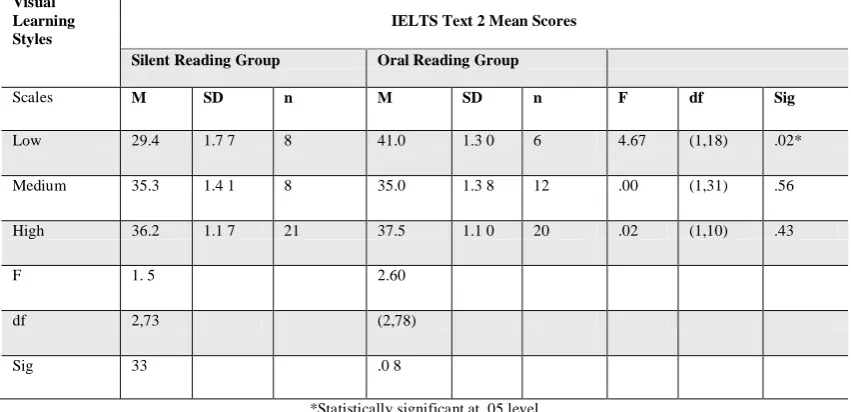
Table 4 shows an ANCOVA analysis between visual learning style and the two reading strategies employed with the more difficult IELTS reading passage. Results showed that low visual learners are doing oral reading of the difficult passage, they outperformed than the low visual learners in doing the same passage silently with mean scores of 41 and 29.4 for both groups respectively. This difference was statistically significant, F (1, 18) =4.67, p=.02. The medium visual learners, F (1, 31) =0, p>.05 and the high visual learners, F (1,101) =.02,/p>.05 showed no differences in mean scores between the two groups after reading this passage.
TABLE 4:
THE ANCOVA OF THE INTERACTION OF VISUAL LEARNING STYLE AND READING STRATEGIES ON THE IELTSTEXT 2
Visual Learning Styles
IELTS Text 2 Mean Scores
Silent Reading Group Oral Reading Group
Scales M SD n M SD n F df Sig
Low 29.4 1.7 7 8 41.0 1.3 0 6 4.67 (1,18) .02*
Medium 35.3 1.4 1 8 35.0 1.3 8 12 .00 (1,31) .56
High 36.2 1.1 7 21 37.5 1.1 0 20 .02 (1,10) .43
F 1. 5 2.60
df 2,73 (2,78)
Sig 33 .0 8
*Statistically significant at .05 level
The mean scores in the table above show that low visual learners in the Oral Reading Group performed better than those in the Silent Reading Group on both easy and difficult passages, but the difference was only significant for the more difficult reading passage; the mean scores within each reading group varied with slightly lower scores for the low visual learners in the silent reading group and higher within the oral reading group. However, these differences were not significant.
B. Auditory Learning Style IELTS Text 1
high auditory learning styles in this group. For the low auditory learners, F(1,29)=2.61,p <.05; for the medium auditory learners, F(1,38)=.00, p>.05; for the high auditory learners, F(1,83)=.03,p > .05.
TABLE 5:
THE INTERACTION OF AUDITORY LEARNING STYLE AND READING STRATEGIES ON IELTSTEXT 1
Auditory Learning Styles
IELTS Text 1 Mean Scores
Silent Oral
Scales M SD N M SD N F df Sig
Low 42.8 1.7 7 8 43.0 1.3 0 9 4.67 (1.18) 1.35
Medium 45.8 1.4 1 14 44.6 1.3 8 13 .00 (1.31) 1.00
High 49.8 1.1 7 15 52.5 1.1 0 16 .02 (1.101) .90
F 1. 5 2.60
df 2,73 (2.78)
Sig 33 .0 4*
Note: Statistically significant at .05 level.
IELTS Text 2
For the group using the silent reading method, there were no differences for the three auditory learning style scales, F (2, 73) =.69, p>.05. However for the group using the oral reading method the students' auditory learning style levels did affect their reading comprehension. Students in this group with high auditory learning style levels performed better in reading comprehension. A further Tukey HSD posthoc test was used to determine if there were any significant differences between each auditory learning style level. Tukey test results revealed that the only statistically significant group differences were detected between the low and high levels (MLow=3.53, MHigh=5.13,p<.05).
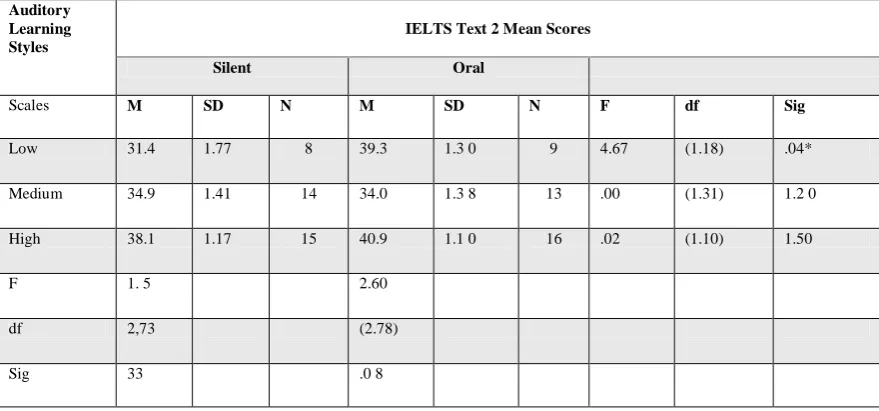
Table 6 shows the interactions between auditory learning style and the two reading methods on the more difficult IELTS reading passage. In this analysis, students in neither of the two reading groups showed any significant difference on their reading comprehension, though the low auditory style readers did better in the Oral Reading Group and the highest scores were for those with high auditory learning styles. For low auditory learners, F(1,29)=.16,p>.05; medium auditory learners, F(1,38)=.13,p>.05; high auditory learners, F(1,83)=1.18,p>.05. For each reading method with the difficult passage, the auditory learning preference did not have a significant impact on their reading comprehension, in the Silent Reading Group, F (2, 73) =2.02, p>.05 and in the Oral Reading Group, F (2, 78) = 2.64, p>.05.
TABLE 6:
THE INTERACTION OF AUDITORY LEARNING STYLE AND READING STRATEGIES ON THE IELTSTEXT 2
Auditory Learning Styles
IELTS Text 2 Mean Scores
Silent Oral
Scales M SD N M SD N F df Sig
Low 31.4 1.77 8 39.3 1.3 0 9 4.67 (1.18) .04*
Medium 34.9 1.41 14 34.0 1.3 8 13 .00 (1.31) 1.2 0
High 38.1 1.17 15 40.9 1.1 0 16 .02 (1.10) 1.50
F 1. 5 2.60
df 2,73 (2.78)
Sig 33 .0 8
Table 7 below summarizes the mean scores for reading comprehension on the easier passage for different combinations of high and low learning scales and results of tests to assess the significance of differences found. In only one case was the difference between the groups, for students in the Oral Reading Group with low scores on both the visual and auditory learning scales.
In many cases, the numbers in the groups for different combinations were very small, and mean scores could be due to the particular score of one or two individuals rather than a generalizable trend. However from an overview of these results in combination with the figures provided in the earlier tables some general conclusions can be drawn.
One result is that low visual learners performed better in the oral reading group regardless of their position on the auditory scale. This is shown in both Table 7 and suggests benefits for comprehension for low visual learners in using oral reading. For students with medium or high positions on the visual learning scale, there were no consistent differences between the silent and oral reading groups. A conclusion from this appears to be that oral reading assists those with low visual learning style, but that particular reading modes are not required for the relative performance of those with medium and high visual learning styles.
TABLE 7
READING COMPREHENSION SCORES ON IELTSPASSAGE 1 FOR DIFFERENT COMBINATIONS OF LEARNING STYLES AND READING MODES
Learning Style Silent Oral
Scales Mean n % Mean n % F df sig
Low Visual Low Auditory 42.8 3 8 45.9 2 5 3.3 10 .02*
Low Visual Medium Auditory 44,3 2 5 46.4 2 5 1.6 8 3.4
Low Visual High Auditory 47.1 2 5 52.2 2 5 3.1 7 1.3
Medium Visual Low Auditory 43.8 2 5 44.2 4 10 2.3 6 0.9
Medium Visual Medium Auditory 45.5 4 11 43.8 5 13 6.0 11 2.7
Medium Visual High Auditory 43.9 3 8 49.0 4 10 2.0 9 1.4
High Visual Low Auditory 48.6 3 8 47.1 2 5 3.3 6 1.5
High Visual Medium Auditory 48.8 6 16 47.2 3 8 1.8 8 3.3
High Visual High Auditory 50.8 13 35 50.7 14 37 1.1 18 1.5
Total 46.7 37 100 47.8 38 100
The mean scores for comprehension on the more difficult reading passage shown in Table 8 show the same pattern of results. Although the mean scores are lower the pattern of results is the same The high positions on the auditory learning scales had better comprehension on this passage for all combinations showing a consistent trend, however the differences were not significant. The scores for low visual learners were consistently lower in the Silent Reading Group, but again the differences were not significant so while a general trend could be detected the results must be treated with caution.
TABLE 8
READING COMPREHENSION SCORES ON IELTSPASSAGE 2 FOR DIFFERENT COMBINATIONS OF LEARNING STYLES AND READING MODES
Learning Style Silent Oral
Scales Mean n % Mean n % F df sig
Low Visual Low Auditory 30.4 3 8 39.9 2 5 8.1 8 .09
Low Visual Medium Auditory 32.9 2 5 36.2 2 5 10.2 4 .28
Low Visual High Auditory 35.6 2 5 38.9 2 5 1.7 6 .86
Medium Visual Low Auditory 33.4 2 5 36.7 4 10 2.1 6 2.5
Medium Visual Medium Auditory 35.0 4 11 34.5 5 13 1.4 7 3.3
Medium Visual High Auditory 37.3 3 8 38.6 4 10 7.2 9 2.9
High Visual Low Auditory 34.8 3 8 38.1 2 5 5.1 9 1.8
High Visual Medium Auditory 35.7 6 16 36.1 3 8 2.8 5 1.2
High Visual High Auditory 37.4 13 35 39.3 14 17 3.3 11 5.5
Total 34.5 37 100 37.7 38 100
VII. DISCUSSION
This study explored the relationships between reading strategies, learning styles and reading comprehension for EFL college students. The first research question addressed silent or oral reading strategies and how these reading strategies influence their reading comprehension. The findings showed that overall the different reading strategies did not lead to any statistically significant differences in reading comprehension. In reading the first IELTS reading passage, which was relatively easier than the second, the score for the silent reading group was 46.7 (SD = 1.64) while it was 47.5 (SD = 1.55) for the oral reading group. In reading the second more difficult IELTS passage the mean score in the silent group was 34.5 (SD = 1.37) and 37.3 (SD = 1.20) for the oral reading group. This finding is consistent with research by McCallum, Sharp, Bell, and George's (2004) which found no significant difference between silent and the oral readers. This shows that overall particular reading strategies were not influential factors in enhancing EFL students' reading comprehension.
two reading groups for those with medium or high visual or auditory learning styles, but that those with low visual learning style performed significantly better in the Oral Reading Group. The low visual learners also performed less well than the medium or high visual learners in the silent reading group, but these differences were not statistically significant. The study also considered differences for students with high, medium or low scores for visual and auditory learning styles. Positions on the visual or auditory scales are not mutually exclusive, and it is possible for a person to be high on both, low on both, or high on one and low on the other. This finding is congruent with Brown's findings (2007) in which he concluded that most successful learners have high preferences for both visual and auditory learning styles that they tend to use more frequently.
High auditory style learners who learn better by listening (McCarthy, 1990; Sarasin, 1999) performed better in both reading groups, but the differences were not statistically significant. The egocentric and communicative speech theory proposed by Vygotsky (1986) explain a limitation in their performance. Vygotsky (1986) noticed that compelling auditory learners to read out aloud gets them to focus on pronunciation, syntacto-lexical structures, and micro units in sentences. During this process, readers focus on new vocabulary and syntax, which negatively affects their reading comprehension. (Brown & Palincsar, 1984; Hannon & Daneman, 2007). In the present study, results showed that readers with high auditory learning styles did no better than others and may have failed to understand the texts as they were distracted by oral reading protocols.
The impact of reading strategies for low visual learners was apparent for both reading passages but was only significantly different from the second more difficult IELTS text. Low visual learners in the Oral Reading Group performed better on reading both IELTS texts. This finding suggests that studying a reading text using read-aloud processes is more likely to assist low visual learners with comprehension. Low visual learners' auditory learning levels did not appear to be significant factors in their reading performance.
The finding that those with low visual learning styles are more likely to benefit from oral reading strategies was outstanding. The implication of this finding can be particularly helpful when they study more difficult reading texts. For these students, greater attention can be focused on the skills they require for reading comprehension such as eliciting content knowledge, utilizing strategic competence and employing metacognitive skills. The study suggests that oral reading could be used for these kinds of students for effective reading comprehension with both easy and difficult reading passages - a finding consistent with prior research (Sawyer, 2002). In addition, variations between oral readers and silent readers in visual learning style readers were similar for low auditory learners; low auditory learners did better, but the difference was more pronounced for the more difficult IELTS passage
In summary, this study has shown that reading strategies may have an impact on low visual style learners' reading comprehension. However, for other levels of visual or learning style there is no detectable difference in the effectiveness for comprehension between silent or oral reading. In oral reading, learners' visual preferences was not a significant factor in influencing reading comprehension, and it was a factor only for those with low visual learning style. This outcome means that a majority of readers should be free to apply the reading mode they prefer, but that those with low visual learning style should be encouraged to read aloud.
VIII. PEDAGOGICAL IMPLICATIONS AND RECOMMENDATIONS
EFL reading teachers can benefit by findings from the present study through carefully designing appropriate strategy-based reading instruction that is grounded in learning style and schema theory, and by allowing a diversity of reading modes in the classroom to cater for the needs and styles of learning of a variety of students. To provide for this, teachers should arrange for small group work in reading classes and give their students the opportunity for silent or oral reading depending on their own learning preferences. This arrangement can be done by selecting oral reading activities for low visual learners, particularly on difficult reading texts as this appears to result in better comprehension. It could also be suggested that high auditory learners should be encouraged to read aloud since their scores in this study were consistently (though not significantly) better than lower auditory learners their learning preferences, despite the complications suggested by Vygotski (1986).
Considering learning styles and preferences, using oral reading and silent reading in isolation will not be effective for all types of learners. An instructor may plan oral reading activities especially for low visual EFL learners and for high auditory EFL learners. Otherwise, the EFL teachers can select either silent or oral reading activities for other students. Findings from the present study suggest that EFL learners can take advantage of both silent and oral reading strategies used in combination through cooperative groups. Consequently, reading instructors can be flexible in preplanning a variety of reading strategies to enrich their teaching activities and make them engaging for their students. For example, a reading instructor can obtain information about learners who have similar learning preferences and assign them to teamwork within small cooperative groups to be provided with miscellaneous reading tasks. Then they can be encouraged to employ effective reading strategies thought to be proper for each group, considering their preferred reading strategies.
be flexible in the teaching of reading materials and choosing teaching strategies that are appropriate for their students learning styles.
REFERENCES
[1] Ahmadi, M., Ismail, H. & Abdullah, M. (2013). The Importance of Metacognitive Reading Strategy Awareness in Reading Comprehension. English Language Teaching, 6(10): 235-244.
[2] Aiken, A. (2000). The effects of explicit strategy instruction at the word level in a first-grade process-based classroom. University of Pittsburgh, ProQuest, UMI Dissertations Publishing, 9974398.
[3] Anderson, R. C., Hiebert, E. H., Scott, J. A., & Wilkinson, I. A., (1985). Becoming a nation of readers: The report of the Commission on Reading. National Academy of Education. Champaign, IL: Center for the Study of Reading
[4] Armbruster, B. B., & Wilkinson, A. G. (1991). Silent reading, oral reading, and learning from text. The Reading Teacher, 45, 145-146.
[5] Baumann, J. F., Jones, L. A., & Seifert-Kessell, N. (1993). Using think alouds to enhance children’s comprehension monitoring abilities. The Reading Teacher,47(3) 184-193.
[6] Beaver, M. (2012). Resources and instructional strategies effective middle school science teachers use to improve content area reading skills. Doctoral dissertation. Indiana State University, ProQuest, UMI Dissertations Publishing, 3539339.
[7] Bell, A. (2012). A Formative Study Investigating the Acquisition of Early Reading Skills Among High School English Language Learners Beginning to Read English. Doctoral dissertation. George Mason University, ProQuest, UMI Dissertations Publishing.
[8] Ben-Ari, R., & Kedem-Friedrich, A. (2000). Restructuring heterogeneous classes for cognitive development: Social Interactive Perspective. Instructional Science, 28, 153-167.
[9] Bernhardt, E. B. (1983). Three approaches to reading comprehension in intermediate German. The Modern Language Journal,
67, 111-115.
[10] Brown, H. D. (2007). Principles of language learning and teaching. New York: Pearson Education. [11] Bruner, J. (1996). The culture of education. Cambridge, MA: Harvard University Press.
[12] Butler, K. A. (1988). Learning and teaching style: In theory and practice. Columbia, CT: Learner's Dimension.
[13] Cain, K. (1999). Ways of reading: How knowledge and use of strategies are related to reading comprehension. British Journal of Developmental Psychology, 17,295- 312.
[14] Cid, J. (2009). Using explanatory item response models to examine the impact of linguistic features of a reading comprehension test on English language learners. Doctoral dissertation. Madison University, ProQuest, UMI Dissertations Publishing, 3366261.
[15] Cullinan, B., & Bagert, B. (1996). Reading with your child. Reading is Fundamental. Retrieved May 21th, 2014 from http://www.rif.org/educators/articles/ReadingWithChild.mspx.
[16] Daggett, W. (2003). Achieving reading proficiency for all. Retrieved April 16th, 2015 from http://www.leadered.com/pdf/Reading%20White%20Paper.pdf.
[17] Davis, Z. T. (1981). A comparison of the effectiveness of sustained silent reading and directed reading activity on student's reading achievement. The High School Journal, 72, 46-48.
[18] Dunn, R. (1990). Rita Dunn answers questions on learning styles. Educational Leadership, 48(2), 15-19.
[19] Egan, E. (2014). Interventions for English language learners: Effects of reading recovery on reading achievement. Doctoral dissertation. Northeastern University, ProQuest, UMI Dissertations Publishing, 3681313.
[20] Ellett, R. (2014). The use of Dynamic Indicators of Basic Early Language Skills (DIBELS) and Measures of Academic Progress (MAP) to compare reading proficiency in native English speakers and English language learners. Doctoral dissertation. University of Kansas, ProQuest, UMI Dissertations Publishing, 3621877.
[21] Furay, J. (2014). Evaluation of artificial intelligent techniques to secure information in enterprises. The Artificial Intelligence Review, 42 (4): 1029-1044.
[22] Gardner, H. (1993). Frames of mind: The theory of multiple intelligences. London: Fontana.
[23] Gläser, J. & Laudel, G. (2013). Life With and Without Coding: Two Methods for Early-Stage Data Analysis in Qualitative Research Aiming at Causal Explanations. Forum: Qualitative Social Research, 14 (2), 1-37.
[24] Gough, R B., & Tumner, W. E. (1986). Decoding, reading, and reading disability. Remedial and Special Education, 7, 6-10. [25] Gregorc, A. F. (1985). An adult's guide to style. Columbia, CT: Gregorc Associates, Inc.
[26] Hannon, B., & Daneman, M. (2007). Prospective memory: The relative effects of encoding, retrieval, and the match between encoding and retrieval. Memory, 15, 572-604.
[27] Harb, J. N., Durrant, S. G., & Terry, R. E. (1993). Use of Kolb learning cycle and the 4M AT system in engineering education.
Journal of Engineering Education, 82(2), 70-77.
[28] Hiebert, E., Samuels, S. & Rasinski, T. (2012). Comprehension-Based Silent Reading Rates: What Do We Know? What Do We Need to Know? Literacy Research and Instruction, 51 (2): 110-124.
[29] Janzen, G. (2003). Effects of explaining the reasoning associated with using reading strategies. Reading Research Quarterly, 22, 347-368.
[30] Kuhn, M. R., & Stahl, S. A. (2003). Fluency: A review of developmental and remedial practices. Journal of Educational Psychology, 95(1), 3-21.
[31] Kung, M. (2012). Instructional Reading Level Growth of English-Language Learners over Two Years, According to Initial Word-Reading Ability. Doctoral dissertation. The University of North Carolina at Chapel Hill, ProQuest, UMI Dissertations Publishing, 1518427.
text. Doctoral dissertation. The University of Arizona, ProQuest, UMI Dissertations Publishing, 2013. 3560793.
[34] Leinhardt, G., Zigmond, N., & Cooley, W. W. (1981). Reading instruction and its effects. American Educational Research Journal, 18, 343-361.
[35] Lepke, H. (1977). Discovering student learning styles through cognitive style mapping. In R. Schulz (Ed.), Personalizing foreign language instruction: Learning styles and teaching options. Skokie, 111.: National Textbook Co.
[36] Levin, J., Divine-Hawkins, P., Kerst, S., & Guttan, J. (1974). Individual differences in learning from pictures and words: The development and application of an instrument. Journal of Educational Psychology, 66(4), 464-472.
[37] Logan, G. D. (1997). Automaticity and reading: Perspectives from the instance theory of automatization. Reading and Writing Quarterly: Overcoming Learning Difficulties, 13, 123-148.
[38] Mastropieri, M.A. & Scruggs, T.E. (1997). Best practices in promoting reading comprehension in students with learning disabilities: 1976 to 1996. Remedial & Special Education, 18, 197 - 213.
[39] McCallum, R. S., Sharp, S., Bell, S. M., & George, T. (2004). Silent versus oral reading comprehension and efficiency.
Psychology in the Schools, 41(2), 241-246.
[40] McCarthy, B. (1990). Using the 4MAT system to bring learning styles to schools. Educational Leadership, 48(2), 31-36. [41] McNamara, D. S., Kintsch, E., Butler-Songer, N., and Kintsch, W. (1996). Are good texts always better? Interactions of text
coherence, background knowledge, and levels of understanding in learning from text. Cognition and Instruction, 14 (1), 1-43. [42] Miller, J., & Schwanenflugel, P. J. (2006). Prosody of syntactically complex sentences in the oral reading of young children.
Journal of Educational Psychology, 95(4), 839-843.
[43] Miller, S. D., & Smith, D. E. P. (1985). Differences in literal and inferential comprehension after reading orally and silently.
Journal of Educational Psychology, 77(3), 341-348.
[44] Nist, S. L., & Simpson, M. L. (1996). Developing textbook fluency. Lexington, MA: Heath.
[45] Palinscar, A. & Brown, A. (1984). Reciprocal teaching of comprehension-fostering and comprehension monitoring activities.
Cognition and Instruction, 1 (2), 117-175.
[46] Park, J., Yang, J., & Hsieh, Y. C. (2014). University level second language readers’ online reading and comprehension strategies. Language Learning & Technology, 18 (3), 148–172. Retrieved July 9th 2015, from http://llt.msu.edu/issues/october2014/parkyanghsieh.pdf.
[47] Ploetzner, R., Lowe, R., Schlag, S. (2013). A Systematic Characterization of Cognitive Techniques for Learning from Textual and Pictorial Representations. Journal of Education and Learning, 2 (2): 78-95.
[48] Pressley, M., & Woloshyn, V.E. (Eds.), (1995). Cognitive strategy instruction that really improves children's academic performance. Cambridge MA: Brookline Books.
[49] Pressley, M., & Wharton-McDonald, R. (1997). Skilled comprehension and its development through instruction. School Psychology Review, 26(3), 448-467.
[50] Prior, S. M., & Welling, K. A. (2001). "Read in your head": A Vygotskian analysis of the transition from oral to silent reading.
Reading Psychology, 22(1), 1-15.
[51] Rogoff, B. (1990). Apprenticeship in thinking. New York: Oxford University Press.
[52] SaieghHaddad, E. (2003). Bilingual oral reading fluency and reading comprehension: The case of Arabic/Hebrew (LI) -English (L2) readers. Reading and Writing: An Interdisciplinary Journal, 16, 717-736.
[53] Sarasin, L. C. (1999). Learning style perspectives: Impact in the classroom. Madison, WI Atwood Publishing. [54] Sawyer, R. (2002). Cambridge handbook of the learning sciences. NY: Cambridge University Press.
[55] Schwanenflugel, P. J., Hamilton, A. M., Kuhn, M. R., Wisenbaker, J. M., & Stahl, S. A. (2004). Becoming a fluent reader: Reading skill and prosodic features in the oral reading of young readers. Journal of Educational Psychology, 96(1), 119-129 [56] Sims, R. R., & Sims, S. J. (1995). The importance of learning styles: Understanding the implications for learning, course design,
and education. Westport, CT: Greenwood Press.
[57] Slack, N., & Norwich, B. (2007). Evaluating the reliability and validity of a learning styles inventory: A classroom-based study.
Educational Research, 49(1), 51-63.
[58] Smith, A. (1998). Accelerated learning in practice: Brain-based methods for accelerating motivation and achievement. Stafford, CA: Network Educational Press.
[59] Tong, X. (2015). Cracking the Chinese character: radical sensitivity in learners of Chinese as a foreign language and its relationship to Chinese word reading. Reading and Writing, 28 (2): 159-181.
[60] Vygotsky, L. S. (1986). Thought and langauge. Cambridge, MA: MIT Press.
[61] Woloshyn, V.E., Elliott, A., & Kacho, S. (2001). So what exactly is explicit strategy instruction? A review of eight critical teaching steps. The Reading Professor, 24(1), 66-114.
[62] Wu, K. (2010). The Relationship between Language Learners' Anxiety and Learning Strategy in the CLT Classrooms.
International Education Studies, 3 (1): 174-191.
[63] Yamauchi, K. (2008). Assessment of adult ESL learners' preferable learning styles: Implications for an effective language learning environment. Doctoral dissertation. Marshall University, ProQuest, UMI Dissertations Publishing, 1463073.
[64] Yeh, Y., McTigue, E., Joshi, R. (2012). Moving From Explicit to Implicit: A Case Study of Improving Inferential Comprehension: [1]. Literacy Research and Instruction, 51 (2): 125-142.
[65] Yi-Chin, L., Yu-Ling, L. & Ying-Shao, H. (2014). The Effects of Meta-Cognitive Instruction on Students' Reading Comprehension in Computerized Reading Contexts: A Quantitative Meta-Analysis. Journal of Educational Technology & Society, 17 (4): 186-202.