Citizen CA
Certification Practice statement
OID: 2.16.56.1.1.1.2.2 OID: 2.16.56.1.1.1.2.1
Table of Contents
1
INTRODUCTION
5
1.1
PRELIMINARY WARNING
5
1.1.1
Trusted Entities ruled by this CPS
5
1.1.2
Relationships between entities ruled by this CPS
6
1.2
SCOPE OF THIS CPS
6
1.3
THE CERTIFICATES ON THE BELGIAN ELECTRONIC IDENTITY CARD
7
1.4
RELATIONSHIP OF THIS CPS TO OTHER DOCUMENTS
8
1.5
POSITION OF THE “CITIZEN CA” IN THE
CA HIERARCHY
9
1.6
DOCUMENT NAME AND IDENTIFICATION
11
1.7
PKI PARTICIPANTS
11
1.7.1
Citizen Certification Authority
11
1.7.2
Root Sign Provider
12
1.7.3
Registration Authorities and Local Registration Authorities
12
1.7.4
Card Personalisator
13
1.7.5
Card Initialisator
13
1.7.6
Subscribers
13
1.7.7
Relying Parties
14
1.8
CERTIFICATE USAGE
14
1.9
POLICY ADMINISTRATION
14
1.10
DEFINITIONS AND ACRONYMS
14
2
PUBLICATION AND REPOSITORY RESPONSIBILITIES
15
2.1
ACCESS CONTROL ON REPOSITORIES
15
3
IDENTIFICATION AND AUTHENTICATION
17
3.1
NAMING
17
3.2
INITIAL IDENTITY VALIDATION
17
3.3
IDENTIFICATION AND AUTHENTICATION FOR RE-KEY REQUESTS
17
3.4
IDENTIFICATION AND AUTHENTICATION FOR REVOCATION AND SUSPENSION REQUESTS
17
4
CERTIFICATE LIFE-CYCLE OPERATIONAL REQUIREMENTS
18
4.1
CERTIFICATE APPLICATION
18
4.2
CERTIFICATE APPLICATION PROCESSING
18
4.3
CERTIFICATE ISSUANCE
18
4.4
CERTIFICATE ACCEPTANCE
19
4.5
KEY PAIR AND CERTIFICATE USAGE
19
4.5.1
Citizen duties
19
4.5.2
Relying party duties
19
4.6
CERTIFICATE RENEWAL
20
4.7
CERTIFICATE RE-KEY
20
4.8
CERTIFICATE MODIFICATION
20
4.9
CERTIFICATE REVOCATION AND SUSPENSION
20
4.9.1
Term and Termination of Suspension and Revocation
21
4.10
CERTIFICATE STATUS SERVICES
21
4.11
KEY ESCROW AND RECOVERY
22
5.1
PHYSICAL SECURITY CONTROLS
23
5.2
PROCEDURAL CONTROLS
23
5.3
PERSONNEL SECURITY CONTROLS
24
5.3.1
Qualifications, Experience, Clearances
24
5.3.2
Background Checks and Clearance Procedures
24
5.3.3
Training Requirements and Procedures
24
5.3.4
Retraining Period and Retraining Procedures
24
5.3.5
Job Rotation
24
5.3.6
Sanctions against Personnel
25
5.3.7
Controls of independent contractors
25
5.3.8
Documentation for initial training and retraining
25
5.4
AUDIT LOGGING PROCEDURES
25
5.5
RECORDS ARCHIVAL
26
5.5.1
Types of records
26
5.5.2
Retention period
26
5.5.3
Protection of archive
27
5.5.4
Archive backup procedures
27
5.5.5
Requirements for Time-stamping of Records
27
5.5.6
Archive Collection
27
5.5.7
Procedures to obtain and verify archive information
27
5.6
KEY CHANGEOVER
27
5.7
COMPROMISE AND DISASTER RECOVERY
27
5.8
CSP TERMINATION
28
6
TECHNICAL SECURITY CONTROLS
29
6.1
KEY PAIR GENERATION AND INSTALLATION
29
6.1.1
CA Private Key Generation Process
29
6.1.2
CA Key Generation
29
6.2
KEY PAIR RE-GENERATION AND RE-INSTALLATION
30
6.2.1
CA Key Generation Devices
30
6.2.2
CA Private Key Storage
30
6.2.3
CA Private Key Distribution
31
6.2.4
CA Private Key Destruction
31
6.3
PRIVATE KEY PROTECTION AND CRYPTOGRAPHIC MODULE ENGINEERING CONTROLS
31
6.4
OTHER ASPECTS OF KEY PAIR MANAGEMENT
31
6.4.1
Computing resources, software, and/or data corrupted
31
6.4.2
CA public key revocation
32
6.4.3
Compromise of the CA private key
32
6.5
ACTIVATION DATA
32
6.6
COMPUTER SECURITY CONTROLS
32
6.7
LIFE CYCLE SECURITY CONTROLS
32
6.8
NETWORK SECURITY CONTROLS
33
7
CERTIFICATE AND CRL PROFILES
34
7.1
CERTIFICATE PROFILE
34
7.1.1
Certificate for identification
34
7.1.2
Certificate for digital signature
35
7.1.3
“Citizen CA” Certificate
37
7.3
OCSP PROFILE
39
8
COMPLIANCE AUDIT AND OTHER ASSESSMENT
41
9
OTHER BUSINESS AND LEGAL MATTERS
42
9.1
FEES
42
9.2
LIABILITY
42
9.2.1
Qualified certificates
42
9.2.2 Certificates that can not be considered as qualified certificates
43
9.3
CONFIDENTIALITY OF INFORMATION
43
9.3.1
Disclosure Conditions
44
9.3.2
Privacy of Personal Information
44
9.3.3
Intellectual Property Rights
44
9.4
REPRESENTATIONS AND WARRANTIES
45
9.4.1
Citizen Obligations
45
9.4.2
Relying Party Obligations
45
9.4.3
Citizen Liability towards Relying Parties
46
9.4.4
CA Repository and Web site Conditions of Use
46
9.4.5
CSP Obligations
46
9.4.6
Service Level Measurement
47
9.4.7
Registration Authority Obligations (applicable to RRN)
48
9.4.8
Card manufacturer (CM) obligations
48
9.5
DISCLAIMERS OF WARRANTIES
48
9.5.1
Exclusion of Certain Elements of Damages
49
9.6
TERM AND TERMINATION
49
9.7
INDIVIDUAL NOTICES AND COMMUNICATIONS WITH PARTICIPANTS
49
9.8
SEVERABILITY
49
9.9
AMENDMENTS
49
9.10
DISPUTE RESOLUTION PROCEDURES
49
9.11
GOVERNING LAW
49
9.12
MISCELLANEOUS PROVISIONS
50
10
LIST OF DEFINITIONS
51
1
1
I
I
n
n
t
t
r
r
o
o
d
d
u
u
c
c
t
t
i
i
o
o
n
n
1.1 Preliminary warning
This Certification Practice Statement (further abbreviated to “CPS”) describes the certification practices applicable to the digital certificates issued for Belgian Electronic Identity Cards by the CSP for “Citizen Certification Authority” (CSP). This CPS must be also considered as the Certificate Policy (CP) for the certificates issued by the “Citizen CA” certificate authority.
1.1.1 Trusted Entities ruled by this CPS
Currently the CSP for “Citizen CA” is the “Société Anonyme CERTIPOST”, having its registered offices at 1000 Brussels Centre Monaie, contracted to do this by the Belgian Authorities in quality of the eID project contracting authority, in the following terms:
CERTIPOST assumes the role of Certification Services Provider (“CSP”) in the sense of the Law of 9 July 2001 and of the European Directive 1999/93/EC.
In particular, Certipost is responsible of the “Citizen CA” under a “Framework Agreement” dd. 14 November 2002 (Ref. RRN 006/2001) signed between the NV of public law BELGACOM and the Belgian State and transferred by BELGACOM to CERTIPOST on the 1st July 2004 where
Certipost is responsible as Trusted Technical agent of the factory issuing certificates under the responsibility of a CSP, under specific SLA.
According to this Framework Agreement CERTIPOST agrees to deliver, to publish and to maintain the identification and the signature certificates for the Belgian Electronic Identity Cards and to provide the trust services related to these certificates such as the publication of Certificate Revocation Lists (“CRLs”), the provision of OCSP (“Online Certificate Status Protocol”) services, archival services and services for certificate consultation. In particular, the tasks are limited to the tasks mentioned in lots 2 en 4 of the Bijzonder Bestek RRN 006/2001 and all agreed change requests, with exclusion of post 10 of Lot 2 and post 9 of Lot 4 such as described in the best and final offer accepted by the authorities.
Certipost assumes both the roles of CA and CSP, knowing that the authorities are the CSP responsible for the Belgium Root CA, and bears thus the overall responsibility for the issuing of the certificates.
Next to the CSP, other parties are involved in the project for the Belgian Electronic Identity Cards. The other parties are:
The authorities:
The Registration Authority (“RA”) which, on behalf of the CSP, certifies that a given public key belongs to a given entity (for example, a person) by issuing a digital certificate and signing it with its private key. For the Belgian Electronic Identity Card, the “National Register”, which is a public administration belonging to the Federal Government Agency of Internal Affairs accomplishes the role of “RA”. The National Register delegates most of the actual registration operations to the local population administrative services in the municipalities, so called Local Registration Authorities ("LRA"). On the basis of this process, the RA requests the CA to issue a certificate.
In particular, RA is responsible for (i) the citizens authentication, (ii) the registration of the to be certified data, (iii) the authorization to issue a certificate for a particular citizen, (iv) taking care that citizen’s certificates are stored on the correct citizen eID card and (v) taking care that a citizen receives that precise card he is expected to receive and activate the card in
question only when dully attributed to the correct citizen, (vi) the SRA (Suspension and Revocation Authority): the entity who suspends and/or revokes the certificates in the sense of the 09th July 2001 law.
Card Manufacturer:
The Cards Manufacturer (“CM”) is the company Zetes, contracted to do this by the Belgian Authorities in quality of the eID project contracting authority, in charge of the production, personalisation, initialisation and distribution of the Belgian Electronic Identity Cards and “cartes de séjours”. The CM, who also generates the key pairs, inserts the certificates in these cards. In particular, the tasks are limited to the tasks mentioned in lots1 and 3 of the RRN/006/2001.
1.1.2 Relationships between entities ruled by this CPS
The relationship between CERTIPOST as the “Citizen CA” and the certificate holders, being the Belgian Citizens, is to a large extent governed by the Law of 19 July 1991 regarding the population registers and the identity cards, amended by the law of 25 March 2003, further referred to as “the Law on Identity Cards”. CERTIPOST informs the certificate holders of their rights and obligations through a leaflet that is distributed by the municipality.
The CA, RA and CM have agreed that CERTIPOST will assume the role of CSP and bear all responsibility towards the public.
In conformity with the ETSI 101.456 standard supporting the European Directive (Directive 1999/93/EC of the European Parliament and of the Council of 13 December 1999 on a Community framework for electronic signatures) on electronic signature, Certipost assumes the management of its CSP tasks via a PKI management board encompassing all the required expertise.
By its official participation to the weekly eID project progress meetings, where all the above mentioned parties are dully represented, Certipost gathers all necessary information and asks all relevant questions to these parties in order to perform its CSP responsibility. Issues and questions are analysed within the PKI management board, and if necessary proposition/correction are brought to the progress meeting.
The PKI Management President, toward the eID Steering Committee lead by the Authorities, will escalate any issue that could not be solved by this process. This Steering Committee has the possibility to call external experts to get second advise and bears dispute settlement responsibility.
1.2 Scope of this CPS
A certification practice statement (CPS) is a unilateral declaration of the practices that a Certification Authority complies with when it provides certification services. A CPS is a comprehensive description of how the CA makes its services available. This CPS should only be used within the CA domain1. The CPS aims at delimiting the domain of providing certification
services to the citizens and relying parties2 within the CA domain. This CPS also outlines the
relationship between the Certification Authority (CA) and other Certification Authorities within
1
The CA domain is the area of competence of the CA to provide certification services. This means the CA domain does for instance not include the applications using the certificates, etc.
the Belgian Government PKI hierarchy such as the Belgium Root Certificate Authority (BRCA)3.
It also describes the relationship between the “Citizen CA” and the other organisations involved in the delivery of the certificates for the Belgian Electronic Identity Cards (hereinafter “Citizen Certificates”).
This CPS also provides operational guidelines for all citizens and relying parties, including natural or legal persons in Belgium or abroad. This CPS also provides operational guidelines to other Certification Authorities, such as the BRCA, that belong to the PKI hierarchy of the Belgian State within the legal framework for electronic signatures and electronic identity cards in Belgium. Moreover, this CPS describes the relationships between the “Citizen CA” and all other entities playing a role in the context of the Belgian Electronic Identity Card, such as the Card Personalisator or the Card Initialisator. The Belgian State acquires these services through appropriate agreements concluded with these third party suppliers. Finally, in an accreditation and supervisory perspective this CPS provides guidance to supervising authorities, accreditation bodies, accredited auditors etc. with regard to the practices of the “Citizen CA”. This “Citizen CA CPS” endorses and implements the following standards:
• RFC 2527: Internet X.509 Public Key Infrastructure – Certificate Policies and Certification Practices
• RFC 2459: Internet X.509 Public Key Infrastructure - Certificate and CRL Profile.
• RFC 3039: Internet X.509 Public Key Infrastructure - Qualified Certificates Profile.
• RFC 2560: X.509 Internet Public Key Infrastructure - Online Certificate Status Protocol - OCSP
• ETSI TS 101 456: Policy requirements for certification authorities issuing qualified certificates.
• ETSI TS 101 862: Qualified certificate profile.
• ETSI TS 102 042: Policy requirements for certification authorities issuing public key certificates (Normalised level only).
• The ISO 1-7799 standard like on security and infrastructure.
The CPS addresses in detail the technical, procedural and organisational policies and practices of the CA with regard to all certification services it provides and during the complete lifetime of certificates issued by the “Citizen CA”. Together with this CPS other documents related to the certification process in the context of the Belgian Electronic Identity Card may have to be taken into account. These documents will be available through the CA repository at:
http://repository.eid.belgium.be.
This CPS is made available on-line in the Repository of the “Citizen CA” under
http://repository.eid.belgium.be.
The “Citizen CA“ accepts comments regarding this CPS addressed to: “Citizen CA” p/a CERTIPOST, Centre Monaie, B-1000 Brussels
This CPS complies with the formal requirements of Internet Engineering Task Force (IETF) RFC 2527, version 12 July 2001 with regard to format and content. While certain section titles are included according to the structure of RFC 2527, the topic may not necessarily apply in the implementation of the certification services of the “Citizen CA”. Such sections are denoted as “Section not applicable”. Minor editorial changes of RFC 2527 prescriptions have been inserted in this CPS to better adapt the structure of RFC 2527 to the needs of this application domain. Further information with regard to this CPS and the “Citizen CA” can be obtained from the “Citizen CA” p/a CERTIPOST, Centre Monaie, B-1000 Brussels.
1.3 The certificates on the Belgian Electronic Identity Card
The Belgian Law of 19 July 1991 regarding the population registers and the identity cards, amended by the law of 25 March 2003, further referred to as “the Law on Identity Cards”, introduces the Belgian Electronic Identity Card. This new type of identity card (Electronic Identity Card) is based on a smart card that contains information in graphical format printed on the surface of the card as well as information in electronic format in a chip embedded in the
3
The BRCA is the CA that has certified the “Citizen CA”. Trust in the BRCA, automatically implies an implicit trust in the “Citizen CA”.
card. The Law regulates the framework for the issuance and the use of the Electronic Identity Card. This CPS addresses aspects of certification practices within the limits of the Belgian Law. In the accomplishment of its role as a “Citizen CA”, CERTIPOST in the first place has to respect the provisions of the law.
In order to allow citizens that are holders of identity cards to authenticate themselves and to sign electronically, the Electronic Identity Cards contain two types of digital certificates:
• An Identification Certificate: the holder of the Electronic Identity Card can use this certificate to get authenticated in electronic transactions. The authentication certificate contains the identity of the holder and the public key corresponding to the private key, stored on the card for the purpose of an eID user authentication.
• A Qualified Certificate for Electronic Signatures (or E-Signatures): this certificate contains the identity of the holder and the public key corresponding to the private key, stored on the card for the purpose of creating an electronic signature only. This certificate is called Qualified Certificate according to the requirements of the European Directive 99/93/EC. The Electronic Signatures Qualified Certificate is compliant with the provisions of the Belgian Electronic Signatures Law.
State of the art security requirements recommend not using authentication certificates for electronic signing purposes, but instead using a separate qualified certificate for electronic signing purposes. For this reason the Authentication Certificate has not been given the status of a qualified certificate, hence allowing all parties involved to make a clear distinction between the Identification Certificate and the Electronic Signatures Qualified Certificate. The activation of the certificates on the Electronic Identity Card is optional to the citizen. A citizen can hence choose to “activate” the use of the keys and the certificates on his/her identity card, or not. By activating the certificates on his/her electronic identity card, the citizen enters into a contractual relationship with CERTIPOST in its role of CSP for “Citizen CA”. The technology used for the certification services for these certificates is “PKI technology”. PKI (Public Key Infrastructure) is an acronym for a system of Public Key cryptography combined with an Infrastructure that is designed to provide a level of security for communicated and stored electronic information sufficient to justify trust in such information by business, consumers, governments and the courts.
The organisation issuing certificates is called Certification Authority (CA), the organisation in charge of the identification of the person applying for a certificate is called the Registration Authority (RA). In this context the role of the issuer of certificates is assumed by the CERTIPOST. The role of the RA is assumed by the RRN4. However, in the context of the
Belgian Electronic Identity Card, only the RA can request the “Citizen CA” to issue a certificate to a citizen.
The RA does not perform the face-to-face identification of the applicant itself, but delegates this responsibility to Local Registration Authorities (LRAs). In this context the municipalities will act as LRA’s. As such the municipalities will be the interface between the applicants, i.e. the citizens and the RA.
1.4 Relationship of this CPS to other documents
As described above, this CPS is a unilateral declaration to the public in general of the practices that the “Citizen CA” complies with when providing certification services. It is a comprehensive description of how the “Citizen CA” makes its services available.
As will be described in more detail further below, the RRN together with the municipalities acts as the RA within the “Citizen CA” domain to the exclusion of any other. Only the RRN and the municipalities may decide upon the issuance of a certificate under this CPS. The RRN may
4
however appoint one or more third parties to carry out RA tasks within the “Citizen CA” domain.
Only the RRN, the municipalities or the CSP may decide upon the suspension and revocation of a certificate under this CPS.
The relationship between the Belgian State and the “Citizen CA” is regulated in a Framework Agreement. In case of any contradiction between this CPS and the Framework Agreement, priority should be given to the provisions of the Framework Agreement. This CPS does not create additional rights and obligations for the Belgian State, CERTIPOST, ZETES or any other party involved in the issuance and the management of the Belgian Electronic Identity Card. The CPS is primarily intended to further precise the legal and contractual provisions and to inform all interested parties about the practices of the “Citizen CA”.
1.5 Position of the “Citizen CA” in the CA Hierarchy
To use the Belgian Electronic Identity Card to its full extent, it is required to ensure both the citizen’s identity and the identity of the technical infrastructure e.g. the servers that are needed in Belgian State applications. It is, therefore, required to use multiple types of certificates beyond the Citizen Certificates. The “Citizen CA” belongs to a broader domain of Certification Authorities of the Belgian State. To facilitate the building of trust between the various participating Certification Authorities, the Belgian State has set up a CA hierarchy. On the top of this hierarchy, there is a “Belgium Root CA (BRCA)” of which the purpose amongst others is to build trust in the various Certification Authorities within the government domain. The (self- signed) BRCA has certified each of the private keys of the Certification Authorities in the government domain including the “Citizen CA”. By validating the certificate of such a CA, the trust in the BRCA can also be applied to the CA it has certified. To the extent that the BRCA is trusted, an end-user certificate can be trusted as well.
Trust in BRCA within software applications is also ascertained through “root sign” carried out by a third party provider (GLOBALSIGN), whose root has widely been embedded in application software.
The BRCA operates under practices published in a dedicated CPS available at
http://repository.eid.belgium.be.
Trust in the Citizen Certificates can be verified as follows:
1. Trusted path buildingThe Citizen Certificate is checked on whether it has been issued by the “Citizen CA”. Pursuant to
that, the certificate of the “Citizen CA” is checked on whether it has been indeed issued by the
BRCA. When the result of these controls is positive trust from the BRCA can be cascaded via the
“Citizen CA” certificate to the Citizen Certificate.
Verification of the BRCA certificate.
Generally the BRCA certificate is indicated in the application’s certificate store as a trusted certificate. In the unlikely case that an end user is warned that the BRCA certificate is not valid anymore, it is sufficient that the end user removes the BRCA certificate from the certificate store to exclude that domain from its trusted ones to ascertain that this part of the verification fails.
2.
Verification of the “Citizen CA” certificatecan be ascertained by taking the following steps
:
• 2.1 Check of the validity of the “Citizen CA” certificate (e.g. check expiration date)
• 2.2 Check of the status of the “Citizen CA” certificate (e.g. check the suspension or revocation state).5
5
3. Verification of the Citizen Certificate can be ascertained by taking the following steps:
• 3.1 Check of the validity of the Citizen Certificate (e.g. check expiration date).
• 3.2 Check of the status of the Citizen Certificate (e.g. check the suspension or revocation state).
Generally most or all of these operations are performed automatically by the application that uses the certificates requiring minimal or no end user interaction.
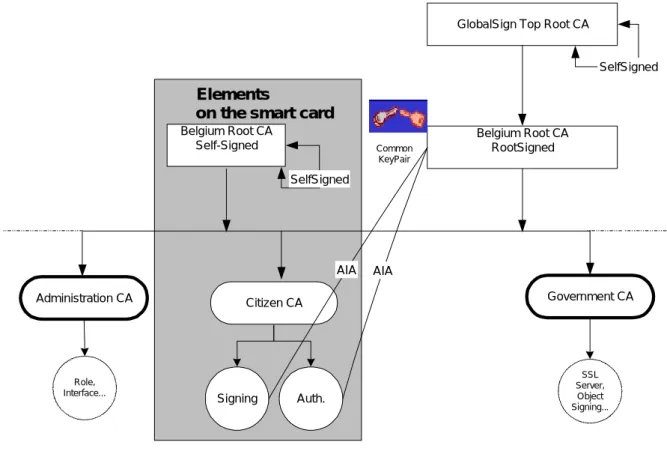
The Trust hierarchy of Citizen Certificates follows the architecture premises below:
1. A small hierarchy for which all the required information to validate the Citizen Certificates off-line
can be stored in the card.
2. A high preference for automated trust in certificates issued by the Belgian State infrastructure
without requiring end-user intervention, for online verification. This more complex hierarchy is
described in figure 1 below.
Figure 1: eID hierarchy
To meet both requirements, the eID hierarchy consists of a combination of a two-layered and a
three-layered model.
Elements
present
on the smart card
Administration CA Citizen CA Government CA
Belgium Root CA Self-Signed
SelfSigned
Common KeyPair
Role,
Interface... Signing Auth.
SSL Server, Object Signing... GlobalSign Top Root CA
Belgium Root CA RootSigned
SelfSigned
AIA AIA
In the two-layered model the “Citizen CA” and the Self-Signed Belgium Root CA
6form a hierarchy,
which in an off-line mode allows validating the eID Citizen signing and identification certificates. In this
model the key of the Belgium Root CA is self-signed. In that case the party that performs the validation
(e.g. Customs Officer, Police Officer, etc.) can use the Self-Signed BRCA certificate from its own
Electronic Identity Card, and use it to validate the “Citizen CA” certificate and Citizen Certificates from
the card to be validated.
In the three-layered model the “Citizen CA”, the Root signed Belgium Root CA and the GlobalSign Root
CA form a hierarchy. In this model the same private key as used for the Self-Signed Belgium Root CA
is this time certified by the Globalsign Root CA. This approach allows the automated validation within
the most widely used applications, e.g. browsers, because these browsers have already embedded the
GlobalSign Top Root CA certificate and they list it as a trusted one. Just as the “Citizen CA” inherits
trust from the BRCA, the BRCA inherits trust from the GlobalSign Root CA. This three-layered model
eliminates the need to individually import the Self-Signed Belgium Root CA certificate.
Because both the Self-Signed Belgium Root CA and the Belgium root signed Root CA share the same
key pair albeit using two different certificates, a certificate signed by the private key of that key pair can
be validated with both Belgium Root certificates.
In most case the application builder will have foreseen one of both models to be used, and the end user
will not have to choose between the two models.
1.6 Document Name and Identification
This CPS can also be identified by any party through the following OIDs7:
• The OID 2.16.56.1.1.1.2.1 for the electronic signature certificate.
• The OID 2.16.56.1.1.1.2.2 for the identification certificate.
1.7 PKI participants
Several parties make up the participants of this PKI hierarchy. The parties mentioned hereunder, including all Certification Authorities, the RA, LRAs (the municipalities), citizens and relying parties are collectively called PKI participants.
1.7.1 Citizen Certification Authority
A Certification Authority is an organisation that issues digital certificates that are used in the public domain or within a business or transactions context. The “Citizen CA” is a Certification Authority.
The “Citizen CA” operates within a grant of authority for issuing Citizen Certificates. This grant has been provided by the Belgium Root Certification Authority (hereinafter, BRCA).
The “Citizen CA” ensures the availability of all services pertaining to the certificates, including the issuing, revocation and status verification, as they may become available or required in specific applications.
The “Citizen CA”, is supervised in application of Article 20 of the Electronic Signatures Law and will be accredited in application of article 17 of the Electronic Signatures Law.
6
A self-signed certificate is a certificate signed with the private key of the certified entity itself. Since there is no trust point higher above in the Trust hierarchy, no trust can be build on that certificate or any of the certificates that are lower in the hierarchy if that self-signed certificate is not trusted. This, however, is a case that very rarely might occur.
7
The “Citizen CA” is established in Belgium. It can be contacted at the address published elsewhere in this CPS. To deliver CA services including the issuance, suspension, revocation, renewal, status verification of certificates, the “Citizen CA” operates a secure facility and provides for a disaster recovery facility in Belgium.
The domain of responsibility of the “Citizen CA” comprises the overall management of the certificate lifecycle including:
• Issuance;
• Suspension/Unsuspension;
• Revocation;
• Status verification (Certificate Status Service);
• Directory service.
1.7.2 Root Sign Provider
The root sign provider ensures trust in BRCA in widely used applications. The root sign provider ensures that its root remains trusted by such applications and notifies the RA of any event affecting trust to its own root. The root sign provider of the BRCA is GLOBALSIGN (www.globalsign.com).
1.7.3 Registration Authorities and Local Registration Authorities
The RRN (National Register) together with the municipalities is the RA within the “Citizen CA” domain to the exclusion of any other. The RRN is established and acts under the provisions of the National Register Law and of the Law on Identity Cards.
Only the RRN and the municipalities can decide upon the issuance of a certificate under this CPS. The RRN may appoint a third party to further carry out RA tasks within the “Citizen CA” domain.
Only the RRN, the municipalities or the CSP may decide upon the suspension and revocation of a certificate under this CPS.
Within the domain of the “Citizen CA” the local administrations or municipalities act as sole designated LRAs. The LRAs register and verify citizen data on behalf of the RA. With regard to registration, LRAs have no direct contact with the “Citizen CA”.
The RA submits the necessary data for the generation and revocation of the certificates to the “Citizen CA”.
The LRAs (the municipalities) directly interact with the citizens to deliver public certification services to the end-user. In specific, the LRAs:
• Send the citizen the convocation letter to invite the citizen to the proper administration location as required, for example when the citizen’s identity card needs replacement;
• Follow all procedures required to complete the base document8. Subsequently the
citizen approves the base document. The LRA then sends the base document data in a secure way to the Card Personalisator so that the certificate request is further processed. The Card Personalisator only issues an identity card following approval of the RA, which is prompted by a request by the Card Personalisator;
• Initiate the process to revoke a certificate and request a certificate revocation from the CA via the RA.;
• Deliver the issued Electronic Identity Cards to the citizen.
The RA interacts indirectly with the citizens and directly with the CA to deliver public certification services to the end-user. In specific, the RA:
8
• Sets up a helpdesk where the holder of the Electronic Identity Card can notify loss, theft or destruction of his Electronic Identity Card when he cannot do this with the municipality or the police. This helpdesk is mentioned hereinafter “the RA Helpdesk”;
• Register citizens for certification services;
• Following approval of an application, request the CA to issue a certificate;
• Initiate the process to revoke a certificate and request the CA to revoke or suspend a certificate.
The RA supplies the “Citizen CA” with the necessary data to enable it to construct the certificates. For each certificate the RA supplies the identity of the holder and the serial number of the requested certificate as well as the public key associated with the citizen to be listed in that certificate.
All communications between the LRA, RA and CA regarding any phase of the life cycle of Citizen Certificates is secured with PKI based encryption and signing techniques, to ensure confidentiality and mutual authentication. This includes communications regarding certificate requests, issuance, suspension, un-suspension and revocation.
1.7.4 Card Personalisator
The Card Personalisator customises non-personalised smart cards to personalised Electronic Identity Cards by printing the citizen identity data and photograph on the card. The Card Personalisator is also responsible to send these personalised cards in a secure way to the Card Initialisator. The role of Card Personalisator is currently accomplished by the S.A. ZETES9 in
execution of a Framework Agreement with the Belgian State.
1.7.5 Card Initialisator
The Card Initialisator provides the following services:
• Generation of the key pairs required within the card.
• Storage of both eID Citizen certificates on the card
• Generation of the personal activation codes of the requestor and the municipality, and the initial PIN code of the requestor.
• Loading the active governmental root certificates on the card
• Provision of the Electronic Identity Card to the municipality
• Provision of the personal activation code and PIN code to the requestor
• Recording the data in the Register of Identity Cards.
The role of Card Initialisator is currently accomplished by the S.A. ZETES according to a Framework Agreement with the Belgian State.
1.7.6 Subscribers
The Subscribers of the CA services in the “Citizen CA” domain are citizens who are holder of an Electronic Identity Card with activated certificates according to the Law on Identity Cards. Further in this document, the term subscriber can be substituted by the term “citizen”. These citizens:
• Are identified in both Citizen Certificates;
• Hold the private keys corresponding to the respective public keys that are listed in their respective Citizen Certificates.
9
The citizens have the right to indicate at the beginning of the Electronic Identity Card application process whether they want to use Citizen Certificates. The Electronic Identity Card is delivered to the citizens with Citizen Certificates loaded. For citizens who do not wish to use the Citizen Certificates, these certificates will be revoked.
1.7.7 Relying Parties
Relying parties are entities including natural or legal persons who rely on a certificate and/or a digital signature verifiable with reference to a public key listed in a citizen’s certificate.
To verify the validity of a digital certificate they receive, relying parties must always verify with a CA Validation Service (e.g. OCSP, CRL, delta CRL, web interface) prior to relying on information featured in a certificate.
1.8 Certificate usage
Certain limitations apply to the usage of the certificates on the Electronic Identity Card.
The identification certificates issued by the “Citizen CA” can be used for specific electronic authentication transactions that support accessing web sites and other online content, electronic mail etc., as they will be made available by Belgian public authorities. State of the art security requirements recommend not to use identification certificates for electronic signing purposes. The “Citizen CA” therefore declines all liability towards relying parties in all cases where the Identification Certificate is used in the context of applications allowing the use of the Identification Certificate for the generation of electronic signatures.
1.9 Policy Administration
Policy administration is reserved to the “Citizen CA”, p/a CERTIPOST, Centre Monaie, B-1000 Brussels
1.10 Definitions and acronyms
2
2
P
P
u
u
b
b
l
l
i
i
c
c
a
a
t
t
i
i
o
o
n
n
a
a
n
n
d
d
R
R
e
e
p
p
o
o
s
s
i
i
t
t
o
o
r
r
y
y
R
R
e
e
s
s
p
p
o
o
n
n
s
s
i
i
b
b
i
i
l
l
i
i
t
t
i
i
e
e
s
s
The “Citizen CA” publishes information about the digital certificates it issues in (an) online publicly accessible repository(ies) under the Belgian Internet Domain. The CA reserves its right to publish certificate status information on third party repositories.
The “Citizen CA” retains an online repository of documents where it makes certain disclosures about its practices, procedures and the content of certain of its policies including its CPS, which will be accessible at http://repository.eid.belgium.be. The CA reserves its right to make available and publish information on its policies by any means it sees fit.
PKI participants are notified that the CA may publish information they submit directly or indirectly to the CA on publicly accessible directories for purposes associated with the provision of electronic certificate status information. The CA publishes digital certificate status information in frequent intervals as indicated in this CPS.
The CA sets up and maintains a repository of all certificates it has issued. This repository also indicates the status of a certificate issued.
The CA publishes CRL’s10 at regular intervals at http://crl.eid.belgium.be. The CA publishes
“DeltaCRLs” containing any changes since the publication of the previous CRL or Delta CRL, at regular intervals. Any newly published CRL includes all updates of the delta CRL’s, published until then.
The CA makes available an OCSP11 server at http://ocsp.eid.belgium.be that provides notice
on the status of a certificate, issued by the CA upon request from a relying party, in compliance with IETF RFC 2560. The status of any certificate listed in a CRL or delta CRL, must be consistent with the information, delivered by the OCSP server.
The CA maintains the CRL distribution point and the information on this URL until the expiration date of all certificates, containing the CRL distribution point. Approved versions of documents to be published on the Repository are uploaded within 24 hours.
Due to their sensitivity the CA refrains from making publicly available certain subcomponents and elements of such documents including certain security controls, procedures related with the functioning of inter alia registration authorities, internal security polices etc. Such documents and documented practices are, however, conditionally available to audit to designated parties that the CA owes duty to.
2.1 Access control on repositories
While the “Citizen CA” strives to keep access to its public repository free of charge, it might, within the framework of its contract with the Belgian government, charge for services such as the publication of status information on third party databases, private directories, etc.
The OCSP service, web interface certificate status verification service, the certificate repository and the CRLs and Delta CRLs are publicly available on the CA site on the Internet and are available via the networks of the Belgian Government.
Within the framework of the contract with the Belgian Government, access restrictions to any of these services provided by the “Citizen CA” include:
Through the publicly available interface to the certificate repository, only a single certificate can be delivered per query made by any party except of the RA.
The CA may take reasonable measures to protect against abuse of the OCSP, Web interface status verification and CRL and delta CRL download services. In particular:
The CA may restrict the processing frequency of OCSP requests by a single user to 10 requests per day if the CA can demonstrate that the user is abusing the system. The CA
10A CRL or Certificate Revocation List is a list issued and digitally signed by a CA that includes serial number of revoked and
suspended certificates. Such list is to be consulted by relying parties at all times prior to relying on information featured in a certificate.
11The Online Certificate Status Protocol (RFC 2560) is a real time status information resource used to determine the current
should not restrict the processing of OCSP requests for any party, who, by the nature of its activities, requires frequent OCSP status verification.
The CA may restrict the processing frequency of Web interface certificate status verification requests by a single user to 10 requests per day.
3
3
I
I
d
d
e
e
n
n
t
t
i
i
f
f
i
i
c
c
a
a
t
t
i
i
o
o
n
n
a
a
n
n
d
d
A
A
u
u
t
t
h
h
e
e
n
n
t
t
i
i
c
c
a
a
t
t
i
i
o
o
n
n
3.1 Naming
The rules concerning naming and identification of citizens for citizen certificates are the same as the legal rules applied to naming and identification of citizens on identity cards.
3.2 Initial Identity Validation
The identification of the citizen who applies for an Electronic Identity Card will be done according the procedures and regulations applicable to the delivery of Electronic Identity Cards. The RA specifies a procedure to be implemented by the LRAs.
3.3 Identification and Authentication for Re-key Requests Section not applicable
3.4 Identification and Authentication for Revocation and Suspension Requests
The identification of the citizen who applies for a revocation or suspension of his Citizen Certificates will be done according to the procedures and regulations applicable to the delivery of Electronic Identity Cards.
The identification and authentication of holders wishing the revocation or suspension of their Citizen Certificates will be performed by the entity that receives the request. This can be:
• The municipality;
• The police;
• The helpdesk established by the RA for this purpose.
Subsequently, this entity refers promptly all revocation requests via the RA to the CA. The RA is the single contact point for the CA to obtain a revocation request.
4
4
C
C
E
E
R
R
T
T
I
I
F
F
I
I
C
C
A
A
T
T
E
E
L
L
I
I
F
F
E
E
-
-
C
C
Y
Y
C
C
L
L
E
E
O
O
P
P
E
E
R
R
A
A
T
T
I
I
O
O
N
N
A
A
L
L
R
R
E
E
Q
Q
U
U
I
I
R
R
E
E
M
M
E
E
N
N
T
T
S
S
For all entities within the CSP domain including the LRAs, citizens, relying parties and/or other participants there is a continuous obligation to inform directly or indirectly the RA of all changes in the information featured in a certificate during the operational period of such certificate or of any other fact that materially affects the validity of a certificate. The RA will then take appropriate measures to make sure that the situation is rectified (e.g. ask the CA for the revocation of the existing certificates and the generation of new certificates with the correct data).
The CA issues, revokes or suspends certificates only at the request of the RA or the CSP to the exclusion of any other, unless explicitly instructed so by the RA.
To fulfil its tasks the CSP uses the services of third party agents. Towards the citizens and relying parties the CSP assumes full responsibility and accountability for acts or omissions of all third party agents it uses to deliver certification services.
4.1 Certificate Application
The enrolment process for the citizen to request the certificates is an integral part of the Electronic Identity Card process with its municipality, i.e. the LRA. The LRA implements a procedure for citizen enrolment as provided by the RA.
4.2 Certificate Application Processing
The LRA acts upon a certificate application to validate an applicant’s identity as foreseen in the Electronic Identity Card process. The procedures for the validation of an applicant’s identity are addressed in a dedicated document.
Following a certificate application the LRA either approves or rejects the Electronic Identity Card application, i.e. including the certificate application. If the application is approved, the LRA transmits the registration data to the RA. The RA in its turn either approves or rejects the application.
4.3 Certificate Issuance
Following approval of the certificate application, the RA sends a certificate issuance request to the CA. The CA does not verify the completeness, integrity and uniqueness of the data, presented by the RA, but relies completely on the RA for the correctness of all data. The CA only verifies that the certificate serial number assigned to the certificate request by the RA is indeed a unique serial number that has not yet been used for any other Citizen Certificate, in which case it notifies the RA.
All requests from the RA are granted approval provided that:
• They are validly formatted.
• Use the proper secure communication channel.
• All appropriate verifications have been performed as defined in the CA contract The CA verifies the identity of the RA on the basis of credentials presented.
The CA ensures that the issued certificate contains all data that was presented to it in the request of the RA and especially a serial number assigned to the certificate by the RA.
Following issuance, the CA suspends the certificate. The certificate is thereafter delivered to the RA.
The RA requests the Card Initialisator to load the Citizen Certificates on the Electronic Identity Card. The Card Initialisator delivers securely the Electronic Identity Card with the Citizen Certificates to the LRA.
4.4 Certificate Acceptance
In the presence of the citizen the LRA make the Electronic Identity Card activated in the RA identity database, that citizen identity card until that stage was still in a non activated state. Both the citizen and the RA require the activation data for the card, which has to be supplied by the Card Initialisator in a secure manner. The card can only be activated when using the combined activation data from the RA and the citizen.
It is at the sole discretion of the citizen to choose whether or not to activate his/her Citizen Certificates. Refraining from activating the Citizen Certificates may limit access to certain services provided by the Belgian State as well as other third party providers on the basis of the eID infrastructure in Belgium and abroad.
The certificates activation process requires that an un-suspension request is sent to the CA via the RA. Following activation of the certificates the citizen has to test the Citizen Certificates and validate the Citizen Certificate content. Upon positive validation, the certificate is deemed accepted.
A certificate may be rejected, for inaccurate citizen data, for example.
Objections to accepting an issued certificate are notified via the LRA to the RA in order to requests the CA to revoke the certificates.
4.5 Key Pair and Certificate Usage
The responsibilities relating to the use of keys and certificates include the ones addressed below.
4.5.1 Citizen duties
Unless otherwise stated in this CPS, citizen’s duties include the ones below:
• Refraining from tampering with a certificate.
• Only using certificates for legal and authorised purposes in accordance with the CPS.
• Using a certificate, as it may be reasonable under the circumstances.
• Preventing the compromise, loss, disclosure, modification, or otherwise unauthorised use of their private keys.
4.5.2 Relying party duties
A party relying on a certificate will:
• Validate a certificate by using a CRL, Delta CRL, OCSP or web based certificate validation in accordance with the certificate path validation procedure.
• Trust a certificate only if it has not been suspended or revoked.
4.6 Certificate Renewal
The Citizen Certificates will only be renewed in the case of Electronic Identity Card renewal. As such Citizen Certificate renewal is governed by the same rules as Electronic Identity Card renewal such as described in the applicable laws and royal decrees.
4.7 Certificate Re-key Section not applicable.
4.8 Certificate Modification Section not applicable.
4.9 Certificate Revocation and Suspension
Until acceptance or denial by the citizen, Citizen Certificates remain suspended in an Electronic Identity Card. Initial activation of an Citizen Certificate must take place within one month from its issuance. The RA and LRAs act promptly to comply with this requirement.
To request the suspension or revocation of a certificate, a citizen must contact an LRA, the police, or the RA Helpdesk. While an LRA opening hours are limited, the RA helpdesk is available 24 hours per day, 7 days a week.
The police, LRA or RA Helpdesk requests promptly the suspension of a pair of Citizen Certificates via the RA after:
• Having received notice by the citizen that a suspicion exist that there has been a loss, theft, modification, unauthorised disclosure, or other compromise of the private key of one or both of his Citizen Certificates.
• The performance of an obligation of the LRA under this CPS is delayed or prevented by a natural disaster, computer or communications failure, or other cause beyond the person's reasonable control, and as a result, there is a suspicion that another person’s information is materially threatened or compromised.
• Having received notice by the citizen that there has been a loss, theft, modification, unauthorised disclosure, or other compromise of the private key of one or both of his Citizen Certificates.
• There has been a modification of the information contained in a Citizen Certificate.
• The performance of an obligation of the RA under this CPS is delayed or prevented by a natural disaster, computer or communications failure, or other cause beyond the person's reasonable control, and as a result, another person’s information is materially threatened or compromised.
• Upon request from the RA or the CSP the CA suspends or revokes a pair of Citizen Certificates.
• The RA revokes a pair of suspended certificates after a period of one week if it does not receive notification from the Citizen to un-suspend the certificate.
• Under specific circumstances (e.g. circumvention of a disaster, a CA key comprise, a security breach, …) , the CSP may request suspension and / or revocation of certificates.
The CSP will ask the eID CSP Steering committee the authorisation to perform such revocations. According to the level of emergency, it is however possible that the eID Steering Committee is warned after completion of the process. RA cares that the concerned citizens are warned of such suspension/revocation.
Relying parties must use on line resources that the CA makes available through its repository to check the status of certificates before relying on them. The CA updates OCSP, the Web interface certification status verification service, CRLs and Delta CRLs accordingly. CRLs are updated frequently with minimum intervals of three hours.
The CA grants access to OCSP resources and a web site to which status inquiries can be submitted.
4.9.1 Term and Termination of Suspension and Revocation
Suspension may last for a maximum of seven calendar days in order to establish the conditions that caused the request for suspension. Following negative evidence of such conditions a citizen may request to re-activate (un-suspension of) the Citizen Certificates on the following conditions:
The citizen has ascertained without any doubt that his suspicion that there has been a loss, theft, modification, unauthorised disclosure, or other compromise of the private key of one or both of his Citizen Certificates was incorrect;
No other reasons exist to doubt the reliability and confidentiality of the private keys of both of his Citizen Certificates.
To request the un-suspension of his Citizen Certificates, a citizen must present him self to his/her LRA (his/her municipalities of residence).
The LRA request promptly the un-suspension of a pair of Citizen Certificates via the RA after:
• Having received notice from the citizen that a suspicion that there has been a loss, theft, modification, unauthorised disclosure, or other compromise of the private key of one or both of his Citizen Certificates was undoubtedly incorrect;
• The suspicion has proven undoubtedly incorrect that another person’s information would be materially threatened or compromised due to the fact that the performance of an obligation of the RA under this CPS was delayed or prevented by a natural disaster, computer or communications failure, or other cause beyond the person's reasonable control.
• Upon request from the RA, the CA suspends or revokes a pair of Citizen Certificates. The CA automatically revokes a suspended certificate after a period of one week if it does not receive in the meantime notification from the RA to un-suspend the certificate. The CA notifies the RA of all revocations made.
The CA publishes notices of suspended or revoked certificates in the Repository.
4.10 Certificate Status Services
The CA makes available certificate status checking services including CRLs, Delta CRLs, OCSP and appropriate Web interfaces.
CRL AND DELTA CRLS HTTP://CRL.EID.BELGIUM.BE
A Delta CRL lists additions since the publishing of the last base CRL. A base CRL of a Delta CRL is updated at least in 14 calendar-day intervals.
CRLs and Delta CRLs are signed and time-marked by the CA.
A CRL is issued each 24 hours, at an agreed time. A Delta CRL is issued each 3 hours, according to an agreed time schedule.
The CA makes all CRLs and DeltaCRLs issued in the previous 12 months available on its Website.
OCSP http://ocsp.eid.belgium.be
The CA makes OCSP responses available to the Belgian Public Administration to use them through its own Public Administration networks.
The OCSP service of the “Citizen CA” is cascaded with the OCSP service of the BRCA.
Web interface for status verification service http://status.eid.belgium.be
A simple web interface for status verification services allows a user to obtain status information on a certificate. The CA makes these web interfaces for status verification services available to the Belgian Public Administration for use through and within its own Public Administration networks
Outside windows maintenance, for each calendar month, the total time of unavailability of each of the following CA services, measured in minutes, cumulated over the whole month should not be more than 1.0% of the total number of minutes of that calendar month:
• OCSP certificate status verification as a result of a request by the RRN, a subscriber or a relying party.
• Download of CRL’s or ∆CRL’s over the Internet or the networks of the government
• Web interface certificate status verification service.
The unavailability of the OCSP service, CRL and ∆CRL download service and the Web interface status verification service includes the unavailability of the local infrastructure of the CA, including local servers, networks and firewalls, but does not include the unavailability of (parts of) the Internet and unavailability of local infrastructure of the service requestor.
The CA internally archives the following items, data and documents pertaining to its service:
•
CRL’s and ∆CRL’s. CRL’s and ∆CRL’s are archived for a period of at least 30 years after publishing.4.11 Key Escrow and Recovery
5
5
M
M
A
A
N
N
A
A
G
G
E
E
M
M
E
E
N
N
T
T
,
,
O
O
P
P
E
E
R
R
A
A
T
T
I
I
O
O
N
N
A
A
L
L
,
,
A
A
N
N
D
D
P
P
H
H
Y
Y
S
S
I
I
C
C
A
A
L
L
C
C
O
O
N
N
T
T
R
R
O
O
L
L
S
S
This section describes non-technical security controls used by the ”Citizen CA” and the other PKI partners, to perform the functions of key generation, subject authentication, certificate issuance, certificate revocation, audit, and archival.
5.1 Physical Security Controls
The CSP implements physical controls on its own premises. The CSP operator’s physical controls include the following:
§ The CSP operators secure premises are located in an area appropriate for high-security operations. These premises feature numbered zones and locked rooms, cages, safes, and cabinets.
§ Physical access is restricted by implementing mechanisms to control access from one area of the facility to another or access into high-security zones, such as locating CSP operations in a secure computer room physically monitored and supported by security alarms and requiring movement from zone to zone to be accomplished using a token and access control lists.
§ Power and air conditioning operate with a high degree of redundancy. § Premises are protected from any water exposures.
§ The CSP implements prevention and protection as well as measures against fire exposures.
§ Media are stored securely. Backup media are also stored in a separate location that is physically secure and protected from fire and water damages.
§ To prevent unwanted disclosure of sensitive data waste is disposed of in a secure manner.
§ The CSP implements a partial off-site backup.
The sites of the CSP host the infrastructure to provide the CSP services. The CSP sites implement proper security controls, including access control, intrusion detection and monitoring. Access to the sites is limited to authorized personnel listed on an access control list, which is subject to audit.
Strict access control is enforced to all areas containing highly sensitive material and infrastructure including material and infrastructure pertaining to signing certificates, CRL’s and delta CRL’s, OCSP and archives.
5.2 Procedural Controls
The CSP follows personnel and management practices that provide reasonable assurance of the trustworthiness and competence of the members of the staff and of the satisfactory performance of their duties in the fields of electronic signature-related technologies.
The CSP obtains a signed statement from each member of the staff on not having conflicting interests with the CSP, maintaining confidentiality and protecting personal data.
All members of the staff operating the key management operations, administrators, security officers, and system auditors or any other operations that materially affect such operations are considered as serving in a trusted position.
The CSP conducts an initial investigation of all members of staff who are candidates to serve in trusted roles to make a reasonable attempt to determine their trustworthiness and competence.
Where dual control is required at least two trusted staff members need to bring their respective and split knowledge in order to be able to proceed with the ongoing operation.
The CSP ensures that all actions with respect to the CSP can be attributed to the system of the CSP and the member of the CSP staff that has performed the action.
For critical CSP functions the CSP implements dual control.
The CSP separates among the following discreet work groups:
•
CSP operating personnel that manages operations on certificates.•
Administrative personnel to operate the platform supporting the CSP.•
Security personnel to enforce security measures.5.3 Personnel Security Controls
The CSP implements certain security controls with regard to the duties and performance of the members of its staff. These security controls are documented in a policy and include the areas below.
5.3.1 Qualifications, Experience, Clearances
The CSP performs checks to establish the background, qualifications, and experience needed to perform within the competence context of the specific job. Such background checks include:
• Criminal convictions for serious crimes;
• Misrepresentations by the candidate;
• Appropriateness of references;
• Any clearances as deemed appropriate.
5.3.2 Background Checks and Clearance Procedures
The CSP makes the relevant checks to prospective employees by means of status reports issued by a competent authority, third-party statements or signed self-declarations.
5.3.3 Training Requirements and Procedures
Each CSP party makes available training for their personnel to perform their CSP functions.
5.3.4 Retraining Period and Retraining Procedures
Periodic training updates might also be carried out to establish continuity and updates in the knowledge of the personnel and procedures.
5.3.5 Job Rotation Section not applicable.
5.3.6 Sanctions against Personnel
Each CSP party sanctions personnel for unauthorized actions, unauthorized use of authority and unauthorized use of systems for the purpose of imposing accountability on the CSP personnel, as it might be appropriate under the circumstances.
5.3.7 Controls of independent contractors
Independent CSP subcontractors and their personnel are subject to the same background checks as the CSP personnel. The background checks include:
• Criminal convictions for serious crimes;
• Misrepresentations by the candidate;
• Appropriateness of references;
• Any clearances as deemed appropriate;
• Privacy protection;
• Confidentiality conditions.
5.3.8 Documentation for initial training and retraining
Each CSP party makes available documentation to personnel, during initial training, retraining, or otherwise.
5.4 Audit Logging Procedures
Audit logging procedures include event logging and systems auditing, implemented for the purpose of maintaining a secure environment. The CA implements the following controls: The CA event logging system records events that include but are not limited to:
•
Issuance of a certificate;
•
Revocation of a certificate;
•
Suspension of a certificate;
•
Automatic revocation;
•
Publishing of a CRL or delta CRL.
The CSP audits all event-logging records. Audit trail records contain:
•
The identification of the operation;
•
The date and time of the operation;
•
The identification of the certificate, involved in the operation;
•
The identity of the transaction requestor.
In addition, the CSP maintains internal logs and audit trails of relevant operational events in the infrastructure, including, but not limited to: