TRAUMATIC BRAIN
INJURY
Better DOD and VA
Oversight Can Help
Ensure More
Accurate, Consistent,
and Timely Decisions
for the Traumatic
Injury Insurance
Program
What GAO Found
Why GAO Did This Study
House of Representatives
In 2005, Congress created a traumatic injury insurance benefit program, known as TSGLI, to help servicemembers with traumatic brain injury and other serious injuries with the financial burdens that they and their families face. The Department of Veterans Affairs (VA) administers the program, in collaboration with the Department of Defense (DOD), while the branches of service are responsible for deciding servicemembers’ claims. GAO examined (1) the TSGLI approval rate for traumatic brain injury claimants, and whether DOD and VA have assurance that claims are processed accurately, consistently, and in a timely manner and (2) any challenges servicemembers with traumatic brain injury may have faced in accessing TSGLI benefits, and the extent to which DOD and VA have taken steps to address such challenges. GAO analyzed program data and interviewed DOD and VA officials, servicemembers, and medical professionals.
What GAO Recommends
GAO recommends that DOD and VA (1) implement a quality assurance review process to help ensure that decisions are accurate and consistent within and across the services and (2) take steps to ensure the data required to assess the approval rate for traumatic brain injury and timeliness of the claims process are reliable and comprehensive. DOD and VA generally agreed with our recommendations.
Although VA data show that 63 percent of servicemembers with traumatic brain injury were approved for TSGLI, the actual approval rate may be lower, and DOD and VA lack assurance that claim decisions are accurate, consistent, and timely within and across the branches of service. VA’s data show that 520 of the 821 servicemembers who filed TSGLI claims for traumatic brain injury received benefits. However, the actual approval rate may be lower because VA does not include all denials for traumatic brain injury in its data. In addition, DOD and VA officials told us there is no systematic quality assurance review process to ensure that claim decisions are accurate and consistent within and across the services. Finally, DOD and VA lack reliable data on how long it takes the services to make decisions on traumatic brain injury claims. We identified three major challenges servicemembers with traumatic brain injury have faced and found that DOD and VA have taken a number of steps to address these challenges and expand access to the program. First, while TSGLI is intended as a quick benefit, servicemembers have had difficulties in starting claims soon after their injuries, in part because of a lack of awareness about the program. In response, DOD placed TSGLI staff in 10 of its largest medical treatment facilities to educate servicemembers and help them file claims. Second, the eligibility criteria for traumatic brain injury in place at the time of our review were subjective and unclear, which created some
challenges for servicemembers. The criteria stated that a servicemember with traumatic brain injury must be completely dependent on another person to perform two of six activities of daily living, such as eating or getting dressed. However, medical providers may have differing opinions on whether someone who requires verbal instructions or reminders to perform these activities is considered completely dependent. VA has since clarified that a
servicemember who requires verbal assistance is eligible, but acknowledged that subjectivity still exists in assessing functional ability. Third,
servicemembers with traumatic brain injury have faced challenges in
obtaining medical records to prove that they meet eligibility criteria. VA made a change to the program to allow servicemembers who can document a 15-day hospital stay to be eligible for a minimum benefit. DOD and VA are reviewing all claims that were denied or approved for less than the maximum amount to determine whether servicemembers are now eligible under these changes.
TSGLI Activities of Daily Living Eligibility Criteria for Traumatic Brain Injury
Servicemember is unable to perform the activity if he or she Activities of daily living Needs assistance in bathing or cannot bathe
Is unable to manage and control bowel and bladder functions Needs assistance in getting dressed Needs assistance in eating or is fed intravenously or by feeding tube
Needs assistance to go to and from toilet to relieve bladder or bowel or to perform associated personal
Needs assistance to get in and out of bed or a chair Bathing
Tub, sponge bath, or shower
Dressing Eating Transferring
Continence Toileting
Letter
1Results in Brief 3
Background 5 Traumatic Brain Injury Approval Rates May Be Lower Than 63
Percent, and DOD and VA Lack Assurance That TSGLI Decisions Are Accurate, Consistent, and Timely within and across the
Services 11 Servicemembers with Traumatic Brain Injury Have Faced
Challenges in Initiating Claims and Proving Eligibility for TSGLI Benefits, and DOD and VA Have Taken Steps to Address These
Challenges 18 Conclusions 25
Recommendations for Executive Action 26
Agency Comments and Our Evaluation 26
Appendix I
Objectives, Scope, and Methodology
29Appendix II
Comments from the Department of Defense
33Appendix III
Comments from the Department of Veterans
Affairs
36Appendix IV
GAO Contact and Staff Acknowledgments
40Table
Table 1: TSGLI Schedule of Losses 9
Figures
Figure 1: Description of Activities of Daily Living Criteria for TSGLI 7
Figure 2: Key Steps in the TSGLI Claims Process 11
Figure 3: Traumatic Brain Injury Claims Not Included in VA’s
Figure 4: VA Study on Average Timeliness of Key Steps in the Claims Process from December 1, 2005, to December 31,
2006 17 Figure 5: Comparison of the Previous and Revised TSGLI Claim
Forms for One Activity of Daily Living 22
Abbreviations
DOD Department of Defense
OSGLI Office of Servicemembers’ Group Life Insurance
OTI other traumatic injury
TBI traumatic brain injury
TSGLI Servicemembers’ Group Life Insurance Traumatic Injury Protection Program
VA Department of Veterans Affairs
This is a work of the U.S. government and is not subject to copyright protection in the United States. The published product may be reproduced and distributed in its entirety without further permission from GAO. However, because this work may contain copyrighted images or other material, permission from the copyright holder may be necessary if you wish to reproduce this material separately.
January 29, 2009
The Honorable Darrell Issa Ranking Member
Committee on Oversight and Government Reform House of Representatives
Dear Mr. Issa:
Traumatic brain injury is one of the most common wounds of the current military operations in Afghanistan and Iraq. The nature of these
conflicts—in particular, the widespread use of improvised explosive devices—increases the likelihood that servicemembers will be exposed to incidents such as blasts that can cause a traumatic brain injury, which is defined as an injury caused by a blow or jolt to the head or a penetrating head injury that disrupts the normal function of the brain. In 2008, the RAND Corporation estimated that about 20 percent, or 320,000, of U.S. servicemembers returning from Afghanistan and Iraq suffered some type of traumatic brain injury during their deployment.1
The number of these and other traumatic injuries suffered by servicemembers in the current conflicts led Congress to create the Servicemembers’ Group Life Insurance Traumatic Injury Protection Program, known as TSGLI, in 2005. TSGLI is intended to provide a quick lump sum payment to help address the financial burdens that
servicemembers and their families face as a result of their injury. Benefits are intended to meet servicemembers’ needs after their injuries but before they start receiving veterans’ benefits. For example, the benefits may enable a spouse to leave his or her job and relocate to be with the injured servicemember during treatment and rehabilitation. TSGLI is an insurance benefit attached as a rider to the existing Servicemembers’ Group Life Insurance program. The program is modeled after commercial accidental death and dismemberment policies and covers injuries such as loss of hearing or vision or loss of a limb. However, TSGLI differs from many commercial policies in that it is tailored to meet the needs of
servicemembers by including injuries such as traumatic brain injury.
1
This RAND estimate is based on a survey of a representative sample drawn from the population of all those who have been deployed for Operation Enduring Freedom and Operation Iraqi Freedom. Of the 1,965 respondents, 19.5 percent reported experiencing a probable traumatic brain injury during deployment.
TSGLI benefits range from $25,000 to $100,000, depending on the type and nature of the traumatic injury. As of June 2008, the program had awarded more than $285 million to over 4,600 injured servicemembers. The
Department of Veterans Affairs (VA) is responsible for administering the TSGLI program, in collaboration with the Department of Defense (DOD), while the individual branches of service are responsible for deciding servicemembers’ claims.
Questions have been raised about whether servicemembers with traumatic brain injury have faced challenges in accessing benefits, given that their injuries—which may result in more cognitive than physical impairments— may be more difficult to substantiate than other traumatic injuries, such as amputations. To be eligible for benefits, servicemembers with traumatic brain injury must demonstrate that they were unable to perform two of six activities of daily living, such as bathing or eating, for at least 15
consecutive days because of their injury.
At your request, we reviewed TSGLI as it relates to servicemembers with traumatic brain injury. Specifically, we examined (1) the approval rate of TSGLI claims for traumatic brain injury, and whether DOD and VA have assurance that claims are processed accurately, consistently, and in a timely manner and (2) any challenges servicemembers with traumatic brain injury may have faced in accessing TSGLI benefits, and the extent to which DOD and VA have taken steps to address such challenges.
To develop the information for this report, we analyzed data VA gathered from its contractor, the Office of Servicemembers’ Group Life Insurance, and the services on the number of claimants and the final disposition and timeliness of their claims since the program’s inception. We also reviewed TSGLI enacting legislation, VA and service branch implementing
regulations and guidance, and VA’s year-one review of the program. We interviewed officials from VA, the Office of Servicemembers’ Group Life Insurance, and the services about procedures for verifying their data. In addition, we pulled a random sample of 100 claimants’ claim forms from VA’s contractor’s central database of 8,205 claimants, as of June 30, 2008, to assess the reliability of these data. We found the data were sufficiently reliable to report the total number of claimants and the final disposition of their claims, but we identified a key data limitation for reporting approval rates for traumatic brain injury. We also found the data on the timeliness of some key steps in the claims process to be unreliable. Furthermore, we
explored the procedures that VA, its contractor, and the services have in place to ensure accuracy and consistency of decision making.2
We discussed challenges that servicemembers with traumatic brain injury have faced with DOD and VA officials; service branch TSGLI processing office officials; medical professionals, including officials from the Defense and Veterans Brain Injury Center and the Brain Injury Association of America; and military and veterans’ advocacy groups. We also discussed such challenges with servicemembers and some family members in group settings and individual interviews, medical providers, and service branch TSGLI staff at Brooke Army Medical Center, Fort Sam Houston, Texas; National Naval Medical Center, Bethesda, Maryland; Walter Reed Army Medical Center, Washington, D.C.; and the Polytrauma Rehabilitation Center at the Hunter Holmes McGuire VA Medical Center, Richmond, Virginia. We selected these sites because they represent three of DOD’s larger medical treatment facilities for servicemembers with traumatic brain injury and one of VA’s four designated traumatic brain injury centers. In addition, we conducted telephone interviews with randomly selected servicemembers with traumatic brain injury who have applied for TSGLI and some of their family members. Furthermore, we reviewed data from a customer satisfaction survey of servicemembers who applied for TSGLI benefits, conducted by VA’s contractor, and found these data to be reliable for our purposes. See appendix I for a more detailed description of our scope and methodology.
We conducted this performance audit from January 2008 through January 2009 in accordance with generally accepted government auditing
standards. Those standards require that we plan and perform the audit to obtain sufficient, appropriate evidence to provide a reasonable basis for our findings and conclusions based on our audit objectives. We believe that the evidence obtained provides a reasonable basis for our findings and conclusions based on our audit objectives.
Although VA data show that 63 percent of servicemembers with traumatic brain injury were approved for TSGLI, the actual approval rate may be lower, and DOD and VA lack assurance that claim decisions are accurate, consistent, and timely within and across the services. According to VA
Results in Brief
2
Our review focused on the Air Force, Army, Marine Corps, and Navy because these services represent almost all of the TSGLI claims filed as of June 30, 2008. However, we have included data from Coast Guard claims in our analyses.
data, 520 of the 821 servicemembers claiming a loss due to traumatic brain injury were approved, as of June 2008. However, the actual approval rate may be lower because VA’s data do not include all denials for traumatic brain injury. We also found that there is no systematic quality assurance review process to ensure that claim decisions are accurate and consistent within and across the services, a key internal control activity and a component of other VA benefits programs. In addition, DOD and VA lack reliable, sufficient data for overseeing TSGLI claims. VA’s central database does not capture all key aspects of the claims process, such as the time that it takes the services to make a decision on a claim. VA officials recognized this limitation and began collecting separate timeliness data from the services on a regular basis in 2007. However, the data they have collected since then are unreliable. For example, about one-third of the data on claim processing times that VA provided to us had dates that were missing or out of sequence. Furthermore, the data VA collects from the services do not break out claims by injury. As a result, DOD and VA lack information on how long it takes the services to make decisions on traumatic brain injury claims.
We identified three major challenges that servicemembers with traumatic brain injury have faced—initiating claims, proving that they met eligibility criteria, and providing adequate documentation to support their claims— and DOD and VA have taken a number of steps to address these challenges and expand access to the program for more servicemembers with
traumatic brain injury. First, while TSGLI is intended as a quick benefit, servicemembers, including those with traumatic brain injury, have had difficulties in starting claims soon after their injuries. For example, some servicemembers we interviewed reported that they did not apply
immediately due to the severity of their injuries or a lack of awareness of the program. In response, DOD placed TSGLI staff in 10 of its largest medical treatment facilities to educate servicemembers about the program and help them navigate the claims process. Second, the eligibility criteria in place at the time of our review for loss of activities of daily living were subjective and unclear, which created challenges for servicemembers with traumatic brain injury in proving that they met the criteria. For example, the criteria stated that a servicemember with traumatic brain injury must be completely dependent on another person to qualify for benefits. However, medical providers may have differing opinions on whether a servicemember with a traumatic brain injury who requires verbal
assistance to perform the activities of daily living, such as instructions on how to dress, is considered completely dependent. During the course of our review, VA completed a comprehensive year-one review of the TSGLI program and made changes to the TSGLI claim form and guidance to
clarify that a servicemember who requires verbal assistance is eligible. Third, servicemembers with traumatic brain injury have faced challenges in proving they met the eligibility criteria because they lacked medical documentation with sufficient information on the length of time they were unable to perform activities of daily living. To remedy this problem, VA made a change to the program to allow servicemembers who can
document a 15-day hospital stay to be eligible for the minimum benefit of $25,000. This change will expand access to the program for more
servicemembers with traumatic brain injury as well as those with other traumatic injuries. DOD and VA officials told us they are reviewing all claims that were denied or approved for less than the maximum amount to determine whether the servicemembers are now eligible for an initial or higher TSGLI payment under the clarified guidance for the activities of daily living criteria and the new 15-day hospital stay criterion.
We are making two recommendations to improve management of the TSGLI program and provide greater assurance that injured
servicemembers receive accurate, consistent, and timely treatment. We are recommending that the Secretary of Veterans Affairs work with the Secretary of Defense and the branches of service to implement a systematic quality assurance review process to help ensure that TSGLI benefit decisions are accurate and consistent within and across the services. We are also recommending that the agencies work together to take steps to ensure that the data required to assess approval rates for traumatic brain injury and the timeliness of key steps in the TSGLI claims process are reliable and comprehensive.
We provided a draft of this report to the Department of Defense; the Department of Veterans Affairs; and VA’s contractor, the Office of Servicemembers’ Group Life Insurance. DOD and VA provided written comments, shown in appendixes II and III, respectively, and VA also provided technical comments, that we have incorporated into the report as appropriate. The Office of Servicemembers’ Group Life Insurance
provided oral comments, and we have incorporated them into the report as appropriate. The agencies and the Office of Servicemembers’ Group Life Insurance generally agreed with our recommendations.
Traumatic brain injury can vary greatly in terms of severity—from mild cases that might involve a brief change in mental status, such as being dazed or confused, to severe cases that may involve an extended period of unconsciousness or amnesia after the injury. The Defense and Veterans Brain Injury Center classifies brain injuries as mild, moderate, or severe
based on factors associated with the initial injury, such as the length of time in a coma, rather than on the symptoms or long-term effects. Servicemembers who sustain even a mild traumatic brain injury may experience short-term physical symptoms such as headaches or dizziness, emotional symptoms such as anxiety or irritability, or cognitive
impairments such as difficulty concentrating or sleep disturbances. According to the Defense and Veterans Brain Injury Center, civilian research on brain injury shows that the majority of people with mild traumatic brain injury recover within a few months or a year, but some may experience symptoms related to mild traumatic brain injury months or even years after their injury.3
Servicemembers also may have other physical injuries in addition to a traumatic brain injury or may suffer from the cumulative effects of multiple blasts that can slow or complicate their recovery. Furthermore, some of the symptoms of mild traumatic brain injury—such as irritability and insomnia—are similar to those associated with other conditions, such as post-traumatic stress disorder.
Although understanding of traumatic brain injury has increased among the medical community in recent decades, according to a DOD task force on traumatic brain injury, gaps remain in research on the short- and long-term effects of traumatic brain injury. DOD is currently investing $300 million in more than 170 research grants to study traumatic brain injury and post-traumatic stress disorder. According to DOD, funds will be used to improve the prevention and treatment of traumatic brain injury and
improve the quality of life for people suffering from traumatic brain injury. While the medical community has established mild, moderate, and severe classifications based on the initial characteristics of traumatic brain injuries, the legislation creating the TSGLI program did not base eligibility on these classifications.4
Rather, it based eligibility on brain injuries that result in a loss of functioning, specifically the ability to perform two of six activities of daily living. According to VA, the activities of daily living criteria are used by some commercial insurance industry carriers in their disability and long-term care policies. The activities of daily living are (1) bathing, (2) continence, (3) dressing, (4) eating, (5) toileting, and
3
According to the Defense and Veterans Brain Injury Center, less is known about the nature of combat-related traumatic brain injury and the short- and long-term outcomes for servicemembers, particularly those who suffered brain injuries caused by blasts.
4
(6) transferring in and out of bed or a chair. See figure 1 for a description of these activities.
Figure 1: Description of Activities of Daily Living Criteria for TSGLI
Servicemember is unable to perform the activity if he or she
Activities
of daily living
Needs assistance in
bathing or cannot bathe
Isunable to manage and control bowel
and bladder functions
Needs assistance in getting dressed
Needs assistance in eating or is fed intravenously or
by feeding tube
Needs assistance to go to and from toilet to relieve
bladder or bowel or to perform
associated personal hygiene
Needs assistance to get in and out of
bed or a chair
Bathing
Tub, sponge bath, or shower
Dressing Eating Transferring
Continence Toileting
Sources: GAO analysis of the Department of Veterans Affairs’ TSGLIprocedural guide (August 2007); Art Explosion (images).
In May 2005, Congress created the TSGLI program to provide lump sum payments to traumatically injured servicemembers. According to VA, these payments are intended to provide a short-term benefit during a
servicemember’s recovery period, whereas the VA disability compensation program is designed to meet the long-term financial needs of
servicemembers who lose income-earning potential due to their injuries. The law mandated coverage of certain specific losses, including coma or the inability to perform two of the activities of daily living resulting from traumatic injury to the brain. The law also gave VA the authority to prescribe additional injuries not specifically listed in the law. VA included additional losses by creating an “other traumatic injury” category to cover traumatic injuries that were not specified in the statute. For example, a gunshot wound to the torso could result in multiple injuries that, while not specifically listed in the law, are significant. As with traumatic brain injury, a servicemember must be unable to perform two of six activities of daily living to qualify for benefits under the other traumatic injury category. However, where servicemembers with traumatic brain injury must be unable to perform activities of daily living for at least 15 days to receive a TSGLI benefit, the minimum threshold for servicemembers applying under the other traumatic injury category is 30 days.
Servicemembers who are injured on or after December 1, 2005, the effective date of the program, are eligible to file a claim for a traumatic injury sustained anywhere.5
Servicemembers injured in a combat zone prior to this date but on or after October 7, 2001—the date military operations in Afghanistan began—are eligible to file a retroactive claim.6
In 2008, legislation passed the Senate that included a provision that would eliminate the requirement that the traumatic injury be incurred in a combat zone to be eligible for retroactive benefits. That provision was not included in the bill passed by the House of Representatives in September 2008. The Congressional Budget Office estimated that expanding
retroactive criteria would make an estimated 700 servicemembers eligible for benefits totaling $47 million.
To qualify for a TSGLI payment:
1. The servicemember’s qualifying injury or loss7
must be directly caused by a traumatic event.
2. The traumatic event must occur before midnight on the day that the member separates from the uniformed services.
3. The servicemember’s qualifying injury or loss must occur within 730 days (2 years) of the traumatic event.
4. The servicemember must survive for at least 7 days from the date of the traumatic injury.8
5
All servicemembers paying premiums into the Servicemembers’ Group Life Insurance Program are automatically covered by TSGLI while they are in service. According to the VA’s Performance and Accountability Report for fiscal year 2008, 99 percent of servicemembers were enrolled in the Servicemembers’ Group Life Insurance Program.
6
Servicemembers may be eligible for retroactive benefits if their injuries occurred during this time period while they were deployed outside of the United States on orders in support of Operation Enduring Freedom or Operation Iraqi Freedom or while they were serving in a geographic location that qualified them for the Combat Zone Tax Exclusion.
7
For the purposes of this report, we will primarily use the term injury. However, it is important to note that TSGLI provides compensation for the eligible losses that result from these injuries—such as a loss of hand or foot or, in the case of traumatic brain injury, the loss of the ability to perform activities of daily living—rather than for the injuries themselves.
8
VA officials explained this criterion by noting that TSGLI was not intended to serve as a death benefit, and that requiring claimants to survive at least 7 days preserves this intent.
5. The injury cannot be caused by a mental disorder, mental or physical illness or disease, among other exceptions.9
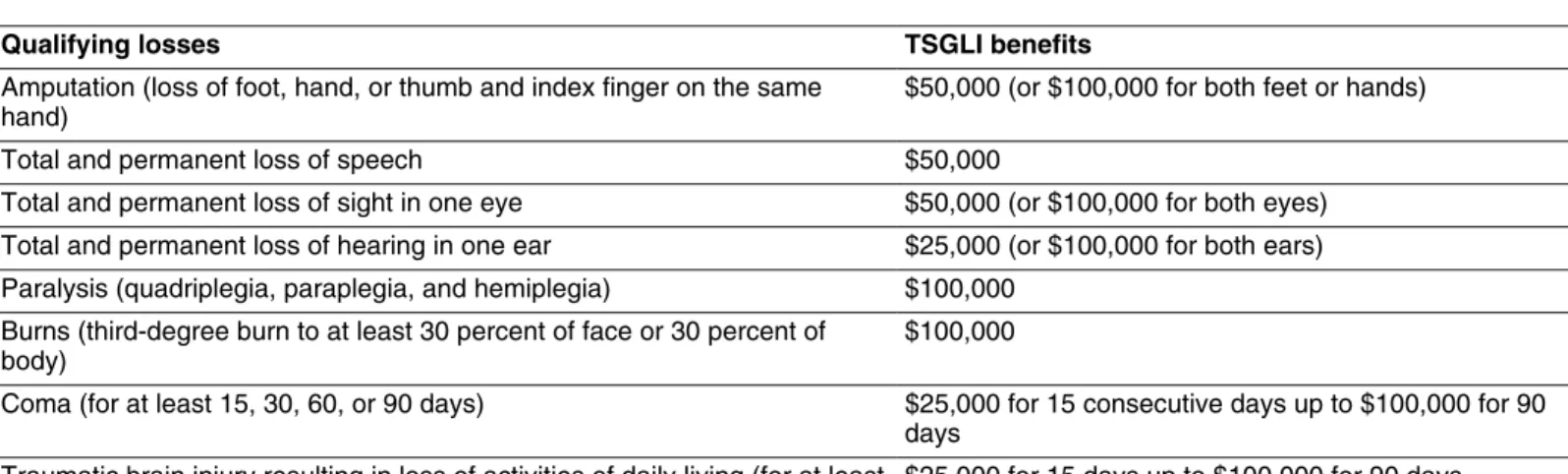
TSGLI provides payments ranging from $25,000 to $100,000, depending on the type and nature of the injury. Servicemembers may be eligible to be paid for injuries under two or more categories, but they may not receive more than a total of $100,000 for injuries resulting from one traumatic event.10
See table 1 for the losses covered by TSGLI at the time of our review.
Table 1: TSGLI Schedule of Losses
Qualifying losses TSGLI benefits
Amputation (loss of foot, hand, or thumb and index finger on the same hand)
$50,000 (or $100,000 for both feet or hands)
Total and permanent loss of speech $50,000
Total and permanent loss of sight in one eye $50,000 (or $100,000 for both eyes) Total and permanent loss of hearing in one ear $25,000 (or $100,000 for both ears) Paralysis (quadriplegia, paraplegia, and hemiplegia) $100,000
Burns (third-degree burn to at least 30 percent of face or 30 percent of body)
$100,000
Coma (for at least 15, 30, 60, or 90 days) $25,000 for 15 consecutive days up to $100,000 for 90 days
Traumatic brain injury resulting in loss of activities of daily living (for at least 15, 30, 60, or 90 days)
$25,000 for 15 days up to $100,000 for 90 days Other traumatic injuries resulting in loss of activities of daily living (for at
least 30, 60, 90, or 120 days)
$25,000 for 30 days up to $100,000 for 120 days
Source: GAO analysis of the Department of Veterans Affairs’ TSGLI procedural guide (August 2007).
9
Injuries caused by a mental disorder, a mental or physical illness or disease—unless caused by a pyogenic (pus forming, often from a wound) infection, biological, chemical, or radiological weapon—or attempted suicide are not covered by TSGLI. Furthermore, injuries sustained while committing or attempting to commit a felony and injuries caused by self-inflicted wounds; medical or surgical treatment of an illness or disease; or willful use of an illegal or controlled substance, unless administered or consumed on the advice of a medical professional, are not covered.
10
For example, a servicemember may have traumatic brain injury causing an inability to perform activities of daily living for 30 days, in addition to an amputation of one foot. If found eligible for TSGLI, he or she would receive $50,000 for traumatic brain injury and $50,000 for the loss of one foot, for a total of $100,000. However, according to TSGLI procedures, a servicemember may not combine payment for an injury under the other traumatic injury category with payment for an injury in another category.
Note: On November 26, 2008, VA published interim final regulations that modified the schedule of losses. Among other changes, VA added a $25,000 TSGLI benefit for a 15-day continuous hospital stay due to traumatic brain injury or other traumatic injuries.
VA’s Insurance Service is responsible for administering the TSGLI program, setting policies and issuing regulations, in collaboration with DOD.11
According to agency officials, one way that DOD and VA regularly coordinate is through monthly conference calls to discuss issues related to program administration.12
VA is responsible for ensuring the financial health of the program, and DOD collects TSGLI premiums—currently $1 per month for servicemembers with full-time coverage through the Servicemembers’ Group Life Insurance program—and forwards them monthly to VA for transfer to the Office of Servicemembers’ Group Life Insurance. DOD, through the branches of service, is responsible for covering costs that exceed premium income due to the extra hazards of military service. The services are responsible for developing and deciding servicemembers’ claims as well as overseeing reconsiderations and appeals.
The Office of Servicemembers’ Group Life Insurance—an office established by a contractor, the commercial life insurance company Prudential—is responsible for paying benefits to servicemembers who are approved and for issuing denial letters to those who are not approved. The Office of Servicemembers’ Group Life Insurance is also responsible for centrally recording data on all TSGLI claims, including reconsiderations and appeals. If a servicemember is not satisfied with the decision, he or she may submit additional medical documentation and request that the claim be reconsidered by the TSGLI office within their branch of service. If still not satisfied with the results of the reconsideration, the
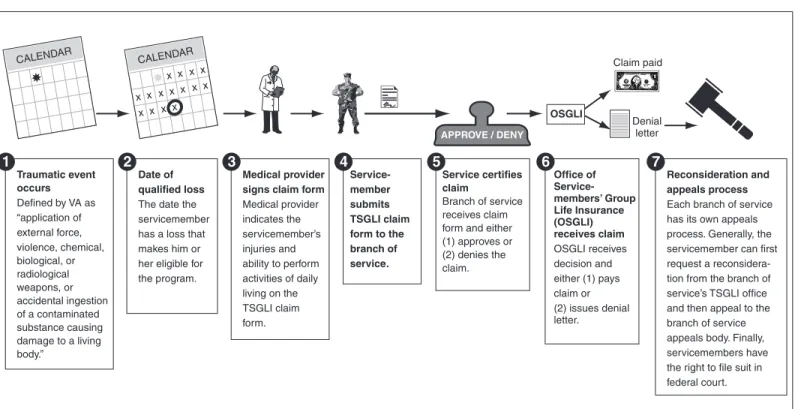
servicemember can appeal the decision to a branch of service appeals body. See figure 2 for an illustration of the key steps in the TSGLI claims process.
11
VA initially began making payments under an interim final rule published in the Federal Register on December 22, 2005. The final rules were published on March 8, 2007 (38 C.F.R. Part 9).
12
According to agency officials, the purpose of these conference calls is to discuss policy issues and unusual cases.
Figure 2: Key Steps in the TSGLI Claims Process
Sources: GAO analysis of the Department of Veterans Affairs’ TSGLIprocedural guide (August 2007); Art Explosion (images).
1
Traumatic event occurs
Defined by VA as
“application of external force, violence, chemical,
biological, or radiological weapons, or
accidental ingestion of a contaminated
substance causing damage to a living
body.”
2
Date of qualified loss
The date the
servicemember hasa loss that makes him or her eligible for the program.
3
Medical provider
signs claim form Medical provider indicates the
servicemember’s
injuriesand
ability to perform
activities of daily living on the TSGLI claim form.
4 S ervice-member
submits
TSGLI claim form to the branch of
service.
5
Service certifies
claim
Branch of service receives claim form and either (1) approves or (2) denies the claim.
6
Office of
S ervice-members’ Group Life Insurance (OSGLI) receives claim OSGLI receives
decision and either (1) pays
claim or (2) issues denial letter.
7
Reconsideration and appeals process
Each branch of service has its own appeals
process. Generally, the
servicemember can first request a reconsidera -tion from the branch of
service’s TSGLI office
and then appeal to the
branch of service
appealsbody. Finally,
servicemembers have the right to file suit in federal court.
CALENDAR CALENDAR
x x x x x x x x x x
x x x x
x
OSGLI
Denial letter Claim paid
APPROVE / DENY
Although VA data show that 63 percent of servicemembers claiming a traumatic brain injury were approved for TSGLI, the actual approval rate may be lower; and DOD and VA lack assurance that claim decisions are accurate, consistent, and timely within and across the services. The actual approval rate for traumatic brain injury claimants may be lower because VA’s data do not include all traumatic brain injury denials. In addition, neither DOD nor VA has a systematic quality assurance review process to ensure that claim decisions are accurate and consistent within and across the services, a key internal control activity and a component of other VA benefits programs. Finally, DOD and VA lack reliable, sufficient data on the timeliness of key steps in the claims process, particularly data on how long servicemembers with traumatic brain injury wait for their benefits after they submit their TSGLI applications.
Traumatic Brain
Injury Approval Rates
May Be Lower Than
63 Percent, and DOD
and VA Lack
Assurance That
TSGLI Decisions Are
Accurate, Consistent,
and Timely within and
across the Services
VA’s data show that 63 percent of servicemembers who filed a TSGLI claim for traumatic brain injury were approved, but the actual approval rate may be lower because of the way that VA tracks its data. According to VA’s data, 821 servicemembers applied for TSGLI benefits for a loss due to traumatic brain injury and 520 (63 percent) were approved, which is higher than the overall TSGLI approval rate of 56 percent. However, these data do not include all traumatic brain injury denials and, as a result, the actual approval rate may be lower.
VA Data Show 63 Percent
of Servicemembers
Claiming a Traumatic
Brain Injury Were
Approved, but the Actual
Approval Rate May Be
Lower
Officials from VA and the contractor that administers the program—the Office of Servicemembers’ Group Life Insurance—told us that they do not include traumatic brain injury claims where, according to the medical provider who signed the claim form, the servicemember did not suffer a loss in his or her ability to perform activities of daily living due to traumatic brain injury. Officials explained that they do not include these claims in their data due to a software limitation—their system will not allow claims to be recorded in the traumatic brain injury category unless the medical provider indicated a loss in at least one of the six activities of daily living. To record these denied claims, VA places them in the other traumatic injury category. We were unable to determine how many denials were not included in the traumatic brain injury category in VA’s data, but we found 4 such denials in our random sample of 100 claims.13
See figure 3 for an illustration of traumatic brain injury claims that were not included in VA’s data.
13
There are other denials for traumatic brain injury that also are not reflected in VA’s central data system because this system only records one claim per claimant and one primary injury category. For example, a previously denied claim for traumatic brain injury may not appear in VA’s data if a later claim for a different injury was approved for that individual. As a result, data may not reflect all servicemembers who claimed a traumatic brain injury. However, officials told us that tracking the number of servicemembers who receive benefits is a better measure of the program’s impact than tracking individual claims.
Figure 3: Traumatic Brain Injury Claims Not Included in VA’s Approval Rate Data
0 100 200 300 400 500 600
Denied Appr
oved
Number of traumatic brain injury claimants
Source: GAO analysis of Department of Veterans Affairs data.
?
Denied traumatic brain injury claimants who were not included in VA’s data
Traumatic brain injury claimants who were included in VA’s data
520
301
Finally, the approval rates in VA’s data reflect final approval rates because they also include claimants who were initially denied, but who were approved on reconsideration or appeal.14
If a servicemember is dissatisfied with the initial decision, he or she can request a reconsideration—a review of the denial or request for a higher benefit award based on new medical documentation—or an appeal. About 40 percent of the requests for a review of the initial decision were eventually approved or awarded a higher amount.
However, VA could not provide much detail on why claims for traumatic brain injury were denied or why decisions were changed upon
reconsideration or appeal. Adjudicators in the services describe why they are denying a claim on the claim form, but VA’s contractor groups these reasons into broad categories in VA’s data system, such as “provisions not
14
met.” As a result, VA has little information across the services on the specific reasons that claims were denied.15
VA’s data also only has a few broad categories to capture the reasons that initial decisions were upheld or reversed. VA officials told us they are improving the level of detail their data will include on the reasons that claims are denied.
DOD and VA Lack
Assurance That TSGLI
Decisions Are Accurate
and Consistent within and
across the Services
Neither DOD nor VA has a systematic quality assurance review process to ensure that claim decisions are accurate and consistent within and across the services. A quality assurance review process is a key internal control activity to ensure proper stewardship of federal resources and a
component of other VA benefits programs.16
For example, VA has a quality assurance review process for its disability compensation program, known as the Systematic Technical Accuracy Review, where VA selects random samples of each of its regional offices’ decisions and assesses their accuracy in processing and deciding such cases. For the TSGLI program, claim forms should be reviewed by at least two staff members within a service’s adjudication office, and VA’s contractor, the Office of
Servicemembers’ Group Life Insurance, performs some checks on the claims before paying them. According to the Office of Servicemembers’ Group Life Insurance, claims examiners check claims for obvious errors but do not review medical documentation to determine the accuracy of the services’ decisions. In addition, 25 percent of claims are selected for an additional check, which involves verifying information such as a servicemember’s name, bank account number, and payment amount.17
These checks have identified some errors, according to VA officials. For example, one servicemember with traumatic brain injury was initially
15
In our limited review of a small sample of claim forms, traumatic brain injury claims were denied due to a lack of medical documentation to support the loss of ability to perform activities of daily living or because the servicemembers’ injuries occurred in a non-combat zone prior to the effective date of the program, December 1, 2005.
16
According to the Standards for Internal Control in the Federal Government, internal control monitoring—one of five internal control activities—should assess the quality of performance over time. Internal controls should generally be designed to ensure that ongoing monitoring occurs in the course of normal operations, including regular management and supervisory activities, comparisons, reconciliations, and other actions people take in performing their duties. See GAO, Standards for Internal Control in the Federal Government, GAO/AIMD-00-21.3.1 (Washington, D.C.: November 1999).
17
VA officials noted that early in the TSGLI program, claims examiners from the Office of Servicemembers’ Group Life Insurance reviewed medical documentation to ensure the claim had been adjudicated properly by the services. However, as of the summer of 2006, claims examiners no longer receive or review medical documentation.
approved by the branch of service and told he would receive a benefit. However, upon receiving the approved claim form, VA’s contractor informed the service that the claim should have been denied because his injury occurred in a non-combat zone 5 months prior to the effective date of the program. The service corrected the error and informed the
servicemember that he was not eligible for the program. While these checks have identified some errors, they do not systematically examine whether the services’ decisions were correct, nor do they assess
consistency within or across the services.
In addition, VA officials noted that the TSGLI approval rates varied across the services, but VA lacked sufficient information to explain these
differences. VA officials attributed the Marine Corps’ higher overall TSGLI approval rate—67 percent compared with Army’s 53 percent approval rate—to the Marine Corps’ use of TSGLI staff in medical treatment
facilities to assist servicemembers in filing their claims. However, without a quality assurance review process, DOD and VA cannot determine
whether differences in approval rates were due to these staff members or to other factors.18
Furthermore, while TSGLI allows servicemembers to request a
reconsideration or appeal, such a process may not identify whether initial claim decisions were accurate or consistent across the services for two reasons. First, not all servicemembers whose claims are denied will request a claim review. Second, neither DOD nor VA use this process to determine whether original decisions were accurate and consistent across the program, because TSGLI officials from the services told us they allow multiple reconsiderations where servicemembers may submit new medical documentation to support their claim.
During our review, VA officials told us that they planned to review a sample of claim decisions and thought they could build an ongoing, systematic quality assurance process out of this review. Officials told us that, based on what they find, they could send out guidance or make recommendations to the services to improve the accuracy and consistency
18
In commenting on our draft report, DOD noted that it believed a comparison of the approval rates before and after placing TSGLI staff in medical treatment facilities would show a significant improvement. However, neither DOD nor VA has conducted such an evaluation that would control for other factors that could have contributed to different approval rates between the two services.
of TSGLI claim decisions. However, VA had not yet performed such a review.
DOD and VA Lack Reliable,
Sufficient Data to Oversee
the Timeliness of the
Claims Process
DOD and VA lack reliable, sufficient data for overseeing the timeliness of the TSGLI claims process for servicemembers with traumatic brain injury, an important tool in monitoring program performance.19
VA officials told us that they initially relied on data collected by their contractor, but they recognized that these data do not include all key aspects of the claim process, such as how long the services take to make decisions on
servicemembers’ claims. As a result, VA requested that the services begin collecting and reporting timeliness data to VA monthly in the spring of 2007. However, we found these data to be unreliable. VA officials acknowledged that there were some problems with the data and stated that about one-third of the data they collected from the services on claim processing times had dates missing or out of sequence. For example, the date the servicemember signed the claim form was prior to the date recorded for the traumatic event that caused the servicemember’s injury. Additionally, neither DOD nor VA can assess whether claims for specific injuries take longer than others to process because the data the services send to VA do not break out claims by injury. VA and TSGLI service branch officials stated that the services are generally able to process claims for amputations faster than claims for traumatic brain injury, which involves an assessment of a servicemember’s ability to perform activities of daily living; however, there are no data to support this observation. Although VA lacks ongoing and reliable timeliness data, the agency provided us with a reliable, point-in-time study of how many days it took to process 238 claims from December 1, 2005, to December 31, 2006. The sample showed that the services took, on average, 35 days to review and make a decision on traumatic brain injury claims, compared with their goal of processing claims within 30 days. During our review, TSGLI officials from each service stated that their average processing time was less than 30 days; however, VA does not have current, reliable data to support this time frame.
19
Government internal control standards require agencies to have internal control activities to help ensure that data on the entire process or life cycle of a transaction are complete and accurate to support decision making. See GAO/AIMD-00-21.3.1.
VA’s study of the first year of the TSGLI program showed that it took about 180 days from the date a servicemember suffered a traumatic brain injury to the date he or she received a benefit or denial letter. As figure 4 shows, the time it took the services to process servicemembers’ claims represented only a small part of this overall time. More than half of this 6-month period elapsed before the services received servicemembers’ claims.
Figure 4: VA Study on Average Timeliness of Key Steps in the Claims Process from December 1, 2005, to December 31, 2006
Loss category
Day
Source: Department of Veterans Affairs, Servicemembers’ Group Life Insurance Traumatic Injury Protection: Year One Review (July 2008).
0 50 100 150 200
All other loss categories
Loss of ADLs due to other traumatic injuries (OTI) Loss of activities of daily living (ADL) due to traumatic brain injury (TBI)
Date of injury to date of qualifying loss (at least 15 days for TBI and 30 days
for OTI)
Date of qualifying loss to date of claimant signature
Date of claimant signature to date of medical provider’ssignature Date of medical provider’ssignature to date of receipt by service branch Date of receipt by service branch to date that service branch completes
review
Date service branch completes review to date of Office of
Servicemembers’ Group Life Insurance (OSGLI) receipt of claim decision Date of OSGLI receipt of claim decision to date that payment or denial was
issued
1.5
0.7
12.0 15.0
30.0 14.3 24.1 18.8
19.5 31.0 34.9
72.7
72.1
18.5 34.8 15.6
57.1
6.5 Total time: 179.7 days
Total time: 146.1 days
Total time: 165.7 days
1.0 5.4
Servicemembers with traumatic brain injury have faced three major challenges to accessing TSGLI benefits—initiating claims, proving that they met eligibility criteria, and providing adequate documentation to support their claims—and DOD and VA have taken a number of steps to address these challenges. For example, DOD has placed TSGLI staff into major medical facilities to assist servicemembers with initiating and filing their claims.
Although TSGLI benefits are intended as a quick, short-term benefit, servicemembers with traumatic injuries, including traumatic brain injury, have faced difficulties in initiating claims soon after their injuries.
Servicemembers and TSGLI staff that we interviewed told us that support from family immediately after a traumatic injury is important for recovery, and that benefits may enable family members to leave their jobs and relocate to stay with the servicemember during his or her treatment or rehabilitation. For example, one servicemember we interviewed told us that the money he received from TSGLI allowed his family to travel with him to three different hospitals, while another servicemember stated that the money helped his mother, who did not work for 3 months to stay with him during recovery. However, within the first year of the TSGLI program, VA estimated it took servicemembers with traumatic brain injury an average of nearly 3 months to initiate a TSGLI claim. Based on interviews we conducted with servicemembers with traumatic brain injury who applied for TSGLI benefits, the time it took after their injury to initiate a claim ranged from 1 week to 11 months.
Servicemembers with
Traumatic Brain
Injury Have Faced
Challenges in
Initiating Claims and
Proving Eligibility for
TSGLI Benefits, and
DOD and VA Have
Taken Steps to
Address These
Challenges
Servicemembers Have
Faced Difficulties in
Initiating Claims, and DOD
Has Placed TSGLI Staff in
Major Medical Facilities to
Assist Them
Servicemembers with traumatic brain injury have experienced three primary difficulties in initiating TSGLI claims, according to VA and service branch TSGLI officials and servicemembers we interviewed. While there may be other reasons servicemembers waited to apply, many
servicemembers did not initiate claims soon after their injuries due to the nature and severity of their traumatic injuries, a lack of awareness of the program, and a lack of assistance in filing the claim.20
For example: • Many servicemembers with traumatic brain injury have had multiple
severe injuries, and they and their families may have initially focused on treatment and recovery, rather than on benefits. For example, one
servicemember we interviewed with a traumatic brain injury told us he did not apply for a TSGLI benefit until more than 2 months after his injury occurred because he was focusing on treating his other injuries—burns to both of his arms.
• Many servicemembers with traumatic brain injury and their families were not aware of TSGLI benefits immediately after the servicemember was injured. One servicemember we interviewed suffered a traumatic brain injury and was in a coma for 3 months due to an automobile accident while on duty in the United States. He spent nearly 8 months in three civilian hospitals and told us he was not aware of the TSGLI program. However, once the servicemember arrived at a VA Medical Center, he told us a TSGLI staff member recognized he would be eligible for benefits and helped him collect medical records from civilian medical providers to support his claim. Many servicemembers learned about TSGLI a month or more after their injury, according to a 2007 VA survey, and often through informal channels like friends or fellow servicemembers.
• Many servicemembers did not have assistance in gathering medical documentation and filling out the claim form. For example, one
servicemember in the National Guard who was taken to a civilian hospital after a car accident in 2007 told us she did not receive assistance in filing her claim and that she had difficulty in gathering medical documentation for the claim. More than half of the servicemembers in VA’s survey did not receive assistance in filing their TSGLI claims. In addition, many of the servicemembers we interviewed, especially those who filed claims for injuries incurred close or prior to the implementation of the program in 2005, did not receive any assistance in initiating their claims.
20
In its Year-One Review of the TSGLI program, VA found that some servicemembers may have delayed applying for TSGLI because it would have prevented them from continuing to receive Combat-related Injury and Rehabilitation Pay. However, Combat-related Injury and Rehabilitation Pay has been replaced by the Pay and Allowances Continuation Program, which is not linked to the receipt of a TSGLI benefit.
DOD has recognized that servicemembers have faced difficulties in initiating TSGLI claims and has placed TSGLI staff in major medical treatment facilities to help raise awareness about the program and help servicemembers navigate the claims process. One major medical treatment facility—National Naval Medical Center in Bethesda,
Maryland—has had in-house Navy and Marine Corps TSGLI staff since early in the program to help servicemembers. TSGLI specialists explain the program’s eligibility criteria, assist servicemembers with traumatic injuries in putting together TSGLI claim packets, and act as advocates for the servicemembers. Although they have not conducted a systematic evaluation, DOD and VA officials have partly attributed the Navy’s and Marine Corps’ higher TSGLI approval rates to this model and
recommended expanding it to other treatment facilities. As a result, DOD has placed TSGLI staff in 10 of its largest medical treatment facilities— such as Brooke Army Medical Center at Fort Sam Houston in Texas and Walter Reed Army Medical Center in Washington, D.C.—to help additional servicemembers navigate the claims process. Several of the
servicemembers we interviewed benefited from the assistance TSGLI staff members provided. For example, the wife of one servicemember who suffered a traumatic brain injury and several other injuries in Iraq was unaware that her husband was eligible but told us a TSGLI staff member came to her husband’s hospital room to inform them about the program and helped them apply for TSGLI.
Some servicemembers with traumatic brain injury are not treated at these major medical treatment facilities and may not benefit from the placement of TSGLI staff, but DOD and VA have proposed steps to provide better outreach to these servicemembers. An Army official told us that servicemembers are increasingly being treated at smaller hospitals, including nonmilitary hospitals, and he has requested additional TSGLI staff to expand their outreach. In addition, during our review, VA completed a comprehensive year-one review of the TSGLI program and proposed several steps to better reach out to servicemembers who may be eligible for the program. For example, VA is exploring using military and VA injury tracking data to periodically identify and notify servicemembers whose injuries may make them eligible for a TSGLI benefit. In addition, VA recently drafted a communications plan, which includes steps such as developing Web-based training and a video on TSGLI as well as revising materials for servicemembers making the transition from military to civilian life and for military and VA staff who assist them.
Servicemembers with traumatic brain injury have faced challenges in proving they met eligibility requirements, because the criteria in place at the time of our review for loss of activities of daily living were subjective and unclear. For a servicemember to qualify for TSGLI with a traumatic brain injury, a medical provider had to certify that the servicemember was completely dependent on another person to perform at least two of the six activities of daily living for at least 15 days. However, these criteria were subject to interpretation by different medical providers because complete dependency on another person was not clearly defined within the TSGLI claim form. For example, medical providers told us that there may be differing opinions on whether servicemembers with traumatic brain injury who require verbal instructions to dress themselves are completely
dependent on another person to perform this activity. Some staff at medical treatment facilities told us that medical providers at their facility would only sign claim forms for loss of activities of daily living if a servicemember was physically dependent on another person. In its year-one review of the TSGLI program, VA acknowledged that the existing guidance on applying the activities of daily living criteria was complicated and subject to different interpretations. As a result, claim decisions could have been inconsistent within and across the services.
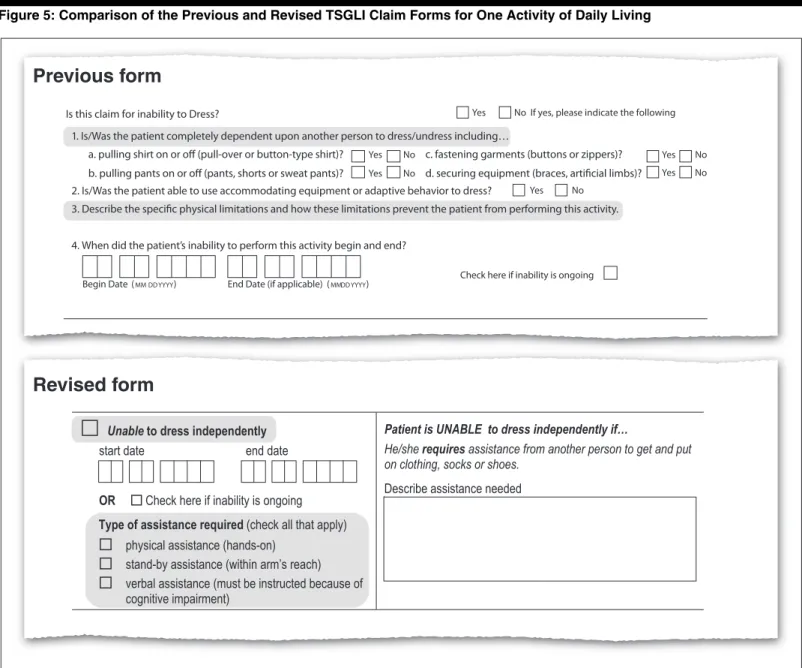
In fall 2008, VA revised the TSGLI claim form and guidance to clarify the criteria for loss of activities of daily living. The form and revised guidance clarify that a servicemember is unable to independently perform an activity of daily living if he or she requires either physical assistance, stand-by assistance,21
or verbal assistance due to a cognitive impairment. See figure 5 for a comparison of the revised claim form and the form in use at the time of our review. Some of the servicemembers we interviewed may now be eligible for benefits with the change in criteria to include stand-by and verbal assistance. For example, one servicemember we interviewed who had a skull fracture and shrapnel in his back from a blast injury in Iraq in 2004 was denied benefits because the service determined he was physically able to perform all of the activities of daily living, despite issues such as nausea and dizziness. However, according to medical documentation, the servicemember is housebound and requires significant assistance from his spouse to perform some activities, such as bathing.
Servicemembers with
Traumatic Brain Injury
Have Faced Challenges in
Proving Their Eligibility
for TSGLI, and VA Has
Revised Guidance and
Criteria to Improve Access
to the Program
21According to VA’s revised TSGLI procedural guide, stand-by assistance is defined as when
a patient requires someone to be within arm’s reach because the patient’s ability fluctuates and physical or verbal assistance may be needed.
Figure 5: Comparison of the Previous and Revised TSGLI Claim Forms for One Activity of Daily Living
Revi
s
ed form
Previou
s
form
Sources: Department of Veterans Affairs, Application for TSGLI Benefits (September 2006 and October 2008).
While this revision to the TSGLI claim form and guidance will help clarify the eligibility criteria, VA acknowledged that there are still inherent difficulties in assessing servicemembers’ ability to perform activities of daily living. According to medical providers we interviewed, assessing whether servicemembers can perform activities of daily living still involves some subjectivity and professional judgment. However, medical providers
told us that the criteria of loss of activities of daily living may be the best available measure for TSGLI benefits because the medical community has not established one objective test to measure a loss of functioning due to traumatic brain injury that could substitute for the current criteria. According to medical providers we interviewed, traumatic brain injury is diagnosed through multiple assessment tools that are subjective in nature, and these tools cannot easily quantify a loss in cognitive functioning because the loss varies on the basis of the individual and the context of the injury. One such assessment tool, a brain scan, may indicate the area of the brain that is damaged but may not correlate to the actual loss of cognitive functioning. For example, a servicemember we interviewed with 35 years of military service sustained a blast injury in Iraq in December 2006 that resulted in a concussion, and a brain scan indicated damage to more than 60 percent of his brain. However, he continued to perform his duties until he was advised to seek medical attention because fellow servicemembers noticed a change in his behavior. As a result of his traumatic brain injury, the servicemember has been in treatment for over 2 years and continues to have symptoms, such as difficulty in speaking and an inability to sequence steps of a process. He is unable to drive and has gotten lost in his own neighborhood. However, he was able to perform the activities of daily living and did not qualify for TSGLI.
Servicemembers with
Traumatic Brain Injury
Have Lacked Adequate
Medical Documentation
for Their TSGLI Claims,
but VA Has Established
an Alternative to Address
This Issue
Servicemembers with traumatic brain injury have faced challenges in proving they met eligibility criteria because they lacked medical
documentation with sufficient information on the length of time they were unable to perform activities of daily living. According to some medical providers and TSGLI staff we interviewed, notes in a servicemember’s medical file may not indicate whether the servicemember was able to perform activities of daily living because such notes are often oriented toward treatment and recovery, rather than documenting the inability to perform certain activities. Medical providers said that occupational therapists may perform assessments of activities of daily living for servicemembers, but that these may only indicate a servicemember’s functional ability at one point in time, rather than at the specified intervals of 15, 30, 60, or 90 days as required by TSGLI. Furthermore, occupational therapy may not occur until after a servicemember’s injuries have been stabilized, which may be after the qualifying period for documenting the inability to perform the activities of daily living as required by TSGLI. In addition, VA and TSGLI officials told us that challenges in documenting loss of activities of daily living may have been greater for servicemembers whose injuries occurred prior to the implementation of the program
because medical providers at major medical facilities may not have routinely documented the loss of activities of daily living. Finally, medical documentation may not have clearly stated that the servicemember’s inability to perform activities of daily living was directly related to his or her traumatic brain injury, although such a link is necessary to establish a servicemember’s eligibility for TSGLI.
VA has recognized that documenting the loss of activities of daily living for traumatic brain injury is difficult, and made a change in the program to create another way for servicemembers to qualify for the minimum TSGLI benefit. In its year-one review of the program, VA stated that a 15-day continuous hospital stay from the time of the traumatic brain injury is equivalent to the first 15 days of the inability to perform activities of daily living. As a result, servicemembers with traumatic brain injury who can document a 15-day hospital stay are now eligible for a TSGLI benefit of $25,000. This change in eligibility criteria, effective in November 2008, expands access to the TSGLI program for servicemembers with traumatic brain injury.22
For example, one of the servicemembers we interviewed had a traumatic brain injury in addition to facial fractures and lacerations due to a blast from an improvised explosive device in Iraq. He was denied for TSGLI because he was able to document the loss of only one activity of daily living—eating—but may qualify under the revised criteria because he told us he was an inpatient for a month at a major medical treatment facility.
DOD and VA officials told us that the services are reviewing all claims that were denied or approved for less than the maximum amount to determine if the servicemembers are now eligible for an initial or higher TSGLI payment under the clarified guidance for the activities of daily living criteria and the revised eligibility criteria. Officials also told us they were exploring options, such as data matches with military and VA injury
tracking systems, to identify servicemembers who never applied for TSGLI but may now be eligible.23
22
This will also expand access to the program for servicemembers with a 15-day hospital stay for other traumatic injuries. The 15-day hospital stay will substitute for the first eligibility period for the other traumatic injury category, which is 30 days.
23
VA officials told us they are conducting data mining with the Joint Patient Tracking and Veterans Tracking Applications to identify veterans who may now be eligible for TSGLI.
Three years after the creation of the TSGLI program, DOD and VA have taken a number of important, proactive steps to improve the program for all servicemembers, including those with traumatic brain injury. DOD and VA efforts to improve program outreach, revise eligibility criteria, and clarify guidance for assessing the inability to perform activities of daily living will help expand access to the program to more servicemembers with traumatic brain injury. However, given the large population of servicemembers with traumatic brain injury, determining who is eligible for TSGLI on the basis of the activities of daily living may continue to present challenges because such assessments involve subjectivity and require adequate, timely documentation of a servicemember’s functional abilities. Furthermore, there is no alternative, objective test to quantify loss of functioning due to traumatic brain injury. The military medical community is still learning about traumatic brain injury and a great deal of research is ongoing that might ultimately bring new tools for measuring traumatic brain injury and understanding its short- and long-term effects on individuals’ lives. This research could prove useful to VA as the agency seeks to continuously improve the TSGLI program for servicemembers with traumatic brain injury.
Conclusions
Without a systematic quality assurance review process, DOD and VA lack information on whether the services are consistently applying the program eligibility criteria and making accurate decisions on servicemembers’ claims. Furthermore, the agencies lack assurance that servicemembers with similar injuries, but in different services, are receiving equitable treatment with respect to the TSGLI program.
In addition, by not addressing a software limitation that excludes some traumatic brain injury denials from its data, VA lacks complete
information on the total universe of traumatic brain injury claimants and the disposition of their claims. Such information is important for
understanding how well the program is working and for making any adjustments to further enhance program performance. Finally, given that the intent of the program is to provide a quick benefit to address
servicemembers’ needs while they recover from their traumatic injuries, timely decisions are important. While the services have goals for reviewing and making decisions on servicemembers’ claims and report they are exceeding these goals, DOD and VA are unable to determine whether they are actually meeting these goals without reliable data. Furthermore, absent timeliness data broken out by type of injury, DOD and VA are unable to determine whether servicemembers with traumatic brain injury are experiencing unnecessary delays. Moreover, without better data, VA
and the services lack a reliable baseline from which to determine whether new initiatives to improve the TSGLI program have the desired effect.
To improve management of the Servicemembers’ Group Life Insurance Traumatic Injury Protection Program (known as TSGLI) and ensure that all injured servicemembers receive accurate, consistent, and timely
treatment, we recommend that the Secretary of Veterans Affairs work with the Secretary of Defense and the branches of service to take the following two actions:
• Implement a systematic quality assurance review process to help ensure that TSGLI benefit decisions are accurate and consistent within and across the services. For example, VA could expand its planned review of a sample of TSGLI claim decisions into a systematic, ongoing quality assurance review process.
• Take steps to ensure that the data required to assess approval rates for traumatic brain injury and the timeliness of key steps in the TSGLI claims process are reliable and comprehensive.
We presented a draft of this report to the Department of Defense; the Department of Veterans Affairs; and VA’s contractor, the Office of Servicemembers’ Group Life Insurance. DOD and VA provided written comments, shown in appendixes II and III respectively, and VA provided technical comments that we have incorporated into the report as
appropriate. The Office of Servicemembers’ Group Life Insurance provided oral comments, and we have incorporated them into the report as appropriate.
DOD concurred with our recommendations. The agency agreed that a quality assurance review process would help to ensure that claim decisions are accurate and consistent, and noted that there is room for improving data on the timeliness of TSGLI claims. While DOD agreed with our recommendation to ensure that the data required to assess approval rates for traumatic brain injury are reliable and comprehensive, the agency cautioned that approval rates may not provide an accurate assessment of the program. DOD noted that, initially, the branches of service encouraged as many servicemembers as possible to apply for TSGLI benefits—even if they may not be eligible—and this practice may have inflated denial rates. DOD also provided some additional comments. DOD noted that it believes a comparison of approval rates before and after placement of TSGLI staff