Tissue Engineering and Regenerative Medicine
Effects of Matrix Metalloproteinases on the
Performance of Platelet Fibrin Gel Spiked With
Cardiac Stem Cells in Heart Repair
DELIANGSHEN,a,*JUNNANTANG,a,b,c,*MICHAELTAYLORHENSLEY,b,cTAOSHENGLI,d THOMASGEORGECARANASOS,eTIANXIAZHANG,bJINYINGZHANG,aKECHENGb,c,f
Key Words. Cardiac stem cellsxPlatelet fibrin gelxMatrix metalloproteinasesxHeart repair
ABSTRACT
Stem cells and biomaterials have been studied for therapeutic cardiac repair. Previous studies have shown the beneficial effects of platelet fibrin gel and cardiac stem cells when cotransplanted into rodent hearts with myocardial infarction (MI). We hypothesized that matrix metalloproteinases (MMPs) play an important role in such protection. Thus, the present study is designed to elucidate the effects of MMP inhibition on the therapeutic benefits of intramyocardial injection of platelet fibrin gel spiked with cardiac stem cells (cell-gel) in a rat model of acute MI. In vitro, broad-spectrum MMP inhibitor GM6001 undermines cell spreading and cardiomyocyte contraction. In a syngeneic rat model of myocardial infarction, MMP inhibition blunted the recruitment of endogenous cardiovascular cells into the injected biomaterials, therefore hindering de novo angiogenesis and cardiomyogenesis. Echocardiography and histology 3 weeks after treatment revealed that metalloproteinase inhibition diminished the functional and structural benefits of cell-gel in treating MI. Reduction of host angio-genesis, cardiomyocyte cycling, and MMP-2 activities was evident in animals treated with GM6001. Our findings suggest that MMPs play a critical role in the therapeutic benefits of platelet fibrin gel spiked with cardiac stem cells for treating MI. STEMCELLSTRANSLATIONALMEDICINE2016;5:793–803
SIGNIFICANCE
In this study, the effects of matrix metalloproteinase inhibition on the performance of platelet gel spiked with cardiac stem cells (cell-gel) for heart regeneration are explored. The results demonstrate that matrix metalloproteinases are required for cell-gel to exert its benefits in cardiac repair. Inhibi-tion of matrix metalloproteinases reduces cell engraftment, host angiogenesis, and recruitment of endogenous cardiovascular cells in rats with heart attack.
INTRODUCTION
Heart disease remains the number one cause of death in developed countries, generating sub-stantial socioeconomic costs [1]. A typical myo-cardial infarction (MI) causes the death of billions of cardiomyocytes and can further de-velop into heart failure. Once failure occurs, only palliative and sympathetic treatment op-tions are available to patients.
Stem cells and biomaterials are promising al-ternatives to conventional pharmacologic thera-pies for therapeutic cardiac repair [2, 3]. Because of their minimally invasive nature, injectable bio-materials are appealing choices to be adminis-tered, alone or blended with stem cells [4, 5]. Numerous injectable biomaterials have been studied for cardiac repair, including fibrin gel [6], collagen [7], self-assembling peptides [8], hydrogel [9], polypropylene [10], and decellularized
myocardium matrix [11]. Among them, platelet fibrin gel (also known as platelet fibrin scaffold) is an appealing choice for therapeutic develop-ment because it can be easily produced from blood as either an allogeneic or autologous product. Car-diac stem cells (CSCs) have been proven to be safe and effective in early phases of clinical trials for treating myocardial infarction [12, 13]. Previous studies from our group showed that injection of platelet gel alone attenuated adverse left ventric-ular remodeling and preserved cardiac function in rats with acute MI [14], whereas injection of platelet gel spiked with CSCs had even better ther-apeutic benefits [15]. It is unclear whether the extra benefits were merely from the addition of cardiac stem cells or complex interactions be-tween the cells and the biomaterial.
Matrix metalloproteinases (MMPs) are a family of structurally related, zinc-containing enzymes that contribute to the degradation of a
Department of Cardiology, First Affiliated Hospital of Zhengzhou University, Zhengzhou, Henan, People’s Republic of China;
b
Department of Molecular Biomedical Sciences and Comparative Medicine Institute, North Carolina State University, Raleigh, North Carolina, USA;cDepartment of Biomedical Engineering, University of North Carolina at Chapel Hill and North Carolina State University, Raleigh, North Carolina, USA; d
Department of Stem Cell Biology, Atomic Bomb Disease Institute, Nagasaki University, Nagasaki, Japan; e
Division of Cardiothoracic Surgery, University of North Carolina at Chapel Hill, Chapel Hill, North Carolina, USA; f
Cyrus Tang Hematology Center, Soochow University, Suzhou, Jiangshu, People’s Republic of China
*
Contributed equally.
Correspondence: Ke Cheng, Ph.D., North Carolina State University, 1060 William Moore Drive, Raleigh, North Carolina 27607, USA. Telephone: 919-513-6157; E-Mail: [email protected] or [email protected]; or Jinying Zhang, Ph.D., M.D., First Affiliated Hospital of Zhengzhou University, No. 1 East of Jianshe Road, Zhengzhou 450052, People’s Republic of China. Telephone: 86-13503830283; E-Mail: [email protected]
Received August 10, 2015; accepted for publication January 13, 2016; published Online First on April 25, 2016.
©AlphaMed Press 1066-5099/2016/$20.00/0
http://dx.doi.org/ 10.5966/sctm.2015-0194
extracellular matrix proteins and connective tissue proteins [16]. MMPs have vital roles in the development, physiology, and pa-thology of the cardiovascular system by acting on cardiovascular remodeling, atherosclerotic plaque formation and plaque insta-bility, vascular smooth muscle cell migration, and restenosis [17]. MMPs also play key roles in extracellular matrix catabolism and activation and inactivation of cytokines, chemokines, growth factors, and other proteinases at the cell surface and within the extracellular matrix. Their activities are tightly regulated in a num-ber of ways, such as transcriptional regulation, proteolytic activa-tion, and interaction with tissue inhibitors of metalloproteinases [18]. In the wound healing response, MMP inhibition has a neg-ative effect on cell phenotype and dynamics [19–21]. In the CSC/platelet fibrin gel (cell-gel) system that we used for cardiac repair, MMPs are likely to play an important role in promoting CSCs to migrate outside of the gel and, conversely, recruiting en-dogenous cardiomyocytes and endothelial cells into the gel. Thus, we hypothesized that MMPs play an essential role in the thera-peutic benefits of cell-gel in cardiac repair. In the present study, we aimed to explore the therapeutic benefits of intramyocardial injection of cell-gel (platelet fibrin gel spiked with CSCs) in a rat model of acute MI with or without the broad-spectrum MMP in-hibitor GM6001.
MATERIALS ANDMETHODS
Derivation of Platelet Fibrin Gel
Platelet fibrin gel was derived from the vein blood of Wistar-Kyoto (WKY) rats [22]. Under deep anesthesia (by inhalation of isoflur-ane), an incision was created at the rat’s abdominal skin, and the vena cava was located. Venous blood (3–5 ml) was drawn from the vena cava. To stop the coagulation cascade, the blood was im-mediately citrated with 10% (vol/vol) 10 mM sodium citrate (Sigma-Aldrich, St Louis, MO, http://www.sigmaaldrich.com), fol-lowed by centrifugation at 1,000gfor 10 minutes and collection of the supernatant (platelet-containing plasma). Whole blood samples were sealed and left at room temperature for a period of 2 hours and placed overnight at 4°C to allow blood cells and blood plasma to fractionate. Samples were then centrifuged at 1,000gfor 10 minutes, and the supernatant was collected. Super-natants were centrifuged for a second time at 1,000gfor 10 min-utes to remove any residual blood cells, and blood plasma was pooled and frozen at220°C. For gel formation, the prewarmed platelet-containing plasma was mixed with prewarmed Dulbec-co’s modified Eagle’s medium (DMEM; Thermo Fisher Scientific Life Sciences, Waltham, MA, http://www.thermofisher.com) at a ratio of 1:1 (vol/vol) and returned to 37°C for∼3–5 minutes (Fig. 1). The calcium in DMEM reinitiates the coagulation process, which leads to the formation of a stable gel.
Derivation of Rat CSCs
CSCs were derived from the hearts of WKY rats using the reported cardiosphere method as previously described [23–27]. Myocardi-al specimens harvested from WKY rats were cut into fragments of ,2 mm3, washed with phosphate-buffered saline, and partially digested with collagenase (Sigma-Aldrich). The tissue fragments were cultured as cardiac explants on a 0.5-mg/ml fibronectin solution–coated surface in Iscove’s modified Dulbecco’s medium (IMDM; Thermo Fisher Scientific Life Sciences) containing 20% fetal bovine serum. A layer of stromal-like cells emerged from
the cardiac explant with phase-bright cells over them. The explant-derived cells were harvested using TryPEL Select (under direct visualization of no more than 5 minutes) (Thermo Fisher Scientific Life Sciences). Harvested cells were seeded at a density of 23104cells/ml in UltraLow Attachment flasks (Corning, Corn-ing, NY, http://www.corning.com) for cardiosphere formation. In ∼3–7 days, explant-derived cells spontaneously aggregated into cardiospheres. The cardiospheres were collected and plated onto fibronectin-coated surfaces to generate cardiosphere-derived CSCs. CSCs were embedded in the scaffold during gel formation to become cell-gel (Fig. 1). The culture was maintained in IMDM (Thermo Fisher Scientific Life Sciences) containing 10% fetal bovine serum.
Cell proliferation, viability, and morphology in the gel were characterized and compared with the control cells cultured on tis-sue culture plates (TCPs). For cell proliferation, 13104rat CSCs were cultured in 1 ml platelet fibrin gel and on TCPs for 7 days. Representative cell cultures were then stained with Live/Dead Viability/Cytotoxicity Kit (Thermo Fisher Scientific Life Sciences) after 12 hours and 3 and 7 days. The number of live cells in three randomized microscopic fields was counted. Cell numbers were normalized to the numbers at 12 hours to generate a cell growth curve. Similarly, for the viability assay, 13104rat CSCs were cul-tured in platelet fibrin gel and on TCPs for 7 days and then stained with the same Live/Dead Viability/Cytotoxicity Kit, based on green fluorescent calcein-AM (live) and red fluorescent ethidium homodimer-1 (dead). Cell morphology was characterized from the same images using ImagePro software.
Culture of Neonatal Rat Cardiomyocytes or
Mononuclear Cells in Cell-Gel With or Without GM6001
To examine the impact of MMP inhibitor GM6001 on cardio-myocytes or bone marrow mononuclear cells (MNCs) cultured in cell-gel, we cultured neonatal rat cardiomyocytes (NRCMs) or MNCs in the cell-gel with GM6001 (EMD Millipore, Darmstadt, Germany, http://www.emdmillipore.com/US/en) or a scrambled control (GM6001 Negative Control [NC]) from the same vendor at a concentration of 20mM. These NRCMs and MNCs were derived from the same strain of WKY rats from which the CSCs were de-rived (Fig. 1), as previously described [28, 29]. The cells were in-cubated at 37°C and 5% CO2. To distinguish between the NRCMs or MNCs and CSCs in the gel, CSCs were prelabeled with green fluorescent DiO and NRCMs or MNCs were stained with red fluorescent CM-DiI (Thermo Fisher Scientific Life Sciences). To evaluate cell-gel degradation under physiological conditions, we measured the thickness of the gel/cell composite over time by determining thezdistance of cell distribution with a confocal microscope.
Release of In Vitro Growth Factors
To study sustained release of growth factors, we collected condi-tioned media at various time points (days 2, 5, 9, and 14), and fresh media was added back into the well to be conditioned for future collection. The concentrations of various growth factors were determined with enzyme-linked immunosorbent assay kits (R&D Systems, Minneapolis, MN, http://www.rndsystems.com).
Animal Models
We used an acute MI model as previously described [30]. Female WKY rats (8–10 weeks old;n= 55) underwent left thoracotomy under general anesthesia, and MI was produced by permanent ligation of the left anterior descending coronary artery. We de-rived platelet fibrin gel and CSCs from WKY rats and intramyocar-dially injected them into the infarcted hearts of syngeneic animals. In general, an apparent infarct area with pale gray color was visible after ligation. The animals were immediately sub-jected to intramyocardial injections with a 29-gauge needle at four sites in the peri-infarct area, according to one of four randomly assigned groups: (a) MI + control: injection of 150ml vehicle (DMEM); (b) MI + cell-gel: injection of 150ml platelet fibrin gel containing 1 million CSCs (75ml host plasma mixed with 75ml prewarmed DMEM containing 1 million CSCs); (c) MI + cell-gel + GM6001: injection of 150ml platelet fibrin gel containing 1 million CSCs plus daily intraperitoneal injections of 50 mg/kg GM6001; and (d) MI + cell-gel + GM6001-NC: injection of 150ml platelet fi-brin gel containing 1 million CSCs plus daily intraperitoneal injec-tions of 50 mg/kg GM6001-NC (Fig. 1).
Heart Morphometric Analysis
Animals were euthanized 3 weeks after various treatments, and the hearts were harvested and prepared for cryosections. Sec-tions every 100mm (10-mm thickness) were prepared and stained with Masson trichrome (six sections per heart, collected at 400-mm intervals) [23]. Images were acquired with a PathScan En-abler IV slide scanner (Advanced Imaging Concepts, Princeton, NJ, http://www.aic-imagecentral.com). From the stained images, morphometric parameters including infarct size, infarct wall thickness, and viable tissue in the risk area were measured using ImageJ software (NIH, Bethesda, MD, http://imagej.nih.gov/ij). Six measurements were averaged for each heart. Respectively, vi-able (normal) tissue and scar (infarct) tissue could be distinguished with red and blue under Masson trichrome staining. To evaluate in-farct thickness, measurements of wall thickness were taken at the thinnest part of the infarction and then averaged (six sections per
heart, collected at 400-mm intervals). Viable tissue, expressed as a percentage of risk region, was calculated by the sum of red area in the risk region (defined with previously published methods [23]). Infarct size was calculated by the sum of blue area and expressed as a percentage of total left ventricular area.
Histology
For immunohistochemistry, heart cryosections were fixed with 4% paraformaldehyde, permeabilized, and blocked with Protein Block Solution (Dako, Carpinteria, CA, http://www.dako.com) containing 1% saponin (Sigma-Aldrich) and then incubated with the following antibodies overnight at 4°C: rabbit anti–von Wille-brand factor (Abcam, Cambridge, MA, http://www.abcam.com), mouse anti–asarcomeric actin (Sigma-Aldrich), rabbit anti-Ki67 (Abcam), or fluorescein isothiocyanate (FITC)-conjugated isolec-tin B4 (Vector Laboratories, Burlingame, CA, http://vectorlabs. com). FITC- or Texas red secondary antibodies were used for de-tection. Images were taken with a confocal microscopy system.
Cardiac Function Assessment
To access cardiac function, blinded echocardiography analysis was performed by a single observer using a Vevo Imaging System (VisualSonics, Toronto, ON, Canada, http://www.visualsonics. com). Light general anesthesia was induced with isoflurane. Two-dimensional long-axis images were recorded from the left caudal (apical) view. left ventricular end diastolic volume (LVEDV) and left ventricular end systolic volume (LVESV) were measured/ calculated from two-dimensional long-axis views taken through the infarcted area. Left ventricular ejection fraction (LVEF) was calculated as (LVEDV–LVESV/LVEDV)3100%.
Tissue Western Blot Analysis
Myocardial samples from the peri-infarct area were collected, lysed, and homogenized. Homogenates were centrifuged at 10,000 relative centrifugal force for 10 minutes on ice,
Figure 1. Study design. CSCs and PFG were harvested from WKY rat hearts and venous blood, respectively. CSCs were embedded in the PFG to form cell-gel. For in vitro studies, neonatal rat cardiomyocytes and BM-MNCs were cultured in cell-gel with or without MMP inhibitor GM6001. In vivo studies involved testing the treatment effects of cell-gel with or without GM6001 in a rat model of myocardial infarction. Abbreviations: BM-MNC, bone marrow mononuclear cell; CSC, cardiac stem cell; MMP, matrix metalloproteinase; PFG, platelet fibrin gel.
supernatants were collected, and protein content was quantified with a BCA Protein Assay (Thermo Fisher Scientific Life Sciences). The equivalent of 15mg total protein per lane was loaded onto 12% Precise Protein gels (Bio-Rad, Hercules, CA, http://www. bio-rad.com) and transferred to polyvinylidene fluoride mem-branes. Membranes were blocked with 5% nonfat milk and incu-bated overnight with primary antibodies against b-actin (Cell Signaling Technologies, Danvers, MA, http://www.cellsignal.com), MMP-2 (Abcam), and MMP-3 (Abcam). Subsequently, the appro-priate horseradish peroxidase-conjugated secondary antibodies were used, and the blots were visualized with SuperSignal West Femto substrate and exposed to the Gel Doc XR System (Bio-Rad). Quantitative analysis was performed with ImageJ software, and expressions were first normalized tob-actin and then to the MI + control group.
Statistical Analysis
All results are presented as mean6SD. Comparisons between any two groups were performed with two-tailed unpaired Stu-dent’sttest, except that statistical significance between baseline and 3-week LVEFs was determined using two-tailed paired Stu-dent’sttest. Comparisons among more than two groups were performed with one-way analysis of variance followed by post hoc Bonferroni correction. Differences were considerd statisti-cally significant whenp,.05.
RESULTS
Characterization of CSCs in Platelet Fibrin Gel
CSCs cultured in platelet fibrin gel exhibited distinct elongated morphology compared with cells cultured on TCPs (Fig. 2A). The proliferation rates of CSCs cultured in the platelet fibrin gel were comparable to those cultured on TCPs (Fig. 2B). The Live/ Dead assay showed that CSCs cultured in platelet fibrin gel had cell viability comparable to those cultured on TCPs (Fig. 2C), whereas MMP inhibitor GM6001 reduced CSC viability in the gel (supplemental online Fig. 1) (p,.05 compared with CSCs treated with GM6001-NC).
Effects of MMP Inhibition on Cardiomyocytes and MNCs Cultured in Cell-Gel
The elongated cell morphology of CSCs in the platelet gel indicates their ability to degrade and soften the surrounding matrix. Mean-while, we have found that the presence of CSCs in platelet fibrin gel promotes cardiomyocyte spreading and contracting. Here we characterized the morphology and function of NRCMs and MNCs cultured in cell-gel (Fig. 3A, 3B) under MMP inhibition. Less spreading of NRCMs or MNCs was confirmed in cell-gel with MMP inhibitor GM6001 (Fig. 3E, 3F) than those in cell-gel with GM6001-NC (Fig. 3C, 3D). Quantitative cell morphology analysis revealed that GM6001 decreased cell body elongation (Fig. 3G) and cardiomyocyte contraction (Fig. 3H) (p,.05). To evaluate the effects of MMP on cell-gel degradation, we measured the thickness of cell-gel over time by confocal microscopy. MMP in-hibition slowed matrix degradation: larger thicknesses were found in cell-gel treated with MMP inhibitor GM6001 at days 7 and 14 (Fig. 3I) (p,.05). Meanwhile, we detected that the release of growth factors (namely vascular endothelial growth factor [VEGF] and insulin-like growth factor 1 [IGF-1]) was persistently
blocked by MMP inhibitor GM6001 (Fig. 3J, 3K) (VEGF and IGF-1,p,.01 on days 2 and 5 andp,.05 on days 9 and 14).
Effects of MMP Inhibition on Recruitment of Endogenous Cells In Vivo
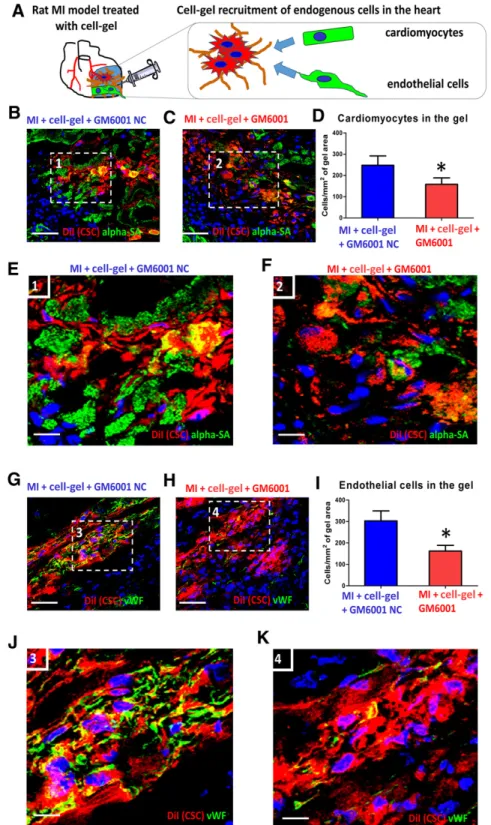
To confirm our findings in vivo, we examined the impact of MMP inhibitor GM6001 on the integration of cardiomyocytes and en-dothelial cells into the injected cell-gel in the post-MI heart (Fig. 4A). To enable histologic detection, CSCs were prelabeled with CM-DiI (Thermo Fisher Scientific Life Sciences). cell-gel was intramyocardially injected into WKY rat hearts immediately after MI, and animals were sacrificed 7 days later for histologic examination. More cardiomyocytes (Fig. 4B, 4C, green) and endo-thelial cells (Fig. 4G, 4H, green) could be detected residing in cell-gel with GM6001-NC (Fig. 4B, 4G, red) than in cell-gel with GM6001 (Fig. 4C, 4H, red). Quantitative analysis confirmed those findings (Fig. 4D, 4I). Higher magnification revealed integration of cardiomyocytes (Fig. 4E, 4F) and endothelial cells (Fig. 4J, 4K) into the cell-gel with the presence of GM6001-NC or GM6001. MMP inhibitor GM6001 diminished such integration between the injected cell-gel and endogenous cells. Quantitative analysis revealed decreased numbers of infiltrating cardiomyocytes (supplemental online Fig. 2A) and endothelial cells (supplemental online Fig. 2B) in the cell-gel with MMP inhibitor GM6001, whereas GM6001-NC had no effects on cell integration (p,.05).
Heart Morphology and Cardiac Function
Effects of MMP Inhibition on Mechanisms Underlying Cell-Gel-Mediated Cardiac Repair and Protection
We have shown in our previous work that CSCs exert the major-ity of their therapeutic benefits through indirect regenerative mechanisms (e.g., paracrine effects) [31, 32]. Two important in-direct regenerative mechanisms of cell-gel are its ability to pro-mote angiogenesis and cardiomyocyte proliferation [15]. Thus, we explored whether MMP inhibitor GM6001 altered the regen-erative mechanisms of cell-gel in those two aspects. Three weeks after MI, transplanted CSCs were identified with CM-DiI fluorescence. Isolectin B4+capillaries (Fig. 6A, 6C) and cycling cardiomyocytes (ki67+/a-SA+) (Fig. 6D) were consistently de-tected. The capillary density (percentages of Lectin B4+ capillar-ies) and number of cycling cardiomyocytes (Ki67+/a-SA+) in the peri-infarct zone from the cell-gel or cell-gel + GM6001-NC group were significantly higher than those from the control or cell-gel + GM6001 group (Fig. 6B, 6E), suggesting that MMP in-hibition suppressed the proangiogenic and procardiomyogenic effects of cell-gel. Ki67+nuclei were detected in DiI+cells, suggesting that a portion of injected CSCs were proliferating (supplemental online Fig. 4). Western blot analysis confirmed that GM6001 treatment decreased expression of MMP-2 and MMP-3 in the heart (p,.05) (Fig. 7).
DISCUSSION
CSCs have been developed for treating MI and heart failure over the last decade. Animal studies and a proof-of-concept human study support the notion that CSCs may benefit patients with
ischemic cardiomyopathy [26]. Platelet fibrin gel represents an appealing choice of injectable biomaterial for heart repair be-cause it is biodegradable, nontoxic, and nonimmunoreactive and provides mechanical and biological support to the injured heart. It has been previously reported in the same rat model of MI studied here that CSCs transplanted in fibrin gel had a favor-able engraftment rate compared with those transplanted in saline [33]. Our group has also reported in a mouse model of MI that CSCs transplanted in another type of hydrogel had a 24-hour en-graftment rate of∼40% versus∼5% transplanted in saline [34]. In addition, we reported the reparative and protective effects of platelet fibrin gel injection for the treatment of acute MI [14]. We further showed that transplantation of platelet fibrin gel spiked with CSCs could boost structural and functional benefits compared with bare gel injection [15]. MMPs are zinc-containing calcium-dependent endopeptidases that are released as inactive zy-mogens in a latent form [35]. MMPs and their tissue inhibitors reg-ulate matrix degradation, which further affects cardiac fibrosis and myocardial performance [35]. It has been reported that CSCs secrete proteins and microRNAs to inhibit cardiac fibrosis and apoptosis and enhance contractility and angiogenesis [36]. All these regenerative pathways could be mediated by matrix modulation.
GM-6001 (ilomastat or gelardin), a broad-spectrum MMP in-hibitor, has been extensively used in various experimental models of disease. The present study, which assessed the impact of MMP inhibitor on the therapeutic performance of cell-gel in a rat model of acute MI, has several important implications. First, we demon-strated that MMP inhibition could not only alter cell morphology but also blunt the proliferation and viability of CSCs cultured in platelet fibrin gel (supplemental online Fig. 1), suggesting that
Figure 2. Characterization of CSCs in platelet fibrin gel.(A):CSCs cultured in platelet fibrin gel exhibited distinct elongated morphology com-pared with control cells cultured on TCPs at days 0.5, 3, and 7.(B):Proliferation of CSCs grown in platelet fibrin gel (red line) or on TCPs (black line) (n= 3).(C):Live/Dead assay showed that CSCs cultured in platelet fibrin gel (red line) at day 7 had cell viability (more calcein AM–positive cells) comparable to those cultured on TCPs (black line) (n= 3). Scale bar = 50mm.p= NS indicatesp..05 compared with one another. Abbreviations: CSC, cardiac stem cell; NS, not significant; PFG, platelet fibrin gel; TCP, tissue culture plate.
MMPs are important for cells to maintain a healthy function in matrix. Second, our in vitro results showed that MMP inhibitor GM6001 slowed cell-gel degradation and decreased the secre-tion of growth factors (e.g., VEGF and IGF-1) (Fig. 3). Consis-tently, previous studies have shown that MMPs can mobilize growth factors such as VEGF through modulating the extracel-lular matrix [37, 38]. Third, we assessed the role of MMPs in cell-gel-induced angiogenesis, cardiac function protection, and adverse remodeling prevention after MI. Our results indi-cated that MMP inhibitor GM6001 diminished the integration of cardiomyocytes and endothelial cell into the cell-gel (Fig. 4 and supplemental online Fig. 2) and the therapeutic benefits of cell-gel (Fig. 5 and supplemental online Fig. 3).
Meanwhile, our study revealed that CSCs in gel (cell-gel) pro-moted angiogenesis and myocyte cycling, but MMP inhibition suppressed the proangiogenic and procardiomyogenic effects of cell-gel (Fig. 6). Previous studies have shown that MMPs can facilitate stem cell differentiation through remodeling of extracel-lular matrix [39], as well as promote epithelial cell ingression through MMP-mediated breakdown of the basement membrane [40, 41]. Similarly, we postulated that MMP inhibitor may block CSCs’ “matrix softener”function, which is essential for their mi-gration and the intemi-gration of local cardiomyocytes and endothe-lial cells into the injected gel. MMP inhibition blunted cell–cell interaction between injected CSCs and endogenous cardiomyo-cytes and endothelial cells, which has been proven to be essential
Figure 3. Effects of MMP inhibition on cardiomyocytes and MNCs cultured in cell-gel.(A, B):Schematic and fluorescent micrograph showing neonatal rat cardiomyocytes (NRCMs, red [A] or MNCs, red [B]) stained with red fluorescent CM-DiI cultured in cell-gel (CSCs labeled with green fluorescent DiO).(C, E):Less spreading of NRCMs (red, yellow outline) were confirmed in cell-gel (CSCs, green) containing MMP inhibitor GM6001(E)than those in cell-gel with GM6001 scrambled control(C).(D, F):Less spreading of MNCs (red, yellow outline) were confirmed in cell-gel (CSCs, green) containing MMP inhibitor GM6001(F)than those in cell-gel with GM6001 scrambled control(D).(G):Quantitative cell morphology analysis showing cell body area of NRCMs cultured in cell-gel with MMP inhibitor GM6001 (red bar) or GM6001-NC (blue bar) (n= 4).
Figure 4. Effects of MMP inhibition on recruitment of endogenous cells to cell-gel.(A):Schematic showing endogenous cell integration with injected cell-gel.(B)and(C):Cardiomyocytes stained witha-sarcomeric actin (green) populating the injected cell-gel, treated with GM6001-NC ([B], red) or cell-gel with GM6001 ([C], red) 7 days after injection.(D):Quantitation of cardiomyocytes infiltrating into the cell-gel (n= 3 animals per group).(E, F):High-magnification images of the white box area inBandC.(G, H):Endothelial cells stained with vWF (green) populating the injected cell-gel, treated with GM6001-NC ([E], red) or cell-gel with GM6001 ([F], red) 7 days after injection.(I):Quantitation of endothelial cells infiltrating into injected cell-gel (n= 3 animals per group).(J, K):High-magnification images of the white box area in(G)and(H). Scale bar = 100mm.
p,p,.05 compared with MI + cell-gel + GM6001-NC group. Abbreviations: alpha-SA,a-sarcomeric actin; CSC, cardiac stem cell; MI, myocardial infarction; MMP, matrix metalloproteinase; NC, negative control; vWF, von Willebrand factor.
for CSC-mediated cardiomyogenesis and angiogenesis [42]. In ad-dition, GM6001 is a broad-spectrum MMP inhibitor, targeting MMP-1, -2, -3, -7, and many others. We have previously reported that MMP-2 and MMP-3 were secreted by CSCs and likely to play positive roles in post-MI heart regeneration [43]. Here, we con-firmed the decreased expressions of MMP-2 and MMP-3 in ani-mals treated with GM6001 (Fig. 7).
Nevertheless, our study has several limitations. First, we did not elucidate the roles of individual MMP subtypes (e.g., MMP-2,
MMP-3) in cell-gel-mediated heart repair. In addition, we used echocardiographic results obtained from 4 hours post-MI as the postinjury baseline. An echocardiography measurement before MI surgery would rule out any congenital differences in cardiac functions in different animals. Moreover, to obtain an accurate cell survival/engraftment rate, quantitative methods such as polymerase chain reaction (e.g., onSRYin the case of male-to-female transplantation) are needed. Nevertheless, our previous report in the same rat model of MI showed that CSCs
Figure 6. Effects of matrix metalloproteinasesinhibition on cell-gel-mediated cardiac repair mechanisms.(A):Injected cell-gel (CSCs labeled with DiI, red) were surrounded by capillaries (stained with FITC-lectinB4, green) in the post-MI heart.(B):Quantification of capillary density (percentages of Lectin B4+capillaries) in hearts treated with control (vehicle), cell-gel alone, cell-gel + GM6001, and cell-gel + GM6001-NC (n= 5 animals per group).(C):High-magnification images of the white box area in(A).(D):Ki67+cardiomyocytes were detected in hearts treated with cell-gel.(E):Quantification of cycling cardiomyocytes (Ki67+/a-SA+) in hearts treated with control (vehicle), cell-gel alone, cell-gel + GM6001, and cell-gel + GM6001-NC (n= 5 animals per group). Scale bar = 50mm.p,p,.05 compared with MI + control group; #,p,.05 compared with MI + cell-gel + GM6001 group. Abbreviations:a-SA,a-sarcomeric actin; CSC, cardiac stem cell; DAPI, 49,6-diamidino-2-phenylindole; FITC, fluorescein isothiocyanate; MI, myocardial infarction; NC, negative control.
transplanted in fibrin gel had a favorable engraftment rate com-pared with those transplanted in saline [33], and the scrambled drug GM6001-NC had no effect on the performance of cell-gel compared with cell-gel alone (supplemental online Fig. 2; cell-gel alone group reproduced from Cheng et al. [15]). In addition, the toxic effects of the scrambled control on cardiomyocyte viability and function in vitro need to be explored further.
CONCLUSION
Our study demonstrates that MMP plays a critical role in the ther-apeutic benefits of platelet fibrin gel spiked with cardiac stem cells for treating myocardial infarction. Our findings provide im-petus for further investigation of the synergistic effects of cell-gel and MMPs in treating myocardial infarction.
ACKNOWLEDGMENTS
This work was supported by funding from the American Heart Association (12BGIA12040477), National Institutes of Health, NC State University Chancellor’s Faculty Excellence Program, University of North Carolina General Assembly Research Oppor-tunities Initiative grant, National Natural Science Foundation of
China (81370216 and 81570274), National Natural Science Foun-dation of China—Henan Talent Training Fund (U1404802), Key Project for Science and Technology Research of Henan Depart-ment of Education (13A320623), Science and Technology Innova-tion Team Support Project of Henan Province (14IRTSTHN018), and Innovation Team of Science and Technology Project of Henan Province. J.T. is supported by China Scholarship Council. The study is also partially supported by the 2015 Cooperative Research Grant(s) of Atomic Bomb Disease Institute at Nagasaki University, Japan.
AUTHORCONTRIBUTIONS
D.S.: conception and design, collection and/or assembly of data; J.T.: data analysis and interpretation, manuscript writing; M.T.H., T.L., T.G.C., and T.Z.: collection and/or assembly of data; J.Z.: finan-cial support; K.C.: conception and design, finanfinan-cial support, collec-tion and/or assembly of data, data analysis and interpretacollec-tion, manuscript writing, final approval of manuscript.
DISCLOSURES OFPOTENTIALCONFLICTS OFINTEREST
The authors indicated no potential conflicts of interest.
REFERENCES
1 Lloyd-Jones D, Adams RJ, Brown TM et al. Executive summary: heart disease and stroke statistics—2010 update: A report from the American Heart Association. Circulation 2010;121:948–954.
2 Christman KL, Lee RJ. Biomaterials for the treatment of myocardial infarction. J Am Coll Cardiol 2006;48:907–913.
3 Laflamme MA, Murry CE. Regenerating the heart. Nat Biotechnol 2005;23:845–856.
4 Nelson DM, Ma Z, Fujimoto KL et al. Intra-myocardial biomaterial injection therapy in the treatment of heart failure: Materials, outcomes and challenges. Acta Biomater 2011;7:1–15.
5 Lee WY, Wei HJ, Lin WW et al. Enhancement of cell retention and functional benefits in myo-cardial infarction using human amniotic-fluid
stem-cell bodies enriched with endogenous ECM. Biomaterials 2011;32:5558–5567.
6 Li Y, Meng H, Liu Y et al. Fibrin gel as an in-jectable biodegradable scaffold and cell carrier for tissue engineering. ScientificWorldJournal 2015;2015:685690.
7 Thompson CA, Nasseri BA, Makower J et al. Percutaneous transvenous cellular cardio-myoplasty. A novel nonsurgical approach for
Figure 7. MMP-2 or -3 activities in the post-MI heart.(A, C):Immunoblotting was performed to examine the relative abundance of MMP-2(A)
and MMP-3(C)in myocardial tissue obtained from the peri-infarct zone 7 days after MI with various treatments.(B, D):Quantitation of MMP-2
myocardial cell transplantation. J Am Coll Car-diol 2003;41:1964–1971.
8 Davis ME, Motion JP, Narmoneva DA et al. Injectable self-assembling peptide nanofibers create intramyocardial microenvironments for endothelial cells. Circulation 2005;111: 442–450.
9 Radhakrishnan J, Krishnan UM, Sethura-man S. Hydrogel based injectable scaffolds for cardiac tissue regeneration. Biotechnol Adv 2014;32:449–461.
10 Enomoto Y, Gorman JH 3rd, Moainie SL et al. Early ventricular restraint after myocardial infarction: Extent of the wrap determines the outcome of remodeling. Ann Thorac Surg 2005;79:881–887; discussion 881–887.
11 Ungerleider JL, Christman KL. Concise re-view: Injectable biomaterials for the treatment of myocardial infarction and peripheral artery disease: Translational challenges and progress. STEM CELLS TRANSLATIONAL MEDICINE 2014;3: 1090–1099.
12 Makkar RR, Smith RR, Cheng K et al. Intra-coronary cardiosphere-derived cells for heart regeneration after myocardial infarction (CA-DUCEUS): A prospective, randomised phase 1 trial. Lancet 2012;379:895–904.
13 Bolli R, Chugh AR, D’Amario D et al. Car-diac stem cells in patients with ischaemic cardio-myopathy (SCIPIO): Initial results of a randomised phase 1 trial. Lancet 2011;378:1847–1857.
14 Cheng K, Malliaras K, Shen D et al. Intra-myocardial injection of platelet gel promotes endogenous repair and augments cardiac func-tion in rats with myocardial infarcfunc-tion. J Am Coll Cardiol 2012;59:256–264.
15 Cheng K, Shen D, Smith J et al. Transplan-tation of platelet gel spiked with cardiosphere-derived cells boosts structural and functional benefits relative to gel transplantation alone in rats with myocardial infarction. Biomaterials 2012;33:2872–2879.
16 Raffetto JD, Khalil RA. Matrix metallopro-teinases and their inhibitors in vascular remod-eling and vascular disease. Biochem Pharmacol 2008;75:346–359.
17 Mittal B, Mishra A, Srivastava A et al. Ma-trix metalloproteinases in coronary artery dis-ease. Adv Clin Chem 2014;64:1–72.
18 Yamamoto K, Murphy G, Troeberg L. Ex-tracellular regulation of metalloproteinases. Matrix Biol 2015;44–46:255–263.
19 Phillips JA, Vacanti CA, Bonassar LJ. Fibro-blasts regulate contractile force independent of
MMP activity in 3D-collagen. Biochem Biophys Res Commun 2003;312:725–732.
20 Sabeh F, Ota I, Holmbeck K et al. Tumor cell traffic through the extracellular matrix is controlled by the membrane-anchored col-lagenase MT1-MMP. J Cell Biol 2004;167: 769–781.
21 Wolf K, Mazo I, Leung H et al. Compen-sation mechanism in tumor cell migration: Mesenchymal-amoeboid transition after block-ing of pericellular proteolysis. J Cell Biol 2003; 160:267–277.
22 Bryan N, Rhodes NP, Hunt JA. Derivation and performance of an entirely autologous in-jectable hydrogel delivery system for cell-based therapies. Biomaterials 2009;30:180–188.
23 Vandergriff AC, Hensley TM, Henry ET et al. Magnetic targeting of cardiosphere-derived stem cells with ferumoxytol nanoparticles for treating rats with myocardial infarction. Bio-materials 2014;35:8528–8539.
24 Davis DR, Zhang Y, Smith RR et al. Valida-tion of the cardiosphere method to culture car-diac progenitor cells from myocardial tissue. PLoS One 2009;4:e7195.
25 Messina E, De Angelis L, Frati G et al. Iso-lation and expansion of adult cardiac stem cells from human and murine heart. Circ Res 2004; 95:911–921.
26 Smith RR, Barile L, Cho HC et al. Regener-ative potential of cardiosphere-derived cells expanded from percutaneous endomyocar-dial biopsy specimens. Circulation 2007;115: 896–908.
27 Cheng K, Li TS, Malliaras K et al. Magnetic targeting enhances engraftment and functional benefit of iron-labeled cardiosphere-derived cells in myocardial infarction. Circ Res 2010; 106:1570–1581.
28 Vandergriff AC, Hensley MT, Cheng K. Isolation and cryopreservation of neonatal rat cardiomyocytes. J Vis Exp 2015;98:e52726.
29 Vandergriff AC, Hensley MT, Cheng K. Cryopreservation of neonatal cardiomyocytes. Methods Mol Biol 2015;1299:153–160.
30 Wu Y, Yin X, Wijaya C et al. Acute myocar-dial infarction in rats. J Vis Exp 2011:pii:2464.
31 Chimenti I, Smith RR, Li TS et al. Relative roles of direct regeneration versus paracrine effects of human cardiosphere-derived cells transplanted into infarcted mice. Circ Res 2010;106:971–980.
32 Li TS, Cheng K, Malliaras K et al. Direct comparison of different stem cell types and
subpopulations reveals superior paracrine potency and myocardial repair efficacy with cardiosphere-derived cells. J Am Coll Cardiol 2012;59:942–953.
33 Terrovitis J, Lautam¨aki R, Bonios M et al. Noninvasive quantification and optimization of acute cell retention by in vivo positron emission tomography after intramyocardial cardiac-derived stem cell delivery. J Am Coll Cardiol 2009;54: 1619–1626.
34 Cheng K, Blusztajn A, Shen D et al. Func-tional performance of human cardiosphere-derived cells delivered in an in situ polymerizable hyaluronan-gelatin hydrogel. Biomaterials 2012; 33:5317–5324.
35 Mishra PK, Givvimani S, Chavali V et al. Cardiac matrix: A clue for future therapy. Bio-chim Biophys Acta 2013;1832:2271–2276.
36 He JQ, Ma Y, Lee Y et al. Human embry-onic stem cells develop into multiple types of cardiac myocytes: Action potential character-ization. Circ Res 2003;93:32–39.
37 Bergers G, Brekken R, McMahon G et al. Matrix metalloproteinase-9 triggers the angio-genic switch during carcinogenesis. Nat Cell Biol 2000;2:737–744.
38 Belotti D, Paganoni P, Manenti L et al. Matrix metalloproteinases (MMP9 and MMP2) induce the release of vascular endothelial growth factor (VEGF) by ovarian carcinoma cells: Implica-tions for ascites formation. Cancer Res 2003;63: 5224–5229.
39 Nguyen AH, Wang Y, White DE et al. MMP-mediated mesenchymal morphogenesis of pluripotent stem cell aggregates stimulated by gelatin methacrylate microparticle incorpo-ration. Biomaterials 2016;76:66–75.
40 Thiery JP, Acloque H, Huang RYJ et al. Epithelial-mesenchymal transitions in develop-ment and disease. Cell 2009;139:871–890.
41 Acloque H, Adams MS, Fishwick K et al. Epithelial-mesenchymal transitions: The impor-tance of changing cell state in development and disease. J Clin Invest 2009;119:1438–1449.
42 Xie Y, Ibrahim A, Cheng K et al. Impor-tance of cell-cell contact in the therapeutic ben-efits of cardiosphere-derived cells. STEMCELLS
2014;32:2397–2406.
43 Tseliou E, de Couto G, Terrovitis J et al. Angiogenesis, cardiomyocyte proliferation and anti-fibrotic effects underlie structural preser-vation post-infarction by intramyocardially-injected cardiospheres. PLoS One 2014;9: e88590.