The Second Language Acquisition of Mandarin Chinese Tones
by English, Japanese and Korean Speakers
Hang Zhang
A dissertation submitted to the faculty of the University of North Carolina at Chapel Hill in
partial fulfillment of the requirements for the degree of Doctor of Philosophy in the Department
of Linguistics.
Chapel Hill
2013
Approved by
Jennifer L. Smith
Elliott Moreton
Misha Becker
Katya Pertsova
Ji-Yeon Jo
ii © 2013 Hang Zhang
iii ABSTRACT
HANG ZHANG: The Second Language Acquisition of Mandarin Chinese Tones by English, Japanese and Korean Speakers
(Under the direction of Jennifer L. Smith)
This dissertation explores the second language acquisition of Mandarin Chinese tones by speakers of non-tonal languages within the framework of Optimality Theory. The effects of three L1s are analyzed: American English, a stress-accent language; Tokyo Japanese, a lexical pitch accent language; and Seoul Korean, a non-stress and non-pitch accent language. The study tests for three possible sources of L2 tonal errors; namely, 1) universal phonological constraints (i.e. the Tonal Markedness Scale (TMS), the
Obligatory Contour Principle (OCP), and Tone-Position Constraints (TPC)); 2) the transfer of L1 pitch patterns; and 3) a pedagogical problem of Tone 3. The data shows that these three factors jointly shape the properties of interlanguage grammars.
This study finds that the TMS, the OCP, and TPC constrain L2 tone acquisition, but do so to varying degrees. Evidence is found that the TMS applies to both word- and sentence-level L2
iv
v
ACKNOWLEDGEMENT
First and foremost, I would like to express my sincere thanks to my advisor, Dr. Jennifer Smith, for her inspiration, guidance, support, and patience. I cannot remember how many times Jen has rescued me and put me back on track. She is strict, but very understanding, approachable and always helpful. Jen is my role model for being a linguist, a mentor, and a teacher. Words fail to express my appreciation to her! I am exceedingly grateful to Dr. Elliott Moreton for his engaging discussions. His enthusiasm and love for linguistic research is contagious. I also greatly appreciate my other committee members, Dr. Katya Pertsova, Dr. Misha Becker, and Dr. Ji-Yeon Jo, for their great support and insightful suggestions.
This project could not have been completed without the assistance of many people. This study relies heavily on the statistical analysis guided by Chris Wiesen, and I truly appreciate all of his hard work and patience. Special thanks are also due to Jia Lin for data analysis; Azusa Saito, Katsuhiko Sawamura, Jeehwae Kim, Seul Bee Lee, and Insun Lee for translating subject-recruitment documents and experiment reading materials into Japanese and Korean; the teaching staff at Zhejiang University
(Hangzhou, China); and the 67 participants who agreed to be a part of this study. I especially appreciate Hong Shi, Linghong Huang, and Feiyan Wang, whose enormous amount of help with the collection of pilot data in 2011 has made this study possible.
vi
P-side group (a UNC-CH phonetics/phonology research group)—Mary Kohn, Lúcia Fischer, Emily Moeng, Jen Griffin, Anna Powers, Amy Reynolds, Katherine Shaw, Matt Fuller, Justin Pinta, and other grads. Thank you all!
I also owe a particular debt of gratitude to the Department of Asian Studies at UNC-CH for opportunities for professional and personal development during the past eight years. I am truly grateful to Dr. Gang Yue for the help he has given me to make my grad career at UNC possible. I also deeply appreciate Dr. Wendan Li’s consistent support for my full-time teaching position in the Asian Studies
Department and my research. I still think fondly of my time talking with her in New West and over the phone. I would also like to thank Dr. Jan Bardsley very much for her support to my trip to China for data collection, and all my colleagues in Asian Studies for their professional support and friendship.
vii
TABLE OF CONTENTS
LIST OF TABLES ………..xii
LIST OF FIGURES ………...…... xiv
LIST OF ABBREVIATIONS AND SYMBOLS ………..xvi
Chapter 1.
INTRODUCTION ………..1
1.1. Overview ………..1
1.2.
The significance of the study ………...31.3.
The theoretical context ……….41.4.
Research questions and general hypotheses ……….…61.5.
The organization of the dissertation ……….……92. PHONOLOGICAL BACKGROUND AND PREDICTIONS ……….……..10
2.1.
Optimality Theory and the second language acquisition of Mandarin tones………...…………102.1.1. Some basic concepts of Optimality Theory ………...…….10
2.1.2. The OT grammars and Second Language Acquisition ………..……....15
2.2. The tone system of Mandarin Chinese ………21
2.2.1. Mandarin tonal features and representation ………...………..21
2.2.2. Mandarin Tone Sandhi ……….25
2.2.2.1. Mandarin T3 Sandhi and the domain ………25
2.2.2.2. T3 and T3 Sandhi Pedagogy ……….26
2.2.3. The perception of tones ……….28
viii
2.2.4.1. The Tonal Markedness Scale (TMS) ………32
2.2.4.2. Obligatory Contour Principle (OCP) ………....35
2.2.4.3. Tone-Position Constraints (TPC) ……….….38
2.3. Assumptions of prosodic structures and the stimulus sentence ……….….42
2.3.1. Assumptions of prosodic structures ……….……..…43
2.3.2. Factors affecting prosodic phrasing ………...44
2.3.2.1. Syntactic structure ………..…44
2.3.2.2. Focus ………..46
2.3.3. Prosodic structure of the Mandarin stimulus sentence ………..…..49
2.4. The prosodic characteristics of the three first languages and predictions concerning each………...….51
2.4.1. Representation of intonation ………...52
2.4.2. English prosodic structures and predictions………...54
2.4.2.1. Prosodic phrasing of stimulus sentences for English speakers………56
2.4.2.2. Tone assignment ……….56
2.4.3. Tokyo Japanese (Japanese) prosodic structures and predictions ………60
2.4.3.1. Japanese Speakers’ Prosodic Phrasing of Stimulus sentence ………. 61
2.4.3.2. The assignment of tones to AP ………63
2.4.4. Seoul Korean (Korean) prosodic structures and predictions ………...68
2.4.4.1. Predicted prosodic phrasing for Korean speakers………....69
2.4.4.2. The tone assignment of test words for Korean Speakers ……….70
2.4.5. Summary of L1 transfer predictions ………...72
3. METHODOLOGY ………...…….74
3.1. Test materials ………...…74
3.2. Subjects and recording procedures ………..78
ix
3.4. Data Analysis ………..….83
4. WORD-LEVEL EXPERIMENT RESULTS ………....84
4.1. General information of L2 production errors ………...85
4. 2. On the test of Tonal Markedness Scale (TMS) ……….…..89
4.2.1. The statistical analysis of TMS ………..………….89
4.2.2. Substitution patterns for individual tones ………...90
4.2.2.1. Substitution patterns without target tone information ………..91
4.2.2.2. Substitution patterns with target tone information ………..94
4.2.2.3. A discussion on the error and substitution patterns of Tone 3 …………..…..96
4.2.3. Summary on TMS tests ………...99
4.3. The test of Obligatory Contour Principle (OCP ) ……….100
4.3.1. OCP test 1 ……….101
4.3.2. OCP test 2 ……….105
4.3.3. Summary of OCP tests ………..108
4.4. Test of Tone-Position Constraints (TPC) ………..109
4.4.1. General positional effects and statistical test of TPC ………...109
4.4.2. Positional error rates details: substitution patterns ………...112
4.4.3. The correlation between error and substitution patterns for positional effects …….115
4.4.4. Summary of TPC tests ………..119
4. 5. The test of typical L1 pitch pattern transfer ………..120
4.5.1. Statistical test of L1-like pitch pattern transfer ……….120
4.5.2. On the most frequently produced tone combinations ………...123
4.6. Summary of Chapter 4 ………...126
5. SENTENCE-LEVEL EXPERIMENT RESULTS ………..129
5.1. General error patterns and the TMS, OCP effects ……….131
x
5.1.2. Individual tone errors and Tonal Markedness Scale ……….133
5.1.3. OCP test in Experiment 2 ………..138
5.1.4. Summary of 5.1 ……….……140
5.2. On the most vulnerable positions at sentence level ………...…141
5.2.1. An overview of vulnerable positions in sentence level tonal productions …………141
5.2.2. Error rates of syllables inside and outside of focused constituents ………...…145
5.2.3. The error patterns in neutral constituents ………..147
5.3. Different types of L1 learners’ expressions of focus ……….152
5.3.1. The monosyllabic focused constituents (F1) ………153
5.3.2. Long focused constituents (F2-F5) and the disyllabic tone patterns ………158
5.3.2.1. L1 transfer of phrasal level pitch patterns ………158
5.3.2.2. The transfer of typical L1 disyllabic tone patterns ………...161
5.4. Summary of Chapter 5 ………...168
6. A DISCUSSION OF THEORETICAL IMPLICATIONS ………..169
6.1. The constraint re-ranking model for second language acquisition (SLA) ……….170
6.1.1. The general structure of the conceptual SLA constraint re-ranking model ………..170
6.1.2. Constraints used in the analysis of the SLA of Mandarin tones ………...172
6.1.2.1. Markedness Constraints ………173
6.1.2.2. Faithfulness Constraints ………175
6.1.2.3. The OT treatment of tones and intonations ………...175
6.1.3. The promotion and demotion of Markedness constraints ……….177
6.1.3.1. The postulation of L1, L2, and interlanguage grammar rankings ………….177
6.1.3.2. Four types of Markedness constraints and the effects of constraint re-ranking ……….179
xi
6.2.1. The summary charts of response tone combination patterns ………184
6.2.2. Representative interlanguage tonal grammars ………..186
6.2.2.1. Japanese speakers’ mismatched pairs ………...187
6.2.2.2. English and Korean speakers’ mismatched pairs………...190
6.2.3. Summary of partial Interlanguage rankings ………..192
6.3. The “Emergence of the Unmarked” cases in the SLA of tones ………...194
6.3.1. About Markedness and “The Emergence of the Unmarked” (TETU) ………. 195
6.3.2. A TETU case of interacting effects of TMS and OCP ……….197
6.3.3. A TETU case of interacting effects of TMS and TPC ………. …201
6.4. Summary ……….. ……….204
7. CONCLUSIONS AND IMPLICATIONS ………...205
7.1. Summary of research findings ………...205
7.1.1. Three universal phonological constraints in the SLA of Mandarin tones ………….205
7.1.2. L1 transfer effects ………..208
7.1.3. The constraint re-ranking model ………209
7.2. Pedagogical implications and future directions ……….212
7.2.1. The pedagogical problem of Tone 3………...212
7.2.2. Other pedagogical implications regarding difficult tones in context ……….217
7.3. Concluding remarks ………...220
APPENDIX 1. Tokyo-type Accent map and Recruitment Criteria Regarding Language Background for Japanese Speaking Learners ………... .223
APPENDIX 2. Sample Language Background Survey (for Japanese Speakers)………..224
APPENDIX 3. Pre-Test Materials ………225
APPENDIX 4: Sample Experiment 1 Reading Materials ……….226
APPENDIX 5: Sample Experiment 2 Test Materials ………...227
xii
L
IST OFT
ABLESTable 2.1. The four traditional lexical tones of standard Mandarin Chinese ……….22
Table 2.2. Predictions of Mandarin tone sequences mimicking L1 intonation patterns ………72
Table 4.1. Rao-Scott Chi-Square test results for TMS hypothesis ……….………90
Table 4.2. English speakers’ substitution patterns ……….94
Table 4.3. Japanese speakers’ substitution patterns ………94
Table 4.4. Korean speakers’ substitution patterns ……….95
Table 4.5. English speakers’ OCP test 1 results ………...…102
Table 4.6. Japanese speakers’ OCP test 1 results ……….103
Table 4.7. Korean speakers’ OCP test 1 results ………...103
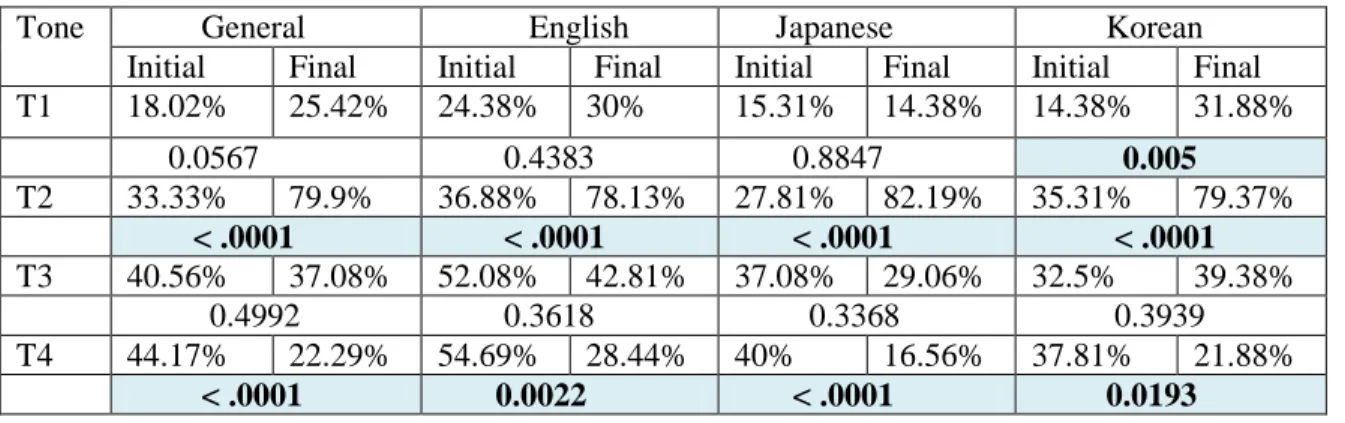
Table 4.8. Error patterns with positional information (Statistical test results included) ………..111
Table 4.9. English speakers’ response-tone rate details with positional information (%)……….112
Table 4.10. Japanese speakers’ response-tone rate details with positional information (%)………113
Table 4.11. Korean speakers’ response-tone rate details with positional information (%)………...114
Table 4.12. Overall Substitutions with positional information (without target tone information)………116
Table 4.13. The comparison of positional errors and substitutions in English speakers’ data set ………117
Table 4.14. The comparison of positional errors and substitutions in Japanese speakers’ data set ……..117
Table 4.15. The comparison of positional errors and substitutions in Korean speakers’ data set ………117
Table 4.16. The test results of L1 transfer of typical F0 patterns ……….121
Table 4.17. Top 10 most frequently produced tone combinations ………123
Table 5.1. TMS test (*T2>>*T4>>*T1) results in Experiment 2 ……….135
Table 5.2. English speakers’ substitutions in Experiment 2………..135
xiii
Table 5.4. Korean speakers’ substitutions in Experiment 2 ………..136
Table 5.5. OCP test results for English speakers in Experiment 2………139
Table 5.6. OCP test results for Japanese speakers in Experiment 2………..139
Table 5.7. OCP test results for Korean speakers in Experiment 2……….139
Table 5.8. The top ten positions with highest error rates ………..144
Table 5.9. Comparison of average error rates of focused and unfocused syllables in Exp.2………147
Table 5.10. English speakers’ error rates of syllables in unfocused (neutral) substituents ………..148
Table 5.11. Japanese speakers’ error rates of syllables in unfocused (neutral) substituents……….148
Table 5.12. Korean speakers’ error rates of syllables in unfocused (neutral) substituents………149
Table 5.13. The most frequently produced tone sequences for “Ft1,” “Ft2” and dummy word ………...164
Table 5.14. Prosodic word tone patterns in F2, F3, F5 and neutral constituents ……….165
Table 6.1. English speakers’ summary chart of disyllabic respondent tones ……….184
Table 6.2. Japanese speakers’ summary chart of disyllabic respondent tones.………...185
Table 6.3. Korean speakers’ summary chart of disyllabic respondent tones.………..185
Table 6.4: Accuracy rates of target tone pairs (cited from summary Table 6.1, 6.2 and 6.3)…………....197
xiv
L
IST OFF
IGURESFigure 2.1. Diagram of an OT grammar ……….11
Figure 2.2. Positive transfer and negative transfer in the framework of OT ………..18
Figure 2.3. Schematized pitch contour of the four Mandarin lexical tones ………22
Figure 2.4. Tonal representation I (Bao 1999) ………23
Figure 2.5. Tone 3 Sandhi Processes from a traditional view ……….28
Figure 2.6. Hasse diagram of the ranking in Tableaux (20) ………..37
Figure 2.7. Syntactic structure of the stimulus sentence………..46
Figure 2.8. Metrical grid for a bitonal metrical foot with one stressed syllable………..55
Figure 2.9. Intonation Model of Korean (Jun 2005)………69
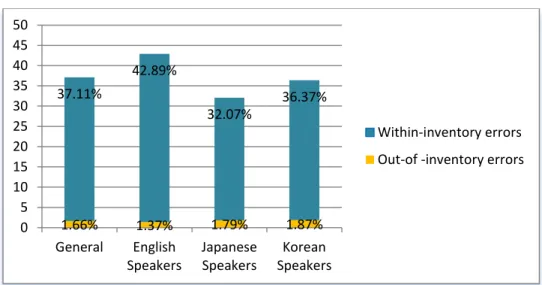
Figure 4.1. Proportions of within-inventory and out-of-inventory errors ………...86
Figure 4.2. Out-of-inventory errors in Experiment 1………...87
Figure 4.3. General error rates for TMS test in Experiment 1……….89
Figure 4.4. Substitutions within each subset in Experiment 1……….92
Figure 4.5. The default forms and surface forms of T3 in Experiment 1………97
Figure 4.6. The occurrences of tone pairs in L2 productions (OCP test 2) ………..107
Figure 5.1. Internal syntactic structure of focused constituents……….130
Figure 5.2. General error rates in Experiment 2 ………...132
Figure 5.3. Error rates of individual tones in Experiment 2 (TMS test)………134
Figure 5.4. Accuracy rates and substitution rates for target F1-f1 in the English speakers’ data set……155
Figure 5.5. Substitute tones for target F1-f1 in the Japanese speakers’ data set ………..156
Figure 5.6. Substitute tones for target F1-f1 in the Korean speakers’ data set ……….157
xv
Figure 6.1. Positive transfer and negative transfer in the framework of OT……….171
Figure 6.2. Hasse diagram for Japanese Speakers’ ILG ………...189
Figure 6.3. Hasse diagram for English and Korean speakers’ ILG ………..191
Figure 7.1. Constraint re-ranking model for SLA ……….210
Figure 7.2. Japanese speakers’ partial interlanguage tonal grammar (i.e., Fig. 6.2) ……….211
Figure 7.3. English and Korean speakers’ partial interlanguage tonal grammars (i.e., Fig. 6.3)………...211
xvi
L
IST OFA
BBREVIATIONS ANDS
YMBOLSAM Autosegmental-metrical model CFL Chinese as a Foreign Language CON Constraints
Con-PT Constraints involved in Positive Transfer Con-NT Constraints involved in Negative Transfer EVAL Evaluator
FAITH Faithfulness Constraints GEN Generator
ILG Interlanguage Grammar ITC Identical Tone Combination L1 First Language
L2 Second Language
NITC Non-Identical Tone Combination OCP Obligatory Contour Principle OT Optimality Theory
ROA Rutgers Optimality Archive (http://roa.rutgers.edu) SLA Second Language Acquisition
TBU Tone-bearing Unit
TETU The Emergence of The Unmarked TMS Tonal Markedness Scale
xvii Mandarin Tones
[5]=high tone, [1]=low tone FT3 low dipping tone [214] T0 Neutral Tone
T1 Tone 1 (level tone [55]) T2 Tone 2 (high rising tone [35]) T3 low tone [21]
T4 Tone 4 (high falling tone [51])
T5 Rising tone (alike in phonetic shape to T2) which results from the Pre-T3 Sandhi.
Symbols
ι (IP) intonational Phrase φ (PhP) phonological Phrase
(ip) intermediate Phrase (used to describe the English prosodic structures)
(AP) accentual phrase (used to describe the Japanese and Korean prosodic structures) ω (PW) prosodic word
ft foot σ syllable μ mora
H* accentual H, which associates to the stressed syllable F0 fundamental frequency, in Hertz
CHAPTER 1: INTRODUCTION
1.1. Overview
Among the languages in the world, about half of them are tonal (Hyman 2011, Yip 2002). Mandarin Chinese is one of the best-known Asian tonal languages. There are nearly 885 million native speakers of Mandarin Chinese, making it the world’s most commonly spoken language. With China’s rising role in the global economy and other fields, there has been a significant increase in the population of second language (L2)learners of Mandarin Chinese all over the world and most of the L2 learners of
Mandarin are non-tonal language speakers (Hu 2008). Because of its complex tone system, Mandarinis
considered to be one of the most difficult languages to learn as an adult (Kiriloff 1969, Bluhme and Burr 1971; Shen 1989; Wang 1995; Sun 1998; Chen 2000; Wang et al. 1999; among others). The pitch of the voice, which relies on the tension of vocal folds and is quantified by fundamental frequency (F0), plays a completely different role in tonal and non-tonal languages. In Mandarin, the contours of pitch over a syllable, known as tones, functions at the lexical level and is used to distinguish the meaning of words. However, in non-tonal languages, pitch functions mainly at post-lexical levels (that is, at the phrase, sentence, and discourse levels), and is independent of the meanings of words (Gussenhoven 2004). That is, pitch patterns may be specified either mainly at the lexical level, at the phrasal/sentential level, or at both lexical and phrasal/sentential levels, resulting in more or less complex tonal specifications for different types of languages. Because of the differing roles that pitch plays in different languages, the second language acquisition (SLA) of Mandarin tones can be extremely difficult for adult speakers of non-tonal languages.
2
random errors. In the past several decades, tone error analysis of the second language acquisition of Mandarin tones has been the focus of much debate and research. Researchers believe that if the sources of tonal errors made by L2 learners could be identified, educators in the field of Teaching Chinese as a
Foreign Language (CFL) would be able to significantly improve the teaching and learning of Mandarin
tones (Sun 1998; Chen, Q-H. 2000; Zhang, H. 2010; Yang 2011; among others). The majority of previous studies on tonal errors are concerned with the L2 tonal productions made by English-speaking learners (Chen G-T. 1974; Chen Q-H. 1997; Elliot 1991; Lu 1992; McGinnis 1996; Miracle 1989; Shen 1989; Sun 1998, Chen 2000; Yang 2011; among others). These studies usually attribute the source of error to the learner’s first language (L1, here is English), to the L2 (Mandarin), or to the relationship between L1 and L2. Some studies have concluded that tonal error originates from an interference from the learner’s mother tongue (referred to as “L1 negative transfer”) by analyzing the differences in pitch ranges between
3
effects that L1 transfer operations and phonological universals might have on the acquisition of Mandarin tones (Major 2008; Eckman 2008). As Sun (1998) points out, a study which assumes that transfer is operative in the perception and production of L2 tones should “examine groups of learners who have demonstrably different discourse-prosodic features in their L1s. Such a study has yet to be conducted.” (p. 8) Furthermore, there are hardly any studies which account for the L2 tonal errors within the framework
of Optimality Theory (OT, Prince and Smolensky 1993, McCarthy and Prince 1993, 1995) in the field of
SLA of Mandarin tones, in spite of the fact that OT is one of the most influential pieces of work in linguistics within the past 25 years.
1.2. The significance of the study
In order to fill the gap in the previous studies and advance the study of L2 tone acquisition by bridging language pedagogy with linguistic theories, this dissertation conducts a phonological study of L2 tonal productions made by American English, Tokyo Japanese, and Seoul Korean speaking learners of Mandarin within the theoretical framework of Optimality Theory. American English, Tokyo Japanese, and Seoul Korean (henceforth English, Japanese, and Korean) represent three different types of non-tonal languages according to the characteristics of word prosody: stress-accent languages (represented by American English), lexical-pitch-accent languages (represented by Tokyo Japanese), and non-stress and non-lexical-pitch-accent languages (represented by Seoul Korean)(Jun 2005).1 In addition, the speakers
of English, Japanese and Korean make up the majority of the population of L2learners of Mandarin
worldwide (Hu 2008). The objective of this dissertation is to identify sources of tonal errors (L1 transfer, phonological universals, and a pedagogical problem related to the teaching of tones), and to clarify how these factors jointly shape the L2 tonal interlanguage grammars.2 L2 learners often substitute other tones for target tones in productions. Both error patterns and substitution patterns are examined to test for
1 The term “stress” and “accent” have been used in linguistic literature in diverse contexts. In this study, “accent”
refers to the underlying specification for prominence whereas the term “stress” refers to the metrical head physically realized on surface.
4
evidence of these three factors and to provide suggestions on improving the pedagogy of Mandarin. It is argued in this study that the SLA of Mandarin tones is constrained not only by L1 transfer, but also by some phonological universals and by pedagogical problems related to the traditional method used to teach Mandarin tones. The bulk of the study tests for the evidence of three phonological universals and
examines how these phonological universals interact with other factors (i.e. L1 transfer and pedagogical issues) in shaping non-native tonal grammars under the framework of OT. To summarize, this study is most concerned with identifying error or substitution patterns which cannot be attributed to L2 input, nor to structure derived from learners’ L1, in order to determine what role phonological universals play in the
second language acquisition of Mandarin tones.
1.3. The theoretical context: Second Language Acquisition and Universal Grammar
Following Chomsky’s works (1965, 1975, 1981 and 1999), the present study assumes a particular
perspective on linguistic universals. That is, the grammars of all languages share a common structure, referred to as Universal Grammar (UG), which stems from a set of universal linguistic principles. It is proposed in Chomsky (1965, 1981) and Pinker (1984, 1994) that UG is part of an innate, biologically endowed language faculty which allows an infant to acquire the grammar of his or her L1 even with limited linguistic experience. UG is composed of certain constant principles that generally apply across languages, but also includes several parameters that allow for variation from language to language. There have been some changes in the way universal principles and parameters have been formalized in UG with
the development of linguistic theories such as Minimalism (Chomsky 1995) andOT. For this project, UG
5
In the study of SLA, Interlanguage Grammar (ILG) refers to non-native grammar developed by L2 learners. The concept of ILG was proposed in the late 1960s and early 1970s by researchers such as Corder (1967), Nemser (1971), Selinker (1972) and Adjemian (1976). One of the characteristics of the system is that it preserves some features of the learners’ first language while creating innovations in
speaking or writing the L2. Through substantial development in SLA research in the last decade, L2 phonologists found that although native language or L1 transfer has proven itself as a source of learner errors, interlanguage grammars are systematic in a way that stays within the limits of variation allowed by UG (Major 2001, Broselow, Chen and Wang 1998). Some research in SLA has discovered patterns that could not have been learned from the target language input alone, nor derived from the grammar of learners’ first languages. Such patterns often reveal a preference for less marked structures (Broselow,
Chen and Wang 1998; Epstein, Flynn, & Martohardjono 1996). Although it has been discovered that universal principles of markedness play a role in the SLA, how the aspects of UG are accessible to L2 learners and the extent to which these principles shape the interlanguage grammar has yet to be
determined. For example, if L2 acquisition is assumed to be constrained by UG, does UG influence the ILG through L1 transfers? What happens to the aspects of UG that are not required in any particular L1; do they deteriorate from lack of use and become inaccessible, or are they still accessible for L2 learners?
6
interlanguage grammars possessed by L2 learners at a given stage of acquisition. The following factors will be considered for the development of tonal interlanguages: L1 grammars, since learners use their L1 knowledge when producing L2; target language grammars, since the target language drives the L2 learners to develop the target language’s structures; and universal constraints, since these keep learners from making “wild” errors (Major 2001). By examining actual L2 productions, OT grammar can be used
to work out rankings of related constraints, thereby modeling the unconscious linguistic knowledge that exists in the minds of L2 learners. More information about the basic design of OT grammar and the use of OT grammars in SLA is introduced in Chapter 2 (§2.1). OT has been very influential in phonology, generating a considerable amount of insightful analysis on a variety of issues (McCarthy & Prince 1993, 1995, Kager 1999). Yet, it has had little impact on the field of SLA, not to mention the SLA of Mandarin tones. L2 phonologists at the frontier of SLA theoretical research believe that OT “demonstrates
promising directions for future research” of SLA (Hancin-Bhatt 2008; Eckman 2004).
1.4. Research questions and general hypotheses
In the theoretical context stated above, the present phonological study of English, Japanese and Korean speakers’ acquisition of Mandarin tones is conducted with the goal of answering the following
research questions:
(1) Is UG accessible to L2 learners? More specifically, is the SLA of Mandarin tones by learners with different L1 backgrounds constrained by tone-related phonological universals? If so, how do the L2 learners access UG and to what extent?
(2) How do the prosodic structures of these three types of L1s affect the SLA of Mandarin tones, especially in expressing sentence-level prominence (namely, contrastive focus and narrow focus)?
(3) How does the current method of teaching tones influence the SLA of Mandarin Tones (especially
Tone 3)?
(4) How do phonological universals, the L1 transfer of typical tone patterns, and Tone 3 pedagogical issue interact with one another and influence the tone production of L2 Mandarin speech?
7
Tone 3) constrain the SLA of Mandarin lexical tones. While there may be many phonological universals affecting the L2 tone acquisition, this study will focus on three phonological principles relevant to
Mandarin tonal acquisition: the Tonal Markedness Scale (TMS), the Obligatory Contour Principle (OCP)
and Tone-Position Constraints (TPC). All three are formalized within the theoretical framework of OT. It is predicted that the L2 tonal productions are governed by these universal phonological constraints at both word and above-word level and that different types of L1 speakers will share some similarities in error and substitution patterns. It will be claimed that these phonological universals influence the L2 tonal
productions either through L1s or in the form of “the Emergence of the Unmarked” (TETU, McCarthy
and Prince 1994), which would suggest that some aspects of UG are still accessible to L2 learner even if they are not required in some L1s. However, the effects of UG may not show up clearly and regularly in error or substitution patterns of participants, since these effects often interact with the L1 transfer. This study assumes that the SLA initial state is the steady L1 final state, and therefore that the L1 transfers will lead to differences in the three ILGs. When the tone structure of the L1 and Mandarin are similar or the same, transfer is positive.3 Positive transfer leads to high accuracy rates and high substitution rates. Substitution rate here means the rate at which the target tone is substituted for another tone. For example, the “substitution rate of T1” means the rate at which T1 is substituted for some other tone. When the
prosodic structures of L1 and Mandarin are very different, negative transfer may occur and lead to high error rates and corresponding low substitution rates. It is predicted that some typical L1 intonation patterns employed in the realization of phonological events in the native L1s, such as sentence-level prominence (namely, contrastive focus and narrow focus), will also be used in the L2 non-native tonal productions and thereby affect the acquisition of Mandarin lexical tones. This hypothesis will be detailed
3 A lot of SLA research on similarity, such as the Speech Learning Model (SLM) by Flege (1992, 1995), seem to
8
by identifying typical L1 pitch patterns which may be transferred to the L2 tonal productions in Chapter 2. The third factor affecting the interlanguage grammars is a problem of Mandarin pedagogy, especially the “Full-Tone 3 First” teaching method. This paper hypothesizes that the problematic assumption of the
underlying form of Tone 3 and the associated teaching method of Tone 3 lead to high error rates of T3 in L2 tonal productions. More details are provided in Chapter 2.
To test for evidence of each of these three factors affecting L2 acquisition of Mandarin tones, a word-level phonological experiment (Experiment 1) is designed. Experiment 1 is concerned with the L2 tonal error and substitution patterns in disyllabic words. Disyllabic words will be tested since it is widely recognized that the dominant metrical structure in Mandarin is a disyllabic unit and because the disyllabic unit is the basic prosodic domain in various studies of phonology (Chen 1979; Shih1986) and morphology (Lü 1963; Feng 1998, 2001; Duanmu 1999). Experiment 2 is a sentence-level phonological experiment containing stimuli of identical tone sequences. This experiment is designed to confirm and expand the findings obtained from the word-level experiment. The error and substitution patterns in both experiments are closely examined and statistical analyses are conducted. The results of the Experiment 1 show that some phonological universals (namely the TMS, the OCP, and TPC) constrain the disyllabic tone sequences. Systematic error and substitution patterns indicating the effects of these constraints are found in participant speech patterns, including cases of UG constraining SLA through L1 and cases of UG not required in L1s but still accessible to SLA (TETU cases). Typical L1 prosodic structures (contrastive focus structures) on disyllabic words are found transferred to L2 disyllabic tonal productions in the examination of the most frequently-produced tone sequences by different types of learners in Experiment 1. Conflicting error and substitution patterns are found and it will be argued that these conflicting patterns are caused by a pedagogical problem related to Tone 3. The effects found in Experiment 1 are confirmed in the sentence-level tonal productions (Experiment 2). In Experiment 2, some effects of the L1 transfer (English as a “head-prominence” or “deaccenting” language, Japanese and Korean as “edge-prominence”
9
similarities among the three languages are also found. In addition, the positional effects pertaining to TPC testing are expanded to the domain of sentences and the most vulnerable positions for specific tone types are identified in Experiment 2.
To address the interacting effects of L1 language transfer, universal phonological constraints (including the TMS, the OCP, and TPC) and pedagogical problems (of Tone 3 teaching) that emerge in the development of second-language tonal grammar, this study addresses theoretical issues concerning the SLA of Mandarin tones by examining and comparing overall substitution patterns of English, Japanese and Korean learners. For a general view of the developmental trajectory of L2 tone acquisition, this study proposes an idealized constraint re-ranking model by observing the L1 and L2 prosodic structures and the interlanguage properties inferred from the experimental results, and sketches out how these learners develop their L2-like tonal grammars from their L1 grammars. Four types of constraints and their behavior patterns during the course of SLA (re-ranking of some related universal constraints) and two cases of the “Emergence of the Unmarked” are discussed. Some important features of tonal interlanguage
grammars are accounted for through representative OT tableaux and it is argued that the three factors (UG, L1, and pedagogical issues) jointly shape interlanguage grammars at the intermediate stages of SLA.
1.5. The organization of the dissertation
CHAPTER 2: PHONOLOGICAL BACKGROUND AND PREDICTIONS
The objective of Chapter 2 is twofold: one is to introduce the phonological background of OT and the prosodic structures of the four languages involved in this study; the other is to detail the predictions made regarding the respective roles played by phonological universal constraints, the transfer of typical L1 melodic patterns, and tone pedagogical issues in the SLA of Mandarin. This chapter is organized as follows: Section §2.1 offers a brief introduction to OT grammar and the use of OT grammar in the context of SLA. In section §2.1, an idealized constraint re-ranking model in the spirit of OT and sketch of the hypothesized rough trajectories of L2 tonal grammar development will be proposed. Section §2.2 offers an introduction of Mandarin tonal phonology including tone representation, tone sandhi rules, tone perception and the three phonological universal constraints formalized in OT which are related to the acquisition of Mandarin lexical tones. Section §2.3 introduces the prosodic structures of the stimuli sentences in this study, preparing for the predictions of typical L1 melodic pattern transfers in the following sections. In section §2.4, the prosodic structures of the three L1s (English, Japanese, and Korean) will be outlined, and typical L1 pitch patterns which may occur in the L2 tonal productions will be identified. Following the descriptions of intonational structures for each language, predictions of the error or substitution patterns regarding L1 transfers are provided.
2.1. Optimality Theory and the second language acquisition of Mandarin tones
This section introduces some basic concepts of Optimality Theory (OT) in §2.1.1. Secion §2.1.2 discusses the use of OT in the context of SLA and predicts the development of interlanguage grammar within an OT framework.
11
The analysis presented in this dissertation makes use of the theoretical framework provided by Optimality Theory (OT). A brief introduction of a few basic and important concepts which are related to the analysis is provided in this section. Readers who are already comfortable with OT may skip to §2.1.2.
OT is a linguistic model proposed by the linguists Alan Prince and Paul Smolensky in 1993, and expanded by John J. McCarthy and Alan Prince in 1993 and 1995. It was first applied in the area of phonology and it shares its focus with the investigation of universal principles, linguistic typology and
language acquisition. OT shares with The Sound Pattern of English (SPE, Chomsky and Halle 1968) the
notion of an underlying form, or input, as well as the notion of a surface form, or output. However, SPE derives the output step by step from an input, whereas OT simply selects the optimal output from many candidates.
The OT grammar assumes an input-output design in which a linguistic input is parsed, not by rules, but by a universal set of constraints on the well-formedness of linguistic structures. OT is
constraint-based, where constraints are generally regarded as universal. The ranking of these constraints differs from language to language, which allows for cross-linguistic differences. The central idea of OT is that the outputs (surface forms) of the language arise from the resolution of conflicts between
grammatical constraints. A surface form is “optimal” in the sense that it incurs the least-serious violations of a set of violable constraints, ranked in a language-specific hierarchy. The basic design of the OT grammar is illustrated by the diagram below.
Figure 2.1.
12
A linguistic input enters the grammar and a set of candidates for that input is automatically generated through a function known as the Generator, or GEN. These candidates are then evaluated according to how well they conform to the set of constraints (CON) on linguistic structures. The harmony evaluations are determined by the evaluator, or EVAL, which is guided by a hierarchical ranking of the universal constraints. The candidate description which is evaluated to be the most harmonic is the optimal output for the given input. Two types of constraints are used in this process of evaluation, namely
Markedness constraints and Faithfulness constraints.
Markedness constraints reflect generalizations of linguistic structures that commonly occur in
natural languages (unmarked) and those that do not commonly occur (marked). The notion of markedness
embodies linguistic universality in a “soft” sense. The idea is that all types of linguistic structure have two values: “marked” and “unmarked”. Unmarked values are cross-linguistically preferred and basic in all
grammars, while marked values are cross-linguistically avoided and used by grammars only to create contrast (Kager 1999). For example, all languages have open syllables (CV, V), but only a subset of language allow closed syllables (CVC, VC). Hence the unmarked value for syllable structure is “open.”
Markedness may also involve scales. For example, the simpler a tone structure the more likely its occurrence in languages (for example, level tones are more unmarked than contour tones). OT turns markedness statements into the actual substance of grammars since the structural well-formedness of the output relies on Markedness constraints. Examples of Markedness constraints are given in (1)-(3):
(1) a. Onset (Prince and Smolensky 1993): Syllables must have onsets. b. NoCoda (McCarthy & Prince 1994): Syllables must not have codas.
(2) a. *Contour >>*Level (Yip 2002): Contour tones are more disfavored than level tones. b. *Contour: No contour tone (two or more pitch targets on a tone-bearing unit) is allowed.
c. *Level: No level tone (one pitch target on a tone-bearing unit) is allowed. 4 (3) OCP (tone) (Leben 1973): Identical tones on adjacent positions are prohibited.
13
(1) includes the unmarkedness values of syllable structures. (2) addresses the tone markedness scale concerning two general categories of tones, namely contour tones such as rising (LH), falling (HL), and even convex tones, versus level tones, such as high level (H) and low level tones (L).5 The constraint in (3) indicates that identical tone sequences, such as H-H and L-L are disfavored.
Faithfulness constraints ensure similarity between the input and the output. That is, Faithfulness constraints require the output (surface form) to be identical, or faithful, to the input (the underlying, lexical form) in some particular way. The requirement to be faithful to the lexicon is the major force counterbalancing markedness. Following McCarthy and Prince (1995), some examples of Faithfulness constraints relevant for the current study are given in (4).
(4) Example Faithfulness constraints:
a. Max (Tone): every tone of the input has a correspondent in the output (that is, don’t delete tones). b. Dep (Tone): every tone of the output has a correspondent in the input (that is, don’t insert tones). c. Ident (Tone): let α be a tone-bearing unit (TBU) in the input, and β be any TBU
corresponding to α in the output; if α has tone T, then β has tone T.
Constraints are violable. Markedness and Faithfulness constraints are inherently in conflict with one another, so every logically possible output of any grammar will necessarily violate at least some constraints. Violation of a constraint is not a direct cause of ungrammaticality. Instead what determines the best output of a grammar is the least costly violation of the constraints. In a grammar, the constraints are ranked relative to one another, with the principle that the higher the ranking of a constraint, the more serious its violation or, alternatively, the more strongly it holds in a language. Constraint rankings are language-specific, which accounts for the variation in structures observed cross-linguistically. A brief illustration of a tableau representing harmony evaluation is offered in (5). The “*” denotes a violation of the constraint. “*!” denotes a fatal violation, signifying that that particular constraint violation prohibits
the candidate from being the optimal one in the evaluation. A shaded cell indicates that the cells have no
14
effect on the outcome. Cells in both loser rows and winner rows can be shaded, and shaded cells can contain violation marks or not. The “” signifies the winner or the most “harmonic” output form.
(5) Sample Tableaux a.
b.
Ranking: *Contour >> Max (Tone)
(5b) shows that the Markedness constraint *Contour dominates the Faithfulness constraint Ident (Tone). The input /LH.L/ generates multiple candidate structure descriptions, and, for the purpose of illustration, only two potential candidates will be considered here, namely a tone sequence that deletes a pitch target of the initial contour tone (decreases the tone complexity) and one that is faithful to the input. The candidate “LH.L” fails because it crucially violate the highest ranked Markedness constraint
*Contour, even though it does not violate any Faithfulness constraints. Thus, the optimal candidate, H.L, has the less serious constraint violation and is picked as the surface form.
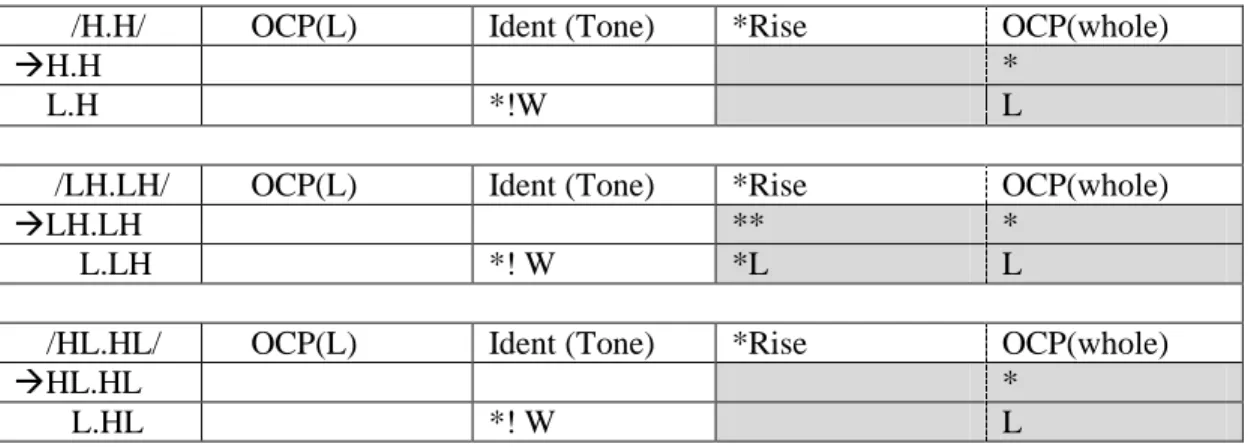
To clearly illustrate the evaluation process, this paper also adopts the format of comparative tableaux introduced by Prince (2002) and uses combination tableaux (McCarthy2008) which include information about violations as well as W and L annotations of the comparative tableau. While the original tableaux focus on constraint violations, comparative tableaux help illustrate why a specific candidate is picked. For each losing candidate in the tableau, a W or an L is placed under each constraint to specify whether that constraint favors the winning candidate over that particular losing candidate (W), favors that particular losing candidate over the winning candidate (L), or favors neither (blank). The W and L symbols are limited to loser rows because they represent how a loser compares with the winners for each constraint. Every loser row is expected to have a W and that W is to the left of (dominates) every L. The tableaux (6) below illustrate the new format of combination tableaux:
/input/ Constraint 1 Constraint 2
Candidate A *
Candidate B *!
/LH.L/ *Contour Ident (Tone)
H.L *
15 (6) Sample Combination Tableaux
a.
b.
This dissertation takes the target forms of tones or tone sequences of Mandarin as the input, or underlying forms, and the L2 tonal productions, or, the non-native productions made by English, Japanese and Korean-speaking learners of Mandarin as the outputs, or the surface forms.
2.1.2. The OT grammars and Second Language Acquisition
In recent years, OT has been developed to account for a range of phonological alternations and has generated a considerable amount of insightful analysis (McCarthy & Prince 1993, 1995, Kager 1999). This theory of the knowledge of language and its acquisition is especially intriguing for researchers in language acquisition studies because of its proposal of language representations and of how language develops over time. Although there is increasing interest in adopting OT to understand L2 data, few studies have actually done so, and even fewer have analyzed the L2 acquisition of tones in an OT framework. Of the few studies which have adopted OT to analyze L2 data, most focus on L2 syllable structures (e.g., Hancin-Bhatt and Bhatt 1997; Hancin-Bhatt 2000; Broselow et al. 1998; Hayes 1999; Villafana 2000). As discussed in Hancin-Bhatt (2008), viewing L2 data within an OT framework has generated more and more interest for a number of reasons. For example, OT does not require different basic assumptions of how the linguistic input types are parsed. Therefore, an OT grammar does not have to assume special rules or representations in order to accommodate L2 input that cannot be passed within an L1 grammar. In other words, the OT grammar removes the need to design specific rules for L2 leaners. In addition, OT begins to acknowledge and encode how language variation, a very important topic
(variant L2 productions and variable competence) in SLA studies, is a natural consequence of a dynamic
/input/ Constraint 1 Constraint 2
Candidate A *
Candidate B *W L
/LH.L/ *Contour Ident (Tone)
H.L *
16
system, particularly during acquisition. In OT, variation results simply from differences in the ranking of the given constraints in different grammars. Furthermore, since OT naturally incorporates UG and accommodates language variation, it not only provides the studies of SLA a new perspective of research but also supplies researchers with very practical tools to account for interlanguage properties, especially those focusing on or involving UG and markedness.
This section will account for the properties of tonal interlanguage grammars in an OT framework and will propose an SLA constraint ranking model. Following the introduction of this constraint re-ranking model, the proposal about the three sources of error for L2 tonal productions will be viewed from the perspective of L1-L2 constraint ranking similarities and differences. The central concept behind an OT grammar is that a grammar consists not of a set of rules, but rather of a set of ranked constraints which are presumed to be universal. Given materials from the target language (i.e., Mandarin in this study), what a second language learner (i.e., the English, Japanese, Korean speaking learners in this study) must infer is the ranking of these universal constraints in L2. That is, within an OT framework, language acquisition can be roughly described as the process of adjusting the L1 ranking of relative constraints to match the L2 grammar one is learning.
This study assumes a Full Transfer/Full Access Model (Schwartz & Sprouse 1996) of L2 learning. “Full Transfer” refers to a full instantiation of the L1 constraint ranking into the initial state of the
interlanguage grammars.6 Therefore the SLA of Mandarin tones can be taken as a process of adjusting the tonal grammar rankings from the L1 prosodic grammars toward the target L2 tonal grammar. During this process, the L1 prosodic properties inevitably influence the acquisition of the L2. In other words, the
6 Hancin-Bhatt (1998) suggests a specific development in complex coda acquisition and proposes that during initial
17
L1-specific rankings of universal constraints are transferred to the interlanguage grammars because L2 acquirers begin with the knowledge of L1 properties before exposure to the target language input (L2).
With respect to constraint re-ranking during language acquisition, Tesar and Smolensky (2000) assume that Markedness constraintsare demoted in the course of L1 acquisition. Boersma and Levelt (2000) discuss the L1 acquisition order of Dutch syllable types and assume both Markedness constraint demotion and Faithfulness constraint promotion. Boersma and Levelt (2000) hold that, in the initial state of the child’s grammar, all Markedness constraints are ranked above Faithfulness constraints
(Gnanadesikan 1995). Faithfulness then gradually rises in the hierarchy, one by one overtaking Markedness constraints. In the end, faithfulness is ranked on top and the child masters all syllable
structures. The constraint re-ranking in second language acquisition differs from the constraint re-ranking in first language acquisition because of the different initial states. Following the “Full Transfer”
hypothesis (Schwartz & Sprouse 1996), we would expect a full instantiation of the L1 constraint ranking into the initial state of the ILGs. Since this study focuses on the effects of phonological universals, we are particularly interested in the re-ranking of Markedness constraints. We assume that, during the SLA process, some Markedness constraints will be demoted while others will be promoted depending on the specific L1 and L2 grammars.
Previous studies reveal that “L2 structures that are similar or the same as their counterparts in the
L1 can have a generally facilitative effect in learning, while L2 structures that are not present in the L1 grammar provide a substantial challenge” (Hancin-Bhatt 2008). Thus, we assume that L1 grammar
rankings similar to or the same as the L2 structures will be transferred to ILG easily and quickly which can be taken as cases of Positive Transfer. However, if the L1 grammar rankings are very different from that of L2’s and re-ranking is required, Negative Transfers would occur.7
The actual SLA process and the interlanguage properties are very complicated and it is even considered “extralinguistic phenomena”
(Hancin-Bhatt 2008: 121). In order to sketch out the rough trajectories of L2 tonal grammar development
18
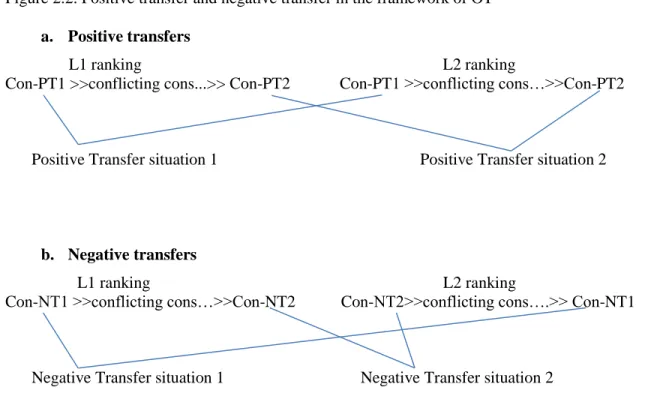
in the spirit of OT, this study proposes a simplified and idealized SLA constraint re-ranking model, as displayed in Fig. 2.2 below. Error and substitution patterns found in non-native tonal productions will be accounted for using this constraint re-ranking model in Chapter 6.
Figure 2.2. Positive transfer and negative transfer in the framework of OT a. Positive transfers
L1 ranking L2 ranking
Con-PT1 >>conflicting cons...>> Con-PT2 Con-PT1 >>conflicting cons…>>Con-PT2
Positive Transfer situation 1 Positive Transfer situation 2
b. Negative transfers
L1 ranking L2 ranking
Con-NT1 >>conflicting cons…>>Con-NT2 Con-NT2>>conflicting cons….>> Con-NT1
Negative Transfer situation 1 Negative Transfer situation 2
The constraints involved with the Positive Transfer situations are either ranked high or low relative to conflicting constraint in both L1 grammar (L2 initial ranking) and L2 grammar (L2 final ranking). There is no need to re-rank constraints during the course of acquisition and therefore the acquisition of the rankings is quick and easy. In this dissertation, the two situations of Positive Transfer will be referred to as PT1 and PT2 and the constraints involved with these two situations will be referred to as Con-PT1 and Con-PT2 respectively. As displayed in Fig. 2.2a, “Con-PT1” constraints are ranked high (Positive Transfer situation 1) while “Con-PT2” constraints are ranked low (Positive Transfer
19
result in slow acquisition (Negative Transfer) of some structures. The two situations of negative transfer will be referred to as NT1 and NT2 and the constraints involved with them will be referred to as “Con-NT1” and “Con-NT2” respectively. As seen in Fig. 2.2b, “Con-“Con-NT1” is ranked high in L1 but low in L2,
while “Con-NT2” is ranked low in L1 but high in L2. The re-ranking of Con-NT1 means L2 learners are trying to acquire a greater range of linguistic structures or trying to acquire a new inventory of linguistic structures. However, the re-ranking of Con-NT2 means L2 learners are trying to delimit the range of possible L2 structures.
In this dissertation, the study of L1 transfer focuses on the transfer of typical L1 pitch patterns (especially in disyllabic words), which varies among the three L1s. The typical L1 pitch patterns are determined based on the L1 prosodic grammars and the structure of stimuli sentences. Both positive and negative transfer may occur regarding these typical L1 pitch patterns, and it depends on whether the properties, P, of the typical L1 pitch patterns are associated with or carried by Positive Transfer-type constraints or Negative Transfer-type constraints. If the constraints bearing the property P, of the L1-specific prominent intonation patterns undergo positive transfer, we expect quick and easy acquisition. However, when the constraints bearing P of the typical L1 intonation patterns undergo negative transfer, it may cause a relatively slow acquisition. We expect that when the target tone sequences are similar to the melodic patterns typical of the L1 (that is, if the target tone sequences share similar rankings of relevant constraints), the error rates will be low and substitution rates of these patterns will be high. However, if the target L2 tone sequences are unlike the typical L1 pitch patterns (i.e., rankings of relevant constraints are very different), learners may experience difficulties in the acquisition process, which may lead to high error rates and low substitution rates for specific tone type or tone sequences.
As mentioned in Chapter 1, we predict not only that L1 transfers constrain the SLA of Mandarin tones, but also that some universal phonological constraints constrain the SLA of Mandarin tones, since we assume a “Full Access” model. The “Full Access” of UG is reflected in the UG-constrained
20
may already be contained in the constraint-ranking of the L1, and these rankings could be transferred into ILGs via typical L1 pitch pattern transfer. In this way UG is accessed by L2 learners through knowledge of their L1. However, it may also be the case that UG is accessible to L2 learners without the help of L1. If this is the case, it should be reflected in the innovations of ILG during SLA. If some Markedness constraints reflecting universally-preferred structures are neither required by the learner’s L1 nor found in the learner’s L2 input but instead emerge during the development of the learner’s interlanguage grammar during SLA, we can infer that aspects of UG which are not in use for the speaker’s L1 do not decay with
lack of use, but instead continue to be accessible to the speaker. If evidence of this is found, it would be an example of “the Emergence of the Unmarked” (TETU, McCarthy and Prince 1994) in SLA.
In the spirit of OT, some constraints are “inactive” in L1 because they are not necessary in
determining the actual outputs. These “inactive” constraints may be ranked very low and masked in the learners’ native-language grammar by the effects of higher ranking constraints, or masked by some
Faithfulness constraints in the correct productions. Thus we cannot identify these constraints by only examining L1 transfer effects. However, these “inactive” constraints are assumed to be present in the
grammar. In some cases, these hidden rankings have been uncovered through examination of loan-word phonology or reduplication and truncation phenomena (Ito and Mester, 1995, McCarthy and Prince, 1995, among others). Studying second language acquisition may be another way of revealing hidden rankings since some of these “inactive” constraints may become visible in the interlanguage grammars reveal their
ranking relative to other constraints. These patterns frequently show a preference for less marked forms and, as Epstein, Flynn & Martohardjono put it, this is “generally described as an effect of universal
principles of markedness, often conceived of as part of the innate endowment provided by Universal Grammar” (1996). This study uncovers some tonal patterns that appear to be independent of both the L1
21
introduced in the section of §2.2 and a discussion of TETU as it relates to Con-PT2 and Con-NT1 is offered in Chapter 6. It is found that in these cases of TETU, some Markedness constraints, such as the OCP (LH) constraint, are not simply demoted (if they are Con-NT1) or remaining low or inactive (if they are Con-PT2) and dominated by other constraints (such as Faithfulness constraints), but sometimes rear their heads in interlanguage grammars, playing a decisive role in picking the surface forms.
The third error source this study identifies is a pedagogical problem of a target tone type, Tone 3. The low T3 is phonetically easy (unmarked) and assumed to be acquired by L2 learners easily. That is, the rankings of T3-related constraints (such as “No dipping tones” or *FT3) in L1s and L2 are similar, so dramatic re-rankings are not required.8 However, it will be claimed that the assumption that the
underlying appearance of Tone 3 is a dipping tone, rather than a low falling tone, and the teaching method associated with this assumption, interferes with the acquisition of Tone 3. This traditional teaching method associated with Tone 3 may cause an unnecessary re-ranking of some specific constraints (specifically, learners may be assigning *FT3 a low rank in L2, but a high one in L1), leading to high error rates of Tone 3 and conflicting error and substitution patterns. This is detailed in the following section §2.2, which gives an overview of T3 Sandhi in Mandarin.
2.2. The tone system of Mandarin Chinese
This section offers an introduction to the tone system of Mandarin, the target language in this study. Sub-section §2.2.1 gives an overview of the inventory of Mandarin tones and their representations; §2.2.2 outlines tone sandhi processes in Mandarin; §2.2.3 gives an overview of the perception of
Mandarin tones; and §2.2.3 gives background information on the three tone-related phonological constraints used in OT: the TMS, the OCP, and TPC.
2.2.1. Mandarin tonal features and representation
8 Since FT3 is not allowed in the surface forms of test words in the experiment 1, we assume the constraint *FT3 is
22
In Mandarin, morphemes are almost exclusively monosyllabic. The pitch contour over a syllable can distinguish word meaning, yet the tone each syllabic morpheme takes is entirely arbitrary and
unpredictable. There are four types of tones on full syllables, as well as a neutral tone, which is carried by unstressed syllables (such as function words) and whose pitch value is determined by the preceding tone. The neutral tone will not be discussed in this study. An example of a stressed syllable in each of the four (non-neutral) tones is provided in table 2.1 below. The numbers of contour pitch value indicate the relative starting and ending pitch of each tone on a 1-5 scale, where 5 represents the highest pitch, and 1 represents the lowest (Chao 1930, 1948).
Table 2.1. The four traditional lexical tones of standard Mandarin Chinese
________________________________________________________________________ Wade-Giles name Pinyin Spelling gloss Shape of tone contour pitch value ________________________________________________________________________ Tone 1 mā “mother” (high) level 55
Tone 2 má “hemp” (high) rising 35 Tone 3 mă “horse” (low) dipping/low 214/21 Tone 4 mà “scold” (high) falling 51 ________________________________________________________________________
Figure 2.3. Schematized pitch contour of the four Mandarin lexical tones
Table 2.1 illustrates each of the four traditional tones. In Chao’s (1948) description, Tone 1 is the
23
[214] is not a possible realization of T3. Only [21] is a possible realization of T3 in these positions and [21] has a much wider distribution in Mandarin. In this study, we assume that Tone 3 is phonologically a low level tone, and that it can appear not only at non-word- and phrase-final positions but also at word- and phrase-final positions in Mandarin Chinese (Kratochvil 1968; Shih 1986, 1997; Yip 2002). Therefore following Yip (2002), this study assumes [21] is the default or standard form of Tone 3, and we label [21] as “T3,” while the full low dipping tone [214] will be labeled “FT3”, which stands for “Full Tone 3”.
Following Goldsmith’s (1976) theory of autosegmental phonology in which segments and tones appear on separate “tiers,” we assume that tones are linked with Tone-Bearing Units (TBU). We assume
the TBU in Mandarin are syllables.9 In the large body of previous work on Chinese Linguistics, tonal categories are consistently classified by two sets of descriptive terms: one denoting pitch height (high/low or “yin”/ “yang”), the other pitch movement (rising, falling, dipping, etc.) This practice implies that tone consists of two independent orthogonal dimensions: register (i.e. pitch height) and pitch contour (Chen 2000). This paper follows the model of tone proposed by Bao (1999), which is displayed in Fig. 2.4.
Figure 2.4. Tonal representation I (Bao 1999)
TBU: tone bearing unit; T: tone root; r: register; c: contour; t: terminal tone segment TBU
T / \ r c / \ t t
All of these features, including register and contour, are borne by a syllable. This model suggests that a contour tone behaves like a single unit since the contour node dominates the terminal tone segments. In this model, register is a sister of contour but does not dominate it. It predicts that register and contour could behave independently.
9 This is a general claim for contour tones, including contour tones in Mandarin. According to Zhang, J. (2004b),
24
In register feature analysis, a binary feature [+/- upper] is proposed (Yip 1980). This register feature “situates the beginning of the tone in either the upper or the lower part of the speaker’s register,
since contours have only an initial tonal specification, and the phonetic contour is the result of drift away from that initial target. Level tones have two targets, firmly anchoring both ends and keeping the pitch stable” (Yip 2001). This paper employs the binary feature, i.e., [+/- upper], henceforth [+/- U]. Following the model of Bao (1999), this paper employs “h” and “l” to refer to high and low component tones in the
terminal tone positions of a contour tone here, where two terminal tone segments make up a whole tone borne by a syllable. Following this claim, the citation forms of four lexical tones can be represented as (7):
(7) Mandarin Tonal representation II
tone pitch value register + component tones Tone 1 (T1) 55 [+U, hh]
Tone 2 (T2) 35 [+U, lh] Tone 3 (T3) 21 [-U, ll] (FT3) 214 [-U, llh] Tone 4 (T4) 51 [+U, hl]
For the sake of economy, I will just use the regular H and L system, the “most parsimonious account” (Yip 2002) proposed for the African tonal system, in the general discussions of tone behaviors
in Chapter 2. Following Yip (2002) who assumes that a contour tone is composed of two level tones, the four tones can be represented as H (T1), LH (T2), L (T3) and HL (T4). However I will use the Mandarin tone representations of T1, T2, T3, FT3 and T4 elsewhere because in most cases the constraints, such as the OCP, refer to Mandarin whole tones in the present study.
It’s clear that Mandarin is a tone language due to the nature of the lexical tones stated above.
25
with respect to fundamental frequency (F0), the quantitative representation of pitch, in Mandarin. The prosodic strength pattern of this strong-weak alternation in Mandarin will be considered in the analysis of universal high-low registered tone pattern found in Experiment 2.
2.2.2. Mandarin Tone Sandhi
2.2.2.1. Mandarin T3 Sandhi and the domain
This section considers Tone Sandhi in Mandarin and the teaching of T3 Sandhi in the field of Chinese as a Foreign Language (CFL). In connected speech, adjacent tones undergo dramatic alternations to their phonetic shape. This tonal alternation is referred to as Tone Sandhi (Chen, M. 2000). Among the few existing Tone Sandhi processes in Mandarin, Tone 3 Sandhi, is the most common. T3 Sandhi is illustrated in (8). The T3 Sandhi rule turns a T3 on the first full syllable of a two-T3 sequence into a rising tone which is alike in phonetic shape to T2. This rising tone which results from the T3 Sandhi rule will be referred to as T5 in this study.
(8) Tone 3 Sandhi rule (or, Pre-T3 Rule) a. mai “buy”
L citation form (T3) b. mai jiu “to buy wine” L.L citation form (T3-T3) HL.L sandhi form (T5-T3)
This dissertation follows Shih’s (1986) proposal about the Sandhi domain. Shih (1986) proposes
that the domain of Mandarin Tone Sandhi is prosodically-defined and that it is the foot that constitutes the domain of Mandarin sandhi. The Foot Formation Rule (FFR) proposed in Shih (1986) to derive prosodic feet is provided in (9) and (10):
(9). Foot (ft) Construction
a. Link immediate constituents into disyllabic feet.
26 (10). Super-foot (ft’) Construction
Join any leftover monosyllable to a neighboring binary foot according to the direction of syntactic branching.
The Foot Formation Rule correctly predicts the sandhi domains for tri-syllabic phrases. Two examples of tri-syllabic phrases (Shih 1986) are given below.
(11) a. “The umbrella is small” Yu san xiao
rain umbrella small ( ) ft ( ) ft’ LH LH L
b. “small umbrella” xiao yu san
small rain umbrella ( ) ft ( ) ft’ L LH L
That the foot is the domain for Tone Sandhi is also evidenced in constructions involving yi
“one”v(一) and bu “no”(不). These are two T4 morphemes which, when strung together, undergo a tone
sandhi rule similar to the T3 Sandhi rule. When these two T4 morphemes are followed by another T4 morpheme, they become rising tones. This particular T4 Sandhi rule only undergoes with these two morphemes, and not with any other T4 morphemes.
The FFR will be referred to in the target tone sequences for Experiment 2. Note that although the Sandhi rules described above (i.e. the T3 Sandhi rule and the T4 Sandhi rule) are both cases of
dissimilation when there are two adjacent similar tones, in native Mandarin, these rules do not apply to other identical tone sequences.Therefore L2 learners should acquire sandhi rules for T3-T3 sequences, but not for T1-T1, T2-T2, or T4-T4 sequences.