© The Author 2016. Published by Oxford University Press on behalf of The Gerontological Society of America. All rights reserved.
For permissions, please e-mail: [email protected]. 543
doi:10.1093/gerona/glw134 Advance Access publication July 20, 2016
Research Article
Low Birth Weight and Risk of Later-Life Physical Disability
in Women
Cassandra N. Spracklen,
1Kelli K. Ryckman,
2Jennifer G. Robinson,
2Marcia L. Stefanick,
3Gloria E. Sarto,
4Stephen D. Anton,
5and Robert B. Wallace
21Department of Genetics, University of North Carolina-Chapel Hill. 2Department of Epidemiology, University of Iowa College of Public Health, Iowa City. 3Department of Medicine, Stanford University, California. 4Department of Obstetrics and Gynecology, University of Wisconsin, Madison. 5Department of Aging and Geriatric Medicine, University of Florida, Gainsville.
Address correspondence to Cassandra N. Spracklen, PhD, Department of Genetics, University of North Carolina at Chapel Hill, 5100 Genetic
Medicine Building, CB #7264 120 Mason Farm Road, Chapel Hill, NC 27516. E-mail: [email protected]
Received December 7, 2015; Accepted June 28, 2016
Decision Editor: Stephen Kritchevsky, PhD
Abstract
Background: There is strong evidence that low and high birth weight due to in-utero programming results in elevated risk for adult diseases, though less research has been performed examining the influence of birth weight and physical disability later in life.
Methods: Baseline data from 76,055 postmenopausal women in the Women’s Health Initiative, a large multi-ethnic cohort, were used to examine the association between self-reported birth weight category (<6 lbs, 6–7 lbs 15 oz, 8–9 lbs 15 oz, and ≥10 lbs) and the self-reported physical functioning score on the RAND 36-item Health Survey. Linear regression models were adjusted for age, education, race/ethnicity, body mass index, and a comorbidity score.
Results: Unadjusted models indicate that women born in the lowest and highest birth weight categories have significantly lower physical functioning scores as compared to women born in the normal weight category (β = −2.22, p < .0001 and β = −3.56, p < .0001, respectively). After adjustments, the relationship between the lowest birth weight category and physical functioning score remained significant (β = −1.52,
p < .0001); however, the association with the highest birth weight category dissipated.
Conclusions: Preconception and prenatal interventions aimed at reducing the incidence of low birth weight infants may subsequently reduce the burden of later-life physical disability.
Keywords: Birth weight—Physical disability—Developmental Origins of Health and Disease hypothesis—Physical functioning
Disability in older adults is an important and growing public health concern. In the United States, approximately 9% of the adult popu-lation (≥18 years) has one or more disabilities in basic activities of daily living (ADLs) (1). With the projected number of people aged 65 and older to double from 35 million in 2000 to 71 million in 2030 (2), an increase in physical disability (defined as having difficulty per-forming daily activities such as walking, getting dressed, and taking a shower) will result in greater use of medical care, more institution-alization, and poorer physical health (3–5). Identifying contributors that increase one’s risk for later-life disability is not only important to prevent physical disability, but also to understand its pathophysi-ology, especially among those who do not have a history of comor-bidities known to result in physical disability.
There is strong evidence that low and high birth weight due to in-utero programming results in elevated risk for adult diseases (6). The Developmental Origins of Health and Disease hypothesis suggests that developmental programming from a suboptimal prenatal envi-ronment (eg, fetal malnutrition, gestational diabetes) permanently sets, or “programs” the structure and function of different organs and organ systems (6). This programming may lead to impairment of vital physiologic and metabolic systems which ultimately results in chronic conditions or disorders later in life (7). It has now been well-established that birth weight is associated with many later-in-life conditions such as hypertension, diabetes, cardiovascular disease, and cancer (8–11). Several studies have also observed significant associations between birth weight and adult grip strength (12,13),
bone mass (14), senior fitness (15), physical functioning (16), and muscle strength (17–19); however, far less is known about the potential impact of birth weight on physical disability. Additionally, early life disadvantages, such as low birth weight, may contribute to health disparities observed in middle- to old-age. As physical disabil-ity rates increase with increasing age and are greater in females than in males, the objective of this study was to examine the association between birth weight and physical disability using a large cohort of women ≥50 from the Women’s Health Initiative (WHI).
Methods
Study PopulationThis retrospective, cross-sectional study utilized data from the WHI, a large, national health study designed to advance knowledge of the causes of major chronic diseases in postmenopausal women. Detailed information regarding the study’s recruitment, eligibility, and implementation can be found elsewhere (20). Briefly, from 1993 to 1998, 40 U.S. clinical centers recruited 161,608 postmenopausal women between the ages of 50–79, representing major racial/ethnic groups from the general population. Women were enrolled in one of the clinical trial arms (WHI-CT; n = 67,932) or in the long-term follow-up observational study (WHI-OS; n = 93,676). Only those enrolled in the WHI-OS reported their birth weight; thus, only these women were included in our analysis. All participating women pro-vided written informed consent upon enrollment. Study protocols were approved by the Institutional Review Board of each clinical center (21).
Data Collection of Baseline Measures
At study entry, physical characteristics, such as weight, height, and waist and hip circumference, were measured and recorded by trained study staff. In addition, structured, self-administered questionnaires were used to collect information on demographics; dietary and life-style factors; and medical, reproductive, and family history. Women were asked to report their birth weight as one of the following cat-egories: less than 6 pounds (lbs), 6–7 lbs 15 ounces (oz), 8–9 lbs 15 oz, ≥10 lbs, or unknown. They were also asked to report if they were born 4 or more weeks premature or if they were a twin or triplet.
Disability Definition
Physical disability was measured according to the physical function-ing construct available in the WHI. This construct was created usfunction-ing responses to ten questions from the RAND 36-item Health Survey (22), which asked participants to indicate if their health limited them a little, a lot, or not at all from completing any of the fol-lowing activities: vigorous activities such as running, lifting heavy objects, or strenuous sports; moderate activities such as moving a table, vacuuming, bowling, or golfing; lifting or carrying groceries; climbing several flights of stairs; climbing one flight of stairs; bend-ing, kneelbend-ing, or stooping; walking more than one mile; walking sev-eral blocks; walking one block, or; bathing or dressing herself. Using the responses, a continuous measure ranging from 0 and 100 was constructed to represent each woman’s level of physical functioning, with higher scores indicating a more favorable state.
Statistical Methods
Baseline characteristics of the study population were compared using chi-square tests for categorical variables and t tests for continuous
variables. Linear regression models were used to estimate the asso-ciation between birth weight and later-life disability with and with-out adjusting for other potential risk factors. For birth weight, the “6 lbs to 7 lbs 15 oz” category was used as the referent group as term infants born within this weight range are considered to be of normal birth weight. Covariates examined for inclusion in the mod-els were demographic characteristics (age, education, ever smoking, and race/ethnicity), body mass index, and a comorbidity score. For the comorbidity score, a woman was given one point if she reported, at baseline, having ever had one of the following conditions: can-cer, osteoporosis, type 2 diabetes, deep vein thrombosis, pulmonary edema, stroke, myocardial infarction, congestive heart failure, or liver disease. Only covariates that altered the beta-estimates by at least 10% were retained in final models. All analyses were performed using SAS 9.3 (SAS Institute Inc., Cary, NC).
Results
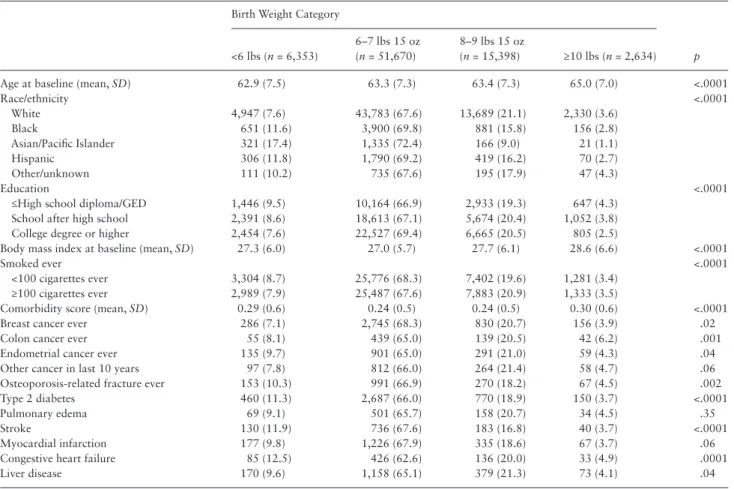
Results from the comparison of baseline characteristics are shown in Table 1. Women born weighing less than 6 lbs tended to be younger, be of a race/ethnicity other than white, have type 2 diabetes at baseline, and to have reported having a stroke prior to study entry. Women born weighing ≥10 lbs were older, had a higher baseline body mass index, and were more likely to report a prior cancer diag-nosis at study entry. Compared to women born between 6 lbs and 9 lbs 15 oz, women born weighing less than 6 lbs and ≥10 lbs were less educated and had a higher comorbidity score.
Table 2 shows the crude and adjusted estimates of the associa-tions between birth weight and physical disability at WHI study entry. Women whose birth weight was outside the normal range (6–7 lbs 15 oz) had a significantly lower physical functioning score when compared to those born within the normal range. Importantly, those born weighing ≥10 lbs had the lowest physical functioning score compared to women in the normal weight range (β = −3.56,
p < .0001). After adjusting the model for age at baseline, education, race/ethnicity, body mass index, and the comorbidity index, women born weighing less than 6 lbs still had a significantly lower physical functioning score compared to those born within the normal range (β = −1.52, p < .0001). However, the physical functioning score was no longer significantly different between women born weighing 8–9 lbs 15 oz or ≥10 lbs and those born in the normal range (p = .76 and
p = .22, respectively).
Discussion
We have demonstrated that a lower birth weight is associated with increased physical disability, as measured by our physical function-ing score. Adjustment for comorbidity and demographic character-istics weakened, but did not remove, this relationship. Birth weight has previously been reported to be positively associated with adult grip strength, physical functioning, and muscle strength and nega-tively associated with sarcopenia (12,16,17,19,23).
Identifying the mechanism(s) underlying the association between lower birth weight and physical disability is complex, as birth weight may be a marker for a variety of in utero insults (24). It has previ-ously been proposed that changes in epigenetic processes (eg, DNA methylation and histone modifications) underlie the associations between birth weight and physical disability, as well as other study outcomes (10,11,25). There is, however, one potential direct mecha-nism by which birth weight could affect muscle mass. Animal studies
have demonstrated that an adverse intrauterine environment, such as malnutrition, can affect muscle histology, including the quantity of muscle fibers (26,27), and any deficit in the number of fibers can-not be entirely explained by genetics or malnutrition during early development (28). As the inevitable loss of muscle fibers proceeds into older age, a person born with fewer muscle fibers would be at a considerable disadvantage later in life, which could, thus, lead to a higher risk of decreased physical functioning or increased physical
disability (13). Additionally, birth weight has also been shown to be positively associated with adult bone mass (14). As bone mass decreases with increasing age, the risk for low-energy fractures due to low bone mass increases, thus increasing the risk for physical dis-ability (14).
The association between birth weight and physical disability could also be explained through birth weight’s associations with other chronic illnesses. Previous studies have identified birth weight Table 1. Baseline Characteristics of 72,650 WHI Study Participants by Birth Weight Category
Birth Weight Category
p <6 lbs (n = 6,353)
6–7 lbs 15 oz (n = 51,670)
8–9 lbs 15 oz
(n = 15,398) ≥10 lbs (n = 2,634)
Age at baseline (mean, SD) 62.9 (7.5) 63.3 (7.3) 63.4 (7.3) 65.0 (7.0) <.0001
Race/ethnicity <.0001
White 4,947 (7.6) 43,783 (67.6) 13,689 (21.1) 2,330 (3.6)
Black 651 (11.6) 3,900 (69.8) 881 (15.8) 156 (2.8)
Asian/Pacific Islander 321 (17.4) 1,335 (72.4) 166 (9.0) 21 (1.1)
Hispanic 306 (11.8) 1,790 (69.2) 419 (16.2) 70 (2.7)
Other/unknown 111 (10.2) 735 (67.6) 195 (17.9) 47 (4.3)
Education <.0001
≤High school diploma/GED 1,446 (9.5) 10,164 (66.9) 2,933 (19.3) 647 (4.3) School after high school 2,391 (8.6) 18,613 (67.1) 5,674 (20.4) 1,052 (3.8) College degree or higher 2,454 (7.6) 22,527 (69.4) 6,665 (20.5) 805 (2.5)
Body mass index at baseline (mean, SD) 27.3 (6.0) 27.0 (5.7) 27.7 (6.1) 28.6 (6.6) <.0001
Smoked ever <.0001
<100 cigarettes ever 3,304 (8.7) 25,776 (68.3) 7,402 (19.6) 1,281 (3.4) ≥100 cigarettes ever 2,989 (7.9) 25,487 (67.6) 7,883 (20.9) 1,333 (3.5)
Comorbidity score (mean, SD) 0.29 (0.6) 0.24 (0.5) 0.24 (0.5) 0.30 (0.6) <.0001
Breast cancer ever 286 (7.1) 2,745 (68.3) 830 (20.7) 156 (3.9) .02
Colon cancer ever 55 (8.1) 439 (65.0) 139 (20.5) 42 (6.2) .001
Endometrial cancer ever 135 (9.7) 901 (65.0) 291 (21.0) 59 (4.3) .04
Other cancer in last 10 years 97 (7.8) 812 (66.0) 264 (21.4) 58 (4.7) .06
Osteoporosis-related fracture ever 153 (10.3) 991 (66.9) 270 (18.2) 67 (4.5) .002
Type 2 diabetes 460 (11.3) 2,687 (66.0) 770 (18.9) 150 (3.7) <.0001
Pulmonary edema 69 (9.1) 501 (65.7) 158 (20.7) 34 (4.5) .35
Stroke 130 (11.9) 736 (67.6) 183 (16.8) 40 (3.7) <.0001
Myocardial infarction 177 (9.8) 1,226 (67.9) 335 (18.6) 67 (3.7) .06
Congestive heart failure 85 (12.5) 426 (62.6) 136 (20.0) 33 (4.9) .0001
Liver disease 170 (9.6) 1,158 (65.1) 379 (21.3) 73 (4.1) .04
Notes: WHI = Women’s Health Initiative.
p-values from chi-square tests for categorical variables and t tests for continuous variables. Values presented as n (%) unless stated as mean (SD).
Table 2. Results From Linear Regression Analysis of the Association Between Birth Weight to Physical Functioning Score in WHI
Birth Weight Category
<6 lbs (n = 6,353) 6–7 lbs 15 oz (n = 51,670) 8–9 lbs 15 oz (n = 15,398) ≥10 lbs (n = 2,634)
Unadjusted −2.22 (0.27) p < .0001 REF −0.64 (0.19) p = .0006 −3.56 (0.40) p < .0001 Adjusted for
Age −2.41 (0.26) p < .0001 REF −0.54 (0.18) p = .003 −2.54 (0.39) p < .0001 Education −1.69 (0.26) p < .0001 REF −0.71 (0.18) p < .0001 −2.94 (0.40) p < .0001 Race/ethnicity −1.99 (0.27) p < .0001 REF −0.80 (0.18) p < .0001 −3.69 (0.40) p < .0001 BMI −1.95 (0.25) p < .0001 REF 0.21 (0.17) p = .23 −1.68 (0.39) p < .0001 Comorbidity score −1.88 (0.26) p < .0001 REF −0.64 (0.18) p = .0004 −3.15 (0.40) p < .0001 Full model* −1.50 (0.23) p < .0001 REF 0.07 (0.18) p = .75 −0.43 (0.38) p = .21
Notes: BMI = body mass index, WHI = Women’s Health Initiative.
Results presented as β (SE) and p-value.
*Full model adjusted for age (continuous), education level (categorical), race/ethnicity (categorical), BMI (continuous), normalized socioeconomic status (NSES) and comorbidity score (continuous).
as a risk factor for several types of adult-onset cancers (11), type 2 diabetes (10), cardiovascular disease (29,30), and other chronic illnesses (31). It is possible that the observed association between birth weight and physical disability could be explained, at least in part, through mediation by other chronic diseases. We attempted to control for the possible effects of these mediators by adjust-ing for the comorbidity score; however, residual association effects are possible. Strengths of our study include its large sample size of more than 72,000 participants. We were also able to evaluate a broad range of potential confounders that may account for the underlying association. Our study was limited to evaluating only self-reported categories of birth weight. While this method is less ideal compared to medical record or birth certificate abstraction, validity has been demonstrated for the correlation between medical record information and self-reported birth weight category (32,33). Additionally, any potential misclassification bias of the exposure would likely not differ across categories. Another limitation of this analysis was our inability to adjust for all possible covariates. It is also possible that some of the physical disability experienced by our subjects was due to a traumatic injury or comorbidity not cap-tured by the WHI questionnaires. Finally, we did not have data on in utero pregnancy-related exposures and conditions (eg, in utero tobacco smoking exposure; gestational diabetes), as this informa-tion was not collected.
In conclusion, we demonstrate that increasing birth weight cat-egory appears to be significantly associated with a decreased risk for physical disability (as measured by the RAND physical function score) in postmenopausal women. Our research further supports the role of early developmental abnormalities in later-life conditions and, therefore, interventions targeted during preconception and pre-natal care to reduce the incidence of low birth weight may reduce the burden of later-life physical disability.
Funding
The WHI program is funded by the National Heart, Lung, and Blood Institute, National Institutes of Health, U.S. Department of Health and Human Services through contracts HHSN268201100046C, HHSN268201100001C, HHSN268201100002C, HHSN268201100003C, HHSN268201100004C, and HHSN271201100004C.
Acknowledgments
We thank the WHI investigators and staff for their dedication and the study participants for making this program possible, including: Program Office: (National Heart, Lung, and Blood Institute, Bethesda, Maryland) Jacques Rossouw, Shari Ludlam, Dale Burwen, Joan McGowan, Leslie Ford, and Nancy Geller. Clinical Coordinating Center: (Fred Hutchinson Cancer Research Center, Seattle, Washington) Garnet Anderson, Ross Prentice, Andrea LaCroix, and Charles Kooperberg. Investigators and Academic Centers: (Brigham and Women’s Hospital, Harvard Medical School, Boston, Massachusetts) JoAnn E. Manson; (MedStar Health Research Institute/Howard University, Washington, DC) Barbara V. Howard; (Stanford Prevention Research Center, Stanford, California) Marcia L. Stefanick; (The Ohio State University, Columbus, Ohio) Rebecca Jackson; (University of Arizona, Tucson/Phoenix, Arizona) Cynthia A. Thomson; (University at Buffalo, Buffalo, New York) Jean Wactawski-Wende; (University of Florida, Gainesville/Jacksonville, Florida) Marian Limacher; (University of Iowa, Iowa City/Davenport, Iowa) Robert Wallace; (University of Pittsburgh, Pittsburgh, Pennsylvania) Lewis Kuller; (Wake Forest University School of Medicine, Winston-Salem, North Carolina) Sally Shumaker. Women’s Health Initiative Memory Study: (Wake Forest University School of Medicine, Winston-Salem, North Carolina) Sally Shumaker.
References
1. Cigolle CT, Langa KM, Kabeto MU, Tian Z, Blaum CS. Geriatric condi-tions and disability: the Health and Retirement Study. Ann Intern Med. 2007;147:156–164. doi:10.7326/0003-4819-147-3-200708070-00004 2. From the Centers for Disease Control and Prevention. Public health and aging:
trends in aging--United States and worldwide. JAMA. 2003;289:1371–1373. doi:10.1001/jama.289.11.1371
3. Fried LP, Ferrucci L, Darer J, Williamson JD, Anderson G. Untan-gling the concepts of disability, frailty, and comorbidity: implica-tions for improved targeting and care. J Gerontol A Biol Sci Med Sci. 2004;59:255–263. doi:10.1093/gerona/59.3.M255
4. Fried LP, Guralnik JM. Disability in older adults: evidence regard-ing significance, etiology, and risk. J Am Geriatr Soc. 1997;45:92–100. doi:10.1111/j.1532-5415.1997.tb00986.x
5. Verbrugge LM, Jette AM. The disablement process. Soc Sci Med. 1994;38:1–14. doi:10.1016/0277-9536(94)90294-1
6. Barker DJ. The developmental origins of adult disease. J Am Coll Nutr. 2004;23:588S–595S. doi:10.1080/07315724.2004.10719428
7. Barker DJ, Osmond C, Kajantie E, Eriksson JG. Growth and chronic dis-ease: findings in the Helsinki Birth Cohort. Ann Hum Biol. 2009;36:445– 458. doi:10.1080/03014460902980295
8. Eriksson J, Forsén T, Tuomilehto J, Osmond C, Barker D. Fetal and child-hood growth and hypertension in adult life. Hypertension. 2000;36:790– 794. doi:10.1161/01.HYP.36.5.790
9. Eriksson J, Forsén T, Tuomilehto J, Osmond C, Barker D. Size at birth, childhood growth and obesity in adult life. Int J Obes Relat Metab Disord. 2001;25:735–740. doi:10.1038/sj.ijo.0801602
10. Ryckman KK, Rillamas-Sun E, Spracklen CN, et al. Ethnic differences in the relationship between birth weight and type 2 diabetes mellitus in post-menopausal women. Diabetes Metab. 2014;40:379–385. doi:10.1016/j. diabet.2014.03.003
11. Spracklen CN, Wallace RB, Sealy-Jefferson S, et al. Birth weight and subse-quent risk of cancer. Cancer Epidemiol. 2014;38:538–543. doi:10.1016/j. canep.2014.07.004
12. Dodds R, Denison HJ, Ntani G, et al. Birth weight and muscle strength: a sys-tematic review and meta-analysis. J Nutr Health Aging. 2012;16:609–615. doi:10.1007/s12603-012-0053-9
13. Kuh D, Bassey J, Hardy R, Aihie Sayer A, Wadsworth M, Cooper C. Birth weight, childhood size, and muscle strength in adult life: evidence from a birth cohort study. Am J Epidemiol. 2002;156:627–633. doi:10.1093/aje/kwf099 14. Dennison EM, Syddall HE, Sayer AA, Gilbody HJ, Cooper C. Birth weight
and weight at 1 year are independent determinants of bone mass in the seventh decade: the Hertfordshire cohort study. Pediatr Res. 2005;57:582– 586. doi:10.1203/01.PDR.0000155754.67821.CA
15. Eriksson JG, Osmond C, Perälä MM, et al. Prenatal and childhood growth and physical performance in old age–findings from the Helsinki Birth Cohort Study 1934-1944. Age (Dordr). 2015;37:108. doi:10.1007/ s11357-015-9846-1
16. von Bonsdorff MB, Rantanen T, Sipilä S, et al. Birth size and childhood growth as determinants of physical functioning in older age: the Helsinki Birth Cohort Study. Am J Epidemiol. 2011;174:1336–1344. doi:10.1093/aje/kwr270 17. Sayer AA, Dennison EM, Syddall HE, Jameson K, Martin HJ, Cooper C.
The developmental origins of sarcopenia: using peripheral quantitative computed tomography to assess muscle size in older people. J Gerontol
A Biol Sci Med Sci. 2008;63:835–840.
18. Inskip HM, Godfrey KM, Martin HJ, Simmonds SJ, Cooper C, Sayer AA; Southampton Women’s Survey Study Group. Size at birth and its relation to muscle strength in young adult women. J Intern Med. 2007;262:368– 374. doi:10.1111/j.1365-2796.2007.01812.x
19. Sayer AA, Syddall HE, Gilbody HJ, Dennison EM, Cooper C. Does sar-copenia originate in early life? Findings from the Hertfordshire cohort study. J Gerontol A Biol Sci Med Sci. 2004;59:M930–M934. doi:10.1093/ gerona/59.9.M930
20. Anderson GL, Manson J, Wallace R, et al. Implementation of the Wom-en’s Health Initiative study design. Ann Epidemiol. 2003;13:S5–17. doi:10.1016/S1047-2797(03)00043-7
21. WHI. Design of the Women’s Health Initiative clinical trial and observa-tional study. The Women’s Health Initiative Study Group. Control Clin
Trials. 1998;19:61–109. doi:10.1016/S0197-2456(97)00078-0
22. Hays RD, Sherbourne CD, Mazel RM. The RAND 36-Item Health Survey 1.0. Health Econ. 1993;2:217–227. doi:10.1002/hec.4730020305 23. Kuh D, Hardy R, Butterworth S, et al. Developmental origins of midlife
grip strength: findings from a birth cohort study. J Gerontol A Biol Sci
Med Sci. 2006;61:702–706.
24. Class QA, Rickert ME, Lichtenstein P, D’Onofrio BM. Birth weight, physical morbidity, and mortality: a population-based sibling-comparison study. Am J Epidemiol. 2014;179:550–558. doi:10.1093/aje/kwt304 25. Gluckman PD, Hanson MA, Cooper C, Thornburg KL. Effect of in utero
and early-life conditions on adult health and disease. N Engl J Med. 2008;359:61–73. doi:10.1056/NEJMra0708473
26. Costello PM, Rowlerson A, Astaman NA, et al. Peri-implantation and late gestation maternal undernutrition differentially affect fetal sheep skeletal muscle development. J Physiol. 2008;586:2371–2379. doi:10.1113/jphys-iol.2008.150987
27. Rehfeldt C, Kuhn G. Consequences of birth weight for postnatal growth performance and carcass quality in pigs as related to myogenesis. J Anim Sci. 2006;84:E113–E123. doi:/2006.8413_supplE113x
28. Gale CR, Martyn CN, Kellingray S, Eastell R, Cooper C. Intrauter-ine programming of adult body composition. J Clin Endocrinol Metab. 2001;86:267–272. doi:10.1210/jcem.86.1.7155
29. Leon DA, Lithell HO, Vâgerö D, et al. Reduced fetal growth rate and increased risk of death from ischaemic heart disease: cohort study of 15 000 Swedish men and women born 1915–29. BMJ. 1998;317:241–245. doi:http://dx.doi.org/10.1136/bmj.317.7153.241
30. Barker DJ, Winter PD, Osmond C, Margetts B, Simmonds SJ. Weight in infancy and death from ischaemic heart disease. Lancet. 1989;2:577–580. doi:10.1016/S0140-6736(89)90710-1
31. Sorensen HT, Sabroe S, Rothman KJ, Gillman M, Fischer P, Sørensen TI. Relation between weight and length at birth and body mass index in young adulthood: cohort study. BMJ. 1997;315:1137. doi:http://dx.doi. org/10.1136/bmj.315.7116.1137
32. Wodskou PM, Hundrup YA, Obel EB, Jørgensen T. Validity of self-reported birthweight among middle-aged and elderly women in the Danish Nurse Cohort Study. Acta Obstet Gynecol Scand. 2010;89:1134–1139. doi:10.3 109/00016349.2010.500370
33. Jaworowicz DJ, Nie J, Bonner MR, et al. Agreement between self-reported birth weight and birth certificate weights. J Dev Orig Health Dis. 2010;1:106–113. doi:10.1017/S2040174410000012