Insights into RNA structure by melding experiment and computation
Christine Elizabeth Hajdin
A dissertation submitted to the faculty of the University of North Carolina at Chapel Hill in partial fulfillment of the requirements for the degree of Doctor of Philosophy in
Department of Chemistry.
Chapel Hill 2013
ABSTRACT
CHRISTINE ELIZABETH HAJDIN: Insights into RNA structure by melding experiment and computation
(Under the direction of Kevin Weeks)
TABLE OF CONTENTS
List of Tables ... vii
List of Figures ... viii
List of Abbreviations ... xi
MAIN CONTENT 1. Chapter 1: Introduction ...1
1.1 RNA structure and function ...1
1.2 Using computational algorithms to determine RNA structure ...2
1.3 Using SHAPE data to refine structural predictions ...4
1.4 Challenges of prediction algorithms ...6
1.5 Research Overview ...8
1.6 Perspective ...9
1.7 References ...10
2. Chapter 2: ShapeKnots: accurate RNA secondary structure predictions, including pseudoknots ...13
2.1 Introduction ...13
2.1.1 RNA structure and function. ...13
2.2 Results ...16
2.2.1 A challenging RNA test set. ...16
2.2.2 A simple, robust model for pseudoknot formation. ...18
2.2.3 RNA structure interrogation by SHAPE. ...22
2.2.4 Algorithm and Parameter Determination. ...22
2.2.5 Extension to additional RNAs. ...27
2.3 Discussion ...27
2.3.2 Short pseudoknotted RNAs...31
2.3.3 Large, complex RNAs. ...33
2.3.4 RNAs with difficult to predict pseudoknots. ...33
2.3.5 RNAs that do not adopt their accepted structures. ...36
2.3.6 Perspective. ...36
2.4 Experimental ...39
2.4.1 ShapeKnots algorithm. ...39
2.4.2 Parameterization of ∆G°SHAPE and ∆G°PK. ...43
2.4.3 SHAPE structure probing. ...45
2.4.4 Parameterization of SHAPE data. ...46
2.4.5 Comparison with other algorithms. ...46
2.4.6 Data and software availability. ...48
2.5 References ...49
3. Chapter 3: Identifying pseudoknots in HIV-1 genomic RNA ...55
3.1.1 Pseudoknots perform critical functions in viruses ...55
3.1.2 Using ShapeKnots to identify pseudoknots in HIV-1 ...56
3.2 Results ...57
3.2.1 Three pseudoknots identified by ShapeKnots algorithm ...57
3.2.2 Using mutual information to test for evolutionary support for pseudoknots...59
3.2.3 LNA binding to potential pseudoknot motifs ...61
3.2.4 In virio mutants of HIV-1 pseudoknots ...61
3.3 Discussion ...66
3.3.2 Conclusion ...68
3.4 Experimental ...68
3.4.1 SHAPE on HIV-1 RNA ...68
3.4.2 Identification of Pseudoknots ...68
3.4.3 Comparison of Mutual Information ...69
3.4.4 Binding of LNAs ...69
3.4.5 In Virio Mutants ...69
3.5 References ...71
4. Chapter 4: Using Shannon entropies to calculate the accuracy of secondary structure predictions ...74
4.1 Introduction ...74
4.1.1 Predicting accurate RNA structures is an important goal ...74
4.2.2 Calculating the partition function as a Shannon entropy ...78
4.2.3 Subdividing the Shannon entropy ...79
4.2.4 Offset Helices ...82
4.2.5 Pseudoknot prediction ...85
4.2.6 Incorporating differential SHAPE data ...86
4.3 Discussion ...88
4.3.2 E. coli 16S and 23S rRNAs...90
4.3.3 Signal Recognition Particle ...92
4.3.4 Other small RNAs ...94
4.3.5 Other large RNAs ...96
4.3.6 Conclusion ...96
4.4 Experimental ...98
4.4.1 RNA preparation and SHAPE modification. ...98
4.4.2 Signal Recognition Particle Protein and RNA preparation and modification ...99
4.4.3 Shannon entropy calculation ...100
4.4.4 Color Distribution. ...102
4.5 References ...103
5. Chapter 5: Testing Alternative 16S rRNA state ...107
5.1 Introduction ...107
5.1.1 RNA structure can be divided into three different levels ...107
5.1.2 Using X-ray crystallography to determine RNA structure ...107
5.2 Results ...110
5.2.1 Alternative SHAPE directed prediction is different than conventional structure ...110
5.2.2 Using modeling techniques to identify topology of alternative SHAPE directed structure ...110
5.3 Discussion ...115
5.3.1 Conclusion ...116
5.4 Experimental ...117
5.4.1 Performing SHAPE on 16S rRNA ...117
5.4.2 Folding using RNAstructure Fold: ...117
5.4.3 Discrete Molecular Dynamics calculations: ...118
5.4.4 Modeling: ...118
5.5 References ...119
6. Chapter 6: Principles for understanding the accuracy of SHAPE-directed RNA structure modeling. ...121
6.1 Introduction ...121
6.1.1 RNA modeling may provide a useful alternative method for experimental techniques ...121
6.1.2 Identifying methods of determining the accuracy of RNA tertiary models ...122
6.1.3 Identifying variables that will effect the accuracy of prediction ...123
6.2 Results ...127
6.2.4 A Power Law Relationship for the Radius of Gyration and
Chain Length in RNA. ...131
6.3 Discussion ...133
6.4 Experimental ...141
6.4.1 Target RNAs and analysis of Power Law relationships for RNA. ...141
6.4.2 Generation of RNA decoys by Replica Exchange DMD. ...142
6.4.3 Pair-wise RMSD and Gaussian Distribution calculations. ...142
6.4.4 Effect of calculating RMSD values over other RNA atoms. ...143
6.4.5 Calculation of Confidence Intervals. ...143
List of Tables
Table 2.1: Prediction accuracies as a function of algorithm and SHAPE
information. ...17 Table 2.2: Energy penalty per in-line pseudoknotted helix of length n. ...21
Table 2.3: ShapeKnots run times as a function of RNA length. ...26
Table 2.4: Prediction accuracies for seven RNA folding algorithms (following
List of Figures
Figure 1.1: Overview of SHAPE mechanism ...5
Figure 1.2: Simple pseudoknot motif in RNA. ...7
Figure 2.1: Overview of pseudoknot structure model and entropic penalty
terms. ...20
Figure 2.2: Representative ShapeKnots structure prediction for the SAM I
riboswitch. ...23
Figure 2.3: Optimization of the ∆G°SHAPE and ∆G°PK parameters (in kcal/mol)
by jackknifing. ...25
Figure 2.4: Summary of predictions for four H-type pseudoknots. ...32
Figure 2.5: Prediction summaries for two large, pseudoknot-containing RNAs. ...34
Figure 2.6: Representative examples in which ShapeKnots avoids
false-positive (top) or false-negative (bottom) pseudoknot predictions. ...35
Figure 2.7: Prediction summary for RNase P RNA. ...37
Figure 3.1: Predicted pseudoknots in HIV-1. ...58
Figure 3.2: Mutual information distribution for all base-pairing conformations
in the HIV-1 genome. ...60
Figure 3.3: LNA binding confirms predicted HIV-1 pseudoknots. ...62
Figure 3.4: Activities of HIV-1 mutants confirm importance of nucleotides in
predicted pseudoknots. ...63
Figure 3.5: Effects of mutations on SHAPE reactivities. ...65
Figure 4.1: Shannon entropies values over the HIV-1 genome. ...80
Figure 4.2: Distribution of the Shannon entropies from no SHAPE and
Figure 4.3: Identifying single nucleotide offsets in helices. ...84
Figure 4.4: Predicting Shannon entropies with pseudoknots. ...87
Figure 4.5: 5S E. coli no SHAPE, 1M7 and differential SHAPE ...89
Figure 4.6: 16S and 23S rRNA no SHAPE and 1M7 SHAPE predictions and
superimposed Shannon entropies ...91
Figure 4.7: Signal Recognition Particle 1M7 and differential SHAPE
predictions ...93
Figure 4.8: Shannon entropy calculations for small RNA predictions. ...95
Figure 4.9: Shannon entropy calculations for large RNA predictions. ...97
Figure 5.1: SHAPE-directed secondary structure model of the 16S rRNA
compared to the conventional model. ...111
Figure 5.2: SHAPE-directed structural models of small refolded regions ...112
Figure 5.3: The structure for the region between nucleotides 920-1410
predicted by DMD based on SHAPE data. ...113
Figure 5.4: SHAPE-directed structure refined using PHENIX for the region
between nucleotides 920-1410. ...114
Figure 6.1: Comparison of an accepted RNA structure with modeled tertiary
structures as a function of RMSD similarity. ...124
Figure 6.2: Replica exchange DMD simulations as a function of starting state
and of enforcing native base pairing. ...129
Figure 6.3: Distributions of decoy structures. ...130
Figure 6.4: Dependence of radius of gyration on chain length for compact
RNAs with higher-order tertiary structure interactions. ...132
Figure 6.7: Significance (p-value) analysis for RNA tertiary structure
List of Abbreviations
1M6 - 1-methyl-6-nitroisatoic anhydride 1M7 - 1-methyl-7-nitroisatoic anhydride di-GMP –diguanylate
DIS – Dimer initiation site
DMD - Discrete molecular dynamics DNA – Deoxyribonucleic acid GDT – Global distance test HCV - Hepatitis C virus
HIV-1 – Human immunodeficiency virus type 1 INF – Interaction network fidelity
IRES – Internal ribosome entry site LNA – Locked nucleic acid
NE – Nested helices NL – Inline helices
NMIA - N-methylisatoic anhydride NMR - Nuclear magnetic resonance MFE – Minimum free energy
mRNA – Messenger ribo-nucleic acid PBS – Primer binding site
PreQ1- Pre-queuosine
RNA – Ribo-nucleic acid RNase P – Ribonuclease P RRE – Rev response element
rRNA – Ribosomal ribo-nucleic acid SAM-I – S’adenosyl methionine
SARS – Severe acute respiratory syndrome
SHAPE - Selective 2'OH acylation analyzed by primer extension SRP – Signal recognition particle
SS – Single stranded
1.
Chapter 1: Introduction
1.1RNA structure and function
Although ribonucleic acid (RNA) is often dismissed as a passive component of translation, RNA plays keys roles in viruses and cells. For example, viral RNAs, like the Human immunodeficiency virus type 1 (HIV-1) RNA, form important elements of structure essential for viral replication and transcription1. Riboswitch RNAs, like the thiamine pyrophosphate (TPP) riboswitch, regulate cellular function2-4 and ribosomal RNAs are critical to translation. For instance the 16S and 23S rRNA found in E. coli
form the main structural component of the ribosome and coordinate between the mRNA, the tRNA and the elongating amino acid chain5, 6.
The ability of RNA to perform these multiple diverse functions depends on its capacity to form distinct structures. Identifying these distinct RNA structures is critical to understanding and characterizing the role of RNA in cells and viruses.
like the signal recognition particle (SRP)10, lysine riboswitch11, and even the 16S rRNA 12, 13.
Despite the advancements of X-ray crystallography, it is not suitable for every RNA. To accurately identify a tertiary structure, the RNA must be able to form a well-ordered crystal. Without a well-well-ordered crystal, the diffraction data becomes ‘fuzzy’ and it is hard to model the electron density. Crystallization, or the act of making an RNA crystal, is a difficult and time-consuming process. Success depends on the specific RNA being tested, the concentration of different components in the solution, the pH, and the flexibility of the RNA. To aid in the crystallization process, and increase the stability of the RNA, high concentrations of proteins, ligands and other stabilizing elements are added. These conditions can perturb the RNA structure and shift it away from its lowest energy state which is adopted in solution13-15_
1.2Using computational algorithms to determine RNA structure
Due to the disadvantages of traditional structure probing techniques, computational algorithms have been developed as a useful alternative for RNA structure determination. However, predicting the tertiary structure of an RNA directly from a linear sequence is a difficult challenge. An important first step in this process is to determine the secondary structure.
with all motifs in a structure is summed to identify the energy of a potential structure. The potential structures are then sorted by their energy and the “correct” structure is identified to be the lowest energy structure. These MFE algorithms, classically called the mFold class of algorithms18, tend to work well for small RNAs, but suffer from inaccuracies due to incomplete energy rules and an inability to correctly rank structures with similar energies, (see Chapter 2) so do not work well for long or complicated RNAs.
Heuristic algorithms work in a similar fashion to MFE algorithms, but attempt to redefine energy rules by supplementing additional constraints from known structures19, 20. These constraints are implemented into the program using a series of fit equations that are optimized against known RNAs. These algorithms tend to work well for small RNAs that can be accurately fit with a small number of equations and parameters. However, the complexity of large RNAs requires additional equations and constraints. Since the number of known large RNA structures is small and biased toward those that are stable enough for crystallography, it results in over-optimized fits to a few RNAs.
Partition function algorithms use statistical characterizations of the equilibrium ensemble of RNA to determine secondary structures21, 22. They function by calculating the base pairing probability of each base pair combination in an RNA and then use this information to rank order potential structures. Like traditional MFE algorithms, partition function algorithms employ classic rules from thermodynamics to assign probabilities. As in the MFE algorithm, this tends to work well for small RNAs, but is not accurate for larger RNAs.
maintained when bases in the pair are mutated. For example, if one serotype of a virus has a predicted CG base pair, co-variation would be observed if in another serotype there is an AU pair in the same relative position. When a large number of homologous sequences are known and there is great variability in the sequences, this method, can provide accurate RNA secondary structures. Many structures have been solved by this method such as the 16S rRNA24, 25. However, if there are not a large number of sequences known, few base pairs can be correctly identified.
1.3Using SHAPE data to refine structural predictions
Previously, work demonstrated how incorporating experimental SHAPE data can help to improve the accuracy of computational algorithms26. SHAPE allows for the differentiation of single-stranded and base-paired nucleotides27 (Figure 1.1). The technique works by chemically foot-printing an RNA using a SHAPE reagent. This molecule preferentially reacts with single-stranded nucleotides, creating bulky 2’-O-adducts. These adducts can be probed using a reverse transcriptase, which dissociates when it encounters the 2’-O-adduct. This creates a series of cDNAs whose lengths correspond to the position of modification and whose abundance corresponds to the degree of modification. These cDNAs are resolved using capillary electrophoresis and aligned to a sequencing ladder27. After integration, background subtraction from a no-reagent control reaction, and further data processing the end result is a SHAPE reactivity profile (Figure 1.1).
Figure 1.1: Overview of SHAPE mechanism
A) Schematic of SHAPE reagent (1M7) reacting with RNA. The SHAPE reagent preferentially reacts with single stranded nucleotides forming bulky 2’-O-adducts. These adducts can be detected using capillary electrophoresis.
B) After data processing, the SHAPE data can be viewed as a SHAPE reactivity profile. The profile plots the nucleotide sequence along the x-axis and the SHAPE reactivities along the y-axis. The reactivates are colored so that very highly reactive nucleotides (> 0.85) are colored red, highly reactivity orange (between 0.4 and 0.85), and lowly reactive (< 0.4) are colored black.
C) When the SHAPE data is superimposed on an RNA structure, single stranded nucleotides are usually red or orange indicating highly flexible and base paired nucleotides are colored back, indicating highly constrained.
(RNA)constrained
OH 2’
(RNA)flexible
OH 2’
2’-O-adduct
N O
O O
NO2
(RNA)
2' O H N O 1M7
NO2 0
1.0
5 10 15 20 25
0.7
0.3
CCC GG
U A
C G
C G
C G
G C
G C
U
10
U GC GU 30
G C
A U
G C
U
U
A G A
20
5'
3'
0 1.0
5 10 15 20 25 30
0.85
0.4
Highly Reactive
Un-reactive A)
sampling space and increase the accuracy of prediction. When this method was incorporated into a secondary structure prediction algorithm, RNAstructure, and applied to the 16S rRNA and 23S rRNA, the accuracy of the prediction of structure for these RNAs increased by more than 20% over a traditional mFold class algorithm 26.
1.4Challenges of prediction algorithms
The RNAstructure algorithm provided a critical first step in refining traditional dynamic programming, but despite its advances, RNAstructure still had several deficiencies. For instance, none of the traditional RNAstructure predictions allows for the prediction of pseudoknots. Pseudoknots form when the loop region of a helix base pairs to another place in a RNA structure. Figure 1.2 shows the secondary structure of a simple pseudoknot on a traditional secondary structure plot and on a circleplot. A circleplot plots the sequence of the RNA around the outside of the circle and base pairs as lines running through the circle. Pseudoknots are easily identified on circleplots because they form a cross-hatching pattern. Pseudoknot motifs are relatively rare, but often occur in key functional areas, such as the pseudoknot near the 5’ end of HIV-1 that allows for frame shifting28, and the central pseudoknot in the SAMI riboswitch29 necessary for ligand binding. Because of their biological importance, there is a need to confidently identify pseudoknots in RNA secondary structures30, 31.
Figure 1.2: Simple pseudoknot motif in RNA.
On the left, the pseudoknot is shown on a traditional secondary structure plot. On the right, the pseudoknot is shown on a circleplot. Circleplots plot the sequence of the RNA around the circumference of the circle; lines running through the circle represent base pairs. Pseudoknots are easy to identify because they create a cross hatching pattern.
C CC GG
U A
C G
C G
C G
G C
G C
U
10
U GC UG 30
G C
A U
G C
U
U
A G A
20
5'
3'
Simple H-type pseudoknot
Pseudoknot
C
1
C C
U
C
C
C
G
G
U 10
U
G
C
G
AG
UC
C
G
20
GG
A
G
G
U
C
U
C
G
30
U
A
G
A
key hypotheses to be made. Conversely, identifying a poorly supported structure allows incorrect hypotheses to be avoided. Lastly, previous work has generally focused on using SHAPE data to understand secondary structure predictions. To obtain a full understanding of RNA structure, we must eventually target tertiary structures.
1.5Research Overview
In this work, I sought to modify current algorithms to increase prediction accuracy and better understand RNA structure. My focus has been on finding techniques to include pseudoknots using SHAPE data in secondary structure predictions, and identifying methods to calculate the accuracy of structure predictions.
In Chapter 2, I discuss how we created a secondary structure prediction algorithm, ShapeKnots, which more accurately incorporates SHAPE reactivities and predicts pseudoknots. By incorporating these features, I show that the accuracy of prediction increases 30% over classic mFold class algorithms to reach 94% accuracy. In Chapter 3, I discuss how I can use the ShapeKnots algorithm to identify pseudoknots in HIV-1. I show that when tested in virio, these pseudoknots are critical to the replication of the HIV-1. In Chapter 4, I discuss how I can determine the accuracy of secondary structure prediction by calculating the Shannon entropy from a modified partition function.
use the central limit theorem to identify a useful metric for categorizing the success of tertiary structure predictions. This metric, denoted the “q value”, can be used to evaluate tertiary structure prediction quality.
1.6Perspective
1.7References
1. Frankel, A.D. & Young, J.A. HIV-1: fifteen proteins and an RNA. Annu Rev
Biochem67, 1-25 (1998).
2. Serganov, A., Polonskaia, A., Phan, A.T., Breaker, R.R. & Patel, D.J. Structural basis for gene regulation by a thiamine pyrophosphate-sensing riboswitch. Nature
441, 1167-1171 (2006).
3. Bocobza, S. et al. Riboswitch-dependent gene regulation and its evolution in the plant kingdom. Genes Dev21, 2874-2879 (2007).
4. Kubodera, T. et al. Thiamine-regulated gene expression of Aspergillus oryzae thiA requires splicing of the intron containing a riboswitch-like domain in the 5'-UTR. FEBS Lett555, 516-520 (2003).
5. Traub, P. & Nomura, M. Structure and function of E. coli ribosomes. V. Reconstitution of functionally active 30S ribosomal particles from RNA and proteins. Proc Natl Acad Sci U S A59, 777-784 (1968).
6. Shajani, Z., Sykes, M.T. & Williamson, J.R. Assembly of bacterial ribosomes.
Annu Rev Biochem80, 501-526 (2011).
7. Wilkinson, K.A. et al. High-throughput SHAPE analysis reveals structures in HIV-1 genomic RNA strongly conserved across distinct biological states. PLoS Biol6, e96 (2008).
8. Mooers, B.H. Crystallographic studies of DNA and RNA. Methods 47, 168-176 (2009).
9. Smyth, M.S. & Martin, J.H. x ray crystallography. Mol Pathol53, 8-14 (2000). 10. Hainzl, T., Huang, S. & Sauer-Eriksson, A.E. Structure of the SRP19 RNA
complex and implications for signal recognition particle assembly. Nature 417, 767-771 (2002).
11. Garst, A.D., Heroux, A., Rambo, R.P. & Batey, R.T. Crystal structure of the lysine riboswitch regulatory mRNA element. Journal of Biological Chemistry
283, 22347-22351 (2008).
12. Dunkle, J.A., Xiong, L., Mankin, A.S. & Cate, J.H. Structures of the Escherichia coli ribosome with antibiotics bound near the peptidyl transferase center explain spectra of drug action. Proc Natl Acad Sci U S A107, 17152-17157 (2010). 13. Sagi, I. et al. Crystallography of ribosomes: attempts at decorating the ribosomal
14. Lu, J., Li, N.S., Sengupta, R.N. & Piccirilli, J.A. Synthesis and biochemical application of 2'-O-methyl-3'-thioguanosine as a probe to explore group I intron catalysis. Bioorg Med Chem16, 5754-5760 (2008).
15. Egli, M. & Pallan, P.S. Insights from crystallographic studies into the structural and pairing properties of nucleic acid analogs and chemically modified DNA and RNA oligonucleotides. Annu Rev Biophys Biomol Struct36, 281-305 (2007). 16. Zhang, S.J. et al. RhesusBase: a knowledgebase for the monkey research
community. Nucleic Acids Res41, D892-905 (2013).
17. Tian, B. et al. Expanded CUG repeat RNAs form hairpins that activate the double-stranded RNA-dependent protein kinase PKR. Rna6, 79-87 (2000).
18. Zuker, M. Mfold web server for nucleic acid folding and hybridization prediction.
Nucleic Acids Res31, 3406-3415 (2003).
19. Westhof, E., Masquida, B. & Jaeger, L. RNA tectonics: towards RNA design.
Fold Des1, R78-88 (1996).
20. Ren, J., Rastegari, B., Condon, A. & Hoos, H.H. HotKnots: heuristic prediction of RNA secondary structures including pseudoknots. Rna11, 1494-1504 (2005). 21. Vreede, F.T., Chan, A.Y., Sharps, J. & Fodor, E. Mechanisms and functional
implications of the degradation of host RNA polymerase II in influenza virus infected cells. Virology396, 125-134 (2010).
22. Dong, H., Ding, L., Yan, F., Ji, H. & Ju, H. The use of polyethylenimine-grafted graphene nanoribbon for cellular delivery of locked nucleic acid modified molecular beacon for recognition of microRNA. Biomaterials 32, 3875-3882 (2011).
23. Eddy, S.R. & Durbin, R. RNA sequence analysis using covariance models.
Nucleic Acids Res22, 2079-2088 (1994).
24. Tocilj, A. et al. The small ribosomal subunit from Thermus thermophilus at 4.5 A resolution: pattern fittings and the identification of a functional site. Proc Natl
Acad Sci U S A96, 14252-14257 (1999).
25. Schluenzen, F. et al. Structure of functionally activated small ribosomal subunit at 3.3 angstroms resolution. Cell102, 615-623 (2000).
28. Gaudin, C. et al. Structure of the RNA signal essential for translational frameshifting in HIV-1. J Mol Biol349, 1024-1035 (2005).
29. Montange, R.K. & Batey, R.T. Structure of the S-adenosylmethionine riboswitch regulatory mRNA element. Nature441, 1172-1175 (2006).
30. Brierley, I., Gilbert, R.J. & Pennell, S. RNA pseudoknots and the regulation of protein synthesis. Biochemical Society transactions36, 684-689 (2008).
31. Brierley, I., Pennell, S. & Gilbert, R.J. Viral RNA pseudoknots: versatile motifs in gene expression and replication. Nat Rev Microbiol5, 598-610 (2007).
32. Ding, F. et al. Ab initio RNA folding by discrete molecular dynamics: from structure prediction to folding mechanisms. Rna14, 1164-1173 (2008).
33. Woese, C.R., Gutell, R., Gupta, R. & Noller, H.F. Detailed analysis of the higher-order structure of 16S-like ribosomal ribonucleic acids. Microbiological reviews
2.
Chapter 2: ShapeKnots: accurate RNA secondary structure
predictions, including pseudoknots
2.1Introduction
2.1.1RNA structure and function.
RNA constitutes the central information conduit in biology1. Information is
encoded in an RNA molecule at two levels: in its primary sequence and in its ability to form higher-order secondary and tertiary structures. Nearly all RNAs can fold to form some secondary structure and, in many RNAs, highly structured regions encode important regulatory motifs. Such structured regulatory elements can be comprised of canonical base pairs but may also feature specialized and distinctive RNA structures. Among the best characterized of these specialized structures are RNA pseudoknots. Pseudoknots are relatively rare but occur overwhelmingly in functionally important regions of RNA2-4. For example, all of the large catalytic RNAs contain pseudoknots5, 6;
roughly two-thirds of the known classes of riboswitches contain pseudoknots that appear to be essential for ligand binding and gene regulatory functions7; and pseudoknots occur
prominently in the regulatory elements that viruses use to usurp cellular metabolism3.
2.1.2Pseudoknots in RNA structure predictions.
Pseudoknots are excluded from the most widely employed algorithms used to model RNA secondary structure8. This exclusion is based on the challenge of
incorporating the pseudoknot structure into the efficient dynamic programming algorithm used in the most popular secondary structure prediction approaches and because of the additional computational effort required. The prediction of lowest free energy structures with pseudoknots is NP-complete9, which means that lowest free energy structure cannot
be solved as a function of sequence length in polynomial time. In addition, allowing pseudoknots greatly increases the number of (incorrect) helices possible and tends to reduce secondary structure prediction accuracies, even for RNAs that include pseudoknots. Current algorithms also have high false positive rates for pseudoknot prediction, necessitating extensive follow-up testing and analysis of proposed structures. Pseudoknot prediction is challenging, in part, for the same reasons that RNA secondary structure prediction is difficult. First, energy models for loops are incomplete because they extrapolate from a limited set of experiments. Second, folding can be affected by kinetic, ligand-mediated, tertiary, and transient interactions that are difficult or impossible to glean from the sequence. Prediction is also difficult for a third reason unique to pseudoknots: Energy models for pseudoknot formation are generally incomplete because the factors governing their stability are not fully understood10-12
accurate for full-length biological RNA sequences, with as few as 5% of known pseudoknotted pairs predicted correctly and with more false positive than correct pseudoknot predictions in some benchmarks13.
2.1.3Using SHAPE data to probe RNA structure.
The accuracy of secondary structure prediction is improved dramatically by including experimental information as restraints14, 15
. SHAPE (selective 2'-hydroxyl
acylation analyzed by primer extension) probing data has proven especially useful in yielding robust working models for RNA secondary structure 15, 16. In essence, inclusion
of SHAPE information provides an experimental adjustment to the well-established, nearest neighbor model parameters17 for RNA folding. This adjustment is implemented as
a simple pseudo-free energy change term, ∆G°SHAPE. SHAPE reactivities are approximately inversely proportional to the probability that a given nucleotide is base paired (high reactivities correspond to a low likelihood of being paired and vice versa) and the logarithm of a probability corresponds to an energy, in this case ∆G°SHAPE, which has the form:
∆G°SHAPE = mln [SHAPE + 1] + b (1)
Our original SHAPE-directed algorithm did not allow for pseudoknotted base pairs15. Given the strong relationship between pseudoknots and functionally critical
regions in RNA and the fact that it is impossible to know a priori whether an RNA contains a pseudoknot, this limitation severely restricts the accuracy and generality of experimentally-directed RNA structure analysis. Here, I describe a concise approach for applying SHAPE-directed RNA secondary structure modeling to include pseudoknots, in an algorithm I call ShapeKnots, and I show that the algorithm yields high quality structures for diverse RNA sequences.
2.2Results
2.2.1A challenging RNA test set.
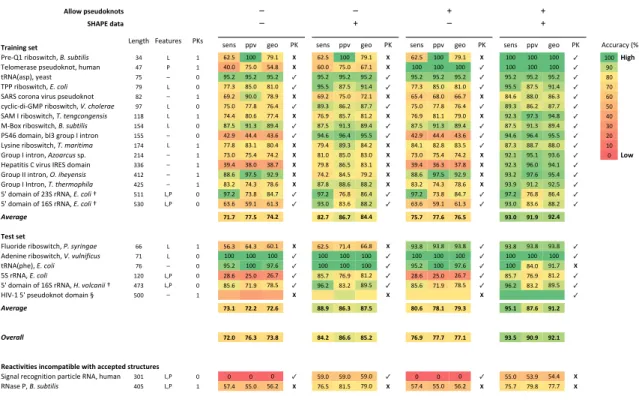
Table 2.1:Prediction accuracies as a function of algorithm and SHAPE information.
Sensitivities (sens), positive predictive value (ppv), and their geometric average (geo) are shown for four test cases: no pseudoknots allowed and no SHAPE data; no pseudoknots allowed and with SHAPE data (both by free energy minimization); pseudoknots allowed and no SHAPE data; and pseudoknots allowed and with SHAPE data (both using ShapeKnots). Complicating features are ligand (L) and protein (P) binding that are not accounted for in nearest-neighbor thermodynamic parameters. Pseudoknot (PK) predictions are indicated with a checkmark ( ) or X; a checkmark indicates that pseudoknots were predicted correctly and that there were no false-positive pseudoknot predictions. For the ribosomal RNAs (†), regions in which the SHAPE reactivities were clearly incompatible with the accepted structure, as described 18, were omitted from the sensitivity and ppv calculations; for the E. coli 16 rRNA, this included nucleotides 143-220. The HIV-1 5' leader domain (§) was included as an example of pseudoknot prediction in a large RNA. Because the accepted structure for this RNA is based on SHAPE-directed prediction 19, we did not include sensitivity and ppv for this RNA in the overall Average values; however, the pseudoknot was proven independently 20 and is included.
!""#$%&'()*#+,#-' ./!01%*2-2
!"#! $$% &"' () !"#! $$% &"' () !"#! $$% &"' () !"#! $$% &"' () *++,-.+/0123
(-"4560-78'!97:+;<0!"#$%&'()($ => ? 6 @ABC 6DD EFB6 3 @ABC 6DD EFB6 3 @ABC 6DD EFB6 3 6DD 6DD 6DD ✓ 6DD%/456
G"H'I"-.!"0$!",J'K#':<0;,I.# >E ( 6 >DBD ECBD C>BL 3 @DBD ECBD @EB6 3 6DD 6DD 6DD ✓ 6DD 6DD 6DD ✓ FD
:MN*1.!$3<0/".!: EC O D FCBA FCBA FCBA ✓ FCBA FCBA FCBA ✓ FCBA FCBA FCBA ✓ FCBA FCBA FCBA ✓ LD
G((0-78'!97:+;<#*"#+,)( EF ? D EEB= LCBD L6BD ✓ FCBC LEBC F6B> ✓ EEB= LCBD L6BD ✓ FCBC LEBC F6B> ✓ ED
P*MP0+'-'#.0%7-,!0$!",J'K#':0 LA O 6 @FBA FDBD ELBF 3 @FBA ECBD EAB6 3 @CB> @LBD @@BE 3 L>B@ LLBD L@B= ✓ @D
+/+H7+4J74QR(0-78'!97:+;<#-"#+.,)/01/# FE ? D ECBD EEBL E@B> ✓ LFB= L@BA LEBE ✓ ECBD EEBL E@B> ✓ LFB= L@BA LEBE ✓ CD
P*R0S0-78'!97:+;<#2"#'/34+,34/3$($ 66L ? 6 E>B> LDB@ EEB> 3 E@BF LCBE L6BA 3 E@BF L6B6 EFBD 3 FAB= FEB= F>BL ✓ >D
R4T'U0-78'!97:+;<0!"#$%&'()($0 6C> ? D LEBC F6B= LFB> ✓ LEBC F6B= LFB> ✓ LEBC F6B= LFB> ✓ LEBC F6B= LFB> ✓ =D
(C>@0J'I.7#<08S=0&-',$0S07#:-'# 6CC O D >ABF >>B> >=B@ ✓ F>B@ F@B> FCBC ✓ >ABF >>B> >=B@ ✓ F>B@ F@B> FCBC ✓ AD
?/!7#"0-78'!97:+;<02"#510('(51 6E> ? 6 EEBL L=B6 LDB> 3 EFB> LFB= L>BA 3 L>B6 LABL L=BC ✓ LEB= LLBE LLBD ✓ 6D
Q-',$0S07#:-'#<#67,10+%$0!$B A6> O 6 E=BD ECB> E>BA 3 L6BD LCBD L=BD 3 E=BD ECB> E>BA 3 FAB6 FCB6 F=B@ ✓ D %7#$
V"$.:7:7!0W0%7-,!0SMXP0J'I.7# ==@ O 6 =FB> =LBD =LBE 3 EFBL L@BC L=B6 3 =FB> =@B= =EBL 3 FAB= F@BD F>B6 ✓
Q-',$0SS07#:-'#<08"#(./9/3$($# >6A O 6 LLB@ FEBC FABF 3 E>BA L>BC EFBA 3 LLB@ FEBC FABF 3 F=BA FEB@ FCB> ✓
Q-',$0S0S#:-'#<#2"#'./05,:.()1 >AC O 6 L=BA E>B= ELB@ 3 LEBL LLB@ LLBA 3 L=BA E>B= ELB@ 3 F=BF F6BA FABC ✓
CY0J'I.7#0'Z0A=P0-MN*<0*"#+,)(0[ C66 ?<( D FEBA E=BL L>BE ✓ FEBA E@BL L@B> ✓ FEBA E=BL L>BE ✓ FEBA E@BL L@B> ✓
CY0J'I.7#0'Z06@P0-MN*<#*"#+,)(0[ C=D ?<( D @=B@ CFB6 @6B= ✓ F=BD L=B@ LLBA ✓ @=B@ CFB6 @6B= ✓ F=BD L=B@ LLBA ✓
!"#$%&# 89:8 88:; 8<:= >=:8 >?:8 ><:< 8;:8 88:? 8?:; @A:B @9:@ @=:<
C('-%'(-\H,'-7J"0-78'!97:+;<#;"#$90(341/ @@ ? 6 C@B= @>B= @DB6 3 @ABC E6B> @@BL 3 F=BL F=BL F=BL ✓ F=BL F=BL F=BL ✓
*J"#7#"0-78'!97:+;<0-"#<%)3(=(+%$ E6 ? D 6DD 6DD 6DD ✓ 6DD 6DD 6DD ✓ 6DD 6DD 6DD ✓ 6DD 6DD 6DD ✓
:MN*1$;"3<#*"#+,)( E@ O D FCBA 6DD FEB@ ✓ 6DD 6DD 6DD ✓ FCBA 6DD FEB@ ✓ 6DD L>BD F6BE 3
CP0-MN*<0*"#+,)( 6AD ?<( D ALB@ ACBD A@BE ✓ LCBE E@BF L6BA ✓ ALB@ ACBD A@BE ✓ LCBE E@BF L6BA ✓
CY0J'I.7#0'Z06@P0-MN*<0>"#<,)+13((0[ >E= ?<( D LCB@ E6BF ELBC ✓ F@BA L=BA LFBC ✓ LCB@ E6BF ELBC ✓ F@BA L=BA LFBC ✓
VS]460CY0$!",J'K#':0J'I.7#0^ CDD O 6 >@BL =CBL
>DBF 3
EEBC LLBD
LAB@ 3
LDBD LDBD
LDBD 3
6DD 6DD
6DDBD ✓
!"#$%&# 8A:9 8=:= 8=:? >>:@ >?:A >8:; >B:? 8>:9 8@:A @;:9 >8:? @9:=
'"#$%(( 8=:B 8?:A 8A:> ><:= >?:? >;:= 8?:@ 88:8 88:9 @A:; @B:@ @=:9
D(2E-4F4-4('%4,E#G&2-4H"(%$4-6%2EE(&-(*%'-I)E-)I('
P7&#.H0-"+':7'#0$.-:7+H"0MN*<0;,I.# =D6 ?<( D D D D ✓ CFBD CFBD CFBD ✓ D D D ✓ CCBD C=BF C>B> 3
MN.!"0(<0!"#$%&'()($# >DC ?<( 6 CEB> CCBD C@BA 3 E@BC L6BC EFBD 3 CEB> CCBD C@BA 3 ECBE EFBL EEBE 3
Hajdin et al., Table 1
CI24,4,5%'(- ?"#&:; \".:,-"! ()!
O O _ _
The structures of the 16 RNAs in the test set are predicted poorly by a conventional algorithm based on their sequences alone: The average sensitivity (sens; fraction of base pairs in the accepted structure predicted correctly), positive predictive value (ppv, the fraction of predicted pairs that occur in the accepted structure), and geometric average of these metrics are 72, 78, and 74%, respectively (Table 2.1).
In the process of developing this training set, we also analyzed two RNAs – RNase P RNA and the human signal recognition particle RNA – whose in vitro SHAPE reactivities were incompatible with the accepted structures for these RNAs. I include prediction statistics for these RNAs at the bottom of Table 2.1, but do not use these to evaluate our SHAPE-directed modeling algorithm.
2.2.2A simple, robust model for pseudoknot formation.
The favorable energetic contributions for forming the helices that comprise a pseudoknot are likely to be predicted accurately by the Turner nearest-neighbor model 17, 21 when modified by the experimental ∆G°SHAPE term (Eqn. 1). In addition, pseudoknot
formation must overcome an entropic penalty; these energetics are difficult to estimate. The most widely used models are complex and include a large number of constituent parameters11, 12. We adopted a simple approach to estimate the entropies based on three
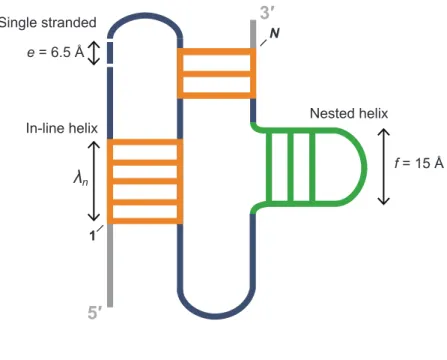
We modeled RNA pseudoknots as the sum of simple distance features, or beads. There are exactly three possibilities for the structures that comprise a pseudoknot: single-stranded nucleotides, nested helices, and in-line helices (Figure 2.1). Duplexes containing single nucleotide bulges are counted as a single helix. This model emphasizes structures rather than topologies and appears to be compatible with the vast majority of known pseudoknots. In essence, energetically favorable pseudoknots feature a small number of the single-stranded, nested helix, and in-line helix “beads.” To account for the number of constituent single-stranded (SS) nucleotides and nested (NE) helices (Figure 2.1), we adopted a simple polymer physics-based model 22. The energetic penalty associated with each of these features is weighted by distances of e = 6.5 Å and f = 15 Å, the mean lengths of a single-stranded nucleotide and a nested helix element, respectively22 (Figure
1). Finally, we created a penalty for in-line (IL) helices (Figure 2.1). The potential to form these structures is weighted by their end-to-end length (n) in the context of A-form helix geometry and the distribution of in-line helices in RNAs of known structure. The model for the entropic cost of pseudoknot formation, ∆G°PK, has two adjustable parameters, P1 and P2:
∆G°PK = P1ln (e2SS + f 2NE) + P2lnΣIL(n)(λn2) (2)
where λn is the penalty constant for in-line helices of length n (see Table 2.2). The first
Figure 2.1: Overview of pseudoknot structure model and entropic penalty terms.
Length features are incorporated into ∆G°PK as described in Eqn. 2. Energy penalties for single-stranded nucleotides and nested helices are based on a previously developed model 22; the penalty for in-line helices was developed in this work.
5
3
Single'stranded
e'='6.5'Å
Nested'helix In6line'helix
f'='15'Å
1
N
Hajdin'et'al.,'Figure'1
____
Helix Length (n) pn (Å) qn λn = pn / qn
_________________________________________________________________________
2 0 0.0000 0
3 6.1 0.2546 24
4 11.9 0.4975 24
5 16.9 0.4962 34
6 20.9 0.8795 24
7 23.8 0.6869 35
8 25.5 0.4430 58
9 26.4 0.3217 82
10 26.8 0.4104 65
11 27.4 0.0519 527
12 28.6 0.0117 2447
13 30.9 0.0074 4199
14 34.1 0.0052 6564
15 38.0 0.0030 12540
_________________________________________________________________________
Table 2.2:Energy penalty per in-line pseudoknotted helix of length n.
pn is the end-to-end distance (in Å) between the C4' of the first and last nucleotide of an
(in-line) helix of length n. The value qn was calculated in two steps. First, for five classes
of RNA – group I introns 24, 25, RNase P 26, SRP 27, tmRNA 28 and telomerase29 – we calculated the fraction of in-line helices of length n over the total number of pseudoknotted structures in each class of RNA. Second, we averaged the fractions of length n across the five RNA classes. λn, the penalty constant for an in-line helix of
2.2.3RNA structure interrogation by SHAPE.
Most RNAs were transcribed in vitro and contained short hairpin-containing structure cassettes at their 5’ and 3’ ends 23. The 16S and 23S ribosomal RNAs were isolated from total E. coli RNA15. The transcribed RNAs were folded in a standard buffer
with physiologically relevant ion concentrations (and saturating ligand concentrations for riboswitches) and treated with 1-methyl-7-nitroisatoic anhydride (1M7)30. Sites of 2'-O
-adduct formation were detected by primer extension using a previously described high-throughput SHAPE approach31
. SHAPE reactivities were normalized to place them on a
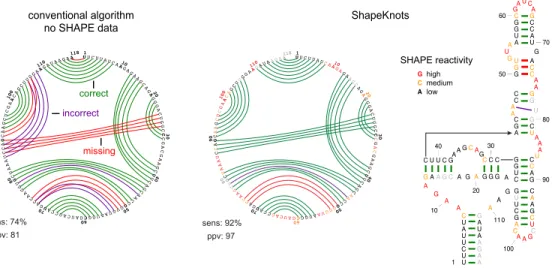
scale from zero (unreactive) to ~1.5 (highly reactive). In this work, we illustrate modeling results in the form of circle plots, which provide an unbiased way to visualize correct and incorrect base pairs. The nucleotide sequence is arrayed on the outer circle: unreactive nucleotides (SHAPE reactivities < 0.4) are colored black, moderately reactive nucleotides (0.4 – 0.85) are yellow, and highly reactive nucleotides (> 0.85) are red. Base pairs are shown as arcs, colored by whether they are predicted correctly or not (Figure 2.2). Pseudoknots correspond to helices whose arcs cross in the circle plot. In general, there was a strong correspondence between SHAPE reactivities and the pattern of base pairing in the accepted structures. Nucleotides that participate in canonical base pairs were generally unreactive; whereas nucleotides in loops, bulges, and other connecting regions were reactive (Figure 2.2).
2.2.4Algorithm and Parameter Determination.
Figure 2.2: Representative ShapeKnots structure prediction for the SAM I riboswitch.
In all panels, base pair predictions are illustrated with colored lines: green, correctly predicted; red, missed base pair relative to the accepted 32 structure; purple, prediction of a pair not in the accepted structure. Left-hand panel shows predictions without SHAPE data. Center and right-hand panels show predictions made when SHAPE data were included, using circle plot and conventional representations, respectively. Sensitivity (sens) and ppv are listed for each structure. SHAPE data are shown as colored nucleotide letters on a black, yellow, red scale for low, medium and high SHAPE reactivities, respectively.
U 1
U C U U A UCAA10G A
G AA
GC AG
A 20G G GA C U G G C C 30 C G A C G A A G C U 40 U C A G C A A CC G 50 GU G UA AU GG C 60 GA UC A G CC A U 70 GA C C A A G G U G80 C U A A A U C C A G 90C A AG CU CG AA
100CA
GC
UU
GGA A 110GA UAA G A
A 118 conventional*algorithm no*SHAPE*data ShapeKnots* 10 A G C A U 4 U A U A C G U A U A A U U A C G A A G A U 0 G C C G
A GA
20 G C G C 30 G C
A CU GA 90 G C G C G A C G A A A U G C C G 80
A
AC G
C G
G 50 G CC
U A
G
UA
A U 70 U A G C GC C 60 G G
A U C A G A A U A A A U C G A U A U G C C G U A C G A A 100 C G A A 110 missing
U1U C U U A U C AA10G A
G A AG C AG A 20 GG G A C U G G C C 30 C G A C G A A G C U 40 U C A G C A A C C G50 GU GU AA UG G C 60 GA UC AG CC A U 70 GA C C A A G G U G80 C U A A A U C C A G 90C A A GC UC GA A 100CA
GC
UUG
G AA
110G AU A
A G AA
and low SHAPE reactivities, respectively, are universal to all RNAs, and do not directly contribute to the entropic penalty for pseudoknot formation. These parameters can thus be fit independently of the ΔG°PK terms, P1 and P2. m and b were optimized using the seven RNAs in our dataset that do not contain pseudoknots. To reduce over-optimization of these parameters, we used a leave-one-out jackknife approach33 to assess prediction
sensitivities, ppv, and the geometric mean of these parameters at each grid point for seven quasi-independent data sets each containing six of the seven RNAs.
Our algorithm for identification of pseudoknots follows the approach implemented in HotKnots10
. A two-stage refinement first finds stable helices using a
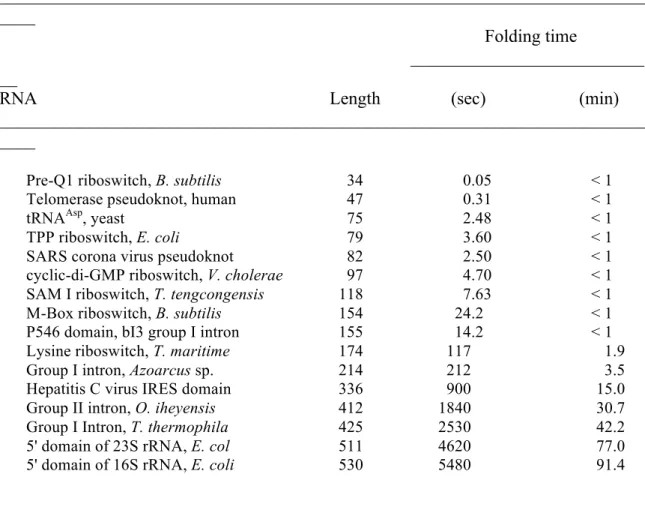
dynamic programming algorithm that does not allow pseudoknots. The second stage uses the same dynamic programming algorithm to predict structures for each stable helix found in stage one. In stage two, structures are predicted such that nucleotides in the stable helix are forced to not pair. These pairs are subsequently added back to the structure, and these helices can therefore be pseudoknotted. This allows the prediction of up to one pseudoknot per run. Run times for the final ShapeKnots algorithm were less than 1 min for RNAs of fewer than 150 nts and ~90 min for the longest (530 nt) RNA (Table 2.3).
Figure 2.3: Optimization of the ∆G°SHAPE and ∆G°PK parameters (in kcal/mol) by jackknifing.
Each of the three panels shows a representative grid in which the M-box RNA was left out. Optimal parameters in each case are emphasized with a white box. Each box in the grid represents the accuracy (calculated as the geometric mean of sens and ppv) for the test set at each slope and intercept for Steps 1 and 3, and each P1 and P2 value for Step 2. For clarity, only a subset of parameter optimizations is shown.
0.15 0.25 0.35 0.45 0.55
0.25 85.8 85.8 85.8 85.8 85.8 85.8 85.8 85.8 85.8
85.8 85.8 85.8 85.8 85.8 85.8 85.8 86.0 86.5
0.35 85.8 85.8 85.8 85.8 85.8 86.0 86.0 86.5 86.5
85.7 85.7 85.7 85.9 85.9 85.9 86.4 86.5 89.9
0.45 85.7 85.8 86.0 85.8 86.5 86.3 89.6 89.6 91.2
85.8 85.8 85.8 86.3 86.3 89.4 89.6 91.0 88.8
0.55 86.5 85.8 87.0 86.3 90.1 89.6 91.7 88.8 88.5
85.8 86.3 86.3 89.4 89.6 91.0 88.8 88.3 88.3
0.65 87.0 86.3 90.1 89.6 91.7 88.1 88.5 88.3 88.5
86.3 89.4 89.6 91.0 88.1 88.3 88.3 88.3 88.3
0.75 90.1 91.0 91.7 88.1 88.5 88.3 88.5 88.3 88.5
91.0 90.2 88.1 88.3 88.3 88.3 88.3 87.4 87.4
0.85 90.9 88.3 88.5 88.3 88.5 88.3 87.6 86.3 86.5
88.3 88.3 88.3 88.3 87.2 86.3 86.3 86.3 86.3
0.95 88.5 88.3 87.4 87.2 86.5 86.3 86.5 86.3 86.5
87.2 87.2 87.2 86.3 86.3 86.3 86.3 86.3 86.2
1.05 87.4 87.2 86.5 86.3 86.5 86.3 86.4 86.2 86.4
86.3 86.3 86.3 86.3 86.2 86.2 86.2 86.2 86.2
1.15 86.5 86.2 86.4 86.2 86.4 86.2 86.4 86.2 86.4
Step01:0Optimize0Slope0and0Intercept0
0 0over070non?pseudoknotted0RNAs
Accuracy
low high Step02:0Optimize0P10and0P20over0160RNAs
Step03:0Optimize0Slope0and0Intercept0over0160RNAs
Hajdin0et0al.,0Figure0S1 P1
P2
Intercept
Slope Slope
Intercept
1.4 1.6 1.8 2.0 2.2 2.4 2.6 2.8 3.0 3.2 3.4 3.6 3.8 4.0
0.0 79.1 78.8 79.0 75.0 74.5 73.5 73.6 73.5 73.2 73.2 73.2 73.0 73.0 72.9 72.6 72.5 72.1 71.6 71.5 71.5 71.0 69.9 69.4 69.9 69.8 69.8 69.7 78.7 78.7 79.1 79.7 79.7 78.5 78.5 77.6 77.5 77.6 77.6 73.7 73.7 73.6 73.2 72.8 72.9 72.9 72.9 72.8 72.6 72.1 72.0 72.1 71.5 71.4 71.3 ?0.2 81.2 80.9 81.1 81.1 81.0 80.9 81.6 81.6 81.4 81.4 80.5 78.6 78.4 77.6 77.3 76.9 77.1 76.9 77.3 75.5 75.5 75.3 75.2 75.3 75.0 75.0 74.5 84.2 84.0 84.0 82.1 80.2 81.0 81.0 81.3 81.4 81.4 81.4 81.4 80.4 80.2 80.2 80.1 80.3 80.2 80.1 79.9 79.9 79.6 78.8 78.8 76.5 76.3 74.2 ?0.4 87.5 86.5 86.5 86.3 84.2 84.1 84.0 83.6 81.6 80.6 81.4 81.4 83.3 81.4 80.4 82.8 82.8 82.8 84.0 83.0 81.7 81.6 82.5 82.5 82.3 81.4 82.0 90.5 89.3 89.4 89.4 89.7 89.7 89.5 87.1 86.2 85.9 85.6 85.4 80.3 83.7 81.0 81.6 84.9 83.9 84.9 85.6 85.6 85.6 83.8 82.5 82.6 82.5 82.5
?0.6 90.1 89.1 89.289.289.2 89.7 89.7 89.7 89.7 89.4 87.3 87.2 86.0 85.6 85.4 85.5 85.5 83.9 81.3 84.9 84.0 84.0 84.8 84.8 83.5 83.5 81.3
83.7 88.6 88.4 88.9 89.1 89.1 89.5 89.2 89.5 89.5 89.8 89.6 90.0 89.7 87.9 86.7 85.5 85.5 86.3 86.3 81.3 81.3 83.6 82.3 82.7 82.6 82.6
?0.8 83.3 87.6 88.1 82.2 89.1 88.6 89.2 89.0 89.4 89.4 89.5 90.0 90.090.091.0 90.7 89.8 89.6 87.9 86.4 86.3 86.4 86.3 85.6 84.3 84.3 84.1
83.6 81.3 88.1 82.2 81.9 88.5 88.5 88.6 89.0 89.1 89.2 89.3 89.4 89.3 90.7 90.6 89.9 90.2 90.7 90.5 90.5 87.9 86.5 85.8 85.6 85.6 85.0 ?1.0 79.3 82.1 81.6 81.8 81.9 88.5 88.5 82.4 89.0 89.0 89.0 89.0 89.2 89.2 90.0 90.1 89.9 89.8 90.9 90.9 90.9 90.5 90.5 90.8 88.3 86.8 86.8
78.9 77.8 82.1 82.1 81.5 82.0 82.0 82.2 88.5 88.9 89.1 89.0 89.0 89.0 89.9 90.0 89.2 89.3 90.1 90.0 90.9 90.9 90.991.291.0 90.8 90.6
?1.2 76.6 78.0 77.7 77.3 82.0 82.0 82.0 82.0 82.0 82.0 82.6 82.6 82.7 89.2 89.8 89.8 89.1 89.2 90.1 90.1 90.1 89.9 90.5 91.2 91.2 91.2 91.1 76.6 76.9 77.7 77.7 77.0 81.7 82.0 82.0 82.0 82.0 82.0 82.4 82.6 82.8 90.0 90.0 89.2 89.2 89.9 89.9 90.1 90.1 90.1 90.4 90.3 90.6 91.2 ?1.4 76.3 76.9 76.6 76.6 76.9 76.9 80.5 82.1 82.0 80.9 80.9 81.3 82.4 82.4 82.4 82.8 82.8 82.8 90.0 89.9 90.1 90.0 90.0 90.4 90.4 90.4 90.2 76.2 76.6 76.8 76.6 76.9 76.9 76.9 76.8 80.9 80.8 80.8 80.8 82.4 82.4 82.4 82.4 82.4 82.8 90.0 90.0 90.0 90.0 90.1 90.4 90.4 90.3 90.3 ?1.6 76.4 76.5 76.6 76.8 76.9 77.1 76.9 76.5 76.4 80.5 80.8 80.8 80.9 80.9 81.3 82.4 82.4 82.4 82.4 82.7 82.8 82.8 90.0 90.4 90.4 90.3 90.4 71.9 73.6 76.2 76.6 76.9 76.9 77.1 76.5 76.5 76.5 80.4 80.5 80.8 80.8 81.5 81.5 81.5 82.7 82.7 82.7 82.4 82.6 82.8 83.1 90.4 90.4 90.4 ?1.8 71.1 72.8 71.1 72.7 73.3 76.9 76.9 76.3 73.0 76.5 76.5 75.8 80.5 80.8 81.4 81.4 81.5 81.5 81.5 81.5 81.5 81.5 82.7 81.7 83.1 83.1 83.1 70 71.4 71.1 72.5 71.2 73.0 73.0 73.3 72.7 72.7 73.0 75.8 72.7 79.7 81.1 81.1 81.4 81.5 81.5 81.5 81.5 81.5 81.5 81.5 81.6 81.7 81.8 ?2.0 67.5 67.8 71.1 71.1 71.4 71.2 73.0 73.3 71.3 72.7 72.7 72.7 72.7 72.7 72.7 76.5 81.1 81.1 81.4 81.5 81.5 81.5 81.5 81.5 81.5 81.5 81.6 67.6 67.8 67.5 67.5 68.9 71.4 71.2 73.3 71.3 71.3 72.7 72.7 72.7 72.7 72.7 72.7 76.5 76.9 78.0 81.4 81.5 81.5 81.5 81.5 81.5 81.5 81.5 ?2.2 67.6 67.6 67.5 67.5 67.8 68.2 68.9 71.5 71.3 71.3 71.3 72.7 72.7 72.7 72.7 72.7 72.7 76.5 76.5 76.9 78.1 78.5 78.5 78.4 81.5 81.5 81.5 55.1 67.6 67.6 67.6 67.8 67.8 68.2 68.2 68.6 68.8 71.3 72.7 72.7 72.7 72.7 72.7 72.7 72.7 76.6 76.5 76.7 78.1 78.1 78.5 78.5 78.4 78.4
1.4 1.6 1.8 2.0 2.2 2.4 2.6 2.8 3.0 3.2 3.4 3.6 3.8 4.0
Table 2.3:ShapeKnots run times as a function of RNA length.
________________________________________________________________________ ____
Folding time
__________________________ __
RNA Length (sec) (min)
________________________________________________________________________ ____
Pre-Q1 riboswitch, B. subtilis 34 0.05 < 1
Telomerase pseudoknot, human 47 0.31 < 1
tRNAAsp, yeast 75 2.48 < 1
TPP riboswitch, E. coli 79 3.60 < 1
SARS corona virus pseudoknot 82 2.50 < 1
cyclic-di-GMP riboswitch, V. cholerae 97 4.70 < 1
SAM I riboswitch, T. tengcongensis 118 7.63 < 1
M-Box riboswitch, B. subtilis 154 24.2 < 1
P546 domain, bI3 group I intron 155 14.2 < 1
Lysine riboswitch, T. maritime 174 117 1.9
Group I intron, Azoarcus sp. 214 212 3.5
Hepatitis C virus IRES domain 336 900 15.0
Group II intron, O. iheyensis 412 1840 30.7
Group I Intron, T. thermophila 425 2530 42.2
5' domain of 23S rRNA, E. col 511 4620 77.0
5' domain of 16S rRNA, E. coli 530 5480 91.4
________________________________________________________________________ ____
We recommend use of these new values for RNA structure prediction both with and without pseudoknots. Applying ShapeKnots using these ∆G°SHAPE and ∆G°PK parameters yielded an average sensitivity for secondary structure prediction of 93% for the sixteen RNAs in the test set (Table 2.1).
2.2.5Extension to additional RNAs.
We used ShapeKnots to model secondary structures for six RNAs that were not used to optimize the final algorithm. Three RNAs – the adenine riboswitch, tRNAPhe,
and E. coli 5S rRNA – were chosen because prior approaches using non-standard data
analysis had suggested that they folded poorly with SHAPE data16
. The other three RNAs
– the fluoride riboswitch pseudoknot, 5' domain of the H. volcanii 16S rRNA, and the 5' pseudoknot leader of the HIV-1 RNA genome – adopt structures that are predicted poorly by conventional approaches. Overall prediction sensitivities for these six RNAs were ~95% (Table 1), and the pseudoknots in the HIV-1 and fluoride riboswitch RNAs 34-36
were identified correctly
2.3Discussion
Pseudoknots are relatively rare in large RNAs but are highly overrepresented in important functional regions2, 3, 6, 7. Despite their importance, the most commonly used
Table 2.4:Prediction accuracies for seven RNA folding algorithms (following page). A) Overall prediction accuracies. Accuracies are shown as percent sensitivity (sens) and positive predictive value (ppv), and allow pairing to be shifted by one position on one side of a pair 37. ShapeKnots, ProbKnot 13, and Fold (the standard RNAstructure algorithm) 38 were run both with and without SHAPE data. Other included algorithms are DotKnot+KL and DotKnot-KL (KL indicates kissing loops) 39, 40, ipknot 41, pknotsRG-mfe 42, and HotKnots 12. Note that Fold does not allow pseudoknots. All algorithms were run using their default parameters. ShapeKnots, Fold and ProbKnot used
m and b parameters (Eqn. 1) of 1.8 and -0.6 kcal/mol, respectively.
B) Prediction accuracies for pseudoknotted base pairs only. Accuracies are evaluated using sensitivity and ppv, allowing for mis-pairing by one position on one side of a pair 37. If both accepted and predicted structures contain no pseudoknot, sens and ppv are defined as 100%. If only the predicted structure contains a pseudoknot, sens and ppv are set to 0. A pseudoknotted pair is scored as correctly predicted only if there is at least one other correctly predicted pair with which it forms a pseudoknot. Fold is excluded because it does not allow prediction of pseudoknots.
The prediction sensitivity for base pairs that specifically form pseudoknots varies by algorithm and benchmark RNAs but averages only 5-20%, with many false-positive predictions13 (Table 2.4). Thus, the current generation of pseudoknot prediction algorithms is poorly suited for designing testable biological hypotheses.
ShapeKnots combines an iterative pseudoknot discovery algorithm with experimental SHAPE information and a simple energy model for the entropic cost of pseudoknot formation. The pseudoknot penalty in ShapeKnots has only two adjustable parameters (Figure 2.1 and Eqn. 2) that limit formation of pseudoknots with long single-stranded regions and many nested helices and that enforce an optimal geometry for in-line helices. ShapeKnots also allows incorporation of an experimental correction to standard free energy terms. Including SHAPE data both limits the number of possible structures and provides information that accounts for hidden features that stabilize RNA folding, including the significant effects of metal ion and ligand binding.
We summarize our modeling results by emphasizing four classes of RNA: (i) short pseudoknotted RNAs with structures that ShapeKnots predicts very accurately, (ii) large, challenging RNAs that ShapeKnots predicts with good accuracy, (iii) RNAs with high likelihood of being mischaracterized with false-positive or missed pseudoknots that ShapeKnots predicts accurately, and (iv) RNAs that interact with other molecules such as ligands, proteins, and metal ions that pose unique challenges. For most RNAs analyzed here, differences between models generated by ShapeKnots and currently accepted structures were minor and typically involved short-range interactions or base pairs at the ends of helices. In some cases, differences likely reflect thermodynamically accessible states at equilibrium in solution.
2.3.2Short pseudoknotted RNAs.
The first class includes small RNAs that contain H-type pseudoknots: the pre-Q1 riboswitch, human telomerase, the fluoride riboswitch, and a SARS corona virus domain. Because the most commonly used dynamic programming algorithms cannot predict base pairs in an H-type pseudoknot, prediction sensitivities using a conventional algorithm38 were quite poor; in contrast, ShapeKnots yielded perfect or near-perfect predictions in each case (Figure 2.4). The only ShapeKnots-predicted base pairs that do not occur in the accepted structures involve sets of two or fewer base pairs located at the ends of individual helices in the fluoride riboswitch and SARS domain. These results suggest that ShapeKnots prediction of H-type pseudoknots in short RNAs is robust.
Figure 2.4: Summary of predictions for four H-type pseudoknots.
Base pair predictions are illustrated as outlined in Figure 2.2; sensitivity (sens) and ppv are listed for each structure. Left- and right-hand columns show predictions for a conventional mfold-class algorithm versus ShapeKnots (with experimental SHAPE restraints).
G 1
C AUU G
G AG
A 10U
G G C A U U C C U 20 C C A U U A A C A A 30 AC CG CU GC G C 40 C C G U A G C A G C 50U GA UG AU GC C 60U AC
A GA
66 Pre$Q1'riboswitch
Telomerase
SARS'virus'domain
conventional,'no'data ShapeKnots
A1G AG
G U U C U A 10 G C U A CA CC CU 20 CU A U A A AA AA
30 CU
A A
34
Hajdin'et'al.,'Figure'3 A1G AG
GU U C U A 10 G C U A CA CC C U 20 C U A U A A A AA A
30CU
AA
34
G 1
G G CU
G U U U U 10 U C U C G C U G A C 20U UU CA GC CC A 30 A C A C A A AA AA 40 A GU
CA G
C 47
G1G G C
U GU
U U U 10 U C U C G C U G A C 20 UU UC AG C CC A 30 A C A C A A AA AA 40A GU
C AG
C 47
U1U U A A
A CG G
G10U
U U G C G G U G U 20 A A G U G C A G C C 30C G U CU UA CA C 40 CG UG CG GC AC 50 A G G C A C U A G U 60A C U GA UG UC G 70 UC
UA
CA
G GG C
U U82 U1UUAA A
C G
GG10
U U U G C G G U G U 20 A A G U G C A G C C 30 C G U C UU AC AC 40 C G UG CG GC AC 50 A G G C A C U A G U 60 A C U G AU GU CG
70UC
UA
CAG G
GC U U
82
G1C A U U
G G AG A 10 U G G C A U U C C U 20 C C A U U A A CA A 30 AC CG CU GC G C 40 C C G U A G C A G C 50U GA UG AU GC C
60U AC A
2.3.1Large, complex RNAs.
The second class includes large RNAs that do not require ligands or protein co-factors for correct folding. Large RNAs pose a challenge to modeling algorithms due to the vast number of possible structures and due to the large number of structures with similar folding free energies changes. For example, in the absence of experimental structure probing data, two representative RNAs, the Azoarcus group I intron and the hepatitis C virus IRES domain are predicted with sensitivities of 73 and 39%, respectively. Mis-predictions occur primarily in two hairpin motifs in the Azoarcus RNA but span essentially the entire HCV IRES RNA (Figure 2.5). Inclusion of SHAPE data yielded near-perfect predictions in each case, including correct identification of the pseudoknot in each RNA (Figure 2.5).
2.3.2RNAs with difficult to predict pseudoknots.
Figure 2.5: Prediction summaries for two large, pseudoknot-containing RNAs.
Structural annotations are as described in Figure 2.2.
C 1
U C A U A UU UC10G AUGUG C C UU20G C
GCCGGGA
A 30A
CC AC G C AA G 40 G G A U G G U G U C 50 A A A U U C G G C G 60 A A A C C U A A G C 70 G C C C G C C C G G 80 G C G UA U GG C A90AC GC CG AG C C 10 0AA GC UU CG G C 11 0G CC UG C GC C G 12 0AU GA A GG UG U 13
0GA
A G A C U A GA14
0GC
G C A C C C A C 150C U A A G G C A A A 160C G CU A U GG UG
170AA
GG
CA UA
GU
180CC
AGG
GA
GUG
190GCGAA AG U
C200ACA CAA A
CC G210GAA UC214
conventional,+no+data ShapeKnots
Hajdin+et+al.,+Figure+4 C
1
CA UGAA UCA10CUCCCCUGUG20A
GGAACUAC U30 GUCU UCAC GC40 AG AAAG CG UC 50UAGCC
AUGGC 60GU
UAGUAUGA 70GUGU
CG
U
G
CA 80GCCU
C
C
A
G
G
A 90
C C C C C C C U C C 100C G G G A G A G C C 110A U A G U G G U C U120G C GG A A CC GG 13 0 UG AG UA CA CC 140 GGA AU UG CC A 150 GG AC GA CC GG 16 0GU CC UU UC UU 170 GG AU UA AC CC 18 0GC UC AA UG CC1 90 UG GA GA UU UG 20 0GG CG UG CC CC 21 0CG CG A G A CU G220 C UA G C C GA GU230 A G U G U U G G G U
240CG
C G AA A G G C 2
50 CUUGUG
G
U
A
C
26
0UGCC
U
GAUAG 270 GG
UGCUUGC280 AGGUGCCCCG29G0GAG GUCU
CGU30 0 AGAC
CGUG C A310UC
A UGAGCAC320GA AUCCUA A A330CCU CA A 336
Hepatitis+C+virus+IRES+domain+(336+nts)
Azoarcus+group+I+intron+(214+nts)
sens:+73% ppv:+75
C1U C A U A U U U
C10G A U
G U GC C
UU20G C
GCCGG
GAA 30 AC CA C GC A A G 40 G G A U G G U G U C 50 A A A U U C G G C G 60 A A A C C U A A G C 70 G C C C G C C C G G80 G C G UA UG GC A 90 AC GC CG AG C C 10 0AA GC UU CG G C 11 0GC CU GC GC C G 12 0AU GA AG GU G U 13 0AG A G A C U A G A14
0GC
G C A C C C A C 150C U A A G G C A A A 160C G C U A UG GU G
170AA GG
CA
UA
GU 180CCA
GGG AG
UG 190GCG AA A
G UC A 200C AC A
A A CC GG
210
A A UC214
C 1
CA U G A AUCA10CU CCC C UGUG20
A G GAA CU ACU30
G UC UUCA C
GC40AG AA
AG CGU
C 50UA
GCC
AUGGC 60GUU A GUAUG
A 70
G
U
GUCGUGCA 8GC0
CUCCA
G
G
A 90
C C C C C C C U C C 100 C GG G A G A G C C 110 A U A G UG G U C U120 G C G G A A C C G G 13 0 U GA GU A CA C C 140 GG AA UUG CC A 150 GG AC GA CC G G 16 0GU CC U UU CU U 170 GG A UU A ACC C 18 0G CU C AA UG C C19 0UG G AG A UU U G 20 0GG C G UG C C C C 21
0GC
C G A G A C U G220 C U A G C C G A G U 230A G U G U U G GG U 240C G C G A A A G G C 25
0CUUGUGGU
A
C
2
60UGCCUGAUA
G
270GGUGCUUG
CG
280AGUGCCCC29GG0GAGGUCU
CG30U0AG AC C
Figure 2.6: Representative examples in which ShapeKnots avoids false-positive (top) or false-negative (bottom) pseudoknot predictions.
Left- and right-hand panels show the results of ShapeKnots predictions without and with SHAPE data, respectively. The bold arrow in the left-hand panels emphasizes the
U1U C U U A U
CAA10
G AG A
A G C AG A 20 G G G A C U G G C C 30 C G A C G A A G C U 40 U C A G C A A CC G 50 GU G UA AU GG C 60 GA UC AG CC A U 70 GA C C A A G G U G80 C U A A A U C C A G 90C A AG CU CG AA
100CA
GC
UU
GGA
A
110GA U
AA G AA
118
U1U C U U A U
C AA10G A
G AA
G C A G A 20 G G G A C U G G C C 30 C G A C G A A G C U 40 U C A G C A A CC G 50 GU GU AA UG G C 60 GA UC AG CC A U 70 GA C C A A G G U G80 C U A A A U C C A G 90C A AG CU CG AA
100CA
GC
UU
GGA
A
110G AU A
A G AA
118 SAM$I$riboswitch
U1U U A A A C
G GG10
U U U G C G G U G U 20 A A G U G C A G C C 30 C G U CU UA CA C 40 CG UG CG GC A C 50 A G G C A C U A G U 60 A C U GA UG UC G
70UC
UA
CA G
G GC
80
UU82 U1UUAA A
C GG
G10 U U U G C G G U G U 20 A A G U G C A G C C 30 C G U C UU AC AC 40 C G UG CG GC AC 50 A G G C A C U A G U 60 A C U GA UG UC G
70 UC
UA
CA
G GG
C U U
82 SARS$corona$virus sens:$65% ppv:$68 sens:$92% ppv:$97 sens:$77% ppv:$81 sens:$85% ppv:$88 Hajdin$et$al.,$Figure$5