EMOTIONALLY MOTIVATED BEHAVIOR AND PERSONALITY AMONG WOMEN WITH BULIMIA NERVOSA
Lisa Brownstone
A thesis submitted to the faculty of the University of North Carolina at Chapel Hill in partial
fulfillment of the requirements for the degree of Master of the Arts in the department of Psychology.
Chapel Hill 2012
Approved By:
ii ABSTRACT
LISA BROWNSTONE: Emotionally Motivated Behavior and Personality Among Women with Bulimia Nervosa
(Under the direction of Anna Bardone-Cone)
iii
iv
TABLE OF CONTENTS
LIST OF TABLES v
LIST OF FIGURES vii
LIST OF ABBREVIATIONS viii
Main Body I. Introduction 1
What is meant by emotionally motivated? 2
Emotion regulation and non-bulimic behaviors 3
Personality and bulimia nervosa 6
The current study 8
II. Method 11
Procedure 12
Measures 12
Data analytic plan 15
III. Results 19
Descriptive statistics 19
Frequencies of bulimic behaviors 20
Variability of bulimic and non-bulimic behaviors 22
IV. Discussion 24
Strengths and limitations 27
Clinical implications 28
Future directions 29
Conclusions 29
V. Tables 31
VI. Figures 44
v
LIST OF TABLES Table
1. Items from the Impulsivity Behavior Scale included in the count of each non-bulimic behavior for the variability
dependent variable 31 2. Means and standard deviations of continuous independent and
dependent variables 32 3. Correlations among the personality dimensions and the
bulimic behavior frequency variables and the presence
of non-bulimic emotionally motivated behaviors 33 4. Correlations among the personality dimensions and
variability variables 34 5. Hierarchical multiple regression analyses of the interaction
of emotion dysregulation, impulsivity, and inhibitedness with the dependent variable of frequency of objective binge
eating episodes 35 6. Hierarchical multiple regression analyses of the interaction
of emotion dysregulation, impulsivity, and inhibitedness with the dependent variable of frequency of subjective binge
eating episodes 36 7. Hierarchical multiple regression analyses of the interaction
of emotion dysregulation, impulsivity, and inhibitedness with
the dependent variable of frequency of hard exercise episodes 37 8. Hierarchical multiple regression analyses of the interaction
of emotion dysregulation, impulsivity, and inhibitedness with
the dependent variable of frequency of vomiting episodes 38 9. Hierarchical multiple regression analyses of the interaction
of emotion dysregulation, impulsivity, and inhibitedness with
the dependent variable of frequency of laxative use episodes 39 10. Hierarchical multiple regression analyses of the interaction
of emotion dysregulation, impulsivity, and inhibitedness with
the dependent variable of frequency of diuretic use episodes 40 11. Hierarchical multiple regression analyses of the interaction
of emotion dysregulation, impulsivity, and inhibitedness with
vi
12. Hierarchical multiple regression analyses of the interaction of emotion dysregulation, impulsivity, and inhibitedness with the dependent variable of variability of non-bulimic behavior with
the higher threshold for counts 42 13. Hierarchical multiple regression analyses of the interaction
of emotion dysregulation, impulsivity, and inhibitedness with the dependent variable of variability of non-bulimic behavior with
vii
LIST OF FIGURES Figure
1. The three-way interaction of emotion dysregulation, impulsivity, and inhibitedness with the dependent variable of number of
subjective binge eating episodes in the past 28 days 44 2. The interaction of emotion dysregulation and inhibitedness with
number of hard exercise episodes in the past 28 days as
the dependent variable 45 3. The interaction of emotion dysregulation and inhibitedness with
number of laxative use episodes in the past 28 days as
viii
LIST OF ABBREVIATIONS AN = Anorexia Nervosa
BIS-11 = Barrett Impulsivity Scale BN = Bulimia Nervosa
DAPP-BQ = Dimensional Assessment of Personality Problems-Brief Questionnaire DIRI-RS = Depressive Interpersonal Relationships Inventory-Reassurance Seeking Scale DMQ = Drinking Motives Questionnaire
DSM-IV = Diagnostic Statistic Manual of Mental Disorders—Fourth Edition EDE = Eating Disorder Examination
EDE-Q = Eating Disorder Examination Questionnaire EMA = Ecological Momentary Assessment
IBS = Impulsive Behavior Scale INHIB = Inhibitedness
Non-BN = Non-Bulimic
NSSI = Non-Suicidal Self Injury OBE = Objective Binge Eating SBE = Subjective Binge Eating
I. Introduction
Emotionally Motivated Behavior and Personality Among Women with Bulimia Nervosa
Binge eating and compensatory behaviors can be understood as physical forms of affect regulation. This conceptualization has been put forth in theoretical and narrative accounts of bulimia nervosa (BN) and tested empirically using multiple research methods, including experiments, ecological momentary assessment (EMA), and retrospective report (Engelberg, Steiger, Gauvin, & Wonderlich, 2007; Fox & Froom, 2009; Moon &
Berenbaum, 2009). Most of these studies have focused on the function of the binge eating episode as a maladaptive mode of emotion regulation or as a mode of escape from aversive self awareness (Anestis, Smith, Fink, & Joiner, 2009; Heatherton & Baumeister, 1991).
Far less work has explored the relationship between compensatory behaviors and emotion regulation; however, there is some evidence that purging plays a role in this process. For example, Jeppson, Richards, and Hardman (2003) and Telch (1997) report on qualitative analyses of binge eating and purging as emotion regulation strategies (albeit maladaptive). Excessive exercise has also been conceptualized as a form of affect regulation, particularly among individuals with anorexia nervosa (AN) (Peñas-Lledo, Vaz Leal, & Waller, 2002). As such, both binge eating and compensatory behaviors can be understood as being motivated by a desire to shift emotional experience away from aversive affect, and can therefore be understood as emotionally motivated.
Some individuals with BN engage in a wide variety of potentially emotionally
2
compensatory behaviors. Such behaviors may include non-suicidal self-injury (NSSI), alcohol/substance abuse, risky sexual behavior, and reassurance seeking. These actions can be categorized similarly to binge eating and compensatory behaviors as being potential responses to aversive emotional experience; as such they can all, at least in part, be
understood as emotionally motivated. The current study addresses how the personality traits of inhibitedness and impulsivity in the context of emotion dysregulation affect the frequency and variety of these behaviors (bulimic behaviors and other potentially maladaptive
emotionally motivated behaviors) exhibited by individuals with BN. What is meant by “emotionally motivated”?
It can be argued that all behaviors are emotionally motivated; after all, basic theories of emotion postulate that emotions form the basis of motivational systems (Lang, 1985). This study, however, specifically addresses maladaptive behaviors that may be performed with the intention of regulating emotion in the short term, but that do not provide benefits in the long term. Supporting this idea, Tice, Bratslavsky, and Baumeister (2001) found that when under emotional distress, immediate impulses are prioritized over long-term goals. All of the behaviors investigated in this study are hypothesized to be potentially emotionally motivated behaviors performed with immediate relief as the short-term goal. This relief is likely
3
There are, however, other potential functions that binge eating, compensatory behaviors, NSSI, alcohol/substance abuse, risky sexual behavior, and reassurance seeking may serve. For instance, the Drinking Motives Questionnaire (DMQ; Cooper, 1994) includes questions about drinking to cope, but also acknowledges two other categories of motivation for drinking: social and enhancement. Similarly, compensatory behaviors are often viewed as strategic responses following binge eating episodes aimed at weight management or control (Mond, Hay, Rodgers, Owen, & Mitchell, 2006; Thombs, Mahoney, & McLaughlin, 1998). Lacking from this conceptualization, however, is a rationale for the motivation behind the occurrence of purging in the absence of binge eating. While these alternative explanations may be present, I argue that all of these behaviors have an emotional basis, particularly given that we are investigating these behaviors among a sample of women suffering from BN, a group that has consistently demonstrated difficulties with emotion regulation and negative affect (Whiteside et al., 2007).
Emotion regulation and non-bulimic behaviors
NSSI has been consistently understood as a maladaptive form of emotion or affect regulation (Gratz, 2003; Linehan, Heard, & Armstrong, 1993; Suyemoto, 1998). Parasuicidal behaviors have generally been found to be preceded by negative mood and followed by improved mood. This has also been found among individuals with BN who engage in NSSI, perhaps most convincingly in an EMA study, which looked at mood before and after NSSI among a sample of individuals with BN (Muehlenkamp et al., 2009). Franklin et al. (2009) reported that the emotional relief following NSSI coincides with the removal of the
4
emotional relief operates, therefore, is likely different than how binge eating and
compensatory behaviors have been understood in the context of Baumeister’s escape theory, which focuses more on the experience of escape during the behavior rather than after its completion. NSSI, however, clearly can be understood as having an emotion regulation component, and as such can be grouped into a larger category of emotionally motivated behavior.
Evidence suggests that motivations for alcohol abuse among individuals with BN may tend to be more related to coping than the other motives included in the DMQ (i.e., social and enhancement) (Luce, Engler, & Crowther, 2007). Accordingly, while other
motives can be used to explain motivations for drinking, coping is perhaps the most apparent motivation to drink among individuals with BN. Regarding drug abuse and BN, Carbaugh and Sias (2010) provide a theoretical framework for understanding this comorbid
presentation. They assert that bulimic symptoms and drug abuse behaviors both serve a self-medicating purpose in that they act as outlets for aversive affect. There is, therefore, both a theoretical and empirical basis for conceptualizing alcohol and drug abuse among individuals with BN as emotionally motivated.
5
In contrast, sensation seeking is understood as an approach reaction toward any sort of sensation, most often physical sensation, in such a way that positive experience can be enhanced. In line with this theory, Zapolski, Cyders, and Smith (2009) found that risky sex among college-aged individuals coincided with positive emotional states, and was pursued in an attempt to prolong the positive emotion. The question is whether people with BN have different motivations for behaviors like risky sex than the unselected sample studied by Zapolski et al. (2009).
Some evidence indicates that neurotic individuals are motivated to engage in risky behaviors in order to regulate aversive affect, whereas extraverted individuals are more likely to engage in risky behaviors in order to enhance already present positive affect (Cooper, Agocha, & Sheldon, 2001). This finding supports the likelihood of there being variability in motivations to engage in risky sexual behavior. Baumeister’s escape theory has also been applied to problematic sexual behaviors like hypersexuality, which is often accompanied by risky sex (Baumeister, 1991; Bancroft, 2008). Bancroft theorizes that sex may serve as a distraction or escape from negative mood. This idea of risky sex serving an escape function is not necessarily incompatible with the idea that risky sexual behavior might be motivated by sensation seeking. After all, the sensation sought through risky sex may serve a distracting or escape function for an individual. Keeping in mind the nuances and complications associated with grouping risky sexual behavior with these other emotionally motivated behaviors, there appears to be a reasonable rationale for understanding it in this way.
6
depression, some work has explored reassurance seeking as a mode of behavioral dysregulation motivated by aversive affect (Joiner, Katz, & Lew, 1999). This affect
regulation framework has been supported by findings of Anestis et al. (2009) in a sample of women with BN that showed a relationship between affect lability and excessive reassurance seeking. In line with this work, we are looking at reassurance seeking as a means of seeking out emotional relief from outside sources—as such we include it in our grouping of
emotionally motivated behaviors. However, reassurance seeking, unlike the other behaviors under study in this report, does not lead to direct physical risks or outcomes (e.g., unlike, alcohol or drug use, it does not lead to physiological addiction). Similarly, unlike the other behaviors examined, reassurance seeking does not involve physical or bodily sensation. With these differences in mind, we are exploring excessive reassurance seeking as a potentially emotionally motivated behavior among individuals with BN.
If all of these behaviors have the potential to provide temporary relief from emotional distress, the question becomes: Why do some individuals engage in a wide range of
potentially emotionally regulating behaviors while others seem to restrict themselves to a narrow range? It is possible that personality dimensions contribute to the extent to which specific emotionally motivated behaviors are available to individuals. Specific to this study, personality variables may impact whether an individual with BN engages in a restricted range of repeated behaviors or a wide variety of behaviors.
Personality and BN
7
diagnosis (e.g., someone with BN engaging in binge eating and purging), whereas multi-impulsive describes when individuals engage in a wider range of multi-impulsive behaviors outside the range of a diagnosis (e.g., someone with a substance use disorder who also engages in NSSI and binge eating). Westen and Harnden-Fischer (2001) apply this idea of multi- versus uni- impulsivity to BN as a means of understanding an observable differentiation among individuals with BN: those who engage in a variety of impulsive behaviors and those who are only impulsive in the realm of binge eating and compensatory behaviors.
Along similar lines, studies have consistently found distinct clusters or subtypes of BN based upon symptom ratings, personality variables, and comorbidity that generally differentiate an impulsive subtype from a more restricted and overcontrolled subtype among those with BN (Thompson-Brenner et al., 2008; Westen & Harnden-Fischer, 2001;
Wonderlich et al., 2005). Thompson-Brenner et al. (2008) described five personality subtypes of individuals with eating disorders (not just BN): behaviorally dysregulated, emotionally dysregulated, avoidant-insecure, obsessional-sensitive, and high-functioning. Westen and Harnden-Fischer (2001) described three personality subtypes among individuals suffering from AN or BN: emotionally dysregulated/undercontrolled,
constricted/overcontrolled, and high-functioning/perfectionistic. Similarly, Wonderlich et al. (2005) described three distinct subtypes of BN: an impulsive group, an
8
Wonderlich et al. (2005) compared the three subtypes of BN (impulsive, affective-perfectionistic, and low-comorbidity) on both personality dimensions and symptoms. The affective-perfectionistic subtype and impulsive subtype were similarly high on emotion dysregulation, while the affective-perfectionistic subtype had higher levels of inhibitedness (although the difference did not reach significance), and the impulsive subtype had higher levels of dissocial behavior and lower levels of compulsivity. In terms of symptoms, the affective-perfectionistic subtype had higher levels of weight and shape concern but these two subtypes did not differ on restraint or eating concern on the Eating Disorder Examination-Questionnaire (EDE-Q; Fairburn & Beglin, 1993). The current study will look at various dimensional variables related to personality subtyping, namely inhibitedness, impulsivity, and emotion dysregulation, as they relate to patterns of emotionally motivated behaviors. It is thought that how these personality variables combine may give rise to frequencies and
variability of such behaviors. The Current Study
The current study examines the personality constructs of impulsivity and
inhibitedness among adult women with subthreshold/threshold BN to examine how these constructs relate to frequency and variety of behaviors hypothesized to be emotionally motivated (e.g., binge eating, compensatory behaviors, NSSI, alcohol/substance abuse, risky sex, and reassurance seeking). More specifically, we test whether individuals show different frequencies and variability of emotionally motivated behaviors depending upon levels of impulsivity and inhibitedness in the context of high emotion dysregulation.
9
variability of these behaviors, specifically purging behaviors, is likely more indicative of eating disorder severity than frequency. Related to variability, it was hypothesized that a three-way interaction between impulsivity, inhibitedness, and emotion dysregulation would be associated with variability of emotionally motivated behaviors. More specifically, we expected that individuals who were high on inhibitedness, low on impulsivity, and high on emotion dysregulation would restrict the variety of emotionally motivated behaviors by resorting to repeated and familiar outlets for emotional relief as opposed to more variable comorbid behaviors, because of a trait tendency toward restriction and caution. On the other hand, we expected that individuals who were high on impulsivity, low on inhibitedness, and high on emotion dysregulation would engage in a higher number of different emotionally motivated behaviors due to less restriction and less aversion to unpredictability of outcome. These patterns were hypothesized to emerge both in bulimic and non-bulimic behavior variability.
It was thought that this higher variability of emotionally motivated behaviors might be accompanied by lower frequencies of specific bulimic behaviors among high
10
level, we hypothesized that emotion dysregulation would be associated with the frequencies of OBEs and compensatory behaviors, based upon the idea that these behaviors are
II. Method
Participants included 204 adult women recruited through community advertising and eating disorder clinics in five midwestern cities in 2002-2003. Based upon a telephone interview, 144 (71%) met full diagnostic criteria for BN according to the Diagnostic and Statistical Manual of Mental Disorders, 4th edition (DSM-IV; APA, 1994), and 60 (29%) met criteria for subthreshold BN, defined as (a) objective binge eating and compensatory
behavior occurring at least once per week over the past three months, or (b) compensatory behavior occurring at least once per week along with subjective binge eating episodes (i.e., episodes of binge eating that are not objectively large, but do involve loss of control).
Individuals with threshold versus subthreshold BN were similar in terms of severity of eating pathology as indicated by similar scores on subscales on the EDE-Q (besides the eating concern subscale) and similar levels of psychiatric comorbidity (Le Grange et al., 2006).
12 Procedure
Trained interviewers administered a telephone interview that included the eating disorder module from the Structured Clinical Interview for DSM-IV, Patient Edition (SCID-P; First Spitzer, Gibbon, & Williams, 1995). Interviewers used criteria for binge eating established in the Eating Disorder Examination (EDE; Fairburn & Beglin, 1994) to determine if reported food portions during binges were objectively large in amount. Participants who met current DSM-IV diagnostic criteria for threshold or subthreshold BN provided informed consent, completed a set of questionnaires, and received $50 compensation for their
participation. The Institutional Review Boards at each study site approved this study. Measures
The Structured Clinical Interview for DSM-IV, Patient Edition (SCID-P) Eating Disorder Module (First et al., 1995). The SCID-P is a widely used semi-structured
interview that assesses the presence of Axis I disorders. In this study, the eating disorder module of the SCID-P was used during the phone screen in order to determine diagnostic eligibility.
Eating Disorder Examination Questionnaire (EDE-Q; Fairburn & Beglin, 1994). The EDE-Q is a 36-item self-report survey adapted from the Eating Disorder Examination (EDE) interview (Fairburn & Cooper, 1993). In addition to subscale scores related to
13
combination with loss of control, while an SBE involves loss of control without an
objectively large quantity of food consumed. The compensatory behaviors assessed included the purging behaviors of self-induced vomiting, laxative use, and diuretics use, as well as excessive exercise. Construct validity has been demonstrated by high correlations between the EDE-Q and the EDE subscales ranging from 0.78 to 0.85 (Fairburn & Beglin, 1994). There is some indication that the EDE-Q has adequate test-retest reliability for the
assessment of OBEs (r = .84), but not for the assessment of SBEs (r = .39-.51) (Reas, Grilo, & Masheb, 2006).
Dimensional Assessment of Personality Problems—Basic Questionnaire (DAPP-BQ; Livesley, Jackson, & Schroeder, 1992). The DAPP-BQ is a 290-item self-report
questionnaire with four higher-order factors: inhibitedness, emotion dysregulation, dissocial behavior, and compulsivity. For the purposes of this study, inhibitedness and emotion
14
Barratt Impulsivity Scale (BIS-11; Barratt, 1959). Impulsivity is often examined on a behavioral level; however, the current study focused on impulsivity as a
characterological and dimensional variable. In particular, we conceptualized impulsivity as involving the extent to which people have control over thoughts and behaviors (Barratt, 1972). As such, we used the BIS-11, which is a 30-item scale measuring various elements of trait impulsivity. The measure includes three subscales: attentional, motor, and non-planning. The total score can be interpreted as a measure of general impulsivity, and this is what will be used in the current study. A recent study of the BIS-11 found satisfactory internal
consistency and test-retest reliability for a non-clinical sample with Cronbach’s alpha of 0.83 (Stanford et al., 2009). Validity of the BIS-11 has been demonstrated by clear differences in scores on the BIS-11 between healthy controls and individuals with current drug abuse; this indicates a relationship between scores on the measure and observable behavior (Allen, Moeller, Rhoades, & Cherek, 1998). The alpha for the BIS-11 in the current study was 0.85.
15
behavior counts for the variability dependent variable (besides reassurance seeking, which was assessed using a different measure).
Depressive Interpersonal Relationships Inventory-Reassurance Seeking subscale (DIRI-RS; Joiner, Alfano, &Metalsky, 1999). The DIRI-RS is a four-item scale that measures the degree to which individuals seek reassurance from others using a 7-point Likert response scale. For the purposes of this study, only the first two items of the DIRI-RS were included in the analyses, because these items focus on the behavioral aspect of reassurance seeking, whereas the other two items focus on the interpersonal effects of reassurance seeking. Namely, the items included were: “In general, do you find yourself often asking the people you feel close to how they truly feel about you?” and “In general, do you frequently seek reassurance from the people you feel close to as to whether they really care about you?” Construct validity of the DIRI-RS has been demonstrated by moderate correlations between behavioral ratings of reassurance seeking behaviors and scores on the DIRI-RS ranging from 0.37 to 0.43 (Joiner & Metalsky, 2001). The alpha coefficient for the DIRI-RS in this sample was 0.92.
Data Analytic Plan
Overview and Preliminary Analyses. The means and standard deviations were
16
identifying: (1) frequencies of bulimic behaviors, (2) variability of bulimic behaviors, and (3) variability of non-bulimic emotionally motivated behaviors. Power to detect a three-way interaction with a sample of 204 women was low; however, a theoretically derived three-way interaction had been found within this dataset previously (Bardone-Cone et al., 2008).
Frequencies of specific bulimic behaviors. Frequencies of bulimic behaviors were
measured using the EDE-Q, which gathers information from the prior 28 days about the number of OBEs and SBEs, as well as the number of episodes of vomiting, laxative use, diuretic use, and excessive exercise. Dependent variables relating to frequencies of bulimic behaviors over the past 28 days included frequency of binge eating episodes (OBEs and SBEs examined separately), frequency of each purging behavior (vomiting, laxative use, and diuretic use), and frequency of excessive exercise.
17
Variability of behaviors (bulimic and non-bulimic). Variability of bulimic
behaviors engaged in was explored by counting how many different bulimic behaviors were endorsed over the past month including binge eating (OBE and SBE, examined separately) and different types of compensatory behaviors. Therefore, the maximum possible count of BN behavior variability was six (i.e., OBE, SBE, vomiting, laxative use, diuretic use, and excessive exercise). Since the time frame for reporting these behaviors was over the past month, even a frequency of once (e.g., one use of laxatives) would count toward number of bulimic behaviors engaged in.
Variability of non-bulimic emotionally motivated behaviors was ascertained by counting the number of different behaviors engaged in according to the IBS and DIRI-RS. Therefore, the maximum possible count of non-bulimic behavior variability was five (i.e., NSSI, alcohol abuse, drug abuse, risky sex, and reassurance seeking). It was necessary to set a threshold at which a response on the IBS and DIRI-RS indicated a count in our variability variable.1 We used two different thresholds at which we counted responses toward
variability: a higher and lower threshold.
For the higher threshold system, variability of non-bulimic behaviors involved counting non-BN behaviors toward variability if they were reported as having been engaged in at least “sometimes (4-20 times)” for alcohol abuse, drug abuse, and risky sex; at least “on occasion (2-3 times)” for NSSI; and at least 6 on a 7-point response scale (reflecting at least “yes, quite often”) on at least one of the two reassurance seeking items of interest. We set the threshold for inclusion toward variability count lower for NSSI due to the higher medical
1
18
severity of that behavior in comparison to the others. This higher threshold system for counts was intended to be strict enough to imply that the participant had engaged in that behavior with some regularity.
III. Results Descriptive statistics
Means and standard deviations for all of the continuous study variables, including scores on personality dimensions and frequencies of bulimic behaviors are presented in Table 2. Correlations between the personality dimensions, BN behavior frequencies, and presence of non-BN behaviors (using the higher threshold for presence) are presented in Table 3. Additionally, correlations between variability of bulimic and non-bulimic behaviors (using both variability thresholds) and personality dimensions are presented in Table 4. Of note, BN behavior variability was not significantly correlated with non-BN behavior variability (r = .05 and r = .09 for higher and lower thresholds for counts, respectively).
Examining Table 3, the significant positive correlation between emotion
dysregulation and impulsivity (r = .33) is not surprising given the theoretical connection between emotion regulation and behavioral disinhibition, which is a large component of impulsivity (Hinshaw, 2003). The current study also observed a significant positive correlation between frequency of SBEs and level of emotion dysregulation (r = .17), but surprisingly did not observe a significant correlation between frequency of OBEs and emotion dysregulation. The majority of work that has examined the relation between binge eating and emotion regulation has not teased apart SBEs from OBEs in their discussion of binge eating (Clyne & Blampeid, 2004; Safer, Telch, & Agras, 2001); therefore, to the
20
of SBEs and OBEs (r = .45) suggesting that when an individual’s frequency of SBEs is high, her frequency of OBEs is also high; this relation was stronger than that found by Latner, Hildebrandt, Rosewall, Chisholm, and Hayashi (2007) (r = .22, p = .052). A significant positive correlation was also observed between risky sexual behavior and vomiting frequency (r = .15), suggesting that the two behaviors may involve similar pathways or be related to one another. Given that the higher order factors of the DAPP have been found to be distinct, it is not unexpected that no significant correlation was found between emotion dysregulation and inhibitedness (Livesley & Larstone, 2008).
Examining Table 4, significant positive correlations were observed between emotion dysregulation and non-BN behavior variability (both at the higher and lower thresholds for counts of these behaviors toward variability scores) but not between emotion dysregulation and BN behavior variability. Similarly, significant positive correlations were also observed between impulsivity and both thresholds of the non-BN behavior variability, but not BN behavior variability.
Frequencies of bulimic behaviors
Objective binge eating. With frequency of OBEs over the past 28 days as the dependent variable, the three-way interaction of emotion dysregulation, impulsivity, and inhibitedness was not significant, t(195) = -.37, p = .709 (see Table 5).
21 deviation above and below the mean, respectively.
Hard exercise. With frequency of hard exercise episodes over the past 28 days as the
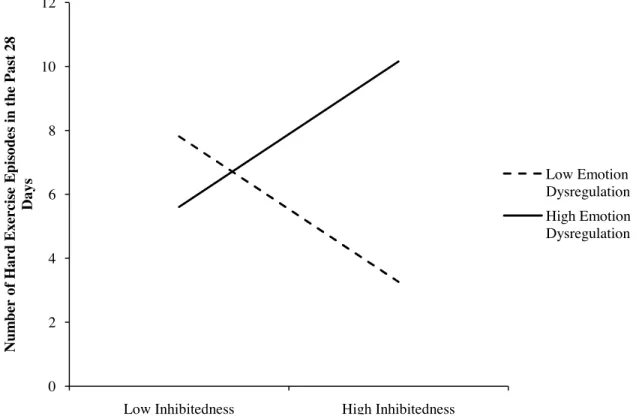
dependent variable, the three-way interaction of emotion dysregulation, impulsivity, and inhibitedness was not significant, t(195) = .37, p = .714 (see Table 7). However, the two-way interaction between emotion dysregulation and inhibitedness was significant within the set of two-way interactions and was examined separately, = .20, t(199) = 2.91, p = .004.2
As depicted in Figure 2, those with high levels of emotion dysregulation who also had high levels of inhibitedness had a higher frequency of hard exercise episodes than those with high emotion dysregulation and low inhibitedness. Simple slope analyses indicated that
inhibitedness was significantly associated with hard exercise at both high levels of emotion dysregulation (1 SD above the mean), = .23, t(199) = 2.28, p = .024, and low levels of emotion dysregulation (1 SD below the mean), = -.23, t(199) = -2.10, p = .037, but in different directions.
Vomiting episodes. With frequency of vomiting episodes over the past 28 days as the dependent variable, the three-way interaction between emotion dysregulation, impulsivity, and inhibitedness was not significant, t(194) = 1.19, p = .236 (see Table 8).
Laxative use episodes. With frequency of laxative use episodes over the past 28 days
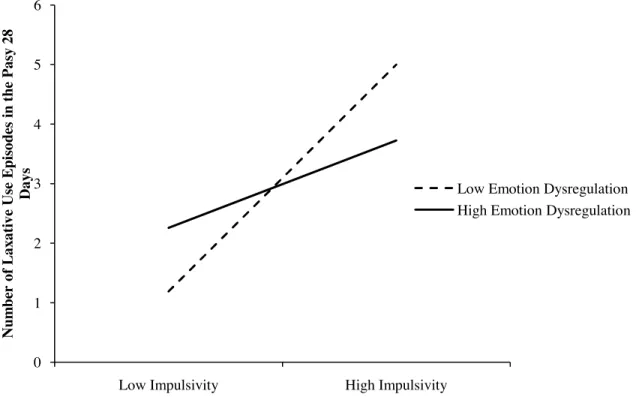
as the dependent variable, the three-way interaction between emotion dysregulation, impulsivity, and inhibitedness was not significant, t(195) = -.50, p = .617 (see Table 9). However, the two-way interaction between emotion dysregulation and inhibitedness was significant within the set of two-way interactions and was examined separately, = -.22,
2
Of note, we also ran the hierarchical multiple regression excluding those who reported zero hard exercise
episodes in the past 28 days (leaving n = 106). The emotion dysregulation x inhibitedness interaction was still
significant in identifying frequency of hard exercise episodes, t(102) = 2.65, p = .009. Those with high levels of
22
t(199) = -2.20, p = .029. As depicted in Figure 3, those with low levels of emotion
dysregulation and high levels of inhibitedness had higher levels of laxative use than those with low emotion dysregulation and low inhibitedness. On the other hand, at high levels of emotion dysregulation, level of inhibitedness did not appear to have the same impact on the level of laxative use. Furthermore, simple slope analyses indicated that inhibitedness was significantly associated with laxative use at low levels of emotion dysregulation, = .30, t(199) = 2.91, p = .004, but not at high levels of emotion dysregulation, = .03, t(199) = -.26, p = .792.3
Additionally, we followed up on the significant two-way interaction between emotion dysregulation and impulsivity found in the set of 2-way interactions, but when examined separately, the 2-way interaction was only marginally significant, t(199) = -1.90, p=.060, thus further simple slope analyses were not performed.
Diuretic use episodes. With frequency of diuretic use episodes over the past 28 days as the dependent variable, the three-way interaction between emotion dysregulation,
impulsivity, and inhibitedness was not significant, t(194) = -.01, p = .992 (see Table 10). Variability of Bulimic and Non-Bulimic Behaviors
Variability of bulimic behaviors. With variability of bulimic behaviors over the past
28 days as the dependent variable, the three-way interaction between emotion dysregulation, impulsivity, and inhibitedness was not significant, t(194) = -.34, p = .731 (see Table 11).
Variability of non-bulimic behaviors. With variability of non-bulimic behaviors
using the higher threshold system as the dependent variable, the three-way interaction
3
Of note, we also ran the hierarchical multiple regression excluding those who reported zero laxative use
episodes in the past 28 days (leaving n = 55). The emotion dysregulation x inhibitedness interaction was no
23
IV. Discussion
Findings from the current study indicate that the three personality variables of interest (emotion dysregulation, impulsivity, and inhibitedness) have differing relationships with frequencies of BN behaviors and emotionally motivated behavior variability. For example, emotion dysregulation was significantly correlated with number of SBEs, but not with frequencies of other BN behaviors, while impulsivity was significantly correlated with frequency of laxative use episodes, but not with frequencies of other BN behaviors. Both emotion dysregulation and impulsivity were positively associated with variability of non-BN behavior, but not with variability of BN behaviors. Inhibitedness, on its own, was not
correlated with any BN behavior frequencies or the behavior variability counts. On the other hand, two 2-way interactions emerged involving inhibitedness. In particular, inhibitedness interacted with emotion dysregulation to identify frequencies of hard exercises and laxative use episodes.
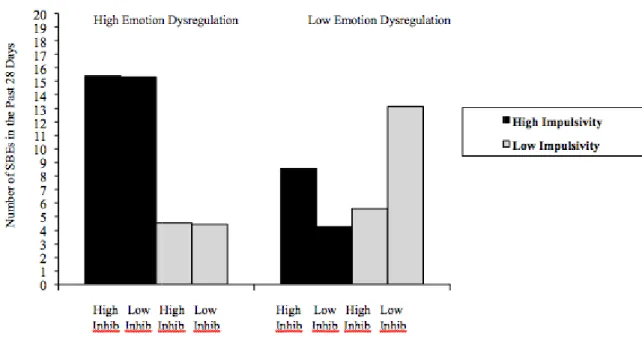
None of the three-way interactions between emotion dysregulation, impulsivity, and inhibitedness were found to be statistically significant; however, the three-way interaction with frequency of SBEs as the dependent variable was found to be marginally significant. Interpretation of this three-way interaction proved difficult. The main effect of emotion dysregulation was such that those high in emotion dysregulation engaged in higher
25
frequency of SBEs. Surprisingly, among those with low emotion dysregulation, the number of SBEs appeared to be highest among those low in both impulsivity and inhibitedness. Simple slope analyses were not completed, because of the marginal significance of the 3-way interaction; here the focus is on describing the interaction.
Given the extensive literature on binge eating as an emotion regulation strategy, it is surprising that emotion dysregulation did not have a significant main effect on number of OBEs, but did have a significant main effect on number of SBEs. This finding suggests that OBEs and SBEs may have different behavioral functions for the individual. It is possible that the OBE is more related to momentary negative affect than trait-level emotion dysregulation, whereas the SBE may be the result of trait-level high emotion dysregulation as it is assessed in the current study. This conceptualization would imply that OBEs may be, in the short term, functional behaviors aimed at regulating momentary aversive states, while SBEs may be markers of overall dysregulated affect. This interpretation is merely suggested by the results presented in the current paper; however, further research is needed to explore potential functional differences of SBEs versus OBEs among individuals with subthreshold/threshold BN.
We found that inhibitedness interacted with emotion regulation to identify frequency of hard exercise episodes, such that the combination of high inhibitedness and high emotion dysregulation indicated the highest number of hard exercise episodes over the past 28 days. This provides some evidence that perhaps hard exercise is more readily used among
26
inhibitedness and high on emotion dysregulation may have more potential outlets for expressing and regulating affect interpersonally due to not having as many difficulties with social connection and expression than those who are high on inhibitedness.
The significant two-way interaction between emotion dysregulation and inhibitedness with frequency of laxative use episodes as the dependent variable is difficult to interpret. For those high in emotion dysregulation, inhibitedness did not appear to be related to the number of laxative use episodes, whereas for those low in emotion dysregulation, higher
inhibitedness was associated with more frequent laxative use episodes. This suggests that, among individuals low in emotion dysregulation, laxative use may be more related to interpersonal and expressivity difficulties; whereas, for those high in emotion dysregulation, laxative use may not be related to these same difficulties. This interpretation is very much tentative, and we suggest further research in this area to better understand the correlates of laxative use in this population.
The observed positive correlations between reassurance seeking and emotion dysregulation, impulsivity, NSSI, and risky sexual behavior are of particular interest, because, to the author’s knowledge, little prior work has explored relations between
reassurance seeking and these variables. Anestis et al. (2009), using this same sample, found that affect lability (a component of emotion dysregulation) predicted reassurance seeking, which may explain some of the correlation between emotion dysregulation and reassurance seeking. Both number of OBEs and SBEs were positively correlated with vomiting episodes (.63 and .56, respectively). This finding highlights the clinical significance of SBEs, because it suggests that SBEs (like OBEs) may be related to vomiting occurrence.
27
the need for novel research designs to better understand the mechanisms associated with variability of these behaviors. This is especially important since prior research indicates that variability in purging behaviors is associated with greater severity of symptoms (Haedt et al., 2006). Regarding the interactive models with non-BN behavior variability, we found that for both higher and lower threshold counts toward variability, emotion dysregulation and
impulsivity had main effects, such that higher levels of each were associated with greater variability. For the lower threshold count variability, inhibitedness had a main effect as well but in the opposite direction, which is somewhat related to the hypothesis: higher levels of inhibitedness were associated with lower variability. These findings suggest independent effects of each of these personality variables on variability of non-BN behaviors. It is
interesting that inhibitedness only had a main effect in the lower threshold system for counts, such that more inhibitedness indicated lower variability of non-BN emotionally motivated behaviors.
Strengths and Limitations
The use of a clinical sample, subthreshold cases, and multiple sites of data collection of BN were all strengths of the present study. The use of a clinical sample allowed us to better understand how these behaviors and personality dimensions operate among the clinical population of interest: individuals with subthreshold/threshold BN. Additionally, the
inclusion of subthreshold cases increased the clinical diversity of the sample and generalizability of the findings. Multiple sites of data collection further increased the generalizability of the study by introducing additional geographic diversity to the sample.
self-28
report nature of the EDE-Q, which requires participants to make a judgment call as to whether or not the binge eating episode was objectively large without the assistance of a trained interviewer. Additionally, given the interest in frequencies of various bulimic
behaviors, it may have been helpful to use a real-time data collection mechanism. This would likely have produced more accurate frequency reporting by avoiding retrospective recall bias. Another limitation was the reliance on the IBS to determine counts of non-BN behaviors toward variability. This measure asked about these behaviors across the lifespan rather than over the past 28 days, making it difficult to compare variability findings related to non-BN versus BN behaviors. Additionally, the cross-sectional design does not allow for inference about causation of behaviors. Future studies interested in prediction of frequencies and variability of behaviors would benefit from using experience sampling methodology or longitudinal designs to infer causation.
Clinical Implications
The current study emphasizes the role of personality in frequency of BN behavior and variability of both BN and non-BN behavior. Specific to hard exercise, clinicians might be able to facilitate reduction of hard exercise by improving interpersonal effectiveness and expressivity (i.e., decreasing inhibitedness) among those who are high in emotion
29 Future Directions
The current study begins to shed light on some of the factors that may explain frequencies and variability of BN and non-BN emotionally motivated behaviors. Given the current study’s finding that SBEs were related to emotion dysregulation, future research could further explore the role of affect regulation in SBEs and how the function of SBEs may differ from that of OBEs. Future research could also examine novel constructs that may be related to BN behavior variability, such as negative affect, negative urgency, compulsivity, diagnostic comorbidity, anxiety, perfectionism, and age. For example, individuals who are high in compulsivity and anxiety may be more likely to engage in a smaller range of these behaviors due to a preference for the predictability of the effects of such behaviors.
Additionally, it would be interesting to continue to examine the role of social inhibitedness in the development and maintenance of hard exercise and laxative use. This research should use a more clearly defined construct of inhibitedness than appears in the DAPP that focuses directly on emotional expressivity and interpersonal connectedness without inclusion of broader interpersonal constructs like insecure attachment and social avoidance. Real time data collection could also be used to see how trait-like personality dimensions combine with more momentary variables like affect and cognitions in relation to emotionally motivated maladaptive behavior frequencies and variability.
Conclusions
30
31 Table 1
Items from the Impulsivity Behavior Scale (IBS) Included in the Count of Each Non-bulimic Behavior for the Variability Dependent Variable
Behavior IBS Question
NSSI Have you self-mutilated (e.g., cutting, pinching, burning yourself)? Alcohol Abuse Have you had times when you consumed too much alcohol for your own
good?
32 Table 2
Means and Standard Deviations of Continuous Independent and Dependent Variables
Note. OBE = objective binge eating episode. SBE = subjective binge eating episode. BN = bulimia nervosa. Variables 4 through 9 indicate the number of episodes of that particular bulimic behavior over the past 28 days. Variability of Non-BN Behaviors (Higher Threshold) involved counting non-BN behaviors toward variability when alcohol abuse, drug abuse, and risky sex were reported as being engaged in at least “sometimes,” when NSSI was reported as being engaged in at least “on occasion,” and reassurance seeking levels were at least 6 on a 7-point response scale on at least one of the two reassurance seeking items of interest. Variability of Non-BN Behaviors (Lower Threshold) involved counting non-BN behaviors toward variability if they were reported as having been engaged in at least “once” for NSSI, drug abuse, and risky sex, at least “on occasion” for alcohol, and at least a 5 out of 7 on at least one of the two reassurance seeking items of interest.
Variable Means and
Standard Deviations
Observed Range
1. Emotion Dysregulation M = 398.75
SD = 51.03
249-503
2. Inhibitedness M = 57.10
SD = 22.29
3-118
3. Impulsivity M = 71.25
SD = 11.46
47-111
4. OBE M = 15.75
SD = 23.56
0-200
5. SBE M = 12.91
SD = 14.46
0-100
6. Hard Exercise M = 6.89
SD = 10.75
0-84
7. Vomiting M = 22.45
SD = 36.38
0-300
8. Laxative use M = 2.75
SD = 6.27
0-28
9. Diuretic use M = 1.12
SD = 5.08
0-50 10. Variability of BN Behaviors M = 3.45
SD = 1.14
0-6 11. Variability of Non-BN Behaviors (Higher
Threshold)
M = 1.53 SD = 1.20
0-5 12. Variability of Non-BN Behaviors (Lower
Threshold)
M = 2.68 SD = 1.28
33 Table 3
Correlations Among the Personality Dimensions and the BN Frequency Variables and the Presence of Non-BN Emotionally Motivated Behaviors (N = 204)
Note. In this table, NSSI, alcohol abuse, drug abuse, risky sex, and reassurance seeking presence was ascertained by meeting the higher threshold for the non-BN behavior count variability: alcohol abuse, drug abuse, and risky sex were reported as being engaged in at least “sometimes,” NSSI was reported as being engaged in at least “on occasion,” and reassurance seeking levels were at least 6 on a 7-point response scale on at least one of the two reassurance seeking items of interest. Variables 4 through 9 are all frequency variables, indicating how many times the behavior was engaged in over the past 28 days.
*
p < .05. ** p < .01. *** p < .001
1 2 3 4 5 6 7 8 9 10 11 12 13 14
1. Emotion Dysregulatio n - 2. Inhibitedness
.09 - 3.
Impulsivity
.33
*** .03 -
4. OBE .02
-.04
.09 -
5. SBE .17
* .06 - .09 .45*** - 6. Hard
Exercise
.12 .03 -.04
-.04
.01 - 7. Vomiting
-.01 -.10
.10 .63
*** .56*** -.09
- 8. Laxative
Use
.07 .08 .19
** .11 .02 -.06
.01 - 9. Diuretic
Use
.02 -.05
.05 -.01
.14 .11 -.07
.13 - 10. NSSI .21
** .13 .18** .13 .11 .00 .07 .09 .00 -3
-
11. Alcohol Abuse
.01 .04 .12 -.06 -.01 -.15 * -.09 -.04
.01 .18
** - 12. Drug Abuse -.01 -.05 .17
* .03 .01 -.09
.01 .02 .05 .28
*** .33*** - 13. Risky
Sex -.05 -.09 .17
* .11 .05 -.05
.15
*
-.03
.00 .12 .29
*** .41*** - 14.
Reassurance Seeking
.41
*** .11 - .17* .002 .11 .12 .02 - .05 .06 .14* .11 - .04 - -.20 **
34 Table 4
Correlations Among the Personality Dimensions and Variability Variables (N = 204)
Note. ** p < .01. *** p < .001
Emotion Dysregulation
Inhibitedness Impulsivity BN Behavior
Variability
.09 .07 .08
Non-BN Behavior Variability at Higher Threshold
.22** -.02 .27***
Non-BN Behavior Variability at Lower Threshold
35 Table 5
Hierarchical Multiple Regression Analyses of the Interaction of Emotion Dysregulation, Impulsivity, and Inhibitedness with the Dependent Variable of Frequency of Objective Binge Eating
Step and predictors B SE B t (dfs) p R2
Step 1 .01
Emotion Dysregulation -.003 .04 -.01 -.08 (3,199)
.938
Impulsivity .21 .16 .10 1.35
(3,199)
.179
Inhibitedness -.05 .08 -.05 -.64
(3,199)
.520
Step 2 .01
Emotion Dysregulation x Impulsivity
-.003 .003 -.07 -.92 (3,196)
.361 Emotion Dysregulation
x Inhibitedness
.000 .002 .01 .10
(3,196)
.920 Impulsivity x
Inhibitedness
-.004 .01 -.05 -.64 (3,196)
.522
Step 3 .001
Emotion Dysregulation x Impulsivity x
Inhibitedness
-6.17E-5 .000 -.03 -.37 (1,195)
36 Table 6
Hierarchical Multiple Regression Analyses of the Interaction of Emotion Dysregulation, Impulsivity, and Inhibitedness with the Dependent Variable of Frequency of Subjective Binge Eating Episodes
Note. ^ p<.10. * p<.05.
Step and predictors B SE B t (dfs) p R2
Step 1 .04^
Emotion Dysregulation .05 .02 .18* 2.36 (3,199)
.019
Impulsivity .03 .09 .02 .27
(3,199)
.784
Inhibitedness -.05 .05 -.08 -1.11
(3,199)
.268
Step 2 .01
Emotion Dysregulation x Impulsivity
.00 .00 .01 .11
(3,196)
.915 Emotion Dysregulation x
Inhibitedness
.00 .00 .05 .65
(3,196)
.514 Impulsivity x
Inhibitedness
.00 .00 .05 .69
(3,196)
.494
Step 3 .02^
Emotion Dysregulation x Impulsivity x
Inhibitedness
.00 .00 .14^ 1.83
(1,195)
37 Table 7
Hierarchical Multiple Regression Analyses of the Interaction of Emotion Dysregulation, Impulsivity, and Inhibitedness with the Dependent Variable of Frequency of Hard Exercise Episodes
Step and predictors B SE B t (dfs) p R2
Step 1 .02
Emotion Dysregulation .03 .02 .14^ 1.92 (3,199)
.057
Impulsivity -.08 .07 -.08 -1.13
(3,199)
.260
Inhibitedness .01 .03 .02 .22
(3,199)
.826
Step 2 .04*
Emotion Dysregulation x Impulsivity
-.00 .00 -.04 -.57 (3,196)
.568 Emotion Dysregulation x
Inhibitedness
.00 .00 .20** 2.73 (3,196)
.007 Impulsivity x
Inhibitedness
-.00 .00 -.03 -.34 (3,196)
.736
Step 3 .00
Emotion Dysregulation x Impulsivity x
Inhibitedness
.00 .00 .03 .37
(1,195)
.714
38 Table 8
Hierarchical Multiple Regression Analyses of the Interaction of Emotion Dysregulation, Impulsivity, and Inhibitedness with the Dependent Variable of Frequency of Vomiting Episodes
Note. ^ p<.10.
Step and predictors B SE B t (dfs) p R2
Step 1 .02
Emotion Dysregulation -.03 .05 -.04 -.56 (3,198)
.574
Impulsivity .39 .24 .12 1.62
(3,198)
.107
Inhibitedness -.16 .12 -.10 -1.35
(3,198)
.177
Step 2 .02
Emotion Dysregulation x Impulsivity
-.01 .01 -.11 -1.46 (3,195)
.145 Emotion Dysregulation x
Inhibitedness
-.01 .00 -.13^ -1.78 (3,195)
.077 Impulsivity x
Inhibitedness
.01 .01 .04 .56
(3,195)
.580
Step 3 .01
Emotion Dysregulation x Impulsivity x
Inhibitedness
.00 .00 .09 1.19
(1,194)
39 Table 9
Hierarchical Multiple Regression Analyses of the Interaction of Emotion Dysregulation, Impulsivity, and Inhibitedness with the Dependent Variable of Frequency of Laxative Use Episodes
Step and predictors B SE B t (dfs) p R2
Step 1 .04*
Emotion Dysregulation -.00 .01 -.00 -.01 (3,199)
.992
Impulsivity .11 .04 .19** 2.63
(3,199)
.009
Inhibitedness .02 .02 .07 1.02
(3,199)
.309
Step 2 .06**
Emotion Dysregulation x Impulsivity
-.00 .00 -.16* -2.37 (3,196)
.019 Emotion Dysregulation x
Inhibitedness
-.00 .00 -.21** -2.95 (3,196)
.004 Impulsivity x
Inhibitedness
.00 .00 .12^ 1.71
(3,196)
.088
Step 3 .00
Emotion Dysregulation x Impulsivity x
Inhibitedness
-.00 .00 -.04 -.50 (1,195)
.617
40 Table 10
Hierarchical Multiple Regression Analyses of the Interaction of Emotion Dysregulation, Impulsivity, and Inhibitedness with the Dependent Variable of Frequency of Diuretic Use Episodes
Step and predictors B SE B t (dfs) p R2
Step 1 .01
Emotion Dysregulation .00 .01 .01 .14 (3,198) .890
Impulsivity .02 .03 .05 .69 (3,198) .493
Inhibitedness -.01 .02 -.06 -.77
(3,198)
.441
Step 2 .01
Emotion Dysregulation x Impulsivity
.00 .00 .01 .16 (3,195) .872 Emotion Dysregulation
x Inhibitedness
.00 .00 .01 .08 (3,195) .935 Impulsivity x
Inhibitedness
-.00 .00 -.09 -1.21 (3,195)
.229
Step 3 .00
Emotion Dysregulation x Impulsivity x
Inhibitedness
-.00 .00 -.00 -.01 (1,194)
41 Table 11
Hierarchical Multiple Regression Analyses of the Interaction of Emotion Dysregulation, Impulsivity, and Inhibitedness with the Dependent Variable of Variability of Bulimic Behaviors
Step and predictors B SE B t (dfs) p R2
Step 1 .02
Emotion Dysregulation .00 .00 .06 .83 (3,198)
.407
Impulsivity .01 .01 .07 .98
(3,198)
.327
Inhibitedness .00 .00 .06 .82
(3,198)
.414
Step 2 .01
Emotion Dysregulation x Impulsivity
-.00 .00 -.03 -.41 (3,195)
.683 Emotion Dysregulation x
Inhibitedness
-.00 .00 -.07 -.89 (3,195)
.377 Impulsivity x
Inhibitedness
.00 .00 .03 .42
(3,195)
.678
Step 3 .00
Emotion Dysregulation x Impulsivity x
Inhibitedness
-.00 .00 -.03 -.34 (1, 194)
42 Table 12
Hierarchical Multiple Regression Analyses of the Interaction of Emotion Dysregulation, Impulsivity, and Inhibitedness with the Dependent Variable of Variability of Non-Bulimic Behaviors with the Higher Threshold for Counts
Step and predictors B SE B t (dfs) p R2
Step 1 .10***
Emotion Dysregulation .004 .002 .16* 2.17 (3,198)
.032
Impulsivity .024 .01 .22** 3.10
(3,198)
.002 Inhibitedness -.002 .004 -.04 -.60
(3,198)
.550
Step 2 .01
Emotion Dysregulation x Impulsivity
.00 .00 -.02 .35
(3,195)
.728 Emotion Dysregulation
x Inhibitedness
.00 .00 .13^ 1.73
(3,195)
.086 Impulsivity x
Inhibitedness
.00 .00 -.05 -.75
(3,195)
.454
Step 3 .01
Emotion Dysregulation x Impulsivity x
Inhibitedness
.00 .00 .08 1.03
(1,194)
.306
43 Table 13
Hierarchical Multiple Regression Analyses of the Interaction of Emotion Dysregulation, Impulsivity, and Inhibitedness with the Dependent Variable of Variability of Non-Bulimic Behaviors with the Lower Threshold for Counts
Note. *p<.05. ** p<.01. ***p<.001.
Step and predictors B SE B t (dfs) p R2
Step 1 .17***
Emotion Dysregulation .01 .00 .21** 2.99 (3,198)
.003
Impulsivity .03 .01 .28*** 4.02
(3,198)
.000
Inhibitedness -.01 .00 -.13* -2.00
(3,198)
.046
Step 2 .00
Emotion Dysregulation x Impulsivity
-.00 .00 -.04 -.60 (3,195)
.548 Emotion Dysregulation
x Inhibitedness
-.00 .00 -.06 -.81 (3,195)
.417 Impulsivity x
Inhibitedness
.00 .00 .04 .57
(3,195)
.570
Step 3 .00
Emotion Dysregulation x Impulsivity x
Inhibitedness
.00 .00 .05 .69
(1,194)
Figure 1. The three-way interaction of emotion dysregulation, impulsivity, and inhibitedness (Inhib) with the dependent variable of
the past 28 days.
44
way interaction of emotion dysregulation, impulsivity, and inhibitedness (Inhib) with the dependent variable of number of subjective binge eating episodes (SBEs) in
45
Figure 2. The interaction of emotion dysregulation and inhibitedness with number of hard exercise episodes in the past 28 days as the dependent variable.
0 2 4 6 8 10 12
Low Inhibitedness High Inhibitedness
Nu m b er o f H a rd E xe rc is e E p is o d es i n t h e P a st 2 8 Da y
s Low Emotion
46
Figure 3. The interaction of emotion dysregulation and inhibitedness with number of laxative use episodes in the past 28 days as the dependent variable.
0 1 2 3 4 5 6
Low Impulsivity High Impulsivity
Nu m b er o f L a xa ti v e Us e E p is o d es i n t h e P a sy 2 8 Da y s
47 References
Allen, T. J., Moeller, F. G., Rhoades, H. M., and Cherek, D. R. (1998). Impulsivity and history of drug dependence. Drug and Alcohol Dependence, 50(2), 137–145. doi:10.1016/S0376- 8716(98)00023-4
American Psychiatric Association (1994). Diagnostic and statistical manual of mental disorders (4th ed.). Washington, DC: Author.
Anestis, M. D., Smith, A. R., Fink, E. L., & Joiner, T. E. (2008). Dysregulated eating and distress: Examining the specific role of negative urgency in a clinical sample. Cognitive Therapy and Research, 33(4), 390-397. doi:10.1007/s10608-008-9201-2
Anestis, M., Peterson, C., Bardone-Cone, A., Klein, M., Mitchell, J., Crosby, R…Joiner, T.E. (2009). Affective lability and impulsivity in a clinical sample of women with bulimia nervosa: The role of affect in severely dysregulated behavior. International Journal of Eating Disorders, 42(3), 259-66. doi:10.1002/eat.20606
Bancroft, J. (2008). Sexual behavior that is “out of control”: A theoretical conceptual approach. Psychiatric Clinics of North America, 31, 593-601.
doi:10.1016/j.psc.2008.06.009
Bardone-Cone, A. M., Joiner, T. E., Crosby, R. D., Crow, S. J., Klein, M. H., Le Grange, D., Mitchell, J. E., Peterson, C. B., & Wonderlich, S. A. (2008). Examining a
psychosocial interactive model of binge eating and vomiting in women with bulimia nervosa and subthreshold bulimia nervosa. Behaviour Research and Therapy, 46, 887-894. doi:10.1016/j.brat.2008.04.003
Barratt, E. (1959). Anxiety and impulsiveness related to psychomotor efficiency. Perceptual and Motor Skills, 9, 191-198. doi:10.2466/PMS.9.3.191-198
Barratt, E. (1972). Anxiety and impulsiveness: Toward a neuropsychological model. In C. Spielberg (Ed.). Anxiety: Current Trends in Theory and Research. New York: NY, Academic Press.
Baumeister, R. F. (1988). Masochism as escape from self. The Journal of Sex Research, 25(1), 28-59. doi:10.1080/00224498809551444
Baumeister, R. F. (1991). Escaping the self: Alcoholism, spirituality, masochism, and other flights from the burden of selfhood. New York, NY: Basic Books.
48
Carbaugh, R., & Sias, S. (2010) Comorbidity of bulimia nervosa and substance abuse: Etiologies, treatment issues, and treatment approaches. Journal of Mental Health Counseling, 32(2), 125-138.
Clark, L. A. (1993). Personality disorder diagnosis: Limitations of the five factor model. Psychological Inquiry, 4(2), 100-104. doi:10.1207/s15327965pli0402_5
Clyne, C., & Blampied, N. M. (2004). Training in emotion regulation as a treatment for binge eating: A preliminary study. Behaviour Change, 21(4), 269-281.
doi:10.1375/bech.21.4.269.66105
Cooper, M. L. (1994). Motivations for alcohol use among adolescents: Development and validation of a four-factor-model. Psychological Assessment, 6, 117-128.
doi:10.1037/1040-3590.6.2.117
Cooper, M., Agocha, V., & Sheldon, M. (2001). Eating disorders and alcohol use: Group differences in consumption rates and drinking motives. Journal of Personality, 68(6), 1059-1088. doi:10.1016/j.eatbeh.2006.04.003
Donohew, L., Zimmerman, R., Cupp, P., Novak, S., Colon, S., & Abell, R. (2000). Sensation seeking, impulsive decision-making, and risky sex: Implications for risk-taking and design of interventions. Personality and Individual Differences, 28(6), 1079-1091. doi:10.1016/S0191-8869(99)00158-0
Engelberg, M. J., Steiger, H., Gauvin, L., & Wonderlich, S. A. (2007). Binge Antecedents in Bulimic Syndromes: An Examination of Dissociation and Negative Affect.
International Journal of Eating Disorders, 40, 531-536. doi:10.1002/eat.20399
Fairburn, C. G. & Beglin, S. J. (1994). Assessment of eating disorders: interview or self-report questionnaire?. International Journal of Eating Disorders, 16, 363–370. Fairburn, C. G., & Cooper, Z. (1993). The Eating Disorder Examination (12th edition). In C.
G. Fairburn & G. T. Wilson (Eds.), Binge eating: Nature, assessment, and treatment (pp. 317–360). New York: Guilford Press.
Fairburn, C. G., Cooper, Z., & Shafran, Z. (2003). Cognitive behaviour therapy for eating disorders: A transdiagnostic theory and therapy. Behaviour Research and Therapy, 41(5), 509-528. doi:10.1016/S0005-7967(02)00088-8
First, M. B., Spitzer, R. L., Gibbon, M. & Williams, J. B. (1995). Structured Clinical Interview for the DSM-IV Axis I Disorders-Patient Edition (SCID-I/P, version 2). New York State Psychiatric Institute, Biometrics Research Department.
49
Franklin, J. C., Hessel, E. T., Aaron, R. V., Arthur, M. S., Heilbron, N., & Prinstein, M. J. (2010). The functions of nonsuicidal self-injury: support for cognitive-affective regulation and opponent processes from a novel psychophysiological paradigm. Journal of Abnormal Psychology, 119(4), 850-62. doi:10.1037/a0020896
Frazier, P. A., Tix, A. P., & Baron, K. E. (2004). Testing moderator and mediator effects in counseling psychology research. Journal of Counseling Psychology, 51(1), 115-134. doi:10.1037/0022-0167.51.1.115
Gratz, K. (2003). Risk factors for and functions of deliberate self-harm: An empirical and conceptual review. Clinical Psychology: Science and Practice, 10(2), 192-205. doi:10.1093/clipsy/bpg022
Haedt, A. A., Edler, C., Heatherton, T. F., & Keel, P. K. (2006). Importance of multiple purging methods in the classification of eating disorder subtypes. International Journal of Eating Disorders, 39, 648-654. doi:10.1002/eat.20335
Harkness, A. R. (1992). Fundamental topics in the personality disorders: Candidate trait dimensions from the lower regions of the hierarchy. Psychological Assessment, 4(2), 251-59. doi:10.1037/1040-3590.4.2.251
Heatherton, T. F., & Baumeister, R. F. (1991). Binge eating as escape from self-awareness. Psychological Bulletin, 110(1), 86-108. doi:10.1037/0033-2909.110.1.86
Hinshaw, S. P. (2003). Impulsivity, emotion regulation, and developmental psychopathology: Specificity versus generality of linkages. Annals New York Academy of Sciences, 1008, 149-159.
Jeppson, J., Richards, P.S., Hardman, R. K., Mac Granley, H. (2003). Binge and purge processes in bulimia nervosa: A qualitative investigation. Eating Disorders, 11, 115-128. doi:10.1080/10640260390199307
Joiner, T. E., & Metalsky, G. I. (2001). Excessive reassurance seeking: Delineating a risk factor involved in the development of depressive symptoms. Psychological Science, 12(5), 371-378. doi:10.1111/1467-9280.00369
Joiner, T. E., Alfano, M. S., Metalsky, G. I. (1999). When depression breeds contempt. Journal of Abnormal Psychology, 101, 165–173. doi:10.1037/0021-843X.101.1.165
Joiner, T., Katz, J., & Lew, A. (1999). Harbingers of depressotypic reassurance-seeking: Negative life events, anxiety, and self-esteem. Personality Social Psychology Bulletin, 25: 630–637. doi:10.1177/0146167299025005008
50
Lang, P. J. (1985). The cognitive psychophysiology of emotion: Fear and anxiety. In A.H. Tuma & J. D. Maser (Eds.), Anxiety and the anxiety disorders (pp. 131-170). Hilisdale, NJ: Erlbaum.
Latner, J. D., Hildebrandt, T., Rosewall, J. K., Chisholm, A. M., & Hayashi, K. (2007). Loss of control over eating reflects eating disturbances and general psychopathology. Behaviour Research and Therapy, 45, 2203-2211. doi:10.1016/j.brat.2006.12.002
Le Grange, D., Binford, R., Peterson, C., Crow, S., Crosby, R., Klein, M…Wonderlich, S. (2006). DSM-IV threshold versus subthreshold bulimia nervosa. International Journal of Eating Disorders, 39, 462-467. doi:10.1002/eat.20304
Linehan, M., Heard, H., Armstrong, H. (1993). Naturalistic follow-up of a behavioral treatment for chronically parasuicidal borderline patients. Archives of General Psychiatry, 50, 971–974.
Livesley, W. J., Jackson, D. N. & Schroeder, M. L. (1992). Factorial structure of traits delineating personality disorders in clinical and general populations. Journal of Abnormal Psychology, 101, 432– 440. doi:10.1037/0021-843X.101.3.432
Livesley, W. J. & Larstone, R. M. (2008). The Dimensional Assessment of Personality Pathology (DAPP). In G.J. Boyle, Matthews, G., & Saklofske, D.H. (Ed.). The Sage Handbook of Personality Theory and Assessment. Thousand Oaks, California: SAGE Publications Ltd.
Luce, K., Engler, P., & Crowther, J. (2007). Eating disorders and alcohol use: Group differences in consumption rates and drinking motives. Eating Behaviors, 8(2), 177-184. doi:10.1016/j.eatbeh.2006.04.003
Mond, J. J., Hay, P. J., Rodgers, B., Owen, C., & Mitchell, J. (2006). Correlates of the use of purging and non-purging methods of weight control in a community sample of women. Australian and New Zealand Journal of Psychiatry, 40(2),136-142. doi:10.1111/j.1440-1614.2006.01760.x
Moon, A., & Berenbaum, H. (2009). Emotional awareness and emotional eating. Cognition & Emotion, 23(3), 417-429. doi:10.1080/02699930801961798
Muehlenkamp, J., Engel, S., Wadeson, A., Crosby, R., Wonderlich, S., Simonich, H., & Mitchell, J. (2009). Emotional states preceding and following acts of non-suicidal self-injury in bulimia nervosa patients. Behaviour Research and Therapy, 47(1), 83-7. doi:10.1016/j.brat.2008.10.011