Microsoft Windows
Common Criteria Evaluation
Microsoft Windows 8
Microsoft Windows RT
Microsoft Windows Server 2012
IPsec VPN Client Security
Target
Document Information
Version Number 1.0
This is a preliminary document and may be changed substantially prior to final commercial release of the software described herein.
The information contained in this document represents the current view of Microsoft Corporation on the issues discussed as of the date of publication. Because Microsoft must respond to changing market conditions, it should not be interpreted to be a commitment on the part of Microsoft, and Microsoft cannot guarantee the accuracy of any information presented after the date of publication.
This document is for informational purposes only. MICROSOFT MAKES NO WARRANTIES, EXPRESS OR IMPLIED, AS TO THE INFORMATION IN THIS DOCUMENT.
Complying with all applicable copyright laws is the responsibility of the user.This work is licensed under the Creative Commons Attribution-NoDerivs-NonCommercial License (which allows redistribution of the work). To view a copy of this license, visit
http://creativecommons.org/licenses/by-nd-nc/1.0/ or send a letter to Creative Commons, 559 Nathan Abbott Way, Stanford, California 94305, USA.
Microsoft may have patents, patent applications, trademarks, copyrights, or other intellectual property rights covering subject matter in this document. Except as expressly provided in any written license agreement from Microsoft, the furnishing of this document does not give you any license to these patents, trademarks, copyrights, or other intellectual property.
The example companies, organizations, products, people and events depicted herein are fictitious. No association with any real company, organization, product, person or event is intended or should be inferred.
© 2013 Microsoft Corporation. All rights reserved.
Microsoft, Active Directory, Visual Basic, Visual Studio, Windows, the Windows logo, Windows NT, and Windows Serverare either registered trademarks or trademarks of Microsoft Corporation in the United States and/or other countries.
The names of actual companies and products mentioned herein may be the trademarks of their respective owners.
TABLE OF CONTENTS
IPSEC VPN CLIENT SECURITY TARGET ...1
TABLE OF CONTENTS ...3
LIST OF TABLES ...6
1 SECURITY TARGET INTRODUCTION ...8
1.1 SECURITY TARGET, TOE, AND COMMON CRITERIA (CC) IDENTIFICATION ...8
1.2 CC CONFORMANCE CLAIMS ...9
1.3 CONVENTIONS, TERMINOLOGY, ACRONYMS ...9
1.3.1 CONVENTIONS ... 9
1.3.2 TERMINOLOGY ... 9
1.3.3 ACRONYMS... 12
1.4 ST OVERVIEW AND ORGANIZATION ... 12
2 TOE DESCRIPTION ... 12
2.1 PRODUCT TYPES ... 13
2.2 PRODUCT DESCRIPTION ... 13
2.3 SECURITY ENVIRONMENT AND TOE BOUNDARY ... 13
2.3.1 LOGICAL BOUNDARIES ... 14
2.3.2 PHYSICAL BOUNDARIES ... 15
2.4 TOE SECURITY SERVICES ... 15
3 SECURITY PROBLEM DEFINITION ... 17
3.1 THREATS TO SECURITY ... 17
3.2 ORGANIZATIONAL SECURITY POLICIES ... 17
3.3 SECURE USAGE ASSUMPTIONS ... 18
4 SECURITY OBJECTIVES ... 19
4.1 TOE SECURITY OBJECTIVES ... 19
4.2 SECURITY OBJECTIVES FOR THE OPERATIONAL ENVIRONMENT ... 20
5.1 TOE SECURITY FUNCTIONAL REQUIREMENTS ... 21
5.1.1 SECURITY AUDIT (FAU) ... 22
5.1.1.1 Audit Data Generation (FAU_GEN.1) ... 22
5.1.1.2 Selective Audit (FAU_SEL.1) ... 24
5.1.2 CRYPTOGRAPHIC SUPPORT (FCS) ... 24
5.1.2.1 Cryptographic Key Generation for Asymmetric Keys (FCS_CKM.1(ASYM)) ... 24
5.1.2.2 Cryptographic Key Generation for Internet Key Exchange (FCS_CKM.1(IKE)) ... 24
5.1.2.3 Cryptographic Key Zeroization (FCS_CKM_EXT.4) ... 25
5.1.2.4 Cryptographic Operation for Data Encryption/Decryption (FCS_COP.1(SYM)) ... 25
5.1.2.5 Cryptographic Operation for Cryptographic Signature (FCS_COP.1(SIGN)) ... 25
5.1.2.6 Cryptographic Operation for Cryptographic Hashing (FCS_COP.1(HASH)) ... 25
5.1.2.7 Cryptographic Operation for Keyed-Hash Message Authentication (FCS_COP.1(HMAC)) ... 26
5.1.2.8 Internet Protocol Security (IPsec) Communications (FCS_IPSEC_EXT.1) ... 26
5.1.2.9 Cryptographic Operation for Random Bit Generation (FCS_RBG_EXT.1) ... 27
5.1.3 USER DATA PROTECTION (FDP) ... 27
5.1.3.1 Full Residual Data Protection (FDP_RIP.2) ... 27
5.1.4 IDENTIFICATION AND AUTHENTICATION (FIA)... 27
5.1.4.1 Pre-Shared Key Composition (FIA_PSK_EXT.1) ... 27
5.1.4.2 X509 Certificates (FIA_X509_EXT.1)... 28
5.1.4.3 X.509 Certificate Storage and Management (FIA_X509_EXT.2) ... 28
5.1.5 SECURITY MANAGEMENT (FMT) ... 28
5.1.5.1 Specification of Management Functions (FMT_SMF.1) ... 28
5.1.6 PROTECTION OF THE TSF(FPT) ... 29
5.1.6.1 Extended: TSF Self-Test (FPT_TST_EXT.1) ... 29
5.1.6.2 Extended: Trusted Update (FPT_TUD_EXT.1) ... 29
5.1.7 TRUSTED PATH/CHANNELS (FTP) ... 29
5.1.7.1 Inter-TSF Trusted Channel (FTP_ITC.1) ... 29
5.2 TOE SECURITY ASSURANCE REQUIREMENTS ... 29
5.2.1 CCPART 3ASSURANCE REQUIREMENTS ... 29
5.2.1.1 Development ... 30
5.2.1.2 Guidance Documents ... 30
5.2.1.3 Testing ... 32
5.2.1.4 Vulnerability Assessment ... 32
5.2.1.5 Lifecycle Support ... 33
5.2.2 IPSEC CLIENT VPNPPASSURANCE ACTIVITIES ... 33
5.2.2.1 Security Audit ... 33
5.2.2.2 Cryptographic Support ... 35
5.2.2.3 IPsec ... 38
5.2.2.4 User Data Protection ... 45
5.2.2.5 Identification and Authentication ... 46
5.2.2.6 Security Management ... 48
5.2.2.8 Trusted Paths / Channels ... 49
6 TOE SUMMARY SPECIFICATION (TSS) ... 50
6.1 AUDIT FUNCTION ... 50
6.1.1.1 Audit Collection ... 50
6.1.1.2 Selective Audit ... 51
6.1.1.3 Audit Log Overflow Protection ... 52
6.1.2 SFRMAPPING: ... 52
6.2 CRYPTOGRAPHIC SUPPORT ... 52
6.2.1 TSSDESCRIPTION ... 52
6.2.2 SFRMAPPING ... 54
6.3 IPSEC ... 55
6.3.1 TSSDESCRIPTION ... 55
6.3.1.1 RFC Summary ... 56
6.3.2 TSSMAPPING ... 57
6.4 USER DATA PROTECTION ... 58
6.4.1 TSSDESCRIPTION ... 58
6.4.2 SFRMAPPING ... 58
6.5 IDENTIFICATION AND AUTHENTICATION ... 59
6.5.1 TSSDESCRIPTION ... 59
6.5.2 SFRMAPPING ... 59
6.6 SECURITY MANAGEMENT ... 60
6.6.1 TSSDESCRIPTION ... 60
6.6.2 SFRMAPPING ... 60
6.7 TSFPROTECTION ... 61
6.7.1 TSSDESCRIPTION ... 61
6.7.1.1 Windows Self-Tests ... 61
6.7.1.2 Windows Code Integrity ... 61
6.7.1.3 Windows Updates ... 62
6.7.2 SFRMAPPING ... 63
6.8 TRUSTED PATH / CHANNELS ... 63
6.8.1 TSSDESCRIPTION ... 63
6.8.2 SFRMAPPING ... 63
7 RATIONALE FOR THE PROTECTION PROFILE CONFORMANCE CLAIM ... 64
8 RATIONALE FOR MODIFICATIONS TO THE SECURITY REQUIREMENTS ... 65
8.1 RATIONALE FOR MODIFIED FUNCTIONAL REQUIREMENTS ... 65
8.3 RATIONALE FOR THE TOE SUMMARY SPECIFICATION ... 66
9 APPENDIX A: LIST OF ABBREVIATIONS ... 68
10 APPENDIX B: REFERENCES ... 73
11 APPENDIX C: DETAILS ON KEY ESTABLISHMENT AND DIGITAL SIGNATURES ... 74
11.1 SPECIAL PUBLICATION 800-56A ... 74
11.1.1 NISTSP800-56ASECTIONS ... 75
11.1.1.1 Sections 1 – 3 ... 75
11.1.1.2 Section 4 Key Establishment Schemes Overview ... 75
11.1.1.3 Section 5 Cryptographic Elements ... 75
11.1.1.4 Section 6 Key Agreement ... 81
11.1.1.5 Section 7 DLC-Based Key Transport ... 84
11.1.1.6 Section 8 Key Confirmation ... 84
11.1.1.7 Section 9 Key Recovery ... 84
11.1.1.8 Section 10 Implementation Validation ... 84
11.1.1.9 Appendices A, D, and E (Informative) ... 85
11.1.1.10 Appendix B: Rationale for Including Identifiers in the KDF Input ... 85
11.1.1.11 Appendix C: Data Conversions (Normative) ... 85
11.1.2 EXCEPTIONS ... 85
11.1.2.1 TOE-Specific Extensions ... 85
11.1.2.2 Additional Processing ... 85
11.1.2.3 Alternative Implementations ... 85
11.2 FIPS 186-3 ... 85
11.2.1 SECTIONS FROM FIPS186-3APPENDIX BKEY PAIR GENERATION ... 85
11.2.1.1 B.1 FFC KEY PAIR GENERATION ... 86
11.2.1.2 B.2 FFC PER-MESSAGE SECRET NUMBER GENERATION ... 86
11.2.1.3 B.3 IFC KEY PAIR GENERATION ... 87
11.2.1.4 B.4 ECC KEY PAIR GENERATION ... 87
11.2.1.5 B.5 ECC PER-MESSAGE SECRET NUMBER GENERATION ... 88
11.2.2 EXCEPTIONS ... 89
11.2.2.1 TOE-Specific Extensions ... 89
11.2.2.2 Additional Processing ... 89
11.2.2.3 Alternative Implementations ... 89
LIST OF TABLES
Table 3-1 Threats Addressed by Windows 8, Windows RT, and Windows Server 2012 ... 17Table 3-2 Organizational Security Policies ... 17
Table 4-1 Security Objectives for the TOE ... 19
Table 4-2 Security Objectives for the Operational Environment ... 20
Table 5-1 TOE Security Functional Requirements ... 21
Table 5-2 Auditable Events ... 23
Table 5-3 TOE Security Assurance Requirements ... 29
Table 6-1 Audit Log Event Categories ... 51
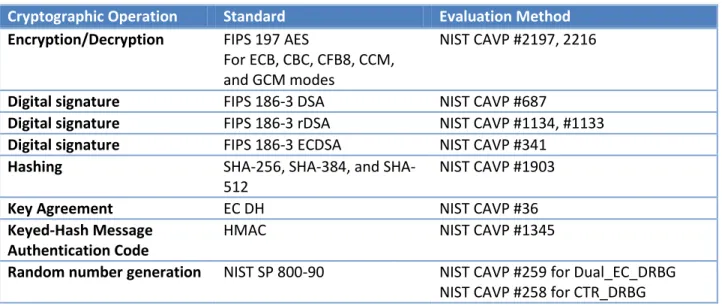
Table 6-2 Cryptographic Standards and Evaluation Methods ... 53
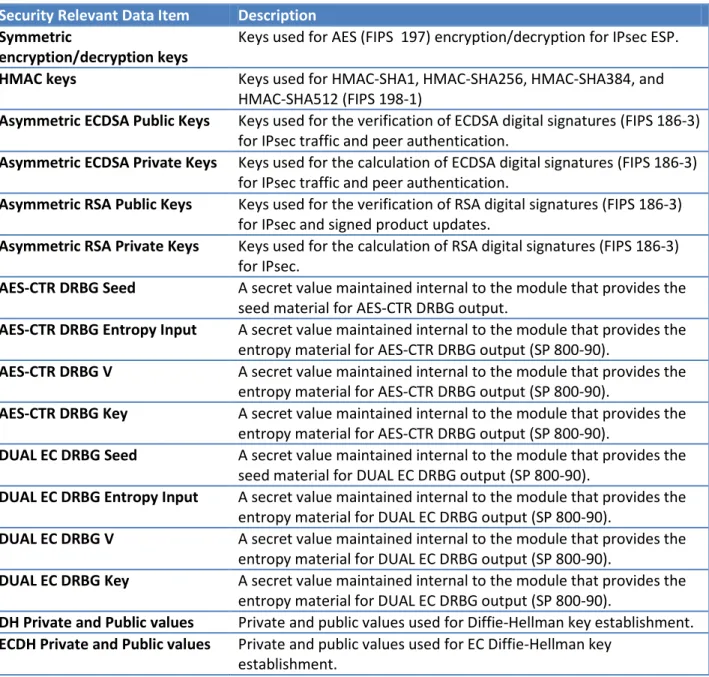
Table 6-3 IPsec VPN Client Keys and Critical Security Parameters ... 54
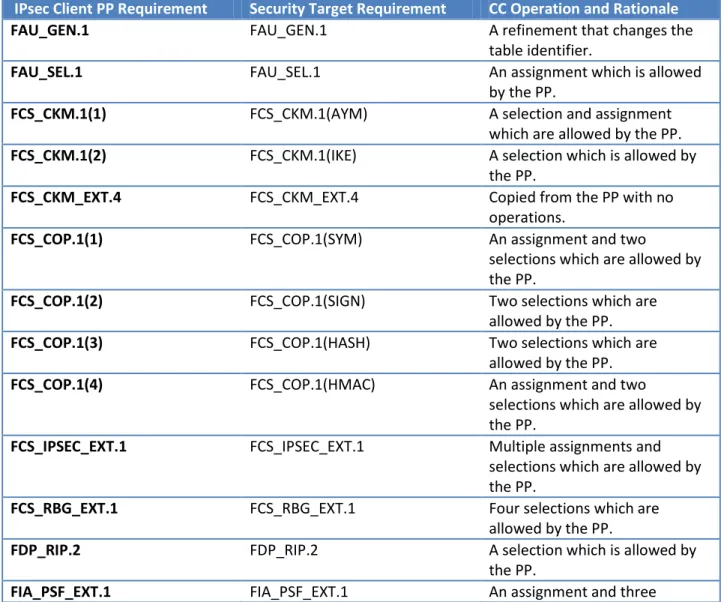
Table 8-1 Rationale for Operations ... 65
1
Security Target Introduction
This section presents the following information required for a Common Criteria (CC) evaluation: • Identifies the Security Target (ST) and the Target of Evaluation (TOE)
• Specifies the security target conventions and conformance claims • Describes the organization of the security target
1.1
Security Target, TOE, and Common Criteria (CC) Identification
ST Title: IPsec VPN Client Security TargetST Version: version 1.0; January 23, 2014
TOE Software Identification: The IPsec client and dependent functionality from the following Windows Operating Systems (OS) that is needed to comply with the security target:
• Microsoft Windows 8 Edition (32-bit and 64-bit versions) • Microsoft Windows 8 Pro Edition (32-bit and 64-bit versions) • Microsoft Windows 8 Enterprise Edition (32-bit and 64-bit versions) • Microsoft Windows RT
• Microsoft Windows Server 2012 Standard Edition • Microsoft Windows Server 2012 Datacenter Edition
The following security updates and patches must be applied to the above Windows 8 products: • All critical security updates published as of February 2013.
The following security updates must be applied to the above Windows RT products: • All critical security updates published as of February 2013.
The following security updates must be applied to the above Windows Server 2012 products: • All critical security updates published as of February 2013.
TOE Hardware Identification: The following real and virtualized hardware platforms and components are included in the evaluated configuration:
• Microsoft Surface RT • Microsoft Surface Pro • ASUS VivoTab RT • Dell XPS 10
• Dell OptiPlex 755, 3.0 GHz Intel Core 2 Duo E8400, 64-bit
TOE Guidance Identification: The following administrator, user, and configuration guides were evaluated as part of the TOE:
• Microsoft Windows 8, Microsoft Windows Server 2012, Microsoft Windows RT Common Criteria Supplemental Admin Guidance for IPsec VPN Clients (version 1.0; May 29, 2013) Evaluation Assurance: As specified in section 5.2.1 and specific Assurance Activities defined in the protection profile associated with the security functional requirements from section 5.2.2. CC Identification: CC for Information Technology (IT) Security Evaluation, Version 3.1, Revision 4, September 2012.
1.2
CC Conformance Claims
This TOE and ST are consistent with the following specifications:
• Common Criteria for Information Technology Security Evaluation Part 2: Security functional requirements, Version 3.1, Revision 4, September 2012, extended (Part 2 extended) • Common Criteria for Information Technology Security Evaluation Part 3: Security assurance
requirements Version 3.1, Revision 4, September 2012, conformant (Part 3 conformant) • Protection Profile for IPsec Virtual Private Network (VPN) Clients, Version 1.1, December 30,
2012
• CC Part 3 assurance requirements specified in section 5.2.1 and evaluation assurance activities specified in section 5.2.2.
1.3
Conventions, Terminology, Acronyms
This section specifies the formatting information used in the security target.
1.3.1
Conventions
The following conventions have been applied in this document:
Security Functional Requirements (SFRs): Part 2 of the CC defines the approved set of operations that may be applied to functional requirements: iteration, assignment, selection, and refinement.
• Iteration: allows a component to be used more than once with varying operations. • Assignment: allows the specification of an identified parameter.
• Selection: allows the specification of one or more elements from a list. • Refinement: allows the addition of details.
The conventions for the assignment, selection, refinement, and iteration operations are described in Section 5.
Other sections of the security target use a bold font to highlight text of special interest, such as captions.
1.3.2
Terminology
The following terminology is used in the security target:
Term Definition
modification of data.
Access control Security service that controls the use of resources1 and the disclosure and
modification of data2.
Accountability Tracing each activity in an IT system to the entity responsible for the activity.
Administrator An authorized user who has been specifically granted the authority to manage some portion or the entire TOE and thus whose actions may affect the TOE Security Policy (TSP). Administrators may possess special
privileges that provide capabilities to override portions of the TSP. Assurance A measure of confidence that the security features of an IT system are
sufficient to enforce the IT system’s security policy.
Attack An intentional act attempting to violate the security policy of an IT system. Authenticated Internet
Protocol (AuthIP)
The Authenticated Internet Protocol is an extension to the Internet Key Exchange (IKE) Protocol. The Authenticated Internet Protocol supports a more generalized authentication exchange than IKE. This protocol also supports optimizations in key exchange and policy discoverability.3
Authentication A security measure that verifies a claimed identity. Authentication data The information used to verify a claimed identity.
Authorization Permission, granted by an entity authorized to do so, to perform functions and access data.
Authorized user An authenticated user who may, in accordance with the TOE Security Policy, perform an operation.
Availability Timely4, reliable access to IT resources.
Compromise Violation of a security policy.
Confidentiality A security policy pertaining to disclosure of data. Critical cryptographic
security parameters
Security-related information appearing in plaintext or otherwise
unprotected form and whose disclosure or modification can compromise the security of a cryptographic module or the security of the information protected by the module.
Cryptographic boundary An explicitly defined contiguous perimeter that establishes the physical bounds (for hardware) or logical bounds (for software) of a cryptographic module.
Cryptographic key A parameter used in conjunction with a cryptographic algorithm that determines:
• the transformation of plaintext data into ciphertext data • the transformation of ciphertext data into plaintext data • a digital signature computed from data
• the verification of a digital signature computed from data • a data authentication code computed from data
Cryptographic module The set of hardware, software, and/or firmware that implements approved security functions, including cryptographic algorithms and key generation,
1Hardware and software 2Stored or communicated
3 [MS-AIPS], Authenticated Internet Protocol, page 7
which is contained within the cryptographic boundary. Cryptographic module
security policy
A precise specification of the security rules under which a cryptographic module must operate.
Defense-in-depth A security design strategy whereby layers of protection are utilized to establish an adequate security posture for an IT system.
Edition A distinct variation of a Windows OS version. Examples of editions are Windows Server 2012 [Standard] and Windows Server 2012 Datacenter. Entity A subject, object, user or external IT device.
General-Purpose Operating System
A general-purpose operating system is designed to meet a variety of goals, including protection between users and applications, fast response time for interactive applications, high throughput for server applications, and high overall resource utilization.
Identity A means of uniquely identifying an authorized user of the TOE. Object An entity under the control of the TOE that contains or receives
information and upon which subjects perform operations.
Operating environment The total environment in which a TOE operates. It includes the physical facility and any physical, procedural, administrative and personnel controls.
Persistent storage All types of data storage media that maintain data across system boots (e.g., hard disk, removable media).
Resource A fundamental element in an IT system (e.g., processing time, disk space, and memory) that may be used to create the abstractions of subjects and objects.
Secure State Condition in which all TOE security policies are enforced.
Security attributes TOE Security Function (TSF) data associated with subjects, objects and users that is used for the enforcement of the TOE Security Policy (TSP). Security-enforcing A term used to indicate that the entity (e.g., module, interface, subsystem)
is related to the enforcement of the TOE security policies.
Security-supporting A term used to indicate that the entity (e.g., module, interface, subsystem) is not security-enforcing; however, the entity’s implementation must still preserve the security of the TSF.
Security Target (ST) A set of security requirements and specifications to be used as the basis for evaluation of an identified TOE.
Subject An active entity within the TOE Scope of Control (TSC) that causes
operations to be performed. Subjects can come in two forms: trusted and untrusted. Trusted subjects are exempt from part or all of the TOE security policies. Untrusted subjects are bound by all TOE security policies.
Target of Evaluation (TOE)
An IT product or system and its associated administrator and user guidance documentation that is the subject of an evaluation.
Threat Capabilities, intentions and attack methods of adversaries, or any circumstance or event, with the potential to violate the TOE security policy.
Unauthorized individual A type of threat agent in which individuals who have not been granted access to the TOE attempt to gain access to information or functions provided by the TOE.
been explicitly granted access to the TOE may attempt to access information or functions that they are not permitted to access. Version A Version refers to a release level of the Windows operating system.
Windows 7 and Windows 8 are different versions.
Vulnerability A weakness that can be exploited to violate the TOE security policy.
1.3.3
Acronyms
The acronyms used in this security target are specified in Appendix A: List of Abbreviations.
1.4
ST Overview and Organization
The Windows 8, Windows RT and Windows Server 2012 IPsec security target contains the following additional sections:
• TOE Description (Section 2): Provides an overview of the TSF and boundary.
• Security Problem Definition (Section 3): Describes the threats, organizational security policies and assumptions that pertain to the TOE.
• Security Objectives (Section 4): Identifies the security objectives that are satisfied by the TOE and the TOE operational environment.
• Security Requirements (Section 5): Presents the security functional and assurance requirements met by the TOE.
• TOE Summary Specification (TSS) (Section 6): Describes the security functions provided by the TOE to satisfy the security requirements and objectives.
• Rationale for the Protection Profile Conformance Claim (Section 7): Presents the rationale concerning compliance of the ST with the IPsec Virtual Private Network (VPN) Client Protection Profile.
• Rationale for Modifications to the Security Requirements (Section 8): Presents the rationale for the security objectives, requirements, and TOE Summary Specification as to their consistency, completeness and suitability.
2
TOE Description
The TOE includes the Microsoft Windows 8 operating system, the Microsoft Windows RT operating system, the Microsoft Windows Server 2012 operating system, and supporting hardware.
The focus of this evaluation is on the IPsec Virtual Private Network (VPN) client that is part of the Windows operating system. There are two mechanisms examined in this evaluation that invoke the IPsec VPN client: the Remote Access Service (RAS) VPN interface and the (raw) IPsec interface. The IPsec interface is a part of the core networking stack and can be used to create IPsec security associations over both local and remote networks.
Remote Access Service (RAS) provides remote access capabilities to client applications on computers running Windows. Historically RAS was used for dial-up and point-to-point networking connections. However it can also be used to establish IPsec virtual private network sessions.
The following sections expand on the networking, cryptographic, authentication, access control, and management aspects of Windows in the context of a protection profile for an IPsec VPN client.
2.1
Product Types
The target of evaluation is the IPsec VPN implementation within Windows 8, Windows RT, and Windows Server 2012.
2.2
Product Description
The TOE is delivered by six product variants of Windows 8, Windows RT, and Windows Server 2012: • Windows 8
• Windows 8 Pro • Windows 8 Enterprise • Windows RT
• Windows Server 2012 Standard • Windows Server 2012 Datacenter
Windows 8 is suited for business desktops and notebook computers. It is the workstation product and while it can be used by itself, it is designed to serve as a client within Windows domains.
Windows RT is a new Windows-based operating system that is optimized for thin and light PCs that have extended battery life and are designed for mobile use. Windows RT only runs built-in apps or apps that are downloaded from the Windows Store. Windows RT computers cannot be connected to a Windows domain.
Built for workloads ranging from the department to the enterprise to the cloud, Windows Server 2012 Standard delivers intelligent file and printer sharing, secure connectivity based on Internet technologies, and centralized desktop policy management. It provides the necessary scalable and reliable foundation to support mission-critical solutions for databases, enterprise resource planning software, high-volume, real-time transaction processing, server consolidation, public key infrastructure, virtualization, and additional server roles.
In terms of security and IPsec client functionality, Windows 8, Windows RT, and Server 2012 all share the same security characteristics.
2.3
Security Environment and TOE Boundary
The TOE includes both physical and logical boundaries. Its operational environment is that of a networked environment.
2.3.1
Logical Boundaries
The logical boundary of the TOE includes:
• The IPv4 / IPv6 network stack in the kernel. • The IPsec module in user-mode.
• The IKE and AuthIP Keying Modules service which hosts the IKE and Authenticated Internet Protocol (AuthIP) keying modules. These keying modules are used for authentication and key exchange in Internet Protocol security (IPsec).5
• The Remote Access Service device driver in the kernel, which is used primarily for ad hoc or user-defined VPN connections; known as the “RAS IPsec VPN” or “RAS VPN”.
• The IPsec Policy Agent service which enforces IPsec policies.
• The Cryptographic Services module which confirms the signatures of Windows program files. • Windows Explorer which can be used to create VPN connections and check the integrity of
Windows files and updates.
• The Certificates MMC snap-in which is used when the authorized administrator needs to add a certificate, such as a root CA or machine certificate, to their certificate store.6
• The Computer Configuration MMC snap-in which can be used to set the auditing policy for the computer.
• The Event Viewer MMC snap-in which is used to view entries in the audit log.
• The IP Security Monitor MMC snap-in which can be used to view active IPsec security associations.
• The IP Security Policies MMC snap-in which is used to configure IPsec policies. • The Windows Registry to manually set certain properties for the RAS interface. • The netsh command line application which can be used to manage IPsec settings.
• The auditpol command line application which can be used to set the auditing policy for the computer.
• The sfc command line application which can be used to check the integrity and repair Windows files.
• The Get-AuthenticodeSignature PowerShell Cmdlet which can be used to confirm the signatures of Windows program files.
• The PowerShell Cmdlets to manage IPsec:
o Get-NetIPsecMainModeSA o Get-NetIPsecQuickModeSA o New-NetIPsecAuthProposal o New-NetIPsecPhase1AuthSet
o New-NetIPsecMainModeCryptoProposal o New-NetIPsecMainModeCryptoSet o New-NetIPsecMainModeRule
o New-NetIPsecQuickModeCryptoProposal
5 AuthIP key exchange was not examined in the Common Criteria portion of this evaluation. 6 For common deployment scenarios manually adding these certificates should not be necessary.
o New-NetIPsecQuickModeCryptoSet o New-NetIPsecRule
o Set-NetIPsecMainModeCryptoSet o Set-NetIPsecQuickModeCryptoSet o Set-NetFirewallSetting
2.3.2
Physical Boundaries
Physically, each TOE tablet, workstation, or server consists of an ARMv7 Thumb-2, x86 or x64 computer. The TOE executes on processors from Intel (x86 and x64), AMD (x86 and x64), Qualcomm (ARM), or NVIDIA (ARM). Refer to section 1.1 for the specific list of hardware used in the evaluation.
A set of devices may be attached as part of the TOE: • Display Monitors
• Fixed Disk Drives (including disk drives and solid state drives) • Removable Disk Drives (including USB storage)
• Network Adaptor • Keyboard
• Mouse • Printer
• Audio Adaptor • CD-ROM Drive • Smart Card Reader
• Trusted Platform Module (TPM) version 1.2 or 2.0
While this set of devices is larger than is needed to evaluate IPsec, it is the same set of devices as the General Purpose Operating System Protection Profile evaluation. By using the same set of devices for both evaluations, consumers can gain assurance by using both core OS capabilities and IPsec in combination.
The TOE does not include any network infrastructure components.
2.4
TOE Security Services
This section summarizes the security services provided by the TOE:
• Security Audit: Windows has the ability to collect audit data, review audit logs, protect audit logs from overflow, and restrict access to audit logs. Audit information generated by the system includes the date and time of the event, the user identity that caused the event to be generated, and other event-specific data. Authorized administrators can review audit logs and have the ability to search and sort audit records. Authorized administrators can also configure the audit system to include or exclude potentially auditable events to be audited based on a wide range of characteristics.
• Cryptographic Protection: Windows provides FIPS-140-2 validated cryptographic functions that support encryption/decryption, cryptographic signatures, cryptographic hashing, cryptographic key agreement (which is not studied in this evaluation), and random number generation. The TOE additionally provides support for public keys, credential management and certificate validation functions and provides support for the National Security Agency’s Suite B
cryptographic algorithms. Windows also provides extensive auditing support of cryptographic operations, the ability to replace cryptographic functions and random number generators with alternative implementations,7 and a key isolation service designed to limit the potential
exposure of secret and private keys. In addition to using cryptography for its own security functions, Windows offers access to the cryptographic support functions for user-mode and kernel-mode programs. Public key certificates generated and used by Windows authenticate users and machines as well as protect both user and system data in transit.
o IPsec: Windows implements IPsec to provide protected, authenticated, confidential, and
tamper-proof networking between two peer computers.
• User Data Protection: In the context of this evaluation, Windows provides object and subject residual information protection.
• Identification & Authentication: In the context of this evaluation, Windows provides the ability to use, store, and protect X.509 certificates that are used for IPsec. Windows also has the ability to use pre-shared keys for IPsec.
• Security Management: Windows includes several functions to manage security policies. Policy management is controlled through a combination of access control, membership in
administrator groups, and privileges.
• Protection of the TOE’s Security Functions: Windows provides a number of features to ensure the protection of TOE security functions. Windows protects against unauthorized data disclosure and modification by using a suite of Internet standard protocols including IPsec, IKE, and ISAKMP. Windows ensures process isolation security for all processes through private virtual address spaces, execution context, and security context. The Windows data structures defining process address space, execution context, memory protection, and security context are stored in protected kernel-mode memory. Windows includes self-testing features that ensure the integrity of executable program images and its cryptographic functions. Finally, Windows provides a trusted update mechanism to update Windows binaries itself.
• Trusted Path for Communications: Windows uses the IPsec suite of protocols to provide a Virtual Private Network Connection (VPN) between itself, acting as a VPN client, and a VPN gateway.
3
Security Problem Definition
The security problem definition consists of the threats to security, organizational security policies, and usage assumptions as they relate to Windows 8, Windows RT, and Windows Server 2012. The
assumptions, threats, and policies are copied from the IPsec Client protection profile.
3.1
Threats to Security
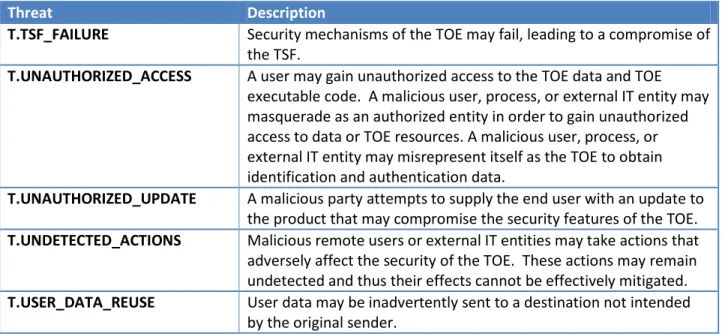
Table 3-1 presents known or presumed threats to protected resources that are addressed by Windows 8, Windows RT, and Windows Server 2012 based on conformance to the IPsec VPN Client PP.
Table 3-1 Threats Addressed by Windows 8, Windows RT, and Windows Server 2012
Threat Description
T.TSF_FAILURE Security mechanisms of the TOE may fail, leading to a compromise of the TSF.
T.UNAUTHORIZED_ACCESS A user may gain unauthorized access to the TOE data and TOE executable code. A malicious user, process, or external IT entity may masquerade as an authorized entity in order to gain unauthorized access to data or TOE resources. A malicious user, process, or external IT entity may misrepresent itself as the TOE to obtain identification and authentication data.
T.UNAUTHORIZED_UPDATE A malicious party attempts to supply the end user with an update to the product that may compromise the security features of the TOE. T.UNDETECTED_ACTIONS Malicious remote users or external IT entities may take actions that adversely affect the security of the TOE. These actions may remain undetected and thus their effects cannot be effectively mitigated. T.USER_DATA_REUSE User data may be inadvertently sent to a destination not intended
by the original sender.
3.2
Organizational Security Policies
An organizational security policy is a set of rules or procedures imposed by an organization upon its operations to protect its sensitive data and IT assets. Table 3-2 describes organizational security policies that are addressed by Windows 8, Windows RT, and Windows Server 2012 which are necessary for conformance to the IPsec VPN Client PP.
Table 3-2 Organizational Security Policies Security Policy Description
P.COMPATIBILITY The TOE must meet Request for Comments (RFC) requirements for implemented protocols to facilitate inter-operability with other network equipment using the same protocols.
P.CONFIGURABILITY The TOE must provide the capability to configure security-relevant aspects of its operation
3.3
Secure Usage Assumptions
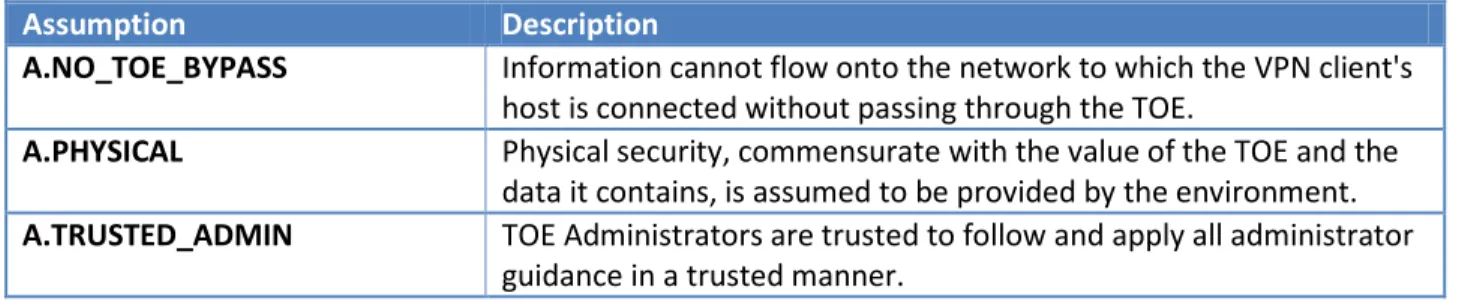
Table 3-3 describes the core security assumptions of the environment in which Windows 8, Windows RT, and Windows Server 2012 is intended to be used. It includes information about the physical, personnel, procedural, and connectivity aspects of the environment.
The following specific conditions are assumed to exist in an environment where the TOE is employed in order to conform to the IPsec VPN Client PP:
Table 3-3 Secure Usage Assumptions
Assumption Description
A.NO_TOE_BYPASS Information cannot flow onto the network to which the VPN client's host is connected without passing through the TOE.
A.PHYSICAL Physical security, commensurate with the value of the TOE and the data it contains, is assumed to be provided by the environment. A.TRUSTED_ADMIN TOE Administrators are trusted to follow and apply all administrator
4
Security Objectives
This section defines the security objectives of Windows 8, Windows RT, and Windows Server 2012 and its supporting environment. Security objectives, categorized as either TOE security objectives or
objectives by the supporting environment, reflect the stated intent to counter identified threats, comply with any organizational security policies identified, or address identified assumptions. All of the
identified threats, organizational policies, and assumptions are addressed under one of the categories below.
4.1
TOE Security Objectives
Table 4-1 describes the security objectives for Windows 8, Windows RT, and Windows Server 2012 which are needed to comply with the IPsec VPN Client PP.
Table 4-1 Security Objectives for the TOE
Security Objective Source
O.AUTH_COMM The TOE will provide a means to ensure users are not communicating with some other entity pretending to be the TOE, and that the TOE is communicating with an authorized IT entity and not some other entity pretending to be an
authorized IT entity.
O.CRYPTOGRAPHIC_FUNCTIONS The TOE shall provide cryptographic functions (i.e., encryption/decryption and digital signature operations) to maintain the confidentiality and allow for detection of
modification of data that are transmitted outside the TOE and its host environment.
O.GW_AUTHENTICATION The TOE will authenticate the VPN Gateway that it attempts to establish a security association with.
O.PROTOCOLS The TOE will ensure that standardized protocols are
implemented in the TOE to RFC and/or industry specifications to ensure interoperability.
O.RESIDUAL_INFORMATION_CLEARING The TOE will ensure that any data contained in a protected resource is not available when the resource is reallocated. O.SYSTEM_MONITORING The TOE will provide the capability to generate audit data. O.TOE_ADMINISTRATION The TOE will provide mechanisms to allow administrators to
be able to configure the TOE.
O.TSF_SELF_TEST The TOE will provide the capability to test some subset of its security functionality to ensure it is operating properly. O.VERIFIABLE_UPDATES The TOE will provide the capability to help ensure that any
updates to the TOE can be verified by the administrator to be unaltered and (optionally) from a trusted source.
4.2
Security Objectives for the Operational Environment
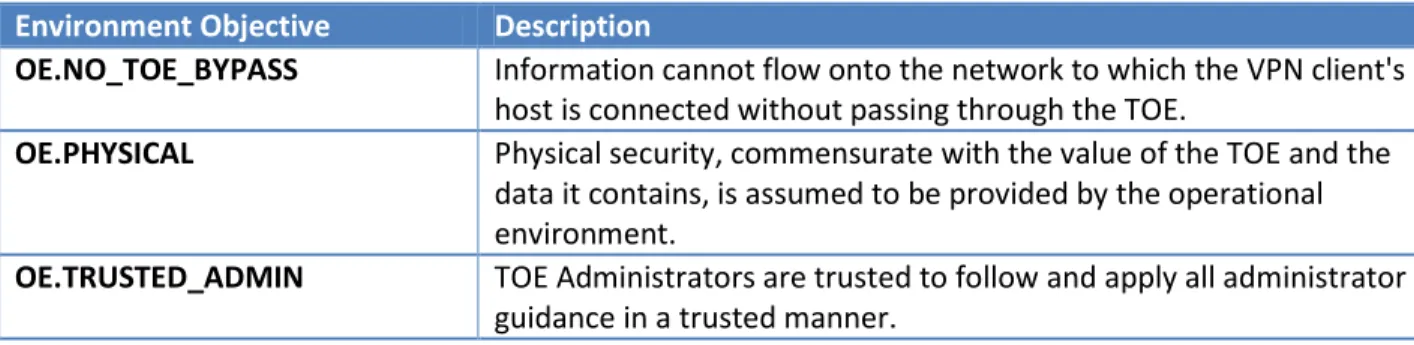
Table 4-2 describes the security objectives for the operational environment as specified in the IPsec VPN Client PP.
Table 4-2 Security Objectives for the Operational Environment Environment Objective Description
OE.NO_TOE_BYPASS Information cannot flow onto the network to which the VPN client's host is connected without passing through the TOE.
OE.PHYSICAL Physical security, commensurate with the value of the TOE and the data it contains, is assumed to be provided by the operational environment.
OE.TRUSTED_ADMIN TOE Administrators are trusted to follow and apply all administrator guidance in a trusted manner.
5
Security Requirements
The section defines the Security Functional Requirements (SFRs) and Security Assurance Requirements (SARs) for the TOE. The requirements in this section have been drawn from the Protection Profile for IPsec Virtual Private Network (VPN) Clients, Version 1.1, December 29, 2011, the Common Criteria, or are defined in the following section.
Conventions:
Where requirements are drawn from the protection profile, the requirements are copied verbatim, except for some changes to required identifiers to match the iteration convention of this document, from that protection profile and only operations performed in this security target are identified. If general requirements are drawn from the Common Criteria, that is, not from the protection profile, the requirements are copied verbatim, except for some changes to required identifiers to match the iteration convention of this document, and the operations performed in this security target are identified. Note that this security target contains only requirements from the protection profile.
The extended requirements, extended component definitions and extended requirement conventions in this security target are drawn from the protection profile; the security target reuses the conventions from the protection profile which include the use of the word “Extended” and the “_EXT” identifier to denote extended functional requirements. The security target assumes that the protection profile correctly defines the extended components and so they are not reproduced in the security target. Requirements defined within this security target do not have identified operations.
Where applicable the following conventions are used to identify operations:
• Iteration: Iterated requirements (components and elements) are identified with letter following the base component identifier. For example, iterations of FMT_MOF.1 are identified in a
manner similar to FCS_COP.1(SIGN) (for the component) and FCS_COP.1(SIGN).1 (for the element).
• Assignment: Assignments are identified in brackets and bold (e.g., [assigned value]). • Selection: Selections are identified in brackets, bold, and italicized (e.g., [selected value]).
o Assignments within selections are identified using the previous conventions, except that
the assigned value would also be italicized and with additional brackets (e.g., [selected value [assigned value]]).
• Refinement: Refinements are identified using bold text (e.g., added text) for additions and strike-through text (e.g., deleted text) for deletions.
5.1
TOE Security Functional Requirements
This section specifies the SFRs for the TOE. In some cases, certain capabilities are not available through the RAS interface. Affected SFRs will have a footnote with a clarification.
Requirement Class Requirement Component
Security Audit (FAU) Audit Data Generation (FAU_GEN.1) Selective Audit (FAU_SEL.1)
Cryptographic Support (FCS)
Cryptographic Key Generation for Asymmetric Keys (FCS_CKM.1(ASYM)) Cryptographic Key Generation for Internet Key Exchange (FCS_CKM.1(IKE)) Cryptographic Key Zeroization (FCS_CKM_EXT.4)
Cryptographic operation for Data Encryption/Decryption (FCS_COP.1(SYM)) Cryptographic operation for Cryptographic Signature (FCS_COP.1(SIGN)) Cryptographic operation for Cryptographic Hashing (FCS_COP.1(HASH)) Cryptographic Operation for Keyed-Hash Message Authentication (FCS_COP.1(HMAC))
Extended: Internet Protocol Security (IPsec) Communications (FCS_IPSEC_EXT)
Extended: Cryptographic operation for Random Bit Generation (FCS_RBG_EXT.1)
User Data Protection (FDP)
Full Residual Information Protection (FDP_RIP.2) Identification &
Authentication (FIA)
Extended: Pre-Shared Key Composition (FIA_PSK_EXT.1) Extended: X.509 Certificates (FIA_X509_EXT.1)
Extended: X.509 Certificate Storage and Management (FIA_X509_EXT.2) Security
Management (FMT)
Specification of Management Functions (FMT_SMF.1) Protection of the TSF
(FPT)
Extended: TSF Testing (FPT_TST_EXT.1) Extended: Trusted Update (FPT_TUD_EXT.1) Trusted
Path/Channels (FTP)
Inter-TSF Trusted Channel (FTP_ITC.1)
5.1.1
Security Audit (FAU)
5.1.1.1 Audit Data Generation (FAU_GEN.1)
FAU_GEN.1.1 The TSF shall be able to generate an audit record of the following auditable events: a) Start-up and shutdown of the audit functions,
b) All auditable events for the not specified level of audit, and c) All administrative actions,
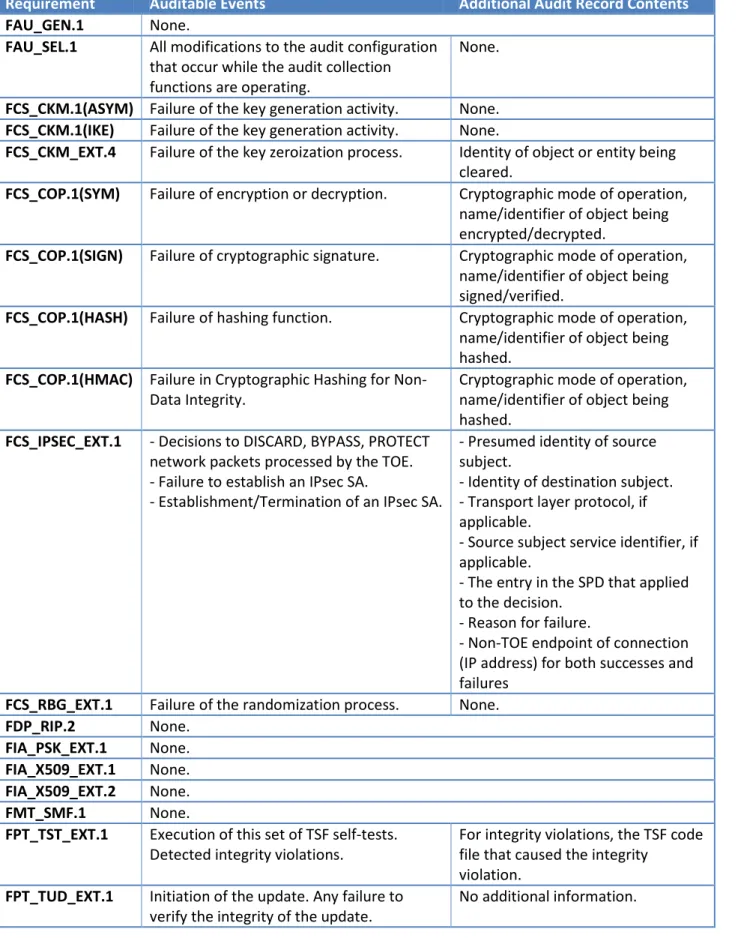
d) Specifically defined auditable events listed in Table 9 Table 5-2.
FAU_GEN.1.2 The TSF shall record within each audit record at least the following information: a) Date and time of the event, type of event, subject identity, and the outcome
(success or failure) of the event; and
b) For each audit event type, based on the auditable event definitions of the functional components included in the PP/ST, information specified in column three of the table below.
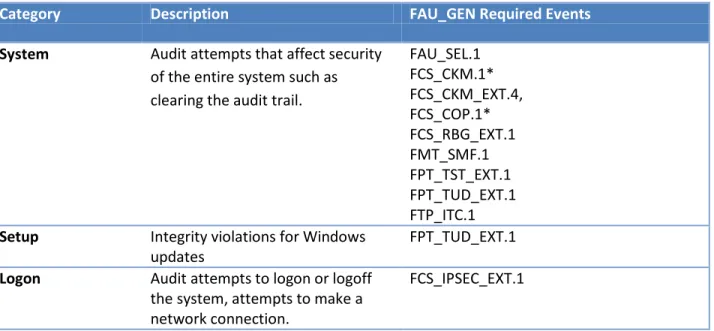
Table 5-2 Auditable Events
Requirement Auditable Events Additional Audit Record Contents FAU_GEN.1 None.
FAU_SEL.1 All modifications to the audit configuration that occur while the audit collection functions are operating.
None.
FCS_CKM.1(ASYM) Failure of the key generation activity. None. FCS_CKM.1(IKE) Failure of the key generation activity. None.
FCS_CKM_EXT.4 Failure of the key zeroization process. Identity of object or entity being cleared.
FCS_COP.1(SYM) Failure of encryption or decryption. Cryptographic mode of operation, name/identifier of object being encrypted/decrypted.
FCS_COP.1(SIGN) Failure of cryptographic signature. Cryptographic mode of operation, name/identifier of object being signed/verified.
FCS_COP.1(HASH) Failure of hashing function. Cryptographic mode of operation, name/identifier of object being hashed.
FCS_COP.1(HMAC) Failure in Cryptographic Hashing for Non- Data Integrity.
Cryptographic mode of operation, name/identifier of object being hashed.
FCS_IPSEC_EXT.1 - Decisions to DISCARD, BYPASS, PROTECT network packets processed by the TOE. - Failure to establish an IPsec SA.
- Establishment/Termination of an IPsec SA.
- Presumed identity of source subject.
- Identity of destination subject. - Transport layer protocol, if applicable.
- Source subject service identifier, if applicable.
- The entry in the SPD that applied to the decision.
- Reason for failure.
- Non-TOE endpoint of connection (IP address) for both successes and failures
FCS_RBG_EXT.1 Failure of the randomization process. None. FDP_RIP.2 None.
FIA_PSK_EXT.1 None. FIA_X509_EXT.1 None. FIA_X509_EXT.2 None. FMT_SMF.1 None.
FPT_TST_EXT.1 Execution of this set of TSF self-tests. Detected integrity violations.
For integrity violations, the TSF code file that caused the integrity
violation. FPT_TUD_EXT.1 Initiation of the update. Any failure to
verify the integrity of the update.
Requirement Auditable Events Additional Audit Record Contents FTP_ITC.1 All attempts to establish a trusted channel.
Detection of modification of channel data
Identification of the non-TOE endpoint of the channel.
5.1.1.2 Selective Audit (FAU_SEL.1)
FAU_SEL.1.1 The TSF shall be able to select the set of events to be audited from the set of all auditable events based on the following attributes:
a) Event type,
b) Success of auditable security events, c) Failure of auditable security events, and d) [None].
5.1.2
Cryptographic Support (FCS)
The functional requirements described in this are only those portions of the cryptographic functions implemented within Windows which are needed to meet the requirements of the IPsec VPN Client protection profile. The intent is to describe only a subset of the product rather than a comprehensive review of Windows.
5.1.2.1 Cryptographic Key Generation for Asymmetric Keys (FCS_CKM.1(ASYM))
Application Note: FCS_CKM.1(ASYM) corresponds to FCS_CKM.1(1) in the IPsec Client protection profile. FCS_CKM.1(ASYM).1 The TSF shall generate asymmetric cryptographic keys used for key
establishment in accordance with
• NIST Special Publication 800-56A, “Recommendation for Pair-Wise Key Establishment Schemes Using Discrete Logarithm Cryptography” for finite field-based key establishment schemes;
• NIST Special Publication 800-56A, “Recommendation for Pair-Wise Key Establishment Schemes Using Discrete Logarithm Cryptography” for elliptic curve-based key establishment schemes and implementing “NIST curves” P- 256, P-384 and [none] 8 (as defined in FIPS PUB 186-3,
“Digital Signature Standard”) 9
• [None]
and specified cryptographic key sizes equivalent to, or greater than, a symmetric key strength of 112 bits.
5.1.2.2 Cryptographic Key Generation for Internet Key Exchange (FCS_CKM.1(IKE))
Application Note: FCS_CKM.1(IKE) corresponds to FCS_CKM.1(2) in the IPsec Client protection profile.
8While Windows implements the P-521 curve, it does not expose an IPsec cryptosuite which leverages it.
FCS_CKM.1(IKE).1 The TSF shall generate asymmetric cryptographic keys used for IKE peer authentication in accordance with a:
[
• FIPS PUB 186-3, “Digital Signature Standard (DSS)”, Appendix B.3 for RSA schemes;
• FIPS PUB 186-3, “Digital Signature Standard (DSS)”, Appendix B.4 for ECDSA schemes and implementing “NIST curves” P-256, P-384 and [none];10
]
and specified cryptographic key sizes equivalent to, or greater than, a symmetric key strength of 112 bits.
5.1.2.3 Cryptographic Key Zeroization (FCS_CKM_EXT.4)
FCS_CKM_EXT.4.1 The TSF shall zeroize all plaintext secret and private cryptographic keys and CSPs when no longer required.
5.1.2.4 Cryptographic Operation for Data Encryption/Decryption (FCS_COP.1(SYM))
Application Note: FCS_COP.1(SYM) corresponds to FCS_COP.1(1) in the IPsec Client protection profile. FCS_COP.1.1(SYM) The TSF shall perform encryption and decryption in accordance with a specified
cryptographic algorithm AES operating in GCM, CBC [none] and cryptographic key sizes 128-bits, 256-bits, and [192 bits] that meets the following:
• FIPS PUB 197, “Advanced Encryption Standard (AES)” • NIST SP 800-38D, NIST SP 800-38A [NIST SP 800-38C].
5.1.2.5 Cryptographic Operation for Cryptographic Signature (FCS_COP.1(SIGN))
Application Note: FCS_COP.1(SIGN) corresponds to FCS_COP.1(2) in the IPsec Client protection profile. FCS_COP.1.1(SIGN) The TSF shall perform cryptographic signature services in accordance with a:
• RSA Digital Signature Algorithm (rDSA) with a key size (modulus) of 2048 bits or greater that meets FIPS PUB 186-2 or FIPS PUB 186-3, “Digital Signature Standard”,
• [Elliptic Curve Digital Signature Algorithm (ECDSA) with a key size of 256 bits or greater] that meets FIPS PUB 186-3, “Digital Signature Standard” with “NIST curves” P-256, P-384 and [none] (as defined in FIPS PUB 186-3, “Digital Signature Standard (DSA) with a key size (modulus) of 2048 bits or greater that meets FIPS PUB 186-3, “Digital Signature Standard”.11
5.1.2.6 Cryptographic Operation for Cryptographic Hashing (FCS_COP.1(HASH))
Application Note: FCS_COP.1(HASH) corresponds to FCS_COP.1(3) in the IPsec Client protection profile.
10 See previous comment about the P-521 curve.
FCS_COP.1.1(HASH) The TSF shall perform [cryptographic hashing services] in accordance with a specified cryptographic algorithm [SHA-1, SHA- 256, SHA-384, SHA-512] and message digest sizes [160, 256, 384, 512] bits that meet the following: FIPS Pub 180-3, “Secure Hash Standard.”
5.1.2.7 Cryptographic Operation for Keyed-Hash Message Authentication (FCS_COP.1(HMAC))
Application Note: FCS_COP.1(HMAC) corresponds to FCS_COP.1(4) in the IPsec Client protection profile. FCS_COP.1.1(HMAC) The TSF shall perform keyed-hash message authentication in accordance with a
specified cryptographic algorithm HMAC- [SHA-1, SHA-256, SHA-384], key size [160, 256, 384], and message digest size of [160, 256, 384] bits that meet the following: FIPS PUB 198-1, “The Keyed-Hash Message Authentication Code”, and FIPS PUB 180-3, “Secure Hash Standard”.
5.1.2.8 Internet Protocol Security (IPsec) Communications (FCS_IPSEC_EXT.1)
FCS_IPSEC_EXT.1.1 The TSF shall implement the IPsec architecture as specified in RFC 4301. FCS_IPSEC_EXT.1.2 The TSF shall implement [transport mode, tunnel mode].
FCS_IPSEC_EXT.1.3 The TSF shall have a nominal, final entry in the SPD that matches anything that is otherwise unmatched, and discards it.
FCS_IPSEC_EXT.1.4 The TSF shall implement the IPsec protocol ESP as defined by RFC 4303 using the cryptographic algorithms AES-GCM-128, AES-GCM-256 as specified in RFC 4106, [AES-CBC-128, AES-CBC-256 (both specified by RFC 3602) together with a Secure Hash Algorithm (SHA)-based HMAC].12
FCS_IPSEC_EXT.1.5 The TSF shall implement the protocol: [IKEv1 as defined in RFCs 2407, 2408, 2409, RFC 4109, [RFC 4304 for extended sequence numbers] and [RFC 4868 for hash functions]; IKEv2 as defined in RFCs 5996 (with mandatory support for NAT traversal as specified in section 2.23), 4307, and [RFC 4868 for hash functions]].
FCS_IPSEC_EXT.1.6 The TSF shall ensure the encrypted payload in the [IKEv1, IKEv2] protocol uses the cryptographic algorithms AES-CBC-128, AES-CBC-256 as specified in RFC 6379 and [no other algorithm].13
FCS_IPSEC_EXT.1.7 The TSF shall ensure that IKEv1 Phase 1 exchanges use only main mode. FCS_IPSEC_EXT.1.8 The TSF shall ensure that [selection: IKEv2 SA lifetimes can be configured by
[an Administrator, VPN Gateway] based on number of packets/number of bytes or length of time, where the time values can be limited to: 24 hours for Phase 1 SAs and 8 hours for Phase 2 SAs, IKEv1 SA lifetimes can be configured by an [an Administrator, VPN Gateway] based on number of packets/number of bytes or length of time, where the time values can be limited to: 24 hours for Phase 1 SAs and 8 hours for Phase 2 SAs].14
FCS_IPSEC_EXT.1.9 The TSF shall generate the secret value x used in the IKE Diffie-Hellman key exchange (“x” in gx mod p) using the random bit generator specified in FCS_RBG_EXT.1, and having a length of at least [256] bits.
12 The RAS VPN interface does not expose the AES-GCM-128, AES-GCM-256 cryptosuites. 13 See comment about AES-GCM and the RAS interface.
FCS_IPSEC_EXT.1.10 The TSF shall generate nonces used in IKE exchanges in a manner such that the probability that a specific nonce value will be repeated during the life a specific IPsec SA is less than 1 in 2^[256]bits.
FCS_IPSEC_EXT.1.11 The TSF shall ensure that all IKE protocols implement DH Groups 14 (2048-bit MODP), 19 (256-bit Random ECP), and [20 (384-bit Random ECP)].15
FCS_IPSEC_EXT.1.12 The TSF shall ensure that all IKE protocols implement peer authentication using a [RSA, ECDSA] that use X.509v3 certificates that conform to RFC 4945 and [Pre-shared Keys].16
FCS_IPSEC_EXT.1.13 The TSF shall be able to ensure by default that the strength of the symmetric algorithm (in terms of the number of bits in the key) negotiated to protect the [IKEv1 Phase 1, IKEv2 IKE_SA] connection is greater than or equal to the strength of the symmetric algorithm (in terms of the number of bits in the key) negotiated to protect the [IKEv1 Phase 2, IKEv2 CHILD_SA] connection.
5.1.2.9 Cryptographic Operation for Random Bit Generation (FCS_RBG_EXT.1)
FCS_RBG_EXT.1.1 The TSF shall perform all random bit generation (RBG) services in accordance with [NIST Special Publication 800-90 using [CTR_DRBG (AES), Dual_EC_DRBG (any)]] seeded by an entropy source that accumulates entropy from [a
combination of hardware-based and software-based noise sources].
FCS_RBG_EXT.1.2 The deterministic RBG shall be seeded with a minimum of [256 bits] of entropy at least equal to the greatest bit length of the keys and authorization factors that it will generate.
5.1.3
User Data Protection (FDP)
5.1.3.1 Full Residual Data Protection (FDP_RIP.2)
FDP_RIP.2.1 The TSF shall enforce that any previous information content of a resource is made unavailable upon the [allocation of the resource to] all objects.
5.1.4
Identification and Authentication (FIA)
5.1.4.1 Pre-Shared Key Composition (FIA_PSK_EXT.1)
FIA_PSK_EXT.1.1 The TSF shall be able to use pre-shared keys for IPsec and [no other protocols]. FIA_PSK_EXT.1.2 The TSF shall be able to accept text-based pre-shared keys that:
• are 22 characters and [up to 100 characters];
• composed of any combination of upper and lower case letters, numbers, and special characters (that include: “!”, “@”, “#”, “$”, “%”, “^”, “&”, “*”, “(“, and “)”).
FIA_PSK_EXT.1.3 The TSF shall [condition the text-based pre-shared keys by using [No conditioning]].
15 The RAS IPsec VPN interface does not offer DH Group 19 as a cryptosuite.
5.1.4.2 X509 Certificates (FIA_X509_EXT.1)
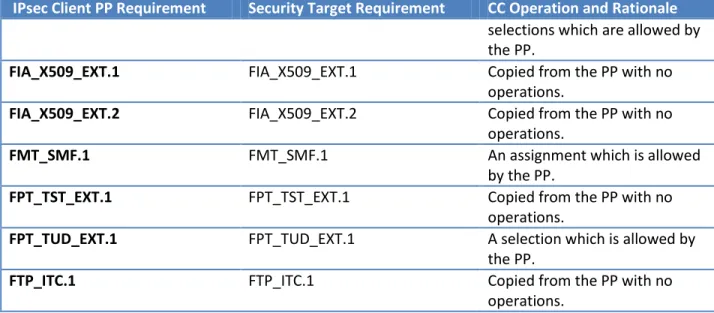
FIA_X509_EXT.1.1 The TSF shall use X.509v3 certificates as defined by RFC 5280 to support authentication for IPsec connections.
FIA_X509_EXT.1.3 The TSF shall provide the capability for Administrators to load X.509v3 certificates into the TOE for use by the security functions specified in this PP. FIA_X509_EXT.1.4 The TSF shall generate a Certificate Request Message as specified in RFC 2986
and be able to provide the following information in the request: public key, Common Name, Organization, Organizational Unit, and Country.
FIA_X509_EXT.1.5 The TSF shall validate the certificate using a Certificate Revocation List (CRL) as specified in RFC 5759].
FIA_X509_EXT.1.6 The TSF shall not establish an SA if a certificate is deemed invalid.
FIA_X509_EXT.1.7 The TSF shall not establish an SA if the distinguished name (DN) contained in a certificate does not match the expected DN for the entity attempting to establish a connection.
FIA_X509_EXT.1.8 When the TSF cannot establish a connection to determine the validity of a certificate, the TSF shall, at the option of the administrator, establish an SA or disallow the establishment of an SA.
5.1.4.3 X.509 Certificate Storage and Management (FIA_X509_EXT.2)
FIA_X509_EXT.1.2 The TSF shall store and protect certificate(s) from unauthorized deletion and modification.
5.1.5
Security Management (FMT)
5.1.5.1 Specification of Management Functions (FMT_SMF.1)
FMT_SMF.1.1 The TSF shall be capable of performing the following management functions: • Specify the security associations that shall be proposed and accepted during
the IKE negotiations,
• Configuration of IKE protocol version(s) used, • Configure IKE authentication techniques used,
• Configure the cryptoperiod for the established session keys. The unit of measure for configuring the cryptoperiod shall be no greater than an hour, • Configure certificate revocation check,
• Specify the algorithm suites that may be proposed and accepted during the IPsec exchanges,
• Specify authentication methods for peer-to-peer connections, if allowed, • Ability to update the TOE, and to verify the updates,
• Ability to configure all security management functions identified in other sections of this PP,
• [None].
Application Note: These management functions can be invoked locally or remotely through Windows Group Policy.
5.1.6
Protection of the TSF (FPT)
5.1.6.1 Extended: TSF Self-Test (FPT_TST_EXT.1)
FPT_TST_EXT.1.1 The TSF shall run a suite of self-tests during initial start-up (on power on) to demonstrate the correct operation of the TSF.
FPT_TST_EXT.1.2 The TSF shall provide the capability to verify the integrity of stored TSF executable code when it is loaded for execution through the use of the TSF-provided
cryptographic services.
5.1.6.2 Extended: Trusted Update (FPT_TUD_EXT.1)
FPT_TUD_EXT.1.1 The TSF shall provide authorized administrators the ability to query the current version of the TOE firmware/software.
FPT_TUD_EXT.1.2 The TSF shall provide authorized administrators the ability to initiate updates to TOE firmware/software.
FPT_TUD_EXT.1.3 The TSF shall provide a means to verify firmware/software updates to the TOE using a digital signature mechanism and [published hash] prior to installing those updates.
5.1.7
Trusted Path/Channels (FTP)
5.1.7.1 Inter-TSF Trusted Channel (FTP_ITC.1)
FTP_ITC.1.1 The TSF shall use IPsec to provide a trusted communication channel between itself and a VPN Gateway that is logically distinct from other communication channels and provides assured identification of its end points and protection of the channel data from disclosure and detection of modification of the channel data.
FTP_ITC.1.2 The TSF shall permit the TSF to initiate communication via the trusted channel. FTP_ITC.1.3 The TSF shall initiate communication via the trusted channel for all traffic
traversing that connection.
5.2
TOE Security Assurance Requirements
The security assurance requirements for the TOE are the requirements defined in the IPsec Client VPN Protection Profile which in turn is based on assurance requirements that are specified in Part 3 of the Common Criteria. No operations are applied to the assurance components.
In addition, the assurance activities from the IPsec Client VPN PP are used to determine that Windows satisfies the IPsec VPN Client security functional requirements. These IPsec VPN Client assurance activities are described in the protection profile and not copied into the security target.
5.2.1
CC Part 3 Assurance Requirements
The following table is the collection of CC Part 3 assurance requirements from the IPsec VPN Client Protection Profile.
Table 5-3 TOE Security Assurance Requirements Requirement Class Requirement Component
Development (ADV) Basic Functional Specification (ADV_FSP.1) Guidance Documents (AGD) Operational User Guidance (AGD_OPE.1)
Preparative Procedures (AGD_PRE.1)
Testing (ATE) Independent Testing – Conformance (ATE_IND.1) Vulnerability Assessment (AVA) Vulnerability Analysis (AVA_VAN.1)
Life-cycle Support (ALC) Labeling of the TOE (ALC_CMC.1) TOE CM Coverage (ALC_CMS.1)
The following sections copy the assurance activities for each family of CC Part 3 assurance requirements.
5.2.1.1 Development
There are no specific assurance activities associated with these SARs. The functional specification documentation is provided to support the evaluation activities described in Section 4.1, and other activities described for AGD, ATE, and AVA SARs. The requirements on the content of the functional specification information is implicitly assessed by virtue of the other assurance activities being performed; if the evaluator is unable to perform an activity because the there is insufficient interface information, then an adequate functional specification has not been provided.
5.2.1.2 Guidance Documents
5.2.1.2.1 Operational User Guidance
During operation, the activities to be described in the guidance fall into two broad categories; those that are performed by a (non-administrative) user, and those that are performed by an administrator. It should be noted that most procedures needed for non-administrative users are referenced in the assurance activities in Section 4.1.
With respect to the administrative functions, while several have also been described in Section 4.1, additional information is required as follows.
The operational guidance shall at a minimum list the processes running (or that could run) on the TOE in its evaluated configuration during its operation that are capable of processing data received on the network interfaces (there are likely more than one of these, and this is not limited to the process that "listens" on the network interface). It is acceptable to list all processes running (or that could run) on the TOE in its evaluated configuration instead of attempting to determine just those that process the network data. For each process listed, the administrative guidance will contain a short (e.g., one- or two-line) description of the process' function, and the privilege with which the service runs. "Privilege" includes the hardware privilege level (e.g., ring 0, ring 1), any software privileges specifically associated with the process, and the privileges associated with the user role the process runs as or under.
The operational guidance shall contain instructions for configuring the cryptographic engine associated with the evaluated configuration of the TOE. It shall provide a warning to the administrator that use of other cryptographic engines was not evaluated nor tested during the CC evaluation of the TOE.
The documentation must describe the process for verifying updates to the TOE, either by checking the hash or by verifying a digital signature. The evaluator shall verify that this process includes the following steps:
• For hashes, a description of where the hash for a given update can be obtained. For digital signatures, instructions for obtaining the certificate that will be used by the FCS_COP.1(2) mechanism to ensure that a signed update has been received from the certificate owner. This may be supplied with the product initially, or may be obtained by some other means.
• Instructions for obtaining the update itself. This should include instructions for making the update accessible to the TOE (e.g., placement in a specific directory).
• Instructions for initiating the update process, as well as discerning whether the process was successful or unsuccessful. This includes generation of the hash/digital signature.
5.2.1.2.2 Preparative Procedures
As indicated in the introduction above, there are significant expectations with respect to the
documentation—especially when configuring the operational environment to support TOE functional requirements. The evaluator shall check to ensure that the guidance provided for the TOE adequately addresses all platforms and components (that is, combination of hardware and operating system) claimed for the TOE in the ST.
The evaluator shall check to ensure that the following guidance is provided:
• As indicated in the introductory material, administration of the TOE is performed by one or more administrators that are a subset of the group of all users of the TOE. While it must be the case that the overall system (TOE plus Operational Environment) provide this capability, the responsibility for the implementation of the functionality can vary from totally the Operational Environment’s responsibility to totally the TOE’s responsibility. At a high level, the guidance must contain the appropriate instructions so that the Operational Environment is configured so that it provides the portion of the capability for which it is responsible. If the TOE provides no mechanism to allow separation of administrative users from the population of users, then the instructions, for instance, would cover the OS configuration of the OS I&A mechanisms to provide a unique (OS-based) identity for users, and further guidance would instruct the installer on the configuration of the DAC mechanisms of the OS using the TOE administrative identity (or identities) so that only TOE administrators would have access to the administrative executables. If the TOE provides some or all of this functionality, then the appropriate requirements are included in the ST from Appendix C, and the assurance activities associated with those requirements provide details on the guidance necessary for both the TOE and Operational Environment.
The evaluators shall also perform the following tests:
• Test 1 [Conditional]: If the separation of administrative users from all TOE users is performed exclusively through the configuration of the Operational Environment, the evaluators will, for each configuration claimed in the ST, ensure that after configuring the system according to the