Issues in Energy Optimization of Reinforcement Learning Based
Routing Algorithm Applied to Ad-hoc Networks
Shrirang Ambaji Kulkarni
Department of Computer Science and Engineering
Gogte Institute of Technology, Belgaum – 590006, Karnataka, India E-mail:[email protected]
G. Raghavendra Rao
Department of Computer Science and Engineering
National Institute of Engineering, Mysore - 590008, Karnataka, India E-mail: [email protected]
Keywords: ad-hoc networks, routing protocols, reinforcement learning, energy optimization and scalability
Received: January 5, 2012
Ad-hoc networks represent a class of networks which are highly unpredictable. The critical work of such networks is performed by the underlying routing protocols. Decision in such an unpredictable environment and with a greater degree of successes can be best modelled by a reinforcement learning algorithm. In this paper we consider SAMPLE, a collaborative reinforcement learning based routing algorithm, which performs competitively with other routing protocols of similar category. A major concern of SAMPLE is its energy consumption, as most of the wireless nodes are driven by finite battery power. Energy conservation has a direct bearing on the network survivability and also affects the underlying quality of services. Energy conservation is not just the problem of the network layer, but it must be considered at the data link layer. Thus we consider a cross-layer energy conservation algorithm SPAN which models a solution by aiding the routing protocol at the network layer with a backbone of stable energy nodes and conserves the energy of remaining nodes by extracting the best features of IEEE 802.11 power saving mode. Most of the network survivability issues should consider scalable scenarios and our work extends our applied energy optimization framework to scalable scenarios. A scalable scenario can be best visualized if we can gain insight into the performances of underlying mobility models. Thus we extend our work to the analysis of the underlying mobility model and its impact on energy conservation in the traffic-mobility dimensions. We also verify the simulation results statistically using hypothesis testing to prove the superiority of our energy conservation attempts for SAMPLE.
Povzetek: Opisana je optimizacija potrošnje s spodbujevalnim učenjem v omrežjih.
1
Introduction
Ad-hoc networks represent a special class of dynamic networks. An ad-hoc network is characterized by dynamic topology, congestion, energy and security constraints [1]. A basic requirement of an ad-hoc network is that nodes act as both hosts and routers. A major work of such networks which represent a complex optimization problem is performed by the underlying routing protocols. Reinforcement learning algorithms hold a lot of promise where solutions to problems in unpredictable scenarios need to be considered [2], [3]. Thus we consider SAMPLE [4] a collaborative reinforcement learning (CRL) routing algorithm which models the dynamics of ad-hoc networks as a distributed optimization problem and strives to solve it, in an optimal manner. Energy consumption modelling was not measured in SAMPLE and in [5] AODV performed better than SAMPLE by 34%. Thus we propose to
integrating it with SPAN and comparing its performance with AODV, a benchmark routing protocol, in the traffic-mobility dimensions and under moderately scalable conditions.
In Section 2 we discuss some of the related work. Section 3 proposes our optimization framework for energy conservation of SAMPLE routing algorithm. In Section 4 we discuss about the Steady State Random Waypoint Mobility Model with its performances under varying density of nodes. Section 5 brings out the simulation results of energy conservation of SPAN with SAMPLE in comparison with a benchmark ad-hoc routing protocol AODV under the traffic-mobility dimensions and scalable conditions along with statistical analysis of results. Section 6 concludes the paper.
2
Related Work
Dowling et.al [4] introduced and evaluated collaborative reinforcement learning (CRL) as a self-organizing technique for mobile ad-hoc network routing protocol called SAMPLE. They considered the Random Waypoint Mobility Model and did not model nor optimize energy conservation as a part of their work. P Nurmi [14] applied reinforcement learning algorithms for ad-hoc network problem where routing decisions of nodes where modelled on selfishness and on the energy level of nodes. Chen and Chang [15] in their work on impact of mobility models on energy conservation showed significant energy conservation differences on various mobility models. They concluded that reactive protocols perform well when nodes move in groups, in terms of energy conservation. They did not evaluate the performance of mobility models in terms of their mobility metrics and did not correlate this to energy conservation. S.A. Kulkarni and G R Rao [25] in their work on energy
efficiency of routing protocols observed that DSR was energy efficient as compared to AODV.
They enhanced the energy efficiency of AODV by deploying SPAN, which acted as a middleware between the data link and the network layer. V Naumov and T Gross [16] analysed the scalability of routing methods for ad-hoc networks and investigated the performance of two routing protocols namely AODV and DSR. They considered only Random Waypoint Mobility Model. They did not take energy conservation of routing protocols in their study. Xu et.al. [17] proposed GAF an energy conservation scheme similar to SPAN. GAF had differences as compared to SPAN; firstly it required nodes to know their geographic positions and second was SPAN’s superiority in terms of its integration with IEEE 802.11 PSM. In PAMAS the power-saving medium access protocol [18], [19], a node turns off its radio when it is overhearing a packet not addressed to it. This approach justified the idea when it is costly to process a received packet as compared to mere listening.
3
Energy Optimization Framework
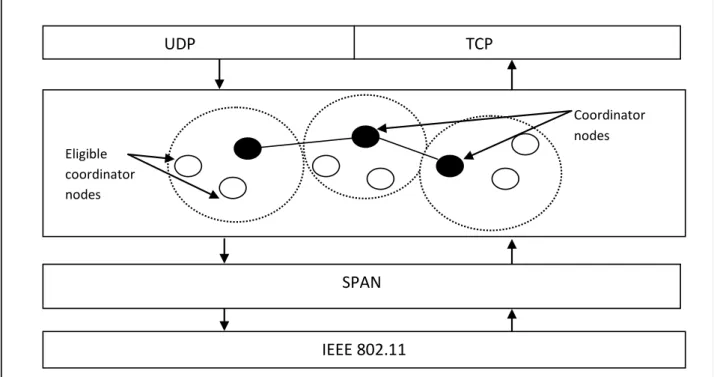
In order to optimize energy conservation in the complex dynamics of ad-hoc networks, and support the functioning of the collaborative reinforcement learning algorithm SAMPLE [4], the following architecture illustrated in Figure 1 is proposed.SAMPLE routing protocol works in an on-demand fashion based on collaborative reinforcement learning (CRL). Routing information is represented as a V-value and is floated in the network by attaching it to the data packets. Each agent maintains routing tables that stores the cost to the neighbours and their last advertised V-value. The path selection is based on the Boltzmann-action selection and optimal paths are selected. Now the
Figure 1: Energy Optimization Frame work for SAMPLE.
UDP TCP
SAMPLE
SPAN
IEEE 802.11
Coordinator nodes Eligible
active nodes performing critical routing actions are eligible to act as coordinators to form energy-stable backbone nodes as chosen by the SPAN algorithm. SPAN adaptively elects “coordinators” from the given active nodes in the ad-hoc network. The chief role of the coordinators is to stay awake and perform multi-hop routing functions, while other nodes are engaged in power saving mode. The task of the coordinator is rotated among all the nodes and SPAN strives to minimize the number of coordinators at any given point of time, one per group of nodes within a radio range. In order to prevent a situation where several nodes contest simultaneously to be elected as a coordinator, a node delays its candidature as specified in Equation 1.
(( ⁄ ) ( ( )
⁄ )) *
where is the number of neighbours of node i; is the number of additional pairs of nodes that would be connected if “i” becomes coordinator. and are the amounts of remaining and maximum energies of the node.T is the round-trip delay of a packet and R is a uniform value from the interval (0, 1).
Only if a node satisfies Equation1, does it announce itself as a coordinator by broadcasting a “Hello” packet. SPAN in order to save energy consumption, relies heavily on IEEE 802.11 power saving mode. The basic idea behind PSM is to power down or make the radio device sleep, when it has no data to transmit or receive. Energy conservation study [6] did not consider scalability issues. In our work we evaluate our optimization framework under scalable routing scenarios. One of the important scenarios to gain information about energy conservation under scalable operations is to gain insights in the underlying mobility model and explore its optimization features via its performance analysis metrics. This study substantiates the fact that network lifetime is defined by the time to a partition in the network [9].
4
Steady State Random Waypoint
Mobility Model
The Random Waypoint Mobility despite being simple and easy to simulate is not very realistic. The model also suffers from non steady-state distribution at the start of a simulation and then ultimately converges to a steady-state distribution known in probability terms as “stationary distribution”. The network performance may be affected between start-up time and after steady state has been reached as described in [26]. Thus we consider a Steady State Random Waypoint Mobility Model.
Consider a mobile node [27] that lives in a connected set A. The trip end times are
Let be the duration of the th trip. At trip transition time , the node selects the path
[ ] of the th trip. The mobile position at time is given by Equation 2.
( )
The node position at the trip begin-point is and the trip end-point . Denote
⁄ the fraction of the elapsed time on the nth trip. Thus, we can write where Also assume that the trip selection rule is Markov modulated. The trip selection rule depends on all past only through the current mobile location and the state of a Markov chain . Further, depends on all past only through the last state . More precisely, (the phase) is defined on some enumerable set ; the sequence of phases take values on state space . Trip selection rule then states that at transition instant , the path and the trip duration , given the phase and mobile position
are drawn independently of " and any other past. In simple cases, the phase corresponds to being in a pause or move state. Further, the perfect sampling algorithm implemented [10] does not require knowledge of generic constants such as average distance between two random points on a graph which may result in difficulty in computation.
Thus, in the case of Steady State Random Waypoint Model at a trip transition instant, a node picks a trip destination randomly and uniformly on a rectangular area and samples the numeric speed from a uniform distribution. After reaching the trip destination, the node pauses for some duration drawn from a uniform distribution. This process repeats for every trip selection rule.
4.1
Performance Evaluation of Steady
State Random Waypoint Mobility
Model
The present study evaluated the performance of Steady State Random Waypoint model as specified [11],[12] to gain an insight into scalability issues and consider the performance of Steady State Random Waypoint Model. The study proves that the performance of mobility models has a direct bearing on the performance of routing protocols and this in turn affects the energy conservation capabilities. Around 20 mobile nodes for a low density mode (LD) and around 100 nodes for a medium density mode (MD) are taken into account. This is moderately scalable in a region of 1200 x 1200 m and with speed varying from 5,10,15,20 and 25 m/sec.
4.2
Mobility Performance Analysis Metric
The mobility analysis metrics from [11] were considered for the analysis of mobility models.∑ ∑ ∑
(3) where P is no of tuples (i, j, t1) and LD (i, j, t1) ≠ 0
Average Relative Speed:- Relative speed is given by Equation 4.
RST (i, j, t) = |Vi(t) – Vj(t) | (4) where Vi(t) and Vj(t) is the velocity vector of node i and j at time t. The average value of RST(i, j, t) is given by Equation 5.
∑ ∑ ∑
(5) where P is no of tuples (i, j, t1) and (i, j, t1) ≠ 0
Average degree of spatial dependence: - It specifies the amount of similarity of velocities of given two nodes, given by Ds(i, j, t) and averaged over pair of nodes and time instants and specified by the Equation 6.
∑ ∑ ∑
(6) where P is no of tuples (i, j, t1) and (i, j, t1) ≠ 0
4.3
Mobility Performance Analysis Results
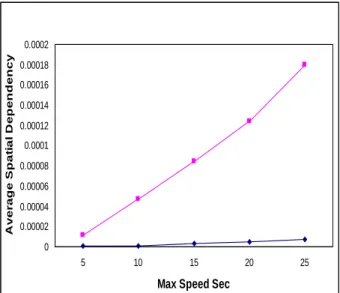
The Steady State Random Waypoint Mobility Model is analysed for low density (RW-LD) of mobile node and for medium density of mobile nodes (RW-MD) and the results is illustrated in Figure 2, Figure 3 and Figure 4.Figure 2: Average link duration of Steady State Random Waypoint Model.
In Figure 2 it is seen that the average link duration, which indicates the stability of the links, is higher for Steady State Random Waypoint Model with low density of nodes (RW-LD) and performs poorly for Steady State Random Waypoint Mobility Model with medium density
of nodes (RW-MD). RW-LD in terms of link stability outperforms RW-MD on an average by 76.95 %.
Figure 3: Average Relative Speed of Steady State Random Waypoint Mobility Model.
In Figure 3 it can be observed that the average relative speed is high for RW-MD as compare to RW-LD and this in turn affects the link durations. Thus the high speed dynamics of RW-MD has an effect on the stability of links.
Figure 4: Average Spatial Dependency of Steady State Random Waypoint Mobility Model.
Figure 4 shows that the average spatial dependency of RW-MD is high as compared to RW-LD and RW-MD outscore RW-LD by 96%. As mobile ad-hoc networks exhibit cohesive properties, this is directly supported by high spatial dependency. Also a high spatial dependency minimizes network partitions and routing overhead sometimes as nodes are nearby. This in turns has a positive effect on energy conservation, provided the link duration is also correspondingly high.
0 50 100 150 200 250 300
5 10 15 20 25
Max Speed Sec
A
v
e
r
a
g
e
L
in
k
D
u
r
a
ti
o
n
0 0.1 0.2 0.3 0.4 0.5 0.6 0.7 0.8
5 10 15 20 25
Max Speed Sec
A
v
e
ra
g
e
R
e
la
ti
v
e
S
p
e
e
d
0 0.00002 0.00004 0.00006 0.00008 0.0001 0.00012 0.00014 0.00016 0.00018 0.0002
5 10 15 20 25
Max Speed Sec
A
v
e
r
a
g
e
S
p
a
ti
a
l
D
e
p
e
n
d
e
n
c
5
Simulation Environment and
Experimental Results
NS-2 simulator ver. 2.28 from [13] was used for the study of energy optimization of routing protocols like AODV and SAMPLE. The underlying MAC Protocol is defined by IEEE 802.11. Continuous bit rate (CBR) traffic sources along with TCP based traffic sources are used. The mobility model used was the Steady State Random Waypoint Mobility Model [20]. The field configurations are 1200 x 1200 m. The traffic generator script called cbrgen.tcl was used to generate CBR/TCP scenario of 8 sources at the rate of 4.0 kbps. The number of nodes in the simulation environment was 20 nodes for low density and 100 nodes for medium density. At least 5 scenarios files for Steady State Random Waypoint Model at different maximum speed of 5, 10, 15, 20, 25 sec were used for testing protocols like AODV and SAMPLE.
5.1
Energy Parameter Configuration
The energy model for energy consumption is based on the parameters given in Table 1.Tx Rx Idle Sleeping
1400mW 1000mW 830mW 130mW
Table 1: Energy Consumption Parameters.
The initial energy supplied to all wireless nodes were 1000 Joules.
5.2
Energy Conservation Metric
Average Energy Conservation (AEC) – This metric specifies the average of residual energy of the nodes in an ad-hoc network at the finish of the simulation period.
∑ ⁄
where is the remaining energy and N is the number of nodes in the given ad-hoc network
5.3
Simulation Results
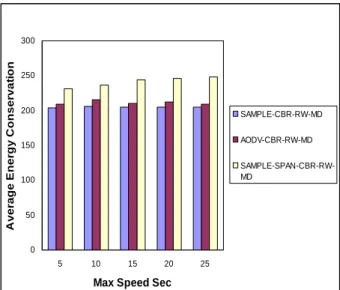
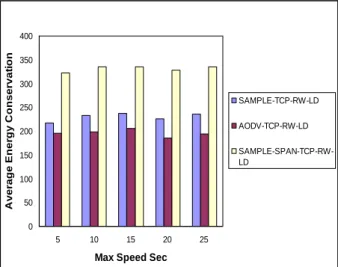
The results of the energy optimization framework which consists of SAMPLE integrated with SPAN on 802.11 and compared with SAMPLE and AODV on 802.11 are illustrated in Figure 5, Figure 6, Figure 7 and Figure 8.
In Figure 5 it is observed that the average energy conservation is the least for the adaptive reinforcement learning based routing algorithm SAMPLE. AODV with low density of nodes and on CBR based traffic outscores SAMPLE by 7% on an average. Thus to improve the energy conservation issues we apply an energy aware extension SPAN to aid modified SAMPLE. In Figure 5 it is clearly observed that SAMPLE-SPAN outperforms AODV and SAMPLE by 25 % and 30% respectively. The high link duration of RW-LD aids in link stability and possibly lesser routing overhead, which in turns aids energy conservation.
Figure 5: Average energy conservation of SAMPLE, AODV and SAMPLE-SPAN with CBR based traffic and on low-density of nodes
.
Figure 6: Average energy conservation of SAMPLE, AODV and SAMPLE-SPAN with CBR based traffic and on medium-density of nodes.
In Figure 6 it is seen that SAMPLE once again performs least in terms of energy conservation and is inferior as compared to AODV by 3% on an average. AODV and SAMPLE performance in terms of energy conservation is more or less the same because of improved spatial dependency exhibited by RW-MD, which reduces network partitions in moderately scalable setting and this in turn complements energy conservation. SAMPLE-SPAN outperforms AODV and SAMPLE on an average by 15% and 13% respectively.
0 50 100 150 200 250 300 350
5 10 15 20 25
Max Speed Sec
A
v
e
r
a
g
e
E
n
e
r
g
y
C
o
n
s
e
r
v
a
ti
o
n
SAMPLE-CBR-RW-LD
AODV-CBR-RW-LD
SAMPLE-SPAN-CBR-RW-LD
0 50 100 150 200 250 300
5 10 15 20 25
Max Speed Sec
A
v
e
ra
g
e
E
n
e
rg
y
C
o
n
s
e
rv
a
ti
o
n
Figure 7: Average energy conservation of SAMPLE, AODV and SAMPLE-SPAN with TCP based traffic and on low-density of nodes.
In Figure 7 for TCP based traffic and low density of nodes, which have stable link properties, SAMPLE with its inherent capability to extract stable links and model them continuously outperforms AODV by 15%. SAMPE-SPAN further conserves energy and outperforms AODV and SAMPLE by 41% and 31% respectively
Figure 8: Average energy conservation of SAMPLE, AODV and SAMPLE-SPAN with TCP based traffic and on medium-density of nodes.
In Figure 8 under moderately scalable condition and with relatively higher degree of spatial dependency, it is observed that SAMPLE on TCP based traffic outperforms AODV by 6% and SAMPLE-SPAN outperforms AODV and SAMPLE by 22% and 17% respectively.
To prove the statistical significance of our results we conducted Hypothesis Testing on the simulation results. The assumptions are as follows. The null hypothesis H0
states that the values for both the data set are similar i.e. H0 : μ1 = μ2 . The alternative hypothesis Ha states that
the values for both the data set are not similar i.e. Ha : μ1
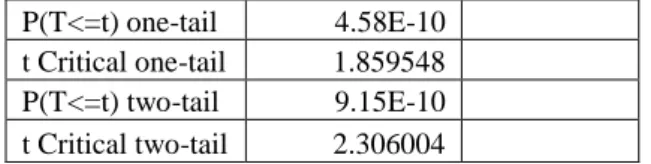
≠ μ2 , whereby we would like to prove that there is sufficient energy conservation achieved by SAMPLE with SPAN extensions. The Hypothesis t-Test [24] results using Analysis Toolpak[23] are illustrated in Table 2, Table 3, Table 4 and Table 5.
Variable 1 Variable 2
Mean 233.0138 311.2544
Variance 19.00113 7.840572
Observations 5 5
Pooled Variance 13.42085 Hypothesized
Mean Difference
0
Df 8
t Stat -33.7685
P(T<=t) one-tail 3.23E-10 t Critical one-tail 1.859548 P(T<=t) two-tail 6.46E-10
t Critical two-tail 2.306004
Table 2: Hypothesis t-Test: Two-Sample Assuming Equal Variances for comparison of average energy conservation of AODV and SAMPLE-SPAN for low density and CBR Traffic.
Variable 1 Variable 2
Mean 211.1304
241.650 1
Variance 7.115177
50.2387 5
Observations 5 5
Pooled Variance 28.67696 Hypothesized
Mean Difference 0
df 8
t Stat -9.01123
P(T<=t) one-tail 9.18E-06 t Critical one-tail 1.859548 P(T<=t) two-tail 1.84E-05 t Critical two-tail 2.306004
Table 3 Hypothesis t-Test: Two-Sample Assuming Equal Variances for comparison of average energy conservation of AODV and SAMPLE-SPAN for Medium density and CBR Traffic.
Variable 1 Variable 2
Mean 196.1009
331.38 28
Variance 53.8941
33.708 04
Observations 5 5
Pooled Variance 43.80107 Hypothesized
Mean Difference 0
df 8
t Stat -32.3197
0 50 100 150 200 250 300 350 400
5 10 15 20 25
Max Speed Sec
A
v
e
ra
g
e
E
n
e
rg
y
C
o
n
s
e
rv
a
ti
o
n
SAMPLE-TCP-RW-LD AODV-TCP-RW-LD SAMPLE-SPAN-TCP-RW-LD
0 50 100 150 200 250 300
5 10 15 20 25
Max Speed Sec
A
v
e
ra
g
e
E
n
e
rg
y
C
o
n
s
e
rv
a
ti
o
n
SAMPLE-TCP-RW-MD
AODV-TCP-RW-MD
P(T<=t) one-tail 4.58E-10 t Critical one-tail 1.859548 P(T<=t) two-tail 9.15E-10 t Critical two-tail 2.306004
Table 4: Hypothesis t-Test: Two-Sample Assuming Equal Variances for comparison of average energy conservation of AODV and SAMPLE-SPAN for Low density and TCP Traffic.
Variable 1 Variable 2
Mean 199.9108 254.5423
Variance 17.32532 45.22516
Observations 5 5
Pooled Variance 31.27524 Hypothesized
Mean Difference 0
df 8
t Stat -15.4459
P(T<=t) one-tail 1.53E-07 t Critical one-tail 1.859548 P(T<=t) two-tail 3.07E-07 t Critical two-tail 2.306004
Table 5 Hypothesis t-Test: Two-Sample Assuming Equal Variances for comparison of average energy conservation of AODV and SAMPLE-SPAN for Medium density and TCP Traffic.
The test data was collected by varying mobility speed for 5, 10, 15, 20 and 25 m/sec. For each test the significance level was 0.05%. Our tests rejected the null hypothesis and this proved our simulation results with 95% confidence interval, for average energy conservation were significant for SAMPLE with SPAN extensions, as compared to average energy conservation for AODV routing protocol.
6
Conclusions
In this paper our study augmented and modified a reinforcement learning routing algorithm SAMPLE’s energy conservation capabilities by integrating it with SPAN a cross layer energy saving extension in the proposed energy conservation optimization framework. We also analysed the experimental mobility model, the Steady State Random Waypoint Mobility Model for performance analysis under low and medium density of nodes to gain insight into energy conservation and scalability issues. From our experimental studies we observed that SAMPLE-SPAN outperformed AODV and SAMPLE on both low density and high density and for both CBR and TCP based traffic. Thus energy optimization should not be the property of only the network layer and it should be visualized at the data link layer also. We also verified our results statistically. In future we would like to apply the energy optimization frame work to an optimized mobility model to gain insights into superior mobility complementing energy conservation issues.
References
[1] S Corson and J Marker, Mobile Ad Hoc Networking (MANET): Routing Protocol Performance Issues and Evaluation Considerations, RFC 2501, pp. 3-9, January 1999
[2] AEthem, Introduction to Machine Learning, Prentice Hall of India, pp. 370-375, 2006.
[3] S.A. Kulkarni, Dr. G.R Rao, “Modeling Reinforcement Learning Algorithms for Performance Analysis”, International Conference on Advances in Computing, Communication and Control - ICAC’03, January 23-24th, 2009.
[4] J Dowling, E Curran, R Cunningham, and V Cahill, Using Feedback in Collaborative Reinforcement Learning to Adaptively Optimize MANET Routing, IEEE Transactions on Systems Man and Cybernetics. Part A: Systems and Humans, Vol. 35, No.3, 2005
[5] S.A Kulkarni and Dr. G.R Rao, “Optimization of Reinforcement Learning Based Routing Algorithm Applied to Dynamic Network”, In Proceedings of ICCVR-2010, August 19th to21st, 2010.
[6] B Chen, K Jamieson, H Balakrishnan and R Morris, “Span: An Energy-Efficient Coordination Algorithm for Topology Maintenance in Ad Hoc Wireless Networks”, ACM/IEEE International Conference on Mobile Computing and Networking (Mobi Comm. 2001), Rome, Italy, July 16-21, 2001. [7] Wireless LAN Medium Access Control and Physical Layer Specifications, IEEE 802.11 Standard (IEEE Computer Society LAN MAN standards Committee), August 1999.
[8] S P Chaudri, J-Y L Boudec, M Vojnovic. Perfect Simulations for Random Trip Mobility Models.
Proceedings of the 38th Annual Symposium on Simulations, pp. 72-79, 2005
[9] R Kravets, C Sengul, “Energy Conservation”, In Ad-Hoc Networks Technologies and Protocols (Eds.) P Mohapatra and S Krishnamurthy, Springer, pp. 153-155, 2005.
[10] J-Y L Boudec and M Vojnovi´c, “Perfect simulation and stationarity of a class of mobility models,” in Proceedings of IEEE Infocom, 2005. [11] F Bai, N Sadagopan and A Helmy, “The
IMPORTANT framework for analyzing the Impact of Mobility on Performance of RouTing protocols for AdhocNeTworks”, Elsevier Ad Hoc Networks, 1, pp. 383-403, 2003.
[12] S.A. Kulkarni, G R Rao, “Mobility and Traffic Model Analysis for Vehicular Ad-hoc Networks”, In Advances in Vehicular Ad Hoc Networks: Developments and Challenges, Ed. Mohamed Watfa, IGI Global, pp. 214-232, 2010.
[13] The Network Simulator – NS-2, http://www.isi.edu/nsam/ns/
[15] B Chen and C Hwa Chang, Mobility Impact on Energy Conservation of Ad Hoc Routing Protocols,
SSGR 2003, Italy, July 28-August 2, 2003.
[16] V Naumov, T Gross, “Scalability of routing methods in ad hoc networks”, In Performance Evaluation Journal (Elsevier Science), Volume 62, pp. 193-207, 2005.
[17] Y Xu, J Heidemann and D Estrin, “Geography-informed Energy Conservation for Ad Hoc Routing.
In proceedings of the Seventh Annual ACM/IEEE International Conference on Mobile Computing and Networking (MobiCom), Rome, Italy, July 2001. [18] C Raghavendra and S Singh, “PAMAS: Power
Aware Multi-Access Protocol with Signaling for Ad Hoc Networks”, ACM Computer Communication Review, pp. 5- 26, July, 1998. [19] S Singh, M Woo and C S Raghavendra,
“Power-Aware Routing in Mobile Ad Hoc Networks”, In Proceedings of the Fifth Annual ACM/IEEE International Conference on Mobile Computing and Networking (MobiCom), Dallas, 1998.
[20] S P Chaudhuri, ns-2 Code for Random Trip Mobility Model, http://monarch. s.rice.edu/~santa /research/mobility/
[21] C Perkins, E Royer and S Das, “Ad Hoc on demand distance vector (AODV) routing”, http://www.ietf.org/internet-drafts/draft-ietf-manet-aodv-03.txt
[22] C Perkins and E Royer, “Ad hoc on-demand Distance Vector Routing”, In Proceedings of the 2nd IEEE Workshop on Mobile Computing Systems and Applications, pp. 90-100, Feb 1999
[23] Analysis Toolpak, http://office.microsoft.com /en-us/excel-help/about-statistical-analysis-tools-HP00 5203873.aspx
[24] K N Krishnaswamy, A I Shivakumar and M Mathirajan “Management Research Methodology – Integration of Principles, Methods and Techniques”, Pearson Education, pp. 352-355, 2006.
[25] S A Kulkarni, G R Rao, “A Performance Analysis of Energy Efficient Routing in Mobile Ad Hoc Network”, International Journal of Simulations – Systems, Science and Technology – IJSSST: Vol. 10, No.1-A. . pp. 1- 9, February – 2010.
[26] J Yoon, M Liu and B Noble, “Random Waypoint Considered Harmful”, in Proceedings IEEE INFOCOM 2003, San Francisco, C A, April 2003. [27] S P Chaudhri, J-Y L Boudec, M Vojnovic, “Perfect