ORIGINAL RESEARCH ARTICLE
Determinants of Modern Contraceptive Uptake among Nigerian
Women: Evidence from the National Demographic and Health
Survey
Ofonime E. Johnson
Department of Community Health, University of Uyo Teaching Hospital/University of Uyo, Akwa Ibom State, Nigeria
*For Correspondence: E-mail: [email protected]; Phone: +2348161518358
Abstract
Family planning is a key strategy in the control of fertility among women. This study sought to determine various factors that influence modern family planning use in Nigeria. The study used data from Nigeria Demographic and Health Survey (NDHS) 2013. Analysis was carried out using Stata version 12.1. Multivariate logistic regression was used to determine association between various factors and use of modern family planning methods. A total of 119,386 women aged 15-49 years participated in the study. The mean age of respondents was 35.9 ± 8.1 years. Overall, contraceptive prevalence rate of modern methods was 10.3%. The highest proportion of use was 26.7% in the South West, while the lowest was 2.7% in the North West. Predictors of modern family planning use were higher education (OR=4.49, 95% CI: 4.10-4.92), richest wealth quintile (OR=3.71 CI: 3.29-4.19), being from South West (OR=3.42, 95% CI: 3.15-3.70), age 25-49 years (OR=1.55, 95% CI: 1.42-1.69) and urban residence (OR=1.08, 95% CI: 1.03-1.13) (p<0.001). The highest predictors of modern contraceptive use were education and wealth index. These indices were poorest in North Western Nigeria. Measures should be taken to improve female literacy and employment as these will most likely improve uptake of modern contraceptives among women in Nigeria. (Afr J Reprod Health 2017; 21[3]: 89-95).
Keywords: Modern contraceptive use, determinants, NDHS, Nigeria
Résumé
La planification familiale est une stratégie clé dans le contrôle de la fécondité chez les femmes. Cette étude a cherché à déterminer les différents facteurs qui influencent l'utilisation de la planification familiale moderne au Nigeria. L'étude a utilisé des données de l'Enquête sur la démographie et la santé au Nigeria (EDSN) de 2013. L'analyse a été effectuée à l'aide de la version Stata 12.1. La régression logistique multivariée a été utilisée pour déterminer l'association entre les divers facteurs et l'utilisation des méthodes modernes de la planification familiale. Au total, 119 386 femmes âgées de 15 à 49 ans ont participé à l'étude. L'âge moyen des répondants était de 35,9 ± 8,1 ans. En général, le taux de prévalence contraceptive des méthodes modernes était de 10,3%. La proportion la plus élevée d'utilisation était de 26,7% dans le sud-ouest, tandis que la plus faible était de 2,7% dans le nord-ouest. Les indices de l'utilisation moderne de la planification familiale étaient une éducation supérieure (OR = 4,49, IC à 95%: 4,10-4,92), le quintile de plus grande richesse (OR = 3,71 IC: 3,29 à 4,19), étant du sud-ouest (OR = 3,42, IC 95% 3,15-3,70), âgés de 25 à 49 ans (OR = 1,55,95% IC: 1,42-1,69) et résidence urbaine (OR = 1,08,95% CI: 1,03-1,13) (p <0,001). Les indices les plus élevés de la contraception moderne étaient l'indice de l'éducation et de la richesse. Ces indices étaient les plus pauvres du nord-ouest du Nigeria. Des mesures devraient être prises pour améliorer l'alphabétisation et l'emploi des femmes, car celles-ci amélioreront probablement l'adoption des contraceptifs modernes chez les femmes au Nigeria. (Afr J Reprod Health 2017; 21[3]: 89-95).
Mots-clés: Utilisation anticonceptionnelle moderne, déterminants, NDHS, Nigeria
Introduction
Family planning refers to a conscious effort by a couple to limit or space the number of children they have through the use of contraceptive methods. Fertility rate remains high in Nigeria
also averting 32% of all maternal deaths and about 10% of child mortality3. Modern family planning methods are more effective and associated with lower failure rates compared to the traditional methods. They include female sterilisation, male sterilisation, the pill, the intrauterine device (IUD), injectables, implants, male condoms, female condoms, the diaphragm, foam/jelly, the lactational amenorrhoea method (LAM), and emergency contraception1. Traditional methods include the rhythm (periodic abstinence) and withdrawal methods. Other methods include folk methods such as strings and herbs1. The use of modern family planning methods facilitates both spacing and limiting of pregnancies in women of reproductive age4.Low utilization has been documented to lead to high maternal mortality ratio5. Poor uptake of contraception in sub-Saharan Africa is due to the existence of a variety of factors6.
One of the factors identified to affect uptake of modern contraceptives among women of child bearing age is their educational level7, 8, 9. A study reported that women with primary, secondary and post-secondary levels of education were 8-10%, 14-17% and 16-20% more likely to use family planning methods respectively than those with no education9.
In addition, an individual‘s financial capacity often affects the utilization of modern contraceptives10. Several studies have recorded higher contraceptive use among women with the richest wealth quintile compared to the poorest6, 9,
11-13
. The use of modern contraceptives has been reported to be higher among the highly empowered and the upper class women compared to the poorly empowered and lower class women14. Strategies to improve contraceptive uptake should therefore focus more on the latter group of women.
In Nigeria, the husband/ partner‘s support affects women‘s contraceptive use15, 16, and 17
. This is because Nigeria is a patriarchal society18. Studies have shown that women who discussed contraceptive use with partners were more likely to use family planning than those who did not16, 19. Also, those whose husbands are literate were more likely to use family planning than those with illiterate husbands20.
Several studies have reported higher uptake of modern contraceptives in the urban and southern parts of Nigeria compared to uptake by women in the rural and northern parts of Nigeria11,
21
. Several socio demographic factors which may be prevalent in those locations could possibly explain the differences and not the locations themselves.
The high fertility rate reported in Nigeria, coupled with the poor uptake of contraception over the years makes it important to seek possible explanations to the observed pattern. This study therefore sought to assess various factors, both individually and collectively in order to possibly determine their influences on modern family planning use in Nigeria.
Methods
The focus for this study was on the subset of data on family planning, with particular focus Table 1: Educational Level and Place of Residence Should be shifted up to align with the Figures on the Corresponding Rows
on modern family planning methods. Possible correlates of use of modern family planning were considered. Such factors included educational level of respondents and their spouses, wealth index, place of residence, age and region of the country. Analysis was carried out using Stata version 12.1. Bivariate analysis and Multivariate logistic regression were used to determine relationship between various factors and use of modern family planning methods. Level of significance was set at 0.05.
Approval was sought and obtained from the data originator who had in turn obtained informed consent from the study participants.
Results
A total of 119,386 women aged 15-49 years participated in the study. The mean age of respondents was 35.9 ±8.1 years. Overall, the
contraceptive prevalence rate for modern method of family planning was 10.3%. The use of modern contraceptive was higher among those aged 25-49 years, 11,723 (10.7%) compared to those aged 15-24 years, 609 (6.4%). Modern contraceptive use increased with educational level among the respondents from 2.4% among those with no education to 26.5% among those with higher education (p<0.001). A higher proportion of those residing in urban regions, (17%) used modern contraceptives compared to rural (7.1%) regions. The lowest rate of use was 2.7% in the North West region of Nigeria, while the highest was 26.7% in the South West region.
Modern contraceptive use progressively increased with the respondents‘ wealth index, being least among the poorest women (1.6%) and highest among the richest (26.0%). (Table 1) A total of 92.9% of the respondents were currently married or living with partner.
Socio demographic characteristics
Current use of FP Total (%) N=119,386 p-value No method N=101,030 N (%) Folkloric N=888 N (%) Traditional N=5,136 N (%) Modern N=12,332 N (%) Age (years) 15-24 24-49 8633(90.6) 92,397 (84.1) 59 (0.6) 829 (0.7) 230 (2.4) 4,906 (4.5) 609 (6.4) 11,723 (10.7) 9,531(100) 109,855 (100) 0.00* Educational level No education Primary Secondary Higher 58,626 (96.4) 22,157 (79.3) 16,542 (67.8) 3,705 (59.0) 278 (0.5) 368 (1.3) 211 (0.9) 31 (0.5) 430 (0.7) 1,360 (4.9) 2,470 (10.1) 876 (14.0) 1,444 (2.4) 4,060 (14.5) 5,165 (21.2) 1,663,(26.5) 60,778 (100) 27,945 (100) 24,388 (100) 6,275) (100) 0.00*
Place of residence
The use of modern family planning among respondents also increased with spouses‘
Table 2: Current use of FP among Respondents by Educational Level of Spouses
Highest Educational level
Current use of FP Total (%) No method
N (%)
Folkloric N (%)
Traditional N (%)
Modern N (%)
No education 48,556 (96.6) 194 (0.4) 299 (0.6 ) 1,216 (2.4) 50,265 (100)
Primary 19,769 (79.8) 262 (1.1) 1,597 (6.4) 3,138 (12.7) 24,766 (100)
Secondary 20,877(74.5) 308 (1.1) 2,123 (7.6) 4,719(16.8) 28,027 (100)
Higher 10,195 (71.2) 96 (0.7) 1,053 (7.4) 2,956 (20.7) 14,300 (100)
Total 99,397 (84.7) 860 (0.7) 5,072 (4.3) 12,029 (10.3) 117,358 (100)
p<0.001
Table 3: Respondents‘ Educational Level by Region of the Country
Region Highest educational level Total (%) No education
N (%)
Primary N (%)
Secondary N (%)
Higher N (%)
North Central 6,275 (38.9) 4,972 (30.8) 3,534 (21.9) 1,362 (8.4) 16,143 (100)
North East 17,233 (71.3) 3,991 (16.5) 2,219 (9.2) 737 (3.1) 24,180 (100)
North West 32,015 (82.6) 4,011(10.4) 2,278(5.9) 453 (1.2) 38,757 (100)
South East 1,551 (13.8) 4,340 (38.7) 4,352 (38.8) 976 (8.7) 11,219 (100)
South South 1,624 (10.9) 6,382 (43.0) 5,761 (38.8) 1090 (7.3) 14,857 (100)
South West 2,080 (14.6) 4,249 (29.9) 6,244 (43.9) 1,657 (11.6) 14,230 (100)
Total 60,778 (50.9) 27,945 (23.4) 24,388 (20.4) 6,275 (5.3) 119,386 (100)
P-value<0.001
Table 4: All Percentages on the Row for North East Have Been Adjusted to 1 Decimal Place As Follows:
Region Wealth Index Total (%) Poorest
N (%)
Poorer N (%)
Middle N (%)
Richer N (%)
Richest N (%)
North Central 1,420 (8.8) 3,384 (21.0) 5,365 (33.2) 3,397 (21.0) 2,577(16.0) 16,143 (100)
North East 9,777 (40.4) 7,260 (30.4) 3,690 (15.3) 2,185 (9.0) 1,268 (5.2) 24,180 (100)
North West 16,156 (41.7) 11,779 (30.4) 5,469 (14.1) 3,602 (9.3) 1,751 (4.5) 38,757 (100)
South East 780 (7.0) 1,968 (17.5) 3,288 (29.3) 3,122 (27.8) 2,061 (18.4) 11,219 (100)
South South 111 (0.8) 1,739 (11.7) 4,520 (30.4) 5,174 (34.8) 3,313 (22.3) 14,857 (100)
South West 356 (2.5) 1,212 (8.5) 2,262 (15.9) 4,678 (32.9) 5,722 (40.2) 14,230 (100)
Total 28,600 (24.0) 27,342 (22.9) 24,594 (20.6) 22,158 (18.5) 16,692 (14.0) 119,386 (100)
p<0.001
educational level from 2.4% among those whose spouses had no education to 20.7% among those whose spouses had higher education (p<0.001). (Table 2)
Only 7.0% of the respondents from the North West had at least secondary education compared to 55.5% from the South West region (p<0.001) (Table 3).
The regions with the lowest proportion of those in the richest wealth quintile were North West (4.52%) and North East (5.2%), while those with the highest proportions were the South West (40.2%) and South South (34.8%) respectively. (Table 4)
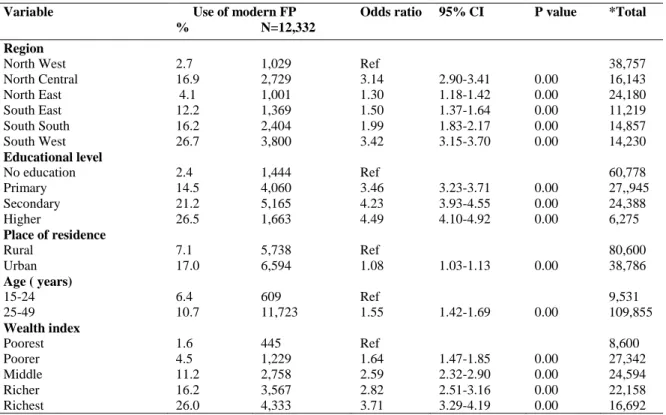
Predictors of modern family planning use were higher education (OR=4.49, 95% CI: 4.10-4.92), richest wealth quintile (OR=3.71 CI: 3.29-4.19), South West region (OR=3.42, 95% CI: 3.15-3.70), being 25-49 years (OR=1.55, 95% CI: 1.42-1.69), and urban residence (OR=1.08, 95% CI: 1.03-1.13). All factors were statistically significant (p<0.001). (Table 5)
Discussion
Respondents were drawn from the six regions in Nigeria with a mean age of 35.9 ± 8.1 years.
Overall, prevalence rate of modern contraceptive
Table 5: Multivariate Logistic Regression of Correlates of use Of Modern FP among Respondents
Variable Use of modern FP Odds ratio 95% CI P value *Total % N=12,332
Region North West North Central North East South East South South South West 2.7 16.9 4.1 12.2 16.2 26.7 1,029 2,729 1,001 1,369 2,404 3,800 Ref 3.14 1.30 1.50 1.99 3.42 2.90-3.41 1.18-1.42 1.37-1.64 1.83-2.17 3.15-3.70 0.00 0.00 0.00 0.00 0.00 38,757 16,143 24,180 11,219 14,857 14,230 Educational level No education Primary Secondary Higher 2.4 14.5 21.2 26.5 1,444 4,060 5,165 1,663 Ref 3.46 4.23 4.49 3.23-3.71 3.93-4.55 4.10-4.92 0.00 0.00 0.00 60,778 27,,945 24,388 6,275
Place of residence
Rural Urban 7.1 17.0 5,738 6,594 Ref
1.08 1.03-1.13 0.00
80,600 38,786
Age ( years)
15-24 25-49 6.4 10.7 609 11,723 Ref
1.55 1.42-1.69 0.00
9,531 109,855 Wealth index Poorest Poorer Middle Richer Richest 1.6 4.5 11.2 16.2 26.0 445 1,229 2,758 3,567 4,333 Ref 1.64 2.59 2.82 3.71 1.47-1.85 2.32-2.90 2.51-3.16 3.29-4.19 0.00 0.00 0.00 0.00 8,600 27,342 24,594 22,158 16,692
Row % add to 100%
use was 10.3%. This was higher than 9.4% in a similar study which analyzed data from NDHS 200823, but far lower than 65% reported in a study in Ethiopia20. About a tenth of women aged 25-49 years used modern contraceptives compared to 6.4% use among the younger age group. Women aged 25-49 years were one and a half times more likely to use modern contraceptives than the younger age group. Similar findings were reported in other studies in India and Jos, Nigeria respectively24, 25. A possible reason could be that the former group possibly had women who had either completed child bearing or wanted to space their children compared to the latter group with women who may not have commenced child bearing. Another reason could be that youths were unlikely to access family planning services due to societal beliefs that they are not supposed to have premarital sex26.
Concerning place of residence, studies done in Ethiopia and Sokoto, Nigeria respectively have shown that women who live in urban regions
are more likely to use modern contraceptives than their rural counterparts4, 21. In the present study, though bivariate analysis showed that close to one fifth of respondents in the urban region used modern contraceptives compared to less than a tenth in the rural, multivariate analysis reduced the disparity as the odds of using modern contraceptive was only marginally higher among the women of urban residence when compared with rural residents. This suggests that other factors which promote contraceptive use and are more prevalent in the urban region exist. These include education and wealth quintile.
were 4 times more likely to have knowledge of modern contraceptive than those with no formal education21. This increased knowledge would probably influence the rate of usage positively. Another study in Nigeria recorded that women with employment and tertiary education were more likely to use contraception compared to the unemployed and the uneducated respectively.22 This suggests that female education most likely has a positive effect on use of modern contraceptives. The use of modern family planning among respondents was also observed to progressively increase with spouses‘ educational level. Similar findings were reported in other studies in Ethiopia19, 20. This suggests that increased investment into educating both sexes would possibly have a positive impact on uptake of contraceptives. Some rural communities in the South West and South South regions of Nigeria where up to two thirds and more than half of the women respectively had post primary education recorded a contraceptive prevalence rates of 63.3% and 42.3% respectively27,28 compared to 5% in the rural community in the North West17. This clearly suggests that it is not living in the rural region per se that leads to low contraceptive prevalence rate but the associated factors. Improving the educational levels of the women in the rural areas has a likelihood of leading to a corresponding increase in contraceptive use among them.
The odds of using modern contraceptives were also observed to progressively increase with wealth quintile, being 3.7 times higher among the richest compared to the poorest. Similar studies in Malawi and Ghana respectively have found a strong association between wealth quintile and modern contraceptive use11, 29. A study in Malawi reported a significant difference in prevalence of modern contraceptive use of 82.4% among women of richest wealth quintile compared to 66.8% among the poorest. Women in the richest wealth quintile were more likely to ever use modern contraceptive (OR=2.36; CI=2.07-2.69, p<0.001) than the poorest11. This suggests that financial constraint probably plays a role in reduced contraceptive usage among poor women. Ensuring availability of modern contraceptive at minimal or no cost could therefore improve usage. Wealth creation for women is also likely to increase their
ability to procure and use modern contraceptives. Wealth in turn can also influence a person‘s status and educational level30. The Malawian study reported that none of the respondents in the poorest wealth quintile had higher education11.
In the present study both education and wealth index were lowest in the North West with less than one tenth of the respondents from that region having at least secondary education compared to over half from the South West. Also, less than 5% from the North West belonged to the richest wealth quintile compared to over 40% from the South West. People that are educated are more likely to be wealthier than the uneducated. Such people would be empowered to sort out their affairs themselves without needing financial support from other sources. Based on these differences in education level and wealth index, it is not surprising that those living in the South West were 3.4 times more likely to use modern contraceptives compared to those in the North West. This is not as a result of their locations but due to more favorable socio demographic indices (educational level and wealth index) among women in the Southern region.
Conclusion
The use of modern contraceptive was very low in this study. The highest predictors of its use were educational level and wealth index. These indices were poorest in North Western Nigeria. Measures should be taken to improve female literacy and employment as these will most likely lead to improved uptake of modern contraceptives among women.
References
1. National Population Commission (NPC) [Nigeria] and ICF International. 2014. Nigeria Demographic and Health Survey 2013. Abuja, Nigeria, and Rockville, Maryland, USA: NPC and ICF International. 2. Stover J and Ross J. How increased contraceptive use
has reduced maternal mortality. Matern Child Health J. 2010; 14 (5):687-95.
3. Okech TC, Wawire NW and Mburu TK. Contraceptive use among women of reproductive age in Kenya‘s city slums. Int J Bus Soc Sci. 2011; 2: 22-43. 4. Bogale B, Wondafrash M, Tilahun T and Girma E.
southern Ethiopia. Biomed Central Public Health. 2011; 11:342.
5. Oye-Adeniran BA, Adewole IF, Odeyemi KA, Ekanem EE and Umoh AV. Contraceptive prevalence among young women in Nigeria. Journal of Obstetrics and Gynaecology. 2005;25:182-185.
6. Creanga AA, Gillspie D, Karklins S and Tsui AO. Low use of contraception among poor women in Africa: an equity issue. Bull World Health Organ. 2011; 89:258-266.
7. Envuladu EA, Agbo HA, Mohammed A, Chia L, Kigbu JH and Zoakah AI. Utilization of modern contraceptives among female traders in Jos South LGA of Plateau State, Nigeria. Int J Med Biomed Res. 2012; 1:224-231.
8. Chola M and Michelo C. Proximate determinants of fertility in Zambia: Analysis of the 2007 Zambia Demographic and Health Survey. Int J Popul Res.2016; 2016:1-7.
9. Bbaale E and Mpuga P. Female education, contraceptive use and fertility: evidence from Uganda. Consilience J Sustain Develop. 2011; 6(1):20-47. 10. Do M and Kurimoto N. Women‘s empowerment and
choice of contraceptive methods in selected African countries. Int Perspect Sex Reprod H. 2012; 38 (1):23-33.
11. Adebowale SA, Adedini SA, Ibisomi LD and Palamuleni ME. Differential effect of wealth quintile on modern contraceptive use and fertility: evidence from Malawian women. BMC Women‘s Health. 2014; 14:40.
12. Hosseinpoor AR, Victora CG, Bergen N, Barros AJD and Boerma JT. Towards universal health coverage: The role of within-country wealth-related inequality in 28 countries in sub-Saharan Africa. Bull World Health Org. 2011; 89:881-890.
13. Gwatkin D , Rutstein S , Johnson K , Suliman E, Wagstaff A and Amouzou A . Socioeconomic Differences in Health, Nutrition and Population, 2nd ed. Washington: World Bank. 2005.
14. Adebowale AS, Gbadebo B and Afolabi FR. Wealth index, empowerment and modern contraceptive use among married women in Nigeria: are they interrelated? J Public Health. 2016;24:415.
15. Odusina E, Ugai D and Olaposi O. Socio-economic status, contraceptive knowledge and use among rural women in Ikeji Arakeji, Osun State, Nigeria. Afro Asian J Soc Sci. 2012;3:1-10.
16. Eliason S, Awoonor-Williams JK, Eliason C, Novignon J, Nonvignon J and Aikins M. Determinants of modern family planning use among women of reproductive age in Nkwanta district of Ghana: a case-control study. Reprod Health. 2014; 11(1):65. 17. Mubita-Ngoma C and Kadantu MC. Knowledge and use
of modern family planning methods by rural women in Zambia. Curationis. 2010;33(1):17-21.
18. Ene-Obong HN, Enugu GI and Uwaegbute AC.
Determinants of Health and Nutritional Status of Rural Nigerian Women. J Health PopulNutr. 2001;19 :320-330.
19. Mekonnen W and Worka A. Determinants of low family planning use and high unmet need in Butajira district, South Central Ethiopia. Reprod Health. 2011;8:37. doi:10.1186/1742-4755-8-37.
20. Tafa M, Haidar J and Fekadu H. Modern family planning use and its relationship with the nutritional status of women of child bearing age at Tena district, Arsi zone Oromia regional state, Ethiopia 2013: A community based case control study. Gynaecol Obstet(Sunnyvale). 2015;5:282.
21. Tunau K, Awosan KJ , Adamu H, Mohammad U, Hassan M, Nasir S, Raji MO, Oche MO, Nwobodo EI and Baba TM. Comparative assessment of modern contraceptives‘ knowledge and utilization among women in urban and rural communities of Sokoto State, Nigeria. J Med Med Sci. 2016;7 (1):6-14
22. National Population Commission of Nigeria, 2006. 23. Igbodekwe FC, Oladimeji O, Oladimeji KO, Adeoye IA,
Akpa OM and Lawson L. Utilization of modern contraceptive among women of child bearing age in resource constraint setting: Evidence from 2008 National Demographic and Health Survey in Nigeria. Journal of Health Science. 2014; 4(3):72-78.
24. Sharma V, Mohan U, Das V and Awasthi S. Socio demographic determinants and knowledge, attitude, practice: Survey of family planning. J Fam Med Primary Care. 2012; 1:43-47.
25. Chingles M, Banwat M , Lar L and Zoakah A.
Contraceptive Uptake among Women of Reproductive Age in a Semi Urban Area in Jos South Local Government Area of Plateau State, North Central Nigeria. The Nigerian health Journal. 2013;13(2):69-74
26. Tolman D. Female adolescent sexuality: an argument for a developmental perspective on the new view of women's sexual problems. Women & Therapy. 2002; 42 (1–2): 195–209.
27. Olugbenga-Bello AI, Abodunrin OL and Adeomi AA. Contraceptive practices among women in rural communities in south western Nigeria. Global J Med Res. 2011;11(2):1-9.
28. Johnson OE and Ekong IE. Knowledge, Attitude and Practice of Family Planning among Women in a Rural Community in Southern Nigeria. Br J Med Med Res. 2016;12(2):1-8
29. Nketiah-Amponsah E, Arthur E and Abuosi A. Correlates of contraceptive use among Ghanaian women of reproductive age (15-49 years). Afr J Reprod Health. 2012;16 (3):154.