Legacy System Integration
using a Grammar-Based
Transformation System
Guido Menkhaus
1and Urs Frei
21Software Research Lab, Department of Computer Science, University of Salzburg, Austria 2Institute MIT/IT, University of Applied Science St. Gallen, Switzerland
Enterprise information system management is the ope-ration of different corporate databases, applications, and more and more often of integration and interoperability of legacy systems, acquired through mergers and ac-quisitions. These legacy systems produce structured or semi-structured data that add to the vast amounts of data a company generates every day. This data needs to be communicated between heterogeneous systems within the same company and eventually beyond the company’s walls. Transformations of communicated data are re-quired to enable companies to tightly integrate their systems into a cohesive infrastructure without changing their applications and systems. This article presents a transformation system that uses a grammar-based ap-proach to provide direct integration of applications and systems at the data level. Sequences of transformations allow flexible and effective exchange of data between heterogeneous systems resulting in a single information network.
Keywords: legacy system, transformation, enterprise in-formation system.
1. Introduction
Most established companies have acquired le-gacy systems through mergers and acquisitions. The systems were developed independently of each other and very often they do not align with the evolving IT infrastructure. Still, they drive day-to-day business processes. Replacing the legacy applications with new solutions might not be feasible or practical, or it might cost a considerable amount of time. However, imme-diate integration might be a requirement for a strategic project, such as supply chain manage-ment or e-business 7, 5].
This article presents a legacy system data in-tegration middleware that allows flexible and effective transformation of data between hetero-geneous systems. Our data integration middle-ware provides a transformation system in which transformation sequences are described based on the grammar of the format of the source and the target data. It provides direct integration of applications and systems at the data level. The remainder of the article is structured as fol-lows: motivation and requirements of this work are discussed in Section 2. Section 3 provides a brief overview of related work and Section 4 presents transformation systems. Section 5 il-lustrates a use-case scenario for legacy data in-tegration. The architecture of the system is pre-sented and discussed in Section 6. Section 7 concludes the article with a brief talk about our future research directions and work.
2. Motivation and Requirements
protocols and produce data in proprietary for-mat. We need to transform the data, control that data and ensure that the transformation from one format to another is carried out correctly. Transforming data is usually done by writing custom programs 6]. However, if either the
format of the source data or the target data changes, if new requirements emerge, the cus-tom programs need to be rewritten. Adapting to frequent changes results in high maintenance costs. To integrate legacy system data we need transformation systems that provide the follow-ing features:
1. Adaptation: The way data is processed and stored is diverse and might be subject to changes. If the format of the source data or the target data in a transformation sequence changes, quick adaptation to the transforma-tion sequence is essential to sustain system interconnection.
2. Control: When data is transformed while communicated between two systems, the tar-get system might require the data to change, to be enriched, filtered, and modified. 3. Format Guarantee: The transformation
se-quence guarantees that the data results in a specified format. A specified structure of the target data is produced, because the transfor-mation is generated based on the grammar describing this structure.
We present a grammar-based transformation system, in which the transformation sequence is generated originating from a set of grammars describing the target data structure of each trans-formation step. Semantic controls need to be programmed manually. The system provides means to integrate them into the transforma-tion sequence. Adaptatransforma-tion is accomplished by respecifying the grammars describing the data structures.
3. Related Work
This section provides a brief overview of the related work. It also aims at giving a short view on legacy system modernization and integration techniques.
Software system evolution activities can be di-vided into three categories: maintenance, mo-dernization, and replacement 18]. System
main-tenance supports the evolution of the system ac-cording to the business needs, but has its limi-tations, since maintenance does not include ma-jor structural changes. Modernization involves extensive and pervasive changes, requiring a significantly greater effort than during main-tenance activities. Replacement is necessary if the system cannot keep up with business re-quirements 4]. Legacy systems are therefore
characterized as “information systems that sig-nificantly resist modernization as part of an evo-lution towards delivering business soevo-lutions”
18, 2].
The most proven solution to legacy integration and modernization is legacy system wrapping 20]. It can be subdivided into wrapping
pre-sentation modules, functionality and data. Carr presents a technique for user interface modernization, where new user interfaces wrap old, text-based interfaces 3].
Wrapping functionality for utilization of legacy system in a distributed environment to cope with new requirements that the Internet has intro-duced, is provided by Yoshioka et al. They use CORBA and DCOM technology to wrap the functionality and to provide network-centric communication. However, the legacy system needs to provide the appropriate level of ab-straction, be modular and fine-grained enough to allow wrapping the business rules and func-tions 1]. The ERCOLE project provides a
pro-cess that describes how to wrap legacy applica-tions with OO systems. The process involves encapsulation, reengineering and concepts for the coexistence of objects with legacy applica-tion funcapplica-tionality 19].
Wrapping legacy data involves the addition of an extra layer or bridge to provide transparent access to the legacy system. Ontology Works provides an ontology and bridges to map data from legacy information systems onto the on-tology 12]. DataMirror 5] provides an
en-gine for bi-directional data transformation, ex-change and integration. The engine incorpo-rates built-in functionality and promises that zero-programming is required for application integration.
build grammar-based systems that allow trans-formation of data and flexible adaptation of changing data structures.
4. Short Overview of Transformation Systems
Transformation systems transform elements of a source language into elements of a target lan-guage. The source and the target languages can be very different from one another 19]. Partsch
and Steinbruggen divide transformations into two types of processes 13]: procedural and
schematic. Procedural transformations specify semantic rules that can be applied globally to the entire source data. They have applicability terms which contain semantic conditions that are not easily decidable by inspecting the syn-tax. Procedural transformations include con-sistency checks and analysis tasks. Schematic transformations are syntax-oriented; their ap-plicability conditions can be verified by check-ing a portion of the syntax. They make local changes to the source data. It should be noted that global, procedural transformations can be accomplished by schematic processes, but also that the required transformation might become arbitrary complex. Therefore, complex rules are better expressed applying procedural than schematic transformations 19].
Partsch and Steinbruggen classify transforma-tion systems into manual, semi-automatic, and automatic transformations 13]
Manual: In manual transformation systems, the user chooses from a predefined set of transformations those, which he wants to ap-ply to the source language. Manual transfor-mation systems provide an environment that puts the user in the position to use trans-formations more effectively than the current programming paradigm which requires from a programmer to manually code a transfor-mation.
Semi-automatic: The objective of semi-automatic transformation systems is to auto-mate the process of transforming and to mi-nimize the intervention of the user, although the major decisions will still be made by the user.
Automatic: The intent of automatic trans-formation system is to fully automate the transformation process.
The class of problems that can be solved using manual transformation systems is the largest, since most transformation solutions require in-sight in the problem domain and decision taking that is beyond what automation techniques can do. Semi-automatic systems need a restricted problem domain where difficult decisions about transformation configuration do not occur and transformations can be generated automatically. Most limitations are in the automatic transfor-mation system class in which the system selects the transformation sequence on the basis of a knowledge base. However, the system can only be as good as the programmer has designed the knowledge base.
In this paper, we present a transformation sys-tem that is semi-automatic. The automatic part of the system is schematic-based and syntax-oriented. The procedural part of the transfor-mation consists of semantic analysis and actions applied to the entire source data which need to be programmed manually, since this part re-quires insight into the problem domain.
5. Application Scenario
The transformation system was designed as mid-dleware for the integration of legacy systems. This section outlines a practice area, which demonstrates the value of our transformation system.
Supply chain management helps companies in controlling the flow of information and goods within their network of suppliers and customers by providing a full view on what happens in the network 7, 15]. But before extending
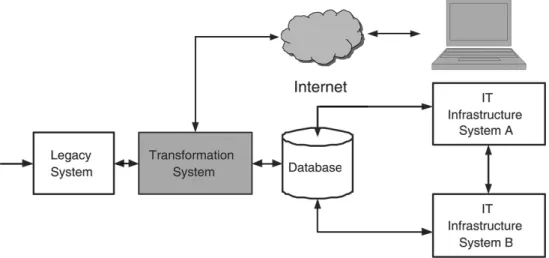
opera-tion management beyond the company’s walls and integrate companies’ suppliers and cus-tomers into a single information network, the company’s own operations must run smoothly towards cooperation and collaboration. This involves the integration and interoperability of different corporate databases, applications, and more, and more often, of legacy systems. These legacy systems produce structured or semi-stru-ctured data. This data needs to be commu-nicated between heterogeneous systems within the same company and eventually beyond the company’s walls(Figure 1). Transformations
Fig. 1.Application scenario: Integration of legacy system.
In our application scenario, the legacy system produces data. This data is checked and veri-fied, transformed into an internal and interme-diate XML format, and finally imported into a central database and prepared for publishing on the Internet.
6. Architecture of Transformation System
Architecture of the transformation system is il-lustrated in Figure 2. The transformation sys-tem runs a sequence of transformations in which
source data complying with a source data gram-mar is transformed into target data described by the target grammar. The schematic part of each transformation sequence is generated by using parser and transformation generating systems. The procedural aspect is manually programmed and integrated into the schematic part.
Each transformation in a sequence consists of three intermediate subtransformations, which are driven by:
Source Data Grammar Configuration
Target Data Grammar
Source Data Grammar-Based Transformation
The source data grammar based transformation
(SD)is decomposed into an analysis and a
syn-thesis part.
Analysis: The analysis consists of the lexical, syntactic, and semantic analyses. It breaks a complex structure into elementary pieces. 1. Lexical Analysis: The lexical analysis is
done using a scanner component. The scan-ner is gescan-nerated on the basis of a lexical analysis specification of the source data and it produces a sequence of tokens. A token is a syntactically structured symbol, whose structure is described in the lexical analysis specification.
2. Syntactic Analysis: The sequence of tokens produced by the scanner is forwarded to the parser, which verifies the structure of the source data against the source data grammar. We use an attributed grammar for structured and semi-structured data.
3. Semantic Analysis: The semantic analysis checks local and global context conditions. It checks conditions that cannot, or are hard to be verified using a syntactic analysis. The results influence subsequent semantic ana-lysis steps.
Synthesis: The synthesis is a process that pro-ceeds from elementary to complex structures. In the transformation phase a complex target document is constructed from simple elements. 1. Transformation: The transformation con-verts the data that has passed the syntactic and semantic analysis into an internal, inter-mediate format.
We use CoCo/R 11] as transformation tool.
The lexical analysis specification is described by regular expressions. The attributed gram-mar of the source data is defined in EBNF. At-tributed grammars were introduced by Knuth in 8] to formalize the semantics of context-free
languages. In their original form they describe dependencies between attributes of symbols, originating from the lexical analyzer. How-ever, attributed grammars can be seen as a dy-namic description of a process, i.e. as a syntax-directed algorithm. The structure of the source data determines the order of the global semantic analysis and of the local transformations.
Configuration-Based Transformation
The configuration driven transformation system
(CD)contains a set of CD types with associated
configurations for different target data formats. The CD transformation bridges the source and target transformations. It decouples the source data grammar from the target data grammar so that the two can vary independently. This avoids a binding between the associated transforma-tions and allows flexible adaptation in case of a modification or extension of the source and the target data grammar, respectively.
Target Data Grammar-Based Transformation
The target data grammar based(TD)
transfor-mation is generated from the target data gram-mar. It takes the data from the CD transforma-tion and generates it in the target grammar for-mat. Since the transformation is produced from the target grammar, the transformation system guarantees that the data results in the specified format.
6.1. Legacy System Integration
In the application scenario we take the data from the legacy system and
1. Import the data into a central database. 2. Prepare them to be published on the Internet. The transformation system applies a sequence consisting of two transformations. For the im-port into the database we convert the legacy data into XML format while verifying the data during the SD subtransformation. The second transformation parses and processes the data be-fore importing it into the database. For publish-ing on the Internet, we substitute the second transformation with a XSLT transformation.
6.2. Token-XPath Matrix
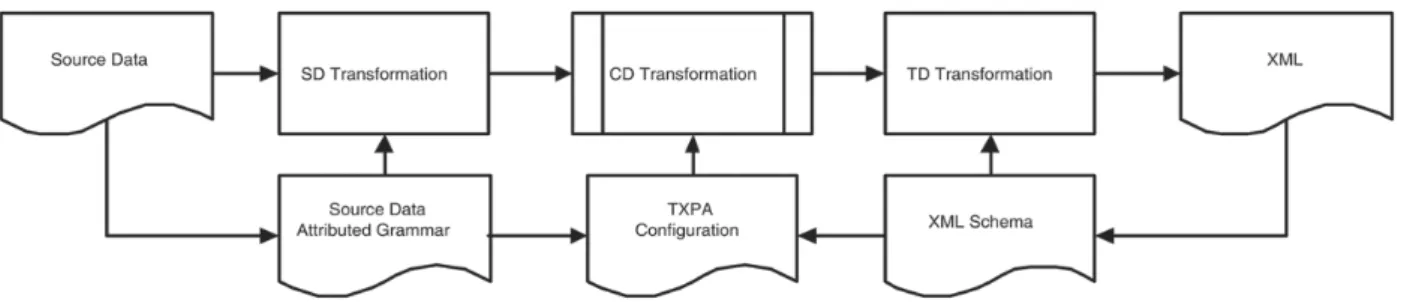
The first transformation converts the legacy sys-tem’s proprietary data format into an intermedi-ate format(Figure 3).
In the SD subtransformation, the parser is gene-rated from an attributed grammar. The semantic verification (in our application scenario,
Fig. 3.Transformation from legacy data to XML.
into the generated parser as is the following CD subtransformation via a callback style.
The CD subtransformation determines where data, originating from a token produced by the scanner component and semantically checked and converted during the semantic analysis, is inserted into the resulting XML document, serv-ing as an intermediate data format in the trans-formation sequence. This is performed apply-ing a Token-XPath-Assigment matrix (TXPA
matrix) MTX = T X, which consists of the
tokens symbolsT of the source data grammar and the target data grammar XML elements ex-pressed as XPath elementsX. The target gram-mar is presented as a XML Schema. The tar-get grammar-driven subtransformation is gene-rated using JAXB 16], which generates a suite
of hierarchical classes that produces an XML document complying with the XML Schema. This suite of classes is subsequently used by the CD and the TD transformation. To accom-plish construction of the XML document using the hierarchical suite of classes, we use reflec-tion to determine the class representing the root element. An object of the class is instantiated using a factory. The factory is analyzed for objects that are required to be present for the resulting XML document being grammatically correct. These objects are instantiated dyna-mically, filled with the corresponding data and integrated in the XML document. This is done
using a set of heuristics, in order to find the correct methods and classes.
The intermediate (CD) subtransformation
de-couples the source and the target grammar-driven subtransformation. If the source or the target grammar is modified or the semantic ana-lysis changes, only the TXPA matrix needs to be adapted. This makes the transformation system flexible and robust in the case of changes.
6.3. XPath-Database Configuration
The second transformation imports the data from the XML document into a database(
Fig-ure 4). Most databases allow importing XML
data or comma-separated value lists. However, data can only be inserted into a single table, and most often this data requires further process-ing such as splittprocess-ing the data and distributprocess-ing it among several database tables.
The SD transformation is accomplished by em-ploying an XML parser. The CD and the TD transformations use OJB 17]. OJB generates
a set of classes on the basis of a database de-sign allowing transparent persistent mapping of objects against relational databases. It allows storing objects, or part of an object, in rela-tional databases, and reading the data from a relational database into the generated object
structure. The grammar-oriented transforma-tion needs to rework the data from an XML into an OJB object representation. The OJB object structure is then imported into the database. The objective of the CD transformation is to remain independent from the grammar of the source XML document and from the target con-figuration of the database. We need to take into account the following requirements:
Specification of a mapping between XML elements and OJB objects.
Instantiation of OJB objects creating a new dataset.
Relations between the OJB objects.
Processing of duplicate datasets. Duplicates are already filtered out in the first transfor-mation. However, at this stage we cannot detect duplicates which might occur during the reordering of the data in the second trans-formation, nor can we detect duplicates that are already in the database.
Declaration of an import sequence to prevent primary key violation.
We have developed XML2OJB, a mapping from XML documents to OJB object structure 10].
It allows flexible, adaptable, and independent import of arbitrary structured XML data into arbitrary database table configuration. The XML2OJB configuration is divided into five parts.
Target Definition: This section defines the target objects that are imported into the data-base.
Source Definition: This element declares where to find the necessary information in the XML source document.
Duplicate Record Definition: The Duplicate Record section specifies the element that functions as autokey in the database. The specification of an autokey is necessary to avoid duplicate entries in database tables.
Workflow Definition: The ImportSequence section determines the sequence in which OJB objects import their data into the data-base. Together with the assembly section, they specify a control flow when and where data is inserted into the database. A Repeat element specifies the start of a new data record in the XML document. The Create-Object element defines the objects that are
required to be instantiated and an Insert ele-ment specifies where the data is set in created OJB objects.
The TD transformation consists of importing the set of OJB classes into the database. The process is configured by using a specific OJB configuration file.
6.4. Internet Publishing
Maverick 14]is a framework that is built around
the Model-View-Controller principle. It is in-tended to publish the data on the Internet and to process incoming requests. Maverick is com-posed of commands. Each command consists of a set of views and of a controller. The controller connects to the model and decides which view renders data from the model. The view then executes a XSLT transformation and publishes the data.
7. Conclusion
We have presented a transformation system that manages sequences of transformation. Each transformation is made up of three individual subtransformations, which are grammar-based. The objective is to decouple the source and target grammar transformation by using an in-termediate transformation. Semantic analysis and the configuration of the intermediate trans-formation require domain knowledge, therefore this task is done manually.
The TXPA matrix maps a sequence of tokens onto XML elements. The XML2OJB con-figuration maps XML elements to OJB ob-jects, which can be imported into a relational database. Communicating data via the Inter-net is accomplished by applying a XSLT trans-formation and the Maverick framework. The TXPA matrix and the XML2-OJB transforma-tion proved to be successful due to their flexi-bility. The architecture of the transformation system represents a viable solution for rapid legacy systems integration requiring frequent reconfiguration and maintenance.
References
1] H. A. AMINIAN, The Legacy System Dilemma:
Making the Right Choices, Technical report, In-surity, 2003.
2] M. BRODIE AND M. STONEBRAKER, Migrating
Legacy Systems Gateways, Interfaces and the Incre-mental Approach, Morgan Kaufman, 1995.
3] D. CARR, Web-Enabling Legacy Data When
Re-sources Are Tight,Internet World, 1998.
4] S. COMELLA-DORDA, K. WALLNAU, R. C. SEACORD
ANDJ. ROBERT, A Survey of Legacy System Moder-nization Approaches,Technical Report CMU/SEI-2000-TN-003, Carnegie Mellon University, Pitts-burgh, PA, USA, 2000.
5] DataMirror, Managing Your Data the XML Way:
Data Transformation, Exchange and Integration, 2001.
6] P. FIORE, Data Warehousing,Evolving Enterprise,
1(1), Spring 1998.
7] R. HIEBER, Supply Chain Management. A
Colla-borative Performance Measurement Approach, vdf Hochschulverlag, Z¨urich, Switzerland, 2002. 8] D. E. KNUTH,Mathematical System Theory 2,
chap-ter Semantics of Context-Free Languages, pp. 127– 145, D. E. Knuth, 1968.
9] A. DE LUIZA, G. A. DE LUCIA, A. R. FASOLINO
AND P. GUERRA, Migration Legacy Systems to-wards Object-Oriented Platforms, inInternational Conference on Software Maintenance (ICSME), 1997.
10] G. MENKHAUS AND U. FREI,
Transformation-oriented Middleware for Legacy System Intergra-tion, in International Conference of Enterprise Information System, Porto, Portugal, April 2004.
11] H. M ¨OSSENBECK, A Generator for Fast Compiler
Front-Ends,Technical Report 127, Institut f ¨ur Com-putersysteme, ETH Z¨urich, 1990.
12] Ontology Works, Integration of Legacy Information
Systems,Technical Report, Ontology Works, 2002.
13] H. PARTSCH AND R. STEINBRUGGEN, Program
Transformation System,ACM Computing Surveys, 15(3), September, 1983.
14] Sourceforge, Maverick, 2003.
15] M. STOR¨ , N. BIRKELAND, J. NIENHAUS AND G.
MENKHAUS, IT Infrastructure for Supply Chain Management in Company Networks with Small and Medium-sized Enterprises, inProceedings of the 5th Internatonal Conference of Enterprise Information System, volume 4, pp. 280–287, Angres, France, April 2003.
16] SUN Microsystems, Java Architecture for XML
Binding(JAXB), 2003.
17] The Apache DB Project, Object/Relational Bridge (OJB), 2003.
18] N. WEIDERMAN, H. NELSON, J. K. BERGEY ANDD.
B. SMITH, Approaches to Legacy System Evolution,
Technical Report CMU/SEI-97-TR-014, Carnegie Mellon University, Pittsburgh, PA, USA, 1997. 19] V. L. WINTER, Program Transformations in HATS,
inProceedings of the Software Transformation Sys-tem Workshop, California, USA, 1999.
20] M. YOSHIOKA, T. SUDO, A. YOSHIKAWA AND K.
SAKATA, Legacy System Integration Technology for Legacy Application Utilization from Distributed Object Environment, Hitachi Review, 47(6), pp.
284–290, 1998.
Received:June, 2004
Accepted:June, 2004
Contact address:
Guido Menkhaus Software Research Lab Department of Computer Science University of Salzburg A-5020 Salzburg Austria Phone:+43 662 8044 6405
Fax:+43 662 8044 6403
e-mail:Menkhaus@SoftwareResea rch. Net
Urs Frei Institute MIT/IT
University of Applied Science St. Gallen CH-9000 St. Gallen Switzerland e-mail:[email protected]
GUIDOMENKHAUSis an assistant professor at the Computer Science Department of the University of Salzburg. He received the M.S. degree in computer science from the University of Bielefeld, Germany in 1997 and the Ph.D. degree from the University of Salzburg, Austria in 2002. Guido Menkhaus’s professional and research interests are in automatic software transformation systems, software testing and system safety and reliability analysis. A lot of current research is devoted to soft-ware engineering and construction techniques for embedded real-time systems.
URSFREIis a research assistant at the MIT/IT of the University of