Hungarian Association of Agricultural Informatics European Federation for Information Technology in Agriculture, Food and the Environment
Journal of Agricultural Informatics. Vol. 8, No. 1 journal.magisz.org
Analysis of smallholder farmers’s ICT-adoption and use through their personal
information space
Mihály Csótó1
I N F O
Received 14 Dec. 2016 Accepted 7 Jan. 2017
Available on-line 15 Mar. 2017 Responsible Editor: M. Herdon
Keywords:
Personal information space, information sources, cluster analysis, ICT adoption, internet usage
A B S T R A C T
ICT has now apparently penetrated the agricultural production processes and farm management tasks. It is necessary to understand the characteristics of these processes in order to effectively exploit the potential inherent in infocommunication devices. The aim of the research was to explore the personal information space and the fundamental relations of information management of farmers from which important conclusions can be drawn in regard to the design, introduction and operation of information services provided to farmers and reducing the information deficit in the agricultural sector. Analysing the database comes from a questionnaire survey conducted in May and June 2015 in Hajdú-Bihar County among smallholder farmers. The article concludes that farmers have different preferences in regard to using information sources, based on which they can be divided into distinct categories, while the information space that results from their choices of these sources gives a clear picture to ICT adaptation and usage. Three distinct groups could be set up, each with their own attributes, information preferences and information activities: ‘the information accumulators’, ‘the analytically-minded’ and ‘the isolated ones’.
1. Introduction
The diffusion of information and communication technologies (ICT) are taking place as we speak. These days ICT can be seen as a universal technological system which interlocks with all of the other, earlier technological systems and which has become embedded in those systems (Sasvári 2008), especially as ICT, as “general purpose” technology can be defined as a tool, a control device, organizational technology, media, and development process as well as technical practice (Molnár 2008).
ICT has now apparently penetrated the agricultural production processes and farm management tasks. However, it is necessary to understand the characteristics of these processes in order to effectively exploit the potential inherent in infocommunication devices (the application of this potential is primarily to increase efficiency). This is especially true in the case of small farms that do not and cannot maintain a separate apparatus that would carry out management tasks. It is also important to study those small-sized farms whose daily sustenance, or a significant part of it, is provided by farming (the number of such farms is in the tens of thousands in Hungary). As Szabó G. (2002) puts it, the development of information systems is a good way to reduce transaction costs, ICT is therefore crucial for smallholders, especially in terms of ex ante costs. However, since these are typically family run farms, their analysis cannot be based merely on economics as the person who runs the farm is of at least the same importance. As Szakál (1993) puts it, the family farm is a special form of joint venture, a complex entity in which business processes and satisfying the needs of the household are continuously interfering.
So it seems obvious that the use of ICT on small and family farms needs to be analysed from an information-focused perspective. As Öhlmer (1991) points out, a tool in itself is not capable of performing a miracle and the individual using the tool plays the key role: he claims that no fundamental change takes place in information processes by computerisation since that alone only
1 Mihály Csótó
adds a certain level of comfort to these processes. Hill (2009) states that farmers are constantly improving their farm businesses in order to remain competitive through fine-tuning existing practices and adopting innovations, creating a unique working method where (Hill cites Vergot, Israel & Mayo 2005 and Solano, Leon, Perez & Herrero 2003) farmers (as individuals) “…have their favoured
information sources, which they use depending on the specific information being sought”.
The information-centred approach leads us to the person’s (in our case: the farmer’s) information culture which is (as Z. Karvalics (2012) cites Gendina (2009) “one of the components of a person’s
general culture; sum total of information outlook and a system of knowledge and skills providing goals aimed at independent activity in optimal satisfaction of information needs on the basis of both: traditional and new information technologies. It is the most important factor of successful professional activity as well as social safety in information society.” Z. Karvalics also emphasis the importance of
“the personal information space”, an umbrella term, which means the continuously developing and expanding “cloud” of individually-selected content, personalized information services and advanced information management tools.
The personal information space appears in many earlier research work relating to ICT adoption in agriculture. As Harkin (2006) stated, telematics as a medium should be examined in relation to competing media and its strengths and advantages over the conventional methods of information dissemination exploited. Doye, Jolly, Hornbaker, Cross, King, Lazarus, Yeboah & Rister (2000) concluded that farmers differ in the ways they use management information, from being information "hogs" requiring great amounts of detailed information, to being "seat of the pants" decision makers where experience and intuition are all that is used in decisions. Berman (2006) stated that the efficiency of different information transfer methods depend on the ability of the end-user farmer, his or her practices in terms of problem identification and analysis, information gathering, critical thinking and evaluating outputs. Alvarez and Nuthall (2006) concluded that farmers’ software adoption behaviour results from a complex pattern of interrelationships involving structural factors, such as farm and farmer characteristics as well as ‘soft’ variables, such as goals and practices, which ‘mediate’ the effects of the first ones.
Parallel with the research on the characteristics of farmers, modelling the agricultural information flow has also been at the focus of many related projects and research in the last 20 years or so (e.g. Szabó (2000) cites Kozári (1994), Sörensen, Fountas, Nash, Pesonen, Bochtis, Pedersen, Basso & Blackmore (2010), Řezník, Lukas, Charvát, Charvát Jr., Horáková & Kepka (2016)). Based on all the above information one can conclude that with the examination of the information environment or the preferred sources of farm-related information some important insights about the role of ICT in the personal information space of farmers can be gained.
2. Hypothesis, methods and material
The main hypothesis of the research was that based on their preferred sources of information farmers can be divided into distinct groups, each with specific attributes, and these groups take a different approach to the use of information technology.
I analysed a database based on a questionnaire survey conducted in May and June 2015 in Hajdú-Bihar County with the cooperation of the county directorate of the Hungarian Chamber of Agriculture (NAK). The delivery and filling in of the questionnaires by the farmers was assisted by the experts of NAK’s agriculture extension network (‘Falugazdász’ in Hungarian). According to my previous knowledge, each extension worker has an approximately similar number of clients, so every officer distributed the same number of questionnaires and they were instructed to have the clients arriving at their next consultation fill them in (and if there are not enough clients, then have the rest filled in during the next consultation session). Hence, the surveyed population was the circle of farmers registered in Hajdú-Bihar County, and the method used a quota-based sampling combined with accidental factors.
The questionnaire had 45 questions seeking to cover all the factors considered as relevant by literature. The first section contained questions about ICT tools and internet use (also asking about the functions used and the frequency of their use in the case of mobile phones). The second section was aimed at examining the attributes of internet and computer users (the beginning of the use of the technology, accumulated experience, the evaluation of their own IT skills, the extent of support) as well as the form and frequency of use, also focusing on various agricultural software programmes and agriculture-related applications. In the case of the latter I devoted special attention to communication, information and transaction services. In this same section those who do not use the internet were asked why they opted for non-use. The third section started with questions about the sources of information necessary for farming, followed by questions in regard to the various factors impacting innovation, i.e. questions about one’s social network and approach to innovation, the reliability of online content, and the perceived usefulness, the ease of usage, observability and compatibility. The last two sections of the questionnaire were devoted to the given farmer’s socio-demographic and farming-related attributes and asked for the description of the farm he or she owned.
Out of the 200 questionnaires that were handed over, a total of 148 were suitable to be evaluated. I recorded the information included in the questionnaire electronically, and ran a consistency check. I then converted the records into the SPSS statistical programme, where I completed the required data cleaning tasks along with the filtering out missing/contradictory data, while altering the existing variables (necessary for logical and/or distributional reasons) into ones that can be better used in the analysis. I used a special case of factor analysis, called main component analysis, to produce factors used for the necessary data reduction, dimension reduction. Based on the results I gained during the principal component analysis of preferred media, I divided the farmers into groups with the help of cluster analysis using hierarchical clustering, which is aimed at gradually decreasing the number of groups by merging at every stage of the process those two groups that are in the closest proximity to each other and show the greatest similarity. I applied the squared Euclidean distance to determine the distance between the objects, and I chose Ward’s method aimed at minimising the total within-cluster variance.
3. Results
3.1. ICT-ownership and usage among farmers
Fifty-nine percent of respondents have a desktop in their homes, while for 44 percent of them a notebook or a laptop is a more accessible solution, and tablets are used by 10 percent. A total of 80 percent of those asked have access to some kind of computer in their homes, and the proportion of those with internet access is the same. The majority subscribed to wired broadband internet (this connection is found in the homes of two-thirds (68%) of those asked).
mobile-owners have a subscription, while one third (31%) use the pre-paid scheme of telephone use, and a small group (5%) has both. The data listed here significantly overlap with KSH (Hungarian Central Statistical Office) data (households with desktop computers: 53%; households with laptops: 45%; households with internet access: 73%; households with mobile phones: 95%), which indicates that the same diffusion process is taking place among farmers as in the rest of the Hungarian population in regard to general-purpose ICT use. As regards internet use, half of the respondents use the internet on a daily basis, one fifth use it several times a week, and some ten percent use it less frequently than that.
In regard to directly applied agricultural solutions it can be stated that the use of various software programmes supporting the management of farming is also clearly present in a certain group of farmers: half of internet-user farmers use farming log-book software, while a quarter of them keep some kind of electronic register. The wide use of the farming log-book (FL) is somewhat overshadowed by the fact that keeping a log-book is mandatory to apply for certain forms of financial support. However, since these support schemes are not tied to the use of an online FL, it is primarily farmers with a basic openness to ICT who tend to choose this software. The support of e-management and decision-support systems are not yet widespread. To sum up, some form of agricultural software is used by 60% of computer-user farmers, and 46% of the whole sample (out of this 28%, 14% and 4% of the respondents use one, two or three applications, respectively).
3.2. Sources of agricultural information and the personal information space of farmers
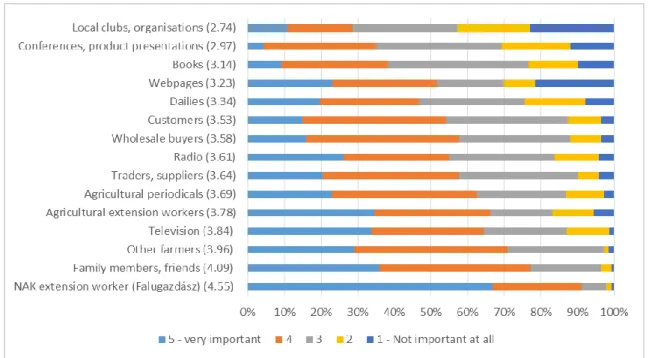
The farmers were asked to evaluate the sources of information they can potentially access, and rate their importance in farming management. Figure 1 shows the distribution of answers provided; the numbers in brackets after the sources are the average values for the given source. The role of NAK extension workers (Falugazdász) (4.55) as sources of information outweighed all other alternatives, although it might partly result from the sampling method, since the questionnaires were filled in with the help of the extension workers, and even if some of the farmers who went to the rural consultancy office for the questionnaire research are not regular visitors to the office, it is likely that it was those farmers who ranked the role of extension workers in their personal information network in a prominent place who were included in the sample. It could be observed in earlier research (Herdon & Csótó 2009, Csótó 2013) too that extension workers are actually well equipped to provide personalised information to farmers; moreover they render assistance in transaction services and are able to synthesise the benefits of other sources.
Television (as mass media, from where general information can be gained about important issues first) is still in the top five choices among preferred and important sources of information in addition to other personal sources of information. Agricultural periodicals also occupy a prestigious place in this regard, while books and other sources providing knowledge transfer in groups are lower in the ranking. Websites lagging behind came as a surprise, however, it must be noted that this question was also answered by non-internet-users, which negatively impacts the average of this source. After filtering out non-internet-user farmers the average for the internet in this question rises to 3.73, i.e. almost comes on a par with that of agricultural extension workers and specialist periodicals.
As could be seen in the introduction, several authors claim that there is a difference between the decision-making techniques of farmers, and this is reflected in their media use. In order to confirm this, an explorative factor analysis was conducted to decrease the dimensions of the listed sources (the Internet and the Falugazdász were excluded) and then divide the farmers into groups based on their preferred media, or preferred categories of media.
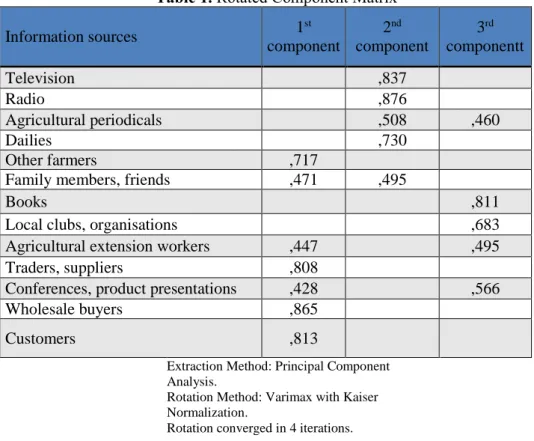
Using the Kaiser-Meyer-Olkin (KMO) statistics to discover if data are likely to factor well, the result was 0.789 which is a quite good (and well above the minimally required 0.5 or 0.6 value), and the three factors together accounted for 63% of the total variance. Table 1 shows the results of the rotated component matrix, where loadings of less than 0.4 are not presented in order to make interpretation easier.
Table 1. Rotated Component Matrix
Information sources 1
st
component
2nd component
3rd componentt
Television ,837
Radio ,876
Agricultural periodicals ,508 ,460
Dailies ,730
Other farmers ,717
Family members, friends ,471 ,495
Books ,811
Local clubs, organisations ,683
Agricultural extension workers ,447 ,495
Traders, suppliers ,808
Conferences, product presentations ,428 ,566
Wholesale buyers ,865
Customers ,813
Extraction Method: Principal Component Analysis.
Rotation Method: Varimax with Kaiser Normalization.
Rotation converged in 4 iterations.
The analysis revealed the existence of three factors representing clearly distinguishable communication activities:
Component 1: ‘Personal professional sources’, in which the personal, face-to-face dialogue plays the central role, primarily conducted with professional players (other farmers, traders, suppliers) and to a lesser extent with family members, agricultural consultants and perhaps in the framework of professional events.
Component 3: ‘Analytical sources’, featuring agricultural mass media (agricultural periodicals and books) and group activities (local clubs, conferences, product presentations).
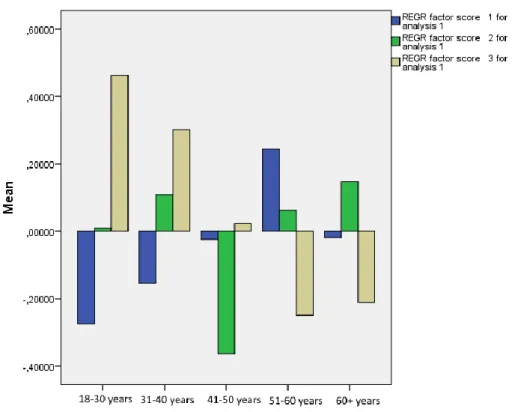
When the different factor scores are represented according to the age groups of the farmers (Figure 2), a turning point can be observed at 40-50 years, since while the third factor dominates in younger age groups (i.e. a kind of analytical approach, which correlates with the higher level of education in the case of younger farmers), it has a negative factor score in older age groups. The middle age groups tend to avoid the middle component, i.e. general sources. The role of personal professional relations steadily increases up to age 60 (as these relationships become more extensive and trusted with time), but for pensioner age farmers the dominance of general sources can be seen.
Figure 2. Distribution of media use factor scores according to age
A cluster analysis was conducted with the factor scores, and based on the result three groups can be created, the first two of which comprise ICT-active, while the third one non-ICT-active famers.
Group 1 (‘the information accumulators’, 26% of the respondents): in most of the cases they are average ICT technology users; almost half of them have agricultural qualifications. Both the general sources and the analytical information factors are significant here, as the members of this group gather information from various sources.
Group 2 (‘the analytically-minded’, 38% of the respondents): the most active group with a marked proportion of the middle-aged (41-50) and a significantly higher number of those with agricultural qualifications (¾ of the group has such qualifications). We can see the dominance of the analytical information factor in this group, while the use of general sources is not at all characteristic.
Group 3 (‘the isolated ones’, 36% of the respondents): a significantly smaller part of this group went to computer courses; the proportion of the older age groups is some 15-20 percent higher. Only a small proportion (10%) in this group have degrees in tertiary education, and less than half of them have agricultural qualifications (45%). One fifth do not regularly discuss matters relating to their farms with anyone and almost exclusively use general sources of information, but not to a great extent.
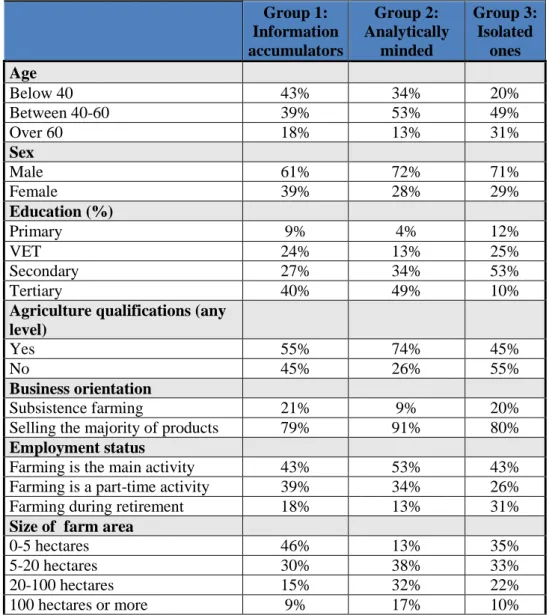
management (Table 2). Group 2 is a kind of ‘farmer elite’. A high number of them have agricultural degrees, and, thus, a more analytical way of thinking, and they own larger and more successful farms; these factors are clearly interrelated. The ‘isolated ones’ are significantly older (and farming during retirement). The ‘information accumulators’ are a somewhat younger group of farmers, who usually have smaller farms than the other two groups.
Table 2. Demographic and farm characteristics in the identified farmer groups
Group 1: Information accumulators
Group 2: Analytically
minded
Group 3: Isolated
ones Age
Below 40 43% 34% 20%
Between 40-60 39% 53% 49%
Over 60 18% 13% 31%
Sex
Male 61% 72% 71%
Female 39% 28% 29%
Education (%)
Primary 9% 4% 12%
VET 24% 13% 25%
Secondary 27% 34% 53%
Tertiary 40% 49% 10%
Agriculture qualifications (any level)
Yes 55% 74% 45%
No 45% 26% 55%
Business orientation
Subsistence farming 21% 9% 20%
Selling the majority of products 79% 91% 80%
Employment status
Farming is the main activity 43% 53% 43%
Farming is a part-time activity 39% 34% 26%
Farming during retirement 18% 13% 31%
Size of farm area
0-5 hectares 46% 13% 35%
5-20 hectares 30% 38% 33%
20-100 hectares 15% 32% 22%
100 hectares or more 9% 17% 10%
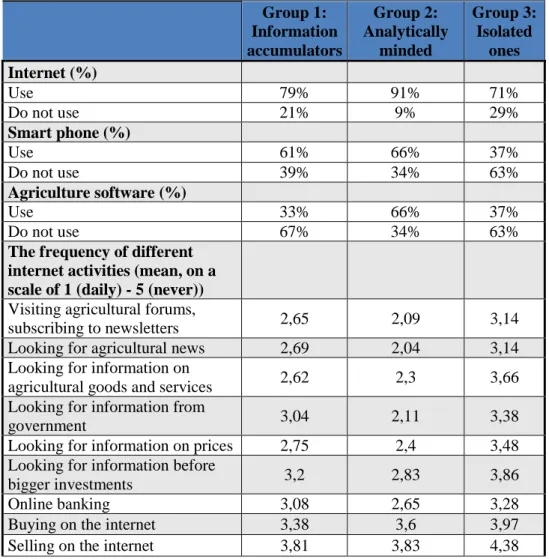
The ’analytically minded’ group is the most efficient in integrating ICT solutions in their management practices, as will (Table 3). In regard to internet use, almost all the members (91%) of group 2 are internet-users, while this percentage is approximately the same for the other two groups (79% for group 1 and 71% for group 3, the latter being almost 10% lower than the average); the difference between the groups is significant. Group 3, the one less open to ICT, is significantly lagging behind in regard to mobile phone use (the percentage of mobile phone use is 61% and 66% for groups 1 and 2, respectively, while it is only 37%- for group 3).
The majority of agriculture-related internet activities are part of the daily or weekly routine of the ‘analytically minded’ farmers (averages below the value of 3 (at least monthly) and close to the value 2 (weekly) indicating this), while the ‘isolated ones’ perform these activities only monthly or less often (if at all), while the ‘information accumulators’ are somewhere in the middle of the two other groups.
Table 3. The usage of different ICT tools and services among the identified farmer groups
Group 1: Information accumulators
Group 2: Analytically
minded
Group 3: Isolated
ones Internet (%)
Use 79% 91% 71%
Do not use 21% 9% 29%
Smart phone (%)
Use 61% 66% 37%
Do not use 39% 34% 63%
Agriculture software (%)
Use 33% 66% 37%
Do not use 67% 34% 63%
The frequency of different internet activities (mean, on a scale of 1 (daily) - 5 (never)) Visiting agricultural forums,
subscribing to newsletters 2,65 2,09 3,14
Looking for agricultural news 2,69 2,04 3,14
Looking for information on
agricultural goods and services 2,62 2,3 3,66
Looking for information from
government 3,04 2,11 3,38
Looking for information on prices 2,75 2,4 3,48
Looking for information before
bigger investments 3,2 2,83 3,86
Online banking 3,08 2,65 3,28
Buying on the internet 3,38 3,6 3,97
Selling on the internet 3,81 3,83 4,38
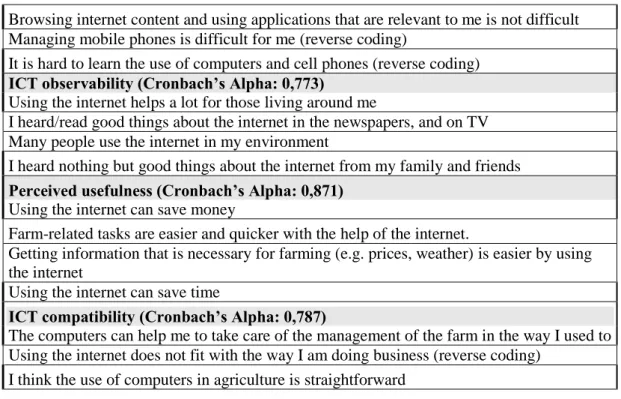
In order to gain a deeper understanding of the groups, some latent variables regarding innovativeness and ICT-adoption were also examined. The variables (Table 4) were fine-tuned to this study using the earlier works of Aubert et al. (2012) and LaRose et al. (2012). The factor scores of each variable between the different groups are shown in Figure 3.
Table 4. The construction of the latent variables (respondents had to evaluate the statements on a scale of 5 whether they find them appropriate for themselves (5) or not (1))
Latent variables Openness to new things (Cronbach’s Alpha: 0,929)
I have always been curious about how to operate new things and innovations I like to experiment with new solutions
If there is an opportunity, I try to grab it
I seek the company of those who are always trying out something new I regularly look for new products and solutions
ICT self-efficacy (Cronbach’s Alpha: 0,877)
Browsing internet content and using applications that are relevant to me is not difficult Managing mobile phones is difficult for me (reverse coding)
It is hard to learn the use of computers and cell phones (reverse coding) ICT observability (Cronbach’s Alpha: 0,773)
Using the internet helps a lot for those living around me
I heard/read good things about the internet in the newspapers, and on TV Many people use the internet in my environment
I heard nothing but good things about the internet from my family and friends Perceived usefulness (Cronbach’s Alpha: 0,871)
Using the internet can save money
Farm-related tasks are easier and quicker with the help of the internet.
Getting information that is necessary for farming (e.g. prices, weather) is easier by using the internet
Using the internet can save time
ICT compatibility (Cronbach’s Alpha: 0,787)
The computers can help me to take care of the management of the farm in the way I used to Using the internet does not fit with the way I am doing business (reverse coding)
I think the use of computers in agriculture is straightforward
To sum up the findings, farmers have different preferences in regard to using sources, based on which they can be divided into distinct categories, while the information space that results from their choices of these sources gives a clear picture to ICT adaptation and usage. During the main component analysis and cluster analysis that were conducted on farmers’ preferences of sources of information three distinct groups could be set up, each with their own attributes, information preferences and information activities: ‘the information accumulators’, ‘the analytically-minded’ and ‘the isolated ones’. Those in the first group are active users of sources of information, characterised by an openness to ICT, although they do not integrate ICT into their farm management activities. The second and third groups are each other’s opposites.
The analytically-minded (group 2) are open to new things and agricultural ICT use is perfectly in line with their management style; moreover, they have good computer skills and are well aware of the benefits of ICT. Their agricultural qualifications help them to form an analytical way of thinking, thus significantly raising the use of agricultural-purpose software. The members of group 3 are typically closed to innovations, have little knowledge of ICT, nor do they see its advantages; consequently, ICT does not match their management style. This rather large third group mainly bear the traits of those members of the late majority or laggards, which can be seen clearly in the low adoption rates of smartphones in this group in comparison with the other two groups. The members of group 1 represent a kind of transition between the other two as they are aware of the advantages of ICT and the internet, they regularly experience the benefits of these technologies in their surroundings but their ICT skills (and confidence) are low, which probably prevents them from the agricultural use of ICT. Beyond the primary digital divide, a ‘secondary agricultural digital divide’ can be seen among farmers in regard to the use of agricultural-purpose ICT innovations. Group 1 holds special interest its members are innovative and open people who understand the benefits of ICT and the internet, frequently experiencing the beneficial effect of these in their surroundings; at the same time, they have poor ICT skills and little self-confidence in regard to ICT, which are likely to stop them from using ICT in agricultural activities, even though they have the opportunity to do so (however, since the proportion of those with small farms is the highest in this group, an increase in self-confidence would probably not automatically result in a sudden rise of software use). Based on the data regarding the various farmer groups, the research main hypothesis is proven.
4. Conclusion
Several conclusions can be drawn from the findings of this research. They can be successfully applied in the following areas: communication strategies with farmers, reducing the information deficit in the agricultural sector, designing ICT applications for farmers. It seems unambiguous that a significant group, amounting to close to one third of farmers in the study, has no openness to ICT innovations, its members not at all adapting these technologies, or even if they do, they do not exploit the potential benefits inherent in them – e.g. the numerous group of farmers who only use their mobile phones for conversations. A significant proportion of these people are not likely to use the most basic, general technologies in the near future. The likelihood of today’s farm management support software being used by this group of farmers is negligible, since the intensity of their general-purpose ICT use and the self-confidence this would be coupled with do not reach the level which would enable the integration of such ICT solutions into daily farming activities. At the same time, information reaches the members of this group mainly via the general mass media: those organising agricultural applications and ICT solutions as well as the leaders in the agricultural sector must be aware of the specific needs and ways of reaching the members of this group. In the case of this group (about one third of farmers) intermediaries and agriculture extension workers will continue to play a great role in providing the mandatory transaction services and personalised information.
At the moment about one third of farmers (the most innovative third) fully and strategically exploit the benefits of ICT, even if the success of the farming log book software is partly explained by its mandatory nature for some EU-subsidies. These farmers practically already base their farm management activities on ICT; they actively gather information, use online transaction services and are open to using agricultural software. They can be the direct target groups and first users of new applications launched in the area, and they can be best reached at agricultural product presentations, fairs and via the agricultural press.
to them the advantages inherent in ICT – this is made easier by the fact that these farmers can be reached by a larger number of information channels. For those developing services and applications must clearly see that these farmers can be at best reached by solutions whose model and even user interface are ‘hidden’ behind a simple communication method (e.g. SMS consultation) in which knowledge transfer does not require farmers to adopt practices significantly different from the ones they are using.
It is an important conclusion of the research that agricultural qualifications have a significant impact on the use of different types of management software, this being a result of analytical thinking. The agricultural educational programmes should emphasise the use of online agricultural sources of information, applications and software from the start, and their integration into daily management tasks; thus, those open to ICT to start with can be orientated towards solutions aimed at enhancing efficiency.
References
Alvarez, J & Nuthall, P 2006. 'Adoption of computer based information systems: The case of dairy farmers in Canterbury, NZ, and Florida, Uruguay' Computers and Electronics in Agriculture, 50, pp.48–60.
doi: 10.1016/j.compag.2005.08.013
Aubert, B, Schroeder, A & Grimaudo, J 2012. ’IT as Enabler of Sustainable Farming: An Empirical Analysis of Farmers’ Adoption Decision of Precision Agriculture Technology’ Decision Support Systems 54 (1), 510–520. doi:10.1016/j.dss.2012.07.002
Berman, A 2006. 'ICT in the Dairy Farming System' in ICT in Agriculture: Perspectives of Technological Innovation, eds E Gelb & A Offer, Samuel Neaman Institute for National Policy Research European Federation for Information Technologies in Agriculture, Food and the Environment (EFITA).
http://departments.agri.huji.ac.il/economics/gelb-farming-6.pdf
Csótó, M 2003. 'Különbségek és azok feltárásának módjai a gazdálkodók információfogyasztásában és IKT-eszközhasználatában' (Exploring differences in farmers' information consumption and ICT-usage)
AGRÁRTUDOMÁNYI KÖZLEMÉNYEK = ACTA AGRARIA DEBRECENIENSIS 52., pp. 91-98.
Doye, DG, Jolly, RW, Hornbaker, R, Cross, T, King, RP, Lazarus, W, Yeboah, A & Rister, E 2000. 'Farm Information Systems: Their Development and use in Decision-making', Ames, Iowa State University. Gengyina, N 2009. 'The Concept of a Person’s Information Culture: View from Russia' HAL archives.
http://archivesic.ccsd.cnrs.fr/file/index/docid/359475/filename/TexteGendinaColloqueErte2008.pdf
Harkin, M 2006. 'ICT Adoption as an Agricultural Information Dissemination tool – an historical perspective' in ICT in Agriculture: Perspectives of Technological Innovation, eds E Gelb & A Offer, Samuel Neaman Institute for National Policy Research European Federation for Information Technologies in Agriculture, Food and the
Environment (EFITA). http://departments.agri.huji.ac.il/economics/gelb-harkin-3.pdf
Herdon M, Csótó M, 2009. ’The Role of Intermediaries in the Success of Electronic Claiming for Farm Subsidies in Hungary’ in 7th World Congress on Computers in Agriculture and Natural Resources, eds. FS Zazueta, J Xin, American Society of Agricultural Engineers, Michigan, pp. 117-120.
Hill, M 2009. 'Using farmer’s information seeking behaviour to inform the design of extension' Extension Farming Systems Journal, 5(2), p.121–126. http://www.apen.org.au/efs-vol-5-no-2
Kozári, J 1994. 'A magyar mezőgazdaság ismereti és információs rendszer értékelése, fejlesztésének lehetséges irányai' (The evaluation and development opportunities for the Hungarian agricultural knowledge and
information system) in Egységes Információs Rendszer alapjai a mezőgazdaságban Tudományos Tanácskozás, Gödöllő.
LaRose, R, DeMaagd, K, Chew, H, Tsai, H, Steinfield, C, Wildman, S & Bauer, J 2012. ’Measuring Sustainable Broadband Adoption: An Innovative Approach to Understanding Broadband Adoption and Use. International Journal of Communication 25 (6), pp. 2576–2600. http://ijoc.org/index.php/ijoc/article/view/1776/811
Öhlmér, B 1991. 'On-farm computers for farm management in Sweden: potentials and problems' Agricultural Economics, 5(3), pp.279–286. doi: 10.1016/0169-5150(91)90049-q
Řezník, T, Lukas, V, Charvát, K, Charvát Jr., K, Horáková, Š & Kepka, M 2016. ’FOODIE data models for precision agriculture’ in Proceedings of the 13th International Conference on Precision Agriculture July 31 – August 4, 2016 St. Louis, Missouri, USA.
Sasvári, P. 2008. 'Az információs és kommunikációs technológia fejlettségének empirikus vizsgálata' (The development of information and communication technology; an empirical study) PhD thesis, Miskolc. Solano, C, León, H, Pérez, E & Herrero, M 2003. 'The role of personal information sources on the decision-making process of Costa Rican dairy farmers' Agricultural Systems, 76(1), pp. 3–18. doi: 10.1016/S0308-521X(02)00074-4.
Sörensen, CG, Fountas, S, Nash, E, Pesonen, L, Bochtis, D, Pedersen, SM, Basso, B & Blackmore, SB 2010. 'Conceptual model of a future farm management information system ' Computers and Electronics in Agriculture, 72, pp.37–47. doi: 10.1016/j.compag.2010.02.003
Szabó, GG 2002. 'A szövetkezeti vertikális integráció fejlődése az élelmiszer-gazdaságban' (The development of cooperatives' vertical integration in the food industry) Közgazdasági Szemle XLIX/3. pp. 235–250.
Szabó, IL, 2000. Családi gazdaságok és szövetkezeteik információs problémái a rendszerváltás után.
(Information-related problems of family farms and cooperatives after the regime change) Veszprémi Egyetem, Georgikon Mezőgazdaságtudományi Kar.
Szakál, F 1993. 'A családi gazdaságok szerepe a mezőgazdaság szerkezetében' (The role of the family farm in the structure of agriculture) Gazdálkodás 37 (7), pp. 1-9.
Vergot III, P, Israel, G & Mayo DE 2005. ‘Sources and channels of information used by beef cattle producers in 12 counties of the Northwest Florida extension district’ Journal of Extension 43(2)
https://www.joe.org/joe/2005april/rb6.php
Z. Karvalics, L 2012. 'Információs kultúra, információs műveltség - egy fogalomcsalád értelme, terjedelme, tipológiája és története' (Information culture, information erudition – meaning, extension, tipology and history of a family of concepts) Információs Társadalom, 12(1), pp.7–43.