Forecasting of Future Academic Libraries with Cross Impact Analysis Approach
Soudeh Torabian
PhD Candidate in Knowledge and Information Science, Islamic Azad University of Hamedan,
Alireza Isfandyari-Moghaddam Associate Prof., Knowledge and Information Science, Islamic Azad University of Hamedan, Corresponding Author: [email protected]
Ehsan Geraie
Assistant Prof., Knowledge and Information Science, Department of Educational Sciences,
Lorestan University [email protected]
Aliakbar Famil-Rouhani
Assistant Prof., Knowledge and Information Science, Islamic Azad University of Hamedan,
Received: 21 January 2020 Accepted: 09 June 2020
Abstract
academic libraries. The first fact is that, through a small amount of effort, academic libraries are able to retain their traditional position in educational institutes. The second fact is that distancing the general process of academic libraries from critical and undesirable results, requires four main activities including “development of strategic plans for libraries”, “using employees who are enthusiastic regarding change”, “compatibility between managers’ specialties and information science and scientometrics” and “systemic thoughts and creativity of library managers”. The results of this study can be used for decision making and planning of higher education managers and authorities. Identifying the driving forces and their interactions can be used for decision making and planning for the future of academic libraries.
Keywords: Forecasting, Academic Libraries, Cross-Impact Analysis.
Introduction
Academic libraries provide the necessary information structure for higher education. For a long time, these centers were known as the gateways for accessing information and therefore had a direct, essential and undeniable role in expanding science in academic centers. In the past, the main role of academic libraries was to provide the information sources necessary for meeting educational and research needs (Lewis, 2007) and traditionally, librarians had a static role in universities. Therefore, in the eyes of managers, libraries were likened to costly and useless warehouses while faculties considered academic librarians as partners in their research and responsible for gathering and safekeeping of books (Simmons-Welburn, Donovan, & Bender, 2008). However, novel technological advances have resulted in rapid advances in all sectors including higher education. Academic libraries as one of the subsystems of the main educational system must therefore change based on new advances and changes in order to harmonize themselves with the current advancing environment. Today, academic libraries have turned into a competitive advantage and are at the center of learning and research in universities. This has challenged their traditional role in supporting educational and learning activities (Walther, 2018).
In the past, library managers attempted to control changes to benefit their organization but in the current dynamic and uncertain environment, using this approach is not effective (Roy & Hallmark, 2017). Adaptation of libraries in such an environment requires higher levels of innovation and efficiency (McKnight, 2010). Talking about the future always involves uncertainty and various conditions have equal probabilities of occurring (Godet, 2006; Corral, 1995). Therefore, the main challenge in forecasting process of academic libraries is the unpredictable nature of future changes and uncertainties of library management. This means that problem solving using this approach requires identification of the paths for all possible occurrences and requirements and prediction of final situation under different conditions. By moving from traditional services toward modern activities, library managers must have a precise understanding of possible future trends affecting academic libraries in order to succeed in their strategic planning, manage uncertainties and achieve an awareness regarding the role of libraries and libraries (Martell, 2008; Miller, Knapp, & Wood, 2007; Sidorko, 2007).
Some of the new trends affecting academic libraries include cloud computing, internet of things, robots and automated equipment, and mobile library services (Bowlby, 2012; Kaur, 2018; Kaushik & Kumar, 2016; Kubat, 2017; Mavodza, 2013; Wada, 2018). Use of information technologies must always be considered along with technical and efficiency considerations because academic libraries are among organizations which always make use of the most novel technologies based on customers and various available options. This means that the structure of these organizations is more compatible with the use of novel and specialized technologies. Identification and use of novel technologies can help librarians in developing libraries in present and future (Roy & Hallmark, 2017).
The rate of technological changes in academic libraries and research centers is constantly increasing. On the other hand, changes such as new frameworks in university plans, changes in the structure of educational, research and curriculum plans of universities, changes in previous approaches, moving toward the use of strategic planning, increased desire for financial gain in universities, acceptance of virtual students, reduced number of staff members and organizational positions, and free access to information have also greatly influenced academic libraries (McKnight, 2010). Therefore, academic libraries must change to accommodate these rapid changes and advancements and move forward together with the rest of the world. As a result, academic libraries will have to adject their services with new conditions or risk becoming redundant or defuncted.
Therefore, managers of academic libraries must create roadmaps based on organizational environment, as well as available resources and capacities and use these roadmaps for planning the future. During the planning process, managers will require to use novel planning tools which enable them to expand their horizons and move toward the future with a higher level of certainty and knowledge. One of these tools is knowledge regarding driving forces and their interactions affecting the future of the organization. Therefore, the main goal of the current study is to identify the driving forces influencing the future of academic libraries. Understanding and monitoring these forces allows managers to move toward a more desirable future.
Data and methodology
This is an applied study and the results are expected to be useful in decision making and planning of authorities in higher education for twenty and fifty-year horizons.
Table 1
The Likert scale used in scoring the questionnaire
Selected answer Fully agree Agree Somewhat
agree Disagree Fully disagree
Score 5 4 3 2 1
The study population included 100 experts and elites active in the field of academic libraries which had three characteristics of related work experience, related academic and research activities and expertise in the field of scientometrics and informatics. These experts were selected due to their role in actively shaping the future of academic libraries or their clear understanding regarding current trends in academic libraries worldwide. The participants were selected using purposeful sampling approach. After follow ups with the participants, 70 questionnaires were returned and analyzed in the next stage.
In the next stage, the identified factors were selectively presented to active experts in the field of academic libraries who were then asked to provide their opinions regarding any additional missing factors or to eliminate factors with low levels of importance. Finally, a total of 70 items in 9 categories were selected for the next stage of the study and presentation to stakeholders. After identification of driving forces, the interaction between these forces and identification of the forces influencing the future of academic libraries in Iran were investigated using interaction identification and analysis approach.
The majority of interaction identification and analysis approaches are carried out in three steps. In the first step, factors affecting the system (descriptors) are identified using various methods such as literature review, experts’ opinions and interviews. In the second step, the relation between these factors is determined based on the size of their interactions. Finally, in the third step, key factors are identified and presented for use in future analyses.
to calculate both of these interactions (Godet & Coates, 1994).
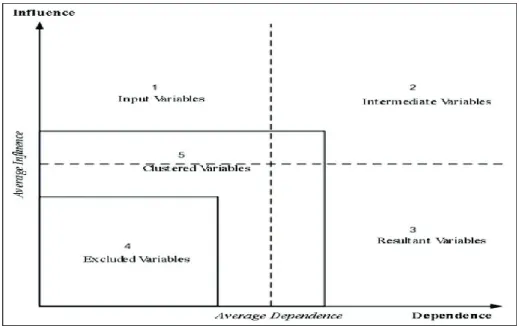
Graphs are useful in presenting the results of any system analysis. One of the outputs of MicMac software is the changes in the position of variables (driving forces) using influence – influenced graph (figure 1). In this graph, the horizontal axis shows the amount of influence for the variable while the vertical axis shows the amount of being influenced by other variables. The influence – influenced numbers are obtained from the interaction matrix. To this end, the sum for each column shows the influence of that variable while the sum of the scores for each column shows how much that variable is being influenced by other variables. A variable which directly influences a small number of other variables has a small effect on the system as a whole.
Figure 1: Influence – Influenced graph
Variables are categorized based on their position on this graph. Since this position is related to the system’s dynamics, the details for each category is presented in the following section.
First Category: Determinant or influential variables
These variables are located on the north west region of the graph (upper left quarter). These variables have the highest amount of influence and are rarely influenced by other variables. This means that system stability is dependent on these variables. Influential variables are the most critical variables for controlling the system because overall system performance is dependent on them. On the other hand, these variables are considered as inputs for the system. This category of variables usually contains environmental variables or textures which significantly affect system performance. Since these variables are located outside of the system, they can’t be controlled by the system itself.
Second category: Bidirectional variables
boomerang effects which can lead to intensification or attenuation of the initial effect.
Third category: Risk variables
These variables are located on the north eastern side of the graph in the diagonal region. These variables can potentially turn into key system variables and due to their unstable nature have the potential to act as connection points in the system.
Fourth category: Target variables
Target variables are located in the north eastern region of the graph under the diagonal line and closer to the horizontal axis. This group of variables can be considered as fulcrum points of the system due to being influenced by other variables more that influencing others. Changing these variables can result in change and development of the system in a desired direction. Therefore, these variables indicate possible targets of the system more than showing predetermined results.
Fifth category: Influenced or outcome variables
Due to low influence and high amount of being influenced, this category of variables is very sensitive to changes in other variables including influential and bidirectional variables and can be considered as system outputs. These variables are located on the south eastern region of the graph.
Sixth category: Independent or exceptional variables
This category of variables is not affected by other system variables while also having no influence on other variables. These variables have low interaction with the system and can’t result in change or development of other main variables. This category can itself be divided into two groups:
a) Discrete variables: these variables are located on the south western side of the graph and under the diagonal line. Due to the low amount of include, these variables are ineffective regarding change in system dynamics and can be removed from the system.
b) Secondary leverage variables: These are the fully independent variables which, due to their higher influence, can be used as evaluation variables. These variables are located in the south west region of the graph, above the diagonal line.
Seventh category: Regulating variables
These variables are often located at the center of the graph or very close to the center and are known as regulating variables since small changes in them can changes them into secondary leverage variables, weak target variables or influential or determinant variables (Pourmohamadi & Zali, 2010).
Findings
This study was conducted in order to answer the question of what are the key driving forces influencing the Future of Academic Libraries?
Identification of the most important influential force
Based on the literature review and survey of experts’ opinions, the driving forces influencing the future of academic libraries were identified in 9 categories and 70 items. Among these forces, “information and communication technology” with the score of 4.34 and importance coefficient of 86.87% was identified as the most influential factor. Furthermore, “environmental stability” with the score of 3.77 and importance coefficient of 75.54% was in the last place (table 2).
Table 2
Different categories of driving forces influencing the future of academic libraries
No. Factor Cronbach’s
Alpha Mean SD Importance coefficient
1 Information and
communication technology
0.902 4.344 0.736 86.87
2 Facilities and equipment 0.741 4.297 0.809 85.93
3 Social dimensions 0.871 4.273 0.791 85.46
4 Educational dimensions 0.926 4.184 0.935 83.67
5 Management and human resource development
0.929 4.176 0.847 83.52
6 Research position 0.828 4.169 0.784 83.37
7 Economic factors 0.863 4.042 0.989 80.83
8 Political factors 0.742 3.938 0.965 87.75
9 Environmental stability 0.772 3.77 0.971 75.54
The results of interaction matrix
In order to identify key driving forces influencing the future of academic libraries, MicMac software was used for data analysis. The summary of interaction matrix is shown in table 3. This matrix contains 1046 zero elements which indicate lack of interaction between two variables (70 of these 0 elements are on the main diagonal of the matrix). Furthermore, this matrix includes 2259 weak interactions, 1290 mediocre interactions and 305 strong interactions.
Table 3
Summary of elements in the interaction matrix
Index Dimension Repeats Zeros Ones Twos Threes Total Non-zero element%
Value 70×70 2 1046 2259 1290 305 4900 78.65
Categorization of interactions between Key driving forces
The result of categorization of key driving forces based on their influences and interactions are as follows:
Influential (determinant) variables
Bidirectional variables
“Development of strategic plans for libraries” is located exactly on this position while “correct management of print materials” and “use of knowledge management in library planning” are close to this position.
Risk variables
The forces of “online citation to published sources by the library”, “electronic publication”, “Production of electronic content”, “the nature of information and access methods”, “development of information and communication technologies” and “reducing the intermediary role of librarians” are close to this position.
Target variables
Six forces of “automated library services”, “development of traditional electronic service environments”, “development of text knowledge and data mining and use of large date”, “intelligence storage and optimal access to information”, “decentralization and use of mobile services” and “use of multimedia measures” are placed in this category.
Influenced or dependent variables
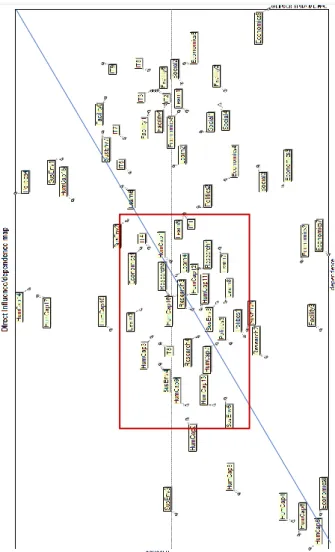
Figure 2: Distribution of driving forces in the influence – included graph based on direct interactions
Independent and exceptional variables
Among the identified driving forces, five were placed among discrete variables including: “role of library in creation and development of higher education”, “recycling management of selected books”, “importance of the library and publications in scientific development of faculty members”, “ranking systems” and “changes in payment methods for accessing information databases”.
Another fourteen variables were among secondary leverage variables including: “building architecture for maximizing space usage”, “creation of suitable interactions between employees and users”, “Motivating the employees”, “improving the position of employees to the position of research partners instead of research servants”, “implementation of suitable and effective employee evaluation systems”, “implementation of land usage for library purposes”, “use of strategic and innovative methods for filling vacant or empty positions”, “prioritizing organizational factors in improving employee efficiency”, and “use of outsourcing instead of hiring in unprofessional positions”.
Regulating variables
A total of twenty-seven driving forces were identified in this category, including “embracing change by employees”, “being calculated in per-capita educational environment statistics”, “updated library employees in regards to relevant professional knowledge”,
“construction of environmentally friendly spaces and use of clean energy”, “internet usage rate and its quality”, “the role of libraries in display of academic ranking of universities”, “being calculated in per-capita research space statistics”, “implementation of suitable and efficient evaluation systems for employees”, “attention toward international students”, “holding short-term educational programs and issuing certificates by the library”, “use of books instead of class notes”, “spread of service ethics among employees”, “the role of libraries in displaying the academic ranking of the country”, “variety of specialties among employees in order to facilitate various research activities”, “cooperation of employees in library management through the use of cooperative management approaches such as suggestion system”, “playing the role of one of the pillars of educational system”, “providing basic textbooks”, “financial independence of the library”, “the situation related to information and communication technology infrastructures of the library”, “training and education in project management methods and use of proper tools in library organization”, “supervision on collections”, “the role of libraries in students’ success”, “commitment to stable scientific and research information ecosystem”, “use of cloud computing services”, “cooperation with activities related to students’ learning” and “interaction between library, faculty members and students”.
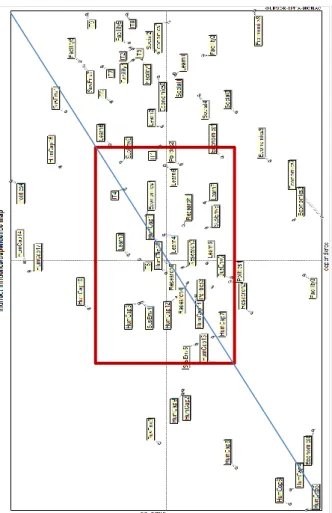
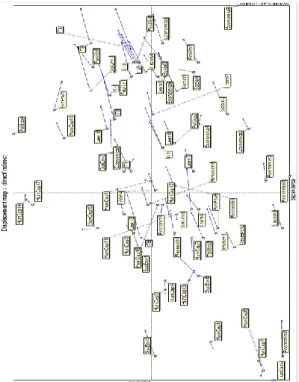
Figure 3 shows the distribution of factors affecting the future of academic libraries using influence – influenced graph for indirect interactions. Changes in these factors compared to the results for direct interactions are presented in figure 4. These changes were very small and no significant changes in rankings or categorization of factors was observed.
Figure 4: Changes in distribution of driving forces between direct and indirect interactions
Selecting key driving forces influencing the future of academic libraries
Based on the main aim of this study and the large number of driving forces identified (70 variables), high complexity and lack of an applicable result at the end of analysis, the table for ranking the direct and indirect interactions between driving forces divided by influencing or being influenced was used. Table 4 shows that until rank 13 in the table, there is a certain order among the driving forces seen in table’s columns. In this stage and for the development of forecasting scenarios, these thirteen driving forces were selected as key driving forces. It is evident that other factors are also used in analysis of scenarios and final conclusion.
Table 4
Ranking of interactions between driving forces
Rank Direct Indirect
Variable Influencing variable Influenced Variable Influencing variable Influenced 1 Politics4 251 Economics
9 205 Politics4 245
Economic
s9 200
2 HumCap1
4 243
Economics
5 191
HumCap1
4 236 IT9 199
3 HumCap1
7 238 IT9 191
HumCap1
7 233 IT8 199
4 SusEnv1 222 IT8 189 HumCap1
5 214
Economic
s5 197
5 HumCap1
5 215 Social2 185 SusEnv1 210 Facility5 191
6 SusEnv7 196 IT2 184 Facility6 201 IT3 189
7 IT9 196 IT3 184 SusEnv7 199 IT2 189
8 Facility6 194 Facility2 184 IT9 197 Social2 188
9 HumCap1
0 191 Facility5 184
HumCap1
Rank Direct Indirect
Variable Influencing variable Influenced Variable Influencing variable Influenced
10 Learn5 184 Facility6 182 IT7 187 Facility4 186
11 IT7 182 Social4 180 Learn5 182 Facility1 186
12 SusEnv2 180 Facility4 180 IT6 181 Facility6 186
13 IT6 179 Economics
6 179 SusEnv2 175 SusEnv7 184
As can be seen in table 2, the study of 13 key driving forces based on their direct and indirect interactions showed that these forces are repeated in both factors and only in some cases, their ranking has changed. This confirms the validity, accuracy and reliability of the calculations. The studies on influential key driving forces based on influenced ranking shows that among these 13 key driving forces, 12 have been repeated and only one variable shows any changes.
Among the 13 key driving forces, the scores for correct management of print materials, preparation of textbooks, electronic publication, preparation of strategic plans for libraries, embracing change by employees, compatibility between library manager’s specialty and librarianship and information science, use of knowledge management in library planning, systemic and creative management, preparation of electronic content, nature of information and access methods, development of information and communication technologies and reduced intermediary role of librarians, role of libraries as a pillar of educational system were all repeated in direct and indirect interactions for influencing or being influenced with only changes in their rankings.
Discussion and conclusion
In the environment category, “Acquisition of basic textbooks” is one of the other key driving forces influencing the future of academic libraries. Libraries play an active role in acquisition of educational resources and necessary textbooks in institutes. However, this role must become more effective. This effect can be achieved by offering consultation to faculty members regarding newer and more cost-effective sources. This will help turn the library into a source for meeting educational needs (Feret & Marcinek, 1999). “Electronic publication” is one of the other driving forces affecting the future of academic libraries. Acquisition of electronic resources and necessary tools for providing electronic services to library’s customers is one of the most important approaches in future libraries. Allen, & Seaman, (2014) believe that advantages of electronic publication include income generation through sale of electronic products, reduced cost due to shared use, possibility of interuniversity interactions for use of costly electronic resources and improved position of the institute in regards to its electronic resources.
Among the political factors, “development of strategic plans for libraries” was among the key driving forces. It can be said that any strategic planning requires forecasting and information regarding future trends. Since environments can change constantly, it is necessary for strategic plans to also change in order to accommodate and balance these external changes. In this regard, Hayes and (Al Hijji, 2014; Düren, 2010; Hayes & Walter, 1996; Mason, 1999), Düren (2010) and Al Hijji (2014) emphasized the importance of strategic planning for libraries in their studies. Therefore, in order to achieve desirable situations in academic libraries, it is necessary for university’s senior management to recognize existing strategic plans and monitor their implementation and progress.
Four key variables were selected among management and human resource development category. “Embracing change by employees” was one of the key driving forces selected from this category. Librarians and other staff members in academic libraries must seek to develop new skills along with providing traditional library services in order to prepare themselves for new roles in the future. Improving one’s organizational position and financial bonuses is one of the methods used for creating motivation among staff members regarding organizational changes. Baughman (2012) believed that factors such as in-service training, planning, and monitoring and guiding staff members regarding the use of their new knowledge and novel technologies are useful in creating acceptance for new conditions. Bozkurt, Okur, & Karadeniz (2016) also investigated the attitude of academic libraries regarding their future position based on technological changes and showed a significant effect for internal factors on librarians’ positive attitude. An important point is that librarians are knowledgeable regarding the conditions governing their profession and its close relation with novel technologies and often attempt to adapt to these changes.
managers of academic libraries also confirm these results. Under these conditions, the main aim of management is to use the existing opportunities and situations for the duration of his tenure in this position. However, improving the situation of academic libraries can only be achieved through the use of individuals with knowledge regarding information science and scientometrics at management positions of academic libraries (Moore & Pearce, 2017).
“Use of knowledge management in library planning” was another driving force of this category. Knowledge management includes gathering of knowledge, logical capabilities and experiences of members in an organization in order to make it possible to recycle and use these organizational resources. In other words, knowledge management emphasizes on storage and reuse of professional information (Branin, 2003). What makes the use of knowledge management in academic libraries significantly more important is the fact that the responsibility for providing knowledge management services in institutes falls to libraries. Therefore, before provision of such services, libraries must have successful experiences in this regard and actualize the definition of knowledge management by creating a knowledge database and knowledge sharing between libraries staff members and customers (Shanhong, 2000).
The final supporting driving force identified in this category was “systemic thinking and creativity of library managers”. Systemic thinking is an approach which considers the entirety of a problem and emphasizes on the interactions between different parts instead of investigating each part separately. This approach, instead of trying to divide the system into different parts for separate analysis, attempts to understand the interactions between all parts of the system (Senge, 2006). This approach results in a comprehensive outlook of the problem. Investigating the dimensions of systemic thinking in Iranian academic libraries is not unheard of. For example, the results of the study by Nemati (2018) on the effect of systemic thinking of central public library managers of Tehran on job satisfaction of librarians confirm the results of the current study.
Driving forces identified in information and communication technology category included “production of electronic content”, “development of information and communication technologies and reduction of librarians’ intermediary role”, and “online citation to publishing source by the library”. Although production of electronic content is not the main goal of academic libraries, it can be a powerful tool for their development. Electronic content is an important part of collections and an archive whose importance has increased in recent years, with a large volume of resources at organizational, regional, national and international levels being used for production, storage, and distribution of these resources. The strategic value of electronic content is due to its fluidity, updated nature, and its ability to answer essential information needs and providing various occupations as intellectually energizing factor (Dulock & Long, 2015). Having a desirable situation in this factor will increase the emphasize on production of electronic resources and sharing them. This approach along with possible income generation (to be used for achieving organizational goals) can create a share for libraries in the production and distribution market for electronic resources and enables libraries to act as the base for teaching methods of production for these resources in their organization.
library software. Third generation are the electronic libraries which existed along physical libraries and became possible due to development of library software applications and electronic resource services. Fourth generation are digital libraries which added digital resources including texts, pictures, sound, movies, and maps to library software in order to facilitate quick and easy access to these resources. Finally, fifth generation libraries are virtual libraries which lack any defined physical location and use links to digital documents to provide an organized collection of links to documents, software, pictures, databases and other resources in a distribution network. Libraries with good situation in this variable, the entire library services are provided by information and communication systems which also minimizes the role of librarians. In these libraries, librarians take up new roles which are known as knowledge workers in information science literature.
“Online citation to publishing source by the library” is one of the other driving forces influencing the future of academic libraries. Today, one of the factors used to evaluate the importance of a scientific research is the number of citations it received from other credible studies. Therefore, the majority of databases pay a great deal of attention to citation and use various methods for registering and reporting citations. In this regard, libraries are in a suitable situation and can act as an active member or partner of credible scientific databases and use the facilities provided by these databases to distribute their own publications and monitor their citations.
The driving force of “nature of information and access methods” was selected from facilities and equipment category. In this regard, Manjunatha and Shivalingaiah (2003) stated that information overload, information quality, information management and access speed are among the main topics of information technology worldwide. Lack of attention to these factors can be dye to traditional and outdated services of libraries. If library services are limited to lending books and provision of newspapers and journals for their customers, it is probable that no attention will be paid to the nature of information and creation of various methods for accessing the information. Libraries must understand the nature of different types of information and have systems in place for storage and sharing of different information. They also must understand the behaviors and interests of their customers in order to meet their information needs. Attention to this driving force makes libraries more sensitive to their audiences and helps them monitor their information seeking behaviors. This in turn helps with creation of necessary infrastructures for providing data storage and management services for researchers while also providing them with suggestions regarding information sources. Such suggestions can be delivered even if the customer doesn’t visit the library.
system. Under these conditions, libraries are created simply for their presence in the organizational structure, various unrelated duties are defined for libraries and it is possible for parts of the library space to be partitioned and delivered to other units. Furthermore, under these conditions, inefficient and ineffective personnel are exiled to libraries. Libraries can have suitable situations and reputation when they play an active role in educational planning and act as an effective consultant for providing faculty members with useful suggestions regarding educational resources. Under these conditions, library staff have the necessary education and scientific standing and libraries provide independent training and education in the institute.
Acknowledgements
The data used in this manuscript were obtained from a PhD thesis at Azad University, Hamedan Branch. We thank Dr. Mohammad Abasi for assistance with methodology, and Dr. Mohammad Rafati for comments that greatly improved the manuscript.
References
Al Hijji, K. Z. (2014). Strategic management model for academic libraries. Procedia-Social and Behavioral Sciences, 147, 9-15.
Allen, I. E., & Seaman, J. (2014). Opening the Curriculum: Open Educational Resources in US Higher Education. Retrieved from http://www.onlinelearningsurvey.com/reports/ openingthecurriculum2014.pdf
Asan, S. S., & Asan, U. (2007). Qualitative cross-impact analysis with time consideration.
Technological Forecasting and Social Change, 74(5), 627-644.
Baughman, M. S. (2012). Research Library Issues: A Quarterly Report from ARL, CNI ,and SPARC. RLI 278. Association of Research Libraries.
Bowlby, R. (2012). Living the future: Organizational performance assessment. Journal of Library Administration, 52(6-7), 626-652.
Bozkurt, A., Okur, M. R., & Karadeniz, A. (2016). Use of digital books at academic level: Perceptions, attitudes and preferences of post-graduate students. Journal of Human Sciences, 13(1), 663-673.
Branin, J. J. (2003). Knowledge management in academic libraries: building the knowledge bank at the Ohio State University .Journal of Library Administration, 39(4), 41-56. Corrall, S. (1995). Academic libraries in the information society. New Library World, 96(3),
35-42.
Dulock, M., & Long, H. (2015). Digital collections are a sprint, not a marathon: Adapting Scrum project management techniques to library digital initiatives. Information Technology and Libraries, 34(4), 5-17.
Düren, P. (2010). Public management means strategic management: how can libraries fulfil the requirements of the new public management? Library management, 31(8), 162-168. Feret, B., & Marcinek, M. (1999). The future of the academic library and the academic librarian:
a Delphi study. Librarian Career Development, 7 (10), 91–107.
Ghafari, G. J., Roshandel, A. T., & Ziai, M. S. (2013). Possible scenarios for the future of iran's public libraries media. Research on Information Science and Public Libraries,19 (47), 295-328.
Godet, M., & Coates, J. (1994) From anticipation to action: A handbook of strategic prospective. Paris: Unesco Publishing.
Hararti, H. (2016). Impact of information technology and computer on knowledge and information science with an emphasis on Libraries software of Ferdowsi University of Mashhad. Scholarly Communication (Ertebatat-e-elmi), 40(1), 2-16. [in Persian]
Hayes, R. M., & Walter, V. A. (1996). Strategic Management for Public Libraries: A Handbook. Greenwood Publishing Group.
Jones, K. M., & Salo, D. (2017). Learning analytics and the academic library: Professional ethics commitments at a crossroads. College & Research Libraries, 79(3), 304-323. Kaur, B. (2018). Cloud Computing and Its Use in Libraries. Journal of Advancements in Library
Sciences, 5(3), 46-48.
Kaushik ,A., & Kumar, A. (2016). Application of cloud computing in libraries. International Journal of Information Dissemination and Technology, 3(4), 270-273.
Kubat, G. (2017). The mobile future of university libraries and an analysis of the Turkish case.
Information and Learning Science, 118(3-4), 120-140. Kyrillidou, M. (2009). ARL Statistics 2007-2008: ERIC.
Lewis, D. W. (2007). A strategy for academic libraries in the first quarter of the 21st century. College & Research Libraries, 68(5), 418-434.
Manjunatha, K., & Shivalingaiah, D. (2003). Information access in libraries. Annuals of Library and Information Studies, 50(2), 85-90.
Martell, C. (2008). The absent user: Physical use of academic library collections and services continues to decline 1995–2006. The Journal of Academic Librarianship, 34(5), 400-407. Mason, M. G. (1999). Strategic management for today's libraries. American Library
Association.
Mavodza, J. (2013). The impact of cloud computing on the future of academic library practices and services. New Library World, 114(3-4), 132-141.
McKnight, S. (2010). Envisioning future academic library services: initiatives, ideas and challenges. Facet Publishing.
Miller, R. G., Knapp, A., & Wood, E. J. (2007). Beyond survival: Managing academic libraries in transition. Libraries unlimited.
Moore, R., & Pearce, A. (2017). Management Survival Skills: Managing as a Non Librarian in an Academic Library [PowerPoint Slides]. SlideShare https://macsphere.mcmaster.ca/
bitstream/11375/21089/1/Management%20Survival%20Skills%20-%20OLA%20Presentation.pdf
Nemati, S. (2018). The Effect of Systemic Thinking on Central Library Librarians in Tehran State University on the Job Satisfaction of Librarians. M.A. thesis, Teran: Alzahra University [in Persian]
Pourmohamadi, M., & Zali, N. (2010). Regional disparities analysis and development foresight (Case study: East Azerbaijan province). Journal of Geography and Planning, 15(32), 29-64. [in Persian]
Roy, L., & Hallmark, E. K. (2017). Charting a multi-dimensional role of future librarians.
Library management, 38(6-7), 302-311.
Senge, P. M. (2006). The fifth discipline: The art and practice of the learning organization: Broadway Business. London: Doubleday
Council and General Conference. Retrieved from https://archive.ifla.org/IV/ifla66 /papers/057-110e.htm
Sidorko, P. E. (2007). Fostering innovation in library management and leadership: the university of Hong Kong libraries leadership institute. Library management, 28(1-2), 5-16.
Simmons-Welburn, J., Donovan, G., & Bender, L. (2008). Transforming the library: The case for libraries to end incremental measures and solve problems for their campuses now.
Library Administration &Management,22(3), 130-134.
Wada, I. (2018). Cloud computing implementation in libraries: A synergy for library services optimization. International Journal of Library and Information Science, 10(2), 17-27. Walther, J. H. (2018). Developing Personal Course Plans (PCPs) as an Example of