Sergio D’Addato
1, A, F, Arrigo F. G. Cicero
1, C, D, F, Martina Rosticci
1, B, F,
Alessandra Reggi
1, D, F, Sandra Cristino
2, B, F, Ada Dormi
1, C, F, Claudio Borghi*
, 1, E, FSerum Proinflammatory Chemokines
in Healthy Elderly Taking or not Taking Simvastatin
– Data from the Brisighella Heart Study**
1 Medicine and Surgery Sciences Department, University of Bologna, Italy
2 Biological, Geological and Environmental Sciences Deptartment, University of Bologna, Italy
A – research concept and design; B – collection and/or assembly of data; C – data analysis and interpretation;
D – writing the article; E – critical revision of the article; F – final approval of article; G – other
Abstract
Background. Recent preclinical evidence and data from adult subjects suggests that statins could improve the proinflammatory profile of hypercholesterolemic subjects.
Objectives. We aim to compare the serum levels of a set of proinflammatory chemokines in elderly statistical twins taking or not taking statins.
Material and Methods. Among the historical cohort of the Brisighella Heart Study, we chose 40 healthy elderly subjects continuously treated with statins for at least 1 year and 40 cross-matched subjects not treated with statins (M : F = 1 : 1) characterized by similar age, body mass index (BMI), leisure-time and working activity, smoking habits, history of cardiovascular disease, systolic and diastolic blood pressure, fasting plasma glucose, plasma lipids, uric acid, and creatinine.
Results. The proinflammatory chemokine serum level is similar in statin untreated and treated statistical twins. The OR to have a serum level of monocyte chemoattractant protein (MCP-1) lower than the 50th percentile of the
dis-tribution in statin-treated subjects compared to the statin untreated subjects is 0.669 (95% CI 0.193; 2.327), the OR for interleukin-8 (IL-8) = 0.818 (95% CI 0.236; 2.835), the OR for γ-interferon inducible protein-10 (IP-10) = 1.361 (95% CI 0.358; 5.175), and for interleukin-18 (IL-18) = 0.545 (95% CI 0.155; 1.914).
Conclusions. In relatively healthy, elderly subjects selected from a randomized general population sample, we did not observe differences in the serum levels of the selected set of proinflammatory chemokines in statin treated and untreated subjects with similar LDL-C level, suggesting that cholesterol reduction per se could be a main determi-nant of statin anti-inflammatory effects (Adv Clin Exp Med 2014, 23, 5, 723–728).
Key words: chemokines, interleukin-8, interleukin-18, monocyte chemoattractant protein, statins.
Adv Clin Exp Med 2014, 23, 5, 723–728 ISSN 1899–5276
ORIGINAL PAPERS
© Copyright by Wroclaw Medical University
Atherosclerosis is a predominantly age-related and multifactorial disease that appears to be caused by lipid retention and LDL enzyme-mediated mod-ification and oxidation, which provoke chronic in-flammation at susceptible sites in the walls of all major conduit arteries [1]. In particular, activated endothelial cells lead to the up-regulation of cell ad-hesion molecules and chemokines, mediating the re-cruitment of circulating monocytes, whose accumu-lation together with monocyte-derived phagocytes
in the wall of large arteries stimulates chronic in-flammation and the progression of atherosclero-sis [2]. Monocyte accumulation and activation ap-pears to play a key role in the loss of collagen in the plaque fibrous cap, a prelude to fibrous cap rupture through the release of collagen degrading enzymes. It is also associated with the death of collagen syn-thesizing smooth muscle cells, which further con-tributes to the loss of fibrous cap integrity [3]. From the earliest stages of the disease, the involvement of
* For the Brisighella Heart Study Group.
the immune system is impressive, with the presence of T- and B-lymphocyte aggregates in the adventi-tia and with particularly aggressive T-cell activity, leading to a consequent pleiotropic proinflamma-tory imbalance with systemic damaging effects [4]. Most of these processes are mediated by proinflam-matory chemokines that could be involved in ath-erogenesis since the earliest phases of disease de-velopment. In fact, proinflammatory chemokines have been associated, in specific categories of pa-tients, with some well-known cardiovascular risk factors such as cigarette smoking [5], arterial hy-pertension [6], obesity and dyslipidemia [7], insu-lin-resistance and diabetes [8]. In particular, mono-cyte chemoattractant protein (MCP-1) is strongly related to atherosclerosis development [9] and its plasma levels are significantly linked to coronary artery disease, starting to increase as early as 3 h af-ter the onset of chest pain [10], while MCP-1 and interleukin 8 (IL-8) are mostly associated with the components of the metabolic syndrome [11]. Inter-leukin 18 (IL-18), either directly or through metal-loproteinase expression induction, has the capaci-ty to alter endothelial function and even to induce endothelial cell death or vascular smooth muscle cell migration and/or proliferation [12]. Converse-ly, a healthy lifestyle, and in particular physical ac-tivity, is linked to the reduction of MCP-1 and IL-8 serum levels [13]. Similarly, MCP-1 serum level is reduced in humans assuming inhibitors of the 3-Hydroxy-3-Metil-Glutaryl-Coenzime A reduc-tase (statins) [14, 15]. The aim of our study was to evaluate the serum level of a set of proinflammato-ry chemokines in elderly statistical twins taking or not taking simvastatin.
Material and Methods
Brisighella Heart Study
The Brisighella Heart Study is a prospective, population-based longitudinal epidemiological cohort study carried out continuously since 1972 in accordance with the principles of the Helsin-ki Declaration and after the approval of the lo-cal Ethics Committee. It started in 1972, involv-ing 2939 randomly selected participants, aged 14 to 84 years, residents in the northern Italian ru-ral village of Brisighella. The requirement to be in-cluded was the absence of cardiovascular disease at enrollment. Each participant was first clinically ex-amined at the beginning of the study and then ev-ery 4 years, together with the collection of fasting blood samples, the registration of his or her nutri-tional habits and the assessment of morbidity and all-cause mortality [16].
Subject Selection
In this study we selected from the cohort da-tabase 40 overall-healthy, elderly subjects, contin-uously treated with simvastatin 20 mg for at least 1 year, and 40 statistical twins not treated with statins, characterized by similar age, body mass index (BMI), leisure-time and working activi-ty, smoking habits, history of cardiovascular dis-ease, systolic and diastolic blood pressure, fasting plasma glucose, total cholesterol, LDL-cholester-ol, HDL-cholesterLDL-cholester-ol, triglycerides, uric acid, and creatinine. The sex distribution was also balanced (M : F = 1 : 1). We selected patients taking simv-astatin 20 mg, because it was the most used statin in subjects with the defined inclusion and exclu-sion criteria.
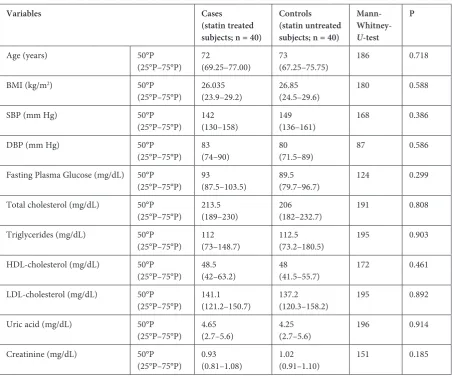
Heavy smokers (> 10 cigarette/day), diabetics, patients affected by cardiovascular disease, cancer or rheumatologic/autoimmune disorders or taking drugs potentially affecting proinflammatory che-mokine serum level (anti-inflammatory drugs, cor-ticosteroids, angiotensin II receptor blockers) were excluded from subject selection. The main charac-teristics of the considered sample are presented in Table 1. The enrolled subjects were overall repre-sentative of the historical cohort of the Brisighella Heart Study.
Laboratory Data
Standard biochemical exams were carried out with standardized methods, as largely reported in previous literature [16, 17].
The serum level (100 µL) of IL-8, MCP-1, IP-10 and IL-18 were measured by the use of a custom 4-plex proteomics platform following the manu-facture’s protocol (Bio-Rad Laboratories, Inc. Life Science Research Group, Hercules, CA, USA). Multiplex proteomics is the newest technique em-ployed to measure multiple biomarkers in various samples. This technology utilizes microspheres as the solid support for a standard sandwich immu-noassay. Each microsphere is labeled with a differ-ent fluorophore and the combination of differdiffer-ent beads makes it possible to simultaneously measure protein markers [18].
Statistical Analysis
A complete descriptive analysis was carried out for all the available variables. Since the normality distribution tests showed that most of the available continuous variables were not normally distributed, non-parametric tests were used (the Mann-Whitney
ratios were calculated for qualitative parameters or for measures split over median value. A first type error p < 0.05 was accepted. All statistical analyses were carried out with SPSS.17.0 for Windows.
Results
As reported in Table 1, the simvastatin treated and statin untreated subjects were matched by age, BMI, systolic and diastolic blood pressure, fasting plasma glucose, total cholesterol, LDL-cholesterol, HDL-cholesterol, triglycerides, uric acid, and creat-inine. Moreover, they were also matched as regards physical activity in leisure-time (chi-square = 3.782, p = 0.286) because all except one in every group were pensioners (Fisher test p = 1), smoking habits (chi-square = 1.222, p = 0.543), and history of cardiovas-cular disease (Fisher test p = 0.695). In particardiovas-cular, while 3 subjects per group were mild smokers (< 10 cigarette/day), there were 3 ex-smokers in the statin-treated group and 4 in the statin-unstatin-treated one.
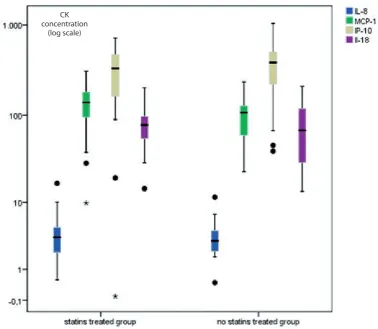
The proinflammatory chemokine serum level was similar in statin untreated and treated statis-tical twins (Fig. 1). The OR to have a serum level of MCP-1 lower than the 50th percentile of the
dis-tribution in simvastatin-treated subjects compared to the statin-untreated subjects was 0.669 (95% CI 0.193; 2.327), the OR for IL-8 = 0.818 (95% CI 0.236; 2.835), the OR for IP-10 = 1.361 (95% CI 0.358; 5.175), and for IL-18 = 0.545 (95% CI 0.155; 1.914).
Taking into consideration the levels of LDL-C, they were normal in all except one of our subjects. We split the subjects over the median in higher and lower LDL-C level groups. No statistically sig-nificant difference was revealed in chemokine lev-els between the 2 groups, even after correction for statins treatment.
The ORMH for lower LDL-C/higher LDL-C
cor-rected for statin treatment were: for MCP-1 = 0.839 (95% CI 0.247; 2.854), the OR for IL-8 = 0.700 (95% CI 0.203; 2.410), the OR for IP-10 = 0.341 (95% CI 0.088; 1.320), and for IL-18 = 0.429 (95%
Table 1. Clinical characteristics of the elderly subjects selected for the study
Variables Cases
(statin treated subjects; n = 40)
Controls (statin untreated subjects; n = 40)
Mann-
Whitney-U-test
P
Age (years) 50°P
(25°P–75°P) 72(69.25–77.00) 73(67.25–75.75) 186 0.718 BMI (kg/m2) 50°P
(25°P–75°P) 26.035(23.9–29.2) 26.85(24.5–29.6) 180 0.588 SBP (mm Hg) 50°P
(25°P–75°P) 142(130–158) 149(136–161) 168 0.386 DBP (mm Hg) 50°P
(25°P–75°P) 83(74–90) 80(71.5–89) 87 0.586 Fasting Plasma Glucose (mg/dL) 50°P
(25°P–75°P) 93(87.5–103.5) 89.5(79.7–96.7) 124 0.299 Total cholesterol (mg/dL) 50°P
(25°P–75°P) 213.5(189–230) 206(182–232.7) 191 0.808 Triglycerides (mg/dL) 50°P
(25°P–75°P) 112(73–148.7) 112.5(73.2–180.5) 195 0.903 HDL-cholesterol (mg/dL) 50°P
(25°P–75°P) 48.5(42–63.2) 48(41.5–55.7) 172 0.461 LDL-cholesterol (mg/dL) 50°P
(25°P–75°P) 141.1(121.2–150.7) 137.2(120.3–158.2) 195 0.892 Uric acid (mg/dL) 50°P
(25°P–75°P) 4.65(2.7–5.6) 4.25(2.7–5.6) 196 0.914 Creatinine (mg/dL) 50°P
(25°P–75°P) 0.93(0.81–1.08) 1.02(0.91–1.10) 151 0.185
CI 0.117; 1.571). Consequently, no statistically sig-nificant correlation was observed between LDL-C and chemokine serum level in simvastatin treated and untreated subjects.
Discussion
Systemic inflammation is a typical character-istic of ageing humans, and commonly it seems to be independent of BMI, blood pressure and lipid levels [19], except for the result of a study carried out on a sample of young people in which IL-8 ap-peared to be associated with systolic blood pres-sure [20]. Inflammation biomarkers; however, have only a small impact on increasing the role of traditional risk factors to predict coronary events in elderly patients [21]. A large body of evidenc-es suggevidenc-ests that the preventive action of statins against cardiovascular diseases is related not only to their cholesterol-synthesis inhibition, but also to a range of non-lipid effects, named “pleiotropic ef-fects”, and in particular to their anti-inflammato-ry action [22, 23]. Recently, it has also been pro-posed that the anti-inflammatory action of statins has a role in improving lung diseases too [24]. On
the other hand, some authors support the hypoth-esis that the anti-inflammatory effect of statins is directly mediated by their reducing action on plas-ma LDL cholesterol [25]. In this context, we tried to observe if, at the same level of LDL-cholester-ol, subjects treated with simvastatin have or do not have the same level of proinflammatory chemo-kines as the untreated subjects. Selecting very sim-ilar subjects for a relatively large number of clinical characteristics, what we called “statistical twins”, we observed that no difference exists in proinflam-matory chemokine levels between the groups stud-ied. Our results suggest that having a similar LDL- -cholesterol level is per se responsible for the lack of difference in the proinflammatory chemokine level. This result puts in perspective the potential relevance of the statin pleiotropic effects, suggest-ing that statins play a role in reducsuggest-ing the chemo-kine levels only through their well-known choles-terol-lowering effect.
Some studies show that MCP-1, IL-18 and other chemokines serum level is also significant-ly related to patient age [19]. We were not able to observe this difference, probably because of the rel-atively small sample size of our study and because of the narrow age interval of the elderly patients we
Fig. 1. Boxplot of chemokine concentration in statins treated and untreated, overall healthy, elderly patients (black points represent the extremes, stars represent the outliers). MCP-1 – monocyte chemoattractant protein; IL-8 – inter-leukin 8; IP-10 – γ-interferon inducible protein-10; IL-18 – interinter-leukin 18
CK concentration
selected. Moreover, beyond clinical variables, the serum concentration of MCP-1 (and presumably of other chemokines) is also strongly related to in-dividual genetic pattern [26]. On the other hand, in contrast to some authors who analyzed a sam-ple of post myocardial infarction patients [27], our data agrees with those of Njemini et al., who ob-served no difference in chemokine levels between genders [28]. A number of studies have reported that statins’ anti-inflammatory effects are mediat-ed by inhibition of isoprenylation, due to block-age of isoprenoid synthesis. These intermediary metabolites of cholesterol synthesis play a role in protein attachment to cellular membranes, which determines their biological activity. The best char-acterized targets of statins’ inhibition of isoprenyl-ation are small GTPases which mediate signaling involved in inflammatory cell activation and che-mokine secretion: these effects appear to be direct-ly related to the statin antihypercholesterolemic power [29].However, the observation of our da-ta in elderly subjects da-taking low doses of moder-ately powerful statins suggests that cholesterolemia per se could be a main determinant of serum level of proinflammatory chemokines.
Our study, therefore, has several limitations. The first one is the relatively small sample size. However, subjects were matched according to a very large number of anagraphical and clinical data, so that the groups could be considered statis-tical twins. Moreover, we excluded those subjects whose proinflammatory chemokine level could have been significantly modified by diseases or pharmacological therapy and we focused our at-tention on elderly patients. On the other hand, this
probably limits the extension of our results to only specific subjects, and not to a general elderly pop-ulation, which is usually affected by more diseases at the same time. In addition, we limited our study to subjects taking simvastatin, which was; howev-er, the most prescribed statin in our cohort of sub-jects. Furthermore, as per the study design, we had information on the drug assumption by the volun-teers, but we had no direct way to check their com-pliance to the treatment, apart from verifying the continuity of prescription by the general physician and the congruity of the actual LDL-C level vs. the basal one. Another limitation is that we measured only a few chemokines, while many others could be evaluated. However, this is a preliminary report and majority of clinical studies showing a modu-lating effect of statins on proinflammatory chemo-kines measured only MPC-1 [14]. Moreover, the strong selection of relatively healthy, elderly sub-jects has reduced the representativity of the sam-ple when compared to the general population. On the other hand, to the best of our knowledge, this is the first observation of such statin effects in an elderly patient sample.
In conclusion, in elderly statistical twins select-ed from a randomizselect-ed general population sample, we did not observe significant differences in the se-rum levels of a set of proinflammatory chemokines (MCP-1, IP-10, IL-8, IL-18) in simvastatin treated and untreated subjects with similar LDL-C level. Although this early observation has to be repeated on larger patient samples, it contributes to putting in perspective the potential relevance of the statins’ pleiotropic effects beyond their well-known ability to reduce LDL-cholesterolemia.
Acknowledgements. We particularly acknowledge Marina Giovannini, Elisa Grandi and Elisabetta Rizzoli for their sup-port of the Brisighella Heart Study laboratory activity. We also thank the Faenza public health district and all the General Practitioners of Brisighella for their continuous support of the study. Finally, we are grateful to Martino Morbini for the English-language revision.
References
[1] Wang JC, Bennett M: Aging and atherosclerosis: mechanisms, functional consequences, and potential therapeu-tics for cellular senescence. Circ Res 2012, 111, 245–259.
[2] Moore KJ, Tabas I: Macrophages in the pathogenesis of atherosclerosis. Cell 2011, 145, 341–355.
[3] Shah PK: Inflammation and plaque vulnerability. Cardiovasc Drugs Ther 2009, 23, 31–40.
[4] Campbell KA, Lipinski MJ, Doran AC, Skaflen MD, Fuster V, McNamara CA: Lymphocytes and the adventitial immune response in atherosclerosis. Circ Res 2012, 110, 889–900.
[5] Halvorsen B, Lund Sagen E, Ueland T, Aukrust P, Tonstad S: Effect of smoking cessation on markers of inflam-mation and endothelial cell activation among individuals with high risk for cardiovascular disease. Scand J Clin Lab Invest 2007, 67, 604–611.
[6] Antonelli A, Fallahi P, Ferrari SM, Ghiadoni L, Virdis A, Mancusi C, Centanni M, Taddei S, Ferrannini E:
High serum levels of CXC (CXCL10) and CC (CCL2) chemokines in untreated essential hypertension. Int J Immunopathol Pharmacol 2012, 25, 387–395.
[7] Gutierrez DA, Puglisi MJ, Hasty AH: Impact of increased adipose tissue mass on inflammation, insulin resis-tance, and dyslipidemia. Curr Diab Rep 2009, 9, 26–32.
[9] Yadav A, Saini V, Arora S: MCP-1: chemoattractant with a role beyond immunity: a review. Clin Chim Acta 2012, 411, 1570–1579.
[10] Shantsila E, Lip GY: Monocytes in acute coronary syndromes. Arterioscler Thromb Vasc Biol 2009, 29, 1433–1438.
[11] Gustafson B: Adipose tissue, inflammation and atherosclerosis. J Atheroscler Thromb 2010, 17, 332–341.
[12] Valente AJ, Yoshida T, Murthy SN, Sakamuri SS, Katsuyama M, Clark RA, Delafontaine P, Chandrasekar B:
Angiotensin-II enhances AT1-Nox1 binding, and stimulates arterial smooth muscle cell migration and prolifera-tion through AT1, Nox1, and interleukin-18. Am J Physiol Heart Circ Physiol 2012. [Ahead of print]
[13] Trøseida M, Lappegardab KT, Mollnes TE, Arnesen H, Seljeflot I: The effect of exercise on serum levels of inter-leukin-18 and components of the metabolic syndrome. Metab Syndr Relat Disord 2009, 7, 579–584.
[14] Nomura S, Shouzu A, Omoto S, Inami N, Shimazu T, Satoh D, Kajuyra T, Yamada K, Urase F, Maeda Y, Iwasaka T: Effects of pitavastatin on monocyte chemoattractant protein-1 in hyperlipidemic patients. Blood Coagul Fibrinolysis 2009, 20, 440–447.
[15] Krysiak R, Gdula-Dymek A, Scieszka J, Okopien B: Anti-inflammatory and monocyte-suppressing effects of simvastatin in patients with impaired fasting glucose. Basic Clin Pharmacol Toxicol 2011, 108, 131–137.
[16] Cicero AF, Salvi P, D’Addato S, Rosticci M, Borghi C: Association between serum uric acid, hypertension, vas-cular stiffness and subclinical atherosclerosis: data from the Brisighella Heart Study.J Hypertens 2014, 32, 57–64.
[17] Cicero AFG, D’Addato S, Santi F, Ferroni A, Borghi C: Leisure-time physical activity and cardiovascular disease mortality: the Brisighella Heart Study. J Cardiovasc Med 2012, 13, 559–564.
[18] Leng XS: Multiplex technologies for cytokine measurement in inflammation and aging research. J Gerontol A Biol Sci Med Sci 2008, 63, 879–884.
[19] Miles EA, Rees D, Banerjee T, Cazzola R, Lewis S, Wood R, Oates R, Tallant A, Cestaro B, Yagoob P, Whale KW, Calder PC: Age-related increases in circulating inflammatory markers in men are independent of BMI, blood pressure and blood lipid concentrations. Atherosclerosis 2008, 196, 298–305.
[20] Ognjanovic S, Jacobs DR, Steinberger J, Moran A, Sinaiko AR: Relation of chemokines to BMI and insulin resis-tance at ages 18–21. Int J Obes 2012 Apr 17. Doi: 10.1038/ijo.2012.61.1 [Epub ahead of print]
[21] Rodondi N, Marques-Vidal P, Butler J, Sutton-Tyrrell K, Cornuz J, Satterfield S, Harris T, Bauer DC, Ferrucci L, Vittinghoff E, Newman AB: Markers of Atherosclerosis and Inflammation for Prediction of Coronary Heart Disease in Older Adults. Am J Epidemiol 2010, 171, 540–549.
[22] Lardizabal JA, Deedwania PC: The anti-ischemic and anti-anginal properties of statins. Curr Atheroscler Rep 2011, 13, 43–50.
[23] Olivieri F, Mazzanti I, Abbatecola AM, Recchioni R, Marcheselli F, Procopio AD, Antonicelli R: Telomere/ Telomerase system: a new target of statins pleiotropic effect? Curr Vasc Pharmacol 2012, 10, 216–224.
[24] Ropponen JO, Syrjälä SO, Hollmén M, Tuuminen R, Krebs R, Keränen MA, Vaali K, Nykänen AI, Lemström KB, Tikkanen JM: Effect of simvastatin on development of obliterative air way disease: an experimental study. J Heart Lung Transplant 2012, 31, 194–203.
[25] Kinlay S: Low-density lipoprotein-dependent and -independent effects of cholesterol-lowering therapies on C-reactive protein: a meta-analysis. J Am Coll Cardiol 2007, 49, 2003–2009.
[26] McDermott DH, Yang Q, Kathiresan S, Cupples LA, Massaro JM, Keaney JF Jr, Larson MG, Vasan RS, Hirschhorn JN, O’Donnell CJ, Murphy PM, Benjamin EJ: CCL2 polymorphisms are associated with serum monocyte chemoattractant protein-1 levels and myocardial infarction in the Framingham Heart Study. Circulation 2005, 112, 1113–1120.
[27] Samnegård A, Hulthe J, Silveira A, Ericsson CG, Hamsten A, Eriksson P: Gender specific associations between matrix metalloproteinases and inflammatory markers in post myocardial infarction patients. Atherosclerosis 2009, 202, 550–556.
[28] Njemini R, Bautmans I, Lambert M, Demanet C, Mets T: Heat shock proteins and chemokine/cytokine secretion profile in ageing and inflammation. Mech Ageing Dev 2007, 128, 450–454.
[29] Mihos CG, Salas MJ, Santana O: The pleiotropic effects of the hydroxy-methyl-glutaryl-CoA reductase inhibitors in cardiovascular disease: a comprehensive review. Cardiol Rev 2010, 18, 298–304.
Address for correspondence:
Sergio D’Addato
Medical and Surgical Sciences Department S. Orsola-Malpighi University Hospital Pad. 2, Via Albertoni 15
40138 Bologna Italy
Tel.: +39 516 262 224
E-mail: sergio [email protected] Conflict of interest: None declared