Developing the strategy
2 Introducing the CIEH Workforce for our Future
Table of Contents
1.1 Aim of the document 3
1.2 Why a strategic workforce strategy and plan? 3
1.3 Developing an effective Strategic Workforce plan 4
1.4 What do we mean by the environmental health workforce? 5
1.5 Environmental health workforce – a national asset 7
2 National landscape 7
3 Integrated national workforce strategies 7
3.2 Local Government regulatory communities 9
3.3 PHE workforce strategy and the role of Health Education England 9
3.4 Local integrated workforce planning 11
4 Workforce profile 11
5 Capacity, capability, supply and demand 12
6. Creating a responsive and adaptable workforce 14
7 Workforce planning for the future 14
8. Workforce evolution 15
1.1 Aim of the document
1.1.1 The aim of this document is to set out the journey to create an environmental health workforce strategy that encompasses the wider environmental health professional community (including and beyond CIEH membership). It also outlines the framework for workforce profiling, education, development and support for all levels of environmental health professionals as we move towards 2025. Workforce for our Future is also about creating a shared narrative that recognises the environmental health workforce as part of the core public health workforce and acknowledges that CIEH contributes to the wider workforce competence in environmental and public health issues through the vocational qualification opportunities.
1.1.2 This initiative forms part of the wider CIEH Environmental Health Futures programme which sets out the vision and plan for the environmental health profession over the next 10 years and also encompasses Health for our Future; Membership for our Future and Education for our Future www.cieh.org/Futures.
1.2 Why a strategic
workforce strategy and plan?
1.2.1 Workforce planning is about ensuring that there are environmental health professionals – the people we need, where and when they are needed and represented across a complex employment market including public, private, voluntary, academic and military. Workforce planning is not the sole responsibility of any one organisation and as the environmental health professional body we recognise that much of the planning is beyond our influence. However, it is important for CIEH to play a role in shaping professional capability and adaptability as well as responding to the workforce supply and demand challenges that impact on the delivery of services. It is the application of enviromental health through the professional workforce across all employment sectors that enables the CIEH to achieve its mission of improved public health, wellbeing and environments for our communities.
4 Introducing the CIEH Workforce for our Future
1.3 Developing an
effective Strategic
Workforce plan
1.3.1 The concept of a single workforce strategy for environmental health is a challenge. The complexity of employment arrangements offers diverse components that can appear disconnected and can impact on the cohesiveness of workforce and service
planning at both national and local levels. The Workforce for our Future will outline the workforce dynamics including education and professional pathways, analysis of skills gaps and a development model for ongoing support for the wider environmental health professional groupings. Modelling will be used to forecast workforce demand and supply over the next 5-10 years. The process for developing the workforce plan follows the model used by the Centre for Workforce Intelligence (CfWI).
1.4 What do we mean
by the environmental
health workforce?
1.4.1 The environmental health workforce, although a broad spectrum, shares the general objective of protecting and enhancing the environmental public health landscape for the various communities that it serves. The strategy will attempt to define the environmental health workforce recognising the range of potential employment sectors and the stakeholders connected to each sectors. In particular the influence of the devolved administrations on the shape of the workforce will also be recognised.
1.4.2 The environmental health professional routes, occupational skills and competencies are diverse. While the CIEH recognise the core profession of environmental health practitioner (EHP) and the specific degree and career pathway to achieve Chartered Status, the environmental health workforce has always and continues to welcome a broad range of other professionals with different training routes and career paths. The range of employment opportunities means that individuals may experience different terms and conditions of employment including pay that are locally or sector determined. In particular the Workforce for our Future addresses the public health environment in which environmental health professionals form a part of the core public health workforce. The environmental health workforce is one of the main public health professional groupings within local government.
6 Introducing the CIEH Workforce for our Future 1.5.3 While it is practical to acknowledge the breadth of employment sectors both in the UK and internationally, the environmental health workforce is linked through the competencies that they utilise in their work; although these may be applied differently depending on the sector and industry they are employed in. One of the expected
outcomes of Workforce for our Future is a series of employment vignettes which will illustrate the range of roles that environmental health professionals can take up using their qualifications and skills.
Diagram: Skill /Competencies mix identified through the CIEH Education Review 2014 (Education for our Future):
Generic competencies including analytical
skills, communication, collaboration,
evidence-based approach
Investigation and enforcement
Understanding, working with
and advising business
Techincal and specialist skills,
knowlege and experience
Knowlege of relevant legislation
1.5 Environmental
health workforce –
a national asset
1.5.1 In Environmental Health 2012 CIEH acknowledged the need for a national workforce strategy, encompassing the training and development of practitioners around public health skills. Workforce for our Future continues this strategic direction and recognises the need for environmental health professionals as part of an extended multi-disciplinary public health team. It also acknowledges the need for new approaches such as apprenticeships
1.5.2 Environmental Health Practitioners have the knowledge, skills, experience and the public engagement that naturally make them a powerful part of the frontline workforce of the public health service. The environmental health profession has now been recognised by Health Education England and Public Health England as being part of the core public health workforce www.gov.uk/government/ publications/healthy-lives-healthy-people-a-public-workforce-strategy.
2 National landscape
2.1.1 The current landscape and context for delivering environmental health services is complex and under pressure from current economic constraints. Whilst these challenges are hitting local authorities hard and local government is still the main employment sector for environmental health professionals, other employment sectors are also under similar economic and market pressures. This impacts on the infrastructure of communities which, in itself, may lead to increases in pressure on the demand for environmental health services through increasing risks in food safety, health and safety practice, unsafe and in appropriate housing, air quality, nuisance, pests etc.
2.1.2 Some local authorities are now showing signs of financial stress (NAO PR 05/12 2014) as they seek to respond to further planned cuts that will bring the total reduction in budgets to 37% by 2015-16. In a separate report that considers the impacts of funding reductions on local authorities the National Audit Office found a significant variation in the way that authorities have responded to the funding reductions. This has been backed up by similar findings in the CIEH workforce survey 2014/15
http://www.cieh.org/Environmental-Health-Workforce-Survey-2014-15/ .
2.1.3 It is not just local authorities that are having to make major adjustments to strategic direction. The NHS is being pressured to upgrade prevention and public health to reduce the risk to population health and reduce the necessity of costly NHS interventions. Therefore, ongoing NHS strategy is likely to further incentivise healthier behaviour; local democratic leadership on public health; targeted prevention; support people to get into and stay in employment and workplace health. 2.1.4 The European context is also experiencing
similar pressures. The economic crisis has severely impacted recruitment and retention in health care staffing throughout the European Union (EU)/ Labour market. Trends and skills forecasts predict skill shortages in the health and social sector in the medium term (Recruitment and retention in the Health Workforce in the EU 2015). Retention strategies are being given higher profile as employers look for cost effective ways to attract and retain health professionals.
3 Integrated national
workforce strategies
3.1.1 CIEH utilises the dispersed leadership model, working collaboratively with a range of stakeholders across all sectors. Integration and alignment with partners and other workforce planning is critical as it is the positioning of the environmental professional
8 Introducing the CIEH Workforce for our Future workforce that provides the validity and contribution to achieving enviromental and public health outcomes. The key connections to support the CIEH integrated workforce strategy are identified in the diagram below.
3.2 Local Government
regulatory communities
3.2.1 The 2013 LGA commissioned research (Hirsch Review) focussed on local
government regulatory services, including environmental health, trading standards and licensing. This work has helped to build a picture of one perspective on the current landscape of environmental health in local government. The research found diverse structures and no model regulatory service. The LGA discussion document “Remodelling Public Protection” 2015 continues the discussion and exploration around the development and positioning of regulatory/ public protection services within local government.
3.3 PHE workforce
strategy and the role
of Health Education
England
3.3.1 The public health workforce strategy “Healthy Lives, Healthy People: towards a workforce strategy for the public health system - developing a public health workforce strategy that will shape the public health workforce of the future” sets out to develop a highly qualified and motivated workforce delivering positive health outcomes wherever they work and whatever their background. The Workforce for Our Future needs to dovetail and support this strategy as environmental health professionals are a key part of the core public health workforce.
3.3.2 Health Education England (HEE) has a clear mandate to reflect areas of health care and public health workforce planning training and development. HEE support the whole of the workforce, within a multi professional and UK wide context, to improve the quality of care delivered to patients. HEE has a
clear duty to provide an effective system for education and training for NHS and the wider public health system (SI 2012 no 1273 the HEE establishment and constitution order 2012). As budgets are held in local authorities for the public health workforce, HEE cannot be held solely responsible for training those health professionals who are employed within this sector. In a similar way, HEE is not responsible for the professional development of the environmental health workforce that sits in the business and commercial sectors. However, this does leave an opportunity for the role of professional bodies such as CIEH as professional leaders, educators and a training organisation.
3.3.3 The national focus on life-course planning for the public health workforce supports health prevention as an integral part of each domain of the Public Health Outcomes Framework. The workforce strategy needs to reflect partnership and that the public health and social care workforce together improve health and reduce inequalities. CIEH recognises the need to support and influence HEE as a critical commissioning agent in the education and training for public health specialists and other public health staff in local government.
3.3.4 A key role for CIEH working with HEE is to work across professional boundaries to ensure workforce plans are aligned and reflected in LETBS and through the commissioning of a public health workforce with common standards and portable qualifications. CIEH can support and encourage this integration and broader reflection of professional development needs.
10 Introducing the CIEH Workforce for our Future
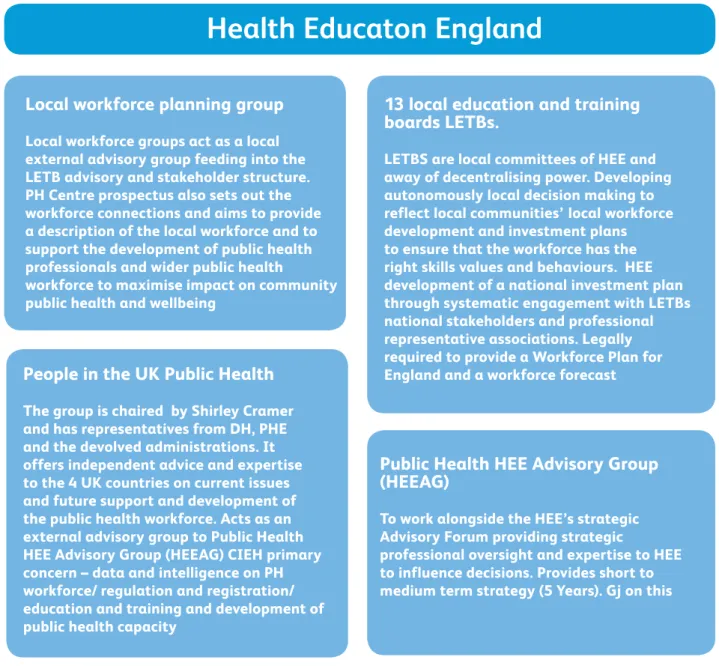
Diagram Workforce planning structures and input of CIEH:
Health Educaton England
13 local education and training
boards LETBs.
LETBS are local committees of HEE and away of decentralising power. Developing autonomously local decision making to reflect local communities’ local workforce development and investment plans to ensure that the workforce has the right skills values and behaviours. HEE development of a national investment plan through systematic engagement with LETBs national stakeholders and professional representative associations. Legally required to provide a Workforce Plan for England and a workforce forecast
Public Health HEE Advisory Group
(HEEAG)
To work alongside the HEE’s strategic Advisory Forum providing strategic
professional oversight and expertise to HEE to influence decisions. Provides short to medium term strategy (5 Years). Gj on this
Local workforce planning group
Local workforce groups act as a local external advisory group feeding into the LETB advisory and stakeholder structure. PH Centre prospectus also sets out the workforce connections and aims to provide a description of the local workforce and to support the development of public health professionals and wider public health
workforce to maximise impact on community public health and wellbeing
People in the UK Public Health
The group is chaired by Shirley Cramer and has representatives from DH, PHE and the devolved administrations. It offers independent advice and expertise to the 4 UK countries on current issues and future support and development of the public health workforce. Acts as an external advisory group to Public Health HEE Advisory Group (HEEAG) CIEH primary concern – data and intelligence on PH workforce/ regulation and registration/ education and training and development of public health capacity
3.4 Local integrated
workforce planning
3.4.1 Integrated workforce strategies for a local area remain a challenge. Local strategic partnerships can struggle with inclusivity, clarity of vision, understanding supply, political contexts and accountability. The variability within local government, identified through the LGA reviews and the CIEH Workforce survey 2014/15 also portrays the complexity of localised diversity. This does not have to be seen as a disadvantage or lack of cohesion but can reflect localism, local responsiveness and delivery. To be sustainable the workforce should be flexible and adaptable to meet the differing needs of communities. 3.4.2 CIEH recognises that the local landscape within
the devolved administrations also impinges on the shape and development of the workforce. In late 2014 Wales Audit Office produced a report “Delivering with less- the impact on environmental health services and citizens “ October 2014 which identified since 2011-12 all major areas of environmental health work have seen significant cuts in staff numbers of between 14.2 % and 19.7%. Staffing within environmental health services currently stands at 874 in 2013-14 and whilst all roles have been subject to cuts in excess of 10%, back office and senior officers have proportionately experienced the greatest hit (Ref Wales Audit Office Delivering with Less 2014: www.audit.
wales/publication/delivering-less-%E2%80%93- impact-environmental-health-services-and-citizens) Following major restructuring in Northern Ireland it is unclear how the changes and new structures have impacted on environmental health staffing.
3.4. Leadership from CIEH is important to draw from the localised and devolved implementation of workforce the key aspects for future strategy and to build links across localities to facilitate workforce movement geographically.
4 Workforce profile
4.1 The ONS survey for England 2012 identifies a total population of 9,000 environmental health professionals in the UK. Outside of this there are specialist professionals that may be included within the environmental health professional community such as health and safety officers, risk advisers, food specialists and technical officers. The CIEH Workforce survey has also provided us with some insight into the shape of the current environmental health working population within local government and further surveys will expand this knowledge to other sectors of employment. The 2014/15 survey demonstrates from the respondents from local authorities in England that almost 43% of the environmental health staff were qualified environmental health practitioners.
12 Introducing the CIEH Workforce for our Future 4.2 Information from CIEH membership on
the employment sectors, indicates that environmental health is still predominantly a public sector profession. Further work on Phase 3 of the CIEH workforce survey aims to focus on the employment sectors outside of local government and this will take place in 2016. It is reasonable to assume that the private sector is unlikely to provide the same number of employment openings to take on the prime role for environmental health delivery in the near future.
5 Capacity, capability,
supply and demand
5.1 While it has been difficult to establish full capacity data for the environmental health workforce since CIPFA stopped publishing the full environmental health reports (2009), their earlier data sets show the environmental health workforce capacity has declined significantly by 13.2% over the decade 1999-2009 (CIEH 2013). The more recent CIEH Workforce survey 2014/15 continues to see this trend as the survey indicates that the numbers of Environmental Health Practitioners (down by 11%) and technical staff have been reduced within the workforce, with an overall reduction of 12% in all environmental health staffing.
5.2 The CIEH Education for our Future, informed by the Education review 2014/15, has identified that in the past 8 years there have been fluctuations in number of environmental health graduates from accredited courses with an overall downwards trend over time. There has also been a downward trend in the number of environmental health graduates who have completed the professional assessments and obtained the Certificate of Registration of the Environmental Health Registration Board in the last 8 years. There has been a 43% fall in the proportion of students qualifying between 2008 and 2013. This has been forecasted to continue to fall over the next two years.
5.3 In terms of the wider environmental health professional community a similar picture exists. Over the past 8 years there have been fluctuations in the number of candidates completing the accredited Higher Certificate in Food Premises Inspection (HCFPI) course and an overall downward trend has been noted. The average proportion of graduates qualifying in the last six years is 48.2% (Ref CIEH Education Review 2014/15)
5.4 In the wider community, the CIEH is the UK’s leading awarding body for vocational qualifications in accredited food safety, health and safety, and environmental protection qualifications. Mapping of the credits associated with each award will provide a more detailed analysis of the learning continuum from this vocational base.
5.5 An overview of the job roles advertised in Environmental Health News (EHN), as a proxy for environmental health job opportunities and nature of current practice, was undertaken for the period September 2013 to Sep 2014.The figures are only to be viewed as an indication of the job market as a whole.
5.6 Recruitment and retention strategies for the environmental health workforce are important as the loss of professionals is a costly business across the employment market. Recruitment and retention requires investment but benefits better health outcomes, savings to organisations and a more stable and resilient professional community.
5.7 Recruitment and retention are complex areas for a professional body such as CIEH, as the organisation does not manage the employment market and has limited influence over specific employment sectors. However, CIEH can use its influence over many of the contributing strands in particular supporting the employers, the education system (see Education for our Future) and individual professional and personal support (Membership for our Future). Success will also require the recognition and mobilisation of employers in understanding the contribution
Graph: Ads by region, September 2013 – September 2014
14 Introducing the CIEH Workforce for our Future the workforce has in enabling them to achieve their corporate goals. The CIEH “ Value and Visibility “ campaign, which aims to promote the role, function and contribution of environmental health, is critical here in supporting this
recognition and will be developed as part of the action plan for the Environmental Health Futures Programme .
6. Creating a responsive
and adaptable
workforce
6.1 Building capacity and an adaptable
environmental health workforce is important to protect against new and emerging challenges such as public health infections, terrorism and extreme weather incidents. Capacity is not only needed for critical events but also for the prevention and management of chronic epidemics such as alcohol misuse, mental illness and obesity. Workforce for our Future will explore ways in which CIEH can support the development of a strong and innovative workforce capable of rigorous surveillance and research. This is where the concept of “lifelong learning” is an attribute. Facing unprecedented demands and an increasing prevention agenda requires a more strategic and innovative approach to upskilling. 6.2 Education for our Future further develops the
concepts and structures to building capacity within the environmental health workforce which broadly can be seen to take place on three levels; • Generic skills – these are transferable skills
such as information seeking, synthesis, project management, critical appraisal, communication • Specialised skills – these can be defined through
skills gaps analysis and may include courses in specialised areas such as acoustics
• High profile strategic – leadership, management
6.3 CIEH Membership for our Future also provides the infrastructure to support CIEH members working within the environmental health workforce to be better equipped to deal with demands and changes in workforce expectations throughout the professional life course and across all sectors of employment.
6.4 Fostering leadership behaviours is more important in times of resource challenge and we recognise that leadership can take place at all levels, even in a small organisation. The CIEH is ideally positioned to support a professional leadership programme and to ensure that the workforce strategy is able to manage the fast pace of change that is taking place within all employment sectors and involving the whole of the workforce to bring them through the changes.
7 Workforce planning
for the future
7.1 Horizon scanning is the systematic exploration of the likely future developments and driving forces and potential issues that may impact on the environmental health workforce. CIEH used a PESTLE analysis in 2015 (Political economic, sociological, technological legal and environmental). This is an information gathering exercise and enables further understanding of links and causes/ effects. PESTLE have been collated from differing perspectives National Environmental Health Boards, environmental health managers and CIEH Assembly
Representatives covering all sectors. The collated PESTLE has been used to identify “issues” that describe a potential future situation that would have an impact on the demand and supply of the workforce.
A total of 150 driving forces were identified and split by the following categories:
• 32 political driving forces • 31 economic driving forces • 33 sociological driving forces • 20 technological driving forces • 18 legal driving forces
• 16 environmental driving forces.
7.2. Workforce for tor Future is designed to enable CIEH to consider what the environmental health workforce will look like in 5 - 10 years’ time. Workforce forecasting is inherently difficult and uncertain as it is impossible to predict the future. While models are needed to enable future planning, these need to be revisited regularly to check against new developments and direction of travel. Forecasting long term futures using “future scenarios” is one methodology that enables a focus on plausible even if highly challenging future landscapes. Workforce supply and demand is then forecast for each of the scenarios and strategies can be considered for each that would be most relevant.
7.3 The CIEH, working with the Centre for Workforce Intelligence (CfWi) has developed the scenario approach to identify 7 “environmental health future scenarios”. This futuring work is subject to a separate report. The scenario model alongside other approaches such as systems thinking will be developed through Workforce for our Future to enhance our prediction for future demands for environmental health services and the type of workforce needed to meet the demand.
8. Workforce evolution
8.1 The CIEH Workforce for our Future will continue to develop longer term planning and account for uncertainties – the future impacts on supply and demand of the enviromental health professional workforce. It will provide the framework for CIEH to promote the right competence, capability and performance to meet future environmental health delivery needs across all sectors.
8.2 The developing strategy will have the following goals in mind. Developing an environmental health workforce that:
• Embraces research and innovation to allow it to adapt to changing demands
• Recognises the importance of supporting continuing professional development • Has a seamless, coherent and systematic
approach to leadership and supporting talent development
• Works closely with specialist services such as the armed forces (future reserves) and across all employment sectors
• Ensures equity and diversity is integral to all workforce planning as well as recognising the different workforce needs within devolved administrations.
16 Introducing the CIEH Workforce for our Future
9 Workforce for our
Future – Pathway goals
The following list identifies actions to support the initiation and development of the Workforce for our Future strategy:
Future workforce modelling
Workforce modelling is an important tool to enable the CIEH to forecast demand and supply, understand the impact of demographics, drivers of change, and to recognise pinch points as well as to test out planned approaches and strategies.
Continue workforce survey – phase 3 and tracking
This continues the programme of workforce intelligence data collection to facilitate a comprehensive understanding of the workforce across all employment sectors.
Supply/demand
Continue the work into supply demand and other factors that influence the recruitment and retention of the workforce.
PHE workforce
To ensure EH recognition and engagement as part of the core workforce within the developing PHE workforce strategy and support mechanisms.
Stakeholder and Member challenge
Instigate “CIEH Member conversations” through a promotional campaign with Assembly and Membership Network as well as other key stakeholders, that challenge our approach and to ensure that the strategy remains viable and relevant.
Identify new approaches to investment in the workforce
Integrating into the Education for our Future to investigate and explore alternative approaches such as apprenticeships and registration to investment in the workplace for:
• New entrants • Existing professionals
Resilience in the workforce
To consider and link to mental health programmes to support health and wellbeing including mental health within the professional workforce
Programme Sponsor:
Graham Jukes OBE Chief Executive Programme lead: