A Comparative Study of the Development of Blood
Impressions on Dark-Colored Substrates Using
Phloxine B and Acid Yellow 7
Manishi Agarwal MS Richard Herlihy MS
Andrew Reitnauer MSFE, CCSA, CPO
New York City Police Crime Laboratory- Latent Print Development Unit
Abstract: When forensic scientists are called upon to examine a possible patent impression deposited in blood, the type and color of the substrate must be considered when deciding on which development technique to use. Often, the surface of the substrate may be dark-colored in nature. This study will focus on the development of blood impressions using Phloxine B and Acid Yellow 7 to determine if one technique is preferred over the other.
Introduction
In a laboratory setting, latent print examiners are occasionally called upon to process items of evidence that may contain patent prints deposited in a blood matrix. These substrates may be of a dark-colored nature. In these instances, some of the traditional blood sensitive processing techniques, such as Amido Black, Leucocrystal Violet, and Ninhydrin, may not result in an adequate level of contrast between the developed matrix and the substrate. The purpose of this study is to compare the
development techniques of Phloxine B (1,7,9) and Acid Yellow 7 (2,4,8) on dark-colored substrates. The resulting developed friction ridge detail will be evaluated based solely upon their individual value for comparison purposes. There will not be any efforts made to conduct comparisons between the developed patent detail and any known exemplar impressions.
Materials and Methods
This study utilized ten different substrates. The substrates used were:
Black plastic bag
Black plastic tray
Black latent print backing card
Blue laminated box
CD case (textured portion)
Blue plastic plate
Blue vinyl shower curtain liner
Blue plastic drinking cup
Dark green glass bottle
Black knife handle
These items were cut into sections of adequate size for the deposition of friction ridge detail and subsequent development. Each of these sections had four patent prints deposited onto it by a single donor. The sets created a series of four sequential
was only applied to the finger prior to the first impression. The matrix used in each of the patent impressions was a sterile sample of human whole blood.
The Na Hep (sodium heparin anticoagulant) whole human blood sample was obtained through Biological Specialty Corporation, and consisted of sterile male human blood, stored in a laboratory refrigerator at approximately 9°C. The areas of deposition were marked on the substrates for future documentation, indicating the sequence of impression. Each substrate was divided into halves for processing at time intervals of immediate processing, twenty-four hours, and ten days. At each time interval, one substrate sample was used for Phloxine B processing, and the other was used for Acid Yellow 7 processing. One half of each patent impression was included on each development technique sample for a comparison test. For the knife handle and glass bottle substrates, only one set was utilized. Between each trial, the substrate was cleaned using a 10% bleach solution and an ethanol rinse to remove any blood matrix and
chemical deposits prior to the deposition of impressions for the second and third time intervals.
Following the specified instructions for each technique, the samples were processed according to the time intervals described above. The samples were permitted to air dry after chemical processing, then examined and photographed. It was noted that the donor’s pressure deposition caused some distortion within the developed impressions as a variable of the resulting evaluation. When properly developed, blood impressions will result in the visualized development represented in figure 1 below.
Figure 1
Phloxine B Acid Yellow 7
Chemical Formulation and Development Techniques
Phloxine B:
Chemical Formula – C12 H2 Br4 Cl4 Na2 O5
Molecular Weight – 829.640
[7]
Synonyms- Acid Red 92; 9-(2-Carboxy-3,4,5,6-Tetrachlorophenyl)-2,4,5,7-Tetrabromo-3,6-dihydroxyxanthylium dipotassium salt; Eosin 10B; Phloxine BB, Eosin S;
Cyanosine; Cyanosine WS; D&C Red 28
Classification- Dyes
Phloxine B, a red acid dye, is a derivative of Fluoresin. Phloxine B is a biological stain as well as an acid/base indicator.
On dark color surfaces existing techniques (e.g., Amido Black, Ninhydrin, Leucocrystal Violet) have limited use because of background interference. Phloxine B is a protein stain and can be used to enhance blood stained prints and footwear impressions on dark or multicolored surfaces. It develops a reddish–orange colored print that produces a luminescent effect with oblique light. Prints can be visualized and photographed easily.
Method- Spray or squirt the working solution of Phloxine B on item. Wait for few minutes. Rinse the item with distilled water. Dry at room temperature. The visualized result will be a reddish-orange colored print. Look with oblique white light, as the resulting print will luminesce as a silver print.
Preparation of working solution of Phloxine B:
Premixed concentrated stock solution diluted to 1liter of methanol, per manufacturer instructions. [3]
Acid Yellow:
Chemical Formula: C16 H9 N4 Na3 O9 S2
Molecular Weight: 404.37
[2]
Synonyms- 4-Amino-1, 1’-azobenzene-3, 4’-disulfonic acid sodium salt; Acid Yellow AT; 4-Aminoazobenzene-3, 4’-disulfonic acid disodium sat: Acetyl yellow G; Yellow Acid; Hexacol acid yellow G; Golden yellow ruaf
Classification- Unclassified
Acid Yellow 7 is a protein dye and is commonly used to enhance blood stained prints and footwear impressions on non-porous surfaces. Blood stained prints have to be fixed by using 5-sulfocylic acid solution. Prints can be visualized by using ALS at 400-495 nm.
Method- First fix the blood stained print by using 2% solution of sulfosalicylic acid. To minimize any trapped air bubbles, use an absorbent paper wetted with fixing solution.
After fixing the print, either use a squirt bottle or submerge the item in working solution of Acid Yellow 7. Wait for 1-3 minutes and then rinse the item with rinse solution or distilled water. For best results use the rinse solution. The prints can be visualized with ALS at 400-495 nm, utilizing a yellow filter transmitting above 350nm.
Preparations of solutions of Acid Yellow [4]:
Working solution- Premixed staining solution (1 gram Acid Yellow 7, 50 ml Glacial Acetic acid, 250 ml Ethanol, 700 ml distilled water)
Fixing solution- 20 grams 5-Sulfosalicylic acid in 1 liter distilled water
Rinse solution- 50 ml Glacial Acetic acid, 250 ml Ethanol, and 700 ml distilled water
Results
Substrate Surface Texture
The blood prints that were deposited on smooth, non-porous surfaces developed a higher quality of friction ridge details with both Phloxine B and with Acid Yellow 7. These substrates (e.g., black plastic bag, black latent backing card, blue plastic plate, and green glass bottle) shared an overall quality based upon the lack of surface texture. On textured surfaces (e.g., shower curtain liner, knife handle), prints developed with
Phloxine B had no discernable friction details, only an overall outline of the print deposition. The prints deposited on the textured surface developed a greater quality of friction ridge details with Acid Yellow 7 treatment.
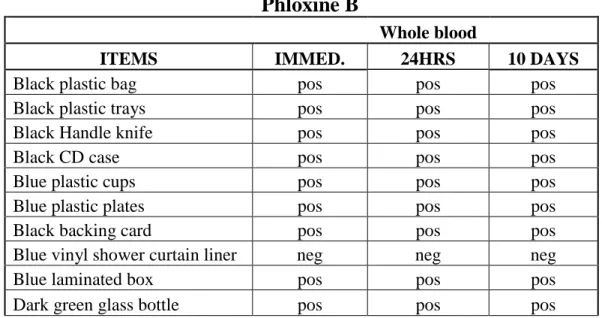
The overall observed results are shown in figure 2. These results are reported simply in terms of positive (pos.) or negative (neg.). Using this terminology, if the reported result is positive, the trial resulted in a positive visualization of friction ridge detail that could be used for further comparison purposes. Additionally, if the reported result is negative, the trial resulted with no developed friction ridge detail that could be used for further comparison purposes.
Another noteworthy result was that in some trials, the photographic techniques used for optimal Acid Yellow 7 visualization also caused an enhancement of the developed Phloxine B developed friction ridge detail. This result was not anticipated, and was not described in the manufacturer’s specifications. GCC Diagnostics lists an absorption maximum for Phloxine B as 548nm with a smaller peak at 510nm (5). This could be a possible explanation for the result observed during these trials. An example of this observation is shown in figure 4 below.
Figure 3 shows the developed prints on various substrates using the two
techniques. All photographs are depicted as captured. The images that showed the best clarity were used for demonstrative purposes. The developed Phloxine B impressions were photographed using direct lighting and the Acid Yellow 7 impressions were photographed using a yellow filter at 445nm, utilizing the manufacturer’s specified excitation wavelength range of 400-495nm. The camera filter used for the Acid Yellow 7 photographs was a yellow 12 filter that transmitted light wavelengths above 510nm [11].
Figure 2
Phloxine B
Whole blood
ITEMS IMMED. 24HRS 10 DAYS
Black plastic bag pos pos pos Black plastic trays pos pos pos Black Handle knife pos pos pos Black CD case pos pos pos Blue plastic cups pos pos pos Blue plastic plates pos pos pos Black backing card pos pos pos Blue vinyl shower curtain liner neg neg neg Blue laminated box pos pos pos Dark green glass bottle pos pos pos
Acid Yellow
Whole blood
ITEMS IMMED. 24HRS 10 DAYS
Black plastic bag pos pos pos Black plastic trays pos pos pos Black Handle knife pos pos pos
Black CD case pos pos pos
Blue plastic cups pos pos pos Blue plastic plates pos pos pos Black backing card pos pos pos Blue vinyl shower curtain liner pos pos pos Blue laminated box neg neg pos Dark green glass bottle pos pos pos
Figure 3
Phloxine B Acid Yellow 7
Black backing card. Treatment immediately after matrix deposition.
Black backing card. Treatment immediately after matrix deposition.
Black plastic bag. Treatment ten days after matrix deposition.
Black plastic bag. Treatment ten days after matrix deposition.
Black plastic tray. Treatment ten days after matrix deposition.
Black plastic tray. Treatment ten days after matrix deposition.
Blue laminated box. Treatment 24 hours following matrix deposition.
Blue laminated box. Treatment 24 hours following matrix deposition. Only the trial completed after ten days showed a positive result of the development of friction ridge
detail; however, the overall trials showed that the Acid Yellow 7 treatment of the
substrate failed to consistently yield a reliable positive result.
Blue plastic plate. Treatment ten days following matrix deposition.
Blue laminated box. Treatment 24 hours following matrix deposition.
Green glass bottle. Treatment ten days after matrix deposition.
Green glass bottle. Treatment ten days after matrix deposition.
Black CD case. Treatment 24 hours after matrix deposition.
Black CD case. Treatment 24 hours after matrix deposition.
Black knife handle. Treatment 24 hours after matrix deposition.
Black knife handle. Treatment 24 hours after matrix deposition.
Blue plastic cup. Treatment ten days after matrix deposition.
Blue plastic cup. Treatment ten days after matrix deposition.
A potential reason for differing results, in respect to the substrate, lies in the working formula for these two processing techniques. As Acid Yellow 7 requires a fixative solution, this preliminary treatment may allow the blood proteins to become stabilized onto textured substrates. The textured areas of a substrate may also hinder the oblique lighting requirements of Phloxine B, whereas the alternate light source
requirements of the Acid Yellow 7 treatments will allow the chemical fluorescence to overcome this aspect of the surface.
Additional trials were conducted on samples after periods of twenty-four hours and ten days. These additional trials did not produce any noticeable difference in development quality of friction ridge detail. However, in the trials conducted with both Phloxine B and Acid Yellow 7, the depletion series of impressions resulted in an overall higher level of friction ridge clarity in impressions three and four. A possible explanation for this was an overabundance of the blood matrix in the initial impressions, which may have masked some of the individual characteristics that were present.
Blue shower curtain. Treatment ten days after matrix deposition. NOTE- No discernable friction ridge detail developed.
Blue shower curtain. Treatment ten days after matrix deposition
Figure 4
Photo taken at 445nm with yellow filter on camera. Note- Phloxine B development
Substrate Absorbance
It was also noted that the substrates that were semi-porous in nature developed improved quality of friction ridge detail when Phloxine B treatments were utilized over Acid Yellow 7. The preliminary requirement of a fixative during the Acid Yellow 7 treatment may have caused the deposited matrix to permeate through the substrate prior to development, resulting in a reduction in development quality. As this study did not focus the trials on the development of blood impressions on dark-colored porous substrates, further experimentation in this area should be explored.
Conclusions
During the trials conducted throughout the course of this study, multiple types of substrates were utilized, in order to compare the effectiveness of these two chemical processing techniques. In many situations, both processing techniques did effectively result in developing a friction ridge impression. However, one conclusion of these trials was that in instances where an examiner encounters a textured substrate, the Acid Yellow 7 technique yielded a positive result in more cases than did Phloxine B. In these
instances, the fluorescent properties of the Acid Yellow 7 treatment suppressed the background distortion. Another potential application of the Phloxine B technique could be at a crime scene. Since the Phloxine B formula used in this study has a similar waste
procedure as other blood reagents currently used at crime scenes, this process could also be considered for these types of applications.
The substrates examined during these trials were a small sample of the types of evidence that forensic analysts routinely encounter within the laboratory. Additional research could be conducted on other types of substrates in order to ascertain the effective use of these two reagents on the development of friction ridge detail deposited in blood. Due to the result noted of the Phloxine B visualization during the Acid Yellow 7
photographing procedure, the potential exists for additional study within the area of the photographic documentation of these processing techniques.
Acknowledgements
The authors would like to extend our thanks to the New York City Police Department Crime Laboratory for their support with this study.
For further information, please contact:
New York City Police Department Crime Laboratory Latent Print Development Unit
150-14 Jamaica Avenue Jamaica, NY 11432 (718) 558-8774
References
1. Acid Red 92. ChemBlink. Online Information Database of Chemicals from China. http://www.chemblink.com/products/18472-87-2.htm.
2. Acid Yellow 7(2391-30-2). Chemical Book.
http://www.chemicalbook.com/ChemicalProductProperty_EN_CB2324207.htm.
3. Arrowhead Forensics. http://www.arrowheadforensics.com/cgi.
4. BVDA:How to Use Acid Yellow 7.
http://www.bvda.com/EN/prdctinf/pf_en_acid_yellow_7.html.
5. Dyes & Stains. GCC Diagnostics.
http://www.gccdiagnostics.co.uk/Dyes_Stains.htm
6. Fregeau, CJ, Germain, O., and Fourney, RM. Fingerprint Enhancement Revisited and the Effects of Blood Enhancement Chemicals on Subsequent Profiler Plus Fluorescent Short Tandem Repeat DNA Analysis of Fresh and Aged Bloody Fingerprints. J Forensic Sci 2000;45(2):354-380.
7. Phloxine B (Acid Red 92).
http://chemicalland21.com/specialtychem/finechem/PHLOXINE%20B.htm
8. Sears V., Butcher C., and Fitzgerald L. Enhancement of Fingerprints in Blood Part 3: Reactive Techniques, Acid Yellow 7, and Process Sequences. J Forensic Identification 2005;55(6):741-763.
9. Sodhi G., Kaur J. Fingerprint Detection Using Phloxine B Dye. J Forensic Identification 2003;53(1):8-13.
10.Sodhi G., Kaur J., Garg R. Fingerprint Powder Formulations Based on Organic, Fluorescent Dyes. Journal of Forensic Identification 2004;54(1):4-7.