What Are Analog Optical Isolators?
PerkinElmer Optoelectronics has been a leading manufacturer of analog optical isolators for over twenty years and makes a broad range of standard parts under its trademark VACTROL®.
There are many kinds of optical isolators, but the most common is the LED/phototransistor type. Other familiar types use output elements such as light sensitive SCRs, Triacs, FETs, and ICs. The major application for these silicon based devices is to provide electrical isolation of digital lines connected between different pieces of equipment. The principle of operation is very simple. When an input current is applied to the LED, the output phototransistor turns on. The only connection between the LED and phototransistor is through light—not electricity, thus the term optical isolator. These optical isolators are primarily digital in nature with fast response times suitable for interfacing with logic gates. Rise and fall times of a few microseconds, faster for some isolators, are typical.
The analog optical isolator (AOI) also uses an optical link between input and output. The input element is an LED and the output element is always photoconductive cell or simply photocell. Together, the coupled pair act as an electrically variable potentiometer. since the output element of the AOI is a resistor, the voltage applied to this output resistor may be DC and/or AC and the magnitude may be as low as zero or as high as the maximum voltage rating. Because the input will control the magnitude of a complex waveform in a proportional manner, this type of isolator is an analog control element. AOIs may be used in the ON-OFF mode but the fastest response time is only in the millisecond range. A level sensitive Schmitt trigger is required between the AOI and logic gates when used in digital circuits. The figure below shows the circuit diagram of a standard AOI.
They must be protected from excessive forward current due to the low dynamic resistance in the forward direction. The forward characteristic of an LED typically used in VACTROLs is shown below.
LED Forward Characteristics
Output Element
The output element in all PerkinElmer’s AOIs is a light dependent resistor (LDR), also called a photoconductor or photocell. Photocells are true resistors.
These passive resistors are made from a light sensitive polycrystalline semiconductor thin film which has a very high electron/photon gain. There are no P/N junctions in a photocell, making it a bilateral device. The resistance of the photocell depends on the amount of light falling on the cell. For a given illumination, the amount of electrical current through the cell depends on the voltage applied. This voltage may be either AC or DC. Thus, the photocell is the ideal low distortion output element for an analog optoisolator.
A complete discussion of photoconductive cells can be found in the first section of this book.
What Are Analog Optical Isolators?
Light History Considerations
Photoconductive cells exhibit a phenomenon knows as hysteresis, light memory, or light history effect. Special consideration must be given to this characteristic in the analog optoisolator because the photoconductive element is normally in the dark. This will lead to having the photocell initially in a “dark adapted” state in many conditions.
The light levels that are seen by the photocell in many analog optoisolator applications are quite low, ranging from 0.1 to 1.0 fc. The effect of this combination of dark adapt and low light levels will be seen in the following table.
The table shows the relationship between light history and light resistance at various light levels for different material types. The values shown were determined by dividing the resistance of a given cell, following “infinite” light history (RLH), by the resistance of the same cell following infinite dark history (RDH). For practical purposes, 24 hours in the dark will achieve RDH or 24 at approximately 30 fc will achieve RLH.
Variation of Resistance with Light History Expressed as a Ratio RLH/RDH at Various Test Illumination Levels
The table illustrates the fact that the resistance of a photocell can increase substantially as it transitions from dark adapted state to a light adapted state. The table shows that the Type 1 photocell can increase resistance by a factor of more than three times as it light adapts up to 0.1 fc. In some applications, this can be an important consideration. In general, the magnitude of this effect is larger for types 1, 4, and 7 than for types Ø, 2, and 3.
Each specific material type represents a tradeoff between several characteristics. Selecting the best material is a process of determining what characteristics are most important in the application. The chart gives some appreciation for the general interrelationships between the material types and their properties.
Material Type Illumination (fc) 0.01 0.1 1.0 10 100 Type Ø 1.60 1.40 1.20 1.10 1.10 Type 1 5.50 3.10 1.50 1.10 1.05 Type 2 1.50 1.30 1.20 1.10 1.10 Type 3 1.50 1.30 1.20 1.10 1.10 Type 4 4.50 3.00 1.70 1.10 1.10 Type 7 1.87 1.50 1.25 1.15 1.08
What Are Analog Optical Isolators?
Relative Resistance vs. Temperature
Type Ø Material
Relative Resistance vs. Temperature
Type 1 Material
Relative Resistance vs. Temperature
Type 2 Material
Relative Resistance vs. Temperature
Type 3 Material
Material Characteristics (General Trends)
Types 2 & 3 Type Ø Type 7 Type 4 Type 1
Lower Temperature Coefficient Higher
Higher Sheet Resistivity Lower
Slower Speed of Response Faster
Lower Resistance Slope Higher
What Are Analog Optical Isolators?
Relative Resistance vs. Temperature
Type 4 Material
Relative Resistance vs. Temperature
Typical Applications of Analog Optical Isolators
Why Use Analog Optical Isolators?
PerkinElmer Optoelectronics’ line of analog optical isolators (AOIs) consists of a light tight package which houses a light source and
one or more photoconductive cells. Through control of the input current or voltage applied to the AOI, the output resistance can be
varied. The output resistance can be made to switch between an “on” and “off” state or made to track the input signal in an analog
manner. Because a small change in input signal can cause a large change in output resistance, AOIs have been found to provide a
very economic and technically superior solution for many applications. Their general characteristics and salient features can be
summarized as follows:
•
High input-to-output voltage isolation
•
True resistance element output
•
Single or dual element outputs available
•
Low cost
•
Suitable for AC or DC use
•
Wide range of input to output characteristics
•
Low drive current
•
Low “on” resistance, high “off” resistance
•
Complete solid-state construction
Applications
Analog Optical Isolators are used in many different types of circuits and applications. Here is a list of only a few examples of where
AOIs have been used.
•
DC isolators
•
Feedback elements in automatic gain control circuits
•
Audio limiting and compression
•
Noiseless switching
•
Logic interfacing
•
Remote gain control for amplifiers
•
Photochoppers
Typical Applications of Analog Optical Isolators
Typical Application Circuits
Automatic Gain Control (AGC)
Remote Gain Control
Noiseless Switching/Logic Interfacing
(See Application Note #1)Characteristics of Analog Optical Isolators
Transfer Characteristics
The light output of an LED is proportional to the input drive current, IF. Some LEDs will begin to radiate useful amounts of light output at forward currents as low as 10 µA. These same LEDs can be driven at 50 mA with no degradation in performance.
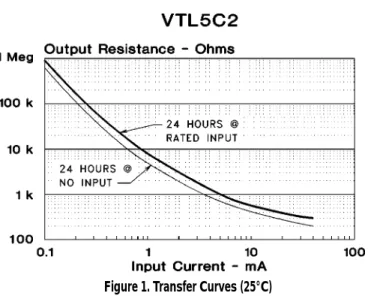
A transfer curve of output resistance versus input light current for a typical AOI is shown in Figure 1. AOIs not only possess a large dynamic range, but the output resistance tracks the input current in a somewhat linear manner over a range of two or more decades. This characteristic makes the AOI suitable for use in a very broad range of applications, especially in audio circuits where they are used for switching, limiting, and gating. For a more extensive discussion on AOIs in audio circuits, refer to Application Notes #1.
Response Time
AOIs are not high speed devices. Speed is limited by the response time of the photocell. With rise and fall times on the order of 2.5 to 1500 msec, most AOIs have bandwidths between 1 Hz and 200 Hz.
Figure 1. Transfer Curves (25°C)
One of the characteristics of photocells is that their speed of response increases with increasing levels of illumination
.
1Thus the bandwidth ofapplied, the photocells resistance drops very fast, typically reaching 63% (1-1/e conductance) of its final values in under 10 msec. When the light is removed, the resistance increases initially at an exponential rate, approximately tripling in a few milliseconds. The resistance then increases linearly with time.
The fast turn-on and slow turn-off characteristics can be used to advantage in many applications. This is especially true in audio applications where a fast turn-on (attack) and a slow turn-off (release) is preferred. For example, the typical AOI can be made to turn-on in 100 to 1000 µsec. In a limited circuit this is fast enough to catch high peak amplitudes but not so fast as to cause obvious clipping. The turn-off will take as much as 100 times longer so the audio circuit will return to a normal gain condition without a disturbing “thump” in the speaker.
Figure 2. Resistance vs. Time
Noise
The sources of electrical noise in the output element of AOIs are the same as for any other type of resistor.
One source of noise is thermal noise, also known as Johnson or “white” noise, which is caused by the random motion of free electrons in the photoconductive material.
Characteristics of Analog Optical Isolators
Some major characteristics of Johnson noise are that it is:
1. Independent of frequency and contains a constant power density per unit of bandwidth.
2. Temperature dependent, increasing with increased temperature. 3. Dependent on photocell resistance value.
Johnson noise is defined by the following equation:
where:
INJ = Johnson noise current, amps RMS k = Boltzmann’s constant, 1.38 x 10⁻²³ T = temperature, degrees Kelvin R = photocell resistance
BW = bandwidth of interest, Hertz
A second type of noise is “shot” noise. When a direct current flows through a device, these are some random variations superimposed on this current due to random fluctuations in the emission of electrons due to photon absorption. The velocity of the electrons and their transit time will also have an effect.
“Shot” noise is:
1. Independent of frequency.
2. Dependent upon the direct current flowing through the photocell. Shot noise is defined by the following equation:
where:
INS = shot noise current, amps RMS e = electron charge, 1.6 x 10⁻¹⁹ Idc = dc current, amps
BW = bandwidth of interest, Hertz
The third type of noise is flicker of 1/f noise. The source of 1/f noise is not well understood but seems to be attributable to manufacturing noise mechanisms. Its equation is as follows:
where:
INF = flicker noise, amps
K = a constant that depends on the type of material and its geometry
Idc = dc current, amps
BW = bandwidth of interest, Hertz f = frequency, Hertz
Unlike thermal or shortnoise, flicker noise has 1/f spectral density and in the ideal case for which it is exactly proportional to , it is termed “pink noise”. Unfortunately, the constant (K) can only be determined empirically and may vary greatly even for similar devices. Flicker noise may dominate when the bandwidth of interest contains frequencies less than about 1 kHz.
In most AOI circuits noise is usually so low that it is hardly ever considered. One notable exception is in applications where large voltages are placed across the cell. For a typical isolator, it takes 80 to 100V across the photocell before the noise level starts to increase significantly.
Distortion
Analog Optical Isolators have found wide use as control elements in audio circuits because they possess two characteristics which no other active semiconductor device has: resistance output and low harmonic distortion. AOIs often exhibit distortion levels below -80 db when the voltage applied to the photocell output is kept below 0.5V.
Figure 3 shows the typical distortion generated in typical AOIs. The distortion depends on the operating resistance level as well as the applied voltage. The minimum distortion or threshold distortion shown in Figure 3 is a second harmonic of the fundamental frequency. The actual source of this distortion is unknown, but may be due to some type of crossover nonlinearity at the original of the I-V curve of the photocell.
I
NJ=
(
4kTBW
)
⁄
R
I
NS=
2eI
dcBW
I
NF=
KI
dcBW f
⁄
Characteristics of Analog Optical Isolators
Figure 3. Typical LED AOI Distortion Characteristics
At high AC voltages, distortion to the waveform can be seen using an oscilloscope. The waveform is still symmetrical but contains the fundamental and the odd harmonics, the third harmonic being
The RMS value of voltage or current is not very sensitive to a large third harmonic component, but the instantaneous value is. A 10% harmonic will only change the RMS values by 0.5%. If the output is
(a) (b)
(d) (c)
Characteristics of Analog Optical Isolators
Voltage Rating
The maximum voltage rating of the output element (photocell) applies only when the input is off. Two different kinds of dark current “leakage” characteristics are observed in photocell output elements. Figure 4 shows the soft breakdown found in lower resistivity materials. With no input, if the applied voltage is suddenly increased from zero to V1, the current increases along section ‘a’, with the steepness depending on the rate at which the voltage is increased. If the voltage is now held at V1, the current decreases along curve ‘b’ and stabilizes at a much lower value. If the voltage is again increased, the next section of the curve is traversed with the current dropping along curve ‘d’ in time. This process can be repeated until the reverse current becomes so great that the cell burns up. The maximum voltage rating for photocells with this soft reverse characteristic is based on a safe steady-state power dissipation in the OFF condition.
Figure 4. Breakdown characteristics of photocells with low resistivity photoconductive material.
Higher resistivity photoconductive materials do not show the reverse characteristics of Figure 4 to any significant degree. As voltage is increased, the dark current increases, but remains very low until breakdown occurs. The current then increases in an avalanche fashion resulting in an arc-over which causes the cell to be permanently damaged (shorted). The dielectric breakdown voltage is approximately 8 - 10 kV per cm of contact spacing for materials with this type of reverse characteristic. Photocells have 0.16 - 0.5 mm electrode spacing so the maximum voltage ratings typically fall into the 100 - 300 volt range.
The high voltage capability of photocells suggests their use as the series pass element in a high voltage regulated power supply. Voltages up to 5 or 10 kV can be regulated but the current should be limited to 1 or 2 mA. The isolated input element greatly simplifies the circuit design
Power Rating
Photocells are primarily used for signal control since the maximum allowable power dissipation is low. Typically, the steady-state output current should be kept below 10 mA on catalog LED AOIs because of the small size ceramic used in the output cell. However, the surface area is large compared to similarly rated transistors, so AOIs withstand significant transient current and power surges.
Power ratings are given in the catalog and are typically a few hundred milliwatts, but special AOIs have been made with power dissipation ratings as high as 2.0 W.
Life and Aging
Life expectancy of an AOI is influenced both by the input and output devices. Isolators which use an LED have long life since LED lifetimes are long: 10,000 to 200,000 hours, depending on the application. LEDs normally show a decrease in light output for a specified bias current as they age.
The photocell output elements in AOIs show an increase in output resistance over time as they age. With a continuous input drive current and with voltage bias applied to the output, the output resistance will generally increase at a rate of 10 percent per year. The aging rate is lower with intermittent operation. Figure 5 shows the trend line for output resistance under typical operating conditions. Other AOIs using different photoconductive materials show similar trends.
Characteristics of Analog Optical Isolators
Storage Characteristics
The instantaneous output resistance of any AOI is somewhat dependent on the short term light history of the photocell output element. With no applied input current or voltage, the output element is in the dark. Dark storage causes the cell to “dark adapt”, a condition which results in an increase in the photocell’s sensitivity to light. When first turned on, an AOI which has experienced a period of dark adaption will exhibit a lower value for “on” resistance, at any given drive condition, than the same device which has been continuously on. The output resistance of an AOI which has been biased “on” is considered to be constant with time (neglecting long term aging effects). After the removal of the input drive, the photocell begins to experience dark adaption. The cell’s rate of increase in sensitivity is initially high but eventually levels off with time in an exponential manner. Most of the dark adapt occurs in the first eight hours, but with some AOIs for sensitivity can continue to increase for several weeks. When an AOI which has been sitting in the dark is turned on, the cell immediately begins returning to its light adapted state. For any given device, the rate of recovery is dependent on the input light level. The type of photoconductive material is the major factor determining the magnitude of these changes. Lower resistivity materials show greater initial and final changes but their rate of change is faster. These light/dark history effects are pronounced at both high and low input levels. However, at high input levels, the photocell light adapts quite rapidly, usually in minutes.
Figure 1 shows the transfer curves for an AOI after 24 hour storage with no input and then after it has been operated with rated input for 24 hours. Because of these “memory” phenomena, it is best to use these parts in a closed loop circuit to minimize the effects of these changes. Open loop proportional operation is possible if the application can tolerate variations. The use of the VTL5C2 and VTL5C3 with their more stable characteristics will help.
Temperature Range
Storage at low temperature has no operating effect on AOIs. Units may be stored at temperatures as low as -40°C. Lower temperatures may cause mechanical stress damage in the package which can cause permanent changes in the AOI transfer characteristics.
The chemistry of the photoconductive materials dictates a maximum operating and storage temperature of 75°C. It should be noted that operation of the photocell above 75°C does not usually lead to catastrophic failure but the photoconductive surface may be damaged, leading to irreversible changes in sensitivity.
The amount of resistance change is a function of time as well as temperature. While changes of several hundred percent will occur in a matter of a few minutes at 150°C, it will take years at 50°C to produce that much change.
In most applications, operation is intermittent. At elevated temperatures, the resistance of the cell rises during the turn-on period and recovers during the turn-off period, usually resulting in little net change. However, if the AOI is stored at elevated temperatures for many hours with no input signal, there is a net reduction in output resistance. There will be some recovery during operation over time but it is not possible to predict the rate or to what degree. Elevated temperatures do not produce sudden catastrophic failure, but changes in the device transfer curve with time must be anticipated.
Characteristics of Analog Optical Isolators
Capacitance
The equivalent circuit for the output photocell is a resistor in parallel with the capacitance. The capacitance arises from the topside metallization of the electrodes which form a coplanar capacitor. The value of this capacitance is largely determined by the size of the ceramic base. For lower capacitance, a smaller cell is needed. The capacitance is so small (3.0 pF, typical on catalog AOIs) that it is negligible in most applications. However, there are applications such as wideband or high frequency amplifiers in which the capacitance needs to be considered. At 4.5 MHz, the video baseband frequency, the photocell capacitive reactance is only 12 kilohms. If the phase shift of the signal is to be kept below 10°, the highest useful cell resistance is only 2.0 kilohms. At high AOI input drive, where the cell is drive below 1.0 kilohm, the capacitance can increase additionally from 2 to 10 times, possibly due to distributed effects.
Summary
Analog Optical Isolators have many unique features, such as: 1. High input-to-output isolation.
2. True resistance element output.
3. Wide dynamic range (low “on” resistance/high “off” resistance). 4. Low drive current.
5. Low distortion.
These features are primarily dependent on which input element and output element photoconductive material is used in the Vactrol AOI. Thus, there is a wide variety of Vactrols to choose from for your application.
Characteristics of Analog Optical Isolators
Typical Transfer Characteristics (Resistance vs. Input Current) For Standard Vactrols
Curves shown are based upon a light adapt condition for 24 hours @ no input at 25°C.
Output Resistance vs. Input Current
VTL5C Series
Output Resistance vs. Input Current
Characteristics of Analog Optical Isolators
Analog Optoisolator Comparison Chart
Specification Notes
(These notes are referenced on the following LED Vactrol Data Sheet pages.)
Since the input has a substantially constant voltage drop, a current limiting resistance is required.
Dark adapted resistance measured after 24 or more hours of no input.
Measured 10 sec. after removal of the input. The ultimate resistance is many times greater than the value at 10 seconds.
Ascent measured to 63% of final conductance from the application of 40 mA input. The conductance rise time to a specified value is
increased at reduced input drive while the conductance decay time to a specified value is decreased.
Typical matching and tracking from 0.4 to 40 mA is 25%.
Measured 5 sec. after removal of the input. The ultimate resistance is many times greater than the value at 5 seconds.
VTL5C9 response times are based on a 2.0 mA input. VTL5C10 response times are based on a 10.0 mA input for ascent time and
a 1.0 mA input for decay time.
Device Material Type Slope Dynamic Range Dark Resistance Temperature Coefficient
Speed of Response
Light History Effect
VTL5C1 1 15.0 100 db 50 MΩ Very High Very Fast Very Large
VTL5C2 Ø 24.0 69 db 1 MΩ Low Slow Small
VTL5C2/2 Ø 20.0 65 db 1 MΩ Low Slow Small
VTL5C3 3 20.0 75 db 10 MΩ Very Low Very Slow Very Small
VTL5C3/2 3 19.0 71 db 10 MΩ Very Low Very Slow Very Small
VTL5C4 4 18.7 72 db 400 MΩ High Fast Large
VTL5C4/2 4 8.3 68 db 400 MΩ High Fast Large
VTL5C6 Ø 16.7 88 db 100 MΩ Low Slow Small
VTL5C7 7 5.7 75 db 1 MΩ Average Average Average
VTL5C8 Ø 8.0 80 db 10 MΩ Low Slow Small
VTL5C9 1 7.3 112 db 50 MΩ Very High Very Fast Very Large
VTL5C10 4 3.8 75 db 400 MΩ High Fast Large
1 2 3 4 5 6 7