Motorcycle
Operator Manual
Two- and Three-Wheel
Washington State
Department of Licensing
WASHINGTON MOTORCYCLE
SAFETY PROGRAM
This manual is provided by the Washington Department of Licensing (DOL) and Washington Motorcycle Safety Program (WMSP) and provides motorcycle rider techniques and information for both new and experienced riders . The mission of WMSP is to provide subsidized and effective rider training, and to promote safe motorcycle operation and motorcycle awareness through outreach to all Washington road users .
License endorsement training courses in Washington are
recognized nationally, conducted locally by DOL-approved training providers, and subsidized by motorcycle endorsement fees . For more information on endorsement and permit fees, motorcycle laws, or to find a motorcycle training/testing provider closest to you, visit: www .dol .wa .gov .
Two- and Three-Wheel Motorcycle Endorsements
To legally operate a motorcycle on Washington State roadways, you must have a motorcycle endorsement on your driver license . Because two-wheeled and three-wheeled motorcycles handle very differently from each other, state law requires separate training, testing, and endorsements .
To lawfully operate:
• A two-wheel motorcycle you must have a two-wheel (Class “3”) endorsement .
• A three-wheel motorcycle (sidecar rig, trike, reverse trike, etc .) you must have a three-wheel (Class “5”) endorsement .
• Both two-wheeled and three-wheeled motorcycles you must have a combined two-wheel and three-wheel (Class “7”) endorsement . If you operate a motorcycle on a public roadway without having the required endorsement, your motorcycle may be impounded .
Getting Your Endorsement
To add an endorsement to your license, you must pass both a knowledge and a skills test . You can take these tests in one of two ways:
• As a part of an approved motorcycle safety license endorsement course
• Knowledge and skills testing (without training) at an approved training/testing provider
You can find training/testing providers at: www .dol .wa .gov/ driverslicense/motoschools .
Like any other sport, motorcycling requires specialized physical and mental skills, and like any other sport, training and practice are required to develop and maintain these specialized skills . Unlike many other sports, however, in motorcycling the consequences of not being proficient in these skills are likely serious injury or death . Give yourself the best chance for a safe, enjoyable, and long riding career by taking training to develop your physical and mental motorcycling skills .
You should study this manual, especially if you are planning to take the test without taking a training course .
Washington State Law requires all riders under 18 years of age to satisfactorily complete an approved motorcycle training course before applying for an endorsement . Under-18 students must have parental permission to take a training course and apply for an endorsement .
Endorsement fees
You can find current motorcycle endorsement fees at: http://www . dol .wa .gov/driverslicense/fees .html
Motorcycle endorsement and renewal fees go directly to the Motorcycle Safety Program’s dedicated account . These fees are then used to administer the program, subsidize training courses, and promote motorcycle safety and awareness throughout the state .
Instruction permits
If you would like to practice operating a motorcycle on public roadways, you can apply for a 90-day instruction permit . Riders must be at least 16, have a valid Washington State driver license, and pass a knowledge test .
Riders with instruction permits are restricted from carrying passengers or riding at night .
Permits expire after 90 days, and may be renewed one time . You may obtain a third permit only when providing documentation showing registration in an upcoming license endorsement training course .
Knowledge tests are conducted by contracted training/testing providers .
Find training/testing providers near you at: www .dol .wa .gov/ driverslicense/motoschools .
Endorsement Training
The Washington Motorcycle Safety Program highly encourages you to take both initial and on-going motorcycle training . Self-taught riders, or those taught by family or friends, often miss out on the key information, street strategies, and skill development provided by professional motorcycle instructors . Set yourself up for a long, enjoyable, and safe riding career by taking professional motorcycle training .
The DOL has certified a variety of basic, intermediate, and advanced two- and three-wheel training courses available
throughout Washington . When you successfully complete a license endorsement training course, you will receive a course completion card to take to a DOL office and get an endorsement added to your license .
Course completion cards are valid for 180 days, and may qualify you for discounts on motorcycle insurance .
To find a training school near you and learn about their particular course offerings, go to: www .dol .wa .gov/driverslicense/motoschools .
DOL-approved two-wheel license endorsement courses: Novice two-wheel rider courses
These courses, normally lasting two or more days, are designed for new riders with little or no experience .
These courses offer:
• Classroom instruction and text book covering topics such as riding techniques, street strategies, and protective gear;
• Use of a training motorcycle for the class, or you may use your own*;
• On-bike riding instruction in a protected training area;
• Knowledge and skills endorsement tests as a part of the course .
*When using your own motorcycle you must show proof of insurance and your motorcycle must pass a pre-ride inspection .
Intermediate two-wheel rider courses
These courses, normally one day in length, are designed for returning riders or riders with some experience .
These courses offer:
• Classroom instruction and text book covering topics such as riding techniques, street strategies, and protective gear; • Use of a motorcycle for the class, or you may use your own; • On-bike riding instruction in a protected training area;
• Knowledge and skills endorsements tests as a part of the course .
*When using your own motorcycle you must show proof of insurance and your motorcycle must pass a pre-ride inspection .
Advanced two-wheel rider courses
Advanced rider courses are designed for experienced riders and will give you an opportunity to increase your skills on your own machine .
These courses offer:
• Riding practice that includes braking, cornering, and swerving skills;
• Discussion of advanced techniques and defensive street strategies;
• Knowledge and skills endorsement test as a part of the course . • Students provide their own rigs for this course . You must show
proof of insurance and your motorcycle must pass a pre-ride inspection .
Common DOL-approved three-wheel license endorsement courses:
Novice three-wheel rider course
Basic three-wheel courses are designed for riders with little or no experience on three-wheelers . The course offers:
• Classroom instruction and textbook covering topics such as riding techniques, street strategies, and protective gear;
• Use of a rig for the class (at some training providers), or you may use your own;*
• On-rig riding instruction in a protected training area;
• Knowledge and skills endorsement test as a part of the course .
*When using your own motorcycle you must show proof of insurance and your motorcycle must pass a pre-ride inspection .
Advanced three-wheel rider courses
This course is designed for those with previous three-wheel riding experience and offers:
• Classroom instruction and textbook covering topics such as riding techniques, street strategies, and protective gear . • On-rig riding instruction in a protected area;
• Knowledge and skills endorsement test as a part of the course . • Students provide their own rigs for this course . You must show
proof of insurance and your motorcycle must pass a pre-ride inspection .
Training course fees
The Washington Motorcycle Safety Program uses motorcycle endorsement and renewal fees to help subsidize motorcycle training .
Subsidized rider courses cost:
• $125 for Washington State residents age 18 and over, or for active military personnel of any age .
• $50 for Washington residents under 18 .
Nonresidents, or residents choosing to take a non-subsidized course, pay full tuition cost as determined by the training provider .
Endorsement Testing
Both two- and three-wheel motorcycle knowledge and skills tests are given by DOL contracted training schools throughout the state . You do not have to take training in order to take the endorsement tests .
Upon successful completion of the knowledge and skills tests you will receive a testing score sheet . Take this to a DOL driver license services office to add the endorsement to your license . Testing score sheets are valid for 180 days .
Endorsement web sites
• DOL approved training school/testing providers: www .dol .wa .gov/driverslicense/motoschools . • DOL driver licensing service office locations: https://fortress .wa .gov/dol/dolprod/dsdoffices/
Transferring an Endorsement from Out of State
When transferring your out of state driver license with a current and valid motorcycle endorsement to Washington, you must let DOL staff know that you also want to transfer the endorsement .
If you want a two-wheel endorsement when transferring from out of state, you must present:
• A current and valid two-wheel motorcycle endorsement or; • Proof of completing a two-wheel rider safety training course in
the past 180 days .
If you want a three-wheel endorsement when transferring from out of state, you must present:
• A current and valid three-wheel motorcycle endorsement or; * • Proof of completing a three-wheel rider safety training course in
the past 180 days *
* Documentation provided must show you passed a separate and distinct three-wheel test in the state you are transferring from . If no proof is available of taking a separate and distinct three-wheel test, you will be offered a two-wheel only endorsement .
If your new license is issued without the endorsement and you wish to get one in the future, you will be required to take the license endorsement knowledge and skills tests .
PREPARING TO RIDE
Manage Your Risk
Like the choice to drive, the choice to ride carries with it a certain amount of risk . However, riders face risk in different and more significant ways . Traction, weather, and potential road hazards all combine to pose considerable challenges to riders that drivers don’t often face .
Adding to these increased risks are factors related to:
• Protection – lack of safety protection built into two and three-vehicles: no seatbelts, air bags, or steel roll cages .
• Stability – difference in stability and balance (four wheels vs . three vs . two) .
• Traction – two wheels, especially, are much more effected by surface hazards than four .
• Comfort – riders are much more exposed to elements than drivers are .
• Visibility – motorcycles are much harder to see than cars . The majority of motorcycle crashes involve several risk factors stacking up at one time . As an example, think of a tower of blocks being stacked on end . Each block represents a different risk that a rider must be aware of and learn to manage . Eventually, if the stack gets too high, what happens? The stack falls . The same can be true when riding —too many risks stacked up eventually causes a fall . The constant development and practice of physical and mental riding skills can help you reduce or eliminate many (but not all) risks when riding .
Does choosing to ride a motorcycle increase your risk compared to driving a car? Yes . Riding is very different from driving . You must think like a rider, instead of like a driver . You must be more aware of the environment around you, the handling of your vehicle, and be ready to adjust and respond to hazards .
Are there ways that you can actively manage these risks? Absolutely! One of the ways you can manage these risks is in preparing for each and every ride . Is your body protected? Is your bike ready? Are YOU ready?
Manage Your Risk With Effective Gear
One way to manage risk is to choose gear that offers: • Protection – from both abrasion and impact
• Comfort – to keep you focused on the road • Visibility – to help other road users see you
Protective gear can significantly reduce risk by providing protection in a crash, comfort in Washington’s wide variety of weather
conditions, and visibility so others on the road can see you .
Helmets
To legally ride in Washington you are required to wear a helmet . The helmet worn must be Department of Transportation (DOT) compliant . DOT compliant helmets will be labeled “DOT” on the rear exterior of the helmet . They also will have a label indicating DOT compliance inside the helmet itself .
The most common cause of rider death in motorcycle crashes is head injury . Regardless of speed, helmeted riders are much more likely to survive a head injury in a crash than those riders not wearing a helmet . The single most important thing you can do to reduce risk and improve your chances of surviving a crash is to wear a quality, properly fitted, and securely fastened helmet .
Helmet types and construction
Helmets come in a variety of styles (Figure 2-1) including full-face (A), modular or flip-up (B), three-quarter shell (C), and half shell (D) . Half-shell and three-quarter shell helmets do not provide protection for your chin and face in a crash . Full-face helmets are considered the safest helmet as they provide the best protection for these areas .
Regardless of style, DOT-compliant helmets are required to have: • An impact resistant outer shell
• An impact absorbing inner liner (usually of Expanded Polystyrene (EPS) foam)
• A comfort liner (the padding)
A
C
B
D
Figure 2-1 Types of helmetsA helmet should have no obvious defects such as cracks or frayed straps . Once a helmet has been involved in a crash it should be replaced . Many manufacturers recommend you replace a helmet every five years due to the breakdown of helmet materials over time .
In addition to DOT compliance, helmets may have other safety certifications . The most common of these are Snell (from the Snell Memorial Foundation) and ECE (the European standard) . Consider researching different helmet styles and certifications to help you determine the best helmet for you . Remember, all helmets legally allowed in Washington must be at least DOT compliant .
Another consideration when choosing a helmet is how it can help you be more visible to other road users . Consider a black helmet vs . white . Which would be easier for you to see? Being visible is an important part of reducing your risk .
Helmet fit
Apart from styles and certifications one of the most important factors of a helmet’s ability to protect you is how it fits . Helmets should fit snuggly all the way around . It should not be so tight that it causes pain or headaches . A helmet should not be so loose that it can be easily rolled around — or off — your head .
Different helmet manufactures make helmets with different “head shapes .” Consider researching different brands to help you determine the best fit .
Properly fitted helmets will not block or obstruct a rider’s central or peripheral vision . Properly fitted helmets do not obstruct hearing sounds motorcyclists need to be aware of . Be safe . Always wear a quality, properly fitted, DOT compliant helmet to offer the protection, comfort, and visibility you desire .
Eye Protection
In addition to a DOT compliant helmet, Washington law requires wearing eye protection when riding on the public roadway, unless your motorcycle is equipped with a windshield .
Keep in mind that most windshields cannot protect your eyes entirely from the dust, wind blasts, rain, etc . you may encounter while riding . Eyeglasses or sunglasses typically don’t provide enough protection, either, and glasses can also blow off when turning your head while riding at speed .
Goggles can protect your eyes, however they can’t protect the rest of your face like a face shield does .
A plastic shatter-resistant face shield offers the most protection for your eyes . Face shields also help protect your whole face in a crash . They can protect you from wind, dust, dirt, rain, insects and pebbles thrown up from vehicles ahead . All of these problems are both distracting and painful . If you have to deal with these problems while riding, you will not be able to devote your full attention to the road and other potential hazards .
Although a windshield blocks some wind and debris, it is a safer choice to have a face shield or goggles as well .
To be effective, eye or face shield protection must: • Be free of scratches .
• Be resistant to penetration .
• Give a clear view to the front and either side .
• Fasten securely to the helmet so it does not blow off . • Permit air to pass through, to reduce fogging .
• Permit enough room for eyeglasses or sunglasses, if needed . Tinted eye protection should not be worn during low-visibility conditions such as when the sun goes down or when riding in poor weather such as fog or rain .
Riding Gear
Just like your choice of a particular style, color, and certification of helmet, your choice in protective clothing can significantly reduce your level of risk .
Jacket and pants
A quality riding jacket and pants can provide excellent protection for your body . Your jacket and pants should cover your arms and legs completely . They should fit snugly enough to keep from flapping in the wind, yet loosely enough to allow you to move freely . Motorcycle protective gear is typically designed to fit differently than your street clothes .
Motorcycle gear made of leather or sturdy synthetic materials offer the best protection against abrasion . Denim does not provide significant abrasion protection . To protect against impact, most riders choose gear with “body armor” inserts in critical areas of protection such as knees, elbows, shoulders, hips, and back . Wearing a jacket and pants designed for motorcycle riding can help you feel comfortable and less distracted in hot or cooler weather . In cooler weather, proper gear can help prevent hypothermia . Hypothermia is when your body temperature gets too low . Hypothermia causes loss of physical and mental function .
In hotter weather, a riding jacket and pants can help protect against the effects of heat exhaustion and dehydration . Many riders choose gear with vents and/or mesh panels to protect against direct sunlight and wind, but allow airflow to help keep them cool . The more comfortable you are, the better you will be able to focus on scanning the road ahead and riding safely .
Boots and shoes
Riding boots or shoes designed for motorcycle use should be high enough and sturdy enough to cover your ankles . Proper riding footwear offers additional support as well as ankle and shin protection . Riders should wear footwear with soles made of hard, durable, slip-resistant material . Remember to keep heels short so they do not catch on rough surfaces and so they fit within foot pegs and controls . It’s also a good idea to tuck-in any laces to prevent them from catching on protruding parts of the bike .
Gloves
Motorcycle specific gloves can offer good grip and control feel, while also providing protection for your hands and fingers . Gloves designed for motorcycle riding are often pre-curved and have seams on the sides or backs of the fingers to increase comfort while riding . Riding gloves are usually made of leather and often include added protection such as padding and rigid armor in potential impact areas .
Hearing protection
Even with a full face helmet, noise from your bike, and especially from the air flow over and around your helmet can be significant . Long term exposure to this noise can cause permanent hearing damage .
Good hearing protection reduces the level of harmful noise, while still allowing you to hear important sounds such as horns and sirens . No matter what brand or style of helmet you choose, also choose additional hearing protection to reduce this risk .
Note: ear hearing protection is legal in Washington, however, in-ear speakers (“in-ear buds”) are not .
Comfort and Weather Protection
You can help reduce your risk by keeping in mind anticipated weather conditions and visibility when selecting gear for your ride . Washington State is one of the most beautiful places to take to the road on two or three wheels . Our scenic and diverse landscape of mountains, forests, deserts, and shores also creates ever-changing types of weather . Within a few hours on the same ride it is possible for you to experience frost, sleet, rain, snow, fog, and blisteringly hot temperatures!
You should be aware of environmental conditions and dress
accordingly . How well does your gear help you stay comfortable and alert in the conditions you may encounter on your ride? Many riders choose to wear multiple layers as a way to be ready for varying conditions .
Riding a motorcycle in even moderate temperatures can lead to severe chill, fatigue, or even hypothermia . At the same time, riding in extreme heat can cause sun stroke, sunburn, dehydration, and fatigue . When you choose gear, make sure it can help reduce these risks . Being distracted due to weather quickly reduces your ability to concentrate on scanning for hazards and riding your motorcycle .
Visibility
Sadly, one of the most common statements from car drivers after being involved in a crash with a motorcycle is, “I didn’t see the motorcycle .” As a rider, you own the responsibility to be seen . Consider what you can do to increase your chances of being seen . By choosing gear in light or high-visibility colors with retro-reflective material, you can more easily be seen by others .
Due to smaller profiles and smaller lights, it is typically harder to see motorcycles . You should know that one of the best ways to reduce risk is to choose riding gear that allows you to see and be seen . Assume that other drivers can’t see you . Ride defensively . Help other road users see you by wearing bright and reflective color gear .
Managing Your Risk By Knowing and
Checking Your Bike
Statistics show that a majority of crashes occur when a rider (regardless of their experience level) has less than six months experience on their current motorcycle . This includes both new riders, as well as experienced riders on borrowed or newly-purchased motorcycles .
You can reduce your risk by:
• Choosing the right bike for you (both size and type);
• Getting to know your bike (control locations and use, and the performance and handling capabilities of your bike); and • Conducting pre-ride inspections of your bike and keeping
up-to-date with maintenance (a little preventative care goes a long way) .
Choosing the right bike for you
Select a bike that both fits you and fits what type of riding you plan to do . Two-wheel motorcycles and three-wheel rigs come in a wide variety of sizes and styles . Not all motorcycles fit all purposes . A heavy-weight cruiser may not be the best choice for off-road riding . A small dual sport bike that is great off-road may not have the luggage capacity you need when touring with a passenger for multiple days . A sidecar-equipped motorcycle may be more comfortable for your passenger than a sport bike .
Whatever bike you are considering, try sitting on it and consider: • Can you comfortably reach all the controls?
• Is the size, weight, and power suitable for your comfort and experience level?
• Does the style suit your needs?
Newer riders often choose bikes that are smaller and lighter because they can be easier to maneuver, especially at low speeds . Consider how you want to use your bike . Will it be for recreation, touring, racing, cruising around town, or commuting?
Motorcycles come in designs and styles suited for many different uses . Whether a dual-sport, cruiser, standard, sport bike, trike, or sidecar equipped motorcycle — choosing a bike designed for YOUR ride can decrease your risk and increase your enjoyment on the road .
Getting to know your motorcycle
Once you have brought your motorcycle home, or if you are borrowing a motorcycle, spend some time getting to know it . Take some time to get familiar with where all the controls are . Take some time to get familiar with how to use them . Using unfamiliar controls can be a big distraction, and distracted riding is dangerous . Each two or three-wheel motorcycle has its own unique handling personality . No matter how experienced you may be, be extra careful on any motorcycle that is unfamiliar or new to you . Find an empty, safe area to practice locating and using your controls . Practice your slow speed maneuvers, turns, stops, and swerves . Consider taking a training course to increase your skill and familiarity with your new bike .
Checking your motorcycle
The primary source of information about your bike, including specifications, operation, and suggested maintenance is its owner’s manual . Be sure to read and understand all of the important
information it contains . A motorcycle will ride like new for years if properly maintained .
A motorcycle needs more frequent attention than a car . A minor technical failure on a car is seldom more than an inconvenience for the driver . The same failure on a motorcycle may result in a crash or having to leave your motorcycle parked on the side of the road . If anything is wrong with your motorcycle, you will want to find out about it before you get into traffic .
To keep aware of your motorcycle’s current mechanical condition, conduct pre-ride inspections of your bike . A pre-ride inspection only takes a few minutes and should be done before every ride . It is a quick and easy check of critical components . These inspections should be as routine as checking the weather forecast before heading out for a ride .
A convenient system developed by The Motorcycle Safety Foundation (MSF) for a pre-ride inspection is T-CLOCSSM . MSF
recommends you check each of the following before every ride:
T — Tires and Wheels
• Air pressure • Tread
• Cracked sidewalls, dented wheels, loose spokes
C — Controls
• Levers and pedals • Cables
• Hoses • Throttle
L — Lights and Mirrors
• Headlight
• Taillights and brake lights • Turn signals
• Switches
O — Oil and Other Fluids
• Levels • Leaks
C — Chassis
• Suspension
• Chain, belt, or drive shaft
S — Stands
• Side Stand (kickstand) • Center stand (if equipped)
*For sidecar equipped motorcycles, also make sure that the connections between sidecar and motorcycle are secure and that the sidecar brake (if so equipped) is operational .
Additionally, regular maintenance such as tune-ups and oil changes are as important for a motorcycle as routine checkups by your doctor are for you . Wear and tear is normal with every mile you ride . Pre-ride inspections and routine maintenance can help prevent costly breakdowns .
Manage Your Risk By Managing You
Safety on a motorcycle, whether two or three-wheeled, requires mental focus, situational awareness, and physical ability . You are the most powerful manager of risk when you ride . Only you can decide how much risk you are willing to accept, and only you can manage those risks for yourself . Prepare your body (with effective gear), your bike (with maintenance and pre-ride inspections), and your mental attitude .
Know your experience and skill level and ride within your limits . Be wary of peer pressure and showing off . Follow the rules of the road . Ride your own ride .
Riding when you are angry, ill, tired, or uncomfortable can increase your risk significantly . Sometimes being a good rider is knowing when NOT to ride .
“Accident” implies an unforeseen event that occurs without fault or negligence . In traffic, that is not the case . In fact, most people involved in a crash can claim some responsibility for what takes place .
Consider a situation where a driver decides to go through an intersection where the yellow light is turning red . As your light turns green, you pull into the intersection without checking for possible traffic . That is all it may take for the two of you to crash . It was the driver’s responsibility to stop, as it was your responsibility to look before pulling out . Both of you are at fault .
Remember that even though someone else might be “legally” at fault, it is a chain of events that leads up to a crash . In almost every crash, you own some responsibility . Maybe there was something that you could have done to anticipate and avoid the crash, to be more visible, or to find an escape route . Realize that being “in-the-right” doesn’t release you from your part in the chain of events that lead to a crash . As a rider, you are more vulnerable to injury than a car driver —no matter who is at fault for a crash .
Ride your own ride . Ride safe . Ride defensively . Remember that as a rider you can’t be sure other road users will see you or yield the right of way .
To lessen your chances of a crash occurring:
• Be visible — wear proper clothing, use your headlight, ride in the best lane position to see and be seen .
• Communicate intentions — use your proper signals, brake light and possibly hand signals .
• Create space — maintain an adequate space cushion when following, being followed, or passing .
• Search — actively search your path of travel far ahead to anticipate any potential hazards .
• Identify and separate — rank hazards . Avoid the most dangerous .
• Be prepared — always remain alert and ready to use crash-avoidance skills or an escape plan .
The ability to ride aware, make wise decisions and apply safer street strategies separates you as a responsible and skilled rider from the rest .
Remember, it is up to you to keep from being in a crash . We all have a lot of choices to make there out on the road . Train often, ride well, and make your choices good ones .
RIDING A TWO-WHEEL
MOTORCYCLE
The Right Bike For You
Two-wheeled motorcycles vary in type, size, and purpose . There are mopeds, scooters, cruisers, dual-sports, sport bikes, and everything in between . When considering a motorcycle, consider how you plan to use it . Then choose a type of motorcycle that best fits your needs . Ensure the size and design of the bike you are considering fits comfortably . If you can, try sitting on as many different bikes as you can until you find one that “feels” right . You should be able to easily reach and use all the controls . Can you get on and off easily? Pick a bike that you can sit on comfortably . If you are uncomfortable, it is harder to stay focused on the road and scan effectively for hazards . New riders often start out on smaller motorcycles that are lighter in weight, easier to control, and less intimidating .
Differences Between Two and Three-Wheel
Motorcycles
Two and three-wheeled motorcycles have significantly different handling characteristics . A two-wheel motorcycle steers, corners, stops, and balances differently than a three-wheel motorcycle . Because of this, separate endorsements are required to operate a two-wheeler, or a three-wheeler, or both on Washington roadways . Consider taking a two or three-wheel training course to learn and practice the techniques needed to ride your motorcycle safely and skillfully .
Riding posture – setting yourself up for success
For balance, control, and safety while riding, consider the following riding posture:
• Head and Eyes – Keep your head and eyes up, looking well ahead so that you can scan for hazards . This also helps with balance and control .
• Body – Position yourself comfortably so you are able to operate all the controls . You should be able to use your arms to steer the motorcycle, rather than hold yourself up .
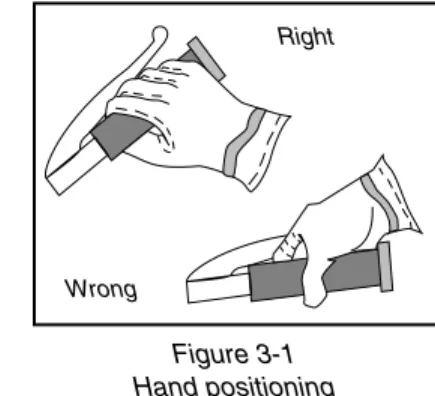
• Seat – Sit far enough forward so that arms are slightly bent when you hold the handgrips . Bending your arms permits you to press
Right
Wrong
Figure 3-1 Hand positioning
on the handlebars without having to stretch . A relaxed and arm-bent posture helps you work with your motorcycle to react quickly to hazards when and if needed .
• Hands – Hold the handgrips firmly to keep your grip when riding over rough surfaces . Start with a flat wrist position for your right hand . This will help you keep from accidentally using too much throttle . Consider adjusting the handlebars so your hands are even with or below your elbows . This permits you to use the proper muscles for precision steering .
• Knees – Keep your knees against the gas tank to help you maintain balance and control as you turn, accelerate, or stop . • Feet – Keep your feet firmly on the footrests or pegs to maintain
balance and control . Keep your feet near the controls so you can use them easily as needed . Don’t drag your feet . If your foot catches on something, you could be injured .
Basic Controls and Operation
Like all vehicles, motorcycles have controls to make them go, stop, and maneuver . Motorcycle controls are located and used differently than those in a car . Although most motorcycles have controls in similar locations to each other, please consult your motorcycle’s owner guide to verify control locations and operation specific to your bike .
Practice in a safe and controlled environment until you become comfortable operating each control . Remember to keep your head and eyes up so you can see far down the road, anticipate hazards, and enjoy your ride .
Clutch Control/Shifting Gears
Most motorcycles are shifted manually . Practice shifting both up and down to develop smooth control . Get used to shifting without looking down at any of the controls so that you can keep your eyes up and focused on the road ahead .
Unlike most vehicles, motorcycles typically have a “wet” clutch . A wet clutch significantly reduces the wear and damage to clutch components, allowing you to “feather” or “slip” the clutch to help control the amount of power given to the rear wheel . Effectively using this “friction zone” by “feathering” or “slipping” the clutch is a fundamental skill to learn and practice . This technique will aid you in starting out smoothly . It also can also be used at low speeds (such as in parking lots or in traffic) to control your motorcycle .
Down shifting smoothly to apply engine braking can be a very useful tool on motorcycles . The downside of this technique is that your brake light does not engage to let drivers behind you notice you are slowing . If engine braking, flash your brake light a few times to help other road users see you are slowing down .
Two-Wheel Steering
One thing all two-wheel motorcycles have in common is how they are maneuvered . Single-track vehicles (two-wheel motorcycles) steer through a technique known as counter-steering . At above walking speed, a motorcycle needs to lean to turn, and counter-steering initiates this lean . To use this technique, press on the grip in the direction you want to turn .
Although it may seem confusing at first, counter steering allows the rider to smoothly and effectively initiate motorcycle lean and turn in the direction they want to go . To counter-steer, press on the grip in the direction you want to turn . Pressing on the left hand grip causes the bike to lean left and turn left . Pressing on the right handgrip causes the bike to lean right and turn right . If you are unfamiliar with counter-steering, consider taking a training course .
Note: Three-wheeled motorcycles (trikes, sidecars, reversed-trikes, etc) steer via direct steering . This technique is simply turning the handlebars in the direction the rider wants to go . See Chapter 4: Riding a Three-Wheeler .
Cornering
Some of the most fun to be had on a motorcycle is riding Washington’s curvy and twisting roads . However, you should be aware that a large percentage of Washington motorcycle fatalities occur in corners – and are single vehicle accidents (just the motorcycle) .The two leading causes of these crashes in corners are excessive speed and improper cornering technique . Too often
Figure 3-2 Lean with motorcycle
riders take corners too fast and are unable to stay in their lane . They frequently end up crossing into another lane of traffic or simply going off the road . Sometimes they overreact and brake too hard, causing a skid and loss of control . One of the most effective ways to reduce your risk in corners is to take training . All two-wheel motorcycle endorsement training in Washington includes an emphasis on cornering strategies and techniques .
Cornering steps
To have a safe ride, approach all turns and curves with caution . Consider using these four Motorcycle Safety Foundation steps as a strategy for better control:
• SLOW – Reduce speed before the corner by rolling-off the throttle and, if necessary, applying both brakes .
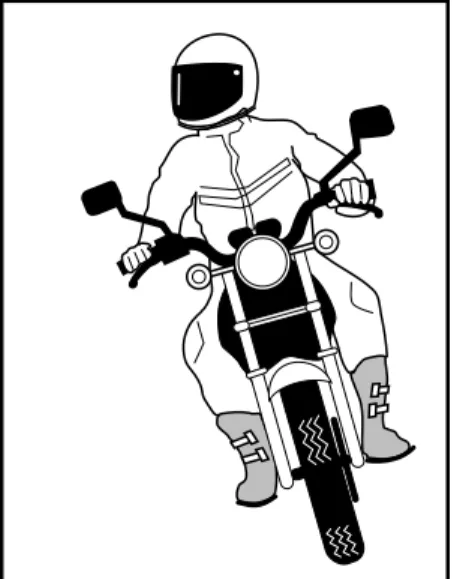
• LOOK – Look through the turn by pointing your head and eyes in the direction you want to go (toward the end or exit of the corner) . Do this throughout the corner . Keep your eyes level with the horizon . If you feel yourself going wide, look more – focus on where you want to go .
• PRESS – Counter-steer . Remember that to turn, the motorcycle must lean . To initiate your lean, lightly press on the handgrip in the direction you want to go . Press left— lean left — go left .
Figure 3-3
Middle/middle/middle cornering line
Middle Middle
Middle
Press right— lean right — go right . If you feel yourself going wide, press more- lean more .
• ROLL – After you enter the corner, smoothly roll-on the throttle to maintain or slightly increase speed . This will help stabilize the motorcycle .
Cornering lines
Every lane you ride in has three positions within it you can use: outside, middle, and inside . This remains true throughout every corner . Additionally, corners have an entry point, a mid-point (or apex), and an exit point . By choosing different lane positions at each of these points you can alter your line of travel to suit each corner and increase your level of safety .
For example, here are three examples of the many ways you can choose to use lane positions to aid you while cornering:
1 . By riding a middle/middle/middle path (Figure 3-3) , you typically keep away from both oncoming traffic and road-edge debris such as gravel . Keep in mind sometimes slippery surfaces such as oil drips from other vehicles or leaves can often accumulate near the center of the lane . This is often the safest path for less experienced riders .
Figure 3-4
Outside/inside/outside cornering line
Outside Inside
Outside
2 . By riding in the outside position at the entry (Figure 3-4) , the inside position at the mid-point, and the outside again at the exit (outside/inside/outside) you can “straighten” out the corner . The straighter the corner, the less lean you need, and thus the more traction you have . You will also have more traction available to slow or stop if necessary . Starting from the outside lane position also gives you a good view through the corner . However, using this line may put you closer to oncoming traffic or possible debris near the road edge .
3 . For riders with more experience (Figure 3-5) , riding a “delayed apex” (a more advanced form of cornering technique involving delaying the turn point and apex of the your corner), can help you see farther around the corner for a longer period of time . This technique requires more lean, but for a less amount of time . A delayed apex may also set you up to be ready to enter the next corner . However, the longer you remain in the outside position of a right-hand corner, the closer you come to oncoming traffic .
Figure 3-5
Delayed apex cornering line
Inside (delayed apex)
The above examples are just three of the many ways to ride through a corner .
The most important thing to know about cornering is that every corner you encounter will be different . Even the same corner may have different traffic, surface, or other hazards the next time you go through it . Thus each corner, every time through, may require a new approach .
Look, anticipate, and choose
Look far ahead and gather as much information as you can about the corner’s radius (how tight it is), surface condition, slope, and line-of-site (how far you can see around the corner) .
Anticipate potential hazards, such as a vehicle coming from the opposite direction that could cross the center line, a deer in the road around the bend, or gravel on the road surface . Use all this information to determine your speed and lane position not only at the entry of the corner, but also through the middle and exit . Choose lane positions throughout your corner that maximize your traction and ability to see and be seen . You will find that your motorcycle tends to go where you look . Whichever path you choose, be sure to keep your head and chin pointed toward the corner exit, and focus on where you want to go .
Braking
Braking in a straight line
Improper braking technique is often a common factor in motorcycle crashes . Most often, a rider gets in a panic situation and either under- or over-applies the brakes . If you under-apply your brakes you may not be able to stop in time before a hazard . If you over-apply your brakes you may lose traction on one or both wheels and crash .
When stopping, your front brake has more braking power than the rear . This is because weight transfers forward when slowing or stopping, thus giving the front brake most of your stopping power . Practice applying your front brake smoothly, without “grabbing” . The shortest and safest stops are obtained by using both front and rear brakes in a smooth and progressive manner, without skidding either tire .
When coming to a stop, consider remaining in 1st gear so you can take off rapidly if necessary to avoid a rear-end collision .
Practice braking in a safe and controlled environment until you become comfortable .
Braking in a corner
When a two-wheeled motorcycle is leaned over in a turn, the amount of traction available for braking is reduced . The greater the lean angle, the less traction available and the greater the possibility of the tires losing traction if brakes are applied .
To stop as quickly and safely as possible in a curve, try to straighten first and then brake . As you straighten, you may ride outside of your lane, so be sure that road and traffic conditions allow this to happen safely .
If road and traffic conditions do not allow you to safely straighten and then brake, smoothly apply your brakes as you gradually straighten your bike . Remember to not apply as much braking force as you would if the motorcycle were straight up . As you straighten, (less lean angle) apply more and more brake pressure . Remember to always square your handlebars during the last few feet of your stop to help maintain stability and control .
The key to avoid having to brake in a corner is to set your entry speed before the corner . Choose your entry speed based on the information you gather about the corner’s radius, surface condition, and line-of-site (how far you can see around the corner) . Remember the cornering technique of SLOW, LOOK, PRESS, and ROLL .
Evasive Maneuvers
When you encounter a hazard on your motorcycle, there are generally two types of evasive maneuvers you can execute: • Change speed (speed up, slow down, or stop) or,
• Change position (swerve or turn) .
Quick stops
To avoid a hazard such as a turning vehicle, pedestrian, animal, or other object in the roadway, you may need to stop your motorcycle in the quickest and safest way possible . To do so, apply both brakes fully without locking either wheel:
• Smoothly squeeze the front brake firmly and progressively . Squeeze with more force as your front suspension loads . Do not grab the front brake lever . Do not use abrupt pressure on either brake .
• Apply a light-to-lighter pressure to the rear brake pedal to prevent a rear wheel skid . As weight transfers forward, less traction will be available at the rear .
• Keep your knees against the tank and your eyes up . Look well ahead . This helps you stop the motorcycle in a straight line . Note: Consider using both brakes even for “normal” stops to develop the skill and habit of using both brakes . This will enable your motorcycle rider “muscle memory” (different than your car driver muscle memory) to help you brake effectively in an emergency .
Practice your braking skills often so that you develop and maintain the skills necessary to better deal with whatever comes your way out on the road .
Swerves
Because two-wheeled motorcycles are very maneuverable, you may be able to avoid a hazard simply by swerving around it . (Figures 3-6 and 3-7) It may not be safe to try to execute a quick stop . You may not have enough room to come to stop, or the vehicles behind you may not be able to stop .
A swerve can be thought of as two consecutive counter-steers . One, to quickly maneuver around the hazard, and the other to return to a straight line of travel . To allow your bike to change direction as rapidly as possible, it is important to keep your body upright and centered so your bike can move independently beneath you . Swerving is a quick maneuver and requires a lot of traction . To maximize your traction, never swerve and brake at the same time . Swerve then brake . Or, brake and then swerve .
Practice swerving in a safe location and at varying speeds to hone this life-saving skill .
Figure 3-6
Carrying Passengers and Cargo
It is important to know that carrying a passenger can significantly affect the handling of your motorcycle . Be aware that your motorcycle will handle differently with the additional weight of a passenger and/or cargo . It may take longer to accelerate and longer to stop . Your bike may be harder to hold steady and upright at stops and may behave differently in corners and slow speed maneuvers . Most new riders choose not to carry a passenger until they gain some experience on the street and are thoroughly practiced and comfortable with the operation of their motorcycle . Not only are you managing your risk when riding with a passenger, but you are now managing their risk as well .
Any passenger carried on a two or three-wheel motorcycle in Washington state must be at least five years old . Passengers must have a seat and footboards or pegs, and are required to wear a DOT compliant helmet .
To help keep your bike stabilized, your passenger should mount after you do, and dismount before you do . Passengers should lean with you and your bike when cornering . Passengers should keep movements to a minimum, especially at slow speeds or stops . Instruct your passengers to keep their feet on the footboards/pegs at all times .
For cargo, make sure it is as centered and low as possible . Make sure it is strapped down and secured tightly . Ensure it does not affect your ability to safely and effectively operate all your motorcycle’s controls .
Your owner’s manual will tell you how much weight you can safely carry on your motorcycle . It may also suggest different tire pressures or suspension adjustments for carrying a passenger and/ or cargo .
RIDING A THREE-WHEEL
MOTORCYCLE
Types of Three-Wheelers: The Right Bike for You
Three-wheeled motorcycles vary widely in type, size, and purpose (Figure 4-1) . For example, there are sidecar rigs (A), trikes with one wheel in front and two in back (B), and trikes with two wheels in front and one in back (C) . When considering a three-wheeler, consider the advantages and disadvantages of each type and what you plan to do with it . Pick the type of motorcycle that best fits your need . Ensure that the size and layout of the bike you are considering fits you comfortably . If you can, try sitting on as many different sizes and types of three-wheelers as you can to find one that “feels” right .
Differences Between Two and Three-Wheel
Motorcycles
Three-wheeled motorcycles have significantly different handling characteristics than two-wheeled motorcycles . Even an experienced two-wheel rider will find that a three-wheel motorcycle steers, corners, stops, and balances differently than the two-wheeler they are used to . Because of this, to legally operate most three-wheelers on Washington roadways you must have a separate three-wheel
Figure 4-1
Types of three-wheel motorcycles
endorsement . Consider taking a three-wheel training course to learn and practice the techniques needed to ride your three-wheeler safely and skillfully .
Advantages
Three-wheel motorcycles, often called rigs, have some advantages over their two-wheeled counterparts . Because of their three wheels, they are typically more stable than a two-wheeler . They do not require you to hold them upright at a stop . They can also slide sideways (or while braking) without falling down . They also tend to be larger than most two-wheelers, thus making them easier for other road users to see . Their size and three-wheel configuration also can make it easier to carry passengers and cargo .
Disadvantages
Although their larger size can be helpful for visibility, it can also mean less maneuverability and greater weight . This added weight can make most three-wheelers accelerate slower than two-wheelers . It can also make some three-wheelers (especially motorcycles equipped with sidecars) take longer to stop . Increased weight can also mean more engine and tire wear and higher fuel consumption .
Riding Posture — Setting Yourself up for Success
For better control, consider the following:
• Posture — Position yourself comfortably so you are able to operate all the controls and can use your arms to steer the motorcycle, rather than to hold yourself upright . This will help you bond with your motorcycle and allow you to quickly respond to hazards .
• Seat — Sit far enough forward so that your arms are slightly bent when you hold the handgrips . A bend in your arms permits you to turn the handlebars more effectively .
• Hands — Hold the handgrips firmly, but not too tight, to keep your grip when riding over rough surfaces . Ride with your right wrist flat when you can . This will help you have better control of the throttle and keep from accidentally using too much . Consider adjusting the handlebars so your hands are even with or below your elbows . This will help you be more comfortable and permit you to use the proper muscles for precision steering .
• Feet — Keep your feet firmly on your footrests – even while stopped . This helps to maintain safety by ensuring your feet are well away from any rolling parts of the three-wheeler . If your foot catches on something, you could be injured and it may affect your control of the motorcycle . Keep your feet near the controls so you can get to them quickly when needed .
• Body Position — You are likely to soon realize the need to change body position while cornering your three-wheeler . Lean and/or shift your body weight in the direction you intend to turn to avoid raising the inside wheel . This is especially important with sidecar rigs during right turns .
Basic Controls and Operation
Just like a car, three-wheel motorcycles have controls to make them go, stop, and maneuver . Unlike a car, however, a motorcycle’s controls are in different locations and are often operated differently . The location and use of controls varies depending on the three-wheeler you are riding . Consult your motorcycle owner’s manual to verify control locations and their operation . Practice with your controls until you become comfortable operating each control . Operate your controls while keeping your head and eyes up so that you can see far down the road to anticipate hazards while riding .
Clutch Control/Shifting Gears
Some three-wheelers shift manually, and some shift either partially or fully automatically . Consult your owner’s manual for the type of transmission and its operation on your motorcycle . Practice shifting both up and down to develop smooth control .
Most fully-manual shifted rigs have a “wet” clutch that allows you to “feather” or “slip” the clutch to help control the amount of power given to the rear wheel(s) – without damaging the clutch . “Feathering” or “slipping” the clutch is a fundamental skill to learn and practice . It will aid you in starting smoothly and can be used to smoothly control speed when maneuvering at slow speeds .
Down shifting to apply engine braking can be a very useful tool on both two and three-wheeled motorcycles . The downside of this technique is that your brake light does not engage to let drivers behind you notice you are slowing . When engine braking, flash your brake light a few times to help other road users see you are slowing down .
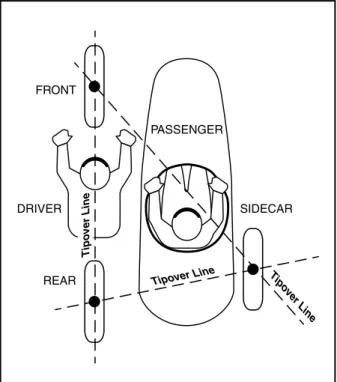
DRIVER FRONT REAR SIDECAR Tipo ver Line
Tipover Line Tipo
ver Line
PASSENGER
Figure 4-2 Tip-over lines: Sidecar rig
Unique Handling Characteristics
Three-wheel steering
Three-wheeled motorcycles steer, under normal conditions, using “direct-steering” . Direct steering is simply turning the handlebars, and thus the front wheel(s), in the direction the rider wants to turn (steer to the right – go to the right) .
Tip-over lines
Tip-over lines are inherent in the design of all three-wheel
motorcycles (Figures 4-2, 4-3, 4-4) . A line drawn between any two wheels on your rig represents a tip-over line . Each line tip-over line is like a hinge point . When enough weight is placed outside a tip-over line, or when cornering forces transfer the center of gravity outside a tip-over line, it is possible for a three-wheeled motorcycle to lift a wheel off the ground . This is occurs most frequently during tight maneuvers or when turning at speed . In extreme cases the rig can actually roll .
FRONT FRONT DRIVER REAR Tipo ver Line Tipo ver Line Tipover Line FRONT DRIVER REAR REAR Tipo ver Line Tipo ver Line Tipover Line Figure 4-4
Tip-over lines: Inverted trike Figure 4-3
Tip-over lines are most obvious when operating sidecar rigs . A shift of weight or centrifugal force can lift the sidecar wheel fairly easily . With practice and experience, a sidecar-equipped motorcycle can actually be operated with complete control while riding upon only the two wheels of the motorcycle itself . This is called “flying” the sidecar . Flying a sidecar on public roadways is not recommended . All three-wheeled motorcycles have tip-over lines . To maintain stability, careful positioning of loads and passengers within the tip-over lines is required . Carefully position passengers and cargo to reduce the possibility of lifting a wheel or rolling the rig . The lower and more centered you can place cargo or passengers the more stable your three-wheeled motorcycle will be .
“Flying” and steering reversion
When “flying” a rig with only two of three wheels in contact with the ground, at enough speed a balance point can be reached and “steering reversion” takes place . Steering reversion is when a three-wheeler (typically a sidecar rig), that is normally controlled by direct steering, temporarily balances and operates on only the two wheels of the motorcycle itself . When this happens, steering “reverts” to counter-steering . The rig will now need to be counter-steered like a two-wheeled motorcycle . Now, like a two-wheeled motorcycle, your rig will need to lean to turn . Counter-steering initiates this lean . To counter-steer, press on the grip in the direction you want to turn . Pressing on the left hand grip causes the bike to lean left and turn left . Pressing on the right handgrip causes the bike to lean right and turn right .
To bring a flying wheel to the ground, you can do one or more of the following: (a) lean into the lift, (b) use a bit of front brake, or (c) roll off the throttle slightly . The best way to understand and control “flying” a wheel is to practice in a safe and controlled location .
Yaw
When moving out from a stop on sidecar rig, you may feel the weight of the sidecar pulling the vehicle slightly to the right . This pull is call “yaw” (Figures 4-5, 4-6) . You can help compensate for this and remain in your lane, by steering slightly to the left when starting out .
You also feel yaw when you are braking on a side car rig . When braking on a motorcycle with a side car, especially one that does
Figure 4-5
Yaw under deceleration Yaw under accerlationFigure 4-6
not have a brake on the sidecar wheel, you may feel the sidecar “yawing” to the left . Compensate for this by steering slightly to the right to maintain your path of travel and stay within your lane .
Cornering
Some of the most fun to be had on a motorcycle is riding Washington’s curvy and twisting roads . However, you should be aware that a large percentage of Washington motorcycle fatalities occur in corners – and are single vehicle accidents (just the motorcycle) .The two leading causes of these crashes in corners are excessive speed and improper cornering technique . Too often riders take corners too fast and are unable to stay in their lane . They frequently end up crossing into another lane of traffic or simply going off the road . Sometimes they overreact and brake too hard, causing a skid and loss of control . One of the most effective ways to reduce your risk in corners is to take training . All three-wheel motorcycle endorsement training in Washington includes an emphasis on cornering strategies and techniques .
Throttle and brake together Hang off inside Enter turns toward outside Slow down before turns
Figure 4-8
Three-wheel cornering technique
Keep in mind that with increased speeds and tighter curves, there is a potential for the inside wheel of your three-wheeler to lift . This happens when weight and/or center of gravity is transferred outside a tip-over line .
Cornering steps
To have a safe ride, approach all turns and curves with caution . Consider using the following five steps for better control of your three-wheeler in corners (Figure 4-8):
1 . SLOW — Reduce speed before the corner by rolling-off the throttle and, if necessary, applying all brakes .
2 LOOK — Look through the turn by pointing your head and eyes in the direction you want to go (toward the end or exit of the corner) . Do this throughout the corner . Keep your eyes level with the horizon . If you feel yourself going wide, look more – focus on where you want to go .
3 . LEAN — Lean your upper body in the direction you intend to turn to help maintain stability .
4 . STEER — Point the front wheel/wheels toward the turn .
5 . ROLL — After you enter the corner, smoothly roll-on the throttle to maintain or slightly increase speed to help pull your three-wheeler through the turn .
When turning a trike:
The weight of most trikes is distributed almost equally side to side . Because of this, these motorcycles handle the same in both left- and right-hand turns .
When turning a sidecar rig:
Because the weight of a sidecar rig is not distributed equally from side to side, the handling characteristics when turning right versus turning left are quite different . During a right turn, side force pulls the rig toward the outside of the turn and creates a tendency for the sidecar wheel to lift . The sidecar will lift even more easily if it is empty or lightly loaded .
In right turns, using the same steps listed above and leaning or shifting your weight toward the sidecar will help reduce this effect and maintain stability .
Unlike right turns, during a left turn the side force pushing to the outside of the turn adds weight to the sidecar wheel and helps it stay in contact with the round . This weight transfer can, however, cause the suspension to extend, reducing traction available for steering and speed control . In extreme cases it could cause the nose of the sidecar to dig into the pavement and flip the entire rig back to front . You can help counter this effect by leaning or shifting your weight in to the turn .
Hills
When riding uphill on a three-wheel motorcycle or sidecar-equipped motorcycle, some weight will shift to the rear that can cause the front of the motorcycle to become lighter . This weight shift can reduce the traction on the front tire(s) . Traction reduction may reduce steering ability and tire grip .
When riding downhill, gravity will shift some weight to the front tire(s) . This weight shift can increase the amount of braking force available . However, it is possible to increase weight and driving force past available traction . It is possible on a trike (one front tire and two rear tires) and sidecar (one front tire, one rear tire, one sidecar tire) to cause the front tire to start to slide . A sliding tire,
breaking free of available traction, typically slides straight forward . If the front tire starts to slide, steering ability is lost . It is important, therefore, to begin slowing earlier and smoother when cornering and stopping downhill to maintain traction and steering ability . When riding a sidecar downhill it is even more important to adjust speed prior to entering a turn, especially right hand turns when riding a sidecar . In downhill, right hand turns both cornering forces and gravity are pulling the rig toward the outside of the curve, and the sidecar can easily lift and tip towards the left .
Remember: It is much easier to speed up in a corner than it is to slow down in one .
Drifting
As discussed earlier, centrifugal force pulls a three-wheeler toward the outside of corners and may cause an inside wheel to lift . To reduce this side force and help keep all wheels on the ground, you can use a technique called “drifting” . This technique consists of using steering and throttle inputs to slightly slide the rear tire(s) toward the outside of the corner . This subtle drift can help dissipate side loads and increase stability .
To learn and practice this important technique, consider taking a three-wheel training course .
Braking
Braking In a Straight Line
Improper braking technique is a significant contributing factor in many motorcycle crashes . One of the advantages of three-wheeled motorcycles is their braking ability . Their brakes can be applied hard up to –and in fact past– the limits of tire traction while still maintaining stability . Skidding on a three-wheeler isn’t nearly as risky as upon a two-wheeler . A skidding three-wheeler maintains stability until stopped .
Remember a sidecar rig’s tendency to yaw slightly to the left during stops . Compensate for this by steering slightly to the right .
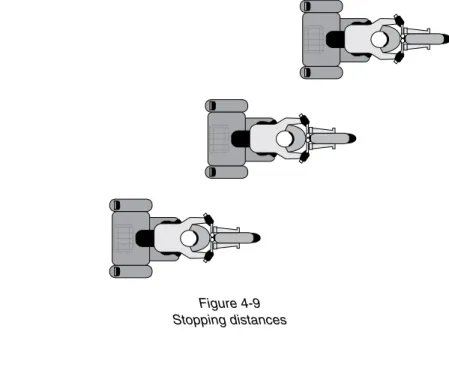
To achieve the shortest and safest stops, apply all brakes on your rig simultaneously (Figure 4-9) . Apply them in a smooth and progressive manner . As you stop, the weight of your three-wheeler shifts forward . On a sidecar rig, or a trike with two wheels up front, this increases the effects of your front brake – making it more
REAR
FRONT
BOTH
Figure 4-9 Stopping distances
powerful than the rear brake(s) . Apply all brakes up to, but not beyond, the skid point .
When coming to a stop, consider remaining in first gear (on a manually shifted rig) so that you can quickly start off if necessary to avoid a rear-end collision .
Braking in a corner
To stop as quickly and as safely as possible in a curve, use all your brakes smoothly and progressively . When cornering, part of your available traction is being used for turning . Available stopping traction is reduced . Do not exceed your traction limits . This may cause you to skid, potentially sliding out of your lane .
Sidecar-equipped motorcycles can be especially challenging while braking in a turn . Keep in mind that centrifugal forces in a right turn tends to lift the sidecar wheel . If braking hard, yaw will push the rig toward the left, so the rider must steer more into the turn . This makes it more likely the sidecar will attempt to lift . You should shift your body weight to compensate .
Be prepared to account for potential traction issues by shifting your weight early and by setting your entry speed before you enter the corner .
Evasive Maneuvers
When encounter a hazard on your three-wheeled motorcycle, there are generally two types of evasive maneuvers you can execute: 1 . Change speed (stop, slow down, or speed up), or
2 . Change position/direction (swerve or turn)
Quick stops
Making a quick stop is the often the safest evasive maneuver for avoiding collisions or other hazards in traffic on a three-wheeler . Fully apply all brakes smoothly without locking any wheels: • Apply all brakes smoothly and progressively, remembering the
front brake(s) have the most effect .
• With a sidecar, be prepared to account for the sidecar’s tendency to yaw (pull) left when stopping .
• Keep your knees against the tank . Keep your eyes up looking well ahead . This helps you stop in a straight line .
You may want to consider practicing using all brakes for “normal” stops to develop the skill and habit of using all brakes . This will enable your “muscle memory” to help you brake properly in an emergency .
Practice braking in a safe and controlled location often so that you develop the skills necessary to better deal with whatever comes your way out on the road .
Swerves
Swerving is another option for avoiding a hazard . However, because of the handling characteristics of three-wheelers, the sudden side loads experienced within a swerve can upset the suspension of the rig . It is possible to tip or roll the rig . This is even more pronounced with a sidecar equipped motorcycle .
Keep in mind that three-wheelers are larger than most
two-wheelers, leaving less room to swerve around vehicles or obstacles . Thus, you may find that executing a quick stop is safer and more effective . If you do need to swerve, remember to shift your weight into each directional change to help keep all wheels on the ground .
Practice swerving in a safe location and at varying speeds . You can practice the weight shifts you will use in swerves by shifting your weight to the inside during normal cornering .
Carrying Passengers and Cargo
Passengers carried by either two or three-wheelers must be at least five years old . Passengers must have a seat and foot-pegs/boards . All passengers are required to wear a DOT compliant helmet . To account for tip-over lines, a single passenger on a sidecar rig should be positioned in the sidecar and not on the rear seat of the motorcycle . If riding with two passengers, the larger passenger should be in the sidecar to minimize lift when turning .
When securing cargo, account for tip-over lines by placing as much of the weight as possible centered within the tip-over lines .
Your owner’s manual will tell you how much weight you can safely carry on your motorcycle . It may also suggest different tire pressures or suspension adjustments for carrying a passenger and/ or cargo .
Be aware that your rig will handle differently with the additional weight of a passenger and/or cargo . It may take longer to accelerate, longer to stop, and may behave differently in corners .
STRATEGIES FOR THE STREET
Managing Your Risk with Street Strategies
With training and continued practice, you can develop the physical skills to operate your motorcycle . It also takes training and
continued practice to develop your mental skills for riding . It is these mental skills of riding (awareness, focus, and strategy) that may contribute even more to your safety . As an example, you may have excellent physical swerving skills, but if your mental strategy helps you see a hazard early, you may not ever need to put your hazard avoidance skills to the test . Rather than reacting to an emergency, you can respond early to eliminate the hazard . This is an example of riding with a proactive strategy . Riding with a proactive strategy can help you see hazards early so you can plan to negotiate them safely .
Seeing and being seen
One of the most effective ways to manage your risk on a two or three-wheel motorcycle is to have a strategy to both see and be seen .
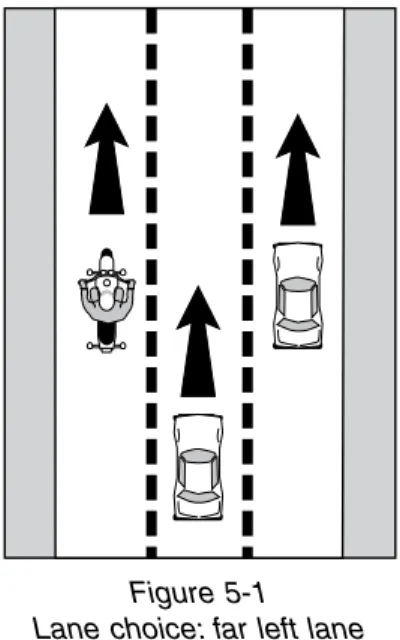
Lane choice
One of the ways you can increase your ability to see and be seen is by choosing the best possible lane in which to ride . Appropriate lane choice can help you to see down the road farther, and help other road users to see you . Constantly evaluate which is the best lane to ride in . Keep in mind that riding in-between lanes, commonly known as “lane splitting”, is against the law in Washington .
When riding, consider the advantages and disadvantages for each lane . Think, “which lane serves me best right now?”