AD9461
Rev. 0
Information furnished by Analog Devices is believed to be accurate and reliable. However, no responsibility is assumed by Analog Devices for its use, nor for any infringements of patents or other
rights of third parties that may result from its use. Specifications subject to change without notice. No One Technology Way, P.O. Box 9106, Norwood, MA 02062-9106, U.S.A.
FEATURES
130 MSPS guaranteed sampling rate
78.7 dBFS SNR/90 dBc SFDR with 10 MHz input (3.4 V p-p input, 130 MSPS) 77.7 dBFS SNR with 170.3 MHz input (4.0 V p-p input, 130 MSPS) 77.0 dBFS SNR/84 dBc SFDR with 170 MHz input (3.4 V p-p input, 130 MSPS) 76.3 dBFS SNR/86 dBc SFDR with 225 MHz input (3.4 V p-p input, 125 MSPS)
89 dBFS two-tone SFDR with 169 MHz and 170 MHz (130 MSPS)
60 fsec rms jitter Excellent linearity
DNL = ±0.6 LSB typical INL = ±5.0 LSB typical
2.0 V p-p to 4.0 V p-p differential full-scale input Buffered analog inputs
LVDS outputs (ANSI-644 compatible) or CMOS outputs Data format select (offset binary or twos complement) Output clock available
FUNCTIONAL BLOCK DIAGRAM
CMOS OR LVDS OUTPUT STAGING CLOCK AND TIMING MANAGEMENT AGND DRGND DRVDD VREF CLK+ VIN+ AD9461 VIN– CLK– DCO AVDD1 AVDD2 DCS MODE DFS OUTPUT MODE T/H BUFFER 16 PIPELINE ADC 2 32 2 OR D15 TO D0 REF REFB SENSE REFT 0601 1-001 Figure 1.
APPLICATIONS
MRI receiversMulticarrier, multimode, cellular receivers Antenna array positioning
Power amplifier linearization Broadband wireless
Radar
Infrared imaging
Communications instrumentation
GENERAL DESCRIPTION
The AD9461 is a 16-bit, monolithic, sampling, analog-to-digital converter (ADC) with an on-chip track-and-hold circuit. It is optimized for performance, small size, and ease of use. The AD9461 operates up to 130 MSPS, providing a superior signal-to-noise ratio (SNR) for instrumentation, medical imaging, and radar receivers using baseband (<100 MHz) and IF frequencies. The ADC requires 3.3 V and 5.0 V power supplies and a low voltage differential input clock for full performance operation. No external reference or driver components are required for many applications. Data outputs are CMOS or LVDS compatible (ANSI-644 compatible) and include the means to reduce the overall current needed for short trace distances.
Optional features allow users to implement various selectable operating conditions, including input range, data format select, and output data mode.
The AD9461 is available in a Pb-free, 100-lead, surface-mount, plastic package (100-lead TQFP_EP) specified over the industrial temperature range −40°C to +85°C.
PRODUCT HIGHLIGHTS
1. True 16-bit linearity.
2. High performance: outstanding SNR performance for baseband IFs in data acquisition, instrumentation, magnetic resonance imaging, and radar receivers. 3. Ease of use: on-chip reference and high input impedance
track-and-hold with adjustable analog input range and an output clock simplifies data capture.
4. Packaged in a Pb-free, 100-lead TQFP_EP.
5. Clock duty cycle stabilizer (DCS) maintains overall ADC performance over a wide range of clock pulse widths. 6. Out-of-range (OR) outputs indicate when the signal is
Rev. 0 | Page 2 of 28
TABLE OF CONTENTS
Features ... 1
Functional Block Diagram ... 1
Applications... 1 General Description ... 1 Product Highlights ... 1 Revision History ... 2 Specifications... 3 DC Specifications ... 3 AC Specifications... 4 Digital Specifications ... 5 Switching Specifications ... 5 Timing Diagrams... 6
Absolute Maximum Ratings... 7
Thermal Resistance ... 7
ESD Caution... 7
Pin Configurations and Function Descriptions ...8
Equivalent Circuits... 12
Typical Performance Characteristics ... 13
Terminology ... 16
Theory of Operation ... 17
Analog Input and Reference Overview ... 17
Clock Input Considerations... 18
Power Considerations... 19
Digital Outputs ... 20
Timing ... 20
Operational Mode Selection ... 20
Evaluation Board ... 21
Outline Dimensions ... 28
Ordering Guide ... 28
REVISION HISTORY
SPECIFICATIONS
DC SPECIFICATIONS
AVDD1 = 3.3 V, AVDD2 = 5.0 V, DRVDD = 3.3 V, LVDS mode, specified minimum sampling rate, 3.4 V p-p differential input, internal trimmed reference (1.0 V mode), AIN = −1.0 dBFS, DCS on, SFDR = AGND, unless otherwise noted.
Table 1.
AD9461BSVZ
Parameter Temp Min Typ Max Unit
RESOLUTION Full 16 Bits
ACCURACY
No Missing Codes Full Guaranteed
Offset Error Full −4.2 ±0.1 +4.2 mV
Gain Error 25°C −3 ±0.5 +3 % FSR
Full −3.4 +3.4 % FSR
Differential Nonlinearity (DNL)1 25°C −1.0 ±0.6 +1.0 LSB
Full −1.0 +1.3 LSB
Integral Nonlinearity (INL)1 25°C −7 ±5.0 +7 LSB
VOLTAGE REFERENCE
Output Voltage VREF = 1.7 V Full +1.7 V
Load Regulation @ 1.0 mA Full ±2 mV
Reference Input Current (External VREF = 1.7 V) Full 350 μA
INPUT REFERRED NOISE 25°C 2.6 LSB rms
ANALOG INPUT Input Span
VREF = 1.7 V Full 3.4 V p-p
VREF = 1.0 V Full 2.0 V p-p
Internal Input Common-Mode Voltage Full 3.5 V
External Input Common-Mode Voltage Full 3.2 3.9 V
Input Resistance2 Full 1 kΩ
Input Capacitance2 Full 6 pF
POWER SUPPLIES Supply Voltage
AVDD1 Full 3.14 3.3 3.46 V
AVDD2 Full 4.75 5.0 5.25 V
DRVDD—LVDS Outputs Full 3.0 3.6 V
DRVDD—CMOS Outputs Full 3.0 3.3 3.6 V
Supply Current1
AVDD1 Full 405 426 mA
AVDD21, 3 Full 131 143 mA
IDRVDD1—LVDS Outputs Full 72 81 mA
IDRVDD1—CMOS Outputs Full 14 mA
PSRR
Offset Full 1 mV/V
Gain Full 0.2 %/V
POWER CONSUMPTION
LVDS Outputs Full 2.2 2.4 W
CMOS Outputs (DC Input) Full 2.0 W
1 Measured at the maximum clock rate, f
IN = 15 MHz, full-scale sine wave, with a 100 Ω differential termination on each pair of output bits for LVDS output mode and
approximately 5 pF loading on each output bit for CMOS output mode.
2 Input capacitance or resistance refers to the effective impedance between one differential input pin and AGND. Refer to Figure 6 for the equivalent analog input structure. 3 For SFDR = AVDD1, I
Rev. 0 | Page 4 of 28
AC SPECIFICATIONS
AVDD1 = 3.3 V, AVDD2 = 5.0 V, DRVDD = 3.3 V, LVDS mode, specified minimum sample rate, 3.4 V p-p differential input, internal trimmed reference (1.7 V mode), AIN = −1.0 dBFS, DCS on, SFDR = AGND, unless otherwise noted.
Table 2.
AD9461BSVZ
Parameter Temp Min Typ Max Unit
SIGNAL-TO-NOISE RATIO (SNR) fIN = 10 MHz 25°C 76.3 77.7 dB Full 76.0 dB fIN = 170 MHz1 25°C 74.2 76.0 dB Full 73.8 dB fIN = 225 MHz 25°C 74.4 dB fIN = 225 MHz @125 MSPS 25°C 75.3 dB
SIGNAL-TO-NOISE AND DISTORTION (SINAD)
fIN = 10 MHz 25°C 74.0 76.7 dB Full 74.0 dB fIN = 170 MHz1 25°C 71.9 75.1 dB Full 68.3 dB fIN = 225 MHz 25°C 73.5 dB fIN = 225 MHz @125 MSPS 25°C 74.6 dB
EFFECTIVE NUMBER OF BITS (ENOB)
fIN = 10 MHz 25°C 12.5 Bits
fIN = 170 MHz1 25°C 12.2 Bits
fIN = 225 MHz 25°C 11.9 Bits
SPURIOUS-FREE DYNAMIC RANGE (SFDR, SECOND OR THIRD HARMONIC)
fIN = 10 MHz 25°C 82 90 dBc Full 80 dBc fIN = 170 MHz1 25°C 77 84 dBc Full 71 dBc fIN = 225 MHz 25°C 82 dBc fIN = 225 MHz @125 MSPS 25°C 86 dBc
WORST SPUR EXCLUDING SECOND OR THIRD HARMONICS
fIN = 10 MHz 25°C 88 96 dBc Full 86 dBc fIN = 170 MHz1 25°C 89 95 dBc Full 85 dBc fIN = 225 MHz 25°C 91 dBc fIN = 225 MHz @ 125 MSPS 25°C 93 dBc TWO-TONE SFDR fIN = 169.6 MHz @ −7 dBFS, 170.6 MHz @ −7 dBFS 25°C 89 dBFS
ANALOG BANDWIDTH Full 615 MHz
DIGITAL SPECIFICATIONS
AVDD1 = 3.3 V, AVDD2 = 5.0 V, DRVDD = 3.3 V, RLVDS_BIAS = 3.74 kΩ, unless otherwise noted. Table 3.
AD9461BSVZ
Parameter Temp Min Typ Max Unit
CMOS LOGIC INPUTS (DFS, DCS MODE, OUTPUT MODE)
High Level Input Voltage Full 2.0 V
Low Level Input Voltage Full 0.8 V
High Level Input Current Full 200 μA
Low Level Input Current Full −10 +10 μA
Input Capacitance Full 2 pF
DIGITAL OUTPUT BITS—CMOS MODE (D0 to D15, OTR)1
High Level Output Voltage Full 3.25 V
Low Level Output Voltage Full 0.2 V
DIGITAL OUTPUT BITS—LVDS MODE (D0 to D15, OTR)
VOD Differential Output Voltage2 Full 247 545 mV
VOS Output Offset Voltage Full 1.125 1.375 V
CLOCK INPUTS (CLK+, CLK−)
Differential Input Voltage Full 0.2 V
Common-Mode Voltage Full 1.3 1.5 1.6 V
Input Resistance Full 1.1 1.4 1.7 kΩ
Input Capacitance Full 2 pF
1 Output voltage levels measured with 5 pF load on each output. 2 LVDS R
TERM = 100 Ω.
SWITCHING SPECIFICATIONS
AVDD1 = 3.3 V, AVDD2 = 5.0 V, DRVDD = 3.3 V, unless otherwise noted.
Table 4.
AD9461BSVZ
Parameter Temp Min Typ Max Unit
CLOCK INPUT PARAMETERS
Maximum Conversion Rate Full 130 MSPS
Minimum Conversion Rate Full 1 MSPS
CLK Period Full 7.7 ns
CLK Pulse Width High1 (t
CLKH) Full 3.1 ns
CLK Pulse Width Low1 (t
CLKL) Full 3.1 ns
DATA OUTPUT PARAMETERS
Output Propagation Delay—CMOS (tPD)2 (Dx, DCO+) Full 3.35 ns
Output Propagation Delay—LVDS (tPD)3 (Dx+), (tCPD)3 (DCO+) Full 2.3 3.6 4.8 ns
Pipeline Delay (Latency) Full 13 Cycles
Aperture Uncertainty (Jitter, tJ) Full 60 fsec rms
1 With duty cycle stabilizer (DCS) enabled.
2 Output propagation delay is measured from clock 50% transition to data 50% transition with 5 pF load. 3 LVDS R
Rev. 0 | Page 6 of 28
TIMING DIAGRAMS
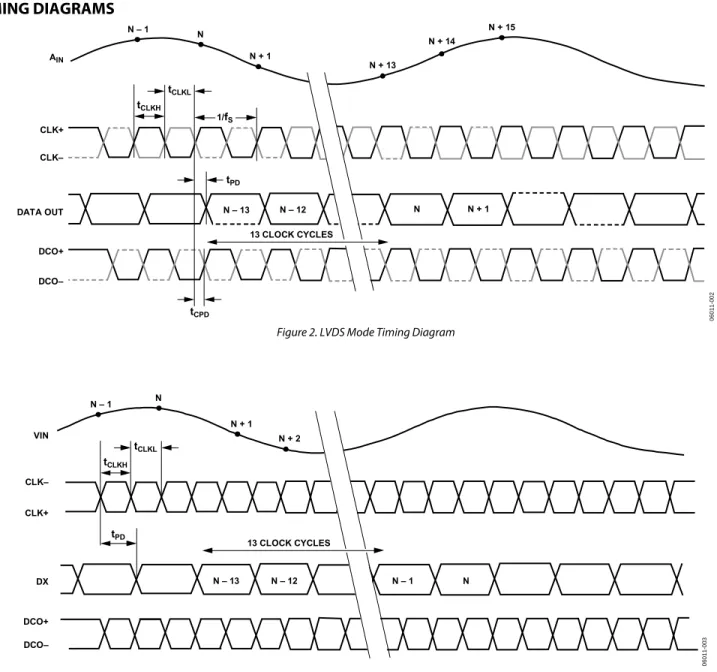
N – 13 N – 12 N N + 1 AIN CLK+ CLK– DATA OUT DCO+ DCO– N N + 1 N – 1 1/fS 13 CLOCK CYCLES tCLKL tPD tCPD tCLKH 06 01 1-0 02 N + 13 N + 14 N + 15Figure 2. LVDS Mode Timing Diagram
N + 1 N + 2 N – 1 tCLKL 13 CLOCK CYCLES N tCLKH tPD VIN CLK+ CLK– DX DCO+ DCO– N – 13 N – 12 N – 1 N 06 01 1 -00 3
ABSOLUTE MAXIMUM RATINGS
Table 5. Parameter Rating ELECTRICAL AVDD1 to AGND −0.3 V to +4 V AVDD2 to AGND −0.3 V to +6 V DRVDD to DGND −0.3 V to +4 V AGND to DGND −0.3 V to +0.3 V AVDD1 to DRVDD −4 V to +4 V AVDD2 to DRVDD −4 V to +6 V AVDD2 to AVDD −4 V to +6 V D0± through D15± to DGND −0.3 V to DRVDD + 0.3 V CLK+/CLK− to AGND –0.3 V to AVDD1 + 0.3 V OUTPUT MODE, DCS MODE, andDFS to AGND
–0.3 V to AVDD1 + 0.3 V VIN+, VIN− to AGND −0.3 V to AVDD2 + 0.3 V VREF to AGND −0.3 V to AVDD1 + 0.3 V SENSE to AGND −0.3 V to AVDD1 + 0.3 V REFT, REFB to AGND −0.3 V to AVDD1 + 0.3 V ENVIRONMENTAL
Storage Temperature Range −65°C to +125°C Operating Temperature Range −40°C to +85°C Lead Temperature (Soldering 10 sec) 300°C
Junction Temperature 150°C
Stresses above those listed under Absolute Maximum Ratings may cause permanent damage to the device. This is a stress rating only; functional operation of the device at these or any other conditions above those indicated in the operational section of this specification is not implied. Exposure to absolute maximum rating conditions for extended periods may affect device reliability.
THERMAL RESISTANCE
The heat sink of the AD9461 package must be soldered to ground.
Airflow increases heat dissipation, effectively reducing θJA. Also,
more metal directly in contact with the package leads from metal traces through holes, ground, and power planes reduces the θJA. It is required that the exposed heat sink be soldered to
the ground plane.
Table 6.
Package Type θJA1 θJB2 θJC3 Unit
100-Lead TQFP_EP 19.8 8.3 2 °C/W 1 Typical θ
JA = 19.8°C/W (heat sink soldered) for multilayer board in still air. 2 Typical θ
JB = 8.3°C/W (heat sink soldered) for multilayer board in still air. 3Typical θ
JC = 2°C/W (junction to exposed heat sink) represents the thermal
resistance through heat sink path.
ESD CAUTION
ESD (electrostatic discharge) sensitive device. Electrostatic charges as high as 4000 V readily accumulate on the human body and test equipment and can discharge without detection. Although this product features proprietary ESD protection circuitry, permanent damage may occur on devices subjected to high energy electrostatic discharges. Therefore, proper ESD precautions are recommended to avoid performance degradation or loss of functionality.
Rev. 0 | Page 8 of 28
PIN CONFIGURATIONS AND FUNCTION DESCRIPTIONS
74 D10+ 73 D10– 72 D9+ 69 D8– 70 D8+ 71 D9– 75 DRGND 68 DCO+ 67 DCO– 66 D7+ 64 DRVDD 63 DRGND 62 D6+ 61 D6– 60 D5+ 59 D5– 58 D4+ 57 D4– 56 D3+ 55 D3– 54 D2+ 53 D2– 52 D1+ 51 D1– 65 D7– PIN 1 DNC = DO NOT CONNECT 100 SF D R 99 AG ND 98 AG ND 97 AV DD 1 96 AV DD 1 95 AV DD 1 94 AV DD 1 93 AV DD 1 92 AV DD 1 91 AG ND 90 OR + 89 OR – 88 DRV D D 87 DRG ND 86 D15+ ( M S B ) 85 D15– 84 D14+ 83 D14– 82 D13+ 81 D13– 80 D12+ 79 D12– 78 D11+ 77 D11– 76 DRV D D 26 AV DD2 27 AV DD2 28 AV DD2 29 AV DD2 30 AV DD2 31 AV DD2 32 AV DD1 33 AV DD1 34 AV DD1 35 AV DD2 36 AV DD1 37 AV DD2 38 AV DD1 39 AG ND 40 CL K + 41 CL K – 42 AG ND 43 AV DD1 44 AV DD1 45 AV DD1 46 AG ND 47 DR G N D 48 DRV DD 49 D0 – ( L S B ) 50 D0+ 2 DNC 3 OUTPUT MODE 4 DFS 7 SENSE 6 AVDD1 5 LVDS_BIAS 1 DCS MODE 8 VREF 9 AGND 10 REFT 12 AVDD2 13 AVDD2 14 AVDD2 15 AVDD2 16 AVDD2 17 AVDD2 18 AVDD1 19 AVDD1 20 AVDD1 21 AGND 22 VIN+ 23 VIN– 24 AGND 25 AVDD2 11 REFB AD9461 LVDS MODE TOP VIEW (Not to Scale) 06 01 1-00 4
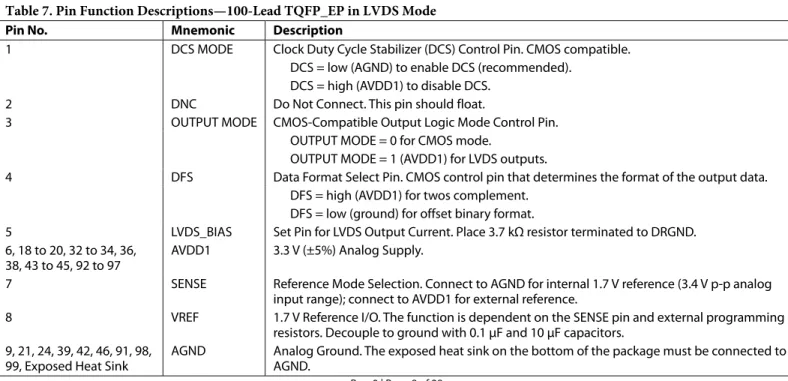
Figure 4. 100-Lead TQFP_EP Pin Configuration in LVDS Mode Table 7. Pin Function Descriptions—100-Lead TQFP_EP in LVDS Mode
Pin No. Mnemonic Description
1 DCS MODE Clock Duty Cycle Stabilizer (DCS) Control Pin. CMOS compatible. DCS = low (AGND) to enable DCS (recommended).
DCS = high (AVDD1) to disable DCS. 2 DNC Do Not Connect. This pin should float.
3 OUTPUT MODE CMOS-Compatible Output Logic Mode Control Pin. OUTPUT MODE = 0 for CMOS mode.
OUTPUT MODE = 1 (AVDD1) for LVDS outputs.
4 DFS Data Format Select Pin. CMOS control pin that determines the format of the output data. DFS = high (AVDD1) for twos complement.
DFS = low (ground) for offset binary format.
5 LVDS_BIAS Set Pin for LVDS Output Current. Place 3.7 kΩ resistor terminated to DRGND. 6, 18 to 20, 32 to 34, 36,
38, 43 to 45, 92 to 97
AVDD1 3.3 V (±5%) Analog Supply.
7 SENSE Reference Mode Selection. Connect to AGND for internal 1.7 V reference (3.4 V p-p analog input range); connect to AVDD1 for external reference.
8 VREF 1.7 V Reference I/O. The function is dependent on the SENSE pin and external programming resistors. Decouple to ground with 0.1 μF and 10 μF capacitors.
9, 21, 24, 39, 42, 46, 91, 98, 99, Exposed Heat Sink
AGND Analog Ground. The exposed heat sink on the bottom of the package must be connected to AGND.
Pin No. Mnemonic Description
10 REFT Differential Reference Output. Decoupled to ground with 0.1 μF capacitor and to REFB (Pin 11) with 0.1 μF and 10 μF capacitors.
11 REFB Differential Reference Output. Decoupled to ground with a 0.1 μF capacitor and to REFT (Pin 10) with 0.1 μF and 10 μF capacitors.
12 to 17, 25 to 31, 35, 37 AVDD2 5.0 V Analog Supply (±5%).
22 VIN+ Analog Input—True.
23 VIN− Analog Input—Complement.
40 CLK+ Clock Input—True.
41 CLK− Clock Input—Complement.
47, 63, 75, 87 DRGND Digital Output Ground.
48, 64, 76, 88 DRVDD 3.3 V Digital Output Supply (3.0 V to 3.6 V). 49 D0− (LSB) D0 Complement Output Bit (LVDS Levels).
50 D0+ D0 True Output Bit.
51 D1− D1 Complement Output Bit.
52 D1+ D1 True Output Bit.
53 D2− D2 Complement Output Bit.
54 D2+ D2 True Output Bit.
55 D3− D3 Complement Output Bit.
56 D3+ D3 True Output Bit.
57 D4− D4 Complement Output Bit.
58 D4+ D4 True Output Bit.
59 D5− D5 Complement Output Bit.
60 D5+ D5 True Output Bit.
61 D6− D6 Complement Output Bit.
62 D6+ D6 True Output Bit.
65 D7− D7 Complement Output Bit.
66 D7+ D7 True Output Bit.
67 DCO− Data Clock Output—Complement.
68 DCO+ Data Clock Output—True.
69 D8− D8 Complement Output Bit.
70 D8+ D8 True Output Bit.
71 D9− D9 Complement Output Bit.
72 D9+ D9 True Output Bit.
73 D10− D10 Complement Output Bit.
74 D10+ D10 True Output Bit.
77 D11− D11 Complement Output Bit.
78 D11+ D11 True Output Bit.
79 D12− D12 Complement Output Bit.
80 D12+ D12 True Output Bit.
81 D13− D13 Complement Output Bit.
82 D13+ D13 True Output Bit.
83 D14− D14 Complement Output Bit.
84 D14+ D14 True Output Bit.
85 D15− D15 Complement Output Bit.
86 D15+ (MSB) D15 True Output Bit.
89 OR− Out-of-Range Complement Output Bit. 90 OR+ Out-of-Range True Output Bit.
100 SFDR SFDR Control Pin. CMOS-compatible control pin for optimizing the configuration of the AD9461 analog front end. Connecting SFDR to AGND optimizes SFDR performance for applications with analog input frequencies <40 MHz or >215 MHz. For applications with analog inputs from 40 MHz to 215 MHz, connect this pin to AVDD1 for optimum SFDR performance; power dissipation from AVDD2 decreases by ~40 mW.
Rev. 0 | Page 10 of 28 74 D4+ 73 D3+ 72 D2+ 69 DNC 70 D0+ (LSB) 71 D1+ 75 DRGND 68 DCO+ 67 DCO– 66 DNC 64 DRVDD 63 DRGND 62 DNC 61 DNC 60 DNC 59 DNC 58 DNC 57 DNC 56 DNC 55 DNC 54 DNC 53 DNC 52 DNC 51 DNC 65 DNC PIN 1 DNC = DO NOT CONNECT 100 SF D R 99 AG ND 98 AG ND 97 AV D D1 96 AV D D1 95 AV D D1 94 AV D D1 93 AV D D1 92 AV D D1 91 AG ND 90 OR + 89 D15+ ( M S B) 88 DRV DD 87 DRG ND 86 D14+ 85 D13+ 84 D12+ 83 D11+ 82 D10+ 81 D9+ 80 D8+ 79 D7+ 78 D6+ 77 D5+ 76 DRV DD 26 AV DD2 27 AV DD2 28 AV DD2 29 AV DD2 30 AV DD2 31 AV DD2 32 AV DD1 33 AV DD1 34 AV DD1 35 AV DD2 36 AV DD1 37 AV DD2 38 AV DD1 39 AG ND 40 CL K+ 41 CL K – 42 AG ND 43 AV DD1 44 AV DD1 45 AV DD1 46 AG ND 47 DRG ND 48 DRV DD 49 DNC 50 DNC 2 DNC 3 OUTPUT MODE 4 DFS 7 SENSE 6 AVDD1 5 LVDS_BIAS 1 DCS MODE 8 VREF 9 AGND 10 REFT 12 AVDD2 13 AVDD2 14 AVDD2 15 AVDD2 16 AVDD2 17 AVDD2 18 AVDD1 19 AVDD1 20 AVDD1 21 AGND 22 VIN+ 23 VIN– 24 AGND 25 AVDD2 11 REFB AD9461 CMOS MODE TOP VIEW (Not to Scale) 06 01 1-00 5
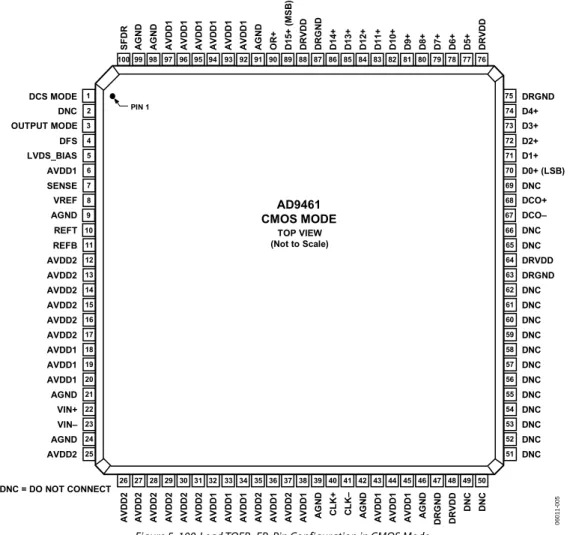
Figure 5. 100-Lead TQFP_EP, Pin Configuration in CMOS Mode Table 8. Pin Function Descriptions—100-Lead TQFP_EP in CMOS Mode
Pin No. Mnemonic Description
1 DCS MODE Clock Duty Cycle Stabilizer (DCS) Control Pin. CMOS compatible. DCS = low (AGND) to enable DCS (recommended).
DCS = high (AVDD1) to disable DCS. 2, 49 to 62, 65 to 66, 69 DNC Do Not Connect. These pins should float.
3 OUTPUT MODE CMOS-Compatible Output Logic Mode Control Pin. OUTPUT MODE = 0 for CMOS mode.
OUTPUT MODE = 1 (AVDD1) for LVDS outputs.
4 DFS Data Format Select Pin. CMOS control pin that determines the format of the output data. DFS = high (AVDD1) for twos complement.
DFS = low (ground) for offset binary format.
5 LVDS_BIAS Set Pin for LVDS Output Current. Place 3.7 kΩ resistor terminated to DRGND. 6, 18 to 20, 32 to 34, 36,
38, 43 to 45, 92 to 97
AVDD1 3.3 V (±5%) Analog Supply.
7 SENSE Reference Mode Selection. Connect to AGND for internal 1.7 V reference (3.4 V p-p analog input range); connect to AVDD1 for external reference.
8 VREF 1.7 V Reference I/O. The function is dependent on the SENSE pin and external programming resistors. Decouple to ground with 0.1 μF and 10 μF capacitors.
9, 21, 24, 39, 42, 46, 91, 98, 99, Exposed Heat Sink
AGND Analog Ground. The exposed heat sink on the bottom of the package must be connected to AGND.
10 REFT Differential Reference Output. Decoupled to ground with 0.1 μF capacitor and to REFB (Pin 11) with 0.1 μF and 10 μF capacitors.
Pin No. Mnemonic Description
11 REFB Differential Reference Output. Decoupled to ground with a 0.1 μF capacitor and to REFT (Pin 10) with 0.1 μF and 10 μF capacitors.
12 to 17, 25 to 31, 35, 37 AVDD2 5.0 V Analog Supply (±5%).
22 VIN+ Analog Input—True.
23 VIN− Analog Input—Complement.
40 CLK+ Clock Input—True.
41 CLK− Clock Input—Complement.
47, 63, 75, 87 DRGND Digital Output Ground.
48, 64, 76, 88 DRVDD 3.3 V Digital Output Supply (3.0 V to 3.6 V). 67 DCO− Data Clock Output—Complement.
68 DCO+ Data Clock Output—True.
70 D0+ (LSB) D0 True Output Bit (CMOS Levels).
71 D1+ D1 True Output Bit.
72 D2+ D2 True Output Bit.
73 D3+ D3 True Output Bit.
74 D4+ D4 True Output Bit.
77 D5+ D5 True Output Bit.
78 D6+ D6 True Output Bit.
79 D7+ D7 True Output Bit.
80 D8+ D8 True Output Bit.
81 D9+ D9 True Output Bit.
82 D10+ D10 True Output Bit.
83 D11+ D11 True Output Bit.
84 D12+ D12 True Output Bit.
85 D13+ D13 True Output Bit.
86 D14+ D14 True Output Bit.
89 D15+ (MSB) D15 True Output Bit.
90 OR+ Out-of-Range True Output Bit.
100 SFDR SFDR Control Pin. CMOS-compatible control pin for optimizing the configuration of the AD9461 analog front end. Connecting SFDR to AGND optimizes SFDR performance for applications with analog input frequencies <40 MHz or >215 MHz. For applications with analog inputs from 40 MHz to 215 MHz, connect this pin to AVDD1 for optimum SFDR performance; power dissipation from AVDD2 decreases by ~40 mW.
Rev. 0 | Page 12 of 28
EQUIVALENT CIRCUITS
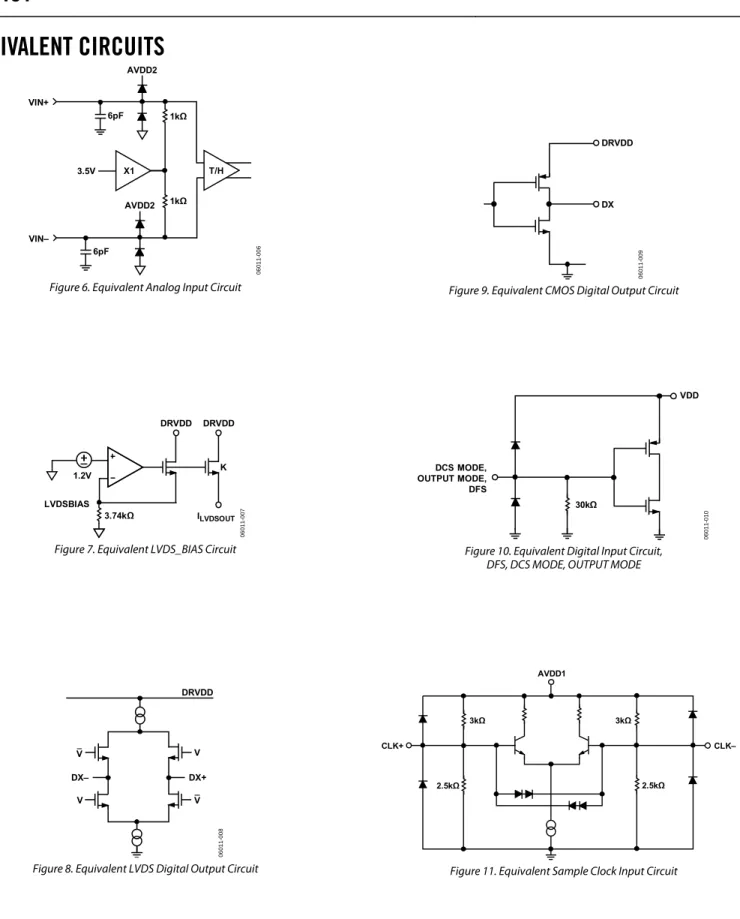
X1 3.5V 1kΩ 1kΩ AVDD2 VIN+ VIN– T/H AVDD2 6pF 6pF 06 01 1-00 6Figure 6. Equivalent Analog Input Circuit
1.2V DRVDD DRVDD K 3.74kΩ ILVDSOUT LVDSBIAS 06 01 1-0 07
Figure 7. Equivalent LVDS_BIAS Circuit
DRVDD DX– DX+ V V V V 06 01 1-0 08
Figure 8. Equivalent LVDS Digital Output Circuit
DX DRVDD 06 01 1-00 9
Figure 9. Equivalent CMOS Digital Output Circuit
DCS MODE, OUTPUT MODE, DFS VDD 30kΩ 06 01 1-0 10
Figure 10. Equivalent Digital Input Circuit, DFS, DCS MODE, OUTPUT MODE
CLK+ 2.5kΩ 3kΩ 3kΩ 2.5kΩ AVDD1 CLK– 06011-011
TYPICAL PERFORMANCE CHARACTERISTICS
AVDD1 = 3.3 V, AVDD2 = 5.0 V, DRVDD = 3.3 V, rated sample rate, LVDS mode, DCS enabled, TA = 25°C, 3.4 V p-p differential
input, AIN = −1 dBFS, internal trimmed reference (nominal VREF = 1.7 V), unless otherwise noted. 0 –130 –120 –110 –100 –90 –80 –70 –60 –50 –40 –30 –20 –10 0 16.25 32.50 48.75 65.00 AM P L IT UDE ( d BF S ) FREQUENCY (MHz) 06 01 1-0 12 130MSPS 10.3MHz @ –1.0dBFS SNR = 77.7dB ENOB = 12.6 BITS SFDR = 90dBc
Figure 12. 130 MSPS, 64k Point Single-Tone FFT, 10.3 MHz
0 –130 –120 –110 –100 –90 –80 –70 –60 –50 –40 –30 –20 –10 0 16.25 32.50 48.75 65.00 AM P L IT UDE ( d BF S ) FREQUENCY (MHz) 06 01 1-0 15 130MSPS 170.3MHz @ –1.0dBFS SNR = 75.4dB ENOB = 12.3 BITS SFDR = 86dBc
Figure 13. 130 MSPS, 64k Point Single-Tone FFT,170.3 MHz
0.6 0.4 0.2 0 –0.2 –0.4 –0.6 0 8192 16384 24576 32768 40960 49152 57344 65536 DN L ( L S B ) OUTPUT CODE 06 01 1-0 16
Figure 14. 130 MSPS, DNL Error vs. Output Code, 10.3 MHz
5 –5 –4 –3 –2 –1 0 1 2 3 4 0 8192 16384 24576 32768 40960 49152 57344 65536 IN L ( L S B ) OUTPUT CODE 06 01 1-0 17
Figure 15. 130 MSPS, INL Error vs. Output Code, 10.3 MHz
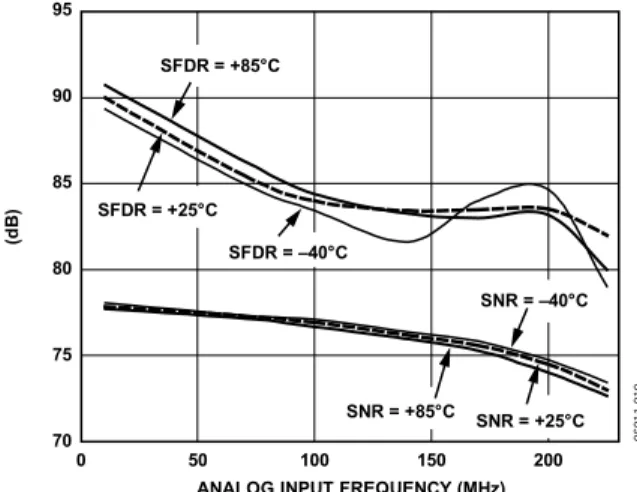
95 90 85 80 75 70 0 50 100 150 200 (d B )
ANALOG INPUT FREQUENCY (MHz)
06 01 1-0 18 SNR = +25°C SFDR = +25°C SNR = –40°C SFDR = –40°C SNR = +85°C SFDR = +85°C
Figure 16. 130 MSPS, SNR/SFDR vs. Analog Input Frequency, 3.4 V p-p
95 90 85 80 75 70 0 50 100 150 200 (d B )
ANALOG INPUT FREQUENCY (MHz)
06 01 1-0 19 SNR = +25°C SFDR = +25°C SNR = –40°C SFDR = –40°C SNR = +85°C SFDR = +85°C
Figure 17. 130 MSPS, SNR/SFDR vs. Analog Input Frequency, 3.4 V p-p, CMOS Output Mode
Rev. 0 | Page 14 of 28 120 100 80 60 40 20 0 –90 –80 –70 –60 –50 –40 –30 –20 –10 0 (d B )
ANALOG INPUT AMPLITUDE (dB)
06 01 1-0 20 SFDR dBFS SFDR dBc SNR dBFS SNR dB
Figure 18. 130 MSPS,170.3 MHz SNR/SFDR vs. Analog Input Amplitude
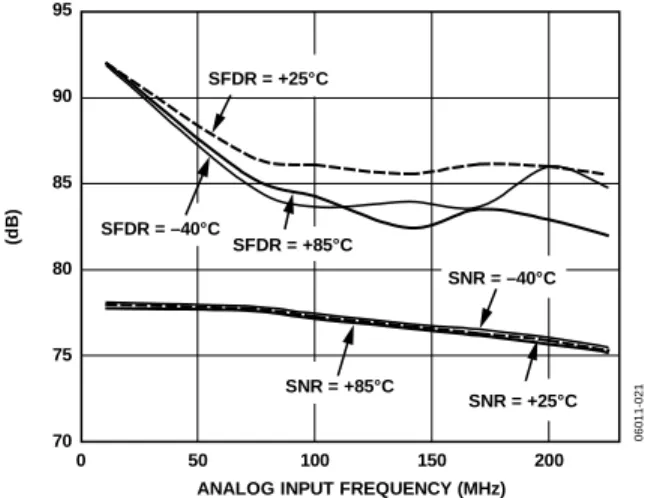
95 90 85 80 75 70 0 50 100 150 200 (d B )
ANALOG INPUT FREQUENCY (MHz)
06 01 1-0 21 SNR = +25°C SFDR = +25°C SNR = –40°C SFDR = –40°C SNR = +85°C SFDR = +85°C
Figure 19. 125 MSPS, SNR/SFDR vs. Analog Input Frequency, 3.4 V p-p
120 100 80 60 40 20 0 –90 –80 –70 –60 –50 –40 –30 –20 –10 0 (d B )
ANALOG INPUT AMPLITUDE (dB)
06 01 1-0 23 SFDR dBFS SFDR dBc SNR dBFS SNR dB
Figure 20. 130 MSPS, 170.3 MHz SNR/SFDR vs. Analog Input Amplitude, CMOS Output Mode
0 –10 –20 –30 –40 –50 –60 –70 –80 –90 –100 –120 –110 –130 –100 –90 –80 –70 –60 –50 –40 –30 –20 –10 0 S F DR AND I M D3 ( d B)
ANALOG INPUT AMPLITUDE (dB)
06 01 1-0 25 SFDR dBc WORST IMD3 dBc SFDR dBFS WORST IMD3 dBFS
Figure 21. 130 MSPS, Two-Tone SFDR vs. Analog Input Amplitude, 169.6 MHz, 170.6 MHz 6000 5000 4000 3000 2000 1000 0 N–11 N–10 N– 9 N– 8 N– 7 N– 6 N– 5 N– 4 N– 3 N– 2 N– 1 N+ 0 N+ 1 N+ 2 N+ 3 N+ 4 N+ 5 N+ 6 N+ 7 N+ 8 N+ 9 N+ 1 0 N+ 1 1 F RE Q UE NCY BIN 06 01 1-0 28
Figure 22. 130 MSPS, Grounded Input Histogram 0 –140 –120 –100 –80 –60 –40 –20 0 15.625 31.250 46.875 62.500 AM P L IT UDE ( d BF S ) FREQUENCY (MHz) 06 01 1-0 29 105MSPS 170.6MHz @ –7.0dBFS 169.6MHz @ –7.0dBFS SFDR = 89dBFS
0.6 –0.2 –0.1 0 0.1 0.2 0.3 0.4 0.5 –40 –20 0 20 40 60 80 G AI N E RRO R ( % F S ) TEMPERATURE (°C) 06 01 1-0 30
Figure 24. 130 MSPS, Gain vs. Temperature
97 72 77 82 87 92 1.8 2.0 2.2 2.4 2.6 2.8 3.0 3.2 3.4 3.6 3.8 4.0 4.2 (d B c)
ANALOG INPUT RANGE (V p-p)
06 01 1-0 47 170.3MHz SNR dBFS 170.3MHz SFDR dBc
Figure 25. 130 MSPS, SNR, SFDR vs. Analog Input Range
1.730 1.728 1.726 1.724 1.722 1.720 1.718 1.734 1.716 –40 –20 0 20 40 60 80 VR E F ( V) TEMPERATURE (°C) 06 01 1-0 32 1.732
Figure 26. 130 MSPS, VREF vs. Temperature
90 65 70 75 80 85 2.9 3.1 3.3 3.5 3.7 3.9 4.1 (d B )
ANALOG INPUT COMMON-MODE VOLTAGE (V)
06 01 1-0 46 SNR dB SFDR dBc
Figure 27. 130 MSPS, SNR/SFDR vs. Analog Input Common Mode
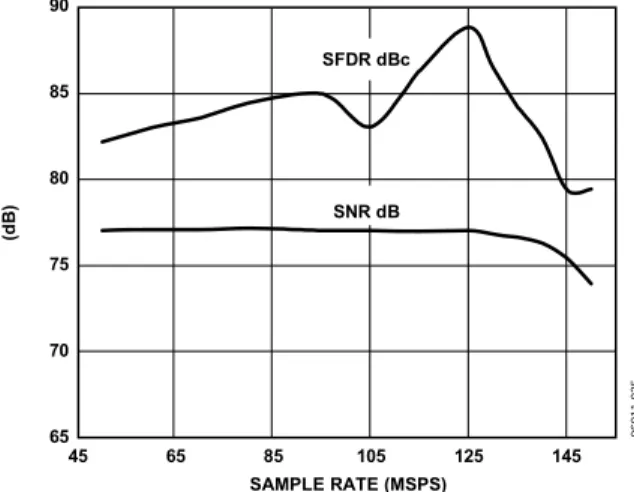
90 65 70 75 80 85 45 65 85 105 125 145 (d B ) SAMPLE RATE (MSPS) 06 01 1-0 35 SNR dB SFDR dBc
Rev. 0 | Page 16 of 28
TERMINOLOGY
Analog Bandwidth (Full Power Bandwidth)
The analog input frequency at which the spectral power of the fundamental frequency (as determined by the FFT analysis) is reduced by 3 dB.
Aperture Delay (tA)
The delay between the 50% point of the rising edge of the clock and the instant at which the analog input is sampled.
Aperture Uncertainty (Jitter, tJ)
The sample-to-sample variation in aperture delay.
Clock Pulse Width and Duty Cycle
Pulse width high is the minimum amount of time that the clock pulse should be left in the Logic 1 state to achieve rated performance. Pulse width low is the minimum time the clock pulse should be left in the low state. At a given clock rate, these specifications define an acceptable clock duty cycle.
Differential Nonlinearity (DNL, No Missing Codes)
An ideal ADC exhibits code transitions that are exactly 1 LSB apart. DNL is the deviation from this ideal value. Guaranteed no missing codes to 16-bit resolution indicates that all 65,536 codes must be present over all operating ranges.
Integral Nonlinearity (INL)
INL is the deviation of each individual code from a line drawn from negative full scale through positive full scale. The point used as negative full scale occurs ½ LSB before the first code transition. Positive full scale is defined as a level 1½ LSB beyond the last code transition. The deviation is measured from the middle of each particular code to the true straight line.
Signal-to-Noise and Distortion (SINAD)
SINAD is the ratio of the rms input signal amplitude to the rms value of the sum of all other spectral components below the Nyquist frequency, including harmonics but excluding dc.
Signal-to-Noise Ratio (SNR)
SNR is the ratio of the rms input signal amplitude to the rms value of the sum of all other spectral components below the Nyquist frequency, excluding the first six harmonics and dc.
Spurious-Free Dynamic Range (SFDR)
SFDR is the ratio of the rms signal amplitude to the rms value of the peak spurious spectral component. The peak spurious component may be a harmonic. SFDR can be reported in dBc (that is, degrades as signal level is lowered) or dBFS (always related back to converter full scale).
Total Harmonic Distortion (THD)
The ratio of the rms input signal amplitude to the rms value of the sum of the first six harmonic components.
Two-Tone SFDR
The ratio of the rms value of either input tone to the rms value of the peak spurious component. The peak spurious component may or may not be an IMD product.
Effective Number of Bits (ENOB)
The effective number of bits for a sine wave input at a given input frequency can be calculated directly from its measured SINAD using the following formula:
(
)
6.02 1.76 − = SINAD ENOB Gain ErrorThe first code transition should occur at an analog value of ½ LSB above negative full scale. The last transition should occur at an analog value of 1½ LSB below the positive full scale. Gain error is the deviation of the actual difference between first and last code transitions and the ideal difference between first and last code transitions.
Maximum Conversion Rate
The clock rate at which parametric testing is performed.
Minimum Conversion Rate
The clock rate at which the SNR of the lowest analog signal frequency drops by no more than 3 dB below the guaranteed limit.
Offset Error
The major carry transition should occur for an analog value of ½ LSB below VIN+ = VIN−. Offset error is defined as the deviation of the actual transition from that point.
Out-of-Range Recovery Time
The time it takes for the ADC to reacquire the analog input after a transition from 10% above positive full scale to 10% above negative full scale, or from 10% below negative full scale to 10% below positive full scale.
Output Propagation Delay (tPD)
The delay between the clock rising edge and the time when all bits are within valid logic levels.
Power-Supply Rejection Ratio
The change in full scale from the value with the supply at the minimum limit to the value with the supply at the maximum limit.
Temperature Drift
The temperature drift for offset error and gain error specifies the maximum change from the initial (25°C) value to the value at TMIN or TMAX.
THEORY OF OPERATION
The AD9461 architecture is optimized for high speed and ease of use. The analog inputs drive an integrated, high bandwidth track-and-hold circuit that samples the signal prior to quantization by the 16-bit pipeline ADC core. The device includes an on-board reference and input logic that accepts TTL, CMOS, or LVPECL levels. The digital output logic levels are user selectable as standard 3 V CMOS or LVDS (ANSI-644 compatible) via the OUTPUT MODE pin.
ANALOG INPUT AND REFERENCE OVERVIEW
A stable and accurate 0.5 V band gap voltage reference is built into the AD9461. The input range can be adjusted by varying the reference voltage applied to the AD9461, using either the internal reference or an externally applied reference voltage. The input span of the ADC tracks reference voltage changes linearly.
Internal Reference Connection
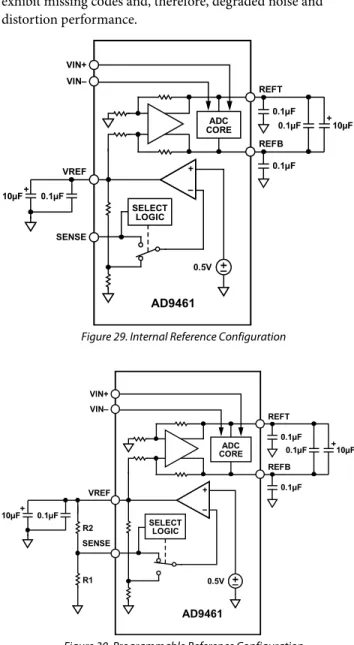
A comparator within the AD9461 detects the potential at the SENSE pin and configures the reference into three possible states, summarized in Table 9. If SENSE is grounded, the reference amplifier switch is connected to the internal resistor divider (see Figure 29), setting VREF to ~1.7 V. If a resistor divider is connected as shown in Figure 30, the switch again sets to the SENSE pin. This puts the reference amplifier in a noninverting mode with the VREF output defined as
⎟ ⎠ ⎞ ⎜ ⎝ ⎛ + × = R1 R2 V VREF 0.5 1
In all reference configurations, REFT and REFB drive the analog-to-digital conversion core and establish its input span. The input range of the ADC always equals twice the voltage at the reference pin for either an internal or an external reference.
Internal Reference Trim
The internal reference voltage is trimmed during the production test; therefore, there is little advantage to the user supplying an external voltage reference to the AD9461. The gain trim is performed with the AD9461 input range set to 3.4 V p-p nominal (SENSE connected to AGND). Because of this trim, and the maximum ac performance provided by the 3.4 V p-p analog input range, there is little benefit to using analog input
ranges <2 V p-p. However, reducing the range can improve SFDR performance in some applications. Likewise, increasing the range up to 3.4 V p-p can improve SNR. Users are cautioned that the differential nonlinearity of the ADC varies with the reference voltage. Configurations that use <2.0 V p-p can exhibit missing codes and, therefore, degraded noise and distortion performance. 10µF+ 0.1µF VREF SENSE 0.5V AD9461 VIN– VIN+ REFT 0.1µF 0.1µF 10µF 0.1µF REFB SELECT LOGIC ADC CORE + 06 011 -03 6
Figure 29. Internal Reference Configuration
10µF+ 0.1µF VREF SENSE R2 R1 0.5V AD9461 VIN– VIN+ REFT 0.1µF 0.1µF 10µF 0.1µF REFB SELECT LOGIC ADC CORE + 060 11-03 7
Rev. 0 | Page 18 of 28
Table 9. Reference Configuration Summary
Selected Mode SENSE Voltage Resulting VREF (V) Resulting Differential Span (V p-p)
External Reference AVDD N/A 2 × external reference
Programmable Reference 0.2 V to VREF
⎟ ⎠ ⎞ ⎜ ⎝ ⎛ + × R1 R2 1
0.5 , (See Figure 30) 2 × VREF Programmable Reference (Set for 2 V p-p) 0.2 V to VREF ⎟ ⎠ ⎞ ⎜ ⎝ ⎛ + × R1 R2 1 0.5 , R1 = R2 = 1 kΩ 2.0 Internal Fixed Reference AGND to 0.2 V 1.7 3.4
External Reference Operation
When the SENSE pin is tied to AVDD, the internal reference is disabled, allowing the use of an external reference. An internal reference buffer loads the external reference with an equivalent 7 kΩ load. The internal buffer continues to generate the positive and negative full-scale references, REFT and REFB, for the ADC core. The input span is always twice the value of the reference voltage; therefore, the external reference must be limited to a maximum of 2.0 V. See Figure 24 for gain variation vs. temperature.
Analog Inputs
As with most new high speed, high dynamic range ADCs, the analog input to the AD9461 is differential. Differential inputs improve on-chip performance because signals are processed through attenuation and gain stages. Most of the improvement is a result of differential analog stages having high rejection of even-order harmonics. There are also benefits at the PCB level. First, differential inputs have high common-mode rejection of stray signals, such as ground and power noise. Second, they provide good rejection of common-mode signals, such as local oscillator feedthrough. The specified noise and distortion of the AD9461 cannot be realized with a single-ended analog input; therefore, such configurations are discouraged. Contact sales for recommendations of other 16-bit ADCs that support single-ended analog input configurations.
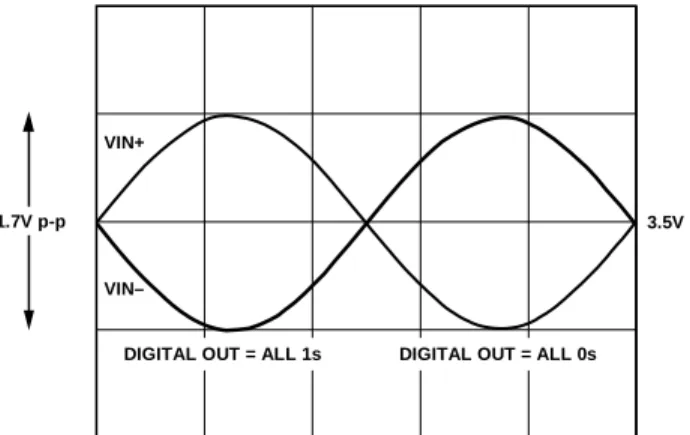
With the 1.7 V reference, which is the nominal value (see the Internal Reference Trim section), the differential input range of the AD9461 analog input is nominally 3.4 V p-p or 1.7 V p-p on each input (VIN+ or VIN−).
3.5V VIN+
VIN– 1.7V p-p
DIGITAL OUT = ALL 1s DIGITAL OUT = ALL 0s
06
01
1-03
8
Figure 31. Differential Analog Input Range for VREF = 1.7 V
The AD9461 analog input voltage range is offset from ground by 3.5 V. Each analog input connects through a 1 kΩ resistor to the 3.5 V bias voltage and to the input of a differential buffer. The internal bias network on the input properly biases the buffer for maximum linearity and range (see the Equivalent Circuits section). Therefore, the analog source driving the AD9461 should be ac-coupled to the input pins. The recommended method for driving the analog input of the AD9461 is to use an RF transformer to convert single-ended signals to differential (see Figure 32). Series resistors between the output of the transformer and the AD9461 analog inputs help isolate the analog input source from switching transients caused by the internal sample-and-hold circuit. The series resistors, along with the 1 kΩ resisters connected to the internal 3.5 V bias, must be considered in impedance matching the transformer input. For example, if RT is set to 51 Ω, RS is set
to 33 Ω and there is a 1:1 impedance ratio transformer, the input matches a 50 Ω source with a full-scale drive of 16.0 dBm. The 50 Ω impedance matching can also be incorporated on the secondary side of the transformer, as shown in the evaluation board schematic (see Figure 35).
0.1µF RT AD9461 VIN+ VIN– RS RS ADT1–1WT ANALOG INPUT SIGNAL 06 011 -03 9
Figure 32. Transformer-Coupled Analog Input Circuit
CLOCK INPUT CONSIDERATIONS
Any high speed ADC is extremely sensitive to the quality of the sampling clock provided by the user. A track-and-hold circuit is essentially a mixer, and any noise, distortion, or timing jitter on the clock combines with the desired signal at the analog-to-digital output. For that reason, considerable care was taken in the design of the clock inputs of the AD9461, and the user is advised to give careful thought to the clock source.
Typical high speed ADCs use both clock edges to generate a variety of internal timing signals and, as a result, can be sensitive to the clock duty cycle. Commonly a 5% tolerance is required on the clock duty cycle to maintain dynamic performance charac-teristics. The AD9461 contains a clock duty cycle stabilizer (DCS) that retimes the nonsampling edge, providing an internal clock signal with a nominal ~50% duty cycle. Noise and distortion per-formance are nearly flat for a 30% to 70% duty cycle with the DCS
formance are nearly flat for a 30% to 70% duty cycle with the DCS enabled. The DCS circuit locks to the rising edge of CLK+ and optimizes timing internally. This allows for a wide range of input duty cycles at the input without degrading performance. Jitter in the rising edge of the input is still of paramount concern and is not reduced by the internal stabilization circuit. The duty cycle control loop does not function for clock rates of less than 30 MHz nominally. The loop is associated with a time constant that should be considered in applications where the clock rate can change dynamically, requiring a wait time of 1.5 μs to 5 μs after a dynamic clock frequency increase or decrease before the DCS loop is relocked to the input signal. During the time that the loop is not locked, the DCS loop is bypassed, and the internal device timing is dependent on the duty cycle of the input clock signal. In such an application, it can be appropriate to disable the duty cycle stabilizer. In all other applications, enabling the DCS circuit is recommended to maximize ac performance. The DCS circuit is controlled by the DCS MODE pin; a CMOS logic low (AGND) on DCS MODE enables the duty cycle stabilizer, and logic high (AVDD1 = 3.3 V) disables the controller. The AD9461 input sample clock signal must be a high quality, extremely low phase noise source to prevent degradation of per-formance. Maintaining 16-bit accuracy places a premium on the encode clock phase noise. SNR performance can easily degrade by 3 dB to 4 dB with 70 MHz analog input signals when using a high jitter clock source. (See the AN-501 Application Note,
Aperture Uncertainty and ADC System Performance for more information.) For optimum performance, the AD9461 must be clocked differentially. The sample clock inputs are internally biased to ~1.5 V, and the input signal is usually ac-coupled into the CLK+ and CLK− pins via a transformer or capacitors. Figure 33 shows one preferred method for clocking the AD9461. The clock source (low jitter) is converted from single-ended to differential using an RF transformer. The back-to-back Schottky diodes across the secondary of the transformer limit clock excursions into the AD9461 to approximately 0.8 V p-p differential. This helps prevent the large voltage swings of the clock from feeding through to other portions of the AD9461 and limits the noise presented to the sample clock inputs.
If a low jitter clock is available, it helps to band-pass filter the clock reference before driving the ADC clock inputs. Another option is to ac couple a differential ECL/PECL signal to the encode input pins, as shown in Figure 34.
0.1µF AD9461 CLK+ CLK– HSMS2812 DIODES CRYSTAL SINE SOURCE ADT1–1WT 0 60 11 -04 0
Figure 33. Crystal Clock Oscillator, Differential Encode
0.1µF AD9461 ENCODE ENCODE 0.1µF VT VT ECL/ PECL 06 01 1-0 41
Figure 34. Differential ECL for Encode Jitter Considerations
High speed, high resolution ADCs are sensitive to the quality of the clock input. The degradation in SNR at a given input frequency (fINPUT) and rms amplitude due only to aperture jitter
(tJ) can be calculated using the following equation:
SNR = −20 log[2πfINPUT × tJ]
In the equation, the rms aperture jitter represents the root-mean-square of all jitter sources including the clock input, analog input signal, and ADC aperture jitter specification. IF undersampling applications are particularly sensitive to jitter
The clock input should be treated as an analog signal in cases where aperture jitter can affect the dynamic range of the AD9461. Power supplies for clock drivers should be separated from the ADC output driver supplies to avoid modulating the clock signal with digital noise. Low jitter crystal-controlled oscillators make the best clock sources. If the clock is generated from another type of source (by gating, dividing, or another method), it should be synchronized by the original clock during the last step.
POWER CONSIDERATIONS
Care should be taken when selecting a power source. The use of linear dc supplies is highly recommended. Switching supplies tend to have radiated components that can be received by the AD9461. Each of the power supply pins should be decoupled as closely to the package as possible using 0.1 μF chip capacitors. The AD9461 has separate digital and analog power supply pins. The analog supplies are denoted AVDD1 (3.3 V) and AVDD2 (5 V), and the digital supply pins are denoted DRVDD. Although the AVDD1 and DRVDD supplies can be tied together, best per-formance is achieved when the supplies are separate. This is because the fast digital output swings can couple switching current back into the analog supplies. Note that both AVDD1 and AVDD2 must be held within 5% of the specified voltage. The DRVDD supply of the AD9461 is a dedicated supply for the digital outputs in either LVDS or CMOS output mode. When in LVDS mode, the DRVDD should be set to 3.3 V. In CMOS mode, the DRVDD supply can be connected from 2.5 V to 3.6 V for compatibility with the receiving logic.
Rev. 0 | Page 20 of 28
DIGITAL OUTPUTS
LVDS Mode
The off-chip drivers on the chip can be configured to provide LVDS-compatible output levels via Pin 3 (OUTPUT MODE). LVDS outputs are available when OUTPUT MODE is CMOS logic high (or AVDD1 for convenience) and a 3.74 kΩ RSET
resistor is placed at Pin 5 (LVDS_BIAS) to ground. Dynamic performance, including both SFDR and SNR, maximizes when using the AD9461 in LVDS mode; designers are encouraged to take advantage of this mode. The AD9461 outputs include complementary LVDS outputs for each data bit (Dx+/Dx−), the overrange output (OR+/OR−), and the output data clock output (DCO+/DCO−). The RSET resistor current is multiplied on-chip,
setting the output current at each output equal to a nominal 3.5 mA (11 × IRSET). A 100 Ω differential termination resistor
placed at the LVDS receiver inputs results in a nominal 350 mV swing at the receiver. LVDS mode facilitates interfacing with LVDS receivers in custom ASICs and FPGAs that have LVDS capability for superior switching performance in noisy environments. Single point-to-point net topologies are recommended, with a 100 Ω termination resistor located as close to the receiver as possible. It is recommended to keep the trace length less than two inches and to keep differential output trace lengths as equal as possible.
CMOS Mode
In applications that can tolerate a slight degradation in dynamic performance, the AD9461 output drivers can be configured to interface with 2.5 V or 3.3 V logic families by matching DRVDD to the digital supply of the interfaced logic. CMOS outputs are available when OUTPUT MODE is CMOS logic low (or AGND for convenience). In this mode, the output data bits, Dx, are single-ended CMOS, as is the overrange output, OR+. The output clock is provided as a differential CMOS signal, DCO+/DCO−. Lower supply voltages are recommended to avoid coupling switching transients back to the sensitive analog sections of the ADC. The capacitive load to the CMOS outputs should be minimized, and each output should be connected to a single gate through a series resistor (220 Ω) to minimize switching transients caused by the capacitive loading.
TIMING
The AD9461 provides latched data outputs with a pipeline delay of 13 clock cycles. Data outputs are available one propagation delay (tPD) after the rising edge of CLK+. Refer to Figure 2 and
Figure 3 for detailed timing diagrams.
OPERATIONAL MODE SELECTION
Data Format Select
The data format select (DFS) pin of the AD9461 determines the coding format of the output data. This pin is 3.3 V CMOS compatible, with logic high (or AVDD1, 3.3 V) selecting twos complement and DFS logic low (AGND) selecting offset binary format. Table 10 summarizes the output coding.
Output Mode Select
The OUPUT MODE pin controls the logic compatibility, as well as the pinout of the digital outputs. This pin is a CMOS-compatible input. With OUTPUT MODE = 0 (AGND), the AD9461 outputs are CMOS compatible, and the pin assignment for the device is as defined in Table 8. With OUTPUT MODE = 1 (AVDD1, 3.3 V), the AD9461 outputs are LVDS compatible, and the pin assignment for the device is as defined in Table 7.
Duty Cycle Stabilizer
The DCS circuit is controlled by the DCS MODE pin; a CMOS logic low (AGND) on DCS MODE enables the DCS, and logic high (AVDD1, 3.3 V) disables the controller.
SFDR Enhancement
Under certain conditions, the SFDR performance of the AD9461 improves by decreasing the power of the core of the ADC. The SFDR control pin (Pin 100) is a CMOS-compatible control pin to optimize the configuration of the AD9461 analog front end. Connecting SFDR to AGND optimizes SFDR performance for applications with analog input frequencies <40 MHz or >215 MHz. For applications with analog inputs from 40 MHz to 215 MHz, connect this to AVDD1 for optimum SFDR performance; power dissipation from AVDD2 decreases by ~40 mW.
Table 10. Digital Output Coding
Code VIN+ − VIN− Input Span = 3.4 V p-p (V) VIN+ − VIN− Input Span = 2 V p-p (V) Digital Output Offset Binary (D15•••D0) Digital Output Twos Complement (D15•••D0) 65,536 +1.700 +1.000 1111 1111 1111 1111 0111 1111 1111 1111 32,768 0 0 1000 0000 0000 0000 0000 0000 0000 0000 32,767 −0.000058 −0.0000305 0111 1111 1111 1111 1111 1111 1111 1111 0 −1.70 −1.00 0000 0000 0000 0000 1000 0000 0000 0000
EVALUATION BOARD
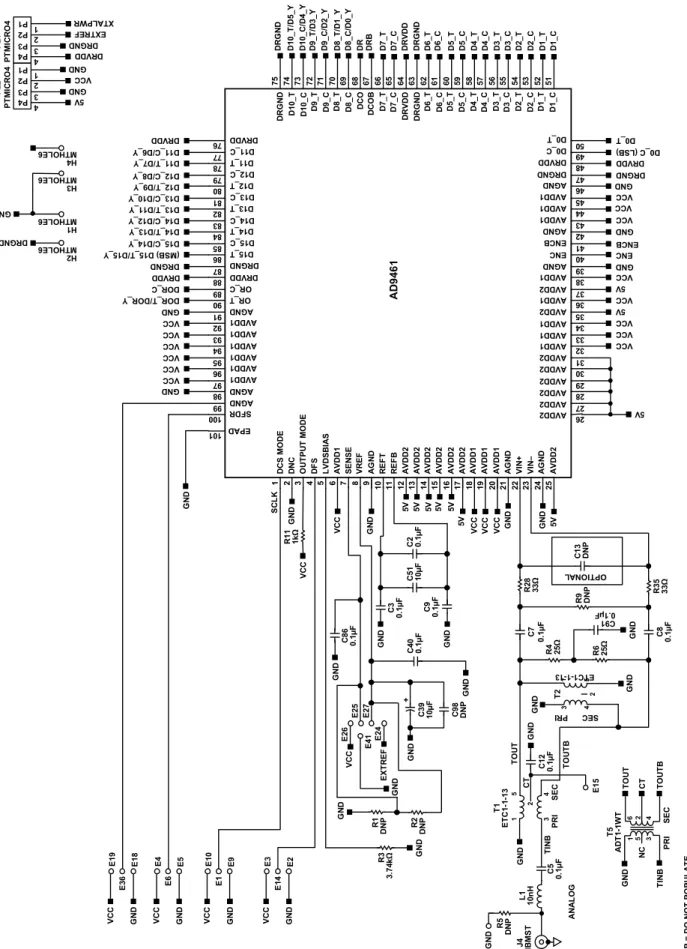
Evaluation boards are offered to configure the AD9461 in either CMOS mode or LVDS mode only. This design represents a recommended configuration for using the device over a wide range of sampling rates and analog input frequencies. These evaluation boards provide all the support circuitry required to operate the ADC in its various modes and configurations. Complete schematics are shown in Figure 35 through Figure 38. Gerber files are available from engineering applications
demonstrating the proper routing and grounding techniques that should be applied at the system level.
It is critical that signal sources with very low phase noise (<60 fsec rms jitter) are used to realize the ultimate performance of the converter. Proper filtering of the input signal to remove harmonics and lower the integrated noise at the input is also necessary to achieve the specified noise performance.
The evaluation boards are shipped with a 115 V ac to 6 V dc power supply. The evaluation boards include low dropout regulators to generate the various dc supplies required by the AD9461 and its support circuitry. Separate power supplies are provided to isolate the DUT from the support circuitry. Each input configuration can be selected by proper connection of various jumpers (see Figure 35).
The LVDS mode evaluation boards include an LVDS-to-CMOS translator, making them compatible with the high speed ADC FIFO evaluation kit (HSC-ADC-EVALA-SC). The kit includes a high speed data capture board that provides a hardware solution for capturing up to 32 kB samples of high speed ADC output data in a FIFO memory chip (user upgradeable to 256 kB samples). Software is provided to enable the user to download the captured data to a PC via the USB port. This software also includes a behavioral model of the AD9461 and many other high speed ADCs.
Behavioral modeling of the AD9461 is also available at www.analog.com/ADIsimADC. The ADIsimADC™ software supports virtual ADC evaluation using ADI proprietary behavioral modeling technology. This allows rapid comparison between the AD9461 and other high speed ADCs with or without hardware evaluation boards.
The user can choose to remove the translator and terminations to access the LVDS outputs directly.
Rev. 0 | Page 22 of 28 OPTI ONA L 15 20 23 97 96 86 12 16 21 22 95 24 25 26 27 34 92 93 94 28 29 30 31 40 39 19 41 42 35 38 90 91 87 18 9 64 63 43 44 72 73 76 77 78 79 80 81 45 46 49 50 51 52 55 56 57 58 59 60 65 66 68 69 70 71 6 88 84 85 48 53 61 67 74 82 47 54 62 75 83 32 33 100 89 36 37 101 98 7 10 13 14 99 11 17 2 3 4 5 8 1 R1 1 1k Ω VC C GN D R3 3. 74 k Ω DRG N D DRVDD E2 4 EXT R EF D0_C ( LSB) D0_T D1_ C D1_ T D3_ C D3_ T D4_ C D4_ T D5_ C D5_ T D7_ C D7_ T DR D8_ C /D 0_ Y D8_ T /D 1_Y D9_ C /D 2_ Y D9_ T /D 3_Y D10 _C/ D4 _Y C9 8 DNP GN D D15_C /D 14_Y E4 1 E2 5 E2 7 E2 6 VC C GN D E6 E5 E4 GN D C3 0.1µF C9 0.1µ F C8 6 0. 1µ F R1 DNP GN D 5V VCC D14_C /D 12_Y DRG N D D6_ T D2_ T DRGND D13_T /D 11_Y D10 _T /D5_ Y DRB D6_ C D2_ C DRVD D D14_T /D 13_Y GND VCC D13_C /D 10_Y D12_T /D9 _Y D12_C /D 8_Y D11_T /D7 _Y D11_C /D 6_Y DRV DD VCC VCC GN D VCC VC C VCC 5V VCC ENC B GND ENC GND VC C 5V VCC 5V GN D VCC 5V 5V 5V 5V 5V GN D SC L K VCC VCC GND VC C GN D 5V C1 3 DN P R35 33Ω R2 8 33 Ω R9 DNP C91 0.1µ F C8 0.1µF GN D GN D VC C GN D VCC EPAD AD9 4 6 1 R4 25Ω P1 P2 P3 P2 2 PT M IC R O 4 VCC 5V GND GND P4 4 3 2 1 P1 P2 P3 P2 1 PT M IC RO 4 EXT RE F DRV DD XTA LPW R DRG ND P4 4 3 2 1 DC S M O D E DN C OU TP U T M OD E DF S L V DSBI AS A V DD1 SEN SE VR EF AG ND RE F T RE F B A V DD2 A V DD2 A V DD2 A V DD2 A V DD2 A V DD2 A V DD1 A V DD1 A V DD1 AG ND VI N + VI N – AG ND A V DD2 VCC DRG ND DOR _C DOR _T /DO R_Y GND VCC VCC DRV DD (M SB ) D15_ T/D 15_Y E1 E9 E1 0 GN D VC C E1 4 E2 E3 GN D VC C E3 6 E1 8 E1 9 GN D VC C C1 2 0. 1µ F C5 0.1µF J4 SMB M ST R5 DN P GN D TIN B GN D ANA L O G L1 10n H E1 5 R6 25Ω R2 DN P C5 1 10 µ F C2 0.1µ F C40 0.1µ F GN D GN D DR G N D D10_ T D10_ C D9_T D9_C D8_T D8_C DC O DC O B D7_T D7_C DR V D D DR G N D D6_T D6_C D5_T D5_C D4_T D4_C D3_T D3_C D2_T D2_C D1_T D1_C D12_T D12_ C D11_T D11_ C DRV DD SFD R AGN D AGN D AVDD1 AVDD1 AVDD1 AVDD1 OR_C OR_T AGN D AVDD1 AVDD1 DRV DD DRG ND D15_T D15_ C D14_T D14_ C D13_T D13_ C AVD D2 AVD D2 AVD D2 AVD D2 AVD D2 AVD D2 AVD D1 AVD D1 AVD D1 AVD D2 AVD D1 AVD D2 AVD D1 ENC AGND ENC B AGND AVD D1 AVD D1 AVD D1 AGND DRG ND DRV DD D0_C D0_T H4 MTH OL E6 GND DRG ND H3 MTH OL E6 H1 MTH OL E6 H2 MTH OL E6 GN D C3 9 10 µ F + TO U T CT TO U TB C7 0.1µF PR I SEC GN D GN D T5 AD T 1-1W T T2 1 5 3 6 2 4 NC GN D GN D T INB T O UT B TOU T CT PRI SEC ETC 1-1 -13 3 4 1 2 5 PR I SEC T1 ET C 1-1 -1 3 15 34 2 06 011-042 DN P = DO NO T P O PUL AT E
IN OU T OU T1 5V C34 10µ F C89 10µ F 3 4 2 1 A D P 3 338 -5 U14 GN D DNP = DO NO T P O P UL A T E GN D GN D 5V X 5V X 5VX 5V GN D VI N GN D + + IN OU T OU T1 3. 3V L3 FE R R ITE C6 10µ F C87 10 µ F 3 4 2 1 A D P 33 38-3. 3 U7 GN D GN D VCCX V CCX GN D VI N GN D + + IN OU T OU T1 3. 3V C4 10µ F C88 10µ F 3 4 2 1 A D P 3 338 -3 .3 U3 DRG ND DR G N D DRV D DX DRV DDX DR G N D VI N GN D + + P J-002A C33 10µ F 1 3 2 P4 GN D VI N + 1 3 2 PO W ER O PT IO N S ADT 1-1W T PR I SEC NC EN C E NCB GN D J5 SM B M ST R7 DNP R39 0Ω R8 50Ω C2 6 0. 1µ F C36 DNP 1 2 3 5 6 T3 2 3 1 CR2 DNP CR1 C42 0.1µ F GN D XT A L IN P U T GN D C R 2 T O M A K E L A Y O UT AND P ARAS IT IC LO A D IN G S Y M M E T R IC A L 4 J1 SM B M ST 1 3 2 E NCODE GN D OU T VC C VEE ~O U T + GN D GN D XT A L IN P U T E3 0 C1 10µ F DNP E3 1 8 14 7 U2 EC L O SC E2 0 VX T A L GN D 5V XT A L P W R VX T A L VX T A L 1 + C44 10µ F DNP C41 0.1µ F DNP OPT IO N AL EN CODE CI R CUI T S V CCX VC C L4 FE R R ITE DRV DD X DRV DD L5 FE R R ITE DR G N D GN D L2 0Ω 06 01 1-0 43
Rev. 0 | Page 24 of 28 C96 0.1µF C970.1µF C840.1µF C460.1µF C22 0.1µF C590.1µF C93DNP C94 0.1µF C950.1µF 5V GND DNP = DO NOT POPULATE C60 0.1µF C100.1µF C61DNP C75DNP C27 0.1µF C900.1µF C500.1µF C30 0.01µF C280.1µF C35 0.1µF C320.1µF VCC BYPASS CAPACITORS GND C31 DNP C380.1µF C29DNP C19DNP C17 DNP C16DNP C150.1µF C11 0.1µF C14DNP VCC GND C37 DNP C480.1µF C180.1µF C53 0.1µF C520.1µF C580.01µF C56 10µF + C85 0.1µF 5V GND C110 DNP C108 DNP C109DNP C72 DNP C73DNP 5V GND C21 0.1µF C200.1µF C65 10µF + C47 0.1µF C230.1µF DRVDD DRGND C64 10µF + C43 0.1µF C45 DNP C49DNP C69 DNP C70DNP DRVDD DRGND C55 10µF DNP + EXTREF GND 06 01 1-0 44