1
Seminary/Theological School of
Ordained Full-Connection Elder or Deacon 2009
By: Sarah Combs
Introduction
From which theological school or seminary do ordained elders and deacons receive their training? This question was explored using 2008 data from the annual conference reports received at the General Board of Higher Education and Ministry (GBHEM). That data revealed that most elders and deacons attended a United Methodist theological institution. However, the data also revealed that the most widely attended school was not a United Methodist institution, but a University Senate-approved school. Using 2009 data, this report revisits the question of where ordained elders and deacons receive their training.
Data
There were 417 newly ordained elders and deacons, 61 deacons and 356 elders, in full connection in the year 2009. Sixteen did not list a school of attendance. Their annual
conference, jurisdiction, school attended, gender, and ethnicity were recorded. Five elders and three deacons were listed as attending two schools and one elder attended three schools. Some elders and deacons attended a school that was not currently University Senate-approved, but was at one time. These students are shown in Table 1. For the purposes of this study, if a school is, or has ever been, University Senate-approved it is designated as a University Senate-approved school. Overall, 37 conferences reported newly ordained elders and deacons in 2009.1
Data Analysis
The questions examined in this review of the 2009 ordained elders and deacons are: 1) Where did elders and deacons attend school?
Were these schools United Methodist institutions?
If elders and deacons did not attend a United Methodist school, what other institutions did they attend?
2) Does race, gender, jurisdiction, or annual conference appear to have played a part in where one attended school?
3) How do 2009 elders and deacons compare to 2008 newly ordained elders and deacons?
1
Conferences not reporting new ordinands were: Alaska, California-Nevada, Illinois Great Rivers, North Indiana, Nebraska, North Texas, Oklahoma Indian Missionary, Peninsula-Delaware, Red Bird Missionary, and West Ohio. Conferences that did not provide MEF data: California-Pacific, Central Pennsylvania, Desert Southwest, Eastern Pennsylvania, Holston, Kansas West, New York, Pacific Northwest, Rio Grande, Rocky Mountain, South Carolina, South Georgia, South Indiana, West Michigan, Wyoming, and Yellowstone.
2
Results
Attended United Methodist Seminary or Theological School
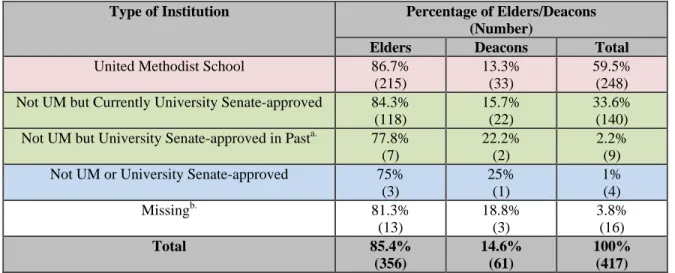
In general, 60% (248) of elders and deacons attended at least one United Methodist institution. This percentage is greater than those elders and deacons ordained in 2008.2 Of the 169 elders/deacons who did not go to a UM school, 88.2 % went to a University
Senate-approved institution. This breakdown is seen in Table 1. The largest number of elders/deacons who attended a UM school were from the Southeastern jurisdiction (97); the fewest number were from the Western jurisdiction (4). However, all elders and deacons from the Western
Jurisdiction attended a UM school, and compared to the other jurisdictions, the Southeastern jurisdiction had the smallest percentage of elders and deacons who attended a UM school. UM schools are the only places where more women attended than men and nearly 77% of ethnic minority elders and deacons attended a UM school. Like 2008 elders and deacons, a non-UM school is more likely to have a white male than is a UM school.
Table 1: Type of Institutions that 2009 Ordained Elders and Deacons Attended3
Type of Institution Percentage of Elders/Deacons
(Number)
Elders Deacons Total
United Methodist School 86.7%
(215)
13.3% (33)
59.5% (248)
Not UM but Currently University Senate-approved 84.3%
(118)
15.7% (22)
33.6% (140)
Not UM but University Senate-approved in Pasta. 77.8%
(7)
22.2% (2)
2.2% (9)
Not UM or University Senate-approved 75%
(3)
25% (1)
1% (4)
Missingb. 81.3%
(13)
18.8% (3)
3.8% (16)
Total 85.4%
(356)
14.6% (61)
100% (417) a. See Appendix A for the Not UM but University Senate-approved in the past schools.
b. All except two of the elders and deacons who did not have a school reported were from the North Alabama annual conference.
2
In 2008, 57.3% of all elders and deacons attended a UM institution for their training. 3
This tables separates the elders and deacons who went to school at a “non-UM but currently University Senate-approved” school and “non-UM but University Senate-approved in the past” school. These two types of schools are merged under “University Senate-approved schools” for the remainder of this study.
3
Table 2: Type of Institutions that 2009 Ordained Elders and Deacons Attended by Gender and Race
Type of Institution Percentage of
Each Sex (Number)
Percentage of Each Race (Number)
Male Female Caucasian Racial
Minority
Race Missing
United Methodist School 48.4%
(120) 51.6% (128) 79.8% (198) 17.3% (43) 2.8% (7) Not UM but Currently University
Senate-approved 54.7% (76) 45.3% (63) 100% (9) 0% (0) 0% (0) Not UM but University Senate-approved
in Past 44.4% (4) 55.6% (5) 87.1% (122) 7.9% (11) 5% (7)
Not UM or University Senate-approved 75%
(3) 25% (1) 75% (3) 25% (1) 0% (0)
Missing 50%
(8) 50% (8) 93.8% (15) 6.3% (1) 0% (0)
Total 50.7%
(211) 49.3% (205) 83.2% (347) 13.4% (56) 3.4% (14)
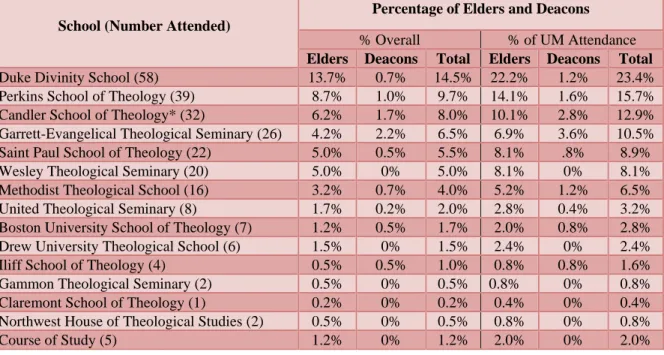
Of the students who attended a UM school, the greatest number went to Duke Divinity, followed by Perkins School of Theology, and Candler School of Theology. The most widely attended United Methodist schools are similar to the most widely attended UM schools for 2008 ordinands. The number of elders and deacons who went to a UM school as their first school is seen in Table 3. Additionally, of the eight elders/deacons who identified more than one institution, and who did not attend a UM institution for their first school, five attended a UM institution. These additional schools attended were Garrett-Evangelical, Iliff, Perkins, Saint Paul, and Wesley.
Table 3: Number of Elders and Deacons that Attended Each UM School4
School (Number Attended)
Percentage of Elders and Deacons
% Overall % of UM Attendance
Elders Deacons Total Elders Deacons Total
Duke Divinity School (58) 13.7% 0.7% 14.5% 22.2% 1.2% 23.4%
Perkins School of Theology (39) 8.7% 1.0% 9.7% 14.1% 1.6% 15.7%
Candler School of Theology* (32) 6.2% 1.7% 8.0% 10.1% 2.8% 12.9%
Garrett-Evangelical Theological Seminary (26) 4.2% 2.2% 6.5% 6.9% 3.6% 10.5%
Saint Paul School of Theology (22) 5.0% 0.5% 5.5% 8.1% .8% 8.9%
Wesley Theological Seminary (20) 5.0% 0% 5.0% 8.1% 0% 8.1%
Methodist Theological School (16) 3.2% 0.7% 4.0% 5.2% 1.2% 6.5%
United Theological Seminary (8) 1.7% 0.2% 2.0% 2.8% 0.4% 3.2%
Boston University School of Theology (7) 1.2% 0.5% 1.7% 2.0% 0.8% 2.8%
Drew University Theological School (6) 1.5% 0% 1.5% 2.4% 0% 2.4%
Iliff School of Theology (4) 0.5% 0.5% 1.0% 0.8% 0.8% 1.6%
Gammon Theological Seminary (2) 0.5% 0% 0.5% 0.8% 0% 0.8%
Claremont School of Theology (1) 0.2% 0% 0.2% 0.4% 0% 0.4%
Northwest House of Theological Studies (2) 0.5% 0% 0.5% 0.8% 0% 0.8%
Course of Study (5) 1.2% 0% 1.2% 2.0% 0% 2.0%
4
4
* This includes 17 elders and 3 deacons who went to Emory University.
Attended University Senate-Approved Seminary or Theological School
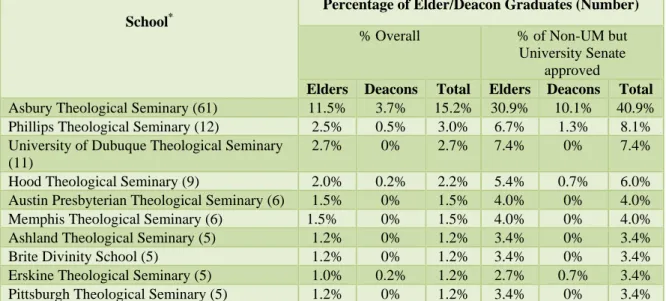
Overall, more elders and deacons attended these schools than did in 2008. Like 2008 ordained elders and deacons, among those ordained in 2009 who attended a University Senate-approved school, Asbury Theological Seminary had the most elder and deacon graduates. In fact, Asbury had more elder and deacon graduates than any other school, including the United Methodist schools. Twice as many men went to Asbury than did women. Most of the Asbury elders and deacons were from the Southeastern Jurisdiction, outnumbering any other school in that jurisdiction, except Duke. Additionally, most of these elders/deacons were from the Kentucky Annual Conference. Many newly ordained elders and deacons also attended Phillips Theological, University of Dubuque Theological, and Hood Theological. Seen in Table 4 are the non-UM, but University Senate-approved schools where at least five elders/deacons attended.
Table 4: Number of Elders and Deacons that went to a non-UM, but University Senate-approved Institution5
School*
Percentage of Elder/Deacon Graduates (Number)
% Overall % of Non-UM but
University Senate approved
Elders Deacons Total Elders Deacons Total
Asbury Theological Seminary (61) 11.5% 3.7% 15.2% 30.9% 10.1% 40.9%
Phillips Theological Seminary (12) 2.5% 0.5% 3.0% 6.7% 1.3% 8.1%
University of Dubuque Theological Seminary (11)
2.7% 0% 2.7% 7.4% 0% 7.4%
Hood Theological Seminary (9) 2.0% 0.2% 2.2% 5.4% 0.7% 6.0%
Austin Presbyterian Theological Seminary (6) 1.5% 0% 1.5% 4.0% 0% 4.0%
Memphis Theological Seminary (6) 1.5% 0% 1.5% 4.0% 0% 4.0%
Ashland Theological Seminary (5) 1.2% 0% 1.2% 3.4% 0% 3.4%
Brite Divinity School (5) 1.2% 0% 1.2% 3.4% 0% 3.4%
Erskine Theological Seminary (5) 1.0% 0.2% 1.2% 2.7% 0.7% 3.4%
Pittsburgh Theological Seminary (5) 1.2% 0% 1.2% 3.4% 0% 3.4%
* The other schools that represented 16% of the non-UM but University Senate-approved schools can be seen in Appendix B.
Of those who attended a non-UM, but University Senate-approved institution, 83.9% (125) were elders (35.1% of all elders) and 16.1% (24) were deacons (39.3% of all deacons). Thirty-eight percent of men and thirty-three percent of women went to a University Senate-approved school. The South Central jurisdiction was more likely to have elders and deacons who went to a University Senate-approved institution and of the 37 conferences who had new elders or deacons reported, nine had more non-UM, but University Senate-approved, graduates than they had UM school graduates.
Attended a Non-UM and Non-University Senate-Approved Seminary or Theological School There were four schools that elders and deacons attended that were not approved institutions.6 The smallest amount of the newly ordained elders and deacons attended these
5
5 schools (1%). Far fewer elders and deacons attended these schools than did the new ordinands in 2008. Three elders (0.8%) and one deacon (0.2%) went to these schools. Only one of the
elders/deacons who attended these schools was a female and only one was an ethnic minority. So Why Do Elders and Deacons Attend Non-UM Schools?
Similar to elders and deacons ordained in 2008, a large number of the 2009 newly
ordained elders and deacons attend non-UM institutions. Part of the reason still may be location. Asbury remained the most attended school by elders and deacons. Not only does Asbury have a variety of online courses available, but the closest UM school was United Theological Seminary, 153 miles north. For the most widely attended non-UM, but Senate-approved, schools the closest UM school was over 100 miles away. Distance, however, does not explain why some elders and deacons chose Ashland Theological Seminary over Methodist Theological School or Brite Divinity School over Perkins School of Theology. Table 5 shows that geographical
distance from a UM school may be a factor. This table also shows the denominational affiliation of the most attended non-UM schools; most of the widely attended schools are denominationally affiliated which suggests that elders and deacons are not attending these schools because of a desire for ecumenical theological education.
Table 5: Denominational Affiliation and Miles Away from Closest UM School of Top Attended Non-UM, but University Senate-approved Institutions
School Denominational Affiliation Closest UM School
Memphis Theological Seminary Cumberland Presbyterian Church Candler School of Theology
383 miles
Phillips Theological Seminary Christian Church (Disciples of Christ) Saint Paul School of Theology
245 miles
Pittsburgh Theological Seminary Presbyterian Church (USA) Methodist Theological School in
Ohio 208 miles
Asbury Theological Seminary Ecumenical/multi-denominational United Theological Seminary
153 miles Austin Presbyterian Theological
Seminary
Presbyterian Church (USA) Perkins School of Theology
199 miles University of Dubuque Theological
Seminary
Presbyterian Church (USA) Garrett-Evangelical Theological
Seminary 180 miles
Erskine Theological Seminary Associate Reformed Presbyterian
Church
Candler School of Theology 145 miles
Hood Theological Seminary African Methodist Episcopal Zion Duke University
105 miles
Ashland Theological Seminary Evangelical Methodist Theological School
68 miles
Brite Divinity School Christian Church (Disciples of Christ) Perkins School of Theology
33 miles
6
The schools attended that were not UM, nor University Senate-approved, were: Southern Baptist Theological Seminary, Denver Seminary, Golden Gate Seminary, and Oxford University.
6
Summary
The majority of newly ordained elders and deacons in 2009 attended a United Methodist institution. However, many also attended a non-UM, but University Senate-approved school. All but four elders and deacons attended in some way a United Methodist University Senate-approved school. Asbury Theological Seminary accounted for the greatest number of
elder/deacon graduates. In addition, women and ethnic minorities are more likely to attend the United Methodist schools.
Conclusion
Like elders and deacons ordained in 2008, the majority of those ordained in 2009 went to a United Methodist school. Also similar to 2008 ordinands, the largest number went to Asbury Theological Seminary (not a UM, but University Senate-approved institution). While many elders and deacons may choose a school based on proximity to where they live, this hypothesis does not hold for several of the widely attended non-UM schools. While the majority of new ordinands in 2009 chose a UM school for their education, the question still remains as to why new elders and deacons in 2009 chose a non-UM institution for their education.
7
References
Combs, Sarah (2009). 2008 Ordained Full-Connection Elders and Deacons. Retrieved from http://www.gbhem.org/research.
Appendix
Appendix A
Non-UM but University Senate-approved in the past:
American Baptist Seminary of the West, Anderson School of Theology, Andover Newton, Associated Mennonite Biblical Seminary, Bangor, Central Baptist Theological Seminary, Eastern Baptist, Episcopal Seminary of the Southwest, Erskine (Mexico), Gordon-Conwell Wesley, North American Baptist, North Park Theological Seminary, Reformed Theological, and Southeastern Baptist.
Appendix B
Non-UM but University Senate-approved schools with fewer than five elder/deacon attendants: Andover Newton, Bangor, Colgate Rochester Crozer Divinity School, Eastern Mennonite Seminary, Eden Theological Seminary, Episcopal Seminary of the Southwest, Evangelical School of Theology, Louisville Presbyterian Theological Seminary, Lutheran Theological Southern Seminary, Princeton Theological Seminary, Sioux Falls Seminary, Union Theological Seminary, Union Theological Seminary & Presbyterian School of Christian Education, The University of Chicago Divinity School, Vanderbilt Divinity School, and Yale Divinity School,.