R E S E A R C H
Open Access
Association between
TNF, IL1B, IL6, IL10
and
IFNG
polymorphisms and recurrent
miscarriage: a case control study
Jianting Ma
*, Xingguang Zhang, Gang He and Chunlin Yang
Abstract
Background:Approximately half of recurrent miscarriages have unexplained etiology. Recent evidences suggest that cytokines are important determinants in pregnancy maintenance and as such, cytokine gene polymorphisms, which can affect cytokine production and/or functionality, could play a role in the disorder. Thus, we aimed to investigate the association of selected cytokine gene polymorphisms with risk of recurrent miscarriage among Chinese.
Methods:TNF-238G > A,TNF-308G > A,IL1B-511 T > C,IL1B3954C > T,IL6-174G > C,IL6-634C > G,IL10 -1082A > G andIFNG874A > T polymorphisms were genotyped on 775 women with idiopathic recurrent miscarriage and 805 healthy parous control women. Logistic regression analysis was performed to determine the odds ratios (ORs) of the association between the polymorphisms and recurrent miscarriage risk.
Results:Among the eight polymorphisms studied, only theIL1B-511 T > C andIL6-634C > G polymorphisms showed statistically significant associations with recurrent miscarriage risk. For the former, a significantly increased risk of recurrent miscarriage was observed for the mutant (CC) genotype (OR: 1.377; 95% CI: 1.039–1.824;P= 0.026). However, for theIL6-634C > G polymorphism, a decreased recurrent miscarriage risk was observed for the
heterozygous (CG) genotype (OR: 0.614; 95% CI: 0.493–0.765;P< 0.001) and the mutant (GG) genotype (OR: 0.414; 95% CI: 0.251–0.684;P= 0.001).
Conclusions:TheIL1B-511 T > C polymorphism may serve as important risk factor for recurrent miscarriage while theIL6-634C > G polymorphism may protect against the risk of recurrent miscarriage.
Keywords:Cytokine, Polymorphism, Pregnancy loss, Recurrent miscarriage
Background
Recurrent miscarriage refers to the consecutive loss of pregnancy before the 20th gestational week for three or more times [1]. This event affects approximately 1–2% of otherwise healthy females, and poses a significant physical and emotional burden on women experiencing the incidence and their family members [2]. A number of etiological factors have been described for recurrent miscarriages, including genetic defects, anatomical ab-normalities, endocrinologic disorders, infections, throm-bophilias, and environmental exposures [2]. However, approximately 50% of recurrent miscarriages are not
attributable to these etiological factors and their causes remained unexplained [1].
Recently, the contributions of immunogenetic factors to the etiopathology of recurrent miscarriages have been suggested [3]. During early stages of normal pregnancies, pro-inflammatory T helper (Th) 1 cytokines are neces-sary for stimulating vasculogenesis which is essential for a successful embryonic implantation [4]. However, a pro-longed exposure to Th1 cytokines can result in a cell-mediated immune response that is detrimental to the fetus, resulting in pregnancy losses [5]. As such, during later stages of successful pregnancies, a shift from pro-inflammatory Th1 immunity to anti-pro-inflammatory Th2 immunity is commonly observed. The proper homeo-static balance between Th1 and Th2 cytokines is
* Correspondence:[email protected]
Department of Obstetrics and Gynecology, the People’s Hospital of Yuyao City, East Road No.800, Yuyao, Zhejiang Province 315400, China
critically important for a stable maintenance of preg-nancy and other reproductive events [6, 7]. It has been observed that normal pregnancies are accompanied by an overall higher expression of Th2 cytokines while pregnancies with unfavorable outcomes are usually associ-ated with an overall higher expression of Th1 cytokines [8].
The expression of cytokines, as well as the immune response elicited, could be influenced by polymorphisms in cytokine genes. Thus, cytokine gene polymorphisms could potentially influence the risk of recurrent miscar-riage. In this study, we investigated the association of eight selected cytokine gene polymorphisms with risk of recurrent miscarriage among Chinese women. The cyto-kine gene polymorphisms selected wereTNF-238G > A, TNF-308G > A,IL1B-511 T > C,IL1B3954C > T, IL6 -174G > C, IL6-634C > G,IL10 -1082A > G and IFNG 874A > T. All the cytokines studied are Th1 cytokines, except IL10, which shows dual (inhibitory and stimula-tory) immunologic functions and thus could not be clas-sified as either Th1 or Th2 [9]. All the polymorphisms included in this work have been previously investigated in relation to their association with the risk of recurrent miscarriage in a number of populations, and significant findings have been observed in a few instances [10–19]. However, population-to-population differences are com-mon in genetic association studies, and the association of these cytokine gene polymorphisms with the risk of recurrent miscarriage has not been extensively studied among Chinese women, especially those from the Eastern China population. This study aimed to address this insuffi-ciency of data in the Eastern China population.
Methods
Ethics, consent and permissions
The study was approved by the Institutional Review Board of People’s Hospital of Yuyao City, Zhejiang Province (approval number: 20,110,030,024). The study was conducted in accordance to the Declaration of Helsinki. Written informed consent was obtained from all participants before being included in the study.
Participants
All young women (age ≤ 40 years) with recurrent mis-carriages were identified from the obstetrical department of the People’s Hospital of Yuyao City, Zhejiang Province between December 2011 and January 2017. All women were at active (non-menopause) phase of menstruation. Recurrent miscarriages were defined as having a mini-mum of three clinically detectable spontaneous abor-tions before the 20th gestational week. Women with a history of diabetes or hypertension, drug or alcohol abuse, and smoking were excluded. Of the 2038 eligible women, 1742 agreed to participate in the study. A number of tests were performed to identify the causes of
recurrent miscarriage among all these women, including hysterosalpingography, ultrasound, parental karyotypic analysis, examination of luteal phase defects, measure-ments of anti-phospholipid antibodies and lupus antico-agulants, examination of TORCH infections, tests of autoimmune disorders and erythroblastosis fetalis (Rh incompatibility) and other in-house examinations. In some but not all women, additional tests such as saline-infusion sonohysterography, hysteroscopy or endocrine tests were also performed. After exclusion of the partici-pants with known causes of recurrent miscarriages, 775 patients were classified as being idiopathic and were re-cruited into the study. Meanwhile, 805 healthy parous women were recruited as controls. Controls were women who had at least 3 successful live births, with no history of miscarriages or preterm birth, and aged-matched to the cases. At recruitment, the interval from the last event (miscarriage or delivery) of the women ranged from 3 to 11 months (mean: 7.36 months). All participants were Han Chinese in ethnicity. A total of 5 ml blood specimen was collected from each partici-pant for genetic analysis. Only 200 μl of the blood was eventually used, and the remaining was stored in our institution bio-repository for future use.
Genotyping
Genotyping was performed on genomic DNA derived from the 200 μl blood specimens of the participants. Genomic DNA was isolated with the ethanol precipita-tion method using TIANamp Blood DNA kit (Beijing, China). Briefly, blood sample from each participant was sequentially mixed with 20 μl Proteinase K and 200 μl Buffer GB, and incubated at 56 °C for 10 min. After a homogenous mixture was formed, 200μl absolute etha-nol was added to precipitate the DNA. The mixture was transferred to a Spin Column CB3 and centrifuged at full speed for 30 s. The spin column was then washed sequentially with 500 μl Buffer GD and 600 μl Buffer PW and centrifuged at full speed for 30 s and 2 min respectively. After the washing step, the DNA was eluted at 100 μl Buffer TB and used for genotyping of the polymorphisms.
v3.1 Cycle Sequencing Kit (Foster City, California, United States) to independently confirm the genotypes.
Statistics
Frequencies of the polymorphic genotypes were calcu-lated by direct counting. Differences in the genotype frequencies between cases and controls were evaluated with chi-squared analysis. Each polymorphism was eval-uated for possible deviation from the Hardy-Weinberg equilibrium by using a goodness-of-fit test. Logistic regression analysis was done to calculate the odds ratios (ORs) of the risk of recurrent miscarriage contributed by the polymorphisms. All statistical tests were two-sided and were performed with SPSS software version 19. All comparisons were considered to be statistically signifi-cant atP< 0.05.
Results
The eight polymorphisms were successfully genotyped in all 775 cases and 805 controls. All results obtained
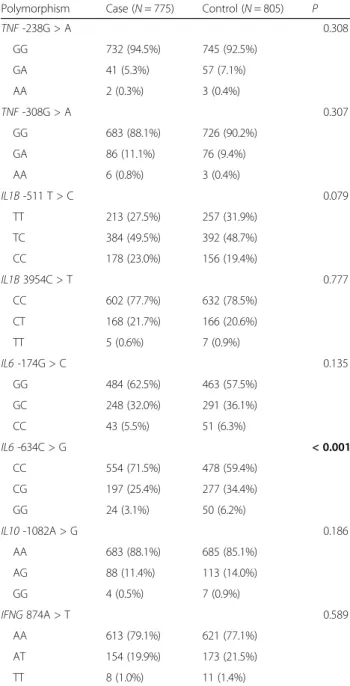
from initial genotyping methods (PCR-RFLP or allele specific PCR) agreed with the independent confirmatory sequencing reactions. The frequencies of the poly-morphic genotypes among the study participants are shown in Table 2. Statistically significant difference in the distribution of genotypes between the cases and con-trols was only observed for the IL6 -634C > G poly-morphism (P< 0.001), with the wild type (CC) genotype observed to be overrepresented in the cases and the heterozygous (CG) and mutant (GG) genotypes observed to be overrepresented in the controls. The CC, CG and GG genotypes were seen in 554 (71.5%), 197 (25.4%) and 24 (3.1%) of the cases, and 478 (59.4%), 277 (34.4%) and 50 (6.2%) of the controls, respectively.
It is also noteworthy to mention that although the geno-type distribution of theIL1B-511 T > C polymorphism did not differ significantly between the cases and controls, the P value was at the borderline of statistical significance (P= 0.079). Contrary to theIL6-634C > G polymorphism, the wild type (TT) genotype of theIL1B-511 T > C poly-morphism was found at a higher frequency in the controls, while the heterozygous (TC) and mutant (CC) genotypes were observed more frequently in the cases. The TT, TC and CC genotypes were respectively present in 213 (27.5%), 384 (49.5%) and 178 (23.0%) of the cases, and 257 (31.9%), 392 (48.7%) and 156 (19.4%) of the controls.
A clear lack of statistical significance was observed for the genotype distribution of the remaining polymor-phisms, with P values of 0.308 (TNF -238G > A poly-morphism), 0.307 (TNF-308G > A polymorphism), 0.777 (IL1B 3954C > T polymorphism), 0.135 (IL6 -174G > C polymorphism), 0.186 (IL10-1082A > G polymorphism) and 0.589 (IFNG874A > T polymorphism), respectively.
The genotype distribution of all the eight polymor-phisms conformed to the Hardy-Weinberg equilibrium in both cases and controls (Table 3).
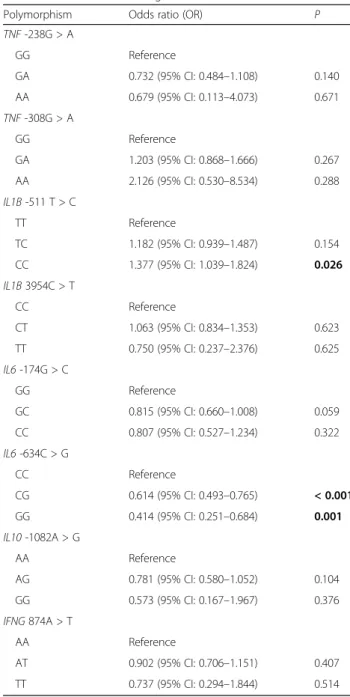
Next, logistic regression analysis was performed to find out the odds ratio (OR) of each polymorphic genotype in contributing to the risk of recurrent miscarriage. The results were presented in Table 4. It was shown that statistically significant ORs were only observed the mutant (CC) genotype of the IL1B -511 T > C poly-morphism (P= 0.026), as well as the heterozygous (CG) and mutant (GG) genotypes of the IL6 -634C > G polymorphism (P < 0.001 and P= 0.001 respectively). The mutant (CC) genotype of the IL1B -511 T > C polymorphism was associated with an increased risk of recurrent miscarriage, with an OR of 1.377 (95% confidence interval (CI): 1.039–1.824). On the contrary, a decreased risk of recurrent miscarriage was noted for the heterozygous (CG) and mutant (GG) genotypes of the IL6 -634C > G polymorphism, which showed an OR of 0.614 (95% CI: 0.493–0.765) and 0.414 (95% CI: 0.251–0.684) respectively.
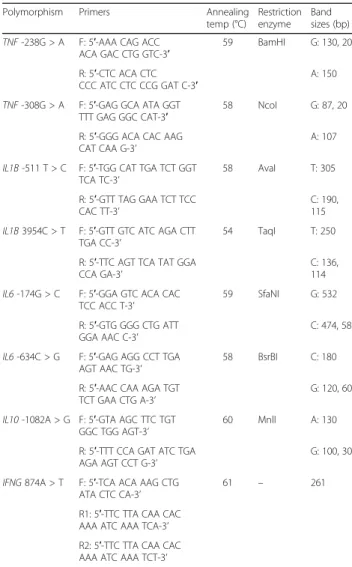
Table 1Primers used for genotyping
Polymorphism Primers Annealing temp (°C)
Restriction enzyme
Band sizes (bp)
TNF-238G > A F: 5′-AAA CAG ACC ACA GAC CTG GTC-3′
59 BamHI G: 130, 20
R: 5′-CTC ACA CTC
CCC ATC CTC CCG GAT C-3′ A: 150
TNF-308G > A F: 5′-GAG GCA ATA GGT TTT GAG GGC CAT-3′
58 NcoI G: 87, 20
R: 5′-GGG ACA CAC AAG
CAT CAA G-3’ A: 107
IL1B-511 T > C F: 5′-TGG CAT TGA TCT GGT TCA TC-3’
58 AvaI T: 305
R: 5′-GTT TAG GAA TCT TCC
CAC TT-3’ C: 190,115
IL1B3954C > T F: 5′-GTT GTC ATC AGA CTT TGA CC-3’
54 TaqI T: 250
R: 5′-TTC AGT TCA TAT GGA
CCA GA-3’ C: 136,114
IL6-174G > C F: 5′-GGA GTC ACA CAC TCC ACC T-3’
59 SfaNI G: 532
R: 5′-GTG GGG CTG ATT
GGA AAC C-3’ C: 474, 58
IL6-634C > G F: 5′-GAG AGG CCT TGA AGT AAC TG-3’
58 BsrBI C: 180
R: 5′-AAC CAA AGA TGT
TCT GAA CTG A-3’ G: 120, 60
IL10-1082A > G F: 5′-GTA AGC TTC TGT GGC TGG AGT-3’
60 MnlI A: 130
R: 5′-TTT CCA GAT ATC TGA
AGA AGT CCT G-3’ G: 100, 30
IFNG874A > T F: 5′-TCA ACA AAG CTG ATA CTC CA-3’
61 – 261
R1: 5′-TTC TTA CAA CAC AAA ATC AAA TCA-3’
Discussion
Fine regulation of cytokine levels is essential for a successful pregnancy. Improper balance in the levels of Th1 and Th2 cytokines has been known to contribute to recurrent mis-carriage [6, 7]. Cytokine levels can be genetically controlled by its polymorphisms. As such, we postulate that polymor-phisms in cytokine genes may influence the risk of recur-rent miscarriage. To test this hypothesis, we investigated the association of eight selected cytokine gene polymor-phisms with risk of recurrent miscarriage among Chinese women. Eight polymorphisms in five cytokine genes were selected, including TNF -238G > A, TNF -308G > A, IL1B -511 T > C, IL1B 3954C > T, IL6 -174G > C,
IL6 -634C > G, IL10 -1082A > G and IFNG 874A > T polymorphisms.
Among these polymorphisms, only IL1B -511 T > C polymorphism andIL6-634C > G polymorphism showed a statistically significant association with recurrent mis-carriage risk. The IL1B -511 T > C polymorphism was found to be associated with an increased risk, with the mutant (CC) genotype having an OR of 1.377 (95% CI: 1.039–1.824). This finding was similar to a previous study in Korea [13], which showed that the polymorph-ism resulted in an increased risk by a magnitude of 1.826 (95% CI: 1.130–2.953). The authors from the Korean study also showed that the T to C substitution of the polymorphism contributed to a higher natural killer (NK) cell activity, causing an enhanced inflammatory state which is harmful for fetal development [13]. Apart from our work, there was another previous study which investigated the association of this polymorphism with recurrent miscarriage risk in the Chinese population [16]. The authors from this previous work indicated that the IL1B -511 T > C polymorphism was not associated with recurrent miscarriage risk, which was in contrast with our findings. However, it should be noted that great discrepancies exist in different subpopulations of China, and these discrepancies may affect the influence of the polymorphism on recurrent miscarriage risk. We studied the association between the polymorphism and recur-rent miscarriage risk among residents of Zhejiang Province, while the previous work investigated the asso-ciation in Jiangsu Province. This could explain the inconsistency in the finding obtained. Moreover, our study included a much larger number of participants compared to this previous work (1580 participants in the present work vs. 318 participants in the previous work), which provide a greater accuracy for our findings. In this study, we also showed that the IL6 -634C > G polymorphism was associated with a decreased risk of recurrent miscarriage, with the heterozygous (CG) geno-type showed an OR of 0.614 (95% CI: 0.493–0.765) and the mutant (GG) genotype showed an OR of 0.414 (95%
Table 2Distribution of genotypes between cases and controls
Polymorphism Case (N= 775) Control (N= 805) P
TNF-238G > A 0.308
GG 732 (94.5%) 745 (92.5%)
GA 41 (5.3%) 57 (7.1%)
AA 2 (0.3%) 3 (0.4%)
TNF-308G > A 0.307
GG 683 (88.1%) 726 (90.2%)
GA 86 (11.1%) 76 (9.4%)
AA 6 (0.8%) 3 (0.4%)
IL1B-511 T > C 0.079
TT 213 (27.5%) 257 (31.9%)
TC 384 (49.5%) 392 (48.7%)
CC 178 (23.0%) 156 (19.4%)
IL1B3954C > T 0.777
CC 602 (77.7%) 632 (78.5%)
CT 168 (21.7%) 166 (20.6%)
TT 5 (0.6%) 7 (0.9%)
IL6-174G > C 0.135
GG 484 (62.5%) 463 (57.5%)
GC 248 (32.0%) 291 (36.1%)
CC 43 (5.5%) 51 (6.3%)
IL6-634C > G < 0.001
CC 554 (71.5%) 478 (59.4%)
CG 197 (25.4%) 277 (34.4%)
GG 24 (3.1%) 50 (6.2%)
IL10-1082A > G 0.186
AA 683 (88.1%) 685 (85.1%)
AG 88 (11.4%) 113 (14.0%)
GG 4 (0.5%) 7 (0.9%)
IFNG874A > T 0.589
AA 613 (79.1%) 621 (77.1%)
AT 154 (19.9%) 173 (21.5%)
TT 8 (1.0%) 11 (1.4%)
Table 3Lack of deviation of the genotype distribution from HWE
Polymorphism Pvalue of HWE deviation
in cases P
value of HWE deviation in controls
TNF-238G > A 0.066 0.098
TNF-308G > A 0.078 0.506
IL1B-511 T > C 0.845 0.766
IL1B3954C > T 0.065 0.277
IL6-174G > C 0.136 0.562
IL6-634C > G 0.211 0.249
IL10-1082A > G 0.611 0.334
IFNG874A > T 0.627 0.789
CI: 0.251–0.684). There were also two previous studies which investigated the association of this polymorphism with recurrent miscarriage risk, including one study from China [16] and one study from Japan [19]. Consist-ent with our study, both previous works showed that the polymorphism decreased the risk of recurrent miscar-riage. The study from China found that the heterozygous and mutant genotypes showed OR values of 0.709 (95% CI: 0.438–1.148) and 0.894 (95% CI: 0.837–0.955) respectively, although only the latter was statistically sig-nificant, while another study from Japan showed that
carriers of the G allele resulted in an OR of 0.46 (95% CI: 0.24–0.91).
We did not find any significant association of TNF -238G > A and -308G > A polymorphisms with risk of recurrent miscarriage. These two polymorphisms have been frequently investigated in the context of recurrent miscarriage, but the results obtained have been incon-sistent [10–12, 14, 15, 18]. One of these previous studies was conducted in the Chinese population [15]. In this previous study by Liu et al. [15], the G allele of theTNF -238G > A polymorphism was found to be significantly more common in the cases. This means that the A allele was significantly associated with a decreased risk of recurrent miscarriage. Consistent with this previous work, our study showed that carriers of the A allele had a lower risk of recurrent miscarriage, although our observation did not reach statistical significance. Several other studies concurred with our findings [11, 12], while some others found that the A allele was significantly associated with increased risk of recurrent miscarriage [14, 18]. The reason behind these discrepancies is not well understood, although it is known that genetic poly-morphisms affect disease risk differently in different populations. Besides, similar to our study, the work by Liu et al. [15] found no association betweenTNF-308G > A polymorphism with recurrent miscarriage risk in the Chinese population. This is consistent with a few previous reports [10, 11, 14, 18], but there was also one study which showed that the mutant AA genotype could increase the risk of recurrent miscarriage [12].
We also did not find an association ofIL1B3954C > T, IL6 -174G > C, IL10 -1082A > G and IFNG 874A > T polymorphisms with the risk of recurrent miscarriage. There was only one previous study which investigated the former (IL1B3954C > T polymorphism) in recurrent miscarriage [16], and the result obtained was the same as our findings. On the other hand, there were two previous works which simultaneously reported the remaining three polymorphisms in recurrent miscarriage [10, 17]. One report from Brazil agreed entirely with our finding that there was no significant association observed between the polymorphisms and risk of recur-rent miscarriage [10], while another work from India showed that the mutant alleles of the three polymor-phisms increased the risk of recurrent miscarriage [17]. Besides these two previous reports, theIL10-1082A > G polymorphism had also been investigated in the South Korean population [14], and no statistically significant finding was observed. These discrepancies clearly showed that the polymorphisms influence the risk of recurrent miscarriage in a population-specific manner.
Our study had the strength in the statistical power. We included a total of 1580 participants (775 cases and 805 controls), which is the largest set of participants ever
Table 4Odds ratio of the association between the polymorphisms and risk of recurrent miscarriage
Polymorphism Odds ratio (OR) P
TNF-238G > A
GG Reference
GA 0.732 (95% CI: 0.484–1.108) 0.140
AA 0.679 (95% CI: 0.113–4.073) 0.671
TNF-308G > A
GG Reference
GA 1.203 (95% CI: 0.868–1.666) 0.267
AA 2.126 (95% CI: 0.530–8.534) 0.288
IL1B-511 T > C
TT Reference
TC 1.182 (95% CI: 0.939–1.487) 0.154
CC 1.377 (95% CI: 1.039–1.824) 0.026
IL1B3954C > T
CC Reference
CT 1.063 (95% CI: 0.834–1.353) 0.623
TT 0.750 (95% CI: 0.237–2.376) 0.625
IL6-174G > C
GG Reference
GC 0.815 (95% CI: 0.660–1.008) 0.059
CC 0.807 (95% CI: 0.527–1.234) 0.322
IL6-634C > G
CC Reference
CG 0.614 (95% CI: 0.493–0.765) < 0.001
GG 0.414 (95% CI: 0.251–0.684) 0.001
IL10-1082A > G
AA Reference
AG 0.781 (95% CI: 0.580–1.052) 0.104
GG 0.573 (95% CI: 0.167–1.967) 0.376
IFNG874A > T
AA Reference
AT 0.902 (95% CI: 0.706–1.151) 0.407
TT 0.737 (95% CI: 0.294–1.844) 0.514
investigated for these eight polymorphisms. However, one limitation is that we did not adjust our findings by other potential confounding factors. This was due to the local legislation scenario, which disallowed us to access certain data of the patients. However, to minimize the influence of the confounding factors, we matched the participants carefully by age, and did not include partici-pants with diabetes or hypertension, drug or alcohol abuse, and smoking habit. Despite this, future studies are needed to confirm our findings.
Conclusions
We showed that theIL1B-511 T > C polymorphism was significantly associated with an increased risk of recur-rent miscarriage, while theIL6-634C > G polymorphism was significantly associated with a decreased risk of recurrent miscarriage. These polymorphisms may poten-tially serve as important biomarkers for predicting recur-rent miscarriage risk among Chinese. Future studies should embark on this research direction.
Abbreviations
CI:Confidence interval; NK: Natural killer; OR: Odds ratio; PCR-RFLP: Polymerase chain reaction restriction fragment length polymorphism; Th: T helper
Acknowledgements
We thank nurses and doctors from the obstetrical department of the People’s Hospital of Yuyao City, Zhejiang Province for their help in recruiting the study participants.
Funding
No funding was received for this work.
Availability of data and materials Not applicable.
Authors’contributions
JM conceived of the study. JM, XZ and GH participated in data acquisition, analysis and interpretation. GH and CY performed statistical analysis. JM and XZ drafted, edited and reviewed the manuscript. All authors read and approved the final manuscript.
Ethics approval and consent to participate
The study was approved by the institutional review board of People’s Hospital of Yuyao City, Zhejiang Province (approval number: 20110030024). Written informed consent was obtained from all participants before being included in the study.
Consent for publication Not applicable.
Competing interests
The authors declare that they have no competing interests.
Publisher’s Note
Springer Nature remains neutral with regard to jurisdictional claims in published maps and institutional affiliations.
Received: 3 March 2017 Accepted: 24 September 2017
References
1. Shahine L, Lathi R. Recurrent pregnancy loss: evaluation and treatment. Obstet Gynecol Clin N Am. 2015;42:117–34.
2. Ford HB, Schust DJ. Recurrent pregnancy loss: etiology, diagnosis, and therapy. Rev Obstet Gynecol. 2009;2:76–83.
3. Grimstad F, Krieg S. Immunogenetic contributions to recurrent pregnancy loss. J Assist Reprod Genet. 2016;33:833–47.
4. Demir R, Yaba A, Huppertz B. Vasculogenesis and angiogenesis in the endometrium during menstrual cycle and implantation. Acta Histochem. 2010;112:203–14.
5. Saini V, Arora S, Yadav A, Bhattacharjee J. Cytokines in recurrent pregnancy loss. Clin Chim Acta. 2011;412:702–8.
6. Dekel N, Gnainsky Y, Granot I, Racicot K, Mor G. The role of inflammation for a successful implantation. Am J Reprod Immunol. 2014;72:141–7. 7. Sykes L, MacIntyre DA, Yap XJ, Teoh TG, Bennett PR. The Th1:th2 dichotomy
of pregnancy and preterm labour. Mediat Inflamm. 2012;2012:967629. 8. Makhseed M, Raghupathy R, Azizieh F, Omu A, Al-Shamali E, Ashkanani L.
Th1 and Th2 cytokine profiles in recurrent aborters with successful pregnancy and with subsequent abortions. Hum Reprod. 2001;16:2219–26. 9. Conti P, Kempuraj D, Kandere K, Di Gioacchino M, Barbacane RC, Castellani ML,
Felaco M, Boucher W, Letourneau R, Theoharides TC. IL-10, an inflammatory/ inhibitory cytokine, but not always. Immunol Lett. 2003;86:123–9. 10. Daher S, Shulzhenko N, Morgun A, Mattar R, Rampim GF, Camano L,
DeLima MG. Associations between cytokine gene polymorphisms and recurrent pregnancy loss. J Reprod Immunol. 2003;58:69–77.
11. Finan RR, Al-Irhayim Z, Mustafa FE, Al-Zaman I, Mohammed FA, Al-Khateeb GM, Madan S, Issa AA, Almawi WY. Tumor necrosis factor-alpha polymorphisms in women with idiopathic recurrent miscarriage. J Reprod Immunol. 2010;84:186–92.
12. Gupta R, Prakash S, Parveen F, Agrawal S. Association of CTLA-4 and TNF-α polymorphism with recurrent miscarriage among North Indian women. Cytokine. 2012;60:456–62.
13. Kim JO, Lee WS, Lee BE, Jeon YJ, Kim YR, Jung SH, Chang SW, Kim NK. Interleukin-1beta -511T>C genetic variant contributes to recurrent pregnancy loss risk and peripheral natural killer cell proportion. Fertil Steril. 2014;102:206–212.e5.
14. Lee BE, Jeon YJ, Shin JE, Kim JH, Choi DH, Jung YW, Shim SH, Lee WS, Kim NK. Tumor necrosis factor-αgene polymorphisms in Korean patients with recurrent spontaneous abortion. Reprod Sci. 2013;20:408–13.
15. Liu C, Wang J, Zhou S, Wang B, Ma X. Association between−238 but not−308 polymorphism of Tumor necrosis factor alpha (TNF-alpha)v and unexplained recurrent spontaneous abortion (URSA) in Chinese population. Reprod Biol Endocrinol. 2010;8:114.
16. Ma X, Xu LJ, Wang J, Xian MM, Liu M. Association of IL-1βand IL-6 gene polymorphisms with recurrent spontaneous abortion in a Chinese Han population. Int J Immunogenet. 2012;39:15–9.
17. Parveen F, Shukla A, Agarwal S. Cytokine gene polymorphisms in northern Indian women with recurrent miscarriages. Fertil Steril. 2013;99:433–40. 18. Zammiti W, Mtiraoui N, Finan RR, Almawi WY, Mahjoub T. Tumor necrosis
factor alpha and lymphotoxin alpha haplotypes in idiopathic recurrent pregnancy loss. Fertil Steril. 2009;91:1903–8.
19. Saijo Y, Sata F, Yamada H, Kondo T, Kato EH, Kishi R. Single nucleotide polymorphisms in the promoter region of the interleukin-6 gene and the risk of recurrent pregnancy loss in Japanese women. Fertil Steril. 2004;81(2):374–8.
• We accept pre-submission inquiries
• Our selector tool helps you to find the most relevant journal • We provide round the clock customer support
• Convenient online submission • Thorough peer review
• Inclusion in PubMed and all major indexing services • Maximum visibility for your research
Submit your manuscript at www.biomedcentral.com/submit