International Journal of Applied Linguistics & English Literature ISSN 2200-3592 (Print), ISSN 2200-3452 (Online) Vol. 3 No. 2; March 2014
Copyright © Australian International Academic Centre, Australia
Grammar in Context using Comprehended Input
Mariam Mohamed Nor E-mail: [email protected]
Chong Seng Tong Universiti Tenaga Nasional E-mail: [email protected]
Abdul Halim Ibrahim Universiti Pendidikan Sultan Idris
E-mail: [email protected]
Ng Yu Jin (corresponding author) Universiti Tenaga Nasional E-mail: [email protected]
Mohd Ariff Ahmad Tarmizi Universiti Tenaga Nasional E-mail: [email protected]
Received: 15-10-2013 Accepted: 06-12-2013 Published: 01-03-2014
doi:10.7575/aiac.ijalel.v.3n.2p.75 URL: http://dx.doi.org/10.7575/aiac.ijalel.v.3n.2p.75
Abstract
There have been so many ongoing disputes on different approaches to teaching grammar. This study aims to evaluate the effectiveness of teaching grammar using Gass comprehended Input technique (GCI) (1997) (implicit) and to explore the undergraduates’ perception on the GCI technique. The respondents consisted of 30 undergraduates’ who are currently pursuing their Bachelor of English. Using the qualitative method, the research instrument was a set of 23- item interview and content analysis of the students’ written work. Results showed that the teaching of grammar using explicit instructions was more preferred than implicit instruction for complex components in grammatical rules. However, implicit instruction is equally effective regardless of the proficiency levels to enable pedagogy to be executed. It is also noted that there is lots of room for improvement, since the undergraduates have a weak grasp of the basic tense aspect of English grammar. Therefore, the Malaysian Ministry of Education should consider having grammar formally taught in isolation as what was practised previously.
Keywords: Teaching Grammar, Gass comprehended Input technique (GCI) 1. Introduction
There has been much debate on the different approaches to teaching and learning of grammar. To date, educators of English as a Second Language (ESL) are still confronted with the crucial issue of choosing the best approach to improve their student’s grammatical competency. Even at the university level, most undergraduates are bogged with grammatical incompetence. According to Krashen (1985), grammar can be learned through comprehensible input. He suggested giving extensive opportunities for meaningful communication in the classroom. The statement below illustrates errors in a student’s writing.
The person who have passion will always think before do something so that, we can control our anger by thinking in the right away .We shouldn’t lose our temper easily and we must learn to control our hanger to avoid others to be heart (a student’s writing).
Can you detect the errors? 2. Background to the Study
1. Data collection: Recognition of idiosyncrasy 2. Description: Accounting for idiosyncratic dialect 3. Explanation (the ultimate object of error analysis).
Table 1. Types of English language Errors Error Categories
Descriptive Surface Structure
Noun Phrase Omission
Verb Phrase: Addition
a. Subject Verb Agreement Misinformation
b. Simple Past Tense Misorder
Complex Sentence Blends
Source: Linguistics and language teaching (Mariam Mohamed Nor, Abdul Halim Ibrahim, & Rajentharan Shubbiah. (2009, p. 171)
The issue on the most effective method to teach grammar has been going on for decades. It is noted from previous research that students in Malaysia have always struggled with their grammar especially in writing and speaking. Students are also not given enough opportunities to fully utilize the target language in the classroom hence; they are incapable of acquiring grammar naturally and automatically. Observational studies of classroom interaction suggested that classes are mostly teacher centred and students are not given much opportunity to give extended answers. As a result, majority of Malaysian students’ failed in the mastery of the fundamentals of the English language despite having at least 11 to 12 years of formal education. In the syllabus curriculum specification for form 5 provided by the Ministry of Education, the grammar items, which are specified are not listed in context, but in isolation. This syllabus format encourages teachers to focus on topics rather than building language knowledge and skills which students need most in real world communication.
Grammar is an abstract system of rules and because it is abstract, it poses great problems for teachers who have little procedural knowledge of the language, and limited teaching techniques or approaches to produce successful grammar lessons (Chomsky, 1976). The abstract nature of language makes it difficult for teachers to organize aspects of grammar and consequently make the subject matter unexciting and dry. Gribbin (2005) in his article “Our Ambivalence toward Teaching Grammar,” notes that grammar often goes untaught. He concedes that students have had limited success with grammar competence whether the content has been taught in or out of context.
Many educators wish to improve the teaching of grammar (Nunan, 2005, p. 71). Mariam Mohamed Nor and Abdul Halim (2006) noted that in Malaysian schools, grammar is taught solely through out-of- context approach. However, if a systematic strategy is employed by incorporating both isolated and out of context instructions. Students will learn that “grammar and writing are intricately related” which assists to build sentence structure in writing and in reading complex, meaningful works (Sams, 2003, p.57). Studies were conducted on the teaching of grammar and its effects on both teachers and language learners (see Robinson, 1997; Tony, Anne and Richard, 2000; Lim, 2006; Nor Hashimah Jalaluddin, Norsimah Mat Awal & Kesumawati Abu Bakar, 2008); Hazita Azman, 2004; Wu, 2006; Wu, 2007; Andrews, 2007).
This implies that the more exposure to the knowledge of linguistics, the better the English teachers will be equipped. For instance, comparative studies or analysis of two different languages, namely ‘Bahasa Melayu’ and English can serve as a proactive way in tackling the problems in acquiring the target language by Malay learners in Malaysia. Results showed that explicit teaching instruction is significantly better than implicit method for the complex rule. However, for teaching the simple grammatical rules, both methods are equally effective regardless of the proficiency levels.
Studies that discussed the effect of grammar instruction programs teacher trainees found out that majority of teacher trainees are still lacking in grammatical knowledge (Tony, Anne and Richard, 2000; Wu, 2007; Shuib, 2009; Farrell and Lim, 2005). In fact, some teachers teaching approach are greatly influenced by their culture (Wu, 2006) Hence, based on the suggestions from the studies read, it was suggested that to be effective teachers they must be well-equipped with sufficient training in grammar instruction (Robinson, 1997, Wu,2007).
In this study, the researchers had promoted the use of short stories and articles from the Reader’s Digest to teach grammar both explicitly and implicitly. We had recommended the use of short stories so that they can attract students’ attention for longer spans as stories are in fact interesting, infused with moral values, as well promote critical and creative thinking. Reader’s Digest provides a wide variety of informative articles that are associated with student’s real-life issues as well as some dramatic stories, which are current, and helps to inject reflective thinking.
3. Research Objectives The objectives of the study are:
1. To investigate whether GCI can prompt undergraduates’ to utilize correct grammar in their speaking and writing. 2. To explore undergraduates’ perceptions of the GCI teaching in learning.
Teachers’ role in communicative language teaching differs from the traditional teaching methods. In the traditional teaching classroom, it is teacher-centred that the teacher controls the input and output of the lessons. In contrast, in communicative language teaching, the teacher functions as a facilitator, providing students with the freedom to determine own learning. The students will be doing much more speaking as compared to the traditional classroom which in turn leads to self-confidence development. The teacher will only provide sets of exercises or trainings to facilitate students’ development in language acquisition.
This study adopted a qualitative method using interviews and document analysis of the undergraduates’ written work. Thirty (30) undergraduates who are currently pursuing the Bachelor of English program in Selangor volunteered to be participants in this research. The research took approximately fourteen weeks to complete.
The participants were mixed races namely Malay, Chinese, Indian and others, aged between 19 and 24, and all of them have been studying English as a second language in the primary and secondary Malaysian schools for eleven years. 4. Instrument
4.1 Tests
The undergraduates’ were taught grammar using the Gass Comprehended Input (GCI) (1997) technique in one of their proficiency classes. They had to complete a reading comprehension and a grammar test.
4.2 Interview
Five of the participants were interviewed individually, in order to gather views on their strategy in learning grammar and to determine factors that have contributed to the success of their learning. Participants were also asked to compare their grammar learning process during their school days and their current university level.
5. Document Analysis Procedure
The analysis of the written texts was done with the help of an expert who was an English language lecturer. The written texts were taken from the group using the GCI technique. The data were analyzed using Gass and Selinker (1994, pg. 67) Error Analysis (EA) model. Data
5.1 Analysis Procedures
Data was analyzed using the four data analysis procedures, which is Reading, Describing, Classifying, and Interpreting as well as Gass and Selinker Error Analysis model.
6. Findings
In order to find out more on general tendencies in tense usage, a wider range of proficiency levels was required therefore a purposive sampling technique was employed. The participants consisted of thirty (30) undergraduates’ from a private university in Selangor aged between 19 and 24 years old. The major findings are based on two sections which are the interviews conducted at the university as well as an analysis of the undergraduates’ written work using the Error Analysis method.
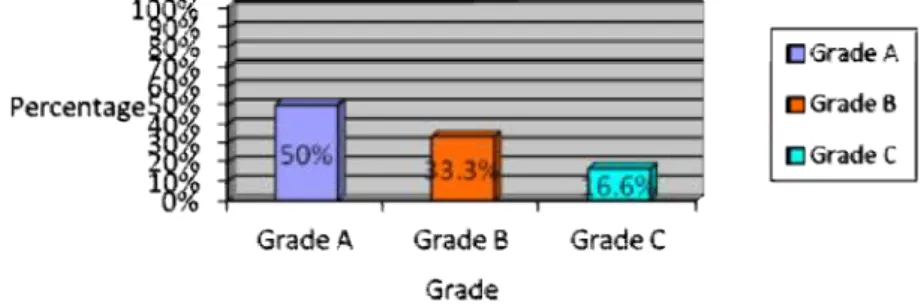
Concerning education background, all respondents had sat for their SPM English papers. Majority of participants obtained a distinction grade totalled at fifteen (15). While ten (10) scored a B grade, and five (5) scored a grade C. Table 2 shows the number of students who scored the following grades.
Table 2. Grade Entry Level
Grade Number of Students Percentage
A 15 50%
B 10 33.3%
C 5 16.6%
Figure 1. Grade Percentage
6.1 Interview
Analysis of the interview data resulted in findings that are reported in 2 major sections:
a) Students Perception based on their school days
b) Students Perception based at University level
6.1.1 Students Perception based on their school days
With regard to the participants’ views on learning grammar during their school days, majority agreed that it should be taught explicitly. The participants felt that learning the complex rules should be conducted at an early stage as it would be beneficial in terms of speaking and writing accurately. They also agreed that grammar is essential for language learning especially English as it helps build a good base of knowledge in grammar. Teaching of grammar has evolved from explicit teaching to communicative learning over the years. Majority of the respondents agreed that learning grammar in classroom was fun and beneficial. However, two of the participants mentioned that their teacher kept repeating the same lesson and he got bored of it. Minority of the respondents claimed that most of the teachers were not proficient in their pronunciation. In order to learn grammar, students need adequate input of grammar rules from the teacher. Hence, teacher must be very knowledgeable with the rules of English grammar in order to teach the students effectively. Teacher must provide students with lots of practice whereby the practices can be applied in real life communication. However based on the interview, it was noted that majority of the teachers were not knowledgeable in terms of grammar rules, in fact the teaching of grammar rules was not emphasized. Teacher must also figure a way to make the lesson interesting, fun, but at the same time, informative.
6.1.2 Students Perception at University level
Based on the findings, majority respondents preferred to learn grammar implicitly at university level as they argued that learning grammar rules was boring and it must have been done at primary and secondary level. Although they had the background knowledge of grammar, they perceived that it was better to learn it implicitly. However, only one respondent mentioned that explicit was still the best way to learn grammar as it saved time and eliminated confusion. In regards to the learning process, majority stated positively as lecturers tried to make the lesson interesting by having in class activities through presentation and group work and less homework. The respondents also mentioned that many exercises were given without direct or prior explanation. Nevertheless, majority respondents agreed that the communicative learning was good, effective, and beneficial as it had assisted to boost student’s confidence, improve critical and creative skills where the learning can be enjoyable through communication and interaction. It is interesting to know that majority of the respondents didn’t spend time learning grammar on their own. This is because they were afraid of making mistakes and not knowing about it compare to learning it in classroom. Majority respondents agreed that they like the way their lecturer taught grammar. They mentioned that it was taught in a very interesting and relaxed environment compared to school days. They felt that talking and discussing certain topics in a non-formal approach were good as they were able to express their own answers and opinion. It was noted that the lecturers had use the implicit approach when teaching and that they indirectly incorporate grammar without the participants’ knowledge. The lecturer tried to make the lesson interesting by using visual aids, video clips, and most importantly, the communicative interaction between lecturer and student encouraged them to express their thoughts. Majority participants also mentioned that promoting discussion and evaluation was the most useful aspect of their proficiency class. However, they felt that certain aspects were not emphasized during their proficiency class such as pronunciation and reading technique.
In conclusion, the respondents preferred to learn grammar both ways, which is implicit and explicit where explicit approach is suitable to teach grammar rules and implicit to practice grammar. One respondent suggested that to learn grammar the verbal and non-verbal way like using visual aids to create interest. This can help in terms of fluency of pronunciation as well as in writing.
6.2 Error Analysis on grammatical errors based on the undergraduates’ written works
An error analysis (based on Gass and Selinker (1994, p.67) model) of the undergraduates’ written works was employed to examine their grammar in writing. Thirty (30) undergraduates’ written works were analyzed to investigate the types
of error made by the students. The errors were categorized in two sections, which is descriptive and surface structure
6.2.1 Descriptive Error
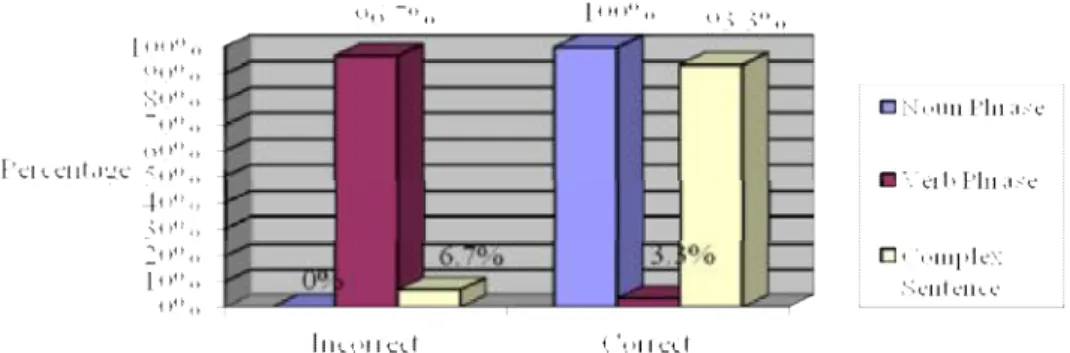
In the category of descriptive description, it was noted that the performance of majority of respondents were commendable in both the noun phrase and complex sentence part, where Noun phrase at 100% (30) and complex sentence at 93.3%(28). This showed that the respondents had made gross grammatical errors in using correct verb forms, at 96.7% (29).
Table 3. Descriptive Error
Descriptive Error Incorrect Correct
Noun Phrase 0 30
Verb Phrase 29 1
Complex Sentence 2 28
None of the participants had made errors in the noun phrase while majority (29) had made errors in the verb phrase section. However, only a minority (2) of the participants made errors in the complex sentence.
Figure 2. Descriptive Error Percentage
In comparing the errors in constructing noun phrase, verb phrase, and complex sentence, it was found that the respondents did not make any errors in noun phrase structure but the frequency of errors in constructing complex sentence part was 6.7 %( 2), which was considered minimal. However, there was a slight increase in the frequency of errors for complex sentence within the range of 1-3 (1), and 4-6 (1). This shows that every respondent had made less than seven (7) errors, which was minimal.
In contrast, there were gross grammatical errors made by the respondent, in constructing the verb forms at 96.7% (29). In comparing the errors in noun phrase, verb phrase, and complex sentence, the frequency of verb errors was the highest, within the range of 1-3 was 50% (15), and followed by the range of 4-6 at 33.3% (10), the range of 7-9 at 10% (3). In fact, the respondents who had made more than seven (7) errors were very low at 13% only.
To conclude, although the percentage of respondents who had made verb errors were high, but the number of errors made were minimal. For example, the error in complex sentence frequency was the lowest within the range of 1-3 and 4-6 at 3.3% (1) each.
Figure 3. Descriptive Error Frequency
No participants had made errors between the frequency of 10 and 12. However, only one (1) participant made errors at the frequency of more than 13. However, he performed well for the noun phrase part, at zero frequency.
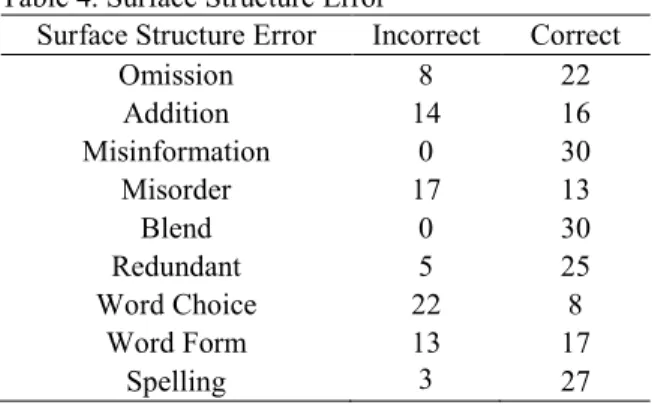
Overall, with regard to surface errors, there were no errors noted in misinformation, and blend, 100% (30). Specifically, more than 50% of the errors were noted in misorder at 56.7 %( 17), and word choice at 73.3% (22). For errors made by the respondents, which were less than 50%, were addition at 46.7% (14), omission at 26.7% (8), redundant at 16.7% (5), word forms at 43.3% (13), and spelling at 10% (3).
Table 4. Surface Structure Error
Surface Structure Error Incorrect Correct
Omission 8 22
Addition 14 16
Misinformation 0 30
Misorder 17 13
Blend 0 30
Redundant 5 25
Word Choice 22 8
Word Form 13 17
Spelling 3 27
Out of the thirty (30) participants, none had made errors in the category of misinformation and blends and only a small number of participants made errors in the category redundant (5) and spelling (3) errors. However, majority of the participants made errors in word choice (22).
Figure 4. Surface Structure Percentage
In comparing the frequency of different types of errors, minimal errors were noted for spelling at 10% within the range of 1-3 errors only.
With respect to redundancy, only 17% were noted, but the frequency for errors were small that is within the range of 1-3 errors only. About 71-3.1-3% of the respondents did word choice errors. The total number of errors exceeded seven and only 3.3 % (1) made between 10-12 errors. Besides, other errors made were 46.7%, which were within the range of 1-3 errors only. Word forms and addition errors were between 10%-49%, however, each respondents
had made less than seven errors. The majority of errors were in the area of misorder and word choice, which exceeds 50%. Nevertheless, the total numbers of errors that each respondent made were less than seven, while only 3.3% made between 10-12 errors.
To conclude based on the frequency, it was noted that the difference in the number of errors made by the respondents was significant; however, the errors made were less than seven. The highest frequency of errors noted was within 1-3
only. The highest did not exceed 9-12 errors, and it only involved word choice and word forms.
7. Conclusions and Recommendations The study has established the following:
The undergraduates felt that learning grammar should be done explicitly, as learning the rules of grammar is important and essential, for it will serve as a strong foundation. They strongly believe that knowing the rules would benefit them later on. This is supported by a study conducted by Andrews (2007). The results showed that the teaching of grammar using explicit instructions was more preferred than implicit instruction for complex components in grammatical rules. However, implicit instruction is equally effective regardless of the proficiency levels to enable pedagogy to be executed.
From both findings, it is noted that the undergraduates’ felt that both approaches to teaching and learning of second language and grammar should be taught in both ways, which is explicit and implicit. However, in terms of complex rules, explicit teaching is still considered significantly better than implicit.
From the analysis of the undergraduates’ written works, it can be concluded that they still have much to do in order to write grammatically correct English essays. This is supported by a study carried out by Abdul Rashid Mohamed, Goh & Wan Rose Eliza (2004).The undergraduates’ basic tense of English grammar was very weak and it clearly shows that they have poor command in basic grammar. As the Communicative Approach currently adopted by the Malaysian school curriculum does not provide desirable results. Thus, explicit teaching of grammar in the classroom should be emphasized from now on. Hence, the formal and extensive teaching of grammar at primary and secondary level must be taken into consideration. This could perhaps reduce the students’ grammatical errors in both speaking and writing discourse.
7.1 Recommendations for Future Research
This study provides evidence that ESL learners are still facing problems of utilizing accurate grammar in their writing and speaking as a result from the implicit teaching approach. From the findings, it is noted that there were not much improvements on the participants’ grammatical performance, particularly writing. The participants were given the same instructions and the same amount of work to complete. Based on the interview, it was indicated that all participants had received formal education in English and that they had learned the basics of grammar. However, based on the results of the error analysis, their grammatical error had persisted. From the findings, it was noted that the participants had achieved different levels of grammatical accuracy, but none at satisfactory level.
Generally, ESL learners have different learning backgrounds and that their education level differs. They may receive the same input, same instructions as well as amount of work to complete. However, the results of their performance showed different levels of competency and understanding. It is aimed and hoped that from this study, teachers can foresee how individual students might perform; therefore, they can make appropriate lesson plans according to their student’s diverse competency level and needs.
References
Abdul Rashid Mohamed, Goh, L.L, Wan Rose Eliza. (2004). English Errors and Chinese Learners. Sunway College Journal 1, 83-97.
Andrews, K.L. (2007). The Effects of Implicit and Explicit Instruction on Simple and Complex Grammatical Structures for Adult English Language Learners. TESL-EJ Volume 11 (2)
Chomsky, N. (1976) Reflections on Language. London: Temple Smith Corder, S.P. (1967).The Significance of learner’s errors’ .IRAL, 5, 161-170 Corder, S.P. (1971). ‘Idiosyncratic dialects and error analysis.’ IRAL, 9, 2,
Ellis, R. (1996). The study of second language acquisition. Oxford: Oxford University Press.
Ellis, R. (1997). Second language research and language teaching. Oxford: Oxford University Press.
Farrell T.S.C & Lim P.C. (2005). Conceptions of Grammar Teaching: A case study of Teachers’ Beliefs and Classroom Practices. TESL-EJ, 9, Number 2.
Gass, S. & Selinker, L. (1994). Second language acquisition: An introductory course. Hillsdale,N.J.:Lawrence Erlbaum.
Gass, S. (1997). Input, interaction, and the second language learner. Mahwah, NJ: Lawrence Erlbaum.
Associates.Greenbaum, S. & Quirk, R. (1992). A student’s grammar of the English language. Harlow, Essex: Pearson Education Limited.
Gribbin, B. (2005). Our ambivalence toward teaching grammar. English Journal, 94(3), 17.
Hazita Azman. (2004). Global English and English Literacy Education in Malaysia in Penny Lee and Hazita Azmab, Global English and Primary Schools: Challenges for Elementary Education, Melbourne: CAE Press.
Krashen, S. (1985). The input hypothesis. London, Longman.
Lim, J.M.H. (2006). Associating Interference with Strategy Instruction: An Investigation into the Learning of the Present Continuous. The Asian EFL Journal Quarterly, 8(2).
Mariam Mohamed Nor, Abdul Halim Ibrahim, & Rajentharan Shubbiah. (2009). Linguistics and language teaching
(p.171) (2nd ed.). Open University Malaysia (OUM).
Mariam Mohamed Nor & Abdul Halim Ibrahim .(2006). Critical Thinking in Malay ESL students’ writing. A case study. UPSI Unpublished Research Report.
Shuib, M. (2009).Grammatical Awareness among Primary School English Language Teachers. GEMA Online Journal of Language Studies. Volume 9(1), 35-46
Nunan, S. (2005). Forgiving ourselves and forging ahead: Teaching grammar in a new millennium. English Journal, 94(4), 70-75.
Robinson, P. (1997) 'Generalizability and Automaticity of Second Language Learning under Implicit, Incidental, Enhanced, and Instructed Conditions', Studies in Second Language Acquisition, 19, 223-247.
Sams, L. (2003). How to teach grammar, analytical thinking, and writing: A method that works. English Journal, 92(3), 57-65.
Tony, B., Anne, T., & Richard, Q. (2000). Teaching Grammar: Working with student teachers. Changing English: Studies in reading and culture. March, Vol. 7, Issue 1, p7-21.
Wu, C.H. (2007).Spoken grammatically and EFL Teacher Candidates: Measuring the Effects of an Explicit Grammar Teaching Method on the Oral Grammatical Performance of Teacher Candidates. The Ohio State University.