Address for correspondence Sohail Shaheen,
Final Year MBBS,
Quaid-e-Azam Medical College, Bahawalpur Email: [email protected]
Original Article
Use of topical corticosteroids and mixed creams over
the face among female medical students of
Quaid-e-Azam Medical College, Bahawalpur
Introduction
Topical Corticosteroids (TCs) have a major role of benefaction in clinical dermatology. Having been introduced to the world in 1952 for the first time, these agents have attained fame in field of
medicine and dermatology in a short time span.1
This is justified by the vast range of therapeutic actions they have. The wonder drug, as considered nowadays, have the capability to act upon leukocytes and cells of different skin layers, giving them anti-inflammatory, immunosuppressive, anti-proliferative and various other crucial properties.2,3 All these
explain their immense use and at the same time their abuse, especially over the face. TCs should be used on face only for acute inflammatory Sohail Shaheen, Asma Shahbaz, Nimra Maqbool, Jamil Ahmad Shaheen*
Final Year MBBS, Quaid-e-Azam Medical College, Bahawalpur.
* Department of Dermatology, Quaid-e-Azam Medical College, Bahawalpur.
Abstract
Background Topical corticosteroids have abundant benefits but if abused, hold dire consequences. One of the common reason for their misuse over the face is skin lightening especially in Asian regions. These steroids are either used alone or in combination with other fairness creams which form a potentially harmful mixture. This study was carried out to comprehend the prevalence of this practice among female medical students of Quaid-e-Azam Medical College, Bahawalpur, as medical students are expected not to follow such practices, rather combat against them.Methods Institutional based cross-sectional study was carried among female medical students of Quaid-e-Azam Medical College, Bahawalpur. It involved a total of 240 female students from First Year to Final Year. Self-administered questionnaire was distributed among the students to assess the prevalence of steroids and mixed cream usage over the face.
Results 240 female students of Quaid-e-Azam Medical College were sampled. Betamethasone was used by 88 (36.7%) students. Fifty Six (23.4%) students used other steroid creams and mixed creams were used by 22 (9.2%) students. The prevalent reason for using these creams was acne (45.4%). The commonest source of obtaining steroids was pharmacies (48.8%). It was found that mostly friends/relatives suggested the participant to use these creams (25.8%). Steroid creams were mostly used for duration of few days.
Conclusion Our study concludes that a significant number of female medical students use steroid creams over the face, especially Betamethasone. Steroids are being dispensed at general stores and pharmacies without any regulatory oversight. There is a serious need to transform public’s insight regarding believes of use of such creams.
Key words
conditions that too with special care and not more than a month.4 If used otherwise, they
cause serious local side effects.5
The majority of Asian societies and some of those in western world are quite colour conscious and are obsessed with fairness and light skin owing to a cultural belief that light skin is more appealing than dark. This craze leads to use of any agent that fulfill the obsession, including those that are harmful when used long term. TCs used alone, interlaced with different fairness creams or as a combination mixture with skin lightening products and bleaching agents, are the most common tool adopted for such purposes. This double edged weapon has caused a potential epidemic of acne, rosacea, hirsutism, telangiectasia, wrinkling of face and steroid dependency among its users.6-8
Owing to the cosmopolitan use of TCs, studies are conducted in different parts of world. These are mainly from Africa9, China10, and rest of the
Asia.11-13 This problem has not spared countries
like United States as well.14 The most common
side effect from a study in India was acne.15
OTC availability, advocacy by non-medical personnel and lack of any check and balance for such drugs has made Pakistanis a victim of these side effects as well. A study showed Erythema to be the most common side effect among dermatology outpatients in Lahore.13
Steroids are also being used as mixture products with different fairness creams. Such ‘Mix Creams’ or ‘Formula Creams’ also cause several adverse effects due to adulteration with steroids and some other harmful chemicals like mercury.13 Such practice is customary in other
countries as well e.g. India and Saudi Arabia, where studies revealed toxic presence of steroids in different fairness creams.11,21 Different
fairness creams are mixed up together with a steroid cream to make a final product. This mixture is made indigenous by people
themselves or at beauty parlours commonly.22
Taking into account the above stated facts, the present study was conducted with an aim to evaluate the use of TCs over the face among female medical students of a medical college, who are supposedly assumed to be well aware of the hazards that come along with them. If medical students, a vital part of the health community that strongly opposes the idea of misuse of drugs, are using TCs for cosmetic purposes themselves, then it will be a matter of immense concern.
Methods
This, institutional based, cross-sectional study was carried out in a public sector medical institute named Quaid-e-Azam Medical College (QAMC), Bahawalpur. It involved a total of 240 female students from First year to Final year. While recruiting the respondents, the inclusion criteria implied were female medical students who had given the consent. Male students were not included in our study.
Our study sample size has been calculated using ‘Sample size determination in Health Studies; a practical manual’ by S.K. Lwanga & S. Lemeshow version 2.0. Using formula 1.1; estimating population proportion with specified absolute precisions for our sample situation. Based on assumptions of α- error being 0.05, β-error to be 80% (power of study), confidence interval (1-α) of 95% and anticipated population proportion (derived from previous study conducted at Nawaz Sharif Hospital, Lahore)13,
The sampling procedure implied is proportionate consecutive. We took total number of female students from each class separately and calculated the proportion of students we needed from each class according to our sample size. The female students in each class, starting from First to Final year, were 173, 181, 172, 180 and 210 respectively. The proportions came out to be 45, 47, 46, 47 and 55 for respective five classes.
Self-administered questionnaires were distributed among the students to assess the prevalence of steroids and mixed creams usage over the face. The participants were asked to fill a structured questionnaire after a formal consent was sought. The bio data section of the questionnaire included age, gender, class and city/domicile of students. Close ended questions were asked, which revolved around the use of TCs on face. The first question was regarding the use of any beauty cream over their face. This was followed by a separate question which covered the use of Betamethasone (Betnovate Cream) over the face. If the participants had used it, they were asked about the purpose and duration of usage, source of obtaining it and its recommendation e.g. the participant herself, friend, relative, beautician, pharmacist, etc. Furthermore, they were inquired about use of other steroid creams over face including Dermovate, Provate, Hivate, Cutivate, Clobivate, Synalar, Hydrocortisone and others. Subsequent questions regarding use of other steroid creams were similar to those asked with Betamethasone i.e. source, duration, recommendation etc. The last question emphasized on the use of Mixed Creams, its purpose, duration, source and its suggestion to the participants. After collection, all the data was entered into and analyzed by statistical software ‘IBM SPSS Statistics 20’.
Results
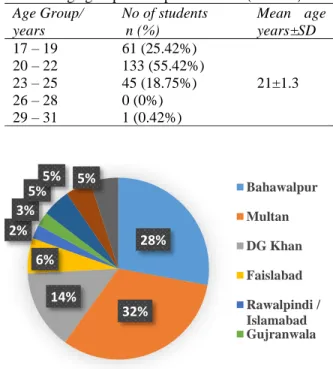
In this study, a sample of 240 students of QAMC was taken. Our study participants were females from First year to Final year of Quaid-e-Azam Medical College, Bahawalpur. The age distribution in the sample ranged 17-29 years (mean 21 years). The most frequently involved age group was 20-22 (55.4%) while there were no students among 26-28 years of age group (Table 1). On stratification of the sampled students according to their place of living in different Divisions of Punjab, Multan division had the highest frequency (32%) whereas Lahore division had the lowest (2%) (Figure 1).
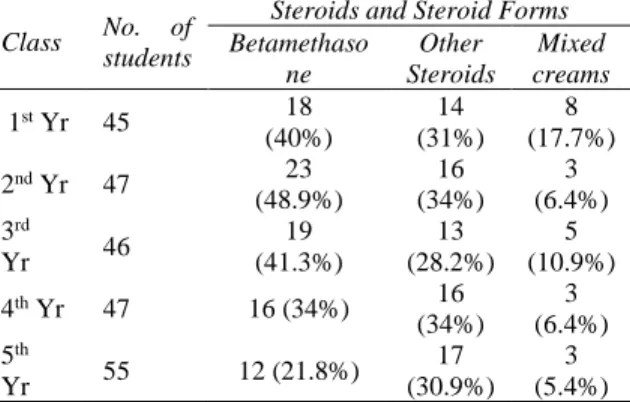
This cross-sectional study revealed that majority of the responders used some sort of cream on their faces, 213 (88.8%). Regarding Betnovate (Betamethasone), 88(36.7%) students used it (Table 2) and most of them i.e. 23 students, were from second year (Table 3).
Table 1 Age group of sampled students (n = 240) Age Group/
years
No of students n (%)
Mean age years±SD 17 – 19 61 (25.42%)
21±1.3 20 – 22 133 (55.42%)
23 – 25 45 (18.75%)
26 – 28 0 (0%)
29 – 31 1 (0.42%)
Figure 1 Residence of students according to Divisions of Punjab
28%
32% 14%
6% 2%
3%
5%5% 5% Bahawalpur
Multan
DG Khan
Faislabad
Table 2 Different steroids and mixed creams used by students over the face (n = 240)
Names of Steroids
(Steroid Forms) n(%)
1 Betnovate
(Betamethasone valerate) 88 (36.7%) 2 Dermovate
(Clobetasol Propionate) 27 (11.3%) 3 Provate
(Betamethasone Dipropionate) 11 (4.6%) 4 Hivate
(Mometasone Furoate) 1 (0.4%) 5 Cutivate
(Fluticasone Propionate) 3 (1.3%) 6 Clobevate
(Clobetasol Propionate) 7 (2.9%)
7 Hydrocortisone 7 (2.9%)
8 Mixed Creams 22 (9.2%)
Figure 2 Classwise trends for using Betamethasone over the face
Table 3 Class wise trends for using different steroids and mixed creams (n= 240)
Class No. of
students
Steroids and Steroid Forms Betamethaso ne Other Steroids Mixed creams
1st Yr 45 18
(40%)
14 (31%)
8 (17.7%)
2nd Yr 47 23
(48.9%) 16 (34%) 3 (6.4%) 3rd
Yr 46
19 (41.3%) 13 (28.2%) 5 (10.9%)
4th Yr 47 16 (34%) 16
(34%) 3 (6.4%) 5th
Yr 55 12 (21.8%)
17 (30.9%)
3 (5.4%)
Table 4 Indications for use of TCs and Mixed Creams (n = 240)
Steroids Acne Fairness Freckles
Other Derma-toses
n (%) n (%) n (%) n (%)
Betamethasone Valerate
66
(27.5%) 8 (3.3%) 3 (1.25%)
11 (4.6%)
Other Steroids 41 (17.1%) 10 (4.2%) 5 (2.1%) 20 (8.3%)
Mixed creams 2 (0.8%) 17 (7.1%) 1 (0.4%) 2 (0.8%)
The commonest indication of its use was found out to be treatment of acne (27.5%) and it was least used for the purpose of freckles (1.25%) (Table 4). Class wise trends showed that 2nd year students had highest usage of this cream over face and final year students had the lowest (Figure 2).
The obtained data showed that 56 (23.4%) students used other steroid preparations. Dermovate was the most famous among them. 2nd and 4th Year had the highest percentage of users among students sampled from each class (Table 3). Acne (17%) was its most common purpose of use and freckles (2.1%) the least common (Table 4).
Additionally, usage of mixed creams was among 22 (9.2%) students only (Table 2). First year students dominated among the mixed cream users. On the other hand second, fourth and final year had 3 students each who used this cream (Table 3). The underlying most common purpose of using mixed creams turned out to be for fairness (7.1%) (Table 4).
In terms of knowledge of source of obtaining steroid creams, 60 (25%) students indicated pharmacy as responsible for it, 25 (10.4%) indicated general store and 3 (1.3%) beauty parlour for Betnovate. Other steroids were obtained from pharmacies by 57 (23.8%), general store by 16 (6.7%) and beauty parlours by 3(1.3%) students. Regarding Mixed creams,
0 5 10 15 20 25 18 23 19 16 12 N O O F S T U D EN T S CLASS
14(5.8%) students stated that they made it indigenous themselves and 8(3.3%) got it from beauty parlours.
On ascertaining the advice and recommendation regarding use of Betnovate, we found that 19(7.9%) started using it at their own, 37(15.4%) were advised by friends/relatives, 16(6.7%) by dermatologists, 12(5%) by general practitioners and 5(2.1%) by beauticians. Similarly, for other steroids group, 10(4.2%) used themselves, 19(7.9%) were suggested by friends, 33(13.8%) were prescribed by dermatologist, 12(5%) by general practitioners and 0.8% through ads. Mixed Cream users used it on their own (3.3%), got it recommended by friends (2.5%), and by general practitioners (3.3%).
Furthermore, the data collected regarding the duration of usage for Betnovate, 54(22.5%) students responded that they used it for few days only. 24(10%) were using it for months and 10(4.2%) for more than a year. Likewise, other steroid preprations were used for a period in years by 12(5%) students, while 32(13.3%) used it for days and the same number for months. Most of the students used Mixed creams for more than a year i.e. 9(3.8%) while 7 (2.9%) used it for timespan in months and 6(2.5%) used it for a short period of few days.
Discussion
‘Fair is beautiful’ the concept most of societies including ours have adopted. Owing to this concept much of the public, especially female population, stays in dire need and search for cosmetic agents, skin lightening products and recently TCs. Steroids due to their magical effects as depigmenting and anti-inflammatory agents have now become much trendy.2,3 In fact,
public use and abuse over the face due to a popular fallacy that steroids treat dark
complexion and acne quite well is on the rise, not only in Pakistan but across the planet. Similar studies on this emerging issue have been published in several countries including India, Iraq, China, Saudi Arabia, United States etc.4,6,7,10,14
In our study, the most frequently used steroid over the face was betamethasone valerate (Betnovate) as a considerable number of sampled students i.e. 88 (36.7%) were using it. It was followed by Clobetasol Propionate (Dermovate) which was used by 27 (11.3%) students. These two steroids have become most popular in our society as a result of easy over the counter availability, poor check and balance, low cost and more acquaintance with the drug. Other steroids were also used but by lesser number of students (Table 2). This finding was consistent with studies carried out in India on patients.15,16 A study from Iraq showed
Clobetasol followed by Betamethasone to be the most common steroids used.4 A similar finding
was also reported in a study conducted at Lahore, Pakistan.13 On analyzing the class wise
trends for the use of Betamethasone, we found out that number of students in early years of medical college were more as compared with senior classes. This may be because of lack of awareness of the serious side effects in early years, peer pressure and craze for cosmetics in young female students as they enter the college.
Our study revealed Acne to be the most common indication for the use of steroids over the face. This provides evidence for the common misconception of steroids as treatment of acne, even in medical students. Acne and dark complexion was the most common reason for use of steroids in a study in western Nepal.17
Similar study conducted on university students in Saudi Arabia also revealed Acne to be the most common indication.6 However in a study
agent was a lot more common than for the treatment of acne.4 Various studies on Indian
population and a study in Lahore reveal similar discoveries of acne as predominant reason for facial steroid use.7,13,17,18 Our study further
disclosed that steroids were also being used as skin lightening agents, for freckles and other dermatoses. One similar and a larger Indian study, inconsistent with ours, showed that the main purpose of use was to lighten the skin colour.20 All of this provides enough evidence of
a pandemic inappropriate steroid use especially for the treatment of acne.
This study reveals pharmacies to be the most important source of acquiring these steroids followed by general stores and beauty parlours as mentioned by the students. This was again consistent with Lahore’s study.13 This shows
easy over the counter access of steroids, even being provided by general stores and beauty parlours, reflecting poor regulatory control by the Govt. for the sale of steroids. Most of the students were advised to use steroids over the face by friends/relatives/peers. Betamethasone was advised to 37(15.4%) students by their friends/relatives. However, self-medication and recommendations from general practitioners and beauticians was also not uncommon. Although the use of these creams was mainly for acne and cosmetic purpose, it was found the recommendations by the beauticians were uncommon. There was an unusual finding that dermatologists prescribed betamethasone to 16(6.7%) students and other steroid creams altogether to 33(13.8%) students. It is yet unknown the reason behind this finding but it is recommended that further studies be done specifically to ascertain the cause behind dermatologists prescribing steroid creams over face. This unusual finding was also present in a study from Saudi Arabia on university students in which 34.15% of students were prescribed steroids by dermatologists.6
Regarding Mixed Creams, only 22(9.2%) students were using them. 17 out of 22 students applying mixed creams did it for fairness. Maximum number was from First year MBBS which is suggestive of lack of awareness in early years of medical college regarding ingredients and side effects of mixed creams. Such formula creams are usually made by mixing 3, 4 or even 6 market beauty creams in addition to steroid which works as a magic ingredient in skin lightening but against a heavy cost of side effects.22 These are dispensed by beauty parlours
or are made by users themselves as is evident by our study results which show 14 students made it themselves while 8 students got them from beauty parlours. It was disturbing to find out that many i.e. 9/22 students were using mixed creams for more than a year.
It is quite alarming to find out that even medical students who are least expected to be a party in misuse or abuse of drugs are involved in such practice, under the cultural and social pressures. Hence, it is recommended that all medical students as well as the general public need to be sensitized about the dangers of topical steroid misuse, especially on the face. Legislations and stronger implementations of existing laws are required to limit public access and its advertisements. It is also recommended that when facial use of steroids are prescribed for certain demanding conditions, its use must be immediately stopped after satisfactory response, all this being done under supervision and follow up by dermatologist. Further studies should be planned especially on steroids being prescribed excessively by dermatologists.
Limitations
avoided to fill the questionnaire. As this was a medical college based study, it may or may not accurately reflect the community data.
Conclusions
Our study concludes that a significant number of medical students use steroid creams over the face especially Betamethasone. It inflicts a serious concern that steroids are being used inappropriately even by medical students. Furthermore, these steroids are being dispensed at general stores and pharmacies without any regulatory oversight. Mixed Creams are also being made at homes and beauty parlours by people in total oblivion of its dangers. There is a serious need to transform public’s insight regarding believes of use of such creams. It is a multiphase problem that needs collaboration of different sectors in the community to overcome it. General Practitioners, Dermatologists and Teachers of Medical and General institutions must also be taken on board about the gravity of situation and be requested to contribute in resolving this craziness by creating awareness among public, patients and students of universities and colleges.
References
1. Jones BJ. Topical therapy. In: Burns T, Breathnach S, Cox N, Griffith C, editors. Rook’s Textbook of Dermatology. 8th ed. Oxford: Wiley Blackwell; 2010:731-732. 2. Hughes J, Rustin M. Corticosteroids.
Clin¬ical Dermatology, 1997, 15(5):715–21. 3. Baumann L, Kerdel F. Topical glucocortic¬coids. In: Fitzpatrick T, ed. Dermatology in general medicine, 5th ed. New York, McGraw–Hill, 1999:2713–7 4. Hameed AF. Topical steroid misuse on the
face: A medical and social problem in Iraq. Iraqi Postgraduate Med J. 2014;13(3):413-7. 5. Hengge UR, Ruzicka T, Schwartz RA, Cork MJ. Adverse effects of topical glucocorticosteroids. J Am Acad Dermatol. 2006;54:1-15.
6. Majed D, Alnujaidi M, Almohammadi N, Kokandi AA. Use of topical steroids on the face among university students in Saudi Arabia. Biomedical Research. 2018;29(13):2786-9.
7. Brar BK, Nidhi K, Brar SK. Topical corticosteroid abuse on face: A clinical, prospective study. Our Dermatol Online. 2015 Sep 1;6(4):407-10.
8. Leyden J, Thew M, Kligman AM. Steroid rosacea. Arch Dermatol. 1974;110:619-22. 9. Mahe A, Ly F, Aymard G, Dangou JM. Skin
diseases associated with the cosmetic use of bleaching products in women from Dakar, Senegal. Br J Dermatol. 2003;148:493-500. 10. Lu H, Xiao T, Lu B et al. Facial
corticosteroid addictive dermatitis in Guiyang city, China. Clin Exp Dermatol. 2009;35:618-21.
11. Agarwal A, Singhvi IJ, Bele D et al. Evaluation of steroids in face creams of different marketed brands. Int J Pharm Technol. 2011;3:2480-6.
12. Rathi S. Abuse of topical steroid as cosmetic cream: A social background of steroid dermatitis. Indian J Dermatol. 2006;51:154-5.
13. Chohan SN, Suhail M, Salman S, Bajwa UM, Saeed M, Kausar S, Suhail T. Facial abuse of topical steroids and fairness creams: A clinical study of 200 patients. J Pak Assoc Dermatol 2014: 24(3):204-11. 14. Solomon BA, Glass AT, Rabbin PE. Tinea
incognito and over the counter potent topical steroids. Cutis. 1996; 58:295-6.
15. Jha AK, Sinha R, Prasad S. Misuse of topical corticosteroids on the face: A cross-sectional study among dermatology outpatients. Indian dermatology online journal. 2016 Jul;7(4):259.
16. Saraswat A, Lahiri K, Chatterjee M, Barua S, Coondoo A, Mittal A, Panda S, Rajagopalan M, Sharma R, Abraham A, Verma SB. Topical corticosteroid abuse on the face: A prospective, multicenter study of dermatology outpatients. Indian Journal of Dermatology, Venereology, and Leprology. 2011 Mar 1;77(2):160.
18. Ambika H, Vinod CS, Yadalla H, Nithya R, Babu AR. Topical corticosteroid abuse on the face: A prospective, study on outpatients of dermatology. Our Dermatol Online. 2014 Jan 1;5(1): 5-8.
19. Nagesh TS, Akhilesh A. Topical steroid awareness and abuse: A prospective study among dermatology outpatients. Indian journal of dermatology. 2016 Nov;61(6): 618.
20. Dey VK. Misuse of topical corticosteroids: A clinical study of adverse effects. Indian
Dermatology online journal. 2014 Oct;5(4): 436.
21. Saleh I, Elkhatib R, Rouqi R, Al-Enazi S, Shinwari N. The dangers of skin-lightening creams. Toxicological & Environmental Chemistry. 2012 Jan 1;94(1): 195-219.
22. Dr. Mobi (2017, November). Formula Creams For Skin Whitening. Skin
Care:Myths vs Facts.