A Study on Business Perspective of Grid and
Cloud Computing
Dr. Ranjit D. Patil
1, Sujata P. Patil
2, Vidya H. Bankar
31
Assistant Professor, Dept. of Computer Science, Dr. D. Y. Patil A.C.S College, Pimpri, Pune, India.
2
Assistant Professor, Dept. of Computer Science, Dr. D. Y. Patil A.C.S College, Pimpri, Pune, India.
3
Assistant Professor, Dept. of Computer Science, Dr. D. Y. Patil A.C.S College, Pimpri, Pune, India.
ABSTRACT: In today‘s dynamic business environment, IT departments need to meet two requirements, reduce costs
and support business with higher flexibility and responsiveness of the IT infrastructure. Grid and Cloud Computing enable a new approach towards IT. They enable increased scalability and more efficient use of IT, based on virtualization of heterogeneous and distributed IT resources.
Grid environments are collections of dispersed resources that can be shared to fulfill specific business requirements. Grid computing is hardware and software infrastructure which offer a cheap, distributable, coordinated and reliable access to powerful computational resources. Cloud computing is a model for enabling ubiquitous, convenient, on-demand network access to a shared pool of configurable computing resources (e.g., networks, servers, storage, applications, and services) that can be rapidly provisioned and released with minimal management effort or service provider interaction. It provides a way for your business to manage these resources online. This papergivesunderstanding ofhowbusinesses can benefit from Grid and Cloudcomputing technology.
KEYWORDS: Grid Computing, Cloud Computing, Virtual Organization
I.INTRODUCTION
Emerging technologies Grid Computing and Cloud computing provides efficient solutions to business challenges. Grid computing is a form of distributed computingthat involves coordinating and sharing computing,application, data and storage or network resources acrossdynamic and geographically dispersed organization. Grid technologies promise to change the wayorganizations tackle complex computational problems. It is a promising technology for future computing platforms and is expected to provide easier access to remote computational resources that are usually locally limited. Grid computing aims to make all such computational resources available constantly on a 24/7 basis.
Cloud computing provides a way for your business to manage your computing resources online. The 'cloud' refers to the internet, and operating 'in the cloud' describes the way you store and access your data through an internet connection virtually at any place any time. Usually, hardware and software is fully contained on a user's computer. That is you access your data and programs exclusively within your own computer. Cloud computing allows you to access your data and programs outside of your own computing environment. Rather than storing your data and software on your personal computer or server, it is stored in 'the cloud'. This could include applications, databases, email and file services.
Cloud computing is described as renting versus buying. Basically, you rent capacity (server space or access to software) from a cloud service provider, and connect over the internet. Instead of buying your own IT requirements, you are renting from a service provider, paying for only the resources you use.
II.RELATED WORK
for the environment.In [2] some researchers discussed on how manufacturing Small and MediumSizedEnterprises (SMEs) using or planning to use cloud computing to improve the availability of operational andstrategic planning information and average increase in company growth.In [3] The researchers conclude that adoption of Cloud Technology has larger impact on business development.
III. WORKING OF GRID COMPUTING AND CLOUD COMPUTING
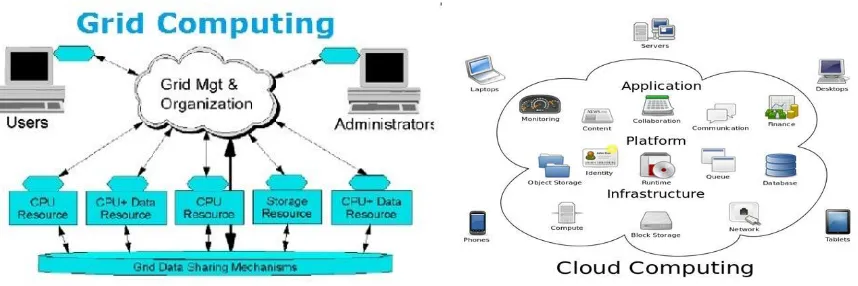
Grid computing is the next step in the evolution of networking. It is a computer network in which each computer's resources(Processing power, memory and data storage) are shared with every other computer in the system. The grid computing concept is not a new one; it is a special kind of distributed computing. It allows widely dispersed departments and businesses to create virtual organizations to share data and resources..
A Grid is basically the one that uses the processing capabilities of different computing units for processing a single task without increasing cost and by reducing time taken to complete task. The task is broken into multiple sub-tasks; each computer on a grid is assigned a task. As when the sub-tasks are completed they are sent back to the original computer which takes care of all the tasks. They are combined or clubbed together as an output. Computers on a grid are not necessarily in the same geographical location, and can be spread out over multiple countries and organizations, or even belong to individuals.
Fig. 1 Grid Computing Fig. 2 Cloud Computing
Cloud computing eliminates the costs and complexity of buying, configuring, and managing the hardware and software needed to build and deploy applications; these applications are delivered as a service over the Internet that is over the cloud. As a virtual space that connects users from all over the globe, the Internet is like a cloud, sharing information by way of satellite networks. The information is stored on physical servers maintained and controlled by a cloud computing provider. As a user, you can access your stored information on the cloud via the Internet.
By using cloud storage, you don‘t have to store the information on your own hard drive. Instead, you can access it from any location and download it onto any device like laptop, tablet, or Smartphone. In addition, you can also edit files, such as Word documents or PowerPoint presentations, simultaneously with other users, making it easier to work away from the office. As per the demand, you can increase how much of the cloud resources you use without the need for assigning specific hardware for the job, or just reduce the amount of resources assigned to you when they are not necessary.
Characteristics of Grid Computing:
Grid computing appears to be a promising model focusing on standardizing APIs, security, interoperability, new business models, and dynamic pricing systems for complex services. It has following characteristics:
Geographical distribution: Grid‘s resources may be located at remote places.
Large scale: Grid able to deal with a number of resources.
Resource sharing: Resources in a grid belong to many different organizations.
Resource coordination: Resources in a grid are coordinated in order to provide aggregated computing capabilities.
Heterogeneity: A grid hosts software and hardware resources that can be varied.
Multiple administrations: Each organization may establish different security and administrative policies. Transparent access: A grid seen as a single virtual computer.
Dependable access: A grid assures the delivery of services under established Quality of Service.
Consistent access: A grid is built with standardservicesand interfaces which hides theheterogeneity of the resources.
Pervasive access: A grid grants access toavailable resources by adapting to a dynamicenvironment in which resource failure is commonplace.
Characteristics of Cloud Computing:
Cloud computing is a major development in IT, that it will grow as predicted, and that it can deliver real business benefits to companies.It has following characteristics:
High availability and reliability: Availability of servers is high and more reliable as the chances of infrastructure failure are minimal.
On-demand self-service: A user can use cloud services as needed without any human interaction with the cloud provider.
Rapid elasticity: Elasticity is defined as the ability to scale resources both up anddown as needed.
Resource pooling: Physical and virtual resources are assigned and reassigned according to consumer demand
by cloud provider.
Measured service: Cloud services arecontrolled and monitored by the cloud providerfor billing, resource optimization, capacity planning etc.
Dynamic provisioning: Software automation allows provision of services based on currentdemand
requirements.
Network access:Needs to be accessed across the internet from a broad range ofdevices such as PCs, laptops,
and mobile devicesusing standardAPIs.
Cloud computing has four deployment models which defines the purpose of the cloud and the nature of how the
cloud is located.
Private cloud:The cloud infrastructure is deployed, maintained and operated for a specific organization. They
are built primarily by IT departments within enterprises who seek to optimize utilization of infrastructure resources within the enterprise by provisioning the infrastructure with applications using the concepts of grid and virtualization.
Public cloud: The cloud infrastructure is available to the public (individuals, corporations and other types of organizations) on a commercialbasis by a cloud service provider. These clouds are administrated by third parties overthe Internet, and services are offered on pay-per-use basis.
Hybrid cloud: The cloud infrastructure consists of multiple clouds of any type, but the clouds have the ability through their interfaces to allow dataand/or applications to be moved from one cloud to another. This can be a combination ofprivate and public clouds.
Cloud computing has three service models: which isused to categorize the various offering of cloud solutions according to the level of the architecture where it is been offered
Infrastructure-as-a-Service (IaaS):Raw or fundamental computing resources like virtual computers, servers, storage devices and network transfer arephysically located in one central place (data center) but they can be accessed and used overthe internet using the login authentication systems. It is also called as Hardware-as-a-Service (HaaS).
Platform-as-a-Service (PaaS):Instead of buying the software licenses for platforms likeoperating systems and
databases, these platforms and the software developmentkits and tools (like Java, .NET) are made available over theInternet. It is the middle bridge between hardware and application.
Software-as-a-Service (SaaS):Instead of installing special software on your computer andupdating it with regular patches, frequent version upgrades etc., applications like Wordprocessing, Customer Relationship Management, Enterprise ResourcePlanning are made available over the internet for the consumption of the end-user.
IV.IMPACT OF CLOUD COMPUTING ON BUSINESS
When a major variation arrives in the IT it's not always clear what the effects will be on the business, if any, and so for large organizations a risk-managed wait-and-see approach tends to overcome those problems. Sometimes however some modifications offer cost savings, improvements to operations, or ways to tackle business problems that offer significant strategic advantage. In such problems, Cloud computing is one of the most discussed and promising IT innovations in today‘s technological market. This emerging technology has already begun changing how IT delivers economic value to industries, and businesses. The primary benefit of cloud is that it frees up resources for enterprises to use in other ways and lowers the cost of many IT functions. When properly applied, a relatively small investment in innovative, flexible, and aligned IT spending "in the cloud" can be converted into a significant return in business income.
Cloud computing is quickly beginning to shape up as one of these major changes and the hundreds of thousands of business customers of cloud offerings from Amazon (Amazon Web Services), Salesforce (Force.com), and Google (many offerings, including Google App Engine), including a growing number of Fortune 500 companies, is showing both considerable interest and momentum in the space.
There are some benefits of cloud computing which include access to completely different levels of scale and economics in terms of the ability to scale very rapidly and to operate IT systems more cheaply that previously possible. Easier change management of infrastructure including maintenance and upgrades. It also offering improved agility to deploy solutions and choice between vendors, particularly when cloud interoperability becomes more of a reality than it is today.
In fact, cloud computing holds the potential to dramatically change the businesses that adopt it, even if the technologies are only used internally. Almost all areas of your organization will be impacted by cloud computing, or they should be, if you have a comprehensive strategy in place. Cloud computing is more than an advance in technology. It represents transformation for your entire organization — people, processes, and systems.
Cloud computing is now evolving like never before, with companies of all shapes and sizes adapting to this new technology. Industry experts as well as researchers believe that this trend will only continue to grow and develop even further in the coming few years. While cloud computing is undoubtedly beneficial for mid-size to large companies, it is not without its downsides, especially for smaller businesses.
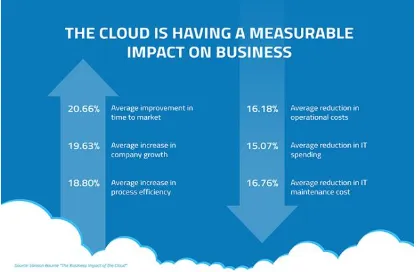
Fig. 4 Impact of Cloud Computing on Business
1. Increase in Ease of use and convenience: Cloud-based services can rapidly meet the business demand of any organization by providing various services. Small business employees often work outside the actual office location and hence having easy access to their data using their mobile devices. This need for employees to have access from remote locations as well as the increasing number of online transactions necessitates a cloud computing solution. Accounting and finance work has been outsourced to the cloud, leaving more time for small business executives spend on strategic work. Accountants are using cloud technologies for their Small medium enterprises clients for a convenient monthly fee. The Cloud approach helps eliminate administrative overhead and permits access from any geographical location, any device, and from any organization. Cloud computing allows employees to work from anywhere. This elasticity positively affects knowledge employees' work-life balance and productivity.
2. Average reeducation in operational, technical and maintenance Cost:
The interest among organizations regarding cloud computing comes mainly from the advantages it brings in terms of cost. Due to that reason, researchers usually focus on the cost benefits while researching the cost impact of cloud computing on organizations.
First of all, cloud computing enables organizations to reduce their hardware costs (Miller,2009). When using cloud services, organizations no longer need high-powered and high rated computers to run applications within the cloud. This comes from the decreased needs for a processing power and storage space (Miller, 2009). Unlike traditional software, for running cloud applications computers need less memory. They also can be with smaller hard disks because there is not installation software. Thus, organizations can reduce costs by purchasing lower-priced computers. Since employing cloud computing, organizations do not have to do high investments in IT infrastructure. This especially concerns the larger organizations (Miller, 2009). Instead of investing a huge amount of money in a large number of powerful servers, the IT departments of those organizations can use the cloud` computing power to replace or improve the internal computing resources.
Cloud computing also leads to lower software costs. Organizations no longer have to buy separate software packages for each computer. Moreover, this also means saved cost of installing and maintaining that software on each computer. Another software-related cost benefit is that organizations do not have to pay for a software upgrade in order to have the latest versions of the applications (Miller, 2009). As all applications are in the cloud, they are upgraded automatically by the provider. Organizations can also greatly reduce their maintenance costs (Miller, 2009). This refers to both hardware and software maintenance. Less computers and servers means lower maintenance costs.
Besides, there are many one-time-payments, pay-as-you-go and other scalable options available, which make it very reasonable for the company in question.
3. Improved sharing and collaboration:
4. Do more with less:
With cloud computing, companies can reduce the size of their own data centers or eliminate their data center footprint altogether. The reduction of the numbers of servers, the software cost, and the number of staff can significantly reduce IT costs without impacting an organization‘s IT capabilities.
5. Less environmental impact:
With fewer data centers worldwide and more efficient operations, we are collectively having less of an impact on the environment. Companies who use shared resources improve their ‗green‘ credentials.
6. Security benefits:
For any organization in case of business Cloud computing makes handling the data and its security much easier. ―Having several backup copies of your data on different servers in the cloud, it is very difficult to lose it.
Furthermore, cloud providers` measures to protect customers‘ data are being constantly improved.Security is heightened by, for example, monitoring activities, tracking transactions, providing selective access to users, and utilizing strong password.
In case of a data intrusion, the data can be immediately transferred from one location (server) to another. It does not take as much time as in the traditional platforms. ―Users no longer have to wait until the data is available again.‖ ―Unlike traditional computing architectures, in the cloud you can handle the security systems support from a central location.‖ Also, the deployment of security software updates is easier because of such features of cloud computing ii becomes very attractive technology for organizations in today‘s world.
V.OBSERVATION AND CONCLUSION
1. In this research paper, we have discussed about scope and characteristics of cloud and Grid Computing in case of
business.
2. As cloud computing becomes more popular technology in today‘s world of IT industry so adoption of Cloud Technology has number of positive impacts on business development as we have discussed in the paper.
3. Cloud and Grid Computing makes significant effect on Small Medium Business to larger business for their average
increase in company growth, ease of use and convenience.
4. As efficiency and speed become important criteria, grid computing has emerged as a viable alternative to maximizing processing resources.
5. Most of the time, the cloud services may be utilized at a lower rate in the beginning and at either higher or lower rate according to the demand. This happens when the business has become standardized or the cloud services have been broadly accepted for more business activities and become highly reliable.
6. Therefore, the organization going into the cloud can experience the cost reduction at the beginning and the flexibility of cost management at a later time in its IT-related activities like cost reduction in case of maintenance, resources, hardware and software which will be required to run the organization.
7. cloud computing will also benefit the business enterprises such as increased efficiency through collaboration and sharing by cloud services and ability to hit the market within the shortest period of time
8. When the organizations are storing the data on cloud security is good, as risks get minimized due to authentication and encryption.
9. Cloud Computing helps businesses of all sizes transform their operations and technology by establishing a flexible, adjustable IT environment to quickly meet changing requirements.
REFERENCES
1. Mr. Gurmeet Singh, Mr. Vineet Kumar Sachdeva,Impact and Challenges of Cloud Computing in Current Scenario,International Journal of Social Science & Interdisciplinary Research
2. Prabha Sharma,Grid Computing Vs. Cloud Computing,International Journal of Information and Computation Technology
5. Shalini Singh, RamanjeetKaur,Mandeep Hans, Arwinder Kaur,Cloud Computing – A Classification, Business Models, and Research Directions,International Journal of Computer Science Trends and Technology (IJCST) – Volume 4 Issue 3, May - Jun 2016
6. Gurpreet Singh, Member, IAENG, Manpreet Singh Manna, Member, IEEE & ACM,A Study of Impact of ERP and Cloud Computing in Business Enterprises,Proceedings of the World Congress on Engineering and Computer Science 2013 Vol I WCECS 2013, 23-25 October, 2013, San Francisco, USA
7. https://en.wikipedia.org/wiki/Grid_computing
8. AbdulazizAljabre 318 Selwyn Dr. Apt. 2D Frederick, MD. 21701USA,Cloud Computing for Increased Business Value,International Journal of Business and Social Science
9. https://en.wikipedia.org/wiki/Cloud_computing
Organizations in Regard to Cost and
BIOGRAPHY
Dr. Ranjit D. Patil is Vice Principal and H.O.D. (Computer Science Department), Dr. D. Y. Patil Arts, Commerce and
Science College Pimpri, SavitribaiPhule Pune University. He received M.C. S degree in 2000 and Ph.D.degree in 2013 from SavitribaiPhule Pune University, MS, India. He has cleared the NET Examination held by UGC in 2006.He has also received M.Phil. (Computer Science) degree in 2013 from AlagappaUniversity, Tamilnadu, India. His research interests are E-Commerce, Information Security and Information Technology etc.
Ms. Sujata P. Patil is an Assistant Professor in the Computer Science Department, Dr. D. Y. Patil Arts, Commerce and Science College Pimpri, SavitribaiPhule Pune University. She received M.C.S degree in 2004 from SavitribaiPhule Pune University, MS, India and M.Phil. (Computer Science) degree in 2010 from AlagappaUniversity, Tamilnadu, India. Her research interests are E-Commerce, Information Security etc.
Ms. Vidya H. Bankar is an Assistant Professor in the Computer Science Department, Dr. D. Y. Patil Arts, Commerce