Data Paper
Biota from the coastal wetlands of Praia da Vitória
(Terceira, Azores, Portugal): Part 3 – Birds
Sofia Goulart, João Pedro Barreiros , Mariana R. Brito, Sónia Santos, César M.M. Pimentel, Elisabete Nogueira, Paulo Alexandre Vieira Borges
‡ LIFE CWR – LIFE project “Ecological Restoration and Conservation of Praia da Vitória Coastal Wet Green Infrastructures, Praia da Vitória, Azores, Portugal
§ CE3C – Centre for Ecology, Evolution and Environmental Changes / Azorean Biodiversity Group and Universidade dos Açores, Faculdade de Ciências Agrárias e do Ambiente, Angra do Heroísmo, Azores, Portugal
Corresponding author: Paulo Alexandre Vieira Borges ([email protected]) Academic editor: Cynthia Parr
Received: 06 Mar 2019 | Accepted: 10 May 2019 | Published: 28 May 2019
Citation: Goulart S, Barreiros J, Brito M, Santos S, Pimentel C, Nogueira E, Borges P (2019) Biota from the coastal wetlands of Praia da Vitória (Terceira, Azores, Portugal): Part 3 – Birds. Biodiversity Data Journal 7: e34327.
https://doi.org/10.3897/BDJ.7.e34327
Abstract
Background
The data presented here come from field observations of Aves between August 2013 and October 2018 as part of a LIFE research project aiming to preserve and restore three coastal wetlands from Praia da Vitória (Terceira Island, Azores, Portugal). Systematic monthly observations were carried out for five years in order to provide a checklist and monitoring of bird species and subspecies observed in three sites: Paul da Praia da Vitória (PPV), Paul do Belo Jardim (PBJ) and Paul da Pedreira do Cabo da Praia (PPCP). Main objectives were to determine their ornithological richness while also adding data to the overall knowledge of Azorean Avifauna and to monitor seasonal and between-year variation on species abundance.
‡ § ‡ ‡ ‡
‡ §
New information
During a five-year observation period (2013-2018), a total of 82,985 birds belonging to 108 species/subspecies were observed. From this, 16,663 were in PPV, 11,793 from PBJ and 54,529 from PPCP. The total richness was 55, 40 and 85, respectively. Three species are first records for the Azores: Aythya americana (Eyton, 1838); Chlidonias leucopterus
(Temminck, 1815) and Tringa brevipes (Vieillot, 1816). One species is a new record for Terceira Island: Lophodytes cucullatus (Linnaeus, 1758).
Keywords
Aves, Azores, Terceira, Wetlands, Ornitofauna.
Introduction
The Azorean Avifauna has been described in several publications, the most recent being Rodrigues et al. (2010), Rodebrand (2012) and Barcelos et al. (2015). Despite the fact that the Azorean list of breeding birds is short (37 species breeding and seven occasionally nesting; Rodrigues et al. 2010), as a consequence of dramatic extinction events (Rando et al. 2013, Alcover et al. 2015, Rando et al. 2017), those publications added numerous records of non-breeding landbird and waterbird species, particularly occasional migrant and wintering species. Those novelties are a consequence of an increase in birdwatching activity on several Azorean islands and an increased interest in rare Nearctic birds arriving to Azores (Alfrey et al. 2018), due to storms that divert birds from their normal migratory routes.
Three coastal wetlands from the municipality of Praia da Vitória (Terceira Island, Azores, Portugal) - Paul da Praia da Vitória (PPV), Paul do Belo Jardim (PBJ) and Paul da Pedreira do Cabo da Praia (PPCP) – were studied during the LIFE – Coastal Wetlands Restoration Project and are known as a high avifauna site attracting birdwatchers and which include an important number of species (Dias et al. 1991, Morton et al. 1997, Morton et al. 1998, Melo and Dias 2005, Pereira and Melo 2017). Pereira and Melo (2017) published a field guidebook on the bird species occurring in PPCP, highlighting the particular importance of this wetland for migrant species and regular and occasional wintering birds.
General description
Purpose: The aim of this work is to inventory the avifauna present in the three coastal areas of Praia da Vitória (Terceira Island, Azores), focused on the LIFE-CWR Project, Paul da Praia da Vitória (PPV) (Fig. 1), Paul do Belo Jardim (PBJ) (Fig. 2) and Paul da Pedreira do Cabo da Praia (PPCP) (Fig. 3), in order to improve our knowledge on the bird diversity that occurs in this area, detect eventual new species for the Azores and monitor seasonal and between-year variation on species abundance.
Figure 1.
General aspect of Paul da Praia da Vitória (Photo by Paulo A.V. Borges).
Figure 2.
Project description
Title: Inventory of bird species in three coastal wetlands from Terceira Island (Azores)
Personnel: The inventory was conducted during five years between August 2013 and October 2018 by experienced birdwatchers: Sofia Goulart, Mariana R. Brito and Sónia Santos.
Study area description: Terceira Island (area: 400.6 km²; elevation: 1,021.14 m) is one of the nine islands of the Azores archipelago, located in the North Atlantic, roughly at 38° 43'49''N 27°19'10''W (Forjaz et al. 2004). The climate in the Azores is temperate oceanic, with regular and abundant rainfall, high levels of relative humidity and persistent western winds, mainly during the winter and autumn seasons (Azevedo et al. 1999).
Sampling methods
Study extent: This study covers a small coastal area with 3.58 km extension between PPV and PPCP.
Sampling description: At the three wetland sites, more than 788 days of observations were carried out for a total of ca. 11,820 h of direct observations. Each observation lasted 15 minutes in which every sighted bird was registered. These were made by experienced birdwatchers (two to three researchers in the field each day) using a Swarovski 20-60 telescope and Opticron Verano HD 10-42 binocular. Photographs were made with a Canon 60D camera (a database and Photo repository is available at http://lifecwr.com/index.php/
Figure 3.
pt/observacao/registos-de-observacao/registos-de-observacao-2). Whenever needed, several field-guides were used (e.g. Pereira 2010, Mullarney et al. 2012), as well as websites on Azorean birds, namely AVES DOS AÇORES, Azores bird sightings and Birdin g Azores.
Geographic coverage
Description: Praia da Vitória marshes, Terceira Island (Azores), Macaronesia, Portugal.
Coordinates: 38º42'09''N and 38°44'12''N Latitude; 27º03'46''W and 27°02'39''W Longitude.
Taxonomic coverage
Description: Aves
Temporal coverage
Notes: Data range: August 2013 – October 2018.
Usage rights
Use license: Creative Commons Public Domain Waiver (CC-Zero)
Data resources
Data package title: LIFE_CWR_TER_Aves
Resource link: http://ipt.gbif.pt/ipt/resource?r=azores_birds
Alternative identifiers: http://islandlab.uac.pt/software/ver.php?id=34
Number of data sets: 1
Data set name: Birds from Praia da Vitória marshes (Terceira, Azores, Portugal)
Download URL: http://ipt.gbif.pt/ipt/resource?r=azores_birds
Data format: Darwin Core Archive
Data format version: version 1
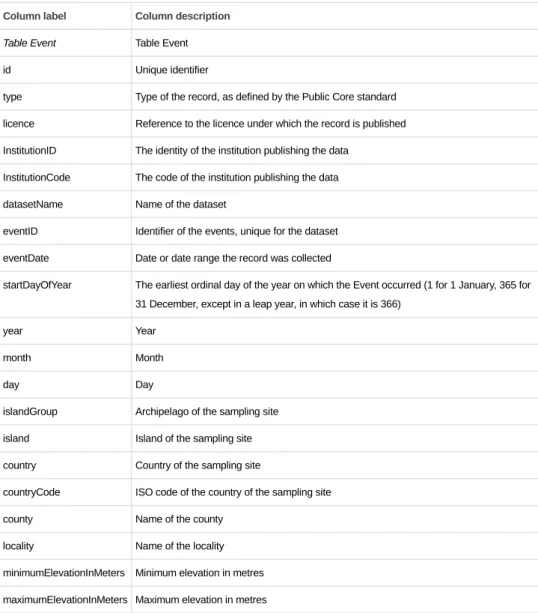
as a sample event dataset, with two tables: event (as core) and occurrences. The data in this sampling event resource have been published as a Darwin Core Archive (DwCA), which is a standardised format for sharing biodiversity data as a set of one or more data tables. The core data table contains 2003 records. One extension data table also exists. An extension record supplies extra information about a core record. The number of records in each extension data table is illustrated in the IPT link. This IPT archives the data and thus serves as the data repository. The data and resource metadata are available for downloading in the downloads section. The versions table lists other versions of the resource that have been made publicly available and allows tracking changes made to the resource over time. In Suppl. material 1, we provide a simpler dataset with few columns in a single table.
Column label Column description
Table Event Table Event
id Unique identifier
type Type of the record, as defined by the Public Core standard licence Reference to the licence under which the record is published InstitutionID The identity of the institution publishing the data
InstitutionCode The code of the institution publishing the data datasetName Name of the dataset
eventID Identifier of the events, unique for the dataset eventDate Date or date range the record was collected
startDayOfYear The earliest ordinal day of the year on which the Event occurred (1 for 1 January, 365 for 31 December, except in a leap year, in which case it is 366)
year Year
month Month
day Day
islandGroup Archipelago of the sampling site island Island of the sampling site country Country of the sampling site
countryCode ISO code of the country of the sampling site county Name of the county
Column label Column description
verbatimCoordinates Original coordinates recorded
decimalLatitude Approximate centre point decimal latitude of the field site in GPS coordinates decimalLongitude Approximate centre point decimal longitude of the field site in GPS coordinates geodeticDatum The reference point for the various coordinate systems used in mapping the earth Table Occurrences Table of Occurrences
id Unique identifier
modified Date of the last modification of the record language A language of the resource
basisOfRecord The nature of the data record
occurrenceID Identifier of the record, coded as a global unique identifier catalogNumber Record number of the specimen in the collection
recordedBy Name of the person who performed the sampling of the specimens individualCount Total number of individuals captured
organismQuantity Total number of individuals captured, as numeric organismQuantityType The unit of the identification of the organisms eventID Identifier of the events, unique for the dataset identifiedBy Name of the person who made the identification dateIdentified Date on which the record was identified
scientificName Complete scientific name including author and year
kingdom Kingdom name
phylum Phylum name
class Class name
order Order name
family Family name
genus Genus name
specificEpithet Specific epithet
infraspecificEpithet Infraspecific epithet, when available taxonRank Lowest taxonomic rank of the record
Additional information
We observed and identified 82,985 birds belonging to 26 families, including 108 species or subspecies. Families Scolopacidae (32 species) and Anatidae (24 species) were the most diverse while three species corresponded to 47.8% of all observed/identified birds (Table 1): Calidris alba (18,856), Charadrius alexandrinus alexandrinus (10,726) and Arenaria interpres (10,074). The Order Charadriformes, with 63,671 individuals observed, corresponds to 75.7% of all birds from this work (Table 1). This abundance of waders is certainly an expected feature on wetlands. Eleven species were represented by a single individual observation and 38 by ten or less individuals.
Order Family Taxon Status PPV PBJ PPCP Total
Anseriformes Anatidae Aix galericulata 1 1
Anseriformes Anatidae Aix sponsa 1 1
Anseriformes Anatidae Anas acuta 302 1 96 399
Anseriformes Anatidae Anas americana 1237 33 1270
Anseriformes Anatidae Anas carolinensis 9 9
Anseriformes Anatidae Anas clypeata 1 1
Anseriformes Anatidae Anas crecca 94 235 329
Anseriformes Anatidae Anas discors 117 147 264
Anseriformes Anatidae Anas penelope 689 30 719
Anseriformes Anatidae Anas querquedula 14 16 30
Anseriformes Anatidae Anas strepera 22 22
Anseriformes Anatidae Anser cygnoides 37 37
Anseriformes Anatidae Aythya affinis 295 1 296
Anseriformes Anatidae Aythya americana 27 27
Anseriformes Anatidae Aythya collaris 531 6 38 575
Anseriformes Anatidae Aythya ferina 12 3 15
Anseriformes Anatidae Aythya fuligula 654 7 661
Table 1.
Order Family Taxon Status PPV PBJ PPCP Total
Anseriformes Anatidae Aythya marila 296 296
Anseriformes Anatidae Branta bernicla 7 3 10
Anseriformes Anatidae Branta canadensis 8 8
Anseriformes Anatidae Bucephala clangula 5 5
Anseriformes Anatidae Clangula hyemalis 4 4
Anseriformes Anatidae Lophodytes cucullatus 64 64
Anseriformes Anatidae Tadorna tadorna 14 14
Charadriiformes Charadriidae Charadrius alexandrinus alexandrinus b / n 7 529 10190 10726 Charadriiformes Charadriidae Charadrius hiaticula 9 964 973 Charadriiformes Charadriidae Charadrius semipalmatus 2 124 126
Charadriiformes Charadriidae Pluvialis apricaria 18 18
Charadriiformes Charadriidae Pluvialis dominica 14 14
Charadriiformes Charadriidae Pluvialis fulva 18 18
Charadriiformes Charadriidae Pluvialis squatarola 225 2970 3195
Charadriiformes Charadriidae Vanellus vanellus 3 3
Charadriiformes Haematopodidae Haematopus ostralegus 1 1 Charadriiformes Laridae Chroicocephalus philadelphia 1 1 Charadriiformes Laridae Chroicocephalus ridibundus 95 425 71 591
Charadriiformes Laridae Larus argentatus 2 2
Charadriiformes Laridae Larus delawarensis 12 12
Charadriiformes Laridae Larus fuscus 153 153
Charadriiformes Laridae Larus glaucoides glaucoides 13 1 14
Charadriiformes Laridae Larus hyperboreus 7 1 8
Charadriiformes Laridae Larus marinus 70 2 72
Charadriiformes Laridae Larus michahellis atlantis b / END 171 8893 731 9795
Charadriiformes Laridae Rissa tridactyla 2 4 2 8
Charadriiformes Scolopacidae Actitis hypoleucos 3 1 14 18
Charadriiformes Scolopacidae Actitis macularius 3 3
Order Family Taxon Status PPV PBJ PPCP Total
Charadriiformes Scolopacidae Calidris alpina 557 557
Charadriiformes Scolopacidae Calidris bairdii 15 15
Charadriiformes Scolopacidae Calidris canutus 902 902
Charadriiformes Scolopacidae Calidris ferruginea 671 671 Charadriiformes Scolopacidae Calidris fuscicollis 381 381
Charadriiformes Scolopacidae Calidris mauri 2 2
Charadriiformes Scolopacidae Calidris melanotos 98 98
Charadriiformes Scolopacidae Calidris minuta 355 355
Charadriiformes Scolopacidae Calidris minutilla 46 46
Charadriiformes Scolopacidae Calidris pusilla 1 556 557
Charadriiformes Scolopacidae Calidris temminckii 4 4
Charadriiformes Scolopacidae Gallinago delicata 2 2
Charadriiformes Scolopacidae Gallinago gallinago gallinago b / n 1 22 23 Charadriiformes Scolopacidae Limnodromus griseus 101 101 Charadriiformes Scolopacidae Limnodromus scolopaceus 3 3
Charadriiformes Scolopacidae Limosa lapponica 197 197
Charadriiformes Scolopacidae Limosa limosa 1 2761 2762
Charadriiformes Scolopacidae Numenius phaeopus hudsonicus 6 6 Charadriiformes Scolopacidae Numenius phaeopus phaeopus 21 474 495 Charadriiformes Scolopacidae Phalaropus fulicarius 2 84 86
Charadriiformes Scolopacidae Phalaropus lobatus 23 23
Charadriiformes Scolopacidae Philomachus pugnax 629 629
Charadriiformes Scolopacidae Tringa brevipes 15 15
Charadriiformes Scolopacidae Tringa flavipes 2 79 81
Charadriiformes Scolopacidae Tringa glareola 3 3
Charadriiformes Scolopacidae Tringa nebularia 16 16
Charadriiformes Scolopacidae Tringa totanus 2 210 212
Charadriiformes Scolopacidae Tryngites subruficollis 2 2
Charadriiformes Sternidae Chlidonias leucopterus 1 1
Order Family Taxon Status PPV PBJ PPCP Total
Charadriiformes Sternidae Sterna hirundo hirundo b / n 91 376 275 742
Charadriiformes Sternidae Thalasseu sandvicensis 2 2
Ciconiiformes Ardeidae Ardea cinerea 713 8 35 756
Ciconiiformes Ardeidae Ardeola ralloides 3 3
Ciconiiformes Ardeidae Bubulcus ibis 2 3 5
Ciconiiformes Ardeidae Egretta garzetta 67 19 25 111
Ciconiiformes Threskiornithidae Platalea leucorodia 5 5
Ciconiiformes Threskiornithidae Plegadis falcinellus 9 9 Columbiformes Columbidae Columba livia b / i 25 185 272 482 Columbiformes Columbidae Columba palumbus azorica b / END 76 43 5 124 Columbiformes Columbidae Streptopelia decaocto decaocto b / n 1 8 127 136
Coraciiformes Alcedinidae Megaceryle alcyon 5 5
Falconiformes Accipitridae Buteo buteo rothschildi b / END 43 4 44 91
Falconiformes Falconidae Falco tinnunculus 2 2
Falconiformes Pandiondidae Pandion haliaetus 1 1
Galliformes Phasianidae Coturnix coturnix conturbans b / n 10 10
Gaviiformes Gaviidae Gavia immer 5 1 6
Gruiformes Rallidae Fulica atra b / n 5077 5077
Gruiformes Rallidae Gallinula chloropus b / n 2930 2 5 2937
Passeriformes Emberizidae Plectrophenax nivalis 1 1
Passeriformes Estrildidade Estrilda astrild b / i 367 18 147 532 Passeriformes Fringillidae Carduelis carduelis parva b / i 196 13 19 228 Passeriformes Fringillidae Serinus canaria canaria b /MAC 61 136 88 285
Passeriformes Hirundinidae Hirundo rustica 9 9
Order Family Taxon Status PPV PBJ PPCP Total
Procellariiformes Procellariidae Calonectris borealis b / n 1 1
Abundance 16663 11793 54529
Species Richness 55 40 85
Of all observed species, three are not referred to in Barcelos et al. (2015), which is the most recent update on the list of Azorean birds: Aythya americana (Eyton 1838),
Chlidonias leucopterus (Temminck 1815) and Tringa brevipes (Vieillot 1816). One species is a new record for Terceira Island: Lophodytes cucullatus (Linnaeus 1758). Aythya americana is a Nearctic occasional migrant duck, Chlidonias leucopterus is a Palearctic tern and Tringa brevipes is a shorebird breeding in northeast Siberia. All other species have previously been recorded at several levels of relative abundance, both as breeding native (ten taxa), breeding Azorean endemic (seven taxa), breeding Macaronesian endemic (one taxon), breeding introduced (four taxa) and vagrant (87 additional taxa) (Table 1). About 15 out of the 21 breeding species are common with more than 100 individuals recorded in the three sites. Based on the Barcelos et al. (2015) classification of vagrant species, in the three sites we found: 45 occasional migrants, 21 regular migrants, 17 occasional wintering taxa and 26 regular wintering taxa. The Palearctic taxa dominate the community of birds (52 taxa), whereas Holarctic (28 taxa) and Nearctic (25 taxa) have similar but with half of the frequency.
Acknowledgements
This research was supported by the project LIFE CWR – Ecological Restoration and Conservation of Praia da Vitória Coastal Wet Green Infrastructure (2013-2018). Many thanks also to Rui Figueira for the creation of the Darwin Core Archive.
Open access was funded by FEDER in 85% and by Azorean Public funds by 15% through Operational Program Azores 2020, under the project AZORESBIOPORTAL – PORBIOTA (ACORES-01-0145-FEDER-000072).
Author contributions
References
• Alcover J, Pieper H, Pereira F, Rando J (2015) Five new extinct species of rails (Aves: Gruiformes: Rallidae) from the Macaronesian Islands (North Atlantic Ocean). Zootaxa 4057 (2): 151‑190. https://doi.org/10.11646/zootaxa.4057.2.1
• Alfrey P, Monticelli D, Legrand V, Birders C (2018) Nearctic vagrants on Corvo, Azores, in 2005-17. Dutch Birding 40: 297‑317. URL: https://www.researchgate.net/
publication/328639036_Nearctic_vagrants_on_Corvo_Azores_in_2005-17
• Azevedo EB, Pereira LS, Itier B (1999) Modelling the local climate in island environments: water balance applications. Agricultural Water Management 40: 393‑403. https://
doi.org/10.1016/s0378-3774(99)00012-8
• Barcelos L, Rodrigues P, Bried J, Mendonça E, Gabriel R, Borges PAV (2015) Birds from the Azores: An updated list with some comments on species distribution. Biodiversity Data Journal 3: e6604. https://doi.org/10.3897/bdj.3.e6604
• Borges PAV, Gabriel R, Pimentel C, Brito M, Serrano ARM, Crespo LC, Assing V, Stüben P, Fattorini S, Soares A, Mendonça E, Nogueira E (2018) Biota from the coastal wetlands of Praia da Vitória (Terceira, Azores, Portugal): Part 1 - Arthropods. Biodiversity Data Journal 6: e27194. https://doi.org/10.3897/bdj.6.e27194
• Dias E, Gabriel R, Borges PAV (1991) Estudo Bio-Ecológico do Paúl da Praia da Vitória e área envolvente (ilha Terceira, Açores). [Bio-ecological study of Paúl da Praia da Vitória and surrounding area (Terceira Island, Azores)]. Universidade dos Açores, Angra do Heroísmo.
• Forjaz VH, Tavares J, Azevedo EB, Rodrigues M, Gonçalves J, Nunes J, Santos R, Barreiros JP, Gallagher L, Barcelos PJM, Silva PH, Cardigos F, França ZTM, Dentinho T, Costa MP, Magalhães L, Rodrigues MC, Silva V, Magalhães L (2004) Atlas Básico dos Açores. [The Azores Basic Atlas]. 2nd Edition. Observatório Vulcanológico e Geotérmico dos Açores, Ponta Delgada, Azores, Portugal. [ISBN 9789729746642 9729746648] • Gabriel R, Pimentel CMM, Claro D, Brito MR, Díaz-Castillo J, Sérgio C, Sim-Sim M,
Borges PAV (2019) Biota from the coastal wetlands of Praia da Vitória (Terceira, Azores, Portugal): Part 2 – Bryophytes. Biodiversity Data Journal.
• Melo C, Dias E (2005) Projecto Recuperar o Paul: Caracterização da comunidade de aves do Paul da Praia. [Description of bird community of Paul Praia Vitória]. Universidade dos Açores, Angra do Heroísmo, Azores, 40 pp.
• Morton B, Britton JC, Martins AMF (1997) The former marsh at Paúl, Praia da Vitória, Terceira, Acores, and the case for the development of a new wetland by rehabilitation of the quarry at Cabo da Praia. Açoreana 8 (3): 285‑307. URL: http://www.cmpv.pt/minisites/ life/ficheiros/Morton+Britton+Martins%201997.pdf
• Morton B, Britton JC, Martins AMF (1998) Coastal Ecology of the Açores. Sociedade Afonso Chaves, Ponta Delgada, Azores.
• Mullarney K, Svensson L, Zetterstrom D (2012) Guia das Aves . [Bird Guide]. 2nd. Assírio & Alvim, Lisboa, 433 pp. [ISBN 978-972-37-1963-5]
• Pereira C (2010) Aves dos Açores. [Birds of Azores]. 1st. SPEA, Sociedade Portuguesa para o Estudo das Aves , Lisboa, 128 pp. [ISBN 978-989-8259-02-8]
preserve]. Letras Lavadas, Edições, Ponta Delgada, Açores, 130 pp. [ISBN 978-989-20-6867-1]
• Rando JC, Alcover JA, Olson SL, Pieper H (2013) A new species of extinct scops owl (Aves: Strigiformes: Strigidae: Otus) from São Miguel Island (Azores Archipelago, North Atlantic Ocean). Zootaxa 3647 (2): 343‑357. https://doi.org/10.11646/zootaxa.3647.2.6
• Rando JC, Pieper H, Olson SL, Pereira F, Alcover JA (2017) A new extinct species of large bullfinch (Aves: Fringillidae: Pyrrhula) from Graciosa Island (Azores, North Atlantic Ocean). Zootaxa 4282 (3): 567‑583. https://doi.org/10.11646/zootaxa.4282.3.9
• Rodebrand S (2012) Checklist of the birds of the Azores including 2012. http://sr-oland.se/ onewebmedia/checklist.pdf. Accessed on: 2019-2-21.
• Rodrigues P, Bried J, Rodebrand S, Cunha R (2010) Aves. In: Borges PAV, Cunha A, Gabriel R, Gonçalves V, Martins AF, Melo I, Parente M, Raposeiro P, Rodrigues P, Santos RS, Silva L, Vieira P, Vieira V (Eds) A list of the terrestrial and marine biota from the Azores. Príncipia, Cascais, 432 pp. URL: http://islandlab.uac.pt/fotos/publicacoes/ publicacoes_Listagem_ml.pdf [ISBN 978-989-8131-75-1].
Supplementary material
Suppl. material 1: LIFE_CWR_Birds
Authors: Goulart S et al.
Data type: Occurrences and abundances
Brief description: In this contribution, we present detailed data on the distribution and
abundance of species belonging to several groups of arthropods in three Terceira island (Azores) wetlands: Paul da Praia da Vitória (PPV), Paul do Belo Jardim (PBJ) and Paul da Pedreira do Cabo da Praia (PPCP).