Address for correspondence Dr. Amer Ejaz,
Consultant Dermatologist, Combined Military Hospital, Pano Aqil Cantonment, Pakistan Email: [email protected]
Original Article
Comparison of low-dose meglumine antimoniate/
allopurinol combination therapy with full dose
meglumine antimoniate alone in the treatment of
cutaneous
leishmaniasis
– A randomized
controlled trial
Amer Ejaz*, Syed Noor Ur Rasool Qadir**, Naveed Malik†, Arfan Ul Bari‡
* Consultant Dermatologist, Combined Military Hospital, Pano Aqil Cantonment, Pakistan ** Consultant Dermatologist, PAF Base Hospital, Sargodha, Pakistan
† Consultant Dermatologist, PNS Shifa Hospital, Karachi, Pakistan
‡ Consultant Dermatologist, Combined Military Hospital, Bahawalpur, Pakistan
Abstract Objective To compare the efficacy and safety of meglumine antimoniate 20 mg/kg/day with combination of meglumine antimoniate 10 mg/kg/day and allopurinol 20 mg/kg/day.
Methods A multi-center single blind randomized controlled trial was conducted. Soldiers over 18 years of age having parasitologically proven cutaneous leishmaniasis requiring systemic therapy, willing for admission to hospital for the study and regular follow up visits in outdoor, and consenting not to use any other treatment for cutaneous leishmaniasis while in study were included. On entry into the study patients were randomly assigned to either group A or group B using a random number table. Group A patients were given meglumine antimoniate 20 mg/kg/day/intramuscular till clinical resolution or for 28 days maximum. Group B patients were given intramuscular meglumine antimoniate 10mg/kg/day along with allopurinol 20 mg/kg/day/per oral till clinical resolution or for a maximum of 28 days. The ulcer and induration areas were recorded separately for each patient. Time to healing was recorded and compared among the two groups.
Results A total of 324 patients were included in the study. Group A had 151 (46.6%) patients while 173 (53.4%) were in group B. Three hundred and six patients completed the study and 18 dropped out due to various complications, 9 belonging to each group. Lesion size at baseline in group A was 29.7+16.4 mm, while in group B it was 28+15.8 mm (p=0.35). Lesion size at the end of treatment period was 1.5+3.4 mm in group A and 0.9+2.6 mm in group B (p=0.07). Lesion size at the end of follow-up period was 0.1+0.9 mm in group A and 0.03+0.4 mm in group B (p=0.40). A total of 109 adverse effects were seen, 60 in group A and 49 in group B (p=0.05).
Conclusion Low-dose meglumine antimoniate/allopurinol combination is equally effective and safe as compared to full dose meglumine antimoniate treatment.
Key words
Cutaneous leishmaniasis, meglumine antimoniate, allopurinol, randomized controlled trial.
Introduction
Cutaneous leishmaniasis (CL) is endemic in Pakistan with an estimated incidence of 2% to
increasing incidence over the last two decades.2
Pentavalent antimonials have been the first-line systemic therapy for more than 50 years now but increased antimony treatment failures have now
been recognized from around the world.3
Toxicity levels of antimonials are also high and dose dependent.4To reduce adverse effects of
antimonial compounds, attempts have been made to use low-dose antimonials and found to be effective.5,6
Search for alternate treatments for cutaneous leishmaniasis is going on for many decades now
and several therapeutic alternatives to
antimonials or in combination with antimonials have been tested. Allopurinol is one such therapeutic agent which was first tested against
Leishmania braziliensis panamensis and found
to be effective.7Since then, allopurinol has been
combined with low-dose antimonials and found to be effective in American and Old World Leishmaniasis.8-10 There is paucity of large-sized,
randomized, controlled trials addressing the problem and no systematic review has yet been published on the subject. Especially in Old World cutaneous leishmaniasis very few clinical trials are available. The combination if found effective, will help reduce the toxicity of antimony compounds as well as help reduce the cost of treatment in a disease of the poor world.
Since the efficacy of low-dose antimony compounds combined with allopurinol has not been tested on CL patients in Pakistan, we undertook this randomized controlled trial to establish a baseline for the therapeutic efficacy of the combination in our population.
Methods
This randomized, controlled, parallel group,
single-blinded, multi-center study was
conducted in Pakistan at dermatology
departments of Combined Military Hospital,
Kharian Cantonment, Combined Military
Hospital, Quetta and Combined Military Hospital, Muzaffarabad starting from Jan 2008 to Dec 2010. All the participating patients gave written informed consent. Study was approved by the institutional review boards of the concerned hospitals. The trial was registered with http://anzctr.org.au/ and the registration number is ACTRN12607000295448. The trial was conducted according to the CONSORT guidelines 2010 and checklist/flow diagram submitted.
Soldiers serving in endemic areas reporting with clinically suspicious lesions of CL were evaluated. Men and women over 18 years of age having parasitologically proven CL requiring systemic therapy, willing for admission to hospital for the study and regular follow-up visits in outdoor, and consenting not to use any other treatment for CL while in study were included.
Considering the combination therapy to be better than meglumine alone by a factor of 24% using mean of the primary outcome measure of successful treatment, assuming equal-sized groups, keeping the equivalence trial design, standardized difference of 0.05 and power at 90%, sample size was calculated as 150 patients
in each arm using Altman nomogram.11,12 A total
of 300 patients were needed for the study and 24 extra patients were recruited to cater for drop outs.
During the screening visit, complete clinical history and data regarding age, sex, residence, duration, treatment, site, number and size of
lesions was obtained. A full medical
examination was done to rule out any systemic disease amounting to exclusion from study. To establish the parasitological diagnosis slit-skin smears were first performed using standard technique. If the first test was negative it was repeated up to three times; after which, in case of negative results, a punch biopsy was performed using standard technique. In case leishmaniasis was not confirmed the patient was excluded from the study. Complete blood count, liver function tests, creatinine, urea, pancreatic amylase, and electrocardiography were done in all patients.
On entry into the study patients were randomly assigned to either group A or group B using simple randomization through a random number
table and allocation ratio being 1:1.
Randomization sequence generation and
allocation of medicine was done by lead investigators at the three research set ups. Group A patients were given meglumine antimoniate (Glucantime, Lot No. 888, Aventis Laboratories, France) 20 mg/kg/day/intramuscular till clinical resolution or for 28 days maximum. Group B patients were given intramuscular meglumine antimoniate 10mg/kg/day along with allopurinol
(Zyloric – 300, Batch No. 2ZMAF,
GlaxoSmithKline Pakistan Limited) 20
mg/kg/day/per oral till clinical resolution or for 28 days maximum. Patient assessors were blinded from the treatment groups. Patients were evaluated daily. If any adverse event was detected it was analyzed and if the patient had to be taken off treatment, he was considered a dropout case and reasons were recorded. Weekly examinations of the patients included new blood samples for biochemical determinations. The
maximum and minimum diameters of the lesion were measured using a graduated scale, and the induration using the ballpoint pen technique. In case of multiple lesions, measurement of the largest lesion was recorded. The ulcer and induration areas were recorded separately on the patient pro forma. Time to healing was recorded in days on the patient pro forma. At the end of 28 days, patients were discharged from hospital and entered the follow-up phase. Follow-up phase lasted 6 months, during which patients were assessed on monthly basis for healing of the lesions.
Successful treatment was defined as complete reepithelization of the ulcer and disappearance of the induration, or reduction of more than 50% of the ulcer and the induration areas in relation to the last clinical evaluation. Therapeutic failure was defined as increase in the size of ulcer or presence of ulcer three months after the beginning of the treatment. Reactivation was defined as appearance of a lesion on the edge or in the center of the scar, with positive parasitological diagnosis, after a period of complete reepithelization. Reinfection was defined as activation of an ulcer in an area different from the original lesion.
At the end of the study, two end points were evaluated; successful treatment and absence of reactivation during the six months of study. Statistical package SPSS 12.0 was used for data
analysis. Frequencies, means, standard
deviations, and proportions were calculated for
variables. Non-parametric variables were
calculated using Mann-Whitney U test and Wilcoxon’s test where applicable. Friedman’s ANOVA test was used to compare follow up values. Independent sample t test and chi square tests were used where necessary. P value was considered significant at .05 and confidence interval at 95%.
Results
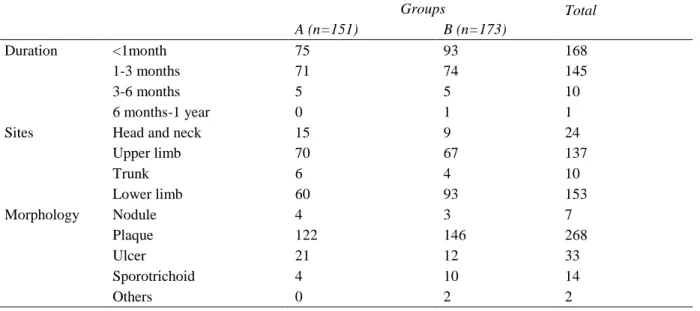
Patient recruitment started in Jan 2008 and was completed in Dec 2010. The follow-up period was of 6 months which was completed for all patients in Jun 2011. A total of 324 patients were included in the study. Mean age was 27.9+6.5 years, range 17-48 years. All the participants were male soldiers. Group A had 151 (46.6%) patients while 173 (53.4%) were in group B. Clinical characteristics of the lesions
are given in Table 1. There were 18 dropouts due to various complications, 9 belonging to each group. In 51.9% of patients, duration of lesions was less than one month whereas only one patient had a lesion of more than one year duration. In 81.5% patients diagnosis was confirmed on slit-skin smear and rest were proven on biopsy. Majority of patients (39.2%) had a single lesion while up to 15 lesions were counted on a single patient. Maximum lesions were found on exposed parts of body, arms and legs accounted for 42.3% and 47.2% of lesions respectively. Plaques were the commonest morphological patterns seen (82.7%).
Mean size of lesions at baseline was 28.8+16.1 mm. Difference between groups was not
significant (Mann Whitney U test, p=0.11).
Mean size of lesion at the end of treatment
period was 1.2+3 mm (Wilcoxon’s test, p=
<0.0001). Difference between the two groups was not significant (Mann-Whitney U test,
p=0.07). Mean induration at baseline was
17.5+11.6mm. Difference between two groups was not significant (p= 0.82).
Table 1 Clinical characteristics of skin lesions in the two groups.
Groups Total
A (n=151) B (n=173)
Duration <1month 75 93 168
1-3 months 71 74 145
3-6 months 5 5 10
6 months-1 year 0 1 1
Sites Head and neck 15 9 24
Upper limb 70 67 137
Trunk 6 4 10
Lower limb 60 93 153
Morphology Nodule 4 3 7
Plaque 122 146 268
Ulcer 21 12 33
Sporotrichoid 4 10 14
Table 2 Statistical analysis of study parameters. Mann Whitney U test applied. Follow up values separately compared by Friedman’s ANOVA test.
Parameter Group A (n 151) Group B (n 173) P value
Lesion size at baseline (mm) 29.7 (+16.4) 28 (+15.8) 0.17
Lesion size at 4 weeks (mm) 1.5 (+ 3.4) 0.9 (+2.6) 0.07
Lesion size at the end of follow-up 0.1 (+ 0.9) 0.03 (+0.4) 0.48
Induration at baseline 17.7 (+11.5) 18 (+12.8) 0.68
Induration at 4 weeks 1.5 (+3.4) 0.9 (+2.6) 0.07
Induration at the end of follow-up 0.1 (+0.9) 0.03 (+0.4) 0.28
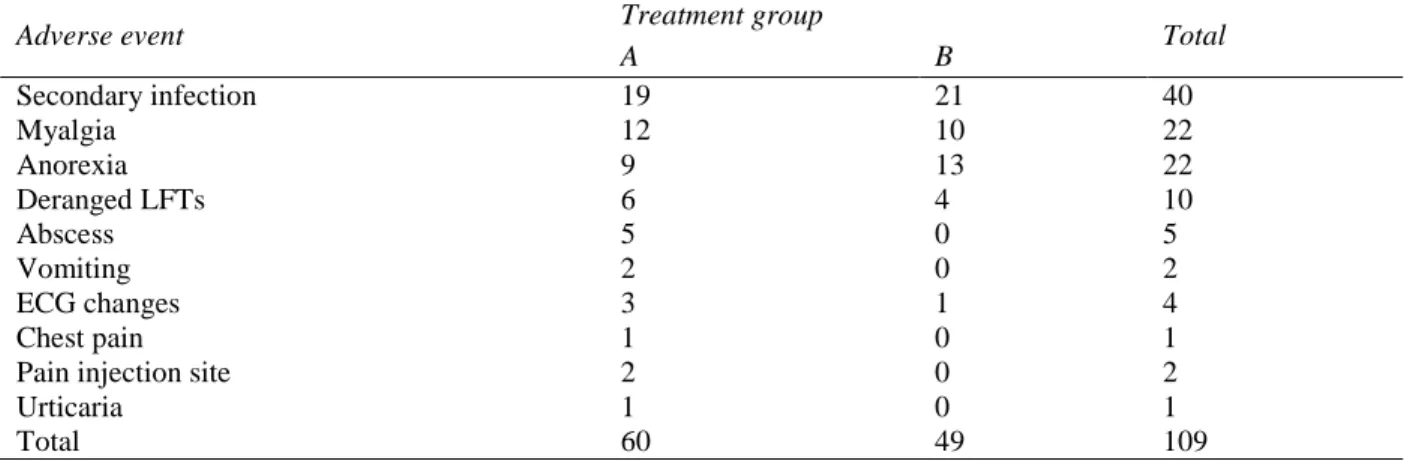
Table 3 Adverse effects comparison among the two groups. Chi square test p value 0.05.
Adverse event Treatment group Total
A B
Secondary infection 19 21 40
Myalgia 12 10 22
Anorexia 9 13 22
Deranged LFTs 6 4 10
Abscess 5 0 5
Vomiting 2 0 2
ECG changes 3 1 4
Chest pain 1 0 1
Pain injection site 2 0 2
Urticaria 1 0 1
Total 60 49 109
Mean induration at the end of treatment period was 0.1+0.8 mm (p<.0001). Both treatments gave statistically significant results in reduction of lesion size and induration. Mann-Whitney U test was used for comparison between two groups and revealed no statistically significant difference between lesion size at the end of treatment period (p=0.07), and at the end of
follow up period (p=0.48). Similarly,
comparison between two groups in reduction in induration was also not statistically significant at the end of treatment period (p=0.07), and at the end of follow up period (p=0.28). Secondary infection was found in 19 patients in group A and 21 patients in group B (chi square test,
p=0.51). Staphylococcus aureus was the
commonest pathogen isolated in 28 patients while MRSA was found in 4 patients. Further details are given in Tables 2 and 3.
A total of 69 adverse effects were seen, 39 in group A and 30 in group B (chi square test,
p=0.05). Most of the adverse effects were mild
and did not warrant stopping treatment and patients completed the trial period. Patients with deranged liver function tests and ECG changes had to abandon treatment. Details of adverse effects are given in Table 3.
Discussion
Allopurinol along with antimony has been used in cutaneous leishmaniasis for more than two decades now with conflicting results. Reports range from better efficacy of combination as compared to antimony alone,9,10,12,13to complete
lack of response as monotherapy.14Others have
found the combination ineffective in post-kala
azar dermal leishmaniasis.15 Allopurinol and
Our results suggest that the combination of
allopurinol and low-dose meglumine
antimoniate is as effective as full dose meglumine antimoniate. A study from Iran on leishmaniasis recidivans done on 32 patients has
also shown similar results, though the
researchers used a higher dose of meglumine antimoniate (50 mg/kg).16 The same author has
done another randomized controlled trial of 150 patients on this combination using 30 mg/kg
meglumine antimoniate and found the
combination to be more effective than either
compound used alone.12Another study from Iran
has used the 60 mg/kg meglumine antimoniate in combination with 20 mg/kg allopurinol and found it effective in resistant cases but the study design was not randomized controlled trial.13
Other researchers from Iran have also used low-dose meglumine antimoniate along with allopurinol but their low-dose is 30 mg/kg. In an open controlled trial, the authors have found the combination to be equally effective as full dose regimen.10They have also found the side effect
profile to be comparable between the two groups. These results are mostly consistent with our findings.
Another aspect of our study was to establish the side effects profile of low-dose meglumine as compared to full-dose. We have found similar side effects profile of the two groups. Combination treatment appears to be as safe as the standard meglumine treatment. Other researchers have found conflicting results in smaller sized trials.10,12 A further advantage of
using the combination is its cost-effectiveness.
Not many large scale studies have been done to test this combination in old world disease. Our study is unique in that we have done a randomized, controlled trial on 324 patients which, as far as we have searched, is the largest
randomized controlled trial testing the
combination in old world disease. Secondly, we have used 10 mg/kg of meglumine in combination with 20 mg/kg of allopurinol, while other trials have mostly used a higher dose of meglumine antimoniate. We can say that our study is exploring the lower end of efficacy of meglumine antimoniate/allopurinol combination. On the other hand, this trial also has some limitations. The study population is male adult soldiers which is not a true representative sample of the population. The follow-up is relatively short and could have been up to 1 to 2 years. Nevertheless, we think that this study will help future researchers in the quest to establish the minimum effective dose of antimony in combination therapy.
Conclusion
Low-dose meglumine antimoniate/allopurinol combination is equally effective and safe as compared to full dose meglumine antimoniate in old world cutaneous leishmaniasis.
References
1. Akilov OE, Khachemoune A, Hasan T. Clinical manifestations and classification of old world cutaneous leishmaniasis. Int J Dermatol. 2007;46:132-42.
2. Davies CR, Kaye P, Croft SL. Leishmaniasis: new approaches to disease control. BMJ. 2003;326:377-82.
3. Valencia C, Arévalo J, Dujardin JC et al. Prediction score for antimony treatment failure in patients with ulcerative leishmaniasis lesions. PLoS Negl Trop Dis. 2012;6:e1656.
4. Wise E, Armstrong M, Watson J, Lockwood D. Monitoring toxicity associated with parenteral sodium stibogluconate in the day case management of returned travelers with new world cutaneous leishmaniasis. PLoS Negl Trop Dis. 2012;6:e1688.
dose of antimony. Revista da Socieda de
Brasileira de Medicina Tropical.
2006;39:376-8.
6. Oliveira-Neto MP, Schubach A, Mattos M et al. A low dose antimony treatment in 159 patients with American cutaneous leishmaniasis: extensive follow up studies (up to 10 years). Am J Trop Med Hyg. 1997;57:651-5.
7. Walton BC, Harper J 3rd, Neal RA. Effectiveness of allopurinol against leishmania Braziliensis Panamensis in Autos trivirgatus. Am J Trop Med Hyg. 1983;32:46-50.
8. Baum KF, Berens RL. Successful treatment of cutaneous leishmaniasis with allopurinol after failure of treatment with ketoconazole. Clin Infect Dis. 1994;18:813-5.
9. Martinez S, Gonzalez M, Vernaza ME. Treatment of cutaneous leishmaniasis with allopurinol and stibogluconate. Clin Infect Dis. 1997;24:165-9.
10. Momeni AZ, Reiszadae MR, Aminjavaheri M. Treatment of cutaneous leishmaniasis with a combination of allopurinol and low-dose meglumine antimoniate. Int J Dermatol. 2002;41:441-3.
11. Whitley E, Ball J. Statistics review 4: Sample size calculations. Crit Care. 2002;6:335-41.
12. Esfandiarpour I, Alavi A. Evaluating the efficacy of allopurinol and meglumine antimoniate (Glucantime) in the treatment of cutaneous leishmaniasis. Int J Dermatol. 2002;41:521-4.
13. Momeni AZ, Aminjavaheri M. Successful treatment of non-healing cases of cutaneous leishmaniasis, using a combination of meglumine antimoniate plus allopurinol. Eur J Dermatol. 2003;13:40-3.
14. Velez I, Agudelo S, Hendrickx E et al. Inefficacy of allopurinol as monotherapy for Colombian cutaneous leishmaniasis. A randomized, controlled trial. Ann Intern Med. 1997;126:232-6.
15. Ramesh V, Kumar J, Kumar D, Salotra P.A retrospective study of intravenous sodium stibogluconate alone and in combinations with allopurinol, rifampicin, and an immunomodulator in the treatment of Indian post-kala-azar dermal leishmaniasis. Indian J Dermatol Venereol Leprol. 2010;76:138-44.