R E V I E W
Open Access
Time abides long enough for those who
make use of it
Muhammad M. Fareed and Thomas J. Galloway
*Abstract
Increased treatment package time is an independent poor prognostic factor for outcomes in head and neck squamous cell carcinoma (HNSCC). Similarly the timeliness of treatment initiation is a risk factor for disease recurrence. Despite these well-known issues, the timeliness of treatment initiation is actually worsening in the United States and the expeditious completion of radiation treatments continues to be difficult secondary to a number of patients and treatment related issues. This analysis evaluates the current data on treatment intervals in the management of head and neck cancer. Rapid staging/diagnosis of head and neck cancer, appropriate referrals to providers qualified to treat said cancer, and expeditious treatment completion remains the most cost-effective, widely applicable method to improve outcomes in head and neck cancer.
Time abides long enough for those who make use of it–Leonardo Da Vinci
Introduction
Increased treatment package time (defined as duration between the initiation and completion of curative therapy), increased time to treatment initiation (TTI – defined as the duration between the histologic diagnosis and initiation of treatment) and increased radiation treatment time (RTT–defined as the duration between the first and last fraction of external beam radiation) have all been demonstrated to be detrimental in the management of head and neck squamous cell carcinoma (HNSCC). In addition, prolonged TTI affects patient satisfaction and quality of life [1] and exacerbates the psychosocial distress accompanying a cancer diagnosis [2, 3]. Furthermore, while most prolongations of both package time and RTT are unplanned, they may be in-creasing due to inin-creasingly complex treatment regimens [4] that are more toxic than prior regimens [5]. Thus, although the effects of timing in head and neck cancer have been discussed for decades [6–8], a critical re-appraisal of the lessons of timing is indicated. In this
manuscript we will review the timing of each interval as-sociated with the successful treatment of head and neck cancer and study the impacts on treatment outcomes. The time between first appreciation of symptom(s) related to an underlying cancer and initial presentation to an oncology provider is an extremely difficult interval to quantify and examine and will not be evaluated in this monograph.
Time to treatment initiation
Many different types of evidence suggest that it is prudent to avoid the prolongation of initiating poten-tially curative radiation therapy [9] and cancer surgery [10]. There is overwhelming evidence that most human cancers steadily grow and progress and although the growth rate is variable [11, 12] this is a provocative ra-tionale to expedite treatment starts. Increase prolonga-tion of TTI leads to stage progression and larger tumors and an associated decrease in recurrence free survival [13]. However convincing these common sense argu-ments may seem, successfully limiting the interval between diagnosis and treatment start and quantifying the effects of prolongation of that time frame is difficult.
Historically, increased TTI was a consequence of an imbalance of supply and demand. Largely due to an in-crease in the use of radiation resources for breast and prostate cancers [14], radiotherapy centers on different continents reported the same problem some decades ago –a prolongation of the time between diagnosis and * Correspondence:[email protected]
Department of Radiation Oncology, Fox Chase Cancer Center, 333 Cottman Avenue, Philadelphia, PA 19111, USA
treatment start [15, 16]. In the United States the re-sponse to this was more access–more radiation oncolo-gists and more radiation therapy centers [17]. However, recent series suggest that even with expanding access to radiation oncologists TTI is not only still elevated, but actively increasing [4]. Understanding why TTI is still elevated and barriers to its reduction requires an under-standing of the processes involved in expeditious yet accurate treatment initiation.
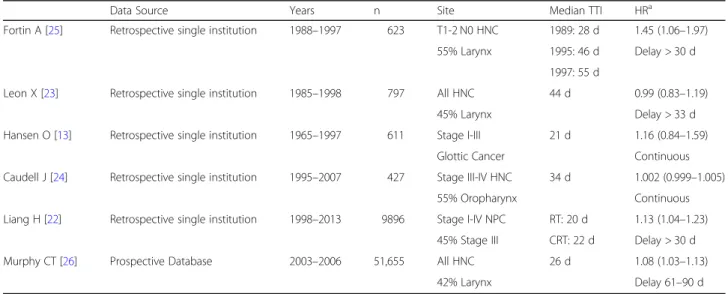
Reported TTI evaluations of patients treated with curative radiotherapy demonstrate a remarkably similar trend (Table 1) –patients generally start radiotherapy a month after the histologic diagnosis is established by a biopsy. This is remarkable–while some impediments to treatment start are constant (it takes time to interpret the biopsy, arrange a new patient referral with a radi-ation oncologist, schedule appointments), the manage-ment of head and neck tumors with primary radiation is profoundly different in 2013 than it was in 1965. As referenced earlier, prolonged TTI was once referable to capacity. While factors related to access unfortunately continue to predict for increasing TTI in the United States [4], the increasing complexity of care has taken over as an additional driver of increased TTI. In 2001 Medicare began to cover 18Ffluorodeoxyglucose/positron emission tomography (FDG/PET) when used for the diagnosis, staging, and restaging of head and neck can-cers [18]. Subsequent prospective investigations demon-strated that pre-therapy PET/computed tomography (CT) imaging could alter the planned management of head and neck cancer [19]. Clinicians responded by or-dering more PET/CT scans for the management of head and neck cancer [20]. The increased use of intensity
modulated radiation therapy (IMRT) from < 10% in 1998 [21] to near ubiquity in 2018 requires days of additional time for contouring, planning, and quality assurance that prolongs TTI [22]. In addition to these clinical factors additional delays stem from the increasing need for time-consuming prior authorizations for medications, additional tests, and referrals [23]. Data from the United States suggests that the increasing complexity of care should not be ignored – the median TTI for all patients increased from 19 days to 30 days from 1998 and 2011 [4].
Quantifying TTI is straightforward. Patients have a date of biopsy and a date of treatment start–the differ-ence is the TTI. Evaluating the impact of TTI is much more complex. Most increases in TTI are caused in large part by the pursuit of improved care. Imaging studies to better identify areas of tumor spread pre-treatment, transitions in care to allow treatment by a more experienced provider, additional scheduling to allow concurrent chemotherapy – all of these increase TTI but also improve patient outcomes. For this reason critical appraisal of the TTI literature is somewhat diffi-cult. Some analyses do not report a significant survival detriment to TTI [24,25] while others report significant detriments to rather short intervals [22,26] (Table1). By far the largest analysis of this issue demonstrated a significant detriment to delays longer than 60 days that further increased for the small subset of patients with TTI≥91 days (HR 1.23, 1.15–1.32, p< 0.001) [27]. Evaluation of TTI as a continuous variable identified 67 days as the most critical threshold, with a TTI threshold of 46–52 days also appeared on 96% of the repeat simulations designed to test for validity. While these
Table 1Time to treatment initiation (TTI) Evaluations
Data Source Years n Site Median TTI HRa
Fortin A [25] Retrospective single institution 1988–1997 623 T1-2 N0 HNC 1989: 28 d 1.45 (1.06–1.97)
55% Larynx 1995: 46 d Delay > 30 d
1997: 55 d
Leon X [23] Retrospective single institution 1985–1998 797 All HNC 44 d 0.99 (0.83–1.19)
45% Larynx Delay > 33 d
Hansen O [13] Retrospective single institution 1965–1997 611 Stage I-III 21 d 1.16 (0.84–1.59)
Glottic Cancer Continuous
Caudell J [24] Retrospective single institution 1995–2007 427 Stage III-IV HNC 34 d 1.002 (0.999–1.005)
55% Oropharynx Continuous
Liang H [22] Retrospective single institution 1998–2013 9896 Stage I-IV NPC RT: 20 d 1.13 (1.04–1.23)
45% Stage III CRT: 22 d Delay > 30 d
Murphy CT [26] Prospective Database 2003–2006 51,655 All HNC 26 d 1.08 (1.03–1.13)
42% Larynx Delay 61–90 d
HNC= head and neck cancer,RT= RT alone,CRT= chemoradiation,d= days a
benchmarks are longer than the median TTI reported in a majority of the published literature, in 2011 in the Unites States 9.6% of patients had a TTI greater than 67 days and 25% of patients had a TTI of greater than 46 days with associated decreases in median overall survival from 71.9 months (TTI < 46–52 days) to 61 months (TTI 53–67 days) to 46.6 months (TTI > 67 days, p< 0.001) [27].
TTI is increasing in the United States and a prime reason for this increase is the pursuit of better care. This is not to say that treatment should begin in haste – patients need advanced imaging, pre-treatment dental attention, and increasingly complex treatment planning that takes time. However these necessary aspects of patient care can be completed without dangerously extended TTI. This need to coordinate multiple aspects of care in a limited amount of time is likely best accom-plished by centers with high head and neck treatment volumes and likely in part responsible for said centers improved survival [28].
Growth rate
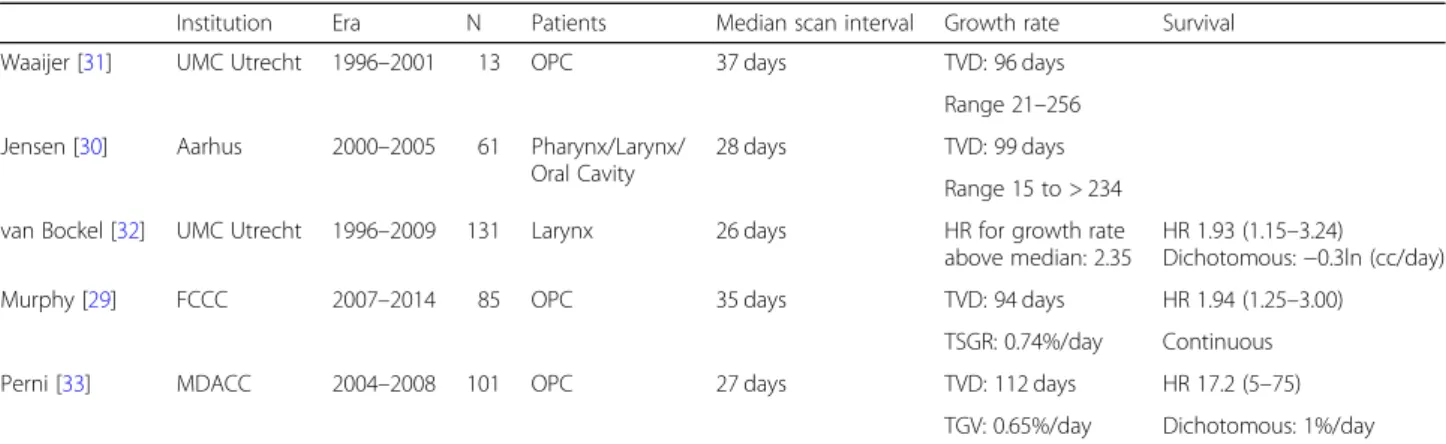
While it is evident that cancer progresses over time, granular detail about growth rate is difficult to obtain. Thus, clinicians rarely directly observe this feature of tumor biology that is intricately linked to TTI. However, in an era of competition among different tumor types for limited resources (radiation treatment machine time or operating room time) the practice of definitive treat-ment of head and neck cancer with primary radiother-apy offers a simple mechanism to observe growth rate; most patients undergo an initial cross sectional imaging scan at the time of diagnosis and then have a similar scan performed for radiation treatment planning. Given the current state of TTI, these two scans are generally separated by a sufficiently long enough interval to allow for a measurement of tumor growth (Table2).
While predictors of a fast growth rate are not clear among different analyses, one oropharynx cancer dataset demonstrated that human papillomavirus (HPV)-nega-tive disease grew at a faster rate than HPV-posi(HPV)-nega-tive disease, with a suggestion that HPV-positive disease with a smoking history may also increase growth rate [29]. Other available datasets do not have enough HPV infor-mation to address this issue. Nonetheless, it is clear that the variation in growth rate among different subsites and even similar subsite head and neck tumors is extreme [29–33]. It is incumbent upon providers at all ends of the spectrum (primary care to tertiary care oncologist) to better appreciate which tumors in the clinic are expected to grow fast (and merit the most expedited oncologically safe treatment) and which are expected to plot a more middling pace. Although predic-tors of growth rate are not consistent, available estimates
of tumor volume doubling time are somewhat consistent across different disease sites and treatment centers. Similarly, overall survival effects of delays noted are con-sistent – increased tumor growth rate is independently associated with worsening survival when controlling for other known risk factors. When one considers that a tumor may double in volume in roughly 90–100 days, the detriment of TTI exceeding 60 days becomes clearer.
Treatment package time
Treatment package time refers to patients managed with primary surgery and adjuvant (chemo)radiation. The treatment package is the interval from the extirpative operation and the eventual completion of adjuvant ther-apy. Initial interrogation of this phenomenon suggested that patients whose radiation was initiated more than 6 weeks after surgery had poorer control rates than those whose radiation was begun earlier [34–36]. Other single institution reports cited radiation start within 7 weeks of an operation was beneficial, particularly for those patients with poor prognostic features [37]. This work is in part the reason that it is common for prospective ad-juvant therapy investigations to mandate the initiation of (chemo)radiation within 4–8 weeks of an operation al-though it must be noted that many patients treated dur-ing the initial evaluation of time factors were treated with daily fractions of 1.8 Gy. A standard adjuvant course of 1.8 Gy daily radiation takes one week (7 days) longer than a standard course delivered in 2 Gy daily fractions (63 Gy in 1.8 Gy/fraction–35 fractions v 60 Gy in 2.0 Gy/fraction - 30 fractions).
benefit to accelerated adjuvant therapy and the burgeon-ing application of adjuvant chemoradiation [40, 41] enthusiasm for the use of accelerated adjuvant therapy waned. The current standard of care in the adjuvant high risk setting is conventionally fractionated chemora-diation – the method to influence treatment package time is to maximize post-operative care and function so that patients are prepared to start adjuvant therapy expeditiously.
Similar to historic series of adjuvant radiation alone, a more modern population based analysis (> 50% of patients received adjuvant chemoradiation) continued to demonstrate the significant influence of treatment pack-age time. In this analysis a significant improvement in overall survival was appreciated for those patients whose treatment was initiated within 42 days (6 weeks) of surgery when compared to those whose treatment did not begin for ≥50 days (HR 1.07; 95% CI, 1.02–1.12) [42]. Interestingly, given the lack of survival benefit ap-preciated in the definitive setting for accelerated chemo-radiation [43], this analysis did demonstrate a survival benefit to modest acceleration.
Radiation treatment time (RTT)
Most treatment prolongation is unplanned and likely due to acute toxicity – thus the results of prolonged RTT are difficult to study. By contrast the effects of treatment acceleration have been frequently investigated. The Radiation Therapy Oncology Group (RTOG) ran multiple trials investigating accelerated fractionation schedules for the definitive management of stage III/IV head and neck cancer with radiation alone, culminating in a large 4-arm trial of radiation alone (RTOG 9003) demonstrating, in part, that delivering 72 Gy in 6 weeks rather than 70 Gy in 7 weeks improved 2 year local-regional control by 8% [44]. Although proving that
treatment in 6 weeks is superior to 7 is not the same as proving that treatment in 7 weeks is superior to 8, a logical conclusion was that an 8 week treatment of head and neck cancer was no longer considered acceptable [45]. Although RTOG 9003 demonstrated no OS improvement with acceleration, a subsequent large meta-analysis did demonstrate a survival benefit for pa-tients receiving altered fractionation and this effect did not differ significantly according to tumor stage or tumor site [46]. Subsequent population based analyses similarly demonstrated a survival benefit to acceleration [47]. Thus the role of RTT in the setting of radiation alone is clear –modest acceleration of radiation results in a small but statistically significant improvement in LRC and OS.
The role of RTT in the setting of chemoradiation is less clear. Randomized trials suggest that the addition of concurrent chemotherapy improves the results of hyper-fractionated definitive radiotherapy but acceleration of radiation does not enhance definitive concurrent chemo-radiation [43, 48]. Given the lack of survival benefit to acceleration in the setting of concurrent chemotherapy and that accelerated radiation with concurrent chemo-therapy has proven to be the most toxic mechanism of delivering non-surgical therapy [5], this treatment tech-nique is not generally recommended. In 2018 acceler-ation is recommended in the setting of radiacceler-ation alone, but not recommended in the setting of chemoradiation.
Prolonged RTT was evaluated in a population based analysis. On the contrary to treatment acceleration, this demonstrated that prolongation (defined as a definitive radiation course taking≥56 days to completion) resulted in worsening survival in both the radiation alone (HR 1.45 95% CI 1.16–1.83 p= 0.0013) and chemoradiation settings (HR 1.22 95% CI 1.01–1.46 p= 0.0368). Pro-longed RTT has many causes, but this series was limited Table 2Growth rate analyses between diagnostic imaging scan and radiation treatment planning scan
Institution Era N Patients Median scan interval Growth rate Survival
Waaijer [31] UMC Utrecht 1996–2001 13 OPC 37 days TVD: 96 days
Range 21–256
Jensen [30] Aarhus 2000–2005 61 Pharynx/Larynx/ Oral Cavity
28 days TVD: 99 days
Range 15 to > 234
van Bockel [32] UMC Utrecht 1996–2009 131 Larynx 26 days HR for growth rate above median: 2.35
HR 1.93 (1.15–3.24)
Dichotomous:−0.3ln (cc/day)
Murphy [29] FCCC 2007–2014 85 OPC 35 days TVD: 94 days HR 1.94 (1.25–3.00)
TSGR: 0.74%/day Continuous
Perni [33] MDACC 2004–2008 101 OPC 27 days TVD: 112 days HR 17.2 (5–75)
TGV: 0.65%/day Dichotomous: 1%/day
OPC= oropharynx cancer,TVD= tumor volume doubling time,TSGR= tumor specific growth rate,TGV= volumetric tumor growth velocity. TSGR and TGV are functionally the same
to patients who completed therapy. Thus, patients who expired during treatment or did not finish their radiation course as prescribed are not included. In view of this study’s generous definition of prolongation (treatment needed to be extended at least a week prior to be classified as ‘prolonged’) it would require unsustainable acceleration to mitigate the effect of a prolonged RTT (increased dose per fraction and/or increased fractions in a given week [49]. The best way to address prolonged RTT is through prevention.
Conclusion
The management of head and neck cancer is complex. Many tumors present locally advanced, and require a team of professionals to adequately diagnose, stage, and treat the diagnosis. Even in the most favorable setting completing the necessary pre-treatment tasks exped-itiously is difficult–unfortunately given the rarity of the disease many patients must travel at least 50 miles to be evaluated by their oncology provider. In addition the treatment frequently requires fractionated radiation with high acute morbidity making daily presentation to the cancer center difficult. All of these factors (and others) contribute to make the timely completion of a treatment package difficult.
Logic would suggest that the aforementioned difficulty in the expeditious initiation and completion of therapy could be ameliorated by familiarity; institutions that treat a high volume of head and neck cancer are likely better at the delivery of swift, high quality care. This would be expected to improve outcomes. Recent large data analyses support this premise. Patients treated on RTOG 0129 at historically low-accruing head and neck centers (median accrual to 21 trials from 1997 to 2002: 4) had significantly worse 5-year survival (51% v 69%, P= 0.002) than those treated at historically high accruing centers (median accrual on same trials: 65) despite having somewhat more favorable stage and performance status [28]. In addition, this analysis demonstrated that patients treated at historically low-accruing centers had a significantly longer RTT. A subsequent big data analysis defining a high-volume facil-ity as the top 1% of centers by the number of patients treated similarly demonstrated an improvement in 5-year overall survival for high volume facilities (61.6% v 55.5%,
P< 0.001) although timing was not specifically evaluated [50]. Finally, other analyses evaluating radiation quality on a randomized trial [51] and intensity modulated RT volume by provider [52] have suggested benefits to treatment at high volume head and neck cancer centers. Although timing is not evaluated in these analyses, it stands to reason that a component of the benefit seen is secondary to better appreciation of the importance of timing at these centers.
As this monograph demonstrates–however difficult it may be treatment timing is important. It takes dedica-tion and attendedica-tion from a committed multidisciplinary team to treat head and neck cancer efficiently and correctly. Currently the most detailed data of this phenomenon identifies 46 days from histologic diagnosis to treatment initiation as a benchmark. While this seems like a generous amount of time, care transitions often re-sult in a 20–30 day interval between histologic diagnosis and first meeting with the provider (surgeon/radiation oncologist/medical oncologist) who will actually deliver care. Providers must not only perform the correct tasks in the correct order–they also must be done in parallel (i.e. visit to the dentist and staging imaging scan on the same day). Expediting treatment start and completion represents a simple, cost-effective mechanism to im-prove patient outcomes.
Abbreviations
CI:Confidence interval; CT: Computed tomography; FDG/
PET: Fluorodeoxyglucose/positron emission tomography; HNSCC: Head and neck squamous cell carcinoma; HPV: Human papillomavirus; HR: Hazard ratio; IMRT: Intensity modulated radiation therapy; LRC: Locoregional control; OS: Overall survival; RTOG: Radiation Therapy Oncology Group; RTT: Radiation treatment time; TTI: Time to treatment initiation
Acknowledgements
None.
Funding
None.
Availability of data and materials
This is a review article. All data used to generate are cited and listed in “References”.
Authors’contributions
MF/TG contributed to the study concept and design; acquisition, analysis, and interpretation of data; drafting of the manuscript; and critical revision. Both authors read and approved the final manuscript.
Ethics approval and consent to participate
Not applicable.
Consent for publication
Not applicable.
Competing interests
The authors declare that they have no competing interests.
Publisher’s Note
Springer Nature remains neutral with regard to jurisdictional claims in published maps and institutional affiliations.
Received: 17 August 2018 Accepted: 9 November 2018
References
3. Hess CB, Chen AM. Measuring psychosocial functioning in the radiation oncology clinic: a systematic review. Psychooncology. 2014;23:841–54. 4. Murphy CT, Galloway TJ, Handorf EA, et al. Increasing time to treatment
initiation for head and neck cancer: an analysis of the National Cancer Database. Cancer. 2015;121:1204–13.
5. Trotti A, Pajak TF, Gwede CK, et al. TAME: development of a new method for summarising adverse events of cancer treatment by the radiation therapy oncology group. Lancet Oncol. 2007;8:613–24.
6. Mackillop WJ, Bates JH, O'Sullivan B, et al. The effect of delay in treatment on local control by radiotherapy. Int J Radiat Oncol Biol Phys. 1996;34:243–50. 7. Feldman M, Fletcher GH. Analysis of the parameters relating to failures
above the clavicles in patients treated by postoperative irradiation for squamous cell carcinomas of the oral cavity or oropharynx. Int J Radiat Oncol Biol Phys. 1982;8:27–30.
8. Peters LJ, Ang KK. The role of altered fractionation in head and neck cancers. Semin Radiat Oncol. 1992;2:180–94.
9. Mackillop WJ. Killing time: the consequences of delays in radiotherapy. Radiother Oncol. 2007;84:1–4.
10. Bleicher RJ, Ruth K, Sigurdson ER, et al. Time to surgery and breast Cancer survival in the United States. JAMA Oncol. 2016;2:330–9.
11. Spratt JS, Meyer JS, Spratt JA. Rates of growth of human solid neoplasms: part I. J Surg Oncol. 1995;60:137–46.
12. Spratt JS, Meyer JS, Spratt JA. Rates of growth of human neoplasms: part II. J Surg Oncol. 1996;61:68–83.
13. Hansen O, Larsen S, Bastholt L, et al. Duration of symptoms: impact on outcome of radiotherapy in glottic cancer patients. Int J Radiat Oncol Biol Phys. 2005;61:789–94.
14. Mackillop WJ, Zhou S, Groome P, et al. Changes in the use of radiotherapy in Ontario 1984-1995. Int J Radiat Oncol Biol Phys. 1999;44:355–62. 15. Ash D, Barrett A, Hinks A, et al. Re-audit of radiotherapy waiting times 2003.
Clin Oncol (R Coll Radiol). 2004;16:387–94.
16. Wigg DR. Radiation oncology in Australia: an increasing crisis. Australas Radiol. 1988;32:24–37.
17. Lewis RS, Sunshine JH. Radiation oncologists in the United States. Int J Radiat Oncol Biol Phys. 2007;69:518–27.
18. Bietendorf J. FDG PET reimbursement. J Nucl Med Technol. 2004;32:33–8. 19. Lonneux M, Hamoir M, Reychler H, et al. Positron emission tomography
with [18F]fluorodeoxyglucose improves staging and patient management in patients with head and neck squamous cell carcinoma: a multicenter prospective study. J Clin Oncol. 2010;28:1190–5.
20. Hillner BE, Tosteson AN, Song Y, et al. Growth in the use of PET for six cancer types after coverage by medicare: additive or replacement? J Am Coll Radiol. 2012;9:33–41.
21. Mell LK, Mehrotra AK, Mundt AJ. Intensity-modulated radiation therapy use in the U.S., 2004. Cancer. 2005;104:1296–303.
22. Liang H, Xiang YQ, Lv X, et al. Survival impact of waiting time for radical radiotherapy in nasopharyngeal carcinoma: a large institution-based cohort study from an endemic area. Eur J Cancer. 2017;73:48–60.
23. Agarwal A, Freedman RA, Goicuria F, et al. Prior authorizations for medications in breast oncology practice: navigation of a complex process. J Oncol Pract. 2017;13(4):e273-e282.https://doi.org/10.1200/JOP.2016.017756. Epub 2017 Feb 28.
24. Leon X, de Vega M, Orus C, et al. The effect of waiting time on local control and survival in head and neck carcinoma patients treated with
radiotherapy. Radiother Oncol. 2003;66:277–81.
25. Caudell JJ, Locher JL, Bonner JA. Diagnosis-to-treatment interval and control of locoregionally advanced head and neck cancer. Arch Otolaryngol Head Neck Surg. 2011;137:282–5.
26. Fortin A, Bairati I, Albert M, et al. Effect of treatment delay on outcome of patients with early-stage head-and-neck carcinoma receiving radical radiotherapy. Int J Radiat Oncol Biol Phys. 2002;52:929–36.
27. Murphy CT, Galloway TJ, Handorf EA, et al. Survival impact of increasing time to treatment initiation for patients with head and neck Cancer in the United States. J Clin Oncol. 2016;34:169–78.
28. Wuthrick EJ, Zhang Q, Machtay M, et al. Institutional clinical trial accrual volume and survival of patients with head and neck cancer. J Clin Oncol. 2015;33:156–64.
29. Murphy CT, Devarajan K, Wang LS, et al. Pre-treatment tumor-specific growth rate as a temporal biomarker that predicts treatment failure and improves risk stratification for oropharyngeal cancer. Oral Oncol. 2015;51:1034–40.
30. Jensen AR, Nellemann HM, Overgaard J. Tumor progression in waiting time for radiotherapy in head and neck cancer. Radiother Oncol. 2007;84:5–10.
31. Waaijer A, Terhaard CH, Dehnad H, et al. Waiting times for radiotherapy: consequences of volume increase for the TCP in oropharyngeal carcinoma. Radiother Oncol. 2003;66:271–6.
32. van Bockel LW, Verduijn GM, Monninkhof EM, et al. The importance of actual tumor growth rate on disease free survival and overall survival in laryngeal squamous cell carcinoma. Radiother Oncol. 2014;112:119–24.
33. Perni S, Mohamed AS, Scott J, et al. CT-based volumetric tumor growth velocity: a novel imaging prognostic indicator in oropharyngeal cancer patients receiving radiotherapy. Oral Oncol. 2016;63:16–22.
34. Vikram B. Importance of the time interval between surgery and postoperative radiation therapy in the combined management of head & neck cancer. Int J Radiat Oncol Biol Phys. 1979;5:1837–40.
35. Vikram B, Strong EW, Shah J, et al. Elective postoperative radiation therapy in stages III and IV epidermoid carcinoma of the head and neck. Am J Surg. 1980;140:580–4.
36. Vikram B, Strong EW, Shah JP, et al. Failure in the neck following multimodality treatment for advanced head and neck cancer. Head Neck Surg. 1984;6:724–9.
37. Parsons JT, Mendenhall WM, Stringer SP, et al. An analysis of factors influencing the outcome of postoperative irradiation for squamous cell carcinoma of the oral cavity. Int J Radiat Oncol Biol Phys. 1997;39:137–48.
38. Ang KK, Trotti A, Brown BW, et al. Randomized trial addressing risk features and time factors of surgery plus radiotherapy in advanced head-and-neck cancer. Int J Radiat Oncol Biol Phys. 2001;51:571–8.
39. ea BBM. Outcomes and risk factors in patients treated with surgery and postoperative radiation therapy alone: a subset update of a randomized trial. Int J Radiat Oncol Biol Phys. 2011;81:S104–5.
40. Cooper JS, Pajak TF, Forastiere AA, et al. Postoperative concurrent radiotherapy and chemotherapy for high-risk squamous-cell carcinoma of the head and neck. N Engl J Med. 2004;350:1937–44.
41. Bernier J, Domenge C, Ozsahin M, et al. Postoperative irradiation with or without concomitant chemotherapy for locally advanced head and neck cancer. N Engl J Med. 2004;350:1945–52.
42. Harris JP, Chen M, Orosco RK, et al. Association of survival with shorter time to radiation therapy after surgery for us patients with head and neck cancer. JAMA Otolaryngol–Head & Neck Surgery. 2018.
43. Nguyen-Tan PF, Zhang Q, Ang KK, et al. Randomized phase III trial to test accelerated versus standard fractionation in combination with concurrent cisplatin for head and neck carcinomas in the radiation therapy oncology group 0129 trial: long-term report of efficacy and toxicity. J Clin Oncol. 2014;32:3858–66.
44. Fu KK, Pajak TF, Trotti A, et al. A radiation therapy oncology group (RTOG) phase III randomized study to compare hyperfractionation and two variants of accelerated fractionation to standard fractionation radiotherapy for head and neck squamous cell carcinomas: first report of RTOG 9003. Int J Radiat Oncol Biol Phys. 2000;48:7–16.
45. Withers HR, Peters LJ. Transmutability of dose and time. Commentary on the first report of RTOG 90003 (K. K. FU et al.). Int J Radiat Oncol Biol Phys. 2000;48:1–2.
46. Bourhis J, Overgaard J, Audry H, et al. Hyperfractionated or accelerated radiotherapy in head and neck cancer: a meta-analysis. Lancet. 2006;368:843–54.
47. Shaikh T, Handorf EA, Murphy CT, et al. The impact of radiation treatment time on survival in patients with head and neck Cancer. Int J Radiat Oncol Biol Phys. 2016;96:967–75.
48. Brizel DM, Albers ME, Fisher SR, et al. Hyperfractionated irradiation with or without concurrent chemotherapy for locally advanced head and neck cancer. N Engl J Med. 1998;338:1798–804.
49. Bese NS, Hendry J, Jeremic B. Effects of prolongation of overall treatment time due to unplanned interruptions during radiotherapy of different tumor sites and practical methods for compensation. Int J Radiat Oncol Biol Phys. 2007;68:654–61.
51. Peters LJ, O'Sullivan B, Giralt J, et al. Critical impact of radiotherapy protocol compliance and quality in the treatment of advanced head and neck cancer: results from TROG 02.02. J Clin Oncol. 2010;28:2996–3001. 52. Boero IJ, Paravati AJ, Xu B, et al. Importance of radiation oncologist