AENSI Journals
Australian Journal of Basic and Applied Sciences
ISSN:1991-8178
Journal home page: www.ajbasweb.com
Corresponding Author: Khashayar Danesh Narooei, Department of Mechanical and Material Engineering, University Kebangsaan Malaysia, 43600 UKM Bangi, Selangor Darul Ehsan Malaysia
Tel: +6017-2324109, E-mail: [email protected]
Tool Path Optimization for Drilling Process by CNC Milling Machine Using Ant
Colony Optimization (ACO)
1Fathiyyah Iberahim, 1Rizauddin Ramli, 1Khashayar Danesh Narooei, 2Jaber Abu Qudeiri
1Department of Mechanical and Material Engineering, University Kebangsaan Malaysia, 43600 UKM Bangi, Selangor Darul Ehsan
Malaysia
2
Advanced Manufacturing Institute, Industrial Engineering Department, College of Engineering, King Saud University, Riyadh Saudi Arabia
A R T I C L E I N F O A B S T R A C T
Article history:
Received 15 April 2014 Received in revised form 22 May 2014
Accepted 25 October 2014 Available online 10 November 2014
Keywords:
Toolpath optimization, Ant Colony Optimization, Travelling Salesman Problem, Manufacturing Lead Time
Currently, most companies that act on both domestic and global markets experience a growing international competition and recognize the importance to reduce manufacturing lead time. One of the industries that has to face this globalization challenges is the machining industry. In general, machining can be done manually or automatically, better known as Computer Numerical Control (CNC). It is reported that tool movement and tool switching time in machining process take most of the total time in a manufacturing process. Optimization of tool path operation can lead to significant reduction in non-productive machining time. This paper focuses on the development of Ant Colony Optimization (ACO) model by using Matlab® software. In searching for the optimize tool path for machining operation in incremental positioning axis movement is based on the Travelling Salesman Problem (TSP) principles. Results shows that with the increasing of the hole drilling operation and also its trail evaporation rate (ρ), will reduce the ACO accuracy. Overall, the objective of this study to produce the optimize tool path by ACO algorithm programming.
© 2014 AENSI Publisher All rights reserved. To Cite This Article: Fathiyyah Iberahim, Rizauddin Ramli, Khashayar Danesh Narooei, Jaber Abu Qudeiri, Tool Path Optimization for Drilling Process by CNC Milling Machine Using Ant Colony Optimization (ACO). Aust. J. Basic & Appl. Sci., 8(19): 106-110, 2014
INTRODUCTION
ACO is a technique that has high capacity and has been used to solve complex problems such as the travelling salesman problem (TSP), quadratic assignment problems (QAP), vehicle routing and many others (Stützle, 1999). Machining process by milling machines involve the searching of tool path for the machining operation. The tool path has consistently been the weak link in the chain. A high quality cutting tool that is driven by innovative tool path programs can increase parts productivity. It can be said that the searching for the tool path is vital in order to reduce processing time and achieving parts manufacturing lead time (Dorigo, 2005; Ünal, 2013).
Hole making operation processes such as drilling, reaming and tapping take most of the machining process time for manufactured parts. The point to point movement in the hole making operation and the requirement for each operation is differ depending on the tool switching process as well as the table movement from one location to another. The optimization of the hole making operation will lead to the reduction of the machining time and improved the productivity of the manufacturing systems (Ghaiebi, 2007).
the general problem of sequential order (SOP). Studies present time savings depending on the size of the problem. The increase in problem size proves the advantages of the algorithms (Castelino, 2003).
For minimize the overall cost of processing of hole making operations Kolahan& Liang employed Tabu search approach. In this research study about tool travel time, tool switching time, selection of tool and tool speed specification. Tabu search approach proves that the total production cost can be reduced significantly in a reasonable search (Kolahan, 2000). Also Onwubolu & Clerc using particle swarm optimization (PSO) to solve the problem of the optimal route for drilling through TSP model. This research shows that the new approach optimization particle swarm optimization and the traveling salesman can reduce the cost of production (Onwubolu, 2004). Tewolde & Weihua implementing appropriate genetic algorithm (GA) and ACO and focus on studying the problems of integration in the context of the tool path creation spray process. The problem is then modeled as variations integration rural postman problem RPP. Result shows that the ACO method can produce better solutions than GA when the complexity of the problem is increasing (Tewolde, 2008).
This paper demonstrates the implementation of the optimization model and algorithm development can provide advantages to manufacturing systems. Thus, the contribution of this research is expected to increase productivity by reducing manufacturing lead time. In this paper, ACO approach will be used for searching optimum distance for a drilling process to a simple work piece. It is important to get an efficient manufacturing system.
Methodology:
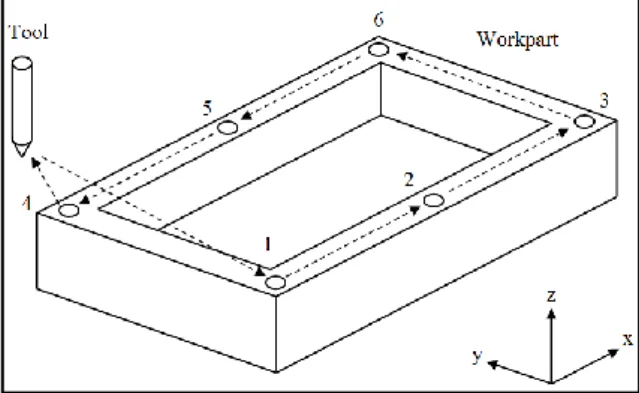
In this research, simple work piece model that will be drilled on certain coordinates is shown in Figure 1.
Fig. 1: Simple work piece model used for simulation.
ACO is a population-based optimization approach that has been used effectively in solving the combinatorial optimization problems. This approach is a simulation based on the behavior of real ants that allows in searching the shortest path from the nest to a food source (Dorigo, 2010; Ghaiebi, 2007). In this paper, ACO approach will be used to find the optimal tool path based on cost function as shown in Equation 1:
1 2 2
1 2 1
( , , )
n n(
j i)
(
j i)
n ki j k
f x y z
x
x
y
y
z
(1)
Where the tool path is based on the incremental positioning that depends on the coordinates point (x,y) of the previous point during the drilling process and z-axis is a 0.5 cm distance between the tool tip and the workpiece surface and the depth of the drilling process is 1 cm as shown in Equation 1 above. ACO start when the colony that consists of N ants, starting at the designated first point travels through layers of the node destination. Node destination in this study is the coordinates of the drilling point in every iterations. An ant can only choose one node destination for each path depending on the state transition rule as shown in Equation 2. Based on Sumathi and Surekha, ACO begins at the starting node and iteratively move from one node to another node [10]. When the ant arrived at a node, the ants will choose to move to the node that has yet to be passed in time, t, with probability:
ACO Equation:
, ,
,
, ,
[
( )] [
( )]
( )
[
( )] [
( )]
k i
i j i j
k k
i j i
i j i j
t N
t
t
p
t
j
N
t
t
(2) Where:
k i
N
= Feasible neighborhood of the antk, that is, the set of nodes which antk has not yet visited.
,
( )
i jt
α = Weight of the pheromone.
,
( )
i jt
= Priori available heuristic information on the edge (i,j) at the time t. β = Weight of heuristic information.
After all the ants return to the home node, the pheromone information is updated according to the relation as Equation 3:
.
( )
,(
1)
1 ,( , )
n k
i j i j k i j
tau
t
t
i j
(3) Where:
ρ = Pheromone trail evaporation rate (0< ρ<1)
,
( )
i jt
= Pheromone deposited on arc (i,j) at time t by the best ant k.
The goal of pheromone update is to increase the pheromone value associated with good or promising paths. The pheromone deposited on arc ij by the best ant is taken as Equation 4 below:
if the edge (i,j) choosen by ant ( )
,
( )
0 Otherwisek k
Q L t k
i j
t
(4)Q
= Constant for pheromone updating.k
L
= Length of the path traveled by kth ant.
Variables and parameters studied in this paper are the difference in node value, the parameters ρ, α and β. The value of the initial population of the ant are constant at a value of 100 and iteration termination condition is when they reach a maximum of 300 iterations.
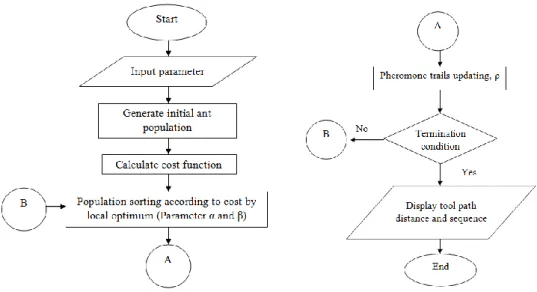
Figure 2 shows the flowchart for the ACO algorithm developed in this paper:
Fig. 2: Flow chart of the ACO algorithm developed.
RESULTS AND DISCUSSIONS
An algorithm was developed to find the shortest or optimal path for three-axis CNC drilling machine. Series of simulations were done to see the comparison of the results obtained to see the affect for the different parameter value used in the simulation.
Table 1: Results for different number of points to be drilled.
Parameter Simulation
1 2 3
No. of points to be drilled 6 10 12
No. of possible path 60 181,440 19,958,400
Optimum distance (cm) 50 62.04 68.63
Average of optimum distance (cm) 50.25 63.37 71.29
Shorthest distance (cm) 50 62.04 68.63
Different number of points to be drilled:
Table 1 shows the results obtained when different number of points is to be drilled. All three simulations are using the maximum number of generation = 300, number of ant population = 100, ρ = 0.1, α = 2 and β = 3.
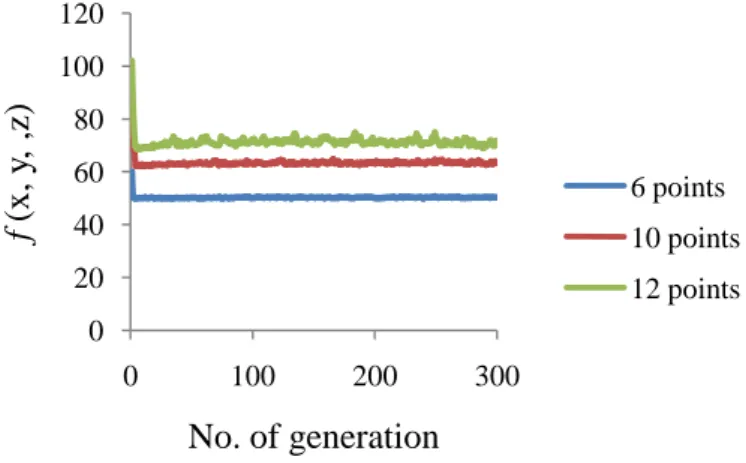
Based from Figure 3, the smaller number of drilling points will produce a more stable average distance curve. Table 1 shows the average of optimum distance for 6 drilling points is closer to the optimum distance for the drilling points. This is because probability to generate tool path is lower.
According to the calculation, the average of optimum distance for different number of drilled points in evaporation rate of pheromone trail (ρ), Weight of the pheromone (α) and weight of the heuristic information (β) are 0.1, 4 and 4 respectively.
This is because, the higher the pheromone trail ρ, the lower probability for the recurrence of the ant trail path. The higher value of the pheromone weight, α will produce a more stable average distance graph curve when the weight of heuristic information, β is constant. Also the higher value of the weight of heuristic information, β will produce a more stable average distance graph curve when the pheromone weight, α is constant. However, the average distance produce is away from the optimum distance value for 6, 10, 12 drilling points which is 50, 62, 68 cm respectively.
Fig. 3: Graph of tool path distance over number of generations for different number of points to be drilled.
Conclusion:
This paper employed ACO method to finds the shortest tool path for 6, 10 and 12 hole drilling operations 50 cm, 62.04 cm and 68.63 cm respectively. Besides, this suitable control parameters can be used in order to obtain the global best solution.
REFERENCES
Castelino, K., R. D'Souza, P.K. Wright, 2003. Toolpath optimization for minimizing airtime during machining. Journal of Manufacturing Systems, 22(3): 173-180.
Dorigo, M., C. Blum, 2005. Ant colony optimization theory: A survey. Theoretical computer science, 344(2): 243-278.
Dorigo, M., M. Birattari, 2010. Ant colony optimization Encyclopedia of Machine Learning, pp: 36-39: Springer.
Ghaiebi, H., M. Solimanpur, 2007. An ant algorithm for optimization of hole-making operations. Computers & Industrial Engineering, 52(2): 308-319.
Kolahan, F., M. Liang, 2000. Optimization of hole-making operations: a tabu-search approach. International Journal of Machine Tools and Manufacture, 40(12): 1735-1753.
Onwubolu, G., M. Clerc, 2004. Optimal path for automated drilling operations by a new heuristic approach using particle swarm optimization. International Journal of Production Research, 42(3): 473-491.
Stützle, T., M. Dorigo, 1999. ACO algorithms for the traveling salesman problem. Evolutionary Algorithms in Engineering and Computer Science, pp: 163-183..
Sumathi, S., S. Paneerselvam, 2010. Computational intelligence paradigms: theory & applications using MATLAB: CRC Press.
Tewolde, G.S., W. Sheng, 2008. Robot path integration in manufacturing processes: Genetic algorithm versus ant colony optimization. Systems, Man and Cybernetics, Part A: Systems and Humans, IEEE Transactions on, 38(2): 278-287.
0 20 40 60 80 100 120
0 100 200 300
f
(x
,
y,
,z
)
No. of generation
6 points
10 points