Munich Personal RePEc Archive
A new panel dataset for cross-country
analyses of national systems, growth and
development (CANA)
Castellacci, Fulvio and Natera, Jose Miguel
January 2011
Online at
https://mpra.ub.uni-muenchen.de/28376/
A new panel dataset for cross-country analyses
of national systems, growth and development
(CANA)
Fulvio Castellacci
*and Jose Miguel Natera
†*
Norwegian Institute of International Affairs (NUPI), Oslo, Norway. E-mail: [email protected]
†
University Complutense, Madrid, Spain. E-mail: [email protected]
NUPI Working Paper, January 2011
Abstract
Missing data represent an important limitation for cross-country analyses of national systems, growth and development. This paper presents a new cross-country panel dataset with no missing value. We make use of a new method of multiple imputation that has recently been developed by Honaker and King (2010) to deal specifically with time-series cross-section data at the country-level. We apply this method to construct a large dataset containing a great number of indicators measuring six key country-specific dimensions: innovation and technological capabilities, education system and human capital, infrastructures, economic competitiveness, political-institutional factors, and social capital. The CANA panel dataset thus obtained provides a rich and complete set of 41 indicators for 134 countries in the period 1980-2008 (for a total of 3886 country-year observations). The empirical analysis shows the reliability of the dataset and its usefulness for cross-country analyses of national systems, growth and development. The new dataset is publicly available.
The CANA database can be downloaded at the web address:
http://english.nupi.no/Activities/Projects/CANA
Please contact the authors for any question, or suggestion for future improvements.
“If you torture the data long enough, Nature will confess” (Ronald Coase, 1982)
1. Introduction
A recent strand of research within the national systems literature investigates the
characteristics of NIS in developing countries and their relevance for economic growth
and competitiveness (Lundvall et al., 2009). Some of this applied research makes use of
available statistical data for large samples of countries and carries out quantitative studies
of the economic and social capabilities of nations and the impacts of these on the growth
and development process (Archibugi and Coco, 2004; Fagerberg et alia, 2007; Castellacci
and Archibugi, 2008).
This empirical research faces however one important limitation: the problem of missing
data. This problem, and the related consequences and possible solutions, have not been
adequately studied yet in the literature. The missing data problem arises because many of
the variables that are of interest for measuring the characteristics and evolution of national
systems are only available for a restricted sample of (advanced and middle-income)
economies and for a limited time span only.
As a consequence, cross-country analyses in this field are typically forced to take a hard
decision: either to focus on a restricted country sample for a relatively long period of time,
or to focus on a very short time span for a large sample of economies. Both alternatives
are problematic: the former neglects the study of NIS in developing and less developed
economies, whereas the latter neglects the study of the dynamics and evolution of national
systems over time.
This paper proposes a third alternative that provides a possible solution to this trade off:
the use of multiple imputation methods to estimate missing data and obtain a complete
panel dataset for all countries and the whole period under investigation. Multiple
imputation methods represent a modern statistical approach that aims at overcoming the
missing data problem (Rubin, 1987). This methodology has received increasing attention
in the last decade and has been applied in a number of different fields of research. In
particular, Honaker and King (2010) have very recently proposed a new multiple
imputation algorithm that is specifically developed to deal with time-series cross-section
data at the country-level.
Our paper employs this new method of multiple imputation and shows its relevance for
new panel dataset (CANA) that contains no missing value. The dataset comprises 41
indicators measuring six key country-specific dimensions: innovation and technological
capabilities, education system and human capital, infrastructures, economic
competitiveness, political-institutional factors, and social capital. The CANA panel
dataset that is obtained by estimating the missing values in the original data sources
provides rich and complete statistical information on 134 countries for the entire period
1980-2008 (for a total of 3886 country-year observations). Our empirical analysis of this
dataset shows its reliability and points out its usefulness for future cross-country studies of
national systems, growth and development. We make the new dataset publicly available
on the web.
The paper is organized as follows. Section 2 briefly reviews the literature and discusses
the missing data problem. Section 3 introduces Honaker and King’s (2010) new method of
multiple imputation. Section 4 presents the CANA dataset and indicators and carries out a
descriptive analysis of some of its key characteristics. Section 5 provides an analysis of
the reliability of the new data material obtained through multiple imputation. Section 6
concludes by summarizing the main results and implications of the paper. A
methodological Appendix contains all more specific details regarding the database
construction, characteristics and quality assessment.
2. Cross-country analyses of national systems, growth and development:
the problem of missing data
The national innovation system (NIS) perspective originally developed during the 1990s
to understand the broad set of factors shaping the innovation and imitation ability of
countries, and how these factors could contribute to explain cross-country differences in
economic growth and competitiveness (Lundvall, 1992; Edquist, 1997). Empirical studies
in this tradition initially focused mostly on advanced economies in the OECD area
(Nelson, 1993). However, the NIS literature has recently shifted the focus towards the
empirical study of innovation systems within the context of developing and less developed
economies (Lundvall et alia,, 2009).1
1
A well-known challenge for applied research in this field is how to operationalize the
innovation system theoretical view in empirical studies and, relatedly, how to measure the
complex and multifaceted concept of national innovation system and its relationship to
countries’ economic performance. Quantitative applied studies of NIS and development
have so far made use of two different (albeit complementary) approaches.
The first approach is rooted in the traditional literature on technology and convergence
(Abramovitz, 1986; Verspagen, 1991; Fagerberg, 1994). Following a technology-gap
Schumpeterian approach, recent econometric studies have focused on a few key variables
that explain (or summarize) cross-country differences in the innovation ability of
countries as well as their different capabilities to imitate foreign advanced knowledge, and
then analysed the empirical relationship between these innovation and imitation factors
and cross-country differences in GDP per capita growth (Fagerberg and Verspagen, 2002;
Castellacci, 2004, 2008 and 2011; Fagerberg et alia, 2007). Since one main motivation of
this type of studies is to analyse the dynamics and evolution of national systems in a
long-run perspective, they typically consider a relatively long time span (e.g. from the 1970s or
1980s onward), but must for this reason focus on a more restricted sample of countries
(e.g. between 70 and 90 countries). Due to the lack of statistical data for a sufficiently
long period of time, therefore, a great number of developing economies and the vast
majority of less developed countries are neglected by this type of cross-country studies.
The second approach is based on the construction and descriptive analysis of composite
indicators. In a nutshell, this approach recognizes the complex and multidimensional
nature of national systems of innovation and tries to measure some of their most important
characteristics by considering a large set of variables representing distinct dimensions of
technological capabilities, and then combining them together into a single composite
indicator – which may be interpreted as a rough summary measure of a country’s relative
position vis-a-vis other national systems. Desai et alia (2002) and Archibugi and Coco
(2004) have firstly proposed composite indicators based on a simple aggregation (simple
or weighted averages) of a number of technology variables. Godinho et alia (2005),
Castellacci and Archibugi (2008) and Fagerberg and Srholec (2008) have then considered
a larger number of innovation system dimensions and analysed them by means of factor
and cluster analysis techniques. As compared to the first approach, the composite
indicator approach has a more explicit focus on the comparison across a larger number of
countries. Consequently, due to the lack of data availability on less developed countries
time span (i.e. a cross-section description of the sample in one point in time, e.g. the
1990s and/or the 2000s).
Considering the two approaches together, it is then clear that researchers seeking to carry
out quantitative analyses of innovation systems and development commonly face a
dilemma with respect to the data they decide to use. Either, they can focus on a small
sample of (mostly advanced and middle-income) economies over a long period of time –
or conversely they can study a much larger sample of countries (including developing
ones) for carrying out a shorter run (static) type of analysis. Such a dilemma is of course
caused by the fact that, for most variables that are of interest for measuring and studying
innovation systems, the availability of cross-section time-series (panel) data is limited:
data coverage is rather low for many developing economies for the years before 2000, and
it improves substantially as we move closer to the present.
Both solutions that are commonly adopted by applied researchers to deal with this
dilemma, however, are problematic. If the econometric analysis focuses on the dynamic
behaviour of a restricted sample of economies, as typically done in the technology-gap
tradition, the parameters of interest that are estimated through the standard cross-country
growth regression are not representative of the whole world economy, and do not provide
any information about the large and populated bunch of less developed countries. In
econometric terms, the regression results will provide a biased estimation of the role of
innovation and imitation capabilities. Relatedly, by removing most developing countries
observations from the sample under study (e.g. by listwise deletion), this regression
approach tends to be inefficient as it disregards the potentially useful information that is
present in the variables that are (at least partly) available for developing countries.
By contrast, if the applied study decides to consider a much larger sample of countries
(including developing ones), as it is for instance the case in the composite indicator
approach, the analysis inevitably assumes a static flavour and largely neglects the
dynamic dimension. This is indeed unfortunate, since it was precisely the study of the
dynamic evolution of national systems that represented one of the key motivation
underlying the development of national systems theories.
Surprisingly, such a dilemma – and the possibly problematic consequences of the
solutions that are typically adopted in this branch of applied research – have not been
properly investigated yet in the literature. This paper intends to contribute to this issue by
pointing out a possible solution to the trade-off mentioned above. We construct and make
the original data sources are estimated by means of a statistical approach that is known as
multiple imputation (Rubin, 1987). Multiple imputation methods for missing data analysis
have experienced a rapid development in the last few years and have been increasingly
applied in a wide number of research fields. The next section will introduce this statistical
method in the context of time-series cross-section data.
3. The multiple imputation method
Multiple imputation methods were firstly introduced two decades ago by Rubin (1987).
They provide an appropriate and efficient statistical methodology to estimate missing
data, which overcomes the problems associated with the use of listwise deletion or other
ad hoc procedures to fill in missing values in a dataset. The general idea and intuition of
this approach can be summarized as follows (see overviews in Rubin, 1996; Schafer and
Olsen, 1998; Horton and Kleinman, 2007).
Given a dataset that comprises both observed and missing values, the latter are estimated
by making use of all available information (i.e. the observed data). This estimation is
repeated m times, so that m different complete datasets are generated (reflecting the
uncertainty regarding the unknown values of the missing data). Finally, all subsequent
econometric analyses that the researcher intends to carry out will be repeated m times, one
for each of the estimated datasets, and the multiple results thus obtained will be easily
combined together in order to get to a final value of the scientific estimand of interest (e.g.
a set of regression coefficients and their significance levels).
Within this general statistical approach, Honaker and King (2010) have very recently
introduced a novel multiple imputation method that is specifically developed to deal with
time-series cross-section data (i.e. panels). This type of data has in the last few years been
increasingly used for cross-country analyses in the fields of economic growth and
development, comparative politics and international relations. However, missing data
problems introduce severe bias and efficiency problems in this type of studies, as pointed
out in the previous section. Honaker and King’s (2010) method is particularly attractive
because its multiple imputation algorithm efficiently exploits the panel nature of the
dataset and makes it possible, among other things, to properly take into account the issue
of cross-country heterogeneity by introducing fixed effects and country-specific time
Suppose we have a latent data matrix X, composed of p variables (columns) and n
observations (rows). Each element of this matrix, xijt, represents the value of country i for
variable j at time t. The data matrix is composed of both observed and missing values:
X = {XOBS; XMIS}. In order to rectangularize the dataset, we define a missingness matrix
M such that each of its elements takes value 1 if it is missing and 0 if it is an observed
value. We then apply the simple matrix transformation: XOBS = X * (1 – M), so that our
matrix dataset will now contain 0s instead of missing values (for further details on this
framework, see Honaker and King, 2010, p. 576).
Multiple imputation methods typically make two general assumptions on the data
generating process. The first is that X is assumed to have a multivariate normal
distribution: X ~ N (μ; Σ), where μ and Σ represent the (unknown) parameters of the
Gaussian (mean and variance). The useful implication of assuming a normal distribution
is that each variable can be described as a linear function of the others.2
The second is the so-called missing at random (MAR) assumption. This means that M can
be predicted by XOBS but not by XMIS (after controlling for XOBS), i.e. formally:
P (M | X) = P (M | XOBS). The MAR assumption implies that the statistical relationship
(e.g. regression coefficient) between one variable and another is the same for the groups
of observed and missing observations. Therefore, we can use this relationship as estimated
for the group of observed data in order to impute the missing values (Shapen and Olsen,
1998; Honaker and King, 2010). This condition also suggests that all the variables that are
potentially relevant to explain the missingness pattern should be included in the
imputation model.3
The core of Honaker and King’s (2010) new multiple imputation method is the
specification of the estimation model for imputing the missing values in the dataset:
xijMIS = βj xi;-jOBS + γj t + δij + δij t + εij (1)
where xijMIS are the missing values to be estimated, for observation i and variable j, and
xi;-jOBS are all other observed values for observation i and all variables excluding j (we
2
The statistical literature on multiple imputation methods has shown that departures from the normality assumption are not problematic and do not usually introduce any important bias in the imputation model.
3
have for simplicity omitted the time index t). The parameter βj represents the estimate of
the cross-sectional relation between the variable j and the set of covariates – j; γj is an
estimate of the time trend; δij is a set of individual fixed effects; δij t is an interaction term
between the time trend and the fixed effects, which provides an estimate of the
country-specific time trends (i.e. a different time trend is allowed for each observation); finally, εij
is the error term of the model.4 For clarity of exposition, it is useful to rewrite this model
in its extended form:
xi1MIS = β1 xi;-1OBS + γ1 t + δi1 + δi1 t + εi1
...
...
xipMIS = βp xi;-pOBS + γp t + δip + δip t + εip (2)
The formulation in (2) makes clear that our imputation model is composed of p equations,
one for each variable of the model. Each variable is estimated as a linear function of all
the others. In each of these p equations, missing values for a given variable are estimated
as a function of the observed values for all the other variables.
The model is estimated through the so-called EM algorithm. This is an iterative algorithm
comprising two steps. In the first (E-step), missing values are replaced by their conditional
expectation (obtained through the estimation of (2)) – given the current estimate of the
unknown parameters μ and Σ. In the second (M-step), a new estimate of the parameters μ
and Σ is calculated from the data obtained in the first step. The two steps are iteratively
repeated until the algorithm will converge to a final solution.
As pointed out above, the key idea common to all multiple imputation methods is that the
imputation process is repeated m times, so that m distinct complete datasets are eventually
obtained – reflecting the uncertainty regarding the unknown values of the missing data.5
Honaker and King’s method implements this idea by setting up the following bootstrap
procedure: m samples of size n are drawn with replacement from the data X; in each of
4
For simplicity, the model specification in equation 1 assumes a linear trend for all variables and all observations. Honaker and King’s method, however, makes it also possible to specify more complex non-linear adjustment processes in order to achieve a better fit of the estimated series to the observed data.
5
these m samples, the EM algorithm described above is run to obtain μ, Σ and the complete
dataset. Thus, m complete datasets are obtained ready for the subsequent analyses.6
In summary, this new multiple imputation method presents two main advantages. First,
similarly to other related methods, it avoids bias and efficiency problems related to the
presence of missing values and/or the use of ad hoc methods to dealing with them (e.g.
listwise deletion). Secondly, it is specifically developed to deal with time-series
cross-section data. In particular, it is well-suited to deal with the issue of cross-country
heterogeneity, since it allows for both country fixed effects as well as country-specific
time trends.
Despite these attractive features, it is however important to emphasize that this type of
missing data estimation procedures should be applied with caution. Specifically, when the
percentage of missing data is high, the imputation procedure tends to be less precise and
reliable, and it is therefore important to carefully scrutinize the results. We will discuss
this important issue in section 5 and provide all related details in the Appendix.
4. A new panel dataset (CANA)
We now present the main characteristics of the CANA panel dataset, which has been
constructed by applying the method of multiple imputation described in the previous
section. The complete dataset that we have obtained contains information for a large
number of relevant variables, and for a very large panel of countries. Specifically, for 34
indicators we have obtained complete data for 134 countries for the whole period
1980-2008 (3886 country-year observations); for seven other indicators we have instead
achieved a somewhat smaller country coverage (see details below). On the whole, this
new dataset represents a rich statistical material to carry out cross-country analyses of
national systems, of their evolution in the last three decades, and of the relationships of
these characteristics to countries’ social and economic development.
Given that the concept of national systems is complex, multifaceted and comprising a
great number of relevant factors interacting with each other, our database adopts a broad
and multidimensional operationalization of it. Our stylized view, broadly in line with the
6
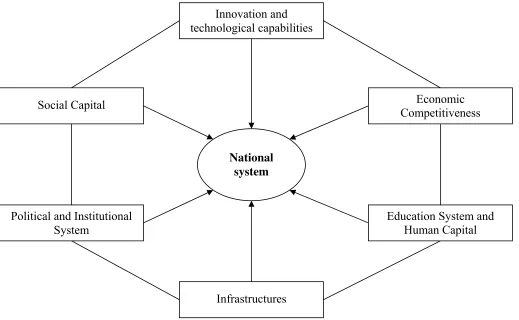
previous literature, is presented in figure 1.7 We represent national systems as composed
of six main dimensions: (1) Innovation and technological capabilities; (2) Education and
human capital; (3) Infrastructures; (4) Economic competitiveness; (5) Social capital; (6)
Political and institutional factors. The underlying idea motivating the construction of this
database is that it is the dynamics and complex interactions between these six dimensions
that represent the driving force of national systems’s social and economic development,
and it is therefore crucial for empirical analyses in this field to have availability of
statistical information for an as large as possible number of indicators and country-year
observations.8
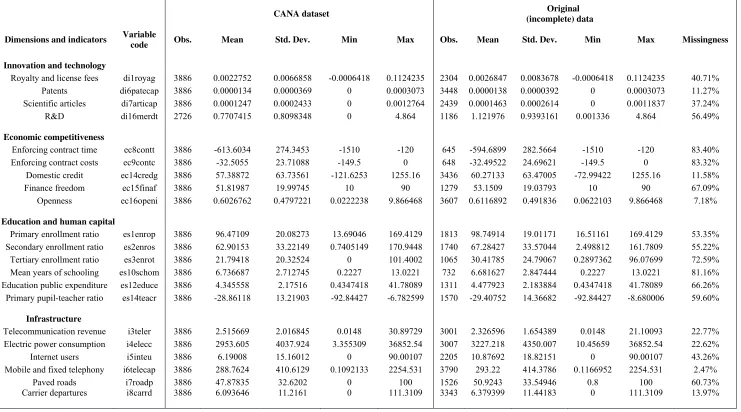
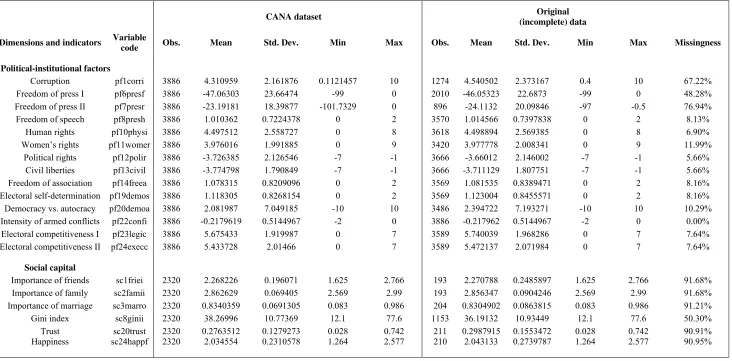
Table 1 presents a list of the 41 indicators included in the CANA database, and compares
some descriptive statistics of the new (complete) panel dataset with those of the
corresponding variables in the original (incomplete) data sources. The last column of the
table shows the share of missing data present in the original data sources, which is in
many cases quite high. A comparison of the left and right-hand sides of the table indicates
that the descriptive statistics of the complete version of the data (containing no missing
value) are indeed very close to those of the original sources – which gives a first and
important indication of the quality and reliability of the new CANA dataset (this aspect
will be analysed in further details in the next section).
< Figure 1 and table 1 here >
The methodology that we have followed to construct the complete dataset and indicators
has proceeded in four subsequent steps (see figure A1 in the Appendix). In the first, we
have collected a total number of 55 indicators from publicly available databases and a
variety of different sources (see the Appendix for a complete list of indicators and data
sources). This large set of indicators covers a wide spectrum of variables that are
potentially relevant to measure the six country-specific dimensions pointed out above.
This initial dataset contains as well-known a great number of missing values for many of
the countries and the variables of interest. In the remainder of the paper, we will for
simplicity refer to it as the observed (or the original) dataset.
7
Other empirical exercises in the NIS literature have previously made use of (at least some of) these dimensions and indicators. See in particular Godinho et alia (2005), Castellacci and Archibugi (2008) and Fagerberg and Srholec (2008).
8
In the second step, we have run Honaker and King’s (2010) multiple imputation procedure
as described in section 4 above. We have carried out the imputation algorithm for each of
the six dimensions separately.9 In order to achieve a high efficiency level, we have set m
= 15, i.e. fifteen complete datasets have been estimated for each of the six dimensions. We
have then combined these fifteen datasets into a single one, which is our complete CANA
dataset. This is a rich rectangular matrix containing information for all relevant variables
for 3886 observations (134 economies for the whole period 1980-2008).
Thirdly, we have carried out a thorough evaluation of each of these 55 variables in order
to analyse the quality of the imputed data and the extent to which the new complete
dataset may be considered a good and reliable extension of the original data sources. This
evaluation process is discussed in details in the next section. In short, the main result of
this assessment work is that the multiple imputation method has been successful for 34
indicators, which we have then included in the final version of database for the whole
range of 3886 country-year observations (134 countries).
Fourthly, in the attempt to increase the number of “accepted” indicators, we have repeated
the imputation procedure for all the remaining indicators and for a smaller number of
countries – i.e. excluding those countries that have a very high share of missing data in the
original sources. After a careful quality check of this second round of multiple
imputations, we have decided to include seven more indicators in the final version of the
CANA database: R&D (for 94 countries) and six social capital variables (for 80
countries).
In summary, the final version of the CANA database that we make available contains a
total number of 41 indicators (34 with full country coverage and seven for a smaller
sample), whereas the remaining 14 indicators have been rejected and not included in the
database because the results of the imputation procedure has not led to imputed data of a
sufficiently good and reliable quality.
A simple descriptive analysis of the CANA dataset and indicators illustrates the relevance
and usefulness of this new data material to gain new empirical insights on some of the
main characteristics of national systems in such a broad cross-section of countries, and
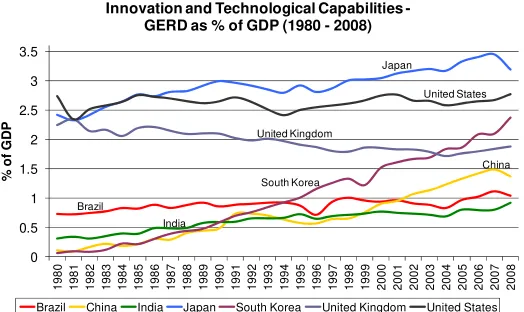
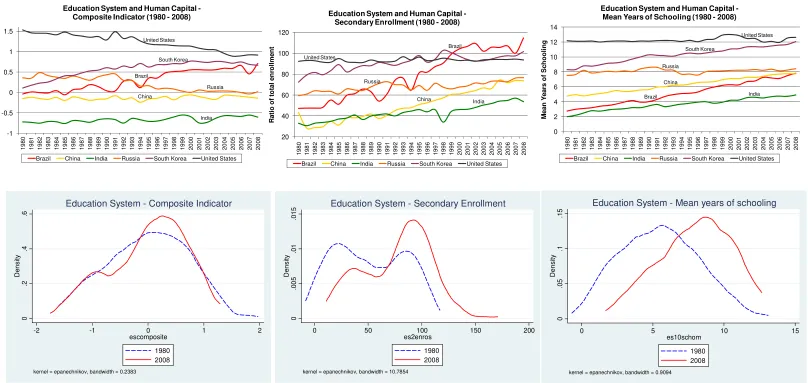
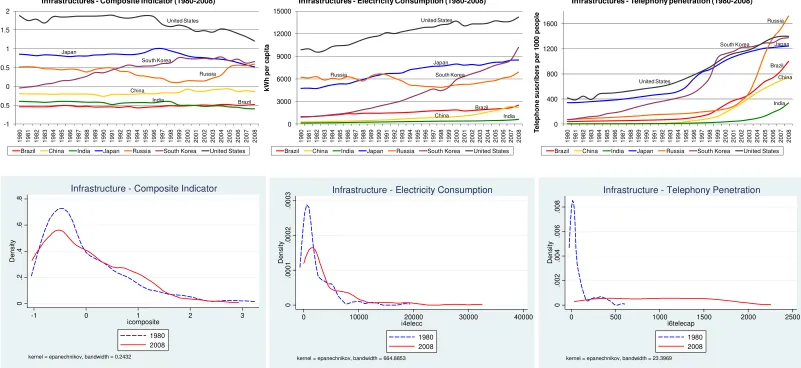
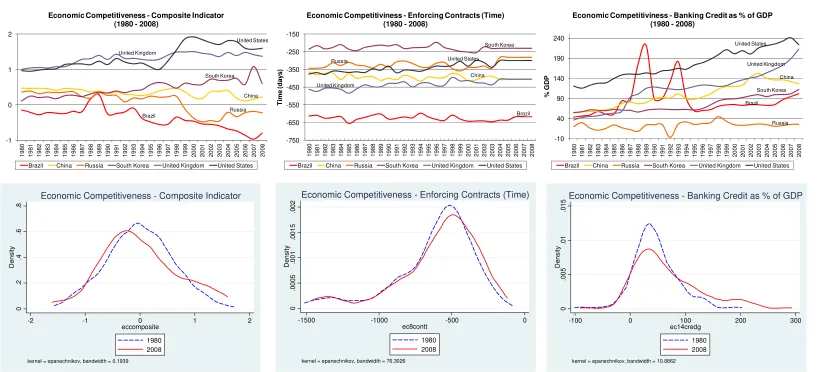
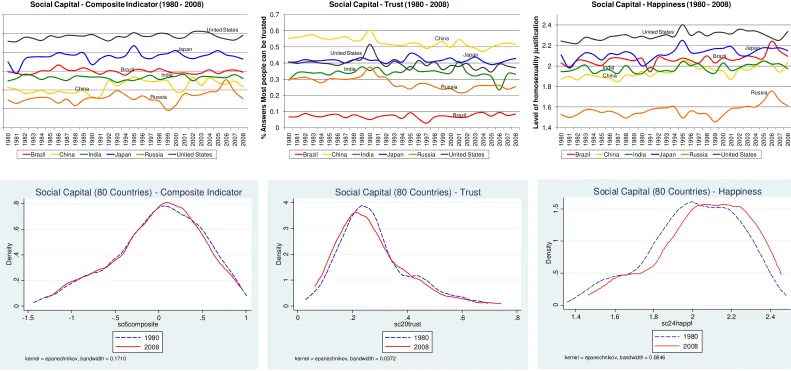
particularly on their dynamic processes over the period 1980-2008. Figures 2 to 7 show
9
the time path of some of the key variables of interest. For each of the six dimensions, we
also report a composite indicator and its time trend. The composite indicators, calculated
for illustrative purposes only, have been obtained by first standardizing all the variables
included in a given dimension (and for any given year), and then calculating a simple
average of them. The upper part of figures 2 to 7 depicts the time trend for some selected
countries, whereas the lower part plots the cross-country distribution of each dimension at
the beginning and the end of the period (1980 and 2008). In each figure, we report the
composite indicator on the left-hand panel, and two of the selected indicators used to
construct it on the middle and right-hand panels.
Figure 2 focuses on countries’ innovation and technological capabilities. The lower part of
the figure shows that the cross-country distribution of innovative capabilities has not
changed substantially over the period, indicating that no significant worldwide
improvement has taken place in this dimension (Castellacci, 2011). However, the pattern
is somewhat different for the R&D variable, since this focuses on a smaller number of
countries. The upper part of the figure suggests that the technological dynamics process
has been far from uniform and that different countries have experienced markedly
different trends. In particular, the US and Japan are the leading economies that have
experienced the most pronounced increase over time, whereas South Korea and China are
the followers that have experienced the most rapid technological catching up process.
Most other middle-income and less developed economies have not been able to catch up
with respect to this dimension.
A worldwide and relatively rapid process of convergence is instead more apparent when
we shift the focus to figures 3 and 4, which study the evolution of the human capital and
infrastructures dimensions respectively. The kernel densities reported in the lower part of
these figures show that the cross-country distributions of these two dimensions have
visibly shifted towards the right, thus indicating an overall improvement of countries’
education system and infrastructure level. The time path for some selected economies
reported in the upper part of these figures also show the rapid catching up process
experienced by some developing countries (and many others not reported in these graphs)
with respect to these dimensions.
As for the remaining three dimensions – economic competitiveness (figure 5), social
capital (figure 6) and political-institutional factors (figure 7) – the worldwide pattern of
evolution over time is less clear-cut and depends on the specific indicators that we take
indicator of happiness has on average increased over time, whereas the trust variable has
not.
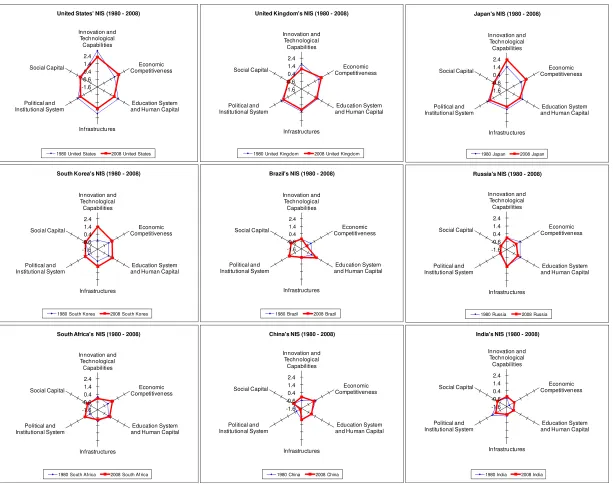
In order to provide a more synthetic view of the main patterns and evolution of NIS,
figure 8 shows a set of radar graphs for some selected countries: four technologically
advanced economies (US, UK, Japan, South Korea) plus the BRICS countries (Brazil,
Russia, India, China and South Africa). For each country, the standardized value of each
composite indicator is reported for both the beginning and the end of the period (1980 and
2008), so that these radar graphs provide a summary view of some key characteristics of
NIS and their dynamic evolution in the last three decades. The graphs are rather
informative. More advanced countries have on average a much greater surface than the
catching up BRICS economies, indicating an overall greater level of the set of relevant
technological, social and economic capabilities. Japan and South Korea are those that
appear to have improved their relative position more visibly over time. By contrast, within
the group of BRICS countries, the catching up process between the beginning and the end
of the period has been more striking for China, Brazil and South Africa, and less so for
Russia and India. It is however important to emphasize that the dynamics looks somewhat
different for each of the six dimensions considered in figure 8, so that our summary
description here is only done for illustrative purposes.
The descriptive analysis of cross-country patterns and evolution that has been briefly
presented in this section will be extended and refined in a number of ways in future
research. However, as previously pointed out, our purpose here is not to carry out a
complete and detailed analysis of the characteristics and evolution of national systems, but
rather to provide a simple empirical illustration of the usefulness of the new CANA panel
dataset, and of how it can be used for cross-country studies of national systems and
development.
5. An analysis of the reliability of the CANA dataset and indicators
The illustration presented in the previous section has shown some of the advantages of
adopting a method of multiple imputation to estimate missing values and obtain a rich
complete dataset for the cross-country empirical investigation of national systems and
development. However, at the same time as emphasizing the usefulness of the CANA
dataset and indicators that we have constructed, it is also important to assess the quality of
this newly obtained data material and investigate the possible limitations of the multiple
imputation method that has been used to construct it.
As mentioned in the previous section, during the construction of the CANA database we
have initially collected a total number of 55 indicators, which are intended to measure six
different dimensions of countries’ social, institutional and economic development. We
have then carried out a first main round of multiple imputations in order to estimate the
missing values in the original sources. After this first set of imputation estimations, we
have carried out a thorough evaluation of each of these 55 variables in order to analyse the
quality of the imputed data and the extent to which the new complete dataset may be
considered a good and reliable extension and estimation of the original data sources. We
have concluded that the multiple imputation method has been successful for 34 indicators,
which we have then included in the final version of database for the whole range of 3886
country-year observations (134 countries).
Next, in the attempt to increase the number of “accepted” (reliable) indicators included in
the dataset, we have repeated the imputation procedure for all the remaining indicators
and for a smaller number of countries – i.e. excluding those countries that have a very
high share of missing data in the original sources. After a second round of quality and
reliability check, we have decided to include seven more indicators in the final version of
the CANA database: R&D (for 94 countries) and six social capital variables (for 80
countries). Therefore, the final version of the CANA database contains a total number of
41 indicators (34 with full country coverage and seven for a smaller sample), whereas the
remaining 14 indicators have been rejected and not included in the database because the
results of the imputation procedure has not led to imputed data of a sufficiently good and
reliable quality.
In order to illustrate our data assessment procedure and the reliability of the indicators that
we have included in the final version of the database, we summarize the main steps here
and report further material in the Appendix (see section A.3). Our evaluation process has
versus the original data; (2) a graphical inspection of their kernel density graphs; (3) a
comparison of the respective correlation tables.
First, table 1 (see previous section) reports a comparison of the main descriptive statistics
for the CANA (complete) dataset versus the observed (original) data sources. The table
shows that, for the 41 indicators included in the final version of the database, the means of
the two distributions are rather similar in nearly all cases. On average, the means are
however slightly lower for the complete version of the dataset, since this includes data for
a larger number of developing economies that is only partly available in the original
datasets.
A second and more detailed assessment exercise is reported in figure A2 (see the
Appendix). The various graphs in figure A2 compare the statistical distributions (kernel
densities) of the observed and the complete datasets for all the 41 indicators that we have
included in the final version of the CANA database. As previously specified, the observed
dataset is the original database that we have constructed by combining together indicators
from different publicly available data sources (i.e. the one containing missing values for
some of the variables and some of the country-year observations), whereas the complete
dataset is the one that we have obtained by estimating missing values through Honaker
and King’s (2010) multiple imputation procedure.
The idea of comparing the two distributions is to provide an easy and effective visual
inspection of the reliability of the multiple imputation results: if the statistical distribution
of the complete dataset is substantially the same (or very similar to) the one for the
observed data, we may be confident about the quality and reliability of the imputation
results; by contrast, if the two distributions turn out to be quite different from each other,
this would imply that the new data that have been estimated depart substantially from the
original ones, and hence the results of the multiple imputation procedure may be less
reliable.10
The comparison among the kernel densities reported in the various panels of figure A2 is
rather informative and provides an interesting quality check of the data material. For four
10
Some other papers in the multiple imputation literature actually compare the observed data to the imputed
of the key dimensions considered in this paper, the distributions of the complete data seem
to provide a very close approximation to those of the original sources – see the indicators
measuring the dimensions of economic competitiveness, education system and human
capital, infrastructure, and political-institutional factors. This represents an important
validation of our multiple imputation exercise, particularly considering that some of the
indicators considered here have a relatively high share of missing values in the original
data sources (e.g. over 80% for the indicators measuring enforcing contracts time and
costs, and the one of mean years of schooling). This means that our multiple imputation
procedure has been able to estimate a substantial amount of missing values with a
relatively good precision.
For the other two dimensions, as previously mentioned, the first round of multiple
imputation has not been equally successful for all the indicators, and we have then carried
out a second set of estimations in which we have focused on a somewhat smaller number
of countries for those variables whose imputation results did not work as well as for the
other indicators. The results of the graphical inspection are again reported in figure A2.
For the innovation and technological capability dimension, the three indicators of patents,
articles and royalties have been estimated for the whole 134 countries sample, and their
distributions appear to be quite skewed and roughly resemble those of the original
variables. For the R&D indicator, however, we have had to focus on a smaller 94
countries sample in order to obtain a more satisfactory fit to the original distribution.
Analogously, for the social capital dimension, we initially included a total of 12 variables
in the multiple imputation algorithm. However, the first set of imputation results was not
successful for this dimension, and most of these indicators had in fact complete data
distributions that were quite different from those of the original data. The reason for this is
that most of our social capital indicators have a very high share of missingness (above
90%), since the original data sources (e.g. the World Value Survey) are only available for
a limited sample of countries and for a relatively short time span. For this reason, we
repeated the multiple imputation procedure for this dimension by focusing on a smaller 80
countries sample (i.e. keeping only those economies with better data coverage for these
indicators). At the end of this procedure and further quality check, we have decided to
disregard six social capital variables with low reliability and poor data quality, and include
only six indicators in the final version of the CANA database. Figure A2 shows the
statistical distributions of these six “accepted” variables, and indicate that these have on
sources (particularly considering the high share of missingness that was present in the
latter).
Finally, the fourth exercise that we have carried out to analyse the reliability of the CANA
dataset is based on the comparison of the correlation tables for each of the six dimensions,
and it is reported in table A2 in the Appendix. For each dimension, table A2 reports the
coefficients of correlation among its selected indicators. Next to each correlation
coefficient calculated on the (original) observed dataset, the table reports between
parentheses the corresponding coefficient calculated on the complete dataset. The
rationale of this exercise is that we expect that the more similar two correlation
coefficients are (for the observed versus the complete data), the closer the match between
the two statistical distributions, and hence the more reliable the results of the imputation
procedure that we have employed. In other words, if the CANA (complete) dataset and its
set of indicators are reliable, then we should observe correlation coefficients among the
various indicators that are quite similar to those that we obtain from the original data
sources. By contrast, if the correlation coefficients are substantially different (in sign
and/or in magnitude), this would imply that our imputation procedure has introduced a
bias in the dataset that is likely to affect any subsequent analysis (e.g. a regression
analysis run on the complete dataset).
The results reported in table A2 are largely in line and corroborate those discussed above
in relation to figure A2. In general terms, the overall impression is that the correlation
patterns within each dimension are substantially preserved by the multiple imputation
procedure: the sign of the correlation coefficients are in nearly all cases the same after
imputing the missing values, and the size of the coefficients are also rather similar for
most of the variables. Some of the correlation coefficients, though, change their size
somewhat, e.g. those between R&D and royalties, finance freedom and openness, and
enforcing contract time with openness. Despite these marginal changes for a very few
coefficients, the results reported in table A2 do on the whole indicate that the data
imputation procedure that we have employed does not seem to have introduced a
6. Conclusions
The paper has argued that missing data constitute an important limitation that hampers
quantitative cross-country research on national systems, growth and development, and it
has proposed the use of multiple imputation methods to overcome this limitation. In
particular, the paper has employed the new multiple imputation method recently been
developed by Honaker and King (2010) to deal with time-series cross-section data, and
applied it to construct a new panel dataset containing a great number of indicators
measuring six different country-specific dimensions: innovation and technological
capabilities, education system and human capital, infrastructures, economic
competitiveness, social capital and political-institutional factors. The original dataset
obtained by merging together various available data sources contains a substantial number
of missing values for some of the variables and some of the country-year observations. By
employing Honaker and King’s (2010) imputation procedure, we are able to estimate
these missing values and thus obtain a complete dataset (134 countries for the entire
period 1980-2008, for a total of 3886 country-year observations).
The CANA database provides a rich set of information and enables a great variety of
cross-country analyses of national systems, growth and development. As one example of
how the dataset can be used within the context of applied growth theory and cross-country
development research, we have carried out a simple descriptive analysis of how these
country-specific dimensions differ across nations and how they have evolved in the last
three decades period.
The methodological exercise presented in this paper leads to two main conclusions and
related implications for future research. The first general conclusion is that the multiple
imputation methodology presents indeed great advantages vis-a-vis all other commonly
adopted ad hoc methods to deal with missing data problems (e.g. listwise deletion in
regression exercises), and it should therefore be used to a much greater extent for
cross-country analyses within the field of national systems, growth and development.
Specifically, the construction of a complete panel dataset through the multiple imputation
approach presents three advantages: (1) it includes many more developing and less
developed economies within the sample and thus leads to a less biased and more
representative view of the relevance of national systems for development; (2) it exploits
all data and available statistical information in a more efficient way; (3) it makes it
possible to enlarge the time period under study and thus enables a truly dynamic analysis
However, multiple imputation methods do not represent a magic solution to the missing
data problem, but rather a modern statistical approach that, besides filling in the missing
values in a dataset, does also emphasize the uncertainty that is inherently related to the
unknown (real) values of the missing data. The second conclusion of our paper, therefore,
is that it is important to carefully scrutinize the results of any multiple imputation exercise
before using a new complete dataset for subsequent empirical analyses. In particular, we
have carried out an analysis of the reliability of the new complete CANA dataset, which
has shown that, in general terms the method seems to work well, since for most of the
indicators the statistical distribution of the complete dataset (after the imputation)
resembles closely the one for the original data (before the imputation). We have therefore
included this set of 41 more reliable indicators in the final version of the CANA panel
dataset, and have instead disregarded the other 14 variables for which our imputation
results seemed to be less reliable.
Acknowledgments
The paper was presented at the Globelics Conference in Kuala Lumpur, Malaysia,
November 2010, at the the EMAEE Conference in Pisa, Italy, February 2011, and at the
DIME Final Conference in Maastricht, the Netherlands, April 2011. A shorter version of
this paper is published in the journal Innovation and Development (2011). We wish to
thank conference participants and three referees of this journal for the helpful comments
References
Abramovitz, M. (1986): “Catching-up, forging ahead and falling behind”, Journal of
Economic History, 46: 385-406.
Archibugi, D. and Coco, A. (2004): “A new indicator of technological capabilities for
developed and developing countries (ArCo)”, World Development, 32 (4): 629-654.
Castellacci, F. (2004): “A neo-Schumpeterian approach to why growth rates differ”,
Revue Economique, 55 (6): 1145-1170.
Castellacci, F. (2008): “Technology clubs, technology gaps and growth trajectories”,
Structural Change and Economic Dynamics, 19: 301-314.
Castellacci, F. and Archibugi, D. (2008): “The technology clubs: The distribution of
knowledge across nations”, Research Policy, 37: 1659-1673.
Castellacci, F. (2011): “Closing the technology gap?”, Review of Development Economics,
15 (1): 180-197.
Castellacci, F. and Natera, J. M. (2011): “Social capabilities, governance quality and technology dynamics: the co-evolutionary process of economic development”, mimeo, Norwegian Institute of International Affairs.
Coase, R. (1982): “How should economists chose?” American Enterprise Institute, Washington, D. C.
Desai, M., Fukuda-Parr, S., Johansson, C. and Sagasti, F. (2002): “Measuring the technology achievement of nations and the capacity to participate in the network age”,
Journal of Human Development, 3 (1): 2002.
Edquist, C. (1997): Systems of Innovation, Technologies, Institutions and Organisations,
Pinter, London and Washington.
Fagerberg, J. (1994): “Technology and International differences in growth rates”, Journal
of Economic Literature, 32: 1147-1175.
Fagerberg, J. and Verspagen, B. (2002): “Technology-gaps, innovation-diffusion and
transformation: an evolutionary interpretation”, Research Policy, 31: 1291-1304.
Fagerberg, J., Srholec, M. and Knell, M. (2007): “The competitiveness of nations: why
some countries prosper while others fall behind”, World Development, 35 (10):
1595-1620.
Fagerberg, J., and Srholec, M. (2008): “National innovation systems, capabilities and
economic development”, Research Policy, 37: 1417-1435.
Honaker, J. and King, G. (2010): “What to do about missing values in time-series
cross-section data”, American Journal of Political Science, 54 (2): 561-581.
Honaker, J., King, G. and Blackwell, M. (2010): “AMELIA II: A program for missing data”, mimeo.
Horton, N. and Kleinman, K. P. (2007): “Much ado about nothing: A comparison of
missing data methods and software to fit incomplete data regression models”, The
American Statistician, 61 (1): 79-90.
Lundvall, B. Å. (1992): National Systems of Innovation: Towards a Theory of Innovation
and Interactive Learning, Pinter Publishers, London.
Lundvall, B. Å., Joseph, K., Chaminade, C. and Vang, J. (2009): Handbook on Innovation
Systems and Developing Countries: Building Domestic Capabilities in a Global Setting, Edward Elgar.
Nelson, R. R. (1993): National Innovation Systems: A Comparative Analysis, Oxford
University Press, New York and Oxford.
Rubin, D. B. (1987): Multiple Imputation for Nonresponse in Surveys, J. Wiley & Sons,
New York.
Rubin, D. B. (1996): “Multiple imputation after 18+ years”, Journal of the American
Statistical Association, 91: 473-489.
Schafer, J. and Olsen, M. (1998): “Multiple imputation for multivariate missing-data problems: a data analyst’s perspective”, mimeo, Pennsylvania State University.
Verspagen, B. (1991): “A new empirical approach to catching up or falling behind”,
Figure 1: National systems, growth and development – A stylized view
Innovation and technological capabilities
Economic Competitiveness
Education System and Human Capital Political and Institutional
System Social Capital
Infrastructures
Table 1: CANA Database, the new complete dataset versus the original (incomplete) data – Descriptive Statistics
(for the exact definition and source of these indicators, see the Appendix)
CANA dataset Original
(incomplete) data
Dimensions and indicators Variable
code Obs. Mean Std. Dev. Min Max Obs. Mean Std. Dev. Min Max Missingness
Innovation and technology
Royalty and license fees di1royag 3886 0.0022752 0.0066858 -0.0006418 0.1124235 2304 0.0026847 0.0083678 -0.0006418 0.1124235 40.71% Patents di6patecap 3886 0.0000134 0.0000369 0 0.0003073 3448 0.0000138 0.0000392 0 0.0003073 11.27% Scientific articles di7articap 3886 0.0001247 0.0002433 0 0.0012764 2439 0.0001463 0.0002614 0 0.0011837 37.24%
R&D di16merdt 2726 0.7707415 0.8098348 0 4.864 1186 1.121976 0.9393161 0.001336 4.864 56.49%
Economic competitiveness
Enforcing contract time ec8contt 3886 -613.6034 274.3453 -1510 -120 645 -594.6899 282.5664 -1510 -120 83.40% Enforcing contract costs ec9contc 3886 -32.5055 23.71088 -149.5 0 648 -32.49522 24.69621 -149.5 0 83.32%
Domestic credit ec14credg 3886 57.38872 63.73561 -121.6253 1255.16 3436 60.27133 63.47005 -72.99422 1255.16 11.58% Finance freedom ec15finaf 3886 51.81987 19.99745 10 90 1279 53.1509 19.03793 10 90 67.09%
Openness ec16openi 3886 0.6026762 0.4797221 0.0222238 9.866468 3607 0.6116892 0.491836 0.0622103 9.866468 7.18%
Education and human capital
Primary enrollment ratio es1enrop 3886 96.47109 20.08273 13.69046 169.4129 1813 98.74914 19.01171 16.51161 169.4129 53.35% Secondary enrollment ratio es2enros 3886 62.90153 33.22149 0.7405149 170.9448 1740 67.28427 33.57044 2.498812 161.7809 55.22% Tertiary enrollment ratio es3enrot 3886 21.79418 20.32524 0 101.4002 1065 30.41785 24.79067 0.2897362 96.07699 72.59% Mean years of schooling es10schom 3886 6.736687 2.712745 0.2227 13.0221 732 6.681627 2.847444 0.2227 13.0221 81.16% Education public expenditure es12educe 3886 4.345558 2.17516 0.4347418 41.78089 1311 4.477923 2.183884 0.4347418 41.78089 66.26% Primary pupil-teacher ratio es14teacr 3886 -28.86118 13.21903 -92.84427 -6.782599 1570 -29.40752 14.36682 -92.84427 -8.680006 59.60%
Infrastructure
Telecommunication revenue i3teler 3886 2.515669 2.016845 0.0148 30.89729 3001 2.326596 1.654389 0.0148 21.10093 22.77% Electric power consumption i4elecc 3886 2953.605 4037.924 3.355309 36852.54 3007 3227.218 4350.007 10.45659 36852.54 22.62%
Internet users i5inteu 3886 6.19008 15.16012 0 90.00107 2205 10.87692 18.82151 0 90.00107 43.26% Mobile and fixed telephony i6telecap 3886 288.7624 410.6129 0.1092133 2254.531 3790 293.22 414.3786 0.1166952 2254.531 2.47%
Table 1 (cont.): CANA database, the new complete dataset versus the original (incomplete) data – Descriptive Statistics
(for the exact definition and source of these indicators, see the Appendix)
CANA dataset Original
(incomplete) data
Dimensions and indicators Variable
code Obs. Mean Std. Dev. Min Max Obs. Mean Std. Dev. Min Max Missingness
Political-institutional factors
Corruption pf1corri 3886 4.310959 2.161876 0.1121457 10 1274 4.540502 2.373167 0.4 10 67.22% Freedom of press I pf6presf 3886 -47.06303 23.66474 -99 0 2010 -46.05323 22.6873 -99 0 48.28% Freedom of press II pf7presr 3886 -23.19181 18.39877 -101.7329 0 896 -24.1132 20.09846 -97 -0.5 76.94% Freedom of speech pf8presh 3886 1.010362 0.7224378 0 2 3570 1.014566 0.7397838 0 2 8.13% Human rights pf10physi 3886 4.497512 2.558727 0 8 3618 4.498894 2.569385 0 8 6.90% Women’s rights pf11womer 3886 3.976016 1.991885 0 9 3420 3.977778 2.008341 0 9 11.99% Political rights pf12polir 3886 -3.726385 2.126546 -7 -1 3666 -3.66012 2.146002 -7 -1 5.66%
Civil liberties pf13civil 3886 -3.774798 1.790849 -7 -1 3666 -3.711129 1.807751 -7 -1 5.66% Freedom of association pf14freea 3886 1.078315 0.8209096 0 2 3569 1.081535 0.8389471 0 2 8.16% Electoral self-determination pf19demos 3886 1.118305 0.8268154 0 2 3569 1.123004 0.8455571 0 2 8.16% Democracy vs. autocracy pf20demoa 3886 2.081987 7.049185 -10 10 3486 2.394722 7.193271 -10 10 10.29% Intensity of armed conflicts pf22confi 3886 -0.2179619 0.5144967 -2 0 3886 -0.217962 0.5144967 -2 0 0.00% Electoral competitiveness I pf23legic 3886 5.675433 1.919987 0 7 3589 5.740039 1.968286 0 7 7.64% Electoral competitiveness II pf24execc 3886 5.433728 2.01466 0 7 3589 5.472137 2.071984 0 7 7.64%
Social capital
Importance of friends sc1friei 2320 2.268226 0.196071 1.625 2.766 193 2.270788 0.2485897 1.625 2.766 91.68% Importance of family sc2famii 2320 2.862629 0.069405 2.569 2.99 193 2.856347 0.0904246 2.569 2.99 91.68% Importance of marriage sc3marro 2320 0.8340359 0.0691305 0.083 0.986 204 0.8304902 0.0863815 0.083 0.986 91.21%
[image:25.842.59.791.100.461.2]Figure 2: Innovation and technological capabilities (1980 – 2008) - 0 50 0 0 0 10 00 00 15 00 00 20 00 00 De ns it y
0 .00005 .0001 .00015 .0002 .00025
di6patecap
1980 2008
kernel = epanechnikov, bandwidth = 8.289e-07
Innovation - USPTO Granted Patents
0 .5 1 1. 5 De ns it y
-1 0 1 2 3
dicomposite
1980 2008
kernel = epanechnikov, bandwidth = 0.1059
Innovation and Technological Capabilities
0 .2 .4 .6 .8 1 De ns it y
0 1 2 3 4 5
di16merdt
1980 2008
kernel = epanechnikov, bandwidth = 0.2011
Innovation and Technological Capabilities (94 Countries) - GERD % GDP
Japan
South Korea
United Kingdom United States
-0.5 0 0.5 1 1.5 2 2.5 3 3.5 198 0 198 1 198 2 198 3 198 4 198 5 198 6 198 7 198 8 198 9 199 0 199 1 199 2 199 3 199 4 199 5 199 6 199 7 199 8 199 9 200 0 200 1 200 2 200 3 200 4 200 5 200 6 200 7 200 8
Innovation and Technological Capabilities -Composite Indicator (1980 - 2008)
Brazil China India Japan South Korea United Kingdom United States
Japan South Korea United Kingdom United States 0 0.00005 0.0001 0.00015 0.0002 0.00025 0.0003 0.00035 198 0 198 1 198 2 198 3 198 4 198 5 198 6 198 7 198 8 198 9 199 0 199 1 199 2 199 3 199 4 199 5 199 6 199 7 199 8 199 9 200 0 200 1 200 2 200 3 200 4 200 5 200 6 200 7 200 8 P a tent s G ra n ted per m illi on peopl e
Innovation and Tech ogical Capabilities -USPTO Patents Granted (1980 - 2008)
nol Brazil China India Japan South Korea United Kingdom United States 0 0.5 1 1.5 2 2.5 3 3.5 198 0 198 1 198 2 198 3 198 4 198 5 198 6 198 7 198 8 198 9 199 0 199 1 199 2 199 3 199 4 199 5 199 6 199 7 199 8 199 9 200 0 200 1 200 2 200 3 200 4 200 5 200 6 200 7 200 8 % o f G D P
Innovation and Technological Capabilities -GERD as % of GDP (1980 - 2008)
Figure 3: Education system and human capital (1980 – 2008) Brazil China India Russia South Korea United States -1 -0.5 0 0.5 1 1.5 1 980 1 981 1 982 1 983 1 984 1 985 1 986 1 987 1 988 1 989 1 990 1 991 1 992 1 993 1 994 1 995 1 996 1 997 1 998 1 999 2 000 2 001 2 002 2 003 2 004 2 005 2 006 2 007 2 008
Education System and Human Capital -Composite Indicator (1980 - 2008)
Brazil China India Russia South Korea United States
Brazil China India Russia South Korea United States 0 2 4 6 8 10 12 14 1 980 1 981 1 982 1 983 1 984 1 985 1 986 1 987 1 988 1 989 1 990 1 991 1 992 1 993 1 994 1 995 1 996 1 997 1 998 1 999 2 000 2 001 2 002 2 003 2 004 2 005 2 006 2 007 2 008 M e an Y ears o f S c h o o li n g
Education System and Human Capital -Mean Years of Schooling (1980 - 2008)
Brazil China India Russia South Korea United States
Brazil China India Russia United States 20 40 60 80 100 120 1 980 1 981 1 982 1 983 1 984 1 985 1 986 1 987 1 988 1 989 1 990 1 991 1 992 1 993 1 994 1 995 1 996 1 997 1 998 1 999 2 000 2 001 2 002 2 003 2 004 2 005 2 006 2 007 2 008 R a ti o o f to ta l e n ro ll m e n t
Education System and Human Capital -Secondary Enrollment (1980 - 2008)
Brazil 0 .0 5 .1 .1 5 De ns it y
0 5 10 15
es10schom
1980 2008
kernel = epanechnikov, bandwidth = 0.9094
Education System - Mean years of schooling
0 .0 0 5 .0 1 .0 1 5 De n s it y
0 50 100 150 200
es2enros
1980 2008
kernel = epanechnikov, bandwidth = 10.7854
Education System - Secondary Enrollment
0 .2 .4 .6 De n s it y
-2 -1 0 1 2
escomposite
1980 2008
kernel = epanechnikov, bandwidth = 0.2383
Education System - Composite Indicator
Figure 4: Infrastructures (1980 – 2008) 0 .0 0 2 .0 04 .0 06 .00 8 De n s it y
0 500 1000 1500 2000 2500
i6telecap
1980 2008
kernel = epanechnikov, bandwidth = 23.3969
Infrastructure - Telephony Penetration
0 .0 0 0 1 .0 00 2 .0 0 0 3 De ns ity
0 10000 20000 30000 40000
i4elecc
1980 2008
kernel = epanechnikov, bandwidth = 664.8853
Infrastructure - Electricity Consumption
0 .2 .4 .6 .8 De n s it y
-1 0 1 2 3
icomposite
1980 2008
kernel = epanechnikov, bandwidth = 0.2432
Infrastructure - Composite Indicator
Brazil
China India
Japan
Russia South Korea
United States 0 3000 6000 9000 12000 15000 1 980 1 981 1 982 1 983 1 984 1 985 1 986 1 987 1 988 1 989 1 990 1 991 1 992 1 993 1 994 1 995 1 996 1 997 1 998 1 999 2 000 2 001 2 002 2 003 2 004 2 005 2 006 2 007 2 008 kW h p e r ca p it a
Infrastructures - Electricity Consumption (1980-2008)
Brazil China India Japan Russia South Korea United States -1 -0.5 0 0.5 1 1.5 2 1 980 1 981 1 982 1 983 1 984 1 985 1 986 1 987 1 988 1 989 1 990 1 991 1 992 1 993 1 994 1 995 1 996 1 997 1 998 1 999 2 000 2 001 2 002 2 003 2 004 2 005 2 006 2 007 2 008
Infrastructures - Composite Indicator (1980-2008)
Brazil China India Japan Russia South Korea United States
Brazil China India Japan Russia South Korea United States 0 400 800 1200 1600 1 980 1 981 1 982 1 983 1 984 1 985 1 986 1 987 1 988 1 989 1 990 1 991 1 992 1 993 1 994 1 995 1 996 1 997 1 998 1 999 2 000 2 001 2 002 2 003 2 004 2 005 2 006 2 007 2 008 T e le p h o n e su scri b ers p e r 1 000 p e o p le
Infrastructures - Telephony penetration (1980-2008)
Figure 5: Economic competitiveness (1980 – 2008) Brazil China Russia South Korea United Kingdom United States -1 0 1 2 1 980 1 981 1 982 1 983 1 984 1 985 1 986 1 987 1 988 1 989 1 990 1 991 1 992 1 993 1 994 1 995 1 996 1 997 1 998 1 999 2 000 2 001 2 002 2 003 2 004 2 005 2 006 2 007 2 008
Economic Competitiveness - Composite Indicator (1980 - 2008)
Brazil China Russia South Korea United Kingdom United States
Brazil China Russia South Korea United Kingdom United States -750 -650 -550 -450 -350 -250 -150 19 80 19 81 19 82 19 83 19 84 19 85 19 86 19 87 19 88 19 89 19 90 19 91 19 92 19 93 19 94 19 95 19 96 19 97 19 98 19 99 20 00 20 01 20 02 20 03 20 04 20 05 20 06 20 07 20 08 T im e ( d ays)
Economic Competitiviness - Enforcing Contracts (Time) (1980 - 2008)
Brazil China Russia South Korea United Kingdom United States
Brazil China Russia South Korea United Kingdom United States -10 40 90 140 190 240 1 980 1 981 1 982 1 983 1 984 1 985 1 986 1 987 1 988 1 989 1 990 1 991 1 992 1 993 1 994 1 995 1 996 1 997 1 998 1 999 2 000 2 001 2 002 2 003 2 004 2 005 2 006 2 007 2 008 % G D P
Economic Competitiviness - Banking Credit as % of GDP (1980 - 2008)
Brazil China Russia South Korea United Kingdom United States
0 .0 00 5 .0 0 1 .0 01 5 .0 0 2 De ns it y
-1500 -1000 -500 0
ec8contt 1980 2008
kernel = epanechnikov, bandwidth = 76.3026
Economic Competitiveness - Enforcing Contracts (Time)
0 .0 0 5 .0 1 .0 15 De ns it y
-100 0 100 200 300
ec14credg 1980 2008
kernel = epanechnikov, bandwidth = 10.8862
Economic Competitiveness - Banking Credit as % of GDP
0 .2 .4 .6 .8 De ns it y
-2 -1 0 1 2
eccomposite 1980 2008
kernel = epanechnikov, bandwidth = 0.1939
Figure 6: Social capital (1980 – 2008) 0 .2 .4 .6 .8 De ns it y
-1.5 -1 -.5 0 .5 1
sc6composite 1980 2008
kernel = epanechnikov, bandwidth = 0.1710
Social Capital (80 Countries) - Composite Indicator
0 1 2 3 4 De ns it y
0 .2 .4 .6 .8
sc20trust 1980 2008
kernel = epanechnikov, bandwidth = 0.0372
Social Capital (80 Countries) - Trust
0 .5 1 1. 5 De n s it y
1.4 1.6 1.8 2 2.2 2.4
sc24happf 1980 2008
kernel = epanechnikov, bandwidth = 0.0846
Social Capital (80 Countries) - Happiness Brazil China India Japan Russia United States -1.5 -1 -0.5 0 0.5 1 1.5 1 980 1 981 1 982 1 983 1 984 1 985 1 986 1 987 1 988 1 989 1 990 1 991 1 992 1 993 1 994 1 995 1 996 1 997 1 998 1 999 2 000 2 001 2 002 2 003 2 004 2 005 2 006 2 007 2 008
Social Capital - Composite Indicator (1980 - 2008)
Brazil China India Japan Russia United States
Brazil China India Japan Russia United States 0 0.1 0.2 0.3 0.4 0.5 0.6 0.7 1 980 1 981 1 982 1 983 1 984 1 985 1 986 1 987 1 988 1 989 1 990 1 991 1 992 1 993 1 994 1 995 1 996 1 997 1 998 1 999 2 000 2 001 2 002 2 003 2 004 2 005 2 006 2 007 2 008 % An sw ers M o st p e o p le ca n b e t ru s te d
Social Capital - Trust (1980 - 2008)
Brazil China India Japan Russia United States 1.4 1.6 1.8 2 2.2 2.4 1 980 1 981 1 982 1 983 1 984 1 985 1 986 1 987 1 988 1 989 1 990 1 991 1 992 1 993 1 994 1 995 1 996 1 997 1 998 1 999 2 000 2 001 2 002 2 003 2 004 2 005 2 006 2 007 2 008 L e vel o f h o m o se xu al it y j u st if icat io n
Social Capital - Happiness (1980 - 2008)
Figure 7: Political-institutional factors (1980 – 2008) Brazil China India Russia United States -1.6 -1.1 -0.6 -0.1 0.4 0.9 1.4 1 980 1 981 1 982 1 983 1 984 1 985 1 986 1 987 1 988 1 989 1 990 1 991 1 992 1 993 1 994 1 995 1 996 1 997 1 998 1 999 2 000 2 001 2 002 2 003 2 004 2 005 2 006 2 007 2 008
Political and Institutional System - Composite Indicator (1980 - 2008)
Brazil China India Russia United States
Brazil China India Russia United States 1 2 3 4 5 6 7 8 1 980 1 981 1 982 1 983 1 984 1 985 1 986 1 987 1 988 1 989 1 990 1 991 1 992 1 993 1 994 1 995 1 996 1 997 1 998 1 999 2 000 2 001 2 002 2 003 2 004 2 005 2 006 2 007 2 008 C or ru pt ion Fr e e Le v e l
Political and Institutional System - Corruption (1980 - 2008)
Brazil China India Russia United States
Brazil China India Russia Unites States -110 -90 -70 -50 -30 -10 1 980 1 981 1 982 1 983 1 984 1 985 1 986 1 987 1 988 1 989 1 990 1 991 1 992 1 993 1 994 1 995 1 996 1 997 1 998 1 999 2 000 2 001 2 002 2 003 2 004 2 005 2 006 2 007 2 008 L evel o f g o vern m en ta l c e n s o rsh ip
Political and Institutional System - Freedom of Press (1980 - 2008)
Brazil China India Russia United States
0 .2 .4 .6 .8 De ns it y
-2 -1 0 1 2
pfcomposite 1980 2008
kernel = epanechnikov, bandwidth = 0.2569
Political and Institutional System - Composite Indicator
0 .0 0 5 .0 1 .0 1 5 .0 2 .0 25 De ns it y
-100 -80 -60 -40 -20 0
pf7presr 1980 2008
kernel = epanechnikov, bandwidth = 6.3700
Political and Institutional System - Freedom of Press
0 .0 5 .1 .1 5 .2 .2 5 De ns it y
0 2 4 6 8 10
pf1corri 1980 2008
kernel = epanechnikov, bandwidth = 0.7395