Experimental and computational study of alkane
dehydrogenation catalyzed by a carbazolide-based
rhodium PNP pincer complex
†
David B´ezier,aChangjian Guan,bKarsten Krogh-Jespersen,bAlan S. Goldman*b
and Maurice Brookhart*a
A rhodium complex based on the bis-phosphine carbazolide pincer ligand was investigated in the context of alkane dehydrogenation and in comparison with its iridium analogue. (carb-PNP)RhH2was found to catalyze cyclooctane/t-butylethylene (COA/TBE) transfer dehydrogenation with a turnover frequency up to 10 min1and turnover numbers up to 340, in marked contrast with the inactive Ir analogue. TONs were limited by catalyst decomposition. Through a combination of mechanistic, experimental and computational (DFT) studies the difference between the Rh and Ir analogues was found to be attributable to the much greater accessibility of the 14-electron (carb-PNP)M(I) fragment in the case of Rh. In contrast, Ir is more strongly biased toward the M(III) oxidation state. Thus (carb-PNP)RhH2but not (carb-PNP)IrH2 can be dehydrogenated by sacrificial hydrogen acceptors, particularly TBE. The rate-limiting segment of the (carb-PNP)Rh-catalyzed COA/TBE transfer dehydrogenation cycle is found to be the dehydrogenation of COA. Within this segment, the rate-determining step is calculated to be (carb-PNP)Rh(cyclooctyl)(H) undergoing formation of ab-H agostic intermediate, while the reverse step (loss of ab-H agostic interaction) is rate-limiting for hydrogenation of the acceptors TBE and ethylene. Such a step has not previously been proposed as rate-limiting in the context of alkane dehydrogenation, nor, to our knowledge, has the reverse step been proposed as rate-limiting for olefin hydrogenation.
Introduction
Olens are highly versatile intermediates which can be con-verted to a wide array of products such as detergents, pharma-ceutical intermediates, lubricants, fuels and polymers.1 Accordingly, there has been growing interest in the homoge-neous dehydrogenation of alkanes as a potential highly atom-economic route to olens.
The rst catalytic transfer alkane dehydrogenations were reported independently by Felkin and Crabtree using phos-phine-based rhenium, ruthenium and iridium catalysts for a reaction that has become standard for screening transfer dehydrogenations, the use of t-butylethylene (TBE) as a hydrogen acceptor to dehydrogenate cyclooctane (COA).2 Turnover numbers (TONs) in these systems were limited (<100 TO) by low catalyst stability. Following these reports,
rhodium-based systems were developed independently by the groups of Saito,3Tanaka4and Goldman5which exhibited high TONs for alkane dehydrogenation; however, formation of the active species, Rh(Cl)(PR3)2, could only be achieved
photo-chemically6 or under H
2 atmosphere, limiting the utility of
these systems.
The development of the iridium pincer complex (tBu4PCP)
IrH2by Kaska and Jensen was a breakthrough for the
achieve-ment of high TONs in the benchmark COA/TBE system.7More active and stable iridium complexes were next developed through modication of the pincer ligand. Catalysts based on the PCP,8POCOP,9PCOP,10anthraphos10a,11(Fig. 1) and other12 frameworks have since been used and studied extensively.
The mechanism of the transfer dehydrogenation of COA with TBE using PCP13and POCOP8a,biridium pincer complexes has
been thoroughly investigated. The overall catalytic cycle is shown in Scheme 1.
Fig. 1 Examples of active PCP iridium pincer complexes for alkane dehydrogenation.
a
Department of Chemistry, The University of North Carolina at Chapel Hill, Chapel Hill, North Carolina 27599, USA
bDepartment of Chemistry and Chemical Biology, Rutgers, The State University of New
Jersey, New Brunswick, New Jersey 08903, USA
†Electronic supplementary information (ESI) available: General experimental details, procedures, and data; images of NMR spectra for new compounds; computational details; structures, energies, and .molles for computational species. See DOI: 10.1039/c5sc04794c
Cite this:Chem. Sci., 2016,7, 2579
Received 11th December 2015 Accepted 20th January 2016
DOI: 10.1039/c5sc04794c
www.rsc.org/chemicalscience
Science
EDGE ARTICLE
Open Access Article. Published on 20 January 2016. Downloaded on 8/2/2018 11:36:10 AM.
This article is licensed under a
Creative Commons Attribution 3.0 Unported Licence.
The mechanisms for these two systems are similar. Begin-ning with the 16-electron iridium dihydride complex, insertion of TBE yields the alkyl hydride complex which undergoes reductive elimination to form the Ir(I) 14-electron species. This complex activates the C–H bond of cyclooctane, followed by
b-hydride elimination to yield cyclooctene and regenerate the iridium dihydride. At low concentration of TBE, hydrogenation is turnover-limiting for the (PCP)Ir system, and the resting state is (PCP)IrH2, while at high [TBE], COA dehydrogenation is
turnover-limiting and the resting state is the vinyl hydride complex. For the (POCOP)Ir system, dehydrogenation is turn-over-limiting and alkene (TBE and COE) complexes are the resting states.
DFT calculations have been conducted14which indicate that more weaklys-donating groups at the central position of the pincer ligand favor the thermodynamics of C–H (and H–H) addition to the 14e pincer-Ir fragments. Intrigued by the possible implications for alkane dehydrogenation, we recently synthesized1-C2H4, an Ir complex of the bis-phosphine carba-zolide pincer, carb-PNP, in which the central coordinating group is an sp2nitrogen which is much lesss-donating than the sp2carbon of PCP pincer ligands. In a previous study, however, 1-C2H4 was found to be ineffective as a catalyst for alkane
transfer dehydrogenation (eqn (1)).15
(1)
Experimental and computational studies indicated that hydrogenation of TBE was the rate-limiting step for1-catalyzed COA/TBE transfer dehydrogenation. TBE did insert into an Ir–H bond of 1-H2, but reductive elimination of alkane from the
resulting Ir(III) alkyl hydride, 1-H(C2H4tBu), was thermody-namically very unfavorable (eqn (2)). Thus, compared with PCP ligands, the carb-PNP ligand was indeed found to strongly favor the Ir(III) alkyl hydride, as well as the Ir(III) dihydride, relative to the 14-electron Ir(I) fragment. But while C–H addition and alkane dehydrogenation by the 14-electron Ir species were fav-oured by the carb-PNP ligand, the hydrogenation segment of the cycle was disfavored so strongly that catalytic transfer-dehy-drogenation was precluded.
(2)
It was previously shown8athat in the case of PCP-type pincer
ligands, the Rh(III) state was not sufficiently accessible to allow an effective catalytic cycle based on the Rh(I)/Rh(III) couple. Based on the conclusions reached in the studies with Ir(I), we considered that for carb-PNP complexes of rhodium, the Rh(III) state should be relatively more favorable and thus the system might be active for alkane dehydrogenation.
Here we report that we have synthesized the rhodium complexes (carb-PNP)Rh(ethylene), 2-C2H4, and (carb-PNP) Rh(H)2,2-H2, and studied, experimentally and computationally,
their hydrogenation of ethylene and TBE, in analogy with the previous study of the (carb-PNP)Ir complexes.15 These complexes were also investigated for catalytic alkane transfer dehydrogenation. In contrast to the (carb-PNP)Ir analogues, and in accord with the hypothesis proposed above, wend them to be quite active as catalysts for COA/TBE transfer-dehydrogenation.
Results and discussion
Synthesis of (carb-PNP)Rh(ethylene) 2-C2H4The bis-phosphine carbazole ligand was synthesized following our previously reported procedure.15Aer deprotonation of the ligand with LiN(TMS)2 and addition of [(C2H4)2RhCl]2, the
solution turned dark brown. Filtration, followed by evaporation of the solvent gave a brown solid which was washed multiple times with coldn-octane and dried under vacuum to yield (carb-PNP)Rh(ethylene),2-C2H4, as a yellow solid (31P{1H} NMR:d¼
44.12 (d,JP–Rh¼130 Hz)) (eqn (3)).16
(3)
Addition of CO to 2-C2H4 at rt resulted in quantitative
formation of the monocarbonyl complex (carb-PNP)Rh(CO),
2-CO(31P{1H} NMR:d¼54.68 (d,JP–Rh¼125 Hz); IRn(CO)¼
1954 cm1) (eqn (4)). Scheme 1 Mechanism of transfer dehydrogenation of COA with TBE
using PCP- and POCOP–iridium complexes.
Open Access Article. Published on 20 January 2016. Downloaded on 8/2/2018 11:36:10 AM.
This article is licensed under a
(4)
Hydrogenation of ethylene and TBE using complexes 2-C2H4 and 2-H2
Purging complex2-C2H4with H2at rt for 10 min resulted in the
complete conversion to (carb-PNP)Rh(H)2,2-H2(31P{1H} NMR: d¼65.70 (d,JP–Rh¼121 Hz);1H NMR:19.69 (q,JP–Rh¼16 Hz,
2H)) (eqn (5)).
(5)
Under 1 atm of ethylene, 2-H2 was rapidly converted to
2-C2H4at rt (eqn (6)). This behaviour is in marked contrast to the iridium analogue1-H2which requires a temperature of 70C with a half-life of 45 min for the analogous reaction (eqn (7)).15
(6)
(7)
We next investigated the hydrogenation of TBE by2-H2(eqn (8)). No reaction was detected aer 3 h at rt. However, aer heating at 80 C for 3 h, 2-H2 was converted to (carb-PNP)
Rh(TBE),2-TBE, (31P{1H} NMR:d¼26.21 (dd,JP–P¼346 Hz, JP–Rh
¼140 Hz),d¼13.26 (dd,JPP¼347 Hz, JP–Rh¼130 Hz)).17Thus
hydrogenation of TBE, like ethylene, by2-H2is much more facile
than by iridium dihydride1-H2, the latter showing no reactivity
aer 10 h at 100C under the same conditions (eqn (9)).15
(8)
(9)
Under an atmosphere of dihydrogen, a solution of2-H2and TBE showed no reaction aer 3 h at room temperature (eqn (10)). This behaviour contrasts with the iridium dihydride1-H2
which, despite of the lack of reaction in the absence of H2,
rapidly catalyzes the hydrogenation of TBE to TBA at room temperature. This hydrogenation was demonstrated to proceed
via an Ir(III)/Ir(V) catalytic cycle (eqn (11))15 with H2 playing a critical role of promoting reductive elimination of alkane from the iridium center through formation of an Ir(V) trihydride intermediate. An analogous mechanism is apparently not operative for the rhodium system.
(10)
(11)
The mechanism of the hydrogenation of ethylene by 2-H2
(eqn (6)) was investigated. Addition of excess ethylene to rhodium dihydride2-H2at88C gave Rh(III) ethylenecis
-(di-hydride) complex2-H2(C2H4)(31P{1H} NMR:d¼84.23 (bs);1H
NMR:11.07 (bs, 1H),20.22 (bs, 1H)) (eqn (12)). Binding of ethylene to2-H2to give2-H2(C2H4) is reversible and
thermo-dynamically favored at low temperature (88C to70C). The free energy barrier for exchange of free ethylene with2-H2(C2H4)
was estimated to bez9 kcal mol1based on NMR line broad-ening of the Ir–H signals at80C. The dissociation of ethylene is easier from the rhodium ethylene dihydride complex than from the iridium analogue for which the barrier to dissociation was found to bez14 kcal mol1at 0C.15
(12)
The rate of the stoichiometric hydrogenation of C2H4by2-H2
was measured at different concentrations of C2H4 at 30 C
(eqn (13)). The rate was found to berst-order in2-H2(C2H4), but otherwise independent of the concentration of C2H4in the
range 0.05–0.5 M. Arst-order rate constant,k, of 2.4104s1 was obtained, corresponding toDG‡¼18 kcal mol1at30C.
(13)
Open Access Article. Published on 20 January 2016. Downloaded on 8/2/2018 11:36:10 AM.
This article is licensed under a
In the case of the hydrogenation of ethylene by the iridium complex 1-H2(C2H4), DG‡ was determined to be ca. 26 kcal mol1 at a temperature of 75 C. In contrast with the reaction of2-H2(C2H4), the rate of reaction of1-H2(C2H4)was
found to be dependent on the concentration of C2H4; this
implied that another molecule of ethylene was involved in the reductive elimination of ethane from1-(H)(Et), analogous to the promotion of reductive elimination by H2 from the same
species.15
Deuterium labelling experiments were conducted to deter-mine whether the rate-limiting step during the hydrogenation of ethylene (eqn (14)) was the migratory insertion, converting
2-H2(C2H4) to2-H(Et), or the reductive elimination (2-H(Et)to
2-C2H4). To a solution of deuterium-labeled2-D2(C2H4), an excess of ethylene was added at80C and the reaction was gradually warmed up to 30 C while monitored by NMR spectroscopy (eqn (15)). No evidence of H exchange into the Rh-D positions of
2-D2(C2H4) was detected prior to formation of 2-C2H4 plus ethane, suggesting that the migratory insertion is irreversible and is the rate-limiting step withDG‡¼18 kcal mol1.18
(14)
(15)
Since the Rh(III) intermediate2-H(Et)was not detected, the barrier to reductive elimination of ethane from2-H(Et)must be less than 18 kcal mol1. In fact this energy barrier was calcu-lated by DFT to be quite low (DG‡calc¼6 kcal mol1). As
antic-ipated, the reductive elimination of ethane from the rhodium complex is more facile than for the iridium analogue which has a high kinetic barrier (DG‡¼20–25 kcal mol1).15
Alkane dehydrogenation using rhodium dihydride complex 2-H2
The reaction of (carb-PNP)RhH2with TBE contrasted with the
behaviour of the Ir analogue which showed no reaction with TBE in the absence of a H2 atmosphere. This led us to test
complex2-H2as a catalyst for transfer dehydrogenation using
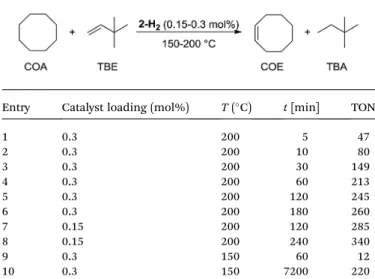
the benchmark COA/TBE system (Table 1).
In contrast with the inactive iridium analogue,2-H2showed
high activity for COA/TBE transfer-dehydrogenation at 200C. With 0.3 mol% catalyst loading of2-H2, 47 TONs were obtained
aer 5 min (TOF z10 min1, entry 1) and the resting states detected by31P NMR at 200C were (carb-PNP)Rh(TBE)2-TBE
and (carb-PNP)Rh(H2) (2-H2) with a 2-TBE/2-H2 ratio of 3 : 1.
The catalytic activity decreased over time with TONs of 149 aer 30 min (entry 3) and 260 aer 3 h (entry 6) corresponding to 44% and 76% conversion respectively. Longer reaction times do not afford increased TONs which suggests that the catalyst had decomposed. Accordingly, no 31P NMR signals were detected
aer 3 h. With a catalyst loading of 0.15 mol%, slightly higher TONs were obtained, up to 340 aer 4 h at 200C (entry 8). The rate of the reaction dropped dramatically when the temperature was decreased to 150C, with TONs of 12 and 220 obtained aer 1 h (entry 9) and 120 h (entry 10), respectively. For all these reactions the same rates and TONs obtained using2-H2 were also obtained with the use of2-C2H4as a catalyst precursor.
2-H2 was signicantly less effective for the transfer dehy-drogenation ofn-octane (Table 2) than for COA. A 1 : 1n -octa-ne : TBE solution of2-H2(0.3 mol%) gave only 4 TOs aer 5 min (TOFz1 min1) at 200C (entry 1). The resting states detected by 31P NMR aer 5 min were (carb-PNP)Rh(TBE) 2-TBE and Table 1 TONs for the transfer dehydrogenation of COA and TBE catalyzed by2-H2a
Entry Catalyst loading (mol%) T(C) t[min] TON
1 0.3 200 5 47
2 0.3 200 10 80
3 0.3 200 30 149
4 0.3 200 60 213
5 0.3 200 120 245
6 0.3 200 180 260
7 0.15 200 120 285
8 0.15 200 240 340
9 0.3 150 60 12
10 0.3 150 7200 220
aTONs were calculated based on conversion of TBE determined by GC
analysis. COA (2.33 mmol), TBE (2.33 mmol),2-H2(3.42–6.83mmol).
Table 2 TONs for the transfer dehydrogenation ofn-octane and TBE catalyzed by2-H2a
Entry T(C) t[min] TON
1 200 5 4
2 200 30 13
3 200 60 14
4 150 60 <1
5 150 120 1
6 150 180 3
aTONs were calculated based on conversion of TBE determined by GC
analysis.n-Octane (2.33 mmol), TBE (2.33 mmol),2-H2(6.83mmol).
Open Access Article. Published on 20 January 2016. Downloaded on 8/2/2018 11:36:10 AM.
This article is licensed under a
(carb-PNP)RhH2(2-H2) with a ratio2-TBE/2-H2of 3 : 1, the same
as observed in the COA/TBE system. The complex (carb-PNP) Rh(1-octene) was not detected, arguing against product inhibi-tion as the explanainhibi-tion underlying the slow rate withn-octane. Decomposition of the catalyst limited the TON to 14 aer 1 h (entry 3). The 1-octene isomer represented 16% of all octenes aer 1 h. Calculations indicate a very slight kinetic preference for formation of 1-octene (0.7 kcal mol1 at 200 C) so this suggests that olen isomerization is competitive with alkane dehydrogenation. Lowering the temperature to 150 C decreased the reaction rate toz0.5 TON per h (entry 5).
Computational results
DFT calculations were conducted on the reactions discussed above using the M06-L density functional and valence basis sets of triple-zeta plus polarization quality (see ESI†). We used a model ligand in which the two i-Pr groups on each P atom were replaced with a t-Bu and a methyl group to give a C2
symmetric diastereomer. Since metal-bound PiPr2groups
typi-cally adopt a conformation in which one of the two methine C–H bonds points toward the metal center while the other points away, the PtBuMe group mimics the steric effect of the PiPr2group. The PtBuMe group, however, offers the advantage
of avoiding the many local (non-global) conformational minima which we have encountered in calculations of pincers with PiPr
2
groups (see ESI†for a computational assessment of this model). In addition, our model does not include the two methyl groups at the positionsparato the carbazolide N atom. We refer to this ligand as carb-PNP0and the model compounds as derivatives of
20to distinguish them from the experimental complexes of2. The results of the calculations proved quite valuable in attempting to interpret the experimental results. A free energy diagram for the reaction of dihydride 20-H2 with ethylene at 30C is shown in Fig. 2. Note that at80C, the calculations indicate that ethylene binds to 20-H2, to give 20-H2(C2H4), exoergically (DG ¼ 0.7 kcal mol1), in agreement with the observation illustrated in eqn (12). At 30 C, the observed equilibrium suggests thatDGis slightly positive and indeed, the calculated free energy of binding isDG¼ 1.5 kcal mol1. At 30 C, the barrier to the reaction of ethylene dihydride
complex20-H2(C2H4)to give the three-coordinate (carb-PNP0)Rh (20) and ethane is calculated to be 16.1 kcal mol1, in good agreement with the experimental value (for 2-H2(C2H4)) of
DG‡¼18 kcal mol1.
As indicated in eqn (15), H/D exchange of20-D2(C2H4)with
C2H4is not observed in the course of the hydrogenation
reac-tion. This would typically be interpreted to suggest that migra-tory insertion of ethylene is irreversible and is the rate-limiting step of the reaction, followed by fast elimination of ethane. The calculations, however, yield a somewhat different explanation. Insertion of C2H4into a Rh–H bond of20-H2leads to ab-agostic
ethyl complex (PNP)RhH(h2-Et),20-H(h2-Et), with a nearly fully formed C–H bond (d¼1.23A; see Fig. 3 and 4).˚ 19The TS for this insertion process at30C has a free energy 9.7 kcal mol1 above that of20-H2(C2H4) while the free energy of the agostic product is 10.6 kcal mol1higher than20-H2(C2H4)(although it has a lower free energy,G, the electronic energy,E, of the TS leading to the agostic intermediate is higher than that of the agostic intermediate, as required of a proper TS on the potential energy surface). Accordingly, the barrier to the back-reaction of this process (i.e.20-H(h2-Et)/20-H
2(C2H4)) is negligible.
The short Rh–H distance of 1.75˚A in20-H(h2-Et)indicates
a very strong agostic interaction. The H atom is locatedtransto the weak-trans-inuence carbazole nitrogen, while thea-carbon
Fig. 2 Calculated free energies (kcal mol1) for reaction of20-H
2with ethylene at30C.
Fig. 3 Structural parameters, in the plane bisecting the P–Rh–P axis, along the pathway for the insertion of ethylene into a Rh–H bond of20 -H2(C2H4).
Fig. 4 “3-D”models of (a) agostic intermediate20-H(h2-Et) and (b) ring-opening transition state TS(20-H(h2-Et)/20-H(Et)). Peripheral
atoms omitted for clarity. Rh–H distances in˚A.
Open Access Article. Published on 20 January 2016. Downloaded on 8/2/2018 11:36:10 AM.
This article is licensed under a
istransto a strong-trans-inuence hydride ligand; this result is consistent with conclusions of an earlier study of the relation-ship between agostic bond strengths and the respectivetrans
inuences of ancillary ligands.20
Loss of the agostic interaction in20-H(h2-Et)has a barrier DG‡¼5.5 kcal mol1(Fig. 2). The product of this ring-opening, 20-H(Et), is 18.9 kcal mol1lower in free energy than agostic20
-H(h2-Et). Since this is formally only a bond breaking reaction, with no concomitant bond making, a negative value ofDG, and particularly such a strongly negative value (18.9 kcal mol1), is
quite striking. This result can be explained, however, in terms of the geometry of reactant and product. In20-H(h2-Et), the
strong-trans-inuence agostic ethyl groupa-carbon is positionedtrans
to the strong-trans-inuence hydride ligand. In contrast, 20 -H(Et)adopts a so-called Y-geometry,21in which the Ca–Rh–H angle, instead of being ca. 180 (mutually trans) is only 72, while the N–Rh–Caangle (106in20-H(h2-Et)) is 149.0(Fig. 3). As a result,20-H(Et)has a very short Rh–C bond (2.095A˚ vs.
2.175˚A in20-H(h2-Et)) and a much shorter Rh–H bond (1.546˚A
vs.1.640A) than is found in˚ 20-H(h2-Et).
The barrier to elimination of ethane from 20-H(Et)is only
DG‡¼6.0 kcal mol1as compared with 24.4 kcal mol1for the
reverse reaction,i.e.re-formation of the agostic bond to give20 -H(h2-Et). Thus the “ring-opening” of 20-H(h2-Et) is the rate-determining step for the overall loss of ethane from dihydride ethylene complex20-H2(C2H4). Attempts to locate a TS for rota-tion around the ethylene C–C bond of agostic complex20-H(h2 -Et)only led to loss of the agostic interaction to give20-H(Et). Thus, although insertion of ethylene into a Rh–H bond of 20 -H2(C2H4) is fully reversible, the calculations predict that it should not lead to exchange between hydride (or deuteride) and ethylene H atoms, in accord with the observed lack of H/D exchange between2-D2and C2H4.
The reaction of dihydride2-H2 with TBE, as noted above,
does not proceed at room temperature in contrast with the reaction with ethylene, which occurs at30C. The TBE reac-tion proceeds slowly at 80 C; the timescale corresponds to a free energy barrier of ca.26–27 kcal mol1, about 8–9 kcal
mol1greater than the reaction with ethylene. The reaction is calculated to proceed via a pathway analogous to that for ethylene. An agostic analogue to 20-H(h2-Et) is calculated to form with a free energy 24.2 kcal mol1higher than20-H2plus TBE, followed by a rate-determining ring-opening with a TS that is 3.3 kcal mol1higher. The overall barrier for the reaction is thusDG‡¼27.5 kcal mol1, about 10 kcal mol1greater than the reaction barrier with ethylene, in very good agreement with experiment. While the Ir analogue was previously shown to react with TBEviaan Ir(III)/Ir(V) pathway requiring the presence of H2, no acceleration by H2 is observed in the present Rh
system. This is consistent with the calculated barrier for elim-ination of neo-hexane from (carb-PNP0)Rh(t-butylvinyl)(H),DG‡
¼5.9 kcal mol1, which is far lower than the barrier calculated for the back-reaction (DG‡¼28.6 kcal mol1).
The calculations also provide insight into the much greater rate of dehydrogenation of COA compared withn-octane (free energy values are shown in Fig. 5, expressed relative to20plus the free alkane and calculated forT¼473 K in the gas phase
with pressures that correspond to the molarity of the respective pure liquid alkanes). Oxidative addition of the C–H bond of COA has a calculated barrier ca.4 kcal mol1 higher than that of
n-octane. However, the TS for formation of theb-agostic species (carb-PNP0)RhH(h2-1-octyl), which is rate-determining for
n-octane dehydrogenation, is 5.4 kcal mol1higher than the TS for formation of the correspondingb-agostic cyclooctyl complex. This may be explained in terms of the eclipsed interactions required by the formation of agostic complex (carb-PNP0)RhH(h2 -1-octyl) (see Fig. 4a for the ethyl analogue). Such unfavorable interactions are also present in the TS for formation of (carb-PNP0)RhH(h2-cyclooctyl). However, in the case of COA, unliken -octane, these eclipsed interactions are already present in the alkane substrate (being responsible for the well known ring strain of COA) as well as in the non-agostic C–H addition product. Thus, relative to these free species and the non-agostic alkyl hydride, the TS for agostic bond formation for COA is signi -cantly lower in energy that that forn-octane. It may be relevant in this context that unlike the case for n-octane or ethane, the agostic cyclooctyl complex (the analogue of20-H(h2-Et)) appears to be a distinct minimum on the free energy surface (Fig. 5), and not only a minimum on the electronic energy surface.
On the dehydrogenation pathway the step subsequent to formation of the agostic intermediate isb-H-elimination. In the case ofn-octane dehydrogenation the TS for this step, TS(20 -H(h2-1-Oc)/20-H(1-Oc)), has a much lower free energy (23.2 kcal mol1) than the TS for the (rate-determining) formation of the agostic complex (28.5 kcal mol1). In contrast,b-H elimi-nation of the agostic cyclooctyl complex (carb-PNP0)RhH(h2
-cyclooctyl) is calculated to have a TS slightly higher in free energy (24.5 kcal mol1) than the TS for formation of the agostic complex (23.1 kcal mol1), although this difference is quite small (and probably too small to be meaningful for the comparison of such different species).
Interestingly, the free energy of the TS forb-H elimination of the cyclooctyl complex (24.5 kcal mol1) is higher than that for Fig. 5 Calculated free energies (kcal mol1) for reaction of2withn -octane (blue) and with cyclo-octane (red) at 200C (gas phase, pres-sures corresponding to molarity of pure liquid).
Open Access Article. Published on 20 January 2016. Downloaded on 8/2/2018 11:36:10 AM.
This article is licensed under a
the 1-octyl complex (23.2 kcal mol1). Likewise (but not surprisingly), as noted above, the TS for C–H addition of COA is of higher free energy than that forn-octane. These steps, C–H
addition andb-H elimination, are the steps most commonly considered in the context of alkane dehydrogenation (while their microscopic reverse reactions are regarded similarly for olen hydrogenation). But although the higher reactivity of COAvs. n -alkanes is a staple of organometallic-catalyzed alkane dehydro-genation, in the present system the TSs of both of these steps are calculated to be higher in free energy for the dehydrogenation of COA than ofn-octane. The higher reactivity of COAvs. n-octane in the present system, according to our calculations, is a result of only the lower energy of the unanticipated transition state for the formation of an agostic interaction in the case of COA.
Conclusions
The iridium dihydride complex1-H2based on the carbazole bis-phosphine ligand was previously reported to be ineffective as a transfer-dehydrogenation catalyst. This was found to be ulti-mately attributable to the very high energy of the (carb-PNP)Ir(I) complex relative to (carb-PNP)Ir(III). Thus potential hydrogen acceptors such as TBE inserted into an Ir–H bond (maintaining the Ir(III) oxidation state), but the barrier to subsequent elimi-nation to give the Ir(I) product was prohibitively high while deinsertion was much more favorable. Hydrogenation by H2
was effected, but this was found to proceed via an Ir(III)/Ir(V) pathway involving addition of H2to the Ir(III) alkyl hydride; such a path is not viable for alkane dehydrogenation.
As the M(I)/M(III) thermodynamics are biased more towards M(I) in the case of Rh than Ir,22we suspected the relatively high stability of a Rh(III) analogue would not preclude, and might even favor, transfer dehydrogenation. Indeed the complex2-H2is found to be an active catalyst for the dehydrogenation of COA with TBE achieving TOFs up to 10 min1, similar to the catalyst (tBu4PCP)
IrH2.7To our knowledge this is therst example of a highly active
rhodium-based alkane transfer-dehydrogenation catalyst that does not require light or H2atmosphere. However, decomposition of
the catalyst at 200C limits the catalyst efficiency.
n-Octane dehydrogenation proceeded more slowly than COA dehydrogenation. DFT calculations indicate that the slower rate forn-octane is attributable to the barrier to a rate-determining step not heretofore given consideration in the context of alkane dehydrogenation (or its microscopic reverse, in the case of alkene hydrogenation), namely the formation of an agostic intermediate, (carb-PNP0)RhH(h2-1-octyl), subsequent to C–H addition. Even so the reaction is not prohibitively slow; however, the combination of relatively rapid decomposition at 200C and the relatively slow dehydrogenation rate leads to very limited TONs. The development of more stable rhodium pincer complexes based on a similar framework is currently underway.
Acknowledgements
We gratefully acknowledge thenancial support of this work by NSF under the CCI Center for Enabling New Technologies through Catalysis (CENTC) Phase II Renewal, CHE-1205189.
Notes and references
1 K. Weissermel and H.-J. Arpe, inIndustrial Organic Chemistry, Wiley-VCH Verlag GmbH, 2008, p. 59.
2 (a) M. Findlater, J. Choi, A. Goldman and M. Brookhart, in
Alkane C–H Activation by Single-Site Metal Catalysis, ed. P. J. P´erez, Springer, Netherlands, 2012, vol. 38, ch. 4, p. 113; (b) J. Choi, A. H. R. MacArthur, M. Brookhart and A. S. Goldman,Chem. Rev., 2011,111, 1761; (c) D. Morales-Morales, Iridium Complexes Org. Synth., 2009; (d) R. H. Crabtree,J. Chem. Soc., Dalton Trans., 2001, 2437. 3 K. Nomura and Y. Saito,J. Chem. Soc., Chem. Commun., 1988,
161.
4 T. Sakakura, T. Sodeyama, Y. Tokunaga and M. Tanaka,
Chem. Lett., 1988, 263.
5 (a) J. A. Maguire, W. T. Boese and A. S. Goldman,J. Am. Chem. Soc., 1989, 111, 7088; (b) J. A. Maguire, W. T. Boese, M. E. Goldman and A. S. Goldman, Coord. Chem. Rev., 1990,97, 179; (c) J. A. Maguire and A. S. Goldman, J. Am. Chem. Soc., 1991, 113, 6706; (d) J. A. Maguire, A. Petrillo and A. S. Goldman,J. Am. Chem. Soc., 1992, 114, 9492; (e) K. Wang, M. E. Goldman, T. J. Emge and A. S. Goldman,J. Organomet. Chem., 1996,518, 55.
6 A. D. Chowdhury, N. Weding, J. Julis, R. Franke, R. Jackstell and M. Beller,Angew. Chem., Int. Ed., 2014,53, 6477. 7 M. Gupta, C. Hagen, R. J. Flesher, W. C. Kaska and
C. M. Jensen,Chem. Commun., 1996, 2083.
8 (a) W.-W. Xu, G. P. Rosini, K. Krogh-Jespersen, A. S. Goldman, M. Gupta, C. M. Jensen and W. C. Kaska,
Chem. Commun., 1997, 2273; (b) M. Gupta, W. C. Kaska and C. M. Jensen, Chem. Commun., 1997, 461; (c) D. W. Lee, W. C. Kaska and C. M. Jensen,Organometallics, 1998,17, 1; (d) F. Liu, E. B. Pak, B. Singh, C. M. Jensen and A. S. Goldman, J. Am. Chem. Soc., 1999, 121, 4086; (e) S. Kundu, Y. Choliy, G. Zhuo, R. Ahuja, T. J. Emge, R. Warmuth, M. Brookhart, K. Krogh-Jespersen and A. S. Goldman,Organometallics, 2009,28, 5432; (f) B. Punji, T. J. Emge and A. S. Goldman, Organometallics, 2010, 29, 2702; (g) J. J. Adams, N. Arulsamy and D. M. Roddick,
Organometallics, 2012, 31, 1439; (h) K. Krogh-Jespersen, M. Czerw, K. Zhu, B. Singh, M. Kanzelberger, N. Darji, P. D. Achord, K. B. Renkema and A. S. Goldman, J. Am. Chem. Soc., 2002, 124, 10797; (i) K. Zhu, P. D. Achord, X. Zhang, K. Krogh-Jespersen and A. S. Goldman, J. Am. Chem. Soc., 2004, 126, 13044; (j) A. Ray, K. Zhu,
Y. V. Kissin, A. E. Cherian, G. W. Coates and
A. S. Goldman, Chem. Commun., 2005, 3388; (k) S. A. Kuklin, A. M. Sheloumov, F. M. Dolgushin, M. G. Ezernitskaya, A. S. Peregudov, P. V. Petrovskii and A. A. Koridze,Organometallics, 2006,25, 5466.
9 (a) I. Gottker-Schnetmann, P. White and M. Brookhart,J. Am. Chem. Soc., 2004,126, 1804; (b) I. Gottker-Schnetmann and M. Brookhart, J. Am. Chem. Soc., 2004, 126, 9330; (c) I. G¨ottker-Schnetmann, P. S. White and M. Brookhart,
Organometallics, 2004, 23, 1766; (d) D. Morales-Morales,
Open Access Article. Published on 20 January 2016. Downloaded on 8/2/2018 11:36:10 AM.
This article is licensed under a
R. O. Red´on, C. Yung and C. M. Jensen,Inorg. Chim. Acta, 2004,357, 2953.
10 (a) R. Ahuja, B. Punji, M. Findlater, C. Supplee, W. Schinski, M. Brookhart and A. S. Goldman,Nat. Chem., 2011,3, 167; (b) A. J. Nawara-Hultzsch, J. D. Hackenberg, B. Punji, C. Supplee, T. J. Emge, B. C. Bailey, R. R. Schrock, M. Brookhart and A. S. Goldman,ACS Catal., 2013,3, 2505. 11 (a) M. W. Haenel, S. Oevers, K. Angermund, W. C. Kaska, H.-J. Fan and M. B. Hall, Angew. Chem., Int. Ed., 2001,40, 3596; (b) T. W. Lyons, D. Guironnet, M. Findlater and M. Brookhart, J. Am. Chem. Soc., 2012, 134, 15708; (c) S. Kundu, T. W. Lyons and M. Brookhart,ACS Catal., 2013,
3, 1768.
12 (a) Y. Shi, T. Suguri, C. Dohi, H. Yamada, S. Kojima and Y. Yamamoto,Chem.–Eur. J., 2013, 19, 10672; (b) W. Yao, Y. Zhang, X. Jia and Z. Huang,Angew. Chem., Int. Ed., 2014,
53, 1390; (c) D. B´ezier and M. Brookhart,ACS Catal., 2014,
4, 3411.
13 (a) K. B. Renkema, Y. V. Kissin and A. S. Goldman,J. Am. Chem. Soc., 2003,125, 7770; (b) M. Kanzelberger, B. Singh, M. Czerw, K. Krogh-Jespersen and A. S. Goldman, J. Am. Chem. Soc., 2000,122, 11017.
14 D. Y. Wang, Y. Choliy, M. C. Haibach, J. F. Hartwig, K. Krogh-Jespersen and A. S. Goldman,J. Am. Chem. Soc., 2016,138, 149.
15 C. Cheng, B. G. Kim, D. Guironnet, M. Brookhart, C. Guan, D. Y. Wang, K. Krogh-Jespersen and A. S. Goldman,J. Am. Chem. Soc., 2014,136, 6672.
16 (a) O. V. Ozerov, C. Guo, V. A. Papkov and B. M. Foxman,J. Am. Chem. Soc., 2004, 126, 4792; (b) W. Weng, C. Guo, C. Moura, L. Yang, B. M. Foxman and O. V. Ozerov,
Organometallics, 2005,24, 3487; (c) S. Gatard, R. Çelenligil-Çetin, C. Guo, B. M. Foxman and O. V. Ozerov, J. Am. Chem. Soc., 2006, 128, 2808; (d) W. Weng, C. Guo, R. Celenligil-Cetin, B. M. Foxman and O. V. Ozerov,Chem. Commun., 2006, 197.
17 Due to decomposition of2-H2at 80C,2-TBEwas formed in
a 50% yield. Aer 3 h at 80C,2-TBEwas the only species detected by 31P NMR, however the 1H NMR showed the presence of other non identied compounds.
18 Since exchange with excess free C2H4 is rapid, if ethylene
insertion into the Rh–D bond of 2-D2(C2H4) were reversible, the major expected product would be the C2H4
(d0) complex with incorporation of H into the hydride
positions as indicated in eqn (15).
19 M. Brookhart, M. L. H. Green and G. Parkin,Proc. Natl. Acad. Sci. U. S. A., 2007,104, 6908.
20 F. Hasanayn, P. Achord, P. Braunstein, H. J. Magnier, K. Krogh-Jespersen and A. S. Goldman, Organometallics, 2012,31, 4680.
21 (a) Y. Jean and O. Eisenstein,Polyhedron, 1988,7, 405; (b) I. E.-I. Rachidi, O. Eisenstein and Y. Jean, New J. Chem., 1990, 14, 671; (c) J. F. Riehl, Y. Jean, O. Eisenstein and M. Pelissier,Organometallics, 1992,11, 729.
22 J. P. Collman,Acc. Chem. Res., 1968,1, 136.
Open Access Article. Published on 20 January 2016. Downloaded on 8/2/2018 11:36:10 AM.
This article is licensed under a