INVESTIGATING THE HANDLING OF SEXUAL ASSAULT INVOLVING COLLEGIATE STUDENT-ATHLETES
Victoria Krause
A thesis submitted to the faculty at the University of North Carolina at Chapel Hill in partial fulfillment of the requirements for the degree of Master of Arts in the Department of Exercise
and Sport Science (Sport Administration).
Chapel Hill 2016
ABSTRACT
Victoria Krause: Investigating the handling of sexual assault involving collegiate student-athletes (Under the direction of Barbara Osborne)
Sexual assault on college campuses is a growing issue in the United States. In May 2014, the Department of Education’s Office for Civil Rights released a list of 57 schools that are currently being investigated for their handling of sexual violence cases. In 2016 that number has risen to over 100 schools.
In 2011, the Office of Civil Rights published the Dear Colleague Letter on Sexual Harassment. This document provided schools with the necessary information to remain Title IX compliant when faced with sexual assault allegations. In 2014, the NCAA issued guidance to athletic departments regarding their role during sexual assault investigations.
TABLE OF CONTENTS
LIST OF TABLES ... vii
CHAPTER 1: INTRODUCTION ... 1
Introduction ... 1
Purpose Statement ... 3
Research Questions ... 3
Assumptions and Limitations ... 3
Significance ... 3
Definitions ... 4
CHAPTER 2: REVIEW OF LITERATURE ... 5
Sexual Assault on Campus ... 5
Why do sexual assaults occur? ... 6
Can sexual assault be prevented? ... 7
Athletes and Violence ... 9
Student-Athletes and Sexual Assault ... 10
Prevention ... 10
Protection for Schools/Athletic Departments ... 11
Notable Supreme Court Cases ... 13
The Office for Civil Rights: Sexual Harassment Guidance (1995) ... 15
Revised Sexual Harassment Guidance (2001) ... 16
Dear Colleague Letter (2011) ... 19
NCAA Guidance ... 21
Theoretical Framework ... 23
Conclusion ... 24
CHAPTER 3: METHODOLOGY ... 26
Subjects ... 26
Data Collection and Organization ... 26
Data Analysis ... 27
CHAPTER 4: RESULTS ... 28
How have schools fallen short? ... 30
What similarities, if any, are there between issues found with handling of cases? ... 32
What changes can schools make to better comply with these guidelines? ... 36
CHAPTER 5: DISCUSSION ... 38
Theoretical Framework ... 38
Limitations ... 41
Future Research ... 42
APPENDIX A ... 43
APPENDIX B ... 62
United Educators Study ... 62
APPENDIX C ... 63
Codebook Categories ... 63
APPENDIX D ... 64
Comprehensive List of Schools ... 64
LIST OF TABLES
Table
1. Descriptive Data ... 28 2. Findings Regarding Schools’ Process of
CHAPTER 1: INTRODUCTION
Introduction
In October 2014 University of Kentucky football player, Lloyd Tubman, was accused of rape by his girlfriend. A grand jury did not indict him but he was found guilty of sexual
misconduct by three University of Kentucky panels and expelled from campus. Tubman has continuously appealed the schools’ decision leading the plaintiff to file a Title IX compliant with the U.S. Education Department’s Office of Civil Rights, against the university, citing Tubman’s appeals as “re-victimization” (Blackford, 2015).
In 2012 a Florida State University student claimed future Heisman Trophy winner Jameis Winston raped her at an off-campus apartment. Two years later, Winston was cleared in a
student code of conduct hearing. The accuser has since filed a lawsuit against Winston and the school. Additionally, the Department of Education has begun an investigation into Florida State University for possible Title IX violations based on their response to complaints of sexual violence (Copeland, 2014).
Sexual assault on college campuses is a growing issue in the United States. In May 2014, the Department of Education’s Office for Civil Rights released a list of 57 schools that are currently being investigated for their handling of sexual violence cases. That number has now risen to over 100 schools, despite information that has been disseminated to aid schools in remaining compliant.
take immediate and effective steps to respond to acts of sexual violence. It also provided schools with detailed instructions related to remaining Title IX compliant.
In 2014, the NCAA published a guidebook entitled, “Addressing Sexual Assault and Interpersonal Violence: Athletics’ Role in Support of Healthy and Safe Campuses.” This guide was meant to provide athletic departments specific information on their role in preventing and handling sexual assault.
The Association of American Universities released their campus survey on sexual assault results in 2015. The purpose of the survey was “to provide participating institutions of higher education (IHEs) with information to inform their policies to prevent and respond to sexual assault and misconduct,” (AAU, 2015, p.iii). The report found that 11.7% of students reported nonconsensual sexual contact (AAU, 2015, p.13).
Student-athletes make up a unique subset of this issue, “Athletes comprised 15% of the study's perpetrators and fraternity members made up 10%, which is generally representative of
student populations,” but “that athletes and fraternity members comprised a disproportionate
share of claims involving serial and multiple perpetrators” (United Educators, 2015). The NCAA
guidance released in 2014 states, “Athletics has a unique platform on most campuses from which
it can visibly and vocally support its colleagues across campus who are working to make the
campus safer for all students” (Wilson, 2014, p. 8). Athletic departments house unique staff,
areas and students, which add additional concerns.
Therefore, it is important to look at moments where schools and athletic departments
have fallen short when handling a case of sexual violence involving a student-athlete in order to
Purpose Statement
The purpose of this study is to determine what similarities, if any, there are between how schools handled cases of sexual assault (beginning after 2011) involving accused student-athletes based on law, legal research, and NCAA guidance.
Research Questions
1. How have schools fallen short of compliance?
2. What similarities, if any are there, between issues found with the handling of cases? 3. What changes can schools make to better comply with these guidelines based on these
trends?
Assumptions and Limitations
This study assumes based on various studies that sexual violence is prevalent among student-athletes. Limitations involve both lack of information and report bias. Information regarding sexual violence is confidential in nature and may be difficult to find. Additionally many cases go unreported or investigations/claims are dropped. According to AAU only about 28% of incidents are reported (American Association of University Professors Committee on Women in the Academic Profession and Subcommittee on sexual assault on campus, 2013, p. iv). Cases will be limited to incidents that occurred after the 2011 Dear Colleague Letter was issued and only situations that involve intercollegiate student-athletes.
Significance
departments tend to mishandle these cases, this study can potentially help schools properly manage cases of sexual violence involving student-athletes in the future.
Definitions
1. Sexual violence “refers to physical sexual acts perpetrated against a person’s will or where a person is incapable of giving consent due to the victim’s use of drugs or alcohol. An individual also may be unable to give consent due to an intellectual or other disability. A number of different acts fall into the category of sexual violence, including rape, sexual assault, sexual battery, and sexual coercion” (Dear Colleague Letter, 2011, p. 1).
2. Sexual Harassment is defined as “unwelcome conduct of a sexual nature. It includes
unwelcome sexual advances, requests for sexual favors, and other verbal, nonverbal, or physical conduct of a sexual nature. Sexual violence is a form of sexual harassment prohibited by Title IX” (Dear Colleague Letter, 2011, p.3).
3.A statute is a law that applies in a certain legal situation that must be complied with. 4. A federal guidance is a document published by a government entity or organization that provides information and best practices that should be followed to remain compliant with a law or laws. These documents and the information they disseminate are seen as a requirement under the law.
5. Dear Colleague Letters are notes typically written by a member of congress (in case it is written by the Assistant Secretary for Civil Rights), typically used to inform members of events or information. It is not a legal document and is instead used to disseminate information.
CHAPTER 2: REVIEW OF LITERATURE
Introduction
This chapter discusses literature regarding sexual assault on college campuses and information more specific to student-athletes and sexual assault. Additionally, it discusses the law, legal research and NCAA guidance regarding sexual assault. Previous research, laws and guidance help to create the framework for this study.
Sexual Assault on Campus
There are numerous studies that show the incredible prevalence of sexual assault on college campuses. In 2012, the CDC released a study that reported 19% of undergraduate women had experienced attempted or completed sexual assault while in college (CDC, 2012). A
statement released by the American Association of University Professors’ Committee on Women in the Academic Profession and Subcommittee reported that women ages eighteen to twenty-one are four times more likely to be sexually assaulted than women in any other age group. It also reported that college-bound women are more at risk than non-college-bound women. This
statement boasts a higher number than the CDC finding 20-25% of college women have reported being sexually assaulted while in college (American Association of University Professors
Committee, 2013).
their sexual assault (80%) compared to 67% of non-students (Stnozich, 2014) When victims reported sexual assaults, fewer than 16% of female student victims received assistance from a victims’ services agency.
Recently United Educators released a report on sexual assault claims among institutions of higher education (Appendix B). The study attempted to examine claims and made suggestions to colleges and universities to “advance efforts to prevent sexual assault and change campus culture,” United Educators, 2015, p. 1). Among participating institutions 43% of perpetrators were expelled and 39% suspended. The study concluded that schools were attempting to improve responses to sexual assaults and should use the information found in this particular study to improve and adjust their strategy (United Educators, 2015).
Findings tend to vary due to low reporting of sexual assaults, which makes it difficult to establish completely accurate numbers, however, these particular studies show the prevalence of sexual assault on college campuses and therefore the importance of studying it further.
Why do sexual assaults occur?
found to be higher among perpetrators relative to nonperpetrator,” however, many of the other categories did not show significant differences (Mouilso, Calhoun, & Rosenbloom, 2013, p. 435).
According to the report released by United Educators 78% of sexual assault claims involved alcohol (United Educators, 2015). In a study of 502 undergraduates, participants were questioned about their alcohol use and sexual objectification. Participants were asked questions to judge the amount of the students’ alcohol consumption and whether they sexually objectified members of the other sex through body evaluation and unwanted sexual advances. The students were then asked to complete the Sexual Experience Survey to determine whether they had engaged in some form of sexual violence. The study found that there was a correlation between heavy drinking and sexual objectification and sexual violence. Students who consumed more alcohol were more likely to commit sexual objectification and sexual violence. However, it was not determined whether this drinking and the sexual objectification or sexual violence actually occurred simultaneously (Gervais, DiLillo & McChargue, 2014).
Can sexual assault be prevented?
Many similar studies have been conducted on various educational programs. These investigate and advocate for peer-based education. In Franklin, Allen and Pratt’s study, social support theory provides the structure, which shows the importance of male peer groups to male behavior (2012). This theory explains, “association and identification with peer groups reinforce particular attitudes and behaviors that are socially desirable and appropriate according to the group” (Franklin, Bouffard & Pratt 2012, p.1459). This study surveyed collegiate men involved in Greek life and found that they were more likely to abuse women and to receive information on tactics to abuse women than their non-Greek counterparts (Franklin, Bouffard & Pratt, 2012).
Many schools have instituted peer-based educational programs to combat sexual assault. Jozkowski, Henry and Sturm (2014) studied the importance of peer-based education to students. This study examined college students’ perceptions of peer-based programs and whether the students viewed them as important. They concluded that 88.7% of college students believed these programs were important for themselves specifically and 97.1% believed they were important for students in general. Jozkowski, Henry and Sturm concluded that those students who perceive sexual assault prevention education to be important may be more likely to take it seriously when exposed to prevention education and they could help to raise awareness among their peers” (2014, p.56)
McMahon (2008) was opposed to advocating a particular prevention method and instead provided a template for schools to better comply with Federal policies prior to the 2011 Dear
Colleague Letter. McMahon provided step-by-step advice for schools to follow, beginning with
is to establish methods and policies that encourage reporting and the second is information on investigation and punishing perpetrators. However, establishing policies to encourage reporting must occur before an individual needs to report an assault. McMahon concludes that this template is meant, “to assist institutions of higher education to benchmark campus policy compliance with federal laws directed at sexual assault” (2008, p.361).
These studies provide information on who commits acts of sexual violence and why; which then leads to attempts to develop programs for schools to implement in an effort to prevent incidents and lessen the chance for litigation.
Athletes and Violence
Several studies investigate reasons athletes in particular commit violent acts. Dabbs (1998) studied professional athletes and explains that athletes are taught to be aggressive and violent on the field, making it then difficult for this attitude to not play out off the field in day-to-day life. Additionally, male athletics participation in general teaches sexism by portraying it as an opportunity to express one’s manliness. Another possible explanation described is the preferential treatment given to many athletes making them feel invincible. Dabbs then explores specific professional leagues and their current policies in regards to violence against women and how they can improve those policies under the law, including allowing commissioners to punish athletes. Dabbs concludes external pressure and punishments are solutions for addressing
violence committed by professional athletes. Although this study is dated, it provides good historical data on professional athletes and violent behavior (Dabbs, 1998).
In a study conducted by Moser (2004), several cases of assault perpetrated by
Moser uses the cases to explain why athletes commit these acts of violence but focuses primarily on the handling of these cases by teams, leagues and the legal system. This study identifies failures of both teams and the legal system when professional athletes are accused of violence by using specific case studies (Moser, 2004).
Despite the prevalence of athlete violence much of the literature is dated and focuses primarily on athlete violence in general opposed to sexual violence specifically and uses professional athletes only as their subjects.
Student-Athletes and Sexual Assault
The United Educators 2015 study found, “Athletes comprised 15% of the study's perpetrators and fraternity members made up 10%, which is generally representative of student populations,” but “that athletes and fraternity members comprised a disproportionate share of claims involving serial and multiple perpetrators.” A 1996 survey of college judicial affairs offices found that although male student-athletes represented only 3% of the population they comprised 19% of reported perpetrators between 1991 and 1993. After conducting multiple t-tests, the study found there was a significant difference and therefore “indicates an association between collegiate athletic membership and reports of sexual assault to judicial affairs offices” (Crosset, Ptacek, McDonald & Benedict, 1996, p. 173). These studies display the prevalence of student-athletes and sexual assault but also the need to examine the subject further.
Prevention
may lead to assault) it significantly improved bystander confidence and intent to engage in bystander behaviors compared to the 86 students in the control group. Jackson and Davis (2000) detail a type of prevention program specifically for male student-athletes called Preventing Assault by Young Student Athletes. The purpose of their program is to teach student-athletes the distinction between appropriate on-field and off-field behaviors, increase their knowledge on sexual assault and its consequences (Jackson & Davis, 2000). The study explains to student-athletes that they must be conscious of their behavior. They must always ask before engaging in any sexual act, remember that “no means, no” and to have open communication throughout, which includes being aware of non-verbal clues (Jackson & Davis, 2000, p.602). Lastly, student-athletes must be aware of the effect alcohol and other drugs can have in a situation (Jackson & Davis, 2000). These studies show the efforts currently taken by schools to prevent sexual assaults and in turn their efforts to decrease their chance of litigation.
Protection for schools/athletic departments
Rammell (2014) and Osborne (2012) both focus on protecting schools and athletic
given of the procedures so everyone is aware of them. Finally, active efforts must be made to create a campus culture that does not accept behavior contrary to Title IX (Rammell, 2014).
Osborne (2012) uses the Supreme Court cases, Gebser v. Lago Vista Independent School
District and Davis v. Monroe Board of Education and the 2011 Dear Colleague Letter to
establish specific guidelines that should help schools navigate any sexual assault case that arises. Unlike Rammell, Osborne does not use athlete-specific cases, but relies on Supreme Court precedent and Office for Civil Rights guidance documents and applies the concepts to the athletics setting. This article was intended to provide schools and athletic departments with information so they can best comply with the law and protect themselves from liability. The conclusion is that schools should create and follow specific policies that pertain to both students and student-athletes alike, which would therefore prevent athletes from receiving different treatment subjecting institutions to potential liability (Osborne, 2012).
The research regarding sexual assault on campus and involving student-athletes provides an excellent framework for this research. The literature focuses primarily on the prevalence of sexual assault on campus and also why sexual assaults occur (both athlete specific and in the general population). Studies also examine ways to prevent assaults from occurring. These studies highlight what schools are currently doing to prevent and understand sexual violence. By then reviewing the requirements under the law, one can gain a better understanding of what schools are mandated to do. This structure can then be used to better study the Title IX complaints against schools that have mishandled cases of sexual assault.
The Law
provide the basis for how schools should be preventing harassment and responding to accusations of sexual violence.
Title IX
Title IX of the Educational Amendments of 1972 (20 U.S.C. §§ 1681) stated, “no person in the United States shall, on the basis of sex, be excluded from participation in, be denied of, or be subjected to discrimination under the Educational Amendments of 1972.”The Department of Health, Education, and Welfare (now the U.S. Department of Education) was responsible for the development of regulations for schools to follow in order to comply with the legislation. General requirements for all educational institutions include a requirement to develop and distribute a notice of non-discrimination stating the school does not discriminate based on sex. Schools are also required to designate at least one employee to ensure Title IX compliance. Finally, schools must adopt and publish grievance procedures for those who believe the school is not in
compliance with the law. (“Know Your Rights”, n.d.).
Notable Title IX Supreme Court Cases on Sexual Harassment
Neither the Title IX statute nor the original Regulations expressly addresses sexual harassment. Through a series of cases, it was established that sexual harassment is a form of sex discrimination, and is therefore prohibited under Title IX. Two Supreme Court decisions
involving sexual harassment shape policy: Davis vs. Monroe County Board of Education (1999)
and Gebser v. Lago Vista Independent School District (1998).
Supreme Court was whether a school board can be held responsible under Title IX for student-on-student harassment?
The Supreme Court found in a 5-4 decision that yes, schools can be found liable for damages in cases of student-on-student harassment. Title IX prevents a student from being discriminated against because of sex, and sexual harassment is a form of sex discrimination. Therefore if sexual harassment prevents a student from receiving proper educational benefits the school can be found liable (Davis vs. Monroe County Board of Education, 1999).
However, the harassment must be severe. According to the court “an action will lie only for harassment that is so severe, pervasive, and objectively offensive that it effectively bars the victim’s access to an educational opportunity or benefit” (Davis vs. Monroe County Board of
Education, 1999, p.633). Additionally, the court found the school was actively indifferent to the
accusations and took no action when Davis contacted them regarding the abuse Davis vs.
Monroe County Board of Education, 1999).
The second case, Gebser v. Lago Vista Independent School District (1998) addressed whether a federally funded educational program or activity should be required to pay sexual harassment damages to a student involved in a secret relationship with a member of its staff. In 1998, Alida Star Gebser had a secret sexual affair with a teacher. After the relationship was discovered the teacher was arrested and fired. The Lago Vista Independent School district did not have an official procedure for reporting sexual harassment or any anti-harassment policy, which was required by federal law. Gebser sued the school for damages stating she was discriminated against under Title IX.
ability to correct the wrong, had to have knowledge of the harassment. Second, it has to be proven that the school, despite having knowledge of the harassment, had not responded properly. Gebser did not meet either of those two criteria, because no one had knowledge of the
relationship and therefore could not act to stop it. Although Gebser lost this case, the decision indicates that schools must properly respond to acts of harassment once it becomes known.
The Office for Civil Rights: Sexual Harassment Guidance (1997)
In 1997, the Office for Civil Rights released a sexual harassment guidance, which provides best practices for schools to remain Title IX compliant. The guidance explains that sexual harassment is prohibited sex discrimination under Title IX. This applies to all public or private schools that receive federal funds.
The guidance explains how schools can be held liable because of sexual harassment by both teachers and students. Schools can be held liable for teacher-student harassment that is quid pro quo. This is when a person of authority (i.e. teachers) uses his or her authority to “force a student to sexual demands” (Sexual Harassment Guidance, 1997, p.3) a school has strict liability. Schools can also be liable under a negligence standard for a hostile environment if the
harassment is “sufficiently severe, persistent, or pervasive to limit a student’s ability to
participate in or benefit from the education program” (Sexual Harassment Guidance, 1997, p.3). Lastly, schools can be liable if a person of authority knows or should have known of the
harassment but the school fails to take “immediate or appropriate corrective action” (Sexual Harassment Guidance, 1997, p.4).
harassment, and whether the school took immediate and appropriate corrective action (Sexual Harassment Guidance, 1997, p.5). A school will be in violation of Title IX if they were given “notice of a sexual hostile environment and fail to take immediate and appropriate corrective action” (Sexual Harassment Guidance, 1997, p. 9).
Lastly, the guidance explains that schools must designate at least one employee to
coordinate its efforts to comply with and carry out its Title IX responsibilities, publish grievance procedures that allow students to report sex discrimination and that these grievance procedures must provide for prompt and equitable resolution of sex discrimination complaints. These prompt and equitable grievance procedures should include:
Notice to students, parents and employees including where complaints can be filed; application of the procedure to complaints alleging harassment carried out by employees, other students, or third parties; adequate, reliable, and impartial investigation of
complaints, including the opportunity to present witnesses and other evidence; designated and reasonably prompt timeframes for the major stages of the complaint process; notice to the parties of the outcome of the complaint; and an assurance that the school will take steps to prevent recurrence of any harassment and to correct its discriminatory effects on the complainant and others, if appropriate, (Sexual Harassment Guidance, 1997, p.14).
The 1997 guidance provides the first information to schools on how to best comply with federal Title IX requirements.
The Office for Civil Rights: The Revised Sexual Harassment Guidance (2001)
In 2001, The Office for Civil Rights published an update to a 1997 guide on sexual harassment. The Revised Sexual Harassment Guidance provided updates including the new Supreme Court decisions Gebser v. Lago Vista Independent School District (1998) and Davis v.
Monroe County Board of Education (1999), as well as greater clarification to various parts of the
The guide first defines sexual harassment more specifically as any “unwelcome conduct of a sexual nature” (Revised Sexual Harassment Guidance, 2001, p. 2). The new guidance goes into much greater detail of how schools must act when harassment has occurred. First, schools must decide if the harassment limits a student’s ability to participate in the educational program. In order to do this schools must decide the degree to which the harassment affected the students’ education and the type, frequency and duration of the harassment, the relationship between harasser and harassed, the number of individuals involved, the age and sex of the harasser and harassed, the size of the school, location of incident and context, other incidents at the school and the incidents of gender-based but non-sexual harassment (Revised Sexual Harassment Guidance, 2001, p. 6-7).
Schools’ responsibilities to address sexual harassment are also detailed in more depth. The guidance describes two types of harassment: quid pro quo harassment and hostile
environment harassment. Quid pro quo harassment, which was also described in the 1997
guidance, “occurs if a teacher or other employee conditions an educational decision or benefit on the student’s submission to unwelcome sexual conduct” (Revised Sexual Harassment Guidance, 2001, p. 5). Harassment that “does not explicitly or implicitly condition a decision or benefit,” is hostile environment harassment (Revised Sexual Harassment Guidance, 2001, p. 5). Teacher-student harassment can be either quid pro quo harassment or hostile environment harassment, while student-student harassment tends to be only be hostile environment harassment, as students do not often have authority over other students (Revised Sexual Harassment Guidance, 2001).
harassment or in a more indirect way such as a distributed flyer (Revised Sexual Harassment Guidance, 2001, p. 13).
Greater attention is given to schools’ response after sexual harassment is reported. Schools must “take prompt and effective steps reasonably calculated to end any harassment, eliminate a hostile environment if one has been created, and prevent harassment from occurring again (Revised Sexual Harassment Guidance, 2001, p. 15). How to respond to reports of
harassment by students or parents, as well as harassment witnessed by a reasonable employee are also explained. The school must take immediate steps to investigate the harassment and provide appropriate measures for the complainant. This includes placing the students in separate classes and/or on campus housing. If the investigation shows harassment occurred, immediate
“corrective actions must be taken” (Revised Sexual Harassment Guidance, 2001, p. 16). Steps must be taken to “eliminate any hostile environment that has been created” (Revised Sexual Harassment Guidance, 2001, p. 16). Lastly, efforts must be made to prevent any retaliation against the complainant or any witnesses.
Similar to the 1997 guidance, the 2001 guidance goes into great detail explaining what constitutes prompt and equitable grievance procedures. The 2001 guidance lists the same six requirements but emphasizes that a grievance procedure “cannot be prompt or equitable unless students know it exists, how it works, and how to file a complaint” (Revised Sexual Harassment Guidance, 2001, p. 20).
grievance procedures must ensure both the Title IX rights of the complainant as well as the due process rights of the accused (Revised Sexual Harassment Guidance, 2001, p. 22).
Overall the 2001 Revised Sexual Harassment Guidance touches on the same subjects as the 1997 guidance. However, it updates schools on the most recent Supreme Court cases as well as provides more specifics and greater detail throughout to better clarify how schools can best comply with Title IX requirements.
The Dear Colleague Letter (2011)
The Dear Colleague Letter, published in 2011, created a framework for schools to implement in order to maintain their Title IX compliance. The letter provided greater detail than the previous guidance published by the OCR.
For each of the Title IX requirements the DCL provides greater insight into how to best comply. The notice of nondiscrimination must state specifically that the school “does not
discriminate on the basis of sex in its education programs and activities” (Dear Colleague Letter, 2011, p. 6-8). It must also include the name, office address, telephone number, and email address of the Title IX coordinator (Dear Colleague Letter, 2011, p. 6-8).
both parties and then school should take steps to prevent any retaliation against the accuser, as well as future sexual assaults (Dear Colleague Letter, 2011, p. 9-14).
The next section of the DCL provides suggestions on education and prevention, before, during and after an investigation. According to the DCL educational prevention programs should include “practical information about how to identify and report sexual harassment and violence” (Dear Colleague Letter, 2011, p. 6).These programs should be required for new students, resident assistants, coaches, athletes and anyone else that could reasonably come in contact with sexual harassment (Dear Colleague Letter, 2011, p. 6).
Throughout an investigation, the Title IX coordinator should be in regular
communication with any law enforcement involved in investigating sexual violence allegations. A committee of students and officials to oversee the investigation and implement the school’s policy should also be created (Dear Colleague Letter, 2011, p. 17-18).The DCL provides greater detail for schools to follow than the previous OCR guidance.
Since the Dear Colleague Letter was issued the Office of Civil Rights has received hundreds of complaints citing schools’ mishandlings of sexual assault cases. In 2014, the
Department of Education released a list of 57 schools under investigation for the mishandling of multiple cases. This number has steadily grown to over a 100 in the past year.
The statutes and Supreme Court decisions provide the framework for what schools must do to remain compliant. The multiple guidance, then provide clarity on how best to comply with these federal regulations. These documents detail exactly what schools should be doing, which can then be used to see if schools are actually complying.
NCAA: Addressing Sexual Assault and Interpersonal Violence
As sexual violence involving student-athletes has become more and more prevalent
athletic departments have found themselves increasingly involved in investigations. In 2014, the
NCAA published a guidebook entitled, “Addressing Sexual Assault and Interpersonal Violence:
Athletics’ Role in Support of Healthy and Safe Campuses,” to aid and instruct athletic
departments on how to best handle instances of sexual violence involving student athletes. The
guideline is meant to explain to athletic departments that they can be an additional resource
during sexual violence investigations, but only a resource. They should not be conducting the
investigation or interfering in any way (Wilson, 2014).
The guideline gives several suggestions on how athletic departments can do this; specifically, how they should act before, during and after allegations. Athletic departments should know and follow all campus protocols for reporting incidents and members of the athletic department should immediately report any suspected sexual violence to the appropriate campus authority and must also remain compliant with all federal and state regulations. Athletic
departments must also educate all student-athletes, coaches and staff about prevention,
Athletics department staffs are not the appropriate officials to report a case to, even if it involves a student-athlete.
The NCAA goes on to detail the responsibilities of athletics programs to remain
compliant. Athletics departments must educate all student-athletes, coaches and staff on sexual harassment prevention, intervention and response. Athletics administrators must eliminate any hostile environments and ensure all areas and facilities under athletics supervision are safe, including athletics buildings, locker rooms, fields, and stadiums. When incidents do occur, departments must take immediate action and cooperate with campus offices responsible for responding to such incidents (Wilson, 2014, p.14-15).
The guide also reminds member institutions what they must do in order to comply with Title IX and the other federal guidelines: one employee must be designated as a Title IX
coordinator, distribute a notice of nondiscrimination; publish grievance procedures that provide for a prompt and equitable resolution, create and implement education programs, and identify who complaints should be directed to and security authorities for Title IX and Clery Act compliance. It provides additional information for athletic departments as well including
ensuring concepts of consent, confidentiality and standard of proof are communicated to students and faculty, and that interim and disciplinary measures are planned.The bottom line of the NCAA guideline is athletic departments should, “cooperate with but not manage, direct, control or interfere,” with investigations, educate student-athletes, coaches and staff, remain compliant with all federal and state regulations, and be an additional resource for students (Wilson, 2014, p. iv).
departments to follow. To begin with, schools must designate at least one employee to be the Title IX coordinator. The name and contact information of this employee must be widely distributed and readily available to all students and staff. A notice of nondiscrimination and grievance procedures that provide for a prompt and equitable resolution of complaints must also be widely distributed and available to all. These notices should be published on the school’s website or anywhere else that will allow it to be easily found.
Educational programs should also be developed and implemented for all students, faculty and staff that could come in contact with sexual harassment. These programs should ensure concepts of consent; confidentiality and standard of proof are understood. They should also explain ways for students and employees to recognize sexual harassment and how to report it.
Lastly, if a complaint is filed all procedures and disciplinary measures should be followed. Remedies for the complainant should also be established. These remedies should include the understanding that the accused or the accuser’s friends may retaliate. Procedures should be put in place in case this occurs. These procedures include: changing academic, residential or work assignments and providing transportation for the complainant. These options must be expressed to the complainant and be readily available.
Athletic departments specifically should follow the same protocol as its school. However, as the NCAA document specifically states, the athletic department should function as an
additional resource during an investigation, not as the driving force.
Theoretical Framework
This research will primarily focus on the theories of managerialism and deterrence. Managerialism theory explains that, “Non-compliance is inadvertent, stemming from lack of capacity or resources, ambiguous, commitments and provisions, and time lags between
commitment and performance” (Zaelke, 2005, p. 57-58). This would explain that schools are not in compliance unintentionally; they may just lack the knowledge of where their procedures fall short.
The deterrence theory states, “there must be a credible likelihood of detecting violations; swift, certain, and appropriate sanctions upon detection; and a perception among the regulated firms that these detection and sanction elements are present” (Zaelke, 2005, p. 59). This theory would mean schools are or are not remaining compliant with federal regulations because they fear or do not fear there will be punishment for not following them.
Lastly, organizational culture could have an affect on the actions of institutions. Organizational culture is “the values and behaviors that contribute to the unique social and psychological environment of an organization” (Business Dictionary, 2015). Organizational culture can influence the way employees and customers are treated, the “extent to which freedom is allowed in decision making” and “how power and information flow through its hierarchy,” (Business Dictionary, 2015). Most importantly culture affects “how committed employees are towards collective objectives,” (Business Dictionary, 2015). In this case, the culture of a school could directly relate to how employees react when hearing about an assault or during an
investigation.
Conclusion
CHAPTER 3: METHODOLOGY
Subjects
This study focuses on cases of sexual assault where the accused was a student-athlete in order to examine how schools handled the cases and whether there are similarities in these errors. The data pool includes cases only after the 2011 Dear Colleague Letter. The DCL provided schools with adequate information to become compliant with federal law, and therefore only complaints after this guidance are relevant to the study. These cases were identified from the list of schools under investigation, published and updated by the Office of Civil Rights as well as news articles. Lawsuits and Title IX complaints that were readily available through the Internet and Bloomberg were utilized, as well as news articles to supplement this information for cases that did not involve litigation.
Data Collection and Organization
39 separate cases were analyzed for this study. They were first identified primarily using news searches. All information was read, coded and recorded in Microsoft Excel. The codes arose from recording every error in a case. If the error appeared in a subsequent case that case would be added to that list. If a new error was found a new code was created. The codebook with the definitions of each code can be found as Appendix C. A qualitative analysis was then
Data Analysis
CHAPTER 4: RESULTS
A review of all OCR sexual assault complaints and media reports yielded 39 sexual assault cases occurring after 2011 involving 35 different institutions, which were analyzed for this study. Results are provided in Table 1. The dates of the assaults were analyzed first to ensure that all events occurred after the Dear Colleague Letter was distributed in 2011. The earliest case occurred at the Air Force Academy in May 2011 and the most recent case occurred October 20, 2015 at the University of Alaska-Fairbanks.
TABLE 1: DESCRIPTIVE DATA
% n
Athletic Team Accused Played On
Percentages derived out of the 39 cases
Football 51.28% 20
Basketball 23.08% 9
Hockey 5.13% 2
Track & Field 5.13% 2
Soccer 2.56% 1
Wrestling 2.56% 1
Rowing 2.56% 1
Not Specified 7.7% 3
Previous Allegations
Percentages derived out of the 39 cases
Yes
No 15.38% 6
No 84.62% 33
Where Assault Occurred
Percentages derived out of the 39 cases
On Campus
All 39 cases alleged sexual assault. Perpetrators primarily played on either their school’s
Alcohol Involvement
Percentages derived out of the 39 cases
Yes YesNo
No Unknown
33.33% 13
No 17.95% 7
Not Specified 48.72% 19
OCR Investigation
Percentages derived out of the 39 cases
Yes
No 46.15% 18
No 53.85% 21
Lawsuit
Percentages derived out of the 39 cases
Yes
No 33.33% 13
No 66.67% 26
Results
Percentages derived out of the 39 cases
Any action 89.74% 35
Results-Criminal
Percentages derived out of the 39 cases
Criminal Proceedings 35.9% 14
Declined by Grand Jury 20.51% 8
Results-Civil
Resulted in School Reaction 71.79% 28
Percentage derived out of the 39 cases
Punishment by Institution 64.1% 25
Percentage derived out of 28 cases with a school reaction
Punishment By Institution
Percentages derived out of 25 cases with a punishment by institution
Suspension
Expu 32% 8
Expulsion 52% 13
Other 8% 2
occurred both on and off campus at the same rate (35.9%). Alcohol was involved more often than not (33.33%), however, the majority of cases (48.72%) did not state whether it played a role.
Almost all 39 cases (89%) resulted in some action, with 71.79% cases resulting in a school action and only 35.9% in criminal proceedings. About 33% of the 39 cases resulted in a lawsuit against the school (4 of which were filed by the accused student-athlete). About 46% of the involved schools either were or are currently under investigation by OCR. Finish describing the reported actions taken.
How have schools fallen short of compliance?
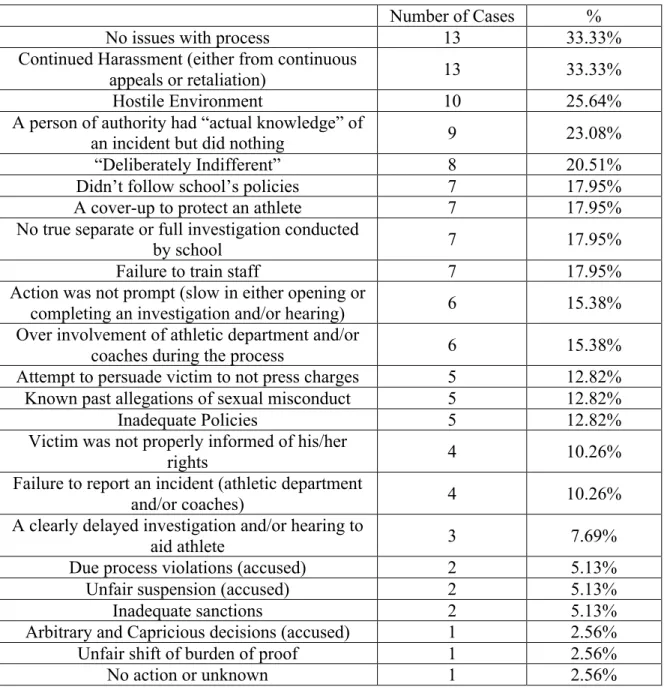
For each case, the school’s process was examined whether it was Title IX compliant; cases were coded for each individual failing (Table 2). Lawsuits as well as news articles from these cases were examined and 23 codes were developed to explain what occurred through the process (Appendix C). Of the 23 codes, 21 were unique ways schools fell short of compliance. The two additional codes included: no known issues in how the case was handled (33.33% of cases resulted in this) and no action taken after an allegation. Only one case received this coding, the result after Duke University basketball player Rasheed Suliamon was accused of sexual assault in February 2014. The school took no action, however, he was dismissed from the team soon after reportedly for a separate team rules violation. Suliamon then transferred to the University of Maryland.
staff to reasonably handle accusations of sexual assault or showed a “deliberate indifference” to accusations (20.51%). In a few cases, staff, were found to have had knowledge of an assault but not act in response to that knowledge (23.08%).
Multiple school (not athletic department) administrators were found to have attempted to cover-up an allegation against a student athlete (17.95%), attempted to delay hearings or
investigations to allow the student-athlete to participate in events (7.69%), or ignored previous allegations of sexual assault committed by a student-athlete (12.82%). Only two errors were
athletic department specific: “failure to report an incident,” which was found in four cases and “over involvement of staff,” which was found in six cases.
Three issues were related to the treatment of victims. Four schools (10.26%) were found to have not properly informed victims of their rights. For example, the lawsuit filed against Boise State alleged the school “failed to inform her of her right to file a criminal complaint against the BSU perpetrator, and even failed to provide her with information regarding available mental health services" (Moeller, 2015). The Huffington Post quoted a lawsuit against Brown University, “the university “led her to believe she had a choice of either pursuing a school investigation that would potentially remove her alleged attacker from campus or going to police, but not both” (Kingdade, April 4, 2014). Additionally, schools were found to allow continuing
harassment of victims (33.33%) and in some cases even attempted to persuade them to not press charges (12.82%).
TABLE 2: Findings Regarding Schools’ Process of Handling Cases of Sexual Assault
Number of Cases %
No issues with process 13 33.33%
Continued Harassment (either from continuous
appeals or retaliation) 13 33.33%
Hostile Environment 10 25.64%
A person of authority had “actual knowledge” of
an incident but did nothing 9 23.08%
“Deliberately Indifferent” 8 20.51%
Didn’t follow school’s policies 7 17.95%
A cover-up to protect an athlete 7 17.95%
No true separate or full investigation conducted
by school 7 17.95%
Failure to train staff 7 17.95%
Action was not prompt (slow in either opening or
completing an investigation and/or hearing) 6 15.38% Over involvement of athletic department and/or
coaches during the process 6 15.38%
Attempt to persuade victim to not press charges 5 12.82% Known past allegations of sexual misconduct 5 12.82%
Inadequate Policies 5 12.82%
Victim was not properly informed of his/her
rights 4 10.26%
Failure to report an incident (athletic department
and/or coaches) 4 10.26%
A clearly delayed investigation and/or hearing to
aid athlete 3 7.69%
Due process violations (accused) 2 5.13%
Unfair suspension (accused) 2 5.13%
Inadequate sanctions 2 5.13%
Arbitrary and Capricious decisions (accused) 1 2.56%
Unfair shift of burden of proof 1 2.56%
No action or unknown 1 2.56%
What similarities, if any, are there between issues found with the handling of cases?
accusers and accused. According to a lawsuit filed by a track athlete at Boise State she "not only had to see the BSU perpetrator at practices following the rape, she also had to endure open sexual taunting by him at those practices"(Boone, 2014). Former Xavier basketball player Dez Wells stated he had “been "branded" as a sexual predator and has been heckled by opposing fans at road games on the subject matter” (Auerbuch, 2013). Multiple lawsuits also described the ability for those found responsible by schools to file multiple appeals after the verdict, causing additional harassment of the victims.
Schools were also often at fault for creating a hostile environment for students. This was true at ten schools. Schools failed to remedy environments that allowed for these assaults to occur. Many had also facilitated environments that did not encourage victims to speak up and report assaults. The current lawsuit against the University of Tennessee states “a hostile sexual
environment was created by this procedure and policy as varsity athletes were condoned and encouraged to have parties with alcohol and drugs, entertain recruits, provide alcohol to underage female students and commit sexual assaults with no discipline or deterrence against committing sexual assaults as perpetrators of assaults faced no serious consequences.” (Jane Doe,
et al. v. University of Tennessee, 2016, p.3). A complaint against the University of Kentucky
alleged, “the University of Kentucky has condoned, permitted and engaged in a hostile environment against the victim of a sexual assault" (Blackford, 2015).
Nine cases alleged that a person of authority had “actual knowledge” of the crime but did nothing about it. According an affidavit by Boise State Athletic Director, Mark Coyle, obtained by the Idaho Statesman: “An investigation headed by the Office of the Dean of Students
“Deliberate indifference,” was cited by eight cases. The lawsuit filed against Florida State University due to the allegation against Heisman Trophy winner Jameis Winston stated the school was “deliberately indifferent” when the allegation was made (Jane Doe v. The Florida
State University, 2015, p.32). A second lawsuit filed against the University of New Mexico
wrote, “the manner in which UNM administrators, including OEO, responded to the plaintiff’s report demonstrates deliberate indifference, and willful decisions and acts to not end sexual harassment under Title IX” (Plaintiff v. The University of New Mexico Board of Regents, 2015, p. 2).
Schools failed to train their own staff or did not follow their own policy in seven cases. The lawsuit filed by Dez Wells questioned the ability of Xavier staff to handle rape kits. A statement to the press regarding the findings of an internal investigation at the University of Alaska-Fairbanks, stated, “for years, we failed to follow our own student discipline policies for the most serious violations of the student code of conduct: assault, burglary and rape” (Caldwell, 2015).
An attempt to cover-up an allegation to protect a student-athlete or the lack of a separate or full investigation also occurred in seven cases. At Boise State: “the athletic department or key members of athletic department had implemented a policy of protecting athletes who had been accused of sexual assaults” according to an article in the Idaho Statesman (Moeller, 2015).
According to a New York Times article, Hobart and William Smith Colleges took “just 12 days to investigate the rape report, hold a hearing and clear the football players” (Bogdanich, July 2014).
returning its football players to team play, protecting the athletic department, and protecting males” (Plaintiff v. The University of New Mexico Board of Regents, 2015, p.2).
Although it is important to conduct a thorough investigation of a complaint, Title IX also requires a prompt resolution to a complaint. Six cases did not provide this. For example, it took one year after Jameis Winston was identified to police for school officials to sit down and speak with him. It was almost one year after that before the school held a hearing on the sexual assault complaint (Bogdanich, April 2014).
Far less often (but still found in five cases), school officials were found to attempt to persuade the victim not to press charges, or knew of past allegations of sexual assault involving the student-athlete but did nothing to mitigate this issue. University of Alabama-Huntsville police told one victim, “You will never win in court”, that “"people who hang out at the hockey dorms share girls all the time,” and that it “was completely normal and okay to have sex with someone that [the plaintiff didn’t] know” (Jane Doe v. The University of Alabama in Huntsville, 2014, p. 3-4). The victim’s lawyer in the Florida State University case stated the investigator told her client "that because Tallahassee was a big football town, her client would be 'raked over the coals' if she pursued the case” (Bogdanich, April 2014). The lawsuit against Tulsa University alleges "Despite its knowledge of at least one, and as many as three prior allegations of sexual assault and misconduct perpetrated by Swilling, TU undertook zero investigation of his conduct and permitted Swilling to continue to attend TU," (Ross v. The University of Tulsa, 2014, p.5).
Five cases also found that schools had inadequate policies before the assault even occurred. All three lawsuits filed by accused student-athletes cite this as a reason for their
Victims also faced similar issues. The New York Times wrote of Hobart and William Smith Colleges, “Whatever precisely happened that September night, the internal records, along with interviews with students, sexual-assault experts and college officials, depict a school ill prepared to evaluate an allegation so serious” (Bogdanich, July 2014).
What changes can schools make to better comply with these guidelines?
Based on the trends found in this study, schools can better comply both prior to an allegation occurring as well as after a complaint as been filed.
Schools must ensure their policies for reporting, investigating, conducting hearings and administering punishments are adequate (Dear Colleague Letter, 2011, p. 9-10). Specifically, schools must have set information that is readily available that explains the process of reporting for victims (Dear Colleague Letter, 2011, p. 9). Then additional information must be available that thoroughly explains the options for pressing charges and the process that will occur with each option (Dear Colleague Letter, 2011, p.10). Information regarding accommodations to prevent continued harassment must also be included, including how to deal with the accused during the investigative process (Dear Colleague Letter, 2011, p. 15). For example, should the accused be immediately suspended following an accusation or should they be allowed to stay on campus?
It is also important to have one policy designed for all students, with no special treatment for student-athletes (Wilson, 2014, p. 24-25). However, when a student-athlete is accused it is equally important to be aware that many more people are going to be involved including coaches, teammates and other athletic department personnel. Therefore, policies that dictate how these groups should act when an allegation occurs should be included (Wilson, 2014, p. 22). For example, once an assault is reported, the athletic department should have no continuing presence during the investigation. Whether a student-athlete is immediately suspended from a team should also be established prior to an allegation.
It is important to create an environment and culture that combats and reports sexual
(Wilson, 2014, p. 11). Having policies for when an assault occurs is important, however, they are
useless if a school has an environment that covers up or discourages reports of sexual assault. The culture within a school and athletic department must be one of reporting as soon as one has knowledge of an incident. Having knowledge of an assault and either not reporting it or covering it up were both huge issues in many of these cases.
CHAPTER 5: DISCUSSION
United Educators examined 305 reported incidents from 104 institutions they insured between 2011 and 2013, a similar timeline to this study. This research provides an excellent overview of the sexual assault landscape on college campuses, and therefore provides a good guideline to compare assaults committed by student-athletes to the rest of the collegiate population. The United Educators study found schools investigated 77% of cases, and of the students then found responsible, 43% were expelled and 39% were suspended. This study saw a slightly lower rate of school involvement (71.79%) and suspension (32%), but higher rates of expulsion (52%).
The UE study found that 60% of assaults occurred off-campus and 41% occurred at off campus parties. This study found that only 35.9% of assaults occurred off-campus (although 28.21% of cases did not specify). Seventy-eight percent of the cases researched by the UE involved alcohol, while only 33.3% of the cases in this study involved alcohol. However,
similarly to location, 48.72% did not specify whether alcohol was involved, so the number could be much higher. Repeat offenses occurred in less frequency in this study: 20% of offenders were found to be repeat offenders in the UE study, while 15.38% were found in this study.
Theoretical Framework
managerialism theory, or that “Non-compliance is inadvertent, stemming from lack of capacity or resources, ambiguous, commitments and provisions, and time lags between commitment and performance” (Zaelke, 2005, p. 57-58). This theory seems unlikely due to the limitations put on this study. Only cases after the Dear Colleague Letter was published in 2011 were used. The DCL should have provided schools enough information to not lack the resources needed to remain compliant. However, multiple mistakes were due to inadequate policies, procedures and sanctions, procedures that were not prompt and not properly informing victims of their rights. Therefore, schools do not lack the information of how to remain compliant but do not have sufficient resources within their own guidelines to remain compliant throughout a case.
Although the schools had the information necessary in 2011, educational institutions are often slow moving bureaucracies and resources are generally not instantaneously provided. Likewise, changing policies and procedures often requires forming a representative committee, fact-finding, discussion, drafting policies and procedures, debate and open forums for comments, then finally adoption and publication.
Deterrence theory provides a better framework: “there must be a credible likelihood of detecting violations; swift, certain, and appropriate sanctions upon detection; and a perception among the regulated firms that these detection and sanction elements are present” (Zaelke, 2005, p. 59). Title IX was enacted in 1972. The sexual harassment regulations and guidance
sanction elements are present.” The amount of missteps that involved blatant over-involvement of athletics staff, cover-ups to ensure student-athletes could still participate, and attempts to persuade victims to not press charges detailed in this research indicates that many schools do not feel these adverse efforts will be discovered.
The last source for non-compliance is the culture of the school and athletic department. Many of the problems found in these cases were due to a hostile environment on campus. This includes how athletic and non-athletic administrators act such as: not reporting assaults, recruiting players that had pervious allegations of sexual assault, deliberate indifference, continued harassment and creating a generally hostile sexual environment. The current lawsuit filed against the University of Tennessee alleges the culture of allowing student-athletes to get away with sexual assault created an unsafe environment of other students:
Incidents involving athletes and misconduct, including specifically sexual violence, have been part of a hostile sexual environment and culture of the University of Tennessee Athletic Department for more than a decade. Plaintiffs aver that the University’s actions affirmatively and deliberately created (and creates) a hostile discriminatory sexual environment for female students and acted with deliberate indifference in its response to incidents of sexual assault in a pattern, practice, practice, policy, and custom of grossly inadequate discipline and resolution in specific favor of male, “major sports” athletes.
(Jane Doe, et al. v. University of Tennessee, 2016, p.7)
Limitations
Information regarding cases of sexual assault is always difficult to obtain, as seen in the amount of information that was unknown or not specified in this study. Although Freedom of Information requests to the Office of Civil Rights for the Title IX complaints were made six months prior to the study, OCR merely replied with an acknowledgement of the request and these complaints and/or resolutions were not provided. Therefore, only information that was readily (publicly) available was used in this study. Lawsuits provided significant information where applicable, however, news articles were relied on for cases that did not involve suits or when suits were not available. While it was assumed that the news source information was reliable, the amount of detail and advocacy perspectives of the writer may have omitted important facts.
Many of the cases were ongoing and few outcomes were reached at this time that would provide complete information regarding the case and its full progression. Additionally, because the data for the study was predominately provided in complaints and news articles about
complaints, the victim’s perspective was much more heavily represented. Only four lawsuits from accused student-athletes were found for this study and only one case (Brandon Austin at Oregon University) provided lawsuits from both the victim and accused student-athlete.
Additionally, very few schools spoke on the allegations, other than to submit statements similar to the one published by Boise State:
learning environment for all students and have instituted programs and policies to prevent discrimination in all its forms. We also are committed to investigating and addressing complaints when they occur. (Boone, 2014)
Therefore, without completed investigations or litigation, it was difficult to establish with complete certainty the happenings surround these cases.
Future Research