EFFECT OF LIGHT AND MEDIUM INTENSITY BRAIN
GYMNASTICS ON THE IMPROVEMENT OF COGNITIVE
FUNCTION IN ELDERLY
Parellangi*, Rina Loriana, Rivan Firdaus
Department of Nursing, Health Polytechnic of Health Ministry, East Kalimantan, Indonesia
*Corresponding author: Parellangi
Department of Nursing, Health Polytechnic of Health Ministry, East Kalimantan, Indonesia
Jl. W. Monginsidi No.38, Sidodadi, Kec. Samarinda Ulu, Kota Samarinda Kalimantan Timur 75243, Indonesia
Email: [email protected]
Abstract
Background: Decreased brain aging is due to impaired cognitive function. One effort to inhibit cognitive decline due to aging is by doing brain gym.
Objective: This study aims to examine the effect of light and medium intensity brain gymnastic on the improvement of cognitive function of elderly, and compare its result between the two intervention.
Methods: This was an experimental research with pre-test and post-test group design conducted in 2016. There were 66 people included in this study, which 33 randomly assigned in the light intensity brain gymnastic group (group I) and medium intensity brain gymnastic group (group II). Mini Mental State Examination (MMSE) questionnaires was used to measure cognitive function of elderly. Data were analyzed using univariate and bivariate analysis. Bivariate analysis used paired t-test and independent sample t-test.
Results: Findings of this study reveal that there was a significant effect of light and medium intensity brain gymnastic on the improvement of cognitive function of elderly (p=0.000). However, light intensity brain gymnastics (mean= 6.61) is better in improving the cognitive function of the elderly compared with medium intensity brain gymnastics (mean 2.18), with p=0.000, respectively.
Conclusions: Brain gymnastic with light intensity for 10 minutes per exercise with frequency of 3 times a week is more effective in improving the cognitive function of the elderly compared with brain gymnastic with medium intensity for 15 minutes per exercise with frequency of two times a week.
Keywords: brain gym; elderly; cognitive function
INTRODUCTION
An indicator of the success on development, especially in the field of health, is increasing life expectancy. This will cause the number of elderly populations increases gradually from year to year. The number of elderly people in 2000 was 7.18% of the total population in Indonesia and increased to 9.77% in 2010 and it is projected in 2020 will increase to 11.34%.
Increasing the number of elderly from year to year will be a challenge, especially for health workers because if it is not well managed it will cause the burden for the state due to decreased the cognitive function, such as dementia (MOH, 2014). Previous study with 10255 elderly over the age of 75 suggests that in the elderly there are physical disorders of © 2018 The Author(s)
This is an Open Access article distributed under the terms of the Creative Commons Attribution 4.0 International License which permits unrestricted non-commercial use, distribution, and reproduction in any medium, provided the original work is properly cited.
arthritis or joint disorder (55%), standing balance (50%), cognitive function of the central nervous system (45%), vision (35%), listening (35%), cardiac abnormalities (20%), shortness of breath (20%), and bedwetting (10%) (Suhartini, 2010).
The decrease in the intensity and duration of activity will accelerate the process of cognitive decline and affect the brain of aging due to impaired the cognitive function (Lautenschlager, Cox, & Cyarto, 2012; van Gelder et al., 2006). One attempt to prevent the cognitive decline due to aging is to do a brain gym that aims to maintain the brain health by doing a bodybuilding. Brain gym for the elderly has great benefits because it increases the flow and volume of blood supply that carries oxygen to the organs of the body, especially to the organs of the brain.
The previous research (Doewes, 2009) was conducted on exercise and brain health in the elderly said that there is a relationship between physical fitness with neurological degeneration, in which brain gym for the elderly is a very effective to reduce and prevent the decline in cognitive function associated with the problem of aging. This study aims to identify the timing and frequency of the most effective brain gym to improve cognitive function in the elderly with impaired cognitive function.
METHODS
Study design
This was an experimental research with pre-test and post-pre-test group design. The study was conducted at the Social Institution of Tresna Werda Nirwana Puri Samarinda, East Kalimantan Province, Indonesia on August 1, until October 30, 2016.
Sample
The sample size is determined by taking all members of the population into samples according to the inclusion criteria. There were 66 people included in this study, which 33 randomly assigned in the light intensity brain
gymnastic group (group I) and medium intensity brain gymnastic group (group II). The inclusion criteria were : 1) recorded and stayed at Tresna Werda Nirwana Social House Puri Samarinda, 2) Aged 60 - 90 years, 3) elderly with impaired cognitive function, 4) recommended by a health worker after being assessed. The exclusion criterion was elderly who got sick during the study and uncooperative.
Instrument
The instrument used to measure cognitive function of elderly were Mini Mental State Examination (MMSE) questionnaires (Folstein, Robins, & Helzer, 1983). The questionnaire contains 5 test points consisting of 11 questions using Indonesian language. Each question has a weight (score) with a maximum score of 5. Total score was categorized into 3 groups: light, medium, and heavy. Validity test is no longer necessary because the MMSE questionnaire has been standardized by the Alzheimer's Association of Indonesia POKDI. The gymnastics brain consists of 3 dimensions, namely: 1) lateral dimension includes 3 movements (cross crawl, lazy, double doodle), 2) focusing dimension includes 5 movements (the owl, the active arm, the foot flex, the gravitation glider, grounder), and 3) concentration dimension includes 7 movements (brain buttons, earth buttons, balance buttons, space buttons, the tinkling cap, hook-ups and positive point). The other instruments used were tensiometer, thermometer, weight scale, stethoscope, tape recorder, DVD, TV, CD and computer program. Cognitive function was measured before and after intervention.
Intervention
Data analysis
Data were analyzed using univariate and bivariate analysis. Bivariate analysis used paired t-test and independent sample t-test.
Ethical consideration
This research has been approved by the Polytechnic Research Commission of Poltekkes Kemenkes Semarang with approval number: 86 / KEPK / Poltekkes-Smg / EC / 2016.
RESULTS
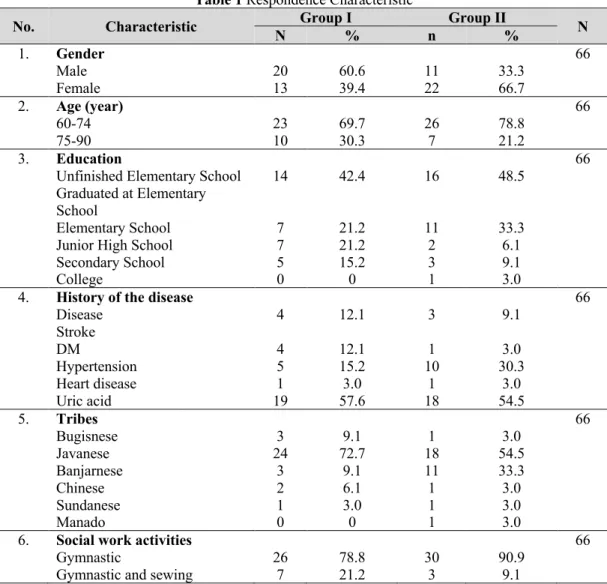
The characteristics of respondents as shown in the table 1 were mostly males (60.6%) in the group I, aged 60-74 years (78.8%), 42.4% of them did not complete primary school. Of the total respondents in the group I, 57.6% of respondents had history of gout disease, and most of the respondents came from Javanese tribe (72.7%). Based on the social activities, all respondents had social activities, such as gymnastics, but only 21.1% of respondents had gymnastics and sewing activities.
Table 1 Respondence Characteristic
No. Characteristic N Group I % n Group II % N
1. Gender 66
Male 20 60.6 11 33.3
Female 13 39.4 22 66.7
2. Age (year) 66
60-74 23 69.7 26 78.8
75-90 10 30.3 7 21.2
3. Education 66
Unfinished Elementary School Graduated at Elementary School
14 42.4 16 48.5
Elementary School 7 21.2 11 33.3
Junior High School 7 21.2 2 6.1
Secondary School 5 15.2 3 9.1
College 0 0 1 3.0
4. History of the disease 66
Disease
Stroke 4 12.1 3 9.1
DM 4 12.1 1 3.0
Hypertension 5 15.2 10 30.3
Heart disease 1 3.0 1 3.0
Uric acid 19 57.6 18 54.5
5. Tribes 66
Bugisnese 3 9.1 1 3.0
Javanese 24 72.7 18 54.5
Banjarnese 3 9.1 11 33.3
Chinese 2 6.1 1 3.0
Sundanese 1 3.0 1 3.0
Manado 0 0 1 3.0
6. Social work activities 66
Gymnastic 26 78.8 30 90.9
Gymnastic and sewing 7 21.2 3 9.1
While the majority of the characteristics of respondents in the group II were females (66.6%), aged 60-74 years (78.8%), and 48.5% of respondents did not complete primary
respondents have social activities, such as
gymnastics performed routinely, but it was only 9.1% of respondents having gymnastics and sewing activities.
Table 2 Difference of mean on the improvement of the cognitive functions before and after a brain gym
intervention
Group Cognitive Function Correlation p-value
Before After Mean±SD
Group I 20.58 ± 2.840 27.18 ± 1.402 6.6± 1.903 0.805 0.000
Group II 20.52 ± 2.671 22.70 ± 3.255 2.18± 1.570 0.878 0.000
Table 2 shows the results of paired sample t-test in group I obtained p value = 0.000 < 0.05 as well as in the group II with p = 0.000 < 0.05, which indicated that there were significant differences in the cognitive function before and after given the intervention both in group I and in group II. The average increases in the cognitive function in the group I was 6.6 with a standard deviation of 1.903, which is higher than the mean of cognitive function in the group II with only 2.18 with a standard deviation of 1.570. It can be concluded that 10 minutes of brain gymnastic for 10 minutes per exercise with frequency of 3 times a week is more effective in improving the cognitive function of the elderly compared with brain gymnastic for 15 minutes per exercise with frequency of 2 times a week.
The value of correlation before and after the intervention of brain gym in the group I was equal to 0.805, so that the brain gym contribution to the improvement of the cognitive function in elderly in the group II was (0.805)2 = 0.648 (64.8%). It can be concluded that 64.8% of the improvement of elderly cognitive function in the group I was caused by light brain gymnastic, while the other 35.2% was caused by other factors. Similarly, in the group II, the correlation obtained before and after the intervention was (0.878) 2 = 0.771 (77.1%), which mean that 77.1% of the cognitive function of the elderly in group II was caused by medium intensity brain gymnastic, the remaining of 22.9% was caused by other factors.
Table 3 The improved the cognitive function before and after the brain intervention was given to group I and
group II
Group Cognitive function %
Before After Mean
Group I 20.58 27.18 6.6 32.07
Group II 20.52 22.70 2.18 10.62
Table 3 shows the improvement of the cognitive function of elderly in the group I was 32.07% and in the group II was 10.62%. It can be concluded that light intensity brain gymnastics is more effective in improving the cognitive function of the elderly compared with medium intensity brain gymnastics. While Table 4 shows that the Levene test
obtained p = 0.473 (>0.05), which can be concluded that the data from both groups were homogenous. While the result of independent sample t-test obtained p = 0.000 (< 0.05), which indicated that there was a significant difference in the improvement of cognitive function of elderly between group I and II.
Table 4 Differences in the Cognitive Function between group I and group II after given intervention
Group N Mean ±SD Levene test P-value
Group I 33 6.61± 1.903 0.473 0.000
DISCUSSION
Findings of this study reveal that there was a significant effect of light and medium intensity brain gymnastic on the improvement of cognitive function of elderly. However, our study found that light intensity brain gymnastics is more effective in improving the cognitive function of the elderly compared with medium intensity brain gymnastics. This result is in line with previous study that brain exercise performed for 1 month resulted in the cognitive function improvement in elderly, which reached 60%. There was an influence of brain gymnastics on the cognitive enhancement function in elderly (p = 0.001) and the difference of the cognitive function was also seen between the experimental group and the control group (p = 0.001) (Yusuf, Indarwati, & Jayanto, 2017).
The improvement of the cognitive function in the elderly is caused by a brain gym intervention that trains elderly to concentrate and stimulate their brain. Brain gym improves fitness and reduces the cardiovascular risk factors, so as to increase blood flow and blood supply volume to the brain, which increases oxygen supply of the brain and affects the neurological degeneration (Kirk-Sanchez & McGough, 2014). The cognitive training also has the potential to improve elderly of the cognitive function and slow the decline in the cognitive function due to aging (Gates & Valenzuela, 2010).
In the lateral dimension, the left brain is active when the right side of the body is moved and the right is active when the left side of the body is moved. In this case, the ability to learn will be maximized if both sides of the brain work well together (As’adi, 2011). The dimension of focusing gives us the attention intelligence. As humans, we have grown up with a unique ability to plan, fulfill purpose, have intentions, and find meaning in life. The brain organizes itself to focus our attention in order to appear purposefully and efficiently. The centering dimension depends on the relationship between the rational big brain (at the very top of the brain), and the lower
emotional limbic system, through which all incoming sensory information is processed. This association brings together the more logical and verbal capabilities of the cortex with more geographical, intuitive, and sometimes irrational needs of the lower part of the brain (Dennison & Dennison, 2006).
Brain gymnastic with light intensity for 10 minutes per exercise with frequency of 3 times a week was more effective in improving the cognitive function of the elderly compared with brain gymnastic with medium intensity for 15 minutes per exercise with frequency of 2 times a week. This is in accordance with the previous research that suggests that the frequency of brain exercise is at least 3 times a week to improve VO2max to improve elderly cognitive function (Pollock, Feigenbaum, & Brechue, 1995).
CONCLUSION
Brain gymnastic with light intensity for 10 minutes per exercise with frequency of 3 times a week is more effective in improving the cognitive function of the elderly compared with brain gymnastic with medium intensity for 15 minutes per exercise with frequency of 2 times a week. The result of this research can be one of sources to decrease cognitive function decline. Combined brain gymnastic with another technique is suggested to the next research.
Declaration of Conflicting Interest
None declared.
Funding
This study has been supported by Department of Nursing, Health Polytechnic of Health Ministry, East Kalimantan, Indonesia.
Author Contribution
All authors contributed equally in this study.
References
As’adi, M. (2011). Dahsyatnya senam otak [The great impact of brain exercise]. Yogyakarta: Diva Press. Dennison, P. E., & Dennison, G. E. (2006). Buku
panduan lengkap brain gym-senam otak [Complete guideline book of brain gym]. Jakarta: Grasindo. Doewes, M. (2009). Exercise and Brain Health in
Folstein, M. F., Robins, L. N., & Helzer, J. E. (1983). The mini-mental state examination. Archives of General Psychiatry, 40(7), 812-812.
Gates, N., & Valenzuela, M. (2010). Cognitive exercise and its role in cognitive function in older adults.
Current Psychiatry Reports, 12(1), 20-27. Kirk-Sanchez, N. J., & McGough, E. L. (2014). Physical
exercise and cognitive performance in the elderly: current perspectives. Clinical Interventions in Aging, 9, 51.
Lautenschlager, N. T., Cox, K., & Cyarto, E. V. (2012). The influence of exercise on brain aging and dementia. Biochimica et biophysica acta (BBA)-Molecular basis of disease, 1822(3), 474-481. MOH. (2014). Situasi dan analisa lanjut usia [situation
and analysis of aging]. Jakarta: Pusat Data Informasi, Ministry of Health of Republic of Indonesia.
Pollock, M. L., Feigenbaum, M. S., & Brechue, W. F. (1995). Exercise prescription for physical fitness.
Quest, 47(3), 320-337.
Suhartini, B. (2010). Pemberdayaan lansia dengan aktivitas olahraga rekreasi therapuetik [Empowering elderly with exercise activity of therapeutic recreation]. Medikora, 5(2), 131-140. van Gelder, B. M., Tijhuis, M., Kalmijn, S., Giampaoli,
S., Nissinen, A., & Kromhout, D. (2006). Marital status and living situation during a 5-year period are associated with a subsequent 10-year cognitive decline in older men: the FINE Study. The Journals of Gerontology Series B: Psychological Sciences and Social Sciences, 61(4), P213-P219. Yusuf, A., Indarwati, R., & Jayanto, A. D. (2017). Brain
gym improves cognitive function for elderly.
Jurnal Ners, 5(1), 79-86.