THE FOOD SAFETY POLICY GAP:
ESSAYS ON EMERGENCY FOOD IN NORTH CAROLINA
Ashley Chaifetz
A dissertation submitted to the faculty at the University of North Carolina at Chapel Hill in partial fulfillment of the requirements for the degree of Doctor of Philosophy in the Department of Public
Policy.
Chapel Hill 2015
ABSTRACT
Ashley Chaifetz: The Food Safety Policy Gap: Essays on Emergency Food in North Carolina (Under the direction of Pamela Jagger)
In an effort to detail, describe, categorize, and analyze the emergency food system of North Carolina, this research presents three essays focused on food pantry procedures as related to food safety. Given the focus on food insecurity, food safety is often a lower priority for food pantries; however, foodborne illness is a serious problem that affects 1 in 6 Americans each year. The first essay identifies and catalogues the standard operating procedures of 105 North Carolina food pantries, comparing those who partner with a formal food bank to those that operate independently,
ACKNOWLEDGEMENTS
I am incredibly grateful for the time, patience, and continued insight of Benjamin Chapman at North Carolina State University, in addition to his willingness to support my dissertation research. Without his generosity, there is little chance this dissertation would be completed at this time. Ben holds the answers to every food safety question I have ever asked, as well as those I do not yet know to ask; his expertise (and unfailing belief in my abilities) truly helped to bring his project into reality. I am infinitely thankful for every nice thing he has ever said about me, in person and in print, making it so others trust the food safety knowledge of a person with little hard science background.
Thank you so much to Pamela Jagger, who took a chance on an unconventional dissertation idea by an unconventional public policy graduate student. Even through international phone calls and multiple time zones, she was perfectly critical and celebratory at the appropriate times, somehow always knowing how to push me into harder and better work, improving this research piece by small piece. Every fabulous thank you to Benjamin Mason Meier, who insanely believed in my work from the moment I threw a rubber band ball at his office door and who gives me hope that someone will ask and answer all of the ever-important normative policy questions.
Immeasurable thanks to the participants and attendees of the Southern Foodways Alliance and William Winter Institute for Racial Reconciliation Graduate Symposium, the Consumer Food Safety Education Conference, and the Northeastern University Workshop on Feeding Cities for their feedback on preliminary results.
This project was supported, in part, by the Agriculture and Food Research Initiative
Competitive Grant no. 2012-68003-30155 from the USDA National Institute of Food and Agriculture and a Leland J. Bellòt Summer Research Fellowship from the University of North Carolina Graduate School. Without these funding sources, I do not know if and when this project would have reached completion. To every person who walked Chloe Moses, let her sleep over, or allowed her to come to a meeting; we offer our appreciation. And to everyone who loaned me a car so that this research could happen at all.
Love and thank you to my family, those related by blood or otherwise—for genuinely believing that I could do this thing. Thanks to my parents, Tina and Farrell, who taught me to dream big; to my brother, Blake, the silliest but best backer of all my decisions. To my cheerleaders: Shira Goldman, Alexandra Graddy-Reed, Courtney Manuel, and Yelena Mokritsky. A giant special thank you to Alex for so many things, including but not limited to answering endless questions regarding statistics and code. I am truly blessed you have been here with me on this journey. A huge shout-out to my dearest Shira for all of her love and support from the moment we left New York; thank you for being there in the worst and best times.
PREFACE
In the summer of 2008, hundreds of people were sick from eating a then-unknown
contaminated food. At the time, it was the largest foodborne illness outbreak in a decade—and the end result was 1,442 confirmed cases of Salmonella Saintpaul (CDC, 2008). The Centers for Disease Control and Prevention and the Food and Drug Administration struggle to determine which product was the culprit; they warned the public that food was possibly tomatoes, jalapeno or Serrano peppers, or even cilantro.1 The agencies were unable to trace the source of contamination to a particular location, going back and forth between Florida and Mexico for months. At the time, I watched a news broadcast in which the reporter detailed only four countries in the world that had been essentially “ruled out” in terms of supplying the product. I distinctly remember going to the grocery store with a list of tomatoes sanctioned by the FDA, as no product in particular had been officially recalled. Multiple tomato growers lost the ability to sell their tomatoes and left them to rot in the field, and it was eventually discovered that the cause of the illnesses were the peppers from Mexico.
To put it lightly, I was obsessed with this outbreak. Even then, I knew that our system was flawed. I just could not understand how and why, in a developed country like America, we could not figure out what was making people sick, or how people without healthcare would be able to get medical assistance for something so dire.2 It was in this outbreak that my interests in food systems policy
expanded to providing citizens with practical scientific information, but also in foodborne illness prevention—and I refuse to look back.
TABLE OF CONTENTS
LIST OF TABLES ... xi
LIST OF FIGURES ... xiii
LIST OF ABBREVIATIONS ... xiv
CHAPTER 1: FOOD SAFETY AND FOOD SECURITY IN AMERICA ... 1
1.1 Introduction ... 1
1.2 Emergency Food ... 1
1.3 Food Safety and Risk ... 4
1.4 Food Waste ... 7
1.5 Corporate Social Responsibility ... 8
1.6 Overview of Dissertation ... 10
CHAPTER 2: EVALUATING NORTH CAROLINA FOOD PANTRY STANDARD OPERATING PROCEDURES: A MIXED-METHODS APPROACH ... 12
2.1 Introduction ... 12
2.2 Literature Review ... 13
2.3 Research Design ... 17
2.3.1 Sample Selection ... 17
2.3.2 Participant Recruitment ... 18
2.3.3 Survey Instrument ... 19
2.3.4 Data Collection and Analysis ... 20
2.4.2 Food Bank Partnership ... 23
2.4.3 Regional Differences ... 28
2.4.4 Food Establishment Inspection Report Questions ... 29
2.5 Additional Themes Established ... 32
2.5.1 Donor Concerns ... 32
2.5.2 Distribution Practices ... 33
2.5.3 Waste Issues ... 34
2.6 Limitations ... 35
2.7 Conclusions ... 36
CHAPTER 3: RISK ANALYSIS OF THE EMERGENCY FOOD SUPPLY CHAIN ... 48
3.1 Introduction ... 48
3.2 Literature Review: Supply Chain Management and Risk Frameworks ... 50
3.3 Research Approach ... 52
3.3.1 Sample Selection ... 52
3.3.2 Participant Recruitment ... 53
3.3.3 Survey Instrument ... 54
3.3.4 Data Collection ... 55
3.4 Descriptive Data Analysis ... 56
3.4.1 Distribution and Storage ... 56
3.4.2 Food Sources ... 58
3.4.3 Transportation ... 60
3.4.4 Transport Times ... 61
3.5 Emergency Food Supply Chain Risk Analysis ... 65
3.5.1 Risk Identification and Creation of Framework ... 66
3.5.2 Method of Analysis ... 67
3.5.3 Empirical Results ... 68
3.6 Limitations ... 70
3.7 Conclusions and Future Research ... 71
CHAPTER 4: EVALUATING FOOD SAFETY GUIDELINES IN FOOD PANTRIES 4.1 Introduction and Motivation ... 89
4.2 Theoretical Framework: Food Handling and the Theory of Planned Behavior ... 89
4.3 Intervention: Online Video Guidelines ... 94
4.4 Empirical Strategy ... 96
4.4.1 Data ... 96
4.4.2 Evaluation Materials ... 99
4.4.3 Sample ... 99
4.4.4 Assignment to Treatment and Control Groups ... 102
4.4.5 Descriptive Statistics ... 102
4.4.6 Difference-in-Difference ... 103
4.5 Results and Discussion ... 105
4.5.1 Difference-in-Difference Results ... 105
4.5.2 Empirical and Analytical Concerns ... 107
4.6 Limitations ... 109
4.7 Policy Implications and Conclusion ... 110
CHAPTER 5: CONCLUSIONS AND FUTURE RESEARCH ... 125
5.2 Chapter 2 Conclusions ... 126
5.3 Chapter 3 Conclusions ... 127
5.4 Chapter 4 Conclusions ... 127
5.5 Regulatory Concerns and Implications ... 128
5.6 Overall Conclusions ... 129
APPENDIX A: LOCAL FOODS, ACCESS, AND PANTRY TYPOLOGY ... 132
APPENDIX B: ADDITIONAL SUPPLY CHAIN DESCRIPTIVE STATISTICS ... 134
APPENDIX C: ADDITIONAL EVALUATION TESTS ... 136
LIST OF TABLES
2.1 Pantry partnerships by region ... 39
2.2 Food pantry organizational characteristics ... 40
2.3 Average prevalence of particular pantry characteristics by food bank partnership ... 41
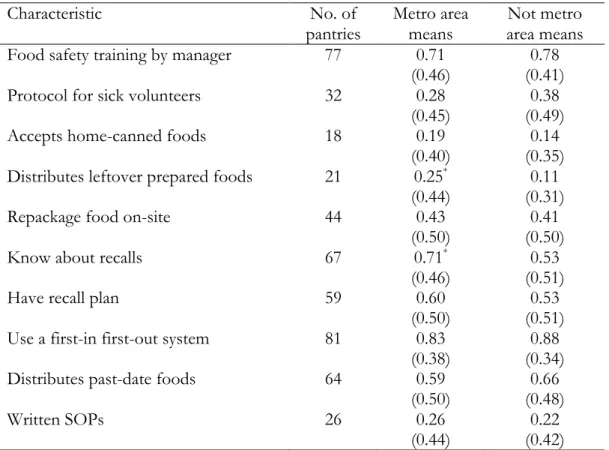
2.4 Average prevalence of particular pantry characteristics by metro area ... 42
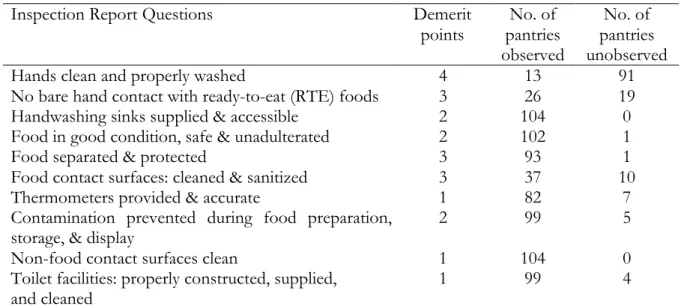
2.5 Possible demerit points for selected Food Establishment Inspection Report questions ... 43
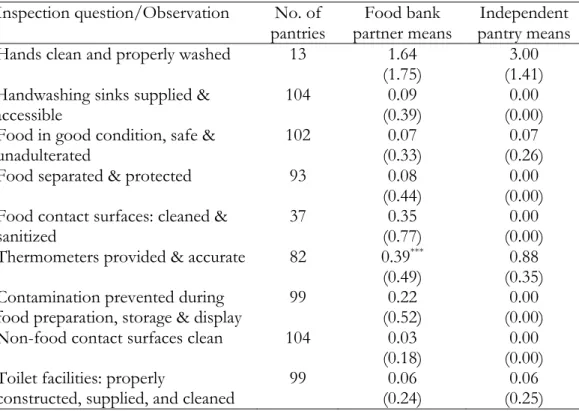
2.6 Average Food Establishment Inspection Report demerit points by food bank partnership ... 44
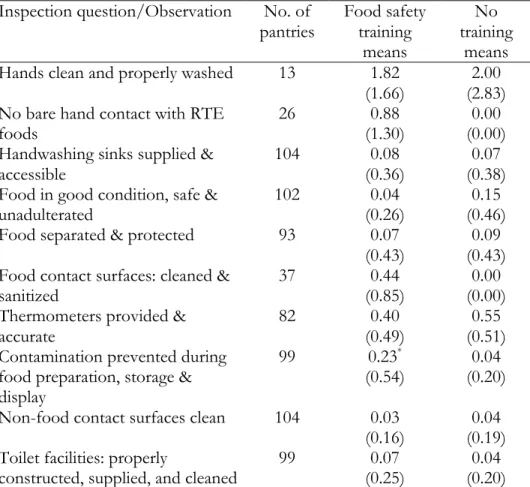
2.7 Average Food Establishment Inspection Report demerit points by food safety training ... 45
2.8 Themes established via qualitative analysis ... 46
3.1 Sources of food ... 73
3.2 Known food sources by type of food ... 74
3.3 Food transit times ... 75
3.4 Distance food travels from various types of locations in minutes, by food bank partnership ... 76
3.5 Distance travels from various types of locations in minutes, by metropolitan status ... 77
3.6 Traceability of items and food bank partnership ... 78
3.7 Traceability of items by food bank partners, by metropolitan status ... 79
3.8 Food pantry risk factors ... 80
3.9 Number of risks per number of pantries ... 81
3.10 Descriptive statistics ... 82
3.11 Coefficients and marginal effects from three models ... 83
3.12 Marginal effects for food bank partners only ... 84
4.1 Food Establishment Inspection Report questions and point values ... 113
4.2 Descriptive statistics and paired t-tests for all pantries in both rounds ... 114
4.4 Difference-in-difference results, by category ... 117
4.5 Difference-in-difference results by category, controlling for food bank ... 119
4.6 Difference-in-difference results by summed category, controlling for food bank ... 121
4.7 Total-sum difference-in-difference results, controlling for food bank ... 122
4.8 Average demerit points for Food Establishment Inspection Report questions by video viewership ... 123
4.9 Average prevalence of particular pantry characteristics by video viewership ... 124
B.1 Descriptive statistics for food bank partners ... 134
B.2 Descriptive statistics for independent pantries ... 135
C.1 Paired t-tests of demerited points by category ... 137
C.2 Difference-in-difference results by category ... 138
LIST OF FIGURES
2.1 Image of Food Establishment Inspection Report ... 47
3.1 Percentage of pantries that distribute certain categories of items ... 85
3.2 Storage location in the pantry, by perishable item ... 86
3.3 Complete supply chain for food pantries ... 87
LIST OF ABBREVIATIONS
CDC Centers for Disease Control and Prevention CSR Corporate Social Responsibility
DD Difference-in-Difference
FDA Food and Drug Administration
MSA Metropolitan Statistical Area
NC North Carolina
NCDA North Carolina Department of Agriculture
OLS Ordinary least squares
RTE Ready-to-eat
SNAP Supplemental Nutrition Assistance Program SOPs Standard operating procedures
TEFAP The Emergency Food Assistance Program
TPB Theory of Planned Behavior
CHAPTER 1: FOOD SAFETY AND FOOD SECURITY IN AMERICA
1.1 Introduction
The safety (or lack thereof) of the American food supply is a significant problem facing individuals of all races, ethnicities, ages, and income levels. The 1993 E. coli O157:H7 outbreak stemming from Jack-in-the-Box hamburgers sparked two decades of research into the fields of microbiology, epidemiology, food technology, agricultural economics and regulatory theory. Every year, an estimated 48 million Americans (1 in 6) contract foodborne illness (Scallan et al., 2011a; Scallan et al., 2011b), stemming from grocery stores, hospitals, prisons, church banquets, county fairs, restaurants, private homes, schools, and even meal programs like Meals on Wheels (CDC Foodborne Outbreak Online Database, 2011; Vail, 2015). Analysis of data from the Centers for Disease Control and Prevention’s (CDC) FoodNet revealed 9.4 million episodes of foodborne illness, defined as consumption of contaminated foods (CDC, 2012), occur each year due to major pathogens, excluding “unspecified agents” (Scallan, et al., 2011a). The estimated costs of foodborne illness in America each year is $36 billion, with an average cost burden of $3,630 per illness (Minor et al., 2014). With various publications on the innumerable aspects of foodborne illnesses, only recently has research has explored the potential connection between food-insecure populations and risk of foodborne illness, especially for emergency foods (c.f. Henley et al., 2012; Koro et al., 2010; Quinlan, 2013).
1.2 Emergency Food
banks are large warehouse operations that store and distribute food from producers, retailers, federal commodity programs, and the food industry to the food pantries, which then distribute emergency food at the local level (Berner & O’Brien, 2004; Curtis & McClellan, 1995). Food emergencies can be often be categorized as “catastrophic and disaster events,” events that are seemingly exogenous rather than persistent (Altay & Green, 2005). Yet, the prevalence and perseverance of the emergency food networks, both formal and informal, across the country tell another story. Food banks and pantries are the largest part of the emergency food system, though individuals and families might also participate in community gardens, eat at church dinners, and accept foods from neighbors for sustenance.
In North Carolina, 27.3% of the children are categorized as food-insecure, but are only a portion of the total 1,863,330 North Carolinians who are food-insecure (Feeding America, 2013).3 While visiting a food pantry or food bank might be the result of a crisis for many of those in need, the food pantries consistently make available and provide complimentary sources of foods
throughout the year. Feeding America is largest domestic hunger relief charity, providing 46.5 million people with 3.3 billion meals annually via their 200 member food banks and 60,000 food pantries (Feeding America, 2014). This network relies heavily on corporate sponsorship, retail and manufacturing donations, and the aforementioned federal commodity programs, namely The
comes from a variety of places, from individuals and grocery stores to community gardens and restaurants (Bhattarai et al., 2005; Curtis and McClellan, 1995; Daponte and Bade, 2006; Davis et al., 2014; Teron & Tarasuk, 1999). More than one-third of supermarkets operate reclamation centers, which allow employees to sift through damaged goods in consideration for donation but they also donate prepared foods to soup and community kitchens, as well as pantries (Food Marketing Institute, 2005). Additionally, salvaged or gleaned foods from producers and distributors that might otherwise be thrown into the garbage are regularly donated (Slipchinsky & Alexander, 2008; Teron & Tarasuk, 1999). Hunters’ cooperative organizations pay for the processing and distribution of hunted game, typically venison, for its donation to food banks and food pantries, with the prevalence of such organizations flourishing in certain communities over others.
1.3 Food Safety and Risk
Overall, individuals consume more fresh fruits and vegetables than they have in the past, notoriously linked to foodborne illness, leading to increased interest and research into foodborne illness outbreaks and recalls (Beuchat, 1995; DuPont, 2007). In America, the current food safety system is the result of cooperation and management from many parts of the federal and state governments, including but not limited to the U.S. Department of Agriculture (and departments of agriculture at the state-level), the Food and Drug Administration, the Department of Defense, and state health departments. President Obama has proposed a single agency to oversee food safety policy in the United States, though its creation and implementation remains uncertain (Nixon, 2015).
A 2007 publication noted, “public concern about food safety is placing increasing pressure on government agencies to be more prescriptive and proactive in their regulation of the food industry” (Garcia Martinez et al., 2007, p. 299). Each state has different means and available funds for carrying out additional protective legislation (Jones et al., 2013). In rural populations, food systems governance issues require analyses of local urban and rural food policy, discussions of infrastructure and transportation, and programs related to food security. Rural sociologists have suggested that strengthening community structure has connections to improved food security, especially if the region can provide foodstuffs for its residents (Morton et al., 2005).
contamination can produce short to medium term health problems amongst their clientele” (Henson & Reardon, 2005, p. 245). Third-party certifications can be the result of absent federal regulations, but also voluntarily adopted as insurance for the store and, more significantly, proof of a major shift to food-related self-governance (Hatanaka et al., 2005; Hatanaka et al, 2008).
A 2003 study by Frewer and Miles resulted in overt answers about the sources of food risk information, finding high levels of distrust in the food industry. Trust in information sources is “dependent upon contextual factors, such as time of measurement and specificity of information source” (Frewer & Miles, 2003, p. 267). To understand how a consumer considers a single purchase, researchers use contingent valuation and experimental auction markets to put a value on food safety, the transaction costs, the probability of foodborne illness, and cost-of-illnesses (Alfnes & Rickertsen, 2003; Caswell, 1998; Hayes et al., 1995; Shogren et al., 1999).
USDA suggests the length of time and at what temperature the items should remain “good” past their respective expiration dates. The laws that state what foods can remain on the grocery store shelves or are required to be removed past its stamped date vary widely by state, and North Carolina has no additional food dating regulations beyond federal. Similarly, emergency food providers are typically seeking any and all available foods. The use of past-date foods is increasingly common; food banks and pantries often receive foods after a grocery store has pulled product from the shelves, usually at or near its package date.
With fewer and fewer grocery stores throughout the United States, nonmetropolitan residents are clearly disadvantaged in their access to food in general, especially if they do not own vehicles or have physical disabilities (Blanchard & Matthews, 2007). Additionally, low-income neighborhoods have fewer instances of grocery stores but have access to convenience stores, with predominately black and Asian neighborhoods at lower rates than white neighborhoods (Powell et al., 2007). The lack of access is shown to lead individuals to alternative food sources, including the pantries (Blanchard & Matthews, 2007; Smith & Morton, 2009). The food travels varying distances with varying levels of risk: hot backseats and trunks of cars, refrigerated vans, and so forth.
Additionally and more importantly, the food handlers are typically volunteers. The role of the
pantries and their volunteers in food provision is critical, yet have been excluded from food handling studies. While Akerlof’s (1970) paper on the market for “lemons” explains that the forces of the market will drive out those who offer “inferior goods,” food pantries with poor practices or
contaminated food will likely continue to go untarnished given they are not inspected or regulated.
Frequently, regulations are in place to protect the market, rather than the public (Antle, 1996) and
1.4 Food Waste
Secondary to the issue of hunger is that of food waste—the pantries are able to intercept goods (both perishable and non-perishable) that might have otherwise been wasted, in the same vein as salvage groceries but with a social welfare mandate. Those goods are used to assist a hungry population and, given the rising interest in food waste, even more food is expected to be recovered in the future, some of which will be redistributed (Gustavsson et al., 2011). Like in the traditional food system, the variety of goods available to the recipients is much broader than before, especially as more emergency food is cooked at home (Daponte & Bade, 2006). As for the food itself,
“agricultural and food products are increasingly viewed as a complex collection of quality attributes, many of which cannot be observed at either the points of purchase or consumption,” including food safety or any other information regarding the way the product is made (Henson & Reardon, 2005). Private standards from grocery stores, for example, can reduce costs and risks in the supply chains, but the supply chain does not always conclude at the grocery store (Henson & Reardon, 2005). Many food pantries also accept fresh fruits and vegetables, which present numerous opportunities for microbial contamination from farm to processor to consumer (Parker et al., 2012).
when food is actually “bad” and buy “imperfect” fruits and vegetables (Gunders, 2012), though emergency food already consists of unsaleable produce and past- or near-date dairy products. 1.5 Corporate Social Responsibility
Corporate social responsibility plays a curious role in the distribution of emergency food, as many grocery stores receive tax credits and good social will by donating their near-date and slightly damaged items to food banks and food pantries. Grocery firms determined, likely via cost-benefit analysis, how to reduce financial loss of the unsaleables, as “the social responsibility of business is to increase its profits” (Friedman, 1970). Yet, the donated items are a direct result of grocery
management’s notion that the items are good enough for those without means, but are unacceptable for store shelves. Research has shown that an ideal level of CSR exists for each firm, based on characteristics like size, research and development, and even consumer income, among other variables (McWilliams & Siegel, 2000; McWilliams & Siegel, 2001). The authors assume that the purpose of CSR is to maximize profit, but also that it is a form of investment.
In the case of emergency food, the profit motive exceeds its ethical and philanthropic components. At Food Lion stores (a subsidiary of Delhaize Group), the donation of near-date food comes as result of the corporation’s attempt to “address a growing need.” Yet, the program is described as a way to “limit the amount of food that might otherwise have to be thrown away, reducing food waste, and saving money on waste disposal” (Delhaize Group, 2012, p.84). The key part of this description is financial, as the food does not have to be (and is not) thrown away. Even with the Good Samaritan Act, one can understand level the detail needed for farmers and grocery stores to donate mass quantities of foods. According to Carroll (1991), one of the ethical
to describe ethical responsibilities as the obligation to do what is “right, just, and fair” (Carroll, 1991, p.42).
But what is “right, just, and fair” is variable. If the donated foods are good enough to feed to one group of people, then they should be good enough for all groups. More importantly, if the policies are to prevent waste, then the grocery stores would be more prudent in their purchasing— but that could mean less profit, an output also determined by Aupperle et al. (1985). However, an analysis of supply chain CSR activities shows reduced transaction costs and risk, but also increased profit (Cruz, 2009). While the discipline of logistics had lagged in social responsibility as of 2002, Murphy and Poist concluded that the discipline would have to accept the concept to reach its full potential. Recognizing that the food industry’s corporate social responsibility strategies lengthen the supply chain, health and safety are key dimensions in the food supply chain framework (Maloni & Brown, 2006). The authors’ detail on this dimension include terrorist threats, traceability, labeling, and healthy lifestyles, and conclude the section by addressing the role food companies play in combatting hunger. Finally, as they suggest future research into the food industry and an examination of practicing established standards, Maloni and Brown address the public concern regarding supply chain CSR deficiencies, though they do not include emergency food. No matter the reasons, grocery stores are key components in shifting America’s fight against hunger and food insecurity.
1.6 Overview of Dissertation
operating procedures, and supply chains of the food pantry system has remained understudied to this point, this dissertation seeks to decipher and analyze the following questions: Are the food pantries increasing the risk of foodborne illness due to their supply chains or on-site operating procedures? In this regulatory desert, how would new food safety guidelines influence on-site food handling and storage procedures? This dissertation is designed to answer those questions; it is a three-essay institutional analysis of North Carolina’s food pantry supply chain and standard operating procedures, and includes the creation and analysis of food safety guidelines specific to emergency food distributors.
and evaluate how to improve their systems. The third essay (Chapter 4) uses a
CHAPTER 2: EVALUATING NORTH CAROLINA FOOD PANTRY STANDARD
OPERATING PROCEDURES: A MIXED-METHODS APPROACH5
2.1 Introduction
The national prevalence of food insecurity, which increased in 2008 alongside the recession, has remained essentially unchanged at 14.5% (Coleman-Jensen et al., 2013). Of the families deemed very low food security by the U.S. Community Population Survey, 99% reported worrying that the food
would run out before they had the means to buy more and 97% reported that purchased food did not last and they lacked enough money obtain more (Coleman-Jensen et al., 2013). Nationally, North Carolina (NC) ranks 12th in terms of food-insecure children (Feeding America, 2013), with particular parts of the state staggeringly worse than others: 35.2% of children in Robeson and 34.4% of Scotland counties’ children are food-insecure (Feeding America, 2013). While more than 2,500 agencies (e.g., pantries, shelters, and backpack programs) in North Carolina provide food and services to many families and individuals, the food pantries are unregulated by government and wholly understudied.
items found in the food pantries; produce commodities are the cause of 46% of foodborne illnesses and require cold storage procedures (Painter et al., 2013). At the same time, apples are ready-to-eat (RTE) items, meaning that a volunteer should wash his or her hands before packing them into the boxes for distribution. It is up to the food pantry manager to make procedural decisions.
The purpose of this research is to explore the standard operating procedures (SOPs) of food pantries in North Carolina and associated food safety risks, especially given the budding uptick in perishable goods. With limited sociodemographic characteristics, the study examines the relationship of those procedures within particular categories of food pantries, particularly those affiliated with a food bank versus those that operate independently, hypothesizing differences regarding centralized guidance.
2.2 Literature Review
Individuals who accept goods from food banks and pantries often still receive government assistance if they are eligible, typically in the form of food stamps, now the Supplemental Nutrition Assistance Program (SNAP), yet are unable to “make ends meet” with the resources they do have (Berner & O’Brien, 2004; Berner et al., 2008; Daponte & Bade, 2006; Paynter et al., 2011). Limited-resource individuals use various strategies to obtain a sufficient amount of food, including federal and state public assistance and buying particularly low-cost foods (Anater et al., 2011). An
making one of four food assistance choices were used to examine the use of food stamps, using only a food pantry, partaking in both programs, or the use of neither; the author concluded that a
longitudinal study, rather than a cross-sectional one, might bring different results (Daponte, 2000). In her paper on motivating behaviors in federal program participation, Jensen (2002) finds a
statistical significance between food security and food stamp program participation, also considering the sex of the head of household and years of education in a bivariate model. The paper does not concentrate on long-term effects; her recommendations include a better understanding of the risks between food security and related health incomes (Jensen, 2002).
Qualitative studies explore coping strategies and other practices for food acquisition (Kempson et al., 2002b; Kempson et al., 2003; Schneider, 2013; Starkey et al., 1999; Teron & Tarasuk, 1999). With access to individuals, researchers were able to uncover particular struggles, including transportation (Starkey et al., 1998), but also uncertainty about the safety of the food received (Teron & Tarasuk, 1999). Studies that examine the nutritional aspects of low-income households include how the food was acquired initially and concerns about waste, including the consumption of road kill, dumpster-diving, and buying past-date goods (Kempson et al., 2002a; Kempson et al. 2002b; Kempson et al, 2003).
participants (Wenrich et al., 2003). Quantitative research conducted at five FoodNet (CDC) sites showed average annual incidences of Yersinia enterocolitica was higher in both infant populations and minority populations, predominately African Americans (Jones et al., 2003; Ray et al., 2004). Studies on invasive Salmonella infections found that mean annual incidences were higher among blacks, Asians, and Hispanics than whites (Vugia et al., 2004). Quinlan’s 2013 review of the literature compiles the bacterial causes of Campylobacter, Salmonella, Shigella, Listeria, E. coli, and Yersinia by race and ethnicity from 2008 to 2011, with incidences of E. coli O157:H7 highest among whites. In an 80-paper review, the author also reveals a lack of data that can absolutely correlate foodborne illness and food-insecurity. She writes, “There has been no research to date which has directly examined the safety of food service facilities in the food desert environment as compared to food service facilities available to populations of higher income” (Quinlan, 2013). This population would include those outside the typical market, like food pantry clients.
In addition to their commitment to social welfare, the food pantries are self-governed and have few ways to demonstrate the definitive importance of food safety to the donors beyond the overarching need for food. The issues of hunger and nutrition can supersede other concerns for the vulnerable populations served. The food pantries create rules and regulations in the absence of those created by government. Each food pantry operates with its own set of rules and norms, some of which are formalized and some that are informal. The food banks present constraints that are only theoretically formalized, as not all of them are interpreted in the same way, from distribution practices to the frequency of training requirements to the use of past-date items; the pantry
managers do not necessarily know if they make food handling mistakes and sanctions are few, even by a food bank partner. To that end, pantries are “slow-moving institutions” with little incentive to adapt new standards (Roland, 2004). Without regulation, the managers can feel as though they have little impetus to change if the organization seems efficient and individuals are able to receive food, their main purpose. While rarely categorized in such a manner, some food pantries are
fundamentally public-private partnerships, as they are private institutions that distribute federal commodity items.
Empirical evidence does not always support the assumptions of traditional policy and economic rationality is sometimes blind to “social rules, practices, and standards of accountability which at any time characterize an industry and its members” (Furger, 1997, p. 446). Without pantry empirics, there is little evidence as to what happens when a food-centric institution operates outside the market. Research has also shown that both intergovernmental actors and private actors
increasingly design global food and agricultural governance, with various types of regulation (Fuchs et al., 2009). Food safety regulation has shown to be effective in the case where food industry
In the case of food pantries, the private actors have taken on key roles in rule-making and monitoring, even enforcement, though the evaluation of their effectiveness is uncertain. 2.3 Research Design
Acknowledging the paucity of data in this particular aspect of food research, primary data were created via interviews and observations at food pantries across the state of North Carolina. 2.3.1 Sample Selection
Given that there are thousands of food pantries in North Carolina, both population and food bank region were stratified to create a 12-county sample that is both a generalizable and representative sample of North Carolina. All counties in North Carolina that have at least 25% of the population in poverty have fewer than 60,000 people (USDA, 2013; SNAP, 2013). Given that rates of food security are correlated with total county population, four categories were created based on the nine urban, rural, and metropolitan divisions used by the U.S. Census Bureau. Counties were stratified by their metropolitan status (defined as being part of a Metropolitan Statistical Area (MSA) of 1 million or more, 250,000 to 1 million, and fewer than 250,000 people) and nonmetropolitan status (defined as urban or rural populations of varying levels adjacent and non-adjacent to metro areas). A random number generator was used to select 12 counties, 6 in metro areas. Every sampled county has a child food insecurity rate over 21% and four counties have an overall food insecurity rate over 20% (Gundersen et al., 2013). The county populations range from less than 20,000 people to nearly 500,000 (USDA, 2013; SNAP, 2013). The population make-up may or may not be
reflective of the food pantry client population; this research did not survey the clients or include any demographic questions.
food bank regions are represented in the sampled food pantries. Details on each food bank region are presented in Table 2.1. Seventeen food pantries (16.2% of 105) are not partnered with a food bank, but operate independently. Partnership with a food bank brings certain benefits: the ability to collect food from particular suppliers (usually grocery stores), food safety training (at a rate variable by food bank), and access to participation in federal emergency food commodity programs (TEFAP and SNAP).
In each of the 12 sampled counties, a list of food pantries was created with relevant names, addresses, phone numbers, emails, and days/times of operation. Publicly-available information on the North Carolina food bank websites was reviewed and Web searches conducted for food pantries, including the names of counties alongside “food pantry” or “pantry,” but also their respective county seats, the names of cities mentioned on their county government websites, and Wikipedia pages. The Executive Director of the North Carolina Association of Feeding America Food Banks connected the researchers to essential individuals at each food bank, some of whom provided their lists of partner pantries.
2.3.2 Participant Recruitment
The managers who participated in the study represented food bank partners and
organization dialed was correct; that is, without a recording or organization mentioned on the recording, no message was left. The pantry managers were informed in the first conversation or email that the study focused on food safety and would require both an interview and the collection of observational data in the pantry. No interviews were conducted at pantries where the websites were entirely in Spanish, as callbacks were not received for any voicemails or emails. Only 3 pantry managers explicitly said that they did not want to participate or did not have the time to do so. Twenty-one of the known pantries have disconnected or unknown phone numbers, leaving their operation in question. Food bank employees suggested that their partner lists might not be up to date. As a result of the 177 pantries in the population that did not respond to the email or phone call, any estimates are subject to selection bias by the pantry managers that chose to participate. All procedures for this study were reviewed and determined to be “exempt” by the Institutional Review Boards of the University of North Carolina at Chapel Hill and North Carolina State University. 2.3.3 Survey Instrument
A self-administered questionnaire was used alongside the observation of criteria from a modified North Carolina Food Establishment Inspection Report (2012) to assess the standard operating procedures of the food pantry system within the state. The instrument included
information on: 1) the sources and delivery methods of the foods, 2) kinds of foods distributed, 3) storage and distribution procedures, 4) supplier requirements, 5) use of past-date foods, and 6) information on recalls. Practices observed include behaviors on handwashing, bare hand contact with ready-to-eat foods, thermometer use, and general prevention of contamination, as per the Food Establishment Inspection Report. An image of the top portion of the first page of the report can be found in Figure 2.1.
Pantry managers were interviewed in the food pantry for 40 minutes to two hours. Pantries were visited almost every day except Sunday, with the researcher conducting one to four interviews per day. Pantry operation schedules vary; some are open five days per week and others are open only once per month. Additionally, not all pantries carry out food distribution in the same way: some prepack bags of boxes of food items to hand out directly to clients, some do so as the clients arrive, and some let the clients choose. If possible, the pantry was visited during food distribution or while food bags were packed (n=70); if not, the pantry manager provided a tour of the pantry and
explained its operating procedures (n=35). The participants received no compensation for their time. Each interview was handwritten or typed (Microsoft Word 14.4.3, Redmond, WA, 2011) and all handwritten notes were later typed. Data collection took place from February to June 2014.
The participants consented verbally to participate in the study. To address concerns about confidentiality, participants were informed that pseudonyms of the individuals and food pantries would be used in any publications, that participation is voluntary, and that questions could be skipped at any time. Interviews were conducted in a space at the food pantry chosen by the
participant. Oftentimes, the participant preferred to “walk and talk,” answering the questions during the tour of the pantry and its operations. To provide an environment of trust, the intention of the interviewer was to display interest in the participant, avoid reactionary responses, and be mindful of his or her time.
distribution of past-date foods, and on-site repackaging. Food Establishment Inspection Report scores were coded with number of demerit points (continuous variables) and if the action was unobserved or not applicable. Descriptive statistics have been generated for key variables, from volunteer duties to organizational set-up. To test hypotheses, associations between certain operating procedures and food bank partnership, training in food safety, or the rural-urban divide were examined using t-tests in Stata11.2 (Statacorp LP, College Station, Texas, 2009). The analysis shows the differences between diverse pantries and managers.
Passages from the full interviews were uploaded and thematically coded in NVivo10 (QSR International, Melbourne, Australia, 2014). The software allows for analysis based on certain themes, but also allows for queries of particular words, like “take at their own risk” or “ministry.” Themes established include: concerns about waste, worries about liability and/or sickness, and reasoning for (or against) the distribution of past-date items. The qualitative analysis provides a richness that cannot be found in a purely quantitative study, with the descriptive data revealing reasoning behind certain actions and procedures in the food pantries. While most of the qualitative insights are intertwined with the quantitative results, additional themes are situated in a latter section. 2.4 Empirical Results
2.4.1 Organization
managerial and volunteer activities and their respective responsibilities to the formalities of the organizations, including the provision of any guidelines or manuals that describe operations, details on types of food held at the pantry and their storage facilities, the distribution of past-date food items and reasoning behind any rules, requirements for suppliers, on-site repackaging of food, knowledge of recalls and recall plans, and food distribution procedures. Organizational variables are presented in Table 2.2. Though the questions were not asked, 16 pantry managers also reported that the pantry provided some form of financial assistance, from electric and gas bills to rent payments. Six pantries also distribute pet food, for either or both dogs and cats. The number of pantries that distribute the same bag to each client (n=47) is approximately the same as those who distribute based on family size (n=49), though some also distribute on an “emergency basis” (n=23).
While pantries describe the person in charge by varying titles, from coordinator to president, the most prevalent one was manager, which is used throughout this essay for brevity and ease. Less than one-third of the managers are paid, as shown in Table 2.2. In the religious institutions, the pantries are often part of a ministry—and to work in the pantry is part of one’s service to the church. To elaborate, a pantry manager expressed the sentiment of many when she said, “there’s an attitude of gratitude.” Most (80.2%) pantries have regular volunteers, defined as a person who repeatedly helps in the pantry for no wage, but also does not require training upon each visit. One pantry did not have volunteers at all, only paid staff. Only 48 of 105 pantries use a sign-in sheet to keep track of who is volunteering on any particular day. In the event of food-borne illness or recall, it could be difficult to decipher which volunteers might have been accomplices to poor practices or who might be at-risk for illness themselves. An outbreak is a “teachable moment,” but in this case, the manager might not know who needs the guidance.
intake of the food, namely how and where it is stored, but also how quickly it is put away. Similarly, only 41.2% of the volunteers go through any training at the pantry, including but not limited to food safety. And while almost two-thirds of the pantries have volunteers that use personal vehicles to pick up the food, only 28.8% of the pantries have any sort of requirements for their volunteers to
participate, cited as anything from a being member of the church to passing a formal background check. Twenty-one of the food pantries were part of a church ministry—either a food ministry or an outreach ministry. As a result, not all volunteers have the same information regarding the SOPs and what he or she does at home might be risky behavior.
2.4.2 Food Bank Partnership
Two-sample t-tests were performed on each pantry characteristic to understand any
statistically significant differences between the food pantries that did and did not partner with a food bank, as depicted in Table 3. Food safety training for managers (p<0.01), distribution of leftover prepared foods (p<0.05), repackaging food on-site (p<0.1), knowledge of recalls (p<0.1), and the use of past-date foods (p<0.01) were all associated with statistically significant differences in food bank partnership and have profound impacts on foodborne illness risk in the pantries. Of the 88 pantries that partner with a food bank, 74 participate in TEFAP, SNAP, or both programs. To participate in TEFAP, the USDA Food and Nutrition Service requires a non-discrimination training, which has been coupled with information provision in food safety by some food banks. Eleven food pantry managers cited the “anti-discrimination” or “civil rights” training when they were asked about training.
certification. Accordingly, the rate at which the managers receive any food safety information is variable; responses included: every year, once every two years, once every three years, once every five years, given handouts yearly but no course requirement, only when a pantry first participates in TEFAP, twice per year, multiple times per year, and only if they “handle food” (rather than just store and distribute). Five pantry managers explained that the training at the food bank was geared towards food handling and preparation rather than storage—that the food bank should not require the training because they “don’t feed people.”
Given the desire to take whatever food is offered and comb through its contents later, most pantries have few requirements for their suppliers beyond type (no glass) and size of packaging. A minority (41.9% of the sample) of the food pantries repackages food on-site and does so with a statistically significant difference at the 90% confidence level between those who do and do not partner with the food bank. For the most part, this task involves repackaging multi-pound bags of dry goods like beans, rice, and sugar into small Ziploc bags, though managers also reported repackaging leftover pizza slices into single-serving bags as well as chopping and freezing fresh vegetables. Though the question was not asked, 23 pantry managers indicated that those who partake in any repacking or food handling activity must wear gloves.
The question on the distribution of past-date items resulted in straightforward responses on their use, both at home and in the pantry. The food banks sell what is called “salvage,” an
assortment of items at a deeply discounted rate, often past the sell-by or use-by date on the
dairy and meat and used determinations like “not long past” or “especially out of date;” they also created differentiations even within a rule for a certain product based on freezing. For example, some might only store meat for 2 weeks while others indicated that it is safe to distribute at any time as long as it is frozen. Twelve pantry managers were especially rigid regarding the expiration date of baby food, potentially due to the fact that infant formula specifically cannot be sold past the date on the packaging due to federal law. Overall, the managers have uneven information regarding the dates, leading to wasted items, a mis-education of sorts. Moreover, the transport of the items from grocery store to food bank to food pantry is moot if the managers fail to distribute the product—a waste of time and energy as well as food.
information to clients to do the same. The lack of preventative steps can lead to the distribution of contaminated food.
Yet, even with a precedent, a new manager might not have the specifics of how to deal with a recall or foodborne illness. While it lacks statistical significance, only 26 pantries have written standard operating procedures (23 of those pantries are food bank partners). The lack of written standard operating procedures (SOPs) results in a lack of access to information by volunteers in the event that the manager is not present. Similarly, even with a precedent, a new manager might not have the specifics of how to deal with a recall or foodborne illness. The interviewer directly asked about a protocol for ill volunteers—that is, if there was an explicit rule in place about illness and volunteering. Overwhelmingly, managers replied that the volunteers would not come to the pantry if they were sick or that they would be sent home otherwise. The responses highlight the need for written standard operating procedures, as not all individuals define illness in the same way; one individual might stay home if he has a sore throat while another volunteer might deem herself well enough to help in the pantry.
While the distribution of home-canned items is not statistically significant, it is of interest due to the fact that 17.1% of pantries distribute these especially-risky items. Home-canned items can be preserved in a safe manner, though there is no way to their safety if they are not labeled with the canning method and/or recipe. Additionally, many of the managers who offered the items did under the guide of “take at one’s own risk” (alongside other items); that is, they allow the clients to take the products if they so choose, but the products do not get put into the food boxes for direct
Many liability concerns center on prepared foods. Managers stated that they were
“conscientious not to have a deep fryer and meat slicer” due to their dangerous nature, “wouldn’t give out leftover catered or home-canned” foods or “cooked food, leftover chicken, potato salad” or “anything with mayonnaise,” and that “the food safety course made her very nervous about cross-contamination.” One manager explained that she was not “worried about contamination” because they do not “serve fresh or prepared food.” Another said, “It’s not as critical since they don’t feed people—it would be more urgent that everybody knows how to handle food.” Other items of concern that were specifically mentioned: meat, Jell-O salad, baby food, and produce. Yet, food handling is not only about food preparation. Ready-to-eat foods not only involve hot meals; they comprise any foods that do not require further preparation, including fruits and vegetables, and require many of the same safety concerns, like handwashing.
Intertwined with the reasoning behind the standard operating procedures for many of the pantries was the policies established by the food bank. Of the 88 pantries that partner with a food bank, there were 49 managers who mentioned rules established by the food bank, with 85 total references. To begin, a manager explained that they “wouldn’t accept non-FDA/NCDA-approved foods, including game. We would take anything Manna deems acceptable and would think that Manna would want to approve it. We don’t have the capacity to determine safety of processors.” To elaborate, managers indicated that the food bank determined: the kinds of foods they distribute (beyond what they receive from the food bank); how often they can distribute; past-date food policies; the overall standard operating procedures; food safety training; when to pull recalled foods and what to do with them in the aftermath; client participation rules (based on address of residence); repackaging procedures; and the rules on donations from other suppliers. Sixteen managers
two times per year, though they still varied in risky behavior. Overall, even with top-down policies, the food bank partners are imperfect when it comes to food safety.
2.4.3 Regional Differences
Two ways to break down the differences in the pantries are along the rural-urban divide and the metropolitan versus micropolitan (or neither) areas. In this study, the urban areas are
characterized by high population density, but due to the fact that the density thins throughout the county and this research takes place at the county-level, the metropolitan designation is used to understand pantry differences as a result of population. The metropolitan designation comes from the U.S. Census Bureau, which has three categorizations: metropolitan, micropolitan, and neither. In these 12 counties, six of them are part of a metropolitan statistical area (MSA), though the cities within them might “feel rural.” Four counties are micropolitan and two have no designation, miles away from an urban area. The rural areas have been described as characteristically different in terms of access, leading to the test of any differences in the standard operating procedures, potentially as a result of poor information dissemination.
Two-sample t-tests were conducted on the same characteristics as in Table 2.3; the
managers could be more internet-savvy, have better access to national media, or be more generally aware of public health risks.
2.4.4 Food Establishment Inspection Report Questions
The Food Establishment Inspection Report is another way to measure the operating
procedures of the food pantries; health inspectors in North Carolina use the same rubric to evaluate whether restaurants and other establishments are safe enough to sell food to the public. Depending on the type of pantry (distribution of non-perishables only; perishables and non-perishables; perishables and non-perishables as well as on-site food preparation), particular questions were scored. Additionally, for some questions, the action went unobserved, rather than lost points. Therefore, the total number of pantries for each question is varied, as are total scores. The total possible number of demerit points for each question is in Table 2.5 and is the same number that could be lost in the Food Establishment Inspection Report. Given that it is better to retain points, lower means for each characteristic in Tables 2.6 and 2.7 (analysis of differences based on food bank partnership and food safety training) are preferable. For example, a pantry manager who washes her hands before handling food loses no points.
For certain questions based on the Food Establishment Inspection Report, the number of pantries where the characteristic was not observed could be just as notable as when the question was scored, as depicted in Table 2.5. For example, handwashing, a particularly critical action, was not observed in 91 pantries, leaving only 13 pantries with scores on that question. There were two instances in which that action was scored: if a person washed his or her hands; or if a person directly touched a ready-to-eat food or participated in food preparation without doing so. Given that pantry operations were only observed once and for a short period of time, handwashing could be
unobserved, with similar criteria as the previous question. Due to the small sample size, the pantries are divided into two groups, but not further. Two-sample t-tests were conducted and reported on selective questions—comparing food pantries with food bank partners with those that lack the designation in Table 2.6 and comparing pantries that have a manager who received food safety training with those who did not do so in Table 2.7.
While handwashing was rarely observed, handwashing sinks were available at every pantry. Pantries lost points because the sinks were harder to access, requiring a trip into another part of the building, or lacked supplies, like soap. Toilet facilities were also observed at almost all food pantries, with points lost due to the lack of toilet paper or soap. Given that many food pantries operate in churches or as a part of another larger organization, pantry managers were not always responsible for the cleanliness or stocking of the bathrooms. For each of these characteristics, there lacks a statistically significant difference in pantries that do and do not partner with a food bank; they are similar in practice regardless of the grouping. Toilet facilities were “constructed, supplied, and cleaned” with few demerit points in 99 pantries, with few differences across food bank partnership (Table 2.6) and food safety training (Table 2.7).
Health and Human Services, 2009); keeping track of the temperature is the only way that someone can recognize a temperature change so that it can be corrected.
Pantries lost points for the prevention of contamination for various reasons: refrigerated items not in a refrigerator, stacked boxes of foods on the floor, questionable foods in the same box (molding or rotting vegetables), food left outside in the heat without a cooler, and even the
suggestion by the pantry manager that something needed to be thrown away for various reasons. Two observations reported are only applicable to pantries that distribute perishable items: 1) food separated and protected; and 2) thermometers provided and accurate. Almost all observed pantries (95.2%) prevented during food preparation, storage, and display; 83 of the 99 pantries that do so are partnered with a food bank, statistically significant at the 90% confidence level. In this case, the independent pantries lost fewer points than the food bank partners; even without guidance, their SOPs were better. Generally, food was kept in an appropriate storage facility (pantry, freezer, refrigerator) and stored with products similar to it. For example, organized pantries keep all like items together within the refrigerator.
Overall, Table 2.7 suggests that food safety training might be deficient. There lacks a
statistically significant difference in all actions between pantry managers who did and did not receive training of some kind. The prevention of contamination during food preparation, storage, and display was the action that had the largest difference between pantry managers that did and did not receive training (p<0.10). Furthermore, not every trained manager received the same training (i.e., curriculum) at the same frequency, which could be the reasoning behind the similarities of both manager types.
2.5 Additional Themes Established
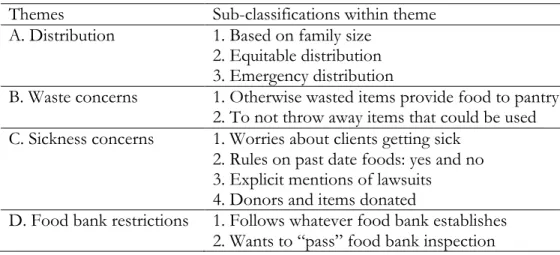
In the following sections, the pantries are qualitatively described according to additional themes established in the interviews: donor concerns, distribution practices, and waste issues. Donor concerns are nested within safety and liability; Table 2.8 lists the four overall themes and their sub-classifications, which include the aforementioned safety and liability concerns and food bank policy. The themes could be categorized as the general reasoning behind the choice of standard operating procedures, but also paternalistic influence by the food banks. The analysis provides insight into how clearer food safety guidelines might better promote risk mitigation, confirming early hypotheses on inconsistency across pantries procedures.
2.5.1 Donor Concerns
it were within six months of the package date, but that she “had a lot of old food from the postal service drive that had to be trashed because it was 2011.” Another manager said, “there’s a lot of old food in the post office drive” while a third manager has “the volunteers pull past-date food from the postal service drive.” While the canned and packaged goods are not unsafe after years on the shelf, they do lose nutritional quality. The adage of “if we wouldn’t eat it, then it wouldn’t be served to the clients” is steadily spoken, though not everyone evaluates items in the same manner.
2.5.2 Distribution Practices
Twenty-three pantries operate on an emergency basis, providing food at any given moment a person is in need, but to operate entirely as an emergency pantry is rare (n=2). Forty-seven pantries distribute the food equitably per household, meaning that each family gets the same box of food. The Emergency Food Assistance Program (TEFAP) is responsible for part of the reasoning behind the equitable distribution, as the policy is that each person must get the same number of items supplied by TEFAP, unless the pantry runs short of an item. For example, a food pantry might receive 48 bottles of orange juice and 80 bags of chicken quarters; if the pantry was giving one item per person, then the 49th person would receive chicken but not orange juice. The TEFAP process is required to be entirely a first-come, first-served basis; foods cannot be saved for particular
individuals. Pantries also give the same amount to each household so that they can prepack (n=37) the items and focus on distribution when the clients are on-site, though some pantries that prepack also do so based on family size. Pantry managers also indicated that when clients do not all receive the same items, they are subject to complaints and arguments.
the bags is also contingent on the pantry, as some managers specialize the contents based on diet (e.g., low-sugar, vegetarians) or age (e.g., seniors, children). Yet, the amount that each pantry gives is variable as well; some pantries provide for up to 10 days of meals, while others only provide enough for 2-3 days. Others tailor the bags of food to plan for whole meals, rather than mismatched items. For example, if they distribute boxed potatoes, then they would provide milk as well. To that end, 11 pantries operate using a client choice model, allowing the clients to “shop” and choose for themselves, usually following a rubric that explains how many items an individual can take from each category. Waste-focused, clients only take what they might want or need, rather than what they might be given.
2.5.3 Waste Issues
Given that food pantries can be the distributors of food that would have been wasted, waste ideologies were revealed over the course of the interview. Oftentimes, these responses came as a result to a question regarding the spontaneity of donations; for example, a western pantry manager explained that “the Bush’s baked beans truck had a wreck and they didn’t want to take the cans back to Tennessee and so they were donated to the pantry.” On the other hand, the managers indicated that they did not want to throw items away (n=14), but that they would in the case of bad smells, torn or broken packaging, or when it seemed generally unsuitable for consumption (e.g., mold). They might conceal the trashed items so that the clients and donors do not see the items in the garbage bin. Six managers explained that they use “common sense” to determine the safety and quality of the food, though that method is unreliable. While quality might be evaluated by sight, foodborne pathogens can neither be seen nor smelled.
next distribution date is too far away. For this reason, many distribute fruits and vegetables on the day of or after they are received. Dairy and eggs are rarely chosen as items for distribution due to the cold storage requirement.
2.6 Limitations
A larger, more diverse sample of food pantries would reduce threats to internal validity, even though the sample is purposeful. Similarly, given that not every pantry manager in the counties responded to the recruitment email or phone call, there remains a selection bias of the pantries in the sample. Pantry managers could have feared the researchers reporting their undesirable
procedures to the food bank. On the other hand, some pantries could have been a part of previous studies (at the University of North Carolina at Chapel Hill, North Carolina State University, or North Carolina A&T University) and might be fatigued by participatory research. Generalizability remains a concern, given that all pantries are located within North Carolina and in only 12% of its counties. The results allow for extrapolation to other, similar counties within the state, though there will be limitations on doing so to other states, given that their regulations on food banks and pantries are likely to differ.
This data only provides a “snapshot” of the pantries; that is, only one event has been
2.7 Conclusions: Policy Implications and Future Research
The results of this study imply that there is much room for improvement in terms of food safety training and, likely, available resources. It adds to the current literature by addressing the differences in food pantry operating procedures, in terms of differences between: independent pantries and those partnered with a food bank metropolitan versus rural; pantries where the
managers do and do not receive any food safety training. Individuals who receive the foods from the pantries are food-insecure—meaning that this population could have higher risk of foodborne illness without operational change, regardless of food bank partnership.
To start, the Centers for Disease Control and Prevention estimate that washing hands with soap water can reduce diarrheal illness in people with weakened immune systems by 58% and the number of people who get sick over by 31% (CDC, 2014). Given its importance, handwashing should be a regular action for all pantry participants and is potentially easy to implement task given the regularity of well-stocked and available bathrooms. Furthermore, pantries would reduce the risk of foodborne illness by obtaining more regular information on recalls, creating strict rules for what they will and will not distribute (e.g., home-processed, past-date), and having set procedures on repackaging items, from glove use to packaging, dating, and labeling. While the managers use the dates as guides for packaged foods, including meat, they use their eyes to analyze bread and pastries. While some of the pantry managers had readily available information for their volunteers to decipher “how long is too long,” it was inconsistent across both regions and partnerships. There remains an incorrect association between the package dates and safety, rather than quality, simply characterized by a pantry manager who explained, “no one wants old meat.”
food banks email regular briefings on recalled items, the provision of that information is variable amongst regions, leaving the pantry managers to independently find and dispense any recall information, as well as dispose of the recalled items or notify the clients. The data show that few managers haven taken that initiative, or even realized that they should do so. Individuals and organizations should be able to easily obtain information from the Food Drug and Administration given that the agency has the authority and means to distribute it in a methodical way—and the managers should know to seek out said information.
Still, individuals might not actualize a task if they don’t fully recognize its importance, shown in the food pantries with thermometers in the freezer that rarely get read. Pantry managers can be left to explain any science behind a procedure, and might not know the reasoning. Therefore, a simple, easy-to-access set of guidelines to explain the importance of such actions would benefit the members of the food pantry community, both those who are partnered with a food bank and independent. Written standard operating procedures allow for the manager to answer each question only once as well as provide agency for volunteers to learn the answers to questions regarding how and why things get done. Even more, tracking information like refrigerator temperatures and
sources of food allow for backwards induction in the event that a client does get sick from the food, as products are then traceable and questionable procedures identifiable. Overall, a new instrument or policy intervention might prove to be more effective than that curriculum or format currently in use, as the information in the food safety trainings has not fully been actualized its participants.
Table 2.1 Pantry partnerships by food bank region
6The Inter-Faith Food Shuttle region overlaps other food bank regions.
Food Bank Partner No. of
counties in sample
Main location % of pantries in
sample
Food Bank of the Albemarle 1 Elizabeth City 2.9%
Food Bank of Central and Eastern NC 3 Raleigh 13.3%
Inter-Faith Food Shuttle (IFFS)6 2 Durham 1.0%
Manna Food Bank 3 Asheville 10.5%
Second Harvest Food Bank of Metrolina 2 Charlotte 18.1% Second Harvest Food Bank of Southeast NC 1 Fayetteville 12.4% Second Harvest Food Bank of Northwest NC 2 Winston-Salem 24.8%
Table 2.2 Food pantry organizational characteristics
Pantry Characteristics No. of food
pantries with characteristic
Food bank
partners Independent pantries
Paid manager 43 35 8
Managers trained in managing volunteers 31 27 4
Regular volunteers on each shift 81 67 14
Use of sign-in sheet 48 41 7
Volunteers responsible for intake of food 78 66 12
Volunteers decide on quality of foods 91 76 15
Volunteers drive own vehicle to pick up food 61 50 11
Volunteers trained 42 37 5
Volunteer requirements 29 24 5
Table 2.3. Average prevalence of particular pantry characteristics by food bank partnership
Characteristic No. of
pantries partnership Food bank means
Independent pantry means Food safety training by manager 77 0.81***
(0.40)
0.35 (0.49) Protocol for sick volunteers 32 0.29
(0.46) (0.51) 0.41
Accepts home-canned foods 18 0.18
(0.39) (0.34) 0.13 Distributes leftover prepared
foods 21 0.24
**
(0.43) (0.00) 0.00
Supplier requirements 20 0.18
(0.38) (0.48) 0.31
Repackage food on-site 44 0.46
(0.50) (0.44) 0.24
Know about recalls 67 0.68*
(0.47)
0.44 (0.51)
Have recall plan 52 0.60
(0.49) (0.51) 0.44 Use a first-in first-out system 81 0.84
(0.37) (0.35) 0.87 Distributes past-date items 64 0.67***
(0.47) (0.48) 0.31
Written SOPs 26 0.26
(0.44) (0.39) 0.18