I
NTRAARTERIAL pressure monitoring is routine for patients having cardiac surgery; however, the ideal site for arterial cannulation that best reflects central aortic pressure while minimizing line-associated complications is unclear. Radial arterial cannulation often is preferred because collat-eral circulation from the ulnar artery to the hand reduces the risk of ischemic injury.1 However, radial arterial pressure often exaggerates central aortic pressures because of decreased arterial elasticity, amplification of harmonic resonance, and the water hammer effect, which describes a bounding and forceful pulse caused by the propagation of a pressure wave throughout the vasculature.2 Furthermore, hemodilution or radial artery vaso-spasm during critical periods of cardiac surgery can cause radial arterial pressure to underestimate central aortic pressure.3,4 Inaccurate pressure measurements even for brief periods of time may promote inappropriate hemodynamic management and possibly increase postoperative morbidity and mortality.5Brachial arterial monitoring, in contrast, closely reflects central aortic pressure even during complex cardiac surgi-cal procedures with prolonged cardiopulmonary bypass sup-port.3 Brachial arterial pressure may thus better guide patient care and clinical management than radial arterial pressure
What We Already Know about This Topic
• Brachial arterial catheters better estimate aortic pressure than radial arterial catheters but are used infrequently because of risk of complications in a major artery without collateral flow are potentially serious
• The present study evaluated a large cohort of cardiac surgical patients to estimate the incidence of brachial artery catheter complications
What This Article Tells Us That Is New
• Brachial artery cannulation for hemodynamic monitoring during cardiac surgery rarely causes complications
Copyright © 2017, the American Society of Anesthesiologists, Inc. Wolters Kluwer Health, Inc. All Rights Reserved. Anesthesiology 2017; 126:1065-76 ABSTRACT
Background: Brachial arterial catheters better estimate aortic pressure than radial arterial catheters but are used infrequently because complications in a major artery without collateral flow are potentially serious. However, the extent to which brachial artery cannulation promotes complications remains unknown. The authors thus evaluated a large cohort of cardiac surgical patients to estimate the incidence of related serious complications.
Methods: The institutional Society of Thoracic Surgeons Adult Cardiac Surgery Database and Perioperative Health Docu-mentation System Registry of the Cleveland Clinic were used to identify patients who had brachial artery cannulation between 2007 and 2015. Complications within 6 months after surgery were identified by International Classification of Diseases, Ninth Revision diagnostic and procedural codes, Current Procedural Terminology procedure codes, and Society of Thoracic Surgeons variables. The authors reviewed electronic medical records to confirm that putative complications were related plausibly to brachial arterial catheterization. Complications were categorized as (1) vascular, (2) peripheral nerve injury, or (3) infection. The authors evaluated associations between brachial arterial complications and patient comorbidities and between complications and in-hospital mortality and duration of hospitalization.
Results: Among 21,597 qualifying patients, 777 had vascular or nerve injuries or local infections, but only 41 (incidence 0.19% [95% CI, 0.14 to 0.26%]) were potentially consequent to brachial arterial cannulation. Vascular complications occurred in 33 patients (0.15% [0.10 to 0.23%]). Definitely or possibly related infection occurred in 8 (0.04% [0.02 to 0.08%]) patients. There were no plausibly related neurologic complications. Peripheral arterial disease was associated with increased risk of complications. Brachial catheter complications were associated with prolonged hospitalization and in-hospital mortality.
Conclusions: Brachial artery cannulation for hemodynamic monitoring during cardiac surgery rarely causes complications. (Anesthesiology 2017; 126:1065-76)
Submitted for publication September 27, 2016. Accepted for publication February 28, 2017. From the Anesthesiology Institute, Cleveland Clinic, Cleveland, Ohio (A.S., B.B., B.J.W.); Departments of Quantitative Health Sciences and OUTCOMES RESEARCH, Cleveland Clinic, Cleveland, Ohio (N.M.); Department of Anesthesiology, University of North Carolina, Chapel Hill, North Carolina (P.A.K.); Outcomes Research Consortium, Cleveland, Ohio (P.A.K.); Department of Thoracic and Cardiovascular Surgery, Cleveland Clinic, Cleveland, Ohio (M.Z.-Y.T.); and Departments of OUTCOMES RESEARCH (D.I.S., A.E.D.) and Cardiothoracic Anesthesiology (A.E.D.), Anesthesiology Institute, Cleveland Clinic, Cleveland, Ohio.
Surgery Rarely Causes Complications
Asha Singh, M.D., Bobby Bahadorani, D.O., Brett J. Wakefield, M.D., Natalya Makarova, M.S., Priya A. Kumar, M.D., Michael Zhen-Yu Tong, M.D., M.B.A., Daniel I. Sessler, M.D.,
Andra E. Duncan, M.D., M.S.
monitoring.6 However, brachial artery catheterization often is avoided because the brachial artery is the major blood sup-ply to the forearm and hand. Thrombotic and ischemic com-plications related to brachial artery cannulation can therefore critically compromise blood flow. Other potentially serious complications include infections and injuries to the median nerve. Complications consequent to brachial artery cannu-lation may be especially common in patients with diabetes and peripheral vascular disease—who are especially likely to require cardiac surgery.
The incidence of complications related to brachial artery cannulation remains essentially unknown. Two recent reports, for example, each included fewer than 150 patients undergoing cardiac surgery,7,8 making them roughly two orders-of-magnitude smaller than necessary to accurately characterize the incidence of complications, much less potential associations between comorbidities and cannula-tion-related complications.
We therefore evaluated vascular complications, nerve injury, and infections plausibly related to brachial arterial cannulation in patients undergoing cardiac surgery. Second, we examined whether patients with preexisting peripheral vascular disease, diabetes mellitus, carotid artery disease, coronary artery disease, or chronic kidney disease were at increased risk for complications from brachial arterial can-nulation. Finally, we assessed the association between com-plications from brachial arterial cannulation and length of hospitalization and risk of in-hospital mortality.
Materials and Methods
With Cleveland Clinic Institutional review board (Cleveland Clinic, Cleveland, Ohio) approval and waiver of informed consent, we reviewed the electronic records of patients who underwent cardiac surgery between January 1, 2007, and March 31, 2015. Using our institutional Society of Tho-racic Surgeons (STS) database and the Perioperative Health Documentation System (PHDS) registry of the Cleveland Clinic, we identified adults who had brachial arterial cath-eters inserted intraoperatively for hemodynamic monitoring during cardiac surgery. Patients who had previous surgery on the brachial artery or known brachial artery disease were excluded.
Cannulation of the left brachial artery for intraarte-rial pressure monitoring is considered standard of care for patients who present for cardiac surgery at the Cleveland Clinic. Arterial puncture is performed with a 20-gauge intra-venous catheter; the Seldinger technique (catheter-over-the-wire) is then used to place a 5-inch, 20-gauge catheter for continuous arterial pressure monitoring.
Both registries were used to identify patients with poten-tial brachial arterial catheter complications by detecting all documented vascular or nerve injury, loss of function, or infection within 6 months after the cardiac surgery. The International Classification of Diseases, Ninth Revision diagnostic and procedural codes and Current Procedural
Terminology procedure codes that were used to identify potential brachial arterial catheter complications from the PHDS are listed in appendix 1. Potential complications related to brachial arterial cannulation also were identified by a search of the institutional STS database for noncardiac reoperations, limb ischemia, postoperative anticoagulation, postoperative infections involving an arm, septicemia, and neuroparalysis.
Among patients with potential brachial arterial complica-tions, electronic medical records were reviewed individually to characterize complications as definitely related, possibly related, or unrelated to brachial arterial line cannulation. Initial chart reviews were performed by one of three anes-thesia residents (A.S., B.B., B.J.W.). All definitely and pos-sibly related complications were cross-validated by a second anesthesiology resident to confirm that the complication appeared related. All complications and any disagreements were adjudicated by an experienced attending cardiothoracic anesthesiologist (A.E.D.).
Complications were considered definitely or possibly related to brachial artery cannulation when (1) the com-plication occurred at the same site and after insertion of the brachial arterial catheter; (2) the daily intensive care unit (ICU) progress note, cardiac surgery progress note, vascular medicine/surgery consult note, neurology con-sult note, operative reports, or infectious disease concon-sult notes stated that the complication was consequent to the brachial arterial line; and (3) the brachial arterial catheter was removed when the complication was identified. Once complications were deemed definitely or possibly related to brachial arterial cannulation, they were categorized as a vascular (brachial arterial injury, upper extremity isch-emia, compartment syndrome), neurologic (median nerve injury, paresthesia), or infectious (local or systemic infection).
Brachial arterial injuries were further categorized as thrombotic, embolic, dissection, stricture, aneurysm, or other arterial injury. If compartment syndrome was iden-tified, the site was recorded as upper arm, forearm, wrist, or hand. We recorded whether treatments were required, including surgical arterial repair, thrombectomy, fasciot-omy (upper arm, forearm, wrist, hand), anticoagulation, or amputation.
note or infectious disease consult note stated that the arte-rial catheter was the likely source of infection; (4) other sources of infection were considered unlikely (for example, there were no other intravascular catheters). It is routine at our institution to remove all intravascular catheters when bloodstream infection or septicemia is identified, even with-out direct evidence that a catheter was the source of infec-tion. Infectious complications were thus labeled as possibly related to arterial catheterization if none of the aforemen-tioned criteria for definitely related to brachial arterial cath-eterization were fulfilled. We recorded whether treatments were required, including cannulation-site debridement and antibiotic therapy.
Patient demographics, comorbidities (diabetes, periph-eral vascular disease, carotid disease, coronary artery disease, chronic kidney disease), type of cardiac surgery, length of hospital stay, and in-hospital mortality also were obtained from the registries.
Carotid artery disease, which is evaluated routinely by carotid ultrasound before cardiac surgery at our institution, was defined by the STS (version 2.81) data specification as carotid stenosis 50% or greater. Diabetes and peripheral vas-cular disease also were defined according to the STS data specifications. Patients having coronary artery bypass graft-ing were considered to have coronary artery disease. Chronic kidney disease was defined as estimated glomerular filtration rate less than 30 ml ∙ min−1 ∙ 1.73 m−2 calculated via the Modification of Diet in Renal Disease estimated glomeru-lar filtration rate formula based on serum creatinine, age, gender, and race.
Statistical Analysis
We summarized patient’s demographic and medical baseline characteristics as well as procedure related details via stan-dard univariable summary statistics as means ± SD, median [first quartile, third quartile], or n (%).
The incidence of complications related to the intraop-erative brachial arterial line insertion, our primary outcome, was estimated along with the 95% CI, assessed via normal approximation theory.9 The separate incidence of brachial artery vascular complications, neurologic complications, and infection along with 98.3% (correction for multiple outcomes) normality approximated CI also was reported.
Second, we reported the association between the presence of diabetes, peripheral vascular disease, carotid artery disease, chronic kidney disease and coronary artery disease, and the risk of complications from brachial arterial cannulation with multivariable logistic regression. The association between chronic kidney disease and risk for brachial complications was assessed post hoc. We considered brachial arterial com-plications as the binary outcome and the listed conditions as the explanatory factors. Given the low incidence of the outcomes, we limited the adjustment of the reported asso-ciations to preselected clinically relevant cofounders, which included patient’s age, body mass index, sex, race, American
Society of Anesthesiologists physical status, duration of sur-gery, surgery emergency status, number of simultaneous car-diac procedures, duration of cardiopulmonary bypass time, duration of myocardial ischemia, and duration of circulatory arrest. The Wald test P value and the adjusted odds ratio along with 99% (correction for multiple comparisons) CI were reported for each of the baseline condition.
For the tertiary outcomes, we examined whether a complication related to brachial arterial cannulation was associated with increased length of hospitalization via mul-tivariable linear regression model with log-transformed (to satisfy model normality assumption) length of hospitaliza-tion as an outcome and status on brachial arterial compli-cation as an exploratory factor. The Wald test P value and the adjusted ratio of geometric means along with 97.5% (correction for multiple comparisons) CI were reported. The association between in-hospital mortality and brachial arte-rial cannulation complications were examined via multivari-able logistic regression models. We reported the Wald test P value and the adjusted odds ratio along with 97.5% (cor-rection for multiple comparisons) CI. Both associations were adjusted for history of diabetes, peripheral vascular disease, carotid disease, coronary artery disease, and all the baseline and intraoperative factors listed for the secondary analysis adjustment.
To adjust for multiple reported comparisons, the Bonfer-roni correction was applied for the computed CIs and tests significance levels to maintain the Type I error rate at 5% on each primary, secondary and tertiary analysis. SAS 9.4 statistical software (SAS Institute Inc., USA) was used for all analysis.
Sample Size Consideration
We planned to use all available cases and anticipated approx-imately 3,000 eligible patients per year, total of 24,000 patients. With 24,000 patients, we have the following pre-cision in estimating complication incidence (prepre-cision is described in terms of CI width): the width of 95% CI ranges from 0.06 to 0.12% for incidence ranging from 0.05 to 0.2%, respectively: CI width was estimated by use of exact binomial method.
Results
that 41 of 777 patients had complications that were defi-nitely or possibly related to intraoperative brachial arterial catheter insertion. The corresponding incidence estimate (95% CI) for the combination of all three complications is 0.19% (0.14 to 0.26%).
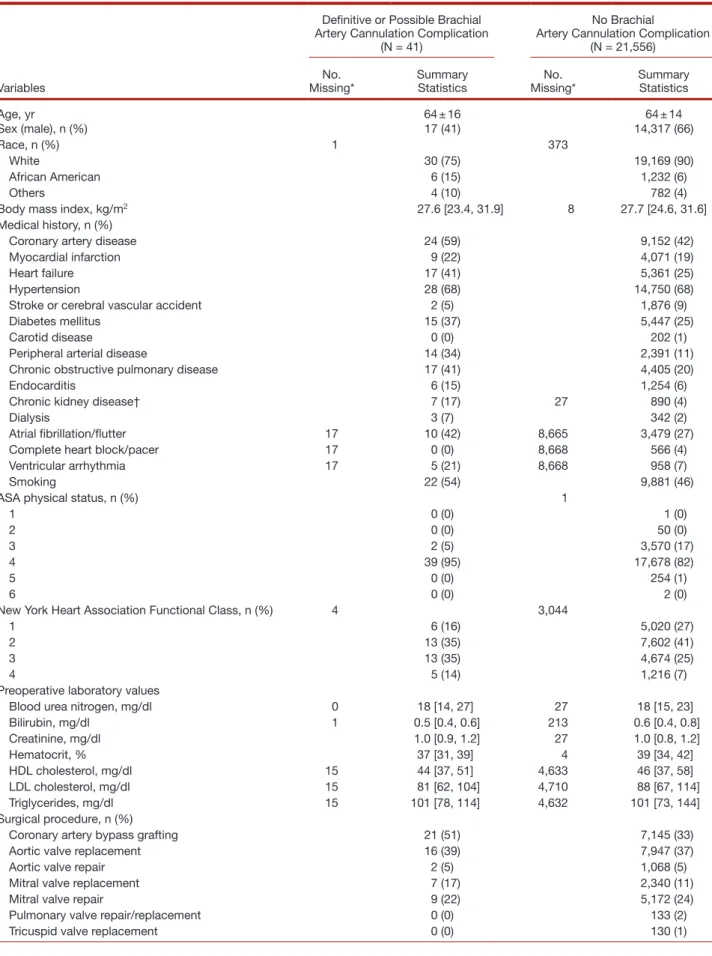
Demographic and baseline characteristics of the study population and procedural details for patients with and without brachial arterial complications are shown in table 1.
Complications related to brachial arterial cannulations occurred between the day of surgery and the 30th postopera-tive day with the median [first, third quartile] day of compli-cation on postoperative day 4 [2, 8]. Brachial artery vascular complications occurred in 33 (0.15% [0.10 to 0.23%]) patients, who had one or more of the following: upper extremity ischemia (21 patients), thrombosis (17 patients), embolism (2 patients), aneurysm (4 patients), compartment syndrome (1 patient), and other arterial injury (1 patient; table 2). No documented neurologic complications were found in any patient (estimated incidence 0.00% [0.00 to 0.03%]). Infection occurred in 8 (0.04% [0.02 to 0.08%]) patients. Five of eight infections were catheter-related sepsis. It was not possible to determine whether the infection origi-nated from the arterial catheter or from coexistent central-venous catheters; thus, these complications were considered possibly related.
Treatment was required for 37 of the 41 patients who experienced complications (appendix 2). Treatment for vascular complications included repair of the brachial artery in 8 (22%) patients, thrombectomy in 18 (49%)
patients, and fasciotomy in 1 (3%) patient. Other thera-peutic interventions included anticoagulation in 17 (46%) patients, direct vascular compression in 3 (8%) patients, Rooke® Mitts (which promote vasodilation; Osborn
Medi-cal, USA) in 3 (8%), and thrombin injection in 1 patient (3%). All 8 cases of infection were treated with systemic antibiotic therapy.
Univariable and multivariable associations between the presence of diabetes, peripheral vascular disease, carotid dis-ease, chronic kidney disdis-ease, coronary artery disdis-ease, and the risk of complications from brachial arterial cannulation are presented in table 3.
Postoperative complications and hospital events of patients who did and did not develop brachial arterial com-plications are presented in table 4. The incidence of cardiac arrest, requirement for extracorporeal membrane oxygen-ation support, use of intraaortic balloon counterpulsoxygen-ation, kidney failure, requirement for dialysis, prolonged ventila-tion, and multisystem organ failure was between 5 and 20 times greater in patients who had complications related to brachial arterial catheterization than in those who did not. Tertiary results on associations between brachial arterial catheter complication and length of hospitalization and in-hospital mortality using multivariate regression are shown in table 5. Patients with complications had median hospital stays of 22 days compared with 8 days for patients without complications. In-hospital mortality was 24% in patients with brachial arterial complications compared with 1.75% in patients without arterial complications.
Table 1. Summary of Patient Demographics, Baseline, and Procedural Characteristics (N = 21,597)
Variables
Definitive or Possible Brachial Artery Cannulation Complication
(N = 41)
No Brachial Artery Cannulation Complication
(N = 21,556)
No.
Missing* Summary Statistics Missing*No. Summary Statistics
Age, yr 64 ± 16 64 ± 14
Sex (male), n (%) 17 (41) 14,317 (66)
Race, n (%) 1 373
White 30 (75) 19,169 (90)
African American 6 (15) 1,232 (6)
Others 4 (10) 782 (4)
Body mass index, kg/m2 27.6 [23.4, 31.9] 8 27.7 [24.6, 31.6] Medical history, n (%)
Coronary artery disease 24 (59) 9,152 (42)
Myocardial infarction 9 (22) 4,071 (19)
Heart failure 17 (41) 5,361 (25)
Hypertension 28 (68) 14,750 (68)
Stroke or cerebral vascular accident 2 (5) 1,876 (9)
Diabetes mellitus 15 (37) 5,447 (25)
Carotid disease 0 (0) 202 (1)
Peripheral arterial disease 14 (34) 2,391 (11)
Chronic obstructive pulmonary disease 17 (41) 4,405 (20)
Endocarditis 6 (15) 1,254 (6)
Chronic kidney disease† 7 (17) 27 890 (4)
Dialysis 3 (7) 342 (2)
Atrial fibrillation/flutter 17 10 (42) 8,665 3,479 (27)
Complete heart block/pacer 17 0 (0) 8,668 566 (4)
Ventricular arrhythmia 17 5 (21) 8,668 958 (7)
Smoking 22 (54) 9,881 (46)
ASA physical status, n (%) 1
1 0 (0) 1 (0)
2 0 (0) 50 (0)
3 2 (5) 3,570 (17)
4 39 (95) 17,678 (82)
5 0 (0) 254 (1)
6 0 (0) 2 (0)
New York Heart Association Functional Class, n (%) 4 3,044
1 6 (16) 5,020 (27)
2 13 (35) 7,602 (41)
3 13 (35) 4,674 (25)
4 5 (14) 1,216 (7)
Preoperative laboratory values
Blood urea nitrogen, mg/dl 0 18 [14, 27] 27 18 [15, 23] Bilirubin, mg/dl 1 0.5 [0.4, 0.6] 213 0.6 [0.4, 0.8]
Creatinine, mg/dl 1.0 [0.9, 1.2] 27 1.0 [0.8, 1.2]
Hematocrit, % 37 [31, 39] 4 39 [34, 42]
HDL cholesterol, mg/dl 15 44 [37, 51] 4,633 46 [37, 58] LDL cholesterol, mg/dl 15 81 [62, 104] 4,710 88 [67, 114] Triglycerides, mg/dl 15 101 [78, 114] 4,632 101 [73, 144] Surgical procedure, n (%)
Coronary artery bypass grafting 21 (51) 7,145 (33)
Aortic valve replacement 16 (39) 7,947 (37)
Aortic valve repair 2 (5) 1,068 (5)
Mitral valve replacement 7 (17) 2,340 (11)
Mitral valve repair 9 (22) 5,172 (24)
Pulmonary valve repair/replacement 0 (0) 133 (2)
Tricuspid valve replacement 0 (0) 130 (1)
Discussion
In more than 21,500 patients who had brachial arterial cathe-terization for cardiac surgery, complications were infrequent, occurring in less than 0.2% of patients. This low incidence of complications is comparable with that reported for radial, femoral, and brachial arterial line cannulation in cardiac surgical, noncardiac surgical, and critically ill patients.3,7,8,10 None of these other reports, however, included an adequate number of brachial arterial catheters to accurately assess the incidence of catheter-related complications of the brachial artery.3,7,8
Hypotension is associated with acute kidney and myo-cardial injury in (noncardiac) surgical patients,5 and accu-rate measurement of arterial blood pressure may improve clinical outcomes. Radial arterial systolic pressure is higher than central aortic pressure because amplification occurs as distance from the heart increases,11 although diastolic and mean arterial pressures decrease only slightly (about 1 to 4 mmHg).11–13 Furthermore, radial artery pressure may
underestimate central aortic pressure during and imme-diately after cardiopulmonary bypass3,6,14 due in part to arterial spasm or thermoregulatory vasomotion.14–17 If radial arterial pressure is inaccurate, patient care may be compromised by promoting administration of vasopres-sor or inotropic drugs, which may themselves worsen outcomes.18 In patients having cardiac surgery, brachial arterial pressure measurements better estimate mean and systolic central aortic pressures than radial arterial pres-sures,3,19 and those who require hypothermic circulatory arrest are at especially high risk for developing large and prolonged radial-to-aorta pressure gradients.20 Use of the brachial artery for intraarterial pressure monitoring may thus provide a more accurate tool for hemodynamic monitoring.
The brachial artery is the main blood supply to the fore-arm and hand. Before the brachial artery bifurcates into the radial and ulnar arteries, several branches, including the deep brachial, humeral nutrient, superior and inferior
Tricuspid valve repair 7 (17) 2,153 (10)
Maze procedure 5 (12) 2,680 (12)
Any aortic root, ascending aortic, or aortic arch
replacement procedure 12 (29) 3,510 (16)
Descending aorta replacement 2 (5) 393 (2)
Congenital ASD/PFO suture closure 1 (2) 372 (2)
Removal of atrial myxoma, cardiac tumors 0 (0) 108 (1)
Carotid endarterectomy 0 (0) 50 (0)
Pulmonary endarterectomy 1 (2) 88 (0)
Any congenital heart disease procedure 1 (2) 632 (3) Left ventricular reconstructive procedure 1 (2) 116 (1)
Pericardiectomy 1 (2) 142 (1)
Septal myectomy 0 (0) 1,157 (5)
Heart transplant 1 (2) 260 (1)
Insertion of mechanical ventricular assist device 14 (34) 1,032 (5) History of cardiothoracic surgical procedures, n (%)
First surgery 26 (64) 16,292 (76)
First reoperative surgery 12 (29) 4,103 (19)
Second or more reoperative surgery 3 (7) 1,161 (5)
Emergent surgery, n (%) 3 (7) 1 816 (4)
Intraoperative
Duration of surgery, min 494 [376, 557] 359 [298, 441] Cardiopulmonary bypass time, min 129 [98, 182] 95 [69, 128] Aortic cross-clamp time, min 87 [58, 107] 71 [50, 96]
Circulatory arrest, n (%) 6 (15) 1,125 (5)
Duration of circulatory arrest, min 41 ± 20 26 ± 21
Values are given as mean ± SD, median [first, third quartile], or n (%), as appropriate.
*The data that were not collected in the medical records marked as missing, which is mostly race, preoperative laboratory results, New York Heart Associa-tion FuncAssocia-tional Class, and preoperative EKG. †Chronic kidney disease was identified if eGFR was less than 30 ml ∙ min−1∙ 1.73 m−2; eGFR was calculated based on the MDRD equation.
ASA = American Society of Anesthesiologists; ASD = atrial septal defect; eGFR = estimated glomerular filtration rate; EKG = electrocardiogram; HDL = high-density lipoprotein; LDL = low-high-density lipoprotein; MDRD = Modification of Diet in Renal Disease; PFO = patent foramen ovale.
Table 1. (Continued).
Variables
Definitive or Possible Brachial Artery Cannulation Complication
(N = 41)
No Brachial Artery Cannulation Complication
(N = 21,556)
No.
ulnar collateral artery, provide collateral blood flow to the elbow and upper arm. However, forearm and hand perfu-sion via these collaterals usually is insufficient if acute occlu-sion of the brachial artery occurs. Thus vascular compromise can cause ischemia to the arm and consequent catastrophic injury, and is an overwhelming concern of brachial arterial cannulation. As might be expected, nearly 80% of all the complications were related to vascular injury or occlusion.
The overall incidence of vascular complications, however, was low at 0.15% (i.e., less than 1 per 650 catheters).
Arterial catheters were removed immediately when complications were detected. Patients with brachial artery thrombosis received either thrombectomy or open repair of the brachial artery and postoperative anticoagulation. The remaining patients with upper extremity ischemia improved with intravenous anticoagulation. Ultrasound-guided compression was used to treat brachial arterial pseudoaneurysms.21 With one exception,7 other studies similarly reported that surgical and/or medical treatment was required for all vascular complications.3,8,10
Handlogten et al.8 reported a slightly greater rate of com-plications compared with our results after brachial arterial catheterization, namely 0.35%; however, this estimate was based on 3 complications among 858 patients, a fragile result that would be altered substantially by the addition or subtraction of a single complication. Nuttall et al.7 similarly reported a complication rate of 0.75% in cardiac surgical patients, which was also based on a single complication in 134 patients; however, their overall complication rate of 0.12% in approximately 1,600 patients was comparable with our report.
Although vascular complications after radial arterial can-nulation recently were reported to be approximately 0.03% overall, complications were higher in patients undergoing cardiac surgery (approximately 0.07%).7 Though our vascu-lar complication rate in cardiac surgical patients of 0.15% was slightly greater,7 the 95% CIs likely overlap. A direct comparison of safety between radial versus brachial arterial lines is not possible by comparing the results of separate reports because of confounding by differences in patient populations and risk factors.7 Nonetheless, complications after brachial arterial cannulation may be slightly higher by perhaps 7 to 8 complications per 10,000 brachial catheters compared with radial arterial cannulation. The incidence
Table 2. Incidence of Definitely or Possibly Related Complications from Brachial Arterial Cannulation: Primary Results (N = 21,597)
Cases,
No. Incidence (CI)*
Definitely or possibly related brachial arterial complica-tions†
41 0.19% (0.14–0.26)
Brachial artery vascular
complications 33 0.15% (0.10–0.23) Upper extremity ischemia 21
Thrombosis 17
Embolism 2
Aneurysm 4
Compartment syndrome,
forearm 1
Other arterial injury 1
Infection‡ 8 0.04% (0.02–0.08) Catheter-site infection 2
Cellulitis 1
Bloodstream infection/
septicemia 7
Neurologic complications 0 0.00% (0.00–0.03)
*We reported 95% CIs for the estimate of the incidence of brachial arte-rial complications; for the specific complications, we reported 98.3% CI, which is Bonferroni adjusted (0.05/3 = 0.017) for multiple outcomes. †A patient might have more than one of the conditions in this list. ‡Five of eight cases of infection were line sepsis. These were identified as compli-cations possibly related to brachial arterial cannulation, because it was not possible to determine whether the arterial catheter or a coexisting central venous catheter was the source of infection.
Table 3. The Association of Patient Comorbidities with Brachial Arterial Complications: Secondary Results (N = 21,597)
Baseline Comorbidities
Univariate Association Multivariate Association†
OR (99% CI)* P Value* Adjusted OR(99% CI)* P Value*
Diabetes 1.71 (0.74–3.94) 0.10 1.17 (0.45–3.03) 0.68
Peripheral arterial disease 4.16 (1.78–9.73) <0.001 2.78 (1.11–7.01) 0.004
Carotid disease‡ N/A N/A N/A N/A
Coronary artery disease 1.91 (0.84–4.33) 0.04 1.46 (0.59–3.59) 0.28 Chronic kidney disease§ 4.78 (1.69–13.51) <0.001 2.31 (0.70–7.65) 0.07
*The significance criteria for all five secondary tests were 0.01, which is Bonferroni adjusted for multiple comparisons (0.05/5 = 0.01) and corresponds to 99% CIs. †The association between the baseline condition (history of diabetes, peripheral vascular disease, carotid disease, coronary artery disease, chronic kidney disease) and postoperative brachial artery cannulation complication outcome was adjusted for patient’s age, body mass index, sex, race, ASA status, duration of surgery, surgery emergency status, number of simultaneous cardiac procedures, duration of cardiopulmonary bypass time, duration of myocardial ischemia, and duration of circulatory arrest. ‡Carotid artery disease was identified if Doppler evaluation demonstrated ≥50% stenosis. There were no patients with carotid disease among 41 patients who experienced complications related to brachial artery cannulation. Therefore, we were not able to report the association between presence of carotid disease and risk of brachial artery cannulation complication. §Chronic kidney disease was identified if eGFR was less than 30 ml ∙ min–1∙ 1.73 m–2; eGFR was calculated based on the MDRD equation.
of complications, however, may be higher at institutions in which brachial arterial cannulation is not routinely performed.
Patients having cardiac surgery may be at greater risk for complications from brachial arterial catheterization because they often have underlying vascular disease and experience perioperative hypoperfusion and low cardiac output state. Use of inotropic and vasopressor therapy may further jeop-ardize peripheral tissue perfusion. Alternatively, anticoagula-tion during cardiopulmonary bypass, perioperative platelet dysfunction or coagulopathy, and hypothermia impair coag-ulation22 and might reduce thrombotic complications. Therefore, the extent to which our observed incidence in car-diac surgical patients can be extrapolated to patients having
other types of surgery remains unknown. Although Nuttall et al.7 reported more complications from brachial arterial cannulation for cardiac than noncardiac surgery, only a small number of patients were included, leaving the issue essen-tially unresolved.
Only 3 of 21,597 patients (0.01%) developed infectious complications definitely related to brachial arterial catheter-ization. Five additional patients developed catheter-related bloodstream infections, but definitive evidence that the arterial catheter was the source of infection was absent. Pre-sumably, coexisting central venous catheters were the more likely source of infection.23 We nonetheless conservatively included these five patients as possible infectious complica-tions. Our incidence of infectious complications is less than
Table 4. Postoperative Complications and Hospital Events in Patients with and without Brachial Arterial Cannulation Complication
Postoperative Complications
Definitive or Possible Brachial Artery
Cannulation Complication No Brachial Artery Cannulation Complication
(N = 41) (N = 21,556)
Cardiac arrest 5 (12) 390 (2)
Atrial fibrillation 17 (41) 6,081 (28)
Extracorporeal membrane oxygenation 7 (17) 214 (1)
Left ventricular assist device 1 (2) 306 (1)
Intra/postoperative intraaortic balloon counterpulsation 6 (15) 527 (2)
Stroke 4 (10) 291 (1)
Transient ischemic attack 0 (0) 32 (0)
Coma/encephalopathy 1 (2) 220 (1)
Renal failure 13 (32) 1,018 (5)
Renal failure requiring dialysis 8 (20) 469 (2)
Prolonged ventilation: >24 h postoperatively 30 (73) 3,344 (16)
Pneumonia 4 (10) 273 (1)
Septicemia or bacteremia or sepsis 11 (27) 224 (1)
Gastrointestinal complication 3 (7) 767 (4)
Multisystem organ failure 4 (10) 87 (0)
Data are shown as n (%).
Table 5. The Association between Brachial Arterial Cannulation Complications and Length of Hospital Stay and In-hospital Mortality: Tertiary Results
Outcomes
Raw Data Univariate Association Multivariate Association*
Definitive or Possible Brachial Artery Can-nulation Complication
No Brachial Artery Cannulation
Complication (97.5% CI)Estimate P Value† (97.5% CI)Estimate P Value†
(n = 41) (n = 21,556)
Length of
hospi-talization, d 22 [14, 30] 8 [6, 14] 2.29 (1.82–2.87)‡ <0.001 1.55 (1.28–1.89)‡ <0.001 In-hospital
mortality 10 (24%) 378 (1.75%) 18.07 (7.93–41.18)§ <0.001 8.19 (3.08–21.78)§ <0.001
The raw data are reported as median [first, third quartiles] or n (%), as appropriate (N = 21,597).
*Multivariate linear regression was used to assess the ratio of geometric means of length of hospitalization comparing patients with brachial artery com-plication with those without comcom-plication along with 97.5% CI. Multivariate logistic regression was used to assess the odds ratio of in-hospital mortality comparing patients with brachial artery complication with those without complication. Both associations were adjusted for patient’s age, body mass index, sex, race, ASA status, history of diabetes, peripheral vascular disease, carotid disease, coronary artery disease, duration of surgery, surgery emergency status, number of simultaneous cardiac procedures, duration of cardiopulmonary bypass time, duration of myocardial ischemia, and duration of circulatory arrest. †The Wald test P-value was reported; significance criteria were Bonferroni corrected for multiple testing and set to 0.05/2 = 0.025. ‡The ratio of geometric means along with 97.5% CI was reported. §The odds ratio along with 97.5% CI was reported.
most reports, which range from 0.02 to 0.36%,7,24 depend-ing on site of arterial cannulation and patient population. Patients with infectious complications were treated with broad-spectrum intravenous antibiotics, whereas nearly one half required vasopressors infusion due to septic shock.
The median nerve runs close to the brachial artery in the antecubital fossa and paresthesia of the median nerve are common during brachial arterial cannulation. We thus expected some nerve injuries; however, we did not observe any reported nerve injury plausibly related to brachial artery cannulation among 21,597 patients. Previous studies also report no nerve injuries, although none were even remotely powered for this rare complication.3,7,8 Injury to the median nerve during brachial arterial cannulation is thus exceedingly rare and does not cause persistent neurologic dysfunction. Fear of this complication should not guide selection of arte-rial cannulation site.
Unsurprisingly, patients with peripheral arterial disease had increased risk of complications from brachial arterial cannulation, possibly related to the presence of atheroma formation, calcification of the peripheral arteries, luminal narrowing, and reduced blood flow.25 We note, however, that the overall incidence of complications even in these patients was low and that peripheral arterial disease is hardly a com-pelling reason to avoid brachial arterial catheterization if otherwise indicated. However, as mentioned previously, our low incidence of complications in cardiac surgical patients cannot be directly extrapolated to patients with peripheral vascular disease having noncardiac surgery, because peri-operative management, such as systemic anticoagulation during cardiac surgery, may reduce risk of complications. Interestingly, patients with diabetes mellitus, coronary artery disease, and chronic kidney disease, all of which are asso-ciated with arterial compromise, were not at increased risk from brachial arterial cannulation. Safety of brachial arterial cannulation has significant future implications, especially in patients with kidney disease, who may later require vas-cular access for hemodialysis. We examined risk in patients with carotid disease, since this finding may indicate disease in other major arteries. However, none of the patients with brachial arterial line complications had preexisting carotid disease, suggesting that patients with carotid artery disease are not at increased risk, although we could not formally assess the association.
Patients with arterial line complications had prolonged hospital stays and greater in-hospital mortality. The post-operative course in these patients, however, was compli-cated by a much greater incidence of severe life-threatening postoperative complications, including cardiac arrest, kid-ney injury requiring dialysis, multiorgan failure, and use of extracorporeal membrane oxygenation for severe cardiac or pulmonary failure refractory to conventional management. It seems obvious that these serious postoperative com-plications were not directly consequent to brachial arte-rial cannulation. Instead, it is more likely that prolonged
cannulation and monitoring of the brachial artery was required in these critically ill patients who suffered from a low cardiac output state, required high-dose vasopressor therapy or mechanical circulatory support, or had com-promised systemic and peripheral perfusion. Thus, these serious postoperative complications likely predisposed patients to brachial arterial line complications, rather than the possibility that brachial arterial cannulation caused life-threatening complications, a prolonged hospital stay, or greater in-hospital mortality. Although the overall inci-dence of complications is low, increased clinical suspicion for vascular complications and appropriate consideration for alternative arterial line sites are suggested for critically ill patients who require prolonged high-dose pharmaco-logic or mechanical circulatory support.
Our observational analysis has the limitations inher-ent to its retrospective design. As in all retrospective stud-ies, our findings rely on accurate recording of arterial line catheterization, comorbidities, and postoperative compli-cations, and thus there is the possibility of underreport-ing of complications. We were not able to report minor complications due to the lack of in-hospital International Classification of Diseases, Ninth Revision and Current Procedural Terminology billing codes for less severe com-plications. It is thus likely that we missed minor self-limited complications, but such complications are also of questionable clinical importance. Unlike one investigation that reported minor clinically insignificant complications, such as “temporary arterial occlusion,”24 we considered only clinically important vascular complications which included upper extremity ischemia, arterial thrombo-sis, pseudoaneurysm, and compartment syndrome. Our investigation could not compare the risk of complications between radial and brachial arterial lines, because radial arterial lines are only used at our institution when contra-indications or difficulty with brachial arterial cannulation are present.
Although our secondary analysis adjusted for multi-ple confounding variables, the possibility of unmeasured covariates and residual confounders cannot be excluded. We were unable to determine the true incidence of infec-tion because catheter tips were not always cultured; how-ever, we conservatively included patients who experienced line-related sepsis, even though the central venous catheter was the more likely source of infection. Arterial line docu-mentation was missing in approximately 20% of patients, mostly during the new implementation of our intraopera-tive electronic documentation record when documenta-tion was in development. However, it seems unlikely that including these patients would substantively influence our conclusions.
than radial arterial catheters and complications are rare, the brachial artery remains a reasonable site for direct arterial pressure measurement.
Research Support
This investigation was funded by the Departments of Car-diothoracic Anesthesia and OUTCOMES RESEARCH at the
Cleve-land Clinic, CleveCleve-land, Ohio.
Competing Interests
The authors declare no competing interests.
Correspondence
Address correspondence to Dr. Duncan: Departments of Cardiothoracic Anesthesiology and OUTCOMES RESEARCH,
Cleve-land Clinic 9500 Euclid Avenue / J4-331, CleveCleve-land, Ohio 44195. [email protected]. Information on purchasing reprints may be found at www.anesthesiology.org or on the mast-head page at the beginning of this issue. ANESTHESIOLOGY’s
ar-ticles are made freely accessible to all readers, for personal use only, 6 months from the cover date of the issue.
References
1. Brzezinski M, Luisetti T, London MJ: Radial artery cannula-tion: a comprehensive review of recent anatomic and physi-ologic investigations. Anesth Analg 2009; 109:1763–81 2. Dorman T, Breslow MJ, Lipsett PA, Rosenberg JM, Balser JR,
Almog Y, Rosenfeld BA: Radial artery pressure monitoring underestimates central arterial pressure during vasopressor therapy in critically ill surgical patients. Crit Care Med 1998; 26:1646–9
3. Bazaral MG, Welch M, Golding LA, Badhwar K: Comparison of brachial and radial arterial pressure monitoring in patients undergoing coronary artery bypass surgery. ANESTHESIOLOGY 1990; 73:38–45
4. Fuda G, Denault A, Deschamps A, Bouchard D, Fortier A, Lambert J, Couture P: Risk factors involved in central-to-radial arterial pressure gradient during cardiac surgery. Anesth Analg 2016; 122:624–32
5. Mascha EJ, Yang D, Weiss S, Sessler DI: Intraoperative mean arterial pressure variability and 30-day mortality in patients having noncardiac surgery. ANESTHESIOLOGY 2015; 123:79–91 6. Gravlee GP, Wong AB, Adkins TG, Case LD, Pauca AL: A
com-parison of radial, brachial, and aortic pressures after cardio-pulmonary bypass. J Cardiothorac Anesth 1989; 3:20–6 7. Nuttall G, Burckhardt J, Hadley A, Kane S, Kor D, Marienau
MS, Schroeder DR, Handlogten K, Wilson G, Oliver WC: Surgical and patient risk factors for severe arterial line com-plications in adults. ANESTHESIOLOGY 2016; 124:590–7
8. Handlogten KS, Wilson GA, Clifford L, Nuttall GA, Kor DJ: Brachial artery catheterization: an assessment of use pat-terns and associated complications. Anesth Analg 2014; 118:288–95
9. Brown LD, Cai TT, DasGupta A: Interval estimation for a binomial proportion. Stat Sci 2001;16:101–17
10. Mann S, Jones RI, Millar-Craig MW, Wood C, Gould BA, Raftery EB: The safety of ambulatory intra-arterial pressure monitoring: a clinical audit of 1000 studies. Int J Cardiol 1984; 5:585–97
11. McEniery CM, Cockcroft JR, Roman MJ, Franklin SS, Wilkinson IB: Central blood pressure: current evidence and clinical importance. Eur Heart J 2014; 35:1719–25
12. Safar ME, Plante GE, Mimran A: Arterial stiffness, pulse pres-sure, and the kidney. Am J Hypertens 2015; 28:561–9 13. O’Rourke MF, Seward JB: Central arterial pressure and
arte-rial pressure pulse: new views entering the second century after Korotkov. Mayo Clin Proc 2006; 81:1057–68
14. Baba T, Goto T, Yoshitake A, Shibata Y: Radial artery diam-eter decreases with increased femoral to radial arterial pres-sure gradient during cardiopulmonary bypass. Anesth Analg 1997; 85:252–8
15. Stern DH, Gerson JI, Allen FB, Parker FB: Can we trust the direct radial artery pressure immediately following cardio-pulmonary bypass? ANESTHESIOLOGY 1985; 62:557–61 16. Kanazawa M, Fukuyama H, Kinefuchi Y, Takiguchi M, Suzuki
T: Relationship between aortic-to-radial arterial pressure gra-dient after cardiopulmonary bypass and changes in arterial elasticity. ANESTHESIOLOGY 2003; 99:48–53
17. Urzua J, Sessler DI, Meneses G, Sacco CM, Canessa R, Lema G: Thermoregulatory vasoconstriction increases the differ-ence between femoral and radial arterial pressures. J Clin Monit 1994; 10:229–36
18. Nielson E, Hennrikus E, Lehman E, Mets B: Angiotensin axis blockade, hypotension, and acute kidney injury in elective major orthopedic surgery. J Hosp Med 2014; 9:283–8 19. De Hert SG, Vermeyen KM, Moens MM, Hoffmann VL,
Bataillie KJ: Central-to-peripheral arterial pressure gradi-ent during cardiopulmonary bypass: relation to pre- and intra-operative data and effects of vasoactive agents. Acta Anaesthesiol Scand 1994; 38:479–85
20. Manecke GR Jr, Parimucha M, Stratmann G, Wilson WC, Roth DM, Auger WR, Kerr KM, Jamieson SW, Kapelanski DP, Mitchell MM: Deep hypothermic circulatory arrest and the femoral-to-radial arterial pressure gradient. J Cardiothorac Vasc Anesth 2004; 18:175–9
21. Luedde M, Krumsdorf U, Zehelein J, Ivandic B, Dengler T, Katus HA, Tiefenbacher C: Treatment of iatrogenic femoral pseudoaneurysm by ultrasound-guided compression therapy and thrombin injection. Angiology 2007; 58:435–9
22. Polderman KH: Mechanisms of action, physiological effects, and complications of hypothermia. Crit Care Med 2009; 37(7 Suppl):S186–202
23. Koh DB, Gowardman JR, Rickard CM, Robertson IK, Brown A: Prospective study of peripheral arterial catheter infection and comparison with concurrently sited central venous cath-eters. Crit Care Med 2008; 36:397–402
24. Scheer B, Perel A, Pfeiffer UJ: Clinical review: complications and risk factors of peripheral arterial catheters used for hae-modynamic monitoring in anaesthesia and intensive care medicine. Crit Care 2002; 6:199–204
Anesthesiology 2017; 126:1065-76 1075 Singh et al.
Appendix 1. Variables Used to Identify Possible Complications Related to Brachial Arterial Catheterization from (1) ICD-9 Diagnoses and Procedures Codes, (2) CPT Procedure Codes from the Cleveland Clinic PHDS Registry, and (3) Postoperative Complications from the Institutional STS Database
Complications Description
ICD-9 Diagnoses or Procedure Code
or CPT Procedure Code
PHDS
Vascular injury Aneurysm of artery of upper extremity 442.0 Chronic total occlusion of artery of the extremities 440.4 Arterial embolism and thrombosis of upper extremity 444.21 Air embolism as a complication of medical care not elsewhere classified 999.1 Nontraumatic compartment syndrome of upper extremity 729.71
Fasciotomy of hand 82.12
Stricture of artery 39.31
Surgical repair/exploration of brachial artery: decompression fasciotomy with brachial artery
exploration 24495
Fasciotomy (possible compartment syndrome) in the antecubital fossa: decompression
fasci-otomy forearm and/or wrist 25020–25025
Thrombectomy of brachial artery 34101
Nerve injury Carpal tunnel syndrome 354.0
Injury to median nerve 955.1
Other neuroplasty 04.79
Median nerve damage (tingling numbness) in antecubital fossa: neuroplasty 64718 Loss of function Other finger(s) amputation status V49.62
Below elbow amputation status V49.65
Digit amputation for upper extremity: amputation finger or thumb 26951, 26952 Infection Other specified local infections of skin and subcutaneous tissue 686.8 Institutional STS database*
Infection Arm infection: infection with type “radial artery harvest site infection” or “arm” — Bacteremia: Indicate whether a recognized pathogen is cultured from 1 or more blood cultures
Sepsis: sepsis is defined as evidence of serious infection accompanied by a deleterious systemic response. In the time period of the first 48 postoperative or postprocedural hours, the diagnosis of sepsis requires the presence of an SIRS resulting from a proven infection (such as bacteremia, fungemia, or urinary tract infection). In the time period after the first 48 postoperative or postprocedural hours, sepsis may be diagnosed by the presence of an SIRS resulting from suspected or proven infection. During the first 48 h, an SIRS may result from the stress associated with surgery and/or cardiopulmonary bypass. Thus, the clinical criteria for sepsis during this time period should be more stringent. An SIRS is present when at least two of the following criteria are present: hypo- or hyperthermia (>38.5 or <36.0), tachycardia or bradycardia, tachypnea, leukocytosis or leukopenia, or thrombocytopenia.
—
Neuroparalysis Indicate whether the patient had a new postoperative permanent or transient paralysis,
para-paresis, or paraplegia related to spinal cord ischemia and not related to a stroke. — Postoperative
anticoagulation Indicate whether the patient had bleeding, hemorrhage, and/or embolic events related to anti-coagulant therapy postoperatively. This may include patients who experience disseminated intravascular coagulopathy or heparin-induced thrombocytopenia.
—
Acute limb
ischemia Indicate whether the patient had any complication producing limb ischemia. This may include upper or lower limb ischemia. — Noncardiac
reoperations Indicate whether the patient returned to the operating room for other noncardiac reasons. This includes procedures requiring a return to the operating room such as tracheostomy or gen-eral surgery procedures. This does not include procedures performed outside the operating room such as gastrointestinal laboratory for PEG tube, shunts for dialysis, etc.
—
*The description corresponds to STS Adult Cardiac Surgery Database Data Specifications, version 2.81.
CPT = Current Procedural Terminology; ICD-9 = International Classification of Diseases, Ninth Revision; PEG = polyethylene glycol; PHDS = Perioperative Health Documentation System; SIRS = systemic inflammatory response syndrome; STS = Society of Thoracic Surgeons.
Anesthesiology 2017; 126:1065-76 1076 Singh et al.
Appendix 2: Treatment for Brachial Arterial Complications
Cases, No. (%) (n = 41)
Any treatment for brachial arterial complication* 37 (100) Brachial artery injury or occlusion* 29 (78) Surgical repair of brachial artery 8 (22)
Thrombectomy 18 (49)
Fasciotomy of forearm 1 (3) Anticoagulation 17 (46)
Amputation 0 (0)
Compression 3 (8)
Thrombin injection 1 (3)
Rooke® mitt 3 (8)
Other 9 (2)
Infection 8 (12)
Antibiotic therapy 8 (12) Median nerve injury 0 (0)
*A patient might have multiple treatments.
Nitrous Oxide from a Peach of a Specialist: J. Warren Worcester, M.D.
After attending lectures at the New York College of Pharmacy and then the nearby College of Physicians and Surgeons, Joseph Warren Worcester (1860 to 1926) earned his M.D. in 1888 from another College of Physicians and Surgeons, the one in Baltimore, Maryland. He returned that same year to New York to marry and live with Ella Hallock, a lifelong Middletown resident. According to this now peach-framed trade card from the Wood Library-Museum’s Ben Z. Swanson Collection, Doctor Worcester was “prepared / to administer Nitrous Oxide Gas for surgical operations / wherever desired.” Branding himself a “Specialist in use of nitrous oxide gas for dental and general surgery,” this physician and dental surgeon cited his professional “change of address” to Manhattan’s “141 West 34th Street.” Using that clue, a diligent historical researcher can comb city directories and newspapers and date this card to c. 1892. By that year, this versatile physician had successfully bred the fruit brand for which he would become nationally renowned, the “Dr. Worcester Peach.” (Copyright © the American Society of Anesthesiologists’ Wood Library-Museum of Anesthesiology.)
George S. Bause, M.D., M.P.H., Honorary Curator and Laureate of the History of Anesthesia, Wood Library-Museum of Anesthesiology, Schaumburg, Illinois, and Clinical Associate Professor, Case Western Reserve University, Cleveland, Ohio. [email protected].
![table 2). No documented neurologic complications were found in any patient (estimated incidence 0.00% [0.00 to 0.03%])](https://thumb-us.123doks.com/thumbv2/123dok_us/8321312.2205650/4.877.209.666.106.534/table-documented-neurologic-complications-patient-estimated-incidence.webp)