Table of Contents
Introduction ...3
Chapter 1. “I Treated, and God Cured You”: Metaphysical Medicine and the
Evasion of Medical Responsibility in Sheridan Le Fanu’s Green Tea ...12
Chapter 2. The Bones of Theory: Vernacular Psychology in M.R. James ...34
Chapter 3. “A Great Pity”: Mysticism, Allegory, and Suffering in The Great God Pan ...61
Introduction
From the time the word hallucination entered into English usage in the late sixteenth century, it has walked hand in hand with ghosts. Robert Harrison’s 1572 translation of Ludwig Lavater’s demonological treatise De spectris defines hallucinations as “ghostes and spirites walking by nyght and…sundry forewarnynges, which commonly happen before death” (1). Intriguingly, Lavater’s Galenic, humor-based notion of
psychopathology underpins his additional claim that “menne…full of melancholie” are more likely than others to witness demons, ghosts, and other such “miraculous and strange things” (9). Medicine and the study of the supernatural world would continue to intersect in discourses about the origins of hallucination for centuries to come as their association with one another was taken up in the works of physicians, psychologists, philosophers, theologians, and literary authors.
Contributing to the persistence of the association between hallucinations and ghosts was the fact that both raised similarly urgent questions concerning epistemological and theological authority. Hallucinate ultimately derives from the Latin alucinari—“to
speak idly” or “to wander in mind.”1 Buried in any allegation of hallucination, then, lies a
latent moral accusation; to hallucinate is not simply to see what might not be there “in reality,” but potentially also to enter into official discourse as one who blabbers, errs, and misleads.2 In the context of post-Reformation England, the potential existence of ghosts presented a far more specific—and more explosive—set of problems. Among the Catholic teachings shunned by the Church of England was the doctrine of Purgatory.
1 See the OED entry for hallucinate. The 1646 edition of Thomas Browne’s Pseudodoxia Epidemica defined “hallucination” as vision that is “depraved and receive[s] its object erroneously” (3.18).
2 Fiona Macpherson’s 2013 collection surveying the philosophical and neuropsychological implications of
Stephen Greenblatt’s Hamlet in Purgatory has examined how the Protestant rejection of Purgatory—which was long thought to be the home from which the spirits of the dead returned to haunt the living—made the theatrical representation of the ghost a potential theological problem for the Shakespearean stage. Absent the liminal space of Purgatory, the existence of human ghosts was more difficult to justify theologically. Indeed,
Protestant teaching commonly treated the entities once known as “ghosts” as demons from Hell, who assumed a false form in order to lure Christians into error and damnation. As Greenblatt observes, the survival of the ghost testifies to the emotional and intellectual appeal of Purgatory, which guaranteed “the dead not to be completely dead—not as utterly gone, finished, complete as those whose souls resided forever in Hell or Heaven” (17). Official denunciations of Popish superstition notwithstanding, the ghost of
Purgatory continued to haunt Protestant England in the widely held belief—perpetuated in both “high” and “low” cultural venues—that the restless spirits of the human dead could be seen wandering the earth.
The rift that the ghost introduced between official discourse and folk belief was never truly sutured. As it applied to ghosts, “superstition” preserved traces of its origins in anti-Catholic polemic, but by the eighteenth century, the pejorative term began to take on a new, more secular flavor. In 1776, Adam Smith declared the credence given to the existence of ghosts a “social poison.” In the 1870s, William Lovett lamented:
“Notwithstanding the progress of knowledge among our people, by means of the press, the school, and the rail, the belief in ghosts is still widely entertained.”3 As Diane Long Hoeveler has shown, a mixture of Protestantizing and modernizing discourses animated
3 For the quotations from Lovett and Smith, see Handley’s discussion of the role that the belief in ghosts
the controversy surrounding the 1797 production of Matthew Lewis’ popular drama The Castle Spectre. By portraying a ghost on stage and refusing to offer any natural or theological explanation of its origins, Lewis reawakened heated debates about the public dangers of appearing to endorse for the masses beliefs that had been putatively
discredited by religious, philosophical, and scientific authorities.
It was this polemical environment that gave rise to both the Gothic novel and its generic descendant, the literary ghost story. As is well known, a significant aesthetic and philosophical fissure shaped the early development of the Gothic novel, dividing its practitioners into two camps, normally represented by the figures of Anne Radcliffe and Matthew Lewis. Radcliffe preferred investigative plots in which hauntings and other apparently supernatural phenomena would ultimately be exposed as misperceptions or hoaxes. Lewis, as the controversy over The Castle Spectre attests, populated his works with “actual” ghosts and demons, without offering any systematic theological or scientific explanation of them. The opposing tendencies of these two authors—who proved central to the subsequent development of British horror fiction—constitute two different positions vis-à-vis evolving cultural debates that were, by the turn of the nineteenth century, several centuries old.
The grip that these debates continued to exercise over the public imagination helps illuminate an enigmatic feature of the modern British ghost story: the relative scarcity of actual ghosts haunting its pages. Unambiguous phantasms in the mold of Lewis’ Bleeding Nun do appear with some regularity in the ghost stories of the
Indeed, in many ghost stories, entities that initially seem like “proper” wraiths are given attributes that suggest that they are actually demons. The routine conflation of ghost and demon in these works should be seen, in part, as an accommodation to Protestant
theology, a literary tradition that arguably began with the spectral appearance of the elder Hamlet in the very first scene of Shakespeare’s play.
The modern ghost story’s interest in scientific—and particularly medical—
methods of investigation introduced a new zone of potential ambiguity in the treatment of the spectral apparition: the possibility of psychogenic hallucination. In the nineteenth century, debates regarding the genesis, treatment, and health effects of hallucinations unfolded within the broader context of medical discourses that were rapidly transforming public attitudes toward psychopathology. The intellectual and practical investments that motivated research into hallucinations were various, as were the methods and disciplinary affiliations of the researchers themselves. In a number of these disparate institutional contexts, inquiries into the nature of hallucinatory experience ventured into far older controversies about the existence of ghosts. At the same time that the work of eminent physicians such as Étienne Esquirol and Brière de Boismont promised that discoveries about the biological basis of hallucination might offer a rational explanation for ghosts, the Society for Psychical Research and the Hermetic Order of the Golden Dawn were conducting their own experiments and formulating their own spiritualizing theories about psychic phenomena and their possible links to ghostly activity. Edmund Parish’s 1897 study of Hallucinations and Illusions collected over 27,000 responses to a major census of hallucinatory experiences conducted by the Society of Psychical Research.4 Although
Parish argued that this data failed to turn up a single example of supernatural phenomena that could not be attributed to chance, psychic researchers associated with the Society— primarily Edmund Gurney, in his comprehensive Phantasms of the Living (1886)—used similar data to argue for the existence of a wide range of supernatural phenomena revealed by both ghost sightings and hallucinations.
Scholars have noted the mutually influential relationship between the ghost story and these ongoing scientific controversies. Throughout the nineteenth and twentieth centuries, the British ghost story exploited—and, at times, explicitly dramatized— unsettled debates about hallucinations and spectral apparitions. Frederick Burwick has highlighted the importance of the medical case study to the formal evolution of the ghost story and other genres descended from the eighteenth-century Gothic novel. Intriguingly, Burwick maintains that the relationship between the horror fiction and the case study was actually one of reciprocal influence, in which research physicians repurposed motifs from the very body of supernatural fiction that had been transformed by its engagement with the formal, evidentiary conventions of medical argument.5 Drawing on authors such as Robert Louis Stevenson and Henry James, Oliver Tearle has suggested that hallucination provided Victorian and Edwardian authors of the ghost story with a trope that enabled them to develop an aesthetics of indeterminacy that anticipated the more thoroughly theorized experiments of modernist fiction.6
5 “Among the effects of the rise of aberrational psychology,” Burwick writes, “was that medical doctors
began to appear as characters in the Gothic novel. But to say that art imitates life is to tell but part of the story….The books on mental pathology published in this era present their empirical evidence in the form of the case study” (73). The writers of these case studies not only used narrative conventions originally developed in fiction, but also displayed their literary learning by quoting Burton, Shakespeare, and Milton. 6 After the first World War, Tearle argues, the ghost story’s “realist representation of unusual visionary
In the pages that follow, I argue that some of the most notable practitioners of the modern ghost story engaged the problem of hallucination in their works for reasons that cannot be reduced to the question of literary aesthetics or form. The three authors at the center of this study—Joseph Sheridan Le Fanu, Montague Rhodes James, and Arthur Machen—were, in various ways, deeply invested in the epistemological, theological, and scientific questions raised by ongoing efforts to account for hallucinations and ghosts. While these writers obviously exploited to chilling aesthetic effect the aporias and cultural tensions that had long attended ghostly and hallucinatory visions, their works also evince a keen interest in the intellectual and social stakes that continued to render the explanation of these phenomena controversial, in both religious and scientific spheres of knowledge-production.
To be more precise, the ghost stories of Le Fanu, James, and Machen share a common interest in the social repercussions of medicine’s increasingly bold claims to explanatory authority in matters related to hauntings, hallucinations, and mystical visions. The doctor-patient relationship is the archetypal dynamic through which these authors grapple with the implications of medicine’s ongoing struggle to offer definitive
explanations for visionary phenomena that had formerly been the purview of theologians (and that somehow continued to evade its grasp). The standard scenario involves a doctor called to attend a patient who is suffering the negative effects of what is either a
hallucination or a ghostly haunting. Often, the physician enters this scene as an
egomaniacal pretender to theological or priestly authority who proves far more interested in reinforcing his existing philosophies about the natural (and supernatural) world than in
actually alleviating the suffering of those who have been placed under his care. At other junctures, the physician embodies the pernicious, disciplinary dimension of medicine— and the fear that perceived psychopathology will result in social stigma or
institutionalization. If they are lucky, the patients of these fictional doctors will be issued a genteel (but useless) prescription of confinement to the home, or perhaps a restorative sojourn to the seaside. Much bleaker outcomes are, however, far more common. This emphasis on the pain, despair, and terror of the patient—usually an upper-class male— points to the therapeutic void that will eventually be occupied by the fields of psychology and psychiatry. While the ghost story is commonly thought of as a genre that
opportunistically exploits cultural anxieties to sensationalist ends, this cannot be said of the fiction of Le Fanu, James, and Machen, which—with insight, compassion, and, occasionally, humor—probe the gap between medicine’s pretensions to knowledge and its actual capacity to understand and to treat those suffering from mental illness.
Timeline and Chapter Overview
The period of time I am considering runs from 1869, the year in which Le Fanu’s “Green Tea” was serialized, to 1925, when M.R. James’ final collection of fiction, A Warning to the Curious and Other Ghost Stories, appeared. The ghost story was taken in many different directions during this period, and the three authors at the center of this study represent many—but certainly not all—of these developments. Joseph Sheridan Le Fanu (1814-73) was an Anglo-Irish journalist and fiction writer highly regarded for his
posted. Working under the influence of Poe, Le Fanu is widely credited with introducing the medical investigator into the ghost story with Dr. Martin Hesselius, a character who paved the way for the likes of Bram Stoker’s Van Helsing and Algernon Blackwood’s John Silence. M.R. James (1862-1936) was one of the foremost academic medievalists of his generation—a scholar of biblical apocrypha and a bibliographer whose manuscript catalogues remain foundational to Medieval Studies. Throughout his life, James wrote and recited ghost stories to gatherings of friends, often—in keeping with British tradition—at Christmas, and often drawing on his scholarly background to develop the genteel antiquarian protagonists for which his fiction is known. James’ ghost stories, published in four collections between 1905 and 1925, are widely judged the greatest examples of the genre.7 Moreover, James was also responsible for the revival of interest in the supernatural fiction of Le Fanu, which had fallen into relative obscurity by the early twentieth century. Arthur Machen (1863-1947), whose work always retained a close connection to his specifically Welsh sense of origin, completed a number of fantastic and decadent novellas that engaged with orthodox and pagan religion. Later, he enjoyed careers on the stage and as a journalist, in which capacity he invented the World War I legend of the Angel of Mons, the angelic analogue of St. George said to protect British soldiers against the Germans. In contrast to M.R. James, Machen’s supernatural fiction engaged medicine and science in a manner indebted to Le Fanu.
Chapter 1 considers Le Fanu’s “Green Tea,” a ghost story that presents itself as a medical case study written by the German metaphysical physician Dr. Hesselius. With unsparing irony, the formal features of “Green Tea” deflate the overweening pretensions
7 The four collections are Ghost-Stories of an Antiquary (1904), More Ghost Stories of an Antiquary
“I Treated, and God Cured You”: Metaphysical Medicine and the Evasion of
Medical Responsibility in Sheridan Le Fanu’s “Green Tea”
Joseph Sheridan Le Fanu’s 1869 Gothic horror story “Green Tea” assumes the guise of a posthumously published medical case study, putatively authored by the late Dr. Martin Hesselius, a self-professed ‘metaphysical physician.’ In his case study, Hesselius provides a first-person account of how he came to treat the disturbing and disabling visions of one Reverend Mr. Jennings, a parish priest and man of letters.1 Not content merely to recount his experience with this unfortunate patient, Hesselius takes advantage of the case to expound his views on matters related to medicine and theology.
The story’s ironic stance toward its protagonist is suggested by the number of narrative conceits that distance the reader of “Green Tea” from Hesselius and his speculations. The notes that constitute the bulk of the story were written in the wake of Hesselius’ tour of England, which he had undertaken sixty-four years prior to the posthumous publication of his case—in the early years of the nineteenth century.2 The physician’s account is framed by the commentary of an editor/translator, who claims that he is Hesselius’ former secretary. (For good measure, he adds that he is also a physician and surgeon, whose career was curtailed by a disabling infection that resulted in the amputation of his finger.) The text of “Green Tea” is, moreover, an English translation of
1 In 1872, “Green Tea” was republished in Le Fanu’s collection In a Glass Darkly, along with four other stories linked by a common frame: each of the tales is presented as a case from Hesselius’ files,
highlighting the importance of the case study form to the stories’ narrative construction and generic context.
2 Sheryl R. Ginn notes that Le Fanu frequently has Hesselius use eighteenth-century medical terminology
Hesselius’ original multilingual manuscript, which was written primarily in German and French. If that were not enough, the editor confesses that he has excerpted those portions of Hesselius’ work that will interest an “unlearned reader,” leaving behind the hieratic medical language that allegedly saturates Hesselius’ professional prose (6). These framing devices complicate the reader’s relationship with Hesselius, and thus with his interpretation of the macabre events of the case.
Hesselius first meets Reverend Jennings at a dinner party hosted by the cleric’s patron, Lady Mary Haddock. Lady Mary tells Hesselius that the Reverend has long been unable to perform his clerical duties regularly. Whenever Jennings travels to his parish to officiate, his health breaks down in a “sudden and mysterious way” (7). Hesselius later learns that Jennings, while writing a book on the “religious metaphysics of the ancients,” had taken up green tea as his preferred beverage, using it as a stimulant to further his intellectual work (21). Before long, Jennings is haunted by a spectral and apparently demonic monkey, which comes and goes unpredictably and prevents him from carrying out his labors. Initially, the apparition is merely grotesque and disconcerting to the eye, but it eventually acquires the power of speech, which it uses to interrupt Jennings’ prayers with blasphemies and to encourage him to harm others and himself. Hesselius listens to Jennings’ curious account, dispenses consolations that sound more priestly than medicinal, and then withdraws to consider the clergyman’s case. While Hesselius is busy theorizing about Jennings’ visions, he receives a desperate note from his new patient; by the time Hesselius answers this plea for help, Jennings has cut his throat with a razor.
medico-spiritual expertise: “hereditary suicidal mania” (40). Tailored to exonerate Hesselius from blame and safeguard his theories about the case, this slapdash diagnosis casts even more doubt on the physician’s authority and competence. Hesselius’
unconvincing verdict on the suicide sits uneasily alongside the theoretical principles that underpin his account of the persecuting apparition and his claim that Jennings’ addiction to green tea opened a door that allowed the malevolent agency to manifest itself. Above all else, the explanation of the suicide raises damning questions about the ethical
commitments of Hesselius and the speculative branch of medicine that he professes.
Material Substances and Spiritual Visions
At the end of “Green Tea,” Hesselius appends a conclusion to his case study that attempts to reconcile the events of the narrative with his metaphysical and medical system. In setting forth his theory about how green tea might open human sight to supernatural visions, Hesselius cites his own tract, entitled The Cardinal Functions of the Brain (38).3 In this fictional treatise, Hesselius speculates that, just as the arterial circulation of the blood centers on the heart, there is a nervous fluid whose circulation centers on the brain:
the nature of that fluid is spiritual, though not immaterial…By various abuses, among which the habitual use of such agents as green tea is one, this fluid may be affected as to its quality, but it is more frequently disturbed as to equilibrium. This fluid being that which we have in common with spirits, a congestion found on the masses of brain or nerve,
3 Like Hesselius’ technical medical writings, this is another phantom text that Hesselius can use to bolster
connected with the interior sense, forms a surface unduly exposed, on which disembodied spirits may operate: communication is thus more or less effectually established….The seat, or rather the instrument of exterior vision, is the eye. The seat of interior vision is the nervous tissue and brain, immediately about and above the eyebrow. (39)
For Hesselius, even though Jennings is the victim of an “authentic” spiritual assault, the unrestrained way that he consumes the dangerous substance is blamed for opening the door to such contact. When Hesselius speaks of the “habitual abuse” of agents such as green tea, he draws on moralizing discourses about the excessive or unjustified consumption of substances such as alcohol and opium—discourses that would become central to the literary genre of the ghost story (see Chapter 2).4 “The same senses that were activated in Jennings, Hesselius observes, “are opened in delirium tremens,5
and entirely shut up again when…terminated by a decided change in the state of the body” (39). When Hesselius first meets Jennings, he knows that the doomed cleric is a green tea drinker simply by looking at him from across the room. It is as though the reverend’s reliance on the substance has produced readable changes in his physiognomy that, in Dorian Gray-like fashion, disclose an unflattering inner truth about his character.6
Such a dim view of what is now considered a salubrious beverage might seem strange today, but at the time Le Fanu was working on the story, many medical professionals had
4 Brenda Hammack situates Jennings among a large class of “chemically inspired intellectuals” who
became prominent in Gothic fiction just as the dangers of substance abuse were shaping the biographies and autobiographies of writers such as Poe, Coleridge, Baudelaire, and De Quincey.
5 See Chapter 2 for background on delirium tremens and an analysis of the moral stigma attached to it. 6 Because the medical literature on green tea stresses that tea effects drinkers in different ways depending
voiced concern about the health effects of green tea consumption.7 This preoccupation, far from being confined to learned medical discourse, spread widely into popular culture, particularly in the 1840s and 50s, alongside mounting public fears surrounding the adulteration of tea by Chinese exporters.8 When Le Fanu’s Lady Mary discusses Jennings’ green tea habit with Hesselius, she notes that the beverage was “a subject on which we used almost to quarrel”; in doing so, she is giving voice (albeit
anachronistically, given the period of the story’s setting) to a common cultural anxiety about the drink (11). In any event, these allusions to the private vices of the patient foreshadow the priestly, confessional orientation of Hesselius’ approach to treating Jennings, an approach that the conclusion of the story proves self-indulgent and lethal.
Indeed, a brief consideration of the medical literature that likely inspired “Green Tea” highlights the bizarrely theological investments that animate Hesselius’ account of Jennings’ troubling visions. Though scholars routinely stipulate that Le Fanu read
“popular” medical literature, little effort has been made to identify specific sources for his works. In the case of “Green Tea,” a strong case can be made for Dr. William
Newnham’s Observations on the Medicinal and Dietetic Properties of Green Tea, published in 1827. Newnham’s Observations includes a case study dated from 1811, roughly the same year as Hesselius’ fictional encounter with the Reverend Mr. Jennings. Just one county away from the place where Le Fanu’s characters first meet, Dr.
Newnham shared a pot of green tea with one Reverend Mr. Jenkins. According to Newnham, Jenkins was experiencing the textbook symptoms of green tea poisoning:
7 The existence of these medical and moral discourses surrounding green tea raises problems for Jack Sullivan’s reading of “Green Tea,” which claims that the tea, a basically absurd detail, simply signifies that Jennings is being punished despite having done nothing wrong.
heart palpitations, sleeplessness, “incubus,”9 and a debilitating presentiment of impending
death. Newnham’s explanation of how green tea produces such effects rests on the Brunonian binary of sthenic versus asthenic disorders—those that result from an excess of nervous stimulation versus those that result from a lack of nervous activity.10 Green tea, Newnham claims, is “a valuable remedy, in a state of sthenic vascular excitement of the brain,” but its influence is “baneful, where this condition is wanting—more
particularly where the very opposite is found to exist” (9-10).
In effect, Hesselius revises Newnham’s materialist account of the symptoms and mechanisms of green tea poisoning so that the tragic case of Jennings can confirm a recognizably Christian mapping of the cosmos. The metaphorical “incubus” of Newnham becomes, in Hesselius’ case study, an actual demon from Hell, come to tempt, torment, and, ultimately, to damn Jennings. Likewise, the insomnia and obsession with impending death cited by Newnham are no longer reactions to metabolic stimulation, but rather to demonic temptations that incite Jennings to succumb to the mortal sin of despair.11
As Hesselius is well aware, in order to bear witness to Christian cosmology, Jennings’ experience must be construed as an authentic mystical vision, precisely the kind of revelation that had been called into question in different ways by the Protestant Reformation and the Scientific Revolution. In his zeal to defend his theological
presuppositions, Hesselius posits the existence of an “interior vision” that parallels and
9 Literally, sleep paralysis accompanied by vivid nightmares, but with lingering premodern associations
with the sexual and the demonic.
10 Mary Lindemann’s history of early modern medicine situates the distinction within competing schools of
physiology, and Ann Goldberg traces the remarkable influence of Brunonianism on psychology, suggesting how these categories became imbricated with gender and sexuality.
gives rise to bodily sight (40). Though the distinction between the corporeal senses and the interior sense predate Christianity, it was one that proved foundational to medieval Catholic rationalizations of mystical experience, which presumed the existence of a “spiritual eye” that could be open to divine and demonic revelation invisible to bodily sight. Thomas Aquinas, discussing the presence of Christ’s body in the sacrament, distinguishes between the “bodily eye” and the “spiritual eye,” suggesting that certain spiritual realities are “perceptible neither by the sense nor by the imagination, but only by…the spiritual eye” (ST 3.76.7). Hesselius’ theory of perception reproduces medieval theology’s attempt to preserve a domain accessible only to spiritual vision.
One of the strangest and most questionable claims made by Hesselius is the idea that green tea, a material substance, is responsible for opening the spiritual eye of Jennings. This assertion is supported in terms that seem to contradict the very premises on which it is made. Throughout “Green Tea,” Hesselius speaks in polemical terms about the “mere” materialism that has become dominant in the practice of medicine. Hesselius wants to see medical science “understood…in a much more comprehensive sense than its generally material treatment would warrant” (8). Early in the case study, Hesselius outlines this ambition in terms of his understanding of the relationship between spirit and matter:
body—a process which commences at the moment of what we term death, and the completion of which, at furthest a few days later, is the
resurrection ‘in power.’ (8)
Here, Hesselius seems to suggest that the spirit is somehow substantive and at the same time immaterial.
As with the proposition that green tea—rather than divine dispensation—is responsible for opening the interior vision of Jennings, this oxymoronic characterization of spirit suggests the extent to which the gruesome suicide of Hesselius’ patient has dragged his theoretical speculations down into the muck of the physical. The theoretical cost of blaming the physical and spiritual ruin of Jennings on the cleric’s substance abuse is that Hesselius must subordinate the spiritual to the laws of the material, in a clear contradiction of the Neo-Platonic principles that supposedly guide every facet of his unique approach to medicine. Hesselius aims to salvage a spiritual reading of Jennings’ visions, but his final position seems to have given ground to his materialist opponents: in attempting to spiritualize the material, Hesselius runs the contrary risk of undermining himself by reducing the spiritual to the material.
Le Fanu not only foregrounds the internal contradictions of Hesselius’
outcome of the case by resorting to yet another materialist explanation: “hereditary suicidal mania” (40). This term—to which I will return later in the chapter—is wielded in a way that attempts (unsuccessfully) to shield Hesselius’ theoretical and practical
approaches to medicine from critique.
Among the many obvious hypotheses that Hesselius fails to entertain is the possibility that Jennings’ visions are psychogenic in origin. Intriguingly, Hesselius never uses the word hallucination to talk about the monkey-shaped demon that haunts his patient; Jennings, on the other hand, pleas to be “delivered from [the] dreadful
hallucination” (29). 12 To consider a neurological or psychological explanation for the
phantom monkey would obviously compromise the cosmological and theological assertions that Jennings’ case is called upon to prove. In circumventing neurology and what would soon be called psychology, Hesselius chooses to spiritualize, romanticize, and ultimately disregard the depths of Jennings’ suffering. The dereliction of duty that contributes to the untimely death of Hesselius’ patient is evident in the outlandish “treatment” of Jennings’ disorder, and perhaps nowhere more so than in the physician’s failure to seek meaning in the simian form of the apparition that drives Jennings beyond the brink of despair.
The Signifying Monkey
Whether the monkey that tortures Jennings is a hallucination or a demon, Hesselius’ reluctance to interpret the form in which it manifests itself is puzzling. One might argue
12 Like the M.R. James characters we will consider in the next chapter, who have no physician figures to
that such a criticism benefits from the hindsight provided by Freud, and that Le Fanu would not have expected his own readers to fault Hesselius for not considering the likelihood that the monkey might signify something—potentially something vital about his patient’s condition. However, Le Fanu stresses the fact that Hesselius fails to follow the lessons imparted by the medical and mystical authority that, to his own admission, has influenced him more than any other: the Swedish mystic and scientist Emanuel Swedenborg (1688-1772). While supposedly investigating the nature of the demon that plagues Jennings, Hesselius is left alone in the clergyman’s library, where his attention turns to his patient’s copy of Swedenborg’s Arcana Coelestia.
Hesselius is drawn, in particular, to certain passages concerning interior sight and the ontological status of spirit-beings, which Jennings has marked and commented on in the margins of the volume:
I…had arrived at a passage, the substance of which is, that evil spirits, when seen by other eyes than those of their infernal associates, present themselves, by ‘correspondence,’ in the shape of the beast (fera) which represents their particular lust and life, in aspect direful and atrocious. This is a long passage, and particularizes a number of those bestial forms. (15)
an evil spirit reveal the hidden secrets of its own “particular lust and life,” or of those of the human to whom it appears? While the latter interpretation, as we will see shortly, is the more damning of the two, the former is problematic in its own right. With an inexplicable disregard for the thinker to whom he claims “to owe a great deal” for inspiring his work on “metaphysical medicine,” Hesselius never pauses to ask what he might learn about the intentions and likely tactics of the demon (or about the
vulnerabilities of his patient) by asking why the being has materialized in the form that it has (16).
As if to compensate for this lapse in Hesselius’ clinical judgment, literary critics have offered an astonishing number of interpretations of the monkey-demon. The monkey has provoked a range of intersecting and competing religious, sexual,
psychoanalytic, colonial, anthropological, and intertextual explanations. Clare Nally has explored the colonialist resonances of the monkey by situating it alongside contemporary English caricatures of the Irish as a backward, simian-like race.13 Jochen Achilles sees the monkey in psychoanalytic terms as a reflection of the “irreligious sensuality…which Jennings sublimates in his studies of pagan rites” (34). Others have detected in the figure a number of other displaced or disavowed libidinal impulses.14 Some scholars have
situated the monkey within the context of Victorian anthropological debates sparked by Darwin, while others have treated the simian menace as a creature native to the world of
13 These colonial dimensions are both political and religious. Nally points out that the religious services the monkey interrupts are specifically High Church, suggesting links with Irish Catholicism. Le Fanu’s biographer W.J. McCormack has explored in detail the fear of Catholicism that Le Fanu seems to have developed as a Protestant youth growing up in an overwhelmingly Catholic parish. L.P. Curtis’ Apes and Angels traces the history of simianizing caricatures of the Irish.
14 See, for example, Peter Penzoldt. Daniel Lewis analyzes the monkey’s gaze in terms of the medical gaze,
the fable—an allegorical embodiment of a spiritual warning or cautionary tale.15 Critics have even advanced meta-literary interpretations, maintaining that the spectral monkey reveals how Le Fanu understood his story’s place within the history of Gothic horror and other popular genres.16 The great variety of these disparate readings suggests something of the enormity of the conceptual terrain that Hesselius passes over in the initial
assessment of his patient’s affliction.
One is tempted to argue that the collective inability to produce a single, satisfying explanation for this enigma can be attributed to the fabric of “Green Tea” itself. Mark Wegley has noted the monkey’s tendency to escape the various systems of meaning posited to control it, all of which fail due to their “partiality” (70). The Swedenborg passage that Hesselius summarizes and fails to act upon suggests that Le Fanu may have deliberately overdetermined his sinister simian. Puzzlingly, the discussion of the
significance of demons’ outward forms has no self-evident counterpart in the Arcana Coelestia. The possibly apocryphal passage attributed to Swedenborg is, like the
“original” manuscript on which “Green Tea” claims to be based, ultimately inaccessible. Of course, only the most diligent members of Le Fanu’s audience would ever discover this fact for themselves. In their endeavor to comprehend the full significance of Jennings’ plight, such readers might take up the very research burden neglected by Hesselius, and the most persistent of them might even expend hours of their life poring
15 Sally Harris, for instance, sees the theme of spiritual struggle as fundamental to Le Fanu’s work, which
thus seeks to vividly depict spiritual forces and issue dramatic warnings to skeptics. Harold Orel casts Jennings as a Marlowean Faust figure.
16 For R. Renee Branca, the monkey is an example of an “un-ghost,” a peculiarly Victorian apparition
over Swedenborg in vain pursuit of an answer.17 On the other side of such a futile request, one could be forgiven for marveling self-righteously at the comparatively feckless spirit in which Hesselius analyzes the testimony of Jennings.
As the plot of “Green Tea” develops, it becomes nearly impossible not to chalk up Hesselius’ lack of curiosity about the demon to professional neglect. Hesselius comments little on the details of Jennings’ description of the demon, apparently unaffected by these rather chilling particulars. Jennings confesses that he feels increasingly “drawn in…by the enormous machinery of hell”; as the demon slowly gains the power to speak to Jennings, the apparition “rocks his mind” with “desperation” and “dreadful blasphemies” (31-2). Hesselius, whose theoretical hobby-horses privilege the visual, displays no interest in the acoustic element of the haunting, even though Jennings is perfectly clear that the apparition wields its oratorical power to supremely devastating effect. It
addresses Jennings “with perfect coherence and articulation,” in a voice that reaches him “not by [his] ears,” but rather by a form of telepathy that “comes like a singing through [his] head” (31). By these telepathic means, the monkey urges Jennings to commit crimes, to harm himself, and to commit acts of violence against others, all the while preventing him from praying, reading the Bible, and fulfilling his pastoral duties. Slightly later, when Hesselius receives word that the monkey has returned following a period of dormancy, he evinces no obvious interest in Jennings’ welfare nor in the dangerous content of the demon’s depraved utterances. Instead, Hesselius revels in the opportunity
17 John Faulkner Potts’ concordance to Swedenborg’s theological works reveals that apes or monkeys
to observe his patient’s tormented reactions to the invisible and inaudible being: “I was profoundly interested, and very anxious to see and examine [Jennings] while the ‘enemy’ was actually present” (34). The scare quotes around enemy—it is not a technical term for
Hesselius, nor does it appear anywhere else in the story—are puzzling. They seem to suggest either a trivialization of the apparition, or a playfully self-aggrandizing
affectation on the part of the physician (both possibilities being tasteless to the extreme, given the outcome of the case).
It is certainly the case that, as “Green Tea” draws to a close, Le Fanu packs its final pages with narrative details and rhetorical flourishes that ironically deflate
reader of the kind I am likely to meet with” (34). He does, however, say that Hesselius has left a “careful note” that details “the habits, dietary, and medicines which he
prescribed. It is curious—some persons would say mystical” (34). Considered alongside the vigilant (if often barbaric) measures taken to prevent suicide in Victorian asylums, these half-measures appear laughably negligent.18
The subversive deflation of Hesselius’ pretensions continues as he visits the scene of his patient’s harrowing suicide. With characteristic bad taste, Hesselius couches the account of his final journey away from the late Reverend’s home in self-aggrandizing, Byronic rhetoric. The resulting prose style bears all the marks of the trite Gothic set pieces that Le Fanu studiously eschewed in his ghost stories: “I passed from that terrible house, and its dark canopy of elms, and I hope I shall never see it more. While I write…I feel like a man who has but half waked from a frightful and monotonous dream. My memory rejects the picture with incredulity and horror” (37). The artificially elevated syntax and generic clichés make a just mockery of Hesselius’ world-weary pose. Self-indulgent to the last, his concern is not for Jennings, whom his negligence has slain, but for his own trauma, here rendered with hammish theatricality.
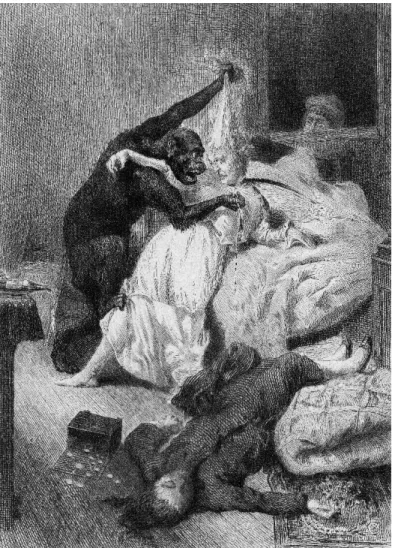
The sum of these observations suggests that Le Fanu’s debt to Edgar Allen Poe’s locked-room detective story “The Murders in the Rue Morgue” (1841) is far more complex and consequential than previous scholarship on “Green Tea” has realized. It has often been noted that the demon that haunts Jennings was inspired by the unlikely culprit of Poe’s tale. Set in Paris, “Rue Morgue” centers on a mysterious double-murder that
turns out to have been committed by a fugitive, razor-wielding orangutan. In a failed attempt to imitate its master’s daily routine of shaving, the escaped orangutan
accidentally slits a woman’s throat. When Jennings intentionally slits his own throat with a razor at the instigation of a simian demon, he imitates the disastrous imitation of Poe’s orangutan. There is another echo of Poe in the inhuman tone in which Le Fanu’s monkey addresses its victim, which recalls not only the “harsh and grating” speech that the Swedenborg excerpts assign to evil spirits (14), but also the ape-assassin of “Rue Morgue,” whose “harsh,” “shrill,” and “gruff” vocalizations lead ear-witnesses to the crime to conclude that the murderer had to have been a foreign-language speaker (408-10).
More importantly, Dupin provides an obvious foil to Hesselius, a failed
investigator who is too busy confirming what he already believes to be true to make any revolutionary, or even remotely useful, discoveries. Poe’s Dupin, the incontrovertibly successful detective, solves the baffling double-murder by listening carefully and skeptically to other people’s accounts of their auditory sensations. As a result, he manages to divine the implausibly simian form of the murderer. In contrast to Dupin, Hesselius recklessly underestimates the lethality of the phantom primate at the center of his case, even though—unlike Dupin—he benefits from relatively straightforward
evidence, an advantage he repeatedly squanders. If Hesselius has a mirror image in Poe’s story, it is the negligent, cowardly owner of the orangutan, who allows his dangerous pet to escape, who arrives too late to prevent its act of carnage, and who subsequently allows an innocent man to take the blame for the crime.
In the case of Hesselius, the final triumph of intellectual and professional bad faith occurs in his epilogue to the case study. Eager to exculpate himself and vindicate his dubious medico-philosophical system, Hesselius represents Jennings’ suicide as an inevitable—and theoretically negligible—feature of the case. Key to this rhetorical gambit is hereditary suicidal mania, a concept which Hesselius borrows from the very “materialist” physicians whom he derides, and which he wields in order to place the blame for Jennings’ tragic death squarely on the patient himself.
Suicidal Mania and the Evasion of Medical Responsibility
incidental detail with little bearing on the theoretical and practical implications of the case. Hesselius starkly distinguishes the “disease” that opened up the interior sense of Jennings from the inherited “complaint” that supposedly sealed the cleric’s doom:
Poor Mr. Jennings made away with himself. But that catastrophe was the result of a totally different malady, which, as it were, projected itself upon the disease which was established. His case was in the distinctive manner a complication, and the complaint under which he really succumbed, was
hereditary suicidal mania. Poor Mr. Jennings I cannot call a patient of mine, for I had not even begun to treat his case, and he had not yet given me, I am convinced, his full and unreserved confidence. If the patient do not array himself on the side of the disease, his cure is certain. (39-40, emphasis mine)
These assertions kill two rhetorical birds with one stone. Hesselius hopes to preserve the cosmological and theological truth-value of Jennings’ visions, where they might
otherwise be dismissed as the imaginings of a deranged mind. At the same time, the physician disavows responsibility for the fate of Jennings, whose congenital defect was apparently lying in wait for the perfect opportunity to enact itself. It is because of this hereditary “complaint,” argues Hesselius, that Jennings cannot but “array himself on the side of the disease” that has brought him into contact with the realm of demons. At some level, the hereditarily compromised patient consents to his inevitable undoing.
an unbridgeable rift in the physician’s endeavor to synthesize medicine and metaphysics. In contrast to a concept such as the interior sense, hereditary suicidal mania does not originate in premodern mysticism, but rather in the mainstream medical discourse of the nineteenth century. Yet, in the reckoning of Hesselius, this recognizably contemporary medical term names a dead-zone of intellectual inquiry that no “serious” practitioner of medicine would waste any time thinking about, one that can be shrugged off as an inevitable, and uncommon, evolutionary evil.
It is easy to understand why Hesselius wields his borrowed term in this way.
Hereditary suicidal mania emerges from a complex discursive field that connects suicide, hallucinations, and sometimes substance abuse in a line of argument that could
potentially devastate Hesselius’ pet theories. The 1845 English translation of Étienne Esquirol’s Mental Maladies: A Treatise on Insanity ranked heredity as the highest-risk factor in cases of insanity in general and of suicide in particular. In a treatise On Hallucinations: Or, the Rational History of Apparitions, Dreams, Ecstasy, Magnetism,
and Somnambulism, translated into English in 1857, the eminent French physician and psychiatrist Brière de Boismont noted that “[s]uicide is frequently the result of
hallucinations, which exist in the form of apparitions, menaces, and chimerical fears” (542). Jennings’ addiction to green tea, meanwhile, assumes a different cast when placed alongside a physician’s 1865 letter to the Medical Times and Gazette which discusses the confessions of a murderer who admitted to the “‘use of ardent spirits,’ which are
alternative to Hesselius’ Christianizing spiritualist explanation of Jennings’ case; this counterargument also exposes the risks involved in treating a hallucinating, stimulant-addicted patient as some sort of tortured mystic.
Attempting to exonerate himself and his hypotheses by invoking hereditary suicidal mania, Hesselius achieves the exact opposite. Obviously, the hereditary
component of this affliction presumes a prior suicide in the immediate family.19 In the nineteenth century, it was held that the circumstances surrounding such suicides were predictable, since they tended to follow a recognizable pattern across multiple
generations. Esquirol, for instance, stresses that the hereditary mania of parents and children “manifests itself…often at the same period of life. It is provoked by the same causes, and assumes the same character” (7). He elaborates this claim with examples: three generations of men kill themselves around the age of fifty; a mother and daughter both become insane at twenty-five following childbirth, etc. If Jennings has any family history of this kind, the story does not reveal it. Indeed, to the extent that pressing details of the patient’s past remain obscure to readers of “Green Tea,” the fault lies with
Hesselius, who neglects several opportunities to inquire into Jennings’ family history. In retrospect, Hesselius appears especially obtuse in overlooking the small yet disquieting details that he learns about Jennings’ father. When Hesselius first becomes intrigued by the enigmatic Jennings, he asks Lady Mary about the Reverend’s parents. Lady Mary volunteers that “his father is only ten years dead” (11). Hesselius presses on, asking whether “his mother or his father—I should rather think his father, saw a ghost”
(12). Mary confirms this suspicion and goes on to paint an unsettling portrait of Jennings’ father. He was a “silent, whimsical man” who related long accounts of his dreams (12). On one occasion, he told Mary’s father “a story about a ghost he had seen and talked with” (12). She recalls having been “afraid” of Jennings’ “silent and moping” father (12). As a child, she “used to fancy there were ghosts about him” and was unsettled when he would “drop in sometimes…when I was alone” (12).
The sinister implications of Lady Mary’s reminiscences become clear later in the story, as Jennings describes the increasingly aggressive techniques through which the monkey-demon urges him to violence. Jennings is particularly troubled by an incident that occurred while he and his young niece were walking together in the woods. The niece—displaying more insight into Jennings’ suffering than his physician—refuses to heed her uncle’s plea to leave him alone during the walk, a request that he makes as the demon is urging him to throw himself down a mineshaft in her presence. The only consideration that gives Jennings the power to resist this command is his “fear lest the shock of the occurrence be too much for the poor girl” (32). He tries to send her away, but “the more I urged her the firmer she became. She looked doubtful and frightened. I suppose there was something in my looks or manner that alarmed her” (32).
suggestion that both Jennings and his father were haunted to their graves exposes the true depth of the negligence involved in disregarding the demon’s simian form. According to the garbled version of Swedenborg that the reader receives via Hesselius, the spirit’s shape encodes a truth about either its own disposition or about the particular weaknesses of its victim. Either way, in materializing as a monkey, the apparition may portend the bout of “hereditary suicidal mania” that snuffs out the life of Jennings. As an
The Bones of Theory: Vernacular Psychology in M.R. James
Although M.R. James deeply admired Sheridan Le Fanu’s horror stories,1 he departed
from his predecessor’s willingness to foreground medical protagonists and to indulge in clinical language. James’ reluctance to employ the technical vocabulary of medicine extends to the word hallucination itself: the term never appears in James’ stories, even
though hallucinatory phenomena are central to the hauntings they depict and to the suffering their protagonists experience. Many of James' characters question their perceptions and doubt their own sanity when confronted with the visual signs of the supernatural. In many instances, these suspicions are well founded, since hallucination is a tactic used by James' ghosts to torment the haunted. The suffering protagonist of “A Warning to the Curious” (1925) gives voice to this central motif of the Jamesian ghost story when he remarks that the vengeful spirit that haunts him does so by exercising “some power over [the] eyes” (2.153).
Whether or not James avoided the medical-sounding term hallucination on purpose, its absence in his ghost stories is consistent with his sparing use of medical and scientific jargon. In a preface to his second volume of ghost stories, James gently
upbraids contemporaries who adopted medical and scientific terms to theorize the supernatural in their fiction. James criticized the twentieth-century ghost story for its “blatancy,” accusing writers such as Algernon Blackwood of dragging into their fictional entertainments too many of the "technical terms of ‘occultism’” (2.260). Rejecting such “quasi-scientific” language, James argues that the best ghost stories “allow us to be just a
1 “I do not think,” James wrote, “that there are better ghost stories anywhere than the best of Le Fanu’s”
little in the dark as to the working of their machinery. We do not want to see the bones of their theory about the supernatural” (2.260). For James, an aversion to technical, expert terminology is consistent with what he considered the central technique of the ghost story: “reticence” in the realm of explanation (2.259).
This does not mean that medicalizing explanations of the supernatural are absent from the Jamesian ghost story. Perhaps guided by James' overt statements on the topic, critics have overlooked the frequency and significance of physiological and psychiatric diagnoses (and self-diagnoses) in his fiction. However, rather than being wielded by physicians with a spiritual bent of mind, medicalizing discourses enter into James' stories as platitudes, common-sense statements, and folk wisdom, policing the standards of normalcy and stigmatizing psychopathology. For characters on the receiving end of vernacular diagnosis, the fear is often less about going insane than being thought insane, not by any particular institution or clinical gaze, but by the agents of rumor and gossip.
the supernatural fiction of other authors would use to account for their experiences. Primary among these excluded explanations is the concept of hallucination. Into this vacuum rushes the language (at turns dismissive and coercive) of vernacular diagnosis.
Recent criticism of James’ fiction has begun to embrace the conclusion that his works are thematically substantial, intellectually complex, and deeply informed by his vast scholarly knowledge. Much twentieth-century work on James, and on the ghost story more generally, focused on an arsenal of formal and technical tricks used to provoke cheap scares—a condescending mode of reading which James’ own criticism of the ghost story tended to endorse—and dismissed the possibility of a serious engagement with social or philosophical issues.2 More recent criticism has traced how James’ tales are shaped by his substantial background knowledge of history, religious controversy, and folklore.3 Ron Weighell has shown that James’ references to ritual magic draw on a broad
familiarity with hermetic traditions. Simon MacCulloch argues for the social and psychological relevance of James’ concerns, and Rosemary Pardoe investigates the complex ways in which his works engage religious and theological issues. By exploring how James’ uneasy relationship with the language and apparatus of medicine shapes the intense psychological pain and trauma that afflict his characters, I hope to illuminate another dimension of James’ complexity and suggest the deep concern that his work evokes for his suffering protagonists who, cut off from any forms of institutionalized medicine that could help to treat them, are nevertheless vulnerable to the stigmatization that the suspicion of psychopathology sets into motion.
2 See Julia Briggs, Jack Sullivan, or the early work of S.T. Joshi (who later became James’ editor).
Guilt and Mental Illness: “Oh, Whistle”
In one of James' best-known stories, “Oh, Whistle, and I’ll Come to You, My Lad,” haunting assumes the form of being made to see what others cannot. First read at a King’s College Christmas party in 1903 (Roden95), "Oh, Whistle" tells the story of Parkins, a young Professor of "Ontography”4 who takes an ill-fated golfing trip to the east coast of England. At the behest of a colleague, Professor Parkins investigates the seaside ruins of a Templar preceptory, where he unearths a whistle with a mysterious Latin inscription. “In fact,” the level-headed Parkins concludes after a cursory examination of the object, “it was—yes, certainly it was—actually no more nor less than a whistle” (1.88). This conclusion is proved wrong once Parkins blows on the trinket, an act that summons the malicious spirit that will haunt him for the remainder of the story and nearly bring about his death.
Even before this ghost appears on the scene, it is clear that the whistle is more than "just" a whistle, since its sound “seemed to have the power (which many scents possess) of forming pictures in the brain” (1.89). In the mental images set into motion by the whistle, Parkins sees two figures on a beach, a man fleeing his pale, tattered, lurching pursuer. Later that evening, Parkins cannot sleep, since every time he closes his eyes, he sees a more menacing version of these moving pictures. The language used to describe the images that torment Parkins positions him as a passive victim:
Parkins’s experience on this occasion was a very distressing one. He found that the picture which presented itself to him was continuous. When he opened his eyes, of course, it went; but when he shut them once more it
framed itself afresh, and acted itself out again, neither quicker nor slower than before. (1.90)
The following night, the ghost from Parkins' vision will visit him in person and nearly cause him to plunge to his death from the window of his hotel room. Parkins survives his encounter with the ghost, thanks to the timely intervention of Colonel Wilson, an
immensely practical and staunchly Protestant figure who “remembered a not very dissimilar occurrence in India” (1.100). According to Wilson, the specter could not have seriously harmed Parkins, and possessed "only" the power to frighten him through spectacle.
While Colonel Wilson encourages Parkins to focus on the supposedly negligible consequences of his visions, the story itself is interested in staging attempts to account for their causes, exploiting the absence of a professional authority capable of doing so
This commentary of the narrator has a counterpart in Parkins' attempts to explain the origins of the visions that disturb his sleep, which ultimately prove no more decisive:
With many misgivings as to incipient failure of eyesight, overworked brain, excessive smoking, and so on, he finally resigned himself to light his candle, get out a book, and pass the night waking, rather than be tormented by this persistent panorama, which he saw clearly enough could only be a morbid reflection of his walk and his thoughts on that very day. (1.91)
Despite this attempt to rationalize his frightful experience, Parkins cannot bring himself to follow through on “his resolution to keep his eyes shut” in order to see what happens when the specter approaches the second figure in his vision (1.91). Early twentieth-century psychology had a precise name for the experiences that Parkins describes here:
hypnagogic hallucinations. In 1886, Edmund Gurney, a psychologist who conducted experiments for the Society of Psychical Research, even wrote about a form of
hypnagogic hallucination in which “some object that has actually been seen during the day seems to reappear before the eyes” (1.390). Without using the kind of technical language deployed by Gurney and other psychologists, Parkins decides to manage his hypnagogic visions by attempting to go without sleep for the evening.
More importantly, as is characteristic in James’ ghost stories, Parkins’
that his over-application to his work is responsible, a pathological cause which, under normal circumstances, would be morally laudable. His third theory suggests a different and more guilt-inducing kind of overindulgence: overindulgence in tobacco, a form of substance abuse. Parkins’ third, self-reproaching explanation for his woes is echoed by the faceless community that tries to make sense of his experience at the end of the narrative: “The Professor was somehow cleared of the ready suspicion of delirium tremens, and the hotel of the reputation of a troubled house” (1.100). The popular imagination flirts with diagnosing Parkins with a disease that had assumed a strong moralistic valence.
In fact, this invocation of delirium tremens is one of the few times in James’ fiction that a current medical term is used. The phrase was coined in 1813 by an English physician, Thomas Sutton, who introduced it as a new name for what had previously been called “idiopathic phrenitis” (1). The Latin word delirium means, broadly, “insanity” or “madness.” In medical discourse, delirium has been applied to psychic phenomena ranging from memory loss and aphasia to nightmare and hallucination. Sutton’s case studies include instances of all these symptoms. His neologism combines delirium with
as the predisposing cause of delirium tremens”5 illustrates both the rapid spread of
Sutton’s designation and the moral stigma that attached to the disease (12). Temperance advocates quickly put the disease to rhetorical use in their arguments.
By the end of the nineteenth century, the association of delirium tremens with alcoholism and moral laxity was standard: the ninth edition of the Encyclopaedia
Britannica, completed in 1889, defines the condition as “one of a train of symptoms…of
acute alcoholism,” in which the patient is “constantly troubled with visual hallucinations in the form of disagreeable animals…He looks suspiciously around him…and ransacks his bedclothes for some fancied object” (“Delirium”). The article pauses to debunk a number of popular misconceptions on the subject, but the very fact that there were
popular misconceptions shows the wide dissemination of the term. In James, this “ready suspicion” constitutes both a psychiatric judgment and a moral accusation on the part of the sufferer’s community. Parkins is “cleared” of the suspicion of disease in the way that he might be cleared of a legal charge. In the story, the diagnosis arises and is overruled without any reference to the institutional embodiments of psychiatry, given voice not by any medical practitioner but by popular gossip.
This flamboyant—by James’ standards—adoption of medical jargon might very well overshadow the other remarkable phrase in the same passage: troubled house. If
delirium tremens gestures toward medical science, “troubled house” belongs to folklore and to scientific inquiries into the phenomenon of haunting. The Edinburgh Annual Register for 1810 recounts the history of a haunted house in Sampford, Devonshire. News of odd phenomena spread, attracting visitors: “two gentlemen, from Taunton,
5 Rayer: “cet état particulier de l’encéphale et des nerfs, chez les ivrognes, que l’on doit regarder comme la
attended the troubled house, and requested permission to pass the night in the haunted room,” where their interest was repaid by the sight of a monster “very much resembling a black rabbit, only wonderfully larger!” (156). An 1825 history of Boston notes that, upon “discovering” in 1687 that four children had been bewitched, the “ministers…kept a day of fasting and prayer at the troubled house” (Snow 194). Catherine Crowe’s 1848
collection The Night Side of Nature; or, Ghosts and Ghost Seers contains, in its chapter on haunted houses, the account of a Mrs. L., whose new servant, hearing her name called out by an unseen being, complained: “This is a troubled house you’ve got into, Ma’am” (111). Like delirium tremens, the euphemism troubled house functions as a stigmatizing instrument, vague in the popular imagination yet always ready at hand. Due to the events of “Oh, Whistle,” the reputation of the hotel’s owner is at stake, just as much as Parkins’. This reputation is tried in the court of popular opinion, which lacks anything resembling a clear standard of proof. For James, the social body seems to engage paranormal activity the same way that it does psychopathology: through rumor and condemnatory innuendo.
James stresses the irony that it is Parkins, of all people, who finds himself the subject of such unlearned speculation. In keeping with his loudly and repeatedly professed disbelief in the supernatural, Parkins decries folk explanation of natural
position…cannot…be too careful about appearing to sanction the current beliefs on such subjects” (1.83). The beliefs that Parkins espouses are based on social, rather than epistemological, criteria: people who wield professional authority must distance
themselves from the common opinion of the masses. The ultimate irony is that Parkins, in attempting to account for why he is suffering from unwanted visions, internalizes and reinforces folk wisdom and the most moralistic, least scientifically rigorous dimensions of professional medical knowledge.
Both communal diagnosis and Parkins’ self-diagnosis explain his experience as a hallucination without using the term. The word hallucination has been in the medical vocabulary considerably longer than delirium tremens, so the fact that James does not use it here or in other stories is puzzling.6 Its absence is all the more curious when one
considers that the etymology of hallucination suggests that moral accusation was built into the concept from the start. In 1604, hallucinate appeared in Robert Cawdry’s
Table…of Hard Usual English Words, which gives the definition “to deceiue, or blind.” This transitive sense, along with an intransitive sense meaning “to be deceived, to be in error,” quickly began to appear in philosophical and theological discourse, especially in arguments about scriptural interpretation.7 Early medical uses referred to hallucination as
a defect of vision, addressing the symptom in starkly moralizing and even theological terms. In 1798, with the Inquiry into…Mental Derangement of the Scottish writer Sir Alexander Crichton, physician to the Tsars, hallucination took its place in psychological discourse, denoting “[E]rror of mind, in which ideal objects are mistaken for
realities…without general derangement of the mental faculties” (342-3). Parkins makes
6 See the Introduction for more general remarks on the word’s history.
the opposite mistake, taking a mental image that could alert him to danger and regarding it as the product of physical malfunction and moral pathology. The dubious medical assumptions that Parkins applies to himself fail to illuminate his situation, but do succeed in prolonging and augmenting his suffering.
Hallucination or Illusion?: “Casting the Runes”
“Casting the Runes” (1911) departs from much of James’ fiction in two particularly noteworthy ways. First, it takes place in modern London, not in the rural settings James generally prefers. Second, it has a human antagonist in Karswell, an amateur scholar who tries to publish academic papers with non-ironic titles such as “The Truth of Alchemy.”8 In "Casting the Runes," it is Karswell, rather than a revenant spirit, who exercises power over the eyes of others. Through his studies in alchemy and magic, he learns how to “cast the Runes” on people, “either for the purpose of gaining their affection or of getting them out of the way” (1.174). Prior to the events of "Casting the Runes," Karswell has already used this power to kill John Harrington, a critic who wrote a scathing review of his first book on witchcraft. The new object of his fury is Edward Dunning, who, when the story opens, has declined to recommend "The Truth of Alchemy" for publication in the journal of a learned society. In the end, Dunning is able to reverse Karswell’s spell by tricking him into taking back the paper on which it is written.
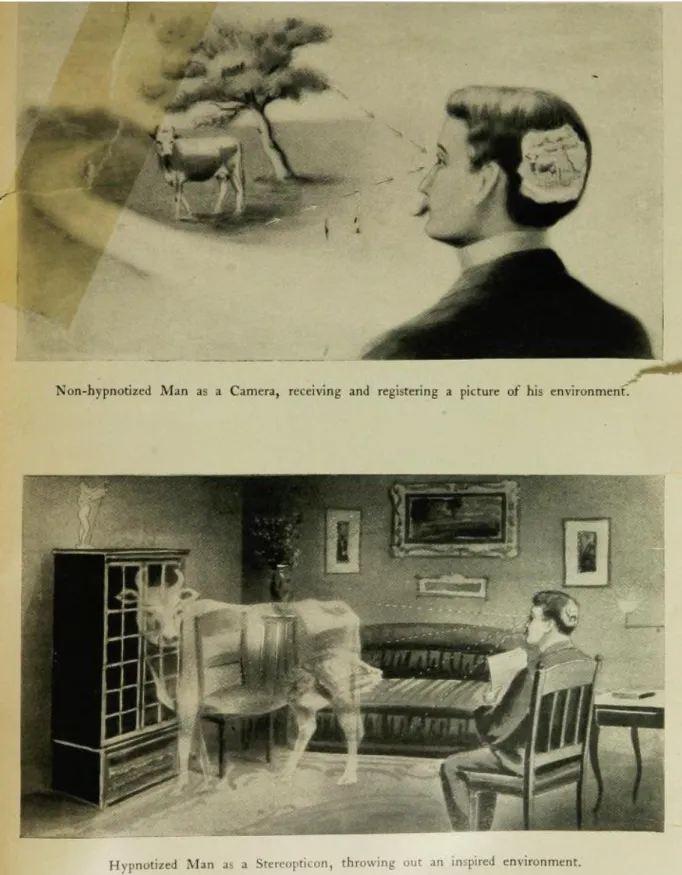
By foregrounding the issue of hypnotism, “Casting the Runes” is able to discuss hallucination in a way that cannot be reduced to pathology. For Dunning, Karswell’s power over his eyes is effectual and potentially deadly regardless of whether it is the
8 James attacked the comparative mythologists of his day for some of the same reasons that his characters
result of magic or—as the story repeatedly hints—of a cheap hypnotic parlor game. Dunning’s sympathetic friends initially dismiss his hallucinations as figments of his imagination, caused by Karswell’s cheap conjuring, and attempt to allay Dunning’s collateral symptoms, which include depression and paranoia. The plot arc of the story shows that this gentle and genteel approach to treating the effects, rather than the causes, of Dunning’s hallucinatory experiences would certainly have lethal results, regardless of the ultimate mechanism by which they are imposed on him by the nefarious Karswell.
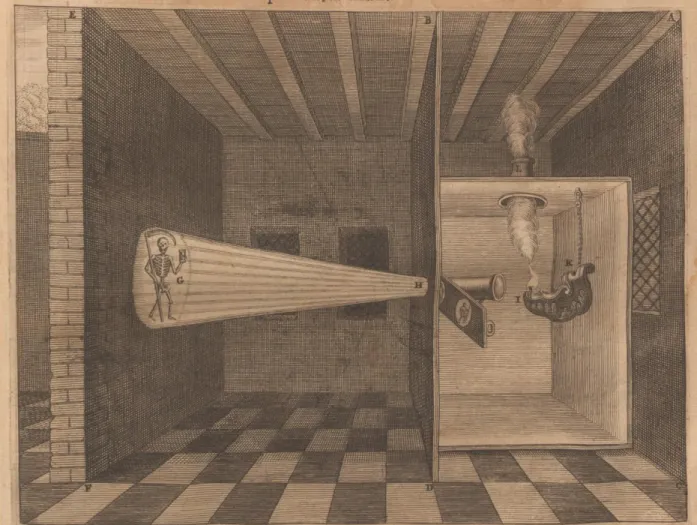
The first insight we are given into Karswell’s history associates him with the power to manipulate vision through a nebulous combination of black magic and theatrical technology. The episode in question is narrated by the unnamed hostess of a lunch, who, in turn, leans heavily on the testimony of a clergyman named Farrer, because she was not actually present for the event that she recounts. Karswell had written to Farrer, offering to show the children of the parish some magic lantern slides in his manor house. The
demonstration proves terrifying, not just to the children, but to Farrer himself, who suffers nightmares as a result of the spectacle. Karswell, the hostess reports, “had evidently set out with the intention of frightening these poor village children out of their wits” (1.160).9 One slide shows Red Riding Hood with a “dreadful” wolf, and another
depicts a “horrible hopping creature in white” (1.161). The last slide seems to exceed the technical limitations of the magic lantern, showing “a great mass of snakes, centipedes, and disgusting creatures with wings" made to seem “as if they were climbing out of the picture” (1.161). Whether Karswell’s performance is supernatural or merely illusory in