Nearer, My God, to Thee: Religion in Executed Persons’ Last Statements
By Molly Williams
Senior Honors Thesis Sociology Department
University of North Carolina at Chapel Hill April 6, 2015
Acknowledgements
Many thanks to my supportive advisor, Professor Andrew Perrin, and my committee member, Professor Lisa Pearce, for their help and guidance in this process. Additionally, a
special thank you to Professor Howard Aldrich, Professor Jessica Pearlman, Honors Carolina, UNC-‐Chapel Hill Sociology Department, Ken Rose, Dr. Scott Vollum, Kaitlyn
Richards, Margaret Williams, Andrew Reckard, Chaplain Lopez, Chaplain Vitela, and Reverend Pickett for making this research possible. This project was supported by the
Dunlevie Honors Undergraduate Research Award, administered by Honors Carolina.
Abstract
This study aims to answer three questions: does religiosity increase with the amount of time spent on death row as indicated by religion in the person’s last statement; what
themes occur in the religious last statements; and what can we learn about religiosity based on the different mechanisms employed by the religious and nonreligious statements? Using available data from the Texas Department of Criminal Justice, I perform a content analysis on all 409 last statements of persons executed between 1982 and 2014. Using interviews with death row chaplains and the theory of theodicy, I conclude that religiosity does not increase with the amount of time spent on death row, but serves as one of two important mechanisms to make meaning out of time on death row and to transcend their impending death.
Table of Contents
The Death Penalty and Death Row………..………5
Literature Review and Theoretical Framework………...17
Data and Methods………22
Results………31
Discussion and Conclusion.………44
References………48
Early on the morning of May 9, 2002, Reginald Reeves processed into a quiet room and situated himself in the proper place. With the attention of a small congregation, he
delivered his message, “I pray that we all may learn to love and forgive so that we can have peace in the world. It is with love and forgiveness and living to learn to love and loving to live that we can learn the power of forgiveness and learn to live as brothers and sisters on this earth…if we don't forgive, sooner or later we will all self-‐destruct. You need to open up your heart and let God in…We should forgive and love…God dwells within us and we are all one big family of humanity; we must all learn to love and live together.“ At first glance, these profound words appear to be an excerpt of a preacher’s Sunday morning sermon. However, these words were spoken by a person who is often labeled a monster, a person representative of the lowest of the low in our country, a person who a majority of
system as a whole. As of February 2014, 41.75% of death row inmates are black, 43% are white, 12.69% are Latino, and 2.54% identify as other (Death Penalty Information Center). Since 1976, 35% of those executed were black, 56% were white, 8% were Latino, and 2% identify as other. However, over 75% of the murder victims resulting in an execution were white (“Facts About the Death Penalty”). Our system of mass incarceration incarcerates black men in dramatic disproportions, with 3% of all black male residents incarcerated as of December 31, 2013, and only 0.5% of white male residents (Bureau of Justice Statistics). Michelle Alexander labels mass incarceration as the “New Jim Crow” (Alexander). Much research has been done on the political, public opinion, and religious discourses
surrounding the death penalty debate, but little attention has been given to death row inmates themselves.
discussion of my results compared to the predictions of theodicy, asserting that religion is used to make meaning out of time on death row and serves as one of two mechanisms to distance oneself from the death penalty.
THE DEATH PENALTY IN THE UNITED STATES
Despite a report by the National Research Council stating that the death penalty does not lower homicide rates, 32 states still use capital punishment as of March 2015 (“Facts About the Death Penalty”). In Alabama, Arizona, Arkansas, California, Colorado, Delaware, Florida Georgia, Idaho, Indiana, Kansas, Kentucky, Louisiana, Mississippi, Missouri,
Montana, Nebraska, Nevada, New Hampshire, North Carolina, Ohio, Oklahoma, Oregon, Pennsylvania, South Carolina, South Dakota, Tennessee, Texas, Utah, Virginia, Washington, and Wyoming, capital punishment remains legal (“Facts About the Death Penalty”). The remaining 18 states have abolished the death penalty.
1930s (Bohm; Schabas). After the 1940s, the number of executions decreased dramatically, with only 191 executions nationwide in the 1960s (Bohm).
Though there were previous Supreme Court cases involving the death penalty, Furman v. Georgia placed a moratorium on the death penalty between 1972 and 1976 (Bohm; Bedau). However, this moratorium was overturned in 1976 at the culmination of Gregg v. Georgia (Bedau). In the 1970s and 1980s restrictions were placed on the death penalty with Coker v. Georgia, Godfrey v. Georgia, Enmund v. Florida, and Ford v. Wainwright
(Bohm). The death penalty was now unconstitutional for rape of an adult if the victim lived, ordinary murder1, a minor involved in a felony not resulting in death, and persons labeled mentally insane (Bedau). In 2002, Atkins v. Virginia outlawed execution for people with mental retardation; Roper v. Simmons, in 2005, labeled the death penalty cruel and unusual punishment for minors who committed a crime (“The Death Penalty for Juveniles”). Finally, Kennedy v. Louisiana ruled that the death penalty could not be imposed for crimes where no death occurred in 2008 (Part 1: History of the Death Penalty).
The number of executions per year increased steadily between the 1976 re-‐enactment and the year 1998. Since 1998, in which 98 people were put to death, the death penalty has slowly declined with only 35 executions in 2014 (“Facts About the Death Penalty”). Despite the decrease in the number of executions, inmates are spending more time on death row than ever before (Snell). In 1984, the average death row inmate spent 74 months, or 6
1 A murder in which the primary aggravating factor is not “outrageously or wantonly vile” (Bedau)
years, on death row before their execution. However, in 2012, the average death row inmate spent almost 16 years waiting for execution, a 257% increase from 1984 (Snell). THE DEATH PENALTY IN TEXAS
For my research, I have chosen to focus on the state with the largest number of
executions and the most available data from these executions: Texas. Widely known for its use of the death penalty, Texas has executed a total of 1,273 people, 755 before 1972 and 518 between the re-‐enactment and 2015 (State by State Database). Between 1928 and 1965, death row was located in the East Building of the Huntsville Unit (Texas Department of Criminal Justice). During this time, the electric chair was used to carry out executions. Following the Furman v. Georgia decision, Texas re-‐enacted the death penalty on December 31, 1976 (State by State Database). The first execution after the re-‐enactment, and the first execution by lethal injection in the United States, was Charlie Brooks on December 7, 1982 (State by State Database). Texas’s death row for men was housed at the Ellis Unit in
Huntsville, Texas, from 1965 until 1999. The Ellis Unit was labeled not suitable after an inmate escaped, and death row moved to the Polunsky Unit, formerly named the Terrell Unit, in Livingston, Texas, in 1999 (R. Lopez, personal communication, January 2015). The women on death row are held at the Mountain View Unit in Gatesville, Texas (Perkinson). However, death row is not where the executions take place; all lethal injections are
administered in the northeast corner of the Walls Unit in Huntsville, Texas.
displays this increase, with inmates spending an average of 10.74 years on death row before their execution.2 David Lee Powell, executed on June 15, 2010, spent 31 years on death row (Texas Department of Criminal Justice).
Figure 1
A NOTE ON GENERALIZABILITY
The data used for this study consist only of last statements from Texas’s death row inmates. Though Texas has a specific political and religious climate, it is the only state with a large enough collection of published statements for systematic analysis. Despite Texas’s political and religious environment, there is little variation among death row conditions
from state to state. Additionally, the demographics of those on death row—primarily minority populations who complete little formal education—are consistent throughout America’s death rows. The similar conditions and demographics of inmates on death row increase the generalizability of my results, despite the specific location, as Texas’s death row inmates are generally similar to those of other states.
LIFE ON DEATH ROW
To further explore possible explanations for religion in executed persons’ last statements, the following highlights life on death row. Unlike prison, death row does not have any rehabilitation services or programs because it serves only as a holding place for inmates until their execution (Magee). Most inmates spend close to twenty-‐three hours every day inside their two-‐paces-‐wide and three-‐paces-‐deep cell (Von Drehle). The cell involves three concrete walls, a concrete ceiling, a concrete floor, and a steel sink and toilet (Von Drehle). An inmate's cell on death row has been described as a “concrete tomb” (Von Drehle).
Based on his time spent with inmates on Florida’s death row, Von Drehle describes the most difficult task each prisoner faces—“filling the hours until he can fall asleep again,” as sleep is the best way to pass time (Von Drehle). To help one better understand life on death row, three inmates outline a typical day in Texas’s Ellis Unit:
4:00am – The lights come on.
5:30am – The radio, which primarily plays the news, is turned on.
6:00am-‐6:30am – The breakfast tray is slid into the cell; meals are virtually the same everyday.
10:30am-‐11am – The lunch cart arrives and the lunch tray is slid into the cell.
11:00am – The televisions are turned on. Each inmate has a view of the television, but no control over the channel. The same series of soap operas and news stations play every day. Televisions were allowed in the Ellis Unit but are not permitted in the Polunsky Unit.
8:30am-‐3:00pm – Three of the four groups are allowed 1.5 hours of recreation. Similar to showers, recreation times operate on a rotating schedule. Each of the four groups is allowed recreation three times a week for a total of 4.5 hours each week. This
recreation is spent inside a day room, consisting of 4 tables, dominoes, and a chess set. The only time inmates are allowed outdoors is the occasional recreation time held in an enclosed yard.
3:30pm-‐4pm – The dinner tray arrives.
7:30pm – Mail is delivered to the inmates’ cells.
11pm – The lights, radio, and televisions are turned off.
Unit. One inmate who has lived in both units describes the Polunsky Unit: “the unit’s mentality is, ‘we keep you kenneled until your date’” (Perkinson).
As there are several hours a day left unscheduled, other common pastimes include push-‐ups or sit-‐ups inside the cell, aimlessly talking, writing letters, or reading, for those who are literate (Von Drehle). Though there are several restrictions, inmates can request certain books in the mail (Von Drehle). While this schedule may not seem difficult, it is important to remember that this is the daily routine of a death row inmate for 365 days every year for several years at a time. The inmates on death row live in a “world of terrible pendency. They find little things that at once consume the time and hold time at a distance” (Jackson and Christian).
Death row is very different from prison. As prisoners move closer to freedom, death row inmates move closer to death (Jackson and Christian). It is also unlike a cancer ward. While patients with a chronic illness can rest in the “hatred of the random, the gratuitous, the inexplicable, the death sentence comes with all the considered logic the state can accumulate” (Jackson and Christian). Strangely, death row is like a combination between prison and a cancer ward as inmates are held in a controlled, closely monitored
environment as they approach death.
Finally, the isolation experienced by death row inmates is unmatched. Anthony Graves, who spent 18 years on Texas’s death row before his exoneration in 2010, describes the isolation:
long periods of time without feeling too crowded. No one can begin to imagine the psychological effects isolation has on another human being” (Reassessing Solitary Confinement, 2012).
The feelings of isolation are compounded by the total dependency inmates
experience. Inmates on death row are dependent on the prison for everything from food to their ration of toilet paper (Radelet). Additionally, it is common for inmates to request that their families do not visit because of shame and guilt, which furthers the feeling of isolation (Arriens). However, when families do visit, they are only allowed to interact through a non-‐contact visiting booth (Perkinson).
In order to better understand life on death row, particularly religious life, I conducted semi-‐structured interviews with three death row chaplains from Texas. The chaplains each had different perspectives to share. Chaplain Vitela served for 7 years in the Ellis Unit (1990-‐1997), Chaplain Lopez for 14 years in the Polunsky Unit (2000-‐present), and
For a brief period of time at the Ellis Unit, 1990 to 1999, there was a weekly religious service held (R. Lopez, personal communication, January 2015). This service involved music, prayer, scripture reading, a sermon, and communion. The service, held in the day room, was one of the few times during the week that inmates were allowed to congregate. However, when death row moved to the Polunsky Unit, these services were no longer permitted.
Chaplain Vitela, who served for 14 years on Texas’s death row, describes the religious life in the Polunsky Unit. There are no religious activities held, but chaplains and spiritual advisors are available to meet with inmates everyday (J. Vitela, personal communication, January 2015). Contact with the chaplains and spiritual advisors is largely the only human contact inmates are allowed. The chaplains and spiritual advisors are available to talk with inmates about any subject, and the conversation only becomes religious if the inmate expresses interest in a religious conversation (R. Lopez, personal communication, January 2015). There are also religious books available to the inmates upon request. To obtain a book or a religious text, the inmates can write to bookstores to place their orders. Vitela shares that about half of the people on death row entered with a religious identity. He says that every inmate experiences personal and religious changes while on death row because of the length of time they spend in isolation. Lopez also reports that inmates experience personal growth and change while on death row, though many of them enter with a pre-‐ existing, familial religious identity (R. Lopez, personal communication, January 2015).
create discourse to respond, both cognitively and emotionally, to these horrors. According to Foucault, when a problem arises—in this case the death penalty—people create
discourses and symbols to respond to the problem or to gain control over the problem (Foucault). This research examines the religious discourses created by death row inmates—whether it increases with time spent on death row, its contours, and how it compares to nonreligious discourses—in order to respond to the death penalty and death row.
A NOTE ON PERSONAL BIAS
As a researcher, it is important for me to note my personal bias—an unequivocal opposition to the death penalty. I do not believe the death penalty is a tool for justice, but instead, a mechanism to continue the systematic killing of a minority population. As Justice William Brennan states, “It is tempting to pretend the minorities on death row share a fate in no way connected to our own…[however] the way in which we choose those who will die reveals the depth of moral commitment among the living” (Ingle). While my feelings
against the death penalty are strong, I will outline clear, objective research methods that work to eliminate biases in my analysis of religiosity among the executed persons’ last statements.
LITERATURE REVIEW
Little research has been conducted on the statements of executed persons. In spite of the adamant, opposing political viewpoints on the death penalty, there is limited research on the last words of the people most deeply affected. Because there is little research on the last words of executed offenders and subsequent themes, there is also a narrow
understanding of possible influences on the persons’ last statement. The following highlights the existing literature on executed persons’ last statements and focuses on possible factors that contribute to the high level of religiosity within these statements. Additionally, using the theory of theodicy in the sociology of religion, I outline a theory that describes religion as a mechanism to make meaning out of suffering.
LAST WORDS OF EXECUTED PERSONS
Primarily, the existing literature on last statements is journalistic. These accounts include a few statements of executed persons but provide little systematic analysis (Vollum). The literature is based on interviews with inmates and prison employees or letters written by the condemned (Dicks; Arriens). Other anecdotal accounts are written from people like prison chaplains who have interacted with death row inmates or
witnessed executions (Pickett; Robertson). Robert Elder provides 110 statements from executed persons with brief biographical data, but he provides no analysis of these words (Elder). Few death row inmates have also written autobiographical accounts of their
experiences (Rossi). While the accounts are important in sharing the stories of inmates and lending a voice to the condemned, they provide little to no analysis or comparison.
statements from January 1997 to April 2005 and identified six themes: “afterlife belief, silence, claims of innocence, activism, love/appreciation, and forgiveness” (Heflick). The study involves a discussion of these themes and provides several examples, but it does not include how often these themes appear or provide an explanation for why these themes are the most prevalent. The second study analyzed 285 last statements from Texas to develop a typology with four identity types: philosopher, externalizer, defiant, and contrite (Slone). The four categories were also examined with respect to characteristics of the offender, but, with no significance testing, there are no firm conclusions (Vollum). Both studies provide limited, analytical understanding of the statements but include helpful descriptions of primary themes.
off after that.”3 While there are several demographics considered in the statistical analyses, Vollum does not research change in religiosity based on the number of years spent on death row. Though Vollum provides a statistical analysis of multiple themes, there is little explanation for why religious themes occur or the possible reasons that religion is
employed. Additionally, in identifying overarching themes for the religion in executed persons’ last statements, researchers generate new categories with little explanation of existing theoretical frameworks. Finally, my analysis examines a larger collection of last statements than previous studies by including every publicly available statement between 1982 and 2014 for a total of 409 statements.
THEORETICAL FRAMEWORK
The sociological theory of theodicy provides a context for possible motivations behind the religiosity in executed persons’ last words. The term theodicy, or using religion to make meaning out of death, pain, and suffering, provides a helpful framework (Weber; Berger; Geertz). Theodicy, coined by Gottfried Leibniz, first emerged in the field of sociology through Weber’s Sociology of Religion as Weber outlined the problem with the
discontinuity of a good God and a world with evil, pain, and suffering (Kalberg; Beckford and Walliss; Turner). According to Weber, religion provides “paths of practical action in the face of the vast array of social inequalities” and seeks to explain “an irrational world of undeserved suffering” (Beckford and Walliss; Swedberg). The theory of theodicy is central to Weber’s understanding of religion, specifically the role that religion plays in the
development of modern societies (Beckford and Walliss).
Weber outlines three typologies within theodicy that seek to explain the ways people assign religious meaning to suffering and pain (Weber). The first typology, karma,
attributes present suffering to past conduct and labels individuals as responsible for their own destinies (Farris; Turner). Next, dualism describes a battle between good and evil, with good triumphing in the end. In dualism, pain is often seen as a necessary period of religious growth (Farris; Turner). Finally, the concept of predestination depicts God as an omnipotent, inscrutable, eternal judge who grants eternity to those who have worked to earn it (Farris; Turner). Primarily, Weber’s theodicy is concerned with the problem of evil, but he also believes theodicy is a “dimension of the politics of exclusion” as he incorporates theology into his understanding of power relations (Turner).
The understanding of theodicy within the sociology of religion expanded under Berger and Geertz. In The Social Reality of Religion, Berger explains the theory of theodicy as a way to establish “an all-‐embracing sacred order, that is, of a sacred cosmos that will be capable of maintaining itself in the ever present face of chaos” (Berger). Contrary to Weber, pain and chaos present problems because they disrupt the societal order (Beckford and
Weber, Berger, and Geertz each claim that religion serves as a mechanism to make meaning out of pain and suffering. The idea of theodicy informed my research questions and my analysis of the executed persons’ last statements. During the unique instance of execution, theodicy attempts to explain the religiosity within the executed persons’ last statements.
DATA AND METHODS HYPOTHESIS
Based on previous studies of the last words of executed persons and the theoretical framework outlined, I anticipate religious language and themes to appear throughout the last statements. As chaplains and spiritual advisors affect the religious life of inmates on death row, I hypothesize a relationship between the number of years a person spends on death row and the level of religiosity of their statement. A null hypothesis predicts no association between number of years on death row and the level of religiosity of the
person’s last statement; my alternative hypothesis anticipates that increased time on death row will increase the level of religiosity of the person’s last statement.
Given the theory of theodicy, I predict that inmates will work to assign meaning to their time and experiences on death row through religion. Similarly, in my comparison between the religious and nonreligious statements, I anticipate the religious statements to more commonly assign meaning to the person’s approaching death. I will test the
aforementioned hypotheses through a statistical and content-‐based analysis of last statements from executed persons on Texas’s death row.
DATA
For each executed person, the Death Row Information website lists their name, TDCJ number, age, race, gender, date of execution, county, date of birth, date received, age when received, date of the offense, age at time of the offense, education level, hair color, height, weight, eye color, native county, native state, prior occupation, prior prison record,
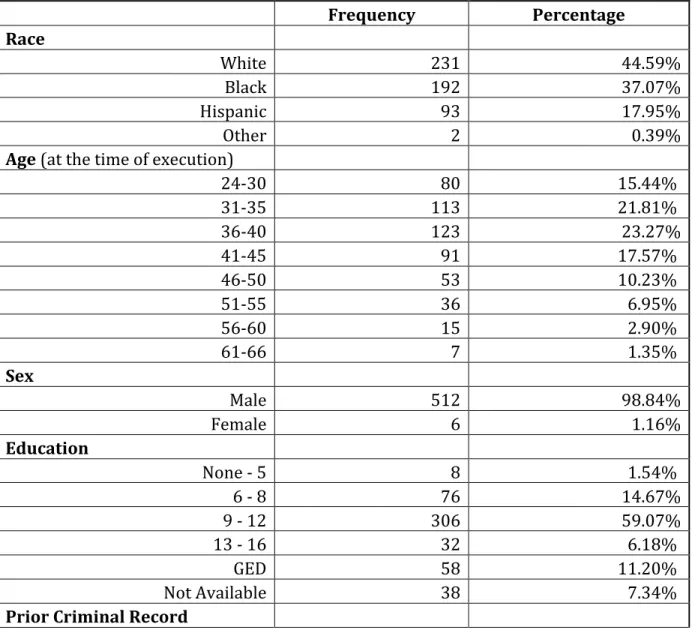
summary of incident, the co-‐defendants, and the race and gender of the victim(s). The table below indicates the racial composition, age, sex, education level, prior criminal record, and prior occupation of the 518 people executed.
Table 1
Frequency Percentage
Race
White 231 44.59%
Black 192 37.07%
Hispanic 93 17.95%
Other 2 0.39%
Age (at the time of execution)
24-‐30 80 15.44%
31-‐35 113 21.81%
36-‐40 123 23.27%
41-‐45 91 17.57%
46-‐50 53 10.23%
51-‐55 36 6.95%
56-‐60 15 2.90%
61-‐66 7 1.35%
Sex
Male 512 98.84%
Female 6 1.16%
Education
None -‐ 5 8 1.54%
6 -‐ 8 76 14.67%
9 -‐ 12 306 59.07%
13 -‐ 16 32 6.18%
GED 58 11.20%
Not Available 38 7.34%
Yes 277 53.47%
No 224 43.24%
Not Available 17 3.28%
Prior Occupation
Laborer 153 29.54%
Construction 26 5.02%
Mechanic 21 4.05%
Electrician 18 3.47%
Cook 16 3.09%
Carpenter 13 2.51%
Welder 12 2.32%
Truck Driver 12 2.32%
Auto Repair 11 2.12%
Roofer 9 1.74%
Painter 8 1.54%
Not Available 45 8.69%
Other 174 33.59%
Of the 518 people executed between 1982 and 2014, 109 (21.04%) people declined to give a last statement, leaving 409 (78.98%) statements for analysis. Approximately 392 people gave only spoken statements, 2 provided only written statements, and 16 had both written and spoken last statements. During an interview with death house chaplain
Reverend Carroll Pickett, he explained the process of recording the last statements. The only people allowed inside the death chamber are the warden, the death house chaplain, and the inmate. After the inmate is on the gurney, the warden asks if the person has any last words. Through a microphone, the person speaks their final words, which are recorded in writing by an assistant warden in the hallway. The assistant warden then calls the
secretary in the administration office to report the last words. The secretary relays the statement to death row public relations who will release the statement to the press.
listed on the website may not be the exact last words spoken by the executed person. Inmates who decide to give a written statement hand the written statement to the death house chaplain, who distributes the statement to the assistant warden and any family members requested by the inmate. The last statements displayed on the TDCJ’s website are the same statements released to the media.
LITERARY FORM
While my research primarily focuses on the religious themes within the last words, the last statements as a whole provide an interesting set of data. While the content of each statement differs drastically, there is limited variation in the literary form of the last statements. The statements often read like a prayer in solitude, a provocative charge at a rally challenging the audience to take on a cause, an acceptance speech at the Academy Awards expressing gratitude to family and friends, or an intimate letter to a loved one. Tones and moods within the statements range from melancholy to anger, from peace and happiness to passivity. Though the forms are similar, the content within the statements varies significantly.
METHODS
primary theme as two, and almost entirely or entirely religious as three. Table 2 displays an example of each level of religiosity.
Table 2
Level of
Religiosity Last Statement
0 I would like to thank all of you for coming. I am sorry for all of the pain I have caused both families – my family and yours. I would like for you to know that I am sorry for all the pain I caused for all these years. I have had time to understand the pain I have caused you. I am ready, Warden.
(Kenneth Harris; June 3, 1997)
1 What is about to transpire in a few moments is wrong! However, we as human beings do make mistakes and errors. This execution is one of those wrongs yet doesn’t mean our whole system of justice is wrong. Therefore, I would forgive all who have taken part in any way in my death. Also, to anyone I have offended in any way during my 39 years, I pray and ask your forgiveness, just as I forgive anyone who offended me in any way. And I pray and ask God’s forgiveness for all of us respectively as human beings. To my loved ones, I extend my undying love. To those close to me, know in your hearts I love you one and all. God bless you all and may God’s best blessings be always yours. Ronald C. O’Bryan P.S. During my time here, I have been treated well by all T.D.C. personnel. (Ronald O’Bryan; March 31, 1984)
2 First of all, I want to say God bless everyone here today. For many years I have done things my way, which caused a lot of pain to me, my family and many others. Today I have come to realize that for peace and happiness, one has to do things God's way. I want to thank my family for their support. I love you. I am taking you with me. You all stay strong. I love you. I also want to say thanks to the Chaplains who I have met through the years and who have brought me a long way. And I cherish you as my family and at this time...oh, Ken, my little son, I am coming to see you. Oh Lord, into your hands I commit my spirit. Thy will be done. (Allen Janrecka; July 24, 2003)
as I am forgiving them. Be merciful to me a sinner. Protect us Lord as we stay awake and watch over us as we sleep as we wake may we may keep watch with Christ and sleep rest in His peace. All right, Warden. I am ready to go home. (Garry Miller; December 5, 2000)
For each of the 409 last statements, the name of the person, the number of years they served on death row, and the level of religiosity of their statement was recorded in an Excel file. I used STATA, a statistical software package, to test my hypothesis.
To examine a possible relationship between the number of years on death row and the level of religiosity of the statement, I used a bivariate regression model. Additionally, I measured a possible change in religiosity over time by analyzing the bivariate relationship between the level of religiosity of the statement and the year the statement was recorded or the year of the execution. Finally, using a multivariate regression, I examined the
relationship between the level of religiosity of the statement and the influence of number of years on death row compounded with the year of the execution.
method to quantify verbal or written messages to determine the presence of themes or certain categories within a data set (Berg).
Within content analysis, there are two primary forms (Berg). The first form, manifest content analysis, is defined as “those elements that are physically present and countable” (Berg). This method is often used to count word or phrase frequency in order to identify categories or concepts. The second form, latent analysis, involves a more “interpretive reading of the symbolism underlying the physical data” (Berg). Latent content analysis can involve quantitative coding, but is more likely to involve a general analysis of themes and concepts. Berg summarizes the two methods stating, “manifest content is comparable to the surface structure present in the message, and latent content is the deep structural meaning conveyed by the message” (Berg).
In the analysis of the last statements, I used a blend of manifest and latent content analysis strategies. As my study primarily involves an exploration of the executed person’s last statements for religious themes, I more closely followed a latent content analysis approach. To involve manifest analysis, I measured the frequency with which each theme occurred, but I was less concerned with specific word choice.
schema, I closely read the last statements and kept a record of the following themes within each statement. The codes and themes are listed in Table 3.
Table 3
Code Theme
1 RH Reference to heaven and/or afterlife 2 GFS Asking for God’s forgiveness for self 3 GFO Asking for God’s forgiveness for others
4 GFTDCJ Asking for God’s forgiveness for the Texas Department of Criminal Justice 5 GC Gratitude towards chaplains and/or spiritual advisors
6 IS Identifying as sinner 7 P Preaching
8 PR Prayer
9 RT Reference to a religious text or scripture 10 PHJ Mention of peace, happiness, or joy
11 CDR Reference change or conversion on death row 12 PT Privileging themselves on the basis of religion 13 TPG Thanks or praise to God
14 GBY God bless you or God bless y’all
15 GJ God is the judge or God’s law is superior 16 DMC Do not mourn my death; celebrate 17 F Reference freedom
18 S Song 19 NF No fear
20 AG Apology to God
I read and coded the entire set of religious statements twice, marking the above concepts I found in each statement. This method of analysis allowed me to identify themes and concepts within the religious statements.
In order to compare and contrast the religious and nonreligious statements, I
developed a different set of codes, listed in Table 4. Using content analysis, I coded for the concepts in both the religious and nonreligious statements:
Code Concept
1 PFM Please forgive me 2 CI Claim innocence 3 RG Reference guilt
4 DPW Death penalty is wrong
5 CDR Reference personal change on death row
In the following section, I will discuss the results of both the statistical and content-‐based analysis.
RESULTS
This study aims to answer three questions: does religiosity within the last statements increase with the amount of time spent on death row; what themes occur in the religious last statements; and what can we learn about religiosity based on the different mechanisms employed by the religious and nonreligious statements? First, I discuss the relationship between religiosity and the number of years spent on death row. This section explains the findings from statistical bivariate and multivariate regressions. Next, I use reoccurring religious themes to thematically explore the last statements. Finally, I contrast the religious and nonreligious statements to explore the differences in peoples’ approaches at the end of life.
Of the 409 last statements from executed persons, I identified 246 statements
(60.15%) as religious and 163 statements (39.85%) as nonreligious. Statements labeled as religious reference the person’s belief in God, heaven, or an afterlife. Two religions, Islam and Christianity, are represented in the statements. Approximately 96.82% of the religious statements refer to the Christian faith, while 3.18% of the religious statements indicate that the inmate is Muslim. When stratified by education level, there are no significant patterns within the religious or nonreligious last statements. Both the religious and nonreligious last statements were written by individuals who completed an average of 10 years in school.
Below, Table 5 describes the religious and nonreligious statements when stratified by race.
Table 5
Race All Statements Religious Statements Nonreligious Statements
White 44.59% 42.68% 44.17%
Black 37.07% 36.18% 41.10%
Hispanic 17.59% 20.73% 14.11%
Other 0.39% 0.41% 0.61%
There are no major differences between blacks and whites in the indications of religiosity within last statements. Both whites and blacks show a higher percentage of nonreligious statements. However, Hispanic inmates show a higher frequency and percentage of religious last statements. This result is not surprising given the large population of Hispanics in Texas who identify with the Catholic faith (Gray).
RELIGIOSITY AND TIME ON DEATH ROW
The result from the bivariate regression to measure a relationship between the level of religiosity and the number of years on death row is statistically insignificant, with a p-‐value of 0.47. Additionally, the multivariate regression measuring a relationship between the level of religiosity and the number of years on death row controlling for the year is also statistically insignificant, with a p-‐value of 0.74. Finally, when comparing the difference in the number of years on death row between the religious and nonreligious statements, disregarding different levels of religiosity, the difference is insignificant. For both religious and nonreligious statements, the average number of years spent on death row is between 10 and 11.
of death row, such as the effects of isolation and meetings with chaplains, are not the leading causes of religiosity among last statements of executed persons, as religiosity does not increase with the number of years spent on death row. Instead, my discussion of the present religious themes and the comparison between religious and nonreligious last statements provide alternate explanations for religion within the last statements.
RELIGIOUS THEMES
As the amount of time on death row does not have a relationship with the level of religiosity of the last statement, religious themes and a content comparison between religious and nonreligious last statements allow for a better understanding of religion as a mechanism within last statements. Analyzing the religious statements thematically allowed me to categorize the themes into larger groups to explore the utility of religion among executed persons. Table 6 displays my results after coding for the themes previously mentioned in Table 3.
Table 6
Theme Frequency Percent
Reference to heaven and/or afterlife 127 51.63%
Asking for God’s forgiveness for self 46 18.70%
Gratitude towards chaplains and/or spiritual advisors 40 16.26%
Thanks or praise to God 39 15.85%
Preaching 35 14.23%
Reference change or conversion on death row 33 13.41%
Mention of peace, happiness, or joy 27 10.98%
Prayer 20 8.13%
Reference to a religious text or scripture 19 7.27%
God bless you or God bless y’all 17 6.91%
Privileging themselves on the basis of religion 13 5.28%
God is the judge or God’s law is superior 13 5.28%
Do not mourn my death; celebrate 10 4.07%
Receive my spirit 10 4.07%
Reference freedom 8 3.25% Asking for God’s forgiveness for the Texas Department
of Criminal Justice 7 2.85%
Identify as sinner 5 2.03%
Song 4 1.63%
No fear 4 1.63%
Apology to God 2 0.81%
After exploring the similarities and differences across the above themes, four larger categories among the religious statements emerged: reframing death through religion, forgiveness, religion as a mechanism for acceptance, and positively reclaiming a person’s years on death row through religion.
REFRAMING DEATH
In my content analysis, I find that religion serves as a mechanism to reframe death. Heaven or the afterlife is the most common theme among the religious last statements. Through references to heaven, victims on death row express hope as they approach the end of life. Jason Massey says, “when I leave this body, I am going home to be with the Lord forever…tonight I dance on the streets of gold.” Similarly, in Clifford Boggess’s last
statement, he shares, “Remember, that today I’ll be with Jesus in paradise.” Over half of the last statements include a reference to heaven, with the most repeated refrains being “I am going to a better place,” “take me home,” and “I’ll see you on the other side.” Heaven not only provides hope for life after death in executed persons’ personal lives, but it also allows for the opportunity to see their families and friends in the future. As the inmates have largely been separated from their loved ones while on death row, the repeated refrain “see you on the other side” brings comfort at the end of life. Talking to his family, Irineo
am at peace with God.” Approaching death through the lens of heaven provides comfort in executed persons’ individual lives and through the possibility of reuniting with their families.
More obvious indications of optimism at the end of life are the victims’ references to peace, happiness, joy, or a lack of fear. Jermarr Arnold shares his outlook at the end of his life: “As for me, I am happy, that is why you see me smiling, I am glad I am leaving this world. I am going to a better place.” Additionally, Charlie Brooks expresses, “at this very moment, I have absolutely no fear of what may happen to this body...unto Allah do we belong, verily unto him we do return.” Despite facing impending executions, 13.41% of the religious statements express happiness, peace, joy, or a lack of fear in their last words. Similarly, 4.07% of people tell others, as Kevin Varga did, “I do not want anyone to mourn my death, celebrate my life,” or exclaim, “this is a celebration of life, not death” (Ivan
Murphy). The religious statements demonstrate the idea that death calls for rejoicing when the inmates tell others, primarily family members, that their death is for celebration
instead of mourning. To reframe death through religion, victims of the death penalty reference heaven for themselves and their families, indicate happiness or peace, and call for celebration as opposed to sadness.
FORGIVENESS
“God, please forgive me of my sins” (Harold Barnard). Referencing God’s forgiveness on an individual level is the second most common theme. In most of these occurrences, the victims ask God for forgiveness. However, they also ask for the forgiveness of others.
In his last statement, Rex Mays says, “I ask You for forgiveness for the ones that need to be forgiven. Dear Lord, deliver us from evil and give us the comfort and peace and joy that we need.” In these statements, it is unclear who the people are that need forgiveness. Finally, seven victims ask for forgiveness for the Texas Department of Criminal Justice. In his final words, Garry Miller pleads, “Lord, be merciful with those who are actively involved with the taking of my life, forgive them as I am forgiving them.” Two people use the same language that Jesus used when dying the on the cross, saying, “forgive them for they know not what they do” (Stephen Moran; John Amador). In these statements, the reference to Christian scripture positions the victim of the death penalty as Jesus and links the Texas Department of Criminal Justice to the government that killed Jesus. Words that Jesus said on the cross, like “It is finished” and “Into your hands I commit my spirit,” commonly occur. Receiving forgiveness is important among the religious statements of executed persons as it is referenced in relation to self, others, and the Texas Department of Criminal Justice.
A MECHANISM FOR ACCEPTANCE
you behind, when I am going to a better place. Y’all still have to go through this hell on earth.” Similarly, Ronford Styron preaches, “I worry more about you all because I know where I am going. I want to see you there, so get your heart right.” In these statements, victims distance themselves from their current surroundings by referring to their
impending acceptance by God in heaven. Religion is used in these instances to privilege the inmates on death row during their final moments.
Executed persons also include rhetoric about God’s law or God as the ultimate judge to explain their acceptance. Jason Massey states, “That’s what counts in the end; where you stand with Almighty God,” while Jamie Elizalde says, “we talk about a reprieve or stay from the Supreme Court, but the real Supreme Court you must face up there and not down here.” In the same way the executed persons preach to those around them, these victims distance themselves from the earthly justice system by including themselves with God. Because inmates on death row are ostracized from society, religion—specifically heaven and God’s law—serves as a mechanism for acceptance.
POSITIVELY RECLAIMING TIME ON DEATH ROW
giving me the strength and the time in my life to find Jesus Christ and to be forgiven for all of my sins.” By centering their time on death row around a personal and religious
transformation, the prisoners can positively reflect on the years spent in routine and isolation.
Additionally, the important role of prison chaplains or spiritual advisors is apparent in the last statements of executed prisoners. Over 15% of the religious last statements include thanks or gratitude to a death row chaplain. Jeffrey Tucker references three spiritual
advisors in his statement, saying, “Irene, you have been like a mother and Jack, you have been like a father…Father Walsh, you have helped me so much to come to knowledge of the Lord. I would never have understood that without you.” Through the gratitude expressed to chaplains and spiritual advisors, the executed prisoners recall positive, influential people they encountered while on death row.
CONTRASTING RELIGIOUS AND NONRELIGIOUS STATEMENTS To understand the differences between religious statements and nonreligious statements, I compared the two groups using the codes outlined in the methods chapter. Below, Table 7 displays the frequency of each theme, as well as the percentage as it relates to the specified group and the percentage as it relates to the statements as a whole. By comparing and contrasting the differing results, religion, as opposed to claiming innocence, emerges as an instrument to distance oneself from the death penalty.
Table 7
Nonreligious Statements Religious Statements Comparison
Topic or
Theme Frequency
Percentage of Nonreligious Statements
Percentage of Total
Statements Frequency
Percentage of Religious Statements
Percentage of Total Statements
Reference
guilt 21 12.88% 5.13% 69 28.05% 16.87% 15.17%
Please
forgive me 12 7.36%
2.93% 50 20.33%
12.22% 12.97%
Claim
innocence 36 22.09%
8.80% 24 9.76%
5.87% -‐12.33% Reference
personal change on
death row 3 1.84%
.73% 33 13.41%
8.07% 11.57%
Death penalty is
wrong 24 14.72%
5.87% 25 10.16%
6.11% -‐4.56%
TRANSCENDING THE DEATH PENALTY
As displayed in the above table, religious statements are approximately 15% more likely than nonreligious statements to reference the person’s own guilt in committing the crime of which they are accused. Both religious statements and nonreligious statements mention guilt most often in the context of an apology to the victim’s family, likely because the family is often present for the execution. Robert Carter indicates his guilt while
addressing the victim’s family—“To the Davis family, I am sorry for all of the pain that I caused your family. It was me and me alone.” Similarly, in a statement that does indicate religious beliefs, John Alba tells the victim’s family, “Wendy’s family, I am sorry for taking something so precious to you and to my kids.” Though both religious and nonreligious statements reference their own guilt in a similar context, religious statements are more likely to reference their guilt in the crime committed.