What Makes a Good Biography?
Multidimensional Quality Analysis Based on Wikipedia Article Feedback Data
Lucie Flekova
†‡, Oliver Ferschke
†‡, and Iryna Gurevych
†‡†Ubiquitous Knowledge Processing Lab (UKP-DIPF)
German Institute for Educational Research and Educational Information
‡Ubiquitous Knowledge Processing Lab (UKP-TUDA)
Department of Computer Science, Technische Universität Darmstadt
www.ukp.tu-darmstadt.de
ABSTRACT
With more than 22 million articles, the largest collaborative knowl-edge resource never sleeps, experiencing several article edits every second. Over one fifth of these articles describes individual peo-ple, the majority of which are still alive. Such articles are, by their nature, prone to corruption and vandalism. Manual quality assur-ance by experts can barely cope with this massive amount of data. Can it be effectively replaced by feedback from the crowd? Can we provide meaningful support for quality assurance with automated text processing techniques? Which properties of the articles should then play a key role in the machine learning algorithms and why?
In this paper, we study the user-perceived quality of Wikipedia articles based on a novel Wikipedia user feedback dataset. In con-trast to previous work on quality assessment which mostly relied on judgements of active Wikipedia authors, we analyze ratings of ordinary Wikipedia users along four quality dimensions (complete, well written,trustworthyandobjective). We first present an empi-rical analysis of the novel dataset with over 36 million Wikipedia article ratings. We then select a subset of biographical articles and perform classification experiments to predict their quality ratings along each of the dimensions, exploring multiple linguistic, surface and network properties of the rated articles. Additionally, we study the classification performance and differences for the biographies of living and dead people as well as those for men and women. We demonstrate the effectiveness of our approach by theF1scores of
0.94,0.89,0.73, and 0.73 for the dimensionscomplete,well written,
trustworthy, andobjective. Based on the results, we believe that the quality assessment of big textual data can be effectively supported by current text classification and language processing tools.
Categories and Subject Descriptors
H.3.1 [Information Storage and Retrieval]: Content Analysis and Indexing—Linguistic Processing; H.3.7 [Information Stor-age and Retrieval]: Digital Libraries—User Issues; I.5.4 [Pattern Recognition]: Applications—Text Processing
Copyright is held by the International World Wide Web Conference Com-mittee (IW3C2). IW3C2 reserves the right to provide a hyperlink to the author’s site if the Material is used in electronic media.
WWW’14,April 7–11, 2014, Seoul, Korea. ACM 978-1-4503-2744-2/14/04.
http://dx.doi.org/10.1145/2566486.2567972 .
1.
INTRODUCTION
With the increasing importance of social aspects of the web, the Internet users of the 21st century become dialog partners rather than mere information recipients. As so-called prosumers, they do not only consume the content, but often participate in its pro-duction. Wikipedia, the collaboratively constructed online ency-clopedia, has become the largest open-edit knowledge resource on the web, with tens of thousands daily edits. The English version alone attracts over 300 million visits per day.1 About one fifth
of its 4.3 million articles are about people. Such articles are, by their nature, prone to corruption (see e.g. John Seigenthaler 2).
Although Wikipedia defines a strict set of standards for creating a good biographical article, the expert quality control can hardly scale fast enough. Using machine learning techniques to predict article quality, we could save lots of human judgements for easier cases, while devoting human efforts only to harder cases that the system may struggle to handle. Can we effectively complement the manual process using automated text processing techniques based on user feedback? Which properties of the articles should then play a key role in the machine learning algorithms and why?
We have exploited a novel large-scale dataset of over 36 mil-lion Wikipedia article ratings, which represent the point of view of ordinary users, in contrast to previous work on quality assess-ment which made use of the ratings by Wikipedia contributors or the Wikipedia flaw markers, as detailed further in this paper. Wiki-pedia users have rated the articles in four dimensions – objectivity, trustworthiness, writing style, and completeness.
We first present an empirical analysis of our dataset. We then se-lect a subset of articles with peoples’ biographies in Wikipedia and perform classification experiments to predict their quality ratings along each of the dimensions. We further discuss the suitability of the linguistic, surface and network features used. Additionally, we perform a contrastive study of biographical articles about living and deceased people in order to analyze whether they receive different ratings by the users. We finally extend the analysis with a gender study to detect systematic differences in the ratings of articles about men and women. To our knowledge, this is the first large-scale study of its kind, providing novel insights into the crowdsourced quality assessment process and its applicability to automated qua-lity assurance.
1http://stats.wikimedia.org/EN/
TablesPageViewsMonthly.htm
2http://usatoday30.usatoday.com/news/opinion/
2.
RELATED WORK
Information quality dimensions.
Information quality is gene-rally defined as “fitness of use”, considering that the perception of quality is task-dependent and subjective [25]. Stvilia et al. [39] suggest a detailed information quality model tailored to fit the con-text of a large-scale, collaboratively created resource like Wiki-pedia. They define 22 quality criteria in three dimensions - intrin-sic, contextual and reputational. Zhu et al. [44] assess the quality of answers on social QA sites and develop a multi-dimensional quality model consisting of 13 dimensions - Informativeness, Relevance, Usefulness, Completeness, Readability, Truthfulness, Objectivity, Conciseness, Politeness, Level of Detail, Originality, Novelty, and Expertise – of which the first three had the highest correlation with an overall quality score (0.79 - 0.92). These, however, are part of Stvilia’s contextual dimension, which is dependent on the subjec-tive information needs of the user and hence not possible to de-termine from our feedback data. We focus on the intrinsic qua-lity criteria, which are the second most important after the contex-tual ones, with correlations to the overall quality ranging from 0.24 (readability) to 0.45 (trustworthiness) on social QA sites. These can be, in contrast to e.g. relevance, evaluated on an aggregate level. Weimer and Gurevych [41] assess the quality of forum posts extracted fromnabble.comon three different topics. Their system combines surface, lexical, syntactic, forum specific and similarity features and outperforms the majority class baseline for all three datasets. In their case, lexical features measuring spelling error and swear word frequency had only a small impact on the overall clas-sifier performance. They identify opinion-based quality ratings as one of the important sources of errors, i.e., the users express in their rating whether they support the author’s opinion rather than if they consider the post of high quality. This makes the data noisy.Wikipedia quality.
In previous work, Wikipedia quality analy-sis has primarily been based on the judgments of active contributors rather than the average user. The focus was furthermore limited to either good articles or articles with specific type of quality prob-lems. Early Wikipedia quality research started out with a small number of outstanding articles labeled as “featured”3 or “good”[42, 40, 5, 21, 30, 24], and focuses on their distinction from the rest. The machine-based assessment performs almost perfect in most of the cases. However, featured articles differ from non-featured ones already by metrics like the number of edits [42], and anF1-score
over 0.9 can be reached even using some simple criteria such as
word count [5]. This is why other researchers [2, 13] used so called “cleanup templates” - labels assigned by editors to fix various qua-lity flaws - as examples of distinctively low quaqua-lity articles rather than high quality ones. None of these experiments however an-swers the research question how quality is perceived by the Wiki-pedia users. Does their perception of quality vary from the one of active contributors? Yaari et al. [43] asked a small group of users to read five Wikipedia articles of different quality, labeled by Wiki-pedia editors, and to order them from best to worst based on the quality perceived. 9.38% of the users pointed the “featured” article as the worst of all five. Chesney et al. [6] conducted another user study – 54 researchers were asked to read a Wikipedia article and assess its credibility. They showed that users tend to assign lower trustworthiness to articles out of their area of expertise. Nume-rous studies [34, 29, 18] revealed that users with a lack of knowl-edge about the content topic are likely to base their trustworthiness judgement on surface features, such as the page layout.
3http://en.wikipedia.org/wiki/WP:FA
Quality of Wikipedia biographies.
In 2004, Halavais4in-tentionally entered incorrect information to 13 existing articles. His errors were all corrected within a couple of hours. Regarding bi-ography pages, historian Roy Rosenzweig claims [35] that “Wiki-pedia is surprisingly accurate in reporting names, dates, and events in U.S. history. In the 25 biographies [he] read closely, [he] found clear-cut factual errors in only 4. Most were small and inconse-quential.” Editors of biographies must adhere to Wikipedia’s core content policies, which include theneutral point of view, verifia-bilityandno original research. They must provide reliable sources and respect the presumption of privacy when writing about living people. These criteria are manually reviewed by members of the WikiProject Biography, which manages the creation, development, and organization of biographical articles. According to these re-viewers, about 60% of over one million assessed biographies “pro-vide very little meaningful content, may be little more than a dictio-nary definition” and over 20% “provide some meaningful content, but most readers will need more.”5 Unfortunately, there is only a
very small overlap between the articles rated in the Wikipedia Ar-ticle Feedback Tool6 project and in theWikiProject Biographyin the same time frame, hence direct comparison of the ratings is not possible. Sadly, the same is true also for the Wikipedia quality flaw dataset used in the experiments of Ferschke et al [13].
Wikipedia and readability.
Islam and Mehler [23] used a cor-pus of 645 Wikipedia articles from the Wikipedia Article Feed-back ratings in categoryWell writtento train a readability classi-fier. Using lexical, syntactic, semantic and information-theoretic features with WEKA SMO, they obtain an F-score of 0.75. In their experiments, the lexical and POS-based features outperform the syntactic and semantic ones. However, in contrast to our work, they do not account for the high correlation of the readability ra-tings with the other three rating categories. Hence the results can be overly optimistic due to the features capturing e.g. complete-ness of the article rather than the actual readability. Furthermore, the performance of each of the feature sets used increases signifi-cantly when changing from average occurrence counts per sentence to absolute counts per document, suggesting a strong length bias of the classifier.3.
ANALYSIS OF ARTICLE RATINGS
3.1
Article Feedback Tool
In September 2010, the Wikimedia Foundation introduced the Article Feedback Tool(AFT), a project for gathering article feed-back from Wikipedia users. It allows the whole Wikipedia com-munity to evaluate articles along the dimensionsTrustworthy, Ob-jective, Well writtenandCompleteon a five-star scale. The user interface is displayed in figure 1. In July 2011, the AFT has been deployed to the whole English Wikipedia.
For our experiments, we use a publicly available dataset with over 36 million ratings for more than 1.5 million articles gathered between July 2011 and July 20127. We furthermore employ a dataset
of nearly 8 million ratings collected from March to September 2011, retrieved from the Wikimedia Toolserver8, which contains
addi-tional information about the raters, such as the level of expertise
4http://alex.halavais.net/the-isuzu-experiment 5http://en.wikipedia.org/wiki/WP:BIOG/A 6http://en.wikipedia.org/wiki/WP:Article_Feedback_ Tool 7http://datahub.io/dataset/ wikipedia-article-ratings 8http://toolserver.org/
Figure 1: Wikipedia Article Feedback box (Version 4) as it ap-peared on article pages
Figure 2: Percentage of rating scores (1–5) per category
in the domain and the individual user ID. After the initial dataset analysis we restricted our experiments to the biographical articles, in order to reduce the previously observed [13] bias of article style (given by the character of the topic) to our classifier.
3.2
Corpus Statistics
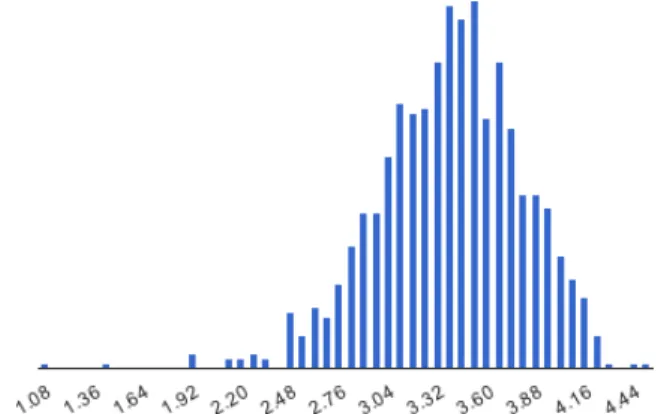
As displayed in figure 2, raters tend to rate articles with posi-tive scores. They express their satisfaction (4 or 5 stars) 3–4 times more often than their dissatisfaction (1 or 2 stars). The difference is slightly lower for the dimensionComplete, where four- and five-star ratings constitute only 52% of the ratings. However, the ave-rage ratings per article are normally distributed, with a positively shifted mean. Figure 3 illustrates this positive shift of the distribu-tion of average article rating scores, which we observed in all four dimensions. This is in contrast with the point of view of experts from theWikiProject Biography, who considered the majority of reviewed biographies unsatisfactory. We explain this phenomenon partly by the fact that the experts focused on reviewing newly cre-ated, low quality articles, while the feedback from users is rather given to more popular, more often visited biographies, which are likely to be more frequently edited and improved. The pairwise correlations between all dimensions are moderately high, with a sample correlation coefficient betweenr=0.66 (Objectivev.
Com-plete) and r = 0.74 (Objectivev. Trustworthy) as displayed in
table 1. If we consider the average rating score of all four dimen-sions as an overall quality score of an article, the dimendimen-sions
Trust-Figure 3: Histogram of average rating scores per article for dimension“well written”
Figure 4: Expert vs non-expert ratings per dimension
worthy and Well writtenshow higher correlation with this score (r=0.89) than the dimensionsObjectiveandComplete(r=0.87).
The ratings per article remain consistent over time, i.e. they do not display stable increasing or decreasing trends across the revi-sion history. The rating average for “featured” articles ranges from 3.79 (Objective) to 3.96 (Well written), only few decimal points above the Wikipedia average.
Based on the additional information which we retrieved from the Wikimedia Toolserver, 24% of all raters claim to have certain ex-pertise in the domain of the article they evaluated. These experts are, on average, less critical in their ratings, as displayed in figure 4. This phenomenon has already been observed in the Wikipedia user study conducted by Chesney [6].
A detailed review of the the Wikimedia Toolserver data revealed that 1,834 articles (5,466 distinct article revisions) obtained five-star ratings multiple times from the same user ID. This mainly af-fected articles about institutions and people, such as non-accredited universities, members of political families or pop idols. However, such articles represent less than 1% of the dataset. The average rater provided feedback for 1.1 articles and 98.7% of all raters rated up to 3 articles. The largest number of articles rated by one user was 1,682, which mainly involved five-star ratings of articles about U.S. politicians.
Table 1: Pair correlation of ratings in the analyzed dimensions
Trustworty Objective Complete Well written
Trustworthy 1 - -
-Objective .745 1 -
-Complete .702 .660 1
-Well written .720 .704 .737 1
Table 2: Statistics of the Wikipedia article feedback dataset
Trust. Obj. Comp. Well w.
No.of articles
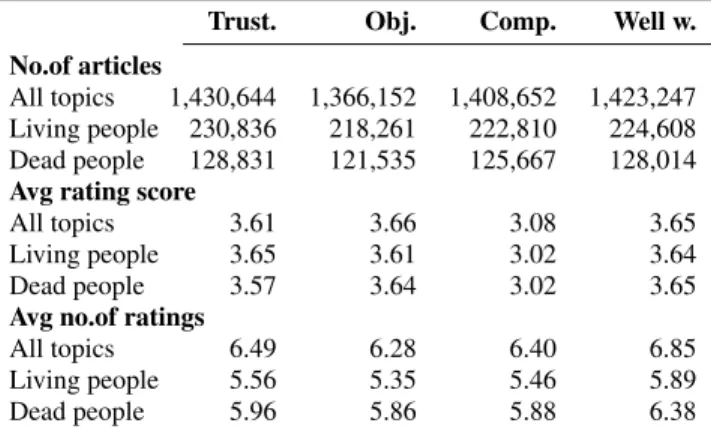
All topics 1,430,644 1,366,152 1,408,652 1,423,247 Living people 230,836 218,261 222,810 224,608
Dead people 128,831 121,535 125,667 128,014
Avg rating score
All topics 3.61 3.66 3.08 3.65
Living people 3.65 3.61 3.02 3.64
Dead people 3.57 3.64 3.02 3.65
Avg no.of ratings
All topics 6.49 6.28 6.40 6.85
Living people 5.56 5.35 5.46 5.89
Dead people 5.96 5.86 5.88 6.38
4.
EXPERIMENTAL SETUP
For our classification experiments, we select a subset of the dataset with ratings for articles from the Wikipedia categoriesLiving peo-ple,Dead peopleand any of their subcategories. An overview of the number of available articles per main category is given in table 2. One of our reasons for focusing on biography articles only is to reduce the impact of some article properties given by the charac-ter of a topic itself. For example articles describing fiction can be problematic when pretending to talk about reality, while for other articles this is not an issue.
Taking into account the high deviation in the rating scores per article, we have approached the problem as a binary classification task rather than distinguishing each of the five rating degrees. We define two classes of ratings,highandlow, with a rating average per article of at least 4 being considered as high and an average of at most 3 as low, thus capturing the shifted distribution as illus-trated on Figure 3. The corpus selection and the classification is performed separately for each of the four rating dimensions ( Com-plete, Objective, Trustworthy, Well written). In each of the observed dimensions, we consider only articles with at least 10 ratings.
The number of articles fulfilling the selection criteria above is listed in table 3. We complemented this training selection with manual gender annotation. Approximately a quarter of the selected articles are biographies of women, while the remaining three quar-ters are biographies of men. This proportion holds true for both living and dead people. The corpus is freely available online9.
From each of the article groups listed in table 3, we select 1,000 articles of classhighand 1,000 articles of classlowin each of the four observed dimensions. To account for the high correlation be-tween dimensions, we first pick articles that appear only in one of the four dimensions of the training corpus. This means that they have outstanding average ratings only in the observed dimension, while in the other three they are average. In cases where this ap-proach does not provide us with enough data (e.g. inhigh
com-9http://www.ukp.tu-darmstadt.de/data/
quality-assessment
Table 3: Number of documents selected for the training corpus
Trust. Obj. Comp. Well w.
High rating Living 8,453 6,863 3,809 9,878 Dead 3,635 3,015 2,033 5,117 Total 12,088 9,878 5,842 14,995 Low rating Living 2,571 2,700 6,145 1,836 Dead 1,514 1,346 2,727 911 Total 4,085 4,046 8,872 2,747
pleteness orlow writing style), we select the remaining articles randomly from the training corpus until we reach 1,000 articles.
Our experimental setup is based on DKPro Core10, an
open-source natural language processing toolkit building upon the Un-structured Information Management Architecture (UIMA) [12]. As a runtime environment, we use the DKPro Lab [10], which allows to combine NLP pipelines into one configurable and modular sys-tem. We furthermore use the open-source API JWPL [14] to ac-cess Wikipedia based on a database dump from 1st April 2012. For preprocessing the articles, we use the components integrated in DKPro Core for sentence splitting, tokenization, stop-word anno-tation, readability annoanno-tation, POS tagging, lemmatization, chunk-ing, spell check and named entity recognition, further detailed in corresponding feature descriptions. Finally, feature extraction is performed using the ClearTK framework [32]. Additional details on the system architecture can be found in the description of the FlawFinder framework [13], which is a predecessor of the system used in our experiments. As opposed to our system, it focuses mainly on structural Wikipedia features and the temporal distinc-tion between article revisions.
We conduct a detailed feature analysis using the Weka Knowl-edge Explorer11and the ROOT data analysis framework12.
We perform binary classification using machine learning algo-rithms from the Weka toolkit. The best performance with a high number of features was reached using an SVM-SMO classifier with a gaussian RBF kernel with parameters empirically set to C=1 andγ = 0.1. With small feature sets (i.e., when lexical features
were excluded), support vector machines were outperformed by the AdaBoostM1 algorithm [19] with decision stumps as a weak learner.
The performance of the classifier has been evaluated with strati-fied ten-fold cross validation on 2,000 articles from training sets of each dimension, split equally into positive and negative instances as described above. Results are compared to the majority class baseline (of the equal split) with regards to accuracy, precision, re-call and F-score. For each of the dimensions, we also evaluate the performance of the classifier using each of the feature classes (le-xical, syntactic etc.) separately. To assess how well our system generalizes, we additionally measure its performance with first all Wikipedia-specific features excluded, then all language-dependent features excluded.
10http://dkpro-core-asl.googlecode.com 11http://www.cs.waikato.ac.nz/~ml/weka/gui_
explorer.html
5.
FEATURES
We divide the features into 9 classes described below. We use the Information Gain feature selection approach [28] to rank and prune the feature space, using the top 3,000 features as the best experimental trade-offbetween the processing speed and the clas-sification performance.
Surface features and readability measures.
To capture the surface properties of text, we measure the length of documents, sentences and words and their proportions to each other. We mea-sure sizes of article sections and ratios between them as well. Since previous research on readability [20, 17] has shown that shorter words are easier to read, we also count the ratio of words longer than five letters and words shorter than three letters compared to all words. We also calculate the type token ratio on lemmas created with the Gate lemmatizer [9]. The type token ratio indicates the le-xical density of text and is considered to be a readability predictor. It can, however, get easily influenced by the text length, as longer texts repeat more words. We implemented the most prominent readability metricssuch as the Flesch-Kincaid Grade Level [26], the Automatic Readability Index [38], the LIX Index [4], the Coleman-Liau Index [7] and the Flesch Reading Ease [17]. The majority of those is computed using the average word and sentence lengths and number of syllables per sentence, combined with manually deter-mined weights. The SMOG grade [31] and the Gunning-Fog Index [20] also consider the number of complex words defined as words with three or more syllables. More recent research on readability [11] shows, however, that longer sentences do not necessarily have to be more complex in terms of syntax and that other properties of the text, such as POS tags, should be taken into account.Lexical features.
We use word unigrams, bigrams and trigrams, extracted from the text before lemmatization and cleaned with the Snowball stopword list13. The ngrams capture not only the topic ofthe article, but also the tone-of-voice differences of content words, e.g.“slaughtered” vs “killed”. We extract n-grams not only from the article, but separately also from the associated article Talk page. We measure the information-to-noise ratio as described by Stvilia et al. [40].
Sentiment features.
Inspired by the author profiling research [16], we adopted several features which were previously success-fully used to indicate authors with more mature, more objective writing style. We measure the occurrence of emotionally charged adjective and adverb endings (-ly, -ful, -ous, . . . ) introduced by Corney et al. [8], based on the assumption that less objective texts may use more emotional words such asfabulousorawfully. We furthermore use word lists14related to anger, sadness, fear,happi-ness and sensations, as we expect articles written by mature authors (and therefore having good quality) to be less emotional [33]. We finally measure the proportion of words expressing certainty (e.g., surely,absolutely) and uncertainty (e.g.,perhaps,supposedly) and we extract exclamation point and question mark patterns.
Spelling errors.
To capture the writing style, but potentially also less trustworthy authors, we count the number of spelling er-rors for each part-of-speech type using the Jazzy spell checker15with its DKPro wrapper. We consider only the spelling error candi-dates which have no more than one letter different from the
vocabu-13http://snowball.tartarus.org/ 14http://www.enchantedlearning.com 15http://jazzy.sourceforge.net/
lary in order to avoid marking names and expert terms as misspelled common nouns.
Semantic features.
The named entity features capture the num-ber of named entities in the article, using the Stanford Named En-tity Recognizer [15], in particular the 3-class model with distribu-tional similarity features for tagging all entities of the types Person, Organization and Location. We use both the overall named entity counts and the average number of named entities per sentence as features, assuming that an article with more named entities is more difficult for the reader to follow [11], but on the other hand could be perceived as more complete or more trustworthy.Syntactic features and punctuation.
We measure the ratio of each POS type as labeled by the OpenNLP POS tagger16andthe ratios of each chunk type annotated by the TreeTagger Chunker [37]. These features are traditionally used to capture writing style [3, 36], as a text with more nouns and articles compared to pro-nouns and adverbs is considered more formal [27]. A large number of nouns can also make the text harder to follow [1], as the user may need to associate the co-references with more entities. We implement the contextuality measure [22], comparing implicitness and explicitness of the text based on POS tags used:
(nouns+ad j.+prep.+art.)−(pron.+verbs+adv.+inter j.)
2PPOS
In order to capture neutrality, we detect the ratios of compara-tive and superlacompara-tive adjeccompara-tives and adverbs. We also measure the ratio of future and past verb tenses and singular and plural nouns and pronouns, assuming, that more trustworthy information may be rather formulated in singular (as opposite to expressions likesome people say). As a readability clue, we retrieve the proportions of in-ner punctuations, end punctuations and commas, with the hypoth-esis that longer sentences, which include more punctuation, can be harder to read. We count occurrences of numbers in the text as a possible completeness indicator.
Network features.
Additional features capture the number of links to and from other articles, the presence of links from other ar-ticles, the number of links to other articles normalized per sentence, the number of outgoing links outside Wikipedia and the number of links to other language versions of the article.Article revision history.
We measure the article age, the num-ber of article revisions, the numnum-ber of unique contributors and the number of contributors registered.References to sources.
Reference-based features capture if the article has reference lists, if it includes citation neededtags as-signed by the editors and how many references are in the articles, as well as their ratio per sentence and per text.In addition to the individual feature groups, we experimented with three combined feature settings: All but Wikipedia, All but lexicaland All but language. TheAll but Wikipedia setting in-cludes all features except the last three groups (network, revision history, references) and except the wikipedia-specific surface pro-perties such as ratio of lead paragraph to the rest of the article. The All but lexicalgroup excludes both the article n-grams and the ar-ticle Talk page n-grams. TheAll but languagesettings includes all Wikipedia-specific and surface features, but excludes all features
Table 4: Features with the highest information gain (IG) in each feature class in the run with all features
Trustworthy IG Objective IG Well written IG Complete IG
Surface features Surface features Surface features Surface features
No. of discussions .0218 Readability-Col.Liau .0712 No. of tokens .3320 No. of tokens .6990
Ratio of short words .0164 No.of characters .0492 No. of characters .3218 No. of characters .6908
No. of sentences .0143 Ratio of long words .0452 No. of sentences .2940 No. of sentences .6599
Content-based feat. Content-based feat. Content-based feat. Content-based feat.
Ending-ible .0129 Number ratio .0523 Ending-ous .1609 Sensation words .4062
Modal verbshould .0431 Ending-able .1500 Ending-able .3935
Negative words .0182 Positive words .1487 Positive feelings .3844
Spelling features Spelling features Spelling features Spelling features
Spelling error ratio .0134 Pronoun error ratio .1471 Card.error ratio .3706
Prep.error ratio .1398 Prep.error ratio .3628
Adverb error ratio .1206 Pronoun error ratio .2940
Syntactic features Syntactic features Syntactic features Syntactic features
Ratio of articles .0338 Ratio of prepositions .0674 Superlative adv.ratio .1580 Superlative ratio .4309
Ratio of nouns .0226 Verb chunk ratio .0590 Superlative adj.ratio .1415 Question ratio .2765
Ratio of prepositions .0202 Noun ratio .0404 Present verb tense .1208 Inner punctuation .2755
Ratio of verbs .0188 Superlative adj.ratio .0397 Pronoun ratio .1176 Present verb tense .2734
Ratio of plurals .0179 Inner punctuation .0296 Inner punctuation .0997 Exclamation rate .2379
Ratio of superlatives .0169 Plural ratio .0142 Question ratio .0997 Interjection rate .1741
Network features Network features Network features Network features
No. of languages .0195 No.of external links .0469 No. of languages .4238
History-based feat. History-based feat. History-based feat. History-based feat.
No. of reg.contrib. .0175 Article age .1412 Article age .5899 Article age .6230
No. of reg.contrib. .3484 No. of reg.contrib. .5740 No. of contributors .3313 No. of contributors .5440
No. of revisions .2894 No. of revisions .5500
Reference-based f. Reference-based f. Reference-based f. Reference-based f.
No. of references .1129
Lexical features Lexical features Lexical features Lexical features
election .0379 political .0794 time .1452 time .3030
political .0353 policy .0725 including .1394 made .2907
award .0316 government .0690 early .1351 left .2890
policy .0268 politicians .0638 character .1329 end .2768
rights .0267 leaders .0635 world .1307 early .2757
voters .0265 accused .0604 film .1304 including .2651
senate .0248 category actors .0600 night .1300 thumb .2745
claims .0243 actors .0591 made .1250 part .2643
party .0242 election .0598 play 1235 back .2630
elected .0240 minister .0551 title .1234 years .2619
dependent on the English language, i.e. lexical, syntactic, seman-tic, spelling and sentiment features.
6.
EXPERIMENTAL RESULTS
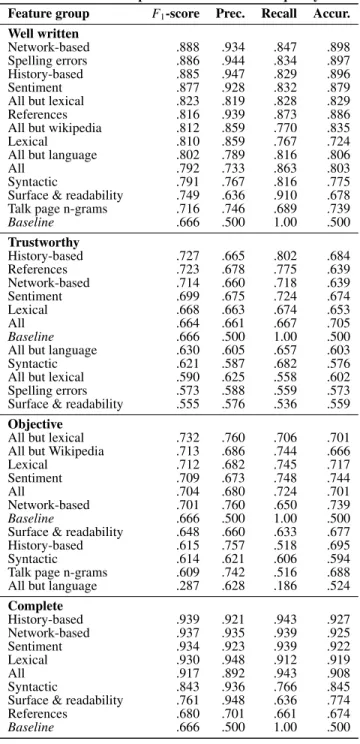
The precision, recall andF1-scores of the cross-validation with
alternated feature sets in each feedback dimension are displayed in table 5. The best performance for the sets with lexical features in-cluded was reached using an SVM-SMO classifier with a gaussian RBF kernel while with small feature sets (i.e. when lexical fea-tures were excluded), the reported performance is achieved with the AdaBoostM1 algorithm using decision stumps as a weak learner. Supposedly, the AdaBoostM1 suffered from overfitting the training data when we included the lexical features. In our terminology, in-stance is classified positively when a quality problem is found, and the precision and recall is reported from this perspective.
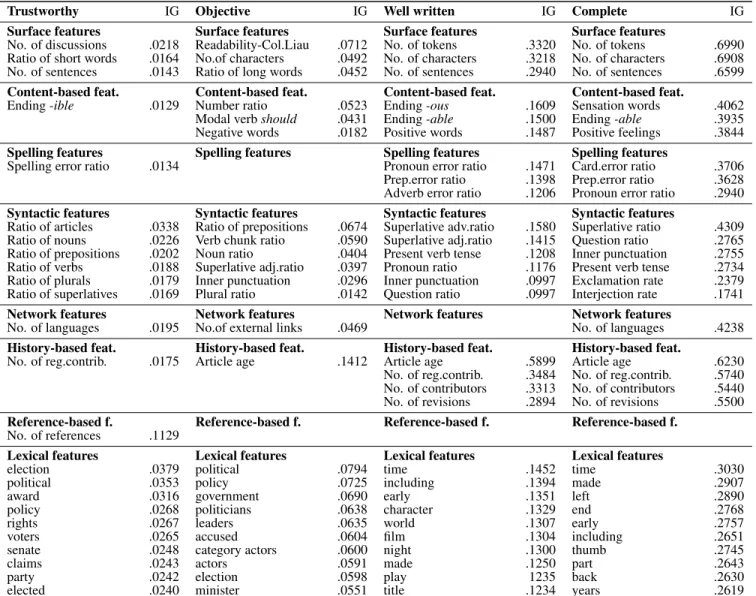
The features with the highest information gain in each dimension are listed in table 4. An extended version of this table, together with our histogram visualizations of the feature values for the two classes, are the background for the analysis in this section.
The biography dataset, which we have used in our core ana-lysis, copies the Wikipedia distribution of the age and gender of
portraited people, containing approximately one third of the bio-graphies of dead and two thirds of living people, of which about one quarter were women. We additionally performed the classification experiments for 2,000 living and 2,000 dead people’s biographies separately, using all of the feature groups together. In a similar way, we also trained the quality classifiers of male and female bio-graphies in our mixed dataset for both genders separately. Observa-tions from these experiments are described in thecontrastive study paragraphs.
6.1
Dimension: Well written
Classification performance.
For the dimensionWell written we obtain anF1-score of 0.89 on all biographies. In the samedi-mension, Islam et al. [23] achieved an F-score of 0.75 on an un-specified subset of 645 articles from the feedback dataset, using mainly lexical and POS-based features. We reach the best results using either spelling error features only or the Wikipedia-specific network features or historical information, such as the number of incoming links or the number of article revisions. Competitive score (0.88) is achieved with sentiment-based features. With each
Table 5: Classification performance for the low quality class
Feature group F1-score Prec. Recall Accur.
Well written
Network-based .888 .934 .847 .898
Spelling errors .886 .944 .834 .897
History-based .885 .947 .829 .896
Sentiment .877 .928 .832 .879
All but lexical .823 .819 .828 .829
References .816 .939 .873 .886
All but wikipedia .812 .859 .770 .835
Lexical .810 .859 .767 .724
All but language .802 .789 .816 .806
All .792 .733 .863 .803
Syntactic .791 .767 .816 .775
Surface & readability .749 .636 .910 .678
Talk page n-grams .716 .746 .689 .739
Baseline .666 .500 1.00 .500 Trustworthy History-based .727 .665 .802 .684 References .723 .678 .775 .639 Network-based .714 .660 .718 .639 Sentiment .699 .675 .724 .674 Lexical .668 .663 .674 .653 All .664 .661 .667 .705 Baseline .666 .500 1.00 .500
All but language .630 .605 .657 .603
Syntactic .621 .587 .682 .576
All but lexical .590 .625 .558 .602
Spelling errors .573 .588 .559 .573
Surface & readability .555 .576 .536 .559
Objective
All but lexical .732 .760 .706 .701
All but Wikipedia .713 .686 .744 .666
Lexical .712 .682 .745 .717
Sentiment .709 .673 .748 .744
All .704 .680 .724 .701
Network-based .701 .760 .650 .739
Baseline .666 .500 1.00 .500
Surface & readability .648 .660 .633 .677
History-based .615 .757 .518 .695
Syntactic .614 .621 .606 .594
Talk page n-grams .609 .742 .516 .688
All but language .287 .628 .186 .524
Complete History-based .939 .921 .943 .927 Network-based .937 .935 .939 .925 Sentiment .934 .923 .939 .922 Lexical .930 .948 .912 .919 All .917 .892 .943 .908 Syntactic .843 .936 .766 .845
Surface & readability .761 .948 .636 .774
References .680 .701 .661 .674
Baseline .666 .500 1.00 .500
of these feature classes, we could reach a precision of over 0.93, while the highest recall (0.91) was obtained with the structural fea-tures.
Helpful features.
As expected, well written articles are older, with a higher number of revisions and more contributors. They also tend to be longer, which is reflected in a lower type-token ratio. Surprisingly, the articles rated as well written are more emotionally intense, which is captured by the excess of words expressing posi-tive emotions and feelings, superlaposi-tives, adjecposi-tives with emotional endings (e.g. remarkable,memorable) and exclamations. Highly rated articles also use more modal verbs, uncertainty expressions (perhaps,possibly,maybe, . . . ) and questions, as well asclarifica-tion expressions such asclarify,specifyorexplain, and they contain more inner punctuation.
Badly written articles contain more errors in prepositions and punctuation and verbs referring to present or future rather than to the past. They use more words expressing certainty, such as obvi-ously,clearlyorabsolutely.
The readability features, which mainly capture the length of words and sentences, did not improve the prediction performance in this dimension. This implies that writing style ratings are based on syn-tactic, stylistic and semantic criteria rather than surface properties.
Contrastive study of age and gender.
Well written articles about living people appear in more languages and have a smaller proportion of lead paragraph to the rest of the article. Articles with low ratings are more often short stubs. The ratings of biographies of living people are negatively correlated to the usage of the present verb tense.Judging from the values of the n-gram features with a high infor-mation gain in both experiments, the biographies of women were more likely to have lower writing style ratings if they did not con-tain any words related to their personal life, such asmother,father, married orlove. In contrast, low rated biographies of men often lacked the wordcareer. High rated biographies of women also contained more named entities referring to persons.
6.2
Dimension: Trustworthy
Classification performance.
Our classifier performs best (F1=0.73) with history-based features only. Trustworthy articles, as
ex-pected, have more references, and often exist in more language ver-sions, thus the high performance (F1 = 0.71) of network-based
features. Using lexical features (F1 =0.67), we observed certain
topic bias in this dimension, e.g. the word ngrams such ascategory indian,india,indianappeared to be rather strong predictors for a high trustworthiness andgovernmentorpoliticiansfor a low one.
Helpful features.
The trustworthiness of an article improves with its age and number of contributors. Trustworthy articles, as expected, have more references, and often exist in more language versions. Trustworthy articles often contain more nouns, while pro-nouns, verbs and definite and indefinite articles would appear more often in the biographies with lower trustworthiness ratings. This information alone, however, is not sufficient as it yields only an F1-score of 0.62.Articles with low trustworthiness have a higher ratio of emotio-nally intense adjectives in the text, and use more words expressing certainty. They contain less modal verbs and inner punctuation. These articles also usually have more comments on the article talk page, demonstrating the efficiency of the community-based reco-very mechanism for this type of quality problem.
Contrastive study of age and gender.
Biographies of living people were rated more trustworthy when more references per sen-tence were included and less trustworthy when having higher ratio of present to past verbs.Low rated biographies of men contain more negative words, while low rated articles about women contained more positive emotions and third person pronouns. The biographies of men with low ra-tings are, judging from the n-gram features, more often related to certain conflicts (middle east, holocaust, . . . ), while those of women contain in most cases some overstated achievements of celebri-ties (award,greatest,star,successful, . . . ).
6.3
Dimension: Objective
Classification performance.
Objectiveness is the only dimen-sion in which the classification result of our system is better when we ignore all Wikipedia-based features (such as the number of links, references, revisions or article age). We obtain the highest F1-score (0.73) by combining stylistic, syntactic, surface(length-based) and sentiment-based features. The Wikipedia-based features contribute to a high precision of the classifier, but result in a low re-call.
Helpful features.
Articles with low objectivity ratings had a higher ratio of long words and thus a lower readability score (Coleman-Liau measure). These articles also show higher proportion of first and third person plurals, prepositions and verbs. They contain more often the wordshould, more negative words and terms express-ing anger. However, they also contain more expressions associated with positive emotions and feelings. Furthermore, named entities referring to organizations appear more often in such articles. Fi-nally, objective articles tend to be older, contain more nouns and, surprisingly, more superlatives.The most predictive word n-grams in this dimension could be grouped into three distinct categories – politicians, actors and mu-sicians. While words related to politics are good predictors of prob-lematic articles, expressions associated with the film and music in-dustry are predictive for articles rated as highly objective. Low ob-jectivity occurs more often for people in the Wikipedia categories of the type “Members of ... ” (party), which is most likely related to the politician bias.
Contrastive study of age and gender.
In comparison to de-ceased people, low rated biographies of living people are more correlated with n-grams such aspoliticiansandelectionsand high rated biographies tend to have more language versions. In the bio-graphies of dead people, positive words and expressions of sadness were predicting an objective article, which was not the case for the articles about living people. This makes us wonder if the users value the principle of the saying “Of the dead, nothing unless good” - however, we cannot disprove that this observation might be only corpus-specific.The low rated articles about men contain more long words and words referring to politicians (both republicans and conservatives, as illustrated in figure 5), words referring to government or high amounts of money (million, billion). In the case of biographies of women, the wordhotindicates highly rated articles with a sur-prisingly high information gain (0.08). A detailed manual analysis revealed, that objective articles about women include many bio-graphies of actresses including a broad coverage of the history of pornography, which seemed to be the main source for these kinds of predictive lexical cues.
6.4
Dimension: Complete
Classification performance.
As table 5 shows, we reach an F1-score of 0.94 already with a small number of simple features(article age, number of revisions, number of contributors). Simi-lar results can be obtained with almost all other individual feature groups except of syntactic, surface and reference features.
Helpful features.
Ratings in this dimension can be well pre-dicted without linguistic features. High performing results obtained with the n-gram based or network-based features or sentimentana-Figure 5: Number of high rated (blue color) and low rated (yel-low color) articles about men, containing the wordsrepublican
andconservative
lysis are in our interpretation just capturing the fact, that articles with non-zero feature values of all of the observed phenomena (e.g. containing at least one noun, one superlative, at least one negative word, etc.) are perceived as more complete. Features based on the document surface (e.g. length), text syntax, or number of refer-ences have high precision of the results, but low recall (i.e. many long documents, which are however rated as incomplete, would not be retrieved). Higher recall is achieved using the history-based fea-tures, as the complete articles are in most cases older.
Contrastive study of age and gender.
In this dimension, we found no remarkable differences between the distinct biography groups.7.
ERROR ANALYSIS
7.1
Sources of false negatives
The following two sections present the common sources of er-rors in our dataset based on the manual analysis of misclassified in-stances. In our terminology, instance is classified positively when a quality problem is found. Hence when we discuss the sources of false negatives further in this section, we are talking about low rated (problem-containing) articles that were classified as high qua-lity (problem-free) ones. If a specific dimension is not discussed explicitly, the error source was common for all four dimensions.
Controversial topics.
During the manual inspection of the mis-classified articles which were supposed to represent the classlow(i.e. having the average rating of 3 or less), we found out that many of them have very bipolar ratings, oscillating between one and five stars with very low user agreement (on false negatives, Krippendorff’sα≤0.1). These articles mainly discuss
controver-sial people, e.g. fanatic religious visionaries, political extremists or pseudoscientists. Based on the talk pages, people could not reach a consensus on what is a neutral point of view on the topic, which projected not only into the objectiveness ratings but also to the other three dimensions.
Missing information.
Based on the article texts and the dis-cussion on its Talk pages, we believe that many articles were rated low in the dimensionWell writtennot due to its writing style itself,but because the users were looking for some specific facts about the person, which were not contained in the article. In theory, this problem shall be captured only by the dimensionComplete. Un-fortunately, the definition of the dimensions is not clear-cut and is sometimes misinterpreted by the users. Hence the rating usually propagated to the dimensionWell writtenas well.
Short-term vandalism.
Since the user feedback was collected during a one-year period, the articles were undergoing frequent edits. As we have not observed a clear shift in rated quality of the individual articles between the beginning and the end of this period and as the ratings were too sparse to obtain a reliably an-notated dataset using only ratings of a specific article revision, we have used only one Wikipedia snapshot. However, some articles suffered from vandalism (e.g., 8 June 2012:“Viktor Brack, an odi-ous bastard never should be born...”). Although such edits were usually corrected within the same day, they occasionally projected into a sudden drop of ratings from five stars to one, decreasing the rating average of the article and thus leading to assigning a mis-leading gold standard label.Repetitive information.
According to the Talk pages, some of the articles presumably received low ratings in the dimension Well writtenfor being written as high-school essays, containing a lot of repetitive information. This problem could not be captured correctly by the type-token ratio feature due to a largely varying length of the articles. The classifier could possibly benefit from in-troducing some sentence similarity measures to capture repetitive sentences.Confusion of dimensions.
The error analysis on instance level confirmed what we could already suspect from the correlation ma-trix (see table 1). Users struggled to distinguish easily between rated dimensions. Many biographies, which were lacking some important information about a person’s life, were considered as in-complete, therefore biased, therefore badly written and not trust-worthy. Articles that are badly written, but at the same time ob-jective, trustworthy and complete are rare to find (about 6% of all available data). The same holds for complete, but at the same time biased, untrustworthy and badly written ones (about 2% of all avail-able data). Although the cases with distinct ratings in one dimen-sion were overrepresented in our corpus (20%) to better train for the individual dimensions, the performance of each of the four in-dependent classifiers possibly still suffered from not being able to capture these implicit relations. Building a meta classifier, which incorporates the implication rules between dimensions, could lead to a better prediction of the ratings as well as of the overall article quality.Topic bias.
Using lexical features in the categoriesTrustworthy andObjectiveleads to a topic bias of the classifier, which then tends to predict all the articles related to government, elections or mili-tary as bad, while low quality biographies of the entertainment sec-tor would be still classified as rated high. This problem can be avoided by completely excluding the n-gram features without loss of performance.7.2
Sources of false positives
Article stubs.
Short articles are a very common source of errors, not only for their length, but also because they often consist mainly of the list of works of the author. It is frequent that such a listcontains many emotionally intense words, e.g. artwork titles, which leads to errors in the dimensionObjective.
Large proportion of foreign language.
Several misclassi-fied biographies were very dense in the named entity content and description of places, customs or movie names in their original, non-English language. This causes errors in the dimensionWell written, as the POS tagger and sentence parser fail, and also the ratio of potential spelling errors is artificially high. This problem could be addressed by a language recognition preprocessing step as well as more advanced treatment of named entities, which shall be excluded from other features.Ancient people.
It turned out that one of the Wikipedia sub-categories of dead people biographies isAncient people, which contains also, for example, biblical individuals. Entries about such persons, although not very frequent in our dataset, differ in the lan-guage style they are written in. These biographies can tolerate more poetic language and examples from ancient texts, which is possibly misleading for our classifier.7.3
Impact of Length
The length bias of high quality articles, which was often ob-served in previous research [5, 21], remains an open problem. The high performance of our classifiers on theCompletenessdimension suggests that even the features normalized per word count tend to capture this property. Similarly to the problem with the type-token ratio decreasing for longer texts, the likelihood that some of the monitored words (e.g., in the sentiment analysis or spelling correc-tion) will be seen at least once in the text is higher when the text is longer. We are still able to correctly and meaningfully classify the articles with a high density of sentiment words. However the distinction between 0.00% and 0.01% of positive words contained in the text can signal a mere text length difference. The same ap-plies for the measures normalized per sentence, as the likelihood that at least one sentence in the long text will have a non-zero value is higher. This comparison issue cannot be avoided by cutting the long articles to the length of the short ones either, as this is likely to cause a stylistic bias - the introduction into one topic would be com-pared to the core body of another. A construction of a Wikipedia quality corpus of articles with naturally equal length would address this issue - unfortunately, this could not be reliably achieved with our rating data.
8.
CONCLUSIONS AND FUTURE WORK
We have analysed the four dimensions of quality – writing style, objectiveness, trustworthiness and completeness – from the per-spective of users in a corpus of Wikipedia biographies. Our fea-tures capture the linguistic dimensions of the text – lexical, syntac-tic and semansyntac-tic – as well as the surface properties of the arsyntac-ticle with and without the Wikipedia-related properties. In all the di-mensions except objectiveness, the age of an article was a strong predictor of high ratings, confirming the efficiency of the collabo-rative quality improvement process. Articles with high ratings are also better connected with the rest of Wikipedia. We confirmed the influence of the number of edits on the article quality, as pre-viously observed on a different dataset [42]. The length bias of high quality articles [5, 21] mainly contributed to the recall in the writing style dimension and the precision in the completeness di-mension. In contrast to Ferschke et al. [13], whose system achieves the best performance in predicting neutrality and style flaws based
on the Wikipedia quality templates using mainly n-gram features, we were able to achieve the bestF1score in all four dimensions by
excluding the n-gram features from our experimental setup and ap-plying the AdaBoostM1 algorithm [19] with decision stumps as a weak learner. Similar finding – a low impact of lexical features on the classifier – have been observed in the experiments by Weimer et al. [41]. In compliance with this work, we also identified opinion-biased, noisy quality ratings as one of our main sources of errors, especially on controversial topics. Our inspection of low rated arti-cle revisions corresponds with the finding of Halavais17that
mali-cious edits are normally corrected within hours from their creation. We explored the differences between the observed quality of bio-graphies of living and dead people and discovered that a biography of a living person is rated higher when it exhibits more past tense than present tense sentences. That could be an indicator of Wiki-pedia notability criteria - the biographies of people with only a few past achievements are possibly rated lower. Furthermore, high qua-lity articles of living people usually exist in more language ver-sions, while for dead people this is not necessarily the case. In our interpretation there might be a higher consensus on the notability of local people from the past, while the descriptions of achievements by contemporary local celebrities can be perceived as exaggerated boasting.
Articles rated as well written are, beside being older and longer, more emotionally written, express more uncertainty and are less likely to contain an excessive number of spelling errors. While we reach the highest precision using spelling-, sentiment- and Wikipedia-based features, the best recall is reached with surface features only. We achieve a good classification performance ofF1 = 0.81 even
when all the Wikipedia-specific properties are excluded, indicating the generalizability potential of our writing style quality prediction system to other online texts such as blogs or news portals.
Trustworthy articles can be well predicted (F1=0.72) using the
information about the number of references included. Furthermore, we observed that the articles with low trustworthiness use more cer-tainty expressions, more emotions and more pronouns rather than nouns, which is possibly perceived as less explicit by the readers. TheF1-score of 0.67 can be also achieved with lexical features
only, which mainly indicate the article topic.
Objective biographies usually describe people from the cultural scene (actors, singers) while any relation to politics is a clear le-xical indicator for a low objectivity rating. Low rated articles are also less readable, contain more long words, more verb chunks, cer-tainty expressions and emotions. Biographies of politicians with low ratings are in most cases about men.
The completeness ratings could be predicted with very high pre-cision (0.921) and recall (0.943) using only history-based features. However, the most of our experimental results in this dimension are not easily interpretable. We believe that the aspects of the com-pleteness ratings, which cannot be correctly captured by simple de-scriptive features, are contextual for the user in terms of informa-tion quality and thus difficult for us to account for.
In our experiments, we were able to predict different quality aspects of Wikipedia biography articles using a large variety of features, ranging from fast and simple heuristics with Wikipedia-specific properties to largely generalizable methods analyzing the writing style. Based on the results, we believe that the quality as-sessment of big textual data can be effectively supported by current text classification and language processing tools.
In the future, we intend to synthesize our system into one robust quality classifier and possibly integrate it more closely with
Wiki-17http://alex.halavais.net/the-isuzu-experiment
pedia in order to identify candidate articles for quality improve-ment. While we can predict the likelihood of a trustworthiness problem based on the Wikipedia-specific properties and sentiment levels in the article, we probably would not be able to recommend trustworthiness corrections on a fine-grained text level (i.e., a spe-cific statement missing reference), neither evaluate missing infor-mation in an incomplete article. Making this kind of predictions would require a very large amount of real world knowledge, which is hardly possible to obtain without the encyclopedia itself. Our system could, however, make valuable edit suggestions to improve objectivity or writing style of an article through replacing emo-tional expressions, making spelling corrections or marking content with low readability or high repetitiveness. Such a system would then be easily generalizable on any informative text outside Wiki-pedia. A drawback to any future work is the discontinuation of the Wikipedia Article Feedback project, since we cannot obtain addi-tional training and testing data from the same resource.
Acknowledgments
This work has been supported by the Volkswagen Foundation as part of the Lichtenberg-Professorship program under grant no. I/82806, by the German Research Foundation under grant no. GU 798/14/1, and by the Hessian research excellence program “Landes-Offensive zur Entwicklung Wissenschaftlich-Ökonomischer Exzellenz” as part of the research center “Digital Humanities”.
9.
REFERENCES
[1] S. Aluisio, L. Specia, C. Gasperin, and C. Scarton. Readability assessment for text simplification. In Proceedings of the NAACL HLT 2010 Fifth Workshop on Innovative Use of NLP for Building Educational Applications, pages 1–9, 2010.
[2] M. Anderka, B. Stein, and N. Lipka. Predicting quality flaws in user-generated content. InProceedings of the 35th international ACM SIGIR conference on Research and development in information retrieval - SIGIR ’12, page 981, Aug. 2012.
[3] S. Argamon, M. Koppel, J. W. Pennebaker, and J. Schler. Automatically profiling the author of an anonymous text. Communications of the ACM, 52(2):119–123, Feb. 2009. [4] C. Björnsson.Läsbarhet: Lesbarkeit durch Lix. (Aus dem
Schwedischen). (Pedagogiskt Utvecklingsarbete vid Stockholms Skolor. 6.). 1968.
[5] J. E. Blumenstock. Size matters. InProceeding of the 17th International Conference on World Wide Web, page 1095, Apr. 2008.
[6] T. Chesney. An empirical examination of Wikipedia’s credibility.First Monday, 11(11), 2006.
[7] M. Coleman and T. Liau. A computer readability formula designed for machine scoring.Journal of Applied Psychology, 60(2):283, 1975.
[8] M. Corney, O. de Vel, A. Anderson, and G. Mohay. Gender-preferential text mining of e-mail discourse. In Proceedings of the 18th Annual Computer Security Applications Conference, pages 282–289, 2002. [9] H. Cunningham, D. Maynard, K. Bontcheva, V. Tablan,
N. Aswani, I. Roberts, G. Gorrell, A. Funk, A. Roberts, D. Damljanovic, T. Heitz, M. A. Greenwood, H. Saggion, J. Petrak, Y. Li, and W. Peters.Text Processing with GATE (Version 6). University of Sheffield, Department of Computer Science, 2011.
[10] R. Eckart de Castilho and I. Gurevych. A lightweight framework for reproducible parameter sweeping in
information retrieval. In M. Agosti, N. Ferro, and C. Thanos, editors,Proceedings of the 2011 Workshop on Data Infrastructures for Supporting Information Retrieval Evaluation, pages 7–10, Oct. 2011.
[11] L. Feng, N. Elhadad, and M. Huenerfauth. Cognitively motivated features for readability assessment. InProceedings of the 12th Conference of the European Chapter of the Association for Computational Linguistics, pages 229–237, 2009.
[12] D. Ferrucci and A. Lally. UIMA: An Architectural Approach to Unstructured Information Processing in the Corporate Research Environment.Natural Language Engineering, 10(3-4):327–348, 2004.
[13] O. Ferschke, I. Gurevych, and M. Rittberger. FlawFinder: A Modular System for Predicting Quality Flaws in Wikipedia. InCLEF 2012 Labs and Workshop, Notebook Papers, 2012. [14] O. Ferschke, T. Zesch, and I. Gurevych. Wikipedia revision
toolkit: Efficiently accessing wikipedia’s edit history. In Proceedings of the 49th Annual Meeting of the Association for Computational Linguistics, pages 97–102, June 2011. [15] J. R. Finkel, T. Grenager, and C. Manning. Incorporating
non-local information into information extraction systems by gibbs sampling. InProceedings of the 43rd Annual Meeting on Association for Computational Linguistics, pages 363–370, 2005.
[16] L. Flekova and I. Gurevych. Can we hide in the web? large scale simultaneous age and gender author profiling in social media. InCLEF 2012 Labs and Workshop, Notebook Papers, Sept. 2013.
[17] R. Flesch. A new readability yardstick.The Journal of applied psychology, 32(3):221, 1948.
[18] B. J. Fogg, P. Swani, M. Treinen, J. Marshall, O. Laraki, A. Osipovich, C. Varma, N. Fang, J. Paul, A. Rangnekar, and J. Shon. What makes Web sites credible? InProceedings of the SIGCHI conference on Human factors in computing systems, pages 61–68, Mar. 2001.
[19] Y. Freund and R. E. Schapire. A desicion-theoretic generalization of on-line learning and an application to boosting. InComputational learning theory, pages 23–37. Springer, 1995.
[20] R. Gunning. The fog index after twenty years.Journal of Business Communication, 6(2):3–13, 1969.
[21] D. Hasan Dalip, M. André Gonçalves, M. Cristo, and P. Calado. Automatic quality assessment of content created collaboratively by web communities. InProceedings of the 2009 joint international conference on Digital libraries, page 295, June 2009.
[22] F. Heylighen and J.-M. Dewaele. Variation in the contextuality of language: An empirical measure. Foundations of Science, 7(3):293–340, 2002.
[23] Z. Islam and A. Mehler. Automatic readability classification of crowd-sourced data based on linguistic and
information-theoretic features.Computación y Sistemas, 17(2):113–123, 2013.
[24] S. Javanmardi and C. Lopes. Statistical measure of quality in Wikipedia. InProceedings of the First Workshop on Social Media Analytics - SOMA ’10, pages 132–138, July 2010. [25] J. Juran and B. Godfrey.The quality control process. 1999.
[26] J. P. Kincaid, R. P. Fishburne Jr, R. L. Rogers, and B. S. Chissom. Derivation of new readability formulas (automated readability index, fog count and flesch reading ease formula) for navy enlisted personnel. Technical report, DTIC, 1975. [27] M. Koppel, S. Argamon, and A. R. Shimoni. Automatically
categorizing written texts by author gender.Literary and Linguistic Computing, 17(4):401–412, 2002.
[28] S. Kullback.Information theory and statistics. 1997. [29] G. Lindgaard, C. Dudek, D. Sen, L. Sumegi, and P. Noonan.
An exploration of relations between visual appeal,
trustworthiness and perceived usability of homepages.ACM Transactions on Computer-Human Interaction, 18(1):1–30, Apr. 2011.
[30] N. Lipka and B. Stein. Identifying featured articles in Wikipedia. InProceedings of the 19th International Conference on World Wide Web, page 1147, Apr. 2010. [31] G. H. McLaughlin. SMOG grading: A new readability
formula.Journal of reading, 12(8):639–646, 1969. [32] P. V. Ogren, P. G. Wetzler, and S. Bethard. ClearTK: A
UIMA toolkit for statistical natural language processing. In Proceedings of the UIMA for NLP workshop at the Language Resources and Evaluation Conference, pages 32–38, 2008. [33] J. Pennebaker, M. Mehl, and K. Niederhoffer. Psychological
aspects of natural language use: Our words, our selves. Annual review of psychology, 54(1):547–577, 2003. [34] R. E. Petty. The Elaboration Likelihood Model of
Persuasion.Advances in Experimental Social Psychology, 19:123–205, 1986.
[35] R. Rosenzweig. Can history be open source? Wikipedia and the future of the past.The Journal of American History, 93(1):117–146, 2006.
[36] J. Schler, M. Koppel, S. Argamon, and J. Pennebaker. Effects of age and gender on blogging. InProceedings of 2006 AAAI Spring Symposium on Computational Approaches for Analyzing Weblogs, pages 199–205, 2006.
[37] H. Schmid. Probabilistic part-of-speech tagging using decision trees. InProceedings of the International
Conference on New Methods in Language Processing, 1994. [38] R. Senter and E. Smith.Automated Readability Index.
AMRL-TR-66-220. 1967.
[39] B. Stvilia, L. Gasser, M. B. Twidale, and L. a. C. Smith. A framework for information quality assessment.Journal of the American Society for Information Science and Technology, 58(12):1720–1733, 2007.
[40] B. Stvilia, M. B. Twidale, L. C. Smith, and L. Gasser. Information quality work organization in Wikipedia.Journal of the American Society for Information Science and Technology, 59(6):983–1001, Apr. 2008.
[41] M. Weimer and I. Gurevych. Predicting the perceived quality of web forum posts. InProceedings of the Conference on Recent Advances in Natural Language Processing, Jan. 2007. [42] D. M. Wilkinson and B. A. Huberman. Assessing the value
of cooperation in wikipedia.First Monday, 12(4), 2007. [43] E. Yaari, S. Baruchson-Arbib, and J. Bar-Ilan. Information
quality assessment of community generated content: A user study of Wikipedia.Journal of Information Science, 37(5):487–498, Aug. 2011.
[44] Z. Zhu, D. Bernhard, and I. Gurevych. A multi-dimensional model for assessing the quality of answers in social Q&A sites. InProceedings of 14th International Conference on Information Quality, pages 264–265, Nov. 2009.