Cardiovascular Disease and Patterns of Change in Functional Status
Over 15 Years: Findings From the Atherosclerosis Risk in
Communities (ARIC) Study
Anna Kucharska-Newton, PhD, MPH; Michael Griswold, PhD; Zhihao Howard Yao, MBA; Randi Foraker, PhD; Kathryn Rose, PhD; Wayne Rosamond, PhD; Lynne Wagenknecht, DrPH; Silvia Koton, PhD; Lisa Pompeii, PhD; B. Gwen Windham, MD, MPH
Background-—Cardiovascular disease (CVD) is the leading cause of premature disability, yet few prospective studies have examined functional status (FS) among persons with CVD. Our aim was to examine patterns of change in FS prior to and after hospitalization for nonfatal myocardial infarction, stroke, and heart failure among members of the Atherosclerosis Risk in Communities (ARIC) study cohort.
Methods and Results-—FS was assessed using a modified Rosow-Breslau questionnaire administered during routine annual telephone interviews conducted from 1993 through 2007 among 15 277 ARIC study participants. An FS score was constructed as a summary measure of responses to questions about participants’ability to perform selected tasks of daily living (eg, walking half a mile, climbing stairs). Incidence of CVD was assessed through ARIC surveillance of hospitalized events. Rate of change in FS over time prior to and following a CVD event was examined using generalized estimating equations. A decline in FS was observed on average 2 years prior to a myocardial infarction hospitalization and on average 3 years prior to a stroke or heart failure hospitalization. FS post–myocardial infarction declined relative to pre-event levels but improved to close to pre–myocardial infarction levels within 3 years. Decline in FS following incident heart failure and stroke remained over time. Observed patterns of change in FS did not differ appreciably by race or sex.
Conclusions-—This study documents that a decline in FS precedes incidence of CVD-related hospitalization by at least 2 years, providing a strong argument for routine preventative assessment of FS among older adults. (J Am Heart Assoc. 2017;6: e004144. DOI: 10.1161/JAHA.116.004144.)
Key Words: functional status•heart failure•myocardial infarction•stroke
W
ith the rapidly increasing burden of chronic cardiovas-cular disease (CVD),1,2primary and secondary preven-tion efforts require a multilevel approach at the patient and provider levels across the continuum of care. Assessment of functional status (FS) is critical to effective prevention andtreatment of chronic disease conditions3,4; however, require-ments for documentation of FS in routine clinical practice are only now beginning to be implemented.5 In comparison to those with functional limitations, patients with high FS report greater adherence to guideline-recommended medication regimens,6possibly as a result of the healthy adherer effect,7 and are more likely to initiate and adhere to recommended rehabilitation programs.8 In an acknowledgement of the importance of FS assessment to the evaluation of the effectiveness of care, the US National Committee for Vital and Health Statistics has proposed a set of“core health data elements”to accompany any electronic record of a healthcare service event, including standardized codes for classifying FS.9 We leveraged annually collected self-reported FS mea-sures, available for participants of a longitudinal cohort of middle-aged men and women, the Atherosclerosis Risk in Communities (ARIC) study, to examine trajectories of FS prior to and following incident CVD events. Our work was aimed at underscoring the importance of regular assessment of FS among individuals at risk for and following a diagnosis of CVD.
From the University of North Carolina at Chapel Hill, NC (A.K.-N., W.R.); University of Mississippi, Jackson, MS (M.G., Z.H.Y., B.G.W.); The Ohio State University, Columbus, OH (R.F.); Social and Scientific Systems, Inc, Durham, NC (K.R.); Wake Forest University, Winston Salem, NC (L.W.); Tel Aviv University, Tel Aviv, Israel (S.K.); University of Texas, Houston, TX (L.P.).
An accompanying Figure S1 is available at http://jaha.ahajournals.org/content/ 6/3/e004144/DC1/embed/inline-supplementary-material-1.pdf
Correspondence to:Anna Kucharska-Newton, PhD, MPH, 137 East Franklin Street, Suite 306, Chapel Hill, NC 27514. E-mail: [email protected] Received June 24, 2016; accepted January 17, 2017.
Methods
Study Population
The ARIC study cohort was established in 1987 as a probability sample of 15 792 predominantly black and white men and women, aged 45 to 64 years, from four communities in the United States (suburbs of Minneapolis, Minnesota; Forsyth County, North Carolina; Washington County, Mary-land; and Jackson, Mississippi).10The expectation, based on Framingham Study criteria, was that the majority of the cohort (95.6%) would be free of coronary heart disease at baseline. Extensive physical examinations were carried out at baseline, at three subsequent triennial clinical examinations, and at the fifth examination conducted in 2011–2013. Ongoing follow-up of the ARIC cohort is conducted through annual telephone interviews and surveillance of mortality and cardiovascular morbidity. We restricted the present analyses to participants alive as of January 1, 1993 (n=15 377), excluding participants with self-reported race other than black or white (n=47) and a nonrepresentative number (n=53) of black participants from the Minnesota and Maryland study communities. Thefinal study population was 15 277. Follow-up for this study was conducted through December 31, 2007.
Event Ascertainment
Hospitalized cardiovascular events were identified through ongoing active surveillance of medical records in study area hospitals and through participants’ self-report of prior hospi-talizations provided during an annual telephone follow-up interview.10 Incident myocardial infarction (MI) events were identified based on the presence ofInternational Classification of Diseases, Ninth Revision(ICD-9) codes 410 and 411.0 in hospitalization records and adjudicated by a panel of clinical investigators as definite or probable MI.11Incident heart failure (HF) events were identified on the basis of the presence of ICD-9 code 428.xx in any position in the medical record.12Incident stroke events were identified based on the presence of ICD-9 codes 430 to 438, imaging data from hospitalizations, and the presence of neurological signs and symptoms, and adjudicated by a panel of clinical investigators as previously described.13
FS Assessment
An FS questionnaire was administered to ARIC participants during the annual telephone interviews that were conducted during the years 1993–2007. Questions included in this questionnaire were based on the Rosow-Breslau Guttman scale of functional health for older people.14An FS score was constructed by summing responses (yes=1, no=0) across the following four questions, comprising a modified version of the Rosow-Breslau questionnaire.
1. Are you able to do your usual activities, such as work around the house or recreation?
2. Are you able to walk up and down stairs without help? 3. Are you able to do heavy work around the house, such as
shoveling snow or washing windows,
4. Are you able to walk half a mile without help?
Exploratory factor analysis, based on a polychoric matrix that accounts for categorical component variables, was used to examine the loading of the individual FS measures on the composite FS score.15Of the two factors identified, thefirst one explained 97% of the variance, confirming the appropriateness of the use of the summary FS score comprising all four FS measures. FS was assessed at each year (maximal 8 years) prior to and following a cardiovascular event among patients who were disease-free at baseline and receiving an incident diagnosis of MI (n=676), patients with an incident HF hospitalization (n=1090), and patients with an incident stroke hospitalization (n=499). In the current analysis, we considered incident disease category groups to be mutually exclusive, such that participants classified as having had a diagnosis of an MI could not be classified as having had a HF hospitalization or stroke during the observation period. Similar exclusions were applied to the classification of incident HF and incident stroke. Study participants who expe-rienced multiple different CVD events (eg, MI and HF hospital-ization) during the observation period formed a separate category, which we labeled“multiple CVD events”(n=662).
To examine change in FS due to aging, participants who did not experience stroke, MI, or HF hospitalization during the years 1993–2007 were considered the CVD-free group, which consisted of 12 350 participants.
Missing FS data for observations where FS was nonmissing in the year immediately prior to and following the observation year were imputed as an average of the two neighboring FS values. The remaining missing FS data were treated as missing at random. Death occurring within the observation period contributed a score of “0” to the individual FS questionnaire items and to thefinal FS score.
Health status variables assessed at baseline included body mass index, classified as normal (<25 kg/m2, referent), over-weight (25–29 kg/m2), and obese (≥30 kg/m2); diabetes mellitus, present if fasting serum glucose≥126 mg/dL, nonfast-ing serum glucose≥220 mg/dL, or self-report of taking antidi-abetic medication or self-reported physician diagnosis within the previous 2 weeks; hypertension, present if systolic blood pressure≥140 mm Hg, diastolic blood pressure≥90 mm Hg, or if taking hypertensive medication within the previous 2 weeks; drinking and smoking status; and lipid levels including total cholesterol, high-density lipoprotein cholesterol, low-density lipoprotein cholesterol, and triglycerides. Educational attainment was assessed at baseline and categorized as less than high school graduate or high school and beyond (referent).
N
AL
RESE
Statistical Analyses
Linear regression models, created separately for each incident disease category, were used to estimate measures of FS at annual increments starting with up to 8 years prior to the cardiovascular event and ending at up to 8 years following the event. Quadratic growth models, which accounted for repeated measures of FS, werefitted individually by incident disease category to identify predictors of change in FS. Time since the initial FS assessment was modeled using a linear spline with knots at 3 years pre-event (2 years for MI) and 1 year post-event. Knots were chosen to identify periods of constant change in FS. Generalized estimating equations were used to examine change in FS within the selected time periods prior to a post event. Analyses were adjusted for baseline age (centered at the mean), and a composite race-study center variable.
All statistical analyses were conducted using STATA 13 (StataCorp LP, College Station, TX). The ARIC study is in compliance with the Declaration of Helsinki and has been approved by institutional review boards of participating institutions. All study participants provided written consent.
Results
In comparison with participants free of CVD during follow-up, those who experienced an incident MI, HF, or stroke event were on average older and more likely to be male, of black race, to have baseline hypertension and diabetes mellitus, and to have attained a lower than high school level of education (Table 1). The baseline proportion of never smokers was greater among those free of CVD. Baseline lipid levels were higher among those with subsequent CVD events.
Table 1. Baseline Characteristics of Study Participants Stratified by Follow-Up CVD Events: the ARIC Study Cohort (1993–2007)
Characteristic
Event-Free MI Only HF Only Stroke Only Multiple CVD Events*
n=12 350 n=676 n=1090 n=499 n=662
Age at baseline (SD), y 53.5 (5.6) 54.8 (5.7) 56.4 (5.4) 55.9 (5.6) 56.7 (5.4)
Age at time of event (SD), y N/A 61.8 (6.9) 64.1 (6.7) 63.2 (6.7) 62.7 (6.7)
Male sex, No. (%) 5204 (42) 410 (61) 567 (52) 250 (50) 345 (52)
Black race, No. (%) 3074 (25) 175 (26) 329 (30) 208 (42) 252 (38)
ARIC study center, No. (%)
Forsyth County, NC 3228 (26) 189 (28) 263 (24) 108 (22) 149 (23)
Jackson, MS 2711 (22) 156 (23) 286 (26) 190 (38) 231 (35)
Minneapolis, MN 3323 (27) 175 (26) 190 (17) 99 (20) 109 (16)
Washington County, MD 3088 (25) 156 (23) 351 (32) 102 (20) 173 (26)
BMI, kg/m2(SD) 27.4 (5.2) 28.2 (5.4) 29.61 (6.3) 28.5 (5.3) 29.5 (5.9)
HDL cholesterol, mmol/L (SD) 1.36 (0.45) 1.18 (0.37) 1.23 (0.41) 1.29 (0.42) 1.21 (0.4)
LDL cholesterol, mmol/L (SD) 3.53 (1) 3.89 (1.06) 3.64 (0.99) 3.67 (1.02) 3.82 (1.07)
Total cholesterol, mmol/L (SD) 5.53 (1.07) 5.83 (1.14) 5.61 (1.08) 5.64 (1.13) 5.82 (1.21)
Triglycerides, mmol/L (SD) 1.44 (0.97) 1.74 (1.11) 1.69 (1.15) 1.57 (0.98) 1.79 (1.44)
Prevalent HF, No. (%) 565 (5) 52 (8) 0 (0) 56 (12) 8 (1)
Prevalent CHD, No. (%) 473 (4) 0 (0) 162 (15) 32 (7) 27 (4)
Hypertension, No. (%) 3756 (31) 294 (44) 534 (49) 282 (57) 378 (57)
Never drinker, No. (%) 3066 (25) 155 (23) 265 (24) 138 (28) 212 (32)
Diabetes mellitus, No. (%) 1061 (9) 125 (19) 237 (22) 93 (19) 228 (35)
<HS education, No. (%) 2550 (21) 182 (27) 397 (36) 165 (33) 271 (41) Never smoker, No. (%) 5467 (44) 214 (32) 302 (28) 197 (39) 236 (36)
Median time to event (25th percentile, 75th percentile), y
N/A 12.6 (9.3, 15.9) 14.2 (10.2, 17.0) 12.8 (9.3, 16.2) 13.3 (9.7, 16.6)
ARIC indicates Atherosclerosis Risk in Communities; BMI, body mass index; CHD, coronary heart disease; HDL, high-density lipoprotein; HS, high school; LDL, low-density lipoprotein; N/A, not available.
*Multiple cardiovascular disease (CVD) events: heart failure (HF) and myocardial infarction (MI) (n=380; 57.4%); HF and stroke (n=157; 23.7%); MI and stroke (n=53; 8%); and MI, HF, and stroke (n=72; 10.9%).
N
AL
RESE
FS Measures
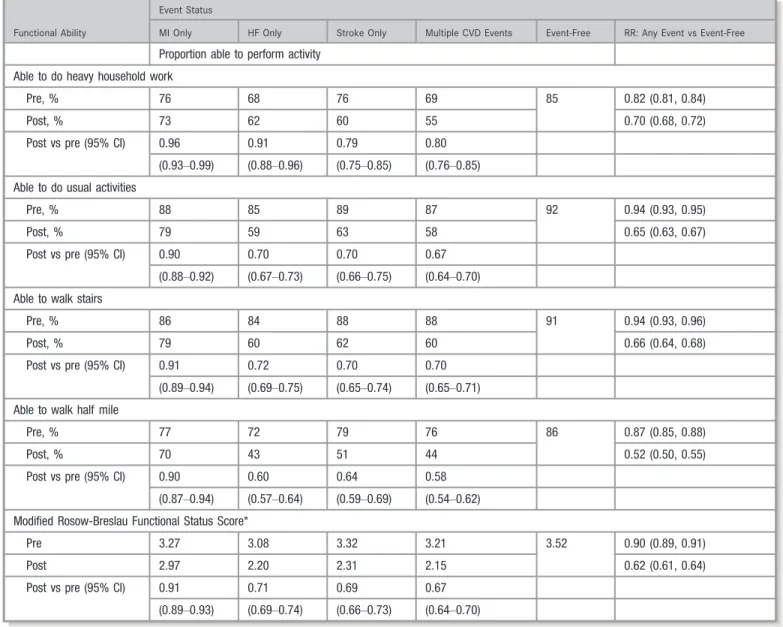
Compared with participants with no CVD hospitalizations, those who experienced an incident MI, HF, or stroke were on average less able to do usual activities such as walk up aflight of stairs, perform heavy household work, or walk half a mile during an average 8 years prior to the event (Table 2).
Pre-event
Overall, the greatest limitation observed in the period leading to the incident CVD hospitalization was seen in participants’ ability to perform heavy household work. Participants who experienced an incident CVD event were 18% less likely to report being able to perform this activity prior to the event,
relative to those having no event (relative risk, 0.82; 95% CI, 0.81–0.84). In analyses adjusted for age, sex, race, and ARIC study center, 76% of participants who had an MI or stroke and 68% of those who had an incident HF hospitalization were able to perform heavy household work prior to the event.
Post-event
Following the event, 73% of participants who had an MI, 62% of those who had an incident HF, and 60% who had a stroke were able to perform heavy household work. Differences in post- and pre-event FS appeared to be the smallest for MI (73% pre-event versus 76% post-event; relative risk, 0.96; 95% CI, 0.93–0.99), compared with stroke and HF.
Table 2. Frequency and Proportion of Decline in Functional Status Pre- and Post-Incident (as Well as Comparison With Those Who Did Not Have an Event) CVD–Related Hospitalization
Functional Ability
Event Status
MI Only HF Only Stroke Only Multiple CVD Events Event-Free RR: Any Event vs Event-Free
Proportion able to perform activity
Able to do heavy household work
Pre, % 76 68 76 69 85 0.82 (0.81, 0.84)
Post, % 73 62 60 55 0.70 (0.68, 0.72)
Post vs pre (95% CI) 0.96 0.91 0.79 0.80
(0.93–0.99) (0.88–0.96) (0.75–0.85) (0.76–0.85)
Able to do usual activities
Pre, % 88 85 89 87 92 0.94 (0.93, 0.95)
Post, % 79 59 63 58 0.65 (0.63, 0.67)
Post vs pre (95% CI) 0.90 0.70 0.70 0.67
(0.88–0.92) (0.67–0.73) (0.66–0.75) (0.64–0.70)
Able to walk stairs
Pre, % 86 84 88 88 91 0.94 (0.93, 0.96)
Post, % 79 60 62 60 0.66 (0.64, 0.68)
Post vs pre (95% CI) 0.91 0.72 0.70 0.70
(0.89–0.94) (0.69–0.75) (0.65–0.74) (0.65–0.71)
Able to walk half mile
Pre, % 77 72 79 76 86 0.87 (0.85, 0.88)
Post, % 70 43 51 44 0.52 (0.50, 0.55)
Post vs pre (95% CI) 0.90 0.60 0.64 0.58
(0.87–0.94) (0.57–0.64) (0.59–0.69) (0.54–0.62)
Modified Rosow-Breslau Functional Status Score*
Pre 3.27 3.08 3.32 3.21 3.52 0.90 (0.89, 0.91)
Post 2.97 2.20 2.31 2.15 0.62 (0.61, 0.64)
Post vs pre (95% CI) 0.91 0.71 0.69 0.67
(0.89–0.93) (0.69–0.74) (0.66–0.73) (0.64–0.70)
The Atherosclerosis Risk in Communities (ARIC) study cohort 1993–2007. All values are adjusted for age, sex, and race–ARIC study center. CVD indicates cardiovascular disease; HF, heart failure; MI, myocardial infarction; RR, relative risk.
*Score range: 0 to 4.
N
AL
RESE
The greatest limitation observed following an incident CVD hospitalization was participants’ability to walk half a mile. For example, 43% of those who had experienced an incident HF hospitalization were able to walk half a mile. Proportionally, this constituted 0.60 (95% CI, 0.57–0.64) of those able to walk that distance prior to the HF hospitalization. For all four FS measures, the proportion of participants able to perform the selected activities post-event was consistently lower among those with incident CVD events, as compared with those free of CVD.
Changes in FS score status pre- and post-CVD
–
related
hospitalization
The average FS score observed during up to 8 years prior to a CVD-related hospitalization was similar among participants who experienced different incident CVD events. The score ranged from 3.08 among study participants with incident HF hospitalization to 3.32 among study participants with incident stroke. On average during this pre-event time, the FS score among participants with CVD-related hospitalizations was 0.90 (95% CI, 0.89–0.91) that of the age, race, and sex comparable group with no CVD event. The mean FS score averaged over up to 8 years following the clinical event showed greater variability, from 2.20 observed for study
participants who experienced an incident HF hospitalization to 2.97 for study participants who were hospitalized with incident MI. The lowest post-event score (2.15) was observed among study participants who experienced more than one cardiovascular event. The 5-year average FS score of partic-ipants who experienced any cardiovascular event was 0.62 (95% CI, 0.61–0.64) that of the age, race, and sex comparable group with no CVD event.
Exclusion of participants with any form of CVD at baseline did not alter the results.
Trajectories of FS Pre- and Post-CVD
–
Related
Hospitalization
In the Figure, we present longitudinal patterns of change in the FS summary score during the interval of up to 5 years prior to and up to 5 years following the date of the incident cardiovascular event. To examine changes potentially due to aging, the FS summary score was also estimated for study participants with no CVD hospitalization during the period of observation (dashed line). All three clinical events, MI, HF, and stroke, were associated with a subsequent significant decrease in participants’ FS, with the smallest decrease observed for participants with incident MI. Study participants
0 1 2 3 4 F unc ti onal S tat us S c or e
-5 -4 -3 -2 -1 0 1 2 3 4 5 Years Prior to and Following MI
Myocardial Infarction 0 1 2 3 4 F unc ti onal S tat us S c or e
-5 -4 -3 -2 -1 0 1 2 3 4 5 Years Prior to and Following HF
Heart Failure 0 1 2 3 4 F unc ti onal S tat us S c or e
-5 -4 -3 -2 -1 0 1 2 3 4 5 Years prior to and following stroke
Stroke
_____ Participants with CVD events __..__ Participants without CVD events
Time zero is the time of the event
Figure. Functional status score trajectories pre- and post-event, by event type, compared with functional status score trajectories among participants with no cardiovascular events in the Atherosclerosis Risk in Communities (ARIC) study cohort. CVD indicates cardiovascular disease; HF, heart failure; MI, myocardial infarction.
N
AL
RESE
who experienced an incident MI event regained their prehos-pitalization FS within 2 years following the event, with the mean FS score for this group approaching that of the control group. Post-discharge FS of study participants experiencing an incident stroke or HF hospitalization remained below the level observed prior to the event and below that of the event-free group.
A similar assessment of longitudinal changes in the proportion of study participants who were able to perform usual activities, climb a flight of stairs, perform heavy household work, and walk half a mile across the years prior to and following the cardiovascular event confirmed observed patterns of change in the composite FS score (data not shown).
Rate of change in FS
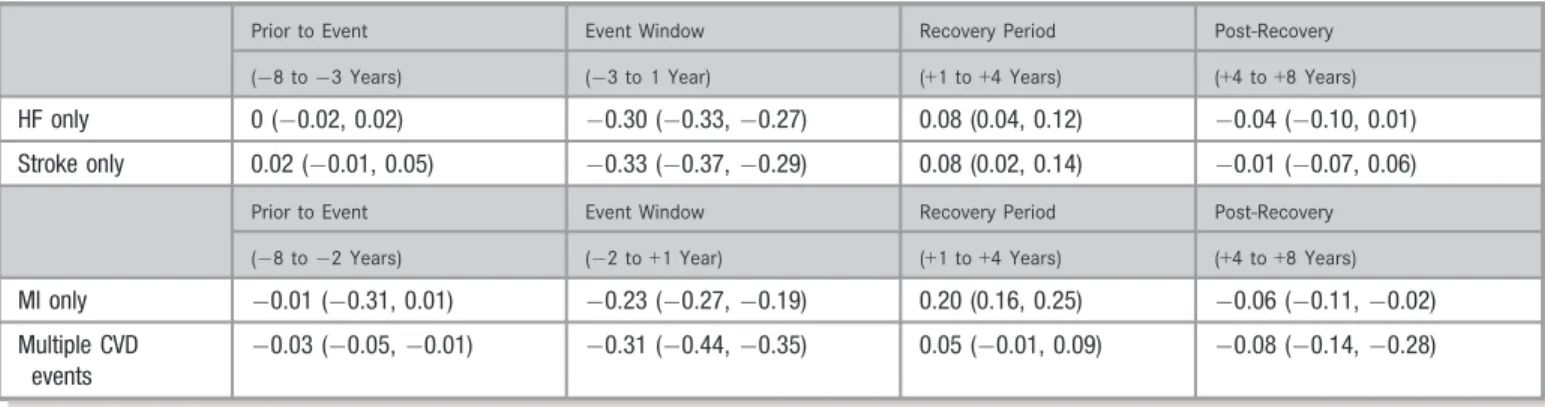
We defined the event window as the time of 3 years (2 for MI) pre-event and 1 year post-event, during which we observed a constant and most pronounced change in FS. We then examined the change in study participants’ FS score relative to the FS of the comparison event-free group during that time and the time prior to and following that period (Table 3). The greatest recovery in FS occurred within 1 to 4 years following the hospitalization. For example, in Table 2 we show that the baseline pre-event FS among participants who experienced incident HF was 0.90 (95% CI, 0.87–0.92) that of the event-free group. During the 3 to 8 years prior to the HF hospitalization, the rate of change in FS of those participants was not different from the rate of change in FS of the event-free group. In Table 3, we show that during the event window (3 years prior to and 1 year post-event), the FS score of study participants who experienced an HF hospitalization declined by 0.30 (95% CI, 0.33 to 0.27) units of the summary FS score per year. A similar magnitude in the decline of the FS score was observed for study participants who experienced an
incident stroke event ( 0.33 [95% CI, 0.37 to 0.29] units per year) or multiple CVD events ( 0.31 [95% CI, 0.44 to 0.35] units per year). The decline in the summary FS score during the event window among study participants who experienced an incident MI was less pronounced at 0.23 (95% CI, 0.27 to 0.19) units per year. During years 2 to 4 following the incident event, FS of all study participants who experienced a CV event improved, with the greatest improve-ments observed for those who experienced an incident MI (0.20 [95% CI, 0.16–0.25] unit increase in the FS score per year). No substantial changes in FS post year 4 were observed among study participants who experienced incident HF or stroke. A slight decrease in FS was observed at that time among those who experienced an incident MI event or multiple CVD events.
Analyses repeated among participants without any form of CVD at baseline yielded the same estimates of rate of change in FS pre- and post-event. Sensitivity analyses did not reveal sex or race differences in longitudinal patterns of change in FS prior to and following cardiovascular events (Figure S1A and S1B). However, the average FS among women was consistently lower than the FS of men across all incident CVD conditions and in all time periods pre- and post-events. The FS of whites was greater than the FS of blacks prior to and following incidence of MI, HF, or stroke. Trajectories of FS for all disease conditions were parallel across sex and race groups, suggesting that the rate of change in FS was not sex- or race-dependent.
Discussion
In this analysis of longitudinal data from a large biracial cohort of men and women, we observed an overall decline in FS during a period of up to 8 years preceding an MI, HF, or stroke hospitalization. This decline was significantly more
Table 3. Adjusted Estimate of Change* in Functional Status Score Over Time (Years) Before and After a CVD Event Relative to Those With No Events
Prior to Event Event Window Recovery Period Post-Recovery
( 8 to 3 Years) ( 3 to 1 Year) (+1 to+4 Years) (+4 to+8 Years)
HF only 0 ( 0.02, 0.02) 0.30 ( 0.33, 0.27) 0.08 (0.04, 0.12) 0.04 ( 0.10, 0.01)
Stroke only 0.02 ( 0.01, 0.05) 0.33 ( 0.37, 0.29) 0.08 (0.02, 0.14) 0.01 ( 0.07, 0.06)
Prior to Event Event Window Recovery Period Post-Recovery
( 8 to 2 Years) ( 2 to+1 Year) (+1 to+4 Years) (+4 to+8 Years)
MI only 0.01 ( 0.31, 0.01) 0.23 ( 0.27, 0.19) 0.20 (0.16, 0.25) 0.06 ( 0.11, 0.02)
Multiple CVD events
0.03 ( 0.05, 0.01) 0.31 ( 0.44, 0.35) 0.05 ( 0.01, 0.09) 0.08 ( 0.14, 0.28)
The Atherosclerosis Risk in Communities (ARIC) study cohort 1993–2007. All values are adjusted for age, sex, and race–ARIC study center. HF indicates heart failure; MI, myocardial infarction.
*Change in functional status score among those with any events was estimated relative to change in the functional status score among those free of incident cardiovascular disease (CVD) events during the same period of observation.
N
AL
RESE
pronounced following the incident CVD event. Despite modest improvement in the 2 to 4 years following a stroke or HF hospitalization, the FS decline was sustained in subsequent years. By contrast, the FS decline observed following an incident MI event was followed by an increase in FS to levels similar to those observed in the year prior to the MI-related hospitalization. We did not observe race or sex differences in patterns of FS change prior to and following an incident cardiovascular hospitalization.
FS assessment is one of the core measures recommended by the Institute of Medicine,16,17 especially for patients with complex chronic conditions, who currently constitute26% of the US adult population.18,19 Longitudinal assessment of FS allows for the evaluation of patients’ quality of life and the effectiveness of care from the patients’perspective. However, standardized FS measures are not often used in clinical practice.20,21 New models of care are gradually transforming practice patterns from those focused on episodic models of care towards comprehensive and coordinated care for complex chronic disease conditions.22It is within this chronic care framework that patients’FS can effectively be optimized to allow for maintenance of functional capacity, prevention of decline in function, and preservation of good quality of life. Chronic conditions, defined by the World Health Organization as conditions that “require ongoing management over a period of years or decades,”can impair the person’s ability to self-manage and impact the caregiver’s capacity to assist with care. Organizations, such as the American Heart Association, strongly advocate for the use of patient-reported FS in clinical care.23However, routine assessment of FS in clinical settings is subject to availability of validated, nonproprietary instru-ments, which can be easily incorporated into electronic health record platforms.5 A first step in that direction is a set of recommendations for the development of FS quality metrics proposed by the Assistant Secretary for Planning and Evaluation and the Centers for Medicare & Medicaid Ser-vices.24 Findings from the present study contribute to the evidence in support of such efforts and underscore the importance of longitudinal clinical assessment of FS among older adults with multiple chronic conditions.
In a study based on Health and Retirement Study data, Lee and colleagues25 observed that a model that included FS measures in addition to information on comorbidity status performed better than a comorbidity-only model in the assessment of the risk of mortality in older adults, thus underscoring the importance of FS in risk prediction models. Similar observations of the risk of readmission among medically complex patients in inpatient rehabilitation facili-ties26suggest that FS, which may act as a marker of disease severity or depression,4or represent an individual’s suscep-tibility to disease complications, is critical in the assessment of post-hospitalization outcomes.
Ourfinding that the functional limitation most affected by a CVD-related hospitalization was the ability to walk half a mile confirms prior observations by Alexander et al,27in which the authors conclude that among older adults, walking ability reflects the ability to perform other activities of daily living. Inability to walk limits an individual’s ability to engage in the most common forms of routine physical activity and may consequently impart increased risk of CVD28 and greater functional decline.29
The Rosow-Breslau questionnaire, which was used in the assessment of FS in this study, was developed for commu-nity-dwelling elderly adults. In that way, it is very applicable to the population of the present study. The test-retest reliability of this questionnaire, assessed using the Pearson correlation coefficient, was found to be high and its concurrent validity was established through comparison with other measures of physical performance.30 The Rosow-Breslau questionnaire items pertain to everyday tasks (such as performing activities of daily living, including shoveling snow), which may, however, change in importance with age. Performance of this questionnaire may therefore be different in different age groups.
Several additional limitations of this study should be taken into consideration. Our assessment of FS relied on self-reported measures only. Furthermore, the time of the FS assessment, relative to the time of hospitalization for CVD events, was not the same for all study participants. For some participants, the time from the hospitalization to the time of FS assessment could have been sufficient for a certain degree of FS recovery.
Conclusions
This longitudinal assessment describes patterns of change in FS among older adults experiencing incident CVD-related hospitalizations. Our results suggest that changes in FS are evident at least 2 years prior to the incident CVD hospital-ization, strongly supporting regular FS assessments among older adults. Such assessments may prevent or delay hospitalizations due to CVDs. Studies are needed to deter-mine predictive utility of change in FS on incident CVD events and effectiveness of screening and longer-term rehabilitation interventions. The sustained differences in the overall FS observed across sex and race groups may be important to consider with respect to rehabilitation occurring post-discharge, such that greater emphasis is placed on the use of rehabilitation services by women and blacks.
Acknowledgments
The authors thank the staff and participants of the ARIC study for their important contributions.
N
AL
RESE
Sources of Funding
The ARIC study is carried out as a collaborative study supported by National Heart, Lung, and Blood Institute contracts (HHSN268201100005C, HHSN268201100006C, HHSN268201100007C, HHSN268201100008C, HHSN2682 01100009C, HHSN268201100010C, HHSN268201100011C, and HHSN268201100012C).
Disclosures
None.
References
1. Go AS, Mozaffarian D, Roger VL, Benjamin EJ, Berry JD, Borden WB, Bravata DM, Dai S, Ford ES, Fox CS, Franco S, Fullerton HJ, Gillespie C, Hailpern SM, Heit JA, Howard VJ, Huffman MD, Kissela BM, Kittner SJ, Lackland DT, Lichtman JH, Lisabeth LD, Magid D, Marcus GM, Marelli A, Matchar DB, McGuire DK, Mohler ER, Moy CS, Mussolino ME, Nichol G, Paynter NP, Schreiner PJ, Sorlie PD, Stein J, Turan TN, Virani SS, Wong ND, Woo D, Turner MB. Executive summary: heart disease and stroke statistics—2013 update: a report from the American Heart Association.Circulation. 2013;127:143–152. 2. Mensah GA, Brown DW. An overview of cardiovascular disease burden in the
United States.Health Aff. 2007;26:38–48.
3. Dhamoon MS, Dong C, Elkind MS, Sacco RL. Ideal cardiovascular health predicts functional status independently of vascular events: the Northern Manhattan Study.J Am Heart Assoc. 2015;4:e001322. DOI: 10.1161/JAHA. 114.001322.
4. Sin NL, Yaffe K, Whooley MA. Depressive symptoms, cardiovascular disease severity, and functional status in older adults with coronary heart disease: the Heart and Soul Study.J Am Geriatr Soc. 2015;63:8–15.
5. Dy SM, Pfoh ER, Salive ME, Boyd CM. Health-related quality of life and functional status quality indicators for older persons with multiple chronic conditions.J Am Geriatr Soc. 2013;61:2120–2127.
6. Whaley C, Reed M, Hsu J, Fung V. PS2-18: functional limitations, home support, and responses to drug costs among Medicare beneficiaries.Clin Med Res. 2013;11:159–160.
7. Dormuth CR, Patrick AR, Shrank WH, Wright JM, Glynn RJ, Sutherland J, Brookhart MA. Statin adherence and risk of accidents: a cautionary tale.
Circulation. 2009;119:2051–2057.
8. Harlan WR III, Sandler SA, Lee KL, Lam LC, Mark DB. Importance of baseline functional and socioeconomic factors for participation in cardiac rehabilitation.
Am J Cardiol. 1995;76:36–39.
9. Meaningful use. 2014 Edition EHR Certification Criteria. 2014. Available at: http://www.healthit.gov/sites/default/files/meaningfulusetablesseries2_110112. pdf. Accessed February 8, 2017.
10. The ARIC Investigators. The Atherosclerosis Risk in Community (ARIC) Study. Design and objectives.Am J Epidemiol. 1989;129:687–702.
11. Rosamond WD, Chambless LE, Folsom AR, Cooper LS, Conwill DE, Clegg L, Wang CH, Heiss G. Trends in the incidence of myocardial infarction and in mortality due to coronary heart disease, 1987 to 1994. N Engl J Med. 1998;339:861–867.
12. Rosamond WD, Chang PP, Baggett C, Johnson A, Bertoni AG, Shahar E, Deswal A, Heiss G, Chambless LE. Classification of heart failure in the Atherosclerosis
Risk in Communities (ARIC) study: a comparison of diagnostic criteria.Circ Heart Fail. 2012;5:152–159.
13. Jones SA, Gottesman RF, Shahar E, Wruck L, Rosamond WD. Validity of hospital discharge diagnosis codes for stroke: the Atherosclerosis Risk in Communities Study.Stroke. 2014;45:3219–3225.
14. Rosow I, Breslau N. A Guttman health scale for the aged. J Gerontol. 1966;21:556–559.
15. Holgado-Tello FP, Barbero-Garcıa FP, Vila-Abad E. Polychoric versus Pearson correlations in exploratory and confirmatory factor analysis of ordinal variables.Qual Quant. 2010;44:153–166.
16. Richardson W.Crossing the Quality Chasm. Washington, DC: National Academy Press; 2001.
17. Roundtable on Value & Science-Driven Health Care; Institute of Medicine. Core Measurement Needs for Better Care, Better Health, and Lower Costs: Counting What Counts: Workshop Summary.Core Metrics Sets in Use2013. 18. US Department of Health and Human Services. Multiple Chronic Conditions—A Strategic Framework: Optimum Health and Quality of Life for Individuals With Multiple Chronic Conditions. Washington, DC: US Department of Health and Human Services; 2010.
19. Ward BW, Schiller JS, Goodman RA. Multiple chronic conditions among US adults: a 2012 update.Prev Chronic Dis. 2014;11:E62.
20. Rumsfeld JS. Health status and clinical practice: when will they meet?
Circulation. 2002;106:5–7.
21. Spertus J. Barriers to the use of patient-reported outcomes in clinical care.
Circ Cardiovasc Qual Outcomes. 2014;7:2–4.
22. Hirschman KB, Shaid E, Bixby MB, Badolato DJ, Barg R, Byrnes MB, Byrnes R, Streletz D, Stretton J, Naylor MD. Transitional care in the patient-centered medical home: lessons in adaptation.J Healthc Qual. 2015 Apr 9. [Epub ahead of print].
23. Rumsfeld JS, Alexander KP, Goff DC, Graham MM, Ho PM, Masoudi FA, Moser DK, Roger VL, Slaughter MS, Smolderen KG, Spertus JA, Sullivan MD, Treat-Jacobson D, Zerwic JJ. Cardiovascular health: the importance of measuring patient-reported health status: a scientific statement from the American Heart Association.Circulation. 2013;127:2233–2249.
24. Deutsch R, Kline T, Kelleher C, Lines LM, Coots L, Garfinkel D, Mallinson T, Gage B. Analysis of Crosscutting Medicare Functional Status Quality Metrics Using the Continuity and Assessment Record and Evaluation (CARE) Item Set Final Report 2012. Available at: https://www.cms.gov/Medicare/Quality-Initiatives-Patient-Assessment-Instruments/Post-Acute-Care-Quality-Initiatives/Functiona l-Measures-.html. Accessed February 8, 2017.
25. Lee SJ, Lindquist K, Segal MR, Covinsky KE. Development and validation of a prognostic index for 4-year mortality in older adults.JAMA. 2006;295:801– 808.
26. Shih SL, Gerrard P, Goldstein R, Mix J, Ryan CM, Niewczyk P, Kazis L, Hefner J, Ackerly DC, Zafonte R, Schneider JC. Functional status outperforms comor-bidities in predicting acute care readmissions in medically complex patients.J Gen Intern Med. 2015;30:1688–1695.
27. Alexander NB, Guire KE, Thelen DG, Ashton-Miller JA, Schultz AB, Grunawalt JC, Giordani B. Self-reported walking ability predicts functional mobility perfor-mance in frail older adults.J Am Geriatr Soc. 2000;48:1408–1413. 28. Murtagh EM, Nichols L, Mohammed MA, Holder R, Nevill AM, Murphy MH. The
effect of walking on risk factors for cardiovascular disease: an updated systematic review and meta-analysis of randomised control trials.Prev Med. 2015;72:34–43.
29. Buchman AS, Wilson RS, Boyle PA, Tang Y, Fleischman DA, Bennett DA. Physical activity and leg strength predict decline in mobility performance in older persons.J Am Geriatr Soc. 2007;55:1618–1623.
30. VanSwearingen JM, Brach JS. Making geriatric assessment work: selecting useful measures.Phys Ther. 2001;81:1233–1252.
N
AL
RESE