1
Using the Multiple Streams Framework to explain the
establishment of the INF treaty: Applying the framework to
an international setting and assessing the treaty's relevance
vis-à-vis the current nuclear hostilities
Master Thesis Public Administration, Leiden University
Name: Daen Smits (S1914243)
Date: 22-05-2018
Supervisors: Dr. V. Karakasis and Dr. A. Afonso
Pages: 95
2
Table of contents
I. Introduction ... 4
II. Theoretical Framework ... 10
Neo-functionalism and the rise of international organizations ... 10
The importance of ideas ... 12
The Multiple Streams Framework explained ... 14
Other scholars on the MSF ... 17
The problem stream: Crises ... 18
The policy stream: Epistemic communities ... 19
The politics stream: Summitry ... 20
The MSF, process-tracing and the INF treaty ... 21
III. Methodological design: interpretivist process-tracing ... 23
The design of my study... 23
Data Collection ... 25
The operationalization of the problem stream ... 27
The operationalization of the policy stream ... 28
The operationalization of the politics stream ... 28
IV. The Analysis ... 30
The problem stream: the antecedent conditions ... 30
The Soviet invasion in Afghanistan ... 31
Economic hardship in the Soviet Union ... 32
The Iran-Contra affair in the United States ... 33
The problem stream: The nuclear crisis ... 35
The focusing event ... 35
The NATO Dual Track decision ... 36
RYAN, Able Archer-83 and KAL-007 ... 37
Widespread demonstrations against nuclear arms ... 38
The INF and the policy stream ... 41
The policy proposals leading to the treaty ... 42
The power of ideas within the epistemic communities ... 46
The INF and the politics stream... 50
Gorbachev's motivations ... 51
Reagan's motivations ... 53
National mood ... 54
3
Concluding the analysis ... 59
V. Reflections on the MSF-model in international politics ... 61
The reflections on the MSF ... 61
The fluidity of the model ... 62
The intimate relationship between the media and public opinion ... 64
Optimizing the MSF-model for international application ... 65
Translating the lessons of the INF to the current crisis ... 67
A different context compared to the 80's make an INF-alike agreement welcome ... 67
The important INF lessons translated to the current context ... 69
VI. Conclusion ... 73
VII. References ... 78
VIII. Appendix ... 87
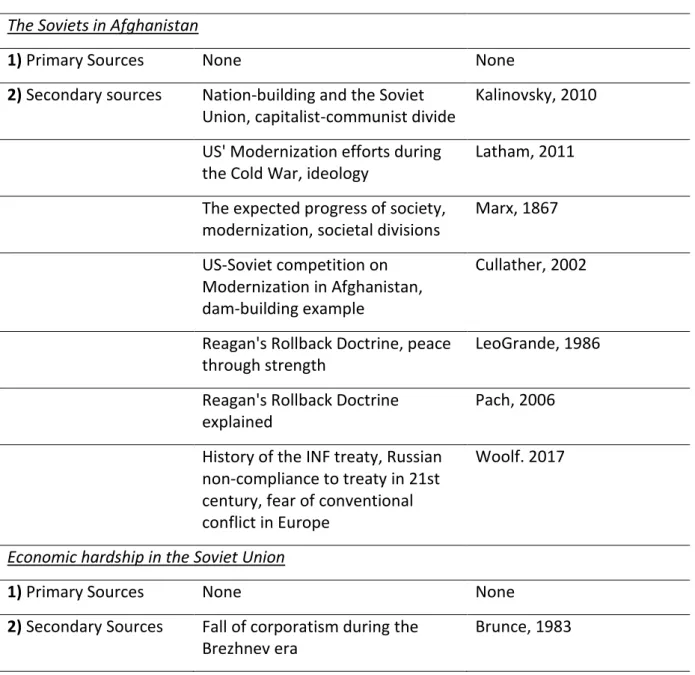
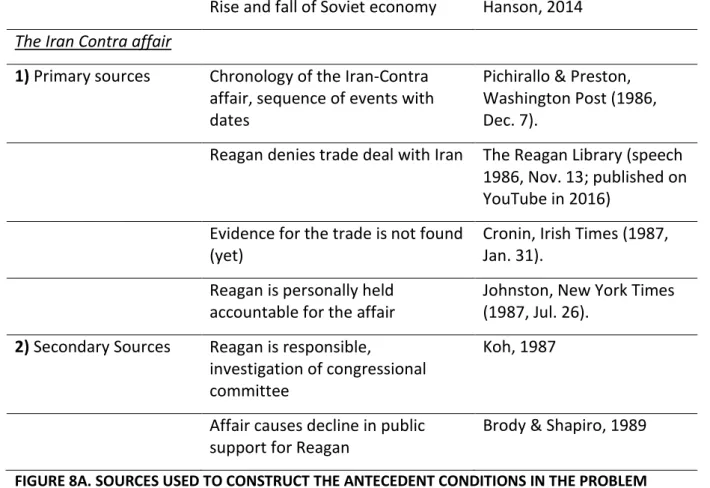
Sources of the Problem stream ... 87
Table 8A: The Problem Stream: The antecedent conditions... 87
Table 8B: The Problem Stream: The nuclear crisis ... 89
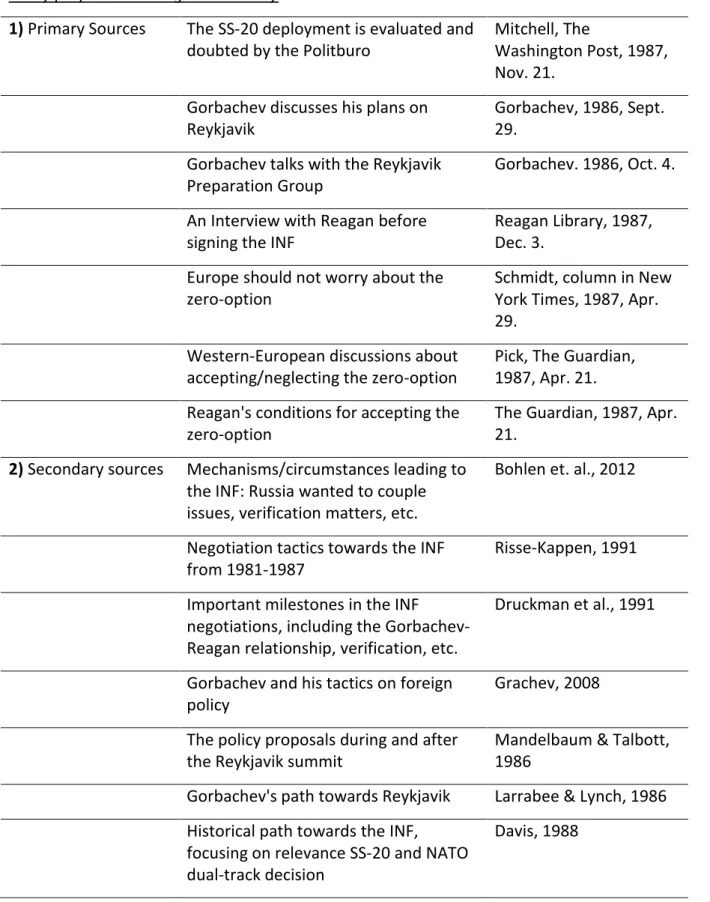
Sources of the Policy Stream ... 91
Table 8C: The Policy Stream ... 91
Sources of the Politics Stream ... 93
4
I. Introduction
The signing of the Intermediate-Range Nuclear Forces Treaty (INF) in 1987 was a major step
towards the end of the Cold War. Even though the hostilities between the Soviet Union and
the US seemed to be reaching their ultimate peak in that period, the USSR-president Mikhail
Gorbachev and the US-president Ronald Reagan got together and signed a bilateral
agreement to end the ongoing fear that either of the parties would be tempted to use (short
range) nuclear weapons. The treaty prohibited the creation, possession and flight testing of
ground-launched ballistic- and cruise missiles with a range between 500 and 5,500
kilometers, together with an additional ban on its launchers. Next to these concrete
disarmament efforts, the two countries also agreed on a mutual inspection mechanism, that
allowed both countries to cross-check and verify the opponent's nuclear arsenals.
The signing of this treaty remains a rather remarkable event in the history of
Russian-American relations, as it seems a point of light in continuing dark ages. If scholars would be
asked to characterize the relationship between Russia and the United States over the last
decades, they would probably have no other option than to state that it is one of extreme
discomfort, despite the promising INF-agreement. The relationship never truly stabilized.
The first approximately thirty years after the end of the Cold War instigated a situation in
which the recognition or denial of Russia's status as a global superpower gained prominence
(MacFarlane, 2006; Forsberg, 2014). Bill Clinton once said he dealt with Russia as if it no
longer counted (Gates, 2014), which was clearly rather insulting towards the Russians. Such
emotions, misunderstandings and cultural perceptions do play a big role in their uneasy
relationship. Forsberg (2014) stated: 'What really matters is not so much an objective status
but rather perceptions thereof and there seems to be a gap of how Russia and the West
perceive Russian status and in particular Western acts in honoring or ignoring it' (p.329). In
2006, Neil MacFarlane even believed that Russia did not deserve its permanent seat in the
UN's Security Council, as such a level of influence was perceived disproportionate when
taking Russia's capabilities and their declining global influence into account.
Following up on such statements, Larson & Shevchenko (2014) warned that the
Russians perceived such a denial of Russian status as humiliating. They wrote: 'Continued
indifference to Russia's great power aspirations, especially in the former Soviet space, will
5
(p.277). In response to the situation, Russia predominantly tried to restore its global
influence by first focusing on former Soviet Union countries. Through regional initiatives and
pressure-building, it intended to gradually retake its global importance (Larson &
Shevchenko, 2014). Practical examples are the Russian attitude during the Russo-Georgian
war in 2008 and the annexation of Crimea in 2014. In the meantime, the Russians have also
gained themselves the status of a decision-making spoiler in the UN SC , with 'Syria' being
the most prominent example. It leaves Forsberg, et al. (2014) to note that: 'Today, being a
great power -and being recognized as one- is a foreign policy goal that appears more
attractive than ever to the Russian foreign policy elites' (p.262).
In these ongoing hostilities, nuclear weapons have also claimed their role again,
which puts the INF treaty under immense pressure. While the treaty actually celebrated its
thirtieth anniversary in 2017, many researchers and journalists question whether the treaty
has a future. Both Russia and the United States accuse each other of violating the treaty,
which leads to even bigger tensions. According to Vladimir Kozin (2017), a former Russian
Diplomat, the American accusations that Russia violates the treaty have been repeatedly
alleged almost annually from 2012 onwards. In that year, Russia tested a far-reaching
intercontinental ballistic missile, which was technically, due to its range beyond 5,500 km,
not constrained by INF regulations. Such rhetoric that Russia violates the treaty reiterated
strongly after Donald Trump entered the White House, as his administration attaches a lot
more value to nuclear arsenals in their national defense policy than Obama used to do.
Unlike Trump, Obama was openly dreaming of a world without such weapons (Allison,
2010).
Trump's position towards nuclear arsenals, as explained in the 2018 Nuclear Posture
Review (which I will touch upon in chapter V), causes a situation of bilateral ambiguity and
mistrust. According to Kozin (2017), the accusations of Russian non-compliance actually
provide the US with an excuse to deploy defensive cruise missiles in Europe, to technically
invest in their nuclear arsenals again and to better cope with the current (geo)political
developments (Kozin, 2017). These developments include the nuclear-testing by
North-Korea, the Iran-deal, the treat of non-state actors and the concern that China can
unboundedly build on their nuclear arsenals without being constrained by an INF- alike
6
Foreign Affairs Sergey Lavrov echoed Kozin’s words, stating that the US recently installed
‘ready-for-use tactical weapons in Europe, which is not just a rudiment of the Cold War, but
clearly an aggressive stance’ (Lavrov, 2018, Feb. 11). Such an act would inherently mean a
violation of the INF. Though the US declared this to be complete nonsense, it clearly
illustrates the lack of trust and the increased level of ambiguity towards one another.
Due to the these tensions, the former USSR-president Mikhail Gorbachev, who
personally signed the INF treaty, felt the urge to ventilate his deep concerns. In a column in
the Washington Post (2017) he wrote:
'Both sides have raised issues of compliance, accusing the other of violating or circumventing the treaty’s key provisions. From the sidelines, lacking fuller information, it is difficult to evaluate those accusations. But one thing is clear: The problem has a political as well as a technical aspect. It is up to the political leaders to take action. Therefore I am making an appeal to the presidents of Russia and the United States. Relations between the two nations are in a severe crisis. A way out must be sought, and there is one well-tested means available for accomplishing this: a dialogue based on mutual respect. It will not be easy to cut through the logjam of issues on both sides. But neither was our dialogue easy three decades ago. It had its critics and detractors, who tried to derail it. In the final analysis, it was the political will of the two nations’ leaders that proved decisive. And that is what is needed now. This is what our two countries’ citizens and people everywhere expect from the presidents of Russia and the United States'.
The nuclear crisis that we are facing today thus also seems to ask for an INF treaty alike agreement, in which two world leaders would overstep the current concerns and tensions. With the INF treaty, Gorbachev and Reagan engaged in dialogue, even though the Cold War was at its peak. As the amount of tension around 1987 seems comparable to the situation now, I think it is extremely valuable to research to what extent the mechanisms that led to
establishment of the INF treaty in 1987 would also be able to settle the current nuclear
hostilities. For that purpose, I will use John Kingdon’s Multiple Streams Framework, a theory
that aims to describe (sudden) policy change. It focuses on how 'problem', 'policy' and
'political' factors, while being subject to timing and circumstances, converge and lead to new
7 'How does the Multiple Streams Framework help to explain the establishment of the INF treaty in 1987 and what is the value of those mechanisms in the context of the current day nuclear hostilities?'
The answer to this research question is relevant due to two reasons. First, the current
nuclear hostilities in the world ask for a better understanding. I think it is essential to not
step in the 'nuclear-threat trap' that the passing of time seems to provide us. What I mean
here, is that a retrospective look on nuclear hostilities instigates researchers to
underestimate the severity of the threat at the time it happens. A good example is how
researchers have classified the Korean war of the 1950's. Some have stated that the use of a
nuclear weapon in that war was unthinkable, and that the weapons were only used as
instruments of policy-making and deterrence (Trachtenberg, 1988). However, Trachtenberg
(1988) countered that several declassified historical documents from that period showed a
very different picture, revealing that the use of nuclear bombs was actually a very realistic
and concrete possibility. Also when it comes to the analysis of the Cold War, many
prominent researchers, like John Mearsheimer (1990), have argued that the mutual
deterrence, paradoxically enough, caused a relatively stable situation. Despite such
theoretical assumptions, the threat of nuclear war was real during the Cold War and such
theories can simply not account for the probability of nuclear accidents, nuclear risks and
the increasing accessibility of nuclear material (I will also touch upon this in the reflections).
In this light, I find comprehensive historical awareness essential to fully grasp contemporary
developments. Walt (2014) agrees and states: 'We cannot evaluate the uniqueness or the
salience of any event without a sense of historical backdrop against which it occurs' (Walt,
2014, p.3).
Second, I this research is a valuable contribution to the literature on the Multiple
Streams Framework (MSF) by John Kingdon (2014). I believe that it is important to
understand how the dynamics within the MSF lead to the establishment of institutions and
agreements. Such agreements typically embody some sort of consensus among sovereign
countries, thus transcending the purely self-interested national concerns. In a world that is
highly globalized, interconnected and compressed in time and space, international
agreements are highly vital for maintaining or creating international peace and security. The
8
political disputes in times of crisis. Though the MSF could be considered a classical theory
and has been applied to various contexts, it still lacks application to international and
bilateral situations. I want to act upon Cairney & Jones' (2016) statement that 'even though
the empirical impact of MSF has been considerable, the untapped potential for theoretical
and empirical advance is far greater' (p.51). I believe the MSF could be highly valuable to
explain the complex and sensitive nature of international agreements. In this regard,
however, it is important to contextualize both international and domestic contexts, as 'the
preferences of decision-makers largely depend on the international and domestic
environment in which they act' (Risse-Kappen, 1991, p.175).
My thesis will consist of six main parts. After the introduction, I will provide a
theoretical framework. In this section, I will address what institutions are, how the
neo-functionalist view explains the establishment of international institutions and how important
discursive institutionalism is in the process of (international) public policy-making. Then, I
will explain what the Multiple Streams Framework is, the criticism and modifications the
theory has faced over the years and what causal mechanisms I identified to explain the
establishment of the INF treaty. In the third section, on research design, I will clarify my
methodological approaches and I will clarify the operationalization of the MSF in relation to
the INF to explain the establishment of the treaty. I will use an inductive single case study
approach based on interpretivist process-tracing. An interpretivist approach aims to explain
how a certain actor, who operates within a certain context, makes sense of the
circumstances and the timeframe around him. The most important premise of this method is
that it acknowledges that in the social world, the political process can be decisive to an
outcome, but so can it be the activity within the brain of an actor (Guzzini, 2012). As such, a
direct X to Y relationship is hard to establish, as many contextual factors may have had its
effect on the outcome. That is where process-tracing comes in, because it features the
inclusion of individual events and facts, it mediates between structure and agencies and it
allows to connect abstract ideas with concrete factors to explain certain phenomena. In the
analysis, the fourth section, I will conduct my process-tracing encounter and apply the MSF
to the INF. In the fifth section, I will reflect on the application of the MSF-model and state its
relevance and limitations when applying it to international politics. This interpretation will
9
in relation to the current day nuclear hostilities. In the last section, the conclusion, the
research question will be answered and here I will also address the relevance of my findings,
their broader implications for society, the limitations of the study and some suggestions for
10
II. Theoretical Framework
In order to be able to answer the research question, it is important to theoretically
understand what international institutions are and why such international structures come
into existence. In this chapter, I will touch upon this by using the neo-functionalist theory.
The neo-functionalist theory fits the idea of the MSF and the INF, because it focuses on why
countries decide to work together, while also indicating the possible limitations and
exceptions to such a cooperation. Globalization might have accelerated the
interconnectedness among countries in many aspects, but domestic concerns often still
prevail. Only when such domestic and international concerns match, an international
agreement becomes possible. As we will see in the coming chapters, the INF is a good
example of this. I will also address the importance of discursive institutionalism and the
power of ideas in this chapter, which are crucial aspects in the formation of institutions and
are often overlooked by other theorists. After having touched on these theoretical schools, I
will explain the Multiple Streams Framework, the criticisms and modifications the MSF faced
over the years and the three causal mechanisms I identified to explain the establishment of
the INF treaty. In the last paragraph of the chapter, I will address the relationship between
interpretivist process-tracing, the MSF and the INF.
Neo-functionalism and the rise of international organizations
It is clear that globalization, which caused growing economical, cultural and humanitarian
interconnectedness across countries, has instigated an increase of international institutions
since 1945. According to North (1991), institutions 'are the humanly devised constraints that
structure political, economic and social interaction. They consist of both informal constraints
(sanctions, taboos, customs, traditions, and codes of conduct), and formal rules
(constitutions, laws, property rights). Throughout history, institutions have been devised by
human beings to create order and reduce uncertainty in exchange' (p.97). An important
characteristic of an institution is that it is a social arrangement to reduce transaction costs.
Without institutions, the market defines the costs of interaction. Price movements direct
production, meaning that certain goods can only be produced when the other trading party
is willing to pay the transaction costs for that particular good. In such a situation, the
reduction of transaction costs thus fosters international trade, because it allows the
11
Coase (1937), one of the founders of the theory, writes: 'Within a firm [institution], these
market transactions are eliminated and in place of the complicated market structure with
exchange transactions is substituted the entrepreneur-coordinator, who directs production'
(p.388). In my particular study, it means that an international arms treaty, with an effective
verification mechanism, would lower the resources that countries need to devote to nuclear
arms in order to protect themselves.
Rodrik (2012) believes that institutions come in three forms. They can be based on a
long term-relationship build on trust and companionship, they can come into existence due
to similar belief systems or institutions enable third party enforcement, such as courts or
rights enactors. Institutions, in a theoretical sense, help us to define the rules of the game
that we, the members of the (inter)national society, find ourselves in. Within that structure,
organizations largely decide which values, customs and habits deserve saliency, and they
structure themselves along these components. An institution is a socially constructed
phenomenon which facilitates a continuous interaction between the structure of the
institution and the behavior of the actors within it. This means that the actors adapt to the
structure they find themselves in, but simultaneously the actors also modify the structure by
continuously testing and using these institutional boundaries.
Functionalism, an early 1900s theory that builds on the concept of globalization,
describes how and why international border-transcending institutions are formed. The
theory goes beyond the primarily economic explanation that institutions reduce transaction
costs. Functionalism entails that states have common interests and needs, that will be
addressed and satisfied by elevating these common national concerns to international
institutional structures (Hurrell, 2007). This whole process would, according to functionalists,
eventually diminish the prominence of state sovereignty in international politics. However,
this premise could not stand the time, because 'the functional demand for institutions is in
many cases not met because it does not mesh with the interests and incentives of powerful
political and economic agents' (Hurrell, 2007, p.201). In reaction, several scholars took
account of this critique and reaffirmed the significance of nation-states in the world order.
For Mitrany (1948), the United Nations is the perfect example of an international institution
that underlines the importance of state sovereignty. He (1948) writes: 'The League of
12
They are loose associations for occasional specific joint action, in regard to each of which
each member remains on the whole free to participate or not' (p.351). An important pillar of
Mitrany's (1948) functionalist approach is the intrinsic will of countries, despite the distinct
national interests of states, to unite and use international institutions and arrangement as a
tool to maintain peace and security. Again, the INF treaty is an example of this.
Based on Mitrany's changes to functionalism, Haas (1958) formulated a
neo-functionalist theory in which (regional) integration was key. It referred to the process
'whereby political actors in several distinct national settings are persuaded to shift their
loyalties, expectations and political activities toward a new centre, whose institutions
possess or demand jurisdiction over the pre-existing national states. The end result of a
process of political integration is a new political community, superimposed over the
pre-existing ones' (Haas, 1958, p.16). The Special Verification Commission on the INF treaty, that
checks both countries on compliance, is an example of how the verification was shifted to a
new bilateral and international centre. Unsurprisingly, however, many scholars have also
challenged Haas' assumptions, fueled by the international political situation that arose
during and after the Cold War. Countless amounts of examples explain how the structure
and the value of international institutions is easily trespassed when national identity,
sovereignty or pride is at stake. This is a practice that Haas did not necessarily foresee. In
those cases, functionalist theories are not sufficient to explain the complex interplay
between international and domestic politics. As such, even though I still believe that
neo-functionalism is very helpful to explain why and how international institutions and
agreements come into existence, it has shown its limitations when applying the theory to
the current world order.
The importance of ideas
The creation of international institutions, their formal and informal rules and the humanly
devised constraints (Douglass North, 1991) get institutionalized through decision-making, a
reoccurring process that determines and reshapes the purpose of an institution. The elusive
nature of the decision-making process has triggered many scholars to develop different
theories around it, such as rational choice institutionalism, sociological institutionalism and
discursive institutionalism. Though it is important to realize that these theories do not exist
13
which focuses on the 'power of ideas', is a crucial paradigm in order to comprehensively
understand making. Therefore, in light of the important role of ideas,
decision-making can be best defined as a process in which actors make a deliberate choice between
alternatives, based on their expectations (or calculations), their personal heuristics and the
structure they find themselves in. Every policy decision has its own unique characteristics
and footprint, in which the actors' expectations, bounded knowledge, expertise, heuristics
and environment all determine the outcome to a variable extent.
Vivien Schmidt (2008) is one of the key scholars to recognize the importance of ideas
in decision-making. Contrary to the more structural and sticky approaches to institutions,
she believes in the importance to consider loosely floating norms and ideas. She assumes
that an institutional structure can constrain actors, but simultaneously, the actors also
create and modify the structure themselves. So even though structure is important, ideas
play a supplementary role and help to fill in much of the gaps of other explanatory models.
Where those theories focus on static equilibriums in decision-making, Schmidt (2008)
believes it happens in a dynamic and unconstrained way without clearly working towards
practical milestones. Inherently, however, it sometimes remains hard to explain why some
ideas attract attention while others do not. Much of these reasons should be sought in the
environmental conditions, such as the international context in which an idea is presented
(Schmidt, 2008). Adding to Schmidt's theory, Panizza & Miorelli (2013) mention the
importance of considering political power structures, which often determine or at least
influence the saliency of certain ideas over others.
Complementary to these approaches, Culpepper (2008) states that institutional
change is caused by the ability of actors to create new understandings of certain problems.
Common knowledge, which is often used in decision-making due to the bounded rationality
of actors, is subject to change and new interpretations. In this process, the role of
persuasion is not to be underestimated. Persuasion could influence how actors perceive the
world, and so modify institutions (Culpepper, 2008). Along those lines, Risse-Kappen (1994),
who researched the dynamics leading up to the end of the Cold War, states: 'The role and
impact of ideas must be conceptualized as intervening variables between structural
conditions and the definition of actors' interests and preferences. Studying ideas does not
14
insufficient if we want to understand the way actors define and interpret their interests'
(p.214).
Within this paradigm of discursive institutionalism, the Multiple Streams Framework
by John Kingdon, first published in 1984, is a protagonist theory that I will use to analyze the
establishment of the INF treaty. I will explain Kingdon's theory below, together with its main
refinements and the criticism it faced.
The Multiple Streams Framework explained
The Multiple Streams Framework (MSF), that was designed by Kingdon in the 1980s, is a
theory that has been extensively used to explain policy-making phenomena, as I will show in
the next sub-section. The theory defines why certain issues get prominence over others, and
why one problem gets translated into public policy mechanisms while others are not. The
MSF thus pays close attention to the dynamics between agents and the structure of an
institution, as well as to the environment around it. In that whole process, context and time
are crucial elements that shape policy decisions (Kingdon, 2014). Ackrill et al. (2013) add:
'The MSF explores which issues get attention and when, how and which actors are mobilized
to participate in a given choice opportunity, how issues are framed and meaning is
generated, and how the process is politically manipulated by skilled policy entrepreneurs'
(p.872). Kingdon (2014) believes that public decision-making is best explained by structuring
those various complex processes in three separate and parallel streams. These streams are
the problem, politics and policy stream. Policy change occurs when the three initially
independently operating streams get coupled by policy entrepreneurs during a window of
opportunity. 'Policy entrepreneurs are people willing to invest their resources in return for
future policies they favor. They are motivated by combinations of several things: their
straightforward concern about certain problems, their pursuit of such self-serving benefits as
protecting or expanding their bureaucracy's budgetor claiming credit for accomplishment,
their promotion of their policy values, and their simple pleasure in participating' (Kingdon,
2014, p.204). The entrepreneurs can manifest themselves during and within several stages
and streams of policy-making. They can try to dominate the agenda-setting process that
largely unfolds in the problem stream, they can soften up the political environment for
certain policy proposals, they can influence policy-makers with certain ideas or they can
15
Due to these different roles that the entrepreneurs can play, the entrepreneurs do not
necessarily match predefined characteristics. They can be civil servants, lobbyists,
journalists, scholars, researchers or elected political officials (Kingdon, 2014).
In the problem stream, the society gets convicted that a problem exists and that
something needs to be done to overcome its complications (Brunner, 2008). An important
element is that, according to Kingdon (2014), 'problems are not simply the conditions or the
external events themselves; there is also a perceptual, interpretive element' (p.110). This
implies that the public subjectively decides which problems deserve prominence. The
problem stream can become activated by governmental multi-year indicators, reoccurring
cycles or, in the case of the INF treaty, by focusing events. Birkland defines focusing events
as 'an event that is sudden; relatively uncommon; can be reasonably defined as harmful or
revealing the possibility of potentially greater future harms; has harms that are concentrated
in a particular geographical area or community of interest; and that is known to policy
makers and the public simultaneously' (Birkland, 1998, p.54). Though the media play an
important role in airing the focusing event, Kingdon (2014) doubts whether the media are
influential when it comes to policy-making. He reiterates the very short attention span of the
media, causing that the attention will already be redirected to something else well before
serious policy proposals can be considered and implemented. Kingdon states: 'The media
has some importance, but it's slight. Either media people are reporting what we [the
policy-makers] are already doing, or they are reporting something that we are already aware of'
(p.59). Kingdon also underlines that although media can accelerate certain messages while
neglecting others, having influence on the agenda is something completely different than
impacting the eventual policy outcome.
Only after the abovementioned problem appears, the search for a solution can begin
(Brunner, 2008). The policy stream addresses the process in which policy proposals are
generated, refined, advocated, debated and considered. Kingdon (2014) calls this mix of all
the alternative solutions to a problem the 'policy primeval soup'. In this soup, policy
proposals float around and will eventually rise to the top when the circumstances allow the
appearance of the proposal. Consequently, possible solutions to yet undefined problems
float around continuously. Some float to the top to be considered, while others will never
16
are only exploited to direct attention to proposals that actually already existed. The
proposals floated around already, but environmental factors now make them ripe for
consideration. Therefore, the involved policy entrepreneurs do not only need to influence
and persuade decision-makers, they also need to have a good feeling of timing. This
'softening up' seems to be necessary before a proposal is taken seriously. 'Many good
proposals have fallen on deaf ears because they arrived before the general public, the
specialized publics, or the policy communities were ready to listen' (Kingdon, 2014, p.130). In
addition, the proposals constructed by the policy communities also need to fit a few
practical criteria in order to survive. The plans need to be technically feasible, they need to
match the common values of involved stakeholders (so also the public) and they need to be
cost-effective (Kingdon, 2014).
Despite the fact that Kingdon rewarded 'the politics' with a separate stream, which
will be discussed in the paragraph below, it is important to note that both the problem and
the policy streams are also considerably influenced by political concerns and motivations.
Brummer (2008) found in relation to environmental issues in Germany that: 'Politicians find
little vote payoff in discussing those rather technical issues. Often very technical issues bring
a lot of debate and little public reward' (p.504). Though technical policy-proposals are not
necessarily politically-laden or should not directly be interpreted as such, it is clear that they
are not developed in an ivory tower.
The politics stream, the last of the three, largely facilitates for the convergence of the
two other streams (Kingdon, 2014). The political processes comprise organized political
forces and mobilization, interest group pressure, the behavior of political elites and,
important when taking the INF negotiations into account, changes in administrations. Here it
is obvious that different personalities have different values and ideas, consequently resulting
in different priorities and eventually other policy proposals. Whereas the policy stream
focuses on persuading actors with certain policy alternatives, the political stream includes
the process of bargaining. This mechanism of bargaining also became visible during the
various summits that were organized by Russia and the US since 1985, as I will show in
17
Other scholars on the MSF
Though Kingdon's theory is considered a cornerstone in the field of public administration,
scholars have intensively refined and criticized (elements of) the MSF. The flexibility and the
interpretive freedom that the theory bears are often referred to as strong and realistic
features, as policies are shaped within complex environments. However, this abstractness
also causes that the theory is inherently better suited for description than prediction
(Cairney & Jones, 2016; Zohlnhöfer et al., 2015; Zahariadis, 1995; Zahariadis, 1998), because
accounting for all mechanisms and conditions in advance is almost impossible. To overcome
these limitations, several scholars have acknowledged that the theory works best when not
applied in a vacuum, but when linked to other theories such as rational choice theory,
historical institutionalism, discursive institutionalism and sociological institutionalism
(Cairney, 2013; Cairney & Jones, 2016). Zahariadis (1998) also underlines that the theory
becomes complex when its four elements, namely problems, policies, politics and policy
windows start to interact in often fluid and context-dependent ways. In that regard, the MSF
'acknowledges the role of chance in choice' (Zahariadis, 1998, p.444), meaning that it leaves
room for interpretation. Rawat and Morris (2016) also believe that this flexibility of the
theory and its conceptual elements inherently explains the delicate and sometimes
unpredictable nature of policy-making. Somewhat contrary to this, Cherlet and Venot (2013)
have argued, while doing research in Mali and Burkina Faso, that structural conditions are
much more decisive in the process of policy-formulation than the extent that Kingdon (2014)
accounts for. Lastly, Weir's (1992) raises the critique on Kingdon's model that the theory is
'ahistorical'. He believes the MSF does not pay enough attention to how previous policies
affect current debates and how learning process will affect new policy outcomes.
The MSF itself has been applied to domestic, presidential and sub-national systems,
but many scholars also focused on specific concepts within the framework, without
embedding these in the overarching Multiple Streams Framework (Zohlnhofer, Herweg &
Rub, 2015). While focusing on these specific concepts within the theory, Bundgaard and
Vrangbæk(2007) criticize Kingdon for not providing the tools to conduct a stream-specific
analysis, which would enable to zoom in on 'interrelated games' (p.515) within a stream.
Similarly, Exworthy and Powell (2004) believe that the policy stream contains much more
18 dynamics also play a role in policy formulation and would, according to Exworthy and Powel
(2004), need its own mini-stream. Ness (2010) on his part, states that the policy-formulation
in itself should not be seen as a separate stream, but as an environmental 'policy milieu'
(p.52) that is floating around the politics and problem stream. Others have also pointed at
Kingdon's (2014) definition of policy entrepreneurs, stating that their role is too vaguely
defined. This eventually makes the empirical identification of those actors harder
(Bundgaard and Vrangbæk, 2007).
In the analysis, chapter IV, I will apply the MSF to the INF negotiations. To that end, I
will link Kingdon's problem, policy and politics stream to three overarching causal
mechanisms that characterize these three streams. The problem stream corresponds to
crises, the policy stream to epistemic communities and the politics stream to summitry.
These overarching mechanisms are necessary to be able to explain how the domestic
preferences of the Soviet Union and the US converged on the international level. The next
subsections are devoted to explaining the theoretical assumptions behind these overarching
mechanisms. Then, I will further touch upon those in Chapter IV.
The problem stream: Crises
It is obvious that crises instigate decision-making, as actors try to solve the complications
and the tensions of that situation. The Oxford Online Dictionary defines a crisis as 'a time of
intense difficulty or danger' and a 'time when a difficult or important decision must be made'
(Oxford Online Dictionary, May 4, 2018). In the problem stream, I will define the different
crises that erupted which largely shaped the environment for the INF negotiations (see the
section 'operationalization of the problem stream'). The several incidents were domestic as
well as international in nature. Domestic pressures that contributed are the economic crisis
in the Soviet Union and the Iran-Contra affair in the United States. On a bilateral,
international level, the relationship was shaped through the history of the Cold War. In this
regard, the starting point for my thesis is the Soviet invasion in Afghanistan. When it comes
to the nuclear crisis that eventually ended with the agreement on INF's, the Russian
deployment of the SS-20 in 1977 was an important starting point. This focusing event
instigated a new chain of nuclear events and reactions that deteriorated the relationship
between the US, the Soviet Union and Europe, before concrete actions were to stabilize the
19
The policy stream: Epistemic communities
Epistemic communities have a direct impact on the policy-making process. Haas (1992)
defines the epistemic community as 'a network of professionals with recognized expertise
and competence in a particular domain and an authoritative claim to policy-relevant
knowledge within that domain or issue-area' (p.3). The epistemic communities share
normative and causal beliefs, perceptions of validity and a common set of practices
associated with a common set of problems (Haas, 1992). At the international level, the
epistemic communities are generating and distributing new ideas towards the responsible
decision-makers (Campbell, 2002). Despite the fact that it might be hard to establish a causal
link between the ideas within such communities and the decisions of a politician, the
epistemic communities have the important role to soften up the climate for a specific policy.
As I will show in the policy stream, transnational epistemic communities were especially
successful in influencing Mikhail Gorbachev.
The epistemic communities are not necessarily a pre-defined set of actors.
Sometimes they can be influential academics or (civil servant) experts, in other situations
they can be diplomats. Classic examples of the epistemic community of diplomats can be
found in the history of the European Union, as for instance the treaty of Westphalia (1648)
and the one of Maastricht (1992) drove on an epistemic motor (Mai'a & Cross, 2007). In
more contemporary examples, such as the 'United Nations Group of Experts' on issues like
fissile material and lethal autonomous weapons, the policy-makers consult experts to bring
in their expertise. The ultimate conviction of these epistemic communities is that they move
on behalf of society, and that they influence policy-making for the sake of creating a more
prosperous world (Haas, 1992). Epistemic communities are increasingly consulted by
policy-makers because of the technicality of issues, time-constraints and their ability to provide
specialized knowledge. This technical knowledge can instantly be accessed in such a
community when the time is ripe, as, according to the primeval soup theory of Kingdon
(2014), the policy proposals float around already. In my INF case study, the epistemic
communities manifested itself in two different ways. We have the diplomats that were
engaged in the multilevel negotiations, but also the more fractured transnational
20
The politics stream: Summitry
Especially in international settings, the mechanism of summitry is indispensable to explain
the activities that took place within the politics stream. This is because the summits help to
channel the domestic and the international political preferences of the different political
actors, and concretely put them on a joint table for dialogue. Without such dialogue, the
distinct political circumstances would never have the opportunity to merge and make a
bilateral treaty impossible. The summits thus help to create the political momentum to
instigate policy change.
The use of the term 'summitry' has proliferated over the years. This is especially due
to the interconnectedness of countries and the rise of international institutions as described
earlier in this chapter. Though the meaning of summitry is ambiguous, and sometimes
politically laden, Plischke (1979) states that: 'It is diplomacy engaged in by political principles
above the cabinet or ministerial rank, including the participation of chiefs of state, heads of
government, a few others who qualify by virtue of their official positions (such as
presidents-elect, crown princes, and the ranking officers of international organizations), and certain
agents of heads of government who genuinely represent them at their level' (p.170). The
idea of summitry is definitely not a one-size-fits-all encounter. Sometimes the summits can
be largely symbolic (as media staging events and confidence-building measures) and in other
occasions they present a momentum for substantial dialogue (Dunn, 2016). Sometimes the
substance is largely pre-negotiated, while in other instances the national leaders trespass
such diplomatic paths. Furthermore, the level of institutionalization of summits differs per
institution or initiative, and, as with all political issues, its outcomes are continuously subject
to great debate (Dunn, 2016). Eban (1983) states that summitry should only take place under
exceptional circumstances, for instance when deliberations between diplomats bear no
results. Summitry should therefore be seen as an ultimate resort, because there is simply no
higher political level available that can credibly settle the issue when a summit is unable to
do so.
Especially in the 1980s, the period I am writing about, summitry was often referred to
as 'Great Power Summitry', a term invented by Nixon (1985) to refer to the bilateral
meetings between the Soviet Union and the United States. These summits were not
21
countries possessed the (nuclear) key to the other's survival. This resulted in a chain of
summits that ultimately brought about the INF treaty. Dunn (2016) states: 'As the Cold War
continued, the feeling developed among politicians that diplomacy in the nuclear age was
too important to be left to the diplomatists. Thus developed the trend for greater
involvement by political leaders in the detailed process of international dialogue' (p.5).
However, in the analysis (Chapter IV) I will show that, despite the less visible role of
diplomats due to these summits, they still largely contributed to setting the right conditions
in the policy stream.
In the next subsection, I will explain the interaction between the MSF, process-tracing
and the INF treaty.
The MSF, process-tracing and the INF treaty
I believe that the MSF is very well-suited to explain the establishment of the INF treaty,
because it takes multiple streams and circumstances into account. This makes the theory
very dynamic, comprehensive and complete. The MSF allows to contextualize and categorize
decisions, as sometimes unexpected events or occurrences can bring about an agreement.
The MSF leaves room for discursive approaches. As Brunner (2007) puts it: 'This
MSF-perspective emphasizes the role of ideas and agenda-setting in the policy process. Change
occurs when advantageous developments in three different streams (problem, policy, and
politics) converge in a ‘policy window’. In this view, change partly relies on exogenous
factors and is fairly random' (p.501). Using this theory to explain the occurrence of a
landmark treaty in nuclear history (EU Statement in UN CD, 2018). has two benefits. It helps
to underline the extraordinary nature of the treaty, while it also helps to identify historically
successful circumstances that settled a dispute. These insights could then be applied to
contemporary problems.
The MSF thus underlines the complicatedness and sensitivity of a process and the
importance of the occurrence of a policy window. Taking out one of the causal pillars would
quickly lead to a different result, and therefore counterfactual analysis is inherent to using
this theory. The MSF is better suited to explain more sudden, unexpected context-driven
change than models of incrementalism and the rational choice theory. For example, it is very
22
rational choice to do at the time. In retrospect it seemed rational, but European concerns as
well as the anti-Soviet public rhetoric did not directly facilitate the establishment of a treaty
which would eliminate the short-range nuclear missiles on both sides. Moreover, the
geopolitical situation at the time did not necessary make the double-zero approach, as the
INF is also called, the most logical. Other states (China, India, Pakistan, UK, France, and
Israel) also possessed nuclear weapons. Watson (2011) writes about this: 'It would not be in
the best interest of either the US or Soviet Union to completely dismantle their nuclear
arsenal in a world where the lack of such weapons would be a geopolitical disadvantage'
(p.36).
The MSF allows researchers to take all contextual and causal dynamics into account
that shaped a treaty, without only focusing on particular aspects. Risse-Kappen (1991) also
underlined that more attention has to be paid to the domestic and international
environment in which arms-negotiations take place. He states: 'Scholarly attention should,
therefore, focus on the interaction of these factors with bargaining strategies in order to
explain cooperative outcomes' (p.166). He believes that not enough scholarly attention is
paid to the 'soft' side of policy-making, such as public opinion, interest groups or
parliamentary processes. However, this is important because 'a good bargaining strategy
cannot make up for a bad environment that is not conductive to operation' (Risse-Kappen,
1991, p.186). The available (secondary) literature on the INF, that I will incorporate in the
sections to come, tends to identify the applicability of only one or two of the MSF-streams,
without comprehensively sketching the overarching picture. Such an approach, however, is
important to fully grasp how ideas affect policy making. Due to its comprehensive nature,
the method of process-tracing is very useful to reveal those dynamics (Campbell, 2002). In
the next section, I will further elaborate on my methodology. To explain the establishment
23
III. Methodological design: interpretivist process-tracing
In the theoretical framework, I have shown what institutions are, why they are formed and
what factors could impede its formation. Ideas play an important role in this process, as
these largely determine how decision-makers perceive the world they find themselves in.
The Multiple Streams Framework (Kingdon, 2014) complements these theoretical
assumptions, as it contextualizes and categorizes decisions and circumstances. The MSF
allows room to explain the fragile way how several occurrences interact. Only when factors
in the problem, policy and politics stream come together in a window of opportunity,
international institutions or treaties can be formed. In this section, I will further elaborate on
my methodological choices and my operationalization to explain the establishment of the
INF treaty and its value in relation to the current nuclear hostilities.
The design of my study
In order to be able to answer the research question, I will use an inductive single case study
approach, as I want to distill theoretical assumptions from the problem at hand. A single
case study tries to explain a phenomenon or an event that happened at a certain point in
time (Toshkov, 2016). The outcome of such study is often softer and not necessarily
providing hard (or statistical) explanations, and can therefore be best explained as a way to
provide insight or to present a 'novel idea' (Toshkov, 2016, p.292). Consequently, the
outcome of a single case study is often a little speculative, but due to the severe nuclear
crisis that we are facing nowadays, such conclusions, based on historical interpretations, are
still very valuable. Explaining the dynamics that led to the INF treaty can help to
contextualize and theorize the current nuclear crisis and more importantly, teach us how
effective (nuclear) decision-making could be established during crises. When considering the
research question, it is clear that identifying a single X-Y relationship is not enough to
capture the entire context in which the decision was made (Gerring, 2006). Single case
research aims to control for as many factors leading up to the outcome as possible, so it
relies heavily on contextual evidence (Toshkov, 2016). For example the media, personal
networks, social movements, heuristics, historical spill-overs, accidents and sometimes even
24
Moreover, to conduct my single case study, I will use an interpretivist approach. This
approach aims to explain how a certain actor, who acts within a certain context, makes
sense of the circumstances and the timeframe he operates in. The most important premise
of the interpretive approach is that it acknowledges that, in the social world, several
processes, that are very different in nature, can be decisive to an outcome. For instance, it
can be a certain political process, but so can it be the activity within the brain of an actor
(Guzzini, 2012). In many socially constructed situations, it is rather hard to say whether the
former or the latter had the biggest effect on the outcome. Conducting an interpretivist
approach therefore helps to explain a phenomenon that is not easily captured through one
single-effect relationship. It allows to control for circumstances that make actors behave the
way they do. Thus, the interpretivist approach assumes that automatisms, or clear-cut
relationships do not exist and that, because a certain phenomenon is rooted within a
particular context, the case at hand is inherently unique (Guzzini, 2012).
The interpretivist approach implies two important but somewhat contradictory
notions. First, it is based on counterfactual ideas, meaning that it assumes that changes in
the circumstances will differ the outcome. Secondly, however, it also acknowledges that the
presence of the same causal mechanisms in another case does not necessarily lead to the
same outcome. This implies that the approach is not necessarily consistent in different
contexts (Guzzini, 2012). Nonetheless, these contradictions illustrate the complex nature of
the socially constructed world around us. As a result, in an interpretive study, the theoretical
assumptions made by the researcher are of special importance. Those assumptions are the
glasses through which the researcher sees the empirical reality. Guzzini (2012) states: 'In
interpretative studies, the empirics and the theory are far more intertwined, because
interpretivists approach theories mostly through their constitutive character: it is through
theory that the empirical analysis becomes possible in the way that it does' (p.73).
Among the methodological choices that an interpretivist approach incurs, I believe
that process-tracing is best suited to explain the INF-phenomenon at hand. Bennett and
Checkel (2015) define process-tracing as 'the use of evidence from within a case to make
inferences about causal explanations of that case' (p.4). An important characteristic of
process-tracing is that it employs multiple types of evidence to explain the inferences and
25
complementary to my interpretivist single case study. Process-tracing inherently identifies a
causal chain of events and mechanisms that enable a certain outcome to become possible.
In short, 'process-tracing incorporates individual events and general facts, mediates between
structure and agency, and shifts between the abstract and the concrete when building
explanatory accounts' (Toshkov, 2016, p.300). Process-tracing allows a very comprehensive,
multilayered and historical study of phenomena (Guzzini, 2012). In my case, I will outline
how domestic, international, personal and interpersonal circumstances led to the singing of
the INF treaty.
With process-tracing, the analysis and interpretation of the events and their
observed linkage is left to the researcher, as the information obtained is not necessarily
always directly comparable. 'Each stage of the case study is qualitatively distinct, creating a
series of nested research designs. Thus, evidence for one link in the chain has no bearing on
the next or the previous link' (Gerring, 2006, p.174). The evidence that is used to construct
the argument can be both qualitative and quantitative in nature. This means that many
different sources can be used to obtain and triangulate evidence. Sources can be interviews,
transcripts of meetings, newspapers, grey documents, online sources, government
documents, documentaries, tv-shows, public discourse, pictures, biographies and academic
literature. As Toshkov (2016) puts it: 'process-tracing research is recovering in as much detail
as possible the institutional context and reconstructing the chronology of events leading to
an outcome of interest' (p.300). In the next sections, I will use interpretivist process-tracing
to assess how the causal mechanisms of crises, epistemic communities and summitry
unfolded in the problem, policy and politics stream. First, however, I will explain my data
collection and the operationalization of the streams.
Data Collection
In order to reconstruct the sequence of events that led to the establishment of the INF
treaty, I will use both secondary as well as primary sources in a dynamic way. With this I
mean that I will use the primary sources to do the analysis myself, or I will use them to
triangulate, meaning that I want to confirm the cause of events stated in other (secondary)
sources. Due to the loose character of process-tracing and the fact that the analyzed sources
are different in nature, it is hard to follow a standardized way of coding. Each stream will
26
all the identified circumstances to the streams designed by Kingdon (2014), and analyze the
cases in which misfits or irregularities occur.
When it comes to the primary sources, I will rely on press statements, reports,
declassified documents and newspaper articles. Due to the fact that much of the
negotiations took place behind closed doors, the openly available primary documents form
the basis of my research. The obtained primary documents allow me to analyze how the
situation was perceived when the event was actually happening. To gain access to such
historical documents, I have used several databases. I have obtained the public press
statements by Ronald Reagan through the Reagan Foundation and the Reagan Library1. The newspapers of that period were accessible through the Proquest Historical Database2, or in a few cases through the newspaper's websites. In addition, I have also used some declassified
documents about Gorbachev that I accessed through the National Security Archive3. To be as transparent as possible about the primary and secondary sources that I used to construct
each of the streams, I listed all of them in the appendix, together with the content of the
source and its keywords. The structure of the appendix is outlined in the table below.
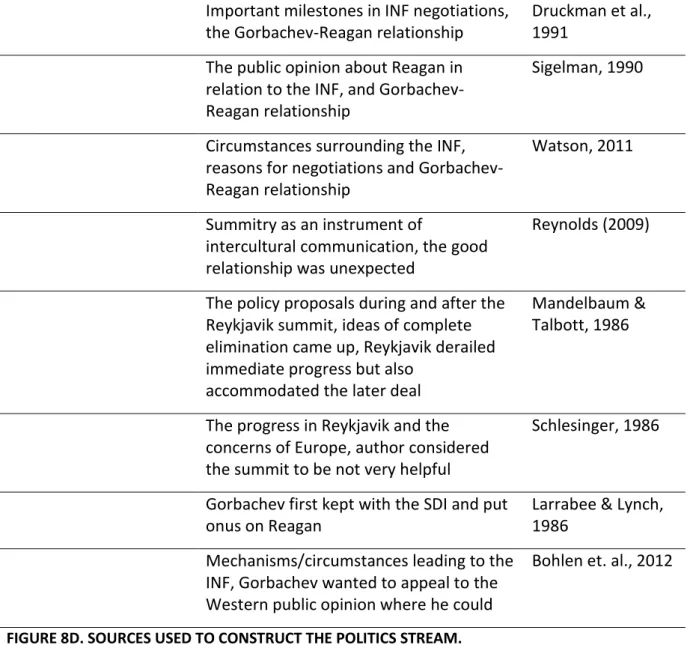
Sources used to construct the three streams (see appendix) Pages
The problem stream: antecedent conditions pp. 87-88
The problem stream: the nuclear crisis pp. 89-90
The policy stream pp. 91-92
The politics stream pp. 93-95
FIGURE 3A. SOURCES USED TO CONSTRUCT THE STREAMS (SEE APPENDIX).
I am aware, however, that primary documents all contain a certain amount of bias. Even the
declassification of certain memoir, while keeping another classified, is in essence a political
activity. The documents inherently reflect the view of the person who produced them,
because the actor produced and released the documents in a certain cultural, political and
cultural setting. This particularly holds true for newspaper articles, which are written by
journalists that are not directly involved in the policy making process. Despite these
1
I have accessed this content through their respective YouTube channels
2
The database can be accessed through https://search-proquest-com
27
disadvantages, I still believe that such documents best allow me to reconstruct the course of
events in an interpretivist, bottom up manner. The historical documents provide me with the
closest and most pure look at the phenomenon. They are traces of history that are often
relatively free of analysis by others, because the outcome was unknown.
In the next subsections, I will further touch upon the operationalization of the
problem, policy and politics stream.
The operationalization of the problem stream
Especially when it comes to the operationalization of the problem stream, important
methodological choices have to be made. Kingdon's (2014) model leaves room for
interpretation and specification, which forces me to clearly set the boundaries of the
problem stream. This is not an easy task, as in international relations, antecedent conditions
largely shape the relationship between countries. The antecedent conditions that shaped
the relationship between Russia and the US could be traced back as far as the researcher
wants, even decades before the treaty was signed. Metaphorically, it comes down to
whether investigators include a traumatic incident during the youth of a murderer in the
dossier about his assault. To what extent are these events (causally) related? Is this
traumatic event still an issue when the murder is committed twenty years later? The chances
are high that different experts will not agree on this question, and the same applies to my
research.
Therefore, I will divide the problem stream in two distinct sections. In the first
section, I will define the antecedent 'problem' conditions that largely shaped the relationship
between the Soviet Union and the United States from 1977 onwards (from the moment
when the focusing-event took place) and the domestic conditions that proved favorable to
the INF-agreement. Though such antecedent conditions are hard to directly and causally link
to the specific outcome, and happened before as well as during the INF-negotiations, they
were largely responsible for creating the atmosphere in which the actors operated. In that
sense, the antecedent conditions float around in the problem stream, even though it is hard
to factually define its practical impact. In the second section, I will identify the specific
factors that led to the deteriorated nuclear situation between the two superpowers.
28
concrete basis of the agreement that was made years later. The impact of this 'problem' was
felt throughout the entire negotiations and the problem continued to exist over time.
Though I thus decided to divide the problem stream in two separate sections, they have one
common denominator: they both appeared during the Cold War crisis and greatly influenced
the relationship between the US and the Soviet Union. They both contributed to the public
climate in which the policy and the politics stream had to manifest itself.
The operationalization of the policy stream
In the policy stream, I will focus on how the epistemic communities have influenced and
initiated policy proposals. This operationalization, combined with interpretivist
process-tracing, allows to see the path towards the final proposal and indicates how the
environment gradually became 'softened up' to seriously consider the full elimination of
INF's. It simply took time before new ideas were considered. The susceptibility of the
decision-makers to certain ideas while neglecting others, are important elements in policy
change and those will be addressed in the policy stream. This section therefore follows a
discursive institutionalist approach, meaning that it takes the power of ideas seriously, even
though ideas can often not be classified in predefined categories or overt structures
(Schmidt, 2008). I will identify two distinct epistemic communities that had a great influence
on the policy outcome, which were the transnational communities that influenced
Gorbachev and the epistemic communities of diplomats that conducted and steered the
multilevel negotiations. This policy section will be concluded with a process-tracing figure to
illustrate these dynamics within the policy stream (see p.49).
The operationalization of the politics stream
The politics stream will focus on the political factors that brought about the INF treaty. As
the Soviet Union and the US were both dealing with different political circumstances at the
time, the mechanism of summitry was indispensable to link these preferences together and
to open up the space for dialogue. Without the existence of the summits, such political
momentum could not have been created. The politics stream will also follow this sequence,
so going from domestic to international concerns. It will first indicate Gorbachev's and
Reagan's separate motivations to engage in the negotiations, and the national mood
29
relax the tensions while they also made the path towards an agreement more concrete. The
section on the politics stream will be concluded with a process-tracing figure to illustrate
30
IV. The Analysis
In the analysis, I will apply John Kingdon's (2014) Multiple Stream's framework to the
establishment of the INF treaty. With the help of interpretivist process-tracing, I will identify
all the factors that were relevant to the establishment of the treaty and allocate them to the
three separate streams. It will become clear that Kingdon's model is very useful to explain
international policy change, even though some issues might show up in more than one of
the streams. This is due to the fact that some events are interrelated and have various
(multi-level) effects. As mentioned before, I have used both primary and secondary sources
to construct this analysis. The sources I used for each stream can be found in the appendix
(p.87). The problem stream will be addressed first, then the policy stream and lastly the
politics stream.
The problem stream: the antecedent conditions
In order to fully grasp the circumstances in which the INF-deal was made, it is inevitable to
sketch the international context (and its forthcoming crises) before and during these
negotiations took place. As mentioned in the former section, I call those antecedent
conditions. I will argue that one international bilateral crisis and two domestic crises
indirectly set the stage for the INF treaty. These are: the Soviet invasion in Afghanistan in
1979 (together with its idea of modernization and the other communist-capitalist proxy
wars), the economic crisis in the Soviet Union and the Iran-Contra affair in the United States
(see the table below). I will also touch upon the latter two in the politics stream, as they
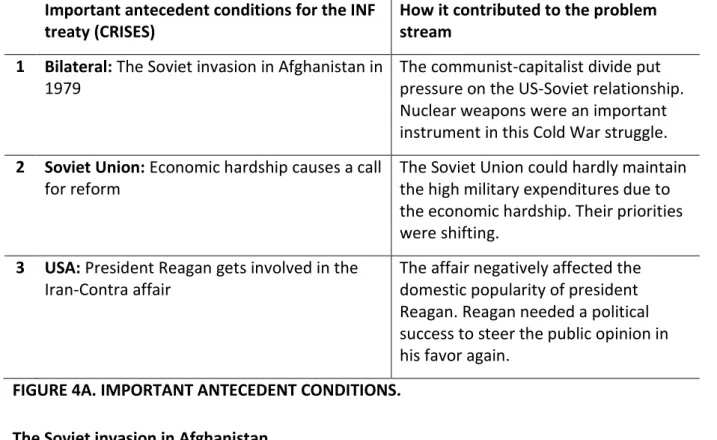
31 Important antecedent conditions for the INF
treaty (CRISES)
How it contributed to the problem stream
1 Bilateral: The Soviet invasion in Afghanistan in 1979
The communist-capitalist divide put pressure on the US-Soviet relationship. Nuclear weapons were an important instrument in this Cold War struggle.
2 Soviet Union: Economic hardship causes a call for reform
The Soviet Union could hardly maintain the high military expenditures due to the economic hardship. Their priorities were shifting.
3 USA: President Reagan gets involved in the Iran-Contra affair
The affair negatively affected the domestic popularity of president Reagan. Reagan needed a political success to steer the public opinion in his favor again.
FIGURE 4A. IMPORTANT ANTECEDENT CONDITIONS.
The Soviet invasion in Afghanistan
The Soviet invasion in Afghanistan caused the American-Soviet relations to deteriorate, after
a relatively calm period of detente in the early 1970s. In Afghanistan, both superpowers
wanted to expand their spheres of influence. The Soviet Union hoped to spread communism
through the central-Asian country, whereas the Americans were keen to teach the Afghans
their values of capitalism and freedom (Kalinovsky, 2010). While this war is generally well
known, the proxy war actually followed up on an economic Soviet-American 'modernization'
battle in Afghanistan that already manifested itself during the 1950s and the 1960s. In
essence, the Soviets and the Americans agreed on the two underlying principles of
modernization. First, they both believed that modernization would elevate the country from
a traditional society to a modern one. Such a development was necessary to sparkle
economic development across the world. Second, they believed that, tough countries moved
at different paces, they would all end up at the same destination of ultimate modernization
(Latham, 2011). These assumptions were based on an idea by Karl Marx, who wrote in 'Das
Kapital' in 1867 that: 'A country that is more developed industrially only shows, to the less
developed, the image of its own future' (p.7). However, as stated before, the two powers
wanted to achieve their goals through different means and values, based on communist or
capitalist ideals. For the Americans, the Afghan acceptance of their offers was perceived as