FAILURE AND INTERPERSONAL LOSS EVENTS IN THE LONGITUDINAL PREDICTION OF SUICIDAL IDEATION AND BEHAVIOR IN ADOLESCENT GIRLS: AN EXAMINATION OF
POTENTIAL MODERATORS
Michelle Lee Gallagher
A dissertation submitted to the faculty at the University of North Carolina at Chapel Hill in partial fulfillment of the requirements for the degree of Doctor of Philosophy in the
Department of Psychology and Neuroscience (Clinical Psychology).
Chapel Hill 2018
© 2018
ABSTRACT
Michelle Lee Gallagher: Failure and Interpersonal Loss Events in the Longitudinal Prediction of Suicidal Ideation and Behavior in
Adolescent Girls: An Examination of Potential Moderators (Under the direction of Mitchell J. Prinstein)
Suicidal thoughts and behaviors in children and adolescents are a serious public health concern. There is substantial support for the role of negative life events in the
emergence of teen suicidality. Two types of events, failure and interpersonal loss, have been shown to increase risk for suicidality in youth. This study examined failure and
interpersonal loss events as predictors of suicidal thoughts and behaviors over time. The sample comprised 134 clinically-referred adolescent girls (ages 12-17). Failure and
interpersonal loss event data was coded using a semi-structured interview that captured the presence of these events over a 9-month time period. Each event was coded for subjective and objective stress as well as the overestimation of stress. This study also examined moderators of the link between failure and interpersonal loss event stress and suicidality. For failure events, stress overestimation predicted both suicidal thoughts and behaviors over time. Negative urgency (impulsive behaviors in response to strong negative emotions) attenuated risk associated with failure event stress overestimation. For interpersonal loss events, subjectively rated and objectively rated stress predicted suicidal thoughts (but not behaviors) over time. Positive friendship quality attenuated and negative friendship quality exacerbated the link between interpersonal loss event stress overestimation and suicidal thoughts (but not behaviors). These results support the use of suicide prevention and intervention programs that not only address underlying psychopathology but also focus on skills-building to enhance teens’ strengths, competencies, and protective resources.
TABLE OF CONTENTS
LIST OF TABLES………...…….………...v
LIST OF FIGURES………vi
LIST OF ABBREVIATIONS AND SYMBOLS……….……….vii
INTRODUCTION……….………1
Failure as a Risk Factor for Suicidal Thoughts and Behaviors in Youth………3
Interpersonal Loss as a Risk Factor for Suicidal Thoughts and Behaviors in Youth……….……….…6
Need for Research Examining Moderators of Adolescent Suicide Risk………....…8
Moderators of the Link between Failure Events and Youth Suicidality………...10
Moderators of the Link between Interpersonal Loss Events and Youth Suicidality….………...………...…….…...12
Present Study………...……….………..14
METHODS………...18
Participants………...………...………...18
Procedure……….19
Measures………...………...21
DATA ANALYTIC PLAN………...………...29
RESULTS………...………..32
Descriptive Analyses………....32
Failure Event Stress Results………...……33
Interpersonal Loss Event Stress Results……….……....35
DISCUSSION………...……39
TABLES……….……...51
FIGURES……….………….60
LIST OF TABLES
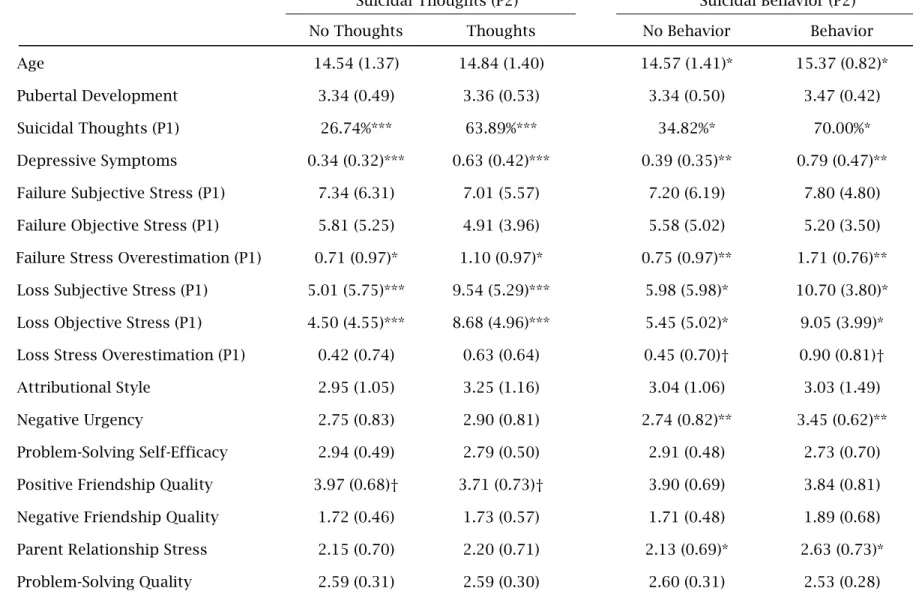
Table 1 - Differences in study variables comparing participants with and without suicidal thoughts and with and without suicidal behavior
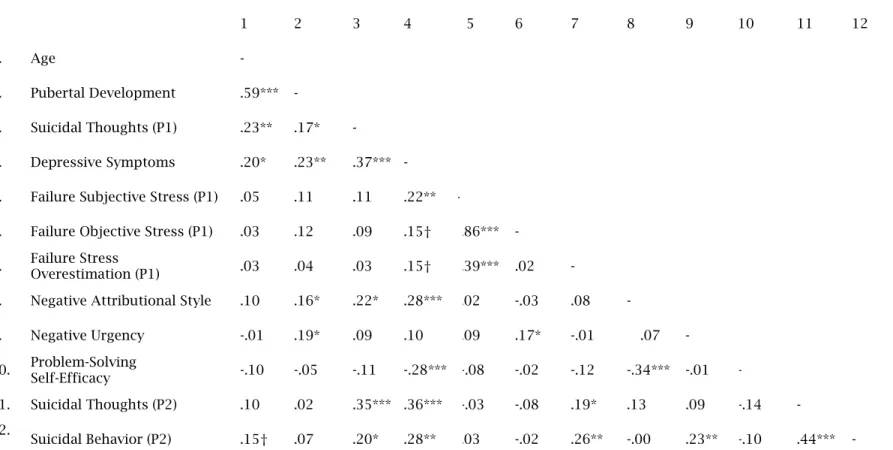
occurring during Period 2……….…..51 Table 2 - Bivariate associations among study variables in failure event analyses..………...…...52 Table 3 - Bivariate associations among study variables in interpersonal
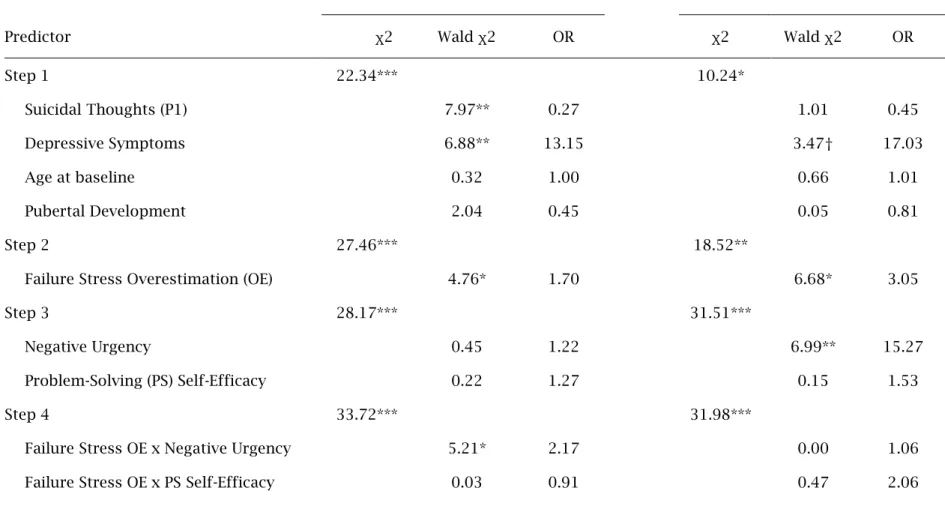
loss event analyses…………...53 Table 4 - Hierarchical logistic regression predicting suicidal thoughts (P2)
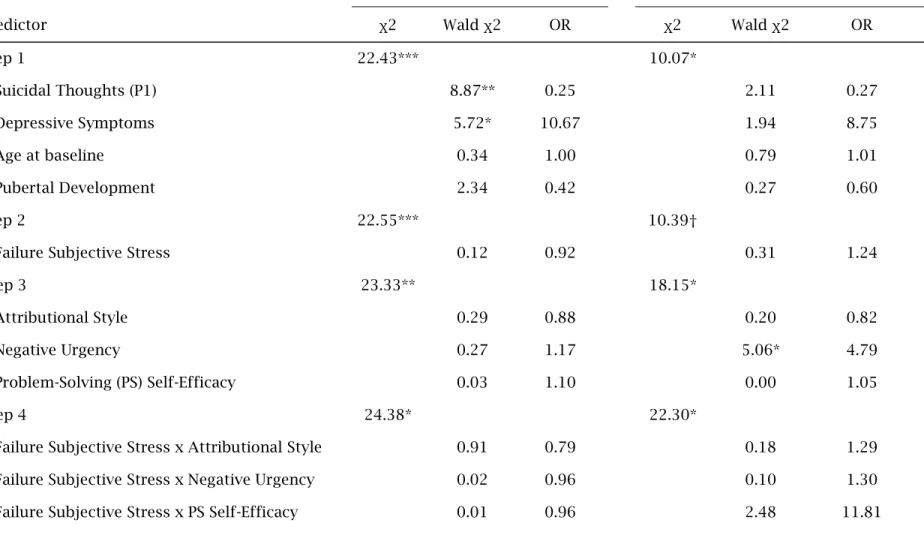
and behavior (P2) from failure event subjective stress………...………..….54 Table 5 - Hierarchical logistic regression predicting suicidal thoughts (P2)
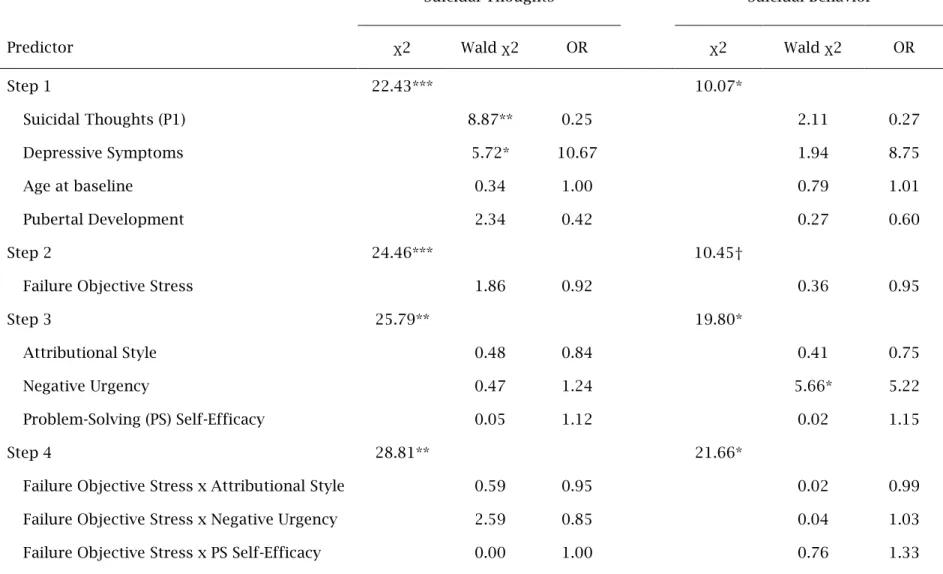
and behavior (P2) from failure event objective stress…...55 Table 6 - Hierarchical logistic regression predicting suicidal thoughts (P2)
and behavior (P2) from failure event stress overestimation……...56 Table 7 - Hierarchical logistic regression predicting suicidal thoughts (P2)
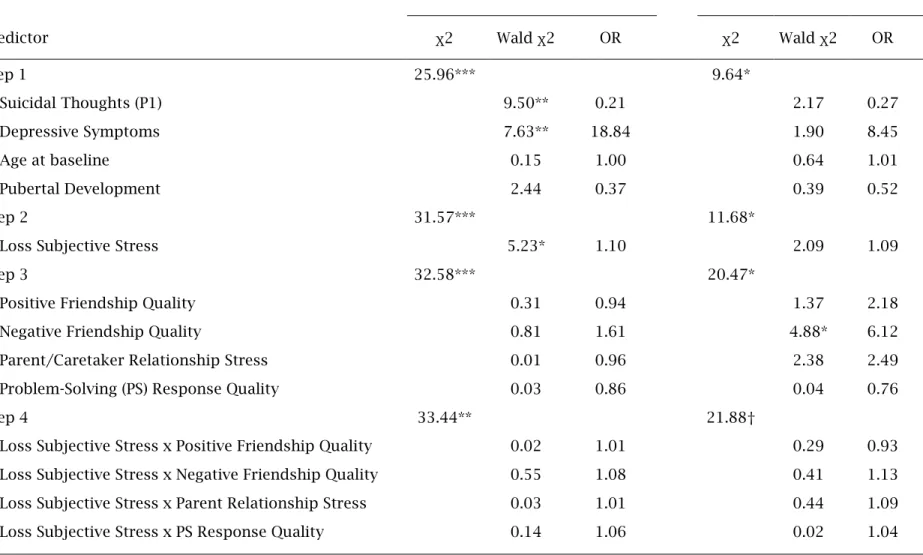
and behavior (P2) from interpersonal loss event subjective stress...57 Table 8 - Hierarchical logistic regression predicting suicidal thoughts (P2)
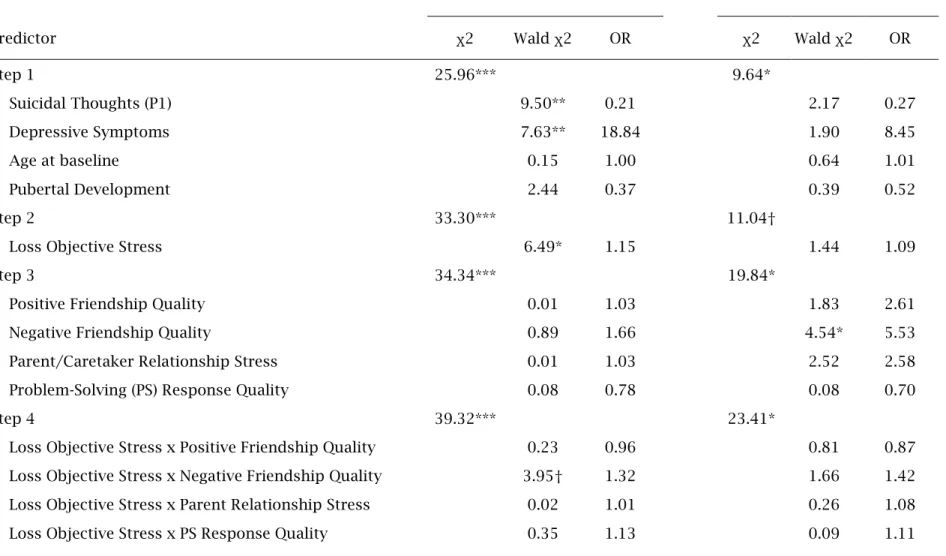
and behavior (P2) from interpersonal loss event objective stress………...58 Table 9 - Hierarchical logistic regression predicting suicidal thoughts (P2)
LIST OF FIGURES
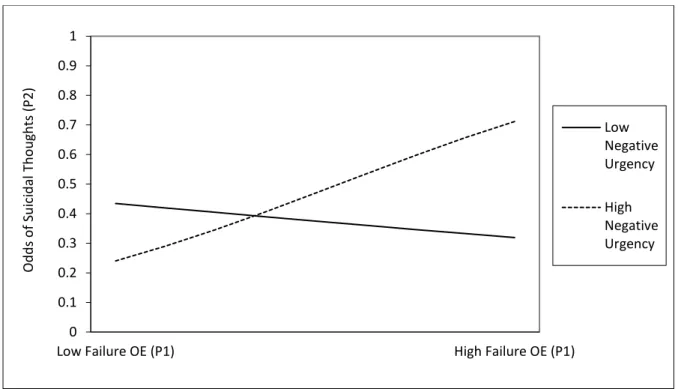
Figure 1 - Interaction between failure event stress overestimation (during the P1 epoch) and negative urgency predicting the odds of suicidal
thoughts during the P2 epoch.……..………...60 Figure 2 - Interaction between interpersonal loss event stress overestimation
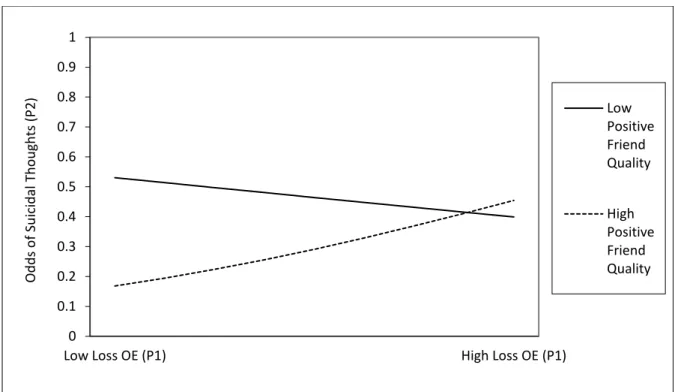
(during the P1 epoch) and positive friendship quality predicting the
odds of suicidal thoughts during the P2 epoch………..…..61 Figure 3 - Interaction between interpersonal loss event stress overestimation
(during the P1 epoch) and negative friendship quality predicting the odds
LIST OF ABBREVIATIONS AND SYMBOLS ACT Acceptance and Commitment Therapy
∝ Alpha
ARQ Adolescent Resilience Questionnaire
b
BetaCBT Cognitive-Behavioral Therapy
χ2 Chi-square
CCSQ Child Chronic Strain Questionnaire Cohen’s ĸ Cohen’s kappa
DBT Dialectical Behavioral Therapy IPT Interpersonal-Psychological Theory
M
MeanMFQ Mood and Feelings Questionnaire n Number of participants
NRI Network of Relationships Inventory
OR Odds ratio
p
P value for statistical significance PDS Pubertal Development ScaleP1 Period 1 time period from baseline visit to the 9-month follow-up
P2 Period 2 time period from the 9-month follow-up to the 18-month follow-up
SD
Standard deviationSITBI Self-Injurious Thoughts and Behavior Interview SPST Social Problem-Solving Task
INTRODUCTION
Suicidal thoughts and behaviors represent a serious public health concern, with over 41,000 deaths by suicide in the U.S. in 2013 (CDC, 2013a). Although suicidality occurs in all age groups, it is developmentally mediated, with rates increasing dramatically in
adolescence. Suicidal ideation, plans, attempts, and completed suicide are extremely rare among prepubescent children, with rates sharply increasing after approximately age 12 (CDC, 2013a; Kessler, Borges & Walters, 1999). Research has estimated the lifetime prevalence of suicidal ideation in adolescents to be 29.9%, with a lifetime prevalence of suicide attempts of 9.7% (Evans, Hawton, Rodham, & Deeks, 2005). Meanwhile, the Youth Risk Behavior Surveillance System, a nationally representative survey of U.S. high-school students, reported that around 17.0% of students had seriously considered suicide in the prior year, 13.6% had made a specific suicide plan, 8.0% had made a suicide attempt, and 2.7% had made a suicide attempt serious enough to require medical attention (CDC, 2013b). Rates of completed suicide likewise rise from 1.0 per 100,000 among 5- to 14-year-olds to 11.1 per 100,000 among 15- to 24-year-olds, making suicide the third leading cause of death for 15- to 24-year-olds (CDC, 2013a). Within this age group, suicidal thoughts and behaviors are particularly prevalent among females, with teenage girls showing higher rates of suicidal ideation, planning, and attempts (CDC, 2013b).
of suicidality in teens, either as distal risk factors (e.g., Beautrais, 2000; Wagner, 1997), proximal risk factors (e.g., Brent, 1995; Sandin, Chorot, Santed, Valiente, & Joiner, 1998), or immediate precipitants of suicidal behavior (e.g., Brent et al., 1993; Mathew & Nanoo, 2013). Several discrete types of stressful life events are especially associated with suicidality in teens, including prior physical or sexual abuse (e.g., Eisenberg, Ackard, & Resnick, 2007; Fergusson, Beautrais, & Horwood, 2003), peer victimization (e.g., Geoffroy et al., 2016; Klomek, Marrocco, Kleinman, Schonfeld, & Gould, 2008), and exposure to recent suicide attempts or completed suicide (e.g., Cerel, Roberts, & Nilsen, 2005; Insel & Gould, 2008).
Although there is substantial research on the relationship between negative life events and suicidality in teens, the existing research is limited in several ways. First, the research in this area is largely cross-sectional, examining concurrent associations between suicidality and events that have been retrospectively reported to have occurred prior to the suicidal outcomes (i.e., events occurring immediately prior to an attempt or within six months or a year prior to suicidal outcomes), preventing the establishment of a causal relationship between life events and suicidality. Second, the research often has relied on life events questionnaires or checklists (e.g., Life Events Checklist; Johnson & McCutcheon, 1980) to obtain information about adolescents’ experience of negative life events. Life event checklists and questionnaires have several drawbacks: (1) they contain a finite selection of events, potentially excluding events critical to any given adolescent’s experience; (2) they do not adequately distinguish between ongoing chronic and episodic stress; and (3) the method for evaluating event impact/stress either considers each event to carry the same weight (i.e., a total score obtained by counting the number of discrete life events) or is unduly
physical/sexual abuse). There is less research in this area examining categories of events that may be theoretically meaningful within the framework of adolescent suicide risk.
The present study addresses some of these key limitations in the literature on negative life events and adolescent suicidality. First, the current study looks at two theoretically meaningful categories of negative life events – experiences of failure and interpersonal loss – to evaluate their impact on suicide risk among adolescent girls. Second, the study uses a semi-structured interview (Youth Life Stress Interview; Rudolph & Flynn, 2007) to obtain information about adolescents’ experience of stressful life events over a 9 -month period, using trained interviewers to facilitate more accurate retrospective recall and an established coding system to obtain both objectively coded ratings of the stress of each event as well as the self-reported subjective stress of the event. And third, the study uses a longitudinal design, examining whether objectively coded failure and interpersonal loss events occurring over an initial 9-month period predict adolescent suicidal outcomes as measured over a subsequent 9-month follow-up period (together comprising 18 months from baseline to the end of the study). Finally, in order to develop a more complex model of risk and resilience, this study will examine several potential moderators of the relationship between failure and interpersonal loss events and suicidal thoughts and behavior.
Failure as a Risk Factor for Suicidal Thoughts and Behaviors in Youth
2005), and dropping out of school (Fergusson & Lynskey, 1995) all have been linked to suicidal outcomes in teens.
Although experiences of academic underperformance are perhaps the most salient and robustly researched phenomena associated with failure in youth, studies have
examined other types of events that could represent personal failure or disappointment. For instance, studies have shown that a range of behavioral and legal issues are implicated in the emergence of suicidal thoughts and behavior, including school truancy (Fergusson, Woodward, & Horwood, 2000), school suspensions or other disciplinary problems (Brent et al., 1993; Thompson et al., 2005), arrests or police contact (Fordwood, Asarnow, Huizar, & Reise, 2007), being a juvenile offender (Fergusson & Lynskey, 1995; Moskowitz, Stein & Lightfoot, 2013), and having other types of legal problems (Brent et al., 1993; Hoberman & Garfinkel, 1988). Similarly, research has shown that youth who experience work-related problems are at higher risk for suicidal thoughts and behavior. Consistent with research in adult samples, studies in youth point to a role for stressful occupational events such as difficulties at work (Beautrais, Joyce, & Mulder, 1997; Hoberman & Garfinkel, 1988), being fired from a job (Fordwood et al., 2007), and experiencing recent financial problems (De Luca et al., 2014; Kienhorst, de Wilde, Diekstra, & Wolters, 1992).
The association between youth suicidality and failure-related events can be understood through the lens of existing suicide theory. In particular, the experience of failure is a central feature of Baumeister’s (1990) Escape Theory of suicidality. Baumeister proposed a theoretical model involving six stages in the causal chain toward the
development of suicidal thoughts and behaviors. Consistent with the research on failure-related events, the initial stage in the model involves an event that falls severely short of expectations or standards (as set by oneself, others, or precedent), either because the standards are too high or because the event is sufficiently negative (i.e., a major
Baumeister’s model, an individual then experiences negative emotions and affect (e.g., guilt, anxiety, depressed mood) and cognitive deconstruction (e.g., cognitive constriction, rigidity, and a focus on the immediate moment). The sixth stage proposes that this cognitive and emotional state increases accessibility to suicidal thoughts and behavior through
irrationality, dissociation, and disinhibition (Baumeister, 1990). What is important to note about Baumeister’s Escape Theory is that an individual’s orientation toward suicide is not a desire for death, but a desire to escape aversive self-awareness and the resulting negative mood and cognitive chaos.
Although a less contemporary model of suicidal thoughts and behaviors,
Baumeister’s Escape Theory has drawn recent attention from researchers aiming to test its primary components. Using an experimental paradigm, Tang and colleagues (2013) found that priming college students with a personally relevant failure scenario led to increased accessibility of implicit suicidal thoughts (as measured on a death/suicide Implicit Association Test) compared with a control condition (Tang, Wu, & Miao, 2013). A second experimental study found that individuals who are made aware that they have failed to attain a culturally or socially important standard (i.e., poverty, unemployment) experienced increased accessibility of implicit suicidal thoughts (as measured on a word completion task). The authors also found that the relationship between failure priming and implicit suicidal thoughts was heightened under conditions of high self-awareness and high escape motivation, consistent with Baumeister’s model (Chatard & Selimbegovic, 2011). In addition to experimental evidence, nearly all elements of Baumeister’s model have been supported by the literature on youth suicidality, with research suggesting links between adolescent suicidality and perfectionistic standards (e.g., Hewitt, Caelian, Chen, & Flett, 2014), internal attributional style (e.g., Speckens & Hawton, 2005), self-criticism (e.g., Enns, Cox, &
Inayatulla, 2003), negative mood (e.g., Cash & Bridge, 2009), cognitive constriction and rigidity (e.g., Leenaars, de Wilde, Wenckstern, & Kral, 2001; Orbach et al., 2007), dissociation (e.g., Levinger, Somer, & Holden, 2015; Orbach, Lotem-Peleg, & Kedem, 1995), and
evidence and theoretical support, the present study continues this promising line of research by examining whether failure-related event stress increases risk for adolescent suicidality over time.
Interpersonal Loss as a Risk Factor for Suicidal Thoughts and Behaviors in Youth
One of the more consistent findings in the literature is that negative interpersonal life events play a prominent role in youth suicidality. Adolescence is a unique transitional period in which teenagers have a dual social focus, still reliant on the support and
connection of parents and family even as their attention shifts to friend, peer, and romantic relationships. Much of the research in this area has focused on the presence or quality of these interpersonal bonds. In the realm of parental relationships, research has shown that a variety of factors are related to youth suicidality, including parental psychopathology, parent-child conflict, harsh parental discipline, low parental responsiveness and support, poor parent-child relationship quality and attachment, and marital dysfunction (Gould et al., 2003; Wagner, 1997). Certain aspects of the overall family environment also can increase risk for suicidality in teens, including poor family communication, dysfunctional family environment, low family cohesion and support, and family life stressors (for a review, see King & Merchant, 2008; Wagner, 1997). Similarly, peer-related risk factors include social isolation, interpersonal difficulty, peer rejection, peer victimization, low social competence, difficulty making friends, lack of close friends, romantic break-ups, and deviant peer group affiliation (Kienhorst et al., 1992; King & Merchant, 2008). Taken as a whole, the evidence suggests that interpersonal life stressors play a significant role in the development of suicidal thoughts and behaviors in teens. Moreover, given that social relationships are especially salient for teenage girls (Rose & Rudolph, 2006), interpersonal stressors may be a particularly potent risk factor for suicidality in this group.
Interpersonal loss is a subtype of interpersonal stress that may be relevant to youth suicidality. Studies that have focused on the overall construct of interpersonal loss –
Overholser, & Spirito, 1994; Brent et al., 1993; Morano, Cisler, & Lemerond, 1993;
Rubenstein, Halton, Kasten, Rubin, & Stechler, 1998). Research on more specific examples of interpersonal loss suggests an even stronger connection. There is substantial support for the link between youth suicidality and the death or suicide of a parent or family member (e.g., Brent, Melham, Donohoe, & Walker, 2009; Cohen-Sandler, Berman, & King, 1982), parental separation or divorce (e.g., Park, Schepp, Jang, & Koo, 2006), and other events resulting in separation from parents, such as foster placement or parental incarceration or relocation (e.g., Beautrais, Joyce, & Mulder, 1996; Cohen-Sandler et al., 1982; Kumar & Steer, 1995). Similarly, studies have shown that adolescent suicidality is linked to events such as the loss of a sibling (de Wilde & Kienhorst, 1994), romantic break-ups (e.g., Brent et al., 1993; Fordwood et al., 2007), the ending of a friendship (e.g., Donald, Correa-Velez, & Jones, 2006), and events that could involve the loss of peer relationships, such as moving to a new neighborhood or school (Adams et al., 1994; Fergusson & Lynskey, 1995).
The relationship between interpersonal loss and suicidality also is supported by contemporary theories of suicide. In particular, Joiner’s Interpersonal-Psychological Theory (IPT; Joiner, 2005) proposes three constructs that contribute to suicidality. Two of these constructs,
thwarted belongingness
andperceived burdensomeness
, contribute to an individual’s desire for death by suicide. Meanwhile, a third component (acquired capability
) suggests that an individual acquires a capacity for lethal self-harm by accumulating risky, dangerous life experiences; this component is linked to suicidal behavior (Anestis & Joiner, 2011). The aspect of this model that is most related to interpersonal loss is thwarted belongingness, a construct thought to involve two distinct facets: the experience ofrelationship between interpersonal loss and thwarted belongingness, showing that low belongingness both mediates and moderates the link between parental loss events (i.e., death, divorce) and suicide attempts in adolescents (Timmons, Selby, Lewinsohn, & Joiner, 2011). Given the strong research and theoretical support, the present study explores the longitudinal relationship between interpersonal loss event stress and suicidality in teens. Need for Research Examining Moderators of Adolescent Suicide Risk
Given the theoretical and research support for failure and interpersonal loss events, the present study examines each of these subtypes of negative life events independently as risk factors for suicidal ideation and behavior over time. However, it should be noted that the suicide literature generally has focused on the identification of risk or protective factors in isolation, with less attention to examining more complex models of how these variables interact to increase or decrease the risk of a suicide outcome. The need for research examining this interaction model is twofold. First, examining potential moderators allows researchers to identify subgroups of adolescents for whom a given risk factor may be more potent due to an individual characteristic (e.g., impulsivity) or environmental variable (e.g., dysfunctional family). A concern within the literature on life events and suicidality is the fact that many life events are inconsistently linked to suicidal outcomes, with some studies showing clear effects and others null findings. Identifying moderators that exacerbate adolescent suicide risk allows insight into these discrepancies, providing a more nuanced understanding of why certain adolescents are more vulnerable to the effects of negative life stress due to their unique emotional, personality, or cognitive traits or their unique cultural, community, family, or social context. The present study examines several potential
moderators known to exacerbate suicide risk in teens: attributional style, negative urgency, negative friendship quality, and parent/caretaker-child stress.
In addition, research on potential moderators allows for the identification of variables that promote resilience to suicide outcomes (e.g., parental support). One
increases an individual’s risk for a negative outcome like suicidality; and (2) protective factors, such as self-esteem, that buffer or protect the high-risk individual against those negative outcomes (Luthar, Cicchetti, & Becker, 2000). This conceptualization suggests that resilience results from the interaction of risk and protective factors, such that protective factors buffer against suicide risk. Although early conceptualizations of resilience focused solely on the buffering effect of individual traits such as hardiness or persistence (Wright, Masten, & Narayan, 2013), recent theories on resilience to youth suicide have taken a broader approach rooted in Bronfenbrenner’s (1977) ecological view on human
development, in which the interaction between a child and his or her changing contexts is taken into account. These theories suggest that resilience to suicide in adolescents occurs across multiple domains, including the child(e.g., self-esteem), the immediate family, peer, and school context (e.g., friendship quality, academic achievement), and the larger
By examining potential moderators of the link between youth suicidality and failure and interpersonal loss events, the present study expands the literature on this topic. To date, research examining moderators of suicide risk in teens has been almost completely cross-sectional (with only two studies looking at moderation over time) and has examined a very narrow range of risk factors, primarily depressive symptoms, physical or sexual abuse, peer victimization, and sexual orientation. In fact, only three studies have focused on negative life events other than peer victimization or physical or sexual abuse. In one of these studies, problem-solving ability buffered the impact of chronic and episodic life stress on suicidality (Grover, Green, Pettit, Monteith, Garza, & Venta, 2009), although a second study found that social problem-solving ability did not moderate the impact of total life stress (Chang, 2002). Meanwhile, a third study showed that the broad construct of
“resilience” buffered against suicide risk related to violent life events (Nrugham, Holen, & Sund, 2010). It should be noted, however, that all of these studies focused on a measure of total negative life events. Thus, the present study extends the literature by using a
longitudinal design, by moving beyond the narrow range of risk factors that have been used in this research, and by examining the suicide risk related to theoretically meaningful categories of negative life events (i.e., failure and interpersonal loss events).
Moderators of the Link between Failure Events and Youth Suicidality
Baumeister’s Escape Theory of suicide provides an indication of which moderators may be particularly relevant for the relationship between failure events and suicidality. The model proposes that one key step in the causal chain toward suicidal thoughts and
behaviors is that an individual makes an internal attribution about the failure event, leading to feelings of aversive self-awareness as well as negative affect and disinhibition
(Baumeister, 1990). Therefore, two potential moderators of failure-related events are attributional style and negative urgency (a dimension of impulsivity). Originally conceptualized with respect to depression, an attributional style in which causal
explanation to events beyond the specific event that occurred) consistently has been linked to depressive symptoms (Gladstone & Kaslow, 1995; Jacobs, Reinecke, Gollan, & Kane, 2008). Similarly, a negative attributional style also has been linked to suicidality in teens (Labelle, Breton, Pouliot, Dufresne, & Berthiaume, 2013; Rotheram-Borus, Trautman,
Dopkins, & Shrout, 1990). Although no research to date has looked at attributional style as a moderator of negative life events, there is research to suggest that a maladaptive cognitive style exacerbates the impact of stressors such as peer victimization and parent expressed emotion on suicidality in teens (Wedig & Nock, 2007; Wolff et al., 2014).
A second moderator suggested by the Baumeister model is negative urgency. According to Baumeister, the aversive self-awareness experienced by individuals leads to a combination of negative mood and disinhibition. Supporting the role of disinhibition, research has shown that impulsivity is associated with suicidal thoughts and behaviors in teens (e.g., Horesh, Gothelf, Ofek, Weizman, & Apter, 1999; Javdani et al., 2011). However, impulsivity is a multi-dimensional trait, with facets such as failure to consider the
Another possible moderator of the relationship between failure-related events and youth suicidality is problem-solving ability. Baumeister’s theory suggests that the desire for suicide is an attempt to escape aversive self-awareness rather than a conscious desire for death. Thus, an individual’s ability to flexibly generate a variety of solutions to failure-related events (i.e., other ways to address the problem or its associated negative emotions) may represent a pathway through which suicide risk can be attenuated. In fact, a study of adolescent suicide attempters found that 68% of the teens viewed the attempt as a way to solve a problem, with 38% reporting that they were unable to generate an alternate solution (McLaughlin, Miller, & Warwick, 1996). In general, problem-solving deficits have been shown to be associated with suicidal outcomes in youth (see Speckens & Hawton, 2005, for a review), with studies finding that adolescents with a history of suicidality come up with fewer, less effective, and more maladaptive solutions to interpersonal problems (Hawton, Kingsbury, Steinhardt, James, & Fagg, 1999; Rotheram-Borus, et al., 1990; Sadowski & Kelley, 1993) and feel less efficacious in their ability to implement a solution (McLaughlin et al., 1996). Research also suggests that problem-solving attenuates the impact of chronic life stress, episodic life stress, and prior physical abuse on suicide outcomes (Grover et al., 2009; Kwok, Yeung, Low, Lo, & Tam, 2015), and that problem-solving confidence buffers the suicide-related risk associated with prior abuse (Esposito & Clum, 2002). The problem-solving construct most implicated by Baumeister’s theory is perceived self-efficacy in problem-solving due to the theory’s focus on risk stemming from negative self-evaluation. Thus, the present study focuses on perceived self-efficacy in problem-solving as a
moderator of the link between failure events and suicidal outcomes in teens. Moderators of the Link between Interpersonal Loss Events and Youth Suicidality
Research and theory also suggest potential moderators for the relationship between interpersonal loss events and suicidality in teens. As is the case with failure events,
particularly prominent role in youth suicidality (see Speckens & Hawton, 2005). The ability to generate an effective solution or coping strategy when confronted by loss situations such as the ending of a friendship may allow an adolescent to better cope with the loss or
manage its consequences. Therefore, the present study examines an aspect of problem-solving related to the quality of an adolescent’s chosen solution to a problem as a potential moderator of the relationship between interpersonal loss and suicide outcomes. Theory also suggests two other possible moderators. Within the framework of Joiner’s IPT model,
interpersonal loss events are most associated with the construct of thwarted belongingness, a multi-faceted construct that encompasses experiences of low social support and low relationship quality (Van Orden et al., 2010). Therefore, it may be the case that the presence of social support and caring relationships would moderate the effects of interpersonal loss on adolescent suicide risk. The present study examines this hypothesis by looking at close friend relationship quality and parent/caretaker-child relationship stress as moderators of the link between interpersonal loss and suicidality in teens.
In addition to having theoretical support as a potential moderator, friendship quality also has been shown to reduce suicide risk in teens. Research has found that peer
acceptance and support, peer connectedness, having a closely interconnected friend group, and having a dense friendship network all reduce risk for suicidality in teens (Bearman & Moody, 2004; Breton et al., 2015; King & Merchant, 2008; Rew, Thomas, Horner, Resnick, & Beuhring, 2001). Meanwhile, peer rejection and victimization, social isolation from peers, difficulty making friends, peer conflict, friendship problems, lack of close friends, and poor friendship quality increase adolescents’ risk for suicidality (Johnson et al., 2008; King & Merchant, 2008). Friend and peer characteristics also can moderate the impact of life stress on suicidality. Studies show that overall social support satisfaction buffers the impact of physical/sexual abuse and child psychopathology on suicide outcomes (Esposito & Clum, 2002; 2003), peer support attenuates the effect of eating disorder and depressive symptoms on suicidality (Brausch & Decker, 2014; Matlin, Molock, & Tebes, 2011), and peer
2011). Given these findings, the present study examines close friend relationship quality (both positive and negative aspects) as a moderator of the link between interpersonal loss events and suicidality in teens.
Similarly, the literature supports the role of the parent-child relationship in increasing or decreasing suicide risk in teens. Studies have shown that the presence of parent-child conflict, low parental monitoring, more negative parent-child interactions, and harsh parental discipline all increase risk for suicidal outcomes in teens (King & Merchant, 2008). Similarly, parent-child connectedness and support, parental presence and
expectations, parent-child attachment, and parent-child shared activities reduce risk for suicidal outcomes (Borowsky, Ireland, & Resnick, 2001; Duke & Borowsky, 2009; King & Merchant, 2008). Facets of the parent-child relationship also have been found to moderate the impact of negative life events and stressors on suicide risk in adolescents. Research has shown that parent conflict heightened the impact of hopelessness on suicidality in teens (Kwok & Shek, 2008), parental rejection exacerbated the effect of peer victimization on adolescent suicide outcomes (Herba et al., 2008), parental support buffered the impact of depressive symptoms and prior sexual abuse on suicidality in teens (Brausch & Decker, 2014; Luster & Small, 1997), and parental concern and parent-child communication buffered the impact of hopelessness on youth suicidality (Kwok & Shek, 2008; 2010). Taken together, theory and research suggest that parent/caretaker-child relationship stress may be a
moderator of the relationship between interpersonal loss events and suicidality in teens. Present Study
interpersonal loss events are supported by the literature. Failure is a construct proposed in Baumeister’s (1990) Escape Theory of suicide, and experiences of academic, behavioral, legal, and occupational failure all are linked to adolescent suicidality (e.g., Brent et al., 1993; Fordwood et al., 2007; Righini et al., 2005; Thompson et al., 2005). Similarly, interpersonal loss is supported by Joiner’s (2005) Interpersonal-Psychological Theory. Interpersonal loss is linked to youth suicidality as a unitary construct (e.g., Morano et al., 1993) and in the form of specific loss events such as parental divorce or the death of a loved one (Brent et al., 2009; Donald et al., 2006; Park et al., 2006). Thus, the first goal of this study is to evaluate the main effects of failure events and interpersonal loss events on suicide risk across a longitudinal timeframe. Prior work generally has been cross-sectional and has involved the use of retrospective reporting with life event checklists that are subject to recall error and subjective bias in the adolescent’s ratings.
The present study extends this literature by examining these two specific categories of negative life events (i.e., failure and interpersonal loss) using a semi-structured interview of life stress administered by trained interviewers. Three methods of measuring the
In addition, in order to develop a more complex model of risk and resilience, this study examines several potential moderators of the relationship between failure and interpersonal loss event stress and suicidal thoughts and behavior. There have only been three studies focused on moderators of the risk related to negative life events (Chang, 2002; Grover et al., 2009; Nrugham et al., 2010), with the vast majority of the existing research cross-sectional in nature. In addition, the research examining moderators of the relationship between negative life events and suicidality has used only self-report inventories of negative life events. Thus, the present study extends the literature by looking at moderators of teen suicide risk over a 9-month follow-up period using a semi-structured interview to measure the objective and subjective stress as well as stress overestimation. For failure event stress, theory and research support three potential moderators of failure-related suicide risk: attributional style, negative urgency, and problem-solving self-efficacy. It is hypothesized that attributional style and negative urgency will moderate the link between failure events and suicidal outcomes such that suicide risk is attenuated in the presence of a less
maladaptive attributional style (Hypothesis 1b) and lower negative urgency (Hypothesis 1c). In addition, it is hypothesized that higher perceived self-efficacy in problem-solving will buffer the impact of failure event stress on suicidal thoughts and behavior such that suicide risk is lower in the presence of higher self-efficacy (Hypothesis 1d).
Similarly, theory and research suggest several potential moderators of the
thoughts and behavior such that suicide risk will be lower in the presence of lower negative friendship quality (Hypothesis 2d). Finally, it is hypothesized that parent/caretaker-child relationship stress will moderate the impact of interpersonal loss events on suicidal thoughts and behavior such that suicide risk will be lower in the presence of lower parent/caretaker-child relationship stress (Hypothesis 2e).
Considering the particularly strong relationship between prior suicidal ideation and later suicidal thoughts and behavior, all analyses in the present study are adjusted for adolescents’ level of baseline suicidal thoughts. In addition, given the particularly strong relationship between depressive symptoms and suicidal ideation in teens (e.g., Gould et al., 2003), all analyses in the present study are adjusted for adolescents’ level of baseline depressive symptoms. Finally, analyses adjust for adolescents’ pubertal development. Research has shown that there is a link between the onset of puberty and the emergence of suicidal thoughts and behaviors in teens. Suicidality dramatically increases during the transition to adolescence, with the prevalence rate continuing to rise during the post-pubertal period until it stabilizes in young adulthood (Esposito-Smythers, Weismoore, Zimmerman, & Spirito, 2014). Given a sample comprised entirely of adolescent girls, coupled with research suggesting that early pubertal development in girls may be
METHODS Participants
Data for this study was drawn from a larger longitudinal research project focused on the ways in which teenage girls’ cognitive, emotional, and physiological responses to interpersonal stressors relate to suicidal thoughts and behaviors. This project involved a baseline visit and follow-up phone calls at 3, 6, 9, 12, 15, and 18 months post-baseline.
At the time of the baseline study visit, participants were 241 adolescent girls between the ages of 12 and 17 (
M
=14.7,SD
=1.4) who had experienced a history of mental health concerns in the prior two years (e.g., affective disorders, anxiety, substance use, disruptive behavior disorders). Participants were recruited using a variety of methods, including referrals from local psychiatric inpatient and outpatient units and community mental health agencies as well as flyers, emails, radio/TV commercials, and othercommunity-based advertisements. Participants were offered gift cards as compensation for participation. Most participants were born in the United States (92.7%), with 63.7%
identifying as Caucasian, 22.9% as African-American, 2.1% as Hispanic/Latino/a, 1.7% as Asian-American and 9.6% as multi-ethnic or other ethnic groups. A majority of adolescents reported that they lived with two biological parents (39.4%) or in a family with two adults in the household (21.9%), such as with a parent and step-parent, adoptive parent, grandparent, or other relative. The remaining participants (38.5%) reported living with a single
parent/guardian: 34.3% with their biological mother, 1.7% with their biological father, and 2.5% with an adult relative, e.g., a grandparent.
and (d) a history of mental health concerns in the past two years. An initial phone interview was conducted with adolescents’ parent/guardian to determine study eligibility. A history of mental health concerns (e.g., affective disorders, anxiety, substance use, disruptive disorder) was defined as having: (a) a history of a psychiatric diagnosis; (b) a history of mental health treatment; or (c) clinical levels of symptoms as assessed by trained staff during the initial interview. Additionally, it was required that one of the adolescent’s close friends – who was of the same gender and within 2 years of age – be able to take part in the baseline study visit. The aforementioned inclusion criteria ensured that the study recruited a sample of adolescents who were at higher risk for developing suicidal thoughts and behaviors. Participants with active psychosis, an intellectual disability, or a pervasive developmental disorder were ineligible for inclusion in the study.
Procedure
During the initial baseline visit, participants attended a laboratory-based research session with their parent/guardian and close friend. Informed consent was obtained from the adolescent and their parent/guardian at the start of the study by trained research assistants. Adolescents, their parent/guardian, and their friend all independently completed questionnaires assessing various psychological symptoms (e.g., anxiety and depressive symptoms) and social, emotional, and cognitive constructs (e.g., impulsivity, attributional style, pubertal development). Adolescents and their parents each completed a structured diagnostic interview, and the adolescent completed a structured interview to assess lifetime history of suicidal thoughts and behaviors. Adolescents also engaged in a number of
current parental depressive symptoms, while teens completed a number of questionnaires focused on a variety of current psychological symptoms (e.g., depressive symptoms) and socioemotional functioning (e.g., friendship quality, chronic stress, parental relationship). Additionally, the participant engaged in a structured clinical interview to assess the
presence of recent suicidal thoughts and behaviors. At two of the six follow-up time points (9 months and 18 months post-baseline), participants were invited to take part in a second, 90-minute phone call, with rates of participation as follows: 9-month (
n
=163; 67.6%); 18-month (n
=151; 62.7%). During this longer, 90-minute phone call, teens participated in the Youth Life Stress Interview, a semi-structured interview assessing for stressful life events occurring in the nine months prior to interview.Of the 220 teen girls originally enrolled in the study at baseline, 58 participants did not participate in the 9-month follow-up call (including the semi-structured interview providing data on failure and interpersonal loss). Thus, only 162 of the original 220 were included in the present analyses. Furthermore, of these 162 participants, only 134 had outcome data on the occurrence of suicidal thoughts and/or behaviors during the period from the 9-month follow-up to the 18-month follow-up. Thus, the analyses in this study were based on these 134 participants. Attrition was primarily related to refusal to participate and/or inability to contact the family, although three participants withdrew from the study. Participants in the present analyses and those excluded from analyses (
n
=86) did not differ by age, pubertal development, minority status, or baseline suicidality.For the purposes of this study, participation in the study was divided into two nine-month epochs. Period 1 (P1) comprises data collected during the time period from the baseline visit to the 9-month follow-up, while Period 2 (P2) comprises data collected during the period from the 9-month follow-up to the 18-month follow-up. Data used from Period 1 includes the covariates (age at baseline; pubertal status; suicidal ideation occurring during the nine-month period from baseline to 9-month follow-up) and several moderating
the nine-month period from baseline to 9-month follow-up). Period 2 data comprises several moderating variables (friendship quality; parent/caretaker relationship stress) and the two outcome variables (suicidal ideation and suicidal behavior occurring during the nine-month period from 9-month follow-up to 18-month follow-up). Thus, the current study examines whether failure and interpersonal loss events experienced during Period 1 longitudinally predict the occurrence of suicidality during Period 2.
Measures
Suicidal Ideation. The Self-Injurious Thoughts and Behaviors Interview (SITBI; Nock, Holmberg, Photos, & Michel, 2007) was used to assess suicidal ideation and suicidal
behavior. The SITBI is a structured clinical interview that assesses a variety of self-injurious thoughts and behaviors, including suicidal ideation, suicide planning, aborted and
interrupted suicide attempts, suicide attempts, and non-suicidal self-injury. At each of the follow-up time points, the SITBI assessed for suicidal ideation and behavior occurring in the 3 months prior to the phone call. To allow for accurate reporting of suicidal thoughts and behaviors, three assessments were made during the first epoch (P1) and three assessments were made during the second epoch (P2). The present study will use two dichotomous composite variables: suicidal ideation and suicidal behavior. The suicidal ideation variable includes adolescents who reported suicidal thoughts (i.e.,
“How often have you had
thoughts of killing yourself?”) and/or suicidal planning (i.e., “
How often have you actually
made a plan to kill yourself?”
). The suicidal behavior variable includes adolescents who reported either an aborted suicide attempt (i.e.,“How often have you been close to killing
yourself and at the last minute decided not to?”
), an interrupted suicide attempt (i.e.,“How
often have you been close to killing yourself and at the last minute someone or something
else stopped you
?”
), or an actual suicide attempt (i.e.,“How often have you made an actual
attempt to kill yourself in which you had at least some intent to die?”
). Thus, two separate dichotomous outcome variables were used to assess for the presence of suicidal ideation or behavior occurring during the nine months comprising P2. In addition, all analysescomprising P1. The SITBI has shown adequate psychometric properties in community and clinical samples of youth (e.g., Nock & Banaji, 2007; Nock et al., 2007; Venta & Sharp, 2014).
Failure and Interpersonal Loss Events. The Youth Life Stress Interview (Youth LSI; Rudolph & Flynn, 2007), a youth-adapted version of the Child Episodic Life Stress Interview (Rudolph & Hammen, 1999), was administered at the end of P1 to assess adolescents’ exposure to episodic life stress (i.e., stressful life events) during the prior nine months. The Youth LSI is an approximately 90-minute semi-structured interview designed to elicit information from adolescents about their experience of negative life events across a variety of domains (i.e., academic, behavioral, peer/friend, romantic, family, and other areas such as extracurricular activities or relocations). Trained interviewers probed for negative life events by asking, “Has anything happened in the past nine months that has upset you or caused you trouble, or have there been any big changes in your family or in your life?” This general probe was followed by a series of specific probes for each of the life domains (e.g., “Have you failed any tests or subjects?”; “Have you had a crush on or liked anyone and they didn’t like you back?”). For each stressful life event, the interviewer obtained relevant information, including the date, description, and surrounding context. For each event, the interviewer also obtained subjective ratings from the adolescent as to the degree of stress/negative impact caused by the event (i.e., “How stressful or how much of a problem was [event]?”), rated on a scale from 1 (
not at all
) to 5 (very much
). The interviewer then created a narrative summary for each negative life event.(indicating that these events were rated as involving no stress at all) were rated as involving no stress. Similarly, teens with no failure or interpersonal loss events also were rated as having no stress.
calculated by subtracting the mean of objective stress ratings from the mean of subjective stress ratings. Thus, each category of event (i.e., failure events and interpersonal loss events) had three separate predictor variables.
Negative Urgency. The UPPS Impulsive Behavior scale (Whiteside & Lynam, 2001) was administered during the initial baseline visit to assess adolescents’ trait levels of
impulsivity. The original version of the UPPS contained 45 items measuring four personality dimensions related to impulsive behavior: Negative Urgency, (lack of) Premeditation, (lack of) Perseverance, and Sensation Seeking. The current study uses a brief version of the UPPS containing a total of 16 items, with four items for each of the four dimensions of
impulsivity. Items are scored on a 4-point scale in which adolescents indicate their agreement (1 =
agree strongly
, 4 =disagree strongly
) with each of the 16 items. TheNegative Urgency subscale (e.g.,
“It is hard for me to resist acting on my feelings”
) has been shown to have the strongest relationship with different forms of psychopathology (Berg et al., 2015), including suicidality, and this 4-item subscale was used in the present study. A mean total score was computed by averaging across the four Negative Urgency items, with higher scores indicating greater negative urgency. In this study, the Negative Urgency subscale had good internal consistency (∝=.84). This internal reliability is similar to that of the entire 16-item UPPS scale (∝=.79), and is consistent with total and subscale estimates in clinical and non-clinical samples of youth (e.g., Klonsky & May, 2010).Attributional Style. A modified version of the Adolescent Cognitive Style
Questionnaire (ACSQ; Hankin & Abramson, 2002) was administered during the baseline study visit to assess adolescents’ attributional style in response to negative event scenarios. In this modified version of the ACSQ, participants are presented with a hypothetical
of something else?
”), stable (e.g., “Do you think the reason you weren’t invited to the partywill cause you not to be invited to parties in the future?”
), and global (e.g.,“Do you think
the
reason you weren’t invited to the party will cause problems in other parts of your life?”
). In addition, participants are asked to rate on a 7-point scale the likelihood that furthernegative consequences will result from the hypothetical negative event (e.g., “
Do you think
other bad things will happen to you because you weren’t invited to the party?”
) and the degree to which the occurrence of the event signifies that the person’s self is flawed (e.g.,“Do you think there is something wrong with you because you weren’t invited to the
party?”
). The present study used five of the 12 original ACSQ negative event scenarios, each comprising five items, resulting in a total of 25 items. A mean score was computed by averaging across all 25 items, with higher scores indicating a more maladaptiveattributional style. The ACSQ has adequate psychometric properties in teens (e.g., Hankin & Abramson, 2002). In the present study, the ACSQ had excellent internal consistency (∝=.94).
Social Problem-Solving. The Social Problem-Solving Skills Task (SPST; Nock, 2010) was used to assess adolescents’ social problem-solving skills at the initial baseline study visit. The SPST is a performance-based measure of problem-solving skills in which adolescents are asked to listen to a series of eight different social scenarios across four domains: peers (e.g., being excluded from a social gathering); romantic (e.g., being criticized by a romantic partner); family (e.g., being told that one cannot attend a party); and
job/school (e.g., getting a low grade on a paper). After listening to each scenario, adolescents are asked to perform a number of tasks to assess different factors of their social problem-solving abilities. Adolescents’ task performance is recorded and then rated by two independent, blind raters using a manualized coding system (Nock, 2010).
(within a 30-second time span), resulting in a Response Generation subscale (i.e., total number of responses). Each of these responses is then coded for the quality of the
Response Content on a 1 to 3 scale, with raters indicating whether the response is negative (e.g.,
“I’d yell at her”
), neutral (e.g.,“I’d walk away”
), or positive (e.g.,“I’d explain the
situation to my boss”
), with higher ratings representing more adaptive solutions. A fourth task asks adolescents to select the response that they are most likely to actually engage in from the list of generated responses, and this response is evaluated for content and quality (Response Selection subscale). Fifth, participants are asked to rate their perceived self-efficacy at being able to act out a model adaptive response provided to them by theinterviewer (e.g.,
“Learn
how you can improve on the next assignment”
) on a scale from 0 to 4 (Self-Efficacy subscale). Finally, participants are asked to actually act out a chosensolution, and this behavioral enactment is coded for clarity of speech and content,
assertiveness of communication, and effectiveness for achieving the goal. In prior research using the SPST, it showed adequate inter-rater reliability for the first five tasks, but not the behavioral enactment ratings (Nock & Mendes, 2008). The present study used two subscales: Self-Efficacy in analyses involving failure events, and Response Selection (i.e., quality of the adolescent’s chosen response) for analyses involving interpersonal loss events.
Friendship Quality. The Network of Relationships Inventory (NRI; Furman, 1998) was administered at the end of P1 to assess close friendship quality. The NRI is a 36-item
measure that assesses positive and negative friendship quality. Positive friendship quality is based on ratings across eight specific domains: companionship, instrumental aid, intimacy, nurturance, affection, admiration, reliable alliance, and support. Negative friendship quality is based on ratings across four specific domains: conflict, antagonism, criticism, and
and mean scores were calculated by averaging across the 24 items related to positive friendship quality and the 12 items related to negative friendship quality. The NRI has demonstrated good psychometric properties in prior work (e.g., Furman, 1998), and both the positive friendship quality (∝=.95) and negative friendship quality subscales (∝=.87) showed adequate internal reliability in the present study.
Parent/Caretaker-Child Relationship Stress. The Child Chronic Strain Questionnaire (CCSQ; Rudolph, Kurlakowsky, & Conley, 2001) was administered at the end of P1 to assess the level of relationship stress in adolescents’ relationship with parents/caregivers.
Depressive Symptoms. Adolescents’ depressive symptoms were assessed using the Mood and Feelings Questionnaire (MFQ; Costello & Angold, 1988) at the end of P1. This 33-item self-report measure assesses participants’ current depressive symptoms over the prior two weeks (e.g.,
"I cried a lot"
;"I felt I was no good anymore"
). Items are scored on a 3-point scale from 0 (not true
) to 2 (mostly true
), A mean score was computed across items, with higher scores indicating higher levels of depressive symptoms. In order to prevent overlap between the MFQ and SITBI measures, four MFQ items assessing suicidal ideation were removed from the present analyses. The MFQ has demonstrated good reliability and validity (Daviss et al., 2006) and exhibited excellent reliability in the current study (∝=.94).Pubertal Status. The Pubertal Development Scale (PDS; Petersen, Crockett, & Richards, 1988) was administered during the initial study visit to participants and their parents to assess adolescents’ pubertal development. The PDS includes four items that assess for the physical changes that accompany pubertal development in adolescent girls: body hair growth, skin changes (e.g., acne), growth spurts, and breast development. Each of these items was rated by both the adolescent and their parent/caregiver using a 4-point scale from 1 (
no development
) to4 (development seems complete
). The scale also includes a fifth, dichotomous item to assess the onset of menstruation (1 =no
; 4 =yes
). The PDS has been shown to have adequate psychometrics (Petersen et al., 1988), and was found to correlate with physicians’ ratings of pubertal development (Brooks-Gunn, Warren, Rosso, & Gargiulo, 1987). Given a high correlation between the adolescent and parent/caregiver ratings (r
=.74), the present study used a mean score that averaged across adolescent and parent/caregiver ratings to yield a combined measure of pubertal development, with higher scores indicating more advanced pubertal development. In the present study, the adolescent and parent/caregiver ratings showed adequate internal reliability (adolescent: ∝=.77; parent:DATA ANALYTIC PLAN
Data analysis was performed using SPSS 25.0 statistical software (SPSS Inc., Chicago, IL, USA). Means and standard deviations were computed for each of the study variables. Independent samples
t-
tests and χ2 analyses were used to explore any differences in study variables between adolescents with and without suicidal ideation (during P2) and with and without suicidal behaviors (during P2). Bivariate correlations were computed to examine the interrelationships among study variables.A series of logistic regression analyses were used to examine the study’s primary hypotheses. Given that the present study examined three different predictor variables for both failure event stress (during P1) and interpersonal loss event stress (during P1) – subjectively rated stress, objectively rated stress, and overestimation of stress – a series of three logistic regression analyses were performed for each of these event categories (for a total of six regression analyses). In addition, each of these six predictor variables were separately regressed on each of the dichotomous outcomes (suicidal thoughts during P2; suicidal behaviors during P2). Thus, the current study includes a series of 12 total
regression analyses. For each of these regression analyses, all hypothesized moderators were entered simultaneously into the regression analysis rather than running separate regression analyses for each moderator, as is recommended in the literature to assess the effect of any given moderator while controlling for the effects of all other hypothesized moderators (Frazier, Tix, & Baron, 2004).
regressed failure event stress overestimation on suicidal thoughts and suicidal behavior, only two of the three proposed moderators were included: negative urgency and problem-solving self-efficacy. The rationale for excluding negative attributional style was its theoretical overlap with the predictor, given that the conceptualization of predictor and moderator includes an overestimation of the consequences of an event. Analyses that retained negative attributional style did not differ from analyses that omitted negative attributional style. Finally, for each of the six interpersonal loss event analyses (subjectively rated stress, objectively rated stress, and overestimation of interpersonal loss event stress regressed onto suicidal thoughts and suicidal behavior independently), all four moderators were simultaneously entered: problem-solving response quality, positive friendship quality, negative friendship quality, and parent/caretaker-child relationship stress.
Each of the logistic regression analyses contained four covariates: age, pubertal timing, depressive symptoms in the three months prior to the end of P1, and the presence of suicidal thoughts during the nine months comprising P1. Age, pubertal timing,
depressive symptoms, and suicidal thoughts were entered at step 1. The predictor variable was entered at step 2. The moderating variables were simultaneously entered at step 3. Finally, the predictor-moderator interactions were simultaneously entered at step 4. Interaction terms for all analyses were computed using the cross product of the predictor and moderator variables. In order to reduce the potential for multicollinearity and improve the interpretability of interaction terms, all predictor and moderator variables were mean centered prior to computing the interaction terms, as is recommended for moderation analysis (Frazier et al., 2004). To address concerns of suppression effects among predictors, a reduced model was examined for each regression equation in which there was a
significant interaction term. The results of these reduced equations did not differ from the results of the full model. Thus, results of the full model are presented here.
Moderation was considered to have occurred when the predictor-moderator
hypothesized moderator variables. The Wald χ2 was used to examine significance. The odds ratio (OR) was used to estimate effect size. Significant interaction effects were examined by plotting regression lines corresponding to the relationship between predictor and outcome at high and low levels of the moderator (+1 SD and -1 SD), computing simple slopes, and examining the statistical significance of slopes at different levels of the moderator. Given the dichotomous nature of the outcome, the regression lines at each level of the moderator were plotted in relation to the probability of suicidal thoughts or suicidal behavior
RESULTS Descriptive Analyses
Means and standard deviations for all study variables are presented in Table 1. Adolescents with and without suicidal thoughts (during the P2 epoch) and adolescents with and without suicidal behavior (during the P2 epoch) were compared on study variables. Adolescents with suicidal thoughts during P2 had significantly higher scores on failure stress event overestimation during the P1 epoch, subjectively rated interpersonal loss event stress during the P1 epoch, and objectively rated interpersonal loss event stress during the P1 epoch. In addition, adolescents with suicidal thoughts during P2 had significantly greater levels of depressive symptoms and suicidal thoughts during the P1 epoch. Adolescents with suicidal behavior during the P2 epoch were significantly older and had significantly higher levels of failure event stress overestimation during the P1 epoch, subjectively rated
interpersonal loss event stress during the P1 epoch, and objectively rated interpersonal loss event stress during the P1 epoch. In addition, adolescents with suicidal behavior during the P2 epoch had significantly higher levels of negative urgency, parent/caretaker-child
relationship stress, and depressive symptoms. In addition, adolescents with suicidal
behavior during the P2 epoch were more likely to have experienced suicidal thoughts during the P1 epoch.
both suicidal thoughts and suicidal behavior during the P2 epoch. Meanwhile, depressive symptoms were correlated with all study variables except objectively rated failure event stress, failure event stress overestimation, negative urgency, negative friendship quality, and problem-solving solution quality.
Suicidal thoughts and suicidal behavior during the P2 epoch were significantly correlated with each other. All three failure event stress variables (subjectively rated stress, objectively rated stress, and stress overestimation) were significantly correlated with each other, with the exception of objectively rated failure event stress and failure event stress overestimation. Similarly, all three of the interpersonal loss event stress variables were significantly correlated with each other. Objectively rated failure event stress additionally was associated with negative urgency; none of the other five predictor variables were associated with any of the other moderators. Failure event stress overestimation,
subjectively rated interpersonal loss event stress, and objectively rated interpersonal loss event stress were significantly correlated with both suicidal thoughts and suicidal behavior during the P2 epoch. Meanwhile, suicidal behavior during the P2 epoch additionally was correlated with negative urgency and parent/caretaker-child relationship stress.
Failure Event Stress Results
significantly associated with the outcome. However, negative urgency was associated with suicidal behavior during the P2 epoch. There were no significant interaction effects. Tests of significance for incremental changes at each hierarchical step were statistically significant (Step 1, 3, and 4) or approaching significance (Step 2).
Objectively Rated Failure Event Stress. Two logistic regression analyses were
conducted regressing objectively rated failure event stress (during the P1 epoch) on suicidal thoughts and suicidal behavior, respectively (during the P2 epoch). Results are found in Table 5. For the suicidal thoughts outcome, suicidal thoughts during the P1 epoch and depressive symptoms were significantly associated with suicidal thoughts during the P2 epoch. There were no significant main effects for objectively rated failure event stress or any of the three moderator variables (attributional style, negative urgency, and problem-solving self-efficacy). There also were no significant interaction effects. Tests of significance for incremental changes at each hierarchical step were statistically significant. For the suicidal behavior outcome, no covariates were associated with the outcome. In addition, objectively rated failure event stress and two of the three moderators were not significantly associated with the outcome. However, negative urgency was associated with suicidal behavior during the P2 epoch. Tests of significance for incremental changes at each hierarchical step were statistically (Steps 1, 3, and 4) or marginally (Step 2) significant.
Failure Event Stress Overestimation. Two logistic regression analyses were
high levels of negative urgency (+1 SD), higher levels of failure event stress overestimation during the P1 epoch was associated with a higher probability of suicidal thoughts during the P2 epoch (simple slope
b
=1.04,p
<.01), such that higher levels of negative urgency increased risk for suicidal thoughts, but only at higher levels of failure event stress overestimation. However, under conditions of low negative urgency (-1 SD), failure event stress overestimation during the P1 epoch was not associated with the probability of suicidal thoughts during the P2 epoch (simple slopeb
=-0.25,p
=.53). Tests of significance for incremental changes at each hierarchical step were statistically significant. For the suicidal behavior outcome, no covariates were associated with the outcome. Failure event stress overestimation during the P1 epoch was significantly related to suicidal behavior during the P2 epoch. While problem-solving self-efficacy was not related to the outcome, negative urgency was associated with suicidal behavior during the P2 epoch. There were no significant interaction effects. Finally, tests of significance for incremental changes at each hierarchical step were statistically significant.Interpersonal Loss Event Stress Results
subjectively rated interpersonal loss event stress. While there was no significant main effect for three of the four moderators (positive friendship quality, parent/caretaker-child
relationship stress, problem-solving response quality), negative friendship quality was significantly related to suicidal behavior during the P2 epoch. There were no significant interaction effects. Tests of significance for incremental changes at each hierarchical step were statistically significant (Steps 1, 2, and 3) or marginally significant (Step 4).
Objectively Rated Interpersonal Loss Event Stress. Two logistic regression analyses were conducted regressing objectively rated interpersonal loss event stress (during the P1 epoch) on suicidal thoughts and suicidal behavior, respectively (during the P2 epoch). Results are found in Table 8. For the suicidal thoughts outcome, suicidal thoughts during the P1 epoch and depressive symptoms were significantly associated with suicidal thoughts during the P2 epoch. Objectively rated interpersonal loss event stress during the P1 epoch also was significantly related to suicidal thoughts during the P2 epoch. There were no significant main effects for any of the four moderator variables (positive friendship quality, negative friendship quality, parent/caretaker-child relationship stress, problem-solving response quality). There also were no significant interaction effects. Tests of significance for incremental changes at each hierarchical step were statistically significant. For the suicidal behavior outcome, none of the covariates were significantly associated with suicidal
behavior during the P2 epoch. There was no significant main effect for objectively rated interpersonal loss event stress or for three of the four moderators (positive friendship quality, parent/caretaker-child relationship stress, problem-solving response quality). However, there was a significant main effect for negative friendship quality. Finally, there were no significant interaction effects. Tests of significance for incremental changes at each hierarchical step were statistically (Steps 1, 3, and 4) or marginally (Step 2) significant.
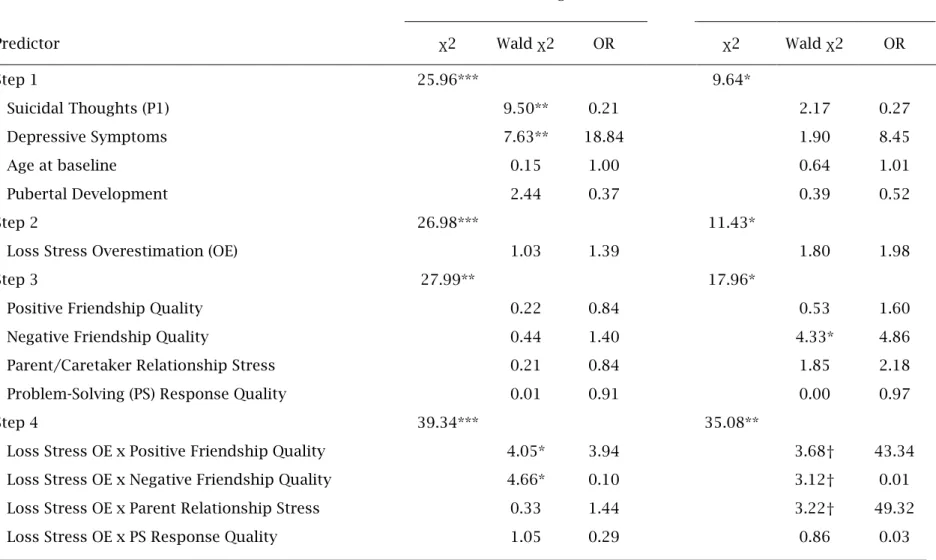
symptoms were significantly associated with suicidal thoughts during the P2 epoch. There were no significant main effects for interpersonal loss event stress overestimation or any of the four moderator variables (positive friendship quality, negative friendship quality,
parent/caretaker-child relationship stress, problem-solving response quality). However, there were significant interactions between interpersonal loss event stress overestimation and positive friendship quality as well as negative friendship quality. Figure 2 depicts the nature of the positive friendship quality interaction. Findings indicate that under conditions of high levels of positive friendship quality (+1 SD), higher levels of interpersonal loss event stress overestimation during the P1 epoch was associated with a higher probability of suicidal thoughts during the P2 epoch (simple slope
b
=0.95,p
<.05), such that higher levels of positive friendship quality buffered against suicidal thoughts, but only at lower levels of interpersonal loss stress overestimation. However, under conditions of low positiveDISCUSSION
Within the literature on risk factors for suicidal thoughts and behaviors in teens, stressful life events consistently have been linked to suicidality, either as distal risk factors (e.g., prior sexual abuse), proximal risk factors (e.g., family discord), or immediate
precipitants (e.g., death of a loved one). However, this research has been limited by: (1) a reliance on retrospective reporting; (2) the frequent use of life events checklists that often contain a finite selection of events, do not distinguish between chronic and episodic stress, and apply the same weight to each event (i.e., present or absent); and (3) the treatment of “stressful life events” either holistically or in terms of very specific life events (e.g., parental divorce). In contrast, the present study used a semi-structured interview with both self-reported subjective ratings of life event stress as well as team-coded objective ratings to look at two categories of events that have strong research support: failure (e.g., academic difficulties) and interpersonal loss (e.g., parental divorce). In keeping with the recent focus on resilience to suicidality, this study also examined moderators (e.g., problem-solving ability) of the relationship between failure and interpersonal loss event stress and suicidality. Although there is a strong literature supporting such moderation, there is almost no longitudinal research (Gallagher & Miller, 2017). The present study longitudinally assessed failure and interpersonal loss event stress on subsequent suicidal thoughts and behaviors using a sample of female teens. Results were promising, suggesting a longitudinal link between failure and interpersonal loss event stress and suicidality as well as a role for several moderators (low negative urgency, high positive friendship quality, low negative friendship quality) in buffering the impact of event stress on later suicidality.