Insured MPC: Efficient Secure Computation
with Financial Penalties
Carsten Baum1?, Bernardo David2??, and Rafael Dowsley3? ? ? 1 Aarhus University, Denmark
2
IT University of Copenhagen, Denmark 3
Bar-Ilan University, Israel
Abstract. Fairness in Secure Multiparty Computation (MPC) is known to be impossible to achieve in the presence of a dishonest majority. Pre-vious works have proposed combining MPC protocols with Cryptocur-rencies in order to financially punish aborting adversaries, providing an incentive for parties to honestly follow the protocol. This approach also yields privacy-preserving Smart Contracts, where private inputs can be processed with MPC in order to determine the distribution of funds given to the contract. The focus of existing work is on proving that this ap-proach is possible and unfortunately they present monolithic and mostly inefficient constructions. In this work, we put forth the first modular construction of “Insured MPC”, where either the output of the private computation (which describes how to distribute funds) is fairly delivered or a proof that a set of parties has misbehaved is produced, allowing for financial punishments. Moreover, both the output and the proof of cheating are publicly verifiable, allowing third parties to independently validate an execution.
We present a highly efficient compiler that uses any MPC protocol with certain properties together with a standard (non-private) Smart Contract and a publicly verifiable homomorphic commitment scheme to implement Insured MPC. As an intermediate step, we propose the first construc-tion of a publicly verifiable homomorphic commitment scheme achieving composability guarantees and concrete efficiency. Our results are proven in the Global Universal Composability framework using a Global Ran-dom Oracle as the setup assumption. From a theoretical perspective, our general results provide the first characterization of sufficient properties that MPC protocols must achieve in order to be efficiently combined with Cryptocurrencies, as well as insights into publicly verifiable proto-cols. On the other hand, our constructions have highly efficient concrete instantiations, allowing for fast implementations.
?Part of this work was done while the author was with Bar-Ilan University. ??
Part of this work was done while the author was with the Tokyo Institute of Tech-nology. This work was partially supported by a grant from Concordium Foundation and by DFF grant number 9040-00399B (TrA2C).
? ? ?
1
Introduction
Secure Multiparty Computation (MPC) allows a set of mutually distrusting parties to evaluate an arbitrary function on secret inputs. The participating parties learn nothing beyond the output of the computation, while malicious behavior at runtime does not alter the output. An intuitive and in practice often required feature of MPC is that if a cheating party obtains the output, then all the honest parties should do so as well. Protocols which guarantee this are also calledfair. In his seminal work, Cleve [21] proved that fair MPC with a dishonest majority is impossible to achieve in the standard communication model. While the result can be circumvented for certain, specific functions [26, 3, 4] in the two-party setting, this barrier prevents MPC from being a useful tool for certain interesting applications.
With the advent of cryptocurrencies, Andrychowicz et al. [2] (and indepen-dently Bentov & Kumaresan [10]) initiated a line of research that avoids the aforementioned drawback by imposing financial penalties on misbehaving par-ties. Such monetary punishments would then incentivize fair behavior of the protocol participants, assuming that they are rational and that the penalties are high enough. This is achieved by constructing a protocol which interacts with a public ledger and digital currency, where the overall structure of their idea is as follows: (i) The parties run the secure computation, but delay the reconstruction of the output; (ii) Each party deposits a collateral on the public ledger; (iii) The parties reconstruct the output. Each party obtains the collateral back if it can prove that it behaved honestly during the reconstruction; and (iv) If some parties have cheated, then their share of the collateral is distributed among the honest participants.
Several works [35, 31, 34] generalized this concept and improved the perfor-mance with respect to the amount of interaction with the public ledger as well as the collateral that each party needs to deposit. In particular, Kumaresan et al. [1, 2, 35] introduced the idea of MPC with cash distribution, in which the inputs and outputs of the parties consist of both data and money. In this latter case, the public ledger is used both to enforce financial penalties as well as to distribute money according to the output of the secure computation.
1.1 Fair Computation vs. Fair Output Delivery
Fair Computation. [2] and [35] follow this line of work, but have high round and communication complexities overheads. As [31] correctly pointed out, care must be taken when choosing the “inner” MPC protocol (which is compiled to obtain financial penalties): to achieve this, the protocol must have a property calledIdentifiable Abort (ID-MPC, [29]). As [2, 35] use GMW [25], their specific construction achieves this property, but not every MPC protocol is suitable for their approach. On the other hand, [31] requires constant rounds but rely on expensive generic zero knowledge proofs to achieve the necessary properties.
Fair Output Delivery. This line of work has been independently initiated by [1, 10] and continued in [33, 34, 36, 11]. Most of the protocols in this line of work still require several rounds of interaction with the public ledger as well as storing all MPC protocol messages on the ledger. The currently most efficient approaches [36, 11] rely on an “inner” MPC protocol that performs the actual computation and then secret shares the result, outputting not the result itself but commitments to each of the shares and privately giving to each party the opening for one of these commitments. The parties subsequently post all (closed) commitments to the public ledger. After the parties agree that the commitments posted on the public ledger correspond to those obtained from the MPC protocol, each party opens its commitment in public. This implicitly has identifiable abort because all parties can publicly agree if another participant has failed to post a valid opening to its commitment on the ledger. In particular, the approach of [11] relies on a smart contract that punishes parties that fail to post valid openings for their commitments to shares. However, a caveat, both from a theoretical and practical point of view, is that current protocols compute both the secret sharing of the result and the commitments to each share inside the MPC in a white-box way, which adds significant computational and communication overheads. Moreover, in order to achieve composable security, the expensive preprocessing phase of a composable commitment scheme would have to be executed as part of the circuit computed by the “inner” MPC protocol.
Other Related Work.Recently Choudhuri et al. [20] showed how to circum-vent the impossibility result of [21] and constructed a fair MPC using a Bulletin Board. As their work either relies on Witness Encryption (which currently re-quires Indistinguishability Obfuscation to be constructed) or Trusted Hardware (which we also deem to be a very strong assumption) it does seem to be an incomparable alternative. The use of MPC for computing on private data in
1.2 Our Contributions
In this work, we give the first modular construction of MPC achieving fair out-put delivery with penalties that can be instantiated with a concretely efficient protocol. While previous works have focused at obtaining protocols that can be instantiated using the Bitcoin or Ethereum blockchains as a public ledger, we focus instead on the MPC aspects of such constructions assuming an ideal public bulletin board. We design a protocol from generic building blocks with security analysed in the Global Universal Composability framework (GUC). This mod-ular approach directly pinpoints the properties that the “inner” MPC protocol and other underlying protocols must have in such constructions, including pre-cise definitions of the necessary public verifiability properties. Besides shedding light on theoretical aspects of MPC with fair output delivery with penalties, our approach also paves the way for concrete implementations, since it uses generic building blocks that have highly efficient instantiations and combines them in a way that yields highly efficient constructions. Moreover, due to its modular nature, our protocol directly benefits from any future efficiency improvements to its individual building blocks.
New Multiparty Additively Homomorphic Commitment with De-layed Public Verifiability.This primitive acts as the central hub of our con-struction. Such commitment schemes are additively homomorphic, allowing one to open linear combinations of commitments without revealing the individual commitments themselves. Moreover, they allow for any third party to verify that a message is a valid opening for a given commitment. These commitments, when combined with a suitable “inner” MPC protocol, allow us to construct a highly efficient and modular output secret sharing and reconstruction mecha-nism. We remark that existing constructions achieving all of these properties do not have composability guarantees. We introduce a new UC secure scheme that only needs a small number of publicly verifiable Oblivious Transfers (OTs) that is independent of the number of commitments to be executed and are performed in a preprocessing phase, after which only calls to a PRG are used. We believe that this construction is of independent interest as it improves on [18, 23], which are not publicly verifiable.
mostly light-weight due to our commitment scheme, which allows for verification of openings using only calls to a PRG. Our technique adds no overhead to the circuit being computed inside the MPC (differently from [36, 11]) and little over-head to the MPC protocol (differently from [31]), since each party only computes and posts to the public ledger a number of commitments linear in the output size as opposed to computing and posting expensive NIZKs together with each MPC protocol message as in [31].
Efficient Instantiation.We show how to instantiate all sub-protocols with efficient primitives. We modify the approach for constant-round MPC of [27, 45] to work as the “inner” MPC with essentially the same concrete efficiency. Our publicly verifiable additively homomorphic commitment scheme only performs Random Oracle (RO) calls after a small number of base OTs using a publicly verifiable OT scheme, achieving the same concrete efficiency as the non-publicly verifiable scheme of [23]. As we use a restricted programmable and observable global RO [13] we are then still able to prove security of all steps in GUC.
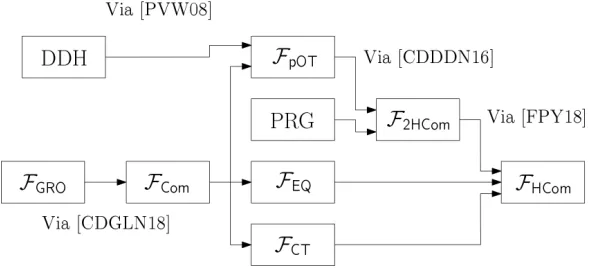
Fig. 1.The Building Blocks of the Additively Homomorphic Multiparty Commitment with Public Verifiability.
1.3 The Structure of our Protocol
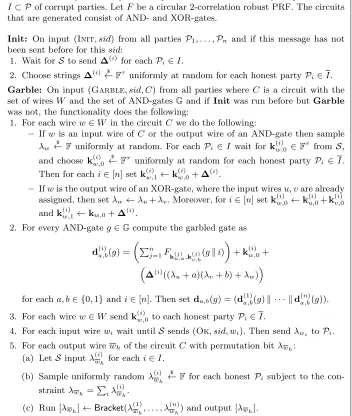
An important building block of our Insured MPC protocol is the multiparty commitment functionality FHCom (described in Section 3) that is additively
ho-momorphic and that allows delayed public verifiability (i.e., after the opening phase it is possible for any third party to verify the opening information).FHCom
is GUC-realized with security in the restricted programmable and observable random oracle model of Camenisch et al. [13] using multiple building blocks as depicted in Figure 1 and briefly explained below. First, we realize a simple (non-homomorphic) commitment functionality with public verifiabilityFCom by
observing that the canonical random oracle based commitment scheme shown to be UC-secure in [13] is trivially publicly verifiable. FCom is then used to realize
coin tossing functionalityFCT. These functionalities are versions of the
function-alities in Frederiksen et al. [23] that are augmented to allow public verifiability. We also use an oblivious transfer functionality with delayed public verifiability FpOT in which the receiver can activate an interface that allows any party to
verify that the receiver used a given choice bit and received a given message. We show thatFpOTcan be realized usingFCom and the DDH-based OT protocol of
Peikert et al. [40]. A two-party homomorphic commitment with delayed public verifiability functionality F2HCom is then realized with a construction based on
the scheme of Cascudo et al. [18], which we augment to achieve public verifiabil-ity by leveragingFpOT. Finally,F2HCom,FEQandFCTare used to obtain a public
verifiable version of the protocol of Frederiksen et al. [23], yielding a protocol that realizes the additively homomorphic multiparty commitment functionality with public verifiabilityFHCom.
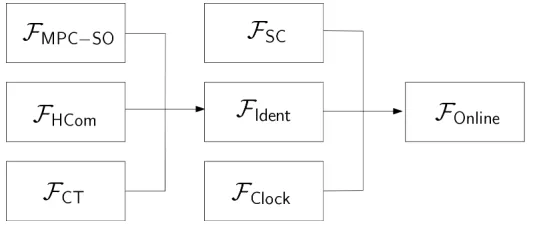
Fig. 2.The Steps Involved in Compiling the MPC Protocol.
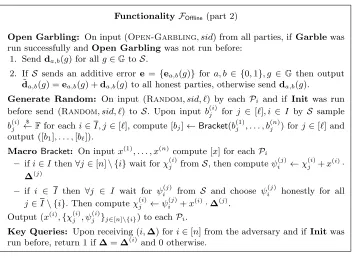
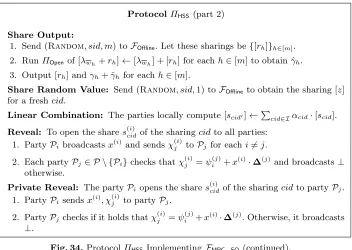
In Section 4, we depart from a flavor of MPC that provides a secret-shared output which can be reconstructed by linear operations on the shares. We capture this precisely in functionalityFMPC−SO. Notice thatFMPC−SO can be efficiently
realized, for instance, by a slightly modified version of the constant-round pre-processed BMR protocol of Hazay et al. [27], which we describe in Appendix B. We then present a protocolΠIdentin theFMPC−SO,FHCom,FCT-hybrid model that
implements FIdent, a functionality capturing MPC with publicly verifiable
out-put. This intermediate functionality allows for third parties to verify that either a given output was indeed obtained from the MPC or a given party has misbe-haved in the output phase. In Section 5, we present the functionalityFSC that
describes the smart contract and an authenticated bulletin board, which are the final ingredients of our compiler. We then build theFIdent,FSC,FClock-hybrid
pro-tocol ΠCompiler that realizesFOnline, the functionality describing MPC with fair
output delivery with penalties. In this protocol, the smart contract represented byFSC uses the properties ofFIdentto either determine the distribution of funds
according to the final output or punish the parties identified as cheaters. The relations among the MPC functionalities are summarized in Figure 2.
they abort in the output reconstruction phase but not if they misbehave dur-ing the computation itself. Hence, our approach still suffers from one of the caveats in previous protocols [36, 11],i.e.an attacker can start many instances of MPC with fair output delivery with penalties only to deliberately fail be-fore the output phase, causing honest parties to waste resources. Approaches to avoid this caveat [2, 35, 34, 31] have computational and communication costs or-ders of magnitude higher than ours, requiring computation of expensive NIZKs and storage of all MPC messages along with these NIZKs on the public ledger. Non-cryptographic countermeasures can be used to disincentivize such adver-sarial behavior, meaning the average cost per execution will be much lower in our approach. For example, such adversaries can be dealt with through heuristic techniques like reputation systems, which are used to identify trustworthy peers before engaging in MPC. Another alternative is to charge all parties an initial fee that is paid regardless of an output being successfully obtained, making this adversarial strategy financially infeasible.
1.4 Efficiency and Comparison to Previous Works
Our approach preserves the efficiency of the “inner” MPC protocol and the com-mitment scheme used for our generic construction. No modifications are done to these components, since our constructions basically consists in executing the MPC protocol to evaluate the circuit describing the function to be computed and then executing the commitment scheme to obtain commitments (and later open-ings) to the MPC protocol’s partial outputs. Hence, the complexity of executing our generic protocol betweennparties is essentially that of executing the “inner” MPC protocol amongnparties in order to evaluate the function and then exe-cutingn commitments and openings using the commitment scheme. Moreover, our approach is “optimistic” in the sense that more expensive verification proce-dures are only executed in case there is a suspicion that a party has cheated. Our generic construction can be concretely instantiated in the preprocessing model based on the MPC protocol of [27] and the publicly verifiable additively homo-morphic commitment scheme that we introduce. In case no party is suspected to be cheating, our online phase achieves basically the same efficiency as the MPC protocol of [27], since our commitment scheme’s online phase achieves the same efficiency as the scheme of [18], which according to the benchmarks of [42] requires only a few microseconds for commitments/openings. An even better concrete instantiation can be obtained by employing the new publicly verifiable additively homomorphic commitment scheme recently introduced in [17].
posted to the ledger at each round, which is prohibitive for practical scenar-ios.4With the exception of [31], none of the previous works have been shown to achieve composability guarantees.
Current protocols for fair output delivery such as [36, 11] compute both the secret sharing of the result and the commitments to each share inside the MPC in a white-box way, adding significant computational and communication over-heads. Moreover, while these works claim that a random oracle (RO) based com-mitment can be used, this would preclude the resulting protocol from achieving simulation-based security notions. Notice that computing such a commitment inside the MPC means that calls to the RO itself would have to be computed by the MPC, which is not possible since the RO ideal functionality cannot be represented as a circuit. The alternative for instantiating such protocols with composabability guarantees would be using universally composable commitment schemes that can be instantiated from a common reference string, which would require the MPC to compute tens (if not hundreds) of modular exponentiations, resulting in enormous overheads.
2
Preliminaries
Let y ←$ F(x) denote running the randomized algorithm F with input x and random coins, and obtaining the output y. When the coins r are specified we usey ←F(x;r). Similarly,y←F(x) is used for a deterministic algorithm. For a set X, let x ← X$ denote xchosen uniformly at random from X; and for a distribution Y, let y ← Y$ denote y sampled according to the distribution Y. For any k ∈ N we write [k] for the set {1, . . . , k}. A function f(x) is negligi-ble in x (or negl(x) to denote an arbitrary such function) if f(x) is positive and for every positive polynomial p(x) ∈ poly(x) there exists a x0 ∈ N such that ∀x ≥ x0 : f(x) < 1/p(x). Two ensembles X = {Xκ,z}κ∈N,z∈{0,1}∗ and
Y = {Yκ,z}κ∈N,z∈{0,1}∗ of binary random variables are said to be statistically
indistinguishable, denoted by X ≈s Y, if for allz it holds that| Pr[D(Xκ,z) = 1]−Pr[D(Yκ,z) = 1]|is negligible inκfor every probabilistic algorithm (distin-guisher) D. In case this only holds for computationally bounded (non-uniform probabilistic polynomial-time (PPT)) distinguishers we say that X and Y are
computationally indistinguishable and denote it by≈c.
Letnbe the number of parties in an MPC scheme and Abe an adversary. Throughout this work, we will denote withP ={P1, . . . ,Pn} the set of parties and with I (P the set of corrupted parties. The uncorrupted parties will be
I =P \I. We denote the ideal-world simulator asS. We use τ to denote the computational andκfor the statistical security parameter.
Vectors of field elements are denoted by bold lower-case letters and matrices by bold upper-case letters. Concatenation of vectors is represented by k. For
4
z ∈ Fk, z[i] denotes the i’th entry of the vector, so that e.g. z[1] is the first element of z. We denote by 0k the column vector of k components where all entries are 0. We denote the scalar product of a scalar α ∈ F with a vector x ∈ Fk by α·x = (α·x[1], . . . , α·x[k]). For a matrix M ∈
Fn×k, we let M[·, j] denote its j’th column and M[i,·] denote itsi’th row. This work focus on computations onF2, which will be denote asFfor conciseness.
2.1 Coding Theory, Interactive Proximity Testing and Linear Time Building Blocks
We adopt the notation and definitions from [18], reproduced in almost verbatim form in the remainder of this section. For a vector x ∈ Fn, we denote the Hamming-weight ofx by kxk0 =|{i ∈[n] :x[i]6= 0}|. Let C⊂Fn be a linear subspace ofFn. We say thatCis an
F-linear [n, k, s] code ifChas dimensionk and it holds for every non-zerox∈Cthatkxk0≥s,i.e., the minimum distance of C is at least s. The distance dist(C,x) between C and a vector x ∈ Fn is the minimum of kc−xk0 when c∈C. The rate of anF-linear [n, k, s] code is
k
n and its relative minimum distance is s
n. A matrix G∈ F
n×k is a generator matrix ofCifC={Gx:x∈Fk}. The codeCis systematic if it has a generator matrixGsuch that the submatrix given by the topkrows ofGis the identity matrix I ∈ Fk×k. A matrix P ∈ F(n−k)×n of maximal rank n−k is a parity check matrix of C ifPc = 0 for allc∈ C. When we have fixed a parity check matrix Pof C we say that the syndrome of an element v ∈Fn is Pv. For an F-linear [n, k, s] codeC, we denote byCmthem-interleaved productofC, which is defined by Cm={C∈Fn×m:∀i∈[m] :C[·, i]∈C}. In other words,Cm consists of all Fn×m matrices for which all columns are in C. We can think of Cmas a linear code with symbol alphabetFm, where we obtain codewords by taking m arbitrary codewords of C and bundling together the components of these codewords into symbols from Fm. For a matrix E ∈
Fn×m, kEk0 is the number of non-zero rows ofE, and the codeCmhas minimum distance at least
s0 if all non-zeroC∈CmsatisfykCk
0≥s0. Furthermore,Pis a parity-check matrix of Cif and only ifPC=0for allC ∈Cm. IfCis an
F-linear [n, k, s] code, its squareC∗2 is defined as the linear subspace of
Fn generated by all the vectors of the formv∗w withv,w∈C.
Definition 1 (Almost Universal Linear Hashing [18]).We say that a fam-ily H of linear functions Fn → Fs is -almost universal, if it holds for every
non-zerox∈Fn that
Pr
H←H$
[H(x) =0]≤,
where H is chosen uniformly at random from the family H. We say that H is universal, if it is |F|−s-almost universal. We will identify functionsH∈ Hwith
their transformation matrix and write H(x) =H·x.
almost universal linear hash functions (fromFmto
F`), and we applyHto each of the rows of a matrixX∈Fn×m, obtaining another matrixX0 ∈
Fn×`; because of linearity, if Xbelonged to an interleaved code Cm, thenX0 belongs to the
interleaved codeC`. The following Theorem (from [18]) states that we can test whether X is close to Cm by testing instead if X0 is close to C` (with high probability over the choice of the hash function) and moreover, if these elements are close to the respective codes, the set of rows that have to be modified in each of the matrices in order to correct them to codewords are the same.
Theorem 1 ([18]). LetH:Fm→F2s+t be a family of|F|−2s-almost universal F-linear hash functions. Further letCbe anF-linear[n, k, s]code. Then for every X∈Fn×m at least one of the following statements holds, except with probability |F|−s over the choice ofH← H$ :
1. XH> has distance at least sfromC(2s+t).
2. For every C0 ∈C(2s+t) there exists aC ∈Cm such thatXH>−C0 and
X−C have the same row support.
Remark 1 ([18]).If the first item in the statement of Theorem 1 does not hold, the second one must and we can efficiently recover a codewordC with distance at mosts−1 fromXusing erasure correction, given a codeword C0∈C(2s+t) with distance at mosts−1 fromXH>. More specifically, we compute the row support of XH>−C0, erase the corresponding rows of X and recoverC from Xusing erasure correction5. The last step is possible as the distance betweenX andC is at mosts−1.
2.2 UC Framework and Functionalities
In this work, the (Global) Universal Composability or (G)UC framework [14, 15] is used to analyze security. Due to space constraints, we refer interested readers to the aforementioned works for more details. We generally useF to denote an ideal functionality andΠ for a protocol. We work in the restricted programmable and observable global random oracle modelGrpoRO of [13] (see Figure 3 for the
description).
Several functionalities in this work allowpublic verifiability. To model this, we follow the approach of Badertscher et al. [5] and allow the set of verifiersV to be dynamic by adding register and de-register instructions as well as instructions that allow S to obtain the list of registered verifiers. All functionalities with public verifiability include the following interfaces (which are omitted henceforth for simplicity):
Register: Upon receiving (Register, sid) from some verifierVi, setV =V ∪ Vi and return (Registered, sid,Vi) toVi.
Deregister: Upon receiving (Deregister, sid) from some verifier Vi, setV = V \ Vi and return (Deregistered, sid,Vi) toVi.
5
FunctionalityGrpoRO
GrpoRO is parameterized by an output size function`and keeps initially empty lists
ListH,prog.
Query: On input (Hash-Query, m) from party (P, sid) or S, parse m as (s, m0) and proceed as follows:
1. Look uphsuch that (m, h)∈ListH. If no suchhexists, sampleh← {$ 0,1}`(τ) and setListH=ListH∪ {(m, h)}.
2. If this query is made by S, or if s 6= sid, then add (s, m0, h) to the (initially empty) list of illegitimate queriesQs.
3. Send (Hash-Confirm, h) to the caller.
Observe: On input (Observe, sid) fromS, ifQsiddoes not exist yet, setQsid=∅. Output (List-Observe,Qsid) toS.
Program: On input (Program-RO, m, h) with h∈ {0,1}`(τ) from S, ignore the input if there existsh0∈ {0,1}`(τ)
where (m, h0)∈ListH andh6=h0. Otherwise, set
ListH=ListH∪ {(m, h)},prog=prog∪ {m}and send (Program-Confirm) toS.
IsProgrammed: On input (IsProgrammed, m) from a partyPorS, if the input was given by (P, sid) then parsemas (s, m0) and, ifs6=sid, ignore this input. Set
b= 1 ifm∈progandb= 0 otherwise. Then send (IsProgrammed, b) to the caller.
Fig. 3.FunctionalityGrpoRO from [13].
Is Registered: Upon receiving (Is-Registered, sid) fromVi, return (Is-Registered, sid, b) toVi, where b= 1 ifVi ∈ V andb= 0 otherwise. Get Registered: Upon receiving (Get-Registered, sid) from the ideal ad-versaryS, the functionality returns (Get-Registered, sid,V) to S.
The above instructions can also be used by other functionalities to register as a verifier of a publicly verifiable functionality.
As some parts of our work are inherently synchronous, we model the different “rounds” of it using a global clock functionalityFClock (see Figure 4), following
the ideas of [5, 31, 30]. For simplicity, we do not introduce a session management inFClock as it is not necessary to state our result. Our clock is not only used to
synchronize the protocol between multiple functionalities and parties, but more-over simulates some “inherent” delayρ. As we use a public ledger functionality, we will have to grant parties some time until certain messages are posted on it and acted upon by the smart contract. Such a delay is difficult to model in UC. Therefore adding this delayρto represent “wall clock-time” to the functionality seems to be a good compromise. That also means thatFClock will not hand over
to the simulator directly after an update was sent by a party or functionality, but before a new value of the clock is read by one of them.
FClock is assumed to be a global functionality, which means that other ideal
functionalities will be granted access to it. And while in the real protocol execu-tion all parties send messages to and receive them fromFClock, in the simulated
dis-FunctionalityFClock
FClock is parameterized by a variableν, setsP,F of parties and functionalities re-spectively, as well as by a “wall clock delay”ρ. It keeps a Boolean variabledJ for eachJ ∈ P ∪ F, a counterνas well as an additional variableupdate. AlldJ,νand updateare initialized as 0.
Clock Update: Upon receiving a message (Update) fromJ ∈ P ∪ F: 1. SetdJ = 1.
2. IfdF = 1 for allF ∈ F anddp= 1 for all honestp∈ P, then setupdate←1 if it is 0.
Clock Read: Upon receiving a message (Read) from any entity:
1. Ifupdate= 1 and has been set so≥ρtime ago, then first send (Tick, sid) to
S. Next setν←ν+ 1, resetdJ to 0 for allJ ∈ P ∪ F and resetupdateto 0.
2. Answer the entity with (Read, ν).
Fig. 4.FunctionalityFClockfor a Global Clock.
honest parties will do so6. A complication that arises from this is that the ideal functionality in such a setting might directly change the visible state ofFClock,
so special care must be taken during the simulation-based proof such that the publicly available state ofFClock is indistinguishable.
2.3 Secure Multiparty Computation with Punishable Abort and Cash Distribution
We focus onSecure Multiparty Computation with security against a static, rush-ing and malicious adversaryAcorrupting up ton−1 of the nparties. For this setting, it is known that fairness cannot be achieved [21]. Instead, we let the func-tionality compute the resulty, but it will only output it if every partyPi sent coins coins(d) to the functionality. The functionality will hand these coins back if every party obtainedy. Awill be able to block honest parties from receiving the output, but only at the expense of losing money to the honest parties. We call thisMPC with Punishable Abort orInsured MPC. Additionally, in the case where no party was punished, we let the parties redistribute additional coins based ony. To formalize this step, we define aCash Distribution Function. Definition 2 (Cash Distribution Function). Letg:Fm×Nn →Nn be such
that∀y∈Fm, t(1), . . . , t(n)∈Nit holds thatPit (i)=P
ie
(i)for(e(1), . . . , e(n))←
g(y, t(1), . . . , t(n)). Theng is called a Cash Distribution Function.
In Figure 5 we formally define functionalityFOnlinethat captures MPC which
has both properties. This functionality allows the adversary todelaythe delivery of the correct output by some time, which is necessary for technical reasons. At the same time, it allows the adversary to punish himself. While being unlikely
6
FunctionalityFOnline
This functionality interacts with the partiesP1, . . . ,Pn as well as the global func-tionalityFClock. It is parameterized by a circuitCrepresenting the computation, the compensation amountq, the security deposit d≥(n−1)q and a cash distribution functiong.S specifies a setI⊂[n] of corrupted parties.
Input: Upon first input (Input, sid, i, x(i)) byP
i and (Input, sid, i,·) by all other parties the functionality stores the value (i, x(i)) internally. Every further such mes-sage with the samesidandiis ignored.
Evaluate: Upon input (Compute, sid) by all parties and if the inputs (i, x(i))i∈[n] for all parties have been received, computey=C(x(1), . . . , x(n)). IfSsends (
Abort,
sid) duringInputorEvaluatethen send (Abort, sid) to all parties and stop. Deposit: Wait for each party Pi to send (Deposit, sid,coins(d+t(i))) containing the d coins of the security deposit as well as the t(i) ≥ 0 coins that Pi wants to use as financial input in the computation. Send (Deposited, sid,Pi, d+t(i)) to S upon receiving it. If all honest parties sent their deposit then send (Update, sid) to
FClock. Then queryFClock untilν= 1. If byν= 1 some partiesj∈I sentcoins(c(j)) withc(j)< dthen return the collateral to all honest parties andS. Afterwards send (Abort, sid) to the honest parties and abort. If all went ok, then activateReveal. Reveal: Send (Output, sid,y) toS, (Update, sid) to FClockand wait untilν= 2.
Smay now either send (No-Output, sid) or (Ok, sid,y). Afterwards send (Update, sid) toFClockand activateResolve.
Resolve: Query FClock until ν = 3. Then send (Update, sid) to FClock and query untilν= 4.
1. Wait for the message (Punish, sid,punish) fromS wherepunish⊆I. IfS sent (No-Output, sid,y) inRevealthen∅ 6=punish.
2. Depending onpunishdo the following:
– Ifpunish=∅then computee(1), . . . , e(n)←g(y, t(1), . . . , t(n)). – Otherwise sete(i) ←d+t(i)+|punish| ·q for each partyP
i ∈ P \punish ande(i)←d−q·(n− |punish|) +t(i) for eachPi∈punish.
3. For each Pi ∈ P send (Payout, sid,Pi,coins(e(i))) to Pi and (Payout,
sid,Pi, e(i)) to each other party.
4. IfSsent (Ok, sid,y) inRevealthen send (Output, sid,y) to each honest party, otherwise send (No-Output, sid).
Fig. 5.FunctionalityFOnlinefor Secure Multiparty Computation with Punishable Abort and Cash Distribution.
in practice, this must still be possible for the security proofs to go through. This MPC runs in the presence of a GUC functionalityFClock. One would obviously
like to get a result in terms of wall-clock time, but this is difficult to specify in UC. Instead, we implement FOnline using a Smart Contract functionality. Such
2.4 Authenticated Bulletin Boards and Smart Contracts
Bulletin Boards and Smart Contracts are primitives which form the backbone of our result. A Bulletin Board is a publicly readable storage for messages which cannot be erased after being posted. We use an authenticated Bulletin Board, which means that messages that are posted can be related to specific parties. These can be implemented from a standard Bulletin Board and signatures.7 As we focus on the MPC aspects rather than compatibility with a blockchain based public ledger, we model the public ledger as an ideal Bulletin Board that allows for parties to immediately write and read messages. We also assume that there exists a Smart Contract functionality that incorporates this ideal Bulletin Board. We defer the full definition of this functionality to Section 5 and until then only use the two simple interfaces of the Bulletin Board as defined below. The Bulletin Board is aware of the set of partiesP and has an initially empty listMof messages and two interfaces:
Post to Bulletin Board: Upon receiving a message (Post, sid,Off, m) from some party Pi ∈ P, if there is no message (Pi, sid,Off, m0) ∈ M, append (Pi, sid,Off, m) to the list M of authenticated messages that were posted in the public bulletin board. Then send (Posted, sid,Pi,Off, m) toS.
Read from Bulletin Board: Upon receiving a message (Read, sid) from some party, returnM.
3
Multiparty Homomorphic Commitments with Delayed
Public Verifiability
One of the main building blocks of our secure multiparty computation protocol is a (multiparty) additively homomorphic commitment scheme with delayed public verifiability, meaning that the receiver can prove that he received a (potentially) invalid opening to a given commitment after it has been opened. In order to construct such a scheme efficiently, we depart from the multiparty homomor-phic commitment scheme of [23], which is in turn realized based on a two-party homomorphic commitment functionality, an equality testing functionality and a coin tossing functionality. In order to augment the construction of [23] with delayed public verifiability, we need to also augment the functionalities it is based on with similar properties. To that end, we present a two-party homo-morphic commitment with delayed public verifiability functionality F2HCom, a
publicly verifiable coin tossing functionalityFCTand a publicly verifiable
equal-ity testing functionalequal-ity FEQ. We realize F2HCom with a construction based on
an instantiation of the scheme of [18] with an oblivious transfer with delayed public verifiability FpOT. We show that FpOT can be realized in the restricted
programmable and observable random oracle model of [13] by the construction of [40] plus a publicly verifiable (non-homomorphic) commitment functionality FCom, which is also instrumental in realizingFEQandFCT.
7
Public Verification. In our modeling of public verification, we denote the parties who actively participate in executing a protocol byP and the parties who later verify the output of an execution of the protocol byV={V1, . . . ,V`}. In the case of functionalities with delayed public verification, the functionality’s interface providing public verification is only activated after a subset of (or all) parties in P agree with its activation. This delayed activation models the fact that the protocols realizing these functionalities require that a subset (or all) of P reveal private information (e.g.private randomness or inputs) in order for the public verification procedure to be executed given publicly available transcripts and outputs. All messages broadcast by parties P to partiesV in the protocols described in this section are in fact sent to the smart contract functionalityFSC,
which makes them accessible to verifiers at any later point. This eliminates the need forV to be involved in the protocol execution ofP, asV can later retrieve relevant messages from the smart contract. When a protocol in this section says a message m is broadcast, the party broadcasting m sends (Post, sid,Off, m) toFSC, posting the message to a bulletin board and increases the identifierOff.
All parties that expect to receive a broadcast message send (Read, sid) toFSC
and retrieve the message from the contents of the authenticated bulletin board.
3.1 Publicly Verifiable Commitments
In order to adapt the construction of [23], it is necessary to also realize function-alities for equality testing and for coin tossing with delayed public verifiability, which can be done from simple (non-homomorphic) commitments with public verifiability. We define a functionality for Publicly Verifiable CommitmentsFCom
in Figure 6 and will show that this functionality can be realized in the restricted programmable and observable random oracle model of [13]. The basic insight here is to observe that the canonical random oracle based commitment scheme proven UC-secure in [13] is trivially publicly verifiable, since any party can verify the validity of a given commitment/opening pair by querying the global random oracle. We describe protocolΠCom in Figure 7. The security ofΠCom is stated in Theorem 2.
Theorem 2. ProtocolΠComGUC-realizesFComin theGrpoRO,FSC hybrid model.
Proof (Sketch).The fact that the Commit and Open steps of protocolΠCom re-alize the corresponding interfaces ofFCom in theGrpoROandFAuthhybrid model
(FAuth is the functionality for authenticated channels) is proven in [13]. In our
case FAuth is substituted by the authenticated bulleting board through which
broadcasts are carried out. Public verification follows in a straightforward man-ner since partiesVreceive the same messages as partiesP and perform the exact same procedures of an honest receiver to verify the validity of such messages. Notice that the strategy taken by the simulator described in [13] in exploring the restricted programmability and observability of GrpoRO allows it to
equivo-cate commitment openings towards V as well. Hence, since GrpoROis global the
FunctionalityFCom
FCom keeps an internal (initially empty) list C and interacts with a set of parties
P = {P1, . . . ,Pn}, a set of verifiers V and an adversary S through the following interfaces:
Commit: Upon receiving (Commit, sid,Pi, cid,x) from Pi ∈ P (where x ∈ Fτ) check if (cid,·,·)∈C. If yes, ignore the message, else add (cid,Pi,x) toCand send a public delayed output (Committed, sid,Pi, cid) to all remaining parties inP.
Open: Upon receiving (Open, sid,Pi, cid) fromPi∈ P, if (cid,Pi,x)∈C, send a delayed output (Open, sid,Pi, cid,x) to all partiesV and allPj∈ P forj6=i. Verify: Upon receiving (Verify, sid, cid,Pi,x) fromVj ∈ V, if (cid,Pi,x)∈Cset
f= 1, otherwise, setf= 0. Send (Verified, sid, cid,Pi,x, f) toVj.
Fig. 6.FunctionalityFCom for Publicly Verifiable Multiparty Commitments. ProtocolΠCom
PartiesP={P1, . . . ,Pn}and verifiersVinteract with each other and withGrpoROas follows:
Commit: On input (Commit, sid,Pi, cid,xi), a party Pi ∈ P uniformly sam-ples r ← {$ 0,1}κ and queries G
rpoRO on (sid, cid,r,xi) to obtain c. Pi broadcasts (Committed, sid,Pi, cid, c). All parties Pj ∈ P for j 6= i output (Committed, sid,Pi, cid) upon receiving this message.
Open: On input (Open, sid,Pi, cid),Pibroadcasts (Open, sid,Pi, cid,r0,x0i). Upon receiving (Open, sid,Pi, cid,r0,x0i), each partyPj queries GrpoRO on (sid, cid,r0,x0i) and checks that the answer is equal toc and that (sid,r0,x0i) is not programmed by sending (IsProgrammed, sid, cid,r0,x0i) to GrpoRO, aborting if the answer is (IsProgrammed, sid,0). Output (Open, sid,Pi, cid,x0i).
Verify: On input (Verify, sid, cid,Pi,x), Vj ∈ V checks that x = x0i in (Open,
sid,Pi, cid,r0,x0i), aborting otherwise. Vj queries GrpoRO on (sid, cid,r0,x0i) and checks that the answer is equal to c and that (sid,r0,x0i) is not programmed by sending (IsProgrammed, sid, cid,r0,x0i) to GrpoRO, setting f = 0 if the an-swer is (IsProgrammed, sid,0) and, otherwise, setting f = 1. Output (Verified, sid, cid,Pi,x, f).
Fig. 7.ProtocolΠComfor Publicly Verifiable Multiparty Commitments.
outputxwas really obtained from a valid opening of the commitment identified
bycid. ut
3.2 Publicly Verifiable Equality Testing
The functionality for Equality Testing as defined in [23] but augmented with Public Verifiability is presented in Figure 8. Notice the functionality for Equality TestingFEQleaks the inputs of all parties to the adversaryafter it provides its
equality testing is performed. Nevertheless, this relaxed guarantee is enough for realizing the construction of [23] and the functionalityFEQitself can be realized
usingFCom. The basic idea as proposed in [23] is to have all parties commit to the
values whose equality will be tested and, after all commitments are performed, open their commitments and compare the values locally. SinceFCom is publicly
verifiable, the commitments and openings can be publicly verified to check the validity of the equality test. We describe protocolΠEQin Figure 9. The security ofΠCom is stated in Theorem 3.
FunctionalityFEQ
FEQ interacts with a set of parties P = {P1, . . . ,Pn}, a set of verifiers V and an adversaryS through the following interfaces:
Equality: Upon receiving (Equal, sid,Pi,xi), where xi ∈ Fm, from each party
Pi∈ P (or fromS in casePi is corrupted), ifx1 =. . .=xn, send (Equal, sid) to
S. Otherwise, send (Not-Equal, sid,x1, . . . ,xn) toS. Proceed as follows according to the answer ofS:
– IfS answers with (Deliver, sid), send (Equal, sid) to all parties inP ifx1 =
. . .=xnand otherwise send (Not-Equal, sid,x1, . . . ,xn) to them. – IfS answers with (Abort, sid), then send (Abort, sid) to all parties.
Verify: Upon receiving (Verify, sid,x1, . . . ,xn) fromVj∈ V, if messages (Equal,
sid,Pi,xi) (withxi∈Fm) have been received from eachPi∈ PandS delivered the resulting message, then send (Verified, sid) toVj.
Fig. 8.FunctionalityFEQfor Publicly Verifiable Equality Testing.
ProtocolΠEQ
PartiesP={P1, . . . ,Pn}and verifiersVinteract with each other and withFCom as follows:
Equality: On input (Equal, sid,Pi,xi), each partyPiproceeds as follows: 1. Samples a fresh unusedcidi and send (Commit, sid,Pi, cidi,xi) toFCom. 2. After receiving (Committed, sid,Pj, cidj) fromFCom for allj∈[n] withj6=i,
send (Open, sid,Pi, cidi) toFCom.
3. Upon receiving (Open, sid,Pj, cidj,xj) from FCom for all j ∈ [n] with j 6= i, output (Equal, sid) ifx1 =. . .=xn, otherwise, (Not-Equal, sid,x1, . . . ,xn). If (Open, sid,Pa, cida,xa) is not received for somea∈[n], output (Abort, sid). Verify: On input (Verify, sid,x1, . . . ,xn), Vj ∈ V sends (Verify, sid, cidi,xi) to
FCom for all i ∈ [n]. If Vj receives (Verified, sid, cid,Pi,xi,1) for all i ∈ [n], it outputs (Verified, sid).
Fig. 9.ProtocolΠEQfor Publicly Verifiable Equality Testing.
Proof (Sketch).We’ll sketch a simulatorS running an internal copy of the real world adversary A such that an execution with S and FEQ is
indistinguish-able from an execution of ΠEQ withAto the environment Z. S interacts with
A emulating the honest parties of the protocol and FCom. On inputs (Equal, sid,Pi,xi), wherePi is a corrupted party,S sends (Committed, sid,Pj, cidj) from each simulated honest party Pj emulating a commitment to a random message fromFComtoAand waits forAto send a (Commit, sid,Pi, cidi,xi) to FCom. For each corrupted party Pi, S sends (Equal, sid,Pi,xi) toFEQ. Upon
receiving (Equal, sid) fromFEQ, if all commitments fromAhave been opened
with messages (Open, sid,Pi, cidi) fromAtoFCom,S opens the emulated
com-mitments from honest parties by sending A a message (Open, sid,Pj, cidj,x) with x equal to value xi contained in the messages (Commit, sid,Pi, cidi,xi) fromAtoFCom and sends (Deliver, sid) toFEQ. Upon receiving (Not-Equal, sid,x1, . . . ,xn) from FEQ, if all commitments from A have been opened with
messages (Open, sid,Pi, cidi) from Ato FCom, S opens the emulated
commit-ments from honest parties by sendingAa message (Open, sid,Pj, cidj,xj) with the correspondingxjaccording tox1, . . . ,xnreceived fromFEQ. Upon receiving
a message (Verify, sid,x1, . . . ,xn) from a party Vi, S emulates ΠEQ exactly,
given the commitment openings programmed intoFCom. ut
3.3 Publicly Verifiable Coin Tossing
The functionality for Publicly Verifiable Coin Tossing FCT (described in
Fig-ure 10) can also be implemented usingFCom. The basic coin tossing interface is
realized in the standard manner: (i) each partyPi∈ Pcommits to a random ele-mentri ∈F(ii) wait for all other parties to perform their commitments (iii) open the commitment and obtain the opening of all other parties; and (iv) define the final random elementx=P
iri. The public verifiability is achieved by relying on the public verifiability ofFCom, which allows parties to check that the openings
to each commitment were presented correctly and to locally compute the final random value. We describe the protocolΠCTin Figure 11. The security ofΠCom
is stated in Theorem 4.
Theorem 4. ProtocolΠCT GUC-realizes FCT in theFSC,FCom-hybrid model.
Proof (Sketch).We’ll sketch a simulatorS running an internal copy of the real world adversary Asuch that an execution with S andFCT is indistinguishable
from an execution ofΠCTwithAto the environmentZ.Sinteracts withA em-ulating the honest parties of the protocol andFCom. On input (Toss, sid, m,F), Ssends (Toss, sid, m,F) toFCTon behalf of the corrupted parties and emulates
commitments from each honest partyPi by uniformly samplingxi,1, . . . , xi,m $ ← F and fresh unused identifiers cidi,k, and sending (Commit, sid,Pi, cidi,k, xi,k) toAfork∈[m]. Upon receiving (Tossed, sid, m,F, x1, . . . , xm) fromFCT, ifA
FunctionalityFCT
FCT interacts with a set of partiesP = {P1, . . . ,Pn}, a set of verifiers V and an adversaryS through the following interfaces:
Toss: Upon receiving (Toss, sid, m,F) from all parties inP wherem∈NandFis a description of a field, uniformly samplemrandom elements x1, . . . , xm
$
←Fand send (Tossed, sid, m,F, x1, . . . , xm) toS. Proceed as follows according to the answer ofS:
– IfSanswers with (Deliver, sid), send (Tossed, sid, m,F, x1, . . . , xm) to all par-ties inP.
– IfS answers with (Abort, sid), then send (Abort, sid) to all parties.
Verify: Upon receiving (Verify, sid, m,F, x1, . . . , xm) from Vj ∈ V, if (Tossed, sid, m,F, x1, . . . , xm) has been sent to all parties in P set f = 1, otherwise, set
f= 0. Send (Verified, sid, m,F, x1, . . . , xm, f) toVj.
Fig. 10.FunctionalityFCTfor Publicly Verifiable Coin Tossing. ProtocolΠCT
PartiesP={P1, . . . ,Pn}and verifiersVinteract with each other and withFCom as follows:
Toss: On input (Toss, sid, m,F) wherem∈NandFis a description of a field, each partyPiproceeds as follows:
1. Uniformly samplem random elementsxi,1, . . . , xi,m $
←F, and for all k ∈ [m], sample fresh unused identifiers cidi,k and send (Commit, sid,Pi, cidi,k, xi,k) to
FCom.
2. After receiving (Committed, sid,Pj, cidj,k) from FCom for all k ∈ [m] and all
j∈[n] withi6=j, send (Open, sid,Pi, cidi,k) toFCom for allk∈[m].
3. Upon receiving (Open, sid,Pj, cidj,k, xj,k) from FCom for all k ∈ [m] and all
j∈[n] withi6=j, output (Tossed, sid, m,F, x1, . . . , xm) wherexk=Pnj=1xj,k. If a message (Open, sid,Pj, cidj,k, xj,k) is not received for any value of j or k, outputs (Abort, sid).
Verify: On input (Verify, sid, m,F, x1, . . . , xm), Vj ∈ V sends (Verify, sid,
cidi,k, xi,k) to FCom for i ∈ [n] and k ∈ [m]. If Vj receives (Verified, sid, cidi,k,Pi, xi,k,1) for all iand k, and xk =Pnj=1xj,k for k ∈ [m],Vj sets f = 1, otherwise it setsf= 0. Output (Verified, sid, m,F, x1, . . . , xm, f).
Fig. 11.ProtocolΠCTFor Publicly Verifiable Coin Tossing.
with valuesxj,k such thatxk =P n
j=1xj,k given valuesxi,k generated by Afor
k ∈ [m]. Upon input (Verify, sid, m,F, x1, . . . , xm), S exactly emulates ΠCT
given the openings programmed into the emulatedFCom. ut
3.4 Oblivious Transfer with Delayed Public Verifiability
In order to realizeF2HCom, we will require an oblivious transfer functionality with
allows parties to check that the receiver used a given choice bit (obtaining a given message). The basic 1-out-of-2 string OT functionality FpOT augmented
with public verifiability is presented in Figure 12. This functionality can be realized by having the receiver use FCom to commit to all of its randomness
(including the choice bit) before the OT protocol is executed and opening this commitment after the protocol is complete. In order for this construction to work, the OT protocol must be such that the receiver cannot generate two alternative randomness values such that each of these values results in the same (fixed) protocol messages for the receiver but in different outputs being obtained given the (fixed) sender’s messages. We will show that the protocol of [40] has this property. Moreover, since we only require static security and are willing to use a protocol with more than two rounds, we will show how to useFCTto generate a
CRS for the scheme of [40], which can be done in two extra rounds in theGrpoRO
-hybrid model using ProtocolΠCTto realizeFCT. We use the scheme of [40] along
with FCom to construct ProtocolΠpOT presented in Figure 13. The security of ΠpOTis stated in Theorem 5.
FunctionalityFpOT
FpOT is parameterized by λ ∈ N, which is publicly known. FpOT interacts with a sender Pi, a receiver Pj, a set of verifiers V and an adversary S, proceeding as follows:
Transfer: Upon receiving a message (Send, sid,x0,x1) from Pi, where x0,x1 ∈ Fλ, store the tuple (sid,x0,x1) and send (Send, sid) toPi and Pj. Ignore further messages fromPi with the samesid.
Choose: Upon receiving a message (Receive, sid, c) from Pj, where c ∈ {0,1}, check if a tuple (sid,x0,x1) was recorded. If yes, send (sid,xc) toPjand (Received,
sid) toS, and ignore further messages formPj with the samesid. Otherwise, send nothing, but continue running.
Initialize Verification: Upon receiving a message (Verification-Start, sid) from Pj, ignore all other messages but start responding to messages (Verify, sid, c,x) in the Public Verification interface.
Public Verification: Upon receiving a message (Verify, sid, c,x) from Vk ∈ V where c ∈ {0,1} and x ∈ Fλ, if verification was not activated with a message (Verification-Start, sid) fromPjor if no (Receive, sid, c) was received fromPj, answer with (Verification-Fail, sid,Pj). If there is no tuple (sid,x0,x1) recorded, send (Verification-Fail, sid,Pi) toVk. Otherwise, if a message (Receive, sid, c) was received fromPjand a tuple (sid,x0,x1) wherexc=xwas recorded, setf= 1, otherwise, setf= 0. Send (Verified, sid, c,x, f) toVk.
Fig. 12.FunctionalityFpOT For Publicly Verifiable Oblivious Transfer.
ProtocolΠpOT
PartiesPi,Pj and verifiersV interact with each other, withFCom and withFCT as follows:
1. Generate CRS: When first activated, both Pi and Pj send (Toss, sid,4,G) toFCT.a If FCTanswers with (Tossed, sid, m,G, g0, g1, h0, h1), both Pi and Pj set
crs = (g0, g1, h0, h1). If FCT answers with (Abort, sid), both Pi and Pj output (Abort, sid) and halt.
2. Choose: On input (Receive, sid, c),Pjuniformly samples a fresh identifiercidj and r ←$ Zp, and sends (Commit, sid,Pj, cidj, c||r) to FCom. Pj computes pk = (grc, hrc),sk=rand broadcasts (sid,pk).
3. Transfer: On input (Send, sid, x0, x1), upon receiving (sid,pk) fromPj,Pi out-puts (Abort, sid) and halts if it has not received (Committed, sid,Pj, cidj) from
FCom. Otherwise,Pi parsespk= (g, h) and, forc∈ {0,1}, sampless, t $
←Zp, com-putesu=gcsh
t c,v=g
s
htandctc= (u, xc·v).Pi broadcasts (sid,ct0,ct1).
4. Finalize Transfer: Upon receiving (sid,ct0,ct1) from Pi, Pj parses ctc = ( ˜ct0,ct˜1) and computesxc=
˜ ct1 ˜ ctsk
0
.Pj outputs (Received, sid).
Initialize Verification: On input (Verification-Start, sid), Pj sends (Open,
sid,Pj, cidj) toFCom.
Public Verification: On input (Verify, sid, c, x), Vk ∈ V outputs (Verification-Fail, sid,Pj) if it has not received (Open, sid,Pj, cidj, c||r) from FCom or (sid,pk) from Pj. If it has not received (sid,ct0,ct1) from Pi, Vk outputs (Verification-Fail, sid,Pi). Otherwise, if it has received (sid,pk) fromPj and (sid,ct0,ct1) fromPi, andx=
˜ ct1 ˜ ctsk
0
,Vksetsf= 1 (otherwise, it setsf= 0) and
outputs (Verified, sid, c, x, f).
a We abuse notation and assume thatF
CT also handles representations of a group G, which can be done by ProtocolsΠCTandΠComusing aGrpoROwhere the domain isG.
Fig. 13.ProtocolΠpOT for Publicly Verifiable Oblivious Transfer.
Proof (Sketch).We’ll sketch a simulatorS running an internal copy of the real world adversaryAsuch that an execution withS andFpOTis indistinguishable
from an execution ofΠpOTwithAto the environmentZ.S operates exactly as the simulator of [40] in order to simulate the steps “2. Choose”, “3. Transfer” and “4. Finalize Transfer”. In the “1. Generate CRS” step, if Pi is malicious, S samples x, y ←$ Zp and g0
$
← Zp, and emulates FCT in such a way that
it outputs g0, g0y, gx0, g xy
0 , which will allow the simulator from [40] to extract Pi’s messages. On the other hand, ifPj is malicious, S samples a, b
$
←Zp and
g0, g1 $
←G, and emulatesFCTin such a way that it outputsg0, g1, ga0, g1b, which will allow the simulator from [40] to extractPj’s choice bit. When simulating the “Start Verification” step,SallowsPjto open its commitment with the emulated FCom. IfS is emulating Pj in an execution with an internalA, it will have sent pk= (gr
string instead of r. If it obtains c = 0 from FpOT, S emulates an opening of
this commitment to the actualr used in computingpk. Otherwise, if it obtains
c = 1 from FpOT, it emulates an opening of this commitment to yr, wherey is the trapdoor in the CRS. Notice that revealing its randomness this way allows S to successfully pass the verification step regardless of the value of c. In step “Public Verification”, notice that Vi learns sk=r, c fromFCom and that it has
also learned (sid,pk = (g, h)) and (sid,ct0,ct1) if those messages have been sent. Hence, it can trivially check that bothPi and Pj have participated in the protocol and thatPj has activated the public verification procedure by opening its commitment. Notice that given a fixed value for pk = (g, h), Pj cannot claim a different value of sk= (r) and vice versa. Given a fixed value of ctc = (gcshtc, gsht·m) and a fixedr(as argued before), the decryption check performed byVi only passes if thec obtained from the commitment is the same that was used in the protocol, which results in the relation g(gssht·m
chtc)r =
(gr
c)s(hrc)t·m
(gs
chtc)r . Hence,
Vi only outputs (Verified, sid, c, x,1) ifPj has indeed usedcand receivedxin the session identified bysid.
3.5 Homomorphic Two-Party Commitments with Delayed Public Verifiability
We will realize homomorphic two-party commitments with delayed public veri-fiability, which will serve as the main building block for our multiparty commit-ment constructions. The functionalityF2HCom, described in Figure 16, performs
the usual actions of a two-party homomorphic commitment but is augmented with an interface that, when activated by the receiver, allows parties to verify that the receiver obtained a given message from a given valid opening of a com-mitment. We will show how to use the construction of [18] together withFpOTto
efficiently realizeF2HCom. The main idea is that the receiver can reveal his view
of the watchlist used by the scheme of [18] (i.e.the random seeds received from FROT), which can be publicly verified with FROT. Given the receiver’s view of
the watchlist, a commitment and corresponding opening information, any party can run the procedures of an honest receiver in the construction of [18] to verify that the commitments were indeed opened to the messages the receiver claims (or that an invalid opening was given by the sender).
Protocol Π2HCom We describe protocol Π2HCom in Figure 17 and Figure 18.
This protocol is basically the protocol of [18] in almost verbatim form with an interface for computing linear combinations (instead of individual additions) and added public verification steps, which are constructed using the public verifica-tion interfaces of FROT as described above. The security of Π2HCom is stated in
Theorem 6.
Functionality FROT
FROT interacts with a senderPi, a receiverPj, a set of verifiersVand an adversary
S, proceeding as follows:
Both parties are honest: FROTwaits for messages (Sender, sid) and (Receiver,
sid) fromPi and Pj, respectively. ThenFROT samples random bits (b1, . . . , bn) $
← {0,1}n
and two random matricesR0,R1
$
← {0,1}n×m
withnrows andmcolumns. It computes a matrixSsuch that fori∈[n]:S[i,·] =Rbi[i,·].
aIt sends (sid,R 0,R1)
toPiand (sid, b1, . . . , bn,S) toPj. That is, for each row-position,Pjlearns a row of R0 or ofR1, butPi does not know the selection. Record tuples (sid,R0,R1) and
(sid, b1, . . . , bn,S).
Pi is corrupted: FROT waits for messages (Receiver, sid) from Pj and (adversary, sid,R0,R1) fromS.FROTsamples (b1, . . . , bn)
$
← {0,1}n
, setsS[i,·] = Rbi[i,·] fori∈[n] and sends (sid, b1, . . . , bn,S) toPj. Record tuples (sid,R0,R1)
and (sid, b1, . . . , bn,S).
Pjis corrupted: FROTwaits for messages (Sender, sid) fromPiand (Adversary, sid, b1, . . . , bn,S) from S. FROT samples random matrices R0,R1
$
← {0,1}n×m , subject to S[i,·] = Rbi[i,·], for i ∈ [n]. FROT sends (sid,R0,R1) to Pi. Record
tuples (sid,R0,R1) and (sid, b1, . . . , bn,S).
Initialize Verification: Upon receiving a message (Verification-Start, sid) from Pj, ignore all other messages but start responding to messages (Verify, sid, b1, . . . , bn,S) in the Public Verification interface.
Public Verification: Upon receiving a message (Verify, sid, b1, . . . , bn,S) from
Vk ∈ V, if verification was not activated with a message (Verification-Start,
sid) from Pj or if no (Receiver, sid) (resp. (Adversary, sid, b1, . . . , bn,S)) was received fromPj(resp.S), answer with (Verification-Fail, sid,Pj). If there is no tuple (sid,R0,R1) recorded, send (Verification-Fail, sid,Pi) toVk. Otherwise, if a tuple (sid, b01, . . . , b0n,S0) where (b10, . . . , b0n,S0) = (b1, . . . , bn,S) was recorded, set
f= 1, otherwise, setf= 0. Send (Verified, sid, b1, . . . , bn,S, f) toVk.
a
Notice thatScan equivalently be specified asS=∆R1+ (I−∆)R0, whereIis
the identity matrix and∆is the diagonal matrix withb1, . . . , bnon the diagonal. Fig. 14.FunctionalityFROT.
Proof (Sketch).In order to prove this protocol secure we observe that there exists a simulatorS running an internal copy of the real world adversaryAsuch that an execution withSandF2HComis indistinguishable from an execution ofΠ2HCom
withAto the environmentZ.Soperates exactly as the simulator of [18] in order to simulate the Commit, Linear Combination and Opening phases. Although the protocol of [18] only handles individual additions, its proof techniques can be trivially extended to handle a linear combination, which simply consists of multiple additions of commitments.
Protocol ΠROT
We assume that all parties have access to a pseudorandom number generatorPRG. A senderPi, a receiverPjand verifiersVinteract with each other and withFpOT as follows:
1. OT Phase: For i ∈ [n], Pi samples random r0,i,r1,i
$
← {0,1}κ and sends (Send, sidi,r0,i,r1,i) to FpOT, while Pj samples bi
$
← {0,1} and sends (Receive, sidi, bi) toFpOT.
2. Seed Expansion Phase:Fori∈[n],PisetsR0[i,·] =PRG(r0,i) andR1[i,·] = PRG(r1,i), whilePjsetsS[i,·] =PRG(rbi,i).Pioutputs (R0,R1) andPjoutputs
(b1, . . . , bn,S).
Initialize Verification: On input (Verification-Start, sid), Pj sends (Verification-Start, sid) toFpOT.
Public Verification: On input (verify, sid, b1, . . . , bn,S),Vk∈ V sends (Verify,
sid, bi,S[i,·]) to FpOT fori ∈ [n]. Upon receiving (Verification-Fail, sid,Pi) or (Verification-Fail, sid,Pj) fromFpOTfor anyi∈[n],Vkoutputs the same message. Upon receiving (Verified, sid, bi,S[i,·],0) for any i∈ [n],Vk outputs (Verified, sid, b1, . . . , bn,S,0). Upon receiving (Verified, sid, bi,S[i,·],1) for all i ∈ [n], Vk outputs (Verified, sid, b1, . . . , bn,S,1).
Fig. 15.ProtocolΠROT.
if this party indeed disrupted an honest execution. First, we observe that all the messages exchanged during the protocol are broadcast to the verifier par-ties V, making it impossible for eitherPi or Pj to later provide an alternative protocol transcript for verification. However, the private view of Pj consisting ofb1, . . . , bn,Bis only revealed once the verification procedure is initialized. No-tice that the public verification procedure ofFROTguarantees thatPj’s view as
broadcast in the verification initialization procedure ofΠ2HComis correct. Given that the protocol transcript received by partiesV through the broadcast channel are immutable and that the values b1, . . . , bn,B are guaranteed by FROT to be
correct, a verifierV following the instructions of an honest receiverPj will only output (Verified, sid, cid, f) if a valid opening for the commitment identified by cid was provided by Pi. Moreover, observing the transcript, any verifier V can readily check whetherPi has failed to provide valid messages or whetherPj
has claimed an opening that is invalid. ut
3.6 Homomorphic Multiparty Commitments with Delayed Public Verifiability
In Figure 19, we present a functionality for multiparty commitments with delayed public verifiability based on the functionality of [23]. As shown in [23], versions of F2HCom,FEQ andFCTwithout delayed public verifiability can be used to realize
a version of FHCom also without delayed public verifiability. We will focus on
FunctionalityF2HCom
F2HCom is parameterized by k ∈ N. F2HCom interacts with parties Pi,Pj, a set of verifiersVand an adversaryS (who may abort at any time) through the following interfaces:
Init: Upon receiving (Init, sid) from partiesPi,Pj, initialize empty lists raw and
actual.
Commit: Upon receiving (Commit, sid,I) fromPiwhereIis a set of unused iden-tifiers, send (Commit, sid,I) toS and proceed as follows:
1. IfS sends (Corrupt, sid,{(cid,xcid)}cid∈I) andPiis corrupted, ignore the next step and proceed to Step 3.
2. IfS answers (No-Corrupt, sid,I), for everycid∈ I, samplexcid←$ Fk. 3. Set raw[cid] = xcid, send (Commit-Recorded, sid,I,{(cid,xcid)}cid∈I) to Pi
and send (Commit-Recorded, sid,I) toPj andS.
Input: Upon receiving a message (Input, sid,Pi, cid,y) from Pi, if raw[cid] = xcid 6=⊥, set actual[cid] = y, set raw[cid] =⊥, and send (Input-Recorded, sid,Pi, cid) toPjandS. Otherwise broadcast (Abort, sid) and halt.
Random: Upon receiving a message (Random, sid, cid) from Pi, if raw[cid] = xcid 6=⊥, set actual[cid] = xcid, set raw[cid] =⊥, and send (Random-Recorded, sid, cid) toPj andS. Otherwise broadcast (Abort, sid) and halt.
Linear Combination: Upon receiving (Linear, sid,{(cid, αcid)}cid∈I, β, cid0) where all αcid ∈ F and β ∈ Fk from Pi, if actual[cid] = xcid 6=⊥for all cid ∈ I and raw[cid0] = actual[cid0] =⊥, setactual[cid0] = β+P
cid∈Iαcid·xcid and send (Linear-Recorded, sid,{(cid, αcid)}cid∈I, β, cid0) to Pj and S. Otherwise broad-cast (Abort, sid) and halt.
Open: Upon receiving (Open, sid, cid) from Pi, if actual[cid] = xcid 6=⊥, send (Open, sid, cid,xcid) toS. IfS does not abort, send (Open, sid, cid,xcid) toPjand send (Open, sid, cid) to all verifiersV.
Initialize Verification: Upon receiving (Verification-Start, sid) from Pi and
Pj, stop responding to all messages with thissidin all other interfaces but Public Verification.
Public Verification: Upon receiving (Verify, sid, cid,x0cid) from a partyVv∈ V, if Pi/Pj has not sent a message (Verification-Start, sid), send (Verify-Fail, sid,Pi)/(Verify-Fail, sid,Pj) to Vv. Otherwise, if a message (Open, sid, cid) has not been received fromPi, send (Verify-Fail, sid,Pi) toVv. Otherwise, if a message (Open, sid, cid) has been received from Pi and actual[cid] =xcid =x0cid, setf = 1 (otherwise setf= 0) and send (Verified, sid, cid, f) toVv.
Fig. 16. Functionality F2HCom For Homomorphic Two-party Commitment With De-layed Public Verifiability.
[23] assuming the underlying functionalities also have this property. The public verification mechanisms ofF2HCom,FEQandFCTare used to obtain the full view
ProtocolΠ2HCom (Commitment Phase)
LetCbe a systematic binary linear [n, k, s] code, where sis the statistical security parameter. LetHbe a family of linear almost universal hash functionsH:{0,1}m→
{0,1}`. A senderPi, a receiverP
jand verifiersVinteract with each other andFROT, proceeding as follows:
Init: On input (Init, sid),Piinitializes empty listsraw=actual=∅.
Commit: On input (Commit, sid,I), where I = {cid1, . . . , cidm−`}, Pi and Pj proceed as follows:
1. Pi and Pj send (Sender, sid) and (Receiver, sid) to FpOT, respectively. Pi receives (sid,R0,R1) from FROT and sets R = R0 + R1. Pj receives (
sid, b1, . . . , bn,S) from FROT and sets the diagonal matrix ∆ such that it con-tains b1, . . . , bn on the diagonal. R will contain in the topk rows the data to commit to. Note thatR0,R1 form an additive secret sharing ofR, and in each
rowPj knows shares from eitherR0orR1.
2. Pinow adjusts the bottomn−krows ofRso that all columns are codewords in
C, and Pj will adjust his shares accordingly, as follows:Pi constructs a matrix Wwith dimensions asRand 0s in the topkrows, such thatA:=R+W∈Cm
(recall thatCis systematic).Pibroadcasts (sid,W) (of course, only the bottom
n−k rows need to be sent).
3. Pisets A0=R0,A1=R1+W andPjsetsB=∆W+S. Note that now we have
A=A0+A1, B=∆A1+ (I−∆)A0, A∈Cm,
i.e.,Ais additively shared and for each row index,Pjknows either a row from A0 or fromA1.
4. Pjchooses a seedH0for a random functionH∈ Hand broadcasts (sid, H0), we identify the function with its matrix (recall that all functions inHare linear).
5. Pi computes T0 = A0H,T1 = A1H and broadcasts (sid,T0,T1). Note that
AH=A0H+A1H=T0+T1, andAH∈C`. So we can think ofT0,T1 as
an additive sharing of AH, where againPj knows some of the shares, namely the rows ofBH.
6. Pjchecks that∆T0+ (I−∆)T1=BHand thatT0+T1∈C`. If any check
fails, he aborts.
7. We sacrifice some of the columns in Ato protectPi’s privacy: Note that each columnjinAHis a linear combination of some of the columns inA, we letA(j) denote the index set for these columns. Now for eachjthe parties choose an index
a(j)∈A(j) such that alla(j)’s are distinct.Pi andPj now discard all columns inA,A0,A1 and B indexed by some a(j). For simplicity in the following, we
renumber the remaining columns from 1.
8. Pi saves A,A0 and A1, andPj saves B and∆ (all of which now havem−` columns).Pistores thektop rows of each columnA[·, ı] inrawi[cidı] andPjsets
rawj[cidı] =>andactualj[cidı] =⊥, forı∈[m−`].