Edo Pellizzari, Kathleen Lohr, Alan Blatecky, and Darryl Creel
Reproducibility
A Primer on Semantics and
Edo Pellizzari, Kathleen Lohr, Alan Blatecky,
and Darryl Creel
Triangle Institute. The RTI logo is a registered trademark of Research Triangle Institute.
This work is distributed under the terms of a Creative Commons Attribution-NonCommercial-NoDerivatives 4.0 license (CC BY-NC-ND), a copy of which is available at https://creativecommons.org/licenses/by-nc-nd/4.0 /legalcode.
Library of Congress Control Number: 2017951510 ISBN 978-1-934831-21-2
(refers to paperback version) RTI Press publication No. BK-0020-1708
https://doi.org/10.3768/rtipress.2017.bk.0020.1708 www.rti.org/rtipress
Cover design: Alisa Clifford
tools, and technical expertise to a national and international audience. RTI Press publications are peer-reviewed by at least two independent substantive experts and one or more Press editors.
RTI International is an independent, nonprofit research institute dedicated to improving the human condition. We combine scientific rigor and technical expertise in social and laboratory sciences, engineering, and international development to deliver solutions to the critical needs of clients worldwide.
This publication is part of the RTI Press Book series. RTI International
3040 East Cornwallis Road, PO Box 12194 Research Triangle Park, NC 27709-2194, USA
www.rti.org/rtipress
Practical Considerations 4
Purpose of This Monograph 5
2. Definitions of Concepts and Terms 7
Introduction 7
Key Concepts and Related Definitions 8
Explication of Key Concepts 18
Concluding Thoughts 23
3. Reproducing or Replicating Studies: Key Considerations and
Challenges 25
Reproducibility and Replicability 25
Regulated and Nonregulated Research: Yet Another Complexity 35
Guidance for Researchers: A Focus on Quality 36
4. Transparency in Reproducible Research 41
Categories of Research Relating to Transparency 41
Fields of Science and Related Reporting Principles 41
5. Conclusions 47
Acknowledgments 49
About the Authors 51
Appendix A. Reproducible Research: Federally Regulated and
Nonregulated Research 55
Appendix B. Transparent Research 63
References 67
Tables
Table 1. Definitions and extensions of key concepts for science and research 9
Table 2. Taxonomies and new, expanded, or overlapping terms, phrases,
or concepts for science and research 12
Table 3. Core components related to the reproducibility of scientific
investigations: A PICOTS framework 26
Table 4. Criteria for reproducible epidemiologic research 46
Figures
Figure 1. Key concepts of high-quality research 7
publishers of journals, and others give low priority to results or findings that are merely confirmatory of previous findings. Increasingly, however, this narrow focus on “new” research results is seen as a challenge to scientific progress and to the acceptance of research (or science and the scientific method) by the public at large. This growing acknowledgment of the importance of reproducibility has been accompanied by rising confusion about this and related concepts, such as repeatability, replicability, transparency, and quality. Globally, experts are pointing to the muddled state of affairs in terms of understanding the literal and technical meanings of these constructs—and using them correctly. Conflating the terms undermines communication across scientific disciplines and endeavors and makes the practical processes of ensuring rigorous multidisciplinary research more difficult.
We consider the issues about reproducibility to be core elements of high-quality research. Most research organizations have formal expectations and policies or programs setting standards for high-quality research. For example, RTI’s commitment to robust research is articulated in its own quality manual. Its goal is to ensure excellence for all RTI’s products and services, from project conception through completion and delivery of research data and final reports, as well as for publications in peer-reviewed journals, the RTI Press, and other venues. The challenges, and the motivation for this publication, lie more in understanding concepts around reproducibility—their similarities and differences, their nuances, and their applications in everyday scientific activities.
smaller set of this group developed a background report, which eventually became this monograph. Appendices to this monograph highlight some practices and resources that are pertinent to the broader requirements of reproducible or transparent research.
To help sort through this confusing environment and offer a common understanding and lexicon across disciplines, we have developed this primer. We hope that it will advance the nation’s portfolio of scientific research—for those engaged in the laboratory, natural, clinical, and social sciences—and ensure that users can address the issues of reproducibility and rigor with confidence and conviction.
“Non-reproducible single occurrences are
of no significance to science.”
—Karl Popper, 1959
Background and Context
Science is allegedly in the midst of a reproducibility crisis,1 but questions of
reproducibility and related principles date back nearly 80 years.2 Further,
since at least the beginning of the 2010s, numerous controversies in a variety of disciplines have arisen stemming from failure to reproduce studies or their findings, and reproducible research has become a critical issue in scientific discourse.3 Scientists across numerous disciplines have expressed serious
concerns and engaged in both philosophical and practical discussions about reproducible research. Disciplines represented in these discussions include biology,4 biomedical5 and preclinical research,6,7 business and organizational
studies,8-12 computational sciences,13,14 drug discovery,15 economics,16,17
education,18-22 epidemiology and statistics,23-25 genetics,26 immunology,27
policy research,28 political science,29-36 psychology,29,37-43 and sociology.44
As a case in point: research indicates that more than half of psychology studies fail reproducibility tests.41,45 A team of highly regarded researchers,
many of them authors of the studies under review, attempted to reproduce 100 experimental and correlational studies published in three psychology journals41,45 using the reported designs and original materials when available.
The results: (1) 62 percent of the replication attempts failed, (2) the reported replication effects sizes were approximately half the magnitude of the original effects, and (3) although 97 percent of the original studies reported statistically significant results at the 95 percent confidence threshold, only 36 percent of replicated studies found significant results at that same threshold.41,45
the conclusions of these two major studies stem from differences in statistical methods used and interpretations of statistical results obtained.
The growing chorus of concern, from scientists and laypeople alike, is that reproducibility of biomedical research is failing.48,49 The US National
Institutes of Health (NIH) shares this concern. Collins and Tabak, for example, cite several problems.5 These are chiefly deficits in experimental design that
ignore fundamental properties of statistical theory, which may occur in part because of improper or inadequate training, incomplete documentation of experimental design, and a need to maintain a “competitive edge” by making provocative statements rather than presenting technical details about the research in question.5 To these concerns one might add the lack of incentives,
time, and resources, which hinders many scientists from trying to reproduce earlier work. All these issues have contributed to the lack of reproducibility in the biomedical sciences.5
Similarly, computational science (sometimes rendered as scientific computing) faces a credibility crisis.14,50 Computational science is a rapidly
growing, multidisciplinary field that uses sophisticated computer capabilities (hardware, software, and advanced analytic techniques or modeling) to solve complicated problems in the biological, physical, and social sciences. Computing results are often presented rather loosely in journal articles, at conferences, and in books.14 Researchers cannot always verify most of the
computational results presented at conferences and in papers today.14 Too
often computations are taken at face value—by both experts and the public at large.
The state of reproducible research was further exposed in a 2016 Nature
survey of 1,576 researchers. The survey results revealed that “more than 70 [percent] of researchers have tried and failed to reproduce another scientist’s experiments, and more than half have failed to reproduce their own experiments.”1 Among those surveyed, 52 percent believed that the crisis is
significant, 32 percent believed it was only slight, and 3 percent did not believe a crisis even exists. Furthermore, “73 [percent] of the respondents believe that at least half of the papers in their field can be trusted, with physicists and chemists generally showing the most confidence.”1 Microbiologist Casadevall
adroitly described the status of reproducible research: “At the current time there is no consensus on what reproducibility is or should be.”1
widely available.52 When this trend toward open access to data is coupled
with the rapid growth and importance of data-intensive research across all the domains of science, many new issues arise and more common questions become more complicated to address. Private-sector foundations also voice concerns.53
In particular, use, reuse, and management of data—and of course issues of reproducibility and replication—become increasingly critical. Provenance, governance, and curation of data, personal identifiers, and metadata must be adequately addressed; if they are not, reproducibility or replicability becomes impossible. This is especially the case if scientific agencies do not establish policies to require more detailed information about how their investigators generated and analyzed their data and do not provide resources for reproducing studies.
Moreover, inadequate analytical skills can produce scientific findings that are neither replicable nor reproducible (and have done so).54 High-profile
cases have been reported in several research fields. Examples include the inability to reproduce Reinhart and Rogoff’s work on the ratio of debt to gross domestic product55 and Regnerus’ New Family Structures Study of children
with same-sex parents.56,57 The retraction of the LaCour and Green work
on transmission of support for gay equality was actually a case of fabrication of data (scientific misconduct),58 but it was identified through an effort
to reproduce the original study and so we include it here. Other types of studies have reported similar reproducibility outcomes.6,57 Issues of scientific
misconduct, such as deliberate fabrication of data and findings, and rising emphasis on issues of both financial and nonfinancial conflicts of interest, are beyond the scope of this monograph.
The fact that, in many cases, the original authors were willing to have their work scrutinized suggests that scientific misconduct was not a reason for failure in reproducibility. What it does indicate is that widespread publication of work, when seen by other investigators after publication, may well not stand up to scrutiny.
and follow their “instincts.” However, when large number of variables are involved in such research, instincts can no longer be trusted.60 The significant
growth of science and continued emphasis on publication both contribute to this dilemma.
Private-sector, academic, and nonprofit groups are leading multiple efforts to reproduce selected published findings. So far, the results do not make happy reading.61 As indicated at the beginning of this chapter, several high-profile
endeavors were unable to reproduce the large majority of peer-reviewed studies that they examined. These efforts have taken place in many fields, including biology, biomedical, chemistry, economics, medicine, psychology, and sociology.1,61 Meanwhile, additional discussions and a recent study by
the US National Academies of Sciences, Engineering, and Medicine entitled “Fostering Integrity in Research” highlight the importance of addressing scientific integrity and reproducibility for the nation’s research enterprise.62
Practical Considerations
Because of ongoing trends among leading peer-reviewed journals, research funders, and others who are addressing these issues, authors increasingly need to pay close attention to reproducibility issues in all their research publications. Such attention begins, ideally, at the outset of the research, but it carries through to final publication of research results.
For example, some journals waive length restrictions or provide for web-based supplemental materials (i.e., appendices) to facilitate reporting methodological details.5 Others promulgate publication review criteria that
specifically consider the ability to replicate or reproduce reported results.63
Finally, as of late 2016, more than 30 journals, associations, and professional societies, particularly in the biomedical realm, have agreed to endorse principles and guidelines for reporting preclinical research.64 These principles
and guidelines cover rigorous statistical analysis, transparency in reporting, sharing of data and materials, and inclusion of image-based data and descriptions of biological material in decisions about manuscript acceptance and publication.64
A second consideration is the potentially substantial cost implications of thoroughly planning for and addressing reproducibility issues.65 Such costs
on what “reproducibility” means.66 The proliferation of related concepts, such
as repeatability and replicability (and multiple subsets of these constructs), as well as notions of transparency and documentation or of scientific rigor, robustness, and quality, simply add to the confusion. Misuse and misunderstanding ensue, and communication about the problems becomes confusing, hampering decisions about addressing the issues.
Adding to the problem is a belief, among both experts and the public at large, that scientists cannot or will not adopt a universal (i.e., shared) definition of reproducibility (or the related terms). That is, instead of advocating for commonly agreed-upon definitions of this term, some leading scientists have proposed expanded sets of terms and terms with various distinctions. Whether or how this trend might illuminate the issues and reduce the conceptual and lexicographical muddle remains to be seen.
The complex (not to say chaotic) nature of animal, human, social, and physical systems imposes limitations on reproducing (or repeating, or replicating) scientific experiments and other types of studies. Thus, we
acknowledge that high-quality research can be, but may not be, reproducible or replicable.67 It should, however, always be transparent and fully documented.
Finally, it should be robust enough to assure scientists and laypeople alike about the confidence they can have in reported findings and ensuing policies that society may want to adopt.
Purpose of This Monograph
To address these conceptual, definitional, and practical issues, a group established by the RTI International Fellow Program began in 2015 to develop a primer on the topic. Its remit included examining the semantics of the terminology and exploring some key implications for the research enterprise broadly conceived. The main audience is scientists and researchers who are not, at present, steeped in the debate.
and a platform for later documents or educational tools that can examine quality and transparency in the projects being conducted by the research community. We believe that such information in a reference document can help to forestall “non-reproducible” research and promote rigorous, high-quality research. We hope to help scientists and society as a whole have confidence in the integrity of the work and the soundness of published findings. Finally, we sought to present the semantics of reproducibility and reproducible research, because those ideas cross numerous disciplines of research.
Introduction
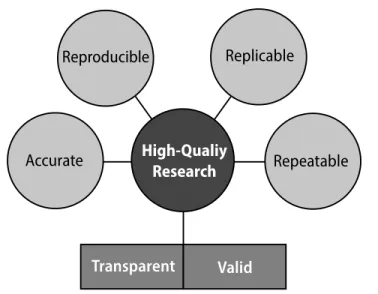
Figure 1 depicts the concepts that we address in this monograph. Our basic premise is that high-quality research is closely associated with concepts such as being accurate, reproducible, replicable, and repeatable—all underpinned by the idea that these scientific endeavors are transparent and valid. Definitions of these concepts are provided in Tables 1 and 2 and the accompanying text.
Figure 1. Key concepts of high-quality research
Reproducible
Accurate
High-Qualiy
Research
Repeatable
Replicable
The most authoritative source that we cite for the definitions of terms is the National Institute of Standards and Technology (NIST; https://www.nist. gov). Across both natural or bench science and the social and policy sciences, NIST offers the most well-known and respected foundation for clarifying and standardizing the lexicon for scientific communication across fields and disciplines. We discuss these key concepts next, relying on NIST when possible; when not, we offer dictionary definitions or cite interpretations or definitions from other scientific experts.
Key Concepts and Related Definitions
For the key concepts presented in Figure 1, Table 1 provides authoritative definitions, some common alternatives that appear to be consistent with NIST definitions, and definitions that are inconsistent with NIST definitions. We rely chiefly on definitions from NIST; others derive from organizations such as the International Union of Pure and Applied Chemistry and other expert groups. We either adopted (i.e., repeat verbatim, identified in Table 1 by quotation marks) or paraphrased definitions from longer discussions in the literature cited at the end of the table. Our goal for the latter step was to make the definitions succinct.
For this monograph, we are using NIST definitions as the standard lexicon. We believe that basing our vocabulary on NIST definitions will be helpful for scientists and researchers working not just in their own fields but also in multidisciplinary teams for whom conflicting definitions can muddle communications.
Quality “It is an encompassing term comprising utility, objectivity, and integrity of research.” a
Utility “means disseminated information is useful to its intended users.” a
Objectivity “means the information is accurate, reliable, and unbiased, and that information products are presented in an accurate, clear, complete, and unbiased manner.” a Integrity “means information is safeguarded from improper access, modification, or destruction.” a
• An attribute of research that is measured against a formal or informal standard and that reflects the degree of excellence (or lack of it) of that research.b
Comment: Consistent with NIST definition.
Accuracy A qualitative term referring to the “closeness of the agreement between the result of a
measurement and the value of the measurand.” c
• “The degree to which the result of a measurement, calculation, or specification conforms to the correct value or a standard.” b
• “The quality or state of being correct or precise.” b
Note: Accuracy implies precision or exactness owing to the care with which the information was assembled.
Comment: Consistent with NIST definition.
Reproducibility The “closeness of the agreement between the results of measurements of the same measurand carried out under changed conditions of measurement” (from an experiment or nonexperimental study using different conditions, such as a different principle of measurement, different method of measurement, different individuals, and different locations).c
• The ability to be reproduced or copied.b • As reproducibility relates to the quality
of an endeavor, it is the “variation in the average measurements of different appraisers who measure the same items using the same measuring equipment.” d Comment: Consistent with NIST definition. “Where independent investigators subject the original data to their own analyses and interpretations. Reproducibility calls for data sets and software to be made available for (1) verifying published findings, (2) conducting alternative analyses of the same data, (3) eliminating uninformed criticisms that do not stand up to existing data, and (4) expediting the interchange of ideas among investigators.” e
Comment: Consistent with NIST definition.
continued
Table 1. Definitions and extensions of key concepts for science and research
Key Concepts
Definitions Adapted from the National Institute of Standards
and Technology (NIST) Definitions in Common Parlance and Their Consistency with NIST Definition Reproducibility
(continued)
• “The ability of a researcher to duplicate the results of a prior study using the same materials and procedures as were used by the original investigator.”f
Consistent with NIST definition if an independent investigator repeats the work. Otherwise, if the same investigator repeats the work, then this is the definition for replicability.
• “The ability to recompute data analytic results given an observed dataset and knowledge of the data analysis pipeline.”g Comment: Consistent with NIST definition if an independent investigator repeats the work. Otherwise, if the same investigator repeats the work, then this is the definition for replicability.
Repeatability The “closeness of agreement between the results of successive measurements of the same measurand carried out under the same conditions of measurement” (measurement procedure, observer, measuring instrument, and location).c
• The closeness of agreement between independent results obtained when the same study is replicated on identical test material or subjects, using the same measurement procedure, same observer, same measuring instrument, the same location and under the same conditions.h Comment: Consistent with NIST definition.
Replicability NIST does not formally address replicability.
NIST does, however, use the term in specific applications without defining it or distinguishing it from repeatability (see above). Replicability can be (or not be) consistent with repeatability. Another distinction is that replicability is the act of repeating exactly, whereas repeatability is a measure of the closeness of the act.
We focus on replicability rather than repeatability because the scientific literature tends to use the former term, but does so in conflicting ways.
• “The ability to obtain an identical result when an experiment is performed under precisely identical conditions.” i Comment: Consistent with implicit NIST definition.
• “The ability of a researcher to duplicate the results of a prior study if the same procedures are followed but new data are collected.” f
Comment: Consistent with implicit NIST definition, assuming it is the original researcher performing the work. • “The chance that an independent
experiment targeting the same scientific question will produce a consistent result.” g Comment: Inconsistent with implicit NIST definition. This is the definition of reproducibility.
(continued)
Replicability
(continued)
• “Replicated by multiple independent investigators using independent data, analytical methods, laboratories, and instruments.” e
Comment: Inconsistent with implicit NIST definition. This is the definition of reproducibility.
Transparency “A matter of showing how you obtained the results being disseminated.” a
• The clarity and completeness of any scientific report, the extent to which intended audiences can readily understand that report, and the extent to which it provides full disclosure and is free of obfuscation or evasion.
Comment: Consistent with NIST definition.
Validity NIST does not formally address validity. The concept is not subsumed in any other concept defined by NIST.
• “The quality of being logically or factually sound.”b
• The extent to which a concept, measurement, or conclusion is well-founded and corresponds accurately to the real world. j
• The ability to achieve accuracy and reproducibility in an experiment or nonexperimental study.
• Whether a scientific claim is true and whether data analysis can be trusted. • The degree to which the tool (e.g., a test
in education; a battery of patient-reported outcomes; an instrument in chemistry) measures what it claims to measure. • In the area of scientific research design
and experimentation, whether a study is able to answer scientifically the questions it is intended to answer.
a NIST, 201668
b English Oxford Living Dictionaries, 201769 c Taylor and Kuyatt, 1994;70 Joint Committee for
Guides in Metrology (JCGM), 201271 d MiC Quality, n.d.72
e Peng et al. 200623
f Bollen et al., 201573 g Leek and Peng, 201574 h McNaught and Wilkinson, 199775 i Casadevall and Fang, 201027
j Scientific Advisory Council of the Medical
Outcomes Trust, 200276
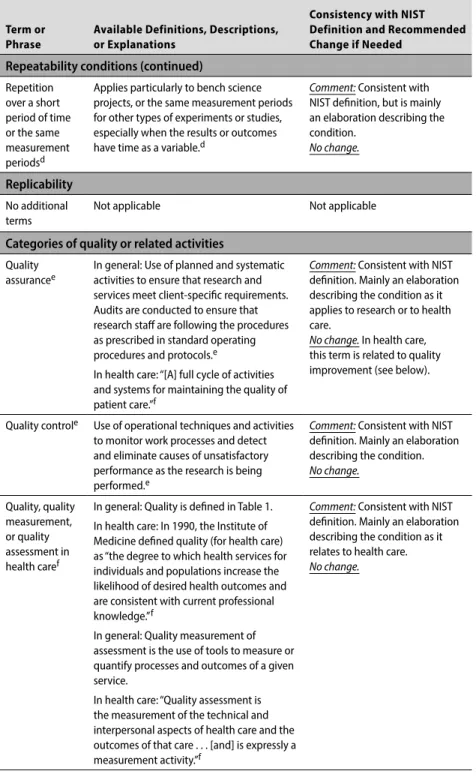
Table 2 documents more thoroughly terms related to aspects of high-quality research (as in Figure 1) and, in particular, reproducibility. We note when these entries are consistent with NIST definitions for a given concept and when they are not; the latter situation arises because, in many cases, the definition for a specific concept is more relevant for a different concept.
Table 2. Taxonomies and new, expanded, or overlapping terms, phrases, or concepts for science and research
Term or
Phrase Available Definitions, Descriptions, or Explanations
Consistency with NIST Definition and Recommended Change if Needed
Reproducibility
Methodological
reproducibilitya “Ability to implement, as as possible, the experimental and exactly computational procedures, with the same data and tools, to obtain the same results.” a
Comment: Inconsistent with NIST
definition. This is the definition of repeatability.
Recommended change: Ability to implement different experimental procedures, with the same or independent data and tools, to obtain the same results. Results
reproducibilitya “The production of corroborating results in a new study [by] having followed the same experimental methods.” a
Comment: Inconsistent with NIST
definition. This is the definition of repeatability.
Recommended change: The
production of corroborating results in a new study by having followed different experimental methods.
Inferential
reproducibilitya “The making of knowledge claims of similar strength from a study replication or reanalysis.” a
Comment: Inconsistent with NIST
definition. This is the definition of repeatability.
Recommended change: The
making of knowledge claims of similar strength between the original and reproduced studies Empirical
reproducibilityb When detailed information is provided “for non-computational empirical scientific experiments” and observations.b
Comment: Consistent with NIST
definition, except that this definition mainly addresses enabling an independent investigator to reproduce an experiment or study.
No change.
Phrase or Explanations Change if Needed
Reproducibility (continued) Statistical
reproducibilityb When detailed information is provided about the choice of statistical tests, model parameters, threshold values, etc.b
Comment: Consistent with NIST
definition, but mainly addresses enabling an independent investigator to reproduce an experiment or study.
No change.
Computational
reproducibilityb When detailed information is provided about code, software, hardware, and implementation details.b
Comment: Consistent with NIST
definition, but mainly addresses enabling an independent investigator to reproduce an experiment or study.
No change.
Analytical reproducibility
When detailed information is provided that enables independent analysts to reproduce the logical, modeling, and computational processes by which the original investigators had drawn their conclusions from a given database.
Comment: Consistent with NIST
definition. No change. Reproducible research when it satisfies transparency criteriac
Providing detailed description of methods, documenting the computer code and software environment, making the analytical data set available to other investigators, and following standard methods of distribution for other investigators to access the software, data, and documentation.c
Comment: Consistent with NIST definition, but is mainly a subcategory that is contingent on transparency.
No change.
Repeatability conditions
Same measurement proceduresd
Can include patients or populations; interventions; control groups or active comparators; and intermediate or final outcomes. They can also include a variety of study design and analytic statistics.d
Comment: Consistent with NIST definition, but is mainly an elaboration describing the condition.
No change.
Same measuring instrumentsd
Can cover a wide range of instruments, from laboratory equipment to patient-reported questionnaires, used under the same conditions.d
Comment: Consistent with NIST definition, but is mainly an elaboration describing the condition.
No change.
Same locationsd Can include laboratories, field sites, health facilities, educational settings, community settings, and homes.d
Comment: Consistent with NIST definition, but is mainly an elaboration describing the condition.
No change.
Table 2. Taxonomies and new, expanded, or overlapping terms, phrases, or concepts for science and research
Term or
Phrase Available Definitions, Descriptions, or Explanations
Consistency with NIST Definition and Recommended Change if Needed
Repeatability conditions (continued)
Repetition over a short period of time or the same measurement periodsd
Applies particularly to bench science projects, or the same measurement periods for other types of experiments or studies, especially when the results or outcomes have time as a variable.d
Comment: Consistent with NIST definition, but is mainly an elaboration describing the condition.
No change.
Replicability
No additional terms
Not applicable Not applicable
Categories of quality or related activities
Quality
assurancee In general: Use of planned and systematic activities to ensure that research and services meet client-specific requirements. Audits are conducted to ensure that research staff are following the procedures as prescribed in standard operating procedures and protocols.e
In health care: “[A] full cycle of activities and systems for maintaining the quality of patient care.”f
Comment: Consistent with NIST
definition. Mainly an elaboration describing the condition as it applies to research or to health care.
No change. In health care, this term is related to quality improvement (see below).
Quality controle Use of operational techniques and activities to monitor work processes and detect and eliminate causes of unsatisfactory performance as the research is being performed.e
Comment: Consistent with NIST
definition. Mainly an elaboration describing the condition.
No change.
Quality, quality measurement, or quality assessment in health caref
In general: Quality is defined in Table 1. In health care: In 1990, the Institute of Medicine defined quality (for health care) as “the degree to which health services for individuals and populations increase the likelihood of desired health outcomes and are consistent with current professional knowledge.” f
In general: Quality measurement of assessment is the use of tools to measure or quantify processes and outcomes of a given service.
In health care: “Quality assessment is the measurement of the technical and interpersonal aspects of health care and the outcomes of that care . . . [and] is expressly a measurement activity.”f
Comment: Consistent with NIST
definition. Mainly an elaboration describing the condition as it relates to health care.
No change.
Phrase or Explanations Change if Needed
Categories of quality or related activities (continued) Quality
improvement; continuous quality improvementg
In general: Use of various formal approaches to analyze performance and implement systematic efforts to improve it.
In health care: "Quality improvement entails continuous efforts to achieve stable and predictable process results, that is, to reduce process variation and improve the outcomes of these processes both for patients and the health care organization and system."g
Comment: Consistent with NIST
definition. Mainly an elaboration describing the condition as it relates to health care.
No change.
Categories of transparent research
Reviewable
researchh “The descriptions of the research methods can be independently assessed and the results judged credible.” h
Comment: Consistent with NIST
definition.
No change.
Replicable
researchh “Tools are made available that would allow one to duplicate the results of the research.” h
Comment: Inconsistent with NIST
definition. This is related more to a basic definition of reproducible research.
Recommended change:
Reproducible research—Making available tools that would allow independent researchers to reproduce the results of their research.
Confirmable
researchh “The main conclusions of the research can be attained independently without the use of software provided by the author.” h
Comment: Not applicable
comparison to NIST definition.
No change.
Auditable
researchh “Sufficient records (including data and software) have been archived so that the research can be defended later if necessary or differences between independent confirmations resolved.” h
Comment: Not applicable
comparison to NIST definition.
No change.
Table 2. Taxonomies and new, expanded, or overlapping terms, phrases, or concepts for science and research
Term or
Phrase Available Definitions, Descriptions, or Explanations
Consistency with NIST Definition and Recommended Change if Needed
Categories of transparent research (continued) Open or
reproducible researchh
“Auditable research made openly available. This comprise[s] well-documented and fully open code and data that are publicly available that would allow [others] to (a) fully audit the [study procedures and computations], (b) replicate and also independently reproduce the results of the research; and (c) extend the results or apply the method to new problems.” h
Comment: Consistent with NIST
definition.
No change.
Verificationh “Checking that the computer code [that the original investigators describe] correctly solves the mathematical problem it claims to solve.” h
Comment: Not applicable
comparison to NIST definition.
No change.
Validationh “Checking that the results of a computer simulation agree with experiments or observations of the phenomenon being studied.” h
Comment: Not applicable
comparison to NIST definition.
No change.
Validationh “Checking that the results of a computer simulation agree with experiments or observations of the phenomenon being studied.” h
Comment: Not applicable
comparison to NIST definition.
No change.
Categories of validity
Content or face validity
Numerous definitions of types of validity are used for measurement.i,j
“Evidence that the domain of an instrument is appropriate relative to its intended use.”
Comment: Not applicable
comparison to NIST definition (i.e., NIST does not have definitions for these categories of validity). No change. Construct validity (e.g., convergent and discriminant validity)
“Evidence that supports a proposed interpretation of scores based on theoretical implications associated with the constructs being measured.”
Comment: Not applicable
comparison to NIST definition (i.e., NIST does not have definitions for these categories of validity). No change. Criterion (e.g., concurrent or predictive) validity
“Evidence that shows the extent to which scores of the instrument are related to a criterion measure.”
Comment: Not applicable
comparison to NIST definition (i.e., NIST does not have definitions for these categories of validity).
No change.
Phrase or Explanations Change if Needed
Categories of validity (continued)
Internal validity: risk of bias in or quality of a study
Generally, the following types of validity are used to characterize studies:
Internal validity: “the extent to which the design and conduct of a study are likely to have prevented bias” k or “the extent to which the results of a study are correct for the circumstances being studied” l Risk of bias: the risk of “a systematic error or deviation from the truth, in results or inferences.” m
Quality: “the extent to which all aspects of a study’s design and conduct can be shown to protect against systematic bias, nonsystematic bias, and inferential error.” n
Comment: Not applicable
comparison to NIST definition (i.e., NIST does not have definitions for these categories of validity).
No change.
External validity: generalizability or applicability of the data from a study to other populations or settings
External validity: “inferences about the extent to which a causal relationship holds over variations in persons, settings, treatments, and outcomes.” o
Applicability: “the extent to which the effects observed in published studies are likely to reflect the expected results when a specific intervention is applied to the population of interest under ‘real-world’ conditions.” p
Comment: Not applicable
comparison to NIST definition (i.e., NIST does not have definitions for these categories of validity).
No change.
NIST = National Institute of Standards and Technology. For NIST definitions, see Table 1. a Goodman et al., 201677
b Stodden, 201478 c Peng et al., 200623
d Taylor and Kuyatt, 1994;70 JCGM, 2012;71
McNaught and Wilkinson, 199775 e RTI International, 201379 f Lohr, 199080
g Knox and Brach, 201381
h Stodden et al., 2012.82 For more details, see
Appendix B.
i Scientific Advisory Committee of the Medical
Outcomes Trust, 200276 j Cella et al., 201583
k Cochrane Collaboration, 200584 l Jüni et al., 200185
m Viswanathan et al., 201286 n Lohr, 200487
Explication of Key Concepts
Referring to Figure 1 and the definitions presented in Tables 1 and 2, we use this section to provide a broader description of these same concepts. Entries in Tables 1 and 2 do not exhaust the possible variations (sometimes minor) in definitions that have emerged over the years; the literature for some concepts (such as quality or validity) is immense.
Whereas common jargon is often vague, with intersecting descriptions of terms, technical definitions have traditionally been developed to bring rigor and specificity that permits distinguishing between terms or concepts. Nevertheless, as presented in Tables 1 and 2, contradictions occur between technical terms because development of their definitions has not been extensively coordinated across disciplines.
Here, therefore, for each term, we begin with its common parlance. Following that, we provide an expanded discussion of technical definitions as applied in the physical, natural and social sciences.
Quality
Quality is an attribute of something—for our purposes, research broadly conceived—that is measured against some kind of formal or informal standard and that reflects the degree of excellence (or lack of it) of that something (i.e., research). Generally speaking, quality is taken to mean high quality. The concept, as applied to health care, similar enterprises (such as education), and manufacturing has a long history. Seminal work on topics such as continuous quality improvement or Six Sigma performance dates from the mid-1990s.90-101
Quality can subsume concepts such as the processes or outcomes of an activity. These specifically include formal programs intended to ensure the quality of something, such as research. Such programs may well entail formal quality assurance (QA) or quality control (QC) activities (which are discussed more in Appendix A).
(Limitations on the scope of our efforts precluded documenting such statutes or regulations outside the United States.)
In some cases, clients supporting nonregulated research projects may also require various kinds of QA systems or activities. Nevertheless, most often investigators who are not conducting research projects for regulatory agencies or purposes are often left to their own discretion on how to implement high-quality research. Not surprisingly, this fact leads to considerable variability in how investigators implement (even similar) studies.
Finally, in the context of reproducible research, quality refers to the internal processes, procedures, and ways of thinking or problem-solving that researchers use in conducting defensible and useful research. The specific expectation is that investigators (and others) can assume that they have produced results that meet two basic criteria: (1) the findings are “correct” or “accurate” (within limits of statistical power, defensible decisions about design, statistics, and interpretations, and measurable limits) and (2) the findings will withstand rigorous scrutiny.
Accuracy
Broadly speaking, accuracy is the condition of being correct or truthful. These terms—accuracy and correctness—are somewhat interchangeable; here, we use accuracy. In common parlance, accuracy implies precision or exactness owing to the care with which the information was assembled. In scientific usage, accuracy refers to the degree to which the result of a measurement, calculation, or specification conforms to a correct value or a well-accepted standard.
Reproducibility
In the broadest terms, reproducibility has numerous (related) connotations. Fundamentally, in common parlance it means making a copy, duplicate, or close imitation of something or to cause something to be recreated. In other words, reproducibility is the ability to obtain the same result, observation, or output from an experiment, a device, a system, a process, or an entire study.102
We return to more specific considerations about reproducible research in this section.
The concept of reproducibility has various technical definitions as well. For instance, in measurement terms it can refer to the extent to which some observation is (or can be) obtained more than once over some (short or long) period of time. (The length of those time periods will differ, perhaps drastically, depending on the effect of time as a variable.) As reproducibility relates to the quality of an endeavor (and especially in considering the quality of health care), it is the “variation in the average measurements of different appraisers who measure the same items using the same measuring equipment.”72 Reproducibility, in the research context, is the ability of a
scientific investigation to be repeated or recreated. In principle, the goal is to produce equivalent (similar, identical) results and interpretations.
A simple example may clarify the difference between reproducibility and repeatability (below). Say the length of a board is measured using a yardstick and determined to be 24 inches in length. The board is measured again but instead with a tape measure and again found to be 24 inches. The measured length of the board has been determined to be the same but using a different tool and thus the measurand (quantity) has been reproduced.
Reproducibility is the closeness of agreement between independent results obtained when carried out under changed measurement conditions.70,71
Changed conditions in an experiment or nonexperimental study can include different settings, different principles of measurement, different methods of measurement, by different individuals, and different locations. The primary aim may be simply to verify the original results. Other goals may be to do the work again so as to expand the number of subjects (i.e., increase sample sizes and thus power); this may be important when the entire body of research results is to be the target of, for example, cumulative meta-analysis.
are not the same thing. A study can be reproducible and still be wrong. (For that matter, a study may be correct yet still not be fully reproducible because of design or other factors.) Nevertheless, scientists generally argue that research that can be independently reproduced is more reliable than research that cannot.
Repeatability
Repeatability is the closeness of agreement between independent results obtained when the same method is replicated on identical test material or subjects and under the same conditions.70,71 As with the example above, a
real-world illustration may help clarify differences in these concepts. In the above example, repeatability would apply to multiple measurements using a yardstick or multiple measurements using a tape measure. Such repeated measures yield information about the extent to which results agree when they are produced by measurements made using the same tool.70,71 The variation
between measurements (whether replicated or reproduced) can be expressed, for example, by a standard deviation.70,71,75
Replicability
Complicating understanding reproducibility is the notion of replicability. The act of making a copy or fully reproducing any one or a combination of components is referred to as replicating it. This term is not precisely interchangeable with reproducibility, but they are related. Among natural and physical scientists, for example, reproducibility refers to achieving the same phenomenon or result when experimental conditions or tools used are varied to some degree. By contrast, replicability is a more rigorous concept, in that it refers to the ability to obtain an identical result when an experiment is performed under precisely identical conditions and using the same tools.
Transparency
In ordinary parlance, transparent or transparency has numerous informal and technical definitions. For our purposes, the concept has three main elements: the clarity and completeness of any report or information about a given topic; the extent to which the report or publication can be readily understood (at least by intended audiences); and the extent to which it provides full disclosure and is free of obfuscation or evasion.
Transparency is achieved through accurately and adequately
communicating what was done. In the research context, this is typically done through a journal publication or technical report (perhaps including online supplemental materials). Thus, transparency can be seen as an enabler for achieving reproducible research.
More specifically, in the context of reproducible research, transparency means that all reports of the investigations are complete, accurate,
understandable, and fully documented. The particulars for documentation may differ by scientific field. For instance, ensuring transparency may entail thorough descriptions of cell lines, animals, or antibodies and other reagents used in biomedical experiments. As another example, transparency requires documenting the steps taken in randomizing (or masking/blinding) subjects, researchers, and outcomes assessors in animal studies, experimental (e.g., clinical) trials, and the like. Federally regulated research, examined more fully in Appendix A, places great emphasis on transparency. Transparency is discussed further in later sections of this monograph, and Appendix B provides more details.
Researchers should be clear about their work, for example, by presenting (or making available) tables of the data that lie behind their graphs and figures. Moreover, investigators may need to make the source data available with easy access for other investigators or QA auditors to use or critique.
Validity
As with all the terms examined in this paper, validity has several connotations. For our purposes, it can be defined as the extent to which a concept,
measurement, or conclusion is well-founded and corresponds accurately to the real world.76,83 The validity of a measurement tool (e.g., a test in education,
Concluding Thoughts
Key Considerations and Challenges
Scientific evidence is strengthened when important findings are reproduced, replicated, or repeated. As we introduced in Chapter 2, two classes of studies are important to distinguish—namely, reproductions and replications. Investigators trying to do “the same” study need to choose between (a) trying to do the same study (or arrive at the same results) under changed conditions—i.e., reproduction, and (b) trying to use the same components of the original study under conditions that truly mimic the original work—i.e., replication. As numerous observers have noted, keeping the distinctions clear is more difficult when people use cognates or different types of words or different parts of speech (nouns, verbs, nominalizations) for the concept they are trying to discuss.
The focus needs to be on the outcomes or results of the measurements or interventions of the original study or trial in question. As the complexity of the system studied increases, the ability to repeat a given study of that system generally decreases. In such cases, reproducibility plays a greater role. (Repeatability is a research effort allied more closely with replicability than reproducibility, and we do not address it further here.) The rest of this chapter examines core elements of work to try to reproduce, if not replicate, scientific endeavors.
Reproducibility and Replicability
Reproducibility
As noted in the previous chapter, reproducibility is the closeness of the agreement between results for a given variable coming from the original work and those coming from assessments of that variable under changed conditions of measurement.27,70,71,75 The later study might be done following the same
changes in other study design elements such as additional doses of medications or different types of environments or locations).70,71,75
Reproducibility is a phenomenon that can be predicted to occur when experimental conditions may differ to some degree; that is to say, reproducibility intrinsically requires changes in some elements of the original investigation. If the research cannot be repeated with precisely the same subjects, then it cannot be replicated but it can be reproduced to determine whether the later study yields the same results or not. Thus, a valid statement that describes a second (or later) study attempting to reproduce the first requires that subsequent investigators specify which conditions of the experiment or study they have changed.
In some social sciences or health research (particularly clinical trials and systematic reviews of such evidence), the construct “PICOTS” can be applied to understand the parameters of the study. PICOTS refers to populations
(patients), interventions,
comparators (which could include placebos or active interventions of various sorts),
outcomes measured, time frames
(for follow-up measurements at the end of the intervention or later follow-up), and
settings.103,104 This framework
is widely used in evidence-based health care practice work (e.g., systematic reviews105 and their
protocols106,107) and can be
applied broadly to much social science and clinical research. Such specificity facilitates designing or describing the conditions for studies attempting to either replicate or reproduce the original investigation. Questions related to PICOTS are listed in Table 3.
Table 3. Core components related to the reproducibility of scientific investigations: A PICOTS framework
What is the chief aim of the study?
What are the main characteristics of the trial or study design?
Who or what are the populations or subjects of interest?
On whom or what are such measurements made?
What are its measurement or data collection tasks?
What measurement instruments are used and by whom are they administered?
What reference standards or population norms for instruments or questionnaires apply?
What are the conditions under which study measurements are done?
When are measurement(s) made?
measure the structure of a chemical, investigators might start first using a mass spectrometer with electron bombardment as the principle of measurement. In a subsequent investigation, they (or others) may measure the structure of the same chemical based on infrared light using an infrared spectrophotometer. Other examples of data collection tasks include questionnaires on health-related quality of life, alternative versions of a standardized test that educational programs use, and outcomes assessed for a community-based domestic violence initiative—all of which could be modified in various ways.
Who makes the measurement? The individuals assessing the intervention or comparator variables and outcomes may be investigators, independent outcomes assessors, subjects or patients, administrators of settings, or various other persons (equipment operators, technicians, proxies for children, and so on). The qualifications for different individuals conducting the measurement may vary, possibly affecting the reproducibility of the outcome.
What measurement instrument(s) do the investigators use? These can range across many types of hardware, devices, data collection forms, and questionnaires of considerable variety. Moreover, instruments can be
administered, as suggested above, by all kinds of persons involved in the study, including the subjects themselves.
What reference standards or population norms apply? These may include measurement standards, such as those obtained from NIST for calibrating a laboratory instrument. They can also be thresholds for (normal vs. abnormal) diagnostic tests or cut points for results from questionnaires or other
instruments completed by schoolchildren, patients, or other subjects.
What are the conditions under which studies deploy measurement
instruments? For example, investigators may need to take into account factors such as effects of temperature on the performance of an instrument, schedules followed by an educational institution, or the workflow of a private physician practice.
consider include, for example, season of the year, day of the week, and time of day. They can also involve the timing of exposure to an intervention and length of exposure to the intervention.
What is the location or setting of the experiment or study? Settings include, for instance, laboratories; health or social services facilities; schools; community or fraternal organizations; communities, neighborhoods, or villages; homes and other residential facilities; and even prisons and jails.
Finally, reproducibility may be expressed quantitatively in terms of the dispersion characteristics of the results—e.g., as a standard deviation.70,71,75
Variance and confidence intervals clarify the uncertainty around estimates of outcomes. In comparing original and later findings to determine whether they agree (such that the later work confirms or supports the earlier work), these statistical elements can be very important for accurately interpreting the “reproduced” study and its findings.
Replicability
As defined in an earlier chapter, replication means that a study conducted by the original investigative team develops new independent data, using the same analytical methods, laboratories, and instruments. The main feature of replication is that the primary elements of the later research are precisely similar to the original experiment, trial, or study.27 The core components of
the research (e.g., the PICOTS) of interest are those outlined in Table 3. Replicability describes the act or ability of obtaining an identical result when an experiment is performed under precisely identical conditions by the original researcher or possibly other scientists. The notion of repeatability, which closely mirrors or can subsume replicability, refers to the closeness of agreement between the results of successive measurements of the same item being measured that are carried out under the same conditions of measurement.75 As with reproducible research, differences in results of
replicated or repeated studies can be expressed quantitatively with dispersion characteristics such as standard deviations.70,71,75
Conceptual, Measurement, and Practical Considerations
are increasing. Researchers trained in several disciplines, such as economics, psychology, political science, business and organizational studies, policy research, and sociology, have been increasingly discussing reproduction (or even replication) in their various research fields (Caren Arbeit, RTI International, personal communication, 2015).
If results from an experiment or study are concordant when conducted by different investigators, then the experiment or study is considered to be successfully reproduced, even if it was never replicated.108 In contrast, if the
results from different investigators differ, myriad possible explanations must be considered. Some of these may relate to differences in methods or protocols. Because of all the possible explanations, which lead to finer distinctions, scientists across the board are more interested in the reproducibility of results than in the precise replication of experiments or studies.27,108
The desirability of showing that later investigations produce the same or similar findings (or even discrepant results) leads to the practical question of how many times researchers should try to reproduce a given study before its results (and conclusions stemming from those results) are accepted.27
Ideally, an experiment or study should be repeated multiple times before it is considered acceptable;27 in practical terms, this scenario is not likely. (Indeed,
no hard-and-fast rules exist for the number of times that an experiment or study should be done over before being accepted.27) Nonetheless, the principle
remains: reproducing an experiment or study provides assurance that the effect or result cannot be attributed to chance alone and that it is not an artifact of the experiment or study that yielded a one-time event.27
Casadevall and Fang explored these issues in greater depth.27 Even though
Why should this question arise? One answer is that confirming results by reproduction (or replication, if feasible) is likely to be inversely proportional to the number of variables in an experiment or study.27 Every variable
contains a certain degree of error. Because error can propagate both linearly and nonlinearly, one may conclude that the more variables involved, the more errors can be expected. This relationship thus reduces the likelihood of replicability of any complex experiment or study.
Costs associated with highly complex experiments and studies raise another practical barrier to successful reproduction or replication. Some scientific research, especially in areas of public health, involves longitudinal studies that are so large and of such great duration that they could not realistically be reproduced. A case in point is the renowned Framingham Heart Study, which has been ongoing since 1948. In some cases, researchers may try to reproduce or replicate findings from important studies using statistical modeling. This strategy may obviate the barriers posed by high costs of major trials or large observational studies but has its own methodologic limitations.
Replication can perhaps be done with tightly controlled laboratory experiments. It is often impossible, however, when studying the behavior of dynamic, complex systems, for example at the intersection of human health, the natural environment, and technological risks.61
When an experiment or study is relatively easily and inexpensively carried out, then it behooves investigators to ascertain the reproducibility or replicability of a result or finding as fully as possible. Some experts argue that the importance of reproducibility increases in proportion to the importance of a result.27 Arguably, experiments or studies that challenge existing beliefs and
assumptions ought to be subjected to greater scrutiny than those fitting within established paradigms.
Barriers to Effective Reproducible Research
often, multiple usages are found in research. For example, researchers (and end users of that research) may use reproducibility in conjunction with one or all of the following:
• the uncertainty of measurements
• the functionality of an instrument or technique (e.g., an instrument for making many different kinds of measurements; a tool, form, or questionnaire for collecting information)
• the observations associated with a given procedure or intervention (i.e., data
• the results obtained from a given algorithm, analysis, statistical test, or modeling activity.
As emphasized in Chapter 2, we are advocating adoption of the formal definition70,71 from the National Institute of Standards and Technology
(NIST), which can be found in Table 1. We believe this will reduce the confusion and permit researchers across many different disciplines to communicate and collaborate with a shared understanding of reproducibility (and related constructs that are different in important ways).
Moreover, as discussed below, research is extremely diverse in the natural, physical, and social sciences. Here, we limit the discussion to investigations involving human beings; however, in theory the issues extend to studies of nonhuman genera and species. Thus, the types of studies that might be subject to requirements of reproducibility range widely across all the following categories:
• laboratory experiments (e.g., biological, chemical, or physical studies with experimental designs)
• clinical trials (e.g., randomized controlled trials of health care interventions)
• nonexperimental (observational) studies of many types, including surveys, longitudinal studies of various sorts (e.g., cohort studies with comparison groups), modeling studies, genome studies, studies based on patient or disease registry data, and the like.
Within these large groupings are a vast array of study designs that need to be taken into account. In short, reproducibility can apply to an extremely diverse universe of research and to situations that run from quite simple to quite complex. Moreover, reproducibility may be ascribed to any one of many integral components that constitute an experiment, trial, or other study.
Reliability and Validity: Related Constructs
Reliability. This concept is typically taken to mean the extent or attribute to which an experiment, measuring procedure, test, system or study yields the same results on repeated trials.76,83 Numerous aspects of reliability can be
invoked, depending on the procedure, instrument, or test. For example, test/ retest reliability is the degree to which responses or answers on a “test” are consistent over time when investigators expect them to remain stable; this is typically assessed with correlation coefficients between results of those tests administered at two points that are relatively close in time, such as 1 week.
Validity. Broadly, validity takes several forms (which are catalogued differently in different fields). As laid out in Table 2, these elements include content (or face) validity, construct validity (e.g., convergent and discriminant validity), and criterion (e.g., concurrent or predictive) validity. Added to these constructs are internal and external validity—respectively, the risk of bias in a study and the generalizability or applicability of the data from a study to other populations, settings, and the like. In some research fields, one or more of these types of validity can be assessed or tested—for example, against findings from an earlier use of a test or instrument or with respect to whether “later” results demonstrate the ability of a predictive model to have predicted accurately the outcome of a given assessment or study.
Linked relationships. Reliability and validity are often considered together in considering the soundness of research and research findings. In basic measurement terms, reliability effectively puts a ceiling on validity: studies or measurement techniques that are not reliable cannot be valid.
not accurate, neither, or both. A method is valid if it is both accurate and reproducible. Likewise, a study is valid if it is both accurate and reproducible.
Additional Reproducibility Concepts
Over the years, scientists have set forth different terms and usages of these concepts. Some are simply alternative terms or phrases, and some are more complex taxonomies for classifying specific types or classes of reproducibility. Table 2 (Chapter 2) presented taxonomies from various experts in the field.
In addition, Goodman et al. recently augmented the word “reproducibility” with three additional descriptors.77Methods reproducibility is considered
to be capturing the experimental and computational procedures, with the same data and tools, to obtain the same results. Results reproducibility is defined as producing corroborating results in a study by having followed the same experimental methods; this is essentially the equivalent of replication. Operationally, however, this goal can be elusive because of problems when studies have substantial random error in any result, which renders difficult concluding that results are “the same.” Finally, inferential reproducibility
reflects the idea of drawing qualitatively similar conclusions from, for example, independent replication of a study or reanalysis of the original study. (It is not the same as reproducing results per se.) Such outcomes may not be possible if different investigators choose different analytic techniques that, even with the same underlying data, produce results potentially consistent with different inferences; in addition, researchers may well draw different conclusions from even the “same” results.
Transparency
Other distinctions about reproducibility are relevant to goals of transparency, documentation, and ultimately the rigor and quality of the research in question. Specifically, these involve empiricism, statistics, computation, and analytics.82,109 We briefly explored some of these concepts in Table 2
(Chapter 2); we elaborate on them here.
Empirical reproducibility refers to the situation in which investigators provide detailed information about the design and conduct of a given study.82