TOWARDS A CRITICAL RACE DISCOURSE FRAMEWORK FOR ADDRESSING DISCIPLINE DISPARITIES FOR AFRICAN AMERICAN STUDENTS
Dena K. Keeling
A dissertation submitted to the faculty at the University of North Carolina at Chapel Hill in partial fulfillment of the requirements for the degree of Doctor of Education in the Educational
Leadership Program in the School of Education.
Chapel Hill 2018
Approved by: Eric Houck
Dana Thompson-Dorsey Gwen Roulhac
iii ABSTRACT
Dena K. Keeling: Towards a Critical Race Discourse Framework for Addressing Discipline Disparities for African American Students
(Under the direction of Eric A. Houck and Dana N. Thompson-Dorsey)
Across the nation, African American students are suspended at rates well above those of Caucasian students and disproportionate to their representation in the total school population (Skiba, Eckes, & Brown, 2009). The pattern of disproportionate suspension rates for African American students has persisted despite over 40 years of research. Although researchers have examined other factors, race is consistently correlated with disproportionate discipline sanctions, particularly for African American students. Solórzano and Yasso (2002) stated that racism and other forms of subordination permeate school structures and processes and that discourse maintains the structures and processes of inequity. The purpose of this study was to explore subtle racial bias as an explanation for racial discipline disparities, through an examination of the discourse of educational leadership and policy in the context of school discipline, and to utilize the analysis towards the end of developing a framework to address the disproportionate
suspension of African American students.
iv
along with district discipline policy serve as the data sources for this critical race discourse analysis. A conceptual framework guides this qualitative study. The framework demonstrates the relationship between subtle racial bias, the discourse of educational leadership and discipline policy, and the enactment of racial discipline disparities for African American students. The study investigates subtle racial bias in discipline within four domains, based on the themes and tenets of critical race theory.
v
To the Lord God, my God. I Chronicles 28:20
You put this work in me and I could not have brought it forth without You, so first and foremost, I thank you and dedicate this back to you.
To my children, Parker, Erin, and Brother
Thank you for the hugs and kisses and prayers when I felt overwhelmed. Thank for being understanding when I needed to write. You three are the reason I did not give up.
I love you so much!
To my mother, Patricia Cauthen
110% I could not have done this without you. Thank you for all your help, your prayers, your support, not just in the completion of this work, but throughout my life. It is because of everything you’ve done that I can even be here. If I haven’t said it enough, know now that I
appreciate you and I love you!
To my father, the good Reverend Dr. Terrence Keeling
Thank you for being a calm in my storm. Thank you for allowing the Lord to use you to talk me through this journey. Thank you for introducing me to social justice before I even knew what that meant. I believe that part of your calling has been to help me understand mine, and for that,
vi
ACKNOWLEDGMENTS
To my advisor, Dr. Dana Thompson Dorsey, thank you for choosing me as your advisee and accompanying me on this journey. You are a woman of great strength and intelligence. You are my role model. Thank you for your encouragement and your guidance throughout this
process.
Dr. Eric Houck, Dr. Tony Watlington, Dr. Gwen Roulhac, and Dr. Jocelyn Glazier, thank you for the time you invested in serving on my dissertation committee and for your helpful feedback. I am especially grateful to you for your enthusiasm about my research. You have no idea how far that went in keeping me encouraged.
Dr. Dana Griffin and Dr. Karen Meadows, thank you for serving on my proposal committee and for helping me determine the course for this research.
Thank you to my family for believing in me more than I believe in myself. Thank you for your constant encouragement, help, laughs, love, and good food. I love you and am thankful for all of you!
Thank you to my friends for being a sounding board and for always reminding me of how close I was to the finish line. I am especially grateful to you for sticking by when I needed to get quiet and only hear the voice of God.
vii
viii PREFACE
ix
TABLE OF CONTENTS
LIST OF TABLES AND FIGURES... xiv
CHAPTER ONE: INTRODUCTION ...1
The Racial Discipline Gap ...1
Statement of the Problem ...2
The impact of discipline disproportionality ...3
Purpose of the Study ...5
Definition of Terms...7
Assumptions and Delimitations ...11
Significance of the Study ...12
Roadmap to the Research...13
CHAPTER TWO: REVIEW OF THE LITERATURE ...14
The Increasing Significance of the Recognition of Race ...14
The Cultural Lens ...15
The Discourse of Educational Leadership ...18
The Discourse of Education: We Must Create Safe Schools ...20
A Critical Race Discourse Analysis Challenges Whiteness as the Standard ...22
The Discourse of Education: Policies are Created and Implemented with Consistency and Uniformity ...27
x
The Discourse of Education: We Need to Address Student Behaviors ...33
A Critical Race Discourse Analysis Challenges Ahistoricism ...35
The Discourse of Education: Education is the Great Equalizer ...41
A Critical Race Discourse Analysis Challenges the Absolute Right to Exclude ...42
CHAPTER THREE: METHODOLOGY ...49
Conceptual Framework ...50
Rationale for Critical Race Discourse Analysis Methodology ...52
The Researcher’s Positionality ...54
State and District Context ...58
Site and Participation Selection ...59
Data Collection ...64
Administrator interviews ...64
Observations ...67
Teacher interviews ...68
Document analysis ...69
Trustworthiness ...69
Data Analysis ...69
Coding ...69
Critical race discourse analysis ...70
CHAPTER FOUR: FINDINGS ...75
School Demographics ...77
xi
Beach...80
Bobby ...81
Herbie ...81
Joe ...81
Nigel ...82
Rick ...82
Rob ...83
Sean ...83
Twinkie ...83
Research Question 1: What shared ideologies, assumptions, and associations about African American students, in the context school discipline, are reflected in the discourse of educational leadership and discipline policy? ...84
The association of African American students with poverty ...84
The assumption: African American students must be “fixed”...86
Research Question 2: How might this discourse be linked to the enactment of racial discipline disparities for African American students? ...90
Whiteness as the standard ...92
The discourse of expectations, standards, and accountability ...93
The association with criminal justice ...98
Assumptions about African American parents/guardians...102
Race neutrality, objectivity, and colorblindness ...103
The assumption of objectivity ...104
Ambiguity of the Code...106
xii
Ahistoricism and context ...112
Disproportionality rationalized as related to the concentration of African American students ...113
Disproportionality in the context of racial inequity ...115
Disproportionality rationalized as related to office discipline referrals ...119
Discipline as property ...124
Rights of disposition ...125
The rights of use and enjoyment ...126
The rights of reputation and status ...130
The absolute right to exclude ...131
Conclusion ...133
CHAPTER FIVE: CONCLUSION...135
Overview of the Research Study ...136
Discussion of the Findings ...138
Negative perceptions and associations ...138
Criminal justice discourse ...140
Ambiguity and discretion ...142
Rationalization of factors other than race ...143
Threat to power, control, and status ...145
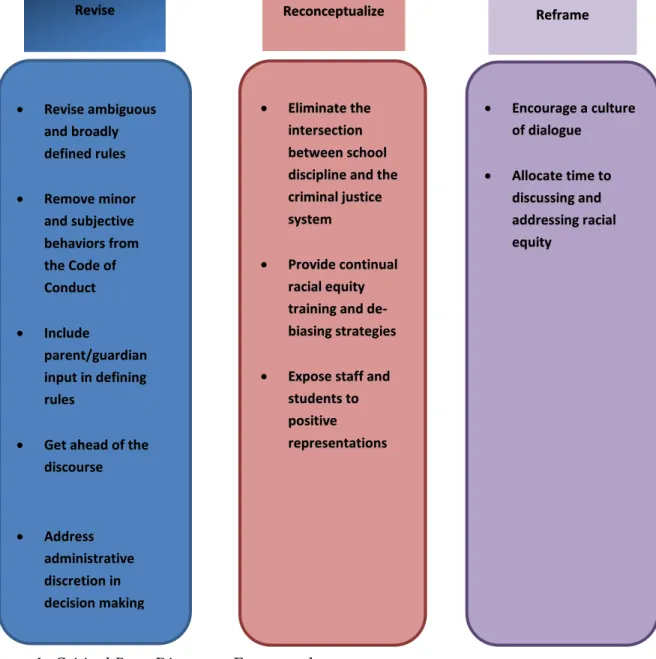
Research Question 3: What contribution can an analysis of the discourse of educational leadership make towards the creation of an analytic framework for addressing racial discipline disparities? ...146
xiii
Action: Revise ambiguous and broadly defined rules and remove
minor and subjective behaviors from the Code of Conduct ...149
Action: Include parents/guardians input as part of the process of defining rules and behaviors ...150
Action: Get ahead of the “Increased revisions means decreased school safety” discourse ...151
Action: Address administrative discretion in the interpretation of discipline policy ...152
Commitment: Reconceptualize the image of African American students ...153
Action: Eliminate the intersection between school discipline and the criminal justice system ...154
Action: Provide continual racial equity training and de-biasing strategies throughout the year ...157
Action: Expose staff and students to positive representations ...158
Commitment: Reframe discipline disproportionality as a racial inequity ...159
Action: Encourage a culture of dialogue ...160
Action: Allocate time to discussing and addressing racial equity ... 161
Implications for Future Research ...162
Limitations of the Study...163
Conclusion and Critical Reflections ...164
APPENDIX A: SCHOOL PRINCIPAL LIFE STORY QUESTIONS ...167
APPENDIX B: SCHOOL PRINCIPAL SEMI-STRUCTURED INTERVIEW QUESTIONS ...168
APPENDIX C: OBSERVATION GUIDE ...170
APPENDIX D: TEACHER SEMI-STRUCTURED INTERVIEW QUESTIONS ...174
xiv
LIST OF TABLES AND FIGURES
Table3.1—Demographic Characteristics of the Participating Schools ...62
Table 3.2—Demographic Characteristics for Participants ...63
Table 3.3—Analytic Framework: Description of Themes of Analysis ...71
Table 3.4—Analytic Framework: Thematic Coding ...73
Table 4.1—Demographic Characteristics for Participanting Schools ... 78
Table 4.2—Demographic Characteristics for Participants ... 79
Table 4.3—Analytic Framework Finding ... 91
Table 4.4—Rules and Consequences ... 107
Figure 1—Critical Race Discourse Framework ... 148
Appendix C Table 1—Participants ... 171
1
CHAPTER ONE: INTRODUCTION The Racial Discipline Gap
In 2014 the US Department of Education’s Office of Civil Rights released findings that while African American children make up 19% of preschool enrollment, they account for 47% of children receiving more than one out-of-school suspension (US Department of Education Office of Civil Rights, 2014). What made this report shocking was the discovery that discipline
disparities begin as early as preschool; however, the overrepresentation of African American students receiving suspensions is not a new finding. In 1975, the Children’s Defense Fund issued a report that contained two key findings. The first finding was in the 1972-1973 school year, over one million students, or 3.7% of all students, were removed from their school district due to school suspensions. The second key finding in the Children’s Defense Fund (1975) report was, in a sample of 2000 school districts in the United States during the 1972-1973 year, one out of every eight African American students was suspended at least once compared to one in every sixteen Caucasian students (Children’s Defense Fund, 1975). The findings brought attention not only to the extensive use of suspensions among school districts, but also to a disparity in the use of suspensions for African American students. While African American students were
2
Despite over 40 years of research, researchers continue to document the pattern of racial disparities in discipline. This study holds the position that in order to disrupt the over 40-year pattern of discipline disparities for African American students, researchers must place race and racial bias at the center of the research analysis. In this chapter, the researcher will illustrate the extent of discipline disparities with national data and detail the impact of disproportionate suspensions, not only for African American students, but also for an educational system which views itself as advancing equity. This chapter will also explain what the researcher sought to accomplish by engaging in this study and will conclude with a discussion of how the study may be relevant to research on discipline disparities and to educational leaders.
Statement of the Problem
3
to three times more likely to be suspended than Caucasian students, while Bloomenthal (2011) found that among middle school students across the country, 28.3% of African American males and 18% of African American females were suspended in 2006 compared to 10% of Caucasian males and 4% of Caucasian females. Blake, Butler, Lewis, and Darensbourg (2011) noted that African American females are more likely to be suspended than Caucasian and Hispanic female students and Raffaele Mendez and Knoff (2003) pointed out that across grade levels, 26% of African American males and 14% of African American females experienced at least one suspension compared to 12% of Caucasian males and 5% of Caucasian females. The disparity cannot be attributed to school size or urban setting (Gregory, Cornell, & Fan, 2011) and it exists despite a school climate of high academic expectations and support.
The impact of discipline disproportionality. Skiba et al. (2009) stated it’s important for school personnel to understand the impact that expulsions and suspension have on African American students. The research shows students who have been suspended are at an increased risk of repeating a grade. Raffaele Mendez (2003) found having more than one suspension in the sixth grade makes students less likely to graduate with their peers, while Bloomenthal (2011) found suspensions are a predictor of dropping out of school later. Being suspended at
disproportionate rates thereby excludes African American students from access to educational opportunities and to achieving academic excellence compared to their peers.
4
(2009) pointed to an increase in the presence of School Resource Officers (SROs) as leading to increased referrals to the juvenile court system and a rise in juveniles being arrested for
nonviolent offenses in schools.
5
(2009) found students suspended in elementary school are more likely to receive office referrals and to be suspended in secondary school. Despite the findings that suspensions appear to be ineffective at achieving the intended goals, the use of suspensions continues to be the primary method of dealing with African American students whose behaviors have been deemed as failing to meet expectations.
Although schools are seen as transmitters of egalitarian principles and education as a means of overcoming inequities, schools are not immune to the reinforcement of racial disparities. Skiba et al. (2009) pointed out that there tends to be inconsistencies in how suspensions are used in schools, even within the same district. Some of the variations can be attributed to the types of behaviors students who attend different schools engage in, yet an equally strong factor lies not within the students themselves, but within school and classroom characteristics. Skiba et al. (2009) went on to conclude school suspensions are better predicted by school culture than student behavior and attitude, and they stated, “one could argue from this finding that if students are interested in reducing their chances of being suspended, they will be better off by transferring to a school with a lower suspension rate than by improving their
attitudes or reducing their misbehavior” (p.3). Education leaders should have a vested interest in examining the role that discipline policies and practices play in creating an environment that contributes to racially disproportionate discipline knowing the negative effects suspensions have on the learning process.
Purpose of the Study
6
the disproportionate suspension of African American students. Although much of the research and literature has examined discipline disparities from the perspective of teachers, discipline disproportionality does not rest solely in African American students being more likely to receive an office referral at the classroom level. It is also that those discipline referrals are more likely to result in suspensions. A number of researchers have acknowledged the lack of focus on school administrators and the effects of unconscious racial bias as gaps in the research on discipline disproportionality. Butler et al. (2012) stated few researcher have conducted empirical research to study unconscious racial bias as the explanation for discipline disparities and Losen (2011) stated unconscious racial bias may affect the choice of discipline policy and practice. Although teachers make disciplinary referrals, school administrators ultimately have the discretion to decide what consequences students receive. African American students are underrepresented in the use of all administrative consequences, except suspensions and expulsions (Skiba et al., 2009). It is the measure of discipline school administrators utilize when they receive office discipline referrals that directly impacts racial discipline disparities. Skiba, Honer, Chung, Rausch, May, and Tobin (2011) pointed out that placing attention on the role of administrative consequences and observing administrative interactions were essential to understanding the variables that contribute to racial disparities in school discipline. This study shifts the focus of the research on discipline disproportionality to school administrators and the subtle racial bias in the structures of school discipline.
7
forms of subtle subordination permeate school structures and processes and that discourse maintains these inequity. Often the discourse is not overt; instead it is unconscious, subtle, and although pervasive, it is seldom investigated (Solórzano, 1997). Van Dijk (1993a) urged researchers engaged in the study of racism to take a closer look at discourse data and discursive aspects to gain more insight into the subtle structures and processes of racism. A conceptual framework guides the study. The framework fuses elements of aversive racism and the themes and tenets of critical race theory with discursive strategies utilized in the critical discourse analysis of racism to demonstrate the relationship between subtle racial bias, educational discourse, and racial discipline disparities for African American students
The research questions for this study seek to explore the discourse of school
administrators and gain an understanding of how this discourse influences disciplinary practices. The research questions are as follows:
1. What shared ideologies, assumptions, and associations about African American students, in the context school discipline, are reflected in the discourse of educational leadership and discipline policy?
2. How might this discourse be linked to the enactment of racial discipline disparities for African American students?
3. What contribution can an analysis of the discourse of educational leadership make towards the creation of an analytic framework for addressing racial discipline disparities?
Definition of Terms
8
involuntary minorities. They classified Black Americans as involuntary minorities because slave owners brought them to America unwillingly. While the use of the term and focus on African American students does not discount the educational inequities faced by other students who may identify as Black, such as those of Caribbean or African descent, I do believe because of a history that has resulted in persistent discrimination against involuntary minorities for
generations (Ogbu & Simons, 1998), the experiences of African American students are different from the experiences of other Black students.
Ahistoricism: Critical race theory insists that an analysis of race and racism in education be placed in historical context (Solórzano, 1997).
Aversive racism theory: The fundamental premise of aversive racism theory is many people consciously support egalitarian principles and do not view themselves as prejudiced, yet harbor unconscious negative feelings and beliefs about African Americans. This conflict in conscious values and unconscious feelings presents in subtle, discriminatory behavior (Gaertner & Dovidio, 2005).
Colorblind, race neutral, objectivity: Colorblind, race neutral, and objectivity are terms utilized in critical race theory which speak to the nonrecognition of race. According to Gotanda (1991), nonrecognition is a technique which appears to be strictly procedural and suggests that a neutral and objective method of decision making is being utilized.
Critical discourse analysis: Critical discourse analysis places the role of discourse at the center of the analysis and seeks to reveal the association between discourse and power (van Dijk, 1993a).
9
discourse analysis as incorporating aspects of critical race methodology and being informed by a discourse analysis of power.
Critical race theory: Critical race theory is a framework for the analysis of race and racism (Lynn & Parker, 2006). First initiated in the legal realm, Ladson-Billings and Tate expanded this theory to examine the role of race and racism in education.
Dominant discourse: The dominant discourse is discourse that is given privileged status over the voice of people of color. The dominant discourse is used to subordinate people of color by advancing shared norms and values and neutrality but that implicitly makes assumptions about people of color based on negative stereotypes (Solórzano & Yasso, 2002).
Enactment: To exercise and reproduce racial inequities. Racial inequities are enacted when discourse is directed against racial minorities and social cognitions support discriminatory practice (van Dijk, 1993a).
Exclusionary discipline: Exclusionary discipline is the removal of students from the educational environment as a consequence for behaving in a manner that breaks school and/or district conduct standards (Noltemeyer & Mcloughlin, 2010). Exclusionary discipline includes in-school suspensions (ISS), out-of-school suspensions (OSS), and expulsions. For this study, exclusionary discipline is limited to in-school and out-of-school suspensions.
Ideologies: Ideologies are a set of beliefs that justify social arrangements. Critical race theorists hold that ideologies are used to justify the dominance of one race over another and to camouflage power and privilege (Solórzano, 1997).
10 communication (van Dijk, 2001).
Relative rate ratio: Compares the proportion of African American students suspended to the proportion of Caucasian students suspended (Porowski, O’Conner, & Pasa, 2014). In this study, a relative rate ratio greater than 1 will indicate discipline disproportionality:
Relative rate ratio for Black students =
(Number of out-of-school suspensions + expulsions for Black students)/Total number of Black students/ (Number of out-of-school suspensions + expulsions for White students)/Total number of White students
Subtle racial bias: Subtle racial bias may be used interchangeable with implicit bias. Implicit bias refers to the unconscious biases that people hold that influence their perception, decision-making and behaviors (Staats, 2014). Implicit biases are defined as being unconscious and outside of the individual’s awareness and control. This researcher utilizes the term subtle racial bias, instead of implicit bias, to denote that racial bias does not occur on a completely unconscious level. Instead, there exists a conscious awareness to make the outward expressions of racial bias subtle.
The absolute right to exclude: A central premise of whiteness as property that gives Whites exclusive rights of possession and use and disposition, as well as the right to exclude those who are not White from these rights and privileges (Harris, 1993).
Whiteness as property: A central tenet of critical race theory that views those who possess white racial identity as beneficiaries of privileges and rights, much like the rights of property ownership (Harris, 1993).
11 (Dixson & Rousseau, 2005).
Assumptions and Delimitations
This study draws from the assumption that if educational leaders and researchers are going to interrupt the pattern of racial discipline disparities, not only must issues of race not be avoided, they must be put at the forefront of the examination. The second assumption is that subtle racial bias exists in the disciplining of African American students and that these subtle racial processes produce, justify, and maintain racial discipline disparities. Although aversive racism theory focuses on the unconscious racial bias of Caucasians, the theory of implicit bias states that no one is immune to unconscious bias. Therefore, the researcher based the study on the assumption that the concepts of aversive racism theory can be extended beyond Caucasians to educational leaders of any racial identity. The study also assumes that an examination of the discourse of school administrators can reveal how subtle racial bias is manifested in the
exclusionary discipline of African American students. Finally, it is assumed that focusing on school administrators and the discourse of exclusionary discipline will provide new insights into both the research on racial discipline disproportionality for African American students and the practice of educational leaders by providing a framework for assessing subtle racial bias as an element of the disciplinary process and challenging the association, assumptions, and ideologies that perpetuate racial discipline inequities.
12
exists regardless of geographic region. The study limits the term ‘exclusionary discipline’ to in-school and out-of-in-school suspensions and does not include expulsions. Although racial
discipline disparities exist in expulsion rates, discipline disproportionality is more evident in the use of suspensions (Noltemeyer & Mcloughlin, 2010).
Significance of the Study
Lamber (1985) pointed out that educational leaders have a duty to recognize that
disproportionate consequences occur due to “structural, historical, or societal racial barriers that have impeded equal achievement” (p. 870). The current research has fallen short of providing educational leaders with an understanding that it is necessary to examine both the racially biased ideologies that may be embedded in the exclusionary disciplinary process, and the role they play in producing, justifying, and maintaining barriers to academic achievement and opportunity access for African American students. Van Dijk (2002) described educational discourse as one of the most influential in society and the discourse of those in educational leadership as playing an integral role in the discursive reproduction of racial inequities. If this is the case, then conducting a study that critically analyzes the discourse of educational leaders could provide a pertinent perspective into the research on racial discipline disparities and new insights on dismantling the over 40-year pattern of discipline disproportionality.
13
sought to provide educational leaders with a framework for analyzing disciplinary structures by challenging assumptions, changing associations, and disrupting the discourse that produces, justifies, and maintains racial discipline disparities for African American students.
Roadmap to the Research
Racial discipline disparities have an impact on both African American students and on the educational system. Despite years of research, discipline disproportionality is still prevalent and persistent for African American students. Although racial bias in the educational
14
CHAPTER TWO: REVIEW OF THE LITERATURE
“Behold! human beings living in a underground den...here they have been from their
childhood...being prevented by the chains from turning round their heads...how could
they see anything but the shadows if they were never allowed to move their
heads?...would they not suppose that they were naming what was actually before
them?...the truth would be literally nothing but the shadows of the images…”
(Plato, 360B.C)
The conceptual framework for the study serves as the organizational structure for the literature review. The framework fuses elements of aversive racism and the themes and tenets of critical race theory with discursive strategies utilized in the critical discourse analysis of racism to demonstrate the relationship between subtle racial bias, educational discourse, and racial discipline disparities for African American students. The researcher will begin with a discussion of a prominent theme in the research and literature on racial discipline disproportionality, then follow with a review of the literature through the lens of the framework.
The Increasing Significance of the Recognition of Race
15
completely unaware of the reality of the existence of that which casts the shadows. While research recommendations and educational interventions suppose they are addressing what is before them, they are actually overlooking the more pervasive issue, the relevance of race in education. Stevenson (2008) stated that a fear exists about discussing racial matters that is reflected in the dodging of racial interpretations in the analysis of social phenomena such as discipline disproportionality. This is not to imply research that espouses quantitative data and cultural differences is not relevant or valid, however the recognition or nonrecognition of racial dynamics affect not only the interpretation of findings, but also the questions that are asked and the research approach that is taken in the examination of processes and outcomes. When there is a refusal or denial of the need to recognize race, issues related to race persist (Davis, Gooden, & Micheaux, 2015). This study is about breaking the chains that stop the breach of the racial discipline gap and disrupting the over 40-year pattern of racial discipline disproportionality by placing race at the center of the discussion on the disciplinary structures and processes of the educational organization.
The Cultural Lens
16
for 34% of school suspensions (Archer, 2010). Another definition of discipline
disproportionality, the relative rate ratio, compares the suspension rate for African American students to the suspension rate for students in other racial/ethnic groups (Porowski et al., 2014). Most often researchers compare the suspension rates for African American students and
Caucasian students. In a study of thirty-five school districts with African American and Caucasian students representing about equal percentages of the population, 44% and 46% respectively, 71% of suspended students were African American compared to 25% of Caucasian students. African American students were suspended or expelled at a rate 250% higher than the Caucasian students (Skiba et al., 2009). Regardless of how researchers define discipline
disproportionality or to which racial/ethnic groups they compare the suspension rates of African American students, African American students continue to experience discipline disparities.
Suspension statistics reported by school districts across the nation give evidence to the argument race plays a role in suspension disproportionately. In Iowa in 2007, African American students received 22% of the suspensions, yet made up only 5% of the state’s student population. The Iowa City Community School District reported that while African American students made up 16% of the district’s student population, they accounted for 59% of the district’s suspensions in the 2010-2011 school year, a rate increase of 49.7% from the year prior. Conversely,
Caucasian students make up 67% of the student population, but accounted for 30% of the suspensions (Daniel, 2011). Twenty percent of the Oakland Unified School District’s African American males were suspended at least once in 2011; a rate six times that of Caucasian males. In Oakland middle schools, one out every three African American males were suspended at least once (Tucker, 2012).
17
disproportionate suspension of African American students tends to analyze the interaction between teachers and students and does so from a predominantly cultural lens. Sheets (1996) studied the interaction of students and teachers from a culture conflict theoretical framework and focused on the conflict that occurs between culturally different teachers and students who have dissimilar goals, behavior patterns, cultural codes, and perceptions. Sheets also discussed how the dissimilarities in both beliefs and attitudes can lead to conflict in the classroom as well as how the tendency to favor those with similar beliefs and attitudes can lead to disparities in discipline for one subgroup over another.
Cultural mismatch theory and the cultural differences model speak to the cultural disconnect between the norms of African American students and the culture of schools which leads to cultural misunderstandings being defined as misbehavior (Best, 2011; Bryan et al., 2012). Sixty-eight percent of the students in the nation’s 100 largest school districts are students of color, while 87% of all teachers are white (Monroe, 2005). Behavioral expectations of the Caucasian middle class culture tend to stand in contrast to the behavior norms of the African American culture. African American students seem to prefer learning environments that
encourage collaboration and cooperation (Wingfield, Reese, & West-Olatanji, 2010) and tend to exhibit Afrocentric cultural behaviors, such as communalism and verve (Bryan et al., 2012). Many teachers do not view these behaviors and learning orientations as positively as the European American values and norms of independence, competition, individualism, future orientation, and ambition (Bryan et al., 2012). As a result, those teachers who align their behavioral expectations with the norms of the Caucasian culture and, as Weinstein, Tomlinson-Clarke and Curran (2004) pointed out, do not have both an understanding of their own
18 behavior of their African American students.
However, the culture of Hispanic students is different than the Caucasian middle class culture of most teachers, yet African American students are twice as likely to be suspended as Hispanic students (Raffaele Mendez & Knoff, 2003). The Southeast Asian culture of Hmong students is vastly different than the Caucasian middle class culture, yet African American students are three times more likely to be suspended than Asian students (Raffaele Mendez & Knoff, 2003). Members of these and other ethnic and racial minorities groups do not
consistently experience the disparities, both in academic achievement and discipline, to a degree equal to African American students. These cultural theories, while relevant, do not account for these systematic variations in disparate outcomes. Instead, the research and literature seems to suggest a racial bias exists in the educational settings against African American students that might be overlooked or explained away when a strictly cultural lens is utilized.
The Discourse of Educational Leadership
19
and discrimination enacted. Bias can either be demonstrated as a tendency to express actions, evaluations, and attitudes more positively toward the in-group or more negatively toward the out-group (Gaertner & Dovidio, 2005). Ahmed (2007) pointed out, however, that regardless of whether there is bias in favor of the in-group or against the out-group, the outcome of differential treatment is the same. If educators are a part of the in-group, who then are members of the out-group?
Cultural capital are those attitudes, behaviors, and characteristics that are highly valued in the educational system (Lareau & Horvat, 2013). Since the educational system is based on Caucasian middle class values, those attitudes, behaviors, and characteristics that coincide with this value system are deemed as cultural capital. Glass (2013) explained that students are sorted into in-group and out-group based on their possession of cultural capital. Lareau and Horvat (1999) indicated that in the education setting, Whiteness is cultural capital and being White is a resource which African American students do not have available to them. As such, African American students become classified as members of the out-group.
While it can be said that all educators are members of the dominant in-group, van Dijk (1993b) pointed out that it is those in leadership within the dominant in-group, whom he refers to as the elites, who play an integral role in the discursive reproduction of racism. Van Dijk
(1993b) went on to state an analysis of their discourse provides a pertinent perspective on how racial disparities are maintained. One way racial disparities in education are maintained is through the myths of the educational organization. According to Lumby and English (2009), myths are “unquestionable assumptions” within the organizations that tell the story of how and why things are the way they are. The myths advance the interests and ideologies of the
20
of the out-group (Lumby & English, 2009). As creators of the myths, it is incumbent upon educational leaders to present the myths with veracity, and to conceal the interests of the organization in maintaining the myths. This presentation of the myths and concealment of the underlying truths is the “dark secret” of educational leadership (Lumby & English, 2009).
There is a discourse that accompanies the dark secret. The purpose of the discourse is to present the desired image of an organization grounded in positive, egalitarian intentions while concealing the intentions of exclusion, power, and self-interests that actually underlie the
organizational myths (Lumby & English, 2009). The discourse is often characterized by the use of repetitive, abstract, quotidian mantras of education, such as “every student succeeds,” or “students who aren’t in the classroom aren’t learning” (Glass, 2013). Educational leaders become so accustomed to saying these mantras, that the discourse and the intentions of the myths become unconscious. The use of mantras by educational leaders become particularly evident when confronted with a view of the organization that is incompatible with the desired image, such as the persistent disproportionate suspension of African American students.
The Discourse of Education: We Must Create Safe Schools
Educational leaders, researchers, and policy makers often link school safety and
discipline. There is an unquestionable assumption that the purpose of suspensions is to preserve safety and order. Students who cannot abide by behavior norms and standards are a danger and must be removed because they pose a risk to the order of the learning environment. This
21
more often than Caucasian students (Bazron, Osher, & Fleischman, 2005; Monroe, 2005), it must be because they pose a disproportionate threat to that safety.
Among the stated purposes of school discipline is to ensure the safety of those in the school (Skiba et al., 2009). The notion of school safety as a pressing issue received national attention when the National Institute of Education released its 1977 report, Violent Schools-Safe Schools. The problem of violent crimes in schools was further exemplified by the 1983 report, A
Nation at Risk, which pointed to inadequate discipline in schools as contributing to the problem
(Sullivan, Larke, & Webb-Hasan, 2010). Zero tolerance policies were initiated in the late 1980s and 1990s as part of the “War on Drugs” (Bloomenthal, 2011). These policies sought to deter drugs, fighting, gang activity, and weapons in schools by imposing mandatory expulsion for these offenses as well as automatic punishment, usually suspension, for other student behaviors that were seen as a threat to the learning environment.
While educational leaders have led many to believe that suspensions are reserved for more severe behaviors and rule violations, in actuality school suspensions are utilized for a wide range of behaviors, the majority of which do not jeopardize school safety. Losen and Skiba (2010) found that 5% of out-of-school suspensions were for serious and dangerous infractions such as weapons and drugs. The other 95% fell into one of two categories, disruption or other. Caucasian students are more likely to engage in more higher level behaviors and severe rule violations (Gregory et al., 2010), while African American students are more often referred for non-violent behavior, such as disrespect and excessive noise (Fenning & Rose, 2007). Further, African American students show no greater propensity for disruptive behavior than their Caucasian peers (Butler et al., 2012; Bloomenthal, 2011).
22
not made schools safer and there was not an increase in school violence as was professed when zero tolerance policies were initiated. Instead, researchers have found schools that utilized more of a locked facility approach with metal detectors, police officers, security guards, and locked doors foster the violence and disorder they are supposed to reduce (Bloomenthal, 2011). Despite the findings that suspensions and punishment focused approaches seem to be counterproductive, or at the very least ineffective at maintaining school safety, exclusionary discipline is the primary consequence utilized with African American students. African American students are
underrepresented in the use of all administrative consequences except suspensions and
expulsions (Skiba et al., 2009). It would seem that suspension and discipline policies have less to do with school safety and more to do with the removal of those who are perceived as violent, criminal, or simply failing to meet the norms of the educational organization.
A Critical Race Discourse Analysis Challenges Whiteness as the Standard
In the analysis of racism, there is a discourse of excuse, which recognizes a negative act has occurred, but attention is placed on circumstances that allow for the diverting of blame from the discriminator to the racial minority group. Critical race theorists draw attention to the varying ways that minority groups are racialized under certain conditions to meet the needs of the dominant society (Delgado & Stefancic, 2001) and seek to critique “the standard.” The mantra of school safety is supported in the educational discourse when stereotypical perceptions and negative associations about African American students are provided as reasoning for
23
One subtle form of expression is through the use of code words in education and in educational research. In the research, teachers sometimes discuss differences in communication styles as a factor in disproportionate office referrals for African American students, but
“communication” may be a code word in a discourse of excuse. Bryant et al. (2012) in their study of student referrals to high school counselors for disruptive behavior, pointed out that the communication styles of African American students are often characterized as rude, loud, and confrontational by teachers, often resulting in disciplinary action. Glass (2013) examined ethnographic accounts of interactions between faculty and students as a way to understand decision-making and to determine the role of cultural capital in the disciplinary process. Glass (2013) made a connection between communication and what is viewed as cultural capital in an educational setting. Glass (2013) discussed how students communicate often led to their being labelled as noncompliant and that miscommunication in the interactions between students and educators resulted in students being viewed as lacking cultural capital. Glass then stated that the question “What do you do with a student like that?“ (2013) should be raised when educators are faced with a student who lacks cultural capital. Lareau and Horvat (1999), in their investigation of the influence of race and social class in shaping family-school relationships, explained that in the educational setting, whiteness is a form of cultural capital. What seems to underlie the question, “What do you do with a student like that,” is “What do educators do with a student who lacks whiteness?”
24
well as the Caucasian teachers demonstrated a shared understanding that “communication” had little to do with actual language and more to do with the perceptions of Caucasian teachers about African American students. Based on the discourse of the Caucasian teachers, “communication” seemed to be one of the code words for not possessing the cultural capital of whiteness or
behaving in a way that demonstrates possessing it. When asked about communication problems, the Caucasian teachers referred to the African American students as “culturally deprived”
(Wynn, 1971, p.13) and stated that because of the communication issues they preferred to teach White students only. Fifty eight percent of those Caucasian teachers who reported behavior issues with African American students perceived that it was linked to communication. None of the African American teachers in Wynn’s study reported that communication issues existed between African American teachers and Caucasian students.
25
threat, combined with denials of White or “Us” deficiencies, reinforces the myth that there is an increased need for disciplinary action towards African American students.
Okonofua and Eberhardt (2015) stated racial stereotypes can heighten sensitivity to behavioral patterns over time and teachers are more likely to punish students who they perceive as repeatedly failing to reach their behavioral expectations. African American students are commonly perceived as being defiant, disruptive, troublemakers, and having negative
demeanors; teachers tend to associate African American students with a history of misbehavior (Gregory & Mosely, 2010; Okonofua & Eberhardt, 2015). Best (2011) found behaviors of African American students are often scrutinized because teachers and administrators believe African American students must be controlled. Similarly, Monroe (2005) found that there is an implicit stereotypical perception that African American students, particularly males, are unlikely to respond to non-punitive measures and require greater control than other students.
26
American students by teachers, none of the studies investigated the perspective of educational leaders or examined the presence of stereotypical associations in discipline policies.
Educational researchers also have to be cognizant of how their use of discourse may further the assumption of stereotypes as truth. Day-Vines and Day-Hairston (2005), in an article that sought to provide school counselors with an understanding of the behaviors of urban African American young males, described the African American male subculture as “the antithesis of healthy prosocial functioning,” which makes “unreasonable and coercive demands on its members,” and that this subculture “promotes physical and sexual prowess and aggression” (p. 238). They went on to state that “school counselors can best assist African American males by providing this information to those who make disciplinary decisions” (Vines & Day-Hairston, 2005, p. 238). Researchers and educators must also be aware of what effect continually witnessing the removal and exclusion of African American students from the learning environment has on how Caucasian students and students of other racial/ethnic groups then perceive African American students.
27
deviant. Students who do not fit this standard are labelled as dangerous and targeted for removal (Fenning & Rose, 2007).
Brown and Beckett (2006) pointed out that there are two trains of thought in the research on student discipline. One is an instructional view, which the researchers see as encompassing a positive preventative approach, and the other is a legal approach. They found discipline policies are often categorized under this second approach and are seen as punitive and reactive.
Mandatory sentencing in the criminal justice system inspired zero tolerance policies. Cobb (2009) cited an increase in SROs, and the discretion school administrators and SROs have in deciding which behavior offenses they refer to the juvenile court system, as reasons for the disproportionate number of African American students being suspended out-of-school. Cobb (2009) went on to state that the increased presence of SROs, who do not receive the training to work in educational settings, has also led to a rise in juveniles being arrested for nonviolent offenses in schools. Bloomenthal (2011) referred to these measures of police officers, metal detectors, and zero tolerance policies that schools use to manage student behavior as a “law-and-order approach” and stated that schools have become intolerant of even minor student behaviors. Perceptions of African American students and associations of “Blackness” become a legitimate reason to punish African American students for not being “White” and school discipline
becomes a vehicle of maintaining and protecting Whiteness. When whiteness is viewed as “normal, natural, and fair,” this ideology operates in the background of policy construction, interpretation, and implementation (Davis et al., 2015).
The Discourse of Education:
Policies are Created and Implemented with Consistency and Uniformity
28
educational leaders. Anyone who violates the policies is suspended, regardless of race, and the decision making of school administrators is consistent and objective. However, there tends to be inconsistencies in how administrators use suspensions in schools, even within the same district (Skiba et al, 2009). Although zero tolerance policies purported to be fair and equitable because of the mandatory enforcement of consequences and the implied colorblind consistency, this consistency did not equate to the same punishment for all students (Sullivan et al., 2010). Zero tolerance has been used with even minor nonviolent offenses (Bloomenthal, 2011) and since its inception, the suspension rate for African American students rose from 6% in 1973 to 15% in 2006. The suspension gap between African American and Caucasian students grew from three percentage points in the 1970’s to ten percentage points in the 2000’s (Losen & Skiba, 2010).
Gregory and Mosely (2010) interviewed teachers on their understanding of the causes of discipline issues and whether students of racial groups had certain disciplinary problems. They found that the majority of teachers provided race neutral responses. Over 80% of teachers linked discipline issues to adolescent development, stating that students were in a normal phase of rebellion. Gregory and Mosely (2010) pointed out that this is a colorblind explanation because it implied that all student behaviors are grouped under “a normal part of adolescent development” and failed to account for racial differences such as the disproportionate suspension rates for African American students and the underrepresentation of other racial groups in suspension data. They also found that teachers believed it was in the best interest of students to not consider race as a factor in discipline.
29
their potential for addressing issues of race in schools. The ISLLC standards have been adopted in over 40 states, yet make no specific mention of race (Davis et al., 2015). Davis et al. (2015) found that, despite the research which shows that race affects the work of educational leaders, the presumption based on the leadership standards is that equitable school leadership could be achieved without the recognitions of race. They pointed out that this is relevant because by failing to recognize race in the discourse of education, educational leaders will be unable to critically confront racist educational policies (Davis et al., 2015).
A Critical Race Discourse Analysis Challenges Race Neutrality
One of the most crucial properties of racism and in the reproduction of inequality is the denial of racism and discrimination; there is no inequality because all people are treated equally and have equal access to resources (van Dijk, 1992). Critical race theory challenges the notion of colorblindness in the decision making process. Colorblindness is a technique that appears to be strictly procedural and suggests administrators are utilizing a neutral and objective method of decision making, but what colorblindness actually does is provides a means of denying racial subordination and the existence of racism (Davis et al., 2015; Gotanda, 1991). Educational leaders that promote a race neutral discourse of school discipline deny the realities of the disparate experiences of African American students. A critical race discourse analysis
investigates not only the stated intent of school discipline as found in the content of discipline codes, but also the unstated and implied intent of school discipline policies by examining such
questions as who do the policies benefit and what are the outcomes of the policies, both intended
and inadvertent.
A critical race discourse analysis investigates racial subordination in policy by
30
disadvantage. There is an amount of discretion in the decision making of school administrators, as opposed to consistency and objectivity, and discipline policies are often ambiguous, as
opposed to being uniform and structured. The decision making of school administrators consists of far more than the mechanical application of policy (Findlay, 2015). There are also
ambiguities in the language of discipline policies that make administrative discretion not only necessary (Findlay, 2015), but also beneficial to school administrators. School administrators often use discipline policies as a way to simply justify their decisions (Brown & Beckett, 2006; Southern Regional Council, 1973). Thornton and Trent (1988) pointed out the increase in suspension and disproportionality rates for African American students following desegregation coincided with increased accountability, higher standards, and new educational policies set by the state of Louisiana. Bloomenthal (2011) also discussed this link between the push out of African American students and the increased emphasis on testing accountability. Fenning and Rose (2007) indicated that the increased pressure on educational leaders to ensure federal mandates are being met has fueled the removal of students who do not fit educational norms. The pushout of African American students serves not only to exclude them from equal access to educational resources, but also to provide a way for schools to maintain their academic standing by removing those they view as academically and socially inept.
Race neutrality hinders the discussion on inequitable outcomes and racial disparities (Davis et al., 2015), but a critical race discourse analysis places race at the center of the analysis on policy outcomes, both the intended as well as the inadvertent outcomes that have a
31
as in the case of seemingly facially race neutral discipline policies, are as harmful as intentional discrimination (Lamber, 1985). Title VI of the Civil Rights Act of 1964 speaks to disparate treatment and disparate impact as a basis for claims of racially discriminatory discipline
practices. Title VI was passed as an enforcement tool for the Fourteenth Amendment and allows federal agencies to deny federal funding to those who discriminate on the basis of race, color, and national origin by denying participation in or the benefits of any programs and activities receiving federal financial assistance (Alexander & Alexander, 2012). While disparate treatment requires a demonstration, with either direct or circumstantial evidence, that school officials intentionally created an inequitable environment, disparate impact only requires evidence that a seemingly neutral discipline policy has a negative impact on African American students. Disparate impact allows for a broader interpretation of the law and can be demonstrated without evidence of intent. In the case of discipline disproportionality, disparate impact is defined as policies and practices which seem racially neutral but which actually have a greater adverse impact on African American students than students of other races. As stated above, there have been an increase in complaints of Title VI violations to the Office of Civil Rights, making
disparate impact a topic worth examining in an analysis of racial discipline disparities.
Losen (2013) offered a three prong approach to the application of disparate impact theory
to the disproportionate suspension of African American students. The first prong, the
determination of whether discipline policies have a racial negative impact on African American
students, and the second prong, whether suspensions are educationally necessary, were discussed
32
suspension rates directly correlate to higher juvenile prison rates for African American students (Cobb, 2009). The researcher also discussed that although the stated purposes of school
discipline includes maintaining an environment conducive to learning (Skiba et al., 2009), in actuality suspensions seem to be counterproductive to this goal. Schools with higher suspension rates tend to have lower test scores than schools with lower suspension rates (Losen & Skiba, 2010; Skiba et al., 2009) and high suspension rates lead to increased dropout rates (Raffaele Mendez, 2003), grade retentions and academic failure (Gregory et al., 2010; Raffaele Mendez & Knoff, 2003), school disengagement (Bryan et al., 2012), negative school climate (Bryan et al., 2012), and negative attitudes towards school by students (Raffaele Mendez & Knoff, 2003). The third prong examines whether there are equally effective and less discriminatory alternatives. This prong seems to suggest an investigation of whether discipline policies offer alternatives to suspensions and whether school administrators utilize these alternatives in their decision making.
33
discipline policies for a response other than suspension, and since few discipline policies require school administrators to utilize proactive responses and instead present the use of suspensions as a “one-size-fits-all” response to any behavior, school administrators have little incentive to temper their disproportionate use of suspensions as a consequence for African American students (Bloomenthal, 2011).
Educational leaders may want to be viewed as objective in their decision making, but background experiences and automatic associations will influence how administrators interpret the behavior of students and whether they identify the situation as one that necessitates
discipline. Subjective judgment in decision making tends to be detrimental for African American students (Gregory et al., 2011). According to Gaertner and Dovidio (2005), the expression of subtle racial bias and discrimination will occur when the guidelines for behavior are vague and the normative structure is ambiguous. While the content of discipline policies may suggest consistency and race neutrality, the ambiguity of discipline policy and unguided discretion in decision making, intended or inadvertently, create a situation that allows for subtle racial bias and discrimination to easily be viewed as justified.
The Discourse of Education: We Need to Address Student Behaviors
In addition to preserving a safe learning environment, another stated purpose of school discipline is to teach students the skills they need to successfully function within school and society (Skiba et al., 2009). This discourse sets forth an image of African American students as having behavioral deficits and the use of educational policies and interventions as needed to address these deficiencies. The American Psychological Association (APA) recommended a three tier approach to ensure school safety and avoid the use of exclusionary discipline
34
prevention, and socio-emotional learning. The second tier is focused on the use of early
screening to identify students that are at risk for violence. The last tier recommended restorative justice and multisystemic therapy, which is a form of family and community based treatment. Restorative justice, along with Schoolwide Positive Behavior Intervention and Support
(SWPBIS) are two interventions that have garnered much of the attention in the research on discipline disproportionality. Restorative justice has its foundation in the criminal justice system. The most often thought of form of restorative justice is the practice of victim-offender mediation, which allows for the rehabilitation of the offender by offering reconciliation to the victim (Simson, 2014). Simson (2014) described restorative justice as an alternative method of dealing with student misbehavior. As such, restorative justice is often utilized from the
standpoint that the student has already engaged in violent or disruptive behavior. The overall premise of SWPBIS is to hold all students to the same standards through the creation of
schoolwide expectations of behaviors, the recognitions of appropriate behavior through the use of incentives, and the consistent enforcement of consequences for inappropriate behavior. SWPBIS is often credited with decreasing overall office discipline referrals and holding all students to the same behavioral standards (Tobin & Vincent, 2011; Vincent, Swain-Bradway, Tobin, & May, 2011). Other interventions suggested in the research on racial discipline
disproportionality include mentoring and anger management. Bloomenthal (2011) described all of these interventions as methods to improve student behavior and reduce student disruptions.
As discussed above, alternatives to suspensions and the use of proactive responses to teach students new behaviors should be investigated and utilized, but as also stated above,
35
of these interventions seem to operate from the assumption of if we address the behaviors and the deficits of African American students, then we will see an overall reduction in suspensions, and decreases in discipline disproportionality for African American students will be the natural progression. Yet none of these interventions have been shown to directly reduce racial discipline disparities for African American students.
In their research on aversive racism, Gaertner and Dovidio (2005) found subtle expressions of racial bias tend to occur when acts of discrimination can be rationalized on the basis of factors other than race. Education leaders and researchers often distract attention away from racial bias and discrimination by suggesting that discipline disproportionality is more closely related to socioeconomics (SES), family and community deficits, or academic issues that lead to student behavioral problems. As such, emphasis is placed on the behavior of African American students, and the problem is identified as being “in” African American students (Gregory & Mosely, 2010). None of these commonly suggested and utilized interventions address racial bias and discrimination in the context of school discipline or in the structure of the educational organization. By keeping the focus off race, educational leaders present discipline disproportionality not as a racial inequity, which must be addressed accordingly, but instead as an unfortunate or inescapable result of student behaviors and factors outside of the control of schools. This discourse advances the justification for the identification of strategies and
interventions to “fix the student” as opposed to acknowledging the educational organization has historically marginalized African American students and then adjusting policies, practices, and the culture of the organization to counter these historical underpinnings.
A Critical Race Discourse Analysis Challenges Ahistoricism
36
legitimate defense for a negative act or discourse toward a racial minority group by presenting that group as deserving of the reaction (van Dijk, 1992) and denying the failure of one’s own policies. In a discourse of justification, the act itself is not denied; what is denied is that the act is negative and unjustified. Educators exhibit justification when they acknowledge that African American students are being suspended, even at disproportionate rates, but they justify these suspensions as being unrelated to race and as the best and/or only way to address the deficiencies in the behavior of African American students. As stated above, poverty is often a code word for African American students, yet as was presented in Chapter One, discipline disproportionality exists for African American students even when socioeconomic indicators are held constant (Skiba et al., 2009). Instead, school suspensions are better predicted by school culture than student behavior and attitude (Skiba et al., 2009). However, in the years following
desegregation, discipline disparities began to be rationalized through a discourse that posited the assumptions that first there were deficiencies within the African American students, their
families, and communities which affected their behavior, and second that schools had to utilize methods such as exclusionary discipline to address these behaviors.
Wynn (1971) interviewed teachers in Bibb County, Georgia, following desegregation to determine if discipline problems were related to perceived communication issues. Fifty-one percent of Caucasian teachers perceived a communication issue existed between Caucasian teachers and African American students, however, most of their responses demonstrated this discourse of deficit and the need for punishment for African American students. The Caucasian teachers in the study referred to African American students as “culturally deprived” and
37
increased punishment for African American students because African American students had not been “taught any respect in their homes,” and their behavior was “related to emotional problems” (Wynn, 1971, p.14).
This discourse continues to be demonstrated in the research today. Glass (2013) discussed the need to “bring [African American] students into compliance,” (Glass, 2013, p. 387). Gregory and Mosely (2010) found in their study that teachers commented that most African American students “don’t know how to act,” and that they “lacked home training to know how to behave appropriately in a formal setting like a classroom” (Gregory & Mosely, 2010, p. 23). Hyland (2005) demonstrated that teachers often have deficit views of African American students, seeing gaps in student achievement as being within the students, their home, or their culture. Even teachers who self-described themselves as effective teachers of African American students inadvertently perpetuate the inequities and issues of power (Hyland, 2005). Hyland (2005) presented some central metaphors of teacher discourse and practices with African American students. One metaphor teachers used was seeing themselves as the helpers. In this metaphor teachers view African American students as needy and incapable, and they see
themselves as the helpers of the less fortunate. Helper teachers may recognize African American students are discriminated against, but often do not recognize their role as benefactors in a
system of racism that patronizes African American students.
38
Council, 1973, p. 3). It became part of the culture of schools to view their system in high regard and find fault with the African American students instead. Caucasian teachers in Wynn’s (1971) study put the onus for the communication issues, as well as the responsibility for acclimation, solely on African American students. Regarding school acclimation, they made such comments as, “I started out as I would with a White class,” “[Negro children] are not willing to cooperate with school regulations,” and “The children are not prepared to have a white teacher.” The discourse of diverting blame from school policies to African American students continues today. Farrell (1984) pointed out that the position of schools has always been for African Americans students to “adapt to the way education (has) always taken place” (Farrell, p. 64), while Glass (2013) discussed the need to “bring [African American] students into compliance,” (p. 387). Vincent et al. (2011) described the goal of School wide Positive Behavior Intervention and Support (SWPBIS) as being “to acculturate them [students] to the school’s institutional order” (p. 177). Gregory and Mosely (2010) found that although teachers did discuss school
organization and culture as contributors to discipline issues, they failed to acknowledge the connection with race and racial bias, and stated instead that discipline was linked to class size. Teachers also did not admit to their own racial bias as a factor in racial discipline disparities.
A critical race discourse analysis recognizes inequities are perpetuated when historical
events are ignored and examines the ways African American students are blamed for disparities
without the educational organization having to be implicated as the source of the problem
(Sullivan et al., 2010). Strong factors for discipline disproportionality lie less within the African