INACCESSIBLE ACCESSIBILITY:
AN ETHNOGRAPHIC ACCOUNT OF DISABILITY AND GLOBALIZATION IN CONTEMPORARY RUSSIA
Cassandra Hartblay
A dissertation submitted to the faculty at the University of North Carolina at Chapel Hill in partial fulfillment of the requirements for the degree of Doctor of Philosophy in the Department
of Anthropology.
Chapel Hill 2015
! ! ! !
Approved by:
ABSTRACT
Cassandra Hartblay: Inaccessible Accessibility:
An Ethnographic Account Of Disability And Globalization In Contemporary Russia (Under the Direction of Michele Rivkin-Fish)
Based on over twelve months of fieldwork in Russia, this dissertation explores what an ethnographic approach offers disability studies as a global, interdisciplinary, justice-oriented field. Focused on the personal, embodied narratives and experiences of five adults with mobility impairments in the regional capital city of Petrozavodsk, the dissertation draws on methods including participant observation, ethnographic interviews, performance ethnography, and analysis of public documents and popular media to trace the ways in which the category of disability is reproduced, stigmatized, and made meaningful in a contemporary postsoviet urban context.
In tracing the ways in which concepts of disability and accessibility move transnational and transculturally as part of global expert cultures, I argue that Russian adults with disabilities expertly negotiate multiple modes of understanding disability, including historically and culturally rooted social stigma; psychosocial, therapeutic, or medicalized approaches; and
reconsolidation in the 2010s. The final section of the dissertation relates how adults with mobility impairments who came of age during the postsoviet transition years enact Russian citizenship and assert social worth in the context of an art therapy group, through online social networks, and in kinship and gender relations.
This work contributes to cultural and medical anthropology, to the ethnography of postsocialism and NGO culture, and to the establishment of a robust anthropology of disability.
ACKNOWLEDGEMENTS
The research for this work was funded by a National Science Foundation Graduate Research Fellowship. I also received funding from the Program in Sexuality Studies at the University of North Carolina at Chapel Hill.
My stay in Petrozavodsk was facilitated through visa sponsorship for Youth Exchange through the Center for Initiatives, and for Cultural and Scientific Ties through the Karelian Center for Gender Research. I am grateful to Larissa Dmitrievna Boichenko of the Karelian Center for Gender Research and the Law School of Petrozavodsk State University for her unwavering support in securing my visa status and championing citizen exchange at a moment when our countries began to lean once again toward antagonism. I am also grateful to other scholars in the city of Petrozavodsk, especially Alexey Volkov and Vitaly Nilov. My ties to Petrozavodsk (as well as my Russian language skills) are entirely due to the enduring influence of Jude Wobst, who established and continues to support the exchange program between Amherst Regional High School in Massachusetts and School Number 17 in Petrozavodsk.
am thankful to all of the members and supporters of the Dobry Den' Theater, especially Oleg Lipovetsky and Lidia Pobedinskaia.
I am grateful to the many professionals in Russian NGOs and government agencies who took the time to talk with me and either provide interviews or direct me toward further resources. Those colleagues at international non-profits who have taken an interest in elements of this project and supported me over the years deserve recognition. I am especially indebted to my colleagues at CEC ArtsLink and the Open World program, who brought me deeper into Russia, and to Kate Lapham at OSI, who took a chance on a young scholar. Ethnography is not possible without the participation of a great number of people, both those who participate formally, and those who buoyed me through my time in Russia with friendship and comradery. Thank you to those who participated in this research project. And thank you to my many friends in
Petrozavodsk and across Russia. Spasibo.
Preliminary findings and components of this work were presented at several academic conferences and workshops, and I am grateful to co-panelists, discussants, and audience members in those settings for their helpful feedback. In this vein, I am especially glad to have found interlocutors in Anastasia Kayiatos, Stevie Peace Larson, Louise Hickman, Marina Bazelevych, Amanda Cachia, Sara Hendren, Aimi Hamraie, and the participants and organizers of the Cripping Development Conference in Prague in the fall of 2013, especially Katerina Kolarova, Robert McRuer, and Chris Chapman. You all changed me.
This work and project came into being thanks to the unwavering faith and support of my committee members at UNC-Chapel Hill Michele Rivkin-Fish, Jocelyn Lim Chua, Arturo
the Social Movements working group, especially Michal Osterweil, Jean Dennison, and Dottie Holland. The performance ethnography crowd, including Marie Garlock, Renee Alexander Craft, and Joseph Megel have made elements of this work possible that could not have existed
TABLE OF CONTENTS LIST!OF!TABLES,!FIGURES,!AND!ILLUSTRATIONS!...!xiii! ! LIST!OF!ABBREVIATIONS!...!xv! ! LIST!OF!GEOGRAPHIC!AND!GEOPOLITICAL!TERMS!...!xvi! ! A!NOTE!ON!DISABILITY!AND!TERMINOLOGY!...!xix! ! A!NOTE!ON!LANGUAGE!AND!RUSSIAN!TRANSLATION!AND!!! TRANSLITERATION!...!xxi! !
PART!I:!DISABILITY!AS!A!GLOBAL!CATEGORY!...!1!
Digital!Performance!...!337! ! RuNet!...!341! ! Networked!Publics!...!343! ! Digital!access:!mobility!as!an!object!of!desire!...!344! ! Talking!Through!Walls:!Digital!Space!...!346! ! Online!All!of!the!Time!...!350! ! Disability,!Digital!Mobility!and!Isolation!...!356! ! Pixelization/Conclusion!...!357! ! CHAPTER!XII:!CRIP!ENGAGEMENTS?:!INTERDEPENDENCE,!!! KINSHIP!AND!SEXUALITY!...!358! ! Crip!Futurity:!Kinship,!Disability,!Feminist!and!Sexuality!Studies!...!362! ! Russian!Kinship!Patterns:!Obfuscated!matrilocality!...!364! ! Kinship!and!In(ter)dependence!...!366! ! Tracing!Disability!&!Kinship!Relations:!Family,!Residence,!!! and!Future!in!Petrozavodsk!...!368! ! Conclusion!...!379! !
LIST OF TABLES, FIGURES, AND ILLUSTRATIONS
!
Figure!1:!Map!of!Russia!with!Petrozavodsk!Marked!...!xxii!
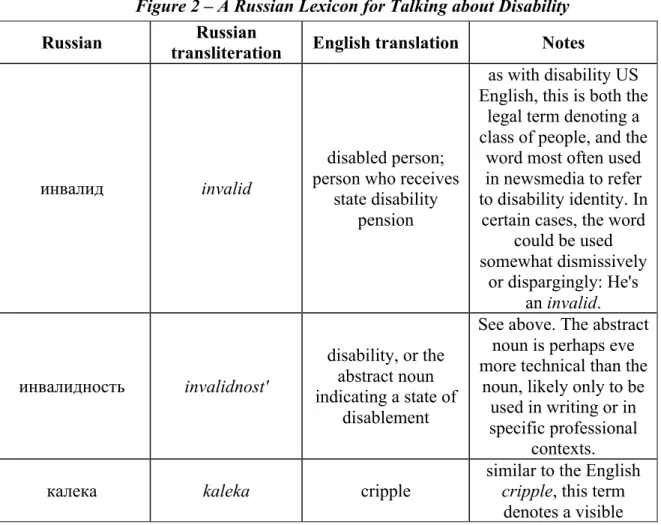
Figure!2:!A!Russian!Lexicon!for!Talking!about!Disability!...!78!
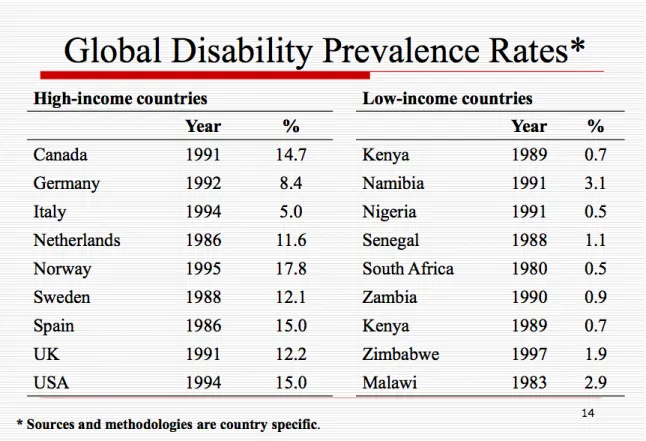
Figure!3:!Global!Disability!Prevalence!Rates!...!95!
Figure!4:!Variation!in!estimates!of!Disability!in!Canada!...!99!
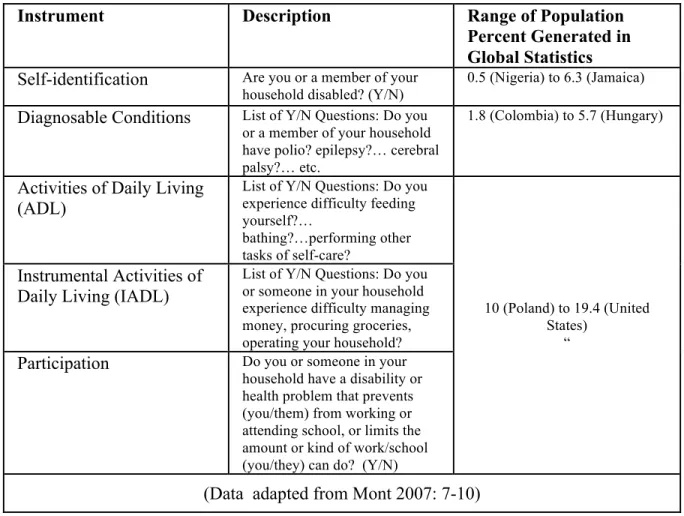
Figure!5:!Survey!Instruments!to!Measure!SelfYReported!!! Disability!and!Impairment!...!100!
Figure 6: Sample questions to elicit prevalence of disability according to a functional model!...!102!
Figure 7: Photo: Household Survey Data Processing!...!108!
Figure 8: Excerpt from the RMLS Adult Questionnaire!...!110!
Figure!9:!Table:!Estimates!of!rates!of!disability!in!Russia!...!113!
Figure 10: Map of Russia's Climactic Zones!...!133!
Figure 11: Map of the Natural Resources of Russia!...!133!
Figure 12: Map of Ethnic Groups of the USSR!...!134!
Figure 13: Map of Karelian Border Region!...!136!
Figure 14: Graphic: Shifting Borders of Finland!...!137!
Figure 15: Photo: Petrozavodsk Train Station!...!140!
Figure 16: Photo: Petrozavodsk neighborhoods!...!140!
Figure 17: Photo: View of Petrozavodsk from across the Lake!...!141!
Figure!18:!Film!Still:!Images!of!replicating!Soviet!Apartment!Buildings!...!160!
Figure!19:!Film!Still:!Opening!Sequence!from!The!Irony!of!Fate!...!161!
Figure 21: Photo: A typical apartment building staircase in Petrozavodsk!...!174!
Figure 22: Photo: A typical entrance doorway in the Drevlyanka region of Petrozavodsk!...!176!
Figure!23:!Meme!Analytics!...!181!
Figure 24: Photo: Neighborhhod Ramp in Petrozavodsk!...!185!
Figure 25: Photo:“Don't Park here, 8am-8pm!”\!...!200!
Figure!26:!Dictionary!definitions!of!the!word!accessible!in!English!...!211!
Figure!27:!Table:!Russian!Words!for!Access!...!237!
Figure!28:!Table:!Theoretical!and!Colloquial!notions!of!Access!...!239!
Figure!29:!Photo!of!Nevskii!Prospekt!in!Petrozavodsk!...!244!
Figure 30: Photo of Petrozavodsk neighborhood roadways!...!244!
Figure 31: Photo: Pothole in Central Petrozavodsk!...!245!
Figure!32:!Photo!of!a!driveway!in!springtime,!speckled!with!potholes!...!245!
Figure 33: Photo of a snow-covered ramp!...!246!
Figure 34: Photo of Alina at the computer!...!347!
LIST OF ABBREVIATIONS
ADL Activities of Daily Living (an abbreviation used in US disability adjudication, e.g. whether or not an impairment results in limited functioning in ADL can be a factor in determining disability status for Social Security purposes; the term is also used in international disability definitions)
CP Cerebral Palsy; used occasionally in rotation with the roughly equivalent Russian diagnosis, DTsP, detskii tserebralnyi paralich.
HRW Human Rights Watch
ICF International Classification of Functioning (the most widely cited system of defining and/or determining disability status that has been proposed for international use; like the DSM, now in several forms)
IMF International Monetary Fund
PWD People with Disabilities (as a category used in public health and int'l aid contexts)
RF The Russian Federation, 1991-present. Currently the world's largest nation state by land area. Rooted in a national mythology of ancient Russian ethnic heritage stretching back to early medieval Kievan Rus'.
RSSR Russian Soviet Socialist Republic; territorial/ethnic corollary to the present day Russian Federation during the Soviet era
TBI Traumatic Brain Injury
UN United Nations
US The United States, or, of or pertaining to policies and social dynamics of The United States of America
LIST OF GEOGRAPHIC AND GEOPOLITICAL TERMS
Eurasia The world's largest landmass, Eurasia encompasses Western Europe, Northern Europe, Russia, Central Asia, China and Mongolia, and Southeast Asia. The Russian Federation is the political unit occupying the largest territory. The history of Eurocentrism holds a strange sway over Russia, which tends to identify as part of Europe, even as it is orientalized by Westerners as mysterious and
impenetrable.
Helsinki The capital of Finland. A historic city surrounded by water on the southern shore of the Finnish peninsula. An eight-to-ten hour drive by car or shuttle bus from Petrozavodsk.
Karelia, or, The Karelian Republic An administrative unit of the Russian Federation similar to a state in the US federal system. However, in the political system of the RF, a republic, unlike an Oblast', has certain unique properties based in a history of being recognized as a territory belonging to a particular ethnic group, in this case, the Karelians, a people historically and linguistically linked to eastern Finns. Today, the population of the Karelian Republic is ethnically majority Russian, mainly due to centrally orchestrated migration during the Soviet era. Today, Russian is the main language of public life in the region, and thanks to the systematic assertion of the Russian language over the Karelian language in education and commerce throughout the Soviet era, very few families continue speak Karelian at home. Aside from folk songs sung on holidays or at festivals, it is very rare to hear Karelian in the city (although one might hear tourists speaking Finnish or migrant workers speaking Uzbek or Kyrgyz). Southern Karelia is also home to an indigenous group known as the Veps people. Borders Finland to the West, Murmansk Oblast' to the North; the White Sea and Arkhangelsk Oblast' to the east; and Vologda Oblast' and Leningrad Oblast' to the south.
Moscow The capital of the Russian Federation and the seat of the federal government. The largest city in Russia and a center of global commerce. Russia's main diplomatic center and the main point of international air traffic into and out of Russia. North America Here I mean the US and Canada (although Mexico is sometimes included in this
group, by invoking North America in places in this dissertation, I mean to reference specifically Anglophone states of the global North)
Petrozavodsk The capital city of the Karelian Republic.
as the end of the Post-Soviet Period, and the start of a new period of Russian history. "The New Russia" or "Putin's New Russia" has often been used to refer to the subsequent years since 2008, but terminology continues to evolve, and in many cases, including in this dissertation, "post-Soviet" is intended to mean, "anything that happened after the dissolution of the Soviet Union in 1991." In critical scholarship, postsoviet or postsocialist is sometimes used as a single word, to denote not a period of time, but a cultural configuration, following similar moves amongst postcolonial scholars (e.g. Chari and Verdery 2008). Nancy Fraser (1997) has argued that with the collapse of the Soviet Union, so too collapse a global left that considered communism and socialism as a viable political solution; she characterizes this post-1991 horizon of political imaginary as a global postsocialism. As such, I have used post-Soviet when I intend to refer to a period of political history, and postsoviet when I intend to refer to a cultural configuration.
The Russian Federation, or, Russia A political state stretching from Kamchatcka and shared seas with Japan in the East, to the North Sea, sharing borders with China, Mongolia, and Kazakhstan to the South, and Central European and Baltic States to the East. The Russian Federation is a Constitutional Democracy. However, since the current Constitution was adopted in 1993, under Putin, systems of regional rule have shifted from electoral selection of regional administration to federal appointment. Vladimir Putin served as President for two terms 2000-2008, then as Prime Minister during the presidency of Dmitry Medvedyev (the
candidate of Putin's party, United Russia) 2008-2012, and again from 2012 to the present. In the spring of 2014, the Russian Federation annexed Crimea, a region of Ukraine, an country that was also a former Soviet Republic. At the time of this writing, militarized warfare over Donetsk and Luhansk provinces of Ukraine was ongoing (see BBC Ukraine Crisis in Maps for an overview).
Saint Petersburg One of the historic capitals of the Russian Empire and the site of the Russian Revolution, still considered to be a capital of cultural life. Formerly known as Leningrad and Petrograd. Six hours from Petrozavodsk by train, slightly less by car.
Sortavala A small city on the Russian side of the Karelian Russian-Finnish border. Known to residents of Petrozavodsk as the seat of various grey and black market
exchanges and social distress related to its status as a border town.
Soviet Society As an abstract phrase, this refers to the social, cultural, and political configuration of daily life during the Soviet Union, e.g. after the establishment of the Soviet Union (1917) and prior to the collapse of the USSR (1991).
revolutionary founders was to work to build a system democratic communism, in which the state would eventually fade away, capitalism would be overthrown, and a worldwide workers union would prevail. State violence, brutal political
A NOTE ON DISABILITY AND TERMINOLOGY
In this dissertation I have employed several conventions of disability studies in discussing and describing embodiment. As in any field, especially those concerned with a liberatory
consciousness, the question of language is both paramount and hotly debated.
Wherever possible, I have used the unmarked category, nondisabled, to designate normative embodiments. This serves as a way of decentering a status quo in which disability is always a deviant or marked identity. Just as critical race theory describes whiteness, gender studies describes masculinity, and queer theory observes the habits and assumptions of a straight majority, disability studies seeks to define and interrogate the boundaries and stability of the category of able-bodiedness or nondisabled identity. By understanding the dominant group as equally socially and culturally constructed as the oppressed group, this move to name the unmarked category is an important political and theoretical move. In disability studies, some scholars call this group "able-bodied" while others, seeking to center disability experience, call it "nondisabled." I use both phrases at different points in the manuscript.
As with other identity-based critical theory, disability studies names the system of oppression that works to maintain a status quo in which people with disabilities are reproduced as an oppressed and stigmatized minority group. Ableism describes the complex social and cultural system that works at interpersonal, institutional, and cultural-political levels of society to
discriminate against people with disabilities, and deny access to resources and prevent full social participation solely on the perceived or purported membership in the group that is called or defined as "disabled". I refer to ableism in this text sometimes as a universal system. However, as with sexism, racism, and heterosexism, a global approach to ableism requires a recognition that different cultural and historical contexts produce and reproduce distinct patterns or systems of ableism, that is, a global disability studies investigates and compares ableisms. This
dissertation can only claim to describe the specific ableism at work in Petrozavodsk in 2012-2013.
Scholars of Disability Studies have, over the past twenty years, suggested and named a variety of models of disability. A key concept that all readers should be aware of is the way that disability studies distinguishes between disability and impairment. According to the social model of disability, impairment describes a particular body and its capabilities, especially a diagnosis or biological state; disability describes a socially and culturally stigmatized perception of an impairment (e.g. Linton 1998). As with the sex/gender distinction in gender studies, scholars disagree about this model. In particular, there is debate about the degree to which impairment can ever exist outside of culture, or whether there are some impairments that regardless of accommodations and social mores, will always be disabling. The environmental model of
disability assumes that a social model must consider the surrounding inanimate world, as well as social and cultural factors, to understand the degree to which someone's impairment might be disabling (e.g. Shakespeare 2006); this is the predominant model in use in transnational disability rights (e.g. Mont 2007). A further mode of conceptualizing disability as relational or
the environment; relational is currently used in critical humanities and social sciences (e.g. Kafer 2013:6), while a transactional approach is a current in critical applied fields such as
occupational science and education (e.g. Cutchin and Dickie 2013:98).
There is also an ongoing disagreement in disability studies regarding preferences for people-first language (e.g. person with a disability, person living with autism) or descriptive adjectives (e.g. disabled person, autistic person). This debate is partially a disagreement between British and American disability activism, in which Americans tend to prefer people first language, and Brits tend to prefer a short descriptor (Phillips 2011); however the neurodiversity movement in the US, as well as crip sensibilities, have in recent years asserted a preference for descriptive adjectives in American English as well. I personally do not come down on either side of this question, and I have used both types of language. This is partly a reflection of the diversity of Russophone terms that I am representing, and partly a desire for a varied vocabulary in a long document. I hope colleagues and activists will perceive my intention to dismantle ableism. Similarly, I have done my best to avoid ableist language ("blind to the problem," "crippled with doubt," etc), or language that assumes limitations/suffering rather than capabilities (e.g. I write "wheelchair-user" rather than "confined to a wheelchair").
When it comes to diagnostic terminology related to disability, I have frequently used
Anglophone words to discuss specific impairments or conditions. However, as is the convention of medical anthropology, I do not assume that the semantic locations of various diagnostic translations are equivalent in English and Russian. For that reason, where applicable, I have included the Russian phrase in question in parentheses or a footnote. Because a great deal of this work concerns the sematic notion of what constitutes disability, or invalidnost' in Russian, I have frequently used the Russian word invalidnost' rather than disability when I am describing
specific situations and discursive events on the ground in Russia. Alternatively, because the lexicon of disability in Russian is rich and varied (as I discuss in Chapter IV), and people frequently refer to a concept of disability or impairment using some other phrase, when quoting one of my Russian interlocutors, I have usually included the exact term they used in
A NOTE ON LANGUAGE AND RUSSIAN TRANSLATION AND TRANSLITERATION
Although I am not a native speaker of Russian, I have received an unusual amount of Russian language instruction for an American of my generation. I began to study Russian in a high school Russian program in the nineth grade. I first travelled to Russia on a month-long high school exchange program in 2002; therefore, by the time I began fieldwork, I had been studying Russian for over ten years. I had placed as an advanced speaker by my first year in College in the US, and continued my immersion as a study abroad student in Russia. I subsequently continued to
develop my Russian skills in a professional capacity as a program coordinator and Russian-to-English translator working for the Open World cultural exchange program with CEC ArtsLink (a role which also immersed me in contemporary Russian culture, hosting and presenting the work of Russian writers and cultural figures including Zakhar Prilepin and Elena Fanailova in New York City from 2007-2009). I am fluent in conversational Russian, although I speak with an accent and the grammatical and lexical oddities of a non-native speaker; however, most Russians could not tell based on my accent alone what my native language might be (guesses included German, Polish, and Lativan as well as English).
Given this level of fluency, I was able to participate fully in social exchange, understand and respond, ask questions, and be understood without a translator, interpreter, or research assistant, though I would occasionally consult friends for proofreading purposes when preparing a
document in Russian (usually the type of documents, such as CVs or official letters, that would warrant a friend's proofreading in English as well). I was also able to conduct independent in-depth fieldwork immediately upon arriving in the field, whereas many anthropology PhD students spend the first months of their fieldwork mastering the language. That said, I am not a linguist or a slavicist by training, and I do not I claim to have the command of Russian that some of my more literary and linguistically-oriented colleagues have in terms of nuance and tone, particularly in my ability to perfectly replicate the variety of native Russian registers of speech, especially in translation from English to Russian. However, I am quite comfortable operating in Russian and I am quite adept at translating Russian into English (a process that, especially in writing, I enjoy).
All translations from the Russian are my own.
Figure 1: Map of Russia with Petrozavodsk Marked
PART I
DISABILITY AS A GLOBAL CATEGORY
!
CHAPTER I INTRODUCTION
“Ability and disability are not so much a matter of the capacities and limitations of bodies as about what we expect from a body at a particular moment and place”
– Rosemarie Garland-Thompson (2005: 83)
“The creation of conceptual boundaries between civil society, the state, and the market– enacted in legal and administrative practices – permits the democratic claim of universal inclusion in public activity, especially in politics, while accomplishing the exclusion of various categories of person.”
– Susan Gal (1997:34)
The building was somewhere over near the bus station, I saw on my Yandex Navigator app. A social worker I met had invited me to come and meet some of the adults with disabilities in the community; she was facilitating an art therapy program that afternoon. She knew that I wanted to invite new people to participate in my ethnographic project. She also thought that this group would be entertained to meet an American who spoke Russian, as she was herself.
In the bus station yard, diesel exhaust billowing and 1980s-issue buses lined up at their gates, I could see that the building I was supposed to go to was just beyond the rear fence, a large brick multiuse building with a Sberbank sign on the side. Cutting through the central terminal, past merchants selling tchotchkes and people smoking next to duffel bags and plaid plastic totes, I walked to that end of the bus yard, only to find that exit on that side was blocked by a chain link fence. I had to circle back to the main entrance and exit onto Chapaev street, and loop around. Worried now that I would be late, I hurried past teenagers and unemployed men clustered at the mashrutka stop, careful not to slip on the thin layer of snow on asphalt.
I was anxious about making a good impression on a group of people that I hoped to get to know. Somehow this anxiety manifested into a sense of urgency and incompetence. I managed to walk in circles around the building several times, not knowing which entrance to use, before phoning the group’s facilitator, and asking her where to go. She told me which entrance to use, and came down to meet me at the door. Climbing the stairs, speckled linoleum underfoot, she said that my timing was good, they had just finished one segment of the afternoon's activities, and there would be time to introduce me before the photography lesson began.
about my age. One woman with dark hair sat in a wheelchair, on the edge of the semi-circle closest to the door, and the rest were perched on an assortment of folding chairs and stools. There didn't seem to be much talking going on - more like waiting.
"You guys," the facilitator announced, speaking in Russian, using an announcement voice, "this is Kah-sahn-DRAH. She is American. She will join our group today. Please, introduce yourselves."
"Sveta." "Max."
A shy, larger woman with dyed red hair whispered, "Sasha."
A man with a boyish face and neatly combed blond hair grinned. It was his turn, but he didn't want to talk. A silver point-and-shoot camera was on a strap around his neck, and he held it in one hand, poised to click.
"That's Vakas," said the facilitator, matter-of-factly. "Volodya, why don't you say your name!?"
"Hello." Said Volodya-Vakas, mischievously mimicking the social worker's matter-of-fact tone.
"Sergei?" asked the facilitator, looking at the next person in the misshapen semi-circle. "I'm Sergei!" He announced, redundantly, holding up his hands and shrugging his shoulders.
"Alina," said the woman in the wheelchair, looking me in the eye.
"Today we're going to take a photography lesson," the facilitator explained to me. "We're just waiting for the photographer to come. Vakas likes photography, right, Vakas?" she asked.
"And poetry. Vakas has also written a book of poetry." She looked at him. Vakas looked at me and nodded. "I like poetry," I said.
Sasha nodded good-naturedly. Max and Sveta looked bored. Alina was watching me with interest.
"And Sergei is a very good musician and singer," the facilitator said, gesturing to Sergei. Sergei looked embarrassed, but pleased, and blushed a little.
"I also like to sing," announced Alina.
I blinked, not sure what to do. I felt my cough coming on, and reached into my pocket for a cough drop.
"Take your coat off, get comfortable!" said Alina. A fuss ensued while another chair was produced. I took the pause to pop the cough drop into my mouth. I took a swig of water from the small water bottle I had in my bag, and hoped that I wouldn't have a coughing fit.
The chair landed in front of me, and I was instructed to put my coat on it and sit down. I did so, hanging my shoulder bag over the back as well.
"So, Cassandra, tell us about yourself," instructed the facilitator. "Yes, tell us," said Alina.
"I'd really like to ask all of you," I continued, "if any of you would like to participate in my project. I'd like to get to know, and to conduct some interviews about your lives --" I managed. And then I began to cough.
And I kept coughing.
And coughing. And my eyes were watering, they felt like they were bulging out, and I just couldn't stop. It was the deep, dry kind of cough, coming from far down in my aggrieved bronchi. I blinked and tried to swallow, and there were more coughs coming. I was mortified that the whole group had to watch me in such a state of utter collapse, of inability to take command over my body. But there was nothing that I could do. I kept coughing, trying not to spit the coughdrop out and send it flying across the room.
"Excuse me, I can't stop coughing - I've been sick!" I said, grabbing my shoulder bag and heading into the hall through the studio's open door.
After another thirty seconds of noisy and painful aggression, the cough subsided, and I sipped some water. They could all hear me coughing. I took a tissue from my bag, and blotted my eyes. I took a few deep breaths. Another mini cough welled up, and I briefly indulged it, before taking another swig of water, regaining control, and returning to the room.
"I'm sorry, please excuse me," I said, "I'm a little sick. I didn't know a person could cough so much."
"It's okay," Alina said, earnestly. "People cough."
In a way, it was fitting that this was my first introduction to the group of adults with disabilities who would become some of my closest collaborators in the coming months. After all, I had come to Petrozavodsk to think about disability, about what happens to people when their bodies don't fit into a situation or into broad social expectations. Of course, there are people whose bodies don't "fit" in any location. So why did I chose Petrozavodsk?
I had become curious about Russian and post-Soviet understandings of disability. According to disability theorists, disability, like gender or race, is a culturally constructed
category that depends on social, political, medical, and legal norms to make sense. If this was the case, then disability, or at least experiences of disability would be different across cultural
settings. In writing about the oppression and discrimination against people with disabilities in contemporary society, disability studies scholars often point to capitalism as a core cause or root problem that leads to the devaluing of people with disabilities. Yet, people with disabilities were also oppressed - frequently incarcerated in institutions or hidden from public view by family members - in conditions of socialism as they existed in the Soviet Union (Phillips 2009). So in this sense, the political configuration of disability stigma produced in Soviet socialism might be different from that in capitalism. And the changing cultural circumstances of in Russia since the collapse of the Soviet Union has led to changes in daily life; yet disability stigma continues to exist. What does it mean to have a disability in postsoviet Russia?
A few of the characters from this group of adults with disabilities would later become the core of my ethnographic study. Alina, Sergei, and Vakas - more than anyone else in
for tea, and invested in the project of telling the story of coming of age with a disability in Petrozavodsk.
I don't know if my vulnerability in that moment of introduction had anything at all to do with this troika's decision to trust me. In fact, they were quite used to strangers - foreigners and locals alike, mostly nondisabled - appearing out of nowhere and proposing "collaborative" projects. So in a way, my announcement that I was interested in writing a book with and about them was part of a long chain of well-intentioned outsiders showing up with the intention of doing something "for" or "with" young people with disabilities.
Alina, Vakas, and Sergei - along with a few other characters who will appear later on - all grew up in the city of Petrozavodsk during the 1980s and 1990s, and came into adulthood in the early 2000s. From the outside, in international discourse, the 1990s are commonly thought of as the "transition" years, the time when the Russian Federation, following the collapse of the Soviet Union in 1991, was the object of immense economic, political, and social upheaval, as the economy shifted from a centrally planned system in which all goods and services were
provisioned by the state, to a market capitalism model, in which the state was still responsible for some social benefits and entitlements, but commerce depended on business and
entrepreneurship. According to the ideological orientation of the time, international organizations - from aid agencies sponsored by foreign governments (like USAid and its equivalent
organizations from Finland, Sweden, Germany, and Switzerland) to non-governmental
to fully succeed, a new civil sphere would need to emerge that would offer a basis from which entrepreneurship and commerce could emerge.
In this schema, the Russian third sector, or non-profit, non-governmental organizations - those "voluntary associations" that support social interests and are said to make up the stuff of a civil society - were there target of a great deal of foreign aid.
Or, as Meri Kulmala has shown in her study of non-profit organizations in the
neighboring Karelian city of Sortavala, the savviest mode of negotiating this shifting landscape was to keep one foot in Russian state funding and one foot in independent non-profits. The normative model of State/Civic/Private spheres is a manner of understanding the source of funding, and the character of and relative attributes, stregnths, and weaknesses of a given opportunity, but to an organizers trying to create resources for herself, her family, and
community members with shared interests, this heuristic was besides the point. Organizations frequently sought funding from both foreign and domestic state sources, and professionals often wore multiple hats, working during business hours for a state institution - an afterschool cultural program, for instance - and on weekends and in the summer as an organizers for a small non-profit.
In this climate, a network of small non-profit organizations serving children with disabilities and their families emerged during the 1990s as a way for parents to cope with the responsibilities of raising children with medical and social needs that surpassed those of their peers. What started out as a one-room organization for parents in the early 1990s later became a resource center and lobbying network; some parents branched off to form a research organization that conducted academic policy studies on the needs of children with disabilities and their
supporters into professional roles in a reconsolidating state system of social services that was beginning to emerge from about 2008 and onward.
For the children growing up and coming of age in this environment, this meant that new projects and opportunities to engage with new people and new methodologies might pop up at any time. By the time I showed up at the meeting of the art therapy group in 2012, Sergei, Alina, and Vakas had already participated in a wide variety of "projects" [proekti]. As age mates who were often included in a social grouping in terms of the character of their disabilities - significant physical impairments and high intelligence. At the same time that they recognized one another as part of a shared cohort, they were not close friends, per se. Outside of projects, they rarely sought out one another's company, or even spent much time talking with one another online. Yet they were a cohort in the sense that they had a long history of shared experiences and some shared interests, particularly projects having to do with arts and culture. Over the course of the time that I spent with them and the other members of the art therapy group, this troika tended to back each other up and side with one another while more or less ignoring or avoiding extended interactions with other participants (whom they mostly perceived as either having lower intelligence, or being of a different age cohort).
magazine, for which they all created the content (and which prompted another member of their loose cohort, Aiina, to pursue a career in journalism). Vakas, when I met him was already the author of one chapbook of poetry, and subsequently published a second book of poetry and an additional book of memoir-type writing.
I also approached this group as a peer. Unlike the nondisabled social workers and psychologists - also our agemates - who were charged with organizing and facilitating the art therapy group (and who were paid in an official capacity to do so), I had no official status. Of course, I did have an official visa status: first through the local Center for Initiatives under the category of Youth Exchange, and subsequently through the regional Center for Gender Studies under the category of Cultural and Scientific Ties. But these were loose affiliations, and my project was independent. They knew that my stay in Russia was funded by a grant from the US government to research a book, but the fact that I made no pretense toward and "rehabilitative" goal set me and my project apart.
Which is not to say that I didn't arrive with my own agendas. My identity back home as a scholar of anthropology and feminist disability studies at once melted away without a frame of reference that made those concepts make sense, and created moments of absurdity and ridicule when I brought up ideas or categories that were contextually foreign. This strangeness in a way made me a novel interlocutor. At times, I found that I was asking questions or steering
In any case, what ultimately convinced this troika to accept me as their own remains unclear to me, and perhaps also ultimately to them. After that first meeting, I made a habit of attending the weekly meetings of the art therapy group each Wednesday. Following the
photography lesson, the group met in a different location, and studying drawing, then theatrical diction; the program concluded with the presentation of a performance of Pushkin poetry for friends and family.
I didn't set out to study any particular type of disability. Instead, I was interested in
disability as a category. The art therapy group included people with mobility impairments as well as adults with learning disabilities. In my preparation for this research, I had worked long and hard to consider the special challenges of doing research among people with intellectual disabilities or cognitive differences. I had reviewed literature, considered methodologies, and devised strategies. However, as an accident of fieldwork circumstance, the group of people whom I became most closely acquainted with were all identified by the Russian
medical-rehabilitative category oporniki - people with disorders of the muscular-skeletal system. This had to do with the shape of social networks: once I had come to know Vakas and Alina and Sergei, knowing them helped me to demonstrate insider status to others who had grown up attending similar programs and schools. Although I did meet and interview adults with learning
Situating this work
!
In this dissertation, I start from a question about how to understand disability as a social status and identity in Russia today. I investigate the globalization of disability as a category, and offer theoretical observations about how disability, as a status of the welfare state and the global human rights apparatus, attenuates personhood and social identity. I draw on my interlocutor's narratives to describe their own social worlds. I find that their experiences of social exclusion and in/access illuminate the ways in which disability is configured by transnational social, political, and legal dynamics. Their personal histories offer an account of education and social programming that sought to facilitate inclusion in the context of the rapidly changing social and political milieu of the immediate postsoviet years, contributing an as yet unexplored perspective on the development discourses more frequently called "transition" or "democratization" in Russia since the fall of the Soviet Union. Global discourses about disability access and social inclusion take on specific meanings in Russian society, which has particular configurations of material culture and the physical world. The combination of personal accounts also contributes to scholarly questions about how people with disabilities understand themselves and their social roles, and about the liberatory consciousness that prompts some people with disabilities to become activists.
patterns which reproduce disability stigma or combat it are not configured in the same way that they are elsewhere.
I argue that in order to understand the challenges facing people with disabilities in the city of Petrozavodsk, scholarship must attend to the ways that the semantic location of disability and stigma are produced in locally specific ways, attending to the specificities of the material world and social practices of the former Soviet Union. I find that disability issues dovetail with barriers to civic participation for all citizens in contemporary Russia in a manner that is not immediately obvious to a Western observer.
An array of factors reproduces and normalizes the social exclusion and impoverishment of people with disabilities in Russia. These include social stigma, a history of segregation in education and labor, and infrastructural barriers1. Many development and democratization projects in the immediate post-Soviet era took on the issue of social inclusion for people with disabilities. Seeking to apply Western frameworks of access and inclusion to the Russian context, these organizations built a patchwork system of social supports for people with
disabilities; but, concepts of personal independence and minority rights did not translate easily to the Russian context. Now, Putin's reconsolidation of power under federal jurisdiction and
disincentives for non-profits to seek foreign funding since 2008 have left many of those organizations defunct, while federally-funded municipal social work agencies reestablish primacy in the provision of social services. This dissertation relates this history through the
!!!!!!!!!!!!!!!!!!!!!!!!!!!!!!!!!!!!!!!!!!!!!!!!!!!!!!!! !
1 Human Rights Watch. 2013. Barriers Everywhere: Lack of Accessibility for People with Disabilities in Russia.
Romanov, P. V, and Elena Iarskaia-Smirnova. 2006. Politika invalidnosti: sotsial’noe grazhdanstvo invalidov v sovremennoi Rossii. Saratov: Nauchnaia kniga.
personal accounts of my interlocutors, adults with disabilities like the troika of Alina, Sergei, and Vakas, who, now in their 30s, came of age during this era of shifting civic resources and
changing concepts of what constitutes social accessibility and participation.
In choosing this approach to the subject, I argue that ethnography is particularly suited to elucidate insider perspectives that shed light on minority identity and civil society in Russia. Building on a tradition of feminist ethnography of the body, feminist and queer theory of minority political participation, and ethnographic accounts of NGO culture in the postsoviet arena2, my work contributes to a transnational social science approach to disability studies. I have found Anna Tsing's concept of friction in global connection particularly useful in thinking through the ways that objects - like ramps and family apartments - and ideas - like disability and access - that are part of universalizing projects, are actually changed and recreated in local contexts.
In many ways, this is a document that attempts to tell the story of a particular community. At the same time, I offer it as a contribution to anthropological and disability studies scholarship. In particular, I seek to contribute to the development of a robust critical anthropology of
disability as a subfield of our discipline. I also aim to contribute new insights to ongoing conversations in disability studies about how disability theory and disability advocacy can be globalized without participating in ideological colonialism that always privileges a Euroamerican perspective. In an applied or engaged sense, through this work I hope to address practitioners,
!!!!!!!!!!!!!!!!!!!!!!!!!!!!!!!!!!!!!!!!!!!!!!!!!!!!!!!! !
2 Essig, Laurie. 1999. Queer in Russia: A Story of Sex, Self, and the Other. Durham: Duke University Press.
theorists, and activists working to create and foster programming and policies that contribute to more just and inclusive societies for people with disabilities cross-culturally.
In addition to traditional scholarship, as part of my ethnographic methodology, I use multimedia methods including photography and social theater projects to create ethnographic outputs that are accessible and valuable to collaborators in the field as well as to scholars and international disability advocates. I urge the reader to explore some of these complimentary works that are based in the same research.
Major themes: Personhood and Citizenship, Infrastructure and Performance
!
My first impressions of Vakas, Sergei, and Alina during our initial introduction at the photographers studio would grow and take on shades of meaning as I got to know them over the next several months, and subsequently, stayed in touch online after my return to the United States. Their respective personalities, life circumstances, family relationships, and personal histories took shape through our shared experience of participating in the art therapy project, in interviews and visits in their homes and mine, through stories shared with mutual acquaintances, and other meetings around the city. While this depth of perspective and the friendships that we formed is not unusual as an ethnographic encounter, my intention to represent each of them as a unique person, on their own terms, runs counter to so much conversation about "disability" which foregrounds the aggregate or locates "people with disabilities" as a uniform group with shared interests and needs.
"complexes," a sort of psychological barrier to social life. Particularly in Russia, where adult women are relied upon to run the home space, as well as to be conventionally attractive to men in order to be worthy of social respect, and therefore self-esteem, to be a woman with a disability compromised Alina's capacity to participate in some of the expectations of womanhood [see Phillips 2012]. But Alina suffered no crisis of self-respect. Over the course of my fieldwork, I often observed Alina working to shrug off the perceptions of others who, through their actions or ways of relating to her, implied that she ought to have low self-esteem.
Shortly after my first encounter with the group at the photographer's studio, I recorded the following entry in my field notes journal:
As we watched the woman demonstrate the different manners in which to light a still life for photography - front on, from the side, from the rear, and the varying levels of contrast, shadow that ensue from hard or soft lighting - everyone sat transfixed, now and then shifting in their seats to take a better look at how the change in light had changed the visual. Here, just before them was literally a lesson in how to shift perception via manipulation of material surroundings. We all wanted to control the light. When it came time for the teacher to show how to light a portrait - grey background, soft fore light, shaded side lamp, opposite light - Alina readily volunteered to be the model.
"I am always the one who closes my eyes in pictures," she had said, and joked that she would be the perfect subject for those photographers who for artistic reasons prefer to shoot only in natural light.
She slowly moved to undo the brakes on her wheelchair, and then asked the facilitator - who was across the room - to help her move into place. Alina's malomobilnost' then translated interestingly, for once she was set, she was more or less in place. She moved her head and hands with ease, but to reposition the lighting, the photographer moved the actual lamp bases, rather than asking Alina to shift her chair again.
Perhaps to Alina's disappointment, the flash with all this equipment was even brighter and more shocking than a regular flash, and she visibly jumped at the first one. "It takes people awhile to get used to the flash, but most people eventually adjust," the photographer said to the group, as she made adjustments. "Am I right, that you haven't had your photo taken this way before?" she asked. Alina, who nodded, and seemed lost in thought as if trying to work out what she should do with herself in this position as subject. There was only time for about two minutes worth of shots, and the photographer eventually directed Alina to first look at the softbox, then to look at the lens, and to smile. Smiling, Alina has dimples. These images were the best that were captured. The group was surprised to learn that usually for a really good shoot the subject sits for 1-2 hours. "You can see why," the photographer said.
display appropriate conduct for an unfamiliar role, but a role that she had seen portrayed time and again and in the media, but rarely by a bearer of a disabled body.
As I came to know Alina better, I struggled to understand her point of view. She remains the most difficult of my interlocutors to describe in writing, perhaps because her sense of self and other people's perception of her are so divergent. Unlike Vakas and Sergei, she resists internalized oppression. But, unemployed and very poor, she does not situate herself in the community as an activist or public figure, and her family seems at first, from a Western perspective, to have very little cultural capital. As I came to better understand the ways that competing logics of moral personhood - Soviet, liberal democratic, therapeutic, and New Russian - circulated and intertwined in Petrozavodsk, I came to see Alina as a savvy cultural actor, adept at moving between competing frames of reference. I found that it was impossible to describe the complexity of how Russians with disabilities narrated and performed their social roles without contextualizing broader global dynamics and the history of the postsoviet era.
Medical anthropology frequently uses the notion of personhood as a way to consider how individual people might be perceived by others around them as social actors. In this paradigm, full personhood is a term that anthropologists use to denote the characteristic of some people to be perceived as not only human, but as social equals and actors. Meanwhile, compromised personhood is a way that anthropologists describe situations in which particular groups of people who have been racialized, medicalized, or in some other way cast as deviant or separate from a social whole. In these accounts, personhood is often related to citizenship, or the ways in which a person might be considered by others to be privy to and participate in the rights and
Disability stigma - a social phenomenon in Russia and elsewhere - casts people with disabilities as somehow outside of or situated in opposition to an imagined norm. Stigma, as described by Irving Goffman, is the mode by which some people are produced as and treated as deviant. According to Goffman a broad array of categories deemed socially undesirable in a given culture might be cast as deviant; in his description of the US in the mid-twentieth century, this included racialized subjects, as well as those deemed sexually deviant, felons or the
otherwise incarcerated or formerly incarcerated, immigrants, and the chronically ill and disabled. Subsequently, Lennard Davis has described the ways in which the very idea of deviance relies on a logic of mathematical statistics. Davis, a disability theorist, argues that the invention of
statistics in fact created the linguistic possibility in Euroamerican discourse to conceptualize a norm and, in turn, a normal person. That is, before the advent of statistics in the mid-1800s, or population level thinking (which James C. Scott also describes), the possibility of
conceptualizing normal did not yet exist.
in relation to what queer theorists name compulsory heterosexuality suggests that in order to access the full rights and possibilities of citizenship and social personhood, a person must be or present socially as both able-bodied and straight. The normal body, he argues, does not exist without the disabled body; disability as a category in part shores up the stance of the nondisabled as part of the dominant and privileged group. Moreover, McRuer argues, the midcentury
American mode of heterosexuality has subsequently become more flexible. Where once one was heterosexual unless proven otherwise, contemporary Euroamerican cultural configurations often require a straight person to "come out as straight" and to associate with and configure oneself in relation to, rather than in stark opposition to homosexuality.
Where personhood and citizenship have been developed by anthropologists as theoretical tools that might be configured and applied differently across cultures, the work of disability theory has largely focused on the Euroamerican context. In this sense, transnational or
intercultural explorations of disability stigma require attending to the ways in which the normate is differently constituted in different cultural contexts, and that compulsory able-bodiedness and compulsory heterosexuality operate in different modes. How do they function in contemporary Russia?
In Russian, socially marginalized people often invoke a particular phrase to describe their situation: to be needed by nobody, or ne komu ne nuzhni. This is a phrase that I have
occasionally heard disability advocates use to describe the attitude of dominant culture toward people with disabilities. It is a shorthand for describing marginalization and stigma. To be needed by nobody is explicitly about a sort of dislocation of a person from the social whole. In her book, which takes this phrase as its title, and describes the experiences of homeless
'human' and 'needed' are Russian articulations of what anthropologists usually call social personhood, which implies being a recognized co-actor, or agent-in-society, in a social whole of some sort. Like personhood, neededness is contextual, that is, construed in different but partially interconnected social settings, and may be bestowed upon someone in one context but not in another. (6)
In this way, I entered the field with the expectation that my interlocutors, living with disabilities, might frequently refer to this concept of attenuated personhood, or the sense of being needed by nobody. On the contrary, what I found both in in-person conversations, and subsequently in reviewing interview transcripts, was that while the social personhood of people with disabilities might be compromised by stigma, in fact, only some interlocutors talked about this explicitly. The people who were explicit in discussing this were almost always those who self-identified as activists or advocates, or whom I would perceive as having a liberatory consciousness about disability. Alina, Vakas, and Sergei, meanwhile, rarely talked about disability, rarely discussed stigma or marginalization, and tended instead to use colloquial anecdotes to dwell on moments or instances in which they were recognized as bearers of full personhood. That is, their self-narration, personal histories, and responses to interview questions often returned to instances in which they were socially embedded, needed, and treated as such by others. That is, if sociality is what gives our lives meaning, their accounts of their own lives as meaningful were more
interested in moments of sociality than in moments of social rejection.
In this way, social personhood is produced through positive accounts in my interlocutors narratives.
In addition to themes of personhood, the reader will find that this dissertation takes on some current topics in anthropological theory, particularly, anthropology of design or
related to older themes in anthropological theory, particularly the notion of material culture as always intimately linked with and co-constitutive of social life, and to an anthropology of the body.
Likewise, it would be somewhat impossible to write ethnography of disability experience without considering and overlapping with the significant work on stigma, diagnosis, and
governmentality in medical anthropology. Like Joao Biehl's VITA, Matthew Kohrman's Bodies of Difference, or Karen Nakamura's investigation of Deaf culture in Japan, this ethnography puts the lived experience of people with disabilities first. This differs from the conventions of some medical anthropology in that it does not privilege the clinic or sites of medical knowledge making as the sole location of medicalization or pathologization of certain bodies. Given the deep theoretical resonance of disability theory with contemporary queer theory, and the rise of "crip theory" in US disability studies, I find that this work is in some ways more akin to
ethnography of international queer communities, than to medical anthropology. Yet, I have been deeply influenced by medical anthropologists writing ethnography about people with disabilities, and at least in introductory chapters, I have taken the medical anthropological concern with diagnostics and definitions to bear on the question of disability as a category. Which is to say, the reader interested in theory will find that my references span all of these subgenres.
customary private dwellings. By doing so, I will demonstrate some of the social realities of life in the city. In this case, the focus will be on the material and social marginalization of people with disabilities. Third, I will tell the reader a bit about the educational systems, and how it is that people come to identify as part of the group in question. Fourth, I will talk about social performances, rituals, and public rites, as a way to understand group belonging and how these identities get reproduced. Finally, I will observe the systems of kinship and cultural reproduction within household units. Generally speaking, the section one of this dissertation introduces
disability as a subject of study; section two takes a design or infrastructural approach to understanding the reproduction of disability stigma; and the third section has to do with the social performance of disability.
Methodology
!
The central argument of this dissertation is that disability - as a category of human social reality - is culturally contingent. And that the reproduction of stigma and marginalization of people with disabilities is coemergent with the material factors of a given place in culture,
history, and infrastructure. In the first place, a consideration of what Russian-English dictionaries translate as "disability" - the Russian word invalidnost' - requires stepping back and
Russia contributes to the reinscription of invalidnost' in people's everyday lives. In the language of contemporary disability studies debates, this offers a relational model of disability that
accounts for performative as well as environmental modes of socially reproducing disability as a category.
The dissertation focuses not only on the people of a given place, but a subculture or subpopulation within a complex society - that is, residents of Petrozavodsk who have been disabled since childhood. The tactic of focusing on a particular subgroup is one that has been increasingly popular as ethnography has evolved as a genre, as it has become more popular to work in complex societies. Moreover, the role of ethnography in examining and attending to peripheral or subjugated groups within a society has been widely explored - in feminist and postcolonial ethnographies, and in applied anthropology.
And, in a sense, this dissertation has the most in common with those works of applied anthropology which take an activist stance; like feminist anthropology, an anthropology of disability poses questions about how the ongoing subjugation and domination of a particular category of people is reproduced and maintained not only in a single cultural context, but in myriad ways in different cultural configurations.
I seek to unpack the ways in which ableism, the systematic oppression of people with disabilities that is built into attitudes, structures, and institutions - both materially and socially, manifests and is reproduced in contemporary Russia. In doing so, I will argue that these ableist attitudes and systems of oppression are coemergent. While I am not the first to argue that
from others, who argue that stigmatizing attitudes can be seen as the root of disability segregation.
This argument is particularly relevant in thinking about disability in postsoviet Russia. I say this because, as I have argued elsewhere, the dominant Anglophone perception of Russia is one based on a pseudo-colonial understanding of Russian culture as "less progressed" than Western society. That is, Russia is perpetually imagined to be "behind" the US and Britain on a teleological model of progress that imagines the modern nation state as always moving toward a better configuration of social life (Hartblay 2012). This bias is expressed in the binary models of popular representations of Russia versus the West (repressed/free, totalitarian/democratic, corrupt/non-corrupt, etc.), which, in fact are hardly defensible (Yurchak 2006; Klein 2007).
It is with this set of precepts in mind that I pose the questions that are at the center of this dissertation:
• What does it mean to be disabled in Russia today?
• What does it mean to think about the category of disability as an idea that moves transnationally, cross-culturally, and is at once global and local?
• How do the specific social configurations, political configurations, and material configurations of Petrozavodsk create a particularly Russian or postsoviet meanings for disability? For access or inclusion?
• How does the social performance and reproduction of disability occur (e.g. that makes it a cultural artifact, passed down through culture, rather than a fixed medical condition located in a particular body); How are Russians doing disability? How does disability get enacted?
I should also mention that those readers interested in non-text-based media related to this topic
will find an afterword which offers complimentary videos, artworks, and other projects - some of which
were co-created or are the sold creative works of collaborators in the field. This dissertation is by no
means the last word on disability experience in Petrozavodsk, and indeed, I anticipate that it is but one
utterance in a long conversation.
Arriving at a topic for Engaged Ethnography
!
process of arriving at a locally-relevant ethnographic topic; the anthropologist's fieldwork narrative in turn becomes an ethnographic product, elucidating for the reader why and how this subject matter emerged as relevant.
When I conducted Master’s Thesis research in Petrozavodsk in 2010, I was able to connect with a group of parent advocates who had worked with civil rights lawyers and an international network of disability rights organizations to successfully receive a court decision stating that children with disabilities must be allowed to attend any public school or preschool at the discretion of their parents. In practice, up to that point, according to the parent advocates, children with disabilities had been routinely denied access to public educational institutions in Petrozavodsk, aside from those institutions deemed "internati" or designated as serving special populations (there were several of these institutions - one for children with mobility impairments, one for children with intellectual disabilities but no physical or mobility impairments, and special departments within other schools for children with visual, auditory and behavioral needs,
respectively). Many other children, still, were not attending school per se, but were receiving distance education. Meanwhile, the availability of open spaces in public preschools was insufficient for the population of the city overall; many parents of non-disabled children complained that there were long waiting lists for daycares and preschools, and that there were only a few private preschools which were prohibitively expensive for the majority of city residents.
Having won the first lawsuit regarding kindergarten programs in 2006, and the
subsequent lawsuit regarding primary-secondary schools3 in 2008, parent advocates and their
!!!!!!!!!!!!!!!!!!!!!!!!!!!!!!!!!!!!!!!!!!!!!!!!!!!!!!!! !
3 The Russian educational system does not separate primary and secondary education as the American public school
allies were eager to speak with me on this subject in 2010. They described the upcoming struggle to get their children enrolled in public schools. They described the remaining barriers as being primarily related to negotiating with school directors to assert the necessary renovations to make schools accessible for students with disabilities who wanted to be mainstreamed. Publicity materials stressed that integration would occur only at the behest of parents, as the constitution protects a parent's right to choose a child's school, and not be enforced as a required action.
Even by 2012, when I returned to the field for dissertation research, public opinion remained starkly against inclusive education. Public polling by a respected polling organization showed that the majority of Russians felt that including children with disabilities in "normal" [obychnikh] public school classrooms would result in a decreased quality of education for other students (FOM 2012)4.
When I returned to the field in July of 2012, I set about reconnecting with parent
advocates, organizations - both independent nonprofits and municipal centers - serving families of children with disabilities. I quickly realized that one of the most active ally-advocates – Svetlana - a sociologist and social worker who had orchestrated much of the action, and herself written several academic works on the exclusion of young people with disabilities, was planning to move out of the city. At our first in person meeting after two years, she happily told me that
!!!!!!!!!!!!!!!!!!!!!!!!!!!!!!!!!!!!!!!!!!!!!!!!!!!!!!!!!!!!!!!!!!!!!!!!!!!!!!!!!!!!!!!!!!!!!!!!!!!!!!!!!!!!!!!!!!!!!!!!!!!!!!!!!!!!!!!!!!!!!!!!!!!!!!!!!!!!!!!!!!!!!!!!!!!!!!!!!!! !
age seven, and usually continue in the same school from first through eleventh grades (cite). This means that one "school" serves children aged 7-17. There are a few exceptions or alternate pathways: some students apply to a specialized or prestigious high school (liceum) for the last four years of school. Others may leave school (shkola) to attend a trade or community college at age 16 (kolledzh), where they will study alongside students of a range of ages seeking an applied professional education in a particular field (music, mechanics, etc.). University is open and free (in terms of tuition, but not room and board - most live at home with parents, and only a minority who were raised far from the city of study in a student dorm) to those students finishing school (shkola) or liceum who have received a minimum score on an entrance exam (cite).
she was engaged to her boyfriend in Europe, and now that her daughters were both in university, she would leave them in the family apartment, and move abroad to live with her fiancé. I
congratulated her, and we chatted about her daughters. As I met with her and other advocates in the following weeks, I realized that her looming absence had quite seriously circumscribed the possibilities for future plans for the small but dedicated group of advocates in the city.
In the meantime, I had renewed my relationship with a municipal center serving families of young children with disabilities. Analogous to what would be deemed early intervention in the United States, the center housed a summer camp and kindergarten (with insufficient space to provide year-round services to all the families in need), as well as a dedicated group of child psychologists and social workers, and provided free professional rehabilitation in Russian disciplines similar to North American speech therapy [logoped] and occupational therapy [defectologia]5 to families. With the permission of the director, and help from one of the psychologists, I was allowed to conduct outreach recruitment to parents of children with disabilities utilizing the center's services. My colleague mentioned my project to document family's struggles to parents, and several of them agreed to an interview. We met in the center, usually at the end of the day, when parents were there to pick up their children. Some interviews were with only mothers, and some were with both mothers and fathers. However, I found these interviews to be exceedingly difficult, both ethically and methodologically. Having been recruited by a psychologist, many parents came to the interview with the impression that they were being asked to take a survey that would evaluate the degree of their psychological
!!!!!!!!!!!!!!!!!!!!!!!!!!!!!!!!!!!!!!!!!!!!!!!!!!!!!!!! !
5 Logoped is a professional designation quite aligned with western speech thearapy. Occupational therapy, however