DEVELOPMENT AND EVALUATION OF CANDIDATE MICROBIAL SOURCE TRACKING MARKERS TO USE FOLLOWING LAND APPLICATION OF
BIOSOLIDS
Patsy M. Polston
A dissertation submitted to the faculty at the University of North Carolina at Chapel Hill in partial fulfillment of the requirements for the degree of Doctor of Philosophy in the Department of Environmental Sciences and Engineering in the Gillings School of
Global Public Health.
Chapel Hill 2015
ii
iii
ABSTRACT
Patsy M. Polston: Development and Evaluation of Candidate Microbial Source Tracking Markers to Use Following Land Application of Biosolids
(Under the direction of Jill R. Stewart)
Biosolids are generated from the treatment of human waste and upon proper treatment specified by regulatory agencies they are frequently land applied on fields for waste disposal and as a soil amendment. Current methods for assessing water quality around land application sites cannot distinguish biosolid runoff from other sources of pollution. The goal of this research was to identify, develop, and validate novel biosolid microbial source tracking (MST) markers that can be used for tracking
biosolid materials following land application. Biosolid samples were collected from
two different wastewater treatment plants (WWTPs) in the Southeastern region of the US. Total community DNA was extracted and high-throughput 454
iv
Betaproteobacteria, Leptotrichiaceae, Methanosaeta, and an unclassified,
v
To my mom and in loving memory of my Granny
Because of my grandmother, my mother, and other women’s shoulders on which I stand…
vi
ACKNOWLEDGEMENTS
First and foremost, I give honor and all praises to my Lord and Savior Jesus Christ, from whom all my strength and blessings flow. It is by faith and through prayer that I was able to persevere and successfully complete this dissertation. In 2008, I walked into the doors of the School of Public Health with the hopes of pursuing a MSPH degree, and seven years later, a bigger plan manifested itself… thank you Lord, for you know the plans you have for me.
As I reflect on 2008, it was one of the toughest years of my life because I lost my grandmother during my first semester and she was one of my biggest
cheerleaders. During the last conversation we had, she said, “ask for help and people will help you.” These words stuck with me over the years. I believe she knew what I was about to encounter and that I was going to need many supporters. In my heart, I know she placed many angels along my path encouraging and supporting me over these seven years, which was truly a blessing.
Mommy, you are and have always been my rock and my example. You taught me to never give up, to be kind to others, to love and believe in myself, and to
pursue what I am passionate about. Because of you, I am the woman I am. So I thank you for your unconditional love, support, and the sacrifices you made to
vii
in the process even when I did not understand, you reminded me that in all things there is a purpose and a plan and my job was to simply release control and roll with it. Thanks for your love, support, and encouragement. You and my mother were my go-to people during these times. I couldn’t have done it without the two of you. You both learned more environmental microbiology than you will ever need to know, so I share this degree with you because WE DID IT ☺!
To the rest of my family including my aunts, uncles, cousins, godparents, “sisters”, “brothers”, friends, and my Beacon Light Church family—You stuck in there with me from the beginning to the end. Thank you for always “lifting me up” with your prayers, your love, your random acts of kindness, your words of wisdom, and your understanding and compassion through it all. You always knew just what to say and do to make me feel like I could accomplish anything. You have been the best
cheering squad and I truly appreciate you ☺.
To my “PhDivas” (Chantel, Ayodele, Kapuaola, Tandrea, and Kristin)—you ladies were everything I needed to get by and I thank you immensely for your love and support. You were always there to encourage me, to help me in the lab, to stay up late nights with me, to make me laugh, and the list goes on and on. We all were definitely our sister’s keepers!! We held each other up throughout the years. Thanks for having your sister’s back!!!
To my school family—I am delighted to say that I have so many people to thank that there is no way I could list them all or even touch on all they have done for me over the years. I thanked each of you in my own special way ☺. My grandmother
viii
eternally grateful for the role that each of you played in my life. So many people have been a huge support system from encouraging words, smiles, and hugs to advice, a caring ear, and pom-poms-cheering me on. Thank you for always being there to help me with any and everything I needed from great room
selections/support, being my “dissertation bouncer” and taking photos to always having your door open to me (for computer and non computer issues) and simply showing up and supporting me at my defense and many other activities in which I was involved. And a special “shout out” to all those in leadership positions…who would think that you would stop what you were doing and make time to show up and support me on the day of my defense?...Wow, I sincerely thank you for that ☺. I am
so blessed to have met so many wonderful people that were instrumental in my success, and it was because of you that life at UNC Gillings was less stressful and filled with great, unforgettable memories. To Dean Barbara Rimer—a special thank you for your support and encouragement throughout the years…I greatly appreciate you!
ix
want to especially thank the following people that played a critical role in various aspects of my research…I wouldn’t have been able to do it without your assistance and I am very grateful for all that you did: the personnel at the wastewater treatment plants for your willingness to participate in my research; Dr. David Singleton for your teaching and assistance in analyzing my pyrosequencing data; Billy Gerhard for your assistance with the HF183 assays; David Holcomb for your field work assistance; Tyler Wright for being the best IMHOTEP mentee and working diligently in the lab and field, sampling and processing all of the fecal indicator assays; Preetha Naidu for your assistance in the field and help with the coliphage data analysis; Yvonne Yuen and Emily Bailey for always letting me use the Sobsey lab and for your
encouragement, support, and assistance in collecting field samples and processing all the coliphage samples, etc. You ladies were the best and I appreciate you; Thomas Pierce for your assistance with forecasting rain events ☺; Dr. Joseph Lee
and Mellayne Lackey for your teaching and assistance in conducting my systematic review; Dr. Christian Douglas for your biostats expertise and assistance; Dr. Lisa Smeester and the entire Fry Lab for your willingness to always lend a helping hand, Sarah Rhodes for always being willing to help in the lab, and Chad Wagner for all of your assistance and field work expertise.
This work was supported in part by funds from NIH (T32ES007018), the department of environmental sciences and engineering, and by the University of North Carolina at Chapel Hill Gillings School of Global Public Health Gillings Innovation Lab grant.
x
TABLE OF CONTENTS
LIST OF TABLES ... xiii
LIST OF FIGURES ... xv
LIST OF ABBREVIATIONS ... xvi
CHAPTER 1. INTRODUCTION ... 1
Land Application of Biosolids ... 1
Fate and Transport of Contaminants Following Land Application ... 3
Traditional Fecal Indicators ... 3
Non-Traditional Microbial Indicators ... 4
Microbial Source Tracking ... 6
Pyrosequencing and Quantitative Polymerase Chain Reaction (qPCR) ... 6
Specific Research and Objectives and Rationale ... 8
Scientific Significance ... 9
CHAPTER 2. A SYSTEMATIC REVIEW OF MICROBIAL OCCURANCE FOLLOWING LAND APPLICATION OF BIOSOLIDS ... 12
Summary ... 12
Introduction ... 13
Materials and Methods ... 14
Data Sources and Search Strategy ... 14
Study Screening ... 15
xi
Results and Discussion ... 17
Air Studies ... 28
Soil Studies ... 30
Water Studies ... 31
Main Findings ... 32
Microorganisms Analyzed and The Ability to Link to Biosolids ... 33
Potential Pathogen Exposure Following Land Application ... 35
Survival, Regrowth, and Off-Site Migration ... 36
Impact of Land Application ... 38
Strengths of the Study ... 39
Limitations and Generalizability ... 39
Implications for Policy Makers and WWTP Management ... 40
Acknowledgements ... 40
CHAPTER 3. DEVELOPMENT AND EVALUATION OF MICROBIAL SOURCE TRACKING MARKERS TO TRACK LAND-APPLIED BIOSOLIDS ... 41
Summary ... 41
Introduction ... 42
Materials and Methods ... 44
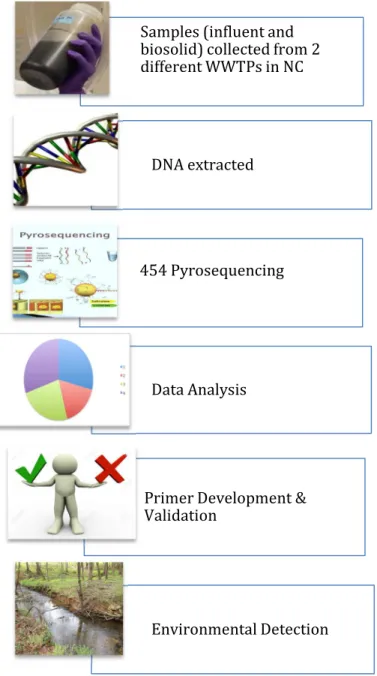
Molecular Analysis of Biosolid Samples for Developing Source Tracking Markers(Figure 2) ... 44
Biosolid Primer Development and Performance Evaluation ... 48
Performance Evaluation Study Data Analysis ... 51
Results ... 56
xii
Discussion ... 72
Acknowledgements ... 77
CHAPTER 4. MICROBIAL SOURCE TRACKING TO EVALUATE MICROORGANISMS FOLLOWING LAND APPLICATION OF BIOSOLIDS TO NEARBY WATER SOURCES IN NORTH CAROLINA ... 78
Summary ... 78
Introduction ... 79
Materials and Methods ... 81
Field Study Site ... 81
Results ... 84
Fecal Indicators in Surface Waters Collected ... 84
Microbial Source Tracking Markers Tested in Water Samples ... 86
P-value based on ANOVA test ... 90
Discussion ... 91
MST Markers in the Water Environment ... 91
Strengths and Limitations ... 96
Future Research ... 96
Acknowledgements ... 97
CHAPTER 5. CONCLUSION ... 99
Summary of Findings ... 99
Potential Benefits ... 100
Innovation... 101
xiii
LIST OF TABLES
Table 1. Summary of 28 Peer-Reviewed Field Studies That Have Evaluated the Occurrence of Microorganisms Following
Land Application of Biosolids ... 18 Table 2. Microorganisms (n=57) Investigated in Bioaerosols
Under Various Biosolids Land Application Conditions ... 29 Table 3. Microorganisms (n=31) Investigated in Soils Under
Various Biosolids Land Application Conditions ... 30 Table 4. Microorganisms (n=8) Investigated in Water Sources
Under Various Biosolids Land Application Conditions ... 31 Table 5. Treatment Type, Biosolid Type and Form for All Biosolid
Products Collected at Five WWTPs (A–E). ... 51 Table 6. Total Pyrosequencing Sequences for Archaea and
BacteriaPer Sample (Influent and Biosolids) Collected at
WWTP1 and WWTP2 ... 56 Table 7. Archaea Top 20 OTUs (Out of 362) and Number of
Sequences Per OTU for Samples (Biosolids and Influent)
Collected across WWTP1 and WWTP2 ... 60 Table 8. BLAST Results for Primer Pair Targeting the
Consensus Sequence for Archaea OTU 001 at Genus Level
for Methanosarcina ... 61 Table 9. BLAST Results for Primer Pair Targeting the
Consensus Sequence for Archaea OTU009 at Genus Level
for Methanosaeta ... 63 Table 10. BLAST Results for Primer Pair Targeting the
Consensus Sequence for Archaea OTU016 at Genus Level
for Unclassified Uncultured Archaea. ... 64 Table 11. Bacterial OTUs Shared between WWTP1 and
WWTP2 for Biosolid Samples Collected ... 65 Table 12. BLAST Results for Primer Pair Targeting the
Consensus Sequence for Bacteria_OTU030 at Genus Level for
Erysipelotrichaceae_incertae_sedis. ... 66 Table 13. BLAST Results for Primer Pair Targeting the
Consensus Sequence for Bacteria_OTU001 at Genus Level
xiv
Table 14. BLAST Results for Primer Pair Targeting the Consensus Sequence for 16S Bacteria_OTU040 at Genus
Level for Betaproteobacteria ... 68 Table 15. Biosolid Samples Collected from Five Different WWTPs. ... 70 Table 16. Untreated Animal Waste Samples (Pig, Chicken,
Cow) Collected from a Local Farm and Tested for Presence/
Absence of Biosolid Microbial Markers ... 71 Table 17. Treated Animal Wastes Samples (Dairy Lagoon,
Swine Lagoon, and Poultry Compost) Tested for Presence/ Absence of Biosolid Microbial Markers and HF183
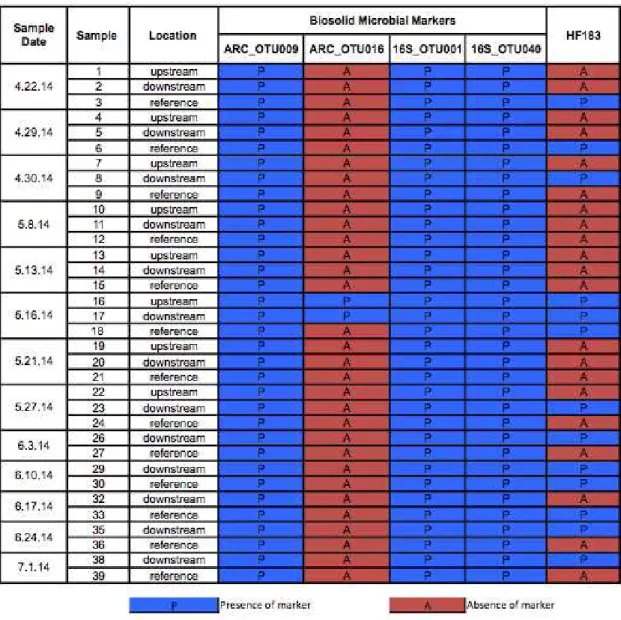
Human-Specific Marker ... 71 Table 18. Surface Water Samples Collected from a Creek
Adjacent to Biosolid Land Application Sites (Upstream and Downstream) and a Creek (Reference) That is Nearby but Not
Subject to Land Application of Biosolids ... 87 Table 19. Frequency and Percent of Tested Samples Out of
Compliance with North Carolina Regulatory Thresholds across
Microorganisms... 89 Table 20. Differences between Sites Comparing Indicators That
Have the Same Conclusions or Different Conclusions When
Looking at Different Indicators for Violation of State Standards ... 90 Table 21. Means and Standard Deviations for Fecal Indicator
xv
LIST OF FIGURES
Figure 1. Fate of municipal wastewater and biosolids. ... 1 Figure 2. Dissertation Research Model. ... 11 Figure 3. PRISMA diagram for systematic review
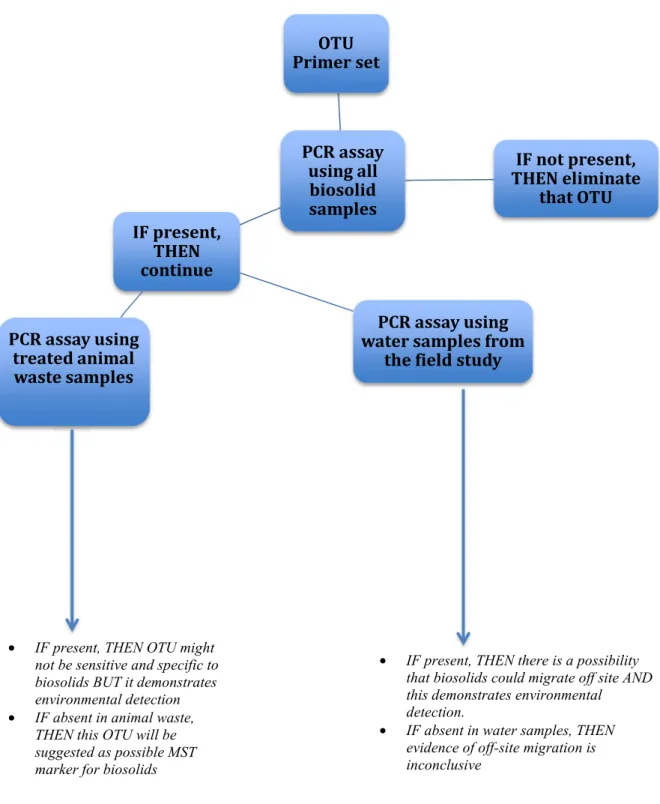
(Moher et al., 2009). ... 16 Figure 4. Process flow chart for developing biosolid MST marker. ... 52 Figure 5. Process for analyzing Bacteria and Archaea
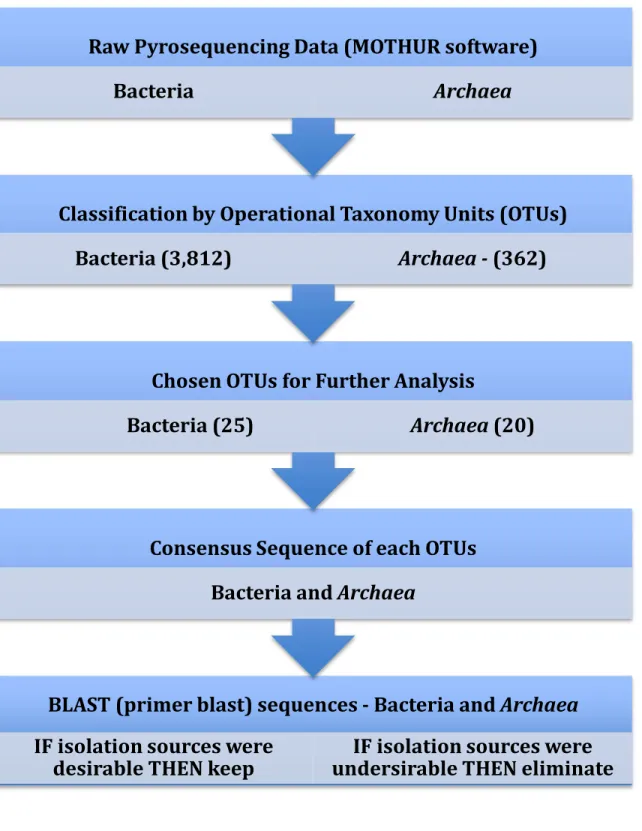
pyrosequencing data. ... 53 Figure 6. Process for designing primer sets for Bacteria and
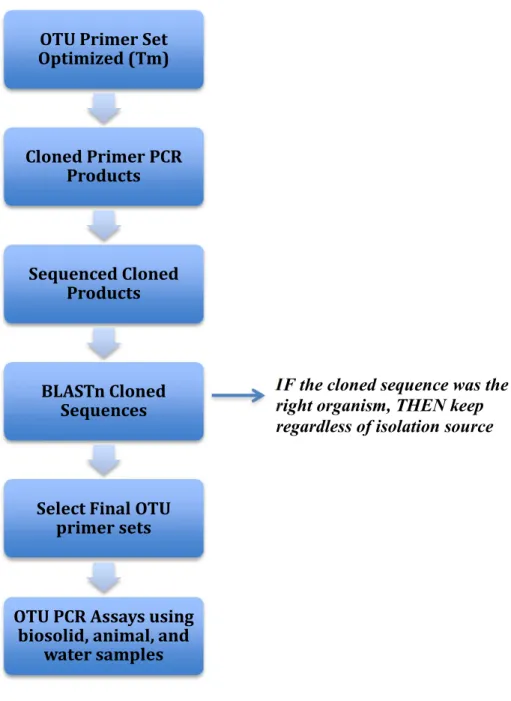
Archaea markers. ... 54 Figure 7. PCR assay procedure toward developing and
validating biosolid MST markers. ... 55 Figure 8. Bacterial Venn diagram illustrating the distribution
of OTUs for biosolid samples between WWTP1 and
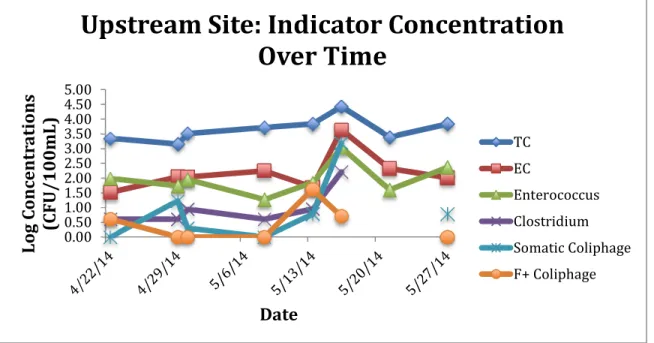
WWTP2 (cutoff 0.03). ... 65 Figure 9. Indicator concentrations over time for all water
samples collected at site upstream of creek B flow. ... 88 Figure 10. Indicator concentrations over time for all water
samples collected at site downstream of creek B flow. ... 88 Figure 11. Indicator concentrations over time for all water
xvi
LIST OF ABBREVIATIONS
40 CFR Part 503 Chapter 40 Part 503 of the Code of Federal Regulations BLAST Basic Local Alignment Search Tool
CFU Colony-forming unit
FC Fecal coliform
LA Land application
MPN Most probable number MST Microbial source tracking
NCBI National Center for Biotechnology Information NRC National Research Council
OTUs Operational taxonomic units PCR Polymerase chain reaction PFU Plaque-forming unit
qPCR Quantitative polymerase chain reaction STV Statistical threshold value
TC Total coliform
USEPA United States Environmental Protection Agency USGS United States Geological Survey
1
CHAPTER 1. INTRODUCTION
Biosolids are generated during treatment of human sewage. Biosolids may be recycled and used as fertilizer following treatment to reduce the public’s risk of environmental exposure to infectious pathogens. The two classes of biosolids, currently classified based on pathogen destruction, are Class A and Class B. Class A biosolids are more highly treated and used without any restrictions at a land application site. They can also be sold to the public through composting companies for application to gardens and yards as a soil amendment. Class B biosolids are treated to reduce pathogens but still contain detectable levels and are, therefore, restricted from use on fields for food crops, for grazing animals, and where there is public contact.
Land Application of Biosolids
Upon proper biosolids treatment, Class A and Class B biosolids are land-applied on fields, adhering to regulations and guidelines established by the USEPA. These regulations and guidelines are encoded in Chapter 40 Part 503 of the Code of
2
Federal Regulations (40 CFR Part 503).1 To be classified as Class A, the fecal coliform density must be less than 1000 most probable number (MPN) or Salmonella
density of less than 3 MPN/4g total solids with no detectable enteric viruses, i.e., less than 1 Plaque Forming Unit (PFU)/4g.1 For Class B, the density of fecal coliforms must be less than 2,000,000 MPN per gram of total solids.1 Class B biosolids are most commonly produced in the United States and, therefore, most commonly disposed of by land application.2
Land application is the primary means of managing and disposing of biosolids. In the United States approximately 60% of the 5.6 million dry tons of sewage sludge disposed of annually is land-applied.2,3 However, this practice sometimes generates concern among nearby residents due to potential pollutants associated with biosolids, the lack of evidence about the transport of pollutants, and potential impact on the environment and human health, including quality of life.
Research indicates that fecal pathogens are present in human waste and the application of biosolids may expose humans in the surrounding communities to illnesses through direct ingestion of contaminated surface or groundwater and
aerosol exposure. 3 Consequently, many communities near sites where biosolids are being applied are concerned not only about the health impact and the risks
associated with biosolids but about other non-pathogenic pollutants (e.g.,
3
(MST) markers could be used to assess human exposure to non-pathogenic biosolid-associated pollutants.
Fate and Transport of Contaminants Following Land Application The fate and transport of contaminants in biosolids following land application is not well understood. For example, a recent review noted that a better assessment of specific pathogens and their transport, regrowth, and survival during land
application is needed to ensure the safety of our water and food supplies. 4 One possible pathway is transport to surface water following a rain event. Many variables play a role in the ability of contaminants contained in biosolids to migrate to surface waters. These include but are not limited to the dilution factors in waterways, rain intensity, the gradient of the land surface and type of soil to which the biosolids are applied, degradation of the contaminants, and the use of management strategies such as buffer zones.
Traditional Fecal Indicators
Traditional fecal indicators have been used as measures to monitor water systems (drinking, wastewater, and recreational). The majority of biosolids research has been limited to investigating transport of some of these microorganisms
following land application. The most frequently researched indicators include total coliforms (TC), which are indicators of fecal contamination but can also be found naturally in the environment; fecal coliforms (FC), Escherichia coli, and enterococci,
which are found in animal and human intestines and feces; and coliphages, which are viruses that infect the bacterium E. coli and indicate fecal contamination.14
4
bifidobacteria, bacteriophages, and Bacteroides fragilis have been used as indicators of fecal contamination.
It is not feasible to test for every indicator, and themajority of biosolids
research has been limited to investigating transport of traditional microbial indicators (e.g., fecal coliforms, total coliforms, E. coli, enterococci) following land application of biosolids. Traditional indicators are problematic because they are not specific to biosolid materials. Water samples can test positive for fecal contamination because of biosolids or due to other sources of fecal contamination including leaky septic tanks, grazing animals, and birds.5 It is also suggested that traditional indicators might not survive anaerobic digestion (a typical treatment process for sludge at wastewater treatment plants), aerosolization, and other environmental stressors.6-8 These factors discourage the continued use of only traditional indicators for
investigating transport following land application of biosolids, and some studies have demonstrated the utility of non-traditional microorganisms to detect contaminants following land application. It should be noted that it is not transport of indicators per se that is of concern but the transport of pathogens themselves and/or other
contaminants associated with biosolids. Non-Traditional Microbial Indicators
5
hydrogen sulfide–producing bacteria and clostridia and suggested clostridia as a better, more accurate indicator of biosolid contamination.6-8 This study used a culture-based method for detection and then targeted the 16S-23S-interspacer region for DNA fingerprinting, successfully tracing clostridia to its original biosolids pile. 6-8 In a separate study that was successful in detecting bioaerosols during high wind events following land application, the investigators developed and validated three sensitive and specific biosolid microorganisms: Clostridium bifermentans,
Chloroflexi, and Euryarchaeota.9 These indicators were unique to biosolids and
therefore were good indicators for airborne biosolid contamination. Additionally, this study showed the utility in using a non-culture dependent method for identifying uncultured microorganisms versus traditional indicators that are non-specific and not always present when assayed.9
6
identifying human fecal contamination.14 There are likely other dominant strains of microbes present and potentially other pollutants in treated biosolids that could be used as tracers in the environment. However, to the best of our knowledge, no study has ever evaluated the use of MST techniques to track occurrence of biosolids in surface waters following land application.
Microbial Source Tracking
Tools to track the potential off-site migration of biosolid materials following land application would be transformative in assessing the environmental quality associated with disposal of biosolids. It is not practical to target all pollutants that may be present in biosolid materials. A more viable approach would be to identify a subset of microbial indicators of biosolids that persist as they travel overland and enter nearby surface waters or otherwise might be transported to receptors beyond the application site. MST methods are used to detect the nucleic acids of a
microorganism and not the actual organism. The genetic material aids in developing the microbial marker, allowing the organism to be tracked in the environment to its original source, but it does not provide any information pertaining to infectivity.
Therefore, potential health risks associated with biosolids’ land application cannot be directly measured. Despite not being able to directly detect pathogens or to infer infectivity, MST could provide evidence indicative of the presence of biosolids, which would be helpful for conducting exposure assessments for nearby communities.
7
amplifying a single copy of the target DNA to millions of copies of DNA that can be easily quantified. For environmental samples, PCR can be used to determine presence/absence of pathogens, especially viruses or other microorganisms that typically need to be cultured. However, these molecular methods can only amplify specified sequences of nucleic acids. More advanced methods are needed to explore microbial diversity and to understand microbial communities.15,16
Pyrosequencing is a robust technique that allows for deep sequencing of the microbial communities, which is needed to characterize microbial diversity.5,17,18 The 16S rRNA gene, found in almost all bacteria, is often targeted for sequencing studies to investigate similarities or differences in the microbial communities between
samples, which leads to the identification of unique and dominant taxonomic
groups.17 Previous studies have demonstrated the effectiveness of pyrosequencing when determining dominant, abundant, and unique members of microbial
communities of wastewater influent, activated sludge, digested sludge, wastewater effluent, and biosolids samples.5,15-17,19,20 Parameters such as geographical regions, wastewater characteristics (e.g., pH, dissolved oxygen, conductivity), wastewater treatment plant (WWTP) operations and processes (e.g., stages of treatment sampled and types of treatment), and environmental conditions are factors contributing to the microbial community’s diversity and abundances of individual species.16,21 It is possible that these traditional and emerging methods can be integrated, identifying the nucleic acids of unique and dominant microorganisms present in biosolids that can lead to the development of novel markers. The
8
migration of biosolids material from land-applied fields but cannot necessarily indicate that pathogenic microorganisms are viable and transmitted in the environment; posing public health risks. Additional studies would need to be conducted to assess any potential health risks that may be associated with pollutants of biosolids.
Specific Research and Objectives and Rationale
The overall goal of this research is to evaluate the fate and transport of biosolids in surface waters following land application through the development and validation of novel biosolid microbial markers.This research fills a critical knowledge gap by providing data to begin assessing the potential environmental impacts
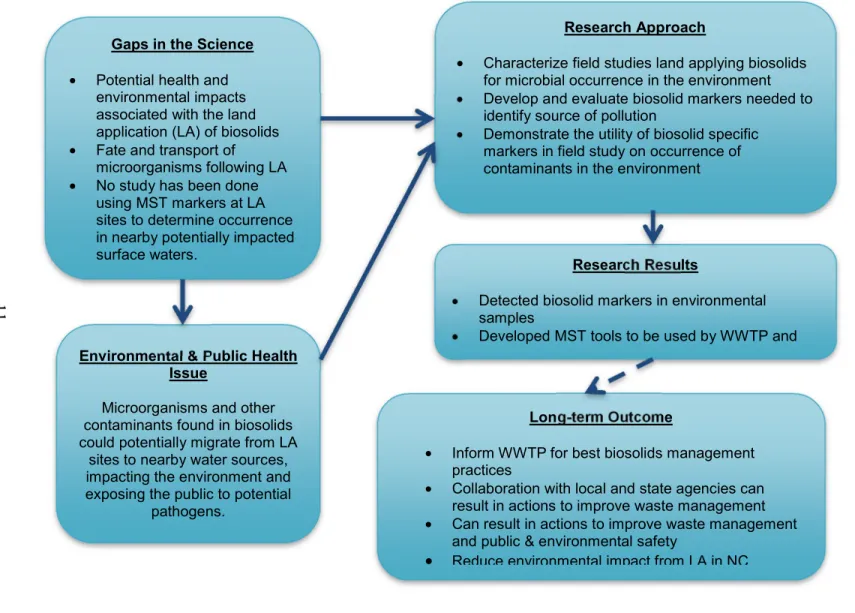
associated with the land application of biosolids. Additionally, this research may enhance the evaluation of current environmental waste management regulations and policies by providing tools to wastewater treatment plants (WWTPs) and the United States Environmental Protection Agency (USEPA) for best biosolids management practices. The model for this dissertation is described in Figure 2. Specifically, this dissertation examined the following aims:
Aim 1: To evaluate current knowledge of microbial occurrence following land application of biosolids in the environment. A systematic literature review was conducted to analyze occurrence of microorganisms in field studies. The review helped determine the types of studies conducted, the microbial indicators
9
Aim 2: To identify and validate candidate microbial biosolid markers for detection in environmental water samples. High-throughput pyrosequencing was used to examine the microbial communities present in biosolid samples for the development of novel biosolid microbial markers. These candidate biosolid markers were evaluated (e.g., in silico and in environmental samples) for sensitivity and specificity to biosolids. The pyrosequencing approach allowed deep sequencing of the samples, including microorganisms that cannot be (or have not yet been) cultured and are not usually monitored. Markers with the highest sensitivity and specificity were selected for a field study (Aim 3).
Aim 3: To conduct a field study on the environmental detection of candidate microbial biosolids markers (from Aim 2) in surface waters
potentially impacted by land-applied biosolids. Using microbial source tracking (MST) techniques, surface waters near biosolids’ land application fields were tested to demonstrate environmental detection of the following microorganisms: fecal indicators, human-specific microbial markers, and candidate biosolid microbial
markers (identified in Aim 2). These markers were compared based on their ability to be detected in surface waters following land application of biosolids.
Scientific Significance
10
Figure 2. Dissertation research model.
Environmental & Public Health Issue
Microorganisms and other contaminants found in biosolids could potentially migrate from LA
sites to nearby water sources, impacting the environment and exposing the public to potential
pathogens.
Gaps in the Science
• Potential health and environmental impacts associated with the land application (LA) of biosolids • Fate and transport of
microorganisms following LA
• No study has been done
using MST markers at LA sites to determine occurrence in nearby potentially impacted surface waters.
Research Approach
• Characterize field studies land applying biosolids for microbial occurrence in the environment
• Develop and evaluate biosolid markers needed to
identify source of pollution
• Demonstrate the utility of biosolid specific markers in field study on occurrence of contaminants in the environment
Research Results
• Detected biosolid markers in environmental samples
• Developed MST tools to be used by WWTP and
USEPA
Long-term Outcome
• Inform WWTP for best biosolids management
practices
• Collaboration with local and state agencies can result in actions to improve waste management
• Can result in actions to improve waste management
and public & environmental safety
• Reduce environmental impact from LA in NC
1
12
CHAPTER 2. A SYSTEMATIC REVIEW OF MICROBIAL OCCURANCE FOLLOWING LAND APPLICATION OF BIOSOLIDS
Summary
Land application of biosolids is a method for disposal of treated human waste. Despite common use in waste management, public controversy regarding safety suggests the importance of synthesizing evidence regarding impacts on
environmental quality. Biosolids applied to land could potentially harbor
microorganisms capable of surviving in the environment and being transported off-site via air, soil, and/or water. To gain insight on microbial occurrence following land application of biosolids, we conducted a systematic review of published studies analyzing microorganisms detected in the environment following land application. The search was conducted on August 12, 2014, using four databases and the following three keywords and their derivatives: “biosolids,” “microorganism,” and “land application.” Twenty-eight studies met our inclusion criteria that investigated occurrence of microorganisms following land application. Our conclusion, based on these studies, is that there is evidence of microbial detection in the environment but traditional fecal indicators (used most often for assessment) cannot distinguish whether the source of pollution is associated with biosolids. Therefore,
13
Introduction
Biosolids are the solids generated during the treatment of human sewage. Upon proper treatment they can be applied on agricultural land as fertilizer. The land application of biosolids is an approved method for disposal of treated human waste, defined by the U.S. Environmental Protection Agency (USEPA) as “the spreading, spraying, injection, or incorporation of sewage sludge, including a material derived from sewage sludge (e.g., compost and pelletized sewage sludge), onto or below the surface of the land to take advantage of the soil enhancing qualities of the
sewage sludge.”22 The treatment process and the level of pathogen or fecal indicator concentrations determine the classification and the usage of biosolids at land
application sites. Class A biosolids have a more stringent treatment process resulting in a higher reduction of pathogens and fecal indicator organism density,1 therefore, they can be land-applied with no restrictions and/or sold to the public as compost. Class B biosolids are produced from treatment processes that result in higher fecal indicator concentrations and pathogens,1 therefore, Class B biosolids require restriction from use on fields for food crops, for grazing animals, and where there is public contact. These restrictions are important because the majority of biosolids that are land-applied in the United States are Class B biosolids.2
The application of biosolids has reduced the amount of sewage sludge that would go into landfills or incinerators; approximately 60% of the 5.6 million dry tons of sewage sludge disposed of annually in the United States is land-applied.2
14
implement regulations that monitor and control treatment and management practices of land application of biosolids, resulting in the Part 503 Rule.1,22
Despite land application being a commonly used and regulated method for waste management, controversy remains about the advantages and disadvantages of land application of biosolids as it pertains to health and environmental impact. Biosolids could potentially harbor microorganisms, raising concerns for communities near sites receiving land-applied biosolids 2,8,23,24if these microorganisms are
capable of surviving and migrating off-site following land application. To gain insight into the current state of science that investigates microbial occurrence following land application of biosolids, we conducted a systematic review of field studies tracking microbial contaminants in the environment following land application to better understand the impact this method of waste disposal has on the environment. This systematic review synthesizes the results of field studies that analyzed various microorganisms off-site following the land application of biosolids through three primary routes of potential environmental exposure (air, water, and soil).
Materials and Methods Data Sources and Search Strategy
Four databases were searched for peer-reviewed research articles (Embase, Environmental Science and Pollution Management via EBSCO, Institute for
Scientific Information (ISI) Web of Science, and PubMed) without date or
15
until no improvements in the search were identified.aThe search was conducted August 12, 2014, with slight modifications for database compatibility. Additional articles were included from citations in the articles found through the database searches.
Study Screening
After removing duplicates, two authors (author 1: PMP, author 2: JGL) independently coded the abstracts and titles of records for inclusion/exclusion. Commentaries, reviews, non–peer-reviewed literature, government agency reports, thesis/dissertations, conference abstracts, and legal documents were excluded. Inclusion criteria included articles that specifically discussed the presence of
microorganisms (e.g., viruses, bacteria, helminthes, and protozoa) following the land application of biosolids (biosolids defined as treated sewage sludge). Studies that only measured chemicals, metals, personal care products, nutrients, food crops, treatment/management of waste, or animal waste were excluded. Figure 3, based on PRISMA guidelines,25shows the inclusion process. The coders reviewed and discussed discrepancies until an agreement was reached on all records.
Data Extraction
One author read each identified study and included in an evidence table (Table 1) the following information: the microorganism(s) analyzed and if the
aExample search string:(((Biosolids OR biosolid OR "refuse disposal" OR treated sewage OR
16
microorganism(s) was able to be detected in the environment; the environmental testing conditions (e.g., biosolids application loading sites, downwind following high wind events, depths of soil or water testing); the environmental medium (e.g., air, soil, and/or water); the geographical location; the type of biosolid and application method; and if there was a method of linking the microorganism(s) to biosolids as a potential source of pollution.
Figure 3. PRISMA diagram for systematic review.25
Records identified through database searching
(n =1,006)
Additional records identified through other sources
(n = 6)
Records after repeated replicates removed
(n = 222)
Records screened (n = 222)
Records excluded (n = 173)
Full-text articles assessed for eligibility
(n = 49)
Full-text articles excluded, with
reasons (n = 21)
Studies included in qualitative synthesis
(n = 28)
17
Results and Discussion
We identified 28 studies meeting our inclusion criteria (Table 1). Of these studies, 14 sampled bioaerosols,8,9,26-37 ten sampled soil,38-44 three sampled water, 45-47 and one sampled water and soil.48 Figure 3, based on PRISMA guidelines, shows the inclusion process. The literature suggests that there is the potential for
microorganisms to travel off-site in the environment when biosolids are applied on agricultural fields. All studies identified microorganisms through at least one of three primary routes of exposure (air, soil, and water) during/following land application of biosolids. Of all the studies in this review, 60% analyzed the occurrence of microbial indicators, 18% analyzed pathogens, and 22% analyzed other microbes. The
Table 1.
Summary of 28 Peer-Reviewed Field Studies That Have Evaluated the Occurrence of Microorganisms Following Land Application of Biosolids
Study Microorganism Environmentally
detected Conditions tested Measure
Geographical
location Biosolid Type
Application Method
Biosolids associated
Total coliforms Y Fecal coliforms Y Fecal streptococci Y Enterovirus N
Y
Summer months - soil cores (exposed to natural
conditions) treated with virus seeded liquid sludge to test for survival: up to 35
days
N
Summer months - leachate from the virus seeded liquid sludge to test for survival, soil cores (exposed to natural
conditions)
Poliovirus 1
Echovirus 1
Fecal streptococci Y
Fecal coliforms Y
Total coliforms Y
N
Bitton et al., 1984
Poliovirus 1
soil Pensacola, FL
Aerobically and anaerobically
digested
NA N
N
fall/winter months - soil cores (exposed to natural
conditions) treated with virus seeded liquid sludge: inactivated between days 8 and 21 and in leachates
Sorber et al 1984 at 50m downwind bioaerosols Four unidentified sites
Liquid - anaerobically
digested
sprayed on fields
N Pepper et al.,
1993
soil migration field and lab study (microcosms) - evaluate survival and vertical transport under the
following coniditoions detected: between
150-200 cm in depth, only before 84 days post injection for fall but 50
days for spring, and increases in numbers
following rainfall
soil Tucson, AZ
Study Microorganism Environmentally
detected Conditions tested Measure
Geographical
location Biosolid Type
Application Method Biosolids associated Heterotropic bacteria Y
Clostridium spp Y Salmonella spp N Fecal coliforms N
Coliphages N
Heterotropic
bacteria Y
Salmonella spp N Bacteriophages N Thermotolerant
clostridia N Fecal streptococci N Total coliforms N H2S producers N Fecal coliforms N Salmonella spp Y Bacteriophages Y Thermotolerant
clostridia Y Fecal streptococci Y H2S producers Y Total coliforms N Fecal coliforms N Salmonella spp Y Bacteriophages Y Thermotolerant
clostridia Y Total coliforms Y Fecal coliforms Y Fecal streptococci N H2S producers N
Dowd & Pillai.,
1999 Clostridia Y Loading sites bioaerosols Sierra Blanca, TX
Dewatered - anaerobically digested surface applied with mechanical spreaders as semi solid "cake"
product
Y
Lang et al., 2003 E. coli Y
unamended and biosolid amended soils (conventionally and
enhanced treated)
soil Ascot, UK
dewatered anaerobically digested sludge (DMAD), composted sludge (CPT), thermally dried digested product (TDD)
in small plots by hand and incorporated immediately into soil 100mm depth
using a cultivator
N Pillai et al 1996
only at the "Hopper" Loading sies
bioaerosols Sierra Blanca, TX
Dewatered - anaerobically digested surface applied with mechanical spreaders (hoppers) as semi
solid "cake" product
Y Upwind, interface between
sludge appication site and population center, application site, hopper
loading sites, and old application sites
N Loading sites
Application sites Dowd et al., 1997
Background sites
bioaerosols Sierra Blanca, TX
Dewatered - anaerobically digested surface applied with mechanical spreaders as semi solid "cake"
product
1
Study Microorganism Environmentally
detected Conditions tested Measure
Geographical
location Biosolid Type
Application Method
Biosolids associated
Rusin et al., 2003b
Staphylococcus
aureus N
during land application and within 2m of application
site
bioaerosols 15 locations - SW to E USA
Class A and Class B
sprayed and
spread on fields N
E. coli N
Coliphages -
MS-2 Y
Total coliforms Y
E. coli Y
C. perfringens Y
at various environmental conditions (i.e. extreme heat, relative humidity, and
UV levels) in bioaerosols
Aspergillus spp N biosolids and bioaerosols within 3m of operation
Coliphages Y in bioaerosol samples within 3m of operation
Heterotropic
bacteria Y
aerosolized the most at application sites most likely
due to aersolised soil Norwalk-like
viruses N
Enterovirus N Brooks et al.,
2004
Transport model: aerosolize seeded groundwater with E. coli
and coliphage (MS-2) monitoring bioaerosols from similar liquid biosolids
sprayer at downwind distances from 2 to 70 m
bioaerosols Not specified but group is in AZ
NA (seeded water experiment to mimic biosolids liquid application) liquid biosolids spray applicator/tanker N N
biosolids and bioaerosols Brooks et al.,
2004
only during high humidity (>10%) within 3m of
operation
bioaerosols Tucson, AZ
Anaerobically digested liquid -
Study Microorganism Environmentally
detected Conditions tested Measure
Geographical
location Biosolid Type
Application Method
Biosolids associated
Total coliforms N
E. coli N
C. perfringens N Hepatitis A N
Coliphages N
Enterovirus N
Heterotropic
bacteria Y
readily detected with the exception of sites located in areas of high relative humidity where soils were
moist and when soil was not incorporated into the
biosolids loading
Norovirus Y
only in one site from study were three samples detected (during slinging (at 5m) and loading (at 2m)
conditions)
Total coliforms Y
E. coli Y
C. perfringens Y
within 15m distances during land application and
loading events Fecal coliforms Salmonella spp Heterotropic bacteria Ascaris spp Enterovirus
Fecal coliforms Y Salmonella spp N
Heterotropic
bacteria Y
Coliphages N
Total coliforms N
E. coli Y
MS2 Coliphage Y Brooks et al.,
2005
as aerosols collected from either downwind or upwind
(background) samples
bioaerosols
10 sites across: AZ, CA, WA, VA,
TX, IL
Anaerobic Class B cake (mostly)
and liquid biosolids spreading, slinging, and spray applications N
within 15m of biosolid sites only during loading
operations
concrete solar
drying beds N
N
Lab - in biosolids and biosolid amended soil (drying and rewetting
conditions)
Tanner et al., 2005
during land application of liquid Class B biosolids; samples taken downwind
2m
bioaerosols Tucson, AZ
Liquid Class B - Mesophilic anaerobic digestion and
groundwater seeded with E.
coli and MS2 coliphage (for comparison)
liquid biosolids spray applicator/tanker
(used for both biosolids and
seeded groundwater) Zaleski et al.,
2005
Y Field -concrete drying beds under various environmental conditions
(e.g. rainfall, animals)
soil Tucson, AZ
Mesophilic anaerobically and
aerobically digested Class B
biosolids
N greater aerosolization
during land application of seeded groundwater than during land application; samples taken downwind
2m
2
Study Microorganism Environmentally
detected Conditions tested Measure
Geographical
location Biosolid Type
Application Method
Biosolids associated
Total bacteria Y Heterotropic
bacteria Y
Total coliforms Y Clostridia Y
endotoxin Y
Total bacteria Y Heterotropic
bacteria Y
Total coliforms N Clostridia Y
endotoxin Y
Clostridia (C.
bifermentans) N
Chloroflexi sp Y
Euryarchaeota Y
Clostridia (C.
bifermentans) Y
Chloroflexi sp Y
Euryarchaeota Y Clostridia (C.
bifermentans) N Chloroflexi sp N Euryarchaeota N
Clostridia Y
Chloroflexi Y Euryarchaeota Y Paez-Rubio et al.,
2006
soil/biosolids composite, aerosols (biosolids disking
and control disking)
bioaerosols Southwest of Phoenix, AZ Class B, Mesophilic anaerobic digestion dewatered biosolids
spread on fields and then disk
incorporated within 48hrs after spreading into soil
N
soil samples
Y Downwind: high wind
events (>5 m/s): "disking - aerosol samples collected downwind of land applied
fields where previously applied biosolids were disk incorporaed within 36hrs of
sampling"
Upwind: high (>5 m/s) and low wind (<2 m/s) events
during disking and no disking
Downwind: high wind events (>5 m/s): "no disking - aerosol samples
collected downwind of fields on which biosolids had been applied withing
the previous 36hrs" Baertsch et al.,
2007
Downwind: low wind events (<2 m/s): "no disking - aerosol samples were collected upwind and downwind of fields which biosolids had been applied withing the previous 36hrs"
bioaerosols Southwest of Buckeye, AZ
Dewatered Class B anaerobically
mesophilically digested
spread on fields and then disk
incorporated within 36hrs of
sampling
2
Study Microorganism Environmentally
detected Conditions tested Measure
Geographical
location Biosolid Type
Application Method
Biosolids associated
Total bacteria Y Heterotropic
bacteria Y
Total coliforms Y Sulfite-reducing
Clostridia Y
endotoxin Y
Actinobacteria Y
alpha - and beta-
proteobacteria Y
Firmicutes Y
Chloroflexi N
Bacteroidetes Y
aerosols downwind biosolids and soil operation
sites, soil samples
gamma
proteobacteria Y
aerosols downwind and background operations, soil samples Actinobacteria N alpha, beta, gamma- proteobacteria Y Chloroflexi Y endotoxin N antibiotic resistant bacteria N
Paez-Rubio et al., 2007
aerosols are emitted during spreading of dewatered Class B
biosolids
bioaerosols Phoenix, AZ
Class B, Mesophilic anaerobic digestion dewatered biosolids
spread onto fields using a side discharge slinger
N
Brooks et al., 2007
aerosolized samples 5m downwind of biosolids and
soil operation sites; background (upwind)aerosol samples
collected (20min prior to application and without disturbance of site), and
soil samples.
bioaerosols South Central Arizona
Mesophilic anaerobically digested Class B
biosolids loading and slinging biosolids land application operations occurred Y
biosolid samples directly from preapplied loads
N Brooks et al.,
2007
No increase in percentage/concentration
due to biosolids
soil Tucson, AZ; CA, NH, and WA
Liquid - anaerobically digested - Class B
injector applicator approximately 15 cm below soil
2
Study Microorganism Environmentally
detected Conditions tested Measure
Geographical
location Biosolid Type
Application Method
Biosolids associated
E. coli Y
in dewatered mesophilic anaerobically digested,
enhanced treated biosolids, control soil or
sludge-amended soil
Salmonella N
in dewatered mesophilic anaerobically digested,
enhanced treated biosolids, control soil or
sludge-amended soil
F-specific RNA
bacteriophage N
in control soil, sludge-amended soil, and enhanced treated biosolids
F-specific RNA
bacteriophage Y
in dewatered mesophilic anaerobically digested- detected in low numbers
Lang and Smith,
2007 E. coli Y
Model incubation study - soil (controlled plots - sandy loam and silty clay) collected to a depth of 10 cm; increase in numbers in
biosolid amended soils vs control non ameneded soils and observed decline
with time in both soil plots
soil Ascot, UK
Dewatered mesophilic anaerobically digested (DMAD) random grab composite samples incorporated at depth of 10cm to
soil plots
N
E. coli Y
in groundwater 1.2m and 2m depth, observed pre
application and immediately after application; in biosolid amended soils with both
application methods
Clostridium
perfringens Y
in biosolid amended soils with both application method and in ground water at 1.2 and 2.0 m
post application Clostridium
perfringens N
in control soil and in any 1.2 or 2.0 m ground water
samples pre application
Lapen et al., 2008 groundwater Winchester
Ontario, Canada Liquid - anaerobically digested two different methods: surface spreading followed by incorporation using a cultivator
and a one-pass AerWaySSD slurry deposition
system (applies above surface to avoid tillage)
N
Lang et al., 2007 soil Ascot, UK
conventional treated: Dewatered mesophilic anaerobically digested sludge (DMAD), enhanced treated: thermally dried digested sludge (TDD) and composted sludge
by hand and incorporaed to a
depth of 10cm with a pedestrian
operated rotart cultivator
N
2
Study Microorganism Environmentally
detected Conditions tested Measure
Geographical
location Biosolid Type
Application Method
Biosolids associated
Fecal coliforms N
Fecal streptococci N
Coliform bacteria Y
when biosolids were applied to land or loaded
into land applicators
Coliform bacteria N
Coliphages N
Coliphages Y
few bioaerosol samples and only when biosolids
were loaded into applicators Heterotropic
bacteria Y
regardless if biosolids were applied
E. coli Y
Enterococci Y
Clostridium
perfringens Y
N
Tanner et al.,
2008 bioaerosols
NV, WA, DC, CA, IL, AZ
Class B - anaerobically
digested
biosolids spread by slinger, spray gun, spreader, and splash plate
(spray tanker)
N in air samples collected:
directly downwind of biosolids piles, downwind
of splash plates, or in background samples collected away from or
before application Surampalli et al.,
2008
biosolid-amended soil from surface (0-5 cm) and deep
layers (20-25 cm), groundwater (well samples), and background
soil samples (no biosolids applied)
water and soil University of
Missouri Class B
Injected into soil surface
N Gottschall et al.,
2009
both application methods: pre and post applications at 1.2 m and 2.0 m depths;
<100 and >100 days post application; post application rainfall to at least 1.2 m depth below
the surface groundwater Winchester Ontario, Canada Dewatered - anaerobically digested surface spreading with shallow incorportaion and direct injection into top soil (~0.1
m depth)
2
Study Microorganism Environmentally
detected Conditions tested Measure
Geographical
location Biosolid Type
Application Method Biosolids associated Heterotropic bacteria Y
in both control soil and amended soil samples
Coliphages
Salmonella
Enterovirus
Total coliforms Y
Fecal coliforms Y
antibiotic resistant
bacteria Y
in biosolid amended soils (collected 10 mo after last
application) and unamended soil Proteobacteria Y Actinobacteria Y Acidobacteria Y Firmicutes Y Bacteroidetes Y
Esseili et al., 2012 E. coli Y offsite transmission under
heavy rain events water NW Ohio
Class B - liquid slurry
subsurface
injection Y
N Zerzghi et al.,
2010
surface (0-30 cm) unamended and
biosolids-amended soil samples
soil Tucson, AZ
Anaerobically digested liquid
Class B
injected into soil surface (0-30 cm) with a semi trailer
applicator Zerzghi et al.,
2010 soil Tucson, AZ
Anaerobically digested liquid
Class B
injected into soil surface (0-30 cm) with a semi trailer
applicator
N N
in soil samples collected 10 mo after last application (control and amended soil)
in biosolid amended soils (collected 10 mo after last
application)
2
Study Microorganism Environmentally
detected Conditions tested Measure
Geographical
location Biosolid Type
Application Method Biosolids associated Heterotropic bacteria Y
in both control soil and amended soil samples Coliphages
Salmonella Enterovirus
Total coliforms Y
Fecal coliforms Y
antibiotic resistant bacteria Y
in biosolid amended soils (collected 10 mo after last
application) and unamended soil Proteobacteria Y Actinobacteria Y Acidobacteria Y Firmicutes Y Bacteroidetes Y
Esseili et al., 2012 E. coli Y offsite transmission under
heavy rain events water NW Ohio
Class B - liquid slurry
subsurface
injection Y N Zerzghi et al.,
2010
surface (0-30 cm) unamended and
biosolids-amended soil samples
soil Tucson, AZ
Anaerobically digested liquid
Class B
injected into soil surface (0-30 cm) with a semi trailer
applicator Zerzghi et al.,
2010 soil Tucson, AZ
Anaerobically digested liquid
Class B
injected into soil surface (0-30 cm) with a semi trailer
applicator
N N
in soil samples collected 10 mo after last application (control and amended soil)
in biosolid amended soils (collected 10 mo after last
application)
2
28
Air Studies
Fourteen of the 28 studies identified in this systematic review were field studies that analyzed the transport of microorganisms in bioaerosols under various conditions during and following land application of biosolids. With the exception of one study conducted by Sorber et al. (1984) that did not identify sample sites, all others were conducted between two groups of researchers, analyzing land application sites mostly in Arizona and Texas where the climate is hot and arid. Three studies did a comparison between biosolid samples collected from various geographical locations, including Texas and Arizona. 29,36,49 Table 2 lists the microorganisms that were observed in bioaerosols and the majority (38%) of all organisms in this systematic review were indicator organisms, which are typically used to assess fecal pollution. Of the total studies (N=28), 14% directly analyzed the potential for pathogens to be transported via bioaerosols. Most of the studies
investigated multiple organisms, giving a total of 57 microorganisms analyzed for potential microbial aerosolization under biosolid land application field conditions. Two studies demonstrated the ability to detect and track microorganisms in bioaerosols during land application of biosolids back to the original source of pollution, the biosolid piles. 50, 51 All studies, under various conditions (identified in Table 1), were able to measure at least one microorganism with the exception of one study that collected aerosol samples from 15 different sites but did not find
29
Table 2.
Microorganisms (n=57) Investigated in Bioaerosols Under Various Biosolids Land Application Conditions
(Note. Most studies investigated multiple organisms, total N=96)
Type Organism # Studies analyzed organism (n=51)
% Total of microbes measured (N=96)
Coliform Bacteria 14
Fecal Streptococci 2
Anaerobic Bacteria 7
Bacteriophages 6
Heterotrophic
plate count 7
Salmonella spp 2
Staphylococcus
aureus 1
Norwalk-like
viruses 1
Enterovirus 3
Hepatitis A 1
Norovirus 1
C. bifermentans 1
Chloroflexi sp 2
Euryarchaeota 1
Actinobacteria 1
alpha, beta,
gamma-
proteobacteria
1
Firmicutes 1
H2S producers 1
Endotoxin 2
Total bacteria 2
Indicator 38
Pathogen 9
30
Soil Studies
Ten of the studies identified in this systematic review were field studies that analyzed the transport of microorganisms in soils under various conditions during and following land application of biosolids. Rainfall events increased microorganisms present in the soil. 39, 52 Soil can be a protective filter preventing vertical transport, 39-41 which is important for Arizona because it relies on aquifers for its drinking water supply. Similar to the air studies, soil studies, with the exception of one, were all conducted in Arizona under arid and warm conditions. One study investigated the impact of 20-year application and reported no pathogen detection and no impact on the soil microbial community.43, 44 Table 3 provides a breakdown of all of the
microorganisms analyzed in soils. Table 3.
Microorganisms (n=31) Investigated in Soils Under Various Biosolids Land Application Conditions
(Note: Most studies investigated multiple organisms, total N=96)
Type Organism # Studies analyzed
organism (n=31)
% Total of microbes measured (N=96) Fecal Streptococci 2
Fecal Coliforms 4
Total Coliforms 2
Heterotrophic plate count 2
E. coli 3
F+ coliphages 2
Poliovirus I 1
Echovirus I 1
Salmonella 3
Enterovirus 2
Ascans spp 1
Endotoxin 1
ABR/ARB 2
Proteobacteria 1
Actinobacteria 1
Acidobacteria 1
Firmicutes 1
Bacteroides 1
Indicator 16
Pathogen
Other
7
31
Water Studies
Field studies investigating the impact of microbial occurrence via water sources resulted in the fewest number of articles. Of the four reported, all
investigated the impact to groundwater. One reported after an 8-10 year study no pathogen contamination.53 However, two reported that rainfall events contributed to
E. coli contamination of shallow groundwater following biosolids application.54,55 A
recent study investigated the potential of transport of E. coli off-site following the land application of biosolids on agricultural fields and not only concluded this possibility during heavy rain events but also the necessity to develop molecular based methods (i.e., combining enumeration of E.coli with genetic fingerprinting) to better identify sources of pollution.55 The impact of biosolids on surface and
groundwater is of concern due to potential of contamination from run-off during rain events.39,41,54-56 Table 4 lists the microorganisms analyzed in the water environment. Table 4.
Microorganisms (n=8) Investigated in Water Sources Under Various Biosolids Land Application Conditions
(Note: Most studies investigated multiple organisms, total N=96).
Type Organism # Studies analyzed organism (n=8)
% Total of microbes measured
(N=96)
Indicator
E. coli 3
8
Enterococci 1
Fecal Coliforms 1
Fecal Streptococci 1
32
Main Findings
This systematic review synthesized the literature on field studies detecting microorganisms in the environment when biosolids were land-applied under various conditions. With land application being the primary means for waste disposal, this review provides an overview of the literature analyzing the microorganisms
investigated, their capability to be transported off-site, and the impact this practice potentially has on the environment.
The commonality in all of the studies in this systematic review described land application as the primary means of disposing of biosolids and noted that there are potential agricultural benefits. However, these articles also suggest that despite treatment, which reduces the microbial load, microorganisms are present and detection could occur in the environment under certain conditions. Unanswered questions remain pertaining to the frequency, timing, and conditions conducive to off-site microbial detection. Additional limitations include the following: 1) The majority of the studies were conducted by two research groups between two states (Arizona and Texas) in the Southwestern region of the United States; 2) The typical environmental conditions were arid, hot temperatures, limited precipitation, low humidities, and high wind velocities; 3) The majority of the biosolids land-applied were Class B; 4) Traditional microbial indicators were analyzed most frequently; and 5) The majority of the studies conducted involved transport via bioaerosols.
33
Microorganisms Analyzed and The Ability to Link to Biosolids
The majority of the studies identified in this systematic review investigated traditional indicators such as fecal coliforms, total coliforms, enterococcus, and coliphages. These indicators are widely used and considered in predicting fecal pollution, determining water quality, assessing risks to public health associated with exposure, and designing remediation plans. However, there are concerns about solely using these microorganisms as confirmatory indicators of fecal pollution because these indicators are not source-specific.
Six of the 28 studies evaluated in this review investigated novel indicators using molecular methods to identify genetic signatures of microorganisms unique to biosolids. 8,41,42,45,50,51 These studies were successful in tracking microorganisms in the environment, linking them to biosolids as the original source of pollution.
Evidence supports the potential feasibility of using these types of indicators as potential biosolid source tracking markers.
A recent review of land-applied waste products suggests that a better
assessment of specific pathogens and their transport, regrowth, and survival during land application is needed to ensure the safety of our water and food supplies.57 However, what seems to be of pubic concern is the potential exposure to pathogens resulting from the land application of biosolids.6-8,30,58
34
application. Traditional microorganisms (e.g., fecal coliforms, total coliforms, male-specific coliphages, fecal streptococci, Salmonella sp.) have been utilized as
indicators for contamination; however, they are not capable of distinguishing sources of fecal pollution. Additionally, they were not always detected in aerosol samples despite being detected in biosolids.6,7 Based on this, researchers suggest that these indicators are not capable of surviving aerosolization and other environmental stressors such as UV and temperature extremes.6,7,26,30
A study that compared the detection of coliphages and total coliform bacteria in aerosols between the application of biosolids and seeded groundwater inoculated with similar concentrations of those microorganisms concluded there might be properties of biosolids that impact the ability of microorganisms to become
aerosolized.32 There is also research that suggests that bacteria and viruses could adsorb to solid particles, which could prevent aerosolization as well.30,32,59 These studies concluded no risks to nearby communities based on their findings; however, they did not analyze pathogens and infectivity was not determined in their studies. There are a number of factors that discourage the continual use of only traditional indicators and a few studies have begun to investigate novel approaches,
demonstrating the utility of non-traditional microorganisms.
35
microorganisms: Clostridium bifermentans, Chloroflexi, and Euryarchaeota.9 These indicators were found in 100% of biosolid samples and in less than 11% of soil samples.9 These studies supplemented each other. Dowd and Pillai (1999) used a method that targeted the 16S-23S interspacer region for DNA fingerprinting,
identifying clostridia and demonstrating that it could be traced back to its original biosolids piles.6-8 This method depends on the ability of a microorganism to be cultured, whereas Baertsch (2007) developed non-culture–dependent methods for microbial source tracking of Chloroflexi and Euryarchaeota.9
Potential Pathogen Exposure Following Land Application
Biosolids potentially contain pathogenic microorganisms but the potential for pathogen exposure (via inhalation, ingestion, and direct contact) or adverse health outcomes among human populations in close proximity to land application sites are not well characterized. In places like Tucson, Arizona (where the majority of the studies in the review were conducted), that rely on underground aquifers to supply drinking water, it is important to assess the public’s risk of exposure and to
investigate the potential for migration through soil.39 Of the 28 studies, 14 investigated pathogenic microorganisms and under certain conditions were successful in detecting these organisms during or following land application of
biosolids (Table 1). Despite these findings, there are still limited data that directly link pathogenic microorganisms to biosolids as the primary source of pollution.
According to a report by the NRC (2002), evidence is needed to link adverse health effects to land application of biosolids. Epidemiological studies are limited and
36
attempt to safeguard the public and reduce potential exposure to pathogens present in biosolids, multiple barriers are in place, which include: treatment to reduce the microbial load; restrictions (e.g., distance to water bodies and frequency of
applications) and guidelines for land use (e.g., harvesting and grazing animals); and a final environmental barrier is the natural decay over a period of time.40
Survival, Regrowth, and Off-Site Migration
One important factor to consider when investigating the impact
land-application of biosolids has on the environment is the ability of microorganisms to survive during and following land application. Biosolids are generally land-applied via spraying or spreading onto fields. During such time, trucks are loaded with biosolid materials and either mechanically spread or sprayed and then incorporated into the soil. These mechanical processes (loading and applying) could potentially contribute to the aerosolization of microorganisms due to the disturbance of the biosolids and the soil that naturally harbors microorganisms.8,23,50,61 Most microorganisms capable of surviving the treatment process then undergo environmental stressors that
inactivate them during bioaerosol transport.32,61
A comparison study of application processes suggests that during liquid spraying, microorganisms get trapped in the heavy large droplets and fall to the ground, limiting aerosolization of organisms.49 However, the dewatered cake product that is land-applied can concentrate microorganisms47 and contribute to the