www.jyoungpharm.org | www.phcog.net
INTRODUCTION
Repaglinide is an oral blood glucose-lowering drug used to treat NIDDM (noninsulin-dependent diabetes mellitus). It drops the blood level glucose by stimulating the release of insulin. It has an oral bioavailability of 56% due to extensive hepatic first-pass metabolism and extreme short half-life of 1 h.1,2 To overcome the problem of hepatic metabolism and to improve bioavailability for the effective treatment of diabetes, alternate long acting formulations may be beneficial.3 Repaglinide topical route of administration may be helpful to the patient to circumvent these problems. It is further justified that requirement of drug for maintaining unfluc-tuating plasma concentrations for the management of blood sugar in diabetic patients for a long period. Repaglinide is a suitable candidate for the development of transdermal dosage form because of its melting point of 130-131°C and mol. wt. 452.58 daltons and a low dose 2.0-16 mg/day.2,4 Because of low permeability and barrier properties of skin a classical administration is not adequate, however, only a small amount of drug molecules can penetrate passively through the skin. Polar, neutral and ionic molecules show limited penetration. Ions permeate the skin at much lower rate compared to neutral compounds. Techniques such as chemical enhancers and iontophoresis were successfully used to enhance ionic drug permeation.5 Iontophoresis defined as the facilitation of (ionizable) drug permeation across the skin by an applied electric potential. It is a noninvasive and painless means of delivering various drugs into the body.6 Increased drug permeation is due to the following mechanisms:
Electro-repulsion (for charged solutes), electro-osmosis (for uncharged solutes), thus enhancing the flux of charged drugs. Currently, 0.5 mA/cm2
is tolerable for patients, the onset of action is rapid with iontophoresis in contrast to hours in passive diffusion. Since the amount of drug permeated through iontophoresis is proportional to intensity of current applied, the benefit includes the possibility of pre-programming the drug
delivery and time in constant or pulsatile fashion. Generally to develop a formulation, traditional experiments require more time and materials, so an issue was to design the pharmaceutical formulation within shorter time and minimum trials showing maximum penetration rate.7 A widely accepted approach in the development of drug delivery is Response surface method (RSM) which aims at approximate regression model that is closest to the actual regression model. In this work, transdermal formulation was developed an approach to illustrate the interactions caused by three different factors such as current intensity, medium and polymer concentration by the aid of Box-Behnken experimental design. The responsibility of each factor to the drug permeation has been defined and the results have been discussed statistically.
MATERIALS AND METHODS
Materials
Repaglinide was received as a gift sample from Symid Laboratories, Hyderabad, India. HPMC E15 was purchased from Qualikem fine chem-icals Ltd, Hyderabad, India. PVP K30 was obtained from SD fine-Chem. Ltd, Mumbai, India. All other materials and chemicals used were of analytical grade.
Methods
Drug-Excipients Compatibility study
A Fourier Transform Infra-Red spectrophotometer (FTIR Spectrum BX series 2.19 version) equipped with spectrum v 2.19 software was used to study the non-thermal analysis of drug-excipient (binary mixture of drug: excipient 1:1 ratio) compatibility. The spectrum for each sample was recorded over the 450-4000 cm-1 spectral region with a resolution of 4 cm-1.
Use of Box-Behnken Experimental design for Optimization of
process Variables in Iontophoretic delivery of Repaglinide
Sriram Pavani1, 2, Yamsani Madusudhan Rao2*, Yamsani Shravan Kumar2 1Department of Pharmacy, JNTU, Kukatpally, Hyderabad, Telangana, INDIA.
2Department of Pharmaceutics, Vaagdevi College of Pharmacy, Telangana, INDIA.
ABSTRACT
Objective: In this study, a Box-Behnken design (BBD) of response surface method was used to investigate and optimize the process parameters of Repaglinide. Repaglinide is a suitable candidate for iontophoretic delivery due to its first pass metabolism and frequent dosing, hence transdermal delivery was required to improve bioavailability and patient compliance. The goal was to identify the optimum levels of independent variables intended for the dependent variable. Materials and Method: Independent variables selected were current intensity (X1), medium/pH (X2), polymer (HPMC) concentration (X3). The dependent variables studied were amount
of drug permeated in 4 h (Y1: Q4), 24 h (Y2: Q24) and lag time (Y3). The
BBD provided an excellent relationship between the independent and dependent variables. Mathematical equations, response surface and contour plots were used to show the interactions and discuss the results in graphic model. Results: The regression equation generated for the iontophoretic permeation was Y1 = 898.68 + 114.51X1 + 325.29X2 - 0.83X3 +142.62X1X2– 27.03X1X3–47.84X2X3-8.85X12 - 90.26X2 2–302.09X3 2; Y(2) =
+3446.82+275.42 X1+1092.93 X2+37.23 X3+136.49 X1X2-114.52 X1X3-241.01
X2X3-164.78 X12-487.25 X22-990.88 X32. The results of statistics between
factorial and theoretical profiles were used to select optimized critical process parameters. Conclusion: Thus, it was concluded that optimal use of amount of polymer and current intensity in the permeation of drug could increase the bioavailability and the interactions can be defined as a regres-sion model which is statistically significant.
Key words: Box-Behnken, Factorial design, Iontophoresis, Optimization, Repaglinide, Transdermal.
Correspondence :
Dr. Yamsani Madusudhan Rao,
Department of Pharmaceutics, Vaagdevi College of Pharmacy, Telangana, INDIA.
Tel no: +918500040644
E-mail: [email protected]
Preparation of Repaglinide transdermal patch
Matrix type transdermal patches containing Repaglinide were prepared by solvent evaporation technique, using different ratios of HPMC E15. The polymers were weighed accurately in requisite ratios and dissolved in solvent mixture (1:1 ratio of methanol and dichloromethane), allowed for swelling for about 6 h. 15% v/w dibutyl phthalate was incorporated as plasticizer, then the drug solution was added to the polymeric solution followed by addition of d-Limonene as penetration enhancer and casted onto the anumbra petri plate with total area of 43.56 cm2 allowed for air drying overnight followed by vacuum drying for 8-10 h. The entire sheet was cut into small patches of required area and stored in desiccator for further studies. Composition of preliminary batches is shown in Table 1. Preparation of rat abdominal skin
The male albino rats weighing 150-200 g were sacrificed using and the hair was carefully trimmed short (<2 mm) with a trimmer taking extreme precaution not to damage the skin and the full thickness skin was removed from the abdominal region. The epidermis was prepared surgically by heat separation technique.8 The epidermis was washed and hydrolyzed with water and used for ex vivo permeability studies. Preparation of electrodes
The silver-silver chloride electrodes used for this study were prepared by dipping silver wire of 0.5 mm diameter into molten silver chloride to form a uniform thin coat. Before start using, the electrodes were immersed in 0.1 M HCl.
Iontophoresis of Repaglinide
In the iontophoretic experiment, a portable iontophoresis system is applied to generate a weak current of 0.5 mA/cm2 using silver/silver chloride electrodes.9 Pure silver wire as anodal electrode, and silver chloride (AgCl) electrode as cathodal electrode was connected to a power source. Initially the receptor compartment filled with phosphate buffer was used for skin integrity test for 3 h by placing the skin between two compartments with methyl red solution in donor compartment. Thereafter, the skin was washed thoroughly and mounted between the compartments with patch positioned above the skin. Now a power supply was used to deliver a constant direct current for about 2 h via electrodes. The active electrode effectively repels the drug and forces into the skin.10 The samples were withdrawn at predetermined time intervals and analyzed. The effect of various iontophoresis limits including applied current density, pulsatile condition was studied.11
Optimization of variables using Experimental design
The experiments were performed according to the Box-Behnken design which is a kind of response surface methodology (RSM), a collection of statistical and mathematical techniques useful for modeling and analyzing the problems in which a response of interest is influenced by several variables and the objective is to optimize this response.10-12 It is an empirical technique developed for analyzing and studying the relationship between set of controlled experimental factors and observed results.13 To analyze a process mutually with a response Y which mainly depends on the input factors X1, X2, …, Xn, the correlation between the response and the input process parameters are described as Y = f (X1, X2, …, Xn) + ε, where f is the response function and ε is the error. Since, the correlation between the response and input variables are described as a surface of the X1, X2, coordinates in the graphical sense, hence named the response surface study.10-12 In this design, 3 independent factors were evaluated, each at 3 levels, and experimental trials were performed for all 13 possible combinations. Current density (X1) medium (X2) and HPMC concentration (X3) were chosen as independent variables strength, permeation of drug at 4 h (Q4) Y1, amount of drug permeated at 24 h (Q24) Y2 and lag time
h Y3 were dependent variables. The formulation layout for the factorial design batches (F1 to F9) are shown in Table 2 and 3.
Characterization of Transdermal patches (Table 4) Film thickness, weight variation
The thickness of patches were measured using screw gauge and the weight was determined using electronic balance. The experiment was performed in triplicate and the mean was calculated.
Drug content14
A specified area of patch was dissolved in 100 mL buffer and shaken continuously for 24 h, filtered and the resultant solution is analyzed by UV spectrophotometer at 283 nm.
Folding endurance15
Folding endurance was determined manually by folding and unfolding the medicated patch at the same place repeatedly till it broke. The number of times the strip could be folded at the same place without breaking gave the folding endurance.
Percentage moisture content17
The films were weighed individually and placed in a desiccator containing calcium chloride for 24 h. After 24 h, the films were reweighed and percentage moisture content was determined from formula mentioned below
Percentage moisture content=Initial weight−Final weight/ Final weight×100.
Percentage Moisture absorbed17
The weighed films were kept in a desiccator containing saturated solution of potassium chloride for 24 h in order to maintain 84% RH. After 24 h, the films were reweighed and the percentage moisture uptake was deter-mined from the formula mentioned below
Percentage moisture uptake = Final weight − Initial weight/ Initial weight × 100.
In vitro drug release
In vitro drug release studies were performed by using a Franz diffusion cell. The cellulose acetate membrane was mounted between the donor and receptor compartments. The patch was placed on the membrane and Table 1: Composition of Repaglinide Transdermal Patches
Formulation Code Drug (mg) HPMC E15 (mg) d-Limonene (% v/w) Plasticizer (% v/w)
F1 34 238 5 15
F2 34 272 5 15
F3 34 340 5 15
Each patch contains 4 mg of Repaglinide.
Table 2: Variables in BB statistical design
Factor Levels
(-1) Low (0) Medium (+1) High
Independent Variables
X1 Current density mA 0.05 0.25 0.50
X2 Medium used pH 5.8 pH Water 7.4 pH
X3 Polymer concentration mg 238 272 340
Dependent Variables
Table 5: Summary of results of regression analysis for responses Quadratic
model R
2 Adjusted R2 Predicted R2 SD %CV
Y1 0.9267 0.6040 0.5721 .21 29.66
Y2 0.9599 0.6797 0.5424 .61 22.94
Y3 0.8332 0.6187 0.5689 .09 21.29
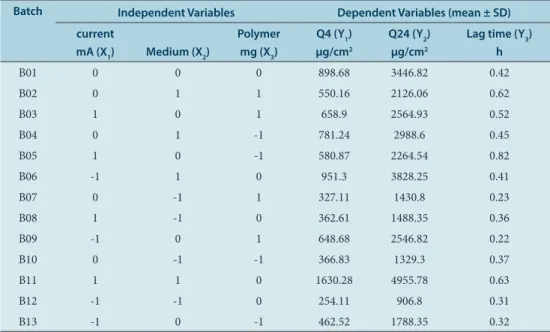
Table 3: Observed responses in the iontophoresis of Repaglinide by BB statistical design
Batch Independent Variables Dependent Variables (mean ± SD)
current
mA (X1) Medium (X2)
Polymer
mg (X3)
Q4 (Y1)
µg/cm2
Q24 (Y2)
µg/cm2
Lag time (Y3)
h
B01 0 0 0 898.68 3446.82 0.42
B02 0 1 1 550.16 2126.06 0.62
B03 1 0 1 658.9 2564.93 0.52
B04 0 1 -1 781.24 2988.6 0.45
B05 1 0 -1 580.87 2264.54 0.82
B06 -1 1 0 951.3 3828.25 0.41
B07 0 -1 1 327.11 1430.8 0.23
B08 1 -1 0 362.61 1488.35 0.36
B09 -1 0 1 648.68 2546.82 0.22
B10 0 -1 -1 366.83 1329.3 0.37
B11 1 1 0 1630.28 4955.78 0.63
B12 -1 -1 0 254.11 906.8 0.31
B13 -1 0 -1 462.52 1788.35 0.32
Table 4: Evaluation Parametersof Preliminary patches Trial
code
Weight
variation(mg) variation(mm)Thickness enduranceFolding Drug content(mg) % Moistureabsorbed % Moisturecontent
B1 25.25 ± 0.67 0.19 ± 1.52 232.48 ± 0.64 3.35 ± 0.96 5.92 ± 1.25 4.38 ± 0.77 B2 29.26 ± 0.59 0.22 ± 1.27 290.7 ± 0.74 3.36 ± 1.29 6.14 ± 1.53 4.82 ± 0.85 B3 37.55 ± 0.55 0.25 ± 0.65 362.45 ± 0.53 3.39 ± 0.84 8.27 ± 0.95 6.97 ± 1.17 Values expressed as mean ± S.D, n=3.
clamped together. The receptor compartment was filled with phosphate buffer pH 7.4 and the whole assembly was placed on magnetic stirrer and maintained at 37oC. Aliquots of 1 mL sample were withdrawn and replenished with an equal volume of phosphate buffer at predetermined time intervals and analyzed at 283 nm by UV spectrophotometer. Ex vivo permeation studies
Franz diffusion cell was used for ex vivo permeation studies. The isolated rat abdominal skin was mounted between the donor and receptor compartments. The patch was placed on the rat skin and clamped together. The receptor compartment was filled with phosphate buffer pH 7.4 maintained at 37oC by stirring magnetically at 200 rpm. Aliquots of 1 mL sample were withdrawn at predetermined time intervals and analyzed by HPLC. The amount of drug permeated was calculated and Flux was determined from the slope of the curve between the amount of drug permeated versus time.
Release kinetic data
The release profile were fitted in to various mathematical models such as Zero order, First order, Hixon and Crowell,18 Higuchi and Korsmeyer.19
RESULTS AND DISCUSSION
The study was to identify the controlling factors responsible for the permeation of Repaglinide. A set of initial trials were carried to establish the range for each process variable to optimize the iontophoretic delivery of Repaglinide across abdominal skin. The initial trials conducted revealed the current density in the range of 0.05-0.5 mA/cm2 as low and high current density respectively, based on these observation the centre level 0.25 mA/cm2 was also used in the design (Table 4). Thirteen experi-ments were carried out based on BBD and the experimental runs and observed responses were given in the Table 3. The range of the responses were found to be 254.11 µg/cm2 in B12 and 951.3 µg/cm2 in B06; 906.8 µg/cm2 in B12 and 3828.25 µg/cm2 in B06 as Y
1 and Y2 respectively. The predicted and actual values were reasonably good and were tested using analysis of variance (ANOVA). The ANOVA indicated a significant effect (p<0.05) of factors on response.
Figure 1:Effect of current density and polymer on Q4.
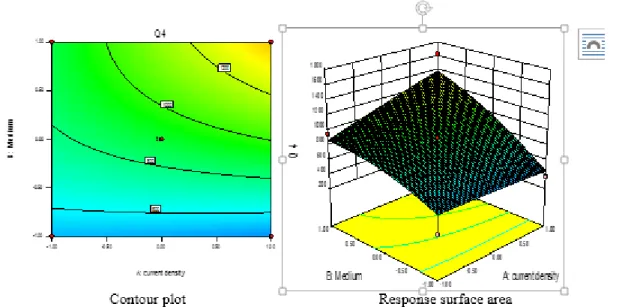
Figure 2:Effect of current and medium on response Y1.
1630.28 µg/cm2 to 906.8 and 4955.78 µg/cm2 in B12 and B11 respectively, using 272 mg of HPMC polymer. The results suggest that decrease in the pH of the medium decreased the iontophoretic permeation of Repaglinide, therefore the permeation of drug increases with increase in current density and increasing the pH of the medium.
Data analysis
By applying regression analysis methods, the predicted response have been obtained and given as
Y1=898.68+114.51X1+325.29X2-0.83X3+142.62X1X2–27.03X1X3– 47.84X2X3-8.85X12 - 90.26X
2 2 – 302.09X3 2
Y(2) = +3446.82 + 275.42 X1 + 1092.93 X2 + 37.23 X3 + 136.49 X1X2 - 114.52 X1X3 - 241.01 X2X3 - 164.78 X12 - 487.25 X
22 - 990.88 X32
Y(3) = +0.42 + 0.13X1 + 0.11X2 - 0.046X3 + 0.042X1X2 - 0.050 X1X3 + 0.077X2X3 + 0.030X12 - 0.022X
2 2 + 0.020 X32.
Where Y1, Y2 and Y3 are the predicted response and X1, X2 and X3 are the coded values of the test variables, current density, medium and polymer concentration.
this indicates excellent correlation between experimental values and predicted values.
CONCLUSION
The permeation of drug was influenced by medium of the donor compartment and current density. The results of the study confirm that the factors current density and medium pH significantly influence the response variables. The application of BBD statistical technique for optimization of process parameters helps in reaching optimum level with minimum experiments in shortest time.
ACKNOWLEDGEMENTS
The authors are thankful to Symed Laboratories, Hyderabad for providing gift sample also thankful to management of college for providing facilities to carry out this work.
CONFLICT OF INTEREST
Authors declare that there is no conflict of interest. interactions, only X1 and X2 were found to be significant (p<0.05),
indi-cating favourable effect on lag time. The experiments conducted with high current density and 7.4 pH medium yielded low lag time.
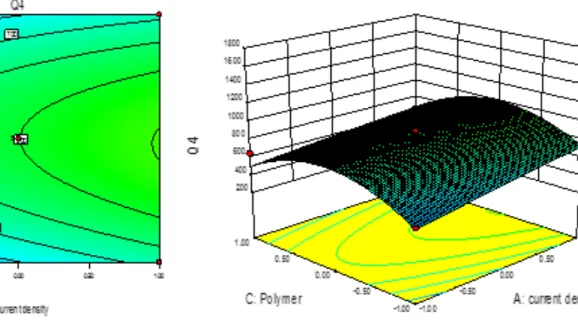
The contour plots and response surface plots are presented in Figure 1a-1b and 2a-2b, which were useful to study the interactions between factors on responses. They are also useful to study the effect of two factors at one time on the response keeping third factor constant level. All the relation-ships among three variables are curvilinear relationship but Figure 1a exhibits a slight linear relationship in the form of straight line from low to medium level of current density. The response surface plots showed the relationship even more clearly. The results revealed that Q4 and Q24 were found to be increased with increasing current density at high level of pH medium and medium level of polymer. Check point analysis were conducted and evaluated. The validity of the results predicted by regres-sion model were compared and revealed that they were as expected. The validity of the results which were predicted by regression model was confirmed by conducting repeated experiments. The results obtained from replication of three confirmed that the average cumulative amount of drug permeated Q24 (3818 µg/cm2) obtained was close to the predicted value (3810 µg/cm2) and the predicted error was found to be 0.209%,
Figure 3:Effect of current and polymer on Y2.
ABBREVIATIONS USED
BBD: Box behnken design; NIDDM: Non insulin dependent diabetes mellitus; HPMC: Hydroxy propyl methyl cellulose.
ABOUT AUTHORS
Sriram Pavani: is an Assistant Professor in Department of Pharmaceutics, Vaagdevi college of Pharmacy, Warangal, India. Her research is focused on Transdermal drug delivery and designing of experiments.
1. Jain SK, Awasthi AM, Jain NK, Agrawal GP. Calcium silicate based microspheres of repaglinide for gastroretentive floating drug delivery: Preparation and in vitro characterization. J Control Rel. 2005;107:300-9.
2. Druglib.com, http://www.druglib.com/activeingredient/repaglinide/prandin 3. Garala KC, Shinde AJ, Shah PH. Formulation and in-vitro characterization of
monolithic matrix transdermal systems using HPMC/Eudragit S 100 polymer blends. Int J Ph and Ph Sci. 2009;1:108-20.
4. Vyas SP, Khar RK. 2002. Controlled drug delivery concepts and advances. New Delhi: Vallabh Prakashan.
5. Ghosal K, Rajan R, Nanda A. Effects of chemical enhancers on the release of glipizide through matrix patch. Int J Chem Tech Res. 2009;1(4):1128-30. 6. Dhote, Vinod, Bhatnagar, Punit, Mishra, Pradyumna K. Iontophoresis: A
poten-tial emergence of a transdermal drug delivery system. Sci Ph. 2012;80(1):1-28. 7. Gannu, Ramesh, Yamsani, Vamshi V, Palem, Chinna R, et al. Iontophoretic
delivery of lisinopril: Optimization of process variables by Box-Behnken statistical design. Ph Dev Tech. 2009;15(12):169-77.
8. Gupta R, Mukharjee B. Development and in vitro evaluation of diltiazem hydro-chloride transdermal patches based on povidone ethyl cellulose matrices. Drug Dev Ind Pharm. 2003;29:1-7.
9. Green PG. Iontophoretic delivery of peptide drugs. J control Rel. 1996;41:33-48. 10. Montgomery DC. Design and Analysis of Experiments, 6th ed. 2005.
11. Ravikumar K, Pakshirajan K, Swaminathan T, Balu K. Optimization of batch process parameters using response surface methodology for dye removal by a novel adsorbent. Chem Eng J. 2005;105:131-8.
12. Kiran B, Kaushik A, Kaushik CP. Response surface methodological approach for optimizing removal of Cr (VI) from aqueous solution using immobilized cyano-bacterium. Chem Eng J. 2007;126(2):147-53.
13. Annadurai G, Sheeja RY. Use of Box-Behnken design of experiments for the adsorption of verofix red using biopolymer. Bioprocess Eng. 1998;18(6):463-6. 14. Yousuf M, Ahmad M. Ketotifen fumarate and salbutamol sulphate combined
transdermal patch formulations: in vitro release and ex vivo permeation studies. In J Pharm Sci. 2013;75(5):569-77.
15. Jitendra B. Formulation, optimization and evaluation of matrix type transdermal system of Lisinopril dehydrate using penetration enhancers. Drug Inv Today. 2010;2:134-7.
16. Bharkatiya M, Neema RK. Skin penetration enhancement techniques. J Young Pharm. 2009;1(2):110-5
17. Keleb E, Sharma R, Mosa EB, Zaljahwi AZ. Transdermal drug delivery system-design and evaluation. Int J Adv Phar Sci. 2010;1201-211.
18. Hixon AW, Crowell JH. Dependence of reaction velocity upon surface andAgita-tion. Indus Eng Chem. 1931;23(10):923-31.
19. Korsmeyer RW, Gurny R, Doelker E. Mechanisms of solute release from po-rous hydrophilic polymers. Int J Pharm. 1983;15(1):25-35.