Text Generation from Keywords
Kiyotaka Uchimoto† Satoshi Sekine‡ Hitoshi Isahara†
†Communications Research Laboratory
2-2-2, Hikari-dai, Seika-cho, Soraku-gun, Kyoto, 619-0289, Japan
{uchimoto,isahara}@crl.go.jp
‡New York University
715 Broadway, 7th floor New York, NY 10003, USA
Abstract
We describe a method for generating sentences from “keywords” or “headwords”. This method consists of two main parts, candidate-text con-struction and evaluation. The concon-struction part generates text sentences in the form of depen-dency trees by using complementary informa-tion to replace informainforma-tion that is missing be-cause of a “knowledge gap” and other missing function words to generate natural text sen-tences based on a particular monolingual cor-pus. The evaluation part consists of a model for generating an appropriate text when given keywords. This model considers not only word n-gram information, but also dependency infor-mation between words. Furthermore, it consid-ers both string information and morphological information.
1 Introduction
Text generation is an important technique used for applications like machine translation, sum-marization, and human/computer dialogue. In recent years, many corpora have become avail-able, and have been used to generate natural surface sentences. For example, corpora have been used to generate sentences for language model estimation in statistical machine trans-lation. In such translation, given a source lan-guage text, S, the translated text, T, in the target language that maximizes the probabil-ity P(T|S) is selected as the most appropri-ate translation, Tbest, which is represented as (Brown et al., 1990)
Tbest = argmaxTP(T|S)
= argmaxT(P(S|T)×P(T)). (1)
In this equation, P(S|T) represents the model used to replace words or phrases in a source lan-guage with those in the target lanlan-guage. It is called a translation model. P(T) represents a language model that is used to reorder trans-lated words or phrases into a natural order in
the target language. The input of the language model is a “bag of words,” and the goal of the model is basically to reorder the words. At this point, there is an assumption that natural sen-tences can be generated by merely reordering the words given by a translation model. To give such a complete set of words, however, a trans-lation model needs a large number of bilingual corpora. If we could automatically complement the words needed to generate natural sentences, we would not have to collect the large number of bilingual corpora required by a translation model. In this paper, we assume that the role of the translation model is not to give a complete set of words that can be used to generate nat-ural sentences, but to give a set of headwords or center words that a speaker might want to express, and describe a model that can provide the complementary information needed to gen-erate natural sentences by using a target lan-guage corpus when given a set of headwords.
If we denote a set of headwords in a target language as K, we can express Eq. (1) as
P(T|S) = P(K|S)×P(T|K). (2)
P(K|S) in this equation represents a model that gives a set of headwords in the target lan-guage when given a source-lanlan-guage text sen-tence. P(T|K) represents a model that gener-ates text sentence T when given a set of head-words, K. We call the model represented by P(T|K) atext-generation model. In this paper, we describe a text-generation model and a gen-eration system that uses the model. Given a set of headwords or keywords, our system outputs the text sentence that maximizes P(T|K) as an appropriate text sentence, Tbest:
Tbest = argmaxTP(T|K)
= argmaxT(P(K|T)×P(T)). (3)
key-words. Therefore, this model can be regarded as a model that translates keywords into text sentences. The model represented by P(T) in Eq. (3) is a language model used in statistical machine translation. The n-gram model is the most popular one used as a language model.
We assume that there is one extremely proba-ble ordered set of morphemes and dependencies between words that produce keywords, and we expressP(K|T) as
P(K|T) ≈ P(K, M, D|T)
= P(K|M, D, T)×P(D|M, T)×P(M|T). (4)
In this equation, M denotes an ordered set of morphemes andDdenotes an ordered set of de-pendencies in a sentence. P(K|M, D, T) rep-resents a keyword-production model. To es-timate the models represented by P(D|M, T) and P(M|T), we use a dependency model and a morpheme model, respectively, for the depen-dency analysis and morphological analysis.
Statistical machine translation and example-based machine translation require numerous high-quality bilingual corpora. Interlingual ma-chine translation and transfer-based mama-chine translation require a parser with high precision. Therefore, these approaches to translation are not practical if we do not have enough bilingual corpora or a good parser. This is especially so if the source text-sentences are incomplete or have errors like those often found in OCR and speech-recognition output. In these cases, however, if we translate headwords into words in the target language and generate sentences from the trans-lated words by using our method, we should be able to generate natural sentences from which we can grasp the meaning of the source-text sen-tences.
The text-generation model represented by P(T|K) in Eq. (2) can be applied to various tasks besides machine translation.
• Sentence-generation support system for people with aphasia: About 300,000 people are reported to suffer from aphasia in Japan, and 40% of them can select only a few words to describe a picture. If candi-date sentences can be generated from these few words, it would help these people com-municate with their families and friends. • Support system for second language
writing: Beginners writing in second lan-guage usually fined it easy to produce cen-ter words or headwords, but often have dif-ficulty generating complete sentences. If several possible sentences could be gener-ated from those words, it would help
begin-ners communicate with foreigbegin-ners or study second-language writing.
These are just two examples. We believe that there are many other possible applications.
2 Overview of the Text-Generation
System
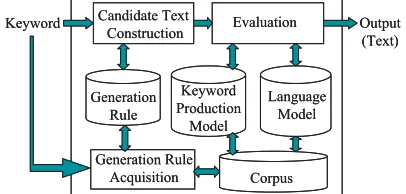
In this section, we give an overview of our sys-tem for generating text sentences from given keywords. As shown in Fig. 1, this system con-sists of three parts: generation-rule acquisition, candidate-text sentence construction, and eval-uation.
Figure 1: Overview of the text-generation sys-tem.
Given keywords, text sentences are generated as follows.
1. During generation-rule acquisition, genera-tion rules for each keyword are automati-cally acquired.
2. Candidate-text sentences are constructed during candidate-text construction by ap-plying the rules acquired in the first step. Each candidate-text sentence is rep-resented by a graph or dependency tree. 3. Candidate-text sentences are ranked
ac-cording to their scores assigned during eval-uation. The scores are calculated as a probability estimated by using a keyword-production model and a language model that are trained with a corpus.
4. The candidate-text sentence that maxi-mizes the score or the candidate-text sen-tences whose scores are over a threshold are selected as output. The system can also output candidate-text sentences that are ranked within the top N sentences. In this paper, we assume that the target lan-guage is Japanese. We define a keyword as the headword of abunsetsu. Abunsetsuis a phrasal unit that usually consists of several content and function words. We define the headword of a
bunsetsu as the rightmost content word in the
word whose part-of-speech is a verb, adjective, noun, demonstrative, adverb, conjunction, at-tribute, interjection, or undefined word. We define the other words as function words. We define formal nouns and auxiliary verbs “SURU (do)” and “NARU (become)” as function words, except when there are no other content words in the same bunsetsu. Part-of-speech categories follow those in the Kyoto University text corpus (Version 3.0) (Kurohashi and Nagao, 1997), a tagged corpus of the Mainichinewspaper.
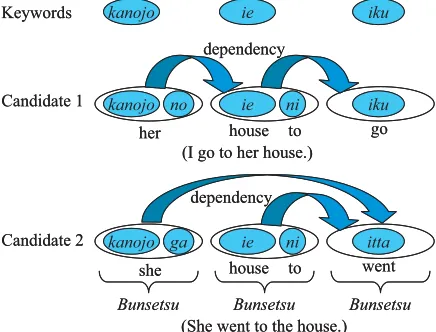
Figure 2: Example of text generated from key-words.
For example, given the set of keywords “kanojo(she),” “ie(house),” and “iku (go),” as shown in Fig. 2, our system retrieves sentences including each word, and extracts eachbunsetsu
that includes each word as a headword of the
bunsetsu. If there is no tagged corpus such as the Kyoto University text corpus, each bun-setsucan be extracted by using a morphological-analysis system and a dependency-morphological-analysis sys-tem such as JUMAN (Kurohashi and Nagao, 1999) and KNP (Kurohashi, 1998). Our system then acquires generation rules as follows.
• “kanojo(she)→kanojo(she) no(of)”
• “kanojo(she)→kanojo(she) ga”
• “ie (house)→ie(house) ni(to)”
• “iku (go)→iku (go)”
• “iku (go)→itta(went)”
The system next generates candidatebunsetsus for each keyword and candidate-text sentences in the form of dependency trees, such as “Can-didate 1” and “Can“Can-didate 2” in Fig. 2, with the assumption that there are dependencies be-tween keywords. Finally, the candidate-text sentences are ranked by their scores, calculated by a text-generation model, and transformed into surface sentences.
In this paper, we focus on the keyword-production model represented by Eq. (4) and assume that our system outputs sentences in the form of dependency trees.
3 Candidate-Text Construction
We automatically acquire generation rules from a monolingual target corpus at the time of gen-erating candidate-text sentences. Generation rules are restricted to those that generate bun-setsus, and the generated bunsetsus must in-clude each input keyword as a headword in the
bunsetsu. We then generate candidate-text sen-tences in the form of dependency trees by simply combining thebunsetsus generated by the rules. The simple combination of generatedbunsetsus may produce semantically or grammatically in-appropriate candidate-text sentences, but our goal in this work was to generate a variety of text sentences rather than a few fixed expres-sions with high precision 1.
3.1 Generation-Rule Acquisition
Let us denote a set of keywords as KS and a set of rules, each of which generates a bunsetsu
when given keyword k(∈KS), as Rk. We then restrict rk(∈Rk) to those represented as
k → hkm∗. (5)
In this rule, hk represents the head morpheme whose word is equal to keyword k; m∗ repre-sents zero, one, or a series of morphemes that are connected tohkin the samebunsetsu. Here, we define a morpheme as consisting of a word and its morphological information or grammat-ical attribute, such as part-of-speech, and we define a head morpheme as consisting of a head-word and its grammatical attribute. By apply-ing these rules, we generate bunsetsus from in-put keywords.
3.2 Construction of Dependency Trees
Given keywordsK=k1k2. . . kn, candidate bun-setsus are generated by applying the generation rules described in Section 3.1. Next, by as-suming dependency relationships between the
bunsetsus, candidate dependency trees are con-structed. Dependencies between the bunsetsus are restricted in that they must have the follow-ing characteristics of Japanese dependencies:
(i) Dependencies are directed from left to right.
(ii) Dependencies do not cross.
(iii) All bunsetsus except the rightmost one de-pend on only one other bunsetsu.
For example, when three keywords are given and candidatebunsetsus including each keyword are generated asb1,b2, andb3, the candidate
de-pendency trees are (b1 (b2 b3)) and ((b1 b2) b3)
if we do not reorder keywords, but 16 trees re-sult if we consider the order of keywords to be arbitrary.
4 Text-Generation Model
We next describe the model represented by Eq. (4); that is, a keyword-production model, a morpheme model that estimates how likely a string is to be a morpheme, and a dependency model. The goal of this model is to select optimal sets of morphemes and dependencies that can generate natural sentences. We imple-mented these models within an maximum en-tropy framework (Berger et al., 1996; Ristad, 1997; Ristad, 1998).
4.1 Keyword-Production Models
This section describes five keyword-production models which are represented byP(K|M, D, T) in Eq. (4). In these models, we define the set of headwords whose frequency in the corpus is over a certain threshold as a set of keywords, KS, and we restrict thebunsetsus to those generated by the generation rules represented in form (5). We assume that all keywords are independent and thatki corresponds to wordwj(1≤j ≤m) when text is given as a series of wordsw1. . . wm.
1. trigram model
We assume thatkidepends only on the two anterior wordswj−1 and wj−2.
P(K|M, D, T) = n
i=1
P(ki|wj−1, wj−2).(6)
2. posterior trigram model
We assume thatkidepends only on the two posterior words wj+1 and wj+2.
P(K|M, D, T) = n
i=1
P(ki|wj+1, wj+2).(7)
3. dependency bigram model
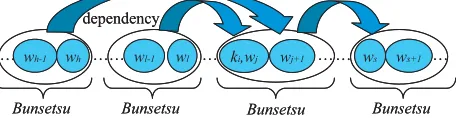
We assume thatkidepends only on the two rightmost words wl and wl−1 in the
right-most bunsetsu that modifies the bunsetsu includingki (see Fig. 3).
P(K|M, D, T) = n
i=1
P(ki|wl, wl−1). (8)
Figure 3: Relationship between keywords and words inbunsetsus.
4. posterior dependency bigram model
We assume that ki depends only on the headword, ws, and the word on its right, ws+1, in the bunsetsu that is modified by
the bunsetsu including ki (see Fig. 3).
P(K|M, D, T) = n
i=1
P(ki|ws, ws+1).(9)
5. dependency trigram model
We assume thatki depends only on the two rightmost words wl and wl−1 in the
right-most bunsetsu that modifies the bunsetsu, and on the two rightmost words wh and wh−1 in the leftmost bunsetsu that
modi-fies the bunsetsu including ki (see Fig. 3).
P(K|M, D, T) =
n
i=1
P(ki|wl, wl−1, wh, wh−1).(10)
4.2 Morpheme Model
Let us assume that there are l grammatical attributes assigned to morphemes. We call a model that estimates the likelihood that a given string is a morpheme and has the grammatical attributej(1≤j≤l) a morpheme model.
Let us also assume that morphemes in the or-dered set of morphemes M depend on the pre-ceding morphemes. We can then represent the probability ofM, given textT; namely,P(M|T) in Eq. (4):
P(M|T) = n
i=1
P(mi|mi1−1, T), (11)
where mi can be one of the grammatical at-tributes assigned to each morpheme.
4.3 Dependency Model
Let us assume that dependencies di(1 ≤i≤n) in the ordered set of dependencies D are inde-pendent. We can then represent P(D|M, T) in Eq. (4) as
P(D|M, T) = n
i=1
P(di|M, T). (12)
5 Evaluation
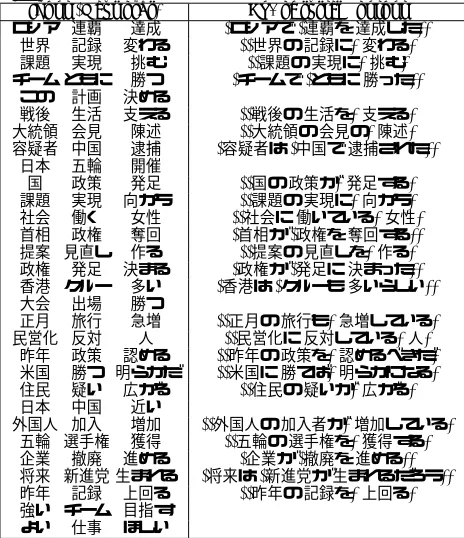
Table 1: Input keywords and examples of sys-tem output.
Input (Keywords) Ex. of system output
( ( ))
(( ) )
(( ) )
( ( ))
(( ) )
(( ) )
( ( ))
(( ) )
(( ) )
(( ) )
( ( ))
(( ) )
( ( ))
( ( ))
(( ) )
(( ) )
(( ) )
(( ) )
(( ) )
(( ) )
(( ) )
( ( ))
( ( ))
(( ) )
times or more in the newspaper articles on Jan-uary 1st in the Kyoto University text corpus (Version 3.0) without looking at the articles.
We evaluated each model by the percentage of outputs that were subjectively judged as ap-propriate by one of the authors. We used two evaluation standards.
• Standard 1: If the dependency tree ranked first is semantically and grammatically ap-propriate, it is judged as appropriate. • Standard 2: If there is at least one
depen-dency tree that is ranked within the top ten and is semantically and grammatically appropriate, it is judged as appropriate.
We used headwords that were found five times or more in the newspaper articles appearing from January 1st to 16th in the Kyoto Univer-sity text corpus and also found in those appear-ing on January 1st as the set of headwords,KS. For headwords that were not in KS, we added their major part-of-speech categories to the set. We trained our keyword-production models by using 1,129 sentences (containing 10,201 head-words) from newspaper articles appearing on January 1st. We used a morpheme model and a dependency model identical to those proposed by Uchimoto et al. (Uchimoto et al., 2001; Uchi-moto et al., 1999; UchiUchi-moto et al., 2000b). To train the models, we used 8,835 sentences from
newspaper articles appearing from January 1st to 9th in 1995. Generation rules were acquired from newspaper articles appearing from Jan-uary 1st to 16th. The total number of sentences was 18,435.
First, we evaluated the outputs generated when the rightmost two keywords, such as “
and ,” on each line of Table 1 were input. Table 2 shows the results. KM1 through KM5 stand for the five keyword-production models described in Section 4.1, and MM and DM stand for the morpheme and the dependency models, respectively. The symbol + indicates a combi-nation of models. In the models without MM, DM, or both, P(M|T) andP(D|M, T) were as-sumed to be 1. We carried out additional ex-periments with models that considered both the anterior and posterior words, such as the com-bination of KM1 and KM2 or KM3 and KM4. The results were at most 16/30 by standard 1 and 24/30 by standard 1.
Table 2: Results of subjective evaluation.
Model Standard 1 Standard 2
KM1 (trigram) 13/30 28/30
KM1 + MM 21/30 28/30
KM1 + DM 12/30 28/30
KM1 + MM + DM 26/30 28/30
KM2 (posterior trigram) 6/30 15/30
KM2 + MM 8/30 20/30
KM2 + DM 10/30 20/30
KM2 + MM + DM 9/30 25/30
KM3 (dependency bigram) 13/30 29/30
KM3 + MM 26/30 29/30
KM3 + DM 14/30 28/30
KM3 + MM + DM 27/30 29/30
KM4 (posterior dependency bigram) 10/30 18/30
KM4 + MM 9/30 26/30
KM4 + DM 9/30 22/30
KM4 + MM + DM 13/30 27/30
KM5 (dependency trigram) 12/30 26/30
KM5 + MM 17/30 28/30
KM5 + DM 12/30 27/30
KM5 + MM + DM 26/30 28/30
The models KM1+MM+DM,
KM3+MM+DM, and KM5+MM+DM achieved the best results, as shown in Ta-ble 2. For models KM1, KM3, and KM5, the results with MM and DM were significantly better than those without MM and DM in the evaluation by standard 1. We believe this was because cases are more tightly connected with verbs than with nouns, so models KM1, KM3, and KM5, which learn the connection between cases and verbs, can better rank the candidate-text sentences that have a natural connection between cases and verbs than other candidates.
the best results in the first experiment, and model KM5+MM+DM, which considers the richest information. We assumed that the in-put keyword order was appropriate and did not reorder the keywords. The results for both models were the same: 19/30 in the evalu-ation by standard 1 and 24/30 in the eval-uation by standard 2. The right column of Table 1 shows examples of the system out-put. For example, for the input “ (syourai, in the future), (shin-shin-tou, the New Frontier Party), and (umareru, to be born)”, the dependency tree “(
[syourai wa] ( [shin-shin-tou ga]
[umareru darou]))” (“The New Frontier Party will be born in the future.”) was generated. This output was automati-cally complemented by the appropriate modal-ity “ ” (darou, will), which agrees with the word “ ” (syourai, in the future), as well as by post-positional particles such as “ ” (wa, case marker) and “ ” (ga). For the input “ (gaikoku-jin, a foreigner),
(kanyuu, to join), and (zouka, to in-crease)”, the dependency tree “((
[gaikokujin no] [kanyuu sya ga])
[zouka shite iru] )” (“Foreigner members are increasing in number.”) was generated. This output was complemented not only by the modality expression “
” (shite iru, the progressive form) and post-positional particles such as “ ” (no, of) and “ ” (ga), but also by the suffix “ ” (sya, person), and a compound noun “ ” (kanyuu sya, member) was generated naturally. In six cases, though, we did not obtain appro-priate outputs because the candidate-text sen-tences were not appropriately ranked. Improv-ing the back-off ability of the model by usImprov-ing classified words or synonyms as features should enable us to rank sentences more appropriately.
6 Related Work
Many statistical generation methods have been proposed. In this section, we describe the differ-ences between our method and several previous methods.
Japanese words are often followed by post-positional particles, such as “ga” and “wo”, to indicate the subject and object of a sen-tence. There are no corresponding words in English. Instead, English words are preceded by articles, “the” and “a,” to distinguish def-inite and indefinite nouns, and so on, and in this case there are no corresponding words in Japanese. Knight et al. proposed a way to
compensate for missing information caused by a lack of language-dependent knowledge, or a “knowledge gap” (Knight and Hatzivassiloglou, 1995; Langkilde and Knight, 1998a; Langkilde and Knight, 1998b). They use semantic expres-sions as input, whereas we use keywords. Also, they construct candidate-text sentences or word lattices by applying rules, and apply their lan-guage model, an n-gram model, to select the most appropriate surface text. While we can-not use their rules to generate candidate-text sentences when given keywords, we can apply their language model to our system to generate surface-text sentences from candidate-text sen-tences in the form of dependency trees. We can also apply the formalism proposed by Langkilde (Langkilde, 2000) to express the candidate-text sentences.
Bangalore and Rambow proposed a method to generate candidate-text sentences in the form of trees (Bangalore and Rambow, 2000). They consider dependency information when deriving trees by using XTAG grammar, but they as-sume that the input contains dependency infor-mation. Our system generates candidate-text sentences without relying on dependency infor-mation in the input, and our model estimates the dependencies between keywords.
Ratnaparkhi proposed models to generate text from semantic attributes (Ratnaparkhi, 2000). The input of these models is semantic attributes. His models are similar to ours if the semantic attributes are replaced with keywords. However, his models need a training corpus in which certain words are replaced with seman-tic attributes. Although our model also needs a training corpus, the corpus can be automati-cally created by using a morphological analyzer and a dependency analyzer, both of which are readily available.
Humphreys et al. proposed using mod-els developed for sentence-structure analysis to rank candidate-text sentences (Humphreys et al., 2001). As well as models developed for sentence-structure analysis, we also use those developed for morphological analysis and found that these models contribute to the generation of appropriate text.
retrieve text that already exists while ours is to generate new text.
7 Conclusion
We have described a method for generating sen-tences from ”keywords” or “headwords”. This method consists of two main parts, candidate-text construction and evaluation.
1. The construction part generates text sen-tences in the form of dependency trees by providing complementary information to replace that missing due to a “knowledge gap” and other missing function words, and thus generates natural text sentences based on a particular monolingual corpus. 2. The evaluation part consists of a model
for generating an appropriate text sentence when given keywords. This model consid-ers the dependency information between words as well as word n-gram informa-tion. Furthermore, the model considers both string and morphological information.
If a language model, such as a word n-gram model, is applied to the generated-text sen-tences in the form of dependency trees, an appropriate surface-text sentence is generated. The word-order model proposed by Uchimoto et al. can also generate surface text in a natural order (Uchimoto et al., 2000a).
There are several possible directions for our future research. In particular,
• We would like to expand the generation rules. We restricted the generation rules automatically acquired from a corpus to those that generate a bunsetsu. To gener-ate a gregener-ater variety of candidgener-ate-text sen-tences, we would like to expand the rules that can generate a dependency tree. Ex-pansion would lead to complementing with content words as well as function words. We also would like to prepare default rules or to classify words into several classes when no sentences including the keywords are found in the target corpus.
• Some of the N-best text sentences gener-ated by our system are semantically and grammatically unnatural. To remove such sentences from among the candidate-text sentences, we must enhance our model so that it can consider more information, such as classified words or those in a thesaurus. • We restricted keywords to the headwords or rightmost content words in the bunsetsus.
We would like to expand the definition of keywords to other content words and to synonyms of the keywords.
Acknowledgments
We thank the Mainichi Newspapers for permis-sion to use their data. We also thank Kimiko Ohta, Hiroko Inui, Takehito Utsuro, Man-abu Okumura, Akira Ushioda, Jun’ichi Tsujii, Kiyosi Yasuda, and Masahisa Ohta for their beneficial comments during the progress of this work.
References
S. Bangalore and O. Rambow. 2000. Exploiting a Probabilis-tic Hierarchical Model for Generation. InProceedings of the COLING, pages 42–48.
A. Berger and J. Lafferty. 1999. Information Retrieval as Statistical Translation. InProceedings of the ACM SIGIR, pages 222–229.
A. L. Berger, S. A. Della Pietra, and V. J. Della Pietra. 1996. A Maximum Entropy Approach to Natural Language Pro-cessing.Computational Linguistics, 22(1):39–71.
P. F. Brown, J. Cocke, S. A. Della Pietra, V. J. Della Pietra, F. Jelinek, J. D. Lafferty, R. L. Mercer, and P. S. Roossin. 1990. A Statistical Approach to Machine Translation.
Computational Linguistics, 16(2):79–85.
K. Humphreys, M. Calcagno, and D. Weise. 2001. Reusing a Statistical Language Model for Generation. InProceedings of the EWNLG.
K. Knight and V. Hatzivassiloglou. 1995. Two-Level, Many-Paths Generation. InProceedings of the ACL, pages 252– 260.
S. Kurohashi and M. Nagao. 1997. Building a Japanese Parsed Corpus while Improving the Parsing System. In
Proceedings of the NLPRS, pages 451–456.
S. Kurohashi and M. Nagao, 1999. Japanese Morphological Analysis System JUMAN Version 3.61. Department of Informatics, Kyoto University.
S. Kurohashi, 1998. Japanese Dependency/Case Structure Analyzer KNP Version 2.0b6. Department of Informatics, Kyoto University.
I. Langkilde and K. Knight. 1998a. Generation that Exploits Corpus-Based Statistical Knowledge. InProceedings of the COLING-ACL, pages 704–710.
I. Langkilde and K. Knight. 1998b. The Practical Value of N-grams in Generation. InProceedings of the INLG. I. Langkilde. 2000. Forest-Based Statistical Sentence
Gener-ation. InProceedings of the NAACL, pages 170–177. A. Ratnaparkhi. 2000. Trainable Methods for Surface
Natu-ral Language Generation. InProceedings of the NAACL, pages 194–201.
E. S. Ristad. 1997. Maximum Entropy Modeling for Natural Language. ACL/EACL Tutorial Program, Madrid. E. S. Ristad. 1998. Maximum Entropy Modeling Toolkit,
Release 1.6 beta. http://www.mnemonic.com/software/ memt.
K. Uchimoto, S. Sekine, and H. Isahara. 1999. Japanese De-pendency Structure Analysis Based on Maximum Entropy Models. InProceedings of the EACL, pages 196–203. K. Uchimoto, M. Murata, Q. Ma, S. Sekine, and H. Isahara.
2000a. Word Order Acquisition from Corpora. In Proceed-ings of the COLING, pages 871–877.
K. Uchimoto, M. Murata, S. Sekine, and H. Isahara. 2000b. Dependency Model Using Posterior Context. In Proceed-ings of the IWPT, pages 321–322.