Evacuation Guidance Design: An Experimental Study Based
on Eye Tracking Devices
Ning Ding
1, Tao Chen
2, Yuan Liu
31School of Criminal Investigation and Counter-Terrorism People’s Public Security University of China, Beijing, China
2Institute of Public Safety Research, Department of Engineering Physics Tsinghua University, Beijing, China
3Institute of Economics, School of Social Sciences Tsinghua University, Beijing, China
Abstract- It is a crucial issue whether evacuees follow the evacuation guidance during evacuation. Good evacuation guidance is necessary to be designed to help the evacuees follow the guidance. In this paper, evacuation experiments based on wearable eye tracking devices were carried out to study the design effect of the evacuation guidance. Three factors were considered in these experiments: 1) the position of the evacuation guidance; 2) follow guidance or follow other evacuees; 3) follow a stranger or a familiar person. The results show that more participants noticed the guidance with low position and ground position than the guidance with up position. The evacuees intend to follow others rather than to follow the guidance, i.e. most evacuees act as “follower”. Eye tracking evacuation experiments can also be used to test the effectiveness of evacuation guidance signs.
Keywords: evacuation guidance; experiments; eye tracking devices; leader-and-follower
1. Introduction
With the continuous development of modern architecture, both the structure and the function of a building are gradually becoming more complicated. Thus, evacuation of people under emergency circumstances becomes an important research topic nowadays. Complex indoor places are usually enclosed environments with internal obstacles and multiple exits. They have features such as large scene area, complex internal structures, and multiple exits, such as supermarkets, movie theaters, and gymnasiums. Unlike pedestrian evacuation modeling in a simple environment (access, barrier-free rooms) whose focus is on research at the operational level, pedestrian evacuation modeling in complex indoor places needs to consider behavioral characteristics at the tactical level [1]. How do evacuees choose the route in the evacuation process? How to make a decision? Do they follow the evacuation guidance? Only solving the problems of evacuation behaviors can provide a strong basis for the design of building evacuation signs and the establishment of evacuation simulation models.
order to further analyze the evacuees' psychology and behavior, eye tracking devices can be introduced in evacuation experiments.
Eyes are an important way for humans to obtain information. They can reflect people's psychological activities to some extent. The eye movement technique is to extract the data such as the gaze point, the gaze time, the number of gazes, the saccade distance, and the pupil size from the records of the eye movement trajectory, so as to study the intrinsic cognitive process of the individual. In recent years, eye tracking devices have also received some attention in evacuation experiments. Cosma [26] combined VR technology with eye tracker to build a smoke-filled railway tunnel evacuations scene. A green LED lighting system was installed on the road surface. The crowd path selection behavior under different lighting conditions were studied through virtual reality evacuation experiments. It was found that the lighting system has a significant positive impact on the crowd's safety evacuation. Andree [27] built a virtual high-rise building through VR technology. Through experiments, they studied the export selection behavior of crowds during the evacuation process and the waiting time when using elevators for evacuation. It was found that green evacuation indicators can effectively guide evacuees to choose elevators. However, there are still few experimental studies using eye trackers in evacuations.
In this paper, experiments were carried out to study how the position of the evacuation guidance sign influences evacuees’ way-finding behaviors, and the impact of leader-and-follower on the way-finding choices during evacuation. In order to study these issues, we carried out 7 experiments with the use of wearable eye tracking glasses. The building layout and the procedure of the experiments are introduced in Section 2. The results of these experiments, including the ratio of different way-finding choices and the fix-action, are shown in Section 3. In the Section 4, the comparison of these results and some interesting phenomena during the experiments are discussed.
2. Experiment
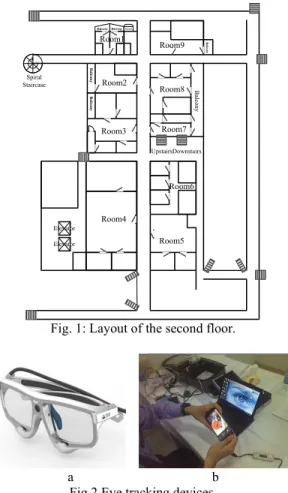
In this paper, 7 experiments were carried out in a complex building. The objectives of these experiments are: (1) the impact of the positions (high, low, ground) of the evacuation guidance sign on the way-finding behavior; (2) when facing to a guidance sign and another evacuee (a stranger or an acquaintance), how does the participant make his/her choice? (3) when facing to an acquaintance and a stranger, the participant tends to follow which person?
Balcony Balcony
Elevator Elevator
UpstairsDownstairs Room3
Balcony
Balcony
Balcony
Balcony
Balcony
向上
Spiral Staircase
Room1
Room2
Room5 Room7 Room8
Room6
Room4
Room9
Fig. 1: Layout of the second floor.
a b Fig.2 Eye tracking devices.
Before the experiment begins, the participant is asked if he knows which room he is in. If he knows the room, the experiment is considered invalid. The subjects of this experiment were all undergraduates of the School of Criminal Investigation and Counter-Terrorism, People’s Public Security University of China. Each experiment includes 50 volunteers, and a total of 300 students participated in the 6 groups of experiments.
The experiment procedure is as follows:
1) Experiment 1: the guidance sign is set 30cm higher than the ground on the wall. 2) Experiment 2: the guidance sign is set 200cm higher than the ground on the wall. 3) Experiment 3: the guidance sign is set right ahead of the door threshold on the ground.
4) Experiment 4: the guidance sign is set 30cm higher than the ground on the wall, and a stranger stood around the door inside the room. The stranger was asked to go to the opposite direction of the guidance sign.
5) Experiment 5: the guidance sign is set right ahead of the door threshold on the ground, and a stranger stood around the door inside the room. The stranger was asked to go to the opposite direction of the guidance sign.
6) Experiment 6: there is no guidance sign at the door. The stranger (Participant B) and a person (participant C) familiar with the evacuee (Participant A) waited in the room before the experiment. When the experiment started, B moved to the left, and C moved to the right. Participant A was behind B and C before the evacuation began.
3. Results
between the way-finding behaviour and eye movement in the evacuation process. In general, in experiment 1-3, eye movement characteristics of evacuees during evacuation can be divided into two categories: 1) the evacuee did not look at the guidance sign; 2) the evacuee looked at the guidance sign. Then the evacuees who looked at the guidance signs can be divided into people following the guidance sign and people not following the guidance sign. In experiment 4-5, the eye movement characteristics during evacuation can be divided into four categories: 1) the evacuee only looked at the guidance sign; 2) the evacuee only looked at participant B; 3) the evacuee looked at the guidance sign and also looked at participant B; 4) the evacuee did not look at the guidance sign, and did not look at participant B. The fourth category of evacuees make their own decision without the influence of the sign or participate B, so there is no need to analyse whether their evacuation direction is in accordance with the direction the sign indicated. Category 1-3 will be analyzed later.
In Experiment 6, the eye movement characteristics during evacuation can also be divided into four categories: 1) evacuee only looked at participant B; 2) evacuee only looked at participant C; 3) evacuee looked at participant B and also looked at participant C; 4) evacuee did not look at participant B, and also did not look participant C. Similar to the analysis of experiment 4-5, the fourth category is the independent decision of the evacuee. There is no need to analyze whether the evacuee follows the participant B or the participant C, and the other three categories need further analysis.
The data of the eye tracker mainly analyzes the time when evacuee looks at the sign: 1) if evacuee looks at the guidance sign, the time starts to count from when the evacuee's gaze falls on the sign, and stops when the gaze point is removed from the sign; 2) if evacuee looks at other participant, when evacuee begins to follow a stranger or opinion leader, the timing begins. When the gaze point moves away from the other participant and turns to another place (such as an intersection) during the evacuation process, the timing stops.
In the course of the experiment, some of the participants’ eye movement data was invalid, mainly due to the fact that the eyeglasses were loose during the evacuation process and the fix-action was inaccurate. Another reason is that they mentioned previously that they knew the location of the room they were in.
3.2. Results of Experiments 1-3
A snapshot of experiment 1 is shown in Fig.3, and Table 1 shows the results of experiment 1-3. For the lower, upper, and ground signs, the percentage of people who could see the sign is 42.55%, 16.67%, and 47.73%, respectively. The guidance signs used in this experiment are evacuation indicators without light-assisted lighting. It can be seen from the experimental results, the percentage of evacuees who can see evacuation guidance sign is less than 50%, where the sign in lower and ground position is more likely to attract evacuees' attention than signs in upper position.
Fig.3: A snapshot of experiment 1.
Table 1. Results of experiment 1-3.
Experiment Number of valid participants
Sign position
Number of participants who see the
sign
Follower Average gaze
time Non-follower
Average gaze
time (s) Follow-then-backtrack
Average gaze time
1 47 Low 20 12 0.54 6 1.04 2 0.48
2 42 High 7 5 0.53 2 0.52 0 -
Among people who saw the guidance sign, 60.00%, 71.43% and 66.67% chose to follow the sign, respectively. It can be seen that 60%-70% of those who saw the sign chose to follow direction the sign indicates. There are also individual participants who chose to follow the evacuation signs to evacuate and then went back to the other direction. In terms of the gazing time of the evacuation guidance sign, the average time of the follower in experiment 1 was only half that of the non-follower. However, in experiment 3, the follower’s average gaze time is longer than that of the non-follower. It can be seen that there is no significant feature in the gaze time.
3.2. Results of Experiments 4-5
Snapshots of experiment 4 are shown in Fig.4, and Table 2 shows the results of experiment 4-5. In experiment 4-5, most evacuees only saw the evacuation guidance sign or participant B. In both sets of experiments, most of the people who only saw the sign and only saw participant B would choose to follow the directions of the sign or participant B respectively (depending on what they saw). Only in experiment 5, although 2 evacuees only saw the evacuation guidance sign, they did not follow the direction the sign indicated. Among the evacuees who saw the sign, the proportion of evacuees following the signs in experiments 4 and 5 was significantly higher than that in experiment 1-3.
Fig.4: Snapshots of experiment 4.
Table 2. Results of experiment 4-5.
Experiment 4, 36 valid data 36 persons, sign position: low
Category Persons following the Persons sign
Average gaze time
(seconds) Persons following participant B Average gaze time (seconds) Only saw sign 10 10 0.74 0 - Only saw participant
B 15 0 - 15 3.75
Saw both 6 6 0.66 0 3.58
Saw now 5 - - - -
Experiment 5,valid data 43 persons,sign position: ground
Category Persons following the Persons sign
Average gaze time
(seconds) Persons following participant B Average gaze time (seconds)
Only saw sign 10 8 0.77 2 0.79(time gazing at the signs) Only saw participant
B 18 0 - 18 2.88
Saw both 2 1 0.66 1 0.61
Saw now 13 - - - -
In both sets of experiments, the number of persons who only saw and then followed participant B was significantly higher than the number of people who only saw evacuation signs and followed. The average time of the gaze (3.75 seconds and 2.88 seconds) was much higher than that of participants who only saw the evacuation signs (0.74 second and 0.77 second). The reason is mainly because when evacuees follow other people for evacuation, they will follow this person and watch for a long time.
participant B much longer than when they watch the evacuation sign. In experiment 5, due to the small sample size, there were no significant features.
3.2. Results of Experiments 6
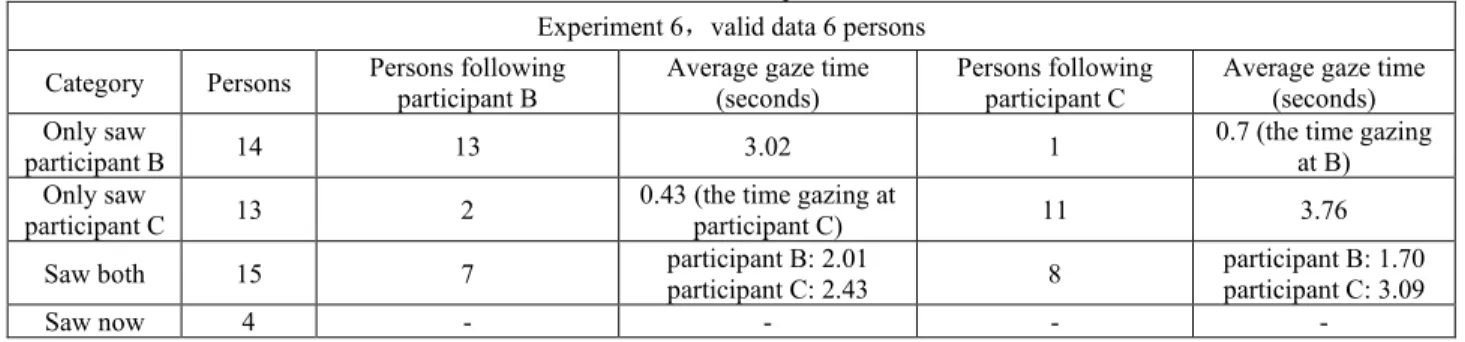
Table 3 shows the results of experiment 6. In experiment 6, the number of evacuees who only saw participant B (stranger) or participant C (acquaintance) are close. And there is no significant difference between the gaze time between the two categories. Of the 15 evacuees who both saw participant B and C, 7 of them chose to follow participant B (stranger), and 8 chose to follow acquaintance. In terms of gaze time, the time to gaze an acquaintance is obviously greater than the time to look at strangers. In addition, there were four people who did not look at familiar people or strangers and made their choices based on their own judgment.
Table 3. Results of experiment 6. Experiment 6,valid data 6 persons
Category Persons Persons following participant B Average gaze time (seconds) Persons following participant C Average gaze time (seconds) Only saw
participant B 14 13 3.02 1 0.7 (the time gazing at B) Only saw
participant C 13 2 0.43 (the time gazing at participant C) 11 3.76 Saw both 15 7 participant B: 2.01 participant C: 2.43 8 participant B: 1.70 participant C: 3.09
Saw now 4 - - - -
4. Comparison and Discussion
4.1. Comparison
As stated earlier, in experiments 1 and 4, the guidance sign is set 30cm higher than the ground on the wall, in experiment 2 is set 200cm higher than the ground on the wall and in experiment 3 and 5 right ahead of the door threshold on the ground. By comparing the proportions of evacuees who gazed at the guidance sign in experiments 1-5, as shown in Fig.5, results indicate that it is harder to be noticed when the position of the sign is higher. And only 16.67% of evacuees noticed the guidance sign set 200cm above the ground which is the highest sign position in all the six experiments. In contrast, the effect of an evacuation sign set in a lower position is relatively good. However, the evacuation signs used in this experiment were not light-assisted. In other VR evacuation experiments, it was found that the green LED evacuation guidance signs had good effect. In future experiments, we will also consider light-assisted evacuation indicators[26, 27].
Fig.5 Proportions of evacuees who saw guidance sign in experiment 1-6.
Fig.6 Average gaze time of the evacuees in experiment 1-6.
In the experiment, the proportion of evacuees who only saw the evacuation guidance sign or only saw another participant and acted as follower is shown in Fig.7. It shows that among the evacuees who only saw the guidance sign or another participant, the proportion of choosing to follow another participant is higher than that to follow the signs. By comparing experiments 1 and 4, experiments 3 and 5, it was found that although the location of the evacuation sign was the same, the proportion of evacuees who chose to follow the evacuation sign is higher when participant B is involved in the experiment. In addition, in the experiment 4-6, participants have a higher probability of following the target (guidance sign or other participants) they saw, and in experiments 4 and 5, the percentage of following strangers is 100%. In the experiment, directions of the sign and participant B are opposite. If the directions are the same, the probability that the crowd will follow the guidance sign may increase, and further studies will be conducted in later experiments.
Fig.7 The proportion of evacuees following the target they saw.
Fig.8. Number of evacuees who only saw the sign or other participants.
4.2. Limitations
There is a gap between experiments and real emergency evacuation events. The participants in our experiments were all Chinese students and well-educated; the type of participants and Chinese culture may have impact on the experimental results.
5. Conclusion
In this paper, 6 experiments were carried out. According to the results of experiments, it is found that more participants noticed the guidance with low position and ground position than the guidance with up position. The evacuees intend to follow others than to follow the guidance. Most of the evacuees play the role of a “follower”. Eye tracking evacuation experiments can be used to test the effectiveness of evacuation guidance signs. In our future work, more features should be tested based on experiments, such as social influence or social bond, guidance sign with lighting.
Acknowledgements
This work is supported by National Key R&D Program of China (No. 2017YFC0803300), the National Natural Science Foundation of China (71373139, 91646201).
References
[1] Hoogendoorn, S., and W. Daamen. "Self-organization in pedestrian flow." Traffic and Granular Flow
2003:373-382.
[2] Peacock, R. D., B. L. Hoskins, and E. D. Kuligowski. "Overall and local movement speeds during fire drill evacuations in buildings up to 31 stories." Safety Science, vol. 50, no. 8, pp. 1655-1664, 2012. [3] Huo, F., et al. "Experimental study on characteristics of pedestrian evacuation on stairs in a high-rise
building." Safety Science, vol. 86, pp. 165-173, 2016.
[4] Cheng, X., et al. "Study of announced evacuation drill from a retail store." Building & Environment, vol. 44, no. 5, pp. 864-870, 2009.
[5] Kobes, M., et al. "Building safety and human behaviour in fire: A literature review." Fire Safety Journal, vol. 45, no. 1, pp. 1-11, 2010.
[6] Ma, J., et al. "Experimental study on an ultra high-rise building evacuation in China." Safety Science, vol. 50, no. 8, pp. 1665-1674, 2012.
[7] Fang, Z., et al. "Experiment and modeling of exit-selecting behaviors during a building evacuation."
Physica A Statistical Mechanics & Its Applications, vol. 389, no. 4, pp. 815-824,2010.
[8] Fang, Z., et al. "Experimental study on evacuation process in a stairwell of a high-rise building."
Building & Environment, vol. 47, no.1, pp. 316-321, 2012.
[9] Liao, Y. J., et al. "A Study on People’s Attitude to the Use of Elevators for Fire Escape." Fire Technology, vol. 50, no. 2, pp. 363-378, 2014.
[10] Isobe, M., T. Adachi, and T. Nagatani. "Experiment and simulation of pedestrian counter flow."
[11] Kretz, T., A. Grünebohm, and M. Schreckenberg. "Experimental study of pedestrian flow through a bottleneck." J.Stat.Mech. (2006) P10014.
[12] Seyfried, A., et al. "New Insights into Pedestrian Flow Through Bottlenecks."Transportation Science, vol. 43, no. 3, pp. 395-406, 2009.
[13] Zhang J, W. Klingsch, A. Schadschneider, et al. "Experimental study of pedestrian flow through a T-junction." Traffic and Granular Flow 11. Springer Berlin Heidelberg, 2013: 241-249.
[14] Liu, S. B., et al. "Modeling Movement Direction Choice and Collision Avoidance in Agent-Based Model for Pedestrian Flow." Journal of Transportation Engineering, vol. 141, no. 6, pp. 1-8, 2015. [15] Wei, J., et al. "Experiment of bi-direction pedestrian flow with three-dimensional cellular automata."
Physics Letters A, vol. 379, no. 16-17, pp. 1081-1086, 2015.
[16] Isobe, Motoshige, T. Adachi, and T. Nagatani. "Experiment and simulation of pedestrian counter flow." Physica A Statistical Mechanics & Its Applications, vol. 336, no. 3, pp. 638-650, 2004. [17] Helbing, D., et al. "Self-Organized Pedestrian Crowd Dynamics: Experiments, Simulations, and
Design Solutions." Transportation Science, vol. 39, no. 1, pp. 1-24, 2005.
[18] Hu, J., et al. "Experiment and simulation of the bidirectional pedestrian flow model with overtaking and herding behavior." International Journal of Modern Physics C, vol. 26, no. 11, pp. 1-12, 2015. [19] Kinateder M., E. Ronchi, D. Nilsson, et al., "Virtual reality for fire evacuation research." IEEE
Federated Conference on Computer Science and Information Systems (FedCSIS), 2014, pp. 313-321. [20] Ronchi, E., et al. "A Virtual Reality Experiment on Flashing Lights at Emergency Exit Portals for Road
Tunnel Evacuation." Fire Technology, vol. 52, no. 3, pp. 623-647.
[21] Marsh K L, Wilkie C T, Luh P B, et al. "Crowd Guidance in Building Emergencies: Using Virtual Reality Experiments to Confirm Macroscopic Mathematical Modeling of Psychological Variables."
Pedestrian and Evacuation Dynamics 2012. Springer International Publishing, 2014: 197-212. [22] Lu X., P.B. Luh, K.L. Marsh, et al. "Guidance optimization of building evacuation considering
psychological features in route choice." Intelligent Control and Automation (WCICA), 2014 11th World Congress on. IEEE, 2014: 2669-2674.
[23] Lin P., J. Ma, T. Liu, et al. "An experimental study of the “faster-is-slower” effect using mice under panic." Physica A Statistical Mechanics & Its Applications, vol. 452, pp. 157-166, 2016.
[24] Shiwakoti, N., and M. Sarvi. "Enhancing the panic escape of crowd through architectural design."
Transportation Research Part C, vol. 37, no. 3, pp. 260-267, 2013.
[25] Shiwakoti, N., et al. "Animal dynamics based approach for modeling pedestrian crowd egress under panic conditions." Transportation Research Part B 45.9(2011):1433-1449.
[26] Cosma, G., E. Ronchi, and D. Nilsson. "Way-finding lighting systems for rail tunnel evacuation: A virtual reality experiment with Oculus Rift®." Journal of Transportation Safety &
Security8.sup1(2016):101-117.
[27] Andrée, K., D. Nilsson, and J. Eriksson. "Evacuation experiments in a virtual reality high‐rise