Evaluation of Seismic Response of symmetric and Asymmetric
Multistoried Buildings
Mohammed Irfan, Dr. Sunandan Reddy, K.Mythili
Aurrora’s Scientific Tehnological & Research Acadamy (Bandlaguda Hyd)
ABSTRACT:-Buildings may be considered as asymmetric in plan or in elevation based on the distribution of mass and stiffness along each storey, throughout the height of the buildings. Most of the hilly regions of India are highly seismic. A building on hill slope differs in different way from other buildings. In this study, 3D analytical model of four and nine storied buildings have been generated for symmetric and asymmetric building models and analyzed using structural analysis tool “ETABS Nonlinear”. To study the effect of varying height of columns in ground storey due to sloping ground, the plan layout is kept similar for both buildings on plane and sloping ground. The analytical model of the building includes all important components that influence the mass, strength, stiffness and deformability of the structure. To study the effect of infill during earthquake, seismic analysis using both linear dynamics (response spectrum method) as well as nonlinear static procedure (pushover) has been performed.
INTERDUCTION
1.1 General
Multistoried R.C. framed buildings are getting popular in hilly areas because of increase in land cost and under unavoidable circumstances due to shortage of land in urban areas. Thus, many of them are constructed on hilly slopes. Setback multistoried buildings are frequent over level grounds whereas stepback buildings are quite common on hilly slopes. Combinations of stepback and setback buildings are also common on hilly slopes. At the location of setback stress concentration is expected when the building is subjected to earthquake excitation. These are generally not symmetrical due to setback and/or stepback and result into severe torsion under an earthquake excitation. Current building code suggests detailed dynamic analysis for these types of buildings. Buildings in hilly areas are irregular and
asymmetric and therefore are subjected to severe torsion in addition to lateral forces under the action of earthquake forces. Many buildings on hill slopes are supported by columns of different heights. The shorter columns attract more forces as the stiffness of the short columns is more and undergo damage when subjected to earthquakes. Buildings in hilly areas are subjected to lateral earth pressure at various levels in addition to other normal loads as specified on building on level grounds. Building loads transmitted at the foundation level to a slope create problem of slope instability and may result into collapse of the building. The soil profile is non uniform on the hilly slopes and result into total collapse of the building. The bearing capacity, cohesion, angle of internal friction, etc. may be different at different levels. It may result into unequal settlement of foundations and local failure of the slope.
Simplified approaches for the seismic evaluation of structures, which account for the inelastic behavior, generally use the results of static collapse analysis to define the global inelastic Performance of the structure. Currently, for this purpose, the nonlinear static procedure (NSP) which is described in FEMA-273/356 and ATC-40 (Applied Technology Council, 1996) documents are used. Seismic demands are computed by nonlinear static analysis of the structure subjected to monotonically increasing lateral forces with an invariant height-wise distribution until a predetermined target displacement is reached.
compared with the requirements corresponding to a scenario event.
In pushover analyses, both the force distribution and target displacement are based on very restrictive assumptions, i.e. at time-independent displacement shape. Thus, it is in principle inaccurate for structures where higher mode effects are significant, and it may not detect the structural weaknesses that may be generated when the structures dynamic characteristics change after the formation of the first local plastic mechanism. One practical possibility to partly overcome the limitations imposed by pushover analysis is to assume two or three different displacements shapes (local patterns).
1.2 Objectives of the Study
The present thesis work is aimed at evaluating hypothetical existing RC framed building with the following objectives:
Generation of 3D building model for both elastic and inelastic method of analyses.
Determination of deflections and storey drifts at each storey using Response Spectrum method and Pushover analysis.
Determination of performance level of building using Pushover analysis.
To study on the influence of masonry infill on the overall behavior of structure when subjected to lateral seismic forces.
To study the effect of vertical irregularity on the fundamental natural period of the building and its effect on performance of the structure during earthquake for different building models selected. To find out the damage distribution in the structure due to earthquake loading.
Scope of the Study
The scope of the present study pertaining to building and loading, modeling and analysis method, and different parametric studies are as follows:
Building and Loading
The study is carried out by considering a RC framed residential building resting on isolated footing. Seismic force is applied considering parabolic load pattern.
Modeling and Analysis Method
3D modeling for analyses using ETABS Nonlinear The building models are pushed along positive orthogonal directions and the building is analyzed by Response Spectrum method as well as Pushover analysis.
Parametric Studies
The effects of masonry infill on the overall behavior of the structure when subjected forces are examined. 1.4 Dissertation Outline
The present chapter describes the objective and scope of the present study and also gives a brief description of the order in which the chapters are organized in the thesis. The chapter also describes the importance of the study.
The second chapter entitled Review of Literature describes in detail the various works conducted by the researchers to understand the behavior of masonry infill frames and their effect on strength requirements, for different type of building in the seismic analysis.
The third chapter entitled Seismic Analysis procedures. It explains all the methods available for the lateral load analysis of buildings and procedure to carry out the same.
The fourth chapter entitled Analytical Modeling describes the various building models adopted in the study and their properties. It also describes different analysis performed on the buildings using ETABS analysis package. The results obtained from the analysis are presented in the fifth chapter entitled Results and Discussions. The chapter presents the results in the form graphs and tables for the example buildings considered and it also gives a discussion on the results obtained.
The last chapter entitled Summary and Conclusions gives the conclusions that can be drawn based on the study conducted. It also gives the scope for future work in the study.
1.5 Summary
In this chapter, importance of detailed analysis of building located in hilly areas are discussed along with the advantage and advantages of non linear analysis method. Also the scope and objective of the present study are discussed. Based on the objective of the present study, research papers were collected and studied. The review of research papers is discussed in the next chapter.
ANALYTICAL MODELING 4.1 Introduction
Most building codes prescribe the method of analysis based on whether the building is regular or irregular. Almost all the codes suggest the use of static analysis for symmetric and selected class of regular buildings. For buildings with irregular configurations, the codes suggest the use of dynamic analysis procedures such as response spectrum method or time history analysis.
usually ignored while analysis and design. However even though they are considered as non-structural elements, they tend to interact with the frame when the structures are subjected to lateral loads.
In the present study lateral load analysis as per the seismic code for the bare structure and infilled structure is carried out and an effort is made to study the effect of seismic loads on them and thus assess their seismic vulnerability by performing pushover analysis. The analysis is carried out using Etabs analysis package.
4.2 Description of the Sample Building
The plan layout which is common for both symmetric and asymmetric building models are show in figures 4.1a 4.1b, and 4.2. The difference between symmetric and asymmetric considered models are, symmetric building models are having equal height of columns in ground storey where as in the case of asymmetric building models column height varies from 3m to 5m in ground storey along the longitudinal direction. In these buildings three analytical models are considered for symmetric and asymmetric buildings, namely:
Symmetric Building Models Model 1
Building has no walls in the first storey and one full brick infill masonry walls (230mm thick.) in the upper storeys. The building is modeled as bare frame. However masses of the walls are included.
Model 2
Building has no walls in the first storey and one full brick infill masonry walls (230 mm thick.) in the upper storeys. Stiffness and mass of the walls are considered.
Model 3
Building has one full brick infill masonry wall in the upper storeys. In ground storey, walls are provided in all the bays along periphery in longitudinal direction and in transverse direction, walls are provided at the end bays along periphery. The stiffness and mass of the walls are included.
Figure 4.1a Plan of Model -1 (Bare Frame)
Figure 4.1 b: Plan of Model -2 (Stiffness of walls considered)
Figure 4.2: Plan of Model -3 (No wall between Grid 2-4 upto First Storey)
Figure 4.3: Model-1: 3D (4 Storey-Symmetrical)
Figure 4.5: Model -1: 3D (4 Storey-Asymmetrical)
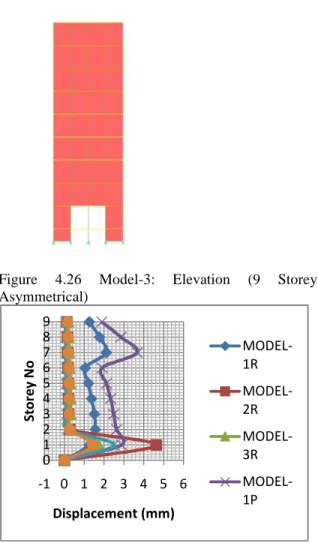
Figure 4.26 Model-3: Elevation (9 Storey-Asymmetrical)
SUMMARY AND CONCLUSIONS General
The present work attempts to study the seismic response of hypothetical symmetric and asymmetric RC building located in seismic zone – III. In this study all important components of the building that influence the mass, strength, stiffness
and deformability of the structure are included in the analytical model. To study the effect of infill on symmetric and asymmetric building models, the infill wall is positioned at various locations. The deflection at different storey levels and storey drifts are compared by performing response spectrum method as well as pushover method of analysis. The seismic performance level of the building models are obtained by performing nonlinear pushover analysis. The study leads to the following broad conclusions:
Conclusion
1) Fundamental natural period of the structure decreases when effect of infill wall is considered. 2) Storey drifts of the structure are found within the limit as specified by code (IS: 1893-2002, part-1) in both linear dynamic and nonlinear static analysis. 3) Base shear and displacement at first hinge are less in asymmetric building compared to symmetric buildings.
4) The presence of masonry infill influences the overall behavior of structures when subjected to lateral forces. Joint displacements and storey drifts are considerably reduced while contribution of the infill brick wall is taken into account.
5) Ductility ratio is maximum for bare frame structures and it gets reduced when the effect of infill wall is considered. It indicates that bare frame structures will shows adequate warning before collapse.
6) Bare frame structures are having highest response reduction factor as compared to the infill frame structures. It indicates that bare frame structures are capable of resisting the forces still after first hinge formation.
Scope for Further Study
The problems related to building on sloping ground can be further studied for following additional considerations:
(a) The foundation effects and soil-structure interaction.
(b) Non-linear time history analysis.
(c) By providing Shear wall at ground storey level. Summary
In this chapter, the conclusions drawn from the present study are given. Also the scope for further investigation based on the present study was discussed.
REFERENCE
1. Agarwal.P. and Shrikhande. M., 2006 “Earthquake Resistant Design of Structures” Prentice-Hall of India Private Limited, New Delhi, India.
0 1 2 3 4 5 6 7 8 9
-1 0 1 2 3 4 5 6
St
or
ey
N
o
Displacement (mm)
2. Arlekar N.J., Jain K.S., and Murthy C.V.R, 1997 “Seismic Response of RC Frame Buildings with Soft First Storeys” Proceedings of the CBRL Golden Jubilee Conference on Natural Hazards in Urban Habitat, New Delhi.
3. Applied Technology Council, 1996: “Seismic Evaluation and Retrofit of Concrete Buildings”, ATC-40, Volume 1.
4. Brick infills in RC frames: “E-Conference Proceeding”, January 28, 2002.
5. IS: 1893 (Part-I)– 2002 “Criteria for Earthquake Resistant Design of Structures”, Part 1 – General provisions and buildings, fifth revision, Bureau of Indian Standards, New Delhi.
6. Krawinkler H. and Seneviratna G.D.P.K, 1998: “Pros and Cons of Pushover Analysis of Seismic Performance Evaluation”.
7. Kanitkar R. and Kanitkar V., 2004 “Seismic Performance of Conventional Multi-storey Buildings with open ground storey for Vehicular Parking”, Indian Concrete Journal.
8. Lee H.S. and Woo W.S., 2001 “Effect of Masonry infills on Seismic Performance of a 3 Storey RC Frame with non-seismic Detailing”, John Wiley & Sons, Ltd.
9. Murthy C.V.R. and Jain S.K., 2000 “The Beneficial Influence of Masonry Infill Walls on the Seismic Performance of RC Framed Buildings”, Indian Institute of Technology, Kanpur, 12th World Conference on Earthquake Engineering, Auckland, New Zealand.
10. Naik. Pramodini, Dyavanal S.S., and Annigeri. S.A., 2006 “Performance Evaluation of Multistoreyed Buildings Subjected to Earthquake Forces”, Proceedings of National Conference on Earthquake Analysis and Design of Structures. 11.Ravi Sinha et al: “Earthquake Resistant Capacity of Reinforced Concrete Frame Buildings”, Technical Project Report Volume 2, Indian Institute of Technology, Bombay.
12. Gupta A, Krawinkler H. “Estimation of seismic drift demands for frame structures.” Earthquake 13.Gupta B, Kunnath SK. 2000 “Adaptive spectra -based pushover procedure for seismic evaluation of structures.” Earthquake Spectra.
14.Chopra AK, Goel RK. 2001 “A modal pushover analysis procedure to estimate seismic demands for Buildings: theory and preliminary evaluation.” PEER Report 2001/03, Pacific Earthquake
15.Chopra AK, Goel RK. 2002 “A modal pushover analysis procedure for estimating seismic demands for buildings.” Earthquake Engineering Structural Dynamics.
16.Miranda E, Garcia JR. 2002 “Evaluation of approximate methods to estimate maximum inelastic displacement demands.” Earthquake Engineering Structural Dynamics.
17.Farrow KT, Kurama YC., 2003 “SDOF demand index relationships for performance-based seismic design.” Earthquake Spectra.
18. FEMA-273. “NEHRP guidelines for the seismic rehabilitation of buildings.” Federal Emergency Management Agency, Washington DC, 1997. 19. FEMA-356. “Prestandard and commentary for the seismic rehabilitation of buildings.” Federal Emergency Management Agency, Washington DC, 2000.
20.Naeim F (Ed)., 2001 “The seismic design handbook.” Chapter 15. Kluwer Academic Publishers, MA.
21. 1997 Uniform Building Code. International Conference of Building Officials, CA, 1997.
22. 2003 International Building Code. International Code Council, Inc, 2002.
23. SAP2000 nonlinear version 12. Computers and Structures, Inc, CA.